SEMINAR
ON
MATERIAL MANAGEMENT
Mrs. Harpreet Kaur,
MSc Nursing 2nd Year
NIMS College of Nursing
NIMS University, Jaipur
Definition
1) ACCORDING TO N. K. NAPIR:-
Material management is the integrated
functioning of purchasing and allied
activities so as to achieve the maximum
co-ordination and optimum expenditure
in the area of materials.
DEFINITION:-
.
2) According to Thomas F. Wallace and John R.
Dougherty :-
Material management is a scientific technique,
concerned with planning ,organizing and control of
flow of materials, from their initial purchase to
destination.
DEFINITION
.
3) Material management is
concerned with providing the
drugs, supplies and equipment
needed by health personnel to
deliver health services.
DEFINITION
Objectives
To reduce cost of material
Ensure a good support with
suppliers(vendors)
Effective and efficient handling of
materials at all stages and in all
sections.
OBJECTIVES……
Maintaining continuous
supply
New material & products
Standardization
Product improvement
Aims of Material Management :-
To get
• The right quality
• Right quantity of supplies
• At the right time
• At the right place
• For the right cost.
PURPOSES :-
 To carry reserve stock to avoid stock out.
 To stabilize fluctuations in consumption
 Increase efficiency of health care systems.
 Develop knowledge and skills of health
care .
Basic Principles of material
Management :-
Effective management and supervision; it deals on
material functions of ;planning, organizing, staffing,
controlling, report and budgeting.
Sound purchasing method
Effective purchase system
Should be simple
Simple inventory control program.
Functions of Material Management :-
Material planning & budgeting
Purchasing
Inventor control
Cost reduction
Value analysis
Receiving & inspection
Stocking & distribution
PROCEDURE:-
Good material managers adopt the
following procedures:
Taking inventory regularly and
systematically .
Requisitioning at indenting
according to actual needs .
PROCEDURE:-
Receiving and inspecting incoming
items
Storing and protecting items
Issuing items for use
Proper use of items.
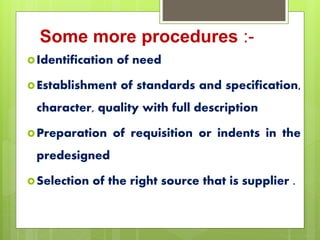
Some more procedures :-
Identification of need
Establishment of standards and specification,
character, quality with full description
Preparation of requisition or indents in the
predesigned
Selection of the right source that is supplier .
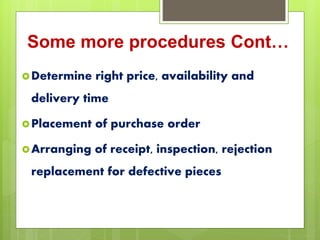
Some more procedures Cont…
Determine right price, availability and
delivery time
Placement of purchase order
Arranging of receipt, inspection, rejection
replacement for defective pieces
Some more procedures :-
Payment of bills
Maintenance of record.
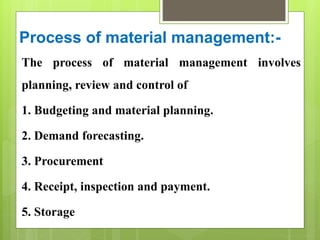
Process of material management:-
The process of material management involves
planning, review and control of
1. Budgeting and material planning.
2. Demand forecasting.
3. Procurement
4. Receipt, inspection and payment.
5. Storage
Continue…….
6. Inventory control.
7. Issue and distribution.
8. Usage.
9. Maintenance.
10. Disposal & condemnation.
11. Collusions
12. Pilferage.
1.BUDGETING AND MATERIAL
PLANNING:
Based on the data of past levels of
performance and on plans, capital
equipment, supplies to be procured during
the year ahead can be projected department
wise. This is the materials budget which
should be prepared annually. At periodic
intervals carryout a budgetary appraisals.
BUDGETING AND MATERIAL
PLANNING:
Important in budgetary control and
reduction of material cost is the concept
of standardisation. This involves
grouping together similar items
depending on their use so as to choose
one of these more universally acceptable
for the purpose.
BUDGETING AND MATERIAL
PLANNING: -
In a hospital standardisation is possible
through preference for ISI approved
items, choice of equipment and
furniture build with standard and easily
available component.
BUDGETING AND MATERIAL
PLANNING:
Related to standardization is the technique
of value analysis, which examines all the
facts of the function and cost of a product /
item in use, in order to determine whether
the cost can be reduced while retaining
quality of the product / item.
2. DEMAND FORECASTING:-
Estimation of right amount of each material is the
most crucial factor for maximising availability with
minimum wastage. Materials in a hospital may be
requisitioned : For an urgent / immediate use on a
one – time basis or repeatedly and continuously to
replenish the stock ; As a single unit or a bulk
requirement.
Continue…..
The greater the crisis situation and
immediate need for the item and the smaller
the quantity required, the greater will be the
procurement price and the incidental cost of
purchase. Bulk price can be affected with
maximum price discounts through demand
forecasting.
Methods of forecasting:
Demand estimation or forecasting is
done by various methods which includes
1. Last period demand
2. Arithmetic average
3. Moving average
METHODS CONTINUE….
1. Last period demand: Forecasting for the next
period is done on the basis of the level of demand
that occurred in the previous period (last year‟s
demand is considered)
2. Arithmetic average: average of all past demands
is taken for forecasting demand. Arithmetic means
found out by averaging out over a time period.
METHODS CONTINUE….
3. Moving average:
The moving average method is the one used more
widely. A moving average strictly corresponds to the
middle of the time over which it is calculated. It
serves as a forecast of the immediate next period in
the time serves, there is a time / lag equivalent to
half the time/span.
MOVING AVERAGE CONTINUE…
When a moving average is taken to
forecast demand, which is showing an
upward trend, it will lag behind actual
demand, and give consistently low
estimates. The reverse occurs when the
trend is downward.
MOVING AVERAGE….
Forecasting for the next period is
generated by averaging the actual
demand for the last „n‟ time periods.
The value of the „n‟ can be two or three
period moving average (last 2-3 years
demands are taken into consideration).
MOVING AVERAGE ….
A moving average, which uses a large
time span, will effectively neutralize the
sudden temporary surges in demand.
However the greater time span, the
greater will be the time/lag resulting in a
greater error of forecast.
MOVING AVERAGE….
A very short time span will be sensitive only
to recent demand values, which may be
biased because of short term random
fluctuations. The choice of a time span is
therefore done on the basis of the experience
and review has to how closely the forecast
correspond with actual demand values.
3. PROCUREMENT
Most organizations have a detailed set of
rules and regulations regarding the
procedure for ordering for materials. An
effective procurement system aims at
purchasing of items of acceptable quality, in
appropriate quantities, at the minimum price
and within the available time.
PROCUREMENT
Purchases may be made by the individual
department of the hospitals or by a single purchase
department. Centralised purchasing has the
advantages in that quantity discounts are possible
because of standardization and bulk orders. There
is better management control as all aspects of
purchase can be screened by the administration.
PROCUREMENT
A group of hospitals having common
interest (e.g. locates in the same
region), may also get together and
constitute an agency to effect bulk
purchases on their behalf.
Objectives of procurement system
Acquire needed supplies as inexpensively
as possible
 Obtain high quality supplies
Distribute the procurement workload to
avoid period of idleness and overwork .
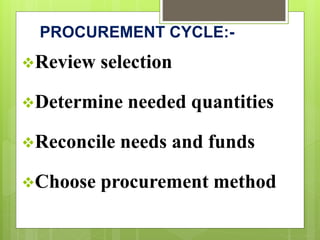
PROCUREMENT CYCLE:-
Review selection
Determine needed quantities
Reconcile needs and funds
Choose procurement method
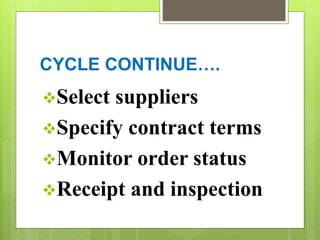
CYCLE CONTINUE….
Select suppliers
Specify contract terms
Monitor order status
Receipt and inspection
Methods in Procurement Process :-
Ø Open tender
Public bidding, resulting in low prices
Published in newspapers
Technical bid (Offer)
Financial bid
Ø Restricted or limited tender
From limited suppliers (about 10)
Lead-time is reduced
Better quality
Methods in Procurement Process :-
Ø Negotiated procurement
Buyer approaches selected potential Suppliers and
bargain directly
Fix at a rate acceptable to both parties
Used in long time supply contracts
Ø Direct procurement
Purchased from single supplier, at his quoted price
Prices may be high
Methods in Procurement Process :-
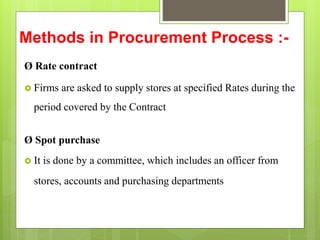
Ø Rate contract
 Firms are asked to supply stores at specified Rates during the
period covered by the Contract
Ø Spot purchase
 It is done by a committee, which includes an officer from
stores, accounts and purchasing departments
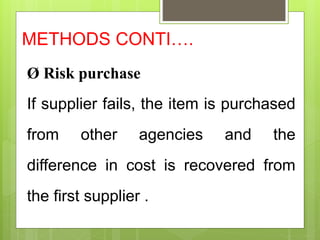
METHODS CONTI….
Ø Risk purchase
If supplier fails, the item is purchased
from other agencies and the
difference in cost is recovered from
the first supplier .
METHODS….
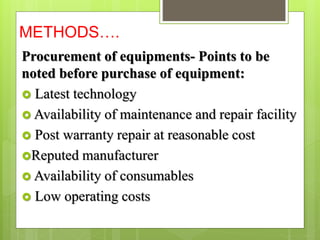
Procurement of equipments- Points to be
noted before purchase of equipment:
 Latest technology
 Availability of maintenance and repair facility
 Post warranty repair at reasonable cost
Reputed manufacturer
 Availability of consumables
 Low operating costs
METHODS….
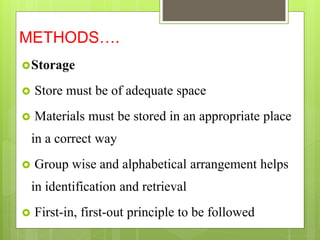
Storage
 Store must be of adequate space
 Materials must be stored in an appropriate place
in a correct way
 Group wise and alphabetical arrangement helps
in identification and retrieval
 First-in, first-out principle to be followed
METHODS….
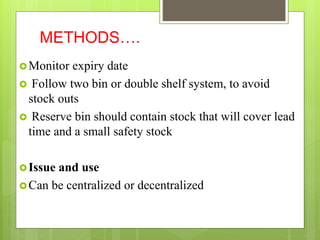
Monitor expiry date
 Follow two bin or double shelf system, to avoid
stock outs
 Reserve bin should contain stock that will cover lead
time and a small safety stock
Issue and use
Can be centralized or decentralized
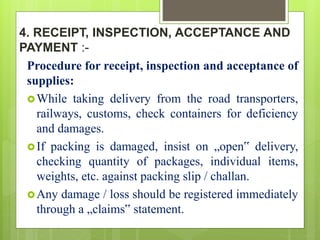
4. RECEIPT, INSPECTION, ACCEPTANCE AND
PAYMENT :-
Procedure for receipt, inspection and acceptance of
supplies:
While taking delivery from the road transporters,
railways, customs, check containers for deficiency
and damages.
If packing is damaged, insist on „open‟ delivery,
checking quantity of packages, individual items,
weights, etc. against packing slip / challan.
Any damage / loss should be registered immediately
through a „claims‟ statement.
RECEIPT, INSPECTION CONT…..:-
Cross check with purchase order
On receipt of the hospital checks supplies for
discrepancies in quantity, quality, product
specifications etc.
Record shortages, incorrect damaged
material, out dated supply and take action
accordingly.
RECEIPT, INSPECTION CONT…..:-
Carry out all necessary documentation,
day book of receipt, goods inward note,
purchase register and bin card.
Notify indenters of special purchase
requisition regarding arrival of materials.
RECEIPT, INSPECTION CONT…..:-
Procedure for payment:
 On accepting the goods and certifying correctness,
send the bills to the accounts department for
payment. Before releasing payment, the account
department should ensure that the bills bears proof of
receipts of goods, certification of acceptance and
completion of purchase documentation.
5. STORAGE
Storage and Preservation are an important part of
the storekeeping function. When materials remain
idle in the store these materials should be taken
care of and looked after properly. Otherwise these
materials may get perished due to natural chemical
reaction like rusting by moisture, melting by heat
etc and also may get affected by insets, rats etc.
STORAGE….
The department stores should be
conveniently located to facilitate easy receipt
of materials from suppliers and easy
dispatch of supplies to the wards and
departments. The materials should be
adequately protected from fire, pests, water
sewage etc.
STORAGE CONT…..
Actions to protect the materials from various
adverse effects: -
1. Store must be of adequate space.
2. Divide the store in to homogenous sections
with separate areas mark for different groups of
items e.g. stationary, furniture etc
3. No material should be stocked on the floor as
it may be affected by dampness, white ants etc.
STORAGE CONT…..
4. Categorize items in a group based on their generic name/
application, store similar items contiguously. Eg :
a. Stationery, Electrical, Civil Engineering, Cleaning and
Similar items may be stocked in the steel racks.
b. Medicine items may be stocked in the fridge.
c. Perishable items may be stored in the cold rooms.
d. Explosive, film, and fuse items may be stored in the AC
room.
e. Attractive items may be stored in shelves under lock and
keys.
STORAGE CONT…..
5. Keep heavy items as low and as near to the door as possible
for easy retrieval. Light items may be placed on top shelves
6. Daily and periodical cleaning should be carried out.
7. Daily and periodical verification of stock should be carried out
to ensure correctness of stock.
8. Proper method of handling should be followed to avoid
damages to the materials.
9. Preservation materials should be applied to protect the items.
STORAGE CONT…..
10. Hazardous materials should be segregated and stocked
in a separate store house away from other store houses.
11. Safety precautions should be taken and safety
appliances should be provided.
12. First-in, first-out principle to be followed
13. Follow two bin or double shelf system, to avoid Stock
outs
14. Reserve bin should contain stock that will cover lead
time and a small safety stock
6. INVENTORY CONTROL:-
It is the process of having the necessary
equipment and supplies available at the
appropriate time. It means stocking adequate
number and kind of stores, so that the
materials are available whenever required
and wherever required. Scientific inventory
control results in optimal balance .
INVENTORY :-
Functions of inventory control To
provide maximum supply service,
consistent with maximum efficiency and
optimum investment. To provide cushion
between forecasted and actual demand for
a material .
7. ISSUE / DISTRIBUTION:-
Items held in inventory by the stores may be issued through
indents to user department on a periodical basis or as and
when necessary. Systems of stocks replenishment(to fill) to
wards are of following types
a) Requisition or Drug basket system:- At definite
intervals when departmental stock level gets low, a
requisition is prepared for replenishing the stock and sent
to stores. The stores then issue items in compliance with
the requisition.
ISSUE / DISTRIBUTION:-
b)Topping up systems: The maximum
stock level for each ward is
predetermined on the basis of usage
and frequency of replenishment. This
departmental stock is stored in an
assigned location.
ISSUE CONT…
c) Exchange cart systems:- This system is
similar to the par level system in that there are
predetermined maximum stock levels and
predetermined intervals for stock restoration. At
predetermined intervals the full cart from the
stores is taken to the user area and exchanged
for the depleted cart.
8] USAGE:
Every effort must be made at all levels in the
organisation to utilize supplies in order to avoid
any form of wastage. Monitoring of consumption
should be effected through monthly supply usage
reports to work which summarize items consumed
department wise. Material cost can also be
decreased by appropriate selection of materials,
cheaper substitutes and standardization of
supplies.
9] MAINTENANCE:
Proper maintenance of equipment, furniture, and
fixtures not only ensure their almost continuous
availability for use but also an extended life and
productivity for the items, thus resulting in lower
material costs. Time and costs of maintenance can
be reduced by consideration of following factors
during purchase :-
MAINTENANCE:-
A] Durability:- Since the equipment will be
handled by multiple users provide for an
element of over specification so that the
item is more sturdy than that available for
single person use in the home
environment.
MAINTENANCE:-
B] Periodical disinfections: The
external surface of the items should be
washable and it should provide for
sterilization by moist heat, formalin
vapour, spirit or other disinfectants
MAINTENANCE CONT…..
C] Repair ability:- Go for items which are
more easily repairable.
D] Spare parts availability:-
Standardization of items and choosing
those easily available in the market
ensures easy availability of spare parts
required for repair and mainaintence.
MAINTENANCE CONT…..
E] Operation and service manuals:
When purchasing sophisticated
equipment it is essential to obtain the
operating and service manuals so that
repairs can be attended to by the
hospital maintenance department
without relying on the supplier.
MAINTENANCE CONT…..
F] Service contracts:- Better terms for
service are possible by negotiating
service contracts for maintenance prior
to purchase of the equipment. Such
contracts should specify minimum
number of preventive maintenance over
hard schedules, service charges etc.
MAINTENANCE CONT…..
G] Stand by units: Since the hospital
work must carry on even when the
equipment is down, wherever possible
it is necessary to provide for
replacements to tide over the period of
repair .
10] DISPOSAL/ CONDEMNATION:
Indents are often improperly examined and
unofficial inventory builds up in wards /
departments because of hoarding of supplies.
Thus the nursing supervisors should
periodically inspect the stocks attached to
each ward and arrange for return of excess
stock/equipment.
DISPOSAL CONT….
Each hospital should also have a condemnation to
review used materials that are to be disposed off.
At times it is possible to recycle or reuse materials
or find some other use for the item. If no further
use can be found for disposables, used consumables
and damaged equipments, it may still have value as
scrap.
11] COLLUSION:
Frauds involving buyer vendor collusion can
account for a significant percentage of avoidable
materials costs. For commission either in cash or
kind purchase personnel may compromise the
interests of the hospital. The vendor finances such
payment by infiltrating the price, overstating the
quantity or through fraudulent payments.
COLLUSION:-
Such frauds can be prevented by
intensive internal audit and by involving
two or more departments or persons in
purchase transactions. It is for this
purchase that many hospitals set up
separate departments for purchase and
for stores.
12] PILFERAGE:
Theft is not common. Items may be
pilfered by the transporters, receiver,
stores personnel or the users. Control of
hospital theft is possible with intensive
vigilance.
Material management

Material management

  • 1.
    SEMINAR ON MATERIAL MANAGEMENT Mrs. HarpreetKaur, MSc Nursing 2nd Year NIMS College of Nursing NIMS University, Jaipur
  • 2.
    Definition 1) ACCORDING TON. K. NAPIR:- Material management is the integrated functioning of purchasing and allied activities so as to achieve the maximum co-ordination and optimum expenditure in the area of materials. DEFINITION:-
  • 3.
    . 2) According toThomas F. Wallace and John R. Dougherty :- Material management is a scientific technique, concerned with planning ,organizing and control of flow of materials, from their initial purchase to destination. DEFINITION
  • 4.
    . 3) Material managementis concerned with providing the drugs, supplies and equipment needed by health personnel to deliver health services. DEFINITION
  • 5.
    Objectives To reduce costof material Ensure a good support with suppliers(vendors) Effective and efficient handling of materials at all stages and in all sections.
  • 6.
    OBJECTIVES…… Maintaining continuous supply New material& products Standardization Product improvement
  • 7.
    Aims of MaterialManagement :- To get • The right quality • Right quantity of supplies • At the right time • At the right place • For the right cost.
  • 8.
    PURPOSES :-  Tocarry reserve stock to avoid stock out.  To stabilize fluctuations in consumption  Increase efficiency of health care systems.  Develop knowledge and skills of health care .
  • 9.
    Basic Principles ofmaterial Management :- Effective management and supervision; it deals on material functions of ;planning, organizing, staffing, controlling, report and budgeting. Sound purchasing method Effective purchase system Should be simple Simple inventory control program.
  • 10.
    Functions of MaterialManagement :- Material planning & budgeting Purchasing Inventor control Cost reduction Value analysis Receiving & inspection Stocking & distribution
  • 11.
    PROCEDURE:- Good material managersadopt the following procedures: Taking inventory regularly and systematically . Requisitioning at indenting according to actual needs .
  • 12.
    PROCEDURE:- Receiving and inspectingincoming items Storing and protecting items Issuing items for use Proper use of items.
  • 13.
    Some more procedures:- Identification of need Establishment of standards and specification, character, quality with full description Preparation of requisition or indents in the predesigned Selection of the right source that is supplier .
  • 14.
    Some more proceduresCont… Determine right price, availability and delivery time Placement of purchase order Arranging of receipt, inspection, rejection replacement for defective pieces
  • 15.
    Some more procedures:- Payment of bills Maintenance of record.
  • 16.
    Process of materialmanagement:- The process of material management involves planning, review and control of 1. Budgeting and material planning. 2. Demand forecasting. 3. Procurement 4. Receipt, inspection and payment. 5. Storage
  • 17.
    Continue……. 6. Inventory control. 7.Issue and distribution. 8. Usage. 9. Maintenance. 10. Disposal & condemnation. 11. Collusions 12. Pilferage.
  • 18.
    1.BUDGETING AND MATERIAL PLANNING: Basedon the data of past levels of performance and on plans, capital equipment, supplies to be procured during the year ahead can be projected department wise. This is the materials budget which should be prepared annually. At periodic intervals carryout a budgetary appraisals.
  • 19.
    BUDGETING AND MATERIAL PLANNING: Importantin budgetary control and reduction of material cost is the concept of standardisation. This involves grouping together similar items depending on their use so as to choose one of these more universally acceptable for the purpose.
  • 20.
    BUDGETING AND MATERIAL PLANNING:- In a hospital standardisation is possible through preference for ISI approved items, choice of equipment and furniture build with standard and easily available component.
  • 21.
    BUDGETING AND MATERIAL PLANNING: Relatedto standardization is the technique of value analysis, which examines all the facts of the function and cost of a product / item in use, in order to determine whether the cost can be reduced while retaining quality of the product / item.
  • 22.
    2. DEMAND FORECASTING:- Estimationof right amount of each material is the most crucial factor for maximising availability with minimum wastage. Materials in a hospital may be requisitioned : For an urgent / immediate use on a one – time basis or repeatedly and continuously to replenish the stock ; As a single unit or a bulk requirement.
  • 23.
    Continue….. The greater thecrisis situation and immediate need for the item and the smaller the quantity required, the greater will be the procurement price and the incidental cost of purchase. Bulk price can be affected with maximum price discounts through demand forecasting.
  • 24.
    Methods of forecasting: Demandestimation or forecasting is done by various methods which includes 1. Last period demand 2. Arithmetic average 3. Moving average
  • 25.
    METHODS CONTINUE…. 1. Lastperiod demand: Forecasting for the next period is done on the basis of the level of demand that occurred in the previous period (last year‟s demand is considered) 2. Arithmetic average: average of all past demands is taken for forecasting demand. Arithmetic means found out by averaging out over a time period.
  • 26.
    METHODS CONTINUE…. 3. Movingaverage: The moving average method is the one used more widely. A moving average strictly corresponds to the middle of the time over which it is calculated. It serves as a forecast of the immediate next period in the time serves, there is a time / lag equivalent to half the time/span.
  • 27.
    MOVING AVERAGE CONTINUE… Whena moving average is taken to forecast demand, which is showing an upward trend, it will lag behind actual demand, and give consistently low estimates. The reverse occurs when the trend is downward.
  • 28.
    MOVING AVERAGE…. Forecasting forthe next period is generated by averaging the actual demand for the last „n‟ time periods. The value of the „n‟ can be two or three period moving average (last 2-3 years demands are taken into consideration).
  • 29.
    MOVING AVERAGE …. Amoving average, which uses a large time span, will effectively neutralize the sudden temporary surges in demand. However the greater time span, the greater will be the time/lag resulting in a greater error of forecast.
  • 30.
    MOVING AVERAGE…. A veryshort time span will be sensitive only to recent demand values, which may be biased because of short term random fluctuations. The choice of a time span is therefore done on the basis of the experience and review has to how closely the forecast correspond with actual demand values.
  • 31.
    3. PROCUREMENT Most organizationshave a detailed set of rules and regulations regarding the procedure for ordering for materials. An effective procurement system aims at purchasing of items of acceptable quality, in appropriate quantities, at the minimum price and within the available time.
  • 32.
    PROCUREMENT Purchases may bemade by the individual department of the hospitals or by a single purchase department. Centralised purchasing has the advantages in that quantity discounts are possible because of standardization and bulk orders. There is better management control as all aspects of purchase can be screened by the administration.
  • 33.
    PROCUREMENT A group ofhospitals having common interest (e.g. locates in the same region), may also get together and constitute an agency to effect bulk purchases on their behalf.
  • 34.
    Objectives of procurementsystem Acquire needed supplies as inexpensively as possible  Obtain high quality supplies Distribute the procurement workload to avoid period of idleness and overwork .
  • 35.
    PROCUREMENT CYCLE:- Review selection Determineneeded quantities Reconcile needs and funds Choose procurement method
  • 36.
    CYCLE CONTINUE…. Select suppliers Specifycontract terms Monitor order status Receipt and inspection
  • 37.
    Methods in ProcurementProcess :- Ø Open tender Public bidding, resulting in low prices Published in newspapers Technical bid (Offer) Financial bid Ø Restricted or limited tender From limited suppliers (about 10) Lead-time is reduced Better quality
  • 38.
    Methods in ProcurementProcess :- Ø Negotiated procurement Buyer approaches selected potential Suppliers and bargain directly Fix at a rate acceptable to both parties Used in long time supply contracts Ø Direct procurement Purchased from single supplier, at his quoted price Prices may be high
  • 39.
    Methods in ProcurementProcess :- Ø Rate contract  Firms are asked to supply stores at specified Rates during the period covered by the Contract Ø Spot purchase  It is done by a committee, which includes an officer from stores, accounts and purchasing departments
  • 40.
    METHODS CONTI…. Ø Riskpurchase If supplier fails, the item is purchased from other agencies and the difference in cost is recovered from the first supplier .
  • 41.
    METHODS…. Procurement of equipments-Points to be noted before purchase of equipment:  Latest technology  Availability of maintenance and repair facility  Post warranty repair at reasonable cost Reputed manufacturer  Availability of consumables  Low operating costs
  • 42.
    METHODS…. Storage  Store mustbe of adequate space  Materials must be stored in an appropriate place in a correct way  Group wise and alphabetical arrangement helps in identification and retrieval  First-in, first-out principle to be followed
  • 43.
    METHODS…. Monitor expiry date Follow two bin or double shelf system, to avoid stock outs  Reserve bin should contain stock that will cover lead time and a small safety stock Issue and use Can be centralized or decentralized
  • 44.
    4. RECEIPT, INSPECTION,ACCEPTANCE AND PAYMENT :- Procedure for receipt, inspection and acceptance of supplies: While taking delivery from the road transporters, railways, customs, check containers for deficiency and damages. If packing is damaged, insist on „open‟ delivery, checking quantity of packages, individual items, weights, etc. against packing slip / challan. Any damage / loss should be registered immediately through a „claims‟ statement.
  • 45.
    RECEIPT, INSPECTION CONT…..:- Crosscheck with purchase order On receipt of the hospital checks supplies for discrepancies in quantity, quality, product specifications etc. Record shortages, incorrect damaged material, out dated supply and take action accordingly.
  • 46.
    RECEIPT, INSPECTION CONT…..:- Carryout all necessary documentation, day book of receipt, goods inward note, purchase register and bin card. Notify indenters of special purchase requisition regarding arrival of materials.
  • 47.
    RECEIPT, INSPECTION CONT…..:- Procedurefor payment:  On accepting the goods and certifying correctness, send the bills to the accounts department for payment. Before releasing payment, the account department should ensure that the bills bears proof of receipts of goods, certification of acceptance and completion of purchase documentation.
  • 48.
    5. STORAGE Storage andPreservation are an important part of the storekeeping function. When materials remain idle in the store these materials should be taken care of and looked after properly. Otherwise these materials may get perished due to natural chemical reaction like rusting by moisture, melting by heat etc and also may get affected by insets, rats etc.
  • 49.
    STORAGE…. The department storesshould be conveniently located to facilitate easy receipt of materials from suppliers and easy dispatch of supplies to the wards and departments. The materials should be adequately protected from fire, pests, water sewage etc.
  • 50.
    STORAGE CONT….. Actions toprotect the materials from various adverse effects: - 1. Store must be of adequate space. 2. Divide the store in to homogenous sections with separate areas mark for different groups of items e.g. stationary, furniture etc 3. No material should be stocked on the floor as it may be affected by dampness, white ants etc.
  • 51.
    STORAGE CONT….. 4. Categorizeitems in a group based on their generic name/ application, store similar items contiguously. Eg : a. Stationery, Electrical, Civil Engineering, Cleaning and Similar items may be stocked in the steel racks. b. Medicine items may be stocked in the fridge. c. Perishable items may be stored in the cold rooms. d. Explosive, film, and fuse items may be stored in the AC room. e. Attractive items may be stored in shelves under lock and keys.
  • 52.
    STORAGE CONT….. 5. Keepheavy items as low and as near to the door as possible for easy retrieval. Light items may be placed on top shelves 6. Daily and periodical cleaning should be carried out. 7. Daily and periodical verification of stock should be carried out to ensure correctness of stock. 8. Proper method of handling should be followed to avoid damages to the materials. 9. Preservation materials should be applied to protect the items.
  • 53.
    STORAGE CONT….. 10. Hazardousmaterials should be segregated and stocked in a separate store house away from other store houses. 11. Safety precautions should be taken and safety appliances should be provided. 12. First-in, first-out principle to be followed 13. Follow two bin or double shelf system, to avoid Stock outs 14. Reserve bin should contain stock that will cover lead time and a small safety stock
  • 54.
    6. INVENTORY CONTROL:- Itis the process of having the necessary equipment and supplies available at the appropriate time. It means stocking adequate number and kind of stores, so that the materials are available whenever required and wherever required. Scientific inventory control results in optimal balance .
  • 55.
    INVENTORY :- Functions ofinventory control To provide maximum supply service, consistent with maximum efficiency and optimum investment. To provide cushion between forecasted and actual demand for a material .
  • 56.
    7. ISSUE /DISTRIBUTION:- Items held in inventory by the stores may be issued through indents to user department on a periodical basis or as and when necessary. Systems of stocks replenishment(to fill) to wards are of following types a) Requisition or Drug basket system:- At definite intervals when departmental stock level gets low, a requisition is prepared for replenishing the stock and sent to stores. The stores then issue items in compliance with the requisition.
  • 57.
    ISSUE / DISTRIBUTION:- b)Toppingup systems: The maximum stock level for each ward is predetermined on the basis of usage and frequency of replenishment. This departmental stock is stored in an assigned location.
  • 58.
    ISSUE CONT… c) Exchangecart systems:- This system is similar to the par level system in that there are predetermined maximum stock levels and predetermined intervals for stock restoration. At predetermined intervals the full cart from the stores is taken to the user area and exchanged for the depleted cart.
  • 59.
    8] USAGE: Every effortmust be made at all levels in the organisation to utilize supplies in order to avoid any form of wastage. Monitoring of consumption should be effected through monthly supply usage reports to work which summarize items consumed department wise. Material cost can also be decreased by appropriate selection of materials, cheaper substitutes and standardization of supplies.
  • 60.
    9] MAINTENANCE: Proper maintenanceof equipment, furniture, and fixtures not only ensure their almost continuous availability for use but also an extended life and productivity for the items, thus resulting in lower material costs. Time and costs of maintenance can be reduced by consideration of following factors during purchase :-
  • 61.
    MAINTENANCE:- A] Durability:- Sincethe equipment will be handled by multiple users provide for an element of over specification so that the item is more sturdy than that available for single person use in the home environment.
  • 62.
    MAINTENANCE:- B] Periodical disinfections:The external surface of the items should be washable and it should provide for sterilization by moist heat, formalin vapour, spirit or other disinfectants
  • 63.
    MAINTENANCE CONT….. C] Repairability:- Go for items which are more easily repairable. D] Spare parts availability:- Standardization of items and choosing those easily available in the market ensures easy availability of spare parts required for repair and mainaintence.
  • 64.
    MAINTENANCE CONT….. E] Operationand service manuals: When purchasing sophisticated equipment it is essential to obtain the operating and service manuals so that repairs can be attended to by the hospital maintenance department without relying on the supplier.
  • 65.
    MAINTENANCE CONT….. F] Servicecontracts:- Better terms for service are possible by negotiating service contracts for maintenance prior to purchase of the equipment. Such contracts should specify minimum number of preventive maintenance over hard schedules, service charges etc.
  • 66.
    MAINTENANCE CONT….. G] Standby units: Since the hospital work must carry on even when the equipment is down, wherever possible it is necessary to provide for replacements to tide over the period of repair .
  • 67.
    10] DISPOSAL/ CONDEMNATION: Indentsare often improperly examined and unofficial inventory builds up in wards / departments because of hoarding of supplies. Thus the nursing supervisors should periodically inspect the stocks attached to each ward and arrange for return of excess stock/equipment.
  • 68.
    DISPOSAL CONT…. Each hospitalshould also have a condemnation to review used materials that are to be disposed off. At times it is possible to recycle or reuse materials or find some other use for the item. If no further use can be found for disposables, used consumables and damaged equipments, it may still have value as scrap.
  • 69.
    11] COLLUSION: Frauds involvingbuyer vendor collusion can account for a significant percentage of avoidable materials costs. For commission either in cash or kind purchase personnel may compromise the interests of the hospital. The vendor finances such payment by infiltrating the price, overstating the quantity or through fraudulent payments.
  • 70.
    COLLUSION:- Such frauds canbe prevented by intensive internal audit and by involving two or more departments or persons in purchase transactions. It is for this purchase that many hospitals set up separate departments for purchase and for stores.
  • 71.
    12] PILFERAGE: Theft isnot common. Items may be pilfered by the transporters, receiver, stores personnel or the users. Control of hospital theft is possible with intensive vigilance.