Headline Verdana Bold
SIMPRE – SAP MM
Procurement Processes
Master Data
Nicolae Calota, Deloitte ERDC Bucharest
November, 2018
Procurement Processes & Master Data
Deloitte ERDC Bucharest 2
Definition
•Commercial software packages that promise the seamless integration of all information flowing through the company
– financial, accounting, human resources, supply chain and customer satisfaction (T.J. Davenport, 1988).
•ERP systems provide information management and analysis to organizations
Benefits
•Online/real time information throughout all the functional areas of an organization
•Data standardization and accuracy across the enterprise
•“best-practices” included in the applications
•The efficiency they force an organization to undertake
•The analysis and reporting that can be used for long term planning
Enterprise Resource Planning and its benefits
Overview of SAP as an ERP
Procurement Processes & Master Data
Deloitte ERDC Bucharest 3
• SAP
 Stands for “Systems, Applications and Products in Data Processing”
 Is a company founded in 1972 by five former IBM engineers
 SAP’s architecture is based on “3-tier” client-server technology (presentation server, application server and database
server)
• ABAP
 Stands for “Advanced Business Application Programming” language
 Is the proprietary programming language in which the SAP product is programmed and customization done
SAP as an ERP
Overview of SAP as an ERP
Procurement Processes & Master Data
Deloitte ERDC Bucharest 4
SAP as an ERP
Overview of SAP as an ERP
Procurement Processes & Master Data
Deloitte ERDC Bucharest 5
SAP as an ERP
Overview of SAP as an ERP
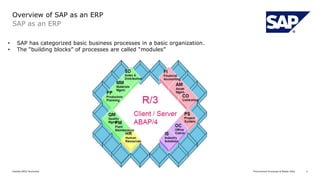
• SAP has categorized basic business processes in a basic organization.
• The “building blocks” of processes are called “modules”
Procurement Processes & Master Data
Deloitte ERDC Bucharest 6
Evolution of SAP products
Overview of SAP as an ERP
• Cross industry solutions and industry solutions
Procurement Processes & Master Data
Deloitte ERDC Bucharest 7
At the end of this course, you will have a clear understanding of the following principles:
SAP Standard Procurement Processes
Documents used in SAP Standard Procurement Processes
Master Data used in SAP Standard Procurement Processes
Course Objectives
Preface
Procurement Processes & Master Data
Deloitte ERDC Bucharest 8
Agenda
Topic Content Person responsible Timing
Procurement Processes • Defining Procurement Processes
• Organizational levels
Nicolae Calota 18:00 – 19:20
Maintaining Purchase Orders • Purchase Order Details
• Purchase Order Maintenance
Nicolae Calota 18:00 – 19:20
Posting Goods Receipt • Goods Receipt in Procurement
• Goods Receipt Details
Nicolae Calota 18:00 – 19:20
Entering Invoices • Invoice Receipt
• Invoice Entry
Nicolae Calota 18:00 – 19:20
Break
Maintaining Vendor Master Records • Master Data in Procurement Processes
• Vendor Master Data
Nicolae Calota 19:30 – 20:50
Maintaining Material Master Records • Material Master Record
• Material Master Record Creation
• Purchasing Info Record
Nicolae Calota 19:30 – 20:50
Procurement Processes & Master Data
Deloitte ERDC Bucharest 9
Procurement Processes
Procurement Processes & Master Data
Deloitte ERDC Bucharest 10
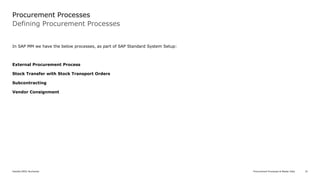
In SAP MM we have the below processes, as part of SAP Standard System Setup:
External Procurement Process
Stock Transfer with Stock Transport Orders
Subcontracting
Vendor Consignment
Defining Procurement Processes
Procurement Processes
Procurement Processes & Master Data
Deloitte ERDC Bucharest 11
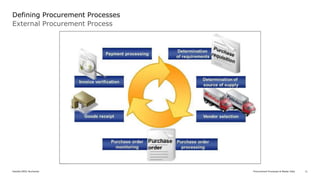
External Procurement Process
Defining Procurement Processes
Procurement Processes & Master Data
Deloitte ERDC Bucharest 12
Stock Transfer with Stock Transport Orders
Defining Procurement Processes
Procurement Processes & Master Data
Deloitte ERDC Bucharest 13
Subcontracting
Defining Procurement Processes
Procurement Processes & Master Data
Deloitte ERDC Bucharest 14
Vendor Consignment
Defining Procurement Processes
Procurement Processes & Master Data
Deloitte ERDC Bucharest 15
Organizational Levels
Client
• It is an organizational unit within logistics that subdivides an enterprise from the viewpoints of
production, procurement, plant maintenance, and materials planning
• The enterprise structure is created by assigning organizational units to each other.
• It is defined in the system by a four-character alphanumeric key that is unique to it in the client
Plant
• It is an organizational unit that facilitates the differentiation of stocks of materials within a plant
• Inventory management on a quantity basis is carried out in the plant at the storage location level
• It is defined by a unique 4 character alphanumeric key
Storage Location
• A unit within an SAP System that is self-contained both in legal and organizational terms
• It s the highest hierarchical level in the SAP System and is uniquely defined by a 3 digit numeric
key
• For example, the client could represent a Corporate Group
Company Code
• A company code represents an independent unit that produces its own financial statements
• It tracks the entry of all events that require posting to the accounts, and creates a complete audit
trail for balance sheets and profit and loss statements
• It is defined in the system by means of a 4 character alphanumeric key that is unique in the client
• The purchasing group is a key organizational unit for a buyer, or group of buyers, responsible for
certain purchasing activities
• A purchasing organization is an organizational unit within logistics that subdivides the enterprise
according to the purchasing requirements.
Purchasing Organization and
Purchasing Group
Procurement Processes & Master Data
Deloitte ERDC Bucharest 16
Example of Organizational Structure
Organizational Levels
Procurement Processes & Master Data
Deloitte ERDC Bucharest 17
Purchasing Organization categories
Organizational Levels
Plant-specific purchasing organization
Cross-plant purchasing organization
Cross-company code purchasing organization
Procurement Processes & Master Data
Deloitte ERDC Bucharest 18
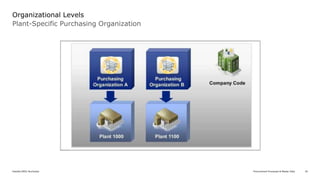
Plant-Specific Purchasing Organization
Organizational Levels
Procurement Processes & Master Data
Deloitte ERDC Bucharest 19
Cross-Plant Purchasing Organization
Organizational Levels
Procurement Processes & Master Data
Deloitte ERDC Bucharest 20
Cross-Company-Code Purchasing Organization
Organizational Levels
Procurement Processes & Master Data
Deloitte ERDC Bucharest 21
Maintaining Purchase Orders
Procurement Processes & Master Data
Deloitte ERDC Bucharest 22
Purchase Order Details
Maintaining Purchase Orders
Procurement Processes & Master Data
Deloitte ERDC Bucharest 23
Purchase Order Details
Maintaining Purchase Orders
Procurement Processes & Master Data
Deloitte ERDC Bucharest 24
Purchase Order Details
Maintaining Purchase Orders
Procurement Processes & Master Data
Deloitte ERDC Bucharest 25
Purchase Order Maintenance
Maintaining Purchase Orders
Procurement Processes & Master Data
Deloitte ERDC Bucharest 26
Purchase Order Maintenance
Maintaining Purchase Orders
Procurement Processes & Master Data
Deloitte ERDC Bucharest 27
Purchase Order Maintenance
Maintaining Purchase Orders
Procurement Processes & Master Data
Deloitte ERDC Bucharest 28
Posting Goods Receipt
Procurement Processes & Master Data
Deloitte ERDC Bucharest 29
Goods Receipt in Procurement
Posting Goods Receipt
Procurement Processes & Master Data
Deloitte ERDC Bucharest 30
Usual checks performed at the time of delivery:
• Was the right material delivered?
• Was the right quantity delivered?
• Are the perishable goods (if any) within their minimum
shelf life? (shelf-life expiration-date check must be
activated)
Goods Receipt in Procurement
Posting Goods Receipt
Procurement Processes & Master Data
Deloitte ERDC Bucharest 31
Goods Receipt Details
Posting Goods Receipt
Procurement Processes & Master Data
Deloitte ERDC Bucharest 32
Goods Receipt Details
Posting Goods Receipt
Procurement Processes & Master Data
Deloitte ERDC Bucharest 33
Entering Invoices
Procurement Processes & Master Data
Deloitte ERDC Bucharest 34
Invoice Receipt
Entering Invoices
Procurement Processes & Master Data
Deloitte ERDC Bucharest 35
Invoice Receipt
Entering Invoices
Procurement Processes & Master Data
Deloitte ERDC Bucharest 36
Invoice Receipt
Entering Invoices
Procurement Processes & Master Data
Deloitte ERDC Bucharest 37
Invoice Entry
Entering Invoices
Presentation title
[To edit, click View > Slide Master > Slide Master]
Member firms and DTTL: Insert appropriate copyright
[To edit, click View > Slide Master > Slide Master]
38
BREAK
Procurement Processes & Master Data
Deloitte ERDC Bucharest 39
Master Data
Procurement Processes & Master Data
Deloitte ERDC Bucharest 40
Master Data in Procurement Processes
Maintaining Vendor Master Records
Procurement Processes & Master Data
Deloitte ERDC Bucharest 41
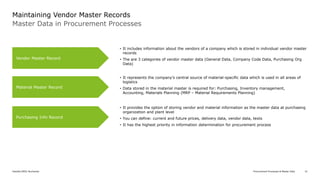
• It provides the option of storing vendor and material information as the master data at purchasing
organization and plant level
• You can define: current and future prices, delivery data, vendor data, texts
• It has the highest priority in information determination for procurement process
Purchasing Info Record
• It includes information about the vendors of a company which is stored in individual vendor master
records
• The are 3 categories of vendor master data (General Data, Company Code Data, Purchasing Org
Data)
Vendor Master Record
• It represents the company’s central source of material-specific data which is used in all areas of
logistics
• Data stored in the material master is required for: Purchasing, Inventory management,
Accounting, Materials Planning (MRP – Material Requirements Planning)
Material Master Record
Master Data in Procurement Processes
Maintaining Vendor Master Records
Procurement Processes & Master Data
Deloitte ERDC Bucharest 42
Categories of Vendor Master Data
Maintaining Vendor Master Records
Procurement Processes & Master Data
Deloitte ERDC Bucharest 43
• Purchasing organization data is maintained for each purchasing organization
• Purchasing organization data includes the purchase order currency, Incoterms, partner roles,
purchasing data, and various controls pertaining to the vendor
Purchasing Org Data
• General data includes the vendor’s address, control data, bank details, communication, and contact
persons. Is valid for a single client
• Valid for a single client
General Data
• Company code data is maintained at the company code level
• Company code data includes the number of the reconciliation account, correspondence, withholding
tax, and the payment methods for automatic payment transactions.
Company Code Data
Vendor Master Data
Maintaining Vendor Master Records
Procurement Processes & Master Data
Deloitte ERDC Bucharest 44
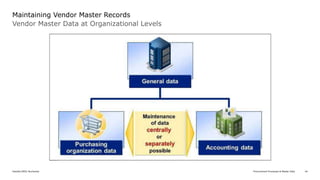
Vendor Master Data at Organizational Levels
Maintaining Vendor Master Records
Procurement Processes & Master Data
Deloitte ERDC Bucharest 45
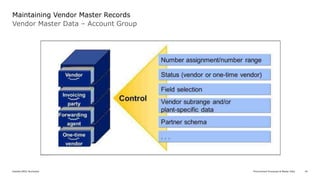
Vendor Master Data – Account Group
Maintaining Vendor Master Records
Procurement Processes & Master Data
Deloitte ERDC Bucharest 46
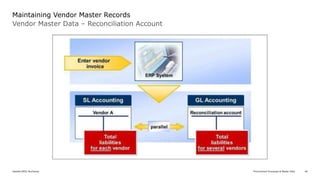
Vendor Master Data – Reconciliation Account
Maintaining Vendor Master Records
Procurement Processes & Master Data
Deloitte ERDC Bucharest 47
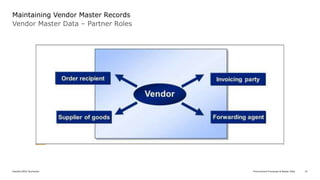
Vendor Master Data – Partner Roles
Maintaining Vendor Master Records
Procurement Processes & Master Data
Deloitte ERDC Bucharest 48
Maintaining Material Master Records
Procurement Processes & Master Data
Deloitte ERDC Bucharest 49
Material Master Record
Maintaining Material Master Records
Procurement Processes & Master Data
Deloitte ERDC Bucharest 50
Material Master Record - Maintenance
Maintaining Material Master Records
Procurement Processes & Master Data
Deloitte ERDC Bucharest 51
Material Master Record – Organizational Levels
Maintaining Material Master Records
Procurement Processes & Master Data
Deloitte ERDC Bucharest 52
Material Master Record Creation
Maintaining Material Master Records
Procurement Processes & Master Data
Deloitte ERDC Bucharest 53
Material Master Record Creation – Material type
Maintaining Material Master Records
Procurement Processes & Master Data
Deloitte ERDC Bucharest 54
Material Master Record Creation – Industry Sector
Maintaining Material Master Records
Procurement Processes & Master Data
Deloitte ERDC Bucharest 55
Material Master Record Extension&Copy
Maintaining Material Master Records
Procurement Processes & Master Data
Deloitte ERDC Bucharest 56
Appendix
Procurement Processes & Master Data
Deloitte ERDC Bucharest 57
Q&A
Procurement Processes & Master Data
Deloitte ERDC Bucharest 58
Contact me
Submit your CVs in English @ ncalota@deloittece.com
Procurement Processes & Master Data
Deloitte ERDC Bucharest 59
Thank You!
Procurement Processes & Master Data
Deloitte ERDC Bucharest 60
Kahoot.it

introduction-to-sap-mm-procurement-overview-and-basics-presentation.pptx

  • 1.
    Headline Verdana Bold SIMPRE– SAP MM Procurement Processes Master Data Nicolae Calota, Deloitte ERDC Bucharest November, 2018
  • 2.
    Procurement Processes &Master Data Deloitte ERDC Bucharest 2 Definition •Commercial software packages that promise the seamless integration of all information flowing through the company – financial, accounting, human resources, supply chain and customer satisfaction (T.J. Davenport, 1988). •ERP systems provide information management and analysis to organizations Benefits •Online/real time information throughout all the functional areas of an organization •Data standardization and accuracy across the enterprise •“best-practices” included in the applications •The efficiency they force an organization to undertake •The analysis and reporting that can be used for long term planning Enterprise Resource Planning and its benefits Overview of SAP as an ERP
  • 3.
    Procurement Processes &Master Data Deloitte ERDC Bucharest 3 • SAP  Stands for “Systems, Applications and Products in Data Processing”  Is a company founded in 1972 by five former IBM engineers  SAP’s architecture is based on “3-tier” client-server technology (presentation server, application server and database server) • ABAP  Stands for “Advanced Business Application Programming” language  Is the proprietary programming language in which the SAP product is programmed and customization done SAP as an ERP Overview of SAP as an ERP
  • 4.
    Procurement Processes &Master Data Deloitte ERDC Bucharest 4 SAP as an ERP Overview of SAP as an ERP
  • 5.
    Procurement Processes &Master Data Deloitte ERDC Bucharest 5 SAP as an ERP Overview of SAP as an ERP • SAP has categorized basic business processes in a basic organization. • The “building blocks” of processes are called “modules”
  • 6.
    Procurement Processes &Master Data Deloitte ERDC Bucharest 6 Evolution of SAP products Overview of SAP as an ERP • Cross industry solutions and industry solutions
  • 7.
    Procurement Processes &Master Data Deloitte ERDC Bucharest 7 At the end of this course, you will have a clear understanding of the following principles: SAP Standard Procurement Processes Documents used in SAP Standard Procurement Processes Master Data used in SAP Standard Procurement Processes Course Objectives Preface
  • 8.
    Procurement Processes &Master Data Deloitte ERDC Bucharest 8 Agenda Topic Content Person responsible Timing Procurement Processes • Defining Procurement Processes • Organizational levels Nicolae Calota 18:00 – 19:20 Maintaining Purchase Orders • Purchase Order Details • Purchase Order Maintenance Nicolae Calota 18:00 – 19:20 Posting Goods Receipt • Goods Receipt in Procurement • Goods Receipt Details Nicolae Calota 18:00 – 19:20 Entering Invoices • Invoice Receipt • Invoice Entry Nicolae Calota 18:00 – 19:20 Break Maintaining Vendor Master Records • Master Data in Procurement Processes • Vendor Master Data Nicolae Calota 19:30 – 20:50 Maintaining Material Master Records • Material Master Record • Material Master Record Creation • Purchasing Info Record Nicolae Calota 19:30 – 20:50
  • 9.
    Procurement Processes &Master Data Deloitte ERDC Bucharest 9 Procurement Processes
  • 10.
    Procurement Processes &Master Data Deloitte ERDC Bucharest 10 In SAP MM we have the below processes, as part of SAP Standard System Setup: External Procurement Process Stock Transfer with Stock Transport Orders Subcontracting Vendor Consignment Defining Procurement Processes Procurement Processes
  • 11.
    Procurement Processes &Master Data Deloitte ERDC Bucharest 11 External Procurement Process Defining Procurement Processes
  • 12.
    Procurement Processes &Master Data Deloitte ERDC Bucharest 12 Stock Transfer with Stock Transport Orders Defining Procurement Processes
  • 13.
    Procurement Processes &Master Data Deloitte ERDC Bucharest 13 Subcontracting Defining Procurement Processes
  • 14.
    Procurement Processes &Master Data Deloitte ERDC Bucharest 14 Vendor Consignment Defining Procurement Processes
  • 15.
    Procurement Processes &Master Data Deloitte ERDC Bucharest 15 Organizational Levels Client • It is an organizational unit within logistics that subdivides an enterprise from the viewpoints of production, procurement, plant maintenance, and materials planning • The enterprise structure is created by assigning organizational units to each other. • It is defined in the system by a four-character alphanumeric key that is unique to it in the client Plant • It is an organizational unit that facilitates the differentiation of stocks of materials within a plant • Inventory management on a quantity basis is carried out in the plant at the storage location level • It is defined by a unique 4 character alphanumeric key Storage Location • A unit within an SAP System that is self-contained both in legal and organizational terms • It s the highest hierarchical level in the SAP System and is uniquely defined by a 3 digit numeric key • For example, the client could represent a Corporate Group Company Code • A company code represents an independent unit that produces its own financial statements • It tracks the entry of all events that require posting to the accounts, and creates a complete audit trail for balance sheets and profit and loss statements • It is defined in the system by means of a 4 character alphanumeric key that is unique in the client • The purchasing group is a key organizational unit for a buyer, or group of buyers, responsible for certain purchasing activities • A purchasing organization is an organizational unit within logistics that subdivides the enterprise according to the purchasing requirements. Purchasing Organization and Purchasing Group
  • 16.
    Procurement Processes &Master Data Deloitte ERDC Bucharest 16 Example of Organizational Structure Organizational Levels
  • 17.
    Procurement Processes &Master Data Deloitte ERDC Bucharest 17 Purchasing Organization categories Organizational Levels Plant-specific purchasing organization Cross-plant purchasing organization Cross-company code purchasing organization
  • 18.
    Procurement Processes &Master Data Deloitte ERDC Bucharest 18 Plant-Specific Purchasing Organization Organizational Levels
  • 19.
    Procurement Processes &Master Data Deloitte ERDC Bucharest 19 Cross-Plant Purchasing Organization Organizational Levels
  • 20.
    Procurement Processes &Master Data Deloitte ERDC Bucharest 20 Cross-Company-Code Purchasing Organization Organizational Levels
  • 21.
    Procurement Processes &Master Data Deloitte ERDC Bucharest 21 Maintaining Purchase Orders
  • 22.
    Procurement Processes &Master Data Deloitte ERDC Bucharest 22 Purchase Order Details Maintaining Purchase Orders
  • 23.
    Procurement Processes &Master Data Deloitte ERDC Bucharest 23 Purchase Order Details Maintaining Purchase Orders
  • 24.
    Procurement Processes &Master Data Deloitte ERDC Bucharest 24 Purchase Order Details Maintaining Purchase Orders
  • 25.
    Procurement Processes &Master Data Deloitte ERDC Bucharest 25 Purchase Order Maintenance Maintaining Purchase Orders
  • 26.
    Procurement Processes &Master Data Deloitte ERDC Bucharest 26 Purchase Order Maintenance Maintaining Purchase Orders
  • 27.
    Procurement Processes &Master Data Deloitte ERDC Bucharest 27 Purchase Order Maintenance Maintaining Purchase Orders
  • 28.
    Procurement Processes &Master Data Deloitte ERDC Bucharest 28 Posting Goods Receipt
  • 29.
    Procurement Processes &Master Data Deloitte ERDC Bucharest 29 Goods Receipt in Procurement Posting Goods Receipt
  • 30.
    Procurement Processes &Master Data Deloitte ERDC Bucharest 30 Usual checks performed at the time of delivery: • Was the right material delivered? • Was the right quantity delivered? • Are the perishable goods (if any) within their minimum shelf life? (shelf-life expiration-date check must be activated) Goods Receipt in Procurement Posting Goods Receipt
  • 31.
    Procurement Processes &Master Data Deloitte ERDC Bucharest 31 Goods Receipt Details Posting Goods Receipt
  • 32.
    Procurement Processes &Master Data Deloitte ERDC Bucharest 32 Goods Receipt Details Posting Goods Receipt
  • 33.
    Procurement Processes &Master Data Deloitte ERDC Bucharest 33 Entering Invoices
  • 34.
    Procurement Processes &Master Data Deloitte ERDC Bucharest 34 Invoice Receipt Entering Invoices
  • 35.
    Procurement Processes &Master Data Deloitte ERDC Bucharest 35 Invoice Receipt Entering Invoices
  • 36.
    Procurement Processes &Master Data Deloitte ERDC Bucharest 36 Invoice Receipt Entering Invoices
  • 37.
    Procurement Processes &Master Data Deloitte ERDC Bucharest 37 Invoice Entry Entering Invoices
  • 38.
    Presentation title [To edit,click View > Slide Master > Slide Master] Member firms and DTTL: Insert appropriate copyright [To edit, click View > Slide Master > Slide Master] 38 BREAK
  • 39.
    Procurement Processes &Master Data Deloitte ERDC Bucharest 39 Master Data
  • 40.
    Procurement Processes &Master Data Deloitte ERDC Bucharest 40 Master Data in Procurement Processes Maintaining Vendor Master Records
  • 41.
    Procurement Processes &Master Data Deloitte ERDC Bucharest 41 • It provides the option of storing vendor and material information as the master data at purchasing organization and plant level • You can define: current and future prices, delivery data, vendor data, texts • It has the highest priority in information determination for procurement process Purchasing Info Record • It includes information about the vendors of a company which is stored in individual vendor master records • The are 3 categories of vendor master data (General Data, Company Code Data, Purchasing Org Data) Vendor Master Record • It represents the company’s central source of material-specific data which is used in all areas of logistics • Data stored in the material master is required for: Purchasing, Inventory management, Accounting, Materials Planning (MRP – Material Requirements Planning) Material Master Record Master Data in Procurement Processes Maintaining Vendor Master Records
  • 42.
    Procurement Processes &Master Data Deloitte ERDC Bucharest 42 Categories of Vendor Master Data Maintaining Vendor Master Records
  • 43.
    Procurement Processes &Master Data Deloitte ERDC Bucharest 43 • Purchasing organization data is maintained for each purchasing organization • Purchasing organization data includes the purchase order currency, Incoterms, partner roles, purchasing data, and various controls pertaining to the vendor Purchasing Org Data • General data includes the vendor’s address, control data, bank details, communication, and contact persons. Is valid for a single client • Valid for a single client General Data • Company code data is maintained at the company code level • Company code data includes the number of the reconciliation account, correspondence, withholding tax, and the payment methods for automatic payment transactions. Company Code Data Vendor Master Data Maintaining Vendor Master Records
  • 44.
    Procurement Processes &Master Data Deloitte ERDC Bucharest 44 Vendor Master Data at Organizational Levels Maintaining Vendor Master Records
  • 45.
    Procurement Processes &Master Data Deloitte ERDC Bucharest 45 Vendor Master Data – Account Group Maintaining Vendor Master Records
  • 46.
    Procurement Processes &Master Data Deloitte ERDC Bucharest 46 Vendor Master Data – Reconciliation Account Maintaining Vendor Master Records
  • 47.
    Procurement Processes &Master Data Deloitte ERDC Bucharest 47 Vendor Master Data – Partner Roles Maintaining Vendor Master Records
  • 48.
    Procurement Processes &Master Data Deloitte ERDC Bucharest 48 Maintaining Material Master Records
  • 49.
    Procurement Processes &Master Data Deloitte ERDC Bucharest 49 Material Master Record Maintaining Material Master Records
  • 50.
    Procurement Processes &Master Data Deloitte ERDC Bucharest 50 Material Master Record - Maintenance Maintaining Material Master Records
  • 51.
    Procurement Processes &Master Data Deloitte ERDC Bucharest 51 Material Master Record – Organizational Levels Maintaining Material Master Records
  • 52.
    Procurement Processes &Master Data Deloitte ERDC Bucharest 52 Material Master Record Creation Maintaining Material Master Records
  • 53.
    Procurement Processes &Master Data Deloitte ERDC Bucharest 53 Material Master Record Creation – Material type Maintaining Material Master Records
  • 54.
    Procurement Processes &Master Data Deloitte ERDC Bucharest 54 Material Master Record Creation – Industry Sector Maintaining Material Master Records
  • 55.
    Procurement Processes &Master Data Deloitte ERDC Bucharest 55 Material Master Record Extension&Copy Maintaining Material Master Records
  • 56.
    Procurement Processes &Master Data Deloitte ERDC Bucharest 56 Appendix
  • 57.
    Procurement Processes &Master Data Deloitte ERDC Bucharest 57 Q&A
  • 58.
    Procurement Processes &Master Data Deloitte ERDC Bucharest 58 Contact me Submit your CVs in English @ ncalota@deloittece.com
  • 59.
    Procurement Processes &Master Data Deloitte ERDC Bucharest 59 Thank You!
  • 60.
    Procurement Processes &Master Data Deloitte ERDC Bucharest 60 Kahoot.it

Editor's Notes

  • #5 Timeline 1972: SAP AG founded in Germany 1979: SAP R/2 introduced for main frame computers 1992: SAP R/3 released as client-server application 1996: SAP R/3 became partially Internet enabled 1997: Developed and launched the new dimension product line including CRM, SCM and Data Warehousing solutions 1999: SAP announced mySAP Solutions, the next generation of its Enterprise Application System, based on the Internet architecture 2000-2005: Introduced mySAP business Suite (SAP ALL in One), Net Weaver and X applications 2015: a new wave of advances in hardware architecture brings massive computing power and decreasing costs.
  • #12  A typical procurement process includes the following phases: -Determination of requirements - Determination of supply source - Vendor Selection - PO processing - PO monitoring - GR - Invoice verification - Payment processing (Accounting)
  • #13 When you use stock transport orders in the procurement process, goods are procured internally and delivered. The plant that requires the goods orders the materials from another plant. This procurement process involves managing inventory and purchasing in the receiving plant.
  • #14 In the subcontracting process, your company orders material or product from an external vendor. Unlike a normal external procurement process, in subcontracting, your company provides the vendor (subcontractor) with some or all of the components required to manufacture the material. Although the components that have been provided are no longer physically in your company, they are managed in your stocks because they still belong to you. The information is shown under the special stock type Stock of material provided to vendor.
  • #15 When a vendor provides you with material that you store, but are not required to pay for immediately, this is called vendor consignment. The vendor remains the owner of the material until you remove some quantity from your consignment inventory. A liability arises for the vendor when you remove any quantity of the material from the consignment inventory. These withdrawals are settled in agreed periods. Before you procure a material from a vendor for a consignment, you and the vendor need to agree on a price for the material. The price information is recorded in the system’s consignment information record before the consignment inventory for the material is filled in your company.
  • #16 Company Code: You can set up several company codes for the same client to keep separate sets of accounts Plant: - Usually used to segregate inventory into geographic or logical locations - A client may contain several company codes, and a company code may contain several plants. However, a plant can only belong to one company code. Example of Possible entities within the firm for plants: - Production facility - Central issuing storage location - Regional sales office - Corporate headquarters - Maintenance location Storage Location - Several storage locations may be assigned to a plant, but a specific storage location can only belong to one plant. St.Loc are define specifically for a Plant and are assigned accordingly The key of a St.Loc is unique within a Plant Purchasing Group The purchasing group is internally responsible for the procurement of a material or class of materials. Externally, the purchasing group supplies the contact person for vendors. Purchasing Organization A purchasing organization procures materials or services, negotiates terms and conditions of purchase with vendors, and assumes responsibility for the transactions. Assign a purchasing organization to a company code and plants. This allows you to take into account whether purchasing is centralized or decentralized in your company; a combination of these two organizational forms is possible.
  • #19 In a plant-specific procurement, a purchasing organization is responsible for procuring materials for a single plant. Settings: Assign a purchasing organization to a company code Assign one plant of the company code to this purchasing organization
  • #20 If a purchasing organization has to procure materials and services for several plants belonging to a company code, you can set up a cross-plant purchasing organization for each company code Settings: Assign a purchasing organization to the desired company code Assign the plants for which a purchasing organization is responsible
  • #21 When setting up cross-company-code purchasing organization, the purchasing organization must not be assigned to any company code(s) in Customizing. When you create a purchase order, the system will ask you to enter the company code for which you want to procure the material.
  • #24 To minimize data entry, the PO can be created with reference to: PO, PR, Qout, Contract, or without Reference Some data is automatically proposed from the master data.
  • #25 PO Format
  • #26 TCODES: ME21N / ME22N / ME23N System Demo * create favorites * maintain personal settings * display saved PO, under My purchase orders
  • #27 TCODES: ME21N / ME22N / ME23N System Demo
  • #28 TCODES: ME21N / ME22N / ME23N System Demo
  • #30 TCODES: MIGO System Demo
  • #31 When you post the receipt of goods into the warehouse or stores, the system generates a material document containing information on the material delivered and the quantity delivered If the goods receipt is valuated, an accounting document is generated TCODE: MIGO System Demo
  • #32 Movement Types: - The movement type is a three-character key used to differentiate between the various types of goods’ movements. Examples of such goods movements are Goods Receipts, Goods Issues, and Transfer Postings. - Assumes important control functions in inventory management - Plays a central role in automatic account determination in the SAP system - Determines which stock or consumption accounts are updated in financial accounting,along with other influencing factors List of movement types (Customizing)
  • #33 System Demo Navigation Movement types PO history Settings > Default values? Material document
  • #35 The procurement process ends with the entry of the vendor’s invoice. You are responsible for testing the functionality of Logistics Invoice Verification (LIV). System Demo
  • #36 LIV to perform the following tasks: - Enter invoices and credit memos - Check invoices and credit memos for arithmetical correctness - Confirm that you have been charged with the right price for the right material or service and for the right quantity When you post an invoice, the system performs the following tasks: - The data from the invoice is saved in the system. - Invoice and accounting documents are generated. - The saved data from the invoice documents is updated in materials management (for example, purchase order history) and in financial accounting.
  • #37 When you post an invoice, the system performs the following tasks: - The data from the invoice is saved in the system. - Invoice and accounting documents are generated. - The saved data from the invoice documents is updated in materials management (for example, purchase order history) and in financial accounting.
  • #38 TCODE MIRO System Demo Navigation PO history
  • #42 Create Vendor master record Create Material Master record Extend Material Master Record Define Purchasing Info Record Create Vendor master record with reference Maintain material master using entry aids Execute mass maintenance
  • #45 Data can be maintained either Centrally (all data is maintained together) or on a decentralized basis (each department maintains its own data) TCODEs MK01, MK02, MK03 – authorized to maintain General Address, Control Data and Purchasing Specific Data - Authorized accounting personnel will have to enter the payment transaction data and company code specific data TCODEs XK01, XK02, XK03 – authorized to maintain and edit all the data in the vendor master record (including Accounting Data)
  • #46 The account group must be assigned to the vendor. (MANDATORY) The account group has the functions to control the screens and fields relevant to your business partner that are displayed and are enabled for input
  • #47 When creating a vendor master record, you must also create a reconciliation account. This account is a General Ledger (G/L) account in G/L accounting. A reconciliation account depicts a company’s liabilities to numerous vendors in G/L accounting. When entering invoices, you enter the vendor and the system produces the reconciliation account from the vendor master record.
  • #48 Mention about Vendor Blocking (MK05) Can be blocked because of poor quality products and you can block using the blocking checkbox from master record and POs can no longer be placed towards this vendor Can be blocked only for one Purch Org or for several Purch Orgs Can be blocked for quality reasons, by using the Block for quality reasons checkbox from master record and this will be effective only for materials for which QM is active in procurement
  • #50 System Demo each tab
  • #51 System Demo: Main Tabs and Additional Data
  • #52 Data at client level General material data that is valid for the whole company is stored at client level. Data at plant level All data that is valid within a plant and for all storage locations belonging to it is stored at plant level. Data at storage location level All data that is valid for a particular storage location is stored at storage location level These organizational levels are relevant for the external procurement process. Client, plant, and storage location matter when you enter data for purchasing, inventory management, and accounting.
  • #53 System Demo: MM01 Also mention Create with reference option
  • #54 System Demo: MM01 The material type controls the following functions: 1. The type of number assignment (internal or external) 2. The permissible number range intervals 3. The user department-specific view that is proposed for entry 4. The procurement type that is allowed for a material (that is, whether the material is produced in-house, procured externally, or both) Material Types also determines which accounts to be updated when a receipt is posted Material Types can be also defined in Customizing
  • #55 Industry sector determines the following functions: 1. Which screens are displayed and in which order 2. Which industry-specific fields are displayed on each screen The material you assign to an industry sector cannot be changed later New Industry sectors can be defined in Customizing
  • #56 Once a department has created data for a material, the material master record exists in the database. If a user from another department wishes to enter data later, they do not have to create the material master record from the beginning, but only have to extend the existing record by adding the information from their department.