Introduction to Data
Analysis
Understanding the basics of data analysis is crucial for deriving valuable insights
from data sets. It involves the process of inspecting, cleaning, transforming, and
modeling data to discover useful information, draw conclusions, and support
decision-making.
Data analysis plays a vital role in various fields, including business, finance,
healthcare, marketing, and more. By analyzing large datasets, organizations can
uncover patterns, trends, and correlations that can inform strategic decisions and
drive innovation.
In this course, we will explore different data analysis techniques and tools, such as
statistical analysis, data visualization, and machine learning algorithms. We will also
discuss real-world applications of data analysis and how it can be used to solve
complex problems.
By Data Club
B.Com(Computer Applications)
Types of Data and Data Sources
Structured Data
Data organized into a tabular format, such as
databases and spreadsheets.
Unstructured Data
Data without a predetermined data model, like
text, images, and videos.
Internal Data
Data generated within an organization, like sales
records and customer information.
External Data
Data from sources outside the organization,
such as social media, public datasets, and
industry reports.
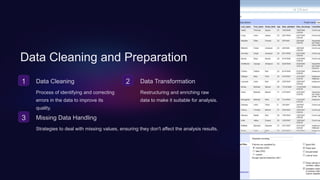
Data Cleaning and Preparation
1 Data Cleaning
Process of identifying and correcting
errors in the data to improve its
quality.
2 Data Transformation
Restructuring and enriching raw
data to make it suitable for analysis.
3 Missing Data Handling
Strategies to deal with missing values, ensuring they don't affect the analysis results.
Data Visualization: Bar Chart, Pie Chart,
and Heatmap
Bar Chart
A bar chart is a graphical
representation of data using
rectangular bars to compare
categories or show
relationships between
variables.
Pie Chart
A pie chart is a circular chart
that is divided into sectors to
represent proportions of a
whole or to compare different
categories.
Heatmap
A heatmap is a graphical
representation of data where
values are represented as
colors. It is useful for
visualizing patterns and
correlations in large datasets.
Descriptive Statistics
Descriptive statistics is a branch of statistics that deals with the collection, analysis, and interpretation of
data. It provides a summary of the key features of a dataset, such as the measures of central tendency,
variability, and shape.
Mean
Mean
The mean represents the average value of a
dataset and is calculated by adding up all the
values and dividing by the number of
observations. It provides a measure of central
tendency that is sensitive to extreme values.
Median
Median
The median shows the middle value of a dataset
and is calculated by sorting all the values in
ascending or descending order and selecting the
value in the middle. It provides a measure of
central tendency that is robust against extreme
values.
Other common measures of central tendency include the mode and the geometric mean. Measures of
variability include the range, variance, and standard deviation. The shape of a dataset can be described
using histograms or other visualization techniques.
Mean Median
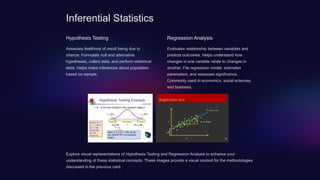
Inferential Statistics
Hypothesis Testing
Assesses likelihood of result being due to
chance. Formulate null and alternative
hypotheses, collect data, and perform statistical
tests. Helps make inferences about population
based on sample.
Regression Analysis
Evaluates relationship between variables and
predicts outcomes. Helps understand how
changes in one variable relate to changes in
another. Fits regression model, estimates
parameters, and assesses significance.
Commonly used in economics, social sciences,
and business.
Explore visual representations of Hypothesis Testing and Regression Analysis to enhance your
understanding of these statistical concepts. These images provide a visual context for the methodologies
discussed in the previous card.
Machine Learning Algorithms
Supervised Learning
Trained on labeled data to
make predictions or
decisions. Common
algorithms: linear regression,
logistic regression, decision
trees, random forests, and
support vector machines.
Unsupervised Learning
Finds patterns and structure
in data without labeled
outputs. Common tasks:
clustering and dimensionality
reduction. Popular algorithms:
k-means clustering,
hierarchical clustering, and
PCA.
Feature Engineering
Creates new features from
existing data to improve
model performance.
Techniques: selecting
relevant features,
transforming variables,
creating interaction terms,
and handling missing data.
Applications of Data Analysis in
Real-World Scenarios
Business Intelligence
Applying data analysis to gain insights
into business operations and market
trends.
Healthcare Management
Utilizing data analysis to improve
patient care, treatment outcomes, and
resource allocation.
Environmental Research
Using data analysis to study climate patterns, pollution levels, and ecosystem changes.
ROLEPLAY
Data Deliberations: A Corporate Conclave:
Members:
• Moderator
• Data Analyst
• IT Specialist
• Chief Financial Officer
• Chief Marketing Officer
• Chief Executive Officer
• Chief Information Officer
• Legal Council
THANK YOU
- Data Club
B.Com(Computer Applications)

Introduction-to-Data-Analysis_Final Content.pptx

  • 1.
    Introduction to Data Analysis Understandingthe basics of data analysis is crucial for deriving valuable insights from data sets. It involves the process of inspecting, cleaning, transforming, and modeling data to discover useful information, draw conclusions, and support decision-making. Data analysis plays a vital role in various fields, including business, finance, healthcare, marketing, and more. By analyzing large datasets, organizations can uncover patterns, trends, and correlations that can inform strategic decisions and drive innovation. In this course, we will explore different data analysis techniques and tools, such as statistical analysis, data visualization, and machine learning algorithms. We will also discuss real-world applications of data analysis and how it can be used to solve complex problems. By Data Club B.Com(Computer Applications)
  • 2.
    Types of Dataand Data Sources Structured Data Data organized into a tabular format, such as databases and spreadsheets. Unstructured Data Data without a predetermined data model, like text, images, and videos. Internal Data Data generated within an organization, like sales records and customer information. External Data Data from sources outside the organization, such as social media, public datasets, and industry reports.
  • 3.
    Data Cleaning andPreparation 1 Data Cleaning Process of identifying and correcting errors in the data to improve its quality. 2 Data Transformation Restructuring and enriching raw data to make it suitable for analysis. 3 Missing Data Handling Strategies to deal with missing values, ensuring they don't affect the analysis results.
  • 4.
    Data Visualization: BarChart, Pie Chart, and Heatmap Bar Chart A bar chart is a graphical representation of data using rectangular bars to compare categories or show relationships between variables. Pie Chart A pie chart is a circular chart that is divided into sectors to represent proportions of a whole or to compare different categories. Heatmap A heatmap is a graphical representation of data where values are represented as colors. It is useful for visualizing patterns and correlations in large datasets.
  • 5.
    Descriptive Statistics Descriptive statisticsis a branch of statistics that deals with the collection, analysis, and interpretation of data. It provides a summary of the key features of a dataset, such as the measures of central tendency, variability, and shape. Mean Mean The mean represents the average value of a dataset and is calculated by adding up all the values and dividing by the number of observations. It provides a measure of central tendency that is sensitive to extreme values. Median Median The median shows the middle value of a dataset and is calculated by sorting all the values in ascending or descending order and selecting the value in the middle. It provides a measure of central tendency that is robust against extreme values. Other common measures of central tendency include the mode and the geometric mean. Measures of variability include the range, variance, and standard deviation. The shape of a dataset can be described using histograms or other visualization techniques. Mean Median
  • 6.
    Inferential Statistics Hypothesis Testing Assesseslikelihood of result being due to chance. Formulate null and alternative hypotheses, collect data, and perform statistical tests. Helps make inferences about population based on sample. Regression Analysis Evaluates relationship between variables and predicts outcomes. Helps understand how changes in one variable relate to changes in another. Fits regression model, estimates parameters, and assesses significance. Commonly used in economics, social sciences, and business. Explore visual representations of Hypothesis Testing and Regression Analysis to enhance your understanding of these statistical concepts. These images provide a visual context for the methodologies discussed in the previous card.
  • 7.
    Machine Learning Algorithms SupervisedLearning Trained on labeled data to make predictions or decisions. Common algorithms: linear regression, logistic regression, decision trees, random forests, and support vector machines. Unsupervised Learning Finds patterns and structure in data without labeled outputs. Common tasks: clustering and dimensionality reduction. Popular algorithms: k-means clustering, hierarchical clustering, and PCA. Feature Engineering Creates new features from existing data to improve model performance. Techniques: selecting relevant features, transforming variables, creating interaction terms, and handling missing data.
  • 8.
    Applications of DataAnalysis in Real-World Scenarios Business Intelligence Applying data analysis to gain insights into business operations and market trends. Healthcare Management Utilizing data analysis to improve patient care, treatment outcomes, and resource allocation. Environmental Research Using data analysis to study climate patterns, pollution levels, and ecosystem changes.
  • 9.
    ROLEPLAY Data Deliberations: ACorporate Conclave: Members: • Moderator • Data Analyst • IT Specialist • Chief Financial Officer • Chief Marketing Officer • Chief Executive Officer • Chief Information Officer • Legal Council
  • 10.
    THANK YOU - DataClub B.Com(Computer Applications)