Introduction to Cyber Security
Certification
Cyber security certification plays a vital role in securing systems, networks, and data from cyber
threats. It involves understanding various security protocols, risk management, and ethical
hacking.
Sa by Sneha Raju
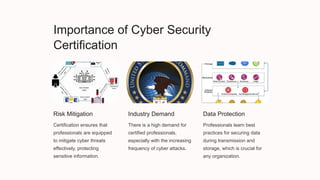
Importance of Cyber Security
Certification
Risk Mitigation
Certification ensures that
professionals are equipped
to mitigate cyber threats
effectively, protecting
sensitive information.
Industry Demand
There is a high demand for
certified professionals,
especially with the increasing
frequency of cyber attacks.
Data Protection
Professionals learn best
practices for securing data
during transmission and
storage, which is crucial for
any organization.
Different types of Cyber Security
Certifications
Vendor-Specific
Certifications tailored for
specific vendors’ products
or services, such as Cisco,
Microsoft, or AWS.
Specialization
Specialized certifications
focus on areas like ethical
hacking, penetration
testing, or digital forensics.
Foundational
Entry-level certifications
providing a foundational
understanding of cyber
security, like CompTIA
Security+ or CEH.
Benefits of getting certified in Cyber
Security
1 Career Advancement
Certification opens up new career
opportunities and can lead to higher-
paying roles.
2 Skills Validation
Validates expertise and demonstrates a
commitment to professional
development.
3 Networking Opportunities
Connect with industry peers, experts,
and potential employers through
certification programs.
4 Organizational Growth
Enhances an organization’s security
posture, contributing to overall growth
and stability.
Overview of the certification process
Study Understand concepts, tools, and practices.
Exam Pass the certification exam to prove
competency.
Renewal Stay updated with continuing education and
renewal requirements.
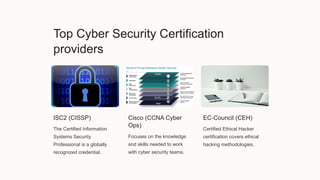
Top Cyber Security Certification
providers
ISC2 (CISSP)
The Certified Information
Systems Security
Professional is a globally
recognized credential.
Cisco (CCNA Cyber
Ops)
Focuses on the knowledge
and skills needed to work
with cyber security teams.
EC-Council (CEH)
Certified Ethical Hacker
certification covers ethical
hacking methodologies.
Tips for preparing and passing the
certification exam
1 Structured Study Plan
Follow a well-structured study plan
and utilize official study materials.
2 Real-World Practice
Engage in real-world scenarios and
hands-on practice to reinforce
learning.
3 Review & Feedback
Regularly review practice exams and seek feedback from industry professionals.
Conclusion and next steps
1
Certification
Earn a cyber security certification.
2 Apply Knowledge
Apply knowledge to real-world
scenarios.
3
Continuous Learning
Engage in continuous learning and
professional development.

Introduction-to-Cyber-Security-Certification.pptx

  • 1.
    Introduction to CyberSecurity Certification Cyber security certification plays a vital role in securing systems, networks, and data from cyber threats. It involves understanding various security protocols, risk management, and ethical hacking. Sa by Sneha Raju
  • 2.
    Importance of CyberSecurity Certification Risk Mitigation Certification ensures that professionals are equipped to mitigate cyber threats effectively, protecting sensitive information. Industry Demand There is a high demand for certified professionals, especially with the increasing frequency of cyber attacks. Data Protection Professionals learn best practices for securing data during transmission and storage, which is crucial for any organization.
  • 3.
    Different types ofCyber Security Certifications Vendor-Specific Certifications tailored for specific vendors’ products or services, such as Cisco, Microsoft, or AWS. Specialization Specialized certifications focus on areas like ethical hacking, penetration testing, or digital forensics. Foundational Entry-level certifications providing a foundational understanding of cyber security, like CompTIA Security+ or CEH.
  • 4.
    Benefits of gettingcertified in Cyber Security 1 Career Advancement Certification opens up new career opportunities and can lead to higher- paying roles. 2 Skills Validation Validates expertise and demonstrates a commitment to professional development. 3 Networking Opportunities Connect with industry peers, experts, and potential employers through certification programs. 4 Organizational Growth Enhances an organization’s security posture, contributing to overall growth and stability.
  • 5.
    Overview of thecertification process Study Understand concepts, tools, and practices. Exam Pass the certification exam to prove competency. Renewal Stay updated with continuing education and renewal requirements.
  • 6.
    Top Cyber SecurityCertification providers ISC2 (CISSP) The Certified Information Systems Security Professional is a globally recognized credential. Cisco (CCNA Cyber Ops) Focuses on the knowledge and skills needed to work with cyber security teams. EC-Council (CEH) Certified Ethical Hacker certification covers ethical hacking methodologies.
  • 7.
    Tips for preparingand passing the certification exam 1 Structured Study Plan Follow a well-structured study plan and utilize official study materials. 2 Real-World Practice Engage in real-world scenarios and hands-on practice to reinforce learning. 3 Review & Feedback Regularly review practice exams and seek feedback from industry professionals.
  • 8.
    Conclusion and nextsteps 1 Certification Earn a cyber security certification. 2 Apply Knowledge Apply knowledge to real-world scenarios. 3 Continuous Learning Engage in continuous learning and professional development.