Introduction to Data Structures
Definition: A data structure is a specialized format for
organizing, processing, retrieving, and storing data.
Importance: Efficient data structures are key to
designing efficient algorithms and managing large
amounts of data.
Types: Linear and Non-linear data structures.
Types of Data Structures
Linear Data Structures:
Array: A collection of elements identified by index
or key.
Linked List: Elements connected by pointers.
Stack: Follows LIFO order; operations are
performed at one end.
Queue: Follows FIFO order; operations are
performed at both ends.
Non-linear Data Structures:
Tree: Hierarchical structure with a root and child
nodes.
Graph: Consists of vertices and edges.
Arrays
Definition: A collection of elements, each identified by
an array index.
Characteristics: Fixed size, same data type elements.
Operations: Accessing (O(1)), Insertion (O(n)), Deletion
(O(n)), Searching (O(n)).
Linked Lists
Definition: A sequence of elements where each element
points to the next one.
Types:
Singly Linked List: Each node points to the next node.
Doubly Linked List: Each node points to both the next
and previous nodes.
Circular Linked List: The last node points back to the
first node.
Operations: Insertion, Deletion, Traversal.
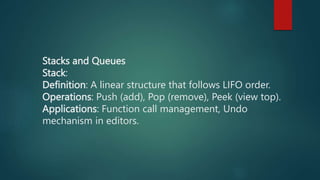
Stacks and Queues
Stack:
Definition: A linear structure that follows LIFO order.
Operations: Push (add), Pop (remove), Peek (view top).
Applications: Function call management, Undo
mechanism in editors.

Introduction_to_Data_Structure_and _arrays.pptx

  • 1.
    Introduction to DataStructures Definition: A data structure is a specialized format for organizing, processing, retrieving, and storing data. Importance: Efficient data structures are key to designing efficient algorithms and managing large amounts of data. Types: Linear and Non-linear data structures.
  • 2.
    Types of DataStructures Linear Data Structures: Array: A collection of elements identified by index or key. Linked List: Elements connected by pointers. Stack: Follows LIFO order; operations are performed at one end. Queue: Follows FIFO order; operations are performed at both ends. Non-linear Data Structures: Tree: Hierarchical structure with a root and child nodes. Graph: Consists of vertices and edges.
  • 3.
    Arrays Definition: A collectionof elements, each identified by an array index. Characteristics: Fixed size, same data type elements. Operations: Accessing (O(1)), Insertion (O(n)), Deletion (O(n)), Searching (O(n)).
  • 4.
    Linked Lists Definition: Asequence of elements where each element points to the next one. Types: Singly Linked List: Each node points to the next node. Doubly Linked List: Each node points to both the next and previous nodes. Circular Linked List: The last node points back to the first node. Operations: Insertion, Deletion, Traversal.
  • 5.
    Stacks and Queues Stack: Definition:A linear structure that follows LIFO order. Operations: Push (add), Pop (remove), Peek (view top). Applications: Function call management, Undo mechanism in editors.