Introduction to TDD
2Confidential
First thingfirst
3Confidential
Whythis session?
• Understand the basics around TDD
• Be able building a software starting with tests
• Enjoy the benefits of building code covered
by tests
• Code a bit (and probably) learn something
new from your colleagues
• … so do not run away please! 😉
Confidential 4
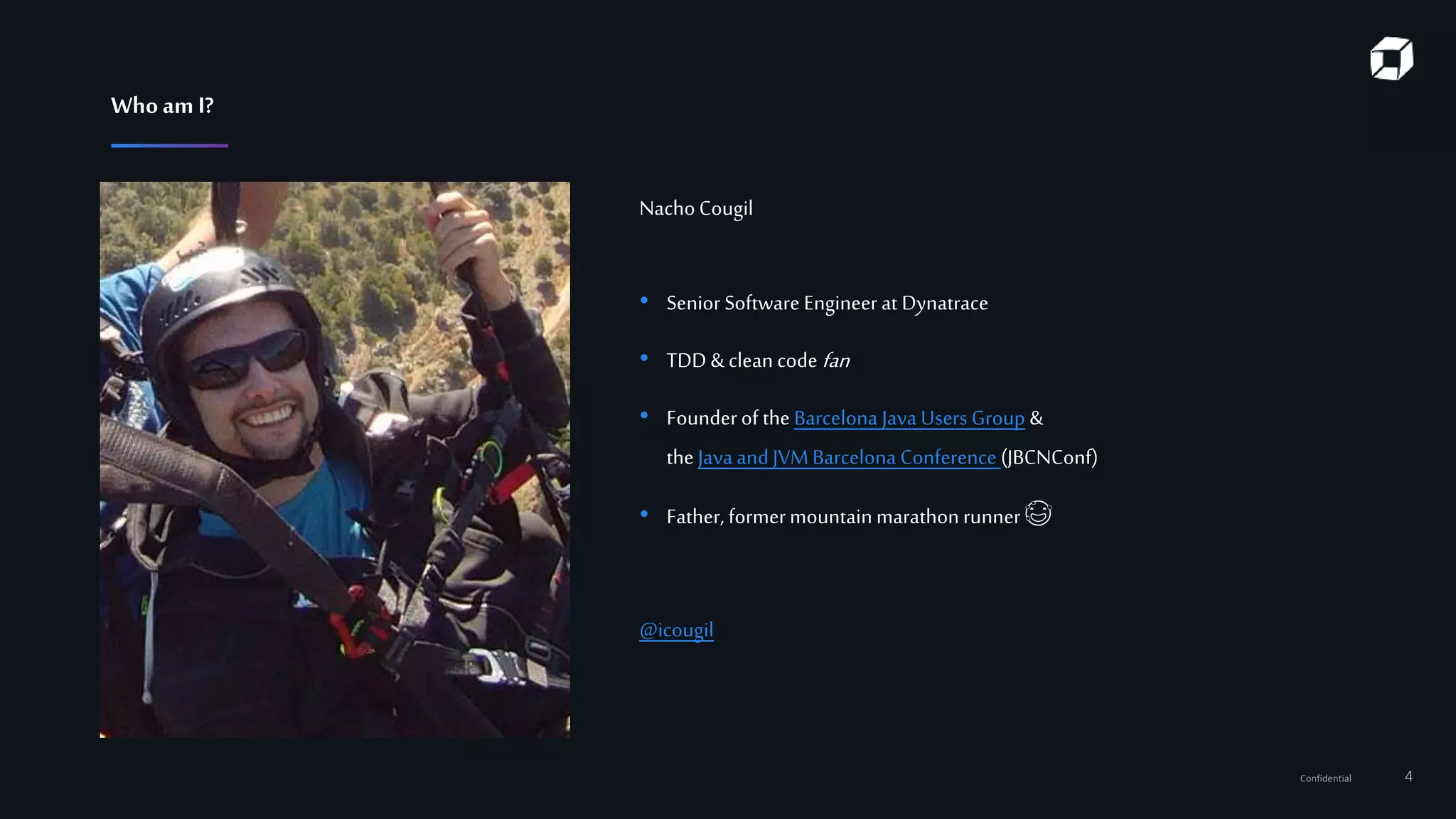
NachoCougil
• Senior Software Engineerat Dynatrace
• TDD &cleancode fan
• Founderof the Barcelona Java Users Group &
the Javaand JVMBarcelona Conference (JBCNConf)
• Father, formermountain marathonrunner 😅
@icougil
WhoamI?
Confidential 5
• Raise yourhand at anymoment!
• Also, join ourSlack for any questions, suggestions or ideas you mayhave!
• http://bit.ly/slack-bcnjug
Askquestions atanytime,please!
6Confidential
Warning
Basedon my*personal*experience
7Confidential
• A bit of history and why
• Process & rules
• Good habits
• Questions?
• Demo / Kata 1
• Pair programming
• Kata 2
• Break
• Kata 3
• Final Recap
Agenda
8Confidential
• A bitof history and why
• Process & rules
• Good habits
• Questions?
• Demo / Kata 1
• Pair programming
• Kata 2
• Kata 3
• Final Recap
Agenda
Confidential 9
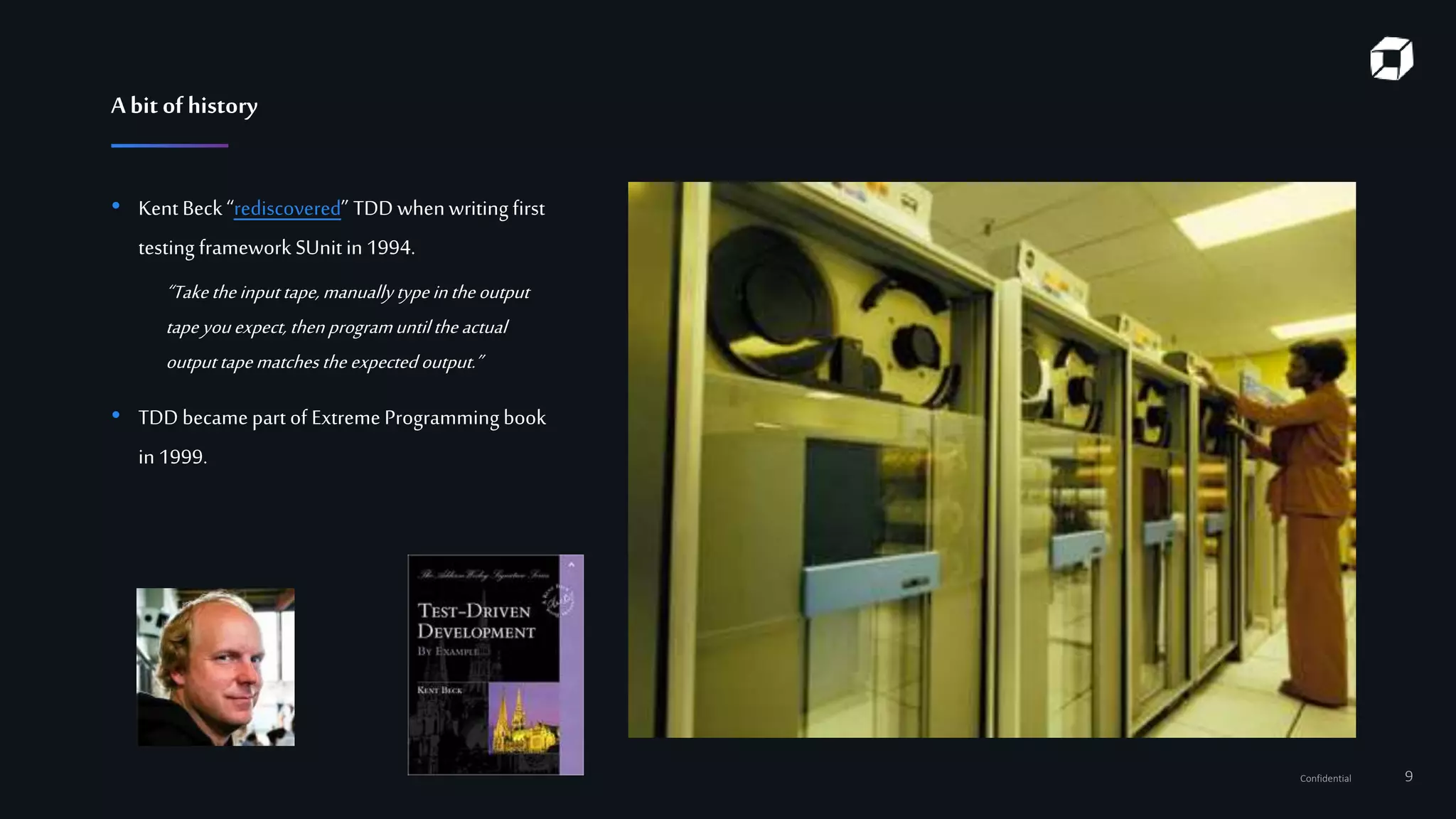
• Kent Beck “rediscovered” TDD whenwriting first
testing framework SUnitin1994.
“Taketheinputtape,manuallytypeintheoutput
tapeyouexpect, then programuntiltheactual
outputtapematches the expected output.”
• TDD became part of Extreme Programmingbook
in1999.
Abit of history
Confidential 10
• Find defectsearlier(whenrunningordesigningyourtests).
Easilydetect regressionerrors
• Yoursoftwarewillbe easiertorefactorbecauseof ✅ green
(safetynet)
• Guidesyoudoing smallsteps
• Guidesyouhow aconsumerwould useyourcomponent
• Testsarelivingdocumentation
• The softwareyouwillwriteitislikely tohavelessbugs(
references:Test-drivendevelopmentasadefect-reduction
practice(IEEE) , Guest Editors'Introduction:TDD--The Artof
FearlessProgramming(computer.org))
• Developmentcostswillbe lower
Why?
Confidential 11
How it is?
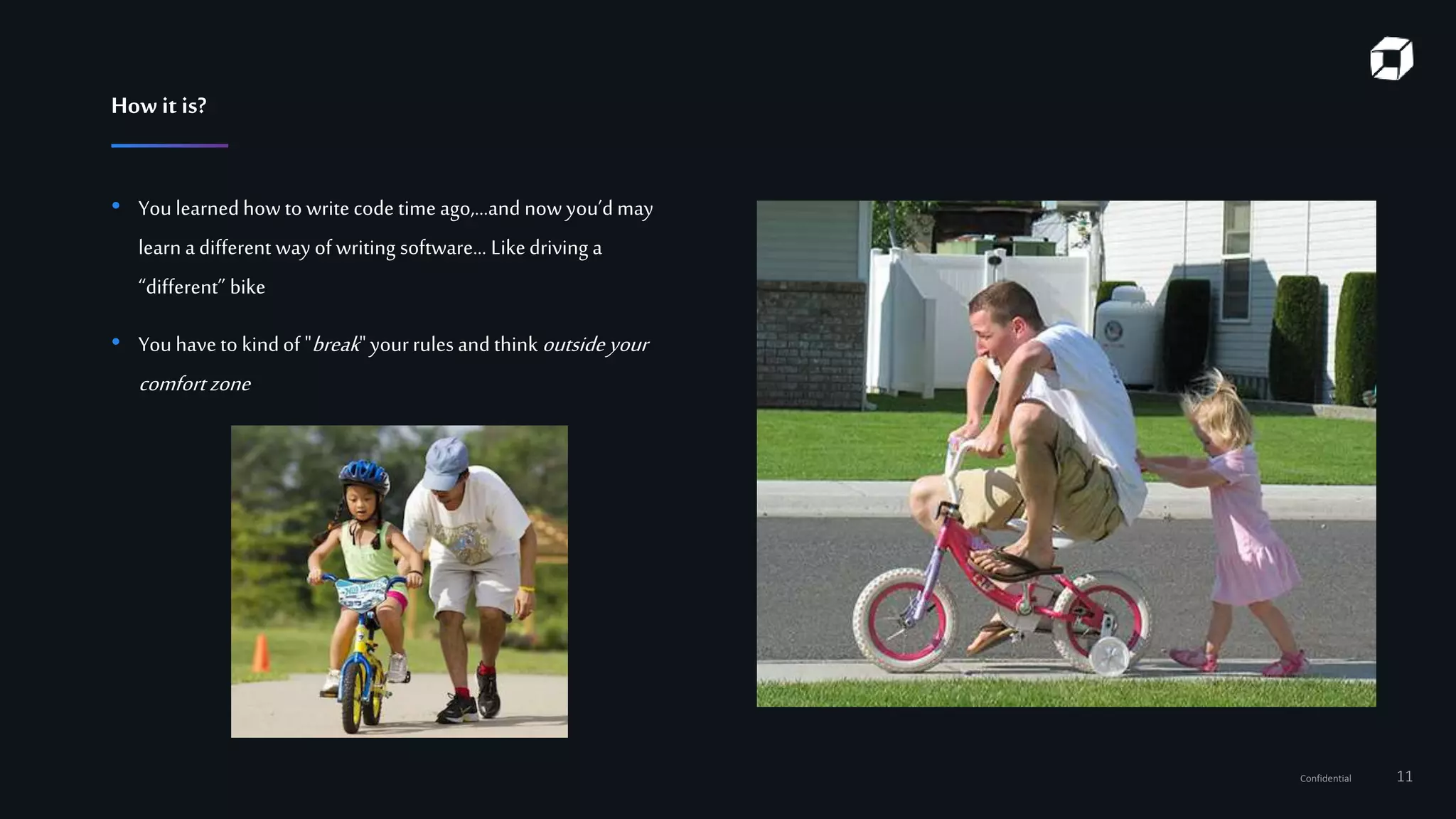
• Youlearnedhow to write code time ago,…and now you’dmay
learn a different way of writing software… Likedriving a
“different” bike
• Youhaveto kindof "break"yourrules and think outsideyour
comfort zone
Confidential 12
• A bit of history and why
• Process &rules
• Good habits
• Questions?
• Demo / Kata 1
• Pair programming
• Kata 2
• Kata 3
• Final Recap
Agenda
Confidential 13
Theprocess
Confidential 14
 Focus on building tests first that will help us demonstrate the
behaviour we want.
 Wewill start writing tests and we can’t writeverymuchapart
from a unittest. Tests are first class citizens
 No overengineering, simple code, simple solution: makethe test
pass
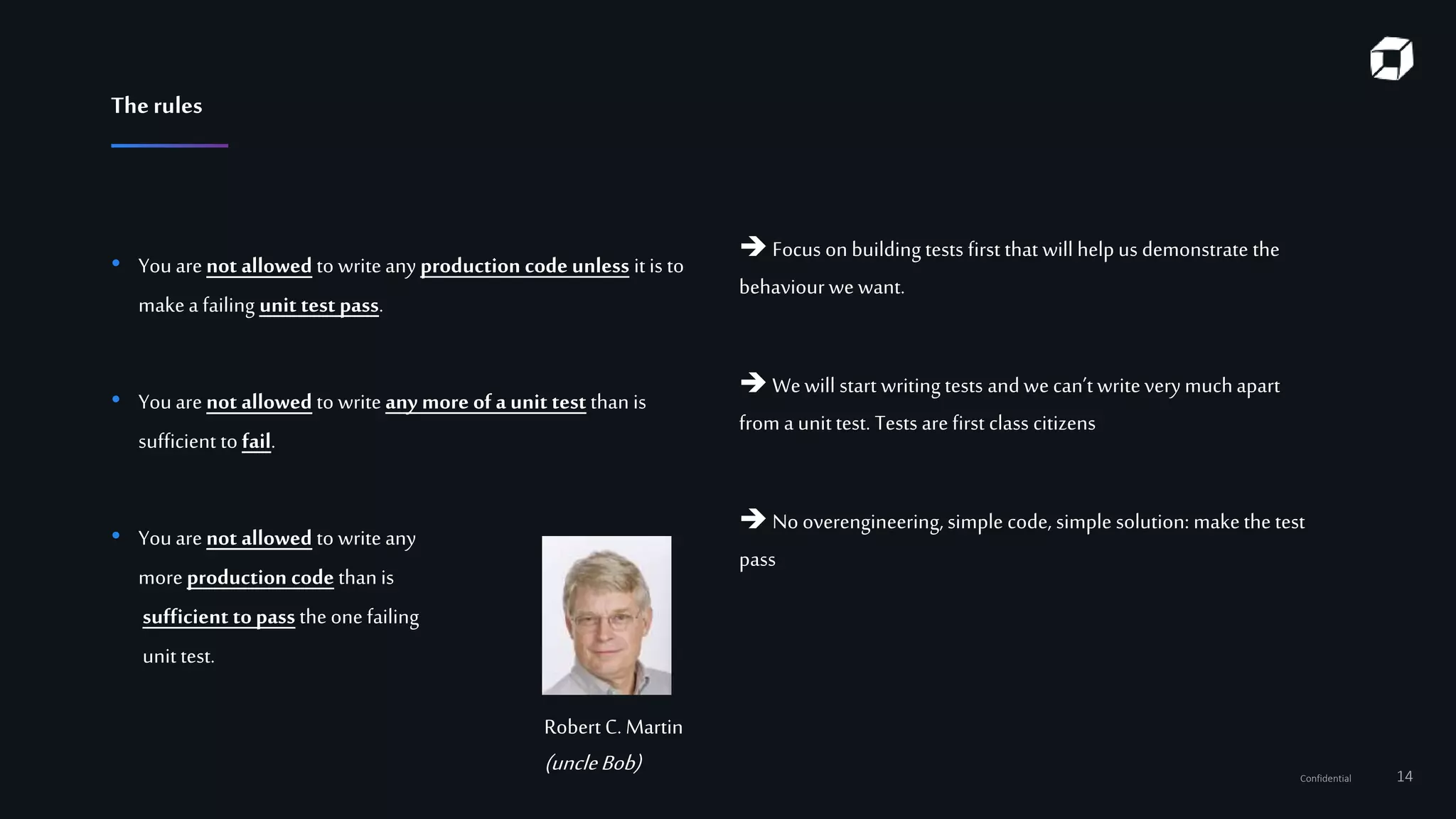
• You are not allowed to writeany production code unless it is to
makea failing unit test pass.
• Youare not allowed to write any more of a unit test than is
sufficient to fail.
• Youare not allowed to write any
more production code than is
sufficient topass the one failing
unit test.
Robert C. Martin
(uncleBob)
Therules
Confidential 15
• A bit of history and why
• Process & rules
• Good habits
• Questions?
• Demo / Kata 1
• Pair programming
• Kata 2
• Break
• Kata 3
• Final Recap
Agenda
Confidential 16
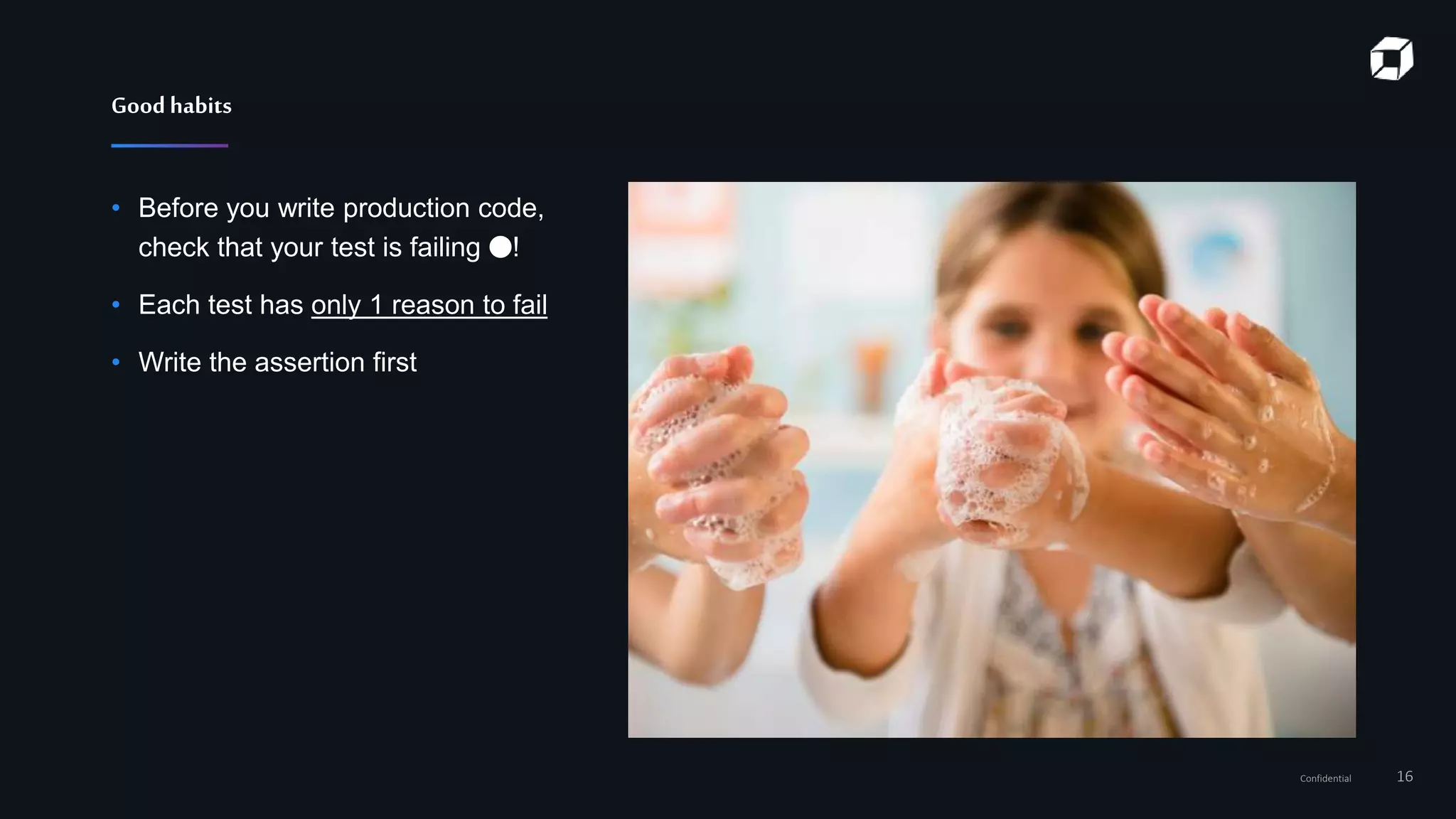
• Before you write production code,
check that your test is failing 🔴!
• Each test has only 1 reason to fail
• Write the assertion first
Goodhabits
Confidential 17
Tests namingconvention
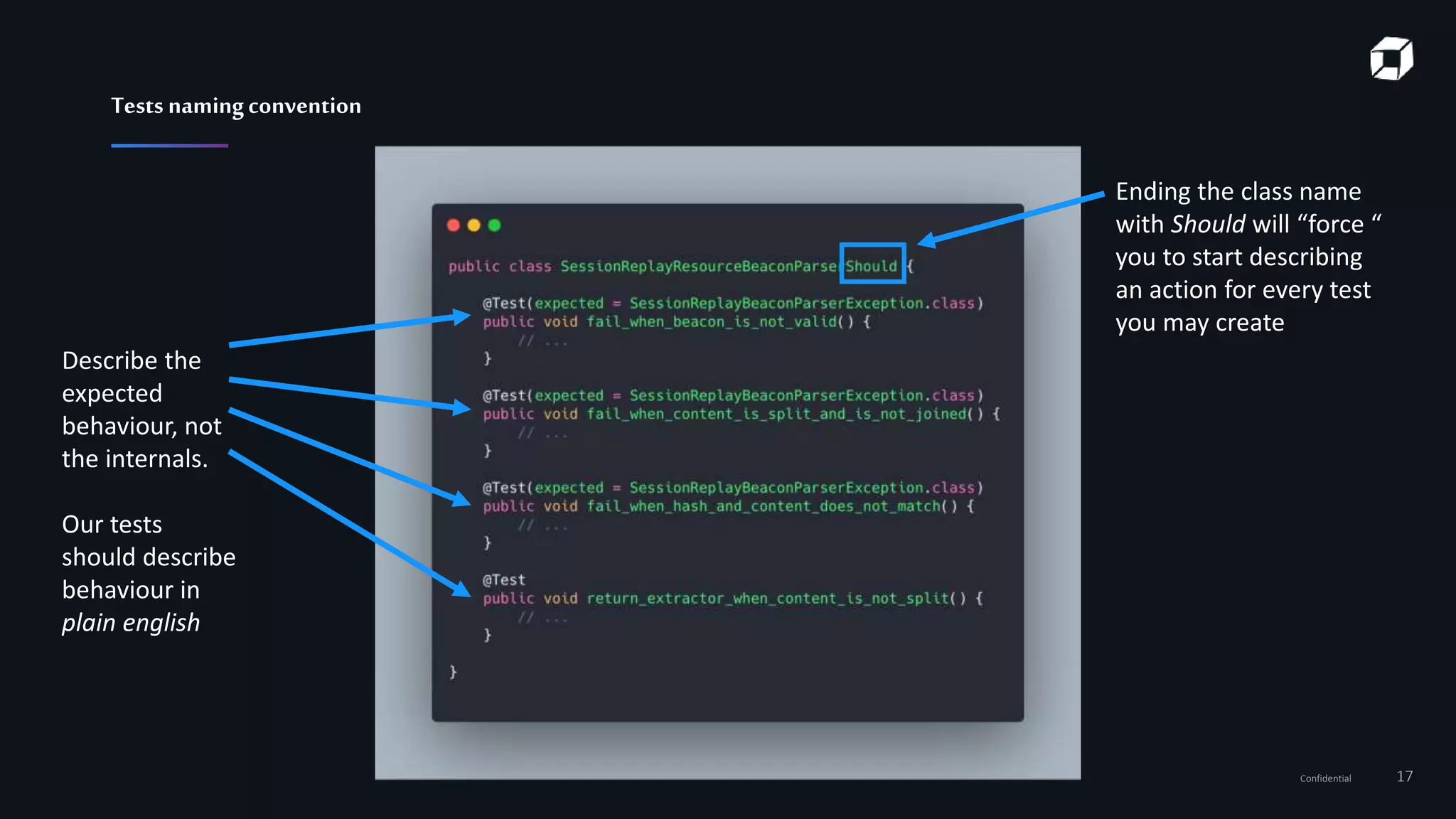
Ending the class name
with Should will “force “
you to start describing
an action for every test
you may create
Describe the
expected
behaviour, not
the internals.
Our tests
should describe
behaviour in
plain english
Confidential 18
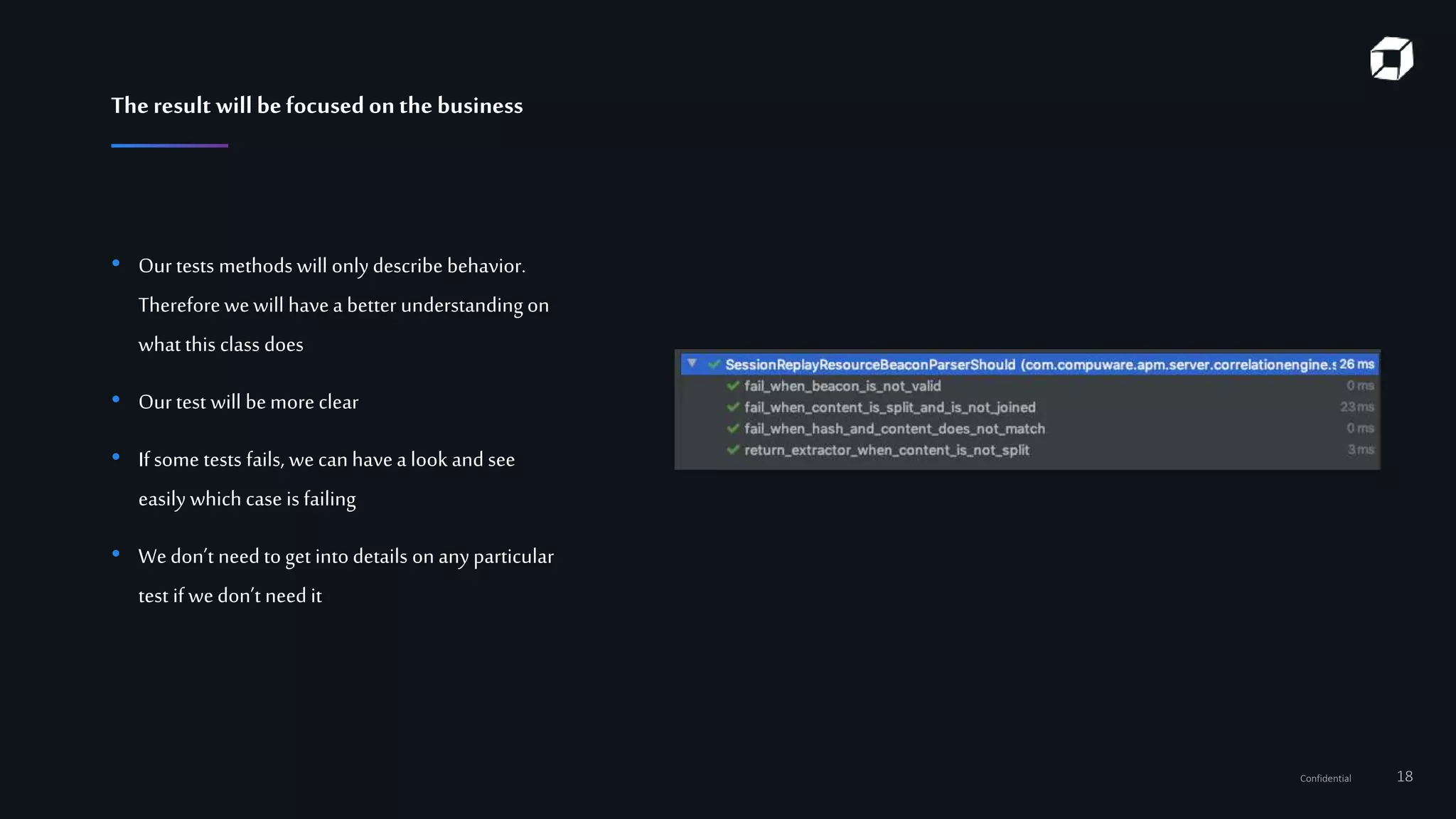
• Our tests methods will onlydescribe behavior.
Thereforewewill havea better understanding on
what this class does
• Ourtest will bemore clear
• If some tests fails, we can havea look and see
easily which case is failing
• Wedon’t need to get into details on anyparticular
test if wedon’t need it
Theresult will befocusedonthe business
Confidential 19
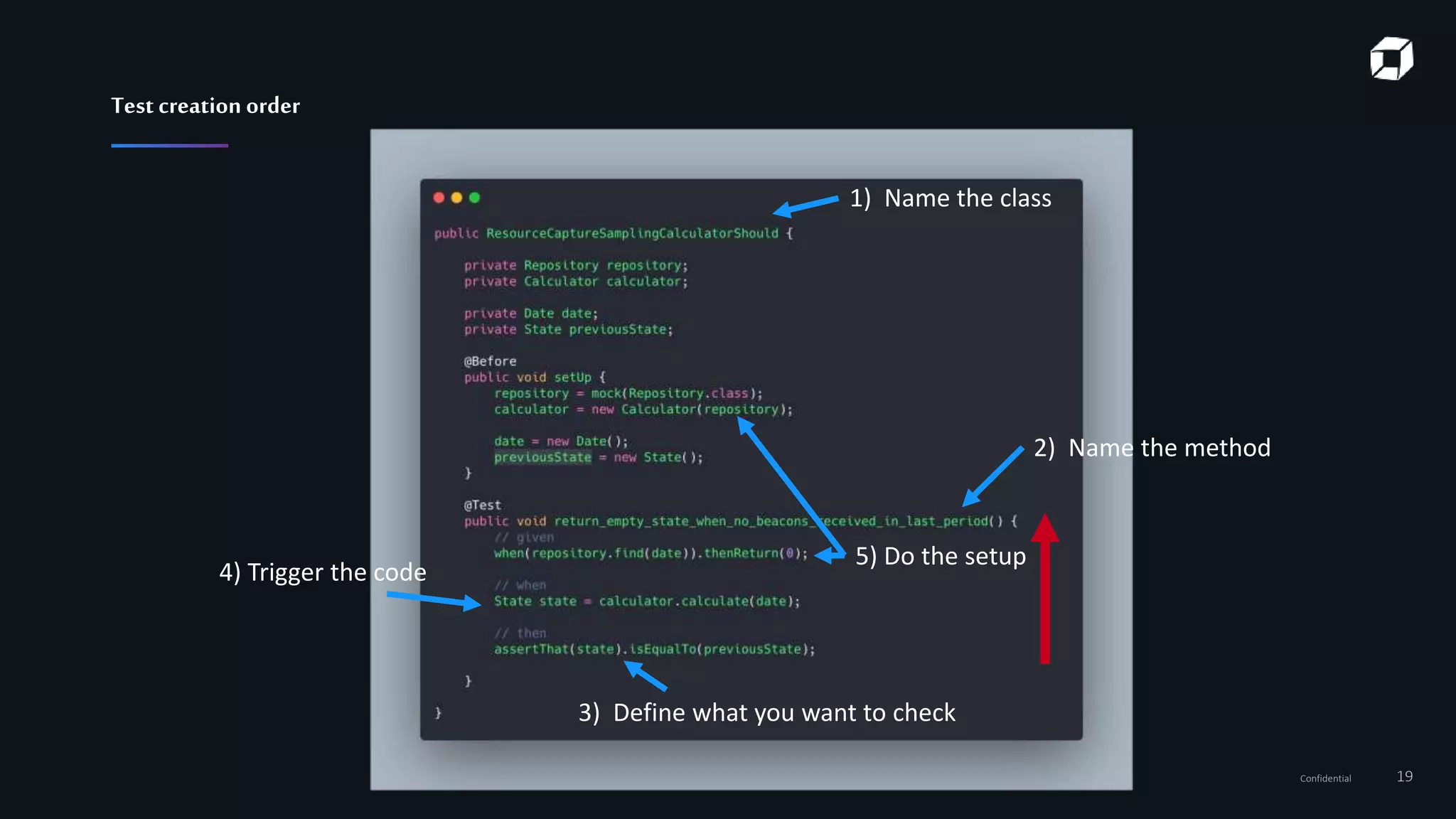
Test creation order
1) Name the class
2) Name the method
3) Define what you want to check
4) Trigger the code
5) Do the setup
Confidential 20
• A bit of history and why
• Process & rules
• Good habits
• Questions?
• Demo / Kata 1
• Pair programming
• Kata 2
• Break
• Kata 3
• Final Recap
Agenda
21Confidential
Questions?
Confidential 22
• A bit of history and why
• Process & rules
• Good habits
• Questions?
• Demo/ Kata1
• Pair programming
• Kata 2
• Break
• Kata 3
• Final Recap
Agenda
Confidential 23
Demo/ Kata 1:FizzBuzz
• https://kata-log.rocks/fizz-buzz-kata • Write a program that prints one linefor each numberfrom 1 to
100
• For multiples of 3 print Fizzinstead of the number
• For the multiples of 5 print Buzzinstead of thenumber
• For numberswhich are multiples of both 3 and 5
print FizzBuzzinstead of thenumber
Confidential 24
Warning –Live coding!
Confidential 25
• A bit of history and why
• Process & rules
• Good habits
• Questions?
• Demo / Kata 1
• Pair programming
• Kata 2
• Break
• Kata 3
• Final Recap
Agenda
Confidential 26
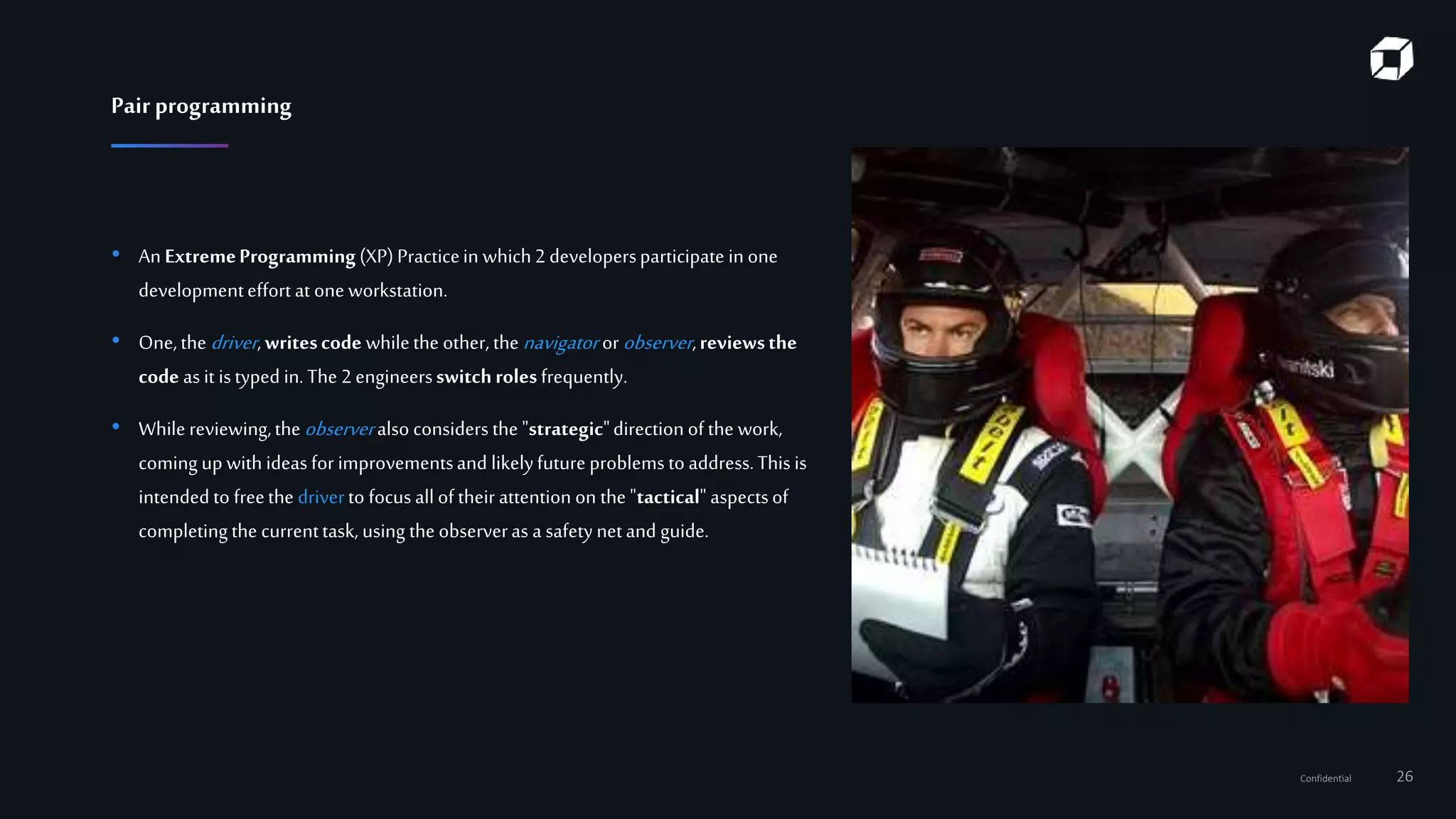
• An ExtremeProgramming(XP)Practicein which2 developersparticipate inone
developmenteffort at one workstation.
• One,the driver,writescode whilethe other, the navigator orobserver,reviewsthe
code as it istyped in. The 2engineersswitchrolesfrequently.
• While reviewing,the observeralso considers the "strategic"direction of the work,
coming up with ideas for improvementsand likelyfuture problemsto address.This is
intended to freethe driverto focus all of their attention on the"tactical" aspectsof
completingthe currenttask, using theobserveras a safety netand guide.
Pair programming
Confidential 27
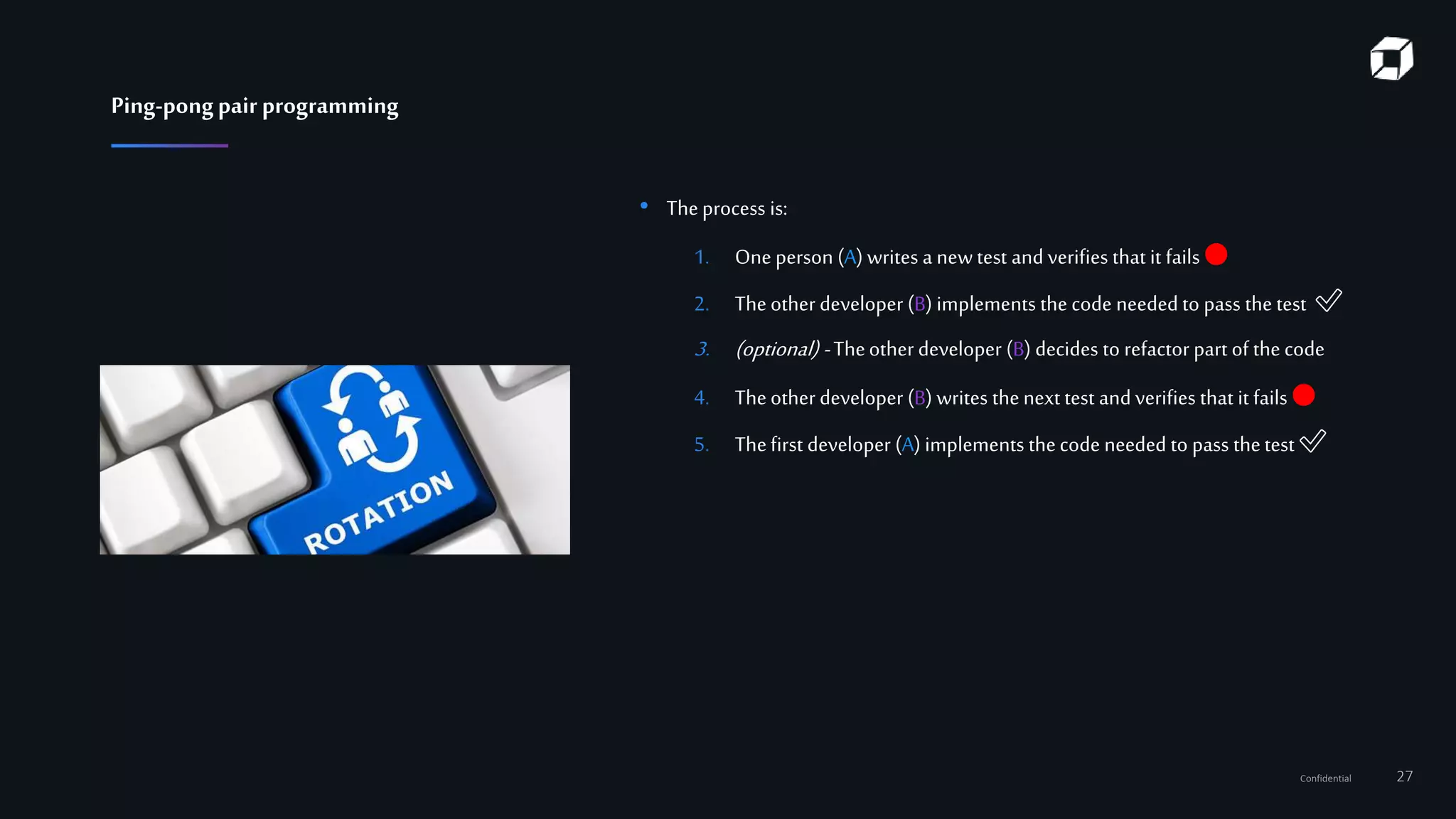
• Theprocess is:
1. One person (A) writes a newtest and verifies that it fails 🔴
2. Theother developer (B) implements the code needed to pass the test ✅
3. (optional) -Theother developer (B) decides to refactor part of the code
4. Theother developer (B) writes thenext test and verifies that it fails 🔴
5. Thefirst developer (A) implements thecode needed to pass thetest ✅
Ping-pongpairprogramming
Confidential 28
Thinkaboutcraftmanship
• Be patience, don’t rush.
• Tryto learn as muchas you can from yourcolleague
• No pair pressure -> negotiation for the win!
• Write code youwill be proud of 😃👍
Confidential 29
Be kind and respectful
Confidential 30
Are youready?
Confidential 31
Let’s play!
Confidential 32
• A bit of history and why
• Process & rules
• Good habits
• Questions?
• Demo / Kata 1
• Pair programming
• Kata2
• Kata 3
• Final Recap
Agenda
Confidential 33
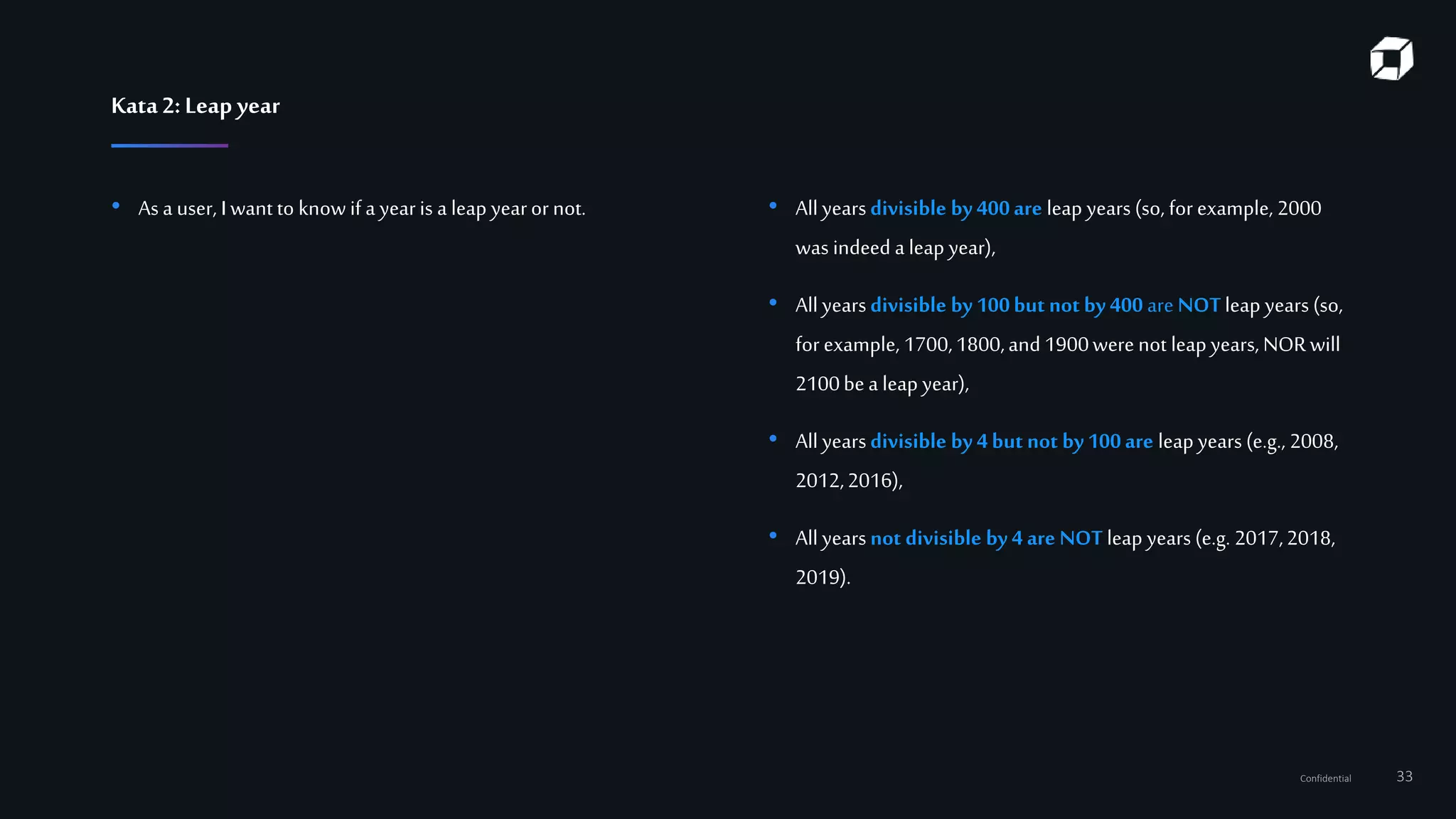
Kata2:Leap year
• As a user, I want to know if a yearis a leap yearor not. • All yearsdivisible by400are leap years (so, for example, 2000
was indeed a leap year),
• All yearsdivisible by100but not by 400 are NOTleap years (so,
for example, 1700,1800,and 1900were not leap years, NORwill
2100bea leap year),
• All yearsdivisible by 4but not by100are leap years (e.g., 2008,
2012,2016),
• All yearsnot divisible by4 are NOT leap years (e.g. 2017,2018,
2019).
Confidential 34
• A bit of history and why
• Process & rules
• Good habits
• Questions?
• Demo / Kata 1
• Pair programming
• Kata 2
• Kata3
• Final Recap
Agenda
Confidential 35
Kata3:String calculator
• Createa simple String calculator with a method signature:
int Add(string numbers)
• Themethod can takeup to two numbers, separated by commas,
and will returntheir sum.
Examples:
• “” or “1” or “1,2” as inputs.
• For an empty string it will return0.
Confidential 36
Kata3:String calculator
• Iteration 1
Allow theAdd method to handle an unknownamountof
numbers.
Confidential 37
Kata3:String calculator
• Iteration 2
Allow theAdd method to handle newlinesbetween numbers
(instead of commas).
Examples:
• Thefollowing input is ok: “1n2,3”(will equal 6)
• Thefollowing input is NOTok: “1,n” (not need to proveit -just
clarifying)
Confidential 38
Kata3:String calculator
• Iteration 3
Support different delimiters:
• To change adelimiter, the beginning ofthe string will contain a
separate line that looks like this: “//[delimiter]n[numbers…]” for

example “//;n1;2” should return three where the default delimiter
is‘;’.
• The firstline is optional. All existing scenarios should still be
supported.
Confidential 39
Kata3:String calculator
• Iteration 4
Calling Add with a negative numberwill throw an
exception “negatives not allowed” -and the negative that was
passed.
• If there are multiple negatives, show all of them in the exception
message.
Confidential 40
Kata3:String calculator
• Iteration 5
Numbersbigger than 1000should be ignored.
• Ifyou want more,you can playmore!See: https://kata-
log.rocks/string-calculator-kata
Example:
• 2+ 1001= 2
Confidential 41
• A bit of history and why
• Process & rules
• Good habits
• Questions?
• Demo / Kata 1
• Pair programming
• Kata 2
• Kata 3
• Final Recap
Agenda
Confidential 42
• Martin Fowler (main concepts around testing)
• https://www.martinfowler.com/bliki/TestDouble.html
• https://martinfowler.com/articles/mocksArentStubs.html
• https://martinfowler.com/articles/practical-test-
pyramid.html
• JamesShore(JS practices)
• https://www.youtube.com/user/jdlshore/videos
• Jason Gorman(Java practices)
• https://www.youtube.com/user/parlezuml/videos
Recommendedcontent
Confidential 43
• What this yourfirst experience using TDD?
• Was it somehow useful?
• Did youlearn something today?
• Did you enjoythe session?
• Would youlike to haveanother (more advanced) session?
FinalRecap
44Confidential
• nacho@cougil.com /nacho@barcelonajug.org
• https://nacho.cougil.com
• @icougil
Questions?
I need yourfeedback, please:
https://bit.ly/intro-to-tdd-feedback
45Confidential

Introduction to TDD

  • 1.
  • 2.
  • 3.
    3Confidential Whythis session? • Understandthe basics around TDD • Be able building a software starting with tests • Enjoy the benefits of building code covered by tests • Code a bit (and probably) learn something new from your colleagues • … so do not run away please! 😉
  • 4.
    Confidential 4 NachoCougil • SeniorSoftware Engineerat Dynatrace • TDD &cleancode fan • Founderof the Barcelona Java Users Group & the Javaand JVMBarcelona Conference (JBCNConf) • Father, formermountain marathonrunner 😅 @icougil WhoamI?
  • 5.
    Confidential 5 • Raiseyourhand at anymoment! • Also, join ourSlack for any questions, suggestions or ideas you mayhave! • http://bit.ly/slack-bcnjug Askquestions atanytime,please!
  • 6.
  • 7.
    7Confidential • A bitof history and why • Process & rules • Good habits • Questions? • Demo / Kata 1 • Pair programming • Kata 2 • Break • Kata 3 • Final Recap Agenda
  • 8.
    8Confidential • A bitofhistory and why • Process & rules • Good habits • Questions? • Demo / Kata 1 • Pair programming • Kata 2 • Kata 3 • Final Recap Agenda
  • 9.
    Confidential 9 • KentBeck “rediscovered” TDD whenwriting first testing framework SUnitin1994. “Taketheinputtape,manuallytypeintheoutput tapeyouexpect, then programuntiltheactual outputtapematches the expected output.” • TDD became part of Extreme Programmingbook in1999. Abit of history
  • 10.
    Confidential 10 • Finddefectsearlier(whenrunningordesigningyourtests). Easilydetect regressionerrors • Yoursoftwarewillbe easiertorefactorbecauseof ✅ green (safetynet) • Guidesyoudoing smallsteps • Guidesyouhow aconsumerwould useyourcomponent • Testsarelivingdocumentation • The softwareyouwillwriteitislikely tohavelessbugs( references:Test-drivendevelopmentasadefect-reduction practice(IEEE) , Guest Editors'Introduction:TDD--The Artof FearlessProgramming(computer.org)) • Developmentcostswillbe lower Why?
  • 11.
    Confidential 11 How itis? • Youlearnedhow to write code time ago,…and now you’dmay learn a different way of writing software… Likedriving a “different” bike • Youhaveto kindof "break"yourrules and think outsideyour comfort zone
  • 12.
    Confidential 12 • Abit of history and why • Process &rules • Good habits • Questions? • Demo / Kata 1 • Pair programming • Kata 2 • Kata 3 • Final Recap Agenda
  • 13.
  • 14.
    Confidential 14  Focuson building tests first that will help us demonstrate the behaviour we want.  Wewill start writing tests and we can’t writeverymuchapart from a unittest. Tests are first class citizens  No overengineering, simple code, simple solution: makethe test pass • You are not allowed to writeany production code unless it is to makea failing unit test pass. • Youare not allowed to write any more of a unit test than is sufficient to fail. • Youare not allowed to write any more production code than is sufficient topass the one failing unit test. Robert C. Martin (uncleBob) Therules
  • 15.
    Confidential 15 • Abit of history and why • Process & rules • Good habits • Questions? • Demo / Kata 1 • Pair programming • Kata 2 • Break • Kata 3 • Final Recap Agenda
  • 16.
    Confidential 16 • Beforeyou write production code, check that your test is failing 🔴! • Each test has only 1 reason to fail • Write the assertion first Goodhabits
  • 17.
    Confidential 17 Tests namingconvention Endingthe class name with Should will “force “ you to start describing an action for every test you may create Describe the expected behaviour, not the internals. Our tests should describe behaviour in plain english
  • 18.
    Confidential 18 • Ourtests methods will onlydescribe behavior. Thereforewewill havea better understanding on what this class does • Ourtest will bemore clear • If some tests fails, we can havea look and see easily which case is failing • Wedon’t need to get into details on anyparticular test if wedon’t need it Theresult will befocusedonthe business
  • 19.
    Confidential 19 Test creationorder 1) Name the class 2) Name the method 3) Define what you want to check 4) Trigger the code 5) Do the setup
  • 20.
    Confidential 20 • Abit of history and why • Process & rules • Good habits • Questions? • Demo / Kata 1 • Pair programming • Kata 2 • Break • Kata 3 • Final Recap Agenda
  • 21.
  • 22.
    Confidential 22 • Abit of history and why • Process & rules • Good habits • Questions? • Demo/ Kata1 • Pair programming • Kata 2 • Break • Kata 3 • Final Recap Agenda
  • 23.
    Confidential 23 Demo/ Kata1:FizzBuzz • https://kata-log.rocks/fizz-buzz-kata • Write a program that prints one linefor each numberfrom 1 to 100 • For multiples of 3 print Fizzinstead of the number • For the multiples of 5 print Buzzinstead of thenumber • For numberswhich are multiples of both 3 and 5 print FizzBuzzinstead of thenumber
  • 24.
  • 25.
    Confidential 25 • Abit of history and why • Process & rules • Good habits • Questions? • Demo / Kata 1 • Pair programming • Kata 2 • Break • Kata 3 • Final Recap Agenda
  • 26.
    Confidential 26 • AnExtremeProgramming(XP)Practicein which2 developersparticipate inone developmenteffort at one workstation. • One,the driver,writescode whilethe other, the navigator orobserver,reviewsthe code as it istyped in. The 2engineersswitchrolesfrequently. • While reviewing,the observeralso considers the "strategic"direction of the work, coming up with ideas for improvementsand likelyfuture problemsto address.This is intended to freethe driverto focus all of their attention on the"tactical" aspectsof completingthe currenttask, using theobserveras a safety netand guide. Pair programming
  • 27.
    Confidential 27 • Theprocessis: 1. One person (A) writes a newtest and verifies that it fails 🔴 2. Theother developer (B) implements the code needed to pass the test ✅ 3. (optional) -Theother developer (B) decides to refactor part of the code 4. Theother developer (B) writes thenext test and verifies that it fails 🔴 5. Thefirst developer (A) implements thecode needed to pass thetest ✅ Ping-pongpairprogramming
  • 28.
    Confidential 28 Thinkaboutcraftmanship • Bepatience, don’t rush. • Tryto learn as muchas you can from yourcolleague • No pair pressure -> negotiation for the win! • Write code youwill be proud of 😃👍
  • 29.
  • 30.
  • 31.
  • 32.
    Confidential 32 • Abit of history and why • Process & rules • Good habits • Questions? • Demo / Kata 1 • Pair programming • Kata2 • Kata 3 • Final Recap Agenda
  • 33.
    Confidential 33 Kata2:Leap year •As a user, I want to know if a yearis a leap yearor not. • All yearsdivisible by400are leap years (so, for example, 2000 was indeed a leap year), • All yearsdivisible by100but not by 400 are NOTleap years (so, for example, 1700,1800,and 1900were not leap years, NORwill 2100bea leap year), • All yearsdivisible by 4but not by100are leap years (e.g., 2008, 2012,2016), • All yearsnot divisible by4 are NOT leap years (e.g. 2017,2018, 2019).
  • 34.
    Confidential 34 • Abit of history and why • Process & rules • Good habits • Questions? • Demo / Kata 1 • Pair programming • Kata 2 • Kata3 • Final Recap Agenda
  • 35.
    Confidential 35 Kata3:String calculator •Createa simple String calculator with a method signature: int Add(string numbers) • Themethod can takeup to two numbers, separated by commas, and will returntheir sum. Examples: • “” or “1” or “1,2” as inputs. • For an empty string it will return0.
  • 36.
    Confidential 36 Kata3:String calculator •Iteration 1 Allow theAdd method to handle an unknownamountof numbers.
  • 37.
    Confidential 37 Kata3:String calculator •Iteration 2 Allow theAdd method to handle newlinesbetween numbers (instead of commas). Examples: • Thefollowing input is ok: “1n2,3”(will equal 6) • Thefollowing input is NOTok: “1,n” (not need to proveit -just clarifying)
  • 38.
    Confidential 38 Kata3:String calculator •Iteration 3 Support different delimiters: • To change adelimiter, the beginning ofthe string will contain a separate line that looks like this: “//[delimiter]n[numbers…]” for example “//;n1;2” should return three where the default delimiter is‘;’. • The firstline is optional. All existing scenarios should still be supported.
  • 39.
    Confidential 39 Kata3:String calculator •Iteration 4 Calling Add with a negative numberwill throw an exception “negatives not allowed” -and the negative that was passed. • If there are multiple negatives, show all of them in the exception message.
  • 40.
    Confidential 40 Kata3:String calculator •Iteration 5 Numbersbigger than 1000should be ignored. • Ifyou want more,you can playmore!See: https://kata- log.rocks/string-calculator-kata Example: • 2+ 1001= 2
  • 41.
    Confidential 41 • Abit of history and why • Process & rules • Good habits • Questions? • Demo / Kata 1 • Pair programming • Kata 2 • Kata 3 • Final Recap Agenda
  • 42.
    Confidential 42 • MartinFowler (main concepts around testing) • https://www.martinfowler.com/bliki/TestDouble.html • https://martinfowler.com/articles/mocksArentStubs.html • https://martinfowler.com/articles/practical-test- pyramid.html • JamesShore(JS practices) • https://www.youtube.com/user/jdlshore/videos • Jason Gorman(Java practices) • https://www.youtube.com/user/parlezuml/videos Recommendedcontent
  • 43.
    Confidential 43 • Whatthis yourfirst experience using TDD? • Was it somehow useful? • Did youlearn something today? • Did you enjoythe session? • Would youlike to haveanother (more advanced) session? FinalRecap
  • 44.
    44Confidential • nacho@cougil.com /nacho@barcelonajug.org •https://nacho.cougil.com • @icougil Questions? I need yourfeedback, please: https://bit.ly/intro-to-tdd-feedback
  • 45.

Editor's Notes

  • #3 Nacho
  • #4 Nacho
  • #5 Nacho & Hermann
  • #6 Nacho
  • #8 Nacho - Around 2hs: Theorical content - 35mins 1st practice (demo) - 15mins 2nd practice (by attendees) – 50’ – 20-25mins 3rd practice (by attendees) – 1:10 – 25-30mins Final recap – 1:40 - 15-20mins - share the link of the presentation in the zoom
  • #9 Around 2hs: Theorical content - 35mins 1st practice (demo) - 15mins 2nd practice (by attendees) – 50’ – 20-25mins 3rd practice (by attendees) – 1:10 – 25-30mins Final recap – 1:40 - 15-20mins
  • #10 Hermann - Kent Beck’s book… Developed XP during his work at Chrysler
  • #11 Hermann -
  • #13 Around 2hs: Theorical content - 35mins 1st practice (demo) - 15mins 2nd practice (by attendees) – 50’ – 20-25mins 3rd practice (by attendees) – 1:10 – 25-30mins Final recap – 1:40 - 15-20mins
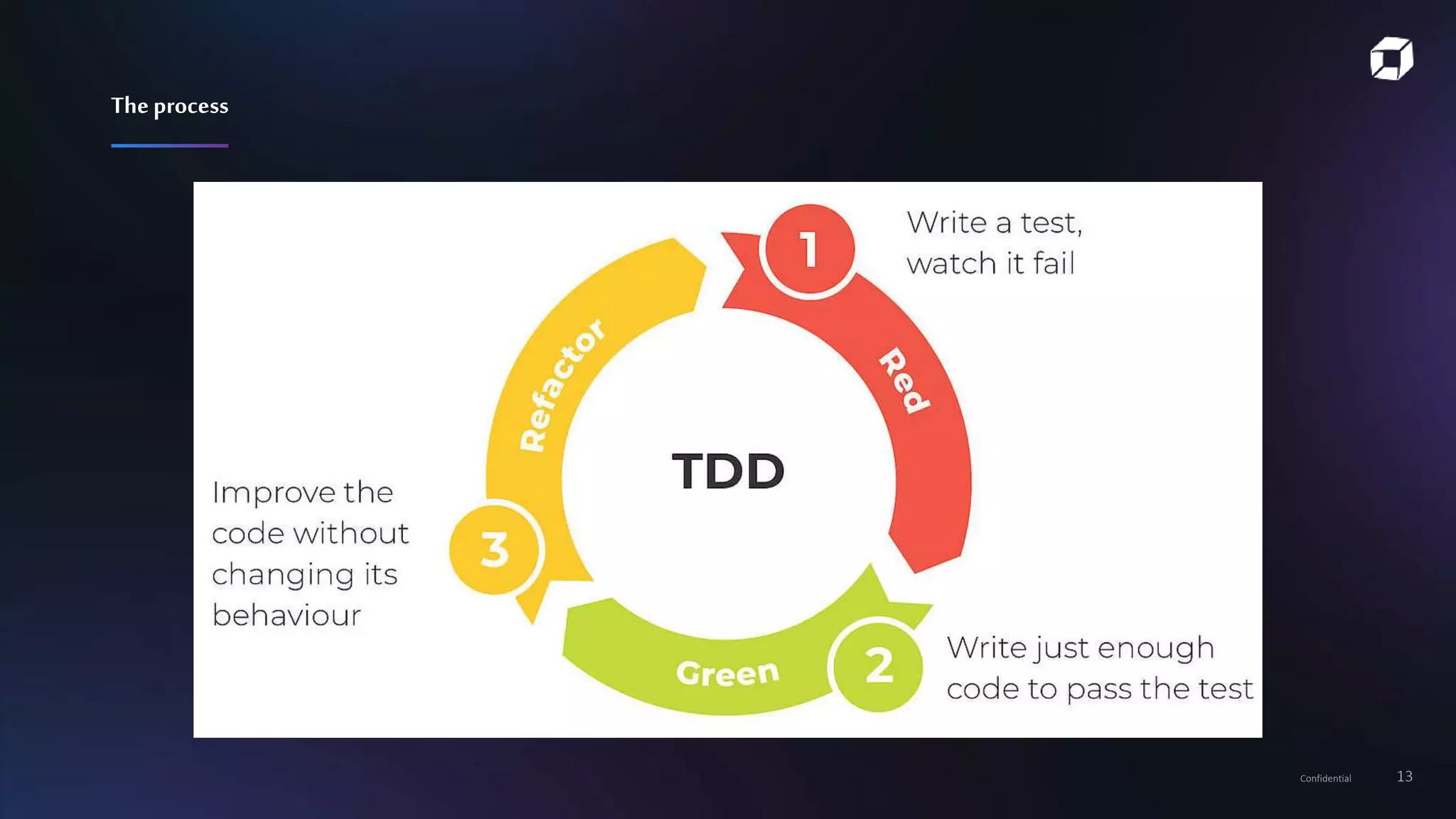
  • #14 Specify what you want to code to do Create just enough code to satisfy the desired behaviour (just make it work!) Clean your code and test / remove duplication / make it better
  • #16 Around 2hs: Theorical content - 35mins 1st practice (demo) - 15mins 2nd practice (by attendees) – 50’ – 20-25mins 3rd practice (by attendees) – 1:10 – 25-30mins Final recap – 1:40 - 15-20mins
  • #17 Nacho -
  • #18 Nacho - (copy the image in the Slack Channel ?)
  • #19 Nacho -
  • #20 Nacho -
  • #21 Around 2hs: Theorical content - 35mins 1st practice (demo) - 15mins 2nd practice (by attendees) – 50’ – 20-25mins 3rd practice (by attendees) – 1:10 – 25-30mins Final recap – 1:40 - 15-20mins
  • #22 Nacho -
  • #23 Nacho - Around 2hs: Theorical content - 35mins 1st practice (demo) - 15mins 2nd practice (by attendees) – 50’ – 20-25mins 3rd practice (by attendees) – 1:10 – 25-30mins Final recap – 1:40 - 15-20mins
  • #24 Nacho – we have to be here at 35 - 40’ as MAXIMUM <<<<
  • #25 Nacho -
  • #26 Nacho - Around 2hs: Theorical content - 35mins 1st practice (demo) - 15mins 2nd practice (by attendees) – 50’ – 20-25mins 3rd practice (by attendees) – 1:10 – 25-30mins Final recap – 1:40 - 15-20mins
  • #27 Nacho – This back-and-forth between test and code, driver and navigator, can offer better/richer feedback when building a system.
  • #28 Nacho – (copy the image in the Slack Channel ?)
  • #29 Nacho -
  • #30 Nacho -
  • #31 Nacho -
  • #32 Nacho -
  • #33 Hermann – 2hs: Theorical content - 35mins 1st practice (demo) - 15mins 2nd practice (by attendees) – 50’ – 20-25mins 3rd practice (by attendees) – 1:10 – 25-30mins Final recap – 1:40 - 15-20mins
  • #34 Bootstrap templates https://github.com/swkBerlin/kata-bootstraps
  • #35 Around 2hs: Theorical content - 35mins 1st practice (demo) - 15mins 2nd practice (by attendees) – 50’ – 20-25mins 3rd practice (by attendees) – 1:10 – 25-30mins Final recap – 1:40 - 15-20mins
  • #42 Around 2hs: Theorical content - 35mins 1st practice (demo) - 15mins 2nd practice (by attendees) – 50’ – 20-25mins 3rd practice (by attendees) – 1:10 – 25-30mins Final recap – 1:40 - 15-20mins
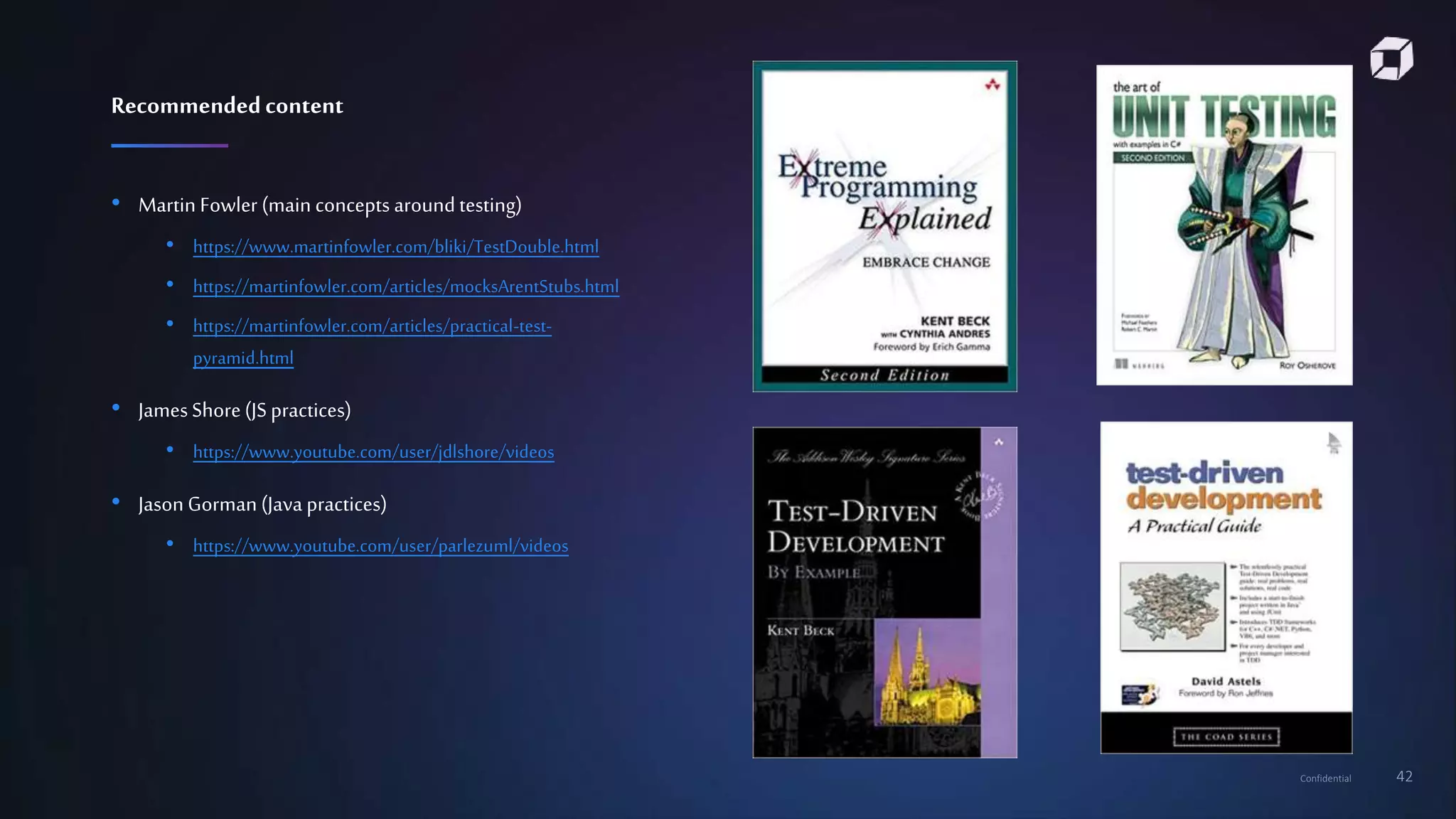
  • #43 XP explained – 1st time TDD appeared – nice intro to XP practices TDD by example – basic intro, idealised situation… The art of unit testing – easy to read TDD a practical guide – some examples with GUI & real examples
  • #45 Nacho
  • #46 Herman & Nacho