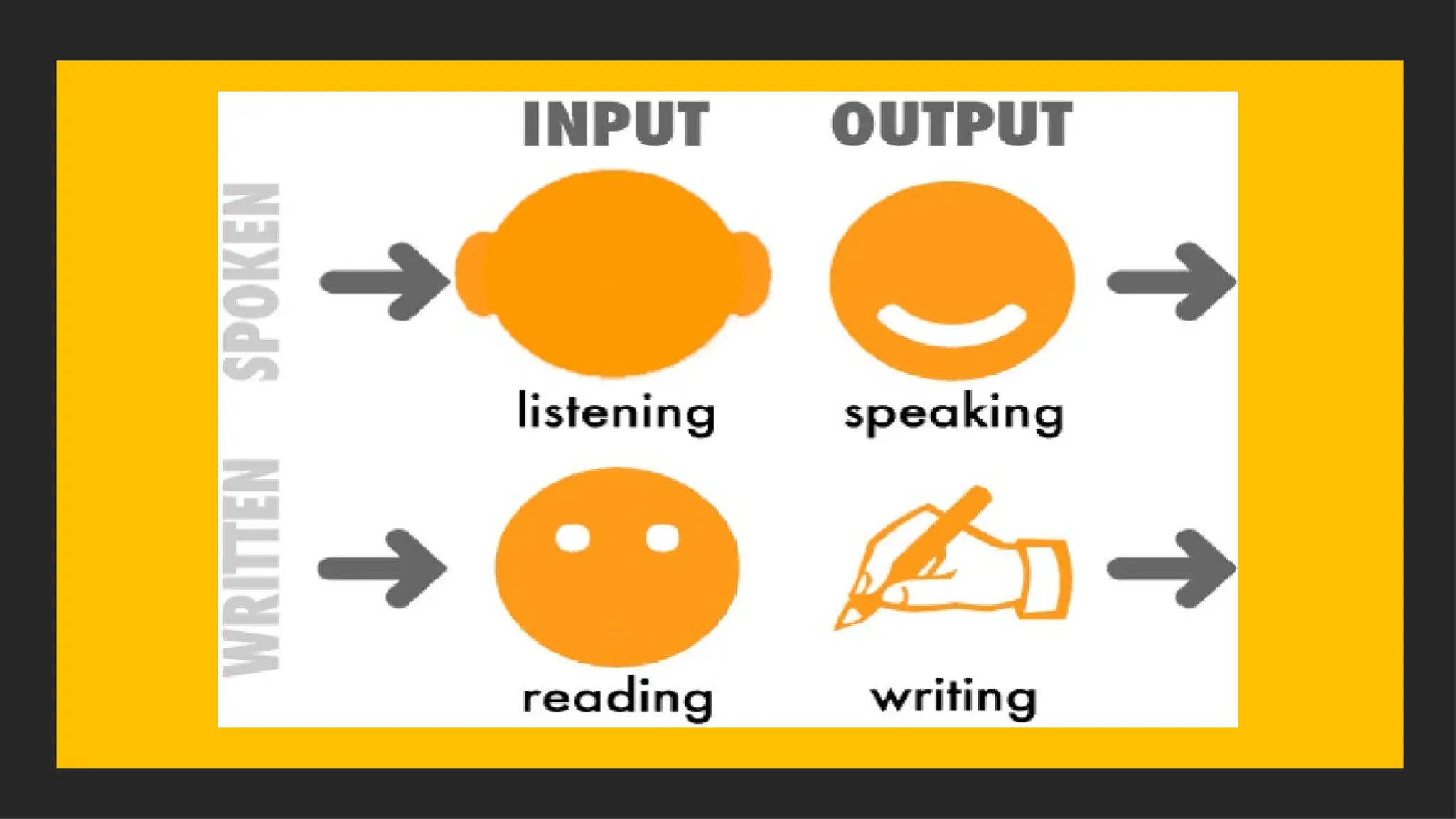
What is Speaking?
Conveying information verbally (through words and sounds),
we create sounds using many parts of our body, including the
lungs, vocal tract, vocal chords, tongue, teeth and lips.
Expression of thoughts
Expression of feelings
Expression of ideas
4.
What are SpeakingSkills ?
Ability to convey one’s message or information, verbally, in
a proper and sensible manner
Ability to express oneself clearly in front of others
Ability to express one’s ideas, feelings, and thoughts
Ability to give one’s opinion in different matters
5.
Importance of SpeakingSkills
Help create understanding
Help express oneself to others
Help a person grow socially in his personal and professional
life
Help avoid conflicts
6.
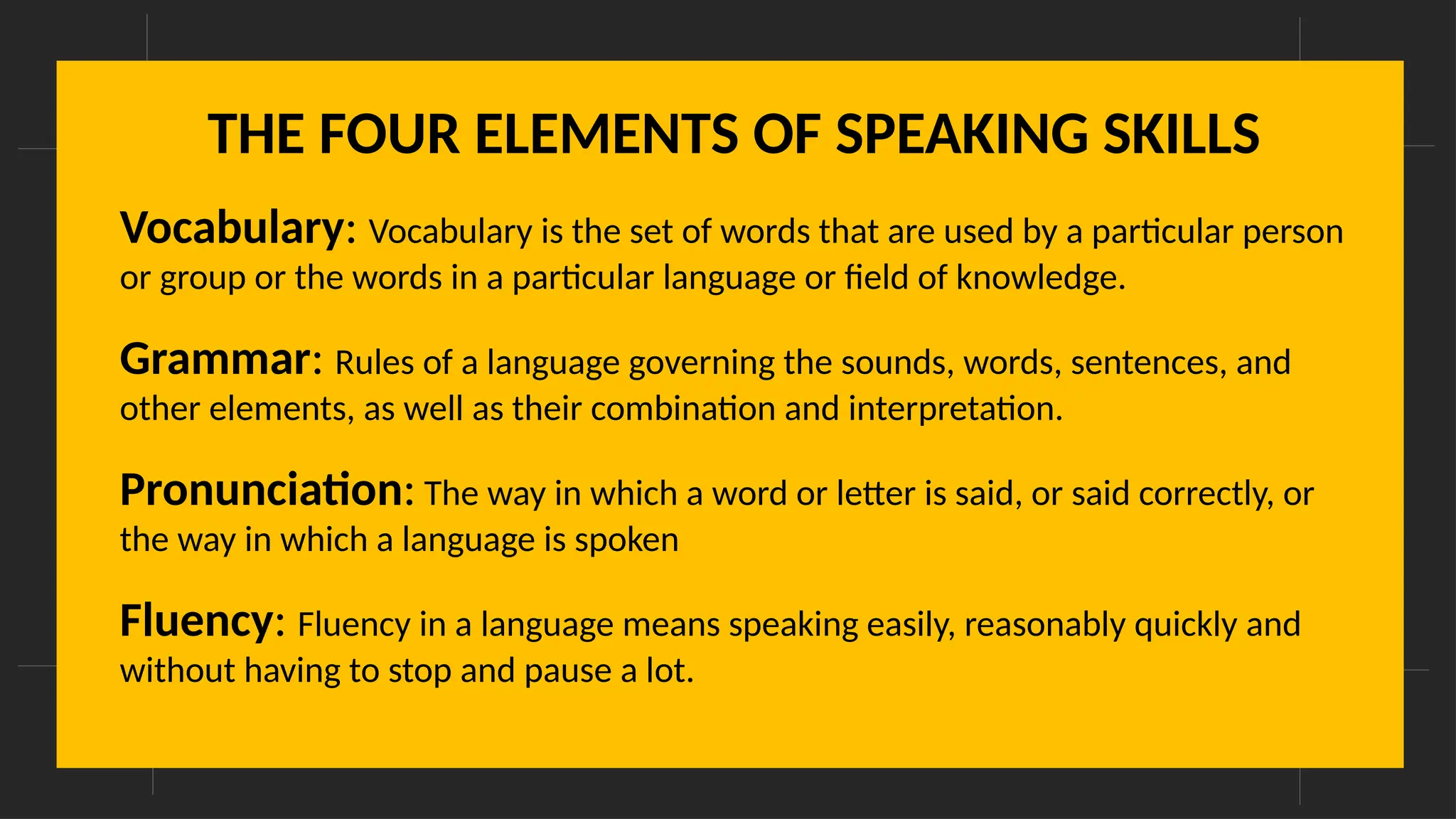
THE FOUR ELEMENTSOF SPEAKING SKILLS
Vocabulary: Vocabulary is the set of words that are used by a particular person
or group or the words in a particular language or field of knowledge.
Grammar: Rules of a language governing the sounds, words, sentences, and
other elements, as well as their combination and interpretation.
Pronunciation: The way in which a word or letter is said, or said correctly, or
the way in which a language is spoken
Fluency: Fluency in a language means speaking easily, reasonably quickly and
without having to stop and pause a lot.
7.
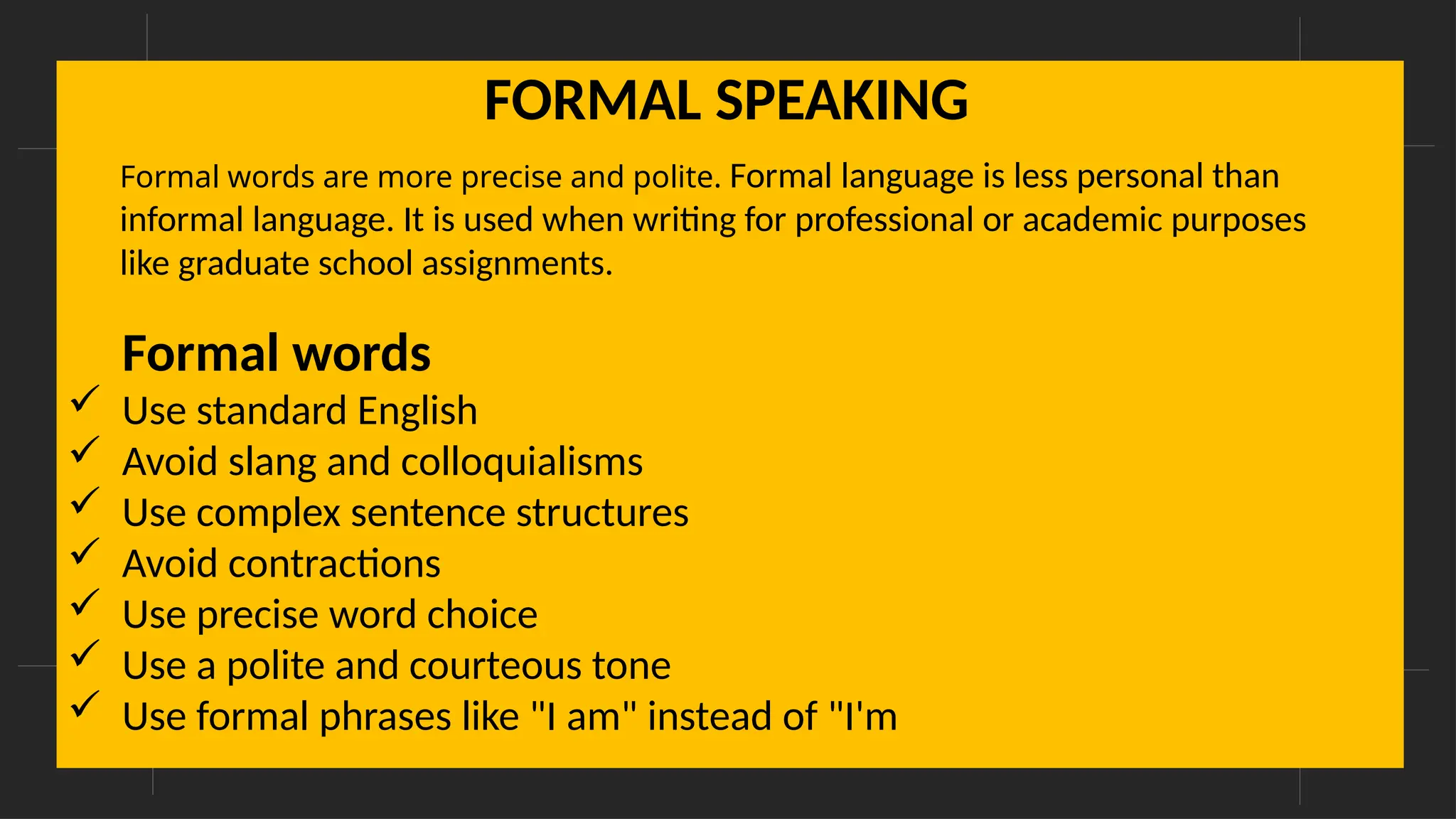
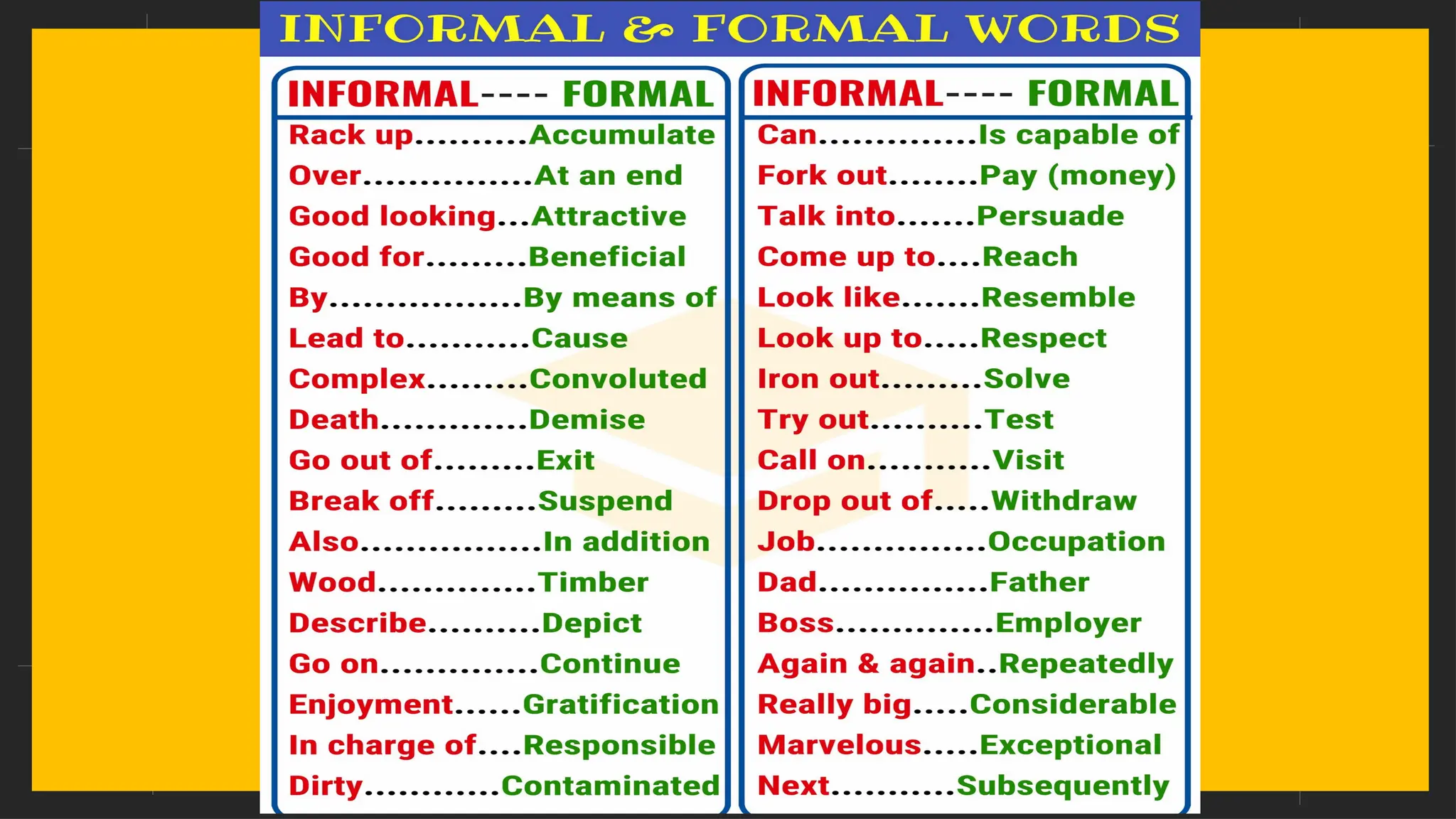
Formal words
Usestandard English
Avoid slang and colloquialisms
Use complex sentence structures
Avoid contractions
Use precise word choice
Use a polite and courteous tone
Use formal phrases like "I am" instead of "I'm
FORMAL SPEAKING
Formal words are more precise and polite. Formal language is less personal than
informal language. It is used when writing for professional or academic purposes
like graduate school assignments.
8.
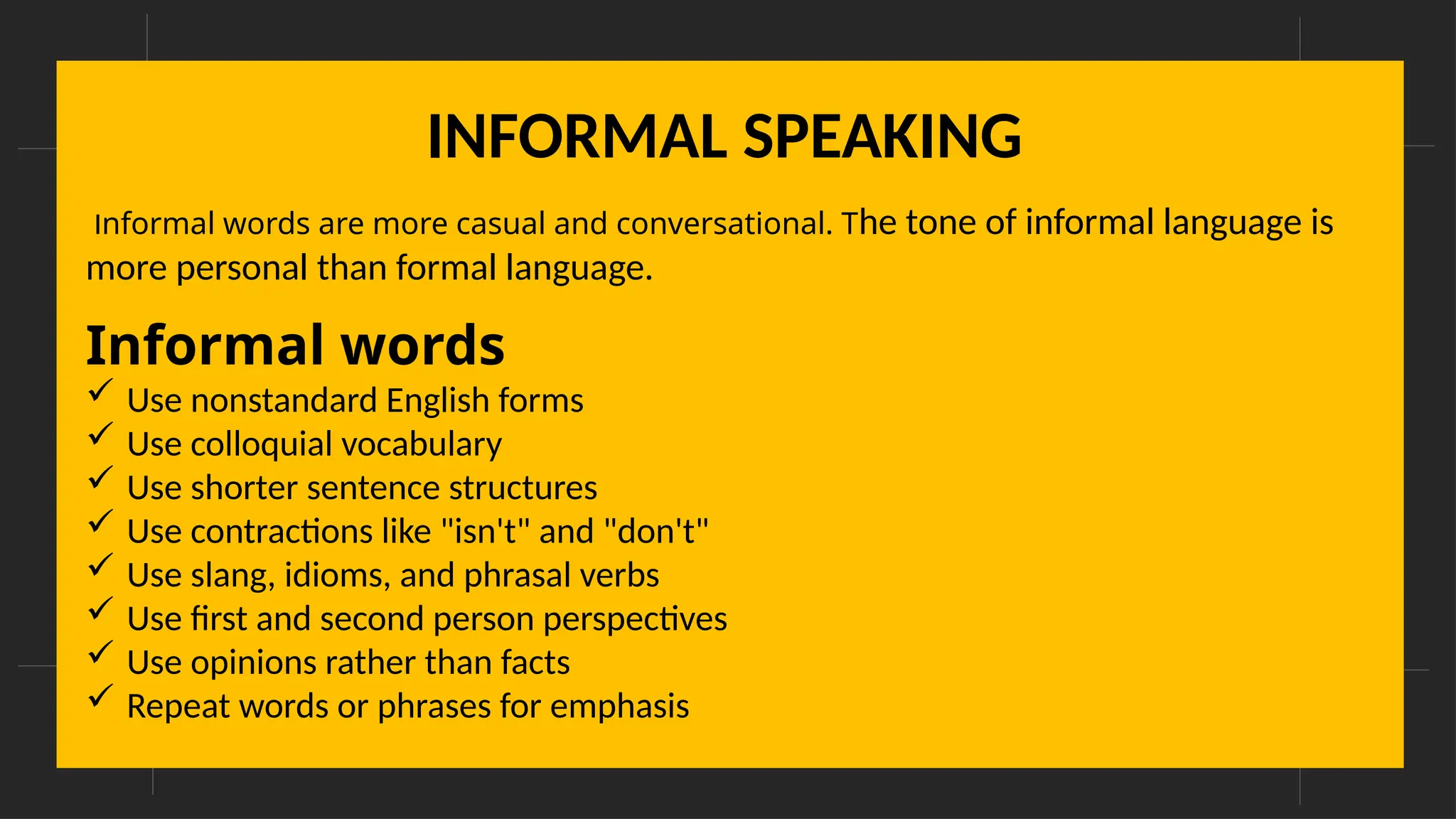
INFORMAL SPEAKING
Informal wordsare more casual and conversational. The tone of informal language is
more personal than formal language.
Informal words
Use nonstandard English forms
Use colloquial vocabulary
Use shorter sentence structures
Use contractions like "isn't" and "don't"
Use slang, idioms, and phrasal verbs
Use first and second person perspectives
Use opinions rather than facts
Repeat words or phrases for emphasis
9.
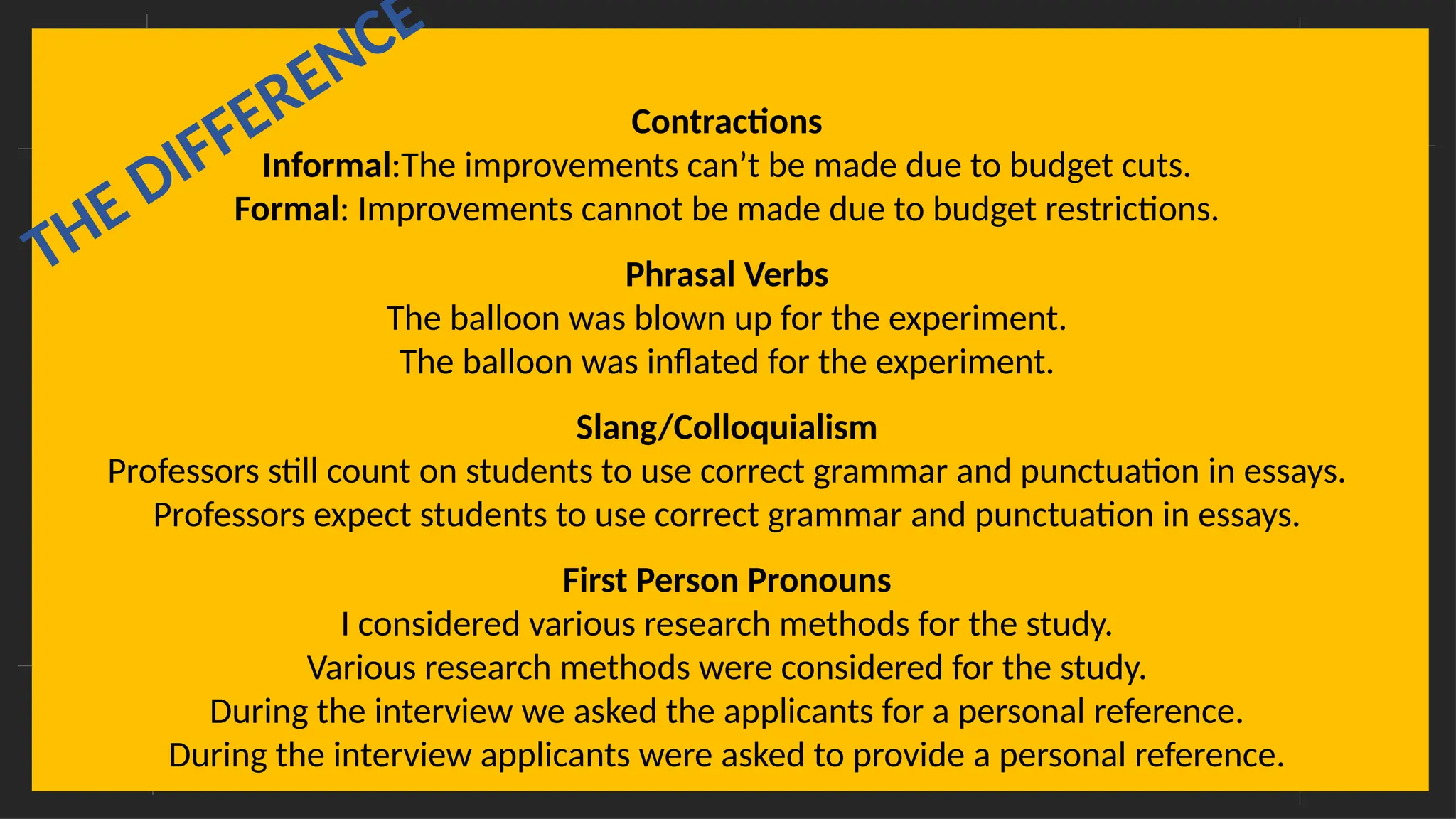
Contractions
Informal:The improvements can’tbe made due to budget cuts.
Formal: Improvements cannot be made due to budget restrictions.
Phrasal Verbs
The balloon was blown up for the experiment.
The balloon was inflated for the experiment.
Slang/Colloquialism
Professors still count on students to use correct grammar and punctuation in essays.
Professors expect students to use correct grammar and punctuation in essays.
First Person Pronouns
I considered various research methods for the study.
Various research methods were considered for the study.
During the interview we asked the applicants for a personal reference.
During the interview applicants were asked to provide a personal reference.
THE DIFFERENCE
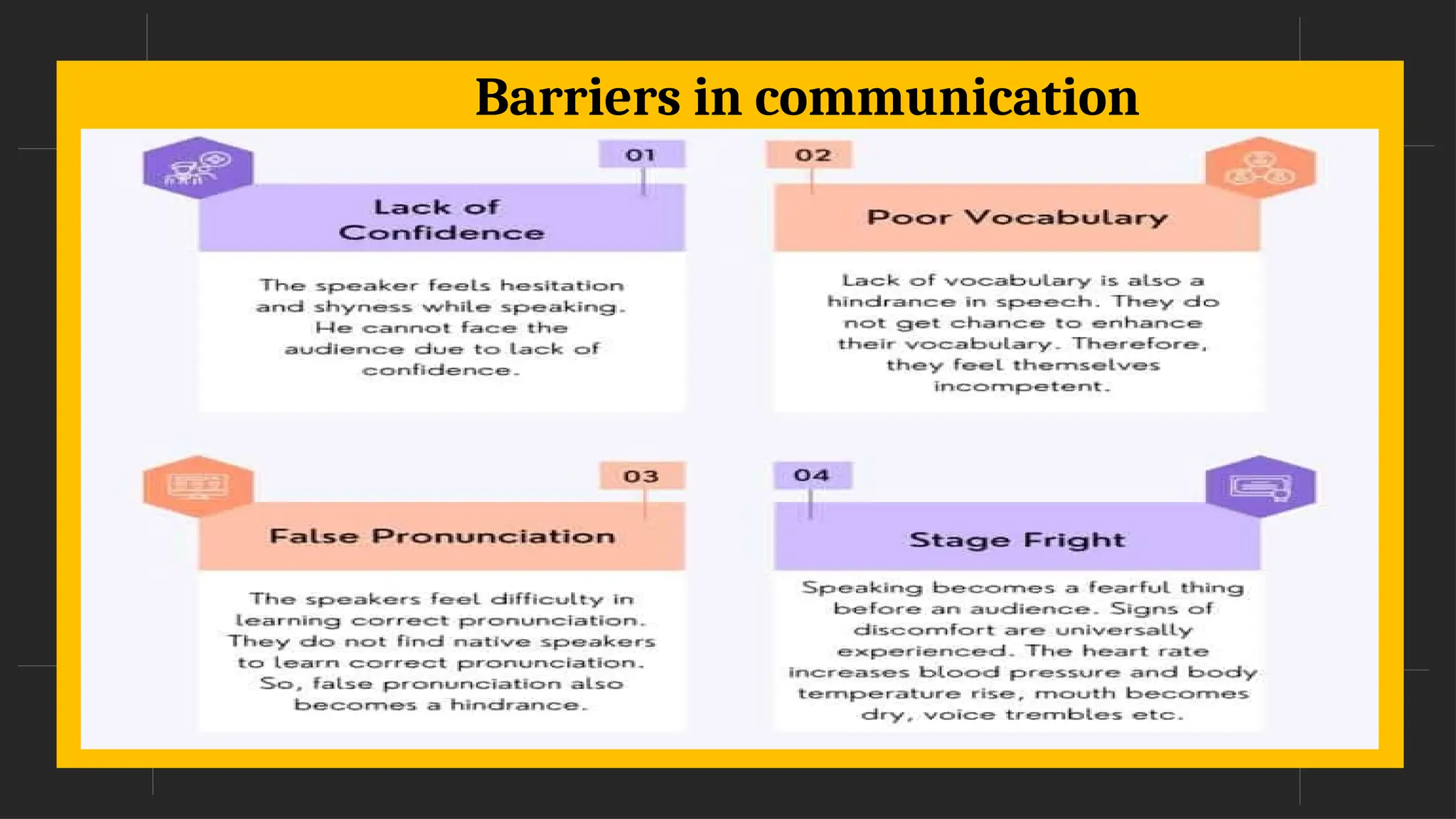
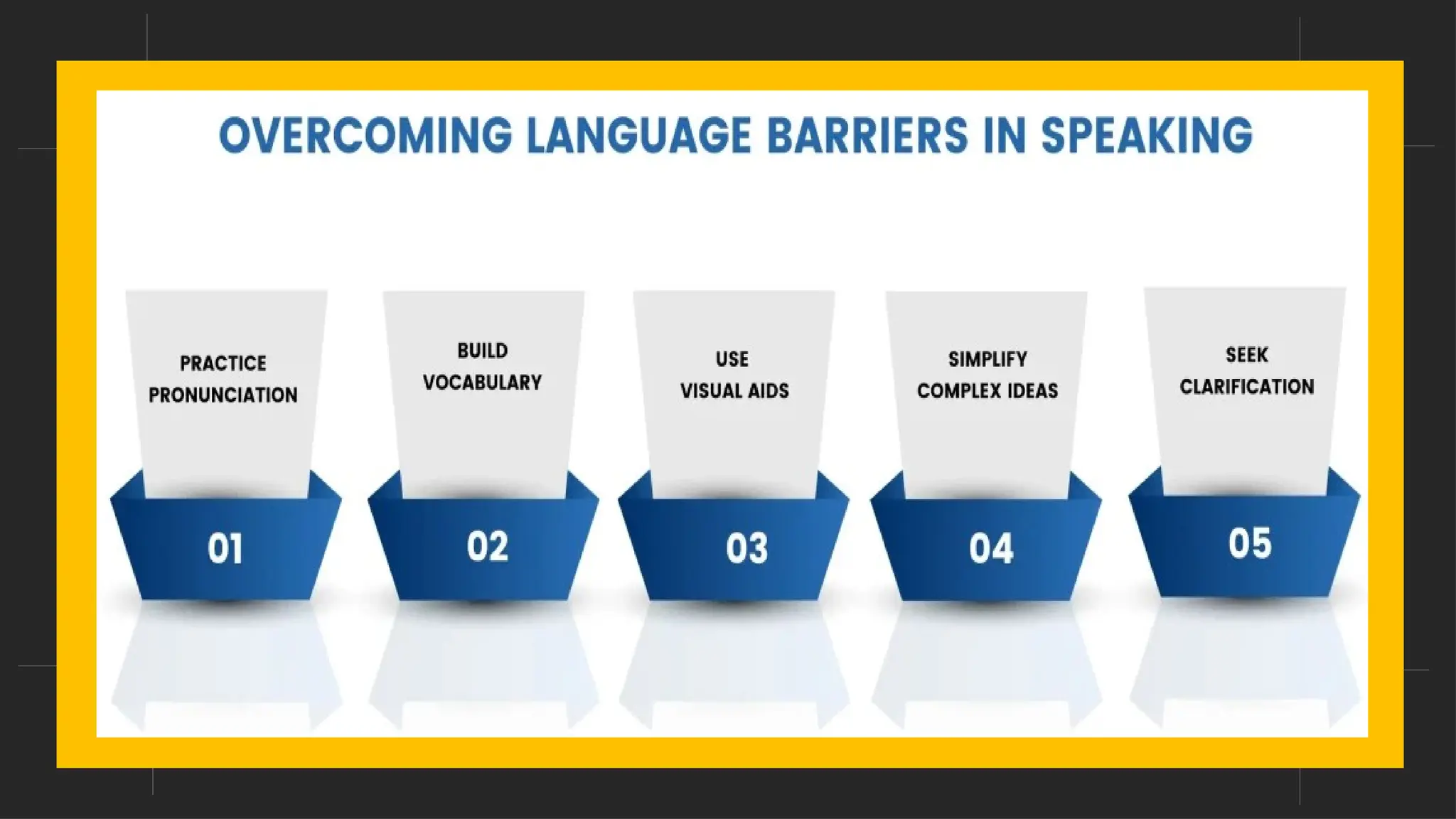
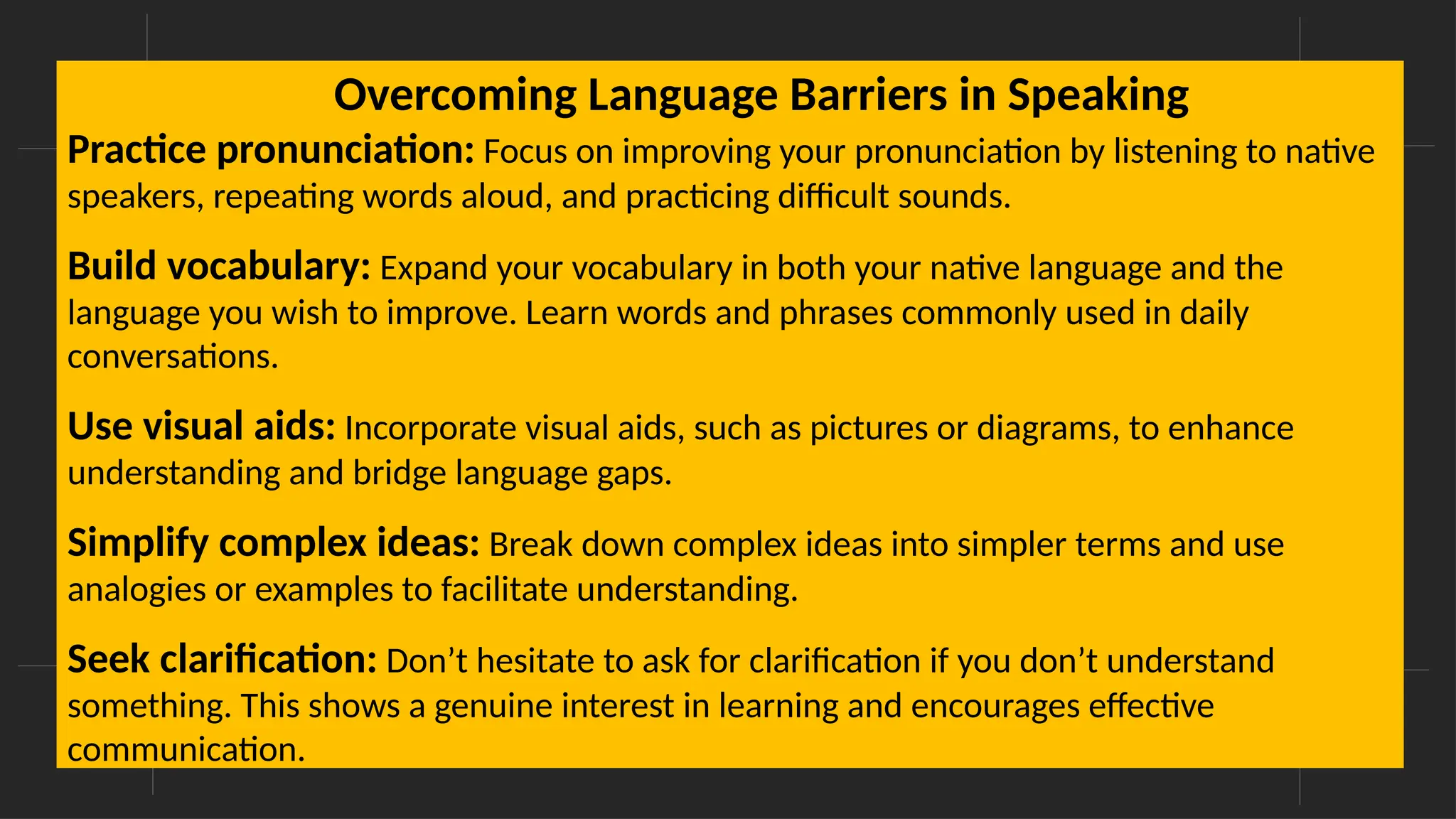
Overcoming Language Barriersin Speaking
Practice pronunciation: Focus on improving your pronunciation by listening to native
speakers, repeating words aloud, and practicing difficult sounds.
Build vocabulary: Expand your vocabulary in both your native language and the
language you wish to improve. Learn words and phrases commonly used in daily
conversations.
Use visual aids: Incorporate visual aids, such as pictures or diagrams, to enhance
understanding and bridge language gaps.
Simplify complex ideas: Break down complex ideas into simpler terms and use
analogies or examples to facilitate understanding.
Seek clarification: Don’t hesitate to ask for clarification if you don’t understand
something. This shows a genuine interest in learning and encourages effective
communication.
Overcoming Language Barriers in Speaking
15.
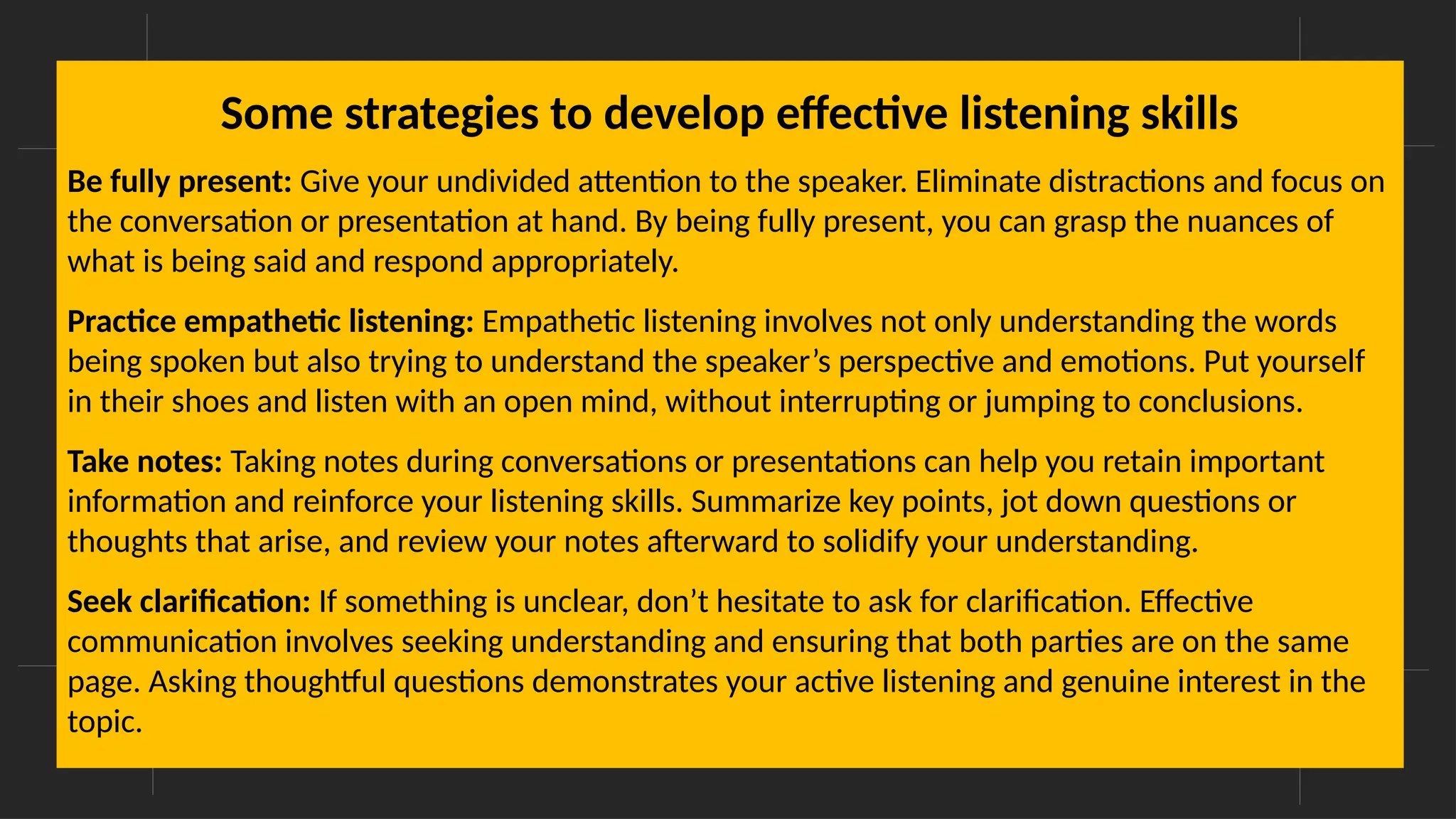
Overcoming Language Barriersin Speaking
Some strategies to develop effective listening skills
Be fully present: Give your undivided attention to the speaker. Eliminate distractions and focus on
the conversation or presentation at hand. By being fully present, you can grasp the nuances of
what is being said and respond appropriately.
Practice empathetic listening: Empathetic listening involves not only understanding the words
being spoken but also trying to understand the speaker’s perspective and emotions. Put yourself
in their shoes and listen with an open mind, without interrupting or jumping to conclusions.
Take notes: Taking notes during conversations or presentations can help you retain important
information and reinforce your listening skills. Summarize key points, jot down questions or
thoughts that arise, and review your notes afterward to solidify your understanding.
Seek clarification: If something is unclear, don’t hesitate to ask for clarification. Effective
communication involves seeking understanding and ensuring that both parties are on the same
page. Asking thoughtful questions demonstrates your active listening and genuine interest in the
topic.
16.
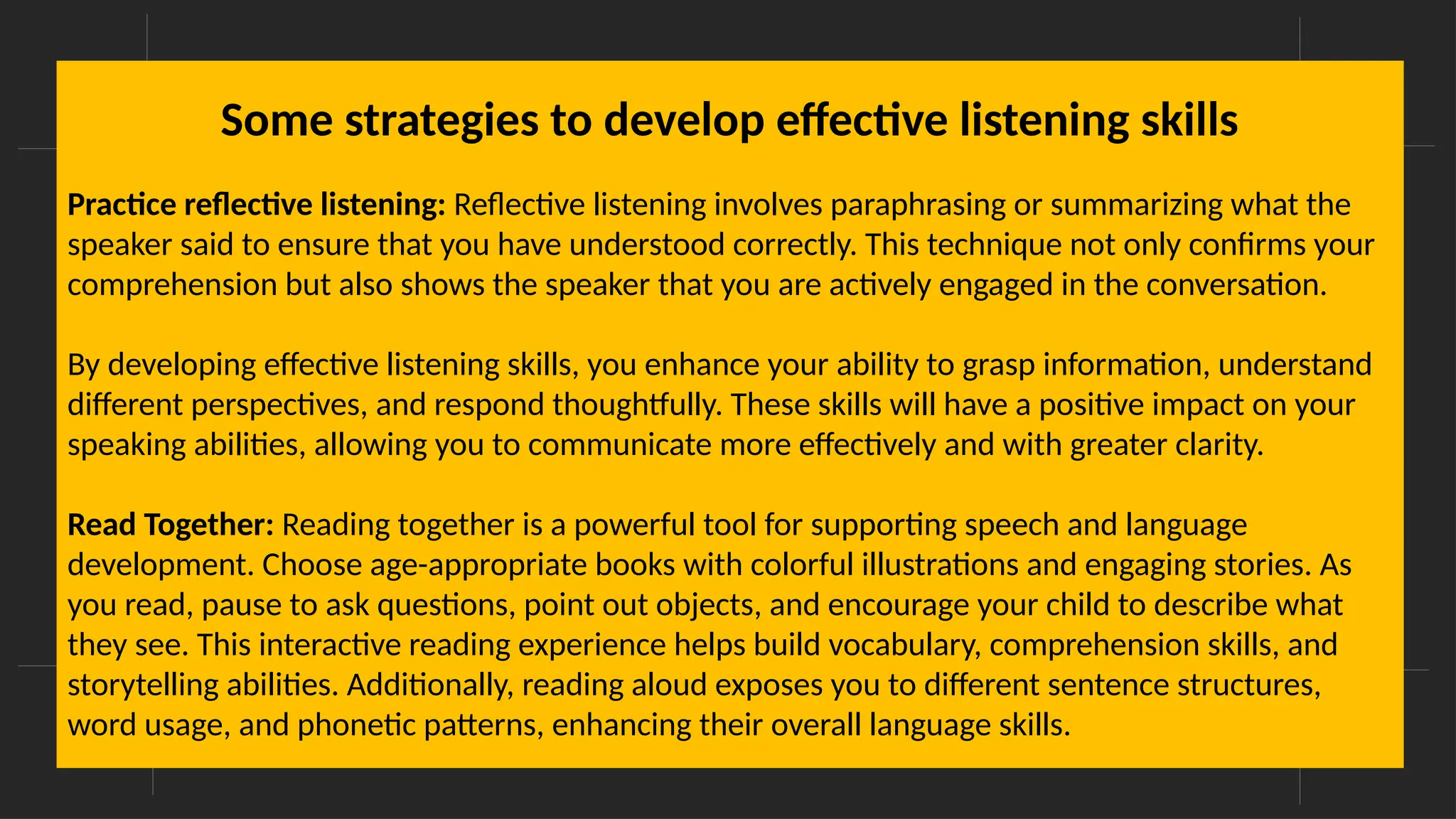
Overcoming Language Barriersin Speaking
Some strategies to develop effective listening skills
Practice reflective listening: Reflective listening involves paraphrasing or summarizing what the
speaker said to ensure that you have understood correctly. This technique not only confirms your
comprehension but also shows the speaker that you are actively engaged in the conversation.
By developing effective listening skills, you enhance your ability to grasp information, understand
different perspectives, and respond thoughtfully. These skills will have a positive impact on your
speaking abilities, allowing you to communicate more effectively and with greater clarity.
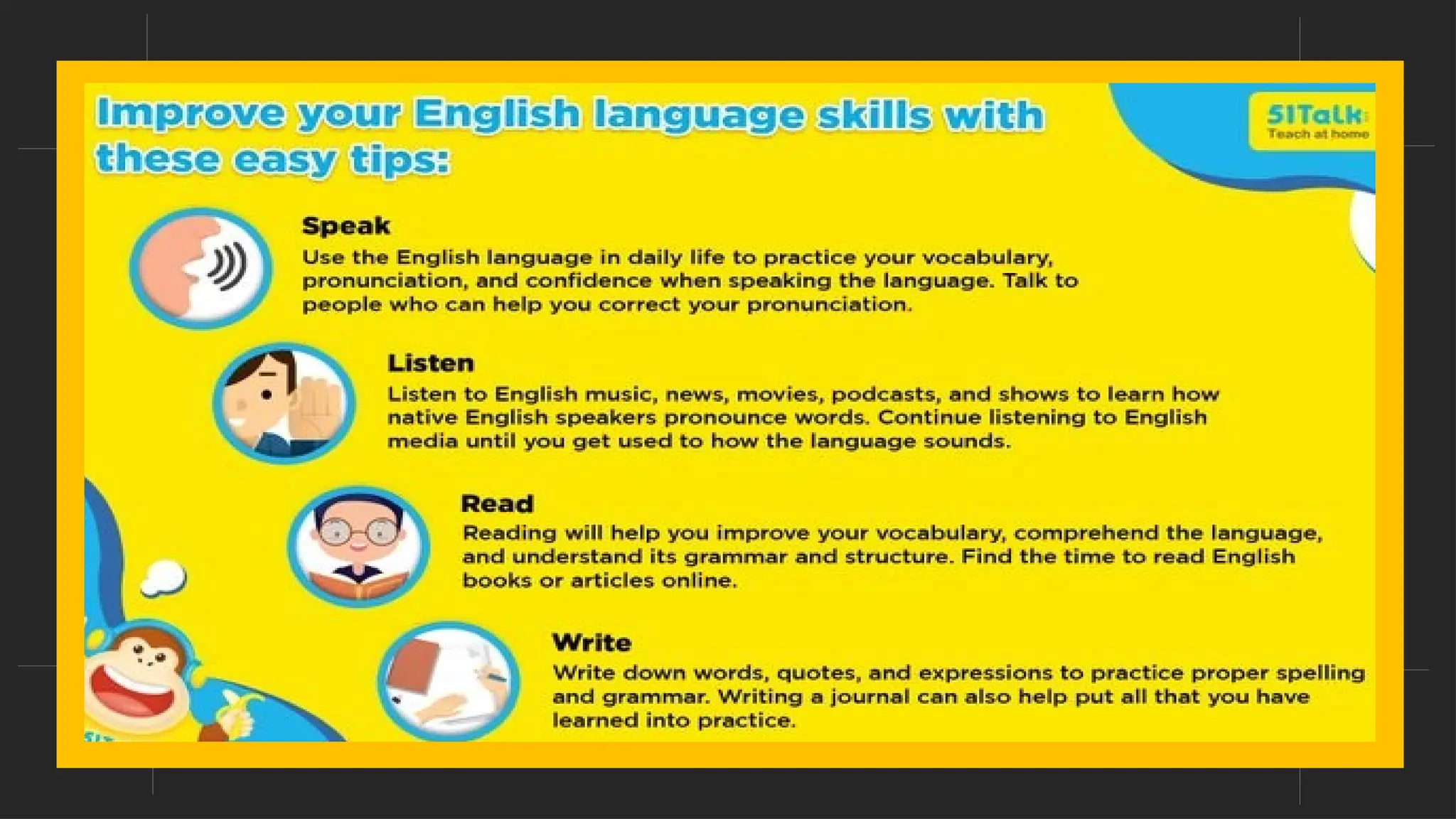
Read Together: Reading together is a powerful tool for supporting speech and language
development. Choose age-appropriate books with colorful illustrations and engaging stories. As
you read, pause to ask questions, point out objects, and encourage your child to describe what
they see. This interactive reading experience helps build vocabulary, comprehension skills, and
storytelling abilities. Additionally, reading aloud exposes you to different sentence structures,
word usage, and phonetic patterns, enhancing their overall language skills.
Overcoming Language Barriersin Speaking
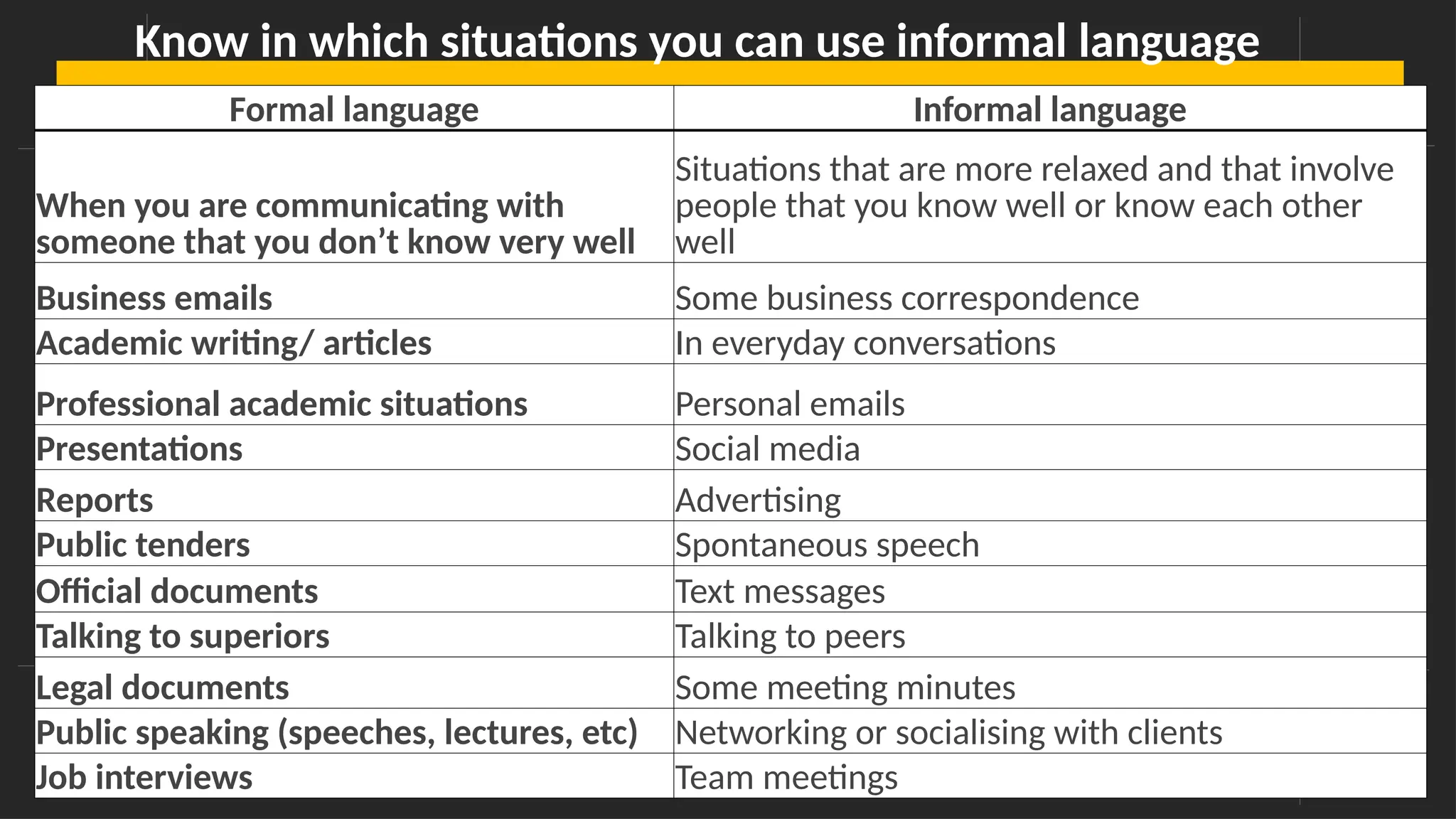
Know in which situations you can use informal language
Formal language Informal language
When you are communicating with
someone that you don’t know very well
Situations that are more relaxed and that involve
people that you know well or know each other
well
Business emails Some business correspondence
Academic writing/ articles In everyday conversations
Professional academic situations Personal emails
Presentations Social media
Reports Advertising
Public tenders Spontaneous speech
Official documents Text messages
Talking to superiors Talking to peers
Legal documents Some meeting minutes
Public speaking (speeches, lectures, etc) Networking or socialising with clients
Job interviews Team meetings
21.
Overcoming Language Barriersin Speaking
Formal and Informal language in Grammar context
In formal language, grammar is more complex and sentences are
generally longer. For example:
We regret to inform you that the delivery will be delayed due to adverse
weather conditions [formal]
Sorry, but the delivery will be late because of the weather [informal]
Have you seen my glasses? [formal]
Seen my glasses? [informal]
I am sorry to have kept you waiting [formal]
Sorry to keep you waiting [informal]
22.
Overcoming Language Barriersin Speaking
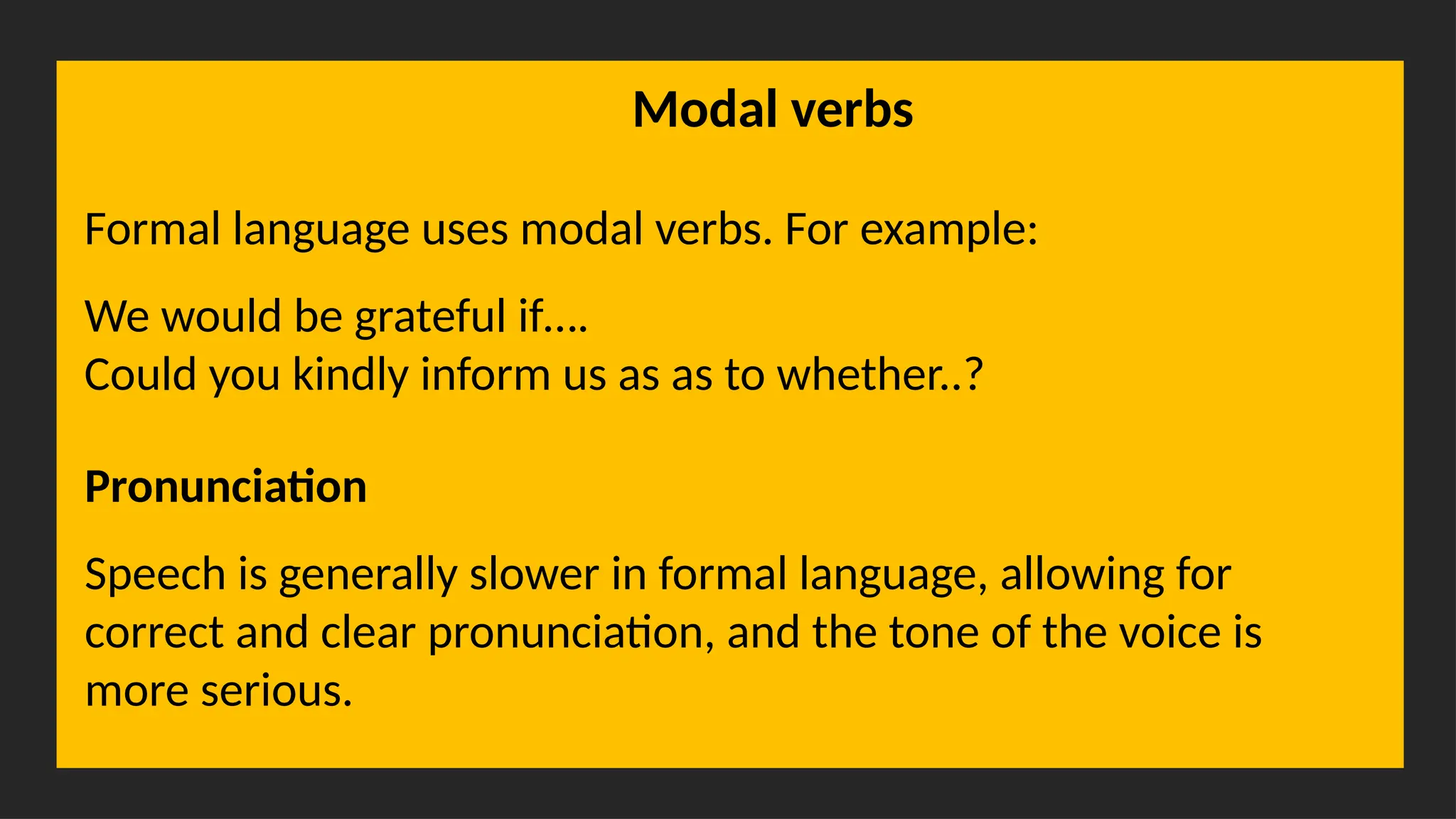
Modal verbs
Formal language uses modal verbs. For example:
We would be grateful if….
Could you kindly inform us as as to whether..?
Pronunciation
Speech is generally slower in formal language, allowing for
correct and clear pronunciation, and the tone of the voice is
more serious.
23.
Overcoming Language Barriersin Speaking
Pronouns
Formal language is less personal, and is more likely to use the ‘we’ as a
pronoun rather than ‘I’: For example:
We can assist in the resolution of this matter. Contact us on our help line
number [formal]
I can help you solve this problem. Call me! [informal]
We regret to inform you that……[formal]
I’m sorry, but…. [informal]
We have pleasure in announcing….[formal]
I’m happy to say…[informal]
24.
Overcoming Language Barriersin Speaking
Vocabulary
In formal language, words are generally longer. For
example:
Require [formal] vs need [informal]
Purchase [formal] vs buy [informal]
Acceptable [formal] vs okay [informal]
Assistance [formal] vs help [informal]
Require [formal] vs want [informal]
25.
Overcoming Language Barriersin Speaking
Contractions
These are not used in formal language. In informal language they are
used for easier flow and faster speech. For example:
She has decided to accept the job offer [formal]
She’s decided to accept the job offer [informal]
Abbreviations and acronyms
These are not used in formal language. For example:
‘As soon as possible’ [formal] vs ‘asap’ [informal]
‘Advertisement’ [formal] vs ‘ad’ or ‘advert’ [informal]
‘Photograph’ [formal] vs ‘photo’ [informal]
26.
Overcoming Language Barriersin Speaking
Colloquial language
This is not used in formal language. For example:
Would you like a cup of tea? [formal] vs Fancy a cuppa?
[informal]
‘Would you like to…’ [formal] vs ‘Do you want….’ [informal]
Overcoming Language Barriersin Speaking
How do speaking skills help us avoid
conflicts ?
By knowing the proper words and the proper way to use them, we can definitely
work our way through a conflicting situation and ease the tension build-up
Silence is not always good
Speaking up is better and it’s about being honest about our experience in a way
that is respectful to ourselves and to those around us.
29.
Overcoming Language Barriersin Speaking
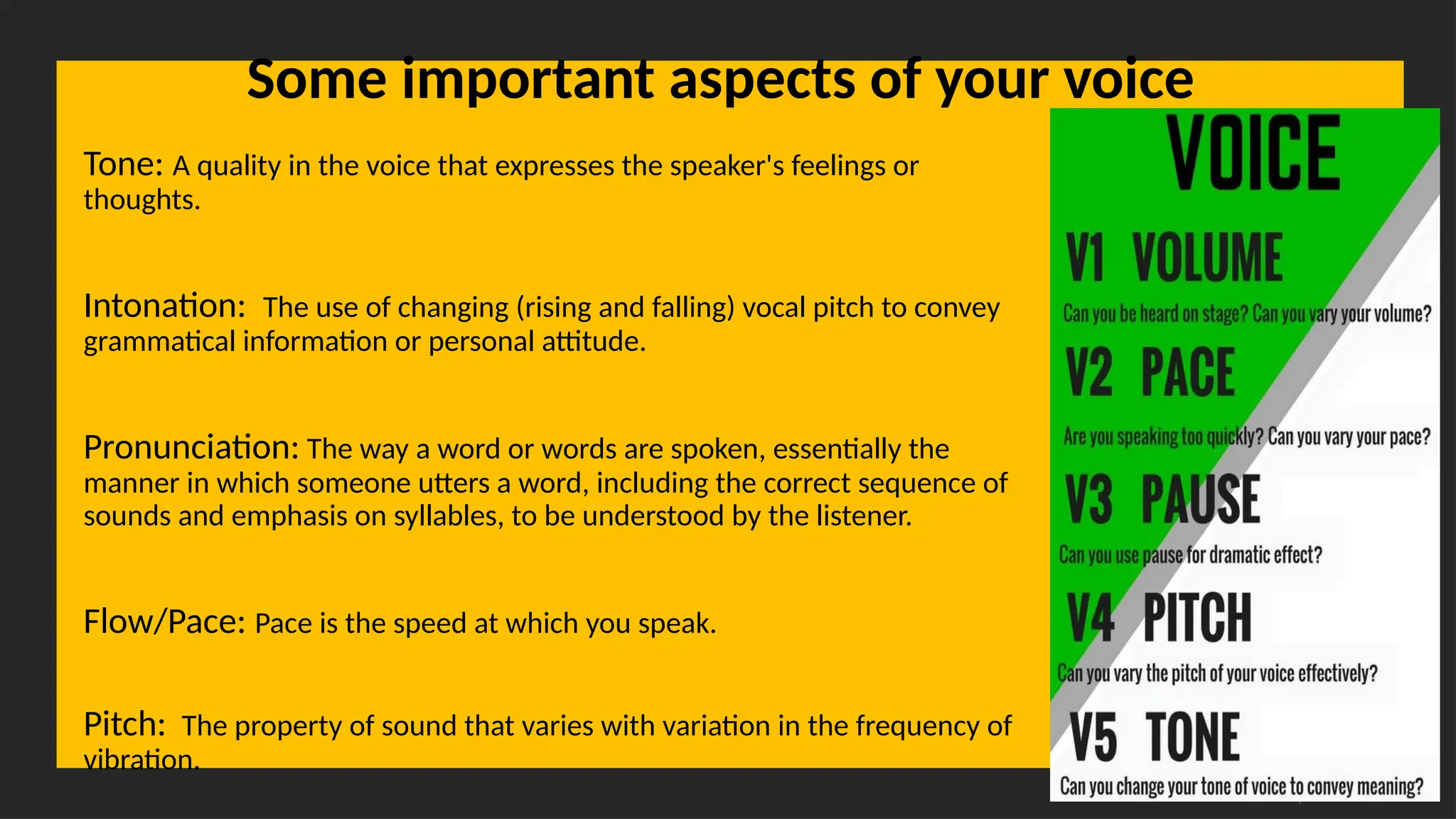
Some important aspects of your voice
Tone: A quality in the voice that expresses the speaker's feelings or
thoughts.
Intonation: The use of changing (rising and falling) vocal pitch to convey
grammatical information or personal attitude.
Pronunciation: The way a word or words are spoken, essentially the
manner in which someone utters a word, including the correct sequence of
sounds and emphasis on syllables, to be understood by the listener.
Flow/Pace: Pace is the speed at which you speak.
Pitch: The property of sound that varies with variation in the frequency of
vibration.
30.
Overcoming Language Barriersin Speaking
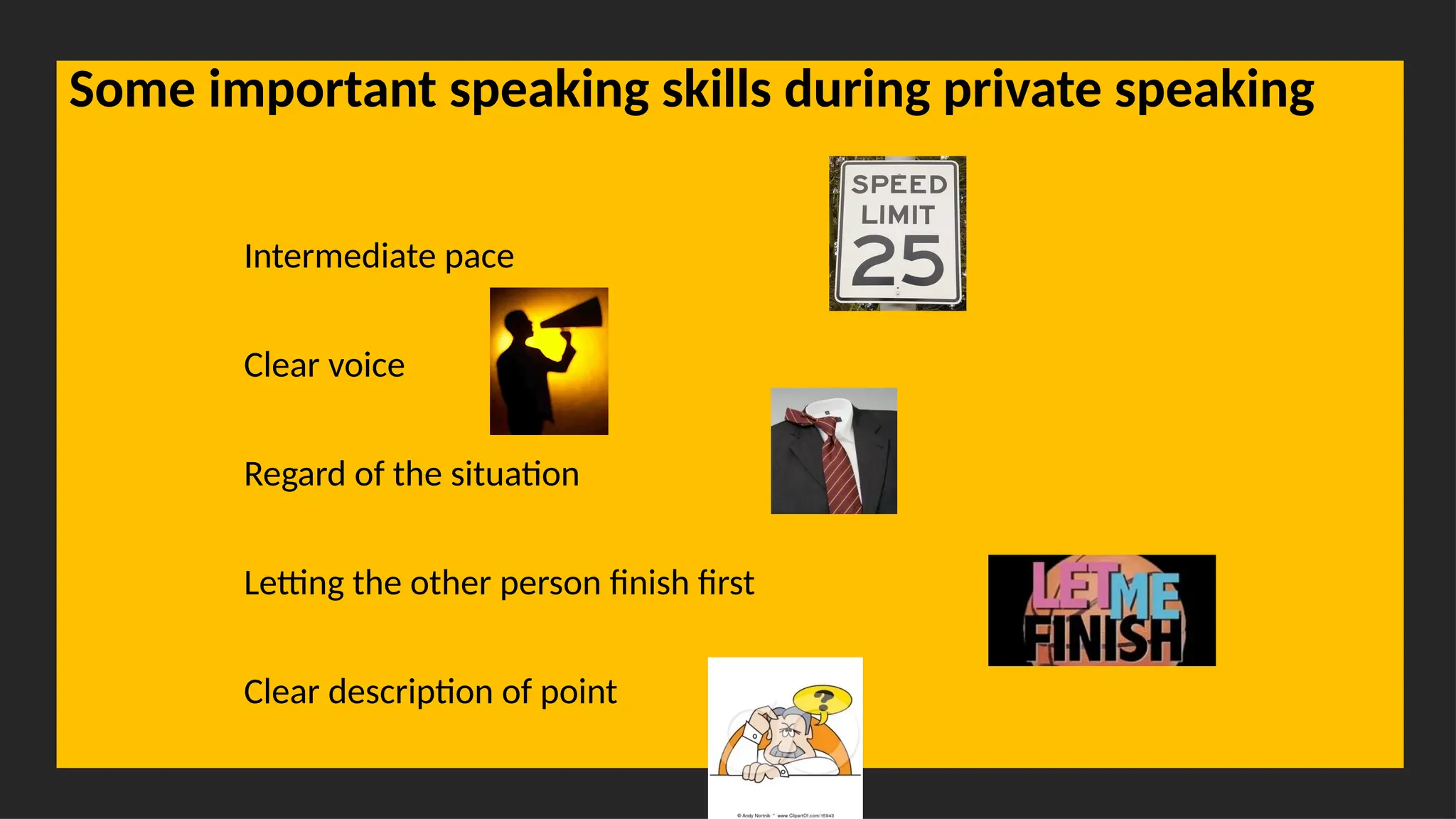
Some important speaking skills during private speaking
Intermediate pace
Clear voice
Regard of the situation
Letting the other person finish first
Clear description of point
31.
Overcoming Language Barriersin Speaking
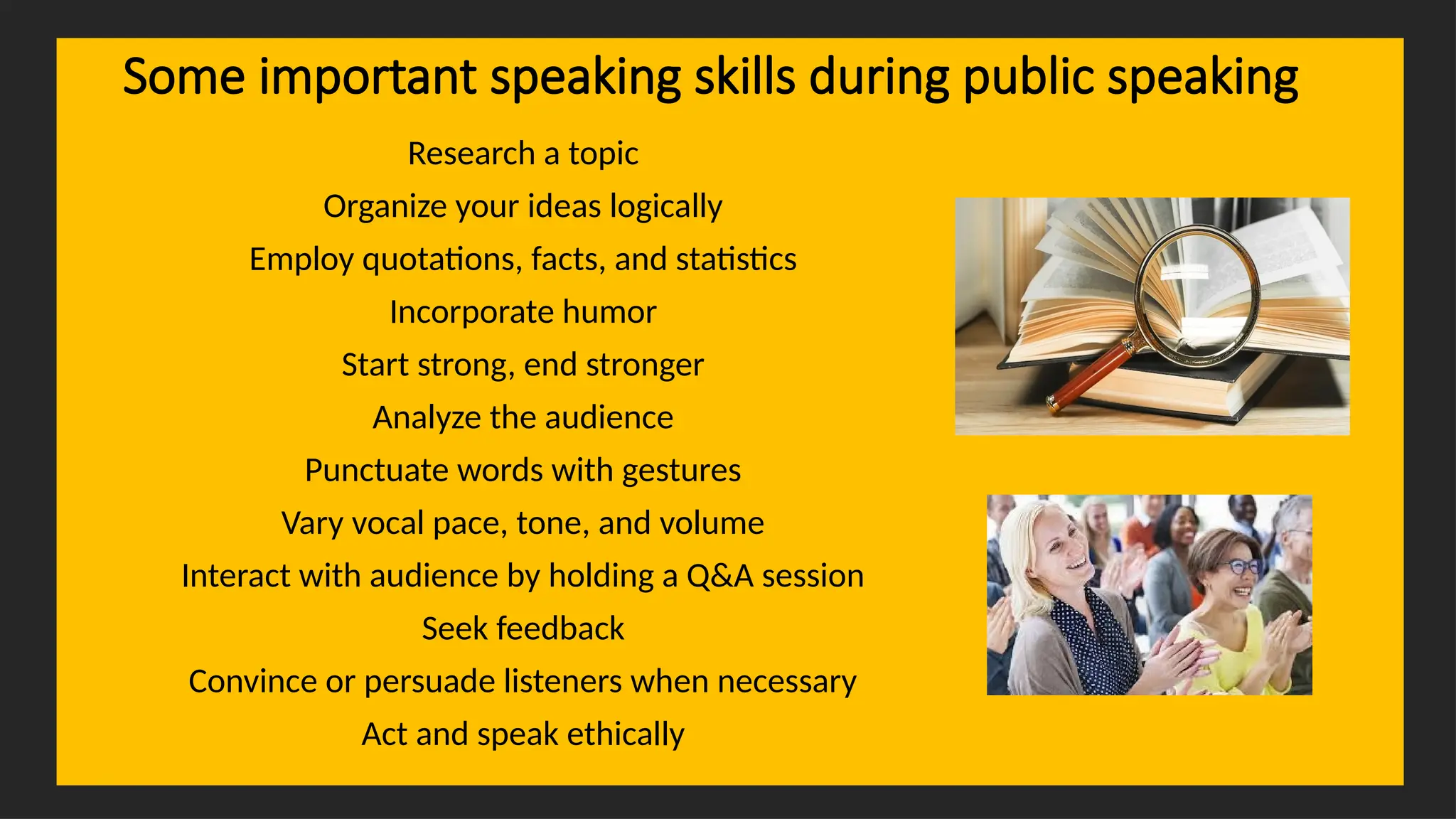
Some important speaking skills during public speaking
Research a topic
Organize your ideas logically
Employ quotations, facts, and statistics
Incorporate humor
Start strong, end stronger
Analyze the audience
Punctuate words with gestures
Vary vocal pace, tone, and volume
Interact with audience by holding a Q&A session
Seek feedback
Convince or persuade listeners when necessary
Act and speak ethically
32.
Overcoming Language Barriersin Speaking
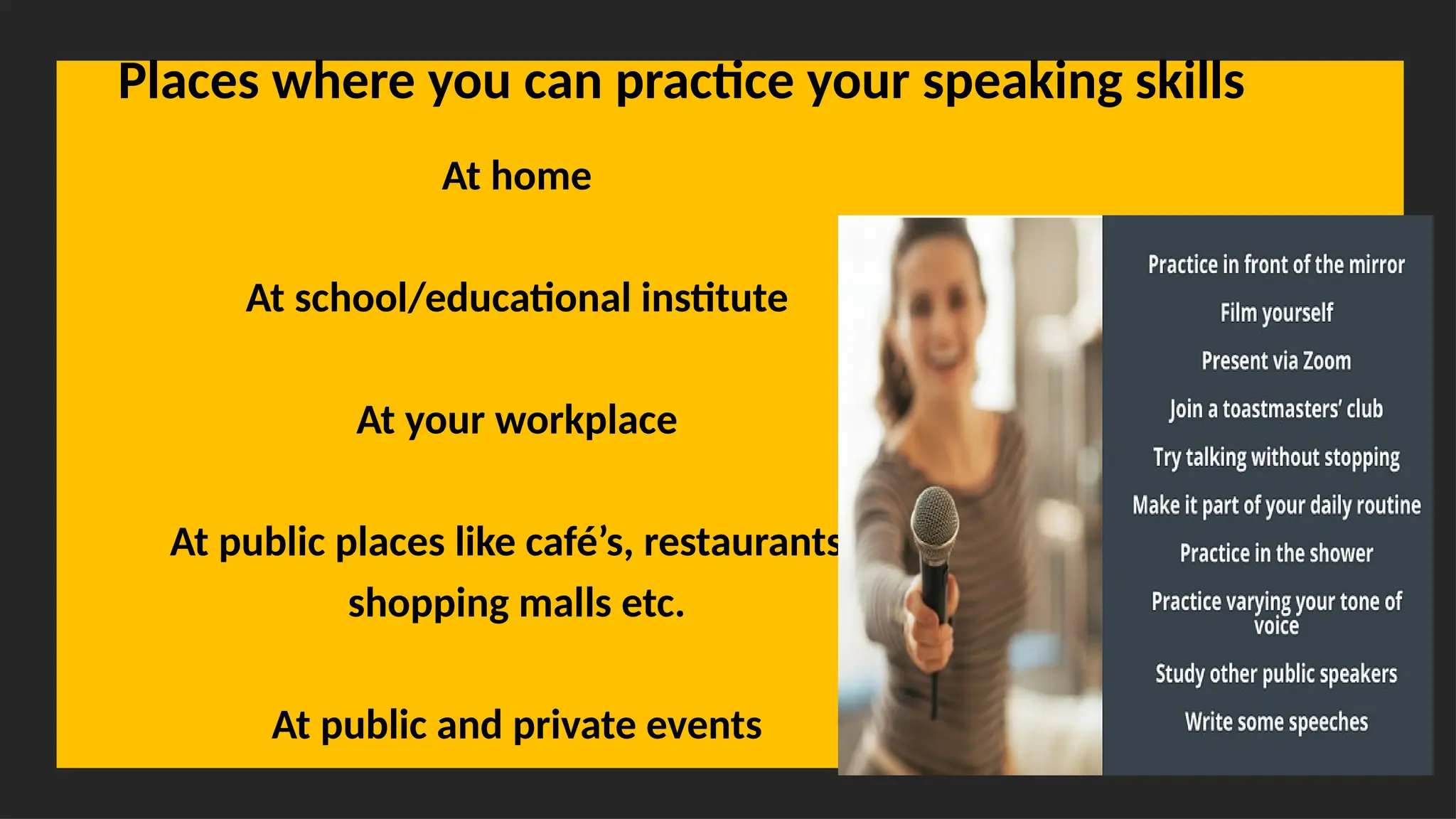
Places where you can practice your speaking skills
At home
At school/educational institute
At your workplace
At public places like café’s, restaurants,
shopping malls etc.
At public and private events
33.
Overcoming Language Barriersin Speaking
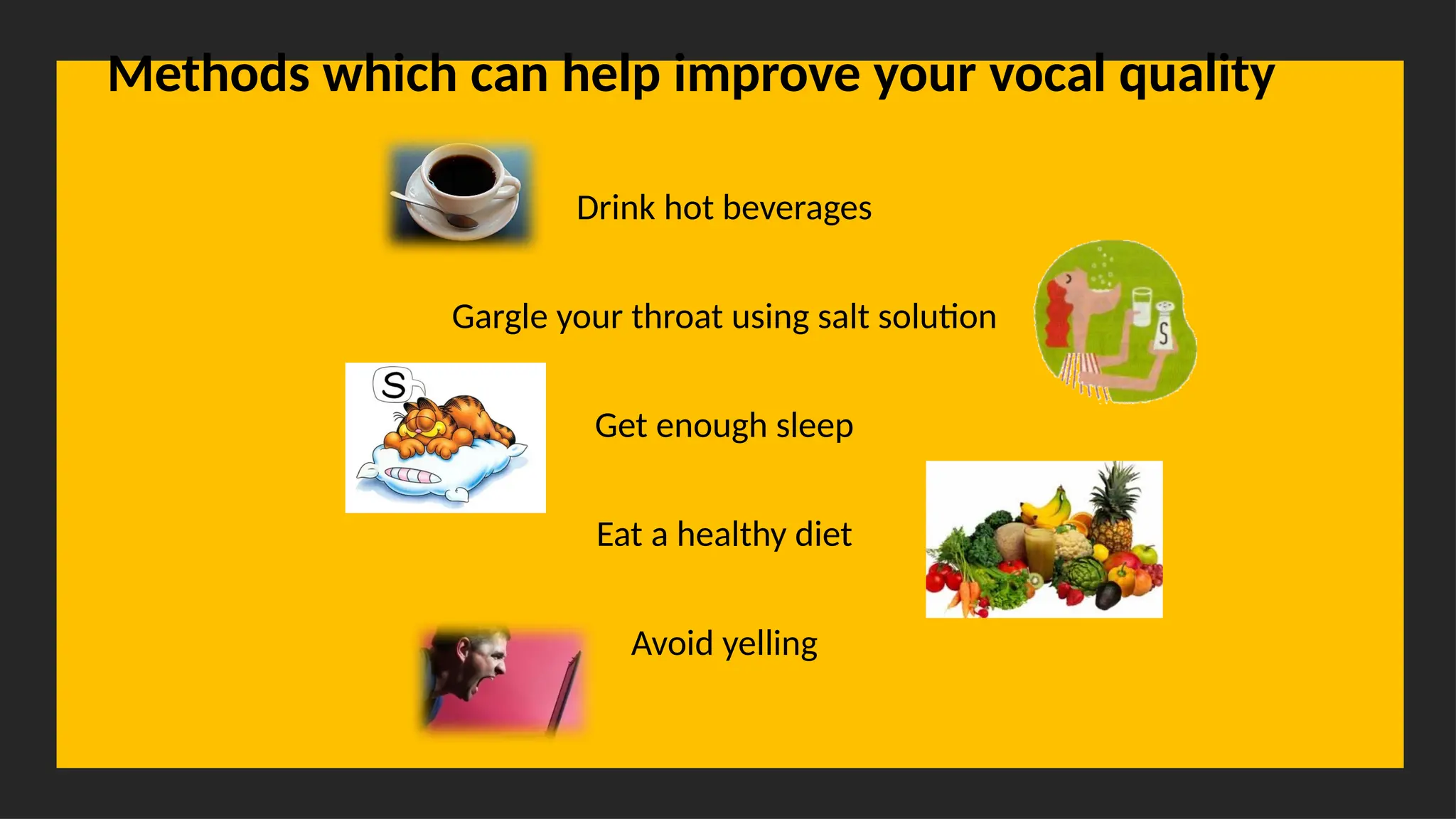
Methods which can help improve your vocal quality
Drink hot beverages
Gargle your throat using salt solution
Get enough sleep
Eat a healthy diet
Avoid yelling
![Overcoming Language Barriers in Speaking
Formal and Informal language in Grammar context
In formal language, grammar is more complex and sentences are
generally longer. For example:
We regret to inform you that the delivery will be delayed due to adverse
weather conditions [formal]
Sorry, but the delivery will be late because of the weather [informal]
Have you seen my glasses? [formal]
Seen my glasses? [informal]
I am sorry to have kept you waiting [formal]
Sorry to keep you waiting [informal]](https://image.slidesharecdn.com/introtospeakingskills-250522071615-9aac6f08/75/INTRODUCTION-TO-SPEAKING-SKILLS-pptx-INTRODUCTION-TO-SPEAKING-SKILLS-pptx-21-2048.jpg)
![Overcoming Language Barriers in Speaking
Pronouns
Formal language is less personal, and is more likely to use the ‘we’ as a
pronoun rather than ‘I’: For example:
We can assist in the resolution of this matter. Contact us on our help line
number [formal]
I can help you solve this problem. Call me! [informal]
We regret to inform you that……[formal]
I’m sorry, but…. [informal]
We have pleasure in announcing….[formal]
I’m happy to say…[informal]](https://image.slidesharecdn.com/introtospeakingskills-250522071615-9aac6f08/75/INTRODUCTION-TO-SPEAKING-SKILLS-pptx-INTRODUCTION-TO-SPEAKING-SKILLS-pptx-23-2048.jpg)
![Overcoming Language Barriers in Speaking
Vocabulary
In formal language, words are generally longer. For
example:
Require [formal] vs need [informal]
Purchase [formal] vs buy [informal]
Acceptable [formal] vs okay [informal]
Assistance [formal] vs help [informal]
Require [formal] vs want [informal]](https://image.slidesharecdn.com/introtospeakingskills-250522071615-9aac6f08/75/INTRODUCTION-TO-SPEAKING-SKILLS-pptx-INTRODUCTION-TO-SPEAKING-SKILLS-pptx-24-2048.jpg)
![Overcoming Language Barriers in Speaking
Contractions
These are not used in formal language. In informal language they are
used for easier flow and faster speech. For example:
She has decided to accept the job offer [formal]
She’s decided to accept the job offer [informal]
Abbreviations and acronyms
These are not used in formal language. For example:
‘As soon as possible’ [formal] vs ‘asap’ [informal]
‘Advertisement’ [formal] vs ‘ad’ or ‘advert’ [informal]
‘Photograph’ [formal] vs ‘photo’ [informal]](https://image.slidesharecdn.com/introtospeakingskills-250522071615-9aac6f08/75/INTRODUCTION-TO-SPEAKING-SKILLS-pptx-INTRODUCTION-TO-SPEAKING-SKILLS-pptx-25-2048.jpg)
![Overcoming Language Barriers in Speaking
Colloquial language
This is not used in formal language. For example:
Would you like a cup of tea? [formal] vs Fancy a cuppa?
[informal]
‘Would you like to…’ [formal] vs ‘Do you want….’ [informal]](https://image.slidesharecdn.com/introtospeakingskills-250522071615-9aac6f08/75/INTRODUCTION-TO-SPEAKING-SKILLS-pptx-INTRODUCTION-TO-SPEAKING-SKILLS-pptx-26-2048.jpg)