Introduction To Public History Interpreting The Past Engaging Audiences Lyon
Introduction To Public History Interpreting The Past Engaging Audiences Lyon
Introduction To Public History Interpreting The Past Engaging Audiences Lyon
Introduction To Public History Interpreting The Past Engaging Audiences Lyon
Introduction To Public History Interpreting The Past Engaging Audiences Lyon
1.
Introduction To PublicHistory Interpreting The
Past Engaging Audiences Lyon download
https://ebookbell.com/product/introduction-to-public-history-
interpreting-the-past-engaging-audiences-lyon-11883792
Explore and download more ebooks at ebookbell.com
2.
Here are somerecommended products that we believe you will be
interested in. You can click the link to download.
Introduction To Public Forum And Congressional Debate Jeffrey Hannan
Benjamin Berkman Chad Meadows
https://ebookbell.com/product/introduction-to-public-forum-and-
congressional-debate-jeffrey-hannan-benjamin-berkman-chad-
meadows-51423930
Introduction To Public Health 1st Edition Raymond L Goldsteen
https://ebookbell.com/product/introduction-to-public-health-1st-
edition-raymond-l-goldsteen-2349204
Introduction To Public Health In Pharmacy 2nd Edition Bruce Lubotsky
Levin
https://ebookbell.com/product/introduction-to-public-health-in-
pharmacy-2nd-edition-bruce-lubotsky-levin-31293444
Introduction To Public Key Infrastructures 1st Edition Johannes A
Buchmann
https://ebookbell.com/product/introduction-to-public-key-
infrastructures-1st-edition-johannes-a-buchmann-4607044
3.
Introduction To PublicHealth Second Edition Promises And Practice 2nd
Edition Raymond L Goldsteen Drph
https://ebookbell.com/product/introduction-to-public-health-second-
edition-promises-and-practice-2nd-edition-raymond-l-goldsteen-
drph-4739028
Introduction To Public Health In China 1st Ed 2019 Liming Li
https://ebookbell.com/product/introduction-to-public-health-in-
china-1st-ed-2019-liming-li-10805124
Introduction To Public Relations Sue Wolstenholme
https://ebookbell.com/product/introduction-to-public-relations-sue-
wolstenholme-10885612
Introduction To Public Health 5th Edition Schneider Henry Sschneider
https://ebookbell.com/product/introduction-to-public-health-5th-
edition-schneider-henry-sschneider-11959422
Introduction To Public Health 4th Edition Schneider Maryjane
https://ebookbell.com/product/introduction-to-public-health-4th-
edition-schneider-maryjane-11959438
AMERICAN ASSOCIATION FORSTATE AND LOCAL HISTORY
BOOK SERIES
SERIES EDITOR
Rebecca K. Shrum, Indiana University–Purdue University Indianapolis
MANAGING EDITOR
Bob Beatty, AASLH
EDITORIAL BOARD
Anne W. Ackerson, Leading by Design
William Bomar, University of Alabama Museums
Jessica Dorman, The Historic New Orleans Collection
W. Eric Emerson, South Carolina Department of Archives and History
Tim Grove, National Air and Space Museum
Laura Koloski, Pew Center for Arts & Heritage
Russell Lewis, Chicago History Museum
Jane Lindsey, Juneau-Douglas City Museum
Ann E. McCleary, University of West Georgia
Laurie Ossman, Preservation Society of Newport County
Sarah Pharaon, International Coalition of Sites of Conscience
Laura Roberts, Roberts Consulting
Julia Rose, Homewood Museum at Johns Hopkins University
Sandra Smith, Heinz History Center
Kimberly Springle, Charles Sumner School Museum and Archives
William S. Walker, Cooperstown Graduate Program, SUNY Oneonta
ABOUT THE SERIES
The American Association for State and Local History Book Series addresses issues critical to the field of
state and local history through interpretive, intellectual, scholarly, and educational texts. To submit a pro-
posal or manuscript to the series, please request proposal guidelines from AASLH headquarters: AASLH
Editorial Board, 2021 21st Ave. South, Suite 320, Nashville, Tennessee 37212. Telephone: (615) 320-3203.
Website: www.aaslh.org.
ABOUT THE ORGANIZATION
The American Association for State and Local History (AASLH) is a national history membership associ-
ation headquartered in Nashville, Tennessee. AASLH provides leadership and support for its members who
preserve and interpret state and local history in order to make the past more meaningful to all Americans.
AASLH members are leaders in preserving, researching, and interpreting traces of the American past to
connect the people, thoughts, and events of yesterday with the creative memories and abiding concerns of
people, communities, and our nation today. In addition to sponsorship of this book series, AASLH publishes
History News magazine, a newsletter, technical leaflets and reports, and other materials; confers prizes and
awards in recognition of outstanding achievement in the field; supports a broad education program and
other activities designed to help members work more effectively; and advocates on behalf of the discipline
of history. To join AASLH, go to www.aaslh.org or contact Membership Services, AASLH, 2021 21st Ave.
South, Suite 320, Nashville, TN 37212.
8.
Introduction to
Public History
Interpretingthe Past,
Engaging Audiences
Cherstin M. Lyon
California State University,
San Bernardino
Elizabeth M. Nix
University of Baltimore
Rebecca K. Shrum
Indiana University-Purdue
University Indianapolis
R OW M A N & LI T T LEF I ELD
Lanham • Boulder • New York • London
For Our Children
GarethImparato, Nicholas Imparato, Forrest H. Lyon,
Savannah M. Lyon, and Matthew Brady Shrum
12.
▲ vii
Contents
Preface forInstructors ix
1 Introducing Public History 1
2 Thinking Historically 21
3
Interpreting the Past Case Study:
The Baltimore ’68 Project 33
4 Collecting History 57
5 Interpreting and Exhibiting History 83
6 Engaging Audiences 113
7 Engaging Audiences: Case Studies from the Field 141
8 Putting Public History to Work in Your World 163
Index 177
About the Authors 187
14.
▲ ix
Preface forInstructors
Welcome to Introduction to Public History: Interpreting the Past, Engaging Audiences. We
wrote this book to provide public history educators with a foundational text that is short
enough to adapt to a variety of situations, that will aid in assessment of student learning,
and that can support more in-depth examinations of the questions that drive a variety of
public history projects and venues. That said, we do not intend to provide a comprehen-
sive, encyclopedic examination of every aspect of public history, nor cover every venue
where nonacademic audiences encounter historical content. Given that the majority of
students who take public history coursework do not become practicing public historians,
we focus here on issues that arise at the kinds of venues that everyone encounters as con-
sumers of the past.
This collaborative project began as a series of conversations between professors of pub-
lic history at the annual meetings of the National Council on Public History (NCPH),
the main professional organization supporting public history practitioners and teachers.
One of those key conversations took place in Portland, Oregon, in 2010 at a working
group organized by Cherstin Lyon and Rebecca Shrum, with Elizabeth Nix as a dis-
cussant, along with Donna DeBlasio, Jennifer Dickey, Catherine Lewis, Allison Marsh,
and Phillip Payne. We continued to seek input from colleagues (both anonymously and
known) and from students as we have developed this manuscript from the proposal stage,
through an earlier draft, to the published version you have before you. Despite our efforts
to meet diverse needs with a single volume, we know that each program, each instruc-
tor, and each group of students is unique. We encourage instructors to use this book in
conjunction with the resources they have on their campuses and in their communities to
develop activities and projects for their classes to serve as a genuine springboard into the
field with as many local connections as possible.
Philosophy of the Book
The book as a whole aligns with the NCPH “Best Practices” for undergraduate students as
a basic framework for introducing public history to undergraduate or graduate students.1
Regardless of a student’s standing, public history should first be rooted in the best practices
of history and should be grounded in a solid understanding of historical content. Introduc-
tory courses are useful to orient students to the range of fields in which public history is
practiced. Merely presenting the fields of practice, however, can look like a parade of career
options to students, and also suggest that public history is a vocational choice rather than a
15.
x ▲
distinctscholarly and intellectual enterprise with its own fundamental practices, premises,
and lines of inquiry. Focusing on careers in this way can obscure how we all encounter and
engage with public history and why it is important for everyone to understand what public
history is and how it functions in our society.
This book is organized instead around the questions and ethical dilemmas that drive
public history work so that students can understand the field’s core values and practices. We
leave the option open to orient students to their career opportunities as a way of considering
next steps and to adapt to the special offerings of various institutions. Just as no one book
can cover every place where history is practiced and do it well, no single university trains
students for all specialty fields in public history. This book is designed to be flexible so that
instructors can find ways to highlight their own strengths and to use the common questions
as a way of exploring their own areas of expertise and to direct students to ask common
questions of diverse fields of practice.
The authors of this volume are practicing public historians who teach history and public
history to a mix of undergraduate and graduate students at universities. We approach the
field from a framework that our colleague Cathy Stanton has described as “progressive pub-
lic history.” This type of public history has an activist identity and is, as Stanton wrote, often
“concentrated in the areas of the profession that overlap most closely with the academy.”2
As scholars and practitioners, we engage with public history out of the conviction that it
has the ability to make our world a more just and ethical society. Progressive public history
can harness the innate sense people already have of themselves as historical interpreters,
working with them to uncover liberatory tools in their lives, communities, and nations.
Progressive public history can approach activism, but the public historian is always bound
first and foremost to the ethics of the historical profession. Public history can be something
more but is never less than an analysis based on sound historical evidence. By beginning
with an overview of public history from a progressive model that places ethics and justice at
the center of practice, we hope that students will be well positioned to ask critical questions
in the future, either as consumers of public history or as practitioners themselves.
We believe that if students gain a strong foundation in the ethics and theories that
ground the decisions that well-trained public historians make every day through reflective
practice, they will be more confident in making informed decisions when the demands of
working in the field do not necessarily correspond with textbook instructions. In consulting
with practitioners, the overwhelming feedback we have received consistently over the past
decade is that the classroom does not necessarily prepare you for the decisions that you must
make when facilitating a wedding at a historic house, or navigating interpersonal relations
with board members or community donors. When in doubt, we all retreat to our core values
and guiding principles.This book is designed to support that framework of educating future
public historians, as well as the future teachers and consumers of history.
Structure of the Book
Each chapter introduces a concept or common practice to students, highlighting key terms
for student review and for instructor assessment of student learning.The body of each chap-
16.
P r ef a c e f o r I n s t r u c t o r s ▲ xi
ter introduces theories and basic conceptual building blocks intermixed with case studies to
illustrate these points. Footnotes give credit to our sources, but also serve as breadcrumbs
for instructors who might like to assign more in-depth reading for more advanced students
and/or for the purposes of lecture development. Each chapter ends with suggestions for
activities that we have tried with our own students.
Finally, each chapter contains suggestions for further study.This list is not a bibliography
for the chapter, but a list of suggested readings, books, and websites that can deepen student
exposure to the topic and support instructor development of supplemental readings to suit
the level of their students and to design further assignments for the class. Above all else, we
hope that instructors will find creative ways to adapt this book as a tool to enhance their
own expertise and their own way of introducing students to the dynamic and creative field
of public history.
We welcome your feedback and questions.
Cherstin M. Lyon, California State University, San Bernardino, clyon@csusb.edu
Elizabeth M. Nix, University of Baltimore, enix@ubalt.edu
Rebecca K. Shrum, Indiana University-Purdue University Indianapolis, rshrum@iupui.edu
Notes
1.
National Council on Public History, “Best Practices in Public History: Public History for
Undergraduate Students,” available at: http://ncph.org/wp-content/uploads/2010/08/Under
grad-Best-Practice.pdf.
2. Cathy Stanton, The Lowell Experiment: Public History in a Postindustrial City (Amherst: Univer-
sity of Massachusetts Press, 2006), 15.
18.
▲ 1
C HA P TER 1
Introducing Public
History
W
HEN YOU THINK ABOUT learning history, do you imagine sitting in a class-
room and reading a textbook? The book you now hold introduces a different
approach to history that focuses on engagement. Introduction to Public History:
Interpreting the Past, Engaging Audiences addresses history that people encounter outside
the classroom and beyond the traditional history text. Its chapters guide you, the student,
through an initial encounter with the field of public history, introducing you to underlying
issues, theories, and core principles that ground the field.This book focuses on the big ques-
tions that underpin the how and, most importantly, the why of public history.
What Is Public History?
Public history is so diverse that even practitioners struggle to define it succinctly. In 1978,
historian Robert Kelley, who founded one of the early graduate programs in public history,
wrote, “Public history refers to the employment of historians and the historical method
KEY TERMS
historical method
audience
collaboration
stakeholders
reflective practice
contextualized learning
banking and problem-posing models of
education
dialogic history
free-choice learning
shared authority
setting problems
problem solving
19.
2 ▲ Chapt e r 1
outside of academia.”1
If we agree that academia is a term used to describe institutions of
higher learning like colleges and universities, then what is “outside of academia”? You can
find public history at a museum, in a historic house, on a walking tour of a historic dis-
trict, or on YouTube. Public historians can produce documentaries, historical markers, and
smartphone apps. The field is broad enough to include more ephemeral venues as well: a
community event, a theatrical performance, a folk-art demonstration.There are more forms
of public history than we can name here, and new ones appear all the time, which is one of
the things that makes the field vibrant and exciting.
But the question of venue—“inside the academy”vs.“everywhere else”—does not cap-
ture all of the differences between public history and traditional academic history. Before
we look at those differences, however, we must recognize what all historians share with
one another.This is what Kelley called, in his definition, the “historical method.”All forms
of history begin in the same place: with solid historical research based on a rigorous ex-
amination of available sources. All historians, regardless of where they work or who makes
up their audience, rely on the systematic and critical examination of sources within their
historical contexts to reveal stories of the past, to explain change and continuity over time,
to consider contingency, and to reconcile competing versions of past events as preserved
in a variety of historical sources. Through this process, we assign meaning to the past,
taking a wide range of materials and using them to form a coherent argument about the
meaning and significance of past events. These practices make up the historical method.
Historians place their work within the context of what we already know and make efforts
to contribute to that knowledge by using sources that have not been used before, by asking
new questions of familiar sources, or by using sources in novel ways. The centrality of the
historical method to public history is the reason you will find “Thinking Historically” as
the next chapter in this textbook.
If public history and academic history share similar research methods and interpretive
standards, what distinguishes them from one another? Some key concepts stand out for
public history:
1. Audience.The audience is public, not academic. Public historians think differently
about audience than they would when sharing their research in academic circles.
The general public does not think about their own pasts or their relationship with
the past the same way historians think about history. Understanding the audience
means understanding what different publics expect and value when it comes to
engaging in historical exploration. This textbook will introduce you to several
different theoretical perspectives that help us work more effectively and ethically
with public audiences.
2. Collaboration. Public historians practice two types of collaboration. First, they col-
laborate with the public. Public historians need to think beyond how they will best
serve the public’s needs as audiences or consumers of history, and to think carefully
about how they will work with stakeholders—those who have a specific interest
or a stake in the topics we study, the communities about which we write, or the
institutions or places where we work. Stakeholders might include the people whose
story a public history project will tell, board members at a public history institution,
20.
I n tr o d u c i n g P u b l i c H i s t o r y ▲ 3
funders, or politicians. Stakeholders are also potential members of the audience, but
we distinguish them because of the specific relationships they have with the history
being interpreted. Collaboration with the stakeholders whose history is being told is
one of the defining features of public history work.The second form of essential col-
laboration requires work with professionals in other disciplines. Since public history
involves skills that go beyond those of a historian, public historians collaborate with
scholars and experts in other fields. Academic historians often work alone to produce
a monograph; public historians work in teams to produce projects.
3. Reflective Practice. Public historians intentionally incorporate what they learn from
the successes and failures of their professional experiences into future interpretive
and engagement strategies. All historians have ethical responsibilities. We must
represent primary sources fairly and accurately and acknowledge when we draw on
the work of other scholars in our own work. Public historians have added ethical
responsibilities that require many layers of reflective practice that will be discussed
throughout the book.
Audience
Who Is the Public? What Is Their Relationship with “History”
and “The Past”?
If one of the major defining characteristics of public history is a public audience, then who
is this “public” and what is their relationship with history, or what some prefer to call “the
past”? In 1994 and 1995, a group of historians conducted extensive phone interviews with
1,453 Americans in an attempt to explore how they understand their pasts and interact with
history. In The Presence of the Past: Popular Uses of History in American Life (1998), historians
Roy Rosenzweig and David Thelen interpreted the interviews and argued that Americans
actively engaged with the past as they sought to understand the forces that had shaped the
individual people that they were in the present and that would affect the people they wanted
to become in the future. The survey respondents also expressed strong preferences for how
they got information about the past.They trusted museums the most, with personal accounts
from relatives following closely in second place, and firsthand accounts from someone who
had been present at an event in third place. College professors, high school teachers, and
nonfiction books still held some credence, but participants ranked movies and television
programs as the least trustworthy (table 1.1).Americans also told the researchers they wanted
to be able to assess what they learned from any source against their own previous knowledge
and draw conclusions for themselves. Before Rosenzweig and Thelen, historians had not
spent much energy analyzing their audience. While museum studies scholars and practi-
tioners were already thinking deeply about audience reactions to exhibitions and museum
visits, Rosenzweig and Thelen looked at people’s relationship with the past in the totality of
their lives. Their study remains our best source of information about the attitudes different
populations have about their own relationship with history and the past, something that is
not captured in visitor surveys about specific exhibitions.
21.
Table 1.1. Trustworthinessof Sources of Information about the Past—By Racial/Ethnic Group
HOW TRUSTWORTHY
DO YOU THINK ____
ARE AS A SOURCE OF
INFORMATION ABOUT
THE PAST?
RACIAL/ETHNIC GROUPS
NATIONAL
SAMPLE WHITE
AFRICAN
AMERICAN
MEXICAN
AMERICA
PINE RIDGE
OGLALA
SIOUX
Museums 8.4 (778) 8.5 (608) 8.1 (283) 8.6 (185) 7.1 (176)
Personal accounts from your
grandparents or other relatives 8.0 (789) 8.0 (615) 8.4 (289) 8.2 (189) 8.8 (181)
Conversations with someone
who was there 7.8 (790) 7.8 (611) 7.9 (290) 8.2 (188) 8.0 (177)
College history professors 7.3 (692) 7.4 (537) 7.0 (261) 8.3 (172) 7.1 (161)
High school history teachers 6.6 (771) 6.7 (594) 6.2 (293) 7.5 (189) 5.9 (178)
Nonfiction books 6.4 (747) 6.4 (583) 5.6 (278) 6.6 (181) 5.4 (169)
Movies or television programs
about the past 5.0 (783) 4.9 (610) 5.2 (291) 6.0 (189) 4.2 (180)
Respondents were asked about seven “places where people might get information about the past.”They rated the
trustworthiness of each “as a source of information about the past using a 1 to 10 scale,”with 1 meaning “not at all
trustworthy” and 10 meaning “very trustworthy.” This table reports the mean score the national sample and four
racial/ethnic groups gave the sources of information in the far-left column. The number in parentheses indicate the
number of respondents on which each mean is based.
Table 1.2. Most Important Pasts—By Racial/Ethnic Group
KNOWING ABOUT
THE PAST OF WHICH
OF THE FOLLOWING
FOUR AREAS OR
GROUPS IS MOST
IMPORTANT TO YOU?
RACIAL/ETHNIC GROUPS
NATIONAL
SAMPLE WHITE
AFRICAN
AMERICAN
MEXICAN
AMERICAN
PINE RIDGE
OGLALA
SIOUX
The past of your family 66% 69% 59% 61% 50%
The past of your racial or
ethnic group 8% 4% 26% 10% 38%
The past of the community
in which you now live 4% 3% 4% 7% 7%
The past of the United States 22% 24% 11% 22% 5%
100%
N=796
100%
N=616
100%
N=297
100%
N=191
100%
N=176
Respondents were asked the following question: “Knowing about the past of which of the following four areas or
groups is most important to you—the past of your family, the past of your racial or ethnic group, the past of the
community in which you now live, or the past of the United States?”This table reports the percentage of respon-
dents in the national sample and four racial/ethnic groups that chose each of the pasts in the far left column.
Tables 1.1 and 1.2 are from Roy Rosenzweig and David Thelen, The Presence of the Past: Popular Uses of History in
American Life (New York: Columbia University Press, 1998) and are reproduced (with edited captions) with permis-
sion of the publisher from http://chnm.gmu.edu/survey/tables.html.
22.
I n tr o d u c i n g P u b l i c H i s t o r y ▲ 5
Experts in the science of learning have found that all humans learn within the contexts of their
own experiences, just as the survey respondents from The Presence of the Past revealed. In their research
on museum visitation, John Falk and Lynn Dierking found, “People make meaning through a constant
process of relating past experiences to the present,” connecting what is happening in the present to
what has happened in the past.2
It follows, then, that for public historians to engage their audiences in
a meaningful experience, they must make history relevant to their lives. Understanding your audience
should always come first, particularly if one primary goal is to facilitate this contextualized learning.
Diversity of Public Experiences
“The public” includes many different people with very different personal experiences. Diversity may
come in the form of age, educational background, economic standing and class, religious diversity,
different abilities, diversities of language, as well as cultural, racial, and ethnic diversities. Sometimes
we can understand diversity of experience in terms of privilege or marginalization. For example,
nondisabled people experience privilege every day whether they recognize it or not. A person with a
disability might never see someone like themselves depicted in a public history venue. In fact, disabil-
ity-rights advocates had to wage protests to add a statue of President Franklin D. Roosevelt sitting in
a wheelchair to the FDR Memorial in Washington, DC, although his paralysis during his presidency
is now widely known. The Presence of the Past revealed that Americans who had historically been
marginalized, specifically African Americans, American Indians, Mexican Americans, and LGBTQ
(Lesbian, Gay, Bisexual,Transgender, Queer) individuals, often understood themselves to be part of a
specific “collective past.” African Americans, for example, used their understanding of the black past
to distance themselves from an “official” version of the past organized around a dominant narrative
that erased the experiences of their families and communities (table 1.2).3
Potential stakeholders and
consumers of public history projects will approach the work through the lens of their own experiences;
public history practitioners need to understand that phenomenon.
Because different segments of the public will approach history differently based on their own his-
torically situated experiences, understanding your audiences is complex. You must look deeper when
examining which publics you serve as a public historian in order to consider multiple layers of expe-
rience. For example, understanding basic demographic details of your audience may be a good start,
but there are variations beyond typical profiles, such as age, economic levels, gender, race, ability, and
ethnicity. It is easy to become complacent if we believe we have sufficiently considered more than one
point of view. Our communities are always changing, and the needs and experiences of the public are
always evolving. We must reexamine who our publics are and their historical and contemporary ex-
periences in order to find ways for them to see themselves in the histories we interpret and represent.
Who Does the Public Trust?
Rosenzweig and Thelen found that the public trusts the history they learn about in museums more
than any other source, for two very different reasons. First, people in the study concluded “museums
arrived at their interpretations only after experts pooled their independent research.”4
In other words,
historians and professionals in other fields had worked with one another to develop interpretations;
one interpretation had not been able to control the museum’s agenda. Second, museum exhibits allow
members of the public to interact directly with “real” objects from the past, devoid of interpretative
23.
Photograph 1.1. Sandy Hanebrinkposes by the wheelchair statue advocates added to the
Franklin Delano Roosevelt Memorial in Washington, DC. Visitors want to see themselves re-
flected in public history interpretation. Courtesy of Sandy Hanebrink.
24.
I n tr o d u c i n g P u b l i c H i s t o r y ▲ 7
layers. This direct access provides an opportunity for the audience to test an exhibit against
their previous knowledge about the subject matter and to make meaning of the past in terms
of their own experiences and understanding.The public does not rely on, nor do they neces-
sarily trust, academic historians to teach them history.They prefer to place their trust in the
interpretations of the past that teams of experts present outside of classrooms, where they
have unmediated access to the objects and pieces of the past to analyze and view for them-
selves. They prefer histories that can fit within their existing understanding of the past, and
enjoy learning history in ways that inform their present and reaffirm their own identities.
Banking Education versus Problem-Posing Education
Another clear takeaway from Rosenzweig and Thelen’s study is that rather than being told
what to think, Americans prefer to participate in the intellectual process, asking ques-
tions and considering the possible answers in relation to their own experiences and new
evidence. Rosenzweig and Thelen’s findings can be understood further by applying Paulo
Freire’s problem-posing model of education.5
Freire is the theorist who helped education
specialists think about banking versus problem posing as educational models. Banking is a
model where knowledge, or in our case history, is delivered as facts prepared by the experts
to be accepted by the learner and regurgitated later as proof that learning happened. This
model could easily be represented by a multiple-choice test that you might have taken in a
high-school history class. That kind of history—the kind the public often associates with
the formal classroom—is of little use to them and was ranked well below other more trusted
ways to encounter the past. In contrast, people actively absorb information about the past if
they can use it to shape their own identities in the present and for the future.Freire observed
this process as he developed a critical pedagogy for adult literacy education. This approach
invited the public to grapple with questions and engage in the process of historical inquiry
based on problems to be solved rather than content to be memorized. Problem-posing ed-
ucation has a liberating effect on people.
Problem-posing education empowers participants to see themselves as actors in con-
structing history, and it emboldens the public to participate as citizens in the shaping of the
futures of their communities, cities, and nations. Problem posing, according to Freire, is at
the heart of critical pedagogical praxis, which he defines as “reflection and action upon the
world in order to transform it.”6
By posing a problem to an audience and asking them to use
their own experience and new knowledge to develop a solution, the teacher can encourage
deep learning. When ordinary people are no longer the objects of education, but, Freire
observed, are humanized through problem-posing education, they understand their own
position in history. They can also see themselves as actors in the process of transformation.
Freire wrote,“The banking method emphasizes permanence and becomes reactionary; prob-
lem-posing education—which accepts neither a ‘well-behaved’present nor a predetermined
future—roots itself in the dynamic present and becomes revolutionary.”7
Freire cautioned
the expert “not to consider himself or herself the proprietor of history” or to become “the
prisoner of a ‘circle of certainty,’” in which he or she claims to know all of the answers for
everyone.8
Historians take pride in doing the reading, knowing the details, and support-
ing an argument with specific pieces of evidence. But public historians must welcome the
25.
8 ▲ Chapt e r 1
expertise of their audiences, especially stakeholders whose experiences can add to a richer
understanding of the past. Inviting the audience into a dialogue instead of a lecture en-
courages engagement and can become a source of empowerment and even liberation for
the people public historians serve. When individuals are able to take control of their own
history, when they engage in a dialogical relationship with their own education, they see the
work that historical understanding can do in the world.
Problem-Posing Education as “Dialogic” History
When you invite the public to participate in a conversation using common questions and
shared inquiry as your approach, when you recognize that the public comes to historical
inquiry with knowledge, you can engage them in a dialogue with the evidence and with your
own research. In the context of public history, this exchange leads us to what theorists call
dialogic history. The idea arises from the study of literature and suggests that people enjoy
reading novels because they contain conversations between characters, as well as a dialogue
between the author and the reader. When we read a novel, we enter this intimate space
where we become a part of the conversation, too. Falk and Dierking have found, “Learning
is a dialogue between the individual and his or her environment through time. Learning can
be conceptualized as a contextually driven effort to make meaning in order to survive and
prosper within the world.”9
If we approach the presentation of history to the public in this
way, by inviting them into a conversation between the documents and objects and people
who lived in the past, and even with historians or exhibition designers posing questions,
then the visitor can likewise become a part of the conversation through dialogic history.10
Many public history projects approach history as dialogic history. The Museum of Chi-
nese in America (MOCA), founded in 1980 as the New York Chinatown History Project,
transformed itself into a dialogue-driven museum by examining the ways in which various
people actively created what we know as New York’s Chinatown. This new focus required
the intentional involvement of the past and present residents of Chinatown through a
wide range of community-based approaches to collecting, researching, and interpreting the
neighborhood’s history. As John Kuo Wei Tchen explained, “We want to fashion a learning
environment in which personal memory and testimony inform and are informed by his-
torical context and scholarship.” They began by rethinking the ways in which they involved
the community in creating the content of the museum. MOCA conducted conversations
with historians of Chinese American history, with Chinese Americans, with residents of
the surrounding areas who are not Chinese, and with tourists. Those conversations brought
new memories to light and raised new areas of study for the public historians. Including
stakeholders in the research and collecting phase of the project added individual stories to
the record, and what emerged was not one central narrative but a variety of points of view.
Tchen also corrected historical trends that had erased Chinese Americans from history when
he successfully pushed for the publication of Paul Chan Pang Siu’s The Chinese Laundryman:
A Study in Social Isolation, a dissertation that the University of Chicago Press had declined
to publish years earlier. Including the public in the earliest phases of research all the way
through the exhibition itself and promoting scholarship where members of the public could
see themselves and their families created a more meaningful experience.The liberating effect
26.
I n tr o d u c i n g P u b l i c H i s t o r y ▲ 9
that Freire wrote about was compounded when the museum conducted a series of commu-
nity conversations where the public could discuss current immigration issues, demonstrating
the power of actual dialogue in a museum setting to address issues that a community was
grappling with in the present, as well as the past.11
Tchen discovered that it was not enough to invite the community to an exhibition open-
ing or a gala and expect that they would then become regular attenders and donors; one
exhibition on a subject dear to a visitor will not lead her to become invested in the museum
long term. Tchen learned that audience development is about more than effective commu-
nication of a single message or one historical investigation.The goal for many institutions is
to create lasting ties with the community by involving them in every step of the collection
and interpretation process.
Free-Choice Learning
When the public either consumes history or engages in public history experiences, they do
so by choice in informal educational settings. Free-choice learning (also known as informal
learning) is a term used to identify modes of learning that take place outside a standard
classroom setting, such as museums, zoos, and historic sites, as well as television or film.
Unlike in a standard classroom setting, there are no exams to pass and no pressure to engage
with and retain the material. Rather, adults and children alike might engage with what is
being presented or ignore it entirely.The public is free to choose what they will spend more
of their time on, and what they will skip altogether. In fact, one director of a small regional
museum once noted that many visitors entered the museum just to use the toilets!
Nikolaj Frederik Severin Grundtvig incorporated this idea of informal learning into
a practice that became a Danish tradition in the mid-nineteenth century. Realizing that
formal education was not meeting the needs of the poor, and inspired by Enlightenment
thinking, Grundtvig believed that education must relate to people’s lives. Instead of plac-
ing expert teachers in front of a formal classroom where they would present knowledge to
students—particularly adult learners who could not complete formal school, or graduates
for whom a university education was not the next logical step—Grundtvig imagined an
educational setting where students and teachers learned together in an environment based
on communal living and shared inquiry. Without the need for tests or grades, in a place
where class differences could be overcome, an atmosphere of mutual trust and respect would
develop. The Grundtvig folk school model has inspired educational reform and even com-
munity organizing strategies far beyond the national boundaries of Denmark, well into the
twentieth century. More recently, museum researcher John Falk has documented that most
adults acquire new information through free-choice learning, an increasingly important
way for young people to learn as well. If sparked by their own curiosity, adults who exercise
control over their learning often continue their own exploration even after they leave the
museum or walk away from the exhibition.12
The original impetus for requiring history in
public schools was to create good citizens for a strong democracy. Presumably the same
goal holds for public history, even though the components may have changed. Still it is less
important that visitors can remember the specific details of any one historical topic than
that they engage in public history as a free choice, and as a result become lifelong learners.
27.
10 ▲ Chapt e r 1
Audiences can choose freely only if they encounter the material through a delivery
method that works for them. The experience of Alaskan teenager Byron Nicholai demon-
strates the importance of considering the audience when picking the delivery method.
Nicholai, a teenage Yu’pik boy living in the remote village of Toksook Bay, Alaska, popula-
tion 600, was the son of a single mother who had learned important cultural traditions, such
as hunting and fishing, from his older cousins and uncles. When he was in sixth grade, his
cousins passed on another legacy—drumming. Nicholai became fascinated by the history
of his people, learning not only drumming patterns but also songs and dances. He wanted
to share his historical knowledge with other teens, and his understanding of his audience
led him to choose Facebook and YouTube as his delivery media. The CB/VHS radio had
connected Native Alaskans for decades, but Nicholai’s generation favored online platforms.
Nicholai started posting videos of himself singing modern songs interlaced with words and
phrases from his Yu’pik language.13
Reflecting on his work,Nicholai told the Alaska Dispatch
News, “Teens nowadays are so modern. They are starting to think the traditional ways are
boring. So what if I mixed them.They would still be into the modern, but they would learn
more about the traditional, too.”14
Soon he had 24,000 followers on Facebook, some from
Alaska, some from other parts of the world. He went on tour around his state, discovering
audiences of adoring fans who wanted to take selfies with him and who knew his Yu’pik
songs word for word. By understanding his audience, this teenager has inspired young peo-
ple to choose to learn the Yu’pik language and to embrace traditional cultural practices as
relevant in their own modern lives.
Collaboration
Shared Authority with the Public
The public not only has choices about what they will learn and how they choose to relate
to the past and to “history,” but they also own their own histories. Respecting the public’s
ownership over their own history demands the recognition and practice of shared author-
ity, a term Michael Frisch developed in his work as an oral historian.15
As Frisch describes
it, this shared authority is inherent in the work of oral and public history because public
historians are not the sole interpreters: “the interpretive and meaning-making process is in
fact shared by definition—it is inherent in the dialogic nature of an interview, and in how
audiences receive and respond to exhibitions and public history interchanges in general.”16
Shared authority does not, however, require that public historians relinquish their expertise,
but it does mean that public historians must be willing to do the work of collaboration,
listening to and respecting diverse points of view, and seeking common ground whenever
possible. Public historians share authority with stakeholders who seek to play a role in how
the story of their people is being interpreted or how their money is being spent. We also
share authority with the much wider audiences of our work. Although most of them will
not play any role in the development or design of public history projects, they will still
understand whatever we produce through the lens of their own worldviews, experiences,
28.
I n tr o d u c i n g P u b l i c H i s t o r y ▲ 11
and understandings. When a stakeholder or audience member disagrees with a historical
narrative, public historians should see that moment as an opportunity to engage in further
dialogue and reflection rather than as a roadblock. There are also significant ways to share
authority with public history consumers, for example, through evaluation of museum exhib-
its and civic engagement, which will be discussed in chapters 5 and 6.
Collaborating with Other Disciplines
Public historians collaborate frequently with non-historians across disciplines. Academic
historical research typically gives preference to textual sources, like legal documents, letters,
diaries, and maps. Academic historians, trained to use these kinds of sources, typically work
alone. But public historians often consult a wide range of textual and non-textual sources,
some of which may require interdisciplinary research techniques or collaboration with in-
dividuals trained as archaeologists, anthropologists, historical and landscape architects, art
historians, and curators, just to name a few. Public historians also work with professionals
who have the expertise to create public history installations, including designers, artists,
installation experts, lighting professionals, web developers, and institutional directors. The
collaborative nature of public history points to one way in which it functions as its own field
of study and its own professional endeavor, requiring that public historians understand the
needs and expectations of the other professionals they work with and that they more clearly
and self-consciously explain their work and their standards to non-specialists. Therefore,
public historians become masters of mediation and interpretation both of their professional
standards and of history itself.
Sunnylands, the winter estate of Walter and Leonore Annenberg in Rancho Mirage,
California, is an example of a site where public historians successfully collaborate across
disciplines every day.The house is a mid-century modern landmark, containing an extensive
art collection, and the grounds boast a professional golf course.The Annenberg Foundation
Trust at Sunnylands offers guided tours of the historic estate and grounds.Through research
on US and international political history, Sunnylands staff developed a script that universi-
ty-student guides use to provide tours to the public fifteen times a day. This script tells the
story of Walter and Leonore Annenberg and of their estate as a meeting place for current
and past US presidents and world leaders. Now functioning as a high-end retreat center for
world leaders, the complexity of the site requires more than a historical knowledge of the
significance of the Annenbergs and their property. Sunnylands staff has collaborated with
environmental resource specialists to model best practices in energy and water conservation
in a desert environment, and with experts on hospitality to ensure the estate does not dis-
appoint as a rarefied getaway for world leaders and high-profile guests. Experts in exhibit
installation work with curators to display objects of interest in rotating exhibitions. Educa-
tion specialists incorporate local high school students in scientific studies of the desert flora
and fauna. The interdisciplinary efforts of the staff at Sunnylands and special contractors
allow a diverse group of visitors to the estate, public center, and gardens to grasp the entire
experience of Sunnylands, both its past and its present.
29.
12 ▲ Chapt e r 1
Reflective Practice
Public history requires collaboration across disciplines and with the public, but this col-
laboration can make it difficult to identify, agree upon, and maintain focus on one or more
project goals.The ability to find end goals that everyone involved in a public history project
can embrace, and the ability to identify the problems that are central to a large project, takes
experience. This is not a technical endeavor with a set of steps that can be followed exactly
to guarantee success. Donald A. Schön, author of The Reflective Practitioner, explored how
problem setting and problem solving work together in nonscientific settings where the end
goals of collaborative projects are not predetermined and there is no preset problem that
everyone can identify as the end goal. Schön wrote:
Technical rationality depends on agreement about ends. When ends are fixed and clear,
then the decision to act can present itself as an instrumental problem. But when the ends
are confused and conflicting, there is as yet no “problem”to solve. A conflict of ends cannot
be resolved by the use of techniques derived from applied research. It is rather through the
non-technical process of framing a problematic situation that we may organize and clarify
both the ends to be achieved and the possible means of achieving them.17
Photograph 1.2. Experts in exhibition installation work with Director of Collections Exhibi-
tions Anne Rowe (far left) to prepare a new exhibition at the Sunnylands Center Gardens in
Rancho Mirage, California, 2014. Courtesy of The Annenberg Foundation Trust at Sunnylands.
30.
I n tr o d u c i n g P u b l i c H i s t o r y ▲ 13
Public historians, like others, engage in reflective practice, drawing on what worked and
what did not work from past experiences to “frame the problematic situation” to better un-
derstand how to approach the complexity and unpredictability of a new project.
Public historians cannot bring a team together effectively until they can identify the
problems that will guide the team’s work. In the real world of multiple experts and stake-
holders working together, the process it takes to identify the problems that will guide
everyone’s work is messy. As Schön puts it, setting problems is the step before problem
solving, in which a professional must “name the things to which we will attend and frame
the context in which we will attend to them.”The problem-setting phase includes, for exam-
ple, the process of determining who the stakeholders are in any given project, determining
what they believe the outcomes of the project should be, and the process of bringing all of
the stakeholders to the table to bring their disparate visions together into a single set of
clearly identified problems.18
As public historians begin their careers, many are still learning how to collaborate
or to appreciate the value of collaboration. Developing an exhibition on the history of
a historically oppressed group or preserving a nineteenth-century slaveholder’s house
on land understood as sacred to indigenous people without consulting those groups of
stakeholders will likely result in an exhibition that leaves out these integral perspectives.
According to Schön, the problems arise because inexperienced professionals pay more
attention to problem solving than they do to problem setting. In other words, turning
back to the example of the exhibition on the history of a historically oppressed group, a
new public historian might immediately turn to what seems to her to be the problem at
hand—primary and secondary source research about that historically oppressed group, so
that she can begin developing that exhibition—instead of engaging in problem setting:
bringing together stakeholders in the project to engage in dialogue with them to discover
what they believe the key components of an interpretive exhibition might be. Consulting
with stakeholders not only helps public historians maintain good community relations,
but also, as you will read in chapter 3 in the case study of the Baltimore ’68 Project, it
helps us discover which questions we should be asking. Knowing how to gain access to
the people and to earn their trust in order to understand and identify the goals that var-
ious stakeholders may have for any given project can be difficult and may develop only
over time. Learning from those who have done this work in the past is vital, but so is
evaluating the steps you undertook—or the steps that you should have taken—to identify
or set the problems of the project and to solve them. Reflective practice requires that the
practitioner not only set and solve the problem then at hand but, throughout the work,
also reflect on what is working and not working as lessons for future projects. The chart
on the next page suggests how this process might work.
Ethics are not determined by consulting a master book of rules. Quite often you select
the most ethical response from a list of imperfect choices. If you develop the ability to think
through ethical dilemmas in the safety of a classroom setting when the stakes are really
quite low, you will be much better equipped to carry on similar discussions with colleagues
in the future when together you face decisions in situations that you or your organization
did not anticipate. We hope that this book will jumpstart conversations and debates focus-
ing on common themes that bring public historians together in order to better understand
31.
14 ▲ Chapt e r 1
the underlying theories that inform the field of public history and to inspire curiosity for
further study. We also hope that those who find that public history becomes for you more
than a passing interest will follow up with internships and hands-on projects that will allow
you to see how the principles introduced in this text compare with the day-to-day demands
of working in the field.
Notes
1.
Robert Kelley, “Public History: Its Origins, Nature, and Prospects,” The Public Historian 1, no.
1 (Fall 1978): 16. doi: 10.2307/3377666.
2.
John Falk and Lynn Dierking, Learning from Museums: Visitor Experiences and The Making of
Meaning (Lanham, MD: AltaMira Press, 2000), 61.
3.
Roy Rosenzweig and David Thelen, The Presence of the Past: Popular Uses of History in American
Life (New York: Columbia University Press, 1998), 149–162.
4. Rosenzweig and Thelen, Presence of the Past, 108.
5. Paulo Freire,Pedagogy of the Oppressed,30th Anniversary Edition (New York: Continuum,2006,
1968).
6. Freire, 51.
7. Freire, 84.
8. Freire, 39.
Figure 1.1. Reflective Practice in Public History. Adapted from David A. Kolb, Experiential
Learning: Experience as the Source of Learning and Development, 2nd Ed. (Upper Saddle River,
NJ: Pearson Education, 2015), 32.
32.
I n tr o d u c i n g P u b l i c H i s t o r y ▲ 15
9.
Falk and Dierking, Learning from Museums, 136.
10.
For an explanation of the theoretical roots of “dialogic” as used in this case based on literary
theorist Mikhail Bakhtin, particularly as used by Tony Bennett, see: Tony Bennett, “Exhibi-
tion, Difference and the Logic of Culture,” in Ivan Karp, Corinne A. Kratz, Lynn Szwaja,
and Tomas Ybarra-Frausto, eds., Museum Frictions: Public Cultures/Global Transformations
(Durham and London: Duke University Press, 2006), 46–69; and Mary Hutchinson and Lea
Collins,“Translations: Experiments in Dialogic Representation of Cultural Diversity in Three
Museum Sound Installations,” Museum and Society 7, no. 2 (2009): 92–109.
11.
John Kuo Wei Tchen, “Creating a Dialogic Museum: The Chinatown History Museum
Experiment,” in Museums and Communities: The Politics of Culture (Washington, DC, and
London: Smithsonian Institution Press, 1992), 285–326, quotation on 286; John Kuo Wei
Tchen and Liz Ševčenko, “The ‘Dialogic Museum’ Revisited: A Collaborative Reflection,” in
Bill Adair, Benjamin Filene, and Laura Koloski, eds., Letting Go? Sharing Historical Authority
in a User-Generated World (Philadelphia: Pew Center for Arts Heritage, 2011), 83.
12.
John H. Falk, “The Director’s Cut: Toward an Improved Understanding of Learning from
Museums,” Science Education 88, no. S1 (July 2004): S83–S96; and Falk, “Free-Choice En-
vironmental Learning: Framing the Discussion,” Environmental Education Research 11, no. 3
(2005): 265–280.
13.
You can see Nicholai’s work on his Facebook page “I Sing, You Dance.”
14.
Byron Nicholai, “I Sing, You Dance,” Alaska Dispatch News, April 9, 2016, http://www.adn
.com/multimedia/video/video-byron-nicholai-i-sing-you-dance/2015/05/07/. See also The
Atlantic, August 4, 2015; Salon, February 12, 2016.
15. Michael Frisch, A Shared Authority: Essays on the Craft and Meaning of Oral and Public History
(Albany: SUNY Press, 1990).
16. Michael Frisch, “From A Shared Authority to the Digital Kitchen, and Back,” in Adair, Filene,
and Koloski, eds., Letting Go?, 127.
17.
Donald A. Schön, The Reflective Practitioner (London: Ashgate, 1991), 41.
18. Schön, The Reflective Practitioner, 40. One of the most insightful descriptions showcasing the
traditional work of the historian working with primary sources as reflective practice is found
in Sam Wineburg, Historical Thinking and Other Unnatural Acts: Charting the Future of Teach-
ing the Past (Philadelphia: Temple University Press, 2001), 17–22. Rebecca Conard identified
reflective practice as one of the core elements of public history practice in “Public History
as Reflective Practice: An Introduction,” The Public Historian 28, no. 1 (Winter 2006): 9–13.
33.
16 ▲ Chapt e r 1
RESOURCES AND SUGGESTED ACTIVITIES
Professional Organizations
Learn about the organizations that represent public historians. Below are some of those
organizations. Read their mission statements, determine who they represent, take a look at
their publications, newsletters, blogs, and consider following them on social media.
• American Association for the History of Medicine
• American Association for State and Local History
• American Alliance of Museums
• American Historical Association
• California Council for the Promotion of History
• Institute for the Public Understanding of the Past
• National Association for Interpretation
• National Council on Public History
• National Trust for Historic Preservation
• Oral History Association
• Organization of American Historians
• Society of American Archivists
History Where You Live
Visit History Museums in Your Area
Where are the history museums in your area? Is there a historic house or building associated
with the museum? Is it focused on national, state, or local history? Who is their main target
audience? How do they engage the public with the material? What types of collections do
they have? What seems to be their main historical narrative? Is the narrative reflective of
the community living in the area? Why or why not?
Visit a Historic Site
Think about how that site is interpreted for the public. You might take a tour, or search for a
podcast about the site,or read plaques at the site,or visit an interpretive center.Before going,
you should take a look at James Loewen’s “Ten Questions to Ask at a Historic Site”available
in his book, Lies Across America, appendix B, or online at: http://sundown.afro.illinois.edu/
content.php?file=liesacrossamerica-tenquestions.html.
34.
I n tr o d u c i n g P u b l i c H i s t o r y ▲ 17
Visit Your Local Public Library
Explore the special collections or local history collections if your library has them, or explore
any exhibitions that might be on display interpreting the history of the area. Talk to a ref-
erence librarian to learn about other resources that might be available for people interested
in local history.
Visit Your Local College Library
Colleges often have archives filled with primary and secondary materials that shed light on
local history. Often alumni, professors, and politicians donate collections to their school’s
special collections. You may also find oral histories, institutional records, and ephemera.
Visit a Historical Society in Your Area
Most historical societies host guest lectures or special events in the community. Find out
when they have an event or lecture or meeting and pay them a visit. Find out who they are,
when they became organized as a historical society, and why. Ask about their collections or
resources and about their organization. Who are their members, and who are their officers?
What is their mission and how do they raise money? What are their most treasured assets
and/or stories? Volunteer to write an article for their newsletter.
Get Creative!
Drive,bike,or take a bus around your city or town and look for monuments,statues,plaques,
murals, or other markers of historical places. Explore a historical district, or a part of town
that contains buildings and/or homes that are older than fifty years. Pay attention to movies
in theaters that are based on historical subjects. Notice television or internet series that are
based even loosely on historical subjects or in historical periods. Talk to family members,
neighbors,friends,or acquaintances about how things have changed in your city,your neigh-
borhood, or your region. What are their fondest memories of places that have changed the
most or that are still exactly as they remember them?
Need some ideas? There are many ways to find historical points of interest online or on
your mobile devices. Here are just a few ideas to get you started.
• Curatescape Projects, http://curatescape.org/projects/
• History Pin, http://www.historypin.org
• Next Exit History, http://nextexithistory.com
• National Trust for Historic Preservation, http://www.preservationnation.org
35.
18 ▲ Chapt e r 1
Thinking Critically about Representation and Local History
After touring your own area and visiting some sites, museums, and libraries, and thinking
about public representations of history, pause and think about how your local community,
your region, your country, or another country represents its own history through the most
public forms of representation, such as advertising and tourism, monuments or place names,
festivals or other means. Below are some ways you might frame this discussion, but there are
many ways to think critically about historical representations of history that are all around
us. Discuss historic representation in your community, on campus, and in your region. How
does it compare with the demographics of your community, campus, or region? Which
groups see themselves most heavily represented? Which groups are invisible? Discuss strat-
egies to improve representation on campus or in the community.
1. How does your town, city, or community represent itself to visitors and/or tourists? Is
that representation accurate? Does it preference one group over others? Is it idealized?
Does it use or ignore history to sell authentic experiences of place to visitors? Why or
why not? To answer this question, you might visit your town, city, or regional office of
tourism. States all have official offices of tourism and provide excellent opportunities
for analysis. For example, visit sites that cater to tourists visiting a city,state,or country.
You might have to dig a little to see what type of history this site portrays, but the
history or “heritage” of a place is always either an explicit or implicit selling point.
2. How often are people of diverse gender, cultural, racial, and ethnic groups represented
on monuments, plaques, wayside exhibitions, official historic sites, museums, and the
like in your town, city, or region? How does the percentage of any one group in his-
torical representations compare with the demographics of the area? One 2014 study
found, for example, that while there are fifty statues in New York City’s Central Park,
none of them represent real women (women who are not characters in fictional pieces
of literature). Zero.1
There are female fictional characters represented, including Alice
in Wonderland, Juliet Capulet, and Mother Goose, but even these statues were created
by men. By contrast, if you stroll through the park you might encounter Shakespeare,
Beethoven, Simón Bolívar, Alexander Hamilton, or even the famous sled dog Balto.
Nationally, within the United States fewer than 8 percent of public outdoor statues
commemorating individuals are of women. Does it matter who we memorialize in
sculptures in our public places? What does it tell us about which individual contribu-
tions in history publics value and what can you learn about efforts (or the lack thereof)
to be more inclusive in public memorialization of historical figures in your country,
your region, or your own community?
Note
1.
Chloe Angyal,“Not One Woman Gets Her Own Pedestal among Central Park’s Statues,”Sep-
tember 5,2014,http://blogs.reuters.com/great-debate/2014/09/05/real-women-belong-in-new
-yorks-central-park.
36.
I n tr o d u c i n g P u b l i c H i s t o r y ▲ 19
RESOURCES FOR FURTHER STUDY
Cauvin, Thomas. Public History: A Textbook of Practice. London: Routledge, 2016.
Gardner, James B., and Peter S. LaPaglia, Eds. Public History: Essays from the Field. Malabar, FL:
Krieger Publishing Company, 2004.
Kammen, Michael G. Mystic Chords of Memory: The Transformation of Tradition in American Cul-
ture. New York: Knopf, 1991.
Kean, Hilda and Paul Martin. The Public History Reader. London: Routledge, 2013.
Kyvig, David E. and Myron A. Marty. Nearby History: Exploring the Past Around You. Lanham,
MD: AltaMira Press, 2010.
Lowenthal, David. The Past Is a Foreign Country. Cambridge: Cambridge University Press, 1985.
Meringolo, Denise. Museums, Monuments, and National Parks: Toward a New Genealogy of Public
History. Amherst: University of Massachusetts Press, 2012.
National Council on Public History. “NCPH Code of Ethics and Professional Conduct,” 2007.
Available at http://ncph.org/about/governance-committees/.
Sayer, Faye. Public History: A Practical Guide. London: Bloomsbury Academic Press, 2015.
Townsend, Robert. History’s Babel: Scholarship, Professionalization, and the Historical Enterprise in
the United States, 1880–1940. Chicago: University of Chicago Press, 2013.
Wallace, Mike. Mickey Mouse History and Other Essays on American Memory. Philadelphia: Temple
University Press, 1996.
38.
▲ 21
C HA P TER 2
Thinking Historically
“When History Doesn’t Matter”
I
N 2016, PUBLIC HISTORIAN Anna Altschwager wrote a blog entry for the American
Association of State and Local History titled, “When History Doesn’t Matter.”1
A title
like that is sure to raise eyebrows, particularly when published by an organization that is
built around the importance of history. Altschwager explained that a colleague of hers had
recently suggested she attend an entire conference with that title, because as the colleague
suggested, “That’s your thing!” After the initial shock, she realized her colleague might be
right. Altschwager had come to the public history world from working for a natural history
museum. She loved history and was committed to her work for the Ohio Village. How
could history not be her thing? When did history not matter?
First, let us explain where Altschwager was working when she realized that, perhaps,
history doesn’t matter. Ohio Village is an open-air, living history museum outside Colum-
bus, where visitors can walk the streets of a replicated nineteenth-century midwestern town
and interact with staff dressed in period clothing.2
The concept of the open-air museum
is based on the historic preservation of original buildings or the creation of reconstructed
buildings from a specific era that all function as an interpretive site where visitors are trans-
ported back in time. In a living history site, visitors can interact with costumed staff who
KEY TERMS
history as a practice
historical thinking
secondary sources
historiography
research question
historical categories of inquiry
cause and effect
change and continuity
turning point
using the past
through their eyes
primary sources
sourcing heuristic
thesis
39.
22 ▲ Chapt e r 2
play the part of people who lived and worked in the historical setting. The concept makes
history accessible to the entire family, and living history sites often become popular vacation
destinations. The 15-acre Ohio Village site was constructed in 1974 in preparation for the
United States’ Bicentennial celebration. The village interpreted life in the 1840s through
replica buildings, only some of which were modeled after specific historic structures, where
the public could stroll through the village, visit shops or houses, and watch one of two his-
toric “base ball” teams play using nineteenth-century rules.3
In 2012, Ohio Village shifted its historical focus from the 1840s to the 1860s to com-
memorate the Sesquicentennial of the Civil War. From 2012 through 2015, Ohio Village
interpreted each year of the Civil War, from 1862–1865. When that anniversary had
passed, site director Altschwager and her team examined their mission to determine their
next steps. Would they like to repeat the Civil War story in a continuous four-year loop?
Should the site go back to its original 1840s programming? Or should they try something
new? The staff at Ohio Village were free to explore these questions because the buildings,
built in the 1970s, were not historic artifacts.Without structures tying their interpretation
to a specific time period of significance, they were free to imagine the site in many dif-
ferent historical periods. They were, however, limited by budgetary concerns: moving the
interpretive time period from 1840 to 1890 was possible without major reconstruction to
the site, but moving the interpretive time period to the colonial era or 1920s would have
required major reconstruction.
Under the leadership of Altschwager, the Ohio Village staff focused on determining
what was at the heart of the work that this site did, what their “game” was. In the process
of analyzing their work, the team made a monumental finding: the choice visitors made to
come to the site “had nothing to do with learning a specific history.” What Ohio Village
did best was help visitors learn “how history works, and how stories work.” At the site, guests
interacted with interpreters, heard stories about people from the past, explored objects that
had been made in earlier times, and asked questions about the era. By interpreting the past
through interaction, the site had introduced guests to the idea of history as a practice. The
planning team concluded that the specific histories they were interpreting did not matter as
much as the ways in which they used history as a tool to further their core values of “dyna-
mism, dialog, connection, questioning, play and the keystone of relevancy.”4
History as a Practice
What does it mean to think of history as a practice? Historians Nikki Mandell and Bob-
bie Malone undertook that question in their work Thinking Like a Historian. Mandell and
Malone observed that “[h]istory is a discipline: a way of thinking that encourages students
to analyze historical evidence, evaluate it, and then demonstrate their understanding of
that evidence.” When students, or the public at large, have the opportunity, as Mandell and
Malone put it, to do history, it engages “their passion and enthusiasm for the past while
applying the highest levels of critical thinking.”“Such involved work,”Mandell and Malone
explain, “is well beyond simple memorization of factual material and prepares young people
for the kinds of sharpened thinking necessary for a successful adult life.”5
40.
Thi n kin g H i s t o r i c a l l y ▲ 23
When we see history as a practice rather than a list to be memorized, historical
thinking, or more broadly constructed, critical thinking, drives history as a creative en-
deavor. When historians draw audiences into the questions that inspire historical inquiry
and invite them to participate in the act of doing history, suddenly history becomes vital.
When people start doing history instead of simply learning history, they quickly realize
that history is not a tidy narrative waiting for a student to memorize. Instead, historians
construct history by analyzing remnants of the past that witnesses have left behind. The
job of the historian is to discover and evaluate those sources in order to develop a respon-
sible interpretation of the past.
Historical Methods
What are the historical methods that historians use? Historical thinking is the term that
describes the reading, analysis, and writing that forms the foundation of the work that his-
torians do. In the academy, historians are trained to begin with a question, one that arises
from reading the secondary sources (work produced by other historians) on a particular
topic. Historians read secondary sources both to understand the past but also to identify
elements of past experiences that remain unexplored by historians. When historians write
their results, they usually explain how they decided to conduct their research based on their
secondary source reading. Historiography, or the history of how scholars have treated a
subject over time, gives credit to the people who have published on the topic already and
explains how you think your work will make a contribution to historical knowledge.
After identifying an area where further exploration is necessary, historians develop
a research question to focus and guide their work, for example: “If President Truman
believed that Japan was really ready to surrender to the Allies in 1945, why did he decide
to drop the bomb?” or “How can we understand why the enslaved Africans who had suc-
cessfully fled from their captors during the 1739 Stono Rebellion stopped to dance and
drum so that whites were able to capture them—why didn’t they keep running until they
had reached safety in Florida?”
Developing a strong research question can be difficult, but it is likely the most import-
ant skill a historian can have. In their work, Mandell and Malone identified the process
by which historians develop these questions that guide their work. They write, “historians’
curiosity . . . tends to fall into recognizable patterns of inquiry.These patterns, or what might
be called historical categories of inquiry, organize both the questions we ask of the past
and the answers we construct.”6
These are the categories of historical inquiry Mandell and
Malone established and how they described them:
• Cause and effect is perhaps the most familiar category of historical questioning and
explanation. We ask questions about the causes and consequences of past events. Not
surprisingly, our answers to these questions, our historical interpretations, take the
forms of stories about causes and consequences.
• We also ask questions about what has changed and what has remained the same over
time. Answers to questions about change and continuity connect events and give
meaning to the chronological sequence of events.
41.
24 ▲ Chapt e r 2
• In some cases we wonder if the change was so dramatic that the topic of study was a
historical turning point. By studying the historical record we are able to reach con-
clusions that some events or developments so dramatically changed a society’s ideas,
choices and ways of living that some paths of development could no longer be followed
and others became more likely or possible.
• In other cases we look at the past as a guide to our present. We want to know about
the particular course of events that shaped our present. Or, we are using the past
to seek guidance in the forms of “lessons of history” that can help us grapple with
current problems.
• We find it both necessary and fascinating to examine the ways in which people of dif-
ferent times, places and conditions made sense of their world. We consider how their
experiences, needs and worldviews affected their actions and the course of events. We
try to imagine the world through their eyes.7
Almost any historical event can be analyzed through several, if not all, of the categories
of historical analysis. For example, the Stono Rebellion, which took place near Charleston,
South Carolina, in 1739, can provide us with a window into the worldview of the enslaved
Africans who rebelled against slavery in that colony. Using the through their eyes category,
we can understand how what seemed like unusual behavior from the perspective of white
observers made perfect sense in the context of the Kongolese culture from which they had
likely come and in which some of them had likely served as soldiers. But the Stono Rebel-
lion also represented a major turning point in South Carolina, after which enslaved Africans
were subjected to a much stricter slave regime. Using the lens of cause and effect enables
a historian to explore how Spanish offers of freedom for enslaved Africans, set against the
backdrop of imperial competition between Spain and England in the New World, moti-
vated Africans to attempt to flee South Carolina for Florida.8
We must recognize that the types of questions historians ask are shaped by the philos-
ophies they hold true about the world. All of us are subject to this bias, and if the research
project you undertake allows you to pick your own topic, then there is nothing wrong with
pursuing a question that is of interest to you. But it is important to ask at the outset what
might remain hidden by answering your research question. Historians all too often do their
work without being explicit about their process. Explicitness about process can reveal these
kinds of biases in the development of the research question. Being explicit about which
categories of historical analysis you are using as a historian helps you determine which
sources are most useful in your research, as well as what you should focus on in your writing.
Moreover, identifying these categories helps your audience understand the meaning and
significance of the work you have undertaken.
Once the research question has been established, the historian is ready to begin an
analysis of the primary sources. Primary sources are the historical sources—documents,
artifacts, visual materials—created during the period being studied. When historians
evaluate evidence, one of the first things they encounter is conflicting information. Many
times eyewitnesses leave vastly different accounts of the same event. How does a historian
reconcile two or three conflicting reports? How can historians represent the points of view
of the victors and vanquished at the same time in a single historical narrative of the past?
26 ▲ Chapt e r 2
How do our own biases or values shape the way we understand past events? How can we
minimize our own ideas in order to better represent the past on its own terms? Answering
these questions requires the skills of a historian.9
Studies have found that professional historians engage in the evaluation-of-evidence
phase of historical thinking almost as second nature. Their particular ways of approaching
a primary source are so ingrained that they have trouble teaching them to novices. In an
effort to pin down the discrete steps in document interrogation, Sam Wineburg, an educa-
tion professor at Stanford who majored in the history of religion as an undergraduate, asked
professional historians to talk through their thought processes as they read a source. In his
studies, Wineburg found a striking consistency in the practices of professional historians:
before they even address the content of the primary source, they ask a number of questions
about where it came from and the process by which it was created.To contextualize this ex-
change, to measure the credibility of the source and to make a judgment about it, historians
regularly employ a sourcing heuristic, or a series of steps they walk through before they
analyze the content of any document. Wineburg found that 98 percent of historians began
with questions about the source before they began to read it because understanding who
created the source is essential in uncovering its meaning.10
Teachers have created a number
of mnemonic devices to help history students remember to ask all these questions, and here
we offer an original one that public historians can use to examine both texts and objects:
SOURCE
Series of steps
Origin
Use at the time it was created
Reality check
Context and Curiosity
Evidence
Origin:
Who is the author (in the case of a document)?
Who is the creator (in the case of an object)?
When was it made?
Where was it made?
How was it made?
Is this a unique document/object or is it one of many duplicates?
Use at the time it was created:
What was it intended to do?
Was it used in other ways?
Who was the audience (in the case of a document)?
44.
Thi n kin g H i s t o r i c a l l y ▲ 27
Historians use this process, or one like it, as they gather and evaluate sources, thinking
through the answers to all of these questions as they examine every source, analyzing the
evidence that may help them develop an argument that will provide an answer to the re-
search question they have identified.
Novice and experienced historians alike constantly ask themselves, “How do I know
when I have looked at enough evidence?” Sometimes, when there is not much evidence
available, this question will not be an issue. But often, historians have assembled a tremen-
dous amount of evidence—especially in this era of rapidly expanding digital resources—so
much so that it can be difficult to know when they have enough to be able to make an argu-
ment. Mandell and Malone argue that the historian should consult “all reasonably available
Who were the users (in the case of an object)?
Was it common or rare?
Did the creator intend for it to last?
Reality check:
What are the limitations of this source?
What were the biases of its creator?
What questions about it can never be answered?
Would any community oppose its use in an exhibit?
What biases do you bring that might affect how you understand this source?
Context and Curiosity:
What relevant events were taking place at the time of this source’s creation or
use?
Is the source in keeping with your understanding of the historical context or does
it surprise you? In other words, does it support or contradict what you already
know about the subject you are studying?
Does this source represent a change or innovation?
What questions about it remain unanswered but answerable?
What further research might be necessary to fully understand the source?
Evidence:
How can you use this source as evidence in your current argument?
Do the answers to the other sets of questions establish its credibility to the point
that you can include it with confidence?
If questions remain, do you have enough evidence to engage in responsible spec-
ulation?
What caveats about it do you need to include?
45.
28 ▲ Chapt e r 2
Photograph 2.1. A student examines a newspaper clipping in the Enoch Pratt
Free Library’s vertical file (Baltimore, Maryland). Photo by Audrey Hayes.
secondary and primary sources.”When there is too much available evidence to consult, then
historians look for the point at which the evidence they are gathering no longer tells them
anything new about their subject—the point at which they have already encountered and
included all of the different perspectives. When some evidence has not been consulted, the
historian should acknowledge this in the final product. Historical work requires historians
to study as much of the available evidence as possible as an ethical practice to represent the
past as fully as possible.11
Once she has gathered the evidence, the historian begins writing in earnest. She has
already been taking notes while reading sources and has developed ideas for the main ar-
46.
Thi n kin g H i s t o r i c a l l y ▲ 29
gument that will answer the research question. Writing and research should happen simul-
taneously, although at the beginning of the process there is more research than writing out
of necessity, with writing becoming the predominant activity later on. Along the way, the
historian is developing an argument that will answer the research question. That argument
is called the thesis, and it guides the writing by providing a frame and a point of reference
for everything else in the final product.
Historical Thinking Matters
When the staff of Ohio Village declared that “history doesn’t matter,”they meant that the
specific stories and the specific content of their message matter less than the dialogue that
takes place when visitors engage with history. It is the process of thinking historically, ask-
ing questions about the past, and exploring how history relates to our lives that matters.
The process of evaluating evidence to develop a historical argument is what really matters.
Even though the Ohio Village buildings are modern, Ohio Village “is not an exception to
a rule,” Anna Altschwager wrote. “We just found an opportunity to articulate the work of
public history in a new way.” Altschwager is now the assistant director over guest experi-
ences at Old World Wisconsin, where their buildings are all originals, but they have been
relocated to the site. A farmhouse may have belonged to one family, but the outbuildings
are from other farms, connected with the lives of different families. In this context, as with
all historical interpretations, choices need to be made. Should they provide a seamless
narrative organized around a single family’s experience despite the fact that only one of
the buildings belonged to that family, or should they use a variety of stories to provide
a composite sketch of an immigrant farming community in history? If so, which stories
do they choose and by what criteria? There is no single correct answer to these questions.
Even when a site is “firmly grounded in a single event or family story,” Altschwager said,
“the dynamism of history (and therefore the opportunity for relevance, questioning, and
connection) shines through when you decide that it is the process of history that is at the
heart of your work.”12
Why is this process so important? The tools of historical inquiry are inherently valuable
for all citizens.The process of historical inquiry teaches people how to evaluate evidence, to
think critically about conflicting pieces of evidence, and to ask questions that move beyond
the most obvious facts. All of a sudden, history becomes a dynamic journey, a detective
game, not just a series of facts to be memorized. The lessons learned based on historical
inquiry at one site can easily be transferred to another time and place because the process is
the same even when the subject changes.
Historical thinking is useful in everyday life. When people practice the skills of a
historian, they are equipped to evaluate evidence they encounter every day, to seek out
and understand sources that would seem to contradict that evidence, and to knit it all
together to tell a coherent and meaningful story that helps them reach conclusions and
make decisions.The work that historians do benefits us all.The more that historians speak
explicitly about how they construct history, the more people will benefit from being able
to use these skills in their own lives.
47.
30 ▲ Chapt e r 2
Notes
1.
Anna Altschwager, “When History Doesn’t Matter,” AASLH Blogs, http://blogs.aaslh.org/
when-history-doesnt-matter/.
2.
The world’s first open air museum was built in Sweden in 1891 and was quickly copied all over
the world. There are several well-known open air museums in the United States, including
Colonial Williamsburg, Old Sturbridge Village, Plymouth Colony, and Greenfield Village.
3.
To learn more about Ohio Village, visit: https://www.ohiohistory.org/visit/ohio-village; and
Lisa Abraham, “Ohio Village Jumps from Depicting 1860s to 1890s,” The Columbus Dispatch,
Wednesday, May 25, 2016, http://www.dispatch.com/content/stories/life_and_entertain
ment/2016/05/26/1-ohio-village-jumps-from-depicting-1860s-to-1890s-a-period-similar
-to-today.html.
4.
Altschwager, “When History Doesn’t Matter.”
5.
Nikki Mandell and Bobbie Malone, Thinking Like a Historian: Rethinking History Instruction
(Madison: Wisconsin Historical Society Press, 2008), 1.
6.
Mandell and Malone, Thinking Like a Historian, 7.
7.
Mandell and Malone, Thinking Like a Historian, 8. Courtesy of Nikki Mandell and the Wis-
consin Historical Society.
8.
Mark M. Smith, ed. Stono: Documenting and Interpreting a Southern Slave Revolt (Columbia:
University of South Carolina Press, 2005), 73. See also: Peter Charles Hoffer, Cry Liberty: The
Great Stono River Rebellion of 1739 (Oxford: Oxford University Press, 2010).
9.
To see a historian at work analyzing a primary source, view “About an Inventory: A Conver-
sation between Natalie Zemon Davis and Peter N. Miller,” available at https://www.youtube
.com/watch?v=hwiR3dz4Wg8.
10. Sam Wineburg, Historical Thinking and Other Unnatural Acts: Charting the Future of Teaching
the Past (Philadelphia: Temple University Press, 2001), 76.
11.
Mandell and Malone, Thinking Like a Historian, 7.
12.
Anna Altschwager, e-mail to Cherstin Lyon, September 3, 2016.
48.
Thi n kin g H i s t o r i c a l l y ▲ 31
RESOURCES AND SUGGESTED ACTIVITIES
A Midwife’s Tale
This American Experience documentary produced by PBS introduces audiences to the re-
search of Laurel Thatcher Ulrich into the diary and life of Martha Ballard. This documen-
tary demonstrates how Ulrich pieced together the life of this eighteenth-century midwife
through careful and creative investigation of documents that captured the world in which
Ballard lived and explained the clues left behind in the mundane details of Ballard’s diary.
Researching Local History
Based on the investigations you conducted on history in your communities, on your cam-
pus, and in your region, are there obvious groups who have been overlooked or who have
been rendered invisible? What sources are available that might reveal more about this
community? How could sources such as newspapers, city or county documents, census
records, and oral histories be used to do historical research? What questions would you
ask of your sources?
Visit a Special Collections Library at Your University
or at an Area Library
Take a look at their manuscript collections. Look for a collection that pertains to a topic of
interest to you. Read the finding aid and calendar. Request a box or two that might reveal
substantive information about the topic or person. For example, if looking at a manuscript
collection relating to an individual, their newspaper clippings or scrapbooks may be inter-
esting, but a more revealing set of documents might be their correspondence folders. Based
on your examination of the sources, what questions could you ask to further investigate the
topic using the historical thinking skills described in this chapter? What secondary sources
might help you establish context for understanding the manuscript collection better? Select
one document to analyze using the sourcing heuristic described in the chapter. Present your
analysis in class or in a short, written assignment.
49.
32 ▲ Chapt e r 2
RESOURCES FOR FURTHER STUDY
Brundage, Anthony. Going to the Sources: A Guide to Historical Research and Writing, 5th Edition.
Malden, MA: Wiley-Blackwell, 2013.
Dobson, Miriam and Benjamin Ziemann, eds. Reading Primary Sources: The Interpretation of Texts
from Nineteenth- and Twentieth-Century History. London: Routledge Press, 2009.
Kammen, Carol. On Doing Local History. Lanham, MD: Rowman Littlefield, 2014.
Kyvig, David E., and Myron A. Marty. Nearby History: Exploring the Past Around You. Lanham,
MD: Rowman Littlefield, 2000.
Storey, William Kelleher. Writing History: A Guide for Students. New York: Oxford University
Press, 1999.
50.
▲ 33
C HA P TER 3
Interpreting the Past
Case Study: The Baltimore
’68 Project
H
ISTORICAL RESEARCH IS A complex process when you are working with existing
sources. But what does historical research look like when the sources are scarce or
when the popular memory of an event contains many conflicting versions? When
interpreting contested recent history, the public historian should go back to the basics of
historical thinking: develop a strong research question based on available sources and con-
sider cause and effect, change and continuity, through their eyes, turning points, and using
the past. But then the researcher might have to go one step further, creating sources to fill
the documentary void. Many times, historians and public historians turn to oral history to
fill in gaps of historical knowledge, and collecting individual recollections about events can
simultaneously create a powerful record and engage the public in community-based partici-
patory research.The challenge comes when popular memory diverges from the documentary
record. When public historians commemorate a difficult period in the past or a tumultuous
event where there were no clear winners, they must diplomatically deploy their analytical
KEY TERMS
community-based participatory research
(CBPR)
experients
shared authority
banking versus problem posing
narrators
dialogic
subjectivity
intersubjectivity
Institutional Review Board (IRB)
human subjects
Belmont Report
respect for persons
beneficence
justice
informed consent
vulnerable populations
cultural broker
51.
34 ▲ Chapt e r 3
skills. The Baltimore ’68 Project demonstrates the ways public historians can use the tools
of the historian to construct an interpretation of a contested historical event, in this case the
disturbances in Baltimore, Maryland, that followed the death of the Rev. Dr. Martin Luther
King, Jr. in 1968. This project took on new resonance when the city erupted again in April
2015 after the death of Freddie Gray.
Urban Unrest in Baltimore
Like scores of cities across America, Baltimore experienced unrest after the assassination
of Dr. Martin Luther King, Jr., the most prominent proponent of nonviolence in the civil
rights movement. Arson and looting destroyed businesses, and six people were killed. Mary-
land’s governor,Spiro Agnew,called in the National Guard and declared a curfew.In the de-
cades following the events, “the riots” became an explanation for many changes in the post-
industrial city. Historian C. Vann Woodward has noted that “the twilight zone that lies
between living memory and written history is one of the favorite breeding places of my-
thology,” and “the riots” in Baltimore were no exception.1
In other words, because many
historians do not interpret events from the very recent past, in the aftermath of some events,
people develop their own stories in order to make sense out of what has happened. Some
people in the region would remark, “Before the riots, I felt safe going downtown, but not
any more.” “Before the riots, people scrubbed their marble steps until they gleamed, but
now people don’t care about their city.”“Before the riots, everybody had a job and got along,
but now the city is so segregated and poor.”There was surprisingly little public or scholarly
examination of events that loomed so large in the public imagination, as if the entire city
wanted to forget that April 1968 had ever happened.2
However, as the city tried to move
forward, “the riots” became the “elephant in the room,” and some Baltimoreans felt that
collective historical ignorance was holding the city back.
As the 40th anniversary of the 1968 unrest approached in 2008, Jessica Elfenbein, a
history professor at the University of Baltimore, decided to break the silence in an effort
to remove a stumbling block to future civic progress. She organized a steering committee
of other academic historians, public historians, and professors in other disciplines. Never
thinking that their work would have a direct correlation to future unrest in Baltimore, the
steering committee examined the causes and effects of the events that transpired in 1968.
In 2006, the university, with its expertise in law, business, local history, and public affairs,
was uniquely positioned to successfully examine the unrest from many perspectives. But
the professors did not conduct the research in isolation from the community that was most
affected by the riots. They employed a variety of community-based participatory research
strategies to conduct research in a manner that was inclusive of diverse perspectives, both
academic and nonacademic.
Shared Authority
Community-based public history efforts become essential when institutions choose to in-
terpret events that the public have lived through themselves. These particular stakeholders
52.
I n te r p r e t i n g t h e P a s t ▲ 35
fall into a special category in public history we will call experients: community experts
who have gained knowledge through their own lived experiences. Experients often have a
variety of reactions in public history situations where they encounter historical construc-
tions of events they know well: they are gratified that someone thinks that what they lived
through merits historical examination, but they often perceive that the public historian is
not getting it completely right. “That’s not the way it was!” a veteran will insist during a
tour of a WWII destroyer. “You’ve got it all wrong,” a visitor will write on a comment card
at the end of an exhibit about the Summer of Love. These particular types of interactions
raise important questions for the public historian: Who owns history? The historian who
has studied many facets of the period, contextualized events, and developed a coherent in-
terpretation? Or the experient who has gained authentic knowledge from a particular point
of view? Public historians conclude that neither of these groups holds exclusive rights to
historical authority. Instead public history practice encourages collaboration between public
history practitioners and experients in historical construction.
One of the most effective ways to involve experients in the construction of a program
about the recent past is through the collection of oral history. In his 1990 classic A Shared
Authority, Michael Frisch points out that oral histories can function as a “kind of searchlight
throwing a beam of inquiry into an ordinarily unreachable corner of the attic of history.”3
As
an example, researchers might interview the founders of shelters for domestic abuse victims,
a network that goes largely undocumented because of fear for the safety of the people they
try to serve.4
The oral history may be the only sources available to a historian attempting
to construct this history. Frisch writes that historians often incorporate this type of oral
history into conventional academic productions, like exhibits or monographs. On the other
end of the spectrum, Frisch suggests that oral history can function as “a short cut to a more
direct, emotionally informed sense of ‘the way it was.’”5
The public historians who created
the 9/11 Memorial Museum included an oral history component in their physical museum
and website.6
The 9/11 Oral History Project, which provides powerful witness testimony
to an event that was extensively documented and which affected people in profound but
different ways, will certainly prove valuable to future historians who may find it difficult to
truly understand the scope of the fallout from the attack.
As they planned the Baltimore ’68 Project, organizers recognized shared authority
through the design of their research and outreach, and the outcomes proved both useful
and accessible to broad audiences of the public. Community-based participatory research
(CBPR) embodies the highest ideals of shared authority. CBPR is an approach where all
stages of the research are done in collaboration with members of the community. The goal
of this research is to ensure that the research benefits all of the partners. Trained histori-
ans, whether coming from a university, museum, library, or any public history institutional
setting or government entity, will share responsibility for the planning, design, research,
analysis, interpretation, and dissemination of the findings with their community partners.
These partnerships are usually built over time, or are long term, based on mutual levels of
trust and common sets of goals and values. The Baltimore ’68 projects listed below contain
elements you will encounter in the rest of this book (collecting, interpreting and exhibiting,
engagement, and difficult encounters), and they are all framed within the rich and compli-
cated framework of a CBPR project.
53.
36 ▲ Chapt e r 3
The Project
The Baltimore ’68 interdisciplinary effort included the following components:
• An oral history project conducted by University of Baltimore students and Ameri-
Corps volunteers, capturing the memories of a wide variety of community members.
• A community arts project led by Maryland Institute College of Art community
arts student Christina Ralls, where people who had participated in the disturbances
worked with people who had been victims to create a mosaic that is now on display
at a YMCA.
• A community convening organized to commemorate the 40th anniversary of the un-
rest, where panelists discussed the events and community members could comment
and provide their own oral histories.
• A series of community dialogues held at YMCAs around the region after the com-
munity convening.
• An online repository of photos, testimony, and documents, available at www.ubalt
.edu/baltimore68.
• Baltimore ’68: Riots and Rebirth in an American City, an anthology of scholarly articles
and four edited oral histories.
• Special edition of Passager, a University of Baltimore literary magazine that solicits
contributions from older residents of Baltimore.
• One Particular Saturday, a play Kimberley Lynne wrote using excerpts from the oral
histories and performed by University of Baltimore students and high school stu-
dents from Baltimore City public high schools. 7
Some projects, particularly the oral history project, involved the collection of new and ex-
isting materials. Interpretation was done at various stages, particularly in collaboration with
the public as interpreters of their own stories and their own memories during the recording
of oral histories, the community arts project, and in the panel discussions and community
dialogues. The results were exhibited in a variety of ways, including exhibitions of the art,
online repositories of collected materials, publication of an anthology containing oral histo-
ries, and performance of a play. Each type of exhibition would reach a different type of audi-
ence, and all of the projects engaged audiences and participants in difficult encounters not as
passive recipients of knowledge, but as participants who are both shaped by their encounters
and who had the power to shape the results of the research through their participation (an
example of the problem-posing approaches to education presented in the first chapter).
Following best practices in community-based participatory research, the Baltimore
’68 Project was structured in ways that were mutually beneficial to all parties involved.
This is not to say that every aspect of the project was perfect. Any project involving so
many participants, based on shared authority, and conducted under the realistic con-
straints of finite budgets and deadlines has limitations; there were things that in an ideal
setting could have been done better or differently. The Baltimore ’68 Project, for example,
collected the memories of many people who had lived through the events of 1968, but
54.
I n te r p r e t i n g t h e P a s t ▲ 37
some of the Baltimoreans present forty years earlier had already died by 2006 when the
project got underway. If the project had waited even longer—hoping for a more ideal set
of conditions, perhaps—even more memories would have been lost. Moreover, in 2015,
when unrest returned to Baltimore after the death of Freddie Gray, a twenty-five-year-old
African American man who died in police custody, and the insights gained through the
Baltimore ’68 process suddenly became critically relevant to the city’s present, it became
clear that as long as a project is conducted ethically with respect for all involved, a com-
pleted project is better than an ideal project that never makes it out of the planning stages.
The historical knowledge and new sources created, collected, preserved, and archived
as a result of the project revealed that the city had not been destroyed by the week of vio-
lence in 1968, as many in the community had assumed or had come to believe. Many areas
of town had not been touched, and in the affected areas, businesses had reopened almost
immediately. The unrest changed the way that people perceived Baltimore, however, illumi-
nating but not causing problems of segregation, poverty, and disinvestment that had existed
for decades.8
The new information about 1968 opened up the possibility for new ways of
perceiving the unrest in 2015, and the mechanisms were already in place to document the
history of this current event without waiting first for forty years to pass.9
Photograph 3.1. Oral history narrators put the finishing touches on the Baltimore ’68 mosaic
they designed under the guidance of community artist Christina Ralls. The mosaic is now on
display at the 33rd Street YMCA in Baltimore. Courtesy of Christina Ralls.
commanded the fastof Lent first ordeined to be kept in England. fortie daies in
the Lent season to be kept and obserued, appointing woorthie and
competent punishment against the transgressors of that
Segburga.
Aimoinus. commandement. He had by his wife Segburga, that was
daughter vnto Anna king of the Eastangles, a daughter named
Eartongatha, a professed nunne within the monasterie of Briege or
Cala in France: for in those daies, bicause there were not manie
monasteries builded within this land, a great number of Englishmen,
that tooke vpon them the profession of a religious life, got them
ouer vnto abbeies in France, and there professed themselues
moonks: and manie there were which sent their daughters ouer to
be professed nuns within the nunneries there, and speciallie at
Briege, Cala, and Andelie: amongst other, there were Sedrike the
lawfull daughter, and Edelburgh the bastard daughter of the said
king Anna, both which in processe of time were made abbesses of
the said monasterie of Briege.
Ye haue heard alreadie, how Oswald king of Northumberland bare
himselfe in all points like a most woorthie prince, not ceasing to
releeue the necessitie of the poore, aduancing the good, and
reforming the euill, whereby he wan to himselfe excéeding praise
and commendation of all good men, and still his fame increased for
his vertuous dooings; namelie, for the ardent zeale he had to the
aduancing of the christian faith. Herevpon Penda king of Mercia,
enuieng the prosperous procéedings of Oswald, as he that could
neuer abide the good report of other mens well-dooings, began to
imagine how to destroie him, and to Penda inuadeth the Northumbers. Beda.
lib. 3. cap. 9. conquere his kingdome, that he might ioine it to his owne.
At length he inuaded his countrie by open warre, met with him in
the field at a place called Maserfield, and there in sharpe and cruell
fight Oswald
King Oswald slaine. Matt. Westm. saith 644. was slaine on the fift day of
August, in the yeare of our Lord 642, and in the 38 yeare of his age,
after he had reigned the tearme of eight or nine yeares after some,
which account that yeare vnto his reigne, in the which his
57.
predecessors Osrike andEaufride reigned, whome they number not
amongest kings, because of their wicked apostasie and renouncing
of the faith which before they had professed. Such was the end of
that vertuous prince king Oswald, being cruellie slaine by that
wicked tyrant Penda. Afterwards, for the opinion conceiued of his
holinesse, the foresaid Oswald was canonized a saint, and had in
great Will. Malmes. worship of the people, being the first of the English
nation that approoued his vertue by miracles shewed after his
departure out of this life.
Oswie succeedeth Oswald in the kingdome of Northumberland, he is
sore vexed by Penda, Oswie and Oswin are partners in
gouernement, they fall at strife, Oswin is betræied into the hands of
Oswie and slaine, a commendation of his personage and goodlie
qualities, bishop Aidan dieth; Cenwalch king of the Westsaxons,
Penda maketh warre against him for putting away his wife, his flight,
he becommeth a christian and recouereth his kingdome, Bishop
Agilbert commeth into Westsaxon, and afterwards departing (upon
occasion) is made bishop of Paris, Wini buieth the bishoprike of
London; Sigibert king of the Eastangles, the vniuersitie of Cambridge
founded by him, he resigneth his kingdome and becometh a
moonke, he and his kinsman Egric are slaine in a skirmish against
Penda king of Mercia.
THE XXX CHAPTER.
OSWIE King of Northumberland. Beda li. 3. ca. 14. After that king Oswald was
slaine, his brother Oswie (being about 30 yeares of age) tooke vpon
him the rule of the kingdome of Northumberland, gouerning the
same with great trouble for the space of 28 yeares, being sore vexed
by the foresaid Penda king of Mercia and his people, which as yet
were pagans. In the first yeare of his reigne, 644. which was in the
yeare of our Lord 644. Pauline the bishop of Rochester which had
58.
beene also archbishopof Yorke departed this life, and then one
Thamar an Englishman of the parties of Kent was ordeined bishop of
Rochester by Honorius the archbishop of Canturburie. King Oswie
had one Oswin partener with him in gouernment of the Northumbers
in the first beginning of his reigne, which was sonne to Osrike, so
that Oswie Bernicia. gouerned in Bernicia, and Oswin in Deira,
continuing in perfect friendship for a season, till at length, through
the counsell of wicked persons, that coueted nothing so much as to
sowe discord and variance betwixt princes, they fell at debate, and
so began to make warres one against an other, so that finallie when
they were at point to haue tried their quarrell in open battell, Oswin
perceiuing that he had not an armie of sufficient force to incounter
with Oswie, brake vp his campe at Wilfaresdowne, ten mile by west
the towne of Cataracton, and after withdrew himselfe onelie with
one seruant named Condhere vnto the house of earle Hunwald,
whome he tooke to haue béene his trustie friend: but contrarie to
his expectation, the said Hunwald did betraie him vnto Oswie, who
by his captaine Edelwine slue the said Oswin and his seruant the
forsaid Condhere, in a place called Ingethling, the 13 kalends of
September, in the ninth yeare of his reigne, which was after 651. the
birth of our Sauiour 651.
This Oswin was a goodlie gentleman of person, tall, and beautifull,
and verie gentle of spéech, ciuill in manners, and verie liberall both
to high low, so that he was beloued of all. Such a one he was, to
be breefe, as bishop Aidan gessed that he should not long continue
in life, for that the Northumbers were not woorthie of so good and
vertuous a gouernour. Such humblenesse and obedience he
perceiued to rest in him towards the law of the Lord, in taking that
which was told him for his better instruction in good part, that he
said, he neuer saw before that time an humble king. The same
Aidan liued not past 12 daies after the death of the said Oswin,
whome he so much loued, departing this world the last daie of
August, in the seuenteenth yeare after he was ordeined bishop. His
bodie was buried in the Ile of Lindesferne. After Aidan, one Finan
was made bishop in his place, a Scotishman also, and of the Ile of
59.
Hui, from whencehis predecessor the foresaid Aidan came, being
first a man of religion professed in the monasterie there (as some
writers doo report.)
CENWALCH. Henr. Hunt.
643. In the meane time, after that Kinigils or Cinigilsus king of the
Westsaxons had reigned 31 yeares, he departed this life Anno 643,
leauing his kingdome to his sonne Cenwalch or Chenwald, who held
the Ran. Higd. same kingdome the tearme of 30 yeares, or 31 (as
some write) in manner as his father had doone before him. In the
third, or (as others saie) in the fift yeare of his reigne, Penda king of
Mercia made sharpe warre against him, because he had put awaie
his wife the sister of the said Penda, and in this warre Chenwald was
ouercome in battell, driuen out of his countrie, so that he fled vnto
Anna king of the Eastangles, with whome he remained the space of
a yeare, or (as other say) thrée yeares, to his great good hap: for
before he was growen to be an enimie to the christian religion, but
now by the wholesome admonitions and sharpe rebukes of king
Anna, he became a christian, and receiued his wife againe into his
companie, according to the prescript of Gods law, and (to be bréefe)
in all things shewed himselfe a new man, imbracing vertue,
auoiding vice, so that shortlie after (through the helpe of God) he
recouered againe his kingdome.
Agilbertus a bishop. Now when he was established in the same, there
came a bishop named Agilbertus out of Ireland, a Frenchman borne
(but hauing remained in Ireland a long time) to reade the scriptures.
This Agilbert comming into the prouince of the Westsaxons, was
gladlie receiued of king Chenwald, at whose desire he tooke vpon
him to exercise the roome of a bishop there: but afterwards, when
the said king admitted another bishop named Wini, which had béene
ordeined in France, and knew the toong better than Agilbert, as he
that was borne in England: Agilbert offended, for that the king had
admitted him without making him of anie counsell therein, returned
into France, and there was made bishop of Paris: within a few
yeares after, the foresaid Wini was expelled also by king Chenwald,
60.
who got himinto Mercia vnto king Vulfhere, of whome he bought
the bishoprike of London, which he held during his life, and so the
countrie of Westsaxon remained long without a bishop, till at length
the said Agilbert at the request of king Chenwald sent to him
Elutherius that was his nephue.
SIGIBERT. Ye haue heard that after Carpwald, his brother Sigibert
succéeded in rule of the Eastangles, a man of great vertue and
woorthinesse, who whilest he remained in France as a banished
man, being constrained to flée his countrie vpon displeasure that
king Redwald bare him, was baptised there, and after returning into
his countrie, and obteining at Beda lib. 3. cap. 4. length the kingdome,
those things which he had séene well ordered in France, he studied
to follow the example of the same at home, and herevpon
considering with himselfe that nothing could more aduance the state
of the common-wealth of his countrie than learning knowledge in
the toongs, began the foundation of certeine schooles, and namelie
at The vniuersitié of Cambridge founded by king Sigibert. Cambridge, where
children might haue places where to be instructed and brought vp in
learning vnder appointed teachers, that there might be greater
numbers of learned men trained vp than before time had béene
within this land, to the furtherance of true religion and vertue.
So that England hath good cause to haue in thankfull remembrance
this noble prince king Sigibert, for all those hir learned men which
haue bin brought vp come foorth of that famous vniuersitie of
Cambridge, the first foundation or rather renouation whereof was
thus begun by him Bale saith 636. about the yeare of our Lord 630. At
length when this worthie king began to grow in age, he considered
with himselfe how hard a matter, and how painefull an office it was
to gouerne a realme as apperteined to the dutie of a good king,
wherevpon he determined to leaue the charge thereof to other of
more conuenient yéeres, and to liue from Sigibert resigneth his kingdome to
Egricus. thencefoorth a priuat kind of life, and so resigning the
administration vnto his kinsman Egricus, he became a moonke, and
led the rest of his life in a certeine abbeie.
61.
Shortlie after itso came to passe that Penda king of Mercia (that
cruell ethnike tyrant) made sore warres vpon Egricus, whervpon the
people of Eastangles compelled Sigibert to come foorth of his
monasterie, to go with them into the field against Penda. Sigibert
being thus constreined against his will, would not put on armour or
beare anie other kind of weapon, than onelie a wand in his hand in
steed of a scepter, and so the armie of the Eastangles in hope of
good spéed by the presence of Sigibert, ioined in battell with their
enimies, but the Eastangles were finallie vanquished, and the more
part Sigibert and Egricus slaine. of them slaine, togither with Sigibert and
his coosen Egricus their king. This happened in the yere after the
birth of our Sauiour (as some 652. haue noted) 652.
Baleus.
Beda lib. 3 cap. 19. Fuersus. In the daies whilest Sigibert as yet ruled the
Eastangles, there came out of Ireland a deuout person named
Furseus, who comming into the countrie of the Eastangles, was
gladlie receiued of king Sigibert, by whose helpe afterwards he
builded the abbeie of Cumbreburge, in the which Sigibert (as some
haue written) when he renounced his kingdome, was professed a
moonke. Of this Furseus manie things are written, the which for
briefenesse we ouerpasse. After that Felix the bishop of the
Eastangles was dead, one Thomas was ordeined in his place, who
after he had béene bishop fiue yéeres, died, and then one Beretgils
was ordeined in his roome by Honorius the archbishop of
Canturburie. The said Honorius himselfe when he had run the race
of his naturall life, 653. deceassed also the last of September in the
yéere of our Lord 653.
Anna king of Eastangles is slaine by Penda king of Mercia, his
brother succeeding him is slaine also by Oswie king of
Northumberland, the Mercians or Middleangles receiue the faith
vnder vertuous Peda their prince, he requesteth Alchfled the king of
Northumberlands daughter in mariage, he is baptised by bishop
Finnan, by whose meanes the Eastsaxons imbraced christian religion
62.
vnder Sigibert theirking, he is murthered of two brethren that were
his kinsmen vpon a conceiued hatred against him for his good and
christian life, how dangerous it is to keepe companie with an
excommunicate person, the authoritie of a bishop.
THE XXXJ CHAPTER.
Anna. Will. Malmes. After Egricus succeeded Anna the sonne of Enus in
the kingdome of Eastangle, and is likewise slaine by Penda king of
Mercia, with the most part of his armie, as he gaue battell vnto the
said Penda that inuaded his countrie. He left behind him manie
children, but his Edelhere K. of Eastangle. brother Edelhere succéeded him
in gouernment of the kingdome, who was slaine by Oswie the king
of Northumberland, togither with the foresaid Penda, and woorthilie,
sith he would aid that tyrant which had slaine his kinsman and his
brother that were predecessors with him in his kingdome. After this,
when the sée of Canturburie had béene vacant by
Deus dedit. the space of one whole yéere and six moneths, one Deus
dedit of the countrie of the Westsaxons, was elected and
consecrated by Ithamar the bishop of Rochester, on the 7 kalends of
Aprill. He gouerned the church of Canturburie by the tearme of nine
yéeres, foure moneths, and two daies. When he was departed this
life, the foresaid Ithamar consecrated for him one Damianus of the
countrie of Sussex.
Beda hist. eccle. lib. 3. cap. 21. 653.
Peda or Peada king of Middleangles. About this time, the people of Mercia
commonlie called Middleangles, receiued the christian faith vnder
their king named Peda or Peada, the sonne of Penda king of Mercia,
who being a towardlie yoong gentleman, and woorthie to haue the
guiding of a kingdome, his father Penda aduanced him to the rule of
that kingdome of the Middleangles during his owne life. [¶ Héere
maie you note, that the kingdome of the Middleangles was one, and
63.
the kingdome ofMercia another, though most commonlie the same
were gouerned by one king.] This yoong Peda came to Oswie king of
Northumberland, requiring of him to haue his daughter Alchfled in
mariage: but when he was informed that he might not haue hir
except he would become a christian, then vpon hearing the gospell
preached, with the promise of the celestiall ioies and immortalitie, by
the resurrection of the flesh in the life to come, he said that whether
he had king Oswies daughter to wife or not, he would suerlie be
baptised, and chieflie he was persuaded therevnto by his kinsman
Alchfrid, who had in mariage his sister the daughter of Penda name
Cimburgh.
Ad murum. Wherefore he was baptised by bishop Finnan, with all those
which came thither with him at a place called At the wall, and taking
with him foure priests which were thought méete to teach and
baptise his people, he returned with great ioy into his owne countrie.
The names of those priests were as followeth, Cedda, Adda, Betti,
and Diuna, of the which, the last was a Scot by nation, and the
other were Englishmen. These priests comming into the prouince of
the Middleangles, preached the woord, and were well heard, so that
dailie a great number of the nobilitie communaltie renouncing the
filthie dregs of idolatrie, were christned. Neither did king Penda
forbid the preaching of the gospell within his prouince of Mercia, but
rather hated and despised those whome he knew to haue professed
themselues christians, and yet shewed The saieng of king Penda. not the
woorks of faith, saieng, that Those were wretches and not to be
regarded, which would not obeie their God in whome they
beléeued. This alteration of things began, about two yéeres before
the death of king Penda.
Beda lib. 3. cap. 22. About the same time, the Eastsaxons at the instance
of Oswie king of Northumberland, receiued eftsoones the faith which
they had renounced, when they banished their bishop Melitus. Ye
haue heard that Serred, Siward, and Sigibert brethren, and the
sonnes of king Sabert (which brethren occasioned the reuolting of
that prouince from the faith of Christ) were slaine in battell by the
64.
kings of Westsaxon,after whome succéeded Sigibert surnamed the
little sonne to the middlemost brother Siward, as some write. This
Sigibert the litle left the kingdome to an other Sigibert that was
sonne to one Sigebald the brother of king Sabert, which second
Sigibert reigned as king in that prouince of the Eastsaxons, being a
most especiall friend of king Oswie, so that oftentimes he repaired
into Northumberland to visit him, whervpon king Oswie ceassed not
most earnestlie at times conuenient to exhort him to receiue the
faith of Iesus Christ, and in King Sigibert receiued the faith. the end by such
effectuall persuasions as he vsed, Sigibert gaue credit to his woords,
and so being conuerted, receiued the sacrament of baptisme by the
hands of bishop Finnan, at the kings house called, At the wall, so
named, bicause it was built néere to the wall which the Romans had
made ouerthwart the Ile, as is often before remembred, being
twelue miles distant from the east sea.
This was about the yéere 649, as Matth. West. hath noted. King Sigibert hauing
now receiued the Christian faith, when he should returne into his
countrie, required king Oswie to appoint him certeine instructors and
teachers which might conuert his people to the faith of Christ. King
Oswie desirous to satisfie his request, sent vnto the prouince of the
Middleangles, calling from thence that vertuous man Cedda. Cedda,
and assigning vnto him another priest to be his associat, sent them
vnto the prouince of the Eastsaxons, there to preach the christian
faith vnto the people. And when they had preached taught
through the whole countrie, to the great increase and inlarging of
the church of Christ, it chanced on a time that Cedda returned home
into Northumberland to conferre of certeine things with bishop
Finnan which Ced or Cedda bishop of the Eastsaxons. kept his sée at
Lindesferne, where vnderstanding by Cedda the great fruits which it
had pleased God to prosper vnder his hands, in aduancing the faith
among the Eastsaxons, he called to him two other bishops, and
there ordeined the foresaid Cedda bishop of the Eastsaxons.
Héerevpon, the same Cedda returned vnto his cure, went forward
with more authoritie to performe the woorke of the Lord, building
65.
churches in diuerseplaces, ordeined priests and deacons which
might helpe him in preaching, and in the ministerie of baptising,
speciallie in the Tilberie. citie of Ithancester vpon the riuer of Pent,
and likewise in Tileburge on the riuer of Thames. Whilest Ced was
thus busie to the great comfort and ioy of the king and all his
people, in the setting forward of the christian religion with great
increase dailie procéeding, it chanced thorough the instigation of the
deuill, the common enimie of mankind, that king Sigibert was
murthered by two of his owne kinsmen who were brethren, the
which when they were examined of the cause that should mooue
them to that wicked fact, they had nothing to alledge, but that they
did it bicause they had conceiued an hatred against the king, for
that he was too fauourable towards his enimies, and would with
great mildnesse of mind forgiue iniuries committed against him: such
was the kings fault for the which he was murthered, bicause he
obserued the commandements of the gospell with a deuout hart.
Notwithstanding, in this his innocent death, his offense was
punished, wherein he had suerlie transgressed the lawes of the
church. For whereas one of them which slue him kept a wife, whome
he had vnlawfullie maried, and refused to put hir away at the
bishops admonition, he was by the bishop excommunicated, and all
other of the christian congregation commanded to absteine from his
companie. This notwithstanding, the king being desired of him came
to his house to a banket, and in his comming from thence met with
the bishop, whome when the king beheld, he waxed afraid, and
alighted from his horsse, and fell downe at his féet, beséeching him
of pardon for his offense. The bishop, which also was on
horssebacke likewise alighted, and touching the king with his rod
which he had in his hand, as one something The authoritie of a bishop.
displeased, and protesting as in the authoritie of a bishop, spake
these words; Bicause (saith he) thou wouldst not absteine from
entring the house of that wicked person being accurssed, thou shalt
die in the same house: and so it came to passe.
66.
Suidhelme king ofthe Eastsaxons, he is baptised, the bishoplike
exercises of Ced in his natiue countrie of Northumberland; Ediswald
K. of Deira reuerenceth him, the kings deuout mind to further and
inlarge religion; the maner of consecrating a place appointed for a
holie vse; the old order of fasting in Lent, bishop Ced dieth; warre
betweene Oswie and Penda, Oswie maketh a vow to dedicate his
daughter a perpetuall virgine to God if he got the victorie, he
obteineth his request and performeth his vow, she liueth, dieth, and
is buried in a monasterie, the benefit insuing Oswies conquest ouer
his enimies, the first second and third bishops of Mercia, the
victorious proceeding of king Oswie; prince Peado his kinsman
murthered of his wife.
THE XXXIJ CHAPTER.
SUIDHELME. Beda lib. 3. cap. 22. Matt. West. After Sigbert succeeded
Suidhelme in the kingdome of the Eastsaxons, he was the son of
Sexbald, and baptised of Ced in the prouince of the Eastangles, at a
place of the kings there called Rendlessham. Ediswald king of the
Eastangles (the brother of king Anna) was his godfather at the
fontstone. Ced the bishop of the Eastsaxons vsed oftentimes to Beda
lib. 3. cap. 23. visit his countrie of Northumberland where he was borne,
and by preaching exhorted the people to godlie life. Whervpon it
chanced that king Ediswald the son of king Oswald which reigned in
the parties of Deira, mooued with the fame of his vertuous trade of
liuing, had him in great reuerence: and therefore vpon a good zeale
and great deuotion, willed him to choose foorth some plot of ground
where he might build a monasterie, in the which the king himselfe
and others might praie, heare sermons the oftener, and haue place
where to burie the dead. The bishop consenting to the kings mind,
at length espied a place amongst high and desert mounteins, where
he began the foundation of a monasterie, afterwards called
Lestinghem.
67.
Wherefore meaning firstof all to purge the place with praier
fasting, he asked leaue of the king that he might remaine there all
the Lent, which was at hand, and so continuing in that place for that
time, The maner of the old fast. fasted euerie daie (sundaie excepted) from
the morning vntill euening, according to the maner, nor receiued
anie thing then but onlie a little bread, and a hens eg, with a little
milke mixt with water: for he said that this was the custome of them
of whome he had learned the forme of his regular order, that they
should consecrate those places vnto the Lord with praier and fasting,
which they latelie had receiued to make in the same either church or
monasterie.
And when there remained ten daies of Lent yet to come, he was
sent for to the king: wherefore he appointed a brother which he
had, being also a priest named Cimbill, to supplie his roome, that his
begun religious woorke should not be hindered for the kings
businesse. Now when the time was accomplished, he ordeined a
monasterie there, appointing the Lindisferne holie Iland. moonks of the
same to liue after the rules of them of Lindesferne where he was
brought vp. Finallie this bishop Ced comming vnto this monasterie
afterwards by chance in time of a sicknesse, died there, and left that
monasterie to the gouernance of another brother which he had
named Ceadda, that was after a bishop, as afterwards shall be
shewed. There were foure brethren of them, and all priests, Ced,
Cimbill, Ceulin, and Ceadda, of the which Ced and Ceadda were
bishops, as before is said.
Beda. lib. 3. cap. 24. About the same time, Oswie king of Northumberland
was sore oppressed by the warres of Penda king of Mercia, so that
he made great offers of high gifts, and great rewards vnto the said
Penda for peace, but Penda refused the same, as he that meant
vtterlie to haue destroied the whole nation of Oswies people, so that
Oswie turning himselfe to seeke helpe War betwéene king Oswie king
Penda. at the hands of the almightie, said: If the pagan refuse to
receiue the gifts which we offer, let us make offer vnto him that
knoweth how to accept them: and so binding himselfe by vow,
68.
promised that ifhe might obtein victorie, he would offer his
daughter to be dedicate to the Lord in perpetuall virginitie: and
further would giue twelue manors, lordships or farmes to the
building of monasteries: and so with a small armie he put himselfe in
hazard of battell.
It is said that Penda had thirtie companies of men of warre,
furnished with thirtie noble capteins or coronels, against whome
came Oswie with his sonne Alchfrid, hauing but a small armie, but
confirmed yet with hope in Christ Iesus. His other son Ecgfrid
remained in hostage at that time with quéene Cinnise. Edilwald the
sonne of Oswald that gouerned Deira, ought to haue aided Oswie,
was on the part of Penda against his countrie, and against his vncle,
but in time of the fight he withdrew himselfe aside, to behold what
chance would follow. The The victorie of the Northumbers. battell being
begun, the thirtie pagan capteins were ouerthrowne and put to
flight, and those that came to aid Penda were almost all slaine,
among whome was Edilhere king of the Eastangles, that reigned
after his brother Anna, and was the procurer of this warre. This
battell was fought néere to the water of Inwet, the which being risen
as then by reason of great raine, drowned more of the enimies than
died of the Northumbers swoords.
After that Oswie had obteined this victorie, he performed promise in
bestowing his daughter to the profession of virginitie, and also gaue
the twelue manors, whereof six were in Deira, and six in Bernicia,
Elfled.
Herteshey saith Matt. West.
Hilda. containing euerie of them ten housholds a péece. Elfled also
king Oswies daughter was professed in the monasterie of Herthew,
where one Hilda was abbesse, which Hilda purchasing a lordship of
ten housholds in Streanshall, now called Whitbie, builded a
monasterie there, in the which first the said Elfled was a nouice, and
after a ruler, till at length being of the age of fortie yéeres she
departed this life, and was buried there, and so likewise was hir
mother Eufled, and hir grandfather Edwin, with manie other high
69.
estates within thechurch of saint Peter the apostle. The victorie
aboue mentioned got by king Loides. Oswie in the countrie of Loides
on the 17 kalends of December, in the thirtenth yéere of his
reigne, happened to the great commoditie and gaine of both the
people, for by the same he deliuered his countrie of Northumberland
from the cruell destruction made in the same by the pagan people of
Mercia, and conuerted those pagans themselues, and the countries
néere adioining to them wholie vnto the faith of Iesus Christ.
The first bishop of Mercia. The first bishop in the prouince of Mercia, and
also of Lindesferne and the Middleangles was one Diuma, who died
amongst the Middleangles. The second was Cellach, the which
leauing his bishoprike returned into Scotland, for they were both of
the nation of the Scots. The third was an Englishman named
Trumhere, but instructed and ordeined of the Scots. He was abbat of
the monasterie of Ingethlingum, being builded in that place where
king Oswin was slaine (as before is mentioned.) For quéene Eufled
that was his kinswoman got of hir husband king Oswie a place there
for the foresaid Trumhere to build that abbeie vpon.
The victorious procéeding of king Oswie. King Oswie hauing slaine king Penda,
gouerned the people of Mercia, and also other of the south
prouinces, subdued a great part of the Pictish nation to the
English dominion. About the same time king Oswie gaue vnto Peada
the son of king Penda (bicause he was his kinsman) the
Southmercia.
Northmercia.
659. countrie of the Southmercies, conteining 5000 housholds, and
separated from the Northmercies by the riuer Trent. The countrie of
the Northmercies conteined in those daies 7000 housholds. But
Peada in the next spring was wickedlie murthered through the
treason of his wicked wife (as was said) in the feast of Easter. Matt.
West.
70.
The dukes ofMercia rebell against Oswie, recouer their owne
bounds, and create Wulfhere their king; Cenwald king of the
Westsaxons fighteth with the Britaines and preuaileth, he is
vanquished by Wulfhere; Adelwold king of Sussex hath the Ile of
Wight giuen him, and why; succession of Edelher, Edelwald, and
Aldulfe in the kingdome of Eastangles; Colman a Scot first made
bishop of Northumberland, controuersie about the obseruation of
Easter, about bald crownes or shauing the haire, superstition
punished by God, Ceadda bishop of Yorke, his course of life and
diligence in his office commended; Egbert king of Kent, the see of
Canturburie void, the preferment thereto refused, Theodore a
moonke supplieth the roome at the popes appointment, all the
English clergie obey him as their head, his visitation and
reformation, singing vsed in churches, Theodore and Adrian
woorthilie praised, English men happie, glasiers first brought into
this Iland.
THE XXXIIJ CHAPTER.
Beda. lib. 3. cap. 24. After three yeeres were complet, next ensuing the
death of king Penda, the dukes of the countrie of Mercia, Immin,
Eaba, and Eadbert rebelled against king Oswie, aduancing one
Wulfhere a yoong gentleman the sonne of Peda, and brother to
Peada, whom they had kept in secret to be their king, and expelling
the lieutenants of king Oswie, they recouered both their owne
confines and libertie withall, and so liuing in fréedome with their
owne naturall king the foresaid Vulfhere, they also continued with
glad hearts in seruice of the celestiall king our God and Sauior.
VULFHERE. Beda. lib. 3. cap. 24. This Vulfhere gouerned the Mercies
seuentéene yeares, the which Mercies (during the reigne of the said
Vulfhere) had foure bishops successiuelie gouerning the church of
that prouince one after another, as the aboue mentioned Trumhere,
71.
Iaroman, Ceadda, andWinfrid, as hereafter shall more at large
appeare.
Henr. Hunt.
Matt. West. About the beginning of king Vulfheres reigne, that is to say,
in the seuentéenth yeare of the reigne of Chenwald king of the
Westsaxons, the same Chenwald fought with the Britains at Pennum,
where the Britains being assembled in great number, proudlie
incountred with the Englishmen, and at the first put them to the
woorst, but when the Englishmen would in no wise giue ouer, but
did sticke to their tackle, The Britains put to flight by Chenwald. at length the
Britains were put to flight, so that the posteritie of Brute receiued
that day an incurable wound. But within thrée yeares after, that is, in
the ninetéenth yeare of the reigne of the said Chenwald, he had not
the like lucke in battell against the foresaid Vulfhere king of Mercia,
as he had before against the Britains, for the Chenwald vanquished by
Vulfhere. said Vulfhere vanquishing him in the field, passed through
this countrie with a great armie vnto the Ile of Wight, which he
conquered,
Adelwold of Sussex. and deliuered it vnto Adelwold king of Sussex, as a
gift at that time, when he receiued him at the fontstone after he had
conuerted him to the faith. He gaue vnto Adelwold that Ile, to the
end he should cause the people there to receiue the faith and
religion of Christ. Now after that Edelhere king of Eastangles was
slaine, as before is mentioned, his brother Edelwald succéeded him
in that kingdome, reigning as king thereof by the space of nine
yeares. Then after Edelwald succéeded Aldulfe the son of Edelhere
in gouernment of that kingdome, and reigned 25 yeares.
Beda. lib. 3. cap. 24. After Finan bishop of the Northumbers that held his
see at Lindesferne, Colman ordeined bishop. as Aidan did before him, one
Colman was ordeined bishop, a Scot borne, and an earnest obseruer
of the customes vsed amongest them of his nation, so that when the
controuersie began to be reuiued for the Beda. lib. 3. cap. 25. holding of
the feast of Easter, he would by no meanes yéeld to them that would
haue perswaded him to haue followed the rite of the Romane
72.
church. There wasa great disputation kept about this matter, and
other things, as shauing or cutting of heares, and such like in the
monasterie of Whitbie, at the which king Oswie and his sonne Alcfrid
were present, where Colman for his part alledged the custome of
Iohn the euangelist, and of Anatholius; and the contrarie side
brought in proofe of their opinion, the custome of Peter and Paule.
At length, when bishop Colman perceiued that his doctrine was not
so much regarded, as he thought of reason it ought to haue béene,
he returned into Scotland with those, which taking part with him,
refused to obserue the feast of Easter according to the custome of
the church of Controuersie about shauing of crownes. Cap. 6. Rome, nor would
haue their crownes shauen, about which point no small reasoning
had béene kept. This disputation was holden in the yeare of
664. our Lord 664, and in the yeare of the reigne of king Oswie 22,
and 30 yeare after the Scotishmen began first to beare the office of
bishops within Northumberland, which was (as W. Harison saith)
624. For Aidan gouerned 17 yeares, Finan 10 yeares, Colman 3
yeares. After that Tuda ordeined bishop. Colman was returned into his
countrie, one Tuda that had béene brought vp amongest the
Southerne Scots, and ordeined bishop by them, succéeded in his
roome, hauing his crowne shauen, and obseruing the feast of Easter
according to the custome of the prouince and rite of the Romane Cap.
27. An eclipse. Punishment of God for yelding to superstition. church. ¶ The same
yeare, there chanced a great eclipse of the sunne, the third of Maie
about 10 of the clocke in the day. A great dearth and mortalitie
insued, both in all the parties of this our Britaine, and likewise in
Ireland. Amongest other, the foresaid bishop Tuda died, and was
buried in the abbeie of Pegnalech. After this Tuda, succéeded in
gouernement of the church of Lindesferne, otherwise called Holie
Iland, Wilfrid bishop. one Wilfrid, which was sent by king Alcfrid into
France, to be ordeined there.
About the same time king Oswie, the father of king Alcfrid, mooued
with Cap. 28. the good example of his sonne, sent Ceadda, the brother
of Ced sometime bishop of the Eastsaxons into Kent, to be ordeined
bishop of Yorke, but at his comming into Kent he found that Deus
73.
dedit the archbishopof Canturburie was dead, and none other as yet
ordeined in his place, so Ceadda ordeined archbishop of Yorke. that Ceadda
repaired into the prouince of the Westsaxons, where he was
ordeined by bishop Wini, who tooke two other bishops of the British
nation vnto him to be his associats, which vsed to obserue the feast
of Easter contrarie to the custome of the Romane church. But there
was no other shift, sith none other bishop was then canonicallie
ordeined in the prouince of the Westsaxons in those daies, this Wini
onlie excepted, and therefore was he constreined to take such as he
might get and prouide.
After that Ceadda was thus ordeined, he began forthwith to follow
the true rules of the church, liued right chastlie, shewed himselfe
humble and continent, applied his studie to reading, and trauelled
abroad on foot and not on horssebacke through the countries,
townes, and villages, to preach the word of God. He was the disciple
of Aidan, and coueted by his example, and also by the example of
Ced, to instruct his hearers with the like dooings maners as he had
knowen them to doo. Wilfrid also being consecrated bishop, and
returned into England, indeuored to plant the orders of the Romane
church in the churches of England, whereby it came to passe, that
the Scots which inhabited amongst the Englishmen, were
constreined either to follow the same, or else to returne into their
owne countrie.
EGBERT king of Kent. In this meane time, king Ercombert being departed
this life, after he had gouerned the Kentishmen by the space of
twentie yeares, his sonne Egbert succéeded him in the kingdome,
and reigned nine yeares. There is little remembrance of his dooings,
which in that short time were not much notable, except ye will
ascribe the comming into this land of the archbishop Theodorus, and
the abbat Adrian vnto his glorie, which chanced in his time. For in
the yeare of the great eclipse and sore mortalitie that insued, it
chanced that both king Ercombert, the archbishop Deus dedit
departed this life, so that the see of Canturburie was void a certeine
time, in so much that king Egbert, who Beda. lib. 3. cap. 9. succéeded his
74.
father Ercombert, togitherwith king Oswie, did send one Wighart.
Wighart a priest of good reputation for his excellent knowledge in
the scriptures, vnto Rome, with great gifts and rich vessels of gold
and siluer, to be presented vnto the pope, requiring him that he
would ordeine the foresaid Wighart archbishop of Canturburie, to
haue rule of the English church. But this Wighart comming vnto
Rome, and declaring his message vnto Vitalianus then gouerning the
church of Rome, immediatlie after he died of the pestilence (that
then reigned in that citie) with all those that came with him.
Beda. lib. 4 cap. 1.
Adrian. The pope then taking aduice whome he might ordeine vnto
the sée of Canturburie, being thus destitute of an archbishop,
appointed a moonke named Adrian to take that office vpon him, but
Adrian excused himselfe as not sufficient for such a roome, and
required the pope to appoint one Andrew a moonke also, wherevnto
the pope consented. But when Andrew was preuented by death,
eftsoones Adrian should haue béene made archbishop, but that he
named one Theodore an other moonke that abode as then in Rome,
but was borne in the citie of Tharsus in Cilicia, verie well learned
both in the Greeke and Latine, and being of reuerend yeares, as of
76. This Theodore by the presentment of Adrian, was appointed to
be ordeined archbishop of Canturburie, with condition, that Adrian
should neuerthelesse attend vpon him into England, both for that he
had béene twise before this time in France, and so knew the coasts;
and againe, for that he might assist him in all things, and looke well
to the matter, that Theodore should not bring into the church of
England anie rite or custome of the Gréekes, contrarie to the vse of
the Romane church. Theodore being first ordeined subdeacon,
tarried foure moneths till his heare was growen, that he might haue
his crowne shauen after the maner of Peter. For he was rounded or
shauen after the maner of the East church, which was as they
persuaded themselues, according to the vse of saint Paule the
apostle. And so at Theodore ordeined archbishop of Canturburie.
668. length was this Theodore ordeined archbishop of Canturburie by
75.
pope Vitalianus inthe yeare of our Lord 668, the sixt kalends of
June, and with Adrian sent into Britaine.
These with their retinue came to France, and being come thither,
shortlie after king Egbert had knowledge thereof: wherevpon with all
conuenient spéed he sent ouer one of his nobles named Redfrid to
bring the archbishop into England, and so he did: but Adrian was
staied for a time, because he was suspected to haue had some
commission from the emperour to haue practised with the
Englishmen, for the disquieting of the realme of France. Howbeit,
after it was perceiued that this suspicion was grounded on no truth,
he was also suffered to follow the archbishop, and so comming vnto
Canturburie, he was made abbat of the monasterie of saint
Augustines. The archbishop Theodore came thus vnto his church of
Canturburie in the second yeare after his consecration, about the
second kalends of June, being sundaie. He gouerned the same
church also 21 yeares and 16 daies, and was the first archbishop to
whome all the churches of England did acknowledge their obeisance.
Being accompanied with the foresaid Adrian, he visited all the parts
of this land, ordeined bishops and ministers in churches where he
thought conuenient, and reformed the same churches as séemed to
him néedfull, as well in other things which he misliked, as also in
causing them to Ran. Cest.
Matth. West.
Beda. obserue the feast of Easter, according to the right and vsage of
the church of Rome. Ceadda that was bishop of Yorke, because he
was not lawfullie ordeined, as he himselfe confessed, was remoued
from the sée of Yorke, and Wilfrid was therevnto restored, so that
Ceadda (though he were not disgraded of his degrée of bishop) liued
yet a priuat kind of life, till he was admitted bishop of Mercia, as
after shall be shewed. Also whereas before time there was in maner
no singing in the English churches, except it were in Kent, now they
began in euerie church to Singing in churches brought in vse. vse singing of
diuine seruice after the rite of the church of Rome. The archbishop
Theodore finding the church of Rochester void by the death
76.
Putta bishop ofRochester. of the last bishop named Damian, ordeined one
Putta a simple man in worldlie matters, but well instructed in
ecclesiasticall discipline, and namelie well séene in song and musicke
to be vsed in the church after the maner as he had learned of pope
Gregories disciples.
The worthie praise of Theodore and Adrian. To be bréefe, the archbishop
Theodore, and the abbat Adrian deserued great commendation in
this, that whereas they were notablie well learned themselues in the
Greeke and the Latine toongs, and also had good knowledge as well
in the liberall arts, as in the scripture, they tooke great paines to
traine vp scholers in knowledge of the same, so Englishmen happy and
why. that the Englishmen had not seene more happie times than in
those daies, hauing as then kings of great puissance, so as strangers
stood in feare of them; and againe, those that coueted learning, had
instructors at hand to teach them, by reason whereof diuers being
giuen Beda. to studie, prooued excellent both in knowledge of the
Gréeke and Latine. There came in companie of the said archbishop
from Rome, an
Benedict or Benet surnamed Biscop. English man named Benedict Biscop,
which had taken vpon him the habit of a moonke in Italie, and now
returning into his countrie, builded two abbeis, the one named
Wiremouth, because it was placed at the mouth of the riuer of Wire,
and the other Girwie, distant from Wiremouth about fiue miles, and
from the towne of Newcastle foure miles, situated neere
670. to the mouth of Tine. Wiremouth was built in the yeare 670, and
Girwie in the yeare 673. There were a 600 moonks found in those
two houses,
Glasiers first brought into England. Ran. Cest. and gouerned vnder one abbat.
The said Benedict was the first that brought glasiers, painters, and
other such curious craftsmen into England. He went fiue times to
Rome, and came againe.
Sighere and Sebbie associats reigne ouer the Eastsaxons, the one
falleth from, the other cleaueth to the faith, Vulfhere king of Mercia
77.
sendeth bishop Iaromanto redresss that apostasie of the prince and
the people, Cead bishop of Mercia, the king of that countrie hath
him in hie reputation, Egfrid king of Northumberland, a synod of
bishops holden at Herford, articles propounded out of the canons by
Theodore archbishop of Canturburie, Bisi unable to discharge his
episcopall office, a remedie therefore; Kenwalke of a very euill prince
becometh a verie good ruler, his wife gouerneth the kingdome after
his death, Escuius succeedeth hir in the roome, of Thunnir a
murtherer king Egberts principall vicegerent, bishop Winfrid deposed
for disobedience, Sebbie king of the Eastsaxons a professed
moonke, his death.
THE XXXIIIJ CHAPTER.
About the same time, after that Suidhelme king of the Eastsaxons
was dead, Sighere the son of Sigbert the little, and Sebbie the son of
Suward succéeded him in gouernement of that kingdome, albeit they
were Beda. lib. 3. cap. 30. subiect vnto Vulfhere the king of Mercia.
Sighere in that time, when the great mortalitie reigned, renounced
the faith of Christ, with that part of the people which he had in
gouernement, for both the same Sighere and others of his chiefest
lords, and also part of his commons louing this life, and not
regarding the life to come, began to repaire their idolish churches,
and fell to the worshipping of idols, as though thereby they should
haue beene defended from that mortalitie. But his associat Sebbie
with great deuotion continued stedfast in the faith which he had
receiued.
King Vulfhere being informed of Seghers apostasie, and how the
people in his part of the prouince of Eastsaxons were departed from
the faith, Bishop Iaruman or Iaroman. sent thither bishop Iaruman or
Iaroman, that was successour vnto Trumhere, which vsed such
diligence and godlie meanes, that he reduced the said king and all
his people vnto the right beliefe, so as the idolish synagogs were
78.
destroied, and theidols also with their altars quite beaten downe,
the Christian churches againe set open, and the name of Christ
eftsoones called vpon amongest the people, coueting now rather to
die in him with hope of resurrection in the world to come, than to
liue in the seruice of idols, spotted with the filth of errors and false
beleefe. And thus when bishop Iaroman had accomplished the thing
for the which he was sent, he returned into Mercia.
After this, when the said Iaroman was departed this life, king
Vulfhere sent vnto the archbishop Theodorus, requiring him to
prouide the prouince of the Mercies of a new bishop. Theodorus not
minding to ordeine anie new bishop at that time, required Oswie
king of Northumberland, that Bishop Cead might come into Mercia to
exercise the office of bishop there. This Cead liued as it were a
priuat life at that time in his monasterie of Lestingham, for Wilfrid
held the bishoprike of Yorke, extending his authoritie ouer all
Northumberland amongest the Picts also, so farre as king Oswies
dominion stretched. Therefore Cead hauing licence to go into Mercia,
was gladlie receiued of king Vulfhere, and well enterteined, in so
much that the said king gaue vnto him lands and possessions
conteining 50 families or housholds to build a monasterie in a
certeine place within the countrie of Lindsey called Etbearne. But the
sée of his bishoprike was assigned to him at Lichfield in
Staffordshire, where he made him a house néere to the church, in
the which he with 7 or 8 other of his brethren in religion vsed in an
oratorie there to praie and reade, so often as they had leasure from
labour and businesse of the world. Finallie, after he had gouerned
the church of Mercia by the space of two yeares and an halfe, he
departed this life, hauing 7 daies warning giuen him (as it is
reported) from aboue, before he should die, after a miraculous
maner, which because in the iudgement of the most it may séeme
méere fabulous, we will omit and passe ouer. His bodie was first
buried in the church of our ladie, but after that the church of saint
Peter the apostle were builded, his bones were translated into the
same.
79.
671. Matth. West.In the yeare of our Lord 671, which was the second
yeare after that Theodorus the archbishop came into this land,
Oswie king of Northumberland was attacked with a grieuous
sicknesse, and died thereof the 15 kalends of March, in the 58 yeare
of his age, after he had reigned 28 yeares complet.
EGFRID.
673. Beda. lib. 4. cap. 5.
Matth. West. After Oswie, his sonne Egfrid succéeded in rule of the
kingdome of Northumberland, in the third yeare of whose reigne,
that is to say, in the yeare of our Lord 673, Theodorus the
archbishop of Canturburie kept a synod at Herford, the first session
whereof began the 24 of
A synod holden at Herford. September, all the bishops of this land being
present either in person or by their deputies, as Bisi bishop of
Estangle, Wilfrid of Northumberland by his deputie Putta bishop of
Rochester, Eleutherius bishop of Westsaxon, and Wilfrid bishop of
Mercia. In the presence of these prelats, the archbishop shewed a
booke, wherein he had noted ten Articles proponed by Theodore. chapters
or articles taken out of the booke of the canons, requiring that the
same might be receiued.
1 The first chapter was, that the feast of Easter should be kept on
the sundaie following the fourtéenth day of the first moneth.
2 The second, that no bishop should intermedle in an others
diocesse, but be contented with the cure of his flocke committed
to him.
3 The third, that no bishop should disquiet in anie thing anie
monasterie consecrated to God, nor take by violence anie goods
that belonged vnto the same.
4 The fourth, that bishops being moonks should not go from
monasterie to monasterie, except by sufferance and permission of
80.
their abbats, should continue in the same obedience wherein
they stood before.
5 The fift, that none of the cleargie should depart from his bishop
to run into anie other diocesse, nor comming from anie other
place should be admitted, except he brought letters of testimonie
with him. But if anie such chanced to be receiued, if he refused to
returne, being sent for home, both he and his receiuer should be
excommunicated.
6 The sixt, that bishops and other of the cleargie being strangers
shold hold them content with the benefit of hospitalitie, should
not take in hand anie priestlie office, without licence of the bishop,
in whose diocesse he chanced so to be remaining.
7 The seuenth, that twice in the yeare a synod should be kept, but
because of diuers impediments herein, it was thought good to
them all, that in the kalends of August a synod should be kept
once in the yeare, at a certeine place called Cloofeshough.
8 The eighth chapter was, that no one bishop should by ambition
séeke to be preferred aboue another, but that euerie one should
know the time and order of his consecration.
9 The ninth, that as the number of the christians increased, so
should there be more bishops ordeined.
10 The tenth was touching mariages, that none should contract
matrimonie with anie person, but with such as it should be lawfull
for him by the orders of the church: none should match with their
kinsfolke, no man should forsake his wife, except (as the gospell
teacheth) for cause of fornication. But if anie man did put awaie
his wife which he had lawfullie married, if he would be accounted
a true Christian, he might not be coopled with an other, but so
remaine, or else be reconciled to his owne wife.
81.
These articles, beingintreated of and concluded, were confirmed
with the subscribing of all their hands, so as all those that did go
against the same, should be disgraded of their priesthood, and
separated from the companie of them all.
Bisi bishop of the Eastangles. The forsaid Bisi that was bishop of the
Eastangles, and present at this synod, was sucessor unto Bonifacius,
which Bonifacius held that sée 17 yéeres, and then departing this
life, Bisi was made bishop of that prouince, and ordeined by the
archbishop Theodore. This Bisi at length was so visited with
sicknesse, that he was not able to exercise the ministration, so that
two bishops were then there elected and consecrated for him, the
one named Aecci, and the other Baldwin.
672. In this meane while, that is, about the yéere of our Lord 672, or
in the beginning of 673, as Harison noteth, Kenwalch king of the
Westsaxons departed this life, after he had reigned Matth. West. de reg.
lib. 1. 30 yéeres. This Kenwalch was such a prince, as in the
beginning he was to be compared with the woorst kind of rulers, but
in the middest and later end of his reigne, to be matched with the
best. His godlie zeale borne towards the aduancing of the christian
religion well appéered in the building of the church at Winchester,
where the bishops sée of all that prouince was then placed. His wife
Segburga ruled the kingdome of Westsaxons after him, a woman of
stoutnesse inough to haue atchiued acts of woorthie remembrance,
but being preuented by death yer she had reigned one whole yéere,
she could not shew anie full proofe of hir noble courage. I remember
that Matth. West. maketh other report heereof, declaring that the
nobilitie remooued hir from the gouernment. But I rather follow
William Malmesburie in this matter.
Escuinus. Will. Malmes. To procéed, after Segburga was departed this life,
or deposed (if you will néeds haue it so) Escuinus or Elcuinus, whose
grandfather called Cuthgislo, the brother of K. Kinigils, succéeding in
gouernment of the Westsaxons, reigned about the space of two
yéeres: and after his deceasse, one Centiuinus or Centwine tooke
82.
vpon him therule, and continued therein the space of nine yeeres.
But Beda saith that these two ruled at one time, and diuided the
kingdom betwixt them. Elcuinus Hen. Hunt. fought against Vulfhere
king of Mercia, a great number of men being slaine on both parties,
though Vulfhere yet had after a maner the vpper hand, as some
haue written.
Beda lib. ca. supr. dict. In the same yéere that the synod was holden at
Herford, that is to say, in the yéere of our Lord 673, Egbert the king
of Kent departed this Io. Lothaire. life in Iulie, and left the kingdome to
his brother Lothaire, which held the same eleuen yéeres, seuen
moneths. Some haue written that Wil. Malm.
Beda. de reg. lib. 1. king Egbert by the suggestion of one Thunnir, who
had the chiefe rule Thunnir.
A vile murther. of the kingdome vnder him, suffered the same Thunnir in
lamentable maner to kill the two innocent sonnes of Ermenredus the
brother of king Ercombert, that was father vnto King Egbert, for
doubt least they being towardlie yoong gentlemen, might in time
grow so into fauour with the people, that it should be easie for them
to depriue both Egbert, and his issue of the kingdome. Also, that
they were priuilie put to death, and secretlie buried at the first, but
the place of their buriall immediatlie being shewed after a
miraculous maner, their bodies long after in the daies of king Egilred
the sonne of king Edgar, were taken vp, conueied vnto Ramsey,
and there buried. And although Egbert being giltie of the death of
those his coosens, did sore repent him, for that he vnderstood they
died giltlesse, yet his brother Lothaire was thought to be punished
for that offense, as after shall be shewed.
Bishop Winfrid deposed. Sexvulfe ordeined bishop of the Mercies.
685, as Matth. Westm. saith. Winfrid bishop of the Mercies, for his
disobedience in some point was depriued by archbishop Theodore,
and one Sexvulfe that was the builder and also the abbat of the
monasterie Meidhamsted, otherwise called Peterborough, was
ordeined and consecrated in his place. About the same
Bishop Erkenwald. time, Erkenwald was ordeined bishop of the
83.
Eastsaxons, and appointedto hold his sée in the citie of London.
This Erkenwald was reputed to be a man of great holinesse and
vertue. Before he was made bishop, he builded two abbeies, the one
of moonks at Chertsey in Southerie, where he himselfe was abbat,
and the other of nuns at Berking, within the Ethelburga. Iohn Capgraue.
prouince of the Eastsaxons, where he placed his sister Ethelburga, a
woman also highlie estéemed for hir deuout kind of life. She was
first brought vp and instructed in the rules of hir profession by one
Hildelitha a nun of the parties beyond the seas, whome Erkenwald
procured to come ouer for that purpose.
Waldhere.
Sebbie king of Eastsaxons. Beda. lib. 4. cap. 16. After Erkenwald, one Waldhere
was made bishop of London, in whose daies Sebbie king of the
Eastsaxons, after he had reigned thirtie yéeres, being now vexed
with a gréeuous sicknesse, professed himselfe a moonke: which
thing he would haue doone long before, if his wife had not kept him
backe. He died shortlie after within the citie of London, and was Wil.
Malm. buried in the church of saint Paule. King Sighere, which in the
beginning reigned with him, and gouerned a part of the Eastsaxons,
was departed this life before, so that in his latter time, the foresaid
Sebbie had the gouernment of the whole prouince of the
Eastsaxons, and left the same to his sonnes Sighard and Sewfred.
About the yéere of our 675.
But other affirme that he reigned 17 yéeres. Wil. Malmes.
Beda.
Peada or rather Weada. Lord 675, Vulfhere king of Mercia departed this
life, after he had reigned (as some say) 19 yéeres, but (as other
affirme) he reigned but 17 yéeres. Howbeit they which reckon 19,
include the time that passed after the slaughter of Penda, wherein
Oswie and Peada held the aforesaid kingdome.
Edilred king of Mercia inuadeth the kingdome of Kent, and maketh
great waste without resistance of Lothaire the king thereof, Putta of
a bishop becommeth a poore curat and teacheth musicke, Wilfred
84.
Welcome to ourwebsite – the perfect destination for book lovers and
knowledge seekers. We believe that every book holds a new world,
offering opportunities for learning, discovery, and personal growth.
That’s why we are dedicated to bringing you a diverse collection of
books, ranging from classic literature and specialized publications to
self-development guides and children's books.
More than just a book-buying platform, we strive to be a bridge
connecting you with timeless cultural and intellectual values. With an
elegant, user-friendly interface and a smart search system, you can
quickly find the books that best suit your interests. Additionally,
our special promotions and home delivery services help you save time
and fully enjoy the joy of reading.
Join us on a journey of knowledge exploration, passion nurturing, and
personal growth every day!
ebookbell.com



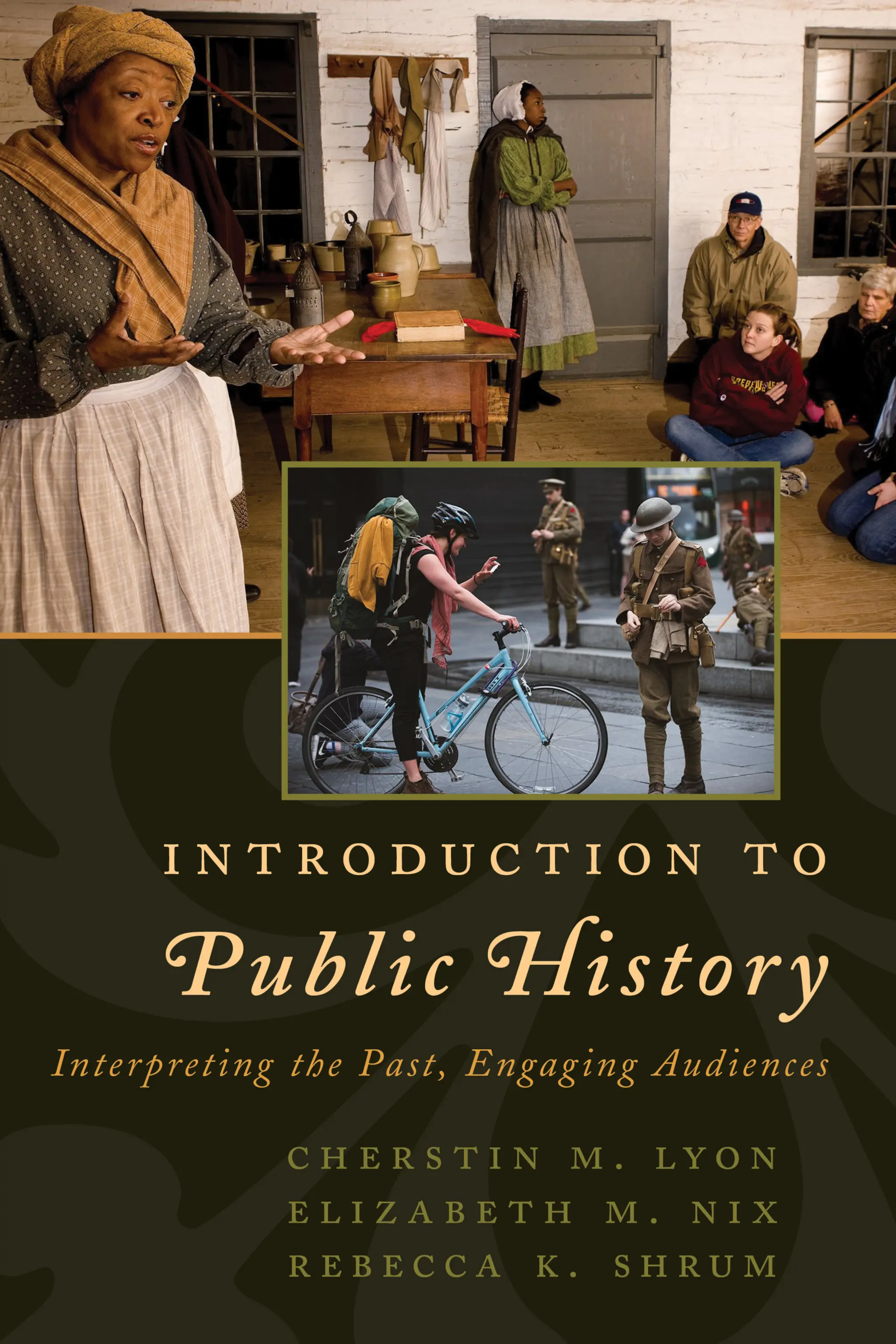

![Executive Editor: Charles Harmon
Assistant Editor: Kathleen O’Brien
Senior Marketing Manager: Deborah Hudson
Interior Designer: Rhonda Baker
Cover Designer: Chloe Batch
Credits and acknowledgments for material borrowed from other sources, and reproduced with
permission, appear on the appropriate page within the text.
Published by Rowman & Littlefield
A wholly owned subsidiary of The Rowman & Littlefield Publishing Group, Inc.
4501 Forbes Boulevard, Suite 200, Lanham, Maryland 20706
www.rowman.com
Unit A, Whitacre Mews, 26-34 Stannary Street, London SE11 4AB, United Kingdom
Copyright © 2017 by Rowman & Littlefield
All rights reserved. No part of this book may be reproduced in any form or by any electronic
or mechanical means, including information storage and retrieval systems, without written
permission from the publisher, except by a reviewer who may quote passages in a review.
British Library Cataloguing in Publication Information Available
Library of Congress Cataloging-in-Publication Data
Names: Lyon, Cherstin M., 1971– author. | Nix, Elizabeth M. (Elizabeth
Morrow), 1964– author. | Shrum, Rebecca K. (Rebecca Kathleen), 1972–
author.
Title: Introduction to public history : interpreting the past, engaging
audiences / Cherstin M. Lyon, Elizabeth M. Nix, Rebecca K. Shrum.
Description: Lanham, MD : Rowman & Littlefield, [2017] | Includes index.
Identifiers: LCCN 2016051418 (print) | LCCN 2016053613 (ebook) | ISBN
9781442272217 (cloth : alk. paper) | ISBN 9781442272224 (pbk. : alk.
paper) | ISBN 9781442272231 (electronic)
Subjects: LCSH: Public history. | Public history—Textbooks.
Classification: LCC D16.163 .L96 2017 (print) | LCC D16.163 (ebook) | DDC
900—dc23
LC record available at https://lccn.loc.gov/2016051418
The paper used in this publication meets the minimum requirements of American National
Standard for Information Sciences—Permanence of Paper for Printed Library Materials, ANSI/
NISO Z39.48-1992.
Printed in the United States of America](https://image.slidesharecdn.com/5941896-250630151948-db4a253d/75/Introduction-To-Public-History-Interpreting-The-Past-Engaging-Audiences-Lyon-9-2048.jpg)



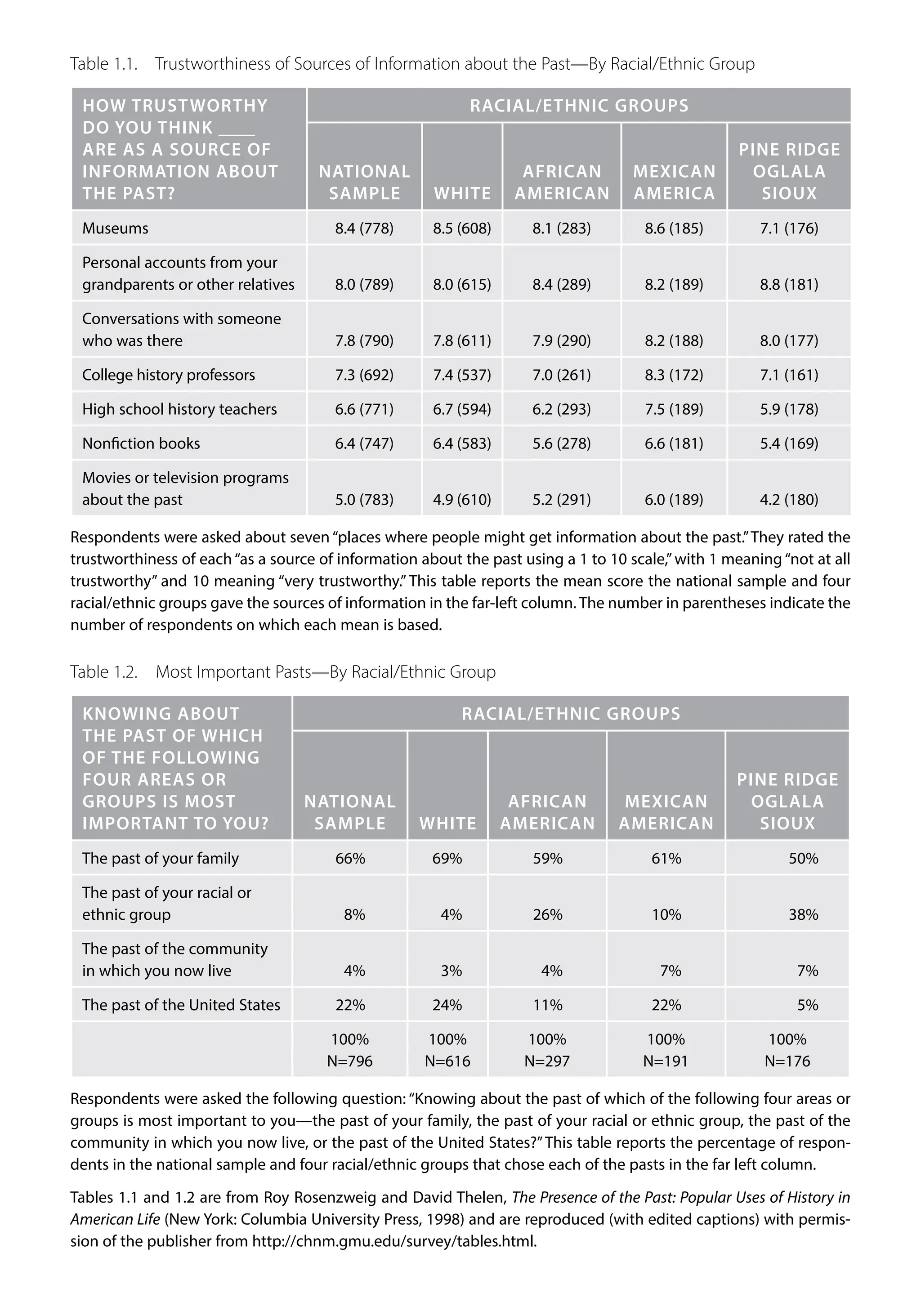
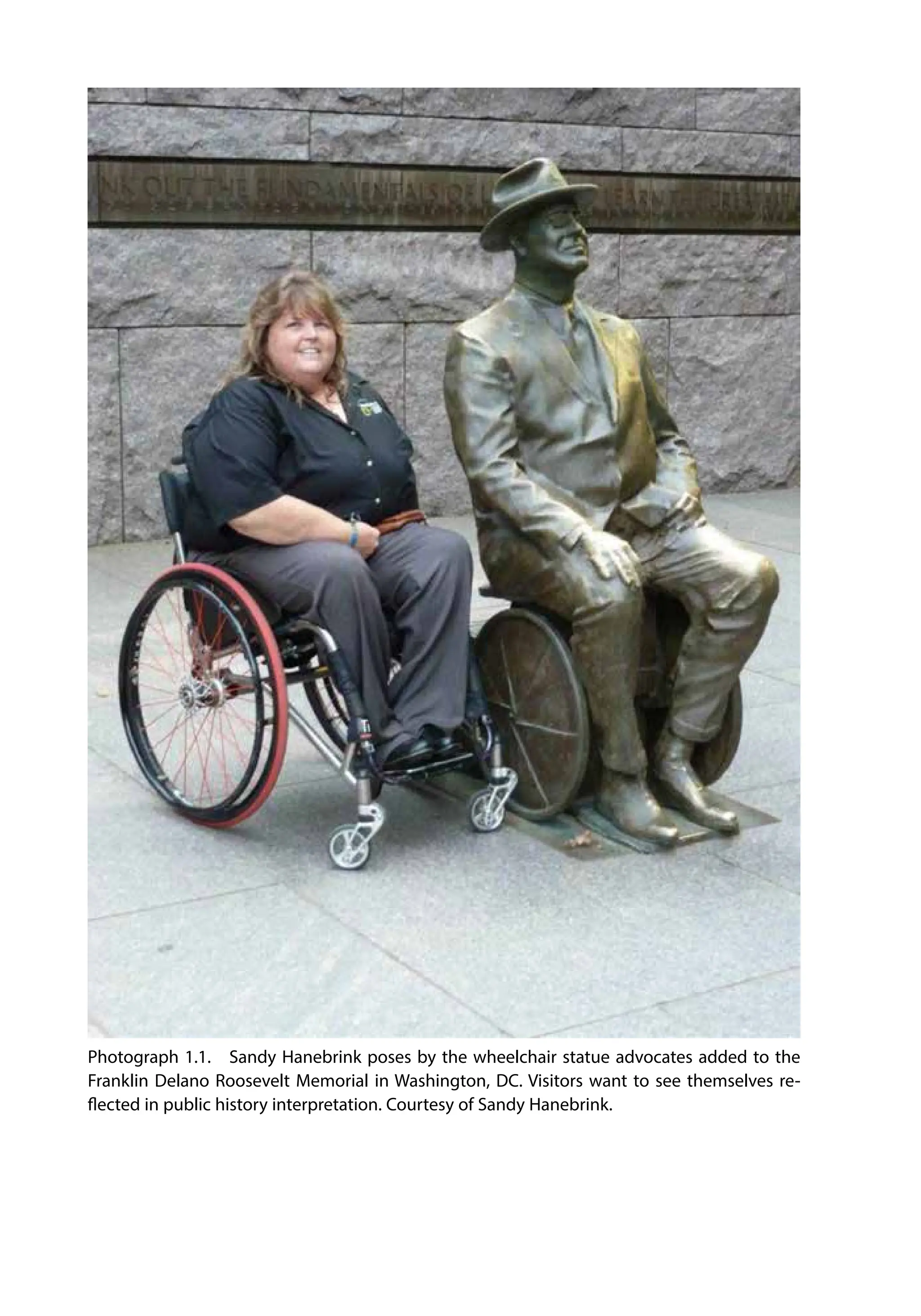
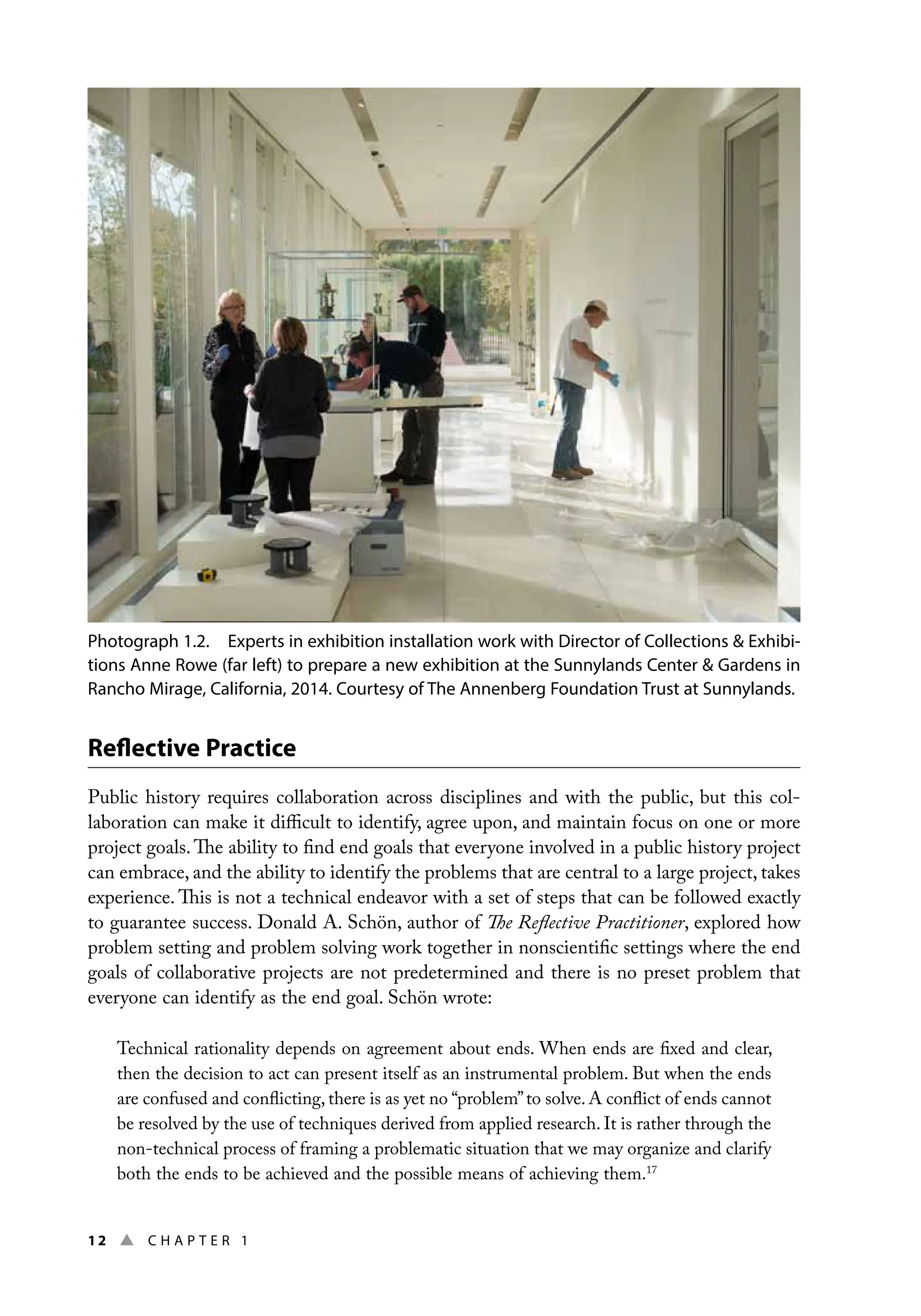
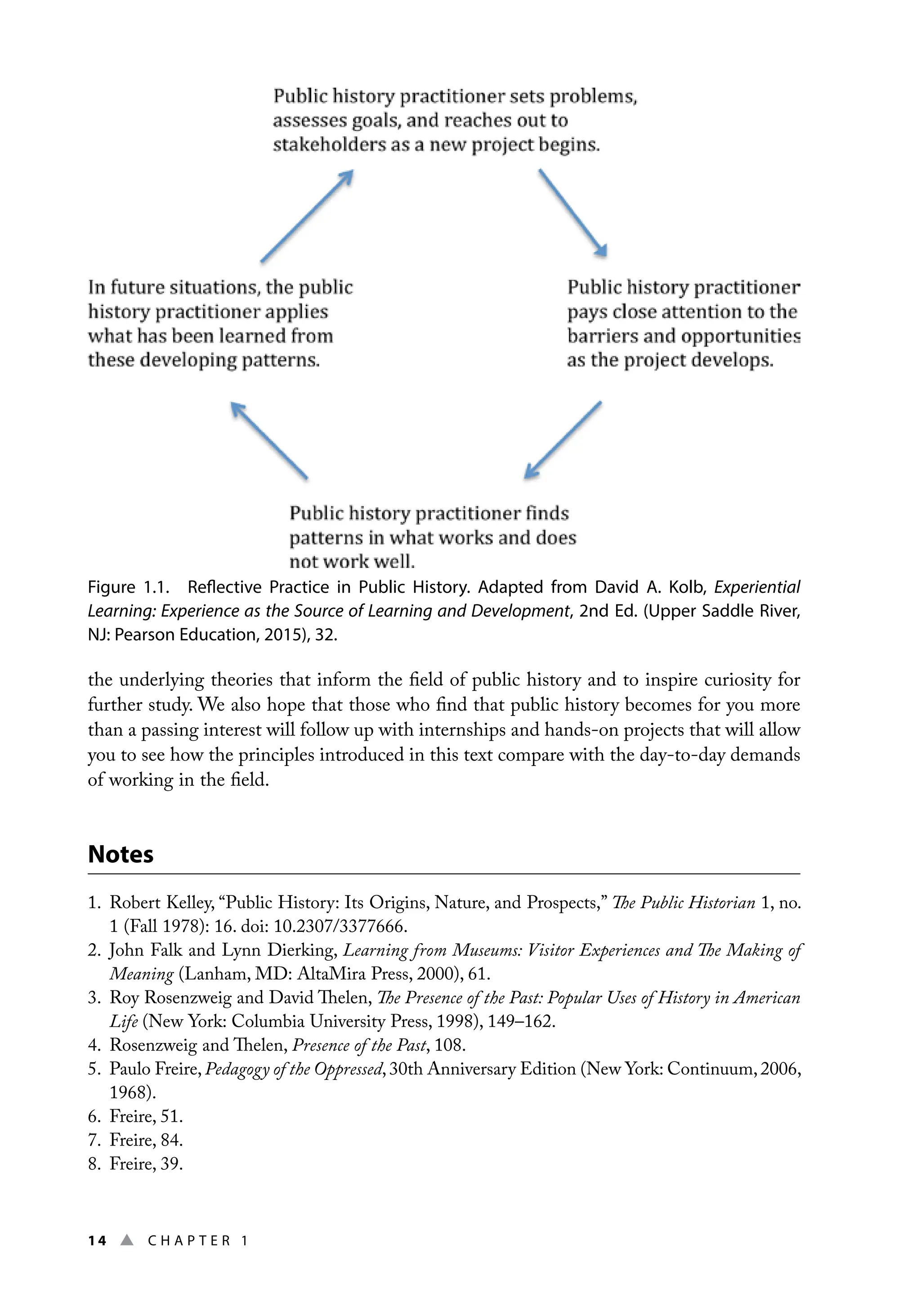

![22 ▲ Chap t e r 2
play the part of people who lived and worked in the historical setting. The concept makes
history accessible to the entire family, and living history sites often become popular vacation
destinations. The 15-acre Ohio Village site was constructed in 1974 in preparation for the
United States’ Bicentennial celebration. The village interpreted life in the 1840s through
replica buildings, only some of which were modeled after specific historic structures, where
the public could stroll through the village, visit shops or houses, and watch one of two his-
toric “base ball” teams play using nineteenth-century rules.3
In 2012, Ohio Village shifted its historical focus from the 1840s to the 1860s to com-
memorate the Sesquicentennial of the Civil War. From 2012 through 2015, Ohio Village
interpreted each year of the Civil War, from 1862–1865. When that anniversary had
passed, site director Altschwager and her team examined their mission to determine their
next steps. Would they like to repeat the Civil War story in a continuous four-year loop?
Should the site go back to its original 1840s programming? Or should they try something
new? The staff at Ohio Village were free to explore these questions because the buildings,
built in the 1970s, were not historic artifacts.Without structures tying their interpretation
to a specific time period of significance, they were free to imagine the site in many dif-
ferent historical periods. They were, however, limited by budgetary concerns: moving the
interpretive time period from 1840 to 1890 was possible without major reconstruction to
the site, but moving the interpretive time period to the colonial era or 1920s would have
required major reconstruction.
Under the leadership of Altschwager, the Ohio Village staff focused on determining
what was at the heart of the work that this site did, what their “game” was. In the process
of analyzing their work, the team made a monumental finding: the choice visitors made to
come to the site “had nothing to do with learning a specific history.” What Ohio Village
did best was help visitors learn “how history works, and how stories work.” At the site, guests
interacted with interpreters, heard stories about people from the past, explored objects that
had been made in earlier times, and asked questions about the era. By interpreting the past
through interaction, the site had introduced guests to the idea of history as a practice. The
planning team concluded that the specific histories they were interpreting did not matter as
much as the ways in which they used history as a tool to further their core values of “dyna-
mism, dialog, connection, questioning, play and the keystone of relevancy.”4
History as a Practice
What does it mean to think of history as a practice? Historians Nikki Mandell and Bob-
bie Malone undertook that question in their work Thinking Like a Historian. Mandell and
Malone observed that “[h]istory is a discipline: a way of thinking that encourages students
to analyze historical evidence, evaluate it, and then demonstrate their understanding of
that evidence.” When students, or the public at large, have the opportunity, as Mandell and
Malone put it, to do history, it engages “their passion and enthusiasm for the past while
applying the highest levels of critical thinking.”“Such involved work,”Mandell and Malone
explain, “is well beyond simple memorization of factual material and prepares young people
for the kinds of sharpened thinking necessary for a successful adult life.”5](https://image.slidesharecdn.com/5941896-250630151948-db4a253d/75/Introduction-To-Public-History-Interpreting-The-Past-Engaging-Audiences-Lyon-39-2048.jpg)
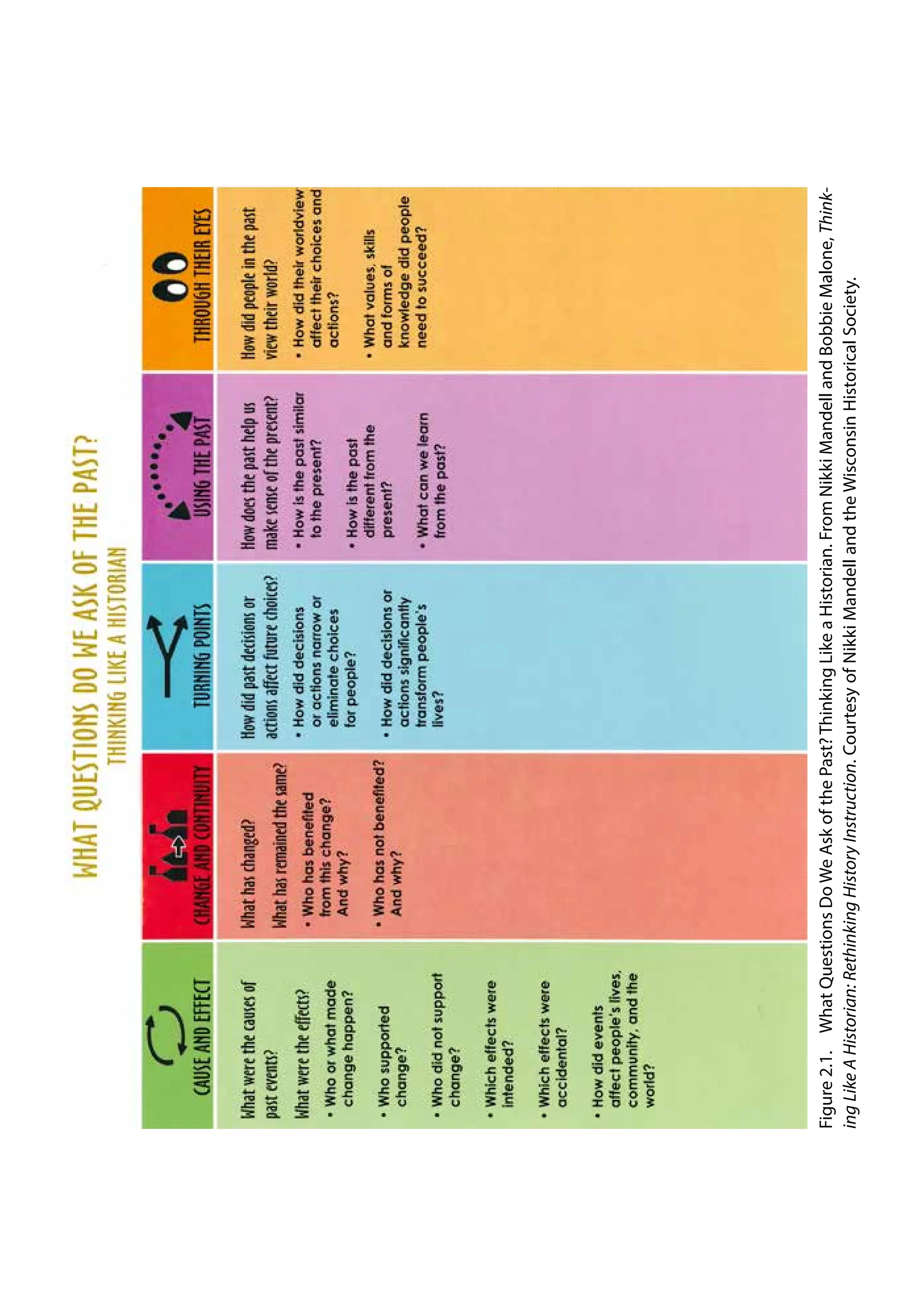
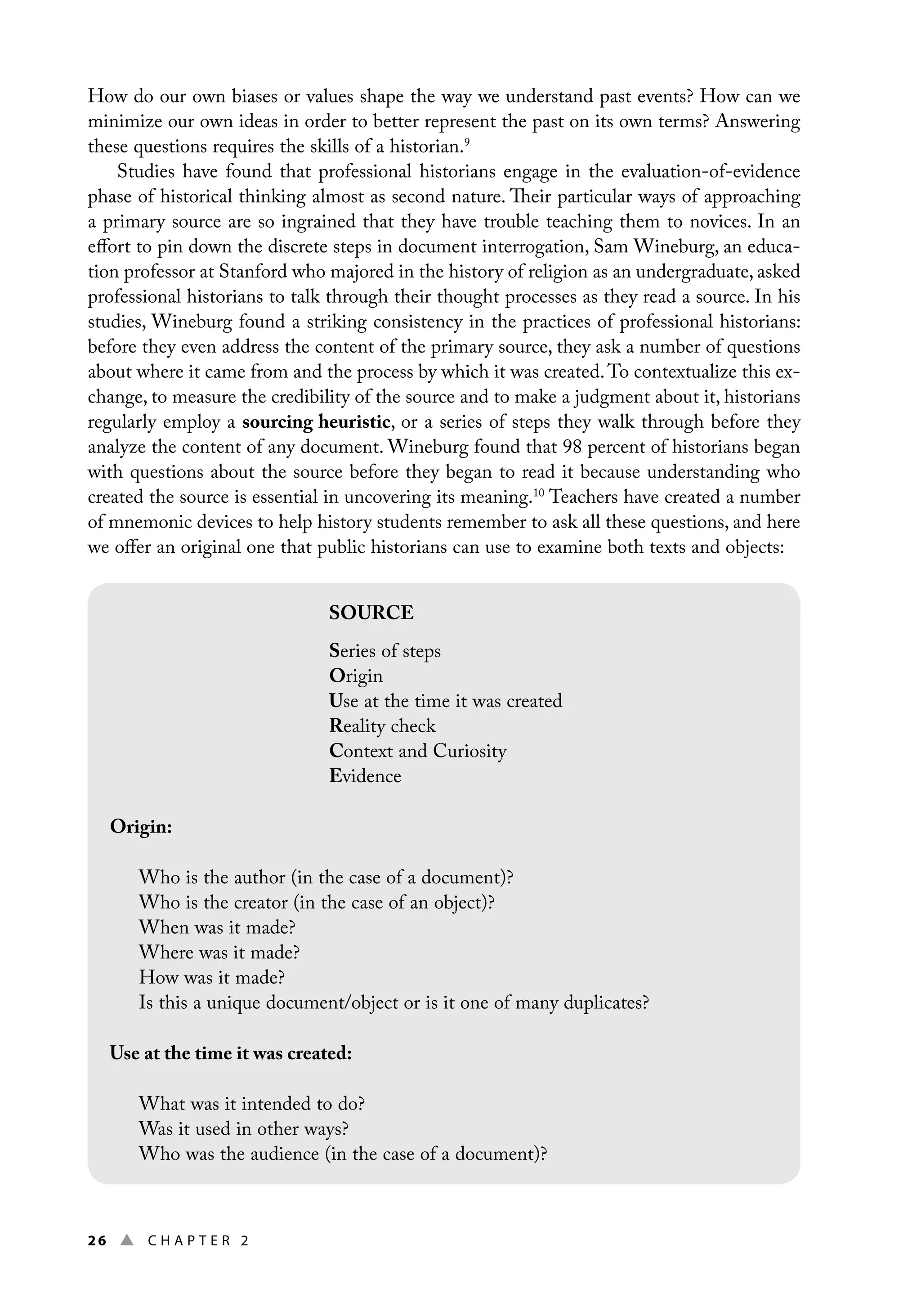
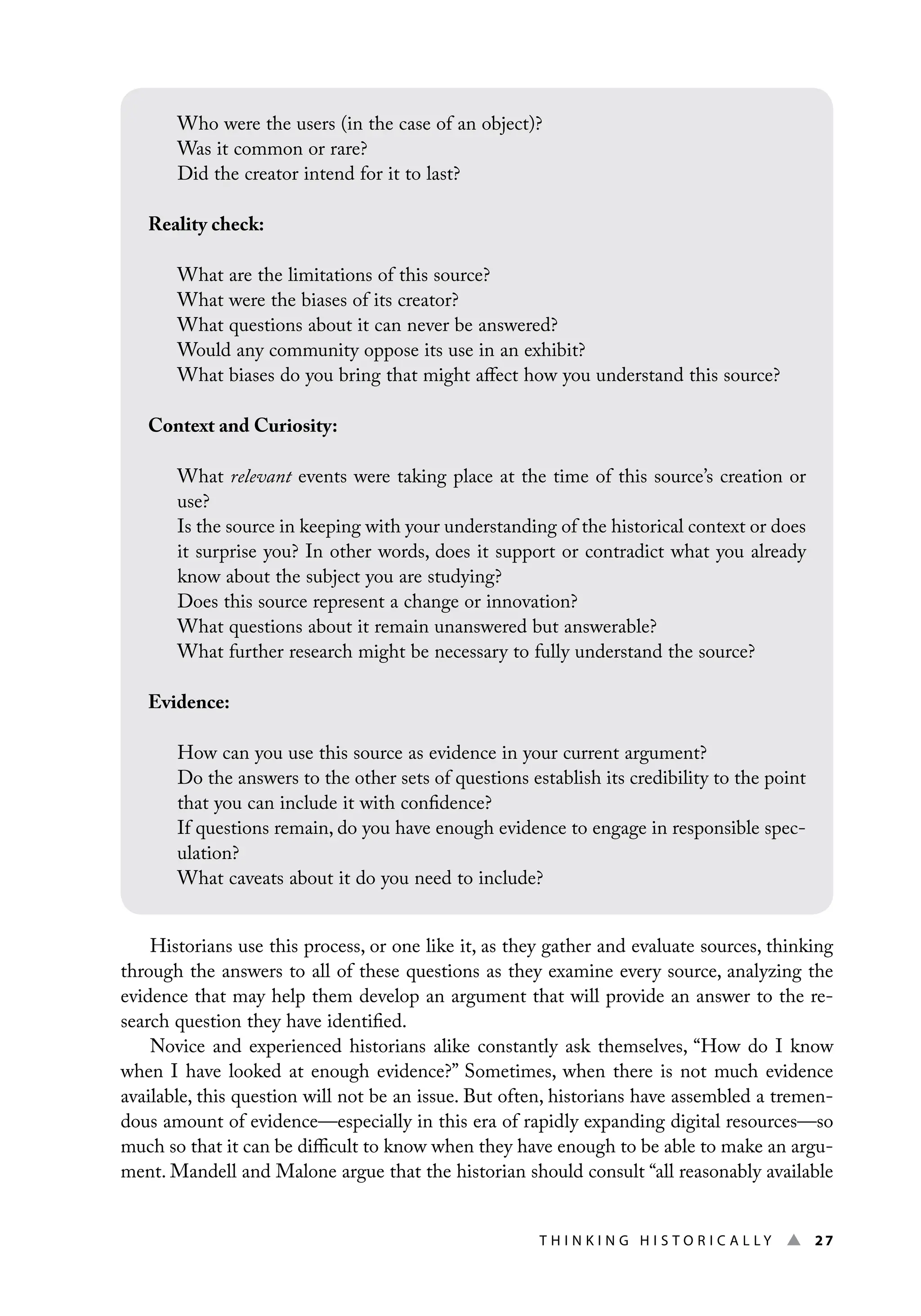
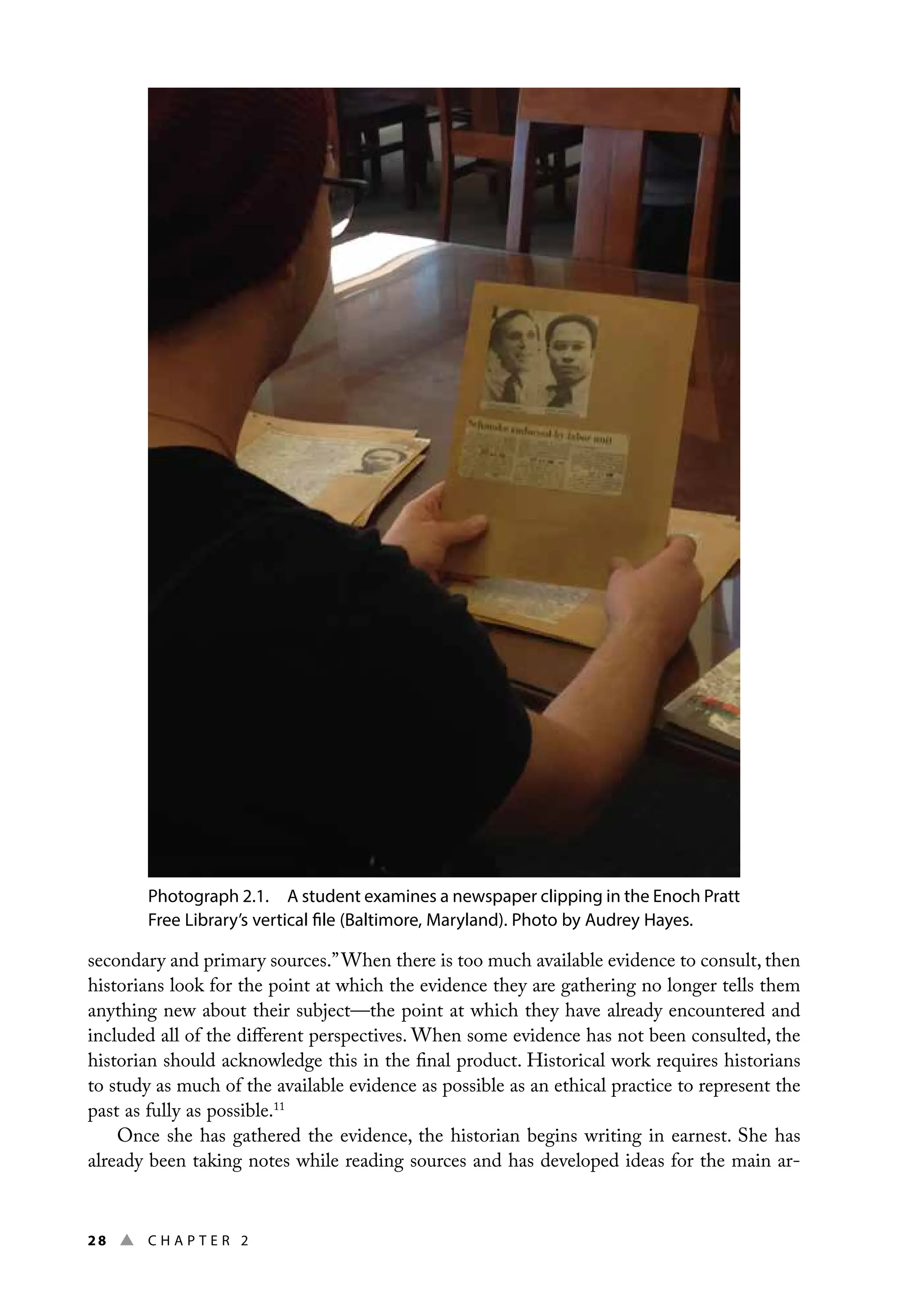

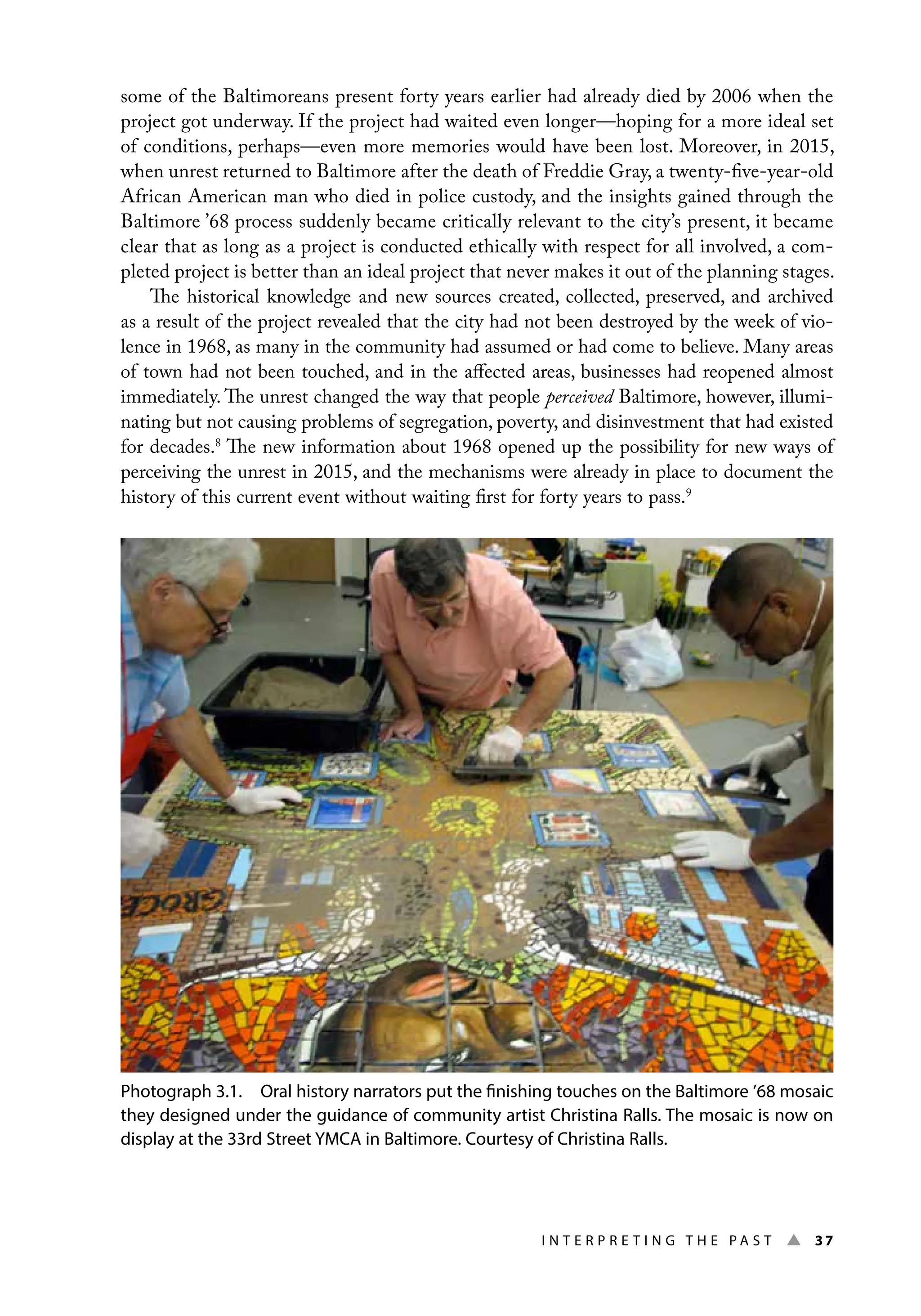

![the kingdome of Mercia another, though most commonlie the same
were gouerned by one king.] This yoong Peda came to Oswie king of
Northumberland, requiring of him to haue his daughter Alchfled in
mariage: but when he was informed that he might not haue hir
except he would become a christian, then vpon hearing the gospell
preached, with the promise of the celestiall ioies and immortalitie, by
the resurrection of the flesh in the life to come, he said that whether
he had king Oswies daughter to wife or not, he would suerlie be
baptised, and chieflie he was persuaded therevnto by his kinsman
Alchfrid, who had in mariage his sister the daughter of Penda name
Cimburgh.
Ad murum. Wherefore he was baptised by bishop Finnan, with all those
which came thither with him at a place called At the wall, and taking
with him foure priests which were thought méete to teach and
baptise his people, he returned with great ioy into his owne countrie.
The names of those priests were as followeth, Cedda, Adda, Betti,
and Diuna, of the which, the last was a Scot by nation, and the
other were Englishmen. These priests comming into the prouince of
the Middleangles, preached the woord, and were well heard, so that
dailie a great number of the nobilitie communaltie renouncing the
filthie dregs of idolatrie, were christned. Neither did king Penda
forbid the preaching of the gospell within his prouince of Mercia, but
rather hated and despised those whome he knew to haue professed
themselues christians, and yet shewed The saieng of king Penda. not the
woorks of faith, saieng, that Those were wretches and not to be
regarded, which would not obeie their God in whome they
beléeued. This alteration of things began, about two yéeres before
the death of king Penda.
Beda lib. 3. cap. 22. About the same time, the Eastsaxons at the instance
of Oswie king of Northumberland, receiued eftsoones the faith which
they had renounced, when they banished their bishop Melitus. Ye
haue heard that Serred, Siward, and Sigibert brethren, and the
sonnes of king Sabert (which brethren occasioned the reuolting of
that prouince from the faith of Christ) were slaine in battell by the](https://image.slidesharecdn.com/5941896-250630151948-db4a253d/75/Introduction-To-Public-History-Interpreting-The-Past-Engaging-Audiences-Lyon-63-2048.jpg)