Topics
• Why dowe need classes?
• Defining Classes
• Defining Objects
• Class variables vs Instance variables
• Methods
• Inheritance
• Polymorphism
3.
Why do weneed classes?
• Which field contains what type of information?
client = [“xxxxxxxxxxxxxxx",
“0000000000",
“xxxxxxxxx",
0]
The parts of a composite list can
be accessed via [index] but they
cannot be labeled (what do these
fields store?)
This isn’t immediately clear from looking at the program statements.
4.
Object-Oriented Programming
You havelearned structured programming
Breaking tasks into subtasks
Writing re-usable methods to handle tasks
We will now study Objects and Classes
To build larger and more complex programs
To model objects we use in the world
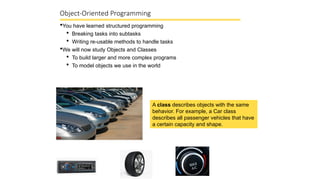
A class describes objects with the same
behavior. For example, a Car class
describes all passenger vehicles that have
a certain capacity and shape.
5.
A class
class
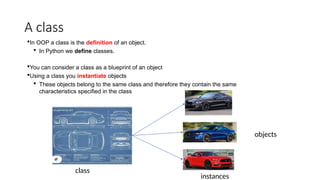
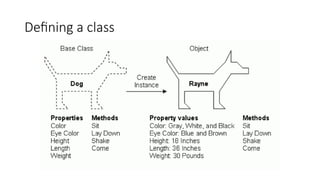
In OOPa class is the definition of an object.
In Python we define classes.
You can consider a class as a blueprint of an object
Using a class you instantiate objects
These objects belong to the same class and therefore they contain the same
characteristics specified in the class
instances
objects
Diagram of aClass
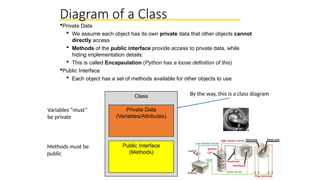
Private Data
We assume each object has its own private data that other objects cannot
directly access
Methods of the public interface provide access to private data, while
hiding implementation details:
This is called Encapsulation (Python has a loose definition of this)
Public Interface
Each object has a set of methods available for other objects to use
Class
Private Data
(Variables/Attributes)
Public Interface
(Methods)
Variables “must”
be private
Methods must be
public
By the way, this is a class diagram
8.
Let’s go toGoogle Colab
• Topics:
• Classes
• Writing classes in Python
• Class variables
• Class constructor
• Instance variables
• Instance methods
• Combining Class variables and Instance variables
• Class inheritance and Polymorphism
• Inheritance
• Polymorphism
9.
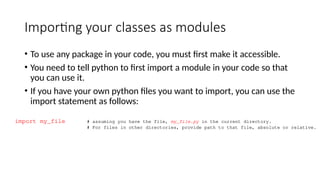
Importing your classesas modules
• To use any package in your code, you must first make it accessible.
• You need to tell python to first import a module in your code so that
you can use it.
• If you have your own python files you want to import, you can use the
import statement as follows:
import my_file # assuming you have the file, my_file.py in the current directory.
# For files in other directories, provide path to that file, absolute or relative.
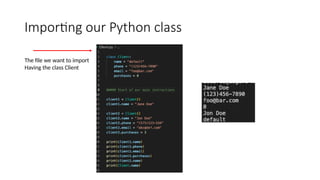
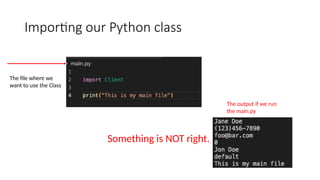
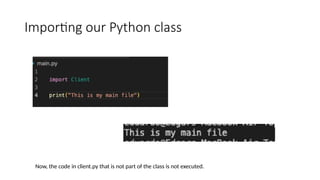
Importing our Pythonclass
The file where we
want to use the Class
The output if we run
the main.py
Something is NOT right.
12.
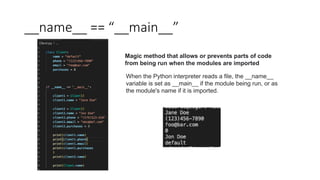
__name__ == “__main__”
Magicmethod that allows or prevents parts of code
from being run when the modules are imported
When the Python interpreter reads a file, the __name__
variable is set as __main__ if the module being run, or as
the module's name if it is imported.
13.
Importing our Pythonclass
Now, the code in client.py that is not part of the class is not executed.
#4 It is difficult to understand and update a program that consists of a large collection of methods.
To overcome this problem, computer scientists invented object-oriented programming, tasks are solved by collaborating objects
When you develop an object-oriented program, you create your own objects that describe what is important in your application.
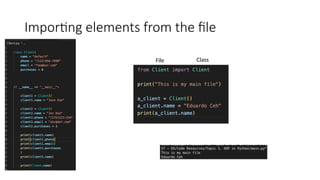
#14 If you only use “import Client”, you are importing EVERYTHING from that file.
Therefore, you need to specify what classes or methods you want to use. For example, Client.Client()
![Why do we need classes?
• Which field contains what type of information?
client = [“xxxxxxxxxxxxxxx",
“0000000000",
“xxxxxxxxx",
0]
The parts of a composite list can
be accessed via [index] but they
cannot be labeled (what do these
fields store?)
This isn’t immediately clear from looking at the program statements.](https://image.slidesharecdn.com/1-250413043657-305d5571/85/Introduction-to-Object-Oriented-Programming-in-Python-pptx-3-320.jpg)