Natural Language Processing
NLP Overview
Outline
• Introduction
• Stages of Language Processing
• Why NLP is hard?
• Fields with Connections to NLP
• NLP Applications
• Factors Changing NLP Landscape
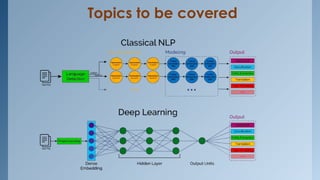
• Topics to be covered
• Practical Tools
Introduction
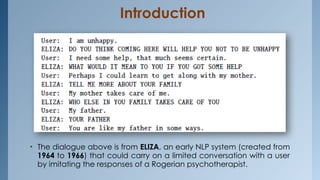
• The dialogue above is from ELIZA, an early NLP system (created from
1964 to 1966) that could carry on a limited conversation with a user
by imitating the responses of a Rogerian psychotherapist.
Introduction
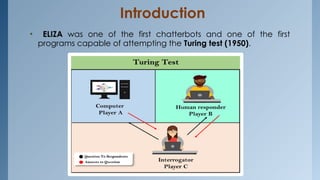
• ELIZA was one of the first chatterbots and one of the first
programs capable of attempting the Turing test (1950).
Introduction
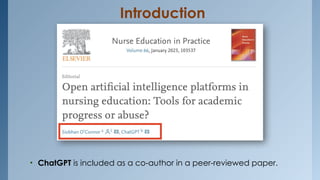
• ChatGPT is included as a co-author in a peer-reviewed paper.
Introduction
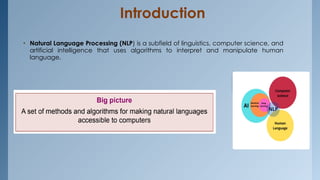
• Natural Language Processing (NLP) is a subfield of linguistics, computer science, and
artificial intelligence that uses algorithms to interpret and manipulate human
language.
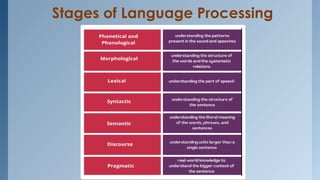
Stages of Language Processing
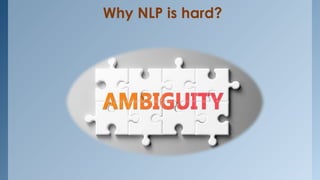
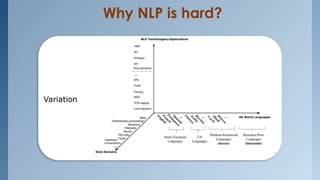
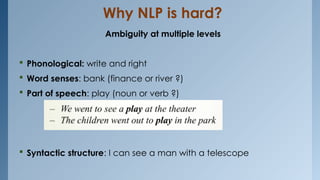
Why NLP is hard?
Why NLP is hard?
Ambiguity at multiple levels
 Phonological: write and right
 Word senses: bank (finance or river ?)
 Part of speech: play (noun or verb ?)
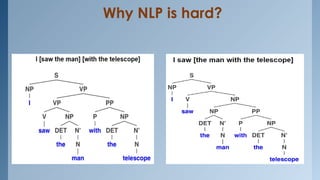
 Syntactic structure: I can see a man with a telescope
Why NLP is hard?
Why NLP is hard?
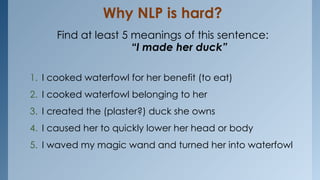
Find at least 5 meanings of this sentence:
“I made her duck”
1. I cooked waterfowl for her benefit (to eat)
2. I cooked waterfowl belonging to her
3. I created the (plaster?) duck she owns
4. I caused her to quickly lower her head or body
5. I waved my magic wand and turned her into waterfowl
Why NLP is hard?
Why NLP is hard?
Why NLP is hard?
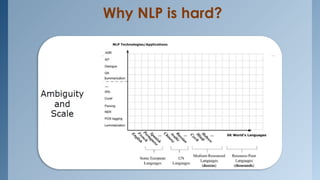
• Are there any other reasons?
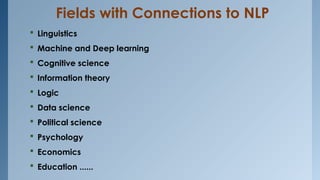
Fields with Connections to NLP
 Linguistics
 Machine and Deep learning
 Cognitive science
 Information theory
 Logic
 Data science
 Political science
 Psychology
 Economics
 Education ......
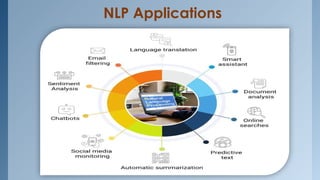
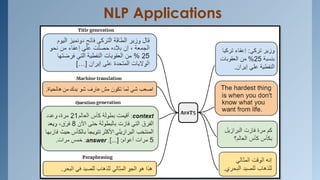
NLP Applications
NLP Applications
NLP Applications
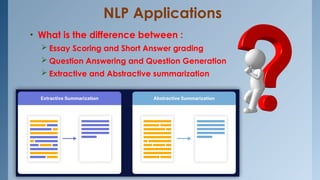
• What is the difference between :
 Essay Scoring and Short Answer grading
 Question Answering and Question Generation
 Extractive and Abstractive summarization
NLP Applications
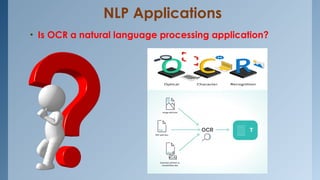
• Is OCR a natural language processing application?
Factors Changing NLP Landscape
 Increases in computing power
 The rise of the web, then the social web
 Advances in machine and deep learning
 Advances in understanding of language in social context
Topics to be covered
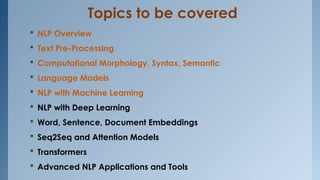
 NLP Overview
 Text Pre-Processing
 Computational Morphology, Syntax, Semantic
 Language Models
 NLP with Machine Learning
 NLP with Deep Learning
 Word, Sentence, Document Embeddings
 Seq2Seq and Attention Models
 Transformers
 Advanced NLP Applications and Tools
Topics to be covered
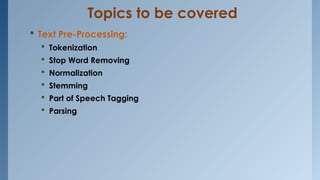
 Text Pre-Processing:
 Tokenization
 Stop Word Removing
 Normalization
 Stemming
 Part of Speech Tagging
 Parsing
Topics to be covered
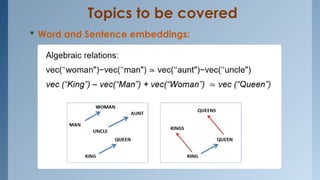
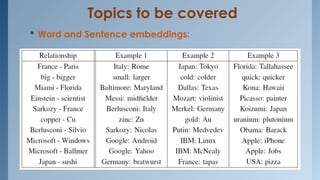
 Word and Sentence embeddings:
Topics to be covered
 Word and Sentence embeddings:
Topics to be covered
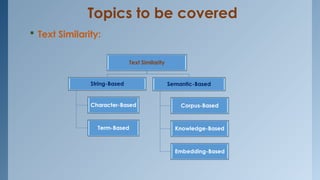
 Text Similarity:
Topics to be covered
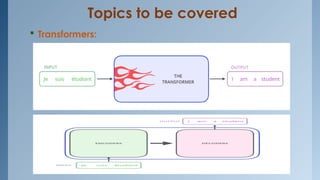
 Transformers:
Practical Tools
Introduction to Natural Language Processing (NLP)

Introduction to Natural Language Processing (NLP)

  • 1.
  • 2.
    Outline • Introduction • Stagesof Language Processing • Why NLP is hard? • Fields with Connections to NLP • NLP Applications • Factors Changing NLP Landscape • Topics to be covered • Practical Tools
  • 3.
    Introduction • The dialogueabove is from ELIZA, an early NLP system (created from 1964 to 1966) that could carry on a limited conversation with a user by imitating the responses of a Rogerian psychotherapist.
  • 4.
    Introduction • ELIZA wasone of the first chatterbots and one of the first programs capable of attempting the Turing test (1950).
  • 5.
    Introduction • ChatGPT isincluded as a co-author in a peer-reviewed paper.
  • 6.
    Introduction • Natural LanguageProcessing (NLP) is a subfield of linguistics, computer science, and artificial intelligence that uses algorithms to interpret and manipulate human language.
  • 7.
  • 8.
  • 9.
    Why NLP ishard? Ambiguity at multiple levels  Phonological: write and right  Word senses: bank (finance or river ?)  Part of speech: play (noun or verb ?)  Syntactic structure: I can see a man with a telescope
  • 10.
  • 11.
    Why NLP ishard? Find at least 5 meanings of this sentence: “I made her duck” 1. I cooked waterfowl for her benefit (to eat) 2. I cooked waterfowl belonging to her 3. I created the (plaster?) duck she owns 4. I caused her to quickly lower her head or body 5. I waved my magic wand and turned her into waterfowl
  • 12.
  • 13.
  • 14.
    Why NLP ishard? • Are there any other reasons?
  • 15.
    Fields with Connectionsto NLP  Linguistics  Machine and Deep learning  Cognitive science  Information theory  Logic  Data science  Political science  Psychology  Economics  Education ......
  • 16.
  • 17.
  • 18.
    NLP Applications • Whatis the difference between :  Essay Scoring and Short Answer grading  Question Answering and Question Generation  Extractive and Abstractive summarization
  • 19.
    NLP Applications • IsOCR a natural language processing application?
  • 20.
    Factors Changing NLPLandscape  Increases in computing power  The rise of the web, then the social web  Advances in machine and deep learning  Advances in understanding of language in social context
  • 21.
    Topics to becovered
  • 22.
    Topics to becovered  NLP Overview  Text Pre-Processing  Computational Morphology, Syntax, Semantic  Language Models  NLP with Machine Learning  NLP with Deep Learning  Word, Sentence, Document Embeddings  Seq2Seq and Attention Models  Transformers  Advanced NLP Applications and Tools
  • 23.
    Topics to becovered  Text Pre-Processing:  Tokenization  Stop Word Removing  Normalization  Stemming  Part of Speech Tagging  Parsing
  • 24.
    Topics to becovered  Word and Sentence embeddings:
  • 25.
    Topics to becovered  Word and Sentence embeddings:
  • 26.
    Topics to becovered  Text Similarity:
  • 27.
    Topics to becovered  Transformers:
  • 28.