Introduction to Linux
Privilege Escalation Methods
KATE BROUSSARD
Senior Security Analyst
February 22, 2019
Introduction
ROADMAP FOR THE NEXT HOUR
• Priv esc definition + Framing
• Easy mode
• Sneaky mode
• Boss mode
• Summary
• Resources
OUTLINE
Senior Security analyst at Bishop Fox
kbroussard@bishopfox.com
Twitter handle: @grazhacks
KATE BROUSSARD
PRIVILEGE ESCALATION
AND SO WE BEGIN
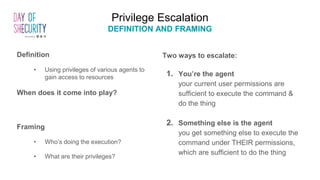
Definition
• Using privileges of various agents to
gain access to resources
When does it come into play?
Framing
• Who’s doing the execution?
• What are their privileges?
Two ways to escalate:
1. You’re the agent
your current user permissions are
sufficient to execute the command &
do the thing
2. Something else is the agent
you get something else to execute the
command under THEIR permissions,
which are sufficient to do the thing
Privilege Escalation
DEFINITION AND FRAMING
EASY MODE
SO YOU’RE IN THE SERVER – NOW WHAT?
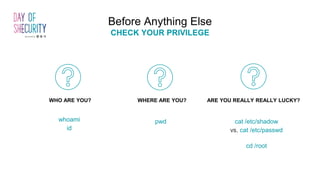
whoami
id
pwd cat /etc/shadow
vs. cat /etc/passwd
cd /root
WHO ARE YOU? WHERE ARE YOU? ARE YOU REALLY REALLY LUCKY?
Before Anything Else
CHECK YOUR PRIVILEGE
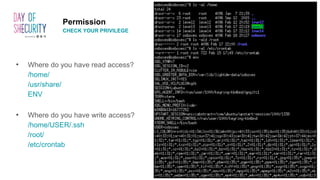
• Where do you have read access?
/home/
/usr/share/
ENV
• Where do you have write access?
/home/USER/.ssh
/root/
/etc/crontab
https://www.gq.com/story/netflix-carmen-sandiego-hero-weird
Permission
CHECK YOUR PRIVILEGE
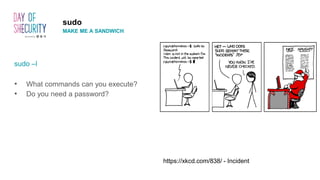
sudo –l
• What commands can you execute?
• Do you need a password?
sudo
MAKE ME A SANDWICH
https://xkcd.com/838/ - Incident
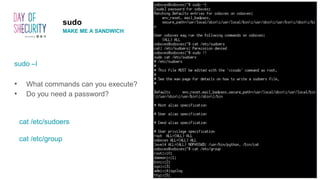
sudo –l
• What commands can you execute?
• Do you need a password?
cat /etc/sudoers
cat /etc/group
sudo
MAKE ME A SANDWICH
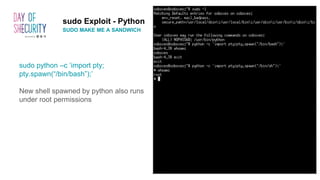
sudo Exploit - Python
SUDO MAKE ME A SANDWICH
sudo python –c ‘import pty;
pty.spawn(“/bin/bash”);’
New shell spawned by python also runs
under root permissions
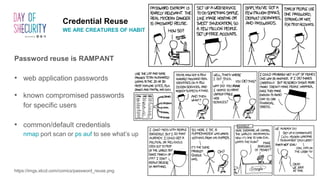
Credential Reuse
WE ARE CREATURES OF HABIT
Password reuse is RAMPANT
• web application passwords
• known compromised passwords
for specific users
• common/default credentials
nmap port scan or ps auf to see what’s up
https://imgs.xkcd.com/comics/password_reuse.png
.bash_history
LEAKED INFORMATION
• Any passwords entered into history?
• Any interesting files or directories?
cat .bash_history vs history
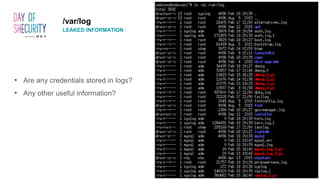
/var/log
LEAKED INFORMATION
• Are any credentials stored in logs?
• Any other useful information?
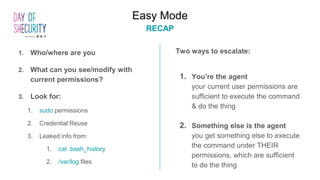
1. Who/where are you
2. What can you see/modify with
current permissions?
3. Look for:
1. sudo permissions
2. Credential Reuse
3. Leaked info from:
1. cat .bash_history
2. /var/log files
Two ways to escalate:
1. You’re the agent
your current user permissions are
sufficient to execute the command
& do the thing
2. Something else is the agent
you get something else to execute
the command under THEIR
permissions, which are sufficient
to do the thing
Easy Mode
RECAP
SNEAKY MODE
FIND AND EXPLOIT SOME MISCONFIGURATIONS
SUID/SGID bits
CHECK THEIR PRIVILEGE
• What is the SUID/SGID bit?
• How to find a SUID/SGID binary?
• What runs as the root user?
find / -perm -u=s [-type f] 2>/dev/null
find / -perm -4000 [-type f] 2>/dev/null
• What runs in the root group?
find / -perm -g=s [-type f] 2>/dev/null
find / -perm -2000 [-type f] 2>/dev/null
SUID/SGID bits
CHECK THEIR PRIVILEGE
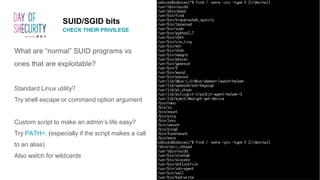
What are “normal” SUID programs vs
ones that are exploitable?
Standard Linux utility?
Try shell escape or command option argument
Custom script to make an admin’s life easy?
Try PATH=. (especially if the script makes a call
to an alias)
Also watch for wildcards
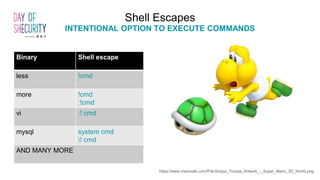
Binary Shell escape
less !cmd
more !cmd
:!cmd
vi :! cmd
mysql system cmd
! cmd
AND MANY MORE
https://www.mariowiki.com/File:Koopa_Troopa_Artwork_-_Super_Mario_3D_World.png
INTENTIONAL OPTION TO EXECUTE COMMANDS
Shell Escapes
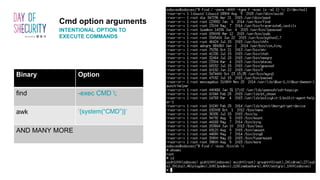
Binary Option
find -exec CMD ;
awk ‘{system(“CMD”)}’
AND MANY MORE
Cmd option arguments
INTENTIONAL OPTION TO
EXECUTE COMMANDS
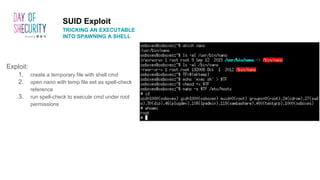
Exploit:
1. create a temporary file with shell cmd
2. open nano with temp file set as spell-check
reference
3. run spell-check to execute cmd under root
permissions
SUID Exploit
TRICKING AN EXECUTABLE
INTO SPAWNING A SHELL
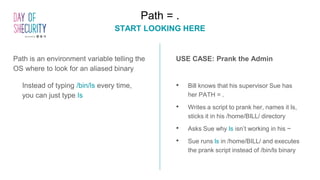
Path is an environment variable telling the
OS where to look for an aliased binary
Instead of typing /bin/ls every time,
you can just type ls
USE CASE: Prank the Admin
• Bill knows that his supervisor Sue has
her PATH = .
• Writes a script to prank her, names it ls,
sticks it in his /home/BILL/ directory
• Asks Sue why ls isn’t working in his ~
• Sue runs ls in /home/BILL/ and executes
the prank script instead of /bin/ls binary
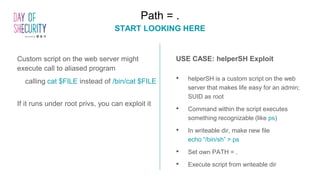
Path = .
START LOOKING HERE
Custom script on the web server might
execute call to aliased program
calling cat $FILE instead of /bin/cat $FILE
If it runs under root privs, you can exploit it
Path = .
START LOOKING HERE
USE CASE: helperSH Exploit
• helperSH is a custom script on the web
server that makes life easy for an admin;
SUID as root
• Command within the script executes
something recognizable (like ps)
• In writeable dir, make new file
echo “/bin/sh” > ps
• Set own PATH = .
• Execute script from writeable dir
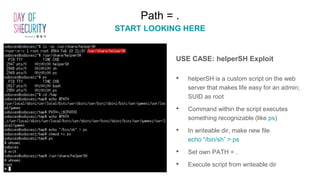
Path = .
START LOOKING HERE
USE CASE: helperSH Exploit
• helperSH is a custom script on the web
server that makes life easy for an admin;
SUID as root
• Command within the script executes
something recognizable (like ps)
• In writeable dir, make new file
echo “/bin/sh” > ps
• Set own PATH = .
• Execute script from writeable dir
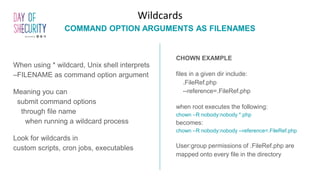
When using * wildcard, Unix shell interprets
–FILENAME as command option argument
Meaning you can
submit command options
through file name
when running a wildcard process
Look for wildcards in
custom scripts, cron jobs, executables
Wildcards
COMMAND OPTION ARGUMENTS AS FILENAMES
CHOWN EXAMPLE
files in a given dir include:
.FileRef.php
--reference=.FileRef.php
when root executes the following:
chown –R nobody:nobody *.php
becomes:
chown –R nobody:nobody --reference=.FileRef.php
User:group permissions of .FileRef.php are
mapped onto every file in the directory
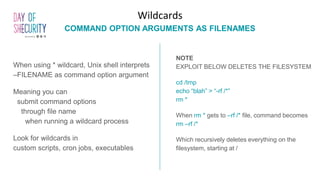
When using * wildcard, Unix shell interprets
–FILENAME as command option argument
Meaning you can
submit command options
through file name
when running a wildcard process
Look for wildcards in
custom scripts, cron jobs, executables
Wildcards
COMMAND OPTION ARGUMENTS AS FILENAMES
NOTE
EXPLOIT BELOW DELETES THE FILESYSTEM
cd /tmp
echo “blah” > “-rf /*”
rm *
When rm * gets to –rf /* file, command becomes
rm –rf /*
Which recursively deletes everything on the
filesystem, starting at /
Sneaky Mode
RECAP
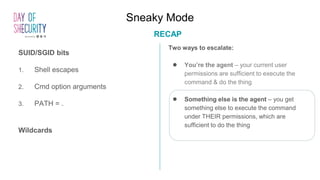
Two ways to escalate:
● You’re the agent – your current user
permissions are sufficient to execute the
command & do the thing
● Something else is the agent – you get
something else to execute the command
under THEIR permissions, which are
sufficient to do the thing
SUID/SGID bits
1. Shell escapes
2. Cmd option arguments
3. PATH = .
Wildcards
BOSS MODE
THESE WILL TAKE SOME TIME TO GET
RIGHT
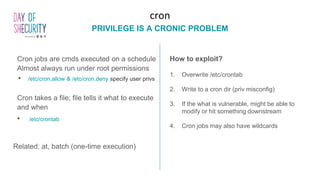
Cron jobs are cmds executed on a schedule
Almost always run under root permissions
• /etc/cron.allow & /etc/cron.deny specify user privs
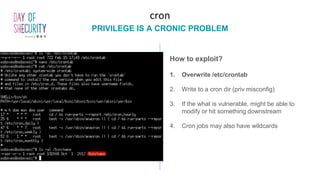
Cron takes a file; file tells it what to execute
and when
• /etc/crontab
Related: at, batch (one-time execution)
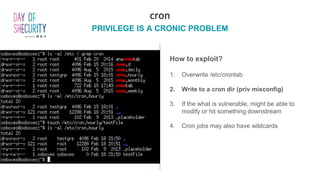
cron
PRIVILEGE IS A CRONIC PROBLEM
How to exploit?
1. Overwrite /etc/crontab
2. Write to a cron dir (priv misconfig)
3. If the what is vulnerable, might be able to
modify or hit something downstream
4. Cron jobs may also have wildcards
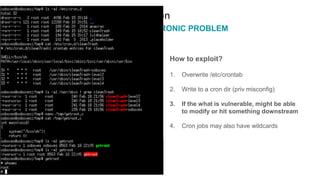
cron
PRIVILEGE IS A CRONIC PROBLEM
How to exploit?
1. Overwrite /etc/crontab
2. Write to a cron dir (priv misconfig)
3. If the what is vulnerable, might be able to
modify or hit something downstream
4. Cron jobs may also have wildcards
cron
PRIVILEGE IS A CRONIC PROBLEM
How to exploit?
1. Overwrite /etc/crontab
2. Write to a cron dir (priv misconfig)
3. If the what is vulnerable, might be able to
modify or hit something downstream
4. Cron jobs may also have wildcards
cron
PRIVILEGE IS A CRONIC PROBLEM
How to exploit?
1. Overwrite /etc/crontab
2. Write to a cron dir (priv misconfig)
3. If the what is vulnerable, might be able
to modify or hit something downstream
4. Cron jobs may also have wildcards
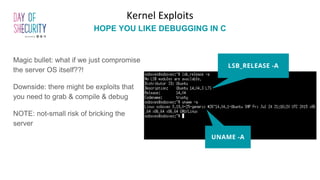
Magic bullet: what if we just compromise
the server OS itself??!
Downside: there might be exploits that
you need to grab & compile & debug
NOTE: not-small risk of bricking the
server
Kernel Exploits
HOPE YOU LIKE DEBUGGING IN C
LSB_RELEASE -A
UNAME -A
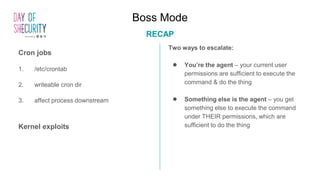
Boss Mode
RECAP
Two ways to escalate:
● You’re the agent – your current user
permissions are sufficient to execute the
command & do the thing
● Something else is the agent – you get
something else to execute the command
under THEIR permissions, which are
sufficient to do the thing
Cron jobs
1. /etc/crontab
2. writeable cron dir
3. affect process downstream
Kernel exploits
THAT’S ONE IN THE BANK
LET ME SUM UP
Summary
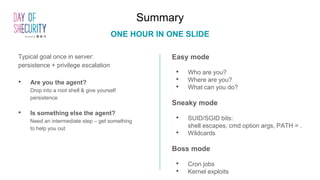
ONE HOUR IN ONE SLIDE
Easy mode
• Who are you?
• Where are you?
• What can you do?
Sneaky mode
• SUID/SGID bits:
shell escapes, cmd option args, PATH = .
• Wildcards
Boss mode
• Cron jobs
• Kernel exploits
Typical goal once in server:
persistence + privilege escalation
• Are you the agent?
Drop into a root shell & give yourself
persistence
• Is something else the agent?
Need an intermediate step – get something
to help you out
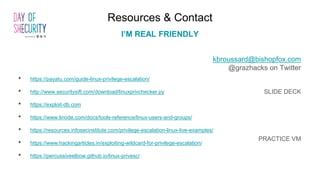
Resources & Contact
I’M REAL FRIENDLY
kbroussard@bishopfox.com
@grazhacks on Twitter
SLIDE DECK
PRACTICE VM
• https://payatu.com/guide-linux-privilege-escalation/
• http://www.securitysift.com/download/linuxprivchecker.py
• https://exploit-db.com
• https://www.linode.com/docs/tools-reference/linux-users-and-groups/
• https://resources.infosecinstitute.com/privilege-escalation-linux-live-examples/
• https://www.hackingarticles.in/exploiting-wildcard-for-privilege-escalation/
• https://percussiveelbow.github.io/linux-privesc/
Thank you!
Questions?

Introduction to Linux Privilege Escalation Methods

  • 1.
    Introduction to Linux PrivilegeEscalation Methods KATE BROUSSARD Senior Security Analyst February 22, 2019
  • 2.
    Introduction ROADMAP FOR THENEXT HOUR • Priv esc definition + Framing • Easy mode • Sneaky mode • Boss mode • Summary • Resources OUTLINE Senior Security analyst at Bishop Fox kbroussard@bishopfox.com Twitter handle: @grazhacks KATE BROUSSARD
  • 3.
  • 4.
    Definition • Using privilegesof various agents to gain access to resources When does it come into play? Framing • Who’s doing the execution? • What are their privileges? Two ways to escalate: 1. You’re the agent your current user permissions are sufficient to execute the command & do the thing 2. Something else is the agent you get something else to execute the command under THEIR permissions, which are sufficient to do the thing Privilege Escalation DEFINITION AND FRAMING
  • 5.
    EASY MODE SO YOU’REIN THE SERVER – NOW WHAT?
  • 6.
    whoami id pwd cat /etc/shadow vs.cat /etc/passwd cd /root WHO ARE YOU? WHERE ARE YOU? ARE YOU REALLY REALLY LUCKY? Before Anything Else CHECK YOUR PRIVILEGE
  • 7.
    • Where doyou have read access? /home/ /usr/share/ ENV • Where do you have write access? /home/USER/.ssh /root/ /etc/crontab https://www.gq.com/story/netflix-carmen-sandiego-hero-weird Permission CHECK YOUR PRIVILEGE
  • 8.
    sudo –l • Whatcommands can you execute? • Do you need a password? sudo MAKE ME A SANDWICH https://xkcd.com/838/ - Incident
  • 9.
    sudo –l • Whatcommands can you execute? • Do you need a password? cat /etc/sudoers cat /etc/group sudo MAKE ME A SANDWICH
  • 10.
    sudo Exploit -Python SUDO MAKE ME A SANDWICH sudo python –c ‘import pty; pty.spawn(“/bin/bash”);’ New shell spawned by python also runs under root permissions
  • 11.
    Credential Reuse WE ARECREATURES OF HABIT Password reuse is RAMPANT • web application passwords • known compromised passwords for specific users • common/default credentials nmap port scan or ps auf to see what’s up https://imgs.xkcd.com/comics/password_reuse.png
  • 12.
    .bash_history LEAKED INFORMATION • Anypasswords entered into history? • Any interesting files or directories? cat .bash_history vs history
  • 13.
    /var/log LEAKED INFORMATION • Areany credentials stored in logs? • Any other useful information?
  • 14.
    1. Who/where areyou 2. What can you see/modify with current permissions? 3. Look for: 1. sudo permissions 2. Credential Reuse 3. Leaked info from: 1. cat .bash_history 2. /var/log files Two ways to escalate: 1. You’re the agent your current user permissions are sufficient to execute the command & do the thing 2. Something else is the agent you get something else to execute the command under THEIR permissions, which are sufficient to do the thing Easy Mode RECAP
  • 15.
    SNEAKY MODE FIND ANDEXPLOIT SOME MISCONFIGURATIONS
  • 16.
    SUID/SGID bits CHECK THEIRPRIVILEGE • What is the SUID/SGID bit? • How to find a SUID/SGID binary? • What runs as the root user? find / -perm -u=s [-type f] 2>/dev/null find / -perm -4000 [-type f] 2>/dev/null • What runs in the root group? find / -perm -g=s [-type f] 2>/dev/null find / -perm -2000 [-type f] 2>/dev/null
  • 17.
    SUID/SGID bits CHECK THEIRPRIVILEGE What are “normal” SUID programs vs ones that are exploitable? Standard Linux utility? Try shell escape or command option argument Custom script to make an admin’s life easy? Try PATH=. (especially if the script makes a call to an alias) Also watch for wildcards
  • 18.
    Binary Shell escape less!cmd more !cmd :!cmd vi :! cmd mysql system cmd ! cmd AND MANY MORE https://www.mariowiki.com/File:Koopa_Troopa_Artwork_-_Super_Mario_3D_World.png INTENTIONAL OPTION TO EXECUTE COMMANDS Shell Escapes
  • 19.
    Binary Option find -execCMD ; awk ‘{system(“CMD”)}’ AND MANY MORE Cmd option arguments INTENTIONAL OPTION TO EXECUTE COMMANDS
  • 20.
    Exploit: 1. create atemporary file with shell cmd 2. open nano with temp file set as spell-check reference 3. run spell-check to execute cmd under root permissions SUID Exploit TRICKING AN EXECUTABLE INTO SPAWNING A SHELL
  • 21.
    Path is anenvironment variable telling the OS where to look for an aliased binary Instead of typing /bin/ls every time, you can just type ls USE CASE: Prank the Admin • Bill knows that his supervisor Sue has her PATH = . • Writes a script to prank her, names it ls, sticks it in his /home/BILL/ directory • Asks Sue why ls isn’t working in his ~ • Sue runs ls in /home/BILL/ and executes the prank script instead of /bin/ls binary Path = . START LOOKING HERE
  • 22.
    Custom script onthe web server might execute call to aliased program calling cat $FILE instead of /bin/cat $FILE If it runs under root privs, you can exploit it Path = . START LOOKING HERE USE CASE: helperSH Exploit • helperSH is a custom script on the web server that makes life easy for an admin; SUID as root • Command within the script executes something recognizable (like ps) • In writeable dir, make new file echo “/bin/sh” > ps • Set own PATH = . • Execute script from writeable dir
  • 23.
    Path = . STARTLOOKING HERE USE CASE: helperSH Exploit • helperSH is a custom script on the web server that makes life easy for an admin; SUID as root • Command within the script executes something recognizable (like ps) • In writeable dir, make new file echo “/bin/sh” > ps • Set own PATH = . • Execute script from writeable dir
  • 24.
    When using *wildcard, Unix shell interprets –FILENAME as command option argument Meaning you can submit command options through file name when running a wildcard process Look for wildcards in custom scripts, cron jobs, executables Wildcards COMMAND OPTION ARGUMENTS AS FILENAMES CHOWN EXAMPLE files in a given dir include: .FileRef.php --reference=.FileRef.php when root executes the following: chown –R nobody:nobody *.php becomes: chown –R nobody:nobody --reference=.FileRef.php User:group permissions of .FileRef.php are mapped onto every file in the directory
  • 25.
    When using *wildcard, Unix shell interprets –FILENAME as command option argument Meaning you can submit command options through file name when running a wildcard process Look for wildcards in custom scripts, cron jobs, executables Wildcards COMMAND OPTION ARGUMENTS AS FILENAMES NOTE EXPLOIT BELOW DELETES THE FILESYSTEM cd /tmp echo “blah” > “-rf /*” rm * When rm * gets to –rf /* file, command becomes rm –rf /* Which recursively deletes everything on the filesystem, starting at /
  • 26.
    Sneaky Mode RECAP Two waysto escalate: ● You’re the agent – your current user permissions are sufficient to execute the command & do the thing ● Something else is the agent – you get something else to execute the command under THEIR permissions, which are sufficient to do the thing SUID/SGID bits 1. Shell escapes 2. Cmd option arguments 3. PATH = . Wildcards
  • 27.
    BOSS MODE THESE WILLTAKE SOME TIME TO GET RIGHT
  • 28.
    Cron jobs arecmds executed on a schedule Almost always run under root permissions • /etc/cron.allow & /etc/cron.deny specify user privs Cron takes a file; file tells it what to execute and when • /etc/crontab Related: at, batch (one-time execution) cron PRIVILEGE IS A CRONIC PROBLEM How to exploit? 1. Overwrite /etc/crontab 2. Write to a cron dir (priv misconfig) 3. If the what is vulnerable, might be able to modify or hit something downstream 4. Cron jobs may also have wildcards
  • 29.
    cron PRIVILEGE IS ACRONIC PROBLEM How to exploit? 1. Overwrite /etc/crontab 2. Write to a cron dir (priv misconfig) 3. If the what is vulnerable, might be able to modify or hit something downstream 4. Cron jobs may also have wildcards
  • 30.
    cron PRIVILEGE IS ACRONIC PROBLEM How to exploit? 1. Overwrite /etc/crontab 2. Write to a cron dir (priv misconfig) 3. If the what is vulnerable, might be able to modify or hit something downstream 4. Cron jobs may also have wildcards
  • 31.
    cron PRIVILEGE IS ACRONIC PROBLEM How to exploit? 1. Overwrite /etc/crontab 2. Write to a cron dir (priv misconfig) 3. If the what is vulnerable, might be able to modify or hit something downstream 4. Cron jobs may also have wildcards
  • 32.
    Magic bullet: whatif we just compromise the server OS itself??! Downside: there might be exploits that you need to grab & compile & debug NOTE: not-small risk of bricking the server Kernel Exploits HOPE YOU LIKE DEBUGGING IN C LSB_RELEASE -A UNAME -A
  • 33.
    Boss Mode RECAP Two waysto escalate: ● You’re the agent – your current user permissions are sufficient to execute the command & do the thing ● Something else is the agent – you get something else to execute the command under THEIR permissions, which are sufficient to do the thing Cron jobs 1. /etc/crontab 2. writeable cron dir 3. affect process downstream Kernel exploits
  • 34.
    THAT’S ONE INTHE BANK LET ME SUM UP
  • 35.
    Summary ONE HOUR INONE SLIDE Easy mode • Who are you? • Where are you? • What can you do? Sneaky mode • SUID/SGID bits: shell escapes, cmd option args, PATH = . • Wildcards Boss mode • Cron jobs • Kernel exploits Typical goal once in server: persistence + privilege escalation • Are you the agent? Drop into a root shell & give yourself persistence • Is something else the agent? Need an intermediate step – get something to help you out
  • 36.
    Resources & Contact I’MREAL FRIENDLY kbroussard@bishopfox.com @grazhacks on Twitter SLIDE DECK PRACTICE VM • https://payatu.com/guide-linux-privilege-escalation/ • http://www.securitysift.com/download/linuxprivchecker.py • https://exploit-db.com • https://www.linode.com/docs/tools-reference/linux-users-and-groups/ • https://resources.infosecinstitute.com/privilege-escalation-linux-live-examples/ • https://www.hackingarticles.in/exploiting-wildcard-for-privilege-escalation/ • https://percussiveelbow.github.io/linux-privesc/
  • 37.