CC BY 4.0
Introduction to Google Earth Engine
Ujaval Gandhi
ujaval@spatialthoughts.com
End-to-End Google Earth Engine
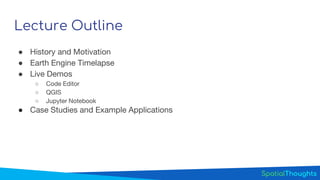
Lecture Outline
● History and Motivation
● Earth Engine Timelapse
● Live Demos
○ Code Editor
○ QGIS
○ Jupyter Notebook
● Case Studies and Example Applications
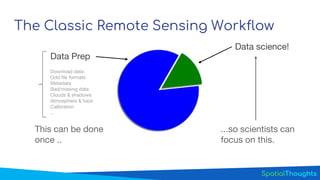
The Classic Remote Sensing Workflow
Download data
Odd file formats
Metadata
Bad/missing data
Clouds & shadows
Atmosphere & haze
Calibration
...
This can be done
once ..
...so scientists can
focus on this.
Data science!
Data Prep
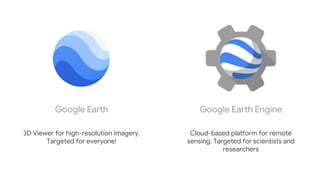
Google Earth Google Earth Engine
3D Viewer for high-resolution imagery.
Targeted for everyone!
Cloud-based platform for remote
sensing. Targeted for scientists and
researchers
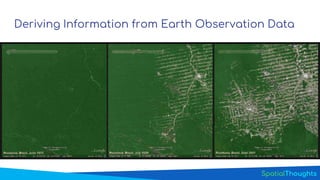
Deriving Information from Earth Observation Data
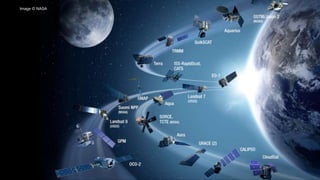
Image © NASA
Spatial Thoughts
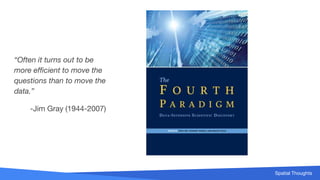
“Often it turns out to be
more efficient to move the
questions than to move the
data.”
-Jim Gray (1944-2007)
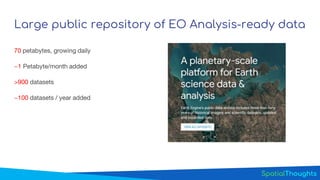
Large public repository of EO Analysis-ready data
70 petabytes, growing daily
~1 Petabyte/month added
>900 datasets
~100 datasets / year added
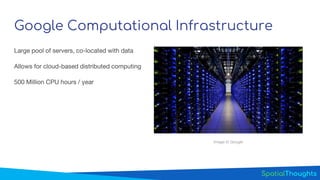
Google Computational Infrastructure
Large pool of servers, co-located with data
Allows for cloud-based distributed computing
500 Million CPU hours / year
Image © Google
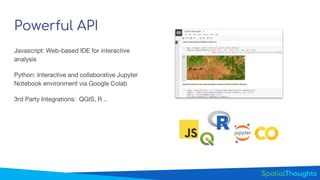
Powerful API
Javascript: Web-based IDE for interactive
analysis
Python: Interactive and collaborative Jupyter
Notebook environment via Google Colab
3rd Party Integrations: QGIS, R ..

Introduction to Google Earth Engine- GEE helping in image analysis.pptx

  • 1.
    CC BY 4.0 Introductionto Google Earth Engine Ujaval Gandhi ujaval@spatialthoughts.com End-to-End Google Earth Engine
  • 2.
    Lecture Outline ● Historyand Motivation ● Earth Engine Timelapse ● Live Demos ○ Code Editor ○ QGIS ○ Jupyter Notebook ● Case Studies and Example Applications
  • 3.
    The Classic RemoteSensing Workflow Download data Odd file formats Metadata Bad/missing data Clouds & shadows Atmosphere & haze Calibration ... This can be done once .. ...so scientists can focus on this. Data science! Data Prep
  • 4.
    Google Earth GoogleEarth Engine 3D Viewer for high-resolution imagery. Targeted for everyone! Cloud-based platform for remote sensing. Targeted for scientists and researchers
  • 5.
    Deriving Information fromEarth Observation Data
  • 6.
  • 7.
    Spatial Thoughts “Often itturns out to be more efficient to move the questions than to move the data.” -Jim Gray (1944-2007)
  • 8.
    Large public repositoryof EO Analysis-ready data 70 petabytes, growing daily ~1 Petabyte/month added >900 datasets ~100 datasets / year added
  • 9.
    Google Computational Infrastructure Largepool of servers, co-located with data Allows for cloud-based distributed computing 500 Million CPU hours / year Image © Google
  • 10.
    Powerful API Javascript: Web-basedIDE for interactive analysis Python: Interactive and collaborative Jupyter Notebook environment via Google Colab 3rd Party Integrations: QGIS, R ..

Editor's Notes

  • #6 This slide shows three images of the Amazon rainforest, spaced about a decade apart, as shown in Earth (NOT Earth Engine). From left to right, you can see almost unentered rainforest, logging starting to occur, and substantial deforestation. The deforestation is “discoverable” in Google Earth, but it’s not easily quantifiable. This observation led to the development of Google Earth Engine. Stakeholders in this region requested help from Google to develop a system through which deforestation could be quantified.
  • #8 The most efficient way to make the data accessible and useful is to "move the question to the data." Jim Gray elaborated on this idea in the influential book by Hey et al., director of research at Microsoft. Earth Engine implements this plan.
  • #11 To use Earth Engine, you just need an Internet connection and a browser. Git-based script management, 250Gb* of storage for your raster/vector data.