1
INTRODUCTION
TO ESTIMATING
1–1 GENERAL INTRODUCTION
Building construction estimating is the determination of
probable construction costs of any given project. Many items
influence and contribute to the cost of a project; each item
must be analyzed, quantified, and priced. Because the esti-
mate is prepared before the actual construction, much study
and thought must be put into the construction documents.
The estimator who can visualize the project and accurately
determine its cost will become one of the most important
persons in any construction company.
For projects constructed with the design-bid-build de-
livery system, it is necessary for contractors to submit a
competitive cost estimate for the project. The competition
in construction bidding is intense, with multiple firms vying
for a single project. To stay in business, a contractor must be
the lowest-qualified bidder on a certain number of projects,
while maintaining an acceptable profit margin. This profit
margin must provide the general contractor an acceptable
rate of return and compensation for the risk associated with
the project. Because the estimate is prepared from the work-
ing drawings and the project manual for a building, the abil-
ity of the estimator to visualize all of the different phases
of the construction project becomes a prime ingredient in
successful bidding.
The working drawings usually contain information rela-
tive to the design, location, dimensions, and construction of
the project, while the project manual is a written supplement
to the drawings and includes information pertaining to ma-
terials and workmanship, as well as information about the
bidding process. The project manual is often mistakenly re-
ferred to as the specifications because it contains the techni-
cal specifications, but it contains much more. The working
drawings and the project manual constitute the majority of
the contract documents, define the scope of work, and must
be considered together when preparing an estimate. The
two complement each other, and they often overlap in the
information they convey. The bid submitted must be based
on the scope of work provided by the owner or the architect.
The estimator is responsible for including everything con-
tained in the drawings and the project manual in the submit-
ted bid. Because of the complexity of the drawings and the
project manual, coupled with the potential cost of an error,
the estimator must read everything thoroughly and recheck
all items. Initially, the plans and the project manual must be
checked to ensure that they are complete. Then the estimator
can begin the process of quantifying all of the materials pre-
sented. Every item included in the estimate must contain as
much information as possible. The quantities determined for
the estimate will ultimately be used to order and purchase
the needed materials. The estimated quantities and their as-
sociated projected costs will become the basis of project
controls (e.g., budget and baseline schedule) in the field.
Estimating the ultimate cost of a project requires the in-
tegration of many variables. These variables fall into either
direct field costs or indirect field costs. The indirect field
costs are also referred to as general conditions or project
overhead costs in building construction. The direct field
costs are the material, labor, equipment, or subcontracted
items that are permanently and physically integrated into the
building. For example, the labor and materials for the foun-
dation of the building would be a direct field cost. The indi-
rect field costs are the costs for the items that are required
to support the field construction efforts. For example, the
project site office would be an indirect field cost. In addi-
tion, factors such as weather, transportation, soil conditions,
labor strikes, material availability, and subcontractor avail-
ability need to be integrated into the estimate. Regardless of
the variables involved, the estimator must strive to prepare
as accurate an estimate as possible. Since subcontractors or
specialty contractors may perform much of the work in the
field, the estimator must be able to articulate the scope of
work in order for these companies to furnish a price quote.
The complexity of an estimate requires organization, the
estimator’s best judgment, complete specialty contractors’
(subcontractors’) bids, accurate quantity takeoffs, and accu-
rate records of completed projects.
CHAPTER ONE
M01_PETE1165_09_SE_C01.indd 1 7/20/17 4:06 PM
2 CHAPTER One
Each piece of work that is to be performed by the contractor
has a distinct labor requirement that must be estimated. The
items that are to be installed by others need to be defined and
priced. Caution needs to be exercised to ensure that there is
agreement between the contractor and the subcontractor as
to what they are to do and whether they are only to install or
both supply and install the items. In addition, there needs to
be an agreement about who is providing support items such
as cranes and scaffolding. The contractor is responsible for
making sure that the scope of work is divided among the
contractor and subcontractors so that there are no overlaps in
the individual scope of works and that everything has been
included in someone’s scope of work.
The detailed estimate must establish the estimated
quantities and costs of the materials, the time required for
and costs of labor, the equipment required and its cost, the
items required for overhead and the cost of each item, and
the percentage of profit desired, considering the investment,
the time to complete, and the complexity of the project. The
principles used to prepare the detailed estimates are covered
in Chapters 4 and 6 through 21.
Assembly Estimating
In assembly estimating, rather than bidding each of the in-
dividual components of the project, the estimator bids the
components in groups known as assemblies. The com-
ponents of an assembly may be limited to a single trade
or may be installed by many different trades. An example
of a simple assembly would be a residential light switch,
which includes a single-gang box, a single-pole switch,
cover plate, two wire nuts, and an allowance of 20 feet of
NM-B 12-gage wire. The entire assembly would be installed
by an electrician. A residential electrical estimate could be
prepared using assemblies for the switches, outlets, lights,
power panels, and so forth rather than determining the in-
dividual components. An example of a complex assembly
would be a metal-stud, gypsum-board partition wall, which
would include bottom track, metal studs, top track, drywall,
screws, tape, joint compound, insulation, primer, paint, and
The design-build and construction-manager/general-
contractor (CM/GC) project delivery systems are gaining in
popularity. In the design-build delivery system, the contrac-
tor acts as both the designer and the general contractor. In
the CM/GC delivery system, the contractor and some of the
key subcontractors are involved in the design process, pro-
viding expertise in construction methods and costs, as well
as managing the construction process. Integrated project
delivery (IPD), a relatively new delivery system, involves
the owners, designers, contractor, and some of the key sub-
contractors in the design process. IPD differs from the CM/
GC delivery system in that the owners, designers, contractor,
and key subcontractors share governance, risk, contingency,
and the profit on the project. All of these delivery systems
require the contractor to provide cost estimates for the pro-
posed project throughout the design process.
At the conceptual stage of the project, the contrac-
tor prepares a cost estimate based on the project’s concept.
This is known as a conceptual estimate. When performing a
conceptual estimate, typically, drawings are not available or
they are very limited. What exists is often verbal or written
description of the project scope, which may be accompanied
by a few sketches. When preparing this type of estimate, the
contractor makes assumptions about virtually every aspect
of the project. The conceptual estimate is used early in the
design process to check to see if the owners’ wants are in
line with their budget and is often used as a starting point to
begin contract negotiations.
During the design process, the contractor prepares and
maintains a cost estimate based on the current, but incom-
plete, design. In addition, the contractor may prepare es-
timates that are used to select between building materials
and to determine whether the cost to upgrade the materials
is justified. What all these estimates have in common is that
the design is incomplete. Once the design is complete, the
contractor can prepare a detailed estimate for the project.
1–2 ESTIMATING METHODS
The required level of accuracy coupled with the amount of
information about the project that is available will dictate
the type of estimate that can be prepared. These estimating
methods require different amounts of time to complete and
produce different levels of accuracy for the estimate. The re-
lationship between the time to complete the estimate and the
accuracy of the estimate is shown in Figure 1.1. The differ-
ent estimating methods are discussed below.
Detailed Estimate
The detailed estimate includes determination of the quan-
tities and costs of everything that is required to complete
the project. This includes materials, labor, equipment, in-
surance, bonds, and overhead, as well as an estimate of the
profit. To perform this type of estimate, the contractor must
have a complete set of contract documents. Each item of the
project should be broken down into its parts and estimated.
&'6#+.'&
#55'/$.;
/1&'.
2#4#/'64+%
537#4'
(116
241,'%6
%1/2#4+510
'UVKOCVG#EEWTCE[
6KOGVQ%QORNGVG
FIGURE 1.1. Estimating Time versus Accuracy.
M01_PETE1165_09_SE_C01.indd 2 7/20/17 4:06 PM
Introduction to Estimating 3
uses broad assemblies, care must be exercised while prepar-
ing a square-foot estimate to ensure that the projects used
to determine the cost per square foot are similar to the pro-
posed project. Companies such as RSMeans publish annual
guides (such as Square Foot Costs) that contain a range of
unit costs for a wide variety of building types. These guides
provide a number of adjustments to compensate for varying
building components, including the city where the project is
located. Square-foot estimating is discussed in Chapter 22.
Parametric Estimates
Parametric estimates use equations that express the statistical
relationship between building parameters and the cost of the
building. The building parameters used in the equation may
include the gross square footage, number of floors, length of
perimeter, percentage of the building that is common space,
and so forth. For an equation to be usable, the parameters
used in the equation must be parameters that can be deter-
mined early in the design process; otherwise the equation is
useless. Parametric estimates are similar to square-foot esti-
mates; however, the equations used in parametric estimates
are more complex and may use log functions, ratios of pa-
rameters, and multiplication of parameters. Parametric esti-
mating is useful for preparing conceptual estimates based on
assumptions of key building parameters or estimates based
upon early designs. As with square-foot estimates and as-
sembly estimates that use broad assemblies, care must be
taken to ensure that the proposed project is similar to the
projects from which the equation has been derived.
Model Estimating
Model estimating uses computer models to prepare an esti-
mate based on a number of questions answered by the esti-
mator. Model estimating is similar to assembly estimating,
but it requires less input from the estimator. For example, an
estimate may be prepared for a warehouse by answering the
following questions:
d
d What is the length of the building?
d
d How many bays are along the length of the building?
d
d What is the width of the building?
d
d How many bays are along the width of the building?
d
d What is the wall height above the grade?
d
d What is the depth (from the grade) to the top of the
footing?
d
d What is the floor thickness?
d
d Do you want wire mesh in the slab?
d
d How many roof hatches do you want?
d
d How many personnel doors do you want?
d
d How many and what size of overhead doors do you want?
d
d How many and what size of skylights do you want?
d
d Do you want fire sprinklers?
d
d What bathroom facilities do you want (separate male
and female, unisex, or none)?
other miscellaneous items needed to construct the wall. This
assembly would be installed by multiple trades.
Many high-end estimating computer programs, such as
WinEst and Timberline, allow the user to prepare detailed
estimates by taking off assemblies. For the switch assembly,
the estimator would take off the number of switch assem-
blies needed for the project, and the software would add one
single-gang box, one single-pole, one cover plate, two wire
nuts, and 20 feet of NM-B 12-gage wire to the detailed esti-
mate for each switch assembly. This simplifies the estimat-
ing process and increases the productivity of the estimator.
Assembly estimating is also useful for conceptual and
preliminary estimates. By using broad assemblies, an estimate
can be prepared quickly for an entire building. For example,
an estimate for a warehouse can be prepared by using assem-
bles for the spot footings, the continuous footings, the founda-
tion wall, the floor slab (slab, reinforcement, granular base,
vapor barrier, and fine grading), the exterior wall, personnel
doors, overhead doors, joist and deck roof structure (including
supports), roof insulation, roofing, wall cap, skylights, bath-
rooms, fire sprinklers, heating, lighting, and power distribu-
tion. This type of estimate can be prepared in hours instead
of spending days preparing a detail estimate. The trade-off is
that this type of estimate has many broad assumptions and is
less accurate. This type of assembly estimating is good for
estimates prepared with limited drawings, to compare design
approaches, and as a check of a detailed estimate. If the as-
sembly price comes from previously completed projects, it is
assumed that this project is identical to the completed proj-
ects. This assumption is clearly not valid in the construction
of buildings. Weather conditions, building materials, and sys-
tems as well as design and construction team members change
from project to project, all adding to the uniqueness of every
project. Skill and judgment must be used while preparing
this type of assembly estimate to ensure that proper adjust-
ments are made by taking into account the varying conditions
of each project. Companies such as RSMeans publish annual
guides (such as Square Foot Costs) that contain pricing for
assemblies. Assembly estimating is discussed in Chapter 22.
Square-Foot Estimates
Square-foot estimates are prepared by multiplying the
square footage of a building by a cost per square foot and
then adjusting the price to compensate for differences in
the building heights, length of the building perimeters, and
other building components. In some cases, a unit other than
square footage is used to measure the size of the building.
For example, the size of a parking garage may be measured
by the number of parking stalls in the garage. The informa-
tion required to produce a square-foot estimate is much less
than is needed to prepare a detailed estimate. For example,
a schematic set of design drawings (a single-line floor plan
and key elevations) would have the dimensions that are nec-
essary to prepare a square-foot estimate. Square-foot esti-
mates are helpful to check whether the project, as designed,
is within the owner’s budget. Like an assembly estimate that
M01_PETE1165_09_SE_C01.indd 3 7/20/17 4:06 PM
4 CHAPTER One
order the materials required to build the framing for a home,
this knowledge is needed to do the best job possible at the
most competitive cost. Others involved include the project
designer, drafters, engineers, contractors, subcontractors,
material suppliers, and material representatives. In the fol-
lowing sections, a few of the estimating opportunities are
described.
Architectural Offices. The architectural office will re-
quire estimates at three design stages: preliminary (rough
square-foot or project comparison costs), cost evaluation
during drawing preparation (usually more accurate square-
foot or assembly costs), and a final estimate (usually based
on material and installation costs, to be as accurate as pos-
sible). For projects built using the design-build or CM/GC
delivery systems, the preliminary estimate is often used dur-
ing negotiation with the general contractor. Once the general
contractor is hired, the general contractor’s estimator will
prepare the remaining estimates.
In large offices, the estimating may be done by an es-
timator hired primarily to do all the required estimating.
In many offices, the estimating may be done by the chief
drafter, head or lead architect, or perhaps someone else in
the office who has developed the required estimating skills.
There are also estimating services or consultants who per-
form estimates on a for-fee basis.
Engineering Offices. The engineering offices involved
in the design of building construction projects include civil,
structural, mechanical (plumbing, heating, air-­
conditioning),
electrical, and soil analysis. All of these engineering de-
sign phases require preliminary estimates, estimates while
the drawings are being prepared, and final estimates as the
drawings are completed. They are prepared in the same way
estimates are prepared by the architects.
General Contractors. For design-bid-build projects,
the general contractor makes detailed estimates that are
used to determine what the company will charge to do the
required work.
The estimator will have to take off the quantities
(amounts) of each material; determine the cost to furnish
(buy and get to the site) and install each material in the proj-
ect; assemble the bids (prices) of subcontractors; as well as
determine all of the costs of insurance, permits, office staff,
and the like. In smaller companies, one person may do the
estimating, whereas in larger companies several people may
work to negotiate a final price with an owner or to provide a
competitive bid.
On projects built using the design-build or CM/GC de-
livery system, the contractor’s scope of work involves pro-
viding assistance to the owners, beginning with the planning
stage and continuing through the actual construction of the
project. Under these delivery systems, the estimators will
also provide preliminary estimates and then update them pe-
riodically until a final price is set.
On the basis of the answers to these questions, the
model prepares a preliminary estimate for the project. Logic
is built into the model, such that the model selects the neces-
sary components for the estimate based upon the answers
to the questions. For example, the size of the spot footings
in the center of the building that support the roof and their
costs are selected based on the area of the roof the footings
support, which is equal to the width of a bay multiplied by
the length of a bay. The length and width of the bays are
calculated from the first four questions. A simple model es-
timate (Warehouse.xls) for a warehouse is provided on the
companion website. This model makes many assumptions
as to the design of the warehouse, such as assuming the ex-
terior wall is constructed of concrete masonry units (CMU).
The model ignores the site and excavation cost, which needs
to be added to the estimate from the model to get a complete
estimate.
Estimating models may be complex and may prepare a
detailed estimate for the entire project, or the models may be
simple and prepare a preliminary estimate for part of a proj-
ect. As with square-foot estimates, assembly estimates that
use broad assemblies, and parametric estimates, care must
be taken to make sure that the proposed project is similar to
the projects from which the model was developed.
Project Comparison Estimates
Project comparison estimates are prepared by comparing
the cost of a proposed project to a completed project. When
preparing an estimate using this method, the estimator starts
with the costs of a comparable project and then makes ad-
justments for differences in the project. For example, an
estimate for the buildings in an apartment project may be
prepared from a project built using the same plans during
the previous year in a nearby city. In this example, the prices
from the completed project need to be adjusted for inflation,
changes in the availability and cost of labor, changes in the
plans made to meet city codes, and so forth. In most cases,
the site should be estimated using another method because
of the many differences in site conditions. As with other esti-
mating methods that do not prepare a detailed list of materi-
als, care must be taken to ensure that the proposed project
is similar to the completed project. The project comparison
method is discussed in Chapter 22.
1–3 ESTIMATING
OPPORTUNITIES
For anyone who is not aware of the many opportunities
in the estimating field, this section will review some of
the areas in which knowledge of estimating is necessary.
Generally, knowledge of the procedures for estimating is
required by almost everyone involved in or associated with
the field of construction. From the estimator, who may be
involved solely with the estimating of quantities of materi-
als and the pricing of the project, to the carpenter, who must
M01_PETE1165_09_SE_C01.indd 4 7/20/17 4:06 PM
Introduction to Estimating 5
If the subcontractor submits a lump-sum bid, then he or
she is proposing to install, or furnish and install, a portion of
work: For example, the bid might state, “agrees to furnish and
install all Type I concrete curbing for a sum of $12,785.00.”
Each subcontractor will need someone (or several people)
to check specifications, review the drawings, determine the
quantities required, and put the proposal together. It may be a
full-time estimating position or part of the duties assumed, per-
haps in addition to purchasing materials, helping to schedule
projects, working on required shop drawings, or marketing.
Material Suppliers. Suppliers submit price quotes to
the contractors (and subcontractors) to supply the materials
required for the construction of the project. Virtually every
material used in the project will be estimated, and multiple
price quotes will be sought. Estimators will have to check
the specifications and drawings to be certain that the materi-
als offered will meet all of the requirements of the contract
and required delivery dates.
Manufacturers’ Representatives. Manufacturers’ rep-
resentatives represent certain materials, product suppliers, or
manufacturers. They spend part of their time visiting con-
tractors, architects, engineers, subcontractors, owners, and
developers to be certain that they are aware of the availability
of the material, its uses, and approximate costs. In a sense
they are salespeople, but their services and the expertise they
develop in their product lines make good manufacturers’
representatives welcome not as salespersons, but as needed
sources of information concerning the materials and products
they represent. Representatives may work for one company,
or they may represent two or more.
Manufacturers’ representatives will carefully check the
specifications and drawings to be certain that their materials
meet all requirements. If some aspect of the specifications
or drawings tends to exclude their product, or if they feel
there may be a mistake or misunderstanding in these docu-
ments, they may call the architects/engineers and discuss it
with them. In addition, many times they will be involved in
working up various cost analyses of what the materials’ or
products’ installed cost will be and in devising new uses for
the materials, alternate construction techniques, and even
the development of new products.
Project Management. Project management companies
specialize in providing professional assistance in planning
the construction of a project and keeping accurate and up-
dated information about the financial status of the project.
Owners who are coordinating large projects often hire such
companies. Among the various types of owners are private
individuals, corporations, municipal government agencies
(such as public works and engineering departments), and
various public utility companies.
The firms involved in project management, as well as
someone on the staff of the owner being represented, must
be knowledgeable in estimating and scheduling projects.
Estimating with Quantities Provided by the
Designer. Estimating for projects with quantity surveys
provided by the designer involves reviewing the specifica-
tions for the contract and material requirements, reviewing
the drawings for the type of construction used, and assem-
bling the materials used. The estimator will spend part of the
time getting prices from subcontractors and material suppli-
ers and the rest of the time deciding on how the work may be
most economically accomplished.
Subcontractors. Subcontractors may be individuals,
companies, or corporations hired by the general contrac-
tor to do a particular portion of the work on the project.
Subcontractors are available for all the different types of
work required to build any project and include excavation,
concrete, masonry (block, brick, stone), interior partitions,
drywall, acoustical ceilings, painting, erection of steel and
precast concrete, windows, metal and glass curtain walls,
roofing, flooring (resilient, ceramic and quarry tile, carpet-
ing, wood, terrazzo), and interior wall finishes (wallpaper,
wood paneling, and sprayed-on finishes). The list continues
to include all materials, equipment, and finishes required.
The use of subcontractors to perform all of the work
on the project is an acceptable model in building construc-
tion. The advantage of this model is that the general contrac-
tor can distribute the risk associated with the project to a
number of different entities. In addition, the subcontractors
and craft personnel perform the same type of work on a re-
petitive basis and are therefore quasi experts in their niche.
However, the general contractor relinquishes a substantial
amount of control over the project when this method is em-
ployed. The more that the contractor subcontracts out, the
more the field operation becomes involved in coordination
rather than direct supervision of craft personnel.
The subcontractor carefully checks the drawings and
project manual and submits a price to the construction com-
panies that will be bidding on the project.
The price given may be a unit or lump-sum price. If
a subcontractor’s bid is presented as what he or she would
charge per unit, then it is a unit price (such as per square
foot, per block, per thousand brick, per cubic yard of con-
crete) bid. For example, the bid might be $5.25 per linear
foot (lf) of concrete curbing. Even with unit price bids, the
subcontractors need to perform a quantity takeoff in order to
have an idea of what is involved in the project, at what stages
they will be needed, how long it will take to complete their
work, and how many workers and how much equipment will
be required. The subcontractor needs the completed estimate
to determine what the reasonable amount for overhead and
profit is. Typically, as the quantity of work increases, the
associated unit cost of jobsite overhead decreases. For ex-
ample, the cost of mobilization for a 100 lf of curb is $1,000
or $10 per lf; if the quantity had been 1,000 lf, it would have
been $1 per lf. The subcontractor would not know how much
to add to the direct field cost unit price for overhead unless a
quantity takeoff had been performed.
M01_PETE1165_09_SE_C01.indd 5 7/20/17 4:06 PM
6 CHAPTER One
of the project. Some construction consultants specialize in
building databases for computerized estimating systems and
training estimators in the use of these systems.
1–4 THE ESTIMATOR
Most estimators begin their career doing quantity takeoff; as
they develop experience and judgment, they develop into es-
timators. A list of the abilities most important to the success
of an estimator follows, but it should be more than simply
read through. Any weaknesses affect the estimator’s ability
to produce complete and accurate estimates. If individuals
lack any of these abilities, they must (1) be able to admit it
and (2) begin to acquire the abilities they lack. Those with
construction experience, who are subsequently trained as es-
timators, are often most successful in this field.
To be able to do quantity takeoffs, the estimator must:
1. Be able to read and quantify plans.
2. Have knowledge of mathematics and a keen under-
standing of geometry. Most measurements and compu-
tations are made in linear feet, square feet, square yards,
cubic feet, and cubic yards. The quantities are usually
multiplied by a unit price to calculate material costs.
3. Have the patience and ability to do careful, thorough
work.
4. Be computer literate and use computer takeoff pro-
grams such as On-Screen Takeoff or Paydirt.
To be an estimator, an individual needs to go a step fur-
ther. He or she must:
1. Be able, from looking at the drawings, to visualize the
project through its various phases of construction. In addi-
tion, an estimator must be able to foresee problems, such
as the placement of equipment or material storage, and
then develop a solution and determine its estimated cost.
2. Have enough construction experience to possess a good
knowledge of job conditions, including methods of han-
dling materials on the job, the most economical meth-
ods of construction, and labor productivity. With this
experience, the estimator will be able to visualize the
construction of the project and thus get the most accu-
rate estimate on paper.
3. Have sufficient knowledge of labor operations and pro-
ductivity to thus convert them into costs on a project.
The estimator must understand how much work can be
accomplished under given conditions by given crafts.
Experience in construction and a study of projects that
have been completed are required to develop this ability.
4. Be able to keep a database of information on costs of all
kinds, including those of labor, material, project over-
head, and equipment, as well as knowledge of the avail-
ability of all the required items.
5. Be computer literate and know how to manipulate and
build various databases and use spreadsheet programs
and other estimating software.
Government. When a government agency is involved
in any phase of construction, personnel with experience in
construction and estimating are required. Included are local,
state or province, and nationwide agencies, including those
involved in highways, roads, sewage treatment, schools,
courthouses, nursing homes, hospitals, and single- and mul-
tifamily dwellings financed or qualifying for financing by
the government.
Employees may be involved in preparing or assisting to
prepare preliminary and final estimates; reviewing estimates
from architects, engineers, and contractors; the design and
drawing of the project; and preparation of the specifications.
Professional Quantity Surveyors. Professional quan-
tity surveyors are for-hire firms or individuals who make
unit quantity takeoffs of the materials required to build a
project. They are available to provide this service to all who
need it, including governmental agencies.
Freelance Estimators. Freelance estimators will do a
material takeoff of a portion or entire project for whoever
may want a job done. This estimator may work for the
owner, architect, engineer, contractor, subcontractor, mate-
rial supplier, or manufacturer. In some areas, the estimator
will do a material takeoff of a project being competitively
bid and then sell the quantity list to one or more contractors
who intend to submit a bid on the project.
Many times a talented individual has a combined draft-
ing and estimating business. Part of the drafting business
may include preparing shop drawings (drawings that show
sizes of materials and installation details) for subcontractors,
material suppliers, and manufacturers’ representatives.
Residential Construction. Estimators are also re-
quired for the contractors, material suppliers, manufactur-
ers’ representatives, and most of the subcontractors involved
in residential construction. From the designer who plans the
house and the drafter who draws the plans and elevations to
the carpenters who put up the rough framing and the roofers
who install the roofing material, knowledge of estimating is
necessary.
The designer and drafter should plan and draw the
house plans using standard material sizes when possible (or
being aware of it when they are not using standard sizes).
In addition, they will need to give preliminary and final es-
timates to the owner. Workers need to have a basic knowl-
edge of estimating so they can be certain that adequate
­
material has been ordered and will be delivered by the time
it is needed.
Computer Software. The use of computers through-
out the world of construction offers many different types of
opportunities to the estimator. Job opportunities in all the
areas mentioned earlier will be centered on the ability to un-
derstand, use, and manipulate computer software. The soft-
ware available today integrates the construction drawings,
estimating, bidding, purchasing, and management controls
M01_PETE1165_09_SE_C01.indd 6 7/20/17 4:06 PM
Introduction to Estimating 7
How closely the estimated cost will agree with the ac-
tual cost depends, to a large extent, on the estimators’ skill
and judgment. Their skill enables them to use accurate esti-
mating methods, while their judgment enables them to visu-
alize the construction of the project throughout the stages of
construction.
1–5 QUANTITY SURVEYING
In Canada and parts of Europe and on most road construc-
tion projects in the United States, the estimated quantities of
materials required on the project are determined by a pro-
fessional quantity surveyor or engineer and provided to the
interested bidders on the project. Figure 1.2 is an example of
the quantities that would be provided by a quantity surveyor
or engineer for the construction of a sewer line. This is often
referred to as a unit price bid.
In this method of bidding, the contractors are all bid-
ding based on the same quantities, and the estimator spends
time developing the unit prices. For example, the bid may
6. Be able to meet bid deadlines and still remain calm. Even
in the rush of last-minute phone calls and the competitive
feeling that seems to electrify the atmosphere just before
the bids are due, estimators must “keep their cool.”
7. Have good writing and presentation skills. With more
bids being awarded to the best bid, rather than the low-
est bid, being able to communicate what your company
has to offer, what is included in the bid, and selling your
services is very important. It is also important to com-
municate to the project superintendent what is included
in the bid, how the estimator planned to construct the
project, and any potential pitfalls.
People cannot be taught experience and judgment, but
they can be taught an acceptable method of preparing an esti-
mate, items to include in the estimate, calculations required,
and how to make them. They can also be warned against pos-
sible errors and alerted to certain problems and dangers, but
the practical experience and use of good judgment required
cannot be taught and must be obtained over time.
Item No. Description Quantity
1 Mobilization (Insurance and Bond Included) 1 lump sum
2 12-inch Reinforce Concrete Pipe—Varying Depths 24 lf
3 18-inch Reinforce Concrete Pipe—Varying Depths 6,696 lf
4 24-inch Reinforce Concrete Pipe—Varying Depths 1,176 lf
5 36-inch Reinforce Concrete Pipe—Varying Depths 1,160 lf
6 42-inch Reinforce Concrete Pipe—Varying Depths 1,560 lf
7 54-inch Reinforce Concrete Pipe—Varying Depths 2,096 lf
8 Catch Basin 3 feet x 3.67 feet (depth  6 feet) 58 each
9 Catch Basin 3 feet x 5.33 feet (depth  6 feet) 1 each
10 Catch Basin 4 feet x 3.67 feet (depth  6 feet) 4 each
11 Catch Basin 4.5 feet x 3.67 feet (depth  6 feet) 2 each
12 Catch Basin 5.75 feet x 3.67 feet (depth  6 feet) 12 each
13 Cleanout 3 feet x 3.67 feet (depth  6 feet) 7 each
14 Cleanout 4 feet x 3.67 feet (depth  6 feet) 5 each
15 Cleanout 5.25 feet x 3.67 feet (depth  6 feet) 1 each
16 Cleanout 5.75 feet x 3.67 feet (depth  6 feet) 1 each
17 Combo Box 4.5 feet x 3.67 feet (depth  6 feet) 1 each
18 Post Construction Sewer Main Television 12,712 If
19 18-inch Slip under Railroad 1 lump sum
20 42-inch Slip under Railroad 1 lump sum
21 End Section 1 lump sum
22 Tie to Existing Sewer 1 lump sum
FIGURE 1.2. Quantity Survey.
M01_PETE1165_09_SE_C01.indd 7 7/20/17 4:06 PM
8 CHAPTER One
The basic underlying difference between negotiated
work and competitive bidding is that with negotiated work
the parties arrive at a mutually agreed-upon price, terms
and conditions, and contractual relationship. This arrange-
ment often entails negotiations back and forth on virtually
all aspects of the project, such as materials used, sizes, fin-
ishes, and other items that affect the price of the project.
Owners may negotiate with as many contractors as they
wish. This type of bidding is often used when owners know
which contractor they would like to build the project, in
which case competitive bidding would waste time. The big-
gest disadvantage of this arrangement is that the contractor
may not feel the need to work quite as hard to get the lowest
possible prices as when a competitive bidding process is
used.
1–7 CONTRACT DOCUMENTS
The bid submitted for any construction project is based
on the contract documents. If an estimator is to prepare a
complete and accurate estimate, he or she must become fa-
miliar with all of the documents. The documents are listed
and briefly described in this section. Further explanations
of the portions and how to bid them are contained in later
chapters.
For design-bid-build projects, the contract documents
consist of the invitation to bid, instructions to bidders, bid
form, owner–contractor agreement, general conditions,
supplementary general conditions, technical specifications,
and the working drawings, including all addenda incorpo-
rated in the documents before their execution. All of these
documents become part of the contract.
Invitation to Bid. The invitation to bid invites potential
contractors to bid on the project and provides a brief sum-
mary of the project, including project scope and size, loca-
tion, and project’s owner.
Instructions to Bidders. The instructions to bidders
provide bidders with the procedures that must be followed
to submit a complete bid and contain such information as
the date, time, and place the bid is due, and attendance at
pre-bid meetings.
Bid Form. The bid form is a standard form that all con-
tractors use to submit their bids.
Owner–Contractor Agreement. The owner–contrac-
tor agreement is the document that formalizes the construc-
tion contract, and it is the basic contract. It incorporates by
reference all of the other documents and makes them part of
the contract. It also states the contract sum and time allowed
to construct the project.
General Conditions. The general conditions define the
rights, responsibilities, and relations of all parties to the con-
struction contract.
be $78.74 per linear foot (lf) of 18-inch reinforced concrete
pipe. Because all of the contractors are bidding on the same
quantities, they will work on keeping the cost of purchasing
and installing the materials as low as possible.
As the project is built, the actual number of units re-
quired is checked against the original number of units on
which the estimates were made. For example, in Figure
1.2, the original quantity survey called for 6,696 lf of 18-
inch reinforced concrete pipe. If 6,703 lf were actually in-
stalled, then the contractor would be paid for the additional
7 lf. If 6,690 lf were used, then the owner would pay only
for the 6,690 lf installed and not the 6,696 lf in the original
quantity survey. This type of adjustment is quite common.
When errors do occur and there is a large difference be-
tween the original quantity survey and the actual number
of units, an adjustment to the unit price is made. Small
adjustments are usually made at the same unit rate as the
contractor bid. Large errors may require that the unit price
be renegotiated.
If the contractor is aware of potential discrepancies
between the estimated quantities and those that will be
required, the contractor may price his or her bid to take
advantage of this situation. With a belief that the estimated
quantities are low, the contractor may reduce his or her
unit price to be the low bidder. If the assumption is true,
the contractor has the potential to make the same profit
by distributing the project overhead over a greater number
of units.
1–6 TYPES OF BIDS
Basically, the two bidding procedures by which the contrac-
tor gets to build a project for owners are as follows:
1. Competitive bidding
2. Negotiated bidding
Competitive bidding involves each contractor sub-
mitting a lump-sum bid or a proposal in competition with
other contractors to build the project. The project may be
awarded based on the price or best value. When the project
is awarded based on the price, the lowest lump-sum bidder
is awarded the contract to build the project as long as the bid
form and proper procedures have been followed and this bid-
der is able to attain the required bonds and insurance. When
the project is awarded based upon the best value, the propos-
als from the contractors are rated based on specified criteria
with each criterion given a certain percentage of the possible
points. The criteria may include review of the capabilities
of the assigned project team, the company’s capabilities and
its approach to the project (including schedule), proposed
innovation, method of mitigating risk, and price. The price
is often withheld from the reviewers until the other criteria
have been evaluated to prevent the price from affecting the
ratings of the other criteria. Most commonly, the bids must
be delivered to the person or place specified by a time stated
in the instruction to bidders.
M01_PETE1165_09_SE_C01.indd 8 7/20/17 4:06 PM
Introduction to Estimating 9
For projects built with the design-build and CM/GC de-
livery systems, the contract documents are more limited than
for projects built with the design-bid-build delivery system
because the contractor is involved in the design and selec-
tion of the specifications for the project. These documents
can be as simple as an agreement with a conceptual descrip-
tion of the project.
1–8 BIDDING INFORMATION
There are several sources of information pertaining to the
projects available for bidding. Public advertising (adver-
tisement for bids) is required for many public contracts.
The advertisement is generally placed in newspapers, trade
magazines, and journals, and notices are posted in public
places and on the Internet. Private owners often advertise
in the same manner to attract a large cross section of bid-
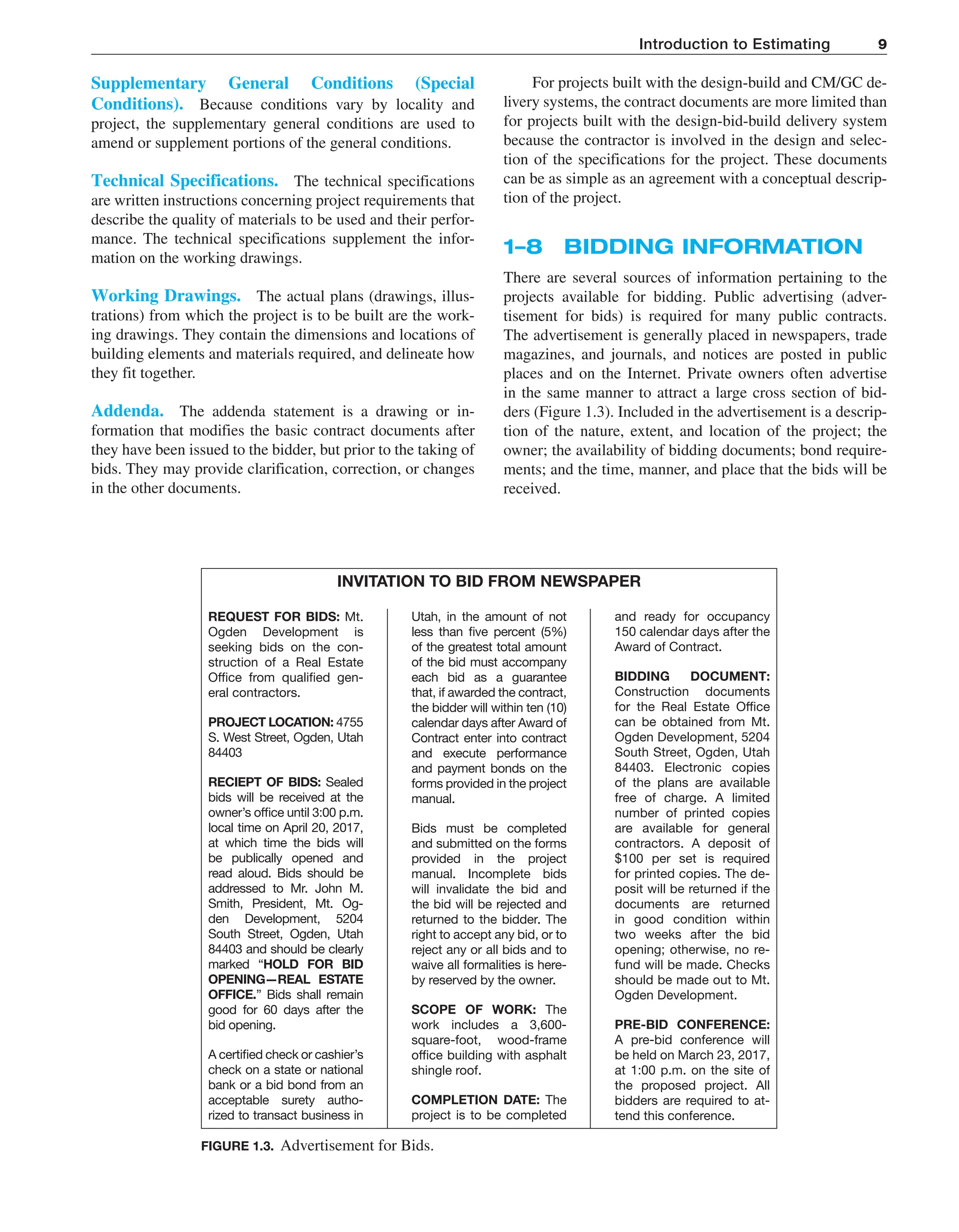
ders (Figure 1.3). Included in the advertisement is a descrip-
tion of the nature, extent, and location of the project; the
owner; the availability of bidding documents; bond require-
ments; and the time, manner, and place that the bids will be
received.
Supplementary General Conditions (Special
Conditions). Because conditions vary by locality and
project, the supplementary general conditions are used to
amend or supplement portions of the general conditions.
Technical Specifications. The technical specifications
are written instructions concerning project requirements that
describe the quality of materials to be used and their perfor-
mance. The technical specifications supplement the infor-
mation on the working drawings.
Working Drawings. The actual plans (drawings, illus-
trations) from which the project is to be built are the work-
ing drawings. They contain the dimensions and locations of
building elements and materials required, and delineate how
they fit together.
Addenda. The addenda statement is a drawing or in-
formation that modifies the basic contract documents after
they have been issued to the bidder, but prior to the taking of
bids. They may provide clarification, correction, or changes
in the other documents.
INVITATION TO BID FROM NEWSPAPER
REQUEST FOR BIDS: Mt.
Ogden Development is
seeking bids on the con-
struction of a Real Estate
Office from qualified gen-
eral contractors.
PROJECT LOCATION: 4755
S. West Street, Ogden, Utah
84403
RECIEPT OF BIDS: Sealed
bids will be received at the
owner’s office until 3:00 p.m.
local time on April 20, 2017,
at which time the bids will
be publically opened and
read aloud. Bids should be
addressed to Mr. John M.
Smith, President, Mt. Og-
den Development, 5204
South Street, Ogden, Utah
84403 and should be clearly
marked “HOLD FOR BID
OPENING—REAL ESTATE
OFFICE.” Bids shall remain
good for 60 days after the
bid opening.
A certified check or cashier’s
check on a state or national
bank or a bid bond from an
acceptable surety autho-
rized to transact business in
Utah, in the amount of not
less than five percent (5%)
of the greatest total amount
of the bid must accompany
each bid as a guarantee
that, if awarded the contract,
the bidder will within ten (10)
calendar days after Award of
Contract enter into contract
and execute performance
and payment bonds on the
forms provided in the project
manual.
Bids must be completed
and submitted on the forms
provided in the project
manual. Incomplete bids
will invalidate the bid and
the bid will be rejected and
returned to the bidder. The
right to accept any bid, or to
reject any or all bids and to
waive all formalities is here-
by reserved by the owner.
SCOPE OF WORK: The
work includes a 3,600-
square-foot, wood-frame
office build­
ing with asphalt
shingle roof.
COMPLETION DATE: The
project is to be completed
and ready for occupancy
150 calendar days after the
Award of Contract.
BIDDING DOCUMENT:
Construction documents
for the Real Estate Office
can be obtained from Mt.
Ogden Development, 5204
South Street, Ogden, Utah
84403. Electronic copies
of the plans are available
free of charge. A limited
number of printed copies
are available for general
contractors. A deposit of
$100 per set is required
for printed copies. The de-
posit will be returned if the
documents are returned
in good condition within
two weeks after the bid
opening; otherwise, no re-
fund will be made. Checks
should be made out to Mt.
Ogden Development.
PRE-BID CONFERENCE:
A pre-bid conference will
be held on March 23, 2017,
at 1:00 p.m. on the site of
the proposed project. All
bidders are required to at-
tend this conference.
FIGURE 1.3. Advertisement for Bids.
M01_PETE1165_09_SE_C01.indd 9 7/20/17 4:06 PM
10 CHAPTER One
Reporting services, such as Dodge Reports and
Engineering News Record (ENR), provide information about
projects that are accepting bids or proposals. The Dodge
Reports are issued for particular, defined localities through-
out the country, and separate bulletins are included that an-
nounce new projects within the defined area and provide a
constant updating on jobs previously reported. The updat-
ing may include a listing of bidders, low bidders, awards of
contracts, or abandonment of projects. In short, the updates
provide information that is of concern to the contractors.
Local contractor groups may provide reporting services
similar to Dodge Reports and provide plan rooms where in-
terested parties may review the drawings and project manual
of current projects.
1–9 AVAILABILITY OF
CONTRACT DOCUMENTS
The contract document for most projects are available in
electronic format, which can be printed or used in estimat-
ing software (such as On-Screen Takeoff). This reduces the
cost of reproducing the drawings and project manual, mak-
ing it economical to distribute them to numerous contractors
and subcontractors, which makes it easier to get the most
competitive prices on a project. The contract document may
be obtained from the architect/engineer or accessed through
an online plan room. When paper copies of the contract
documents are available, the architect/engineer will limit the
number of sets available and require a deposit to ensure the
safe return of the documents.
Some subcontractors and suppliers still prefer to work
with paper copies of the plans. The general contractors often
set aside space in their offices where the subcontractors’ and
material suppliers’ estimators may work. In this manner, the
contract documents never leave the contractor’s office and
are available to serve a large number of bidders who want to
use the paper copies.
1–10 SOURCES OF
ESTIMATING INFORMATION
For matters relevant to estimating and costs, the best
source of information is your historical data. These fig-
ures allow for the pricing of the project to match how the
company actually performs its construction work. This in-
formation takes into account the talent and training of the
craft personnel and the management abilities of the field
staff personnel. In addition, it integrates the construction
companies’ practices and methodologies. This is why a
careful, accurate accounting system combined with accu-
racy in field reports is so important. If all of the informa-
tion relating to the job is tracked and analyzed, it will be
available for future reference. Computerized cost account-
ing systems are very helpful in gathering this information
and making it readily available for future reference. See
Construction Accounting and Financial Management by
Steven J. Peterson for more information on managing con-
struction accounting systems.
There are several “guides to construction cost” manu-
als available; however, a word of extreme caution is offered
regarding the use of these manuals. They are only guides;
the figures should rarely be used to prepare an actual esti-
mate. The manuals may be used as a guide in checking cur-
rent prices and should enable the estimator to follow a more
uniform system and save valuable time. The actual pricing
in the manuals is most appropriately used in helping archi-
tects check approximate current prices and facilitate their
preliminary estimate. In addition to these printed guides,
many of these companies provide electronic databases that
can be utilized by estimating software packages. However,
the same caution needs to be observed as with the printed
version. These databases represent an average of the meth-
odologies of a few contractors. There is no simple way to
convert this generalized information to match the specifics
of the construction companies’ methodologies.
6. What additional skills must the estimator have to be able to
take a quantity survey and turn it into a detailed estimate?
7. What is the difference between competitive and negoti-
ated bidding?
8. What is the difference between a detailed estimate and a
square-foot estimate?
9. What are the contract documents, and why are they so
important?
10. Why is it important to bid only from a full set of con-
tract documents?
11. For this assignment, you will explore the role estimating
plays in the construction industry by interviewing a per-
son whose job duties include estimating. Begin by set-
ting up an interview with an estimator, project ­
manager,
project engineer, superintendent, foreperson, architect,
­
engineer, construction material salesperson, or free-
lance estimator. During the interview, ask the person the
WEB RESOURCES
construction.com/dodge/
enr.construction.com
REVIEW QUESTIONS
1. What information is contained in the working drawings?
2. What information is contained in the technical
specifications?
3. What is the relationship between the working drawings
and the technical specifications?
4. How does the work involved in being an estimator for a
general contractor differ from that of an estimator who
works for a subcontractor?
5. What is the difference between doing a quantity takeoff
and doing a full detailed estimate?
M01_PETE1165_09_SE_C01.indd 10 7/20/17 4:06 PM
Introduction to Estimating 11
following questions and ask follow-up questions as nec-
essary. Be respectful of their time and limit your inter-
view to 20 minutes, unless the person offers to extend the
interview. Be sure to thank the person before you leave
and mail them a thank-you note within 48 hours of the in-
terview. After the interview, prepare written responses to
the following questions and be prepared to discuss your
findings in class, if your instructor chooses to do so:
a. What are the estimates used for (ordering materials,
preliminary budget, etc.)?
b. At what stage of the construction process (early-
design, late-design, bidding, construction, etc.) does
the estimate occur?
c. What are the consequences if the estimate is slightly
wrong? If it is very wrong?
d. How do they prepare an estimate? After the inter-
view, decide which estimating method (detailed, as-
sembly, square-foot, parametric, model, or project
comparison) best describes the type of estimates he
or she prepared.
e. How long does it take to prepare an estimate?
f. What skills are required to become a good estimator?
g. What experience is required to get a job like his or hers?
12. Review a copy of the contract documents (draw-
ings and project manual) for a construction project.
Contract documents may be reviewed at a contractor’s,
subcontractor’s, architect’s, or engineer’s office or may
be downloaded from the Internet. Write a brief sum-
mary of how the contract documents are organized. Be
sure to discuss both the project manual and the draw-
ings. Be prepared to discuss your findings in class, if
your instructor chooses to do so.
13. Using the Warehouse.xls Excel file that accompanies
this text, determine the estimated cost of a warehouse
with the following parameters:
Building length—210 feet
Number of bays on the length side of the building—
7 each
Building width—120 feet
Number of bays on the width of the building—
4 each
Wall height above grade—22 feet
Depth to top of footing—12 inches
Floor slab—6 inches thick with wire mesh
Number of roof hatches—2 each
Number of personnel doors—4 each
Number of 14-foot-wide by 14-foot-high overhead
doors—14 each
Number of 4-foot by 4-foot skylights—28 each
Fire sprinklers are not required
Separate male and female bathrooms are required
M01_PETE1165_09_SE_C01.indd 11 7/20/17 4:06 PM

introduction to estimating in construction.pdf

  • 1.
    1 INTRODUCTION TO ESTIMATING 1–1 GENERALINTRODUCTION Building construction estimating is the determination of probable construction costs of any given project. Many items influence and contribute to the cost of a project; each item must be analyzed, quantified, and priced. Because the esti- mate is prepared before the actual construction, much study and thought must be put into the construction documents. The estimator who can visualize the project and accurately determine its cost will become one of the most important persons in any construction company. For projects constructed with the design-bid-build de- livery system, it is necessary for contractors to submit a competitive cost estimate for the project. The competition in construction bidding is intense, with multiple firms vying for a single project. To stay in business, a contractor must be the lowest-qualified bidder on a certain number of projects, while maintaining an acceptable profit margin. This profit margin must provide the general contractor an acceptable rate of return and compensation for the risk associated with the project. Because the estimate is prepared from the work- ing drawings and the project manual for a building, the abil- ity of the estimator to visualize all of the different phases of the construction project becomes a prime ingredient in successful bidding. The working drawings usually contain information rela- tive to the design, location, dimensions, and construction of the project, while the project manual is a written supplement to the drawings and includes information pertaining to ma- terials and workmanship, as well as information about the bidding process. The project manual is often mistakenly re- ferred to as the specifications because it contains the techni- cal specifications, but it contains much more. The working drawings and the project manual constitute the majority of the contract documents, define the scope of work, and must be considered together when preparing an estimate. The two complement each other, and they often overlap in the information they convey. The bid submitted must be based on the scope of work provided by the owner or the architect. The estimator is responsible for including everything con- tained in the drawings and the project manual in the submit- ted bid. Because of the complexity of the drawings and the project manual, coupled with the potential cost of an error, the estimator must read everything thoroughly and recheck all items. Initially, the plans and the project manual must be checked to ensure that they are complete. Then the estimator can begin the process of quantifying all of the materials pre- sented. Every item included in the estimate must contain as much information as possible. The quantities determined for the estimate will ultimately be used to order and purchase the needed materials. The estimated quantities and their as- sociated projected costs will become the basis of project controls (e.g., budget and baseline schedule) in the field. Estimating the ultimate cost of a project requires the in- tegration of many variables. These variables fall into either direct field costs or indirect field costs. The indirect field costs are also referred to as general conditions or project overhead costs in building construction. The direct field costs are the material, labor, equipment, or subcontracted items that are permanently and physically integrated into the building. For example, the labor and materials for the foun- dation of the building would be a direct field cost. The indi- rect field costs are the costs for the items that are required to support the field construction efforts. For example, the project site office would be an indirect field cost. In addi- tion, factors such as weather, transportation, soil conditions, labor strikes, material availability, and subcontractor avail- ability need to be integrated into the estimate. Regardless of the variables involved, the estimator must strive to prepare as accurate an estimate as possible. Since subcontractors or specialty contractors may perform much of the work in the field, the estimator must be able to articulate the scope of work in order for these companies to furnish a price quote. The complexity of an estimate requires organization, the estimator’s best judgment, complete specialty contractors’ (subcontractors’) bids, accurate quantity takeoffs, and accu- rate records of completed projects. CHAPTER ONE M01_PETE1165_09_SE_C01.indd 1 7/20/17 4:06 PM
  • 2.
    2 CHAPTER One Eachpiece of work that is to be performed by the contractor has a distinct labor requirement that must be estimated. The items that are to be installed by others need to be defined and priced. Caution needs to be exercised to ensure that there is agreement between the contractor and the subcontractor as to what they are to do and whether they are only to install or both supply and install the items. In addition, there needs to be an agreement about who is providing support items such as cranes and scaffolding. The contractor is responsible for making sure that the scope of work is divided among the contractor and subcontractors so that there are no overlaps in the individual scope of works and that everything has been included in someone’s scope of work. The detailed estimate must establish the estimated quantities and costs of the materials, the time required for and costs of labor, the equipment required and its cost, the items required for overhead and the cost of each item, and the percentage of profit desired, considering the investment, the time to complete, and the complexity of the project. The principles used to prepare the detailed estimates are covered in Chapters 4 and 6 through 21. Assembly Estimating In assembly estimating, rather than bidding each of the in- dividual components of the project, the estimator bids the components in groups known as assemblies. The com- ponents of an assembly may be limited to a single trade or may be installed by many different trades. An example of a simple assembly would be a residential light switch, which includes a single-gang box, a single-pole switch, cover plate, two wire nuts, and an allowance of 20 feet of NM-B 12-gage wire. The entire assembly would be installed by an electrician. A residential electrical estimate could be prepared using assemblies for the switches, outlets, lights, power panels, and so forth rather than determining the in- dividual components. An example of a complex assembly would be a metal-stud, gypsum-board partition wall, which would include bottom track, metal studs, top track, drywall, screws, tape, joint compound, insulation, primer, paint, and The design-build and construction-manager/general- contractor (CM/GC) project delivery systems are gaining in popularity. In the design-build delivery system, the contrac- tor acts as both the designer and the general contractor. In the CM/GC delivery system, the contractor and some of the key subcontractors are involved in the design process, pro- viding expertise in construction methods and costs, as well as managing the construction process. Integrated project delivery (IPD), a relatively new delivery system, involves the owners, designers, contractor, and some of the key sub- contractors in the design process. IPD differs from the CM/ GC delivery system in that the owners, designers, contractor, and key subcontractors share governance, risk, contingency, and the profit on the project. All of these delivery systems require the contractor to provide cost estimates for the pro- posed project throughout the design process. At the conceptual stage of the project, the contrac- tor prepares a cost estimate based on the project’s concept. This is known as a conceptual estimate. When performing a conceptual estimate, typically, drawings are not available or they are very limited. What exists is often verbal or written description of the project scope, which may be accompanied by a few sketches. When preparing this type of estimate, the contractor makes assumptions about virtually every aspect of the project. The conceptual estimate is used early in the design process to check to see if the owners’ wants are in line with their budget and is often used as a starting point to begin contract negotiations. During the design process, the contractor prepares and maintains a cost estimate based on the current, but incom- plete, design. In addition, the contractor may prepare es- timates that are used to select between building materials and to determine whether the cost to upgrade the materials is justified. What all these estimates have in common is that the design is incomplete. Once the design is complete, the contractor can prepare a detailed estimate for the project. 1–2 ESTIMATING METHODS The required level of accuracy coupled with the amount of information about the project that is available will dictate the type of estimate that can be prepared. These estimating methods require different amounts of time to complete and produce different levels of accuracy for the estimate. The re- lationship between the time to complete the estimate and the accuracy of the estimate is shown in Figure 1.1. The differ- ent estimating methods are discussed below. Detailed Estimate The detailed estimate includes determination of the quan- tities and costs of everything that is required to complete the project. This includes materials, labor, equipment, in- surance, bonds, and overhead, as well as an estimate of the profit. To perform this type of estimate, the contractor must have a complete set of contract documents. Each item of the project should be broken down into its parts and estimated. &'6#+.'& #55'/$.; /1&'. 2#4#/'64+% 537#4' (116 241,'%6 %1/2#4+510 'UVKOCVG#EEWTCE[ 6KOGVQ%QORNGVG FIGURE 1.1. Estimating Time versus Accuracy. M01_PETE1165_09_SE_C01.indd 2 7/20/17 4:06 PM
  • 3.
    Introduction to Estimating3 uses broad assemblies, care must be exercised while prepar- ing a square-foot estimate to ensure that the projects used to determine the cost per square foot are similar to the pro- posed project. Companies such as RSMeans publish annual guides (such as Square Foot Costs) that contain a range of unit costs for a wide variety of building types. These guides provide a number of adjustments to compensate for varying building components, including the city where the project is located. Square-foot estimating is discussed in Chapter 22. Parametric Estimates Parametric estimates use equations that express the statistical relationship between building parameters and the cost of the building. The building parameters used in the equation may include the gross square footage, number of floors, length of perimeter, percentage of the building that is common space, and so forth. For an equation to be usable, the parameters used in the equation must be parameters that can be deter- mined early in the design process; otherwise the equation is useless. Parametric estimates are similar to square-foot esti- mates; however, the equations used in parametric estimates are more complex and may use log functions, ratios of pa- rameters, and multiplication of parameters. Parametric esti- mating is useful for preparing conceptual estimates based on assumptions of key building parameters or estimates based upon early designs. As with square-foot estimates and as- sembly estimates that use broad assemblies, care must be taken to ensure that the proposed project is similar to the projects from which the equation has been derived. Model Estimating Model estimating uses computer models to prepare an esti- mate based on a number of questions answered by the esti- mator. Model estimating is similar to assembly estimating, but it requires less input from the estimator. For example, an estimate may be prepared for a warehouse by answering the following questions: d d What is the length of the building? d d How many bays are along the length of the building? d d What is the width of the building? d d How many bays are along the width of the building? d d What is the wall height above the grade? d d What is the depth (from the grade) to the top of the footing? d d What is the floor thickness? d d Do you want wire mesh in the slab? d d How many roof hatches do you want? d d How many personnel doors do you want? d d How many and what size of overhead doors do you want? d d How many and what size of skylights do you want? d d Do you want fire sprinklers? d d What bathroom facilities do you want (separate male and female, unisex, or none)? other miscellaneous items needed to construct the wall. This assembly would be installed by multiple trades. Many high-end estimating computer programs, such as WinEst and Timberline, allow the user to prepare detailed estimates by taking off assemblies. For the switch assembly, the estimator would take off the number of switch assem- blies needed for the project, and the software would add one single-gang box, one single-pole, one cover plate, two wire nuts, and 20 feet of NM-B 12-gage wire to the detailed esti- mate for each switch assembly. This simplifies the estimat- ing process and increases the productivity of the estimator. Assembly estimating is also useful for conceptual and preliminary estimates. By using broad assemblies, an estimate can be prepared quickly for an entire building. For example, an estimate for a warehouse can be prepared by using assem- bles for the spot footings, the continuous footings, the founda- tion wall, the floor slab (slab, reinforcement, granular base, vapor barrier, and fine grading), the exterior wall, personnel doors, overhead doors, joist and deck roof structure (including supports), roof insulation, roofing, wall cap, skylights, bath- rooms, fire sprinklers, heating, lighting, and power distribu- tion. This type of estimate can be prepared in hours instead of spending days preparing a detail estimate. The trade-off is that this type of estimate has many broad assumptions and is less accurate. This type of assembly estimating is good for estimates prepared with limited drawings, to compare design approaches, and as a check of a detailed estimate. If the as- sembly price comes from previously completed projects, it is assumed that this project is identical to the completed proj- ects. This assumption is clearly not valid in the construction of buildings. Weather conditions, building materials, and sys- tems as well as design and construction team members change from project to project, all adding to the uniqueness of every project. Skill and judgment must be used while preparing this type of assembly estimate to ensure that proper adjust- ments are made by taking into account the varying conditions of each project. Companies such as RSMeans publish annual guides (such as Square Foot Costs) that contain pricing for assemblies. Assembly estimating is discussed in Chapter 22. Square-Foot Estimates Square-foot estimates are prepared by multiplying the square footage of a building by a cost per square foot and then adjusting the price to compensate for differences in the building heights, length of the building perimeters, and other building components. In some cases, a unit other than square footage is used to measure the size of the building. For example, the size of a parking garage may be measured by the number of parking stalls in the garage. The informa- tion required to produce a square-foot estimate is much less than is needed to prepare a detailed estimate. For example, a schematic set of design drawings (a single-line floor plan and key elevations) would have the dimensions that are nec- essary to prepare a square-foot estimate. Square-foot esti- mates are helpful to check whether the project, as designed, is within the owner’s budget. Like an assembly estimate that M01_PETE1165_09_SE_C01.indd 3 7/20/17 4:06 PM
  • 4.
    4 CHAPTER One orderthe materials required to build the framing for a home, this knowledge is needed to do the best job possible at the most competitive cost. Others involved include the project designer, drafters, engineers, contractors, subcontractors, material suppliers, and material representatives. In the fol- lowing sections, a few of the estimating opportunities are described. Architectural Offices. The architectural office will re- quire estimates at three design stages: preliminary (rough square-foot or project comparison costs), cost evaluation during drawing preparation (usually more accurate square- foot or assembly costs), and a final estimate (usually based on material and installation costs, to be as accurate as pos- sible). For projects built using the design-build or CM/GC delivery systems, the preliminary estimate is often used dur- ing negotiation with the general contractor. Once the general contractor is hired, the general contractor’s estimator will prepare the remaining estimates. In large offices, the estimating may be done by an es- timator hired primarily to do all the required estimating. In many offices, the estimating may be done by the chief drafter, head or lead architect, or perhaps someone else in the office who has developed the required estimating skills. There are also estimating services or consultants who per- form estimates on a for-fee basis. Engineering Offices. The engineering offices involved in the design of building construction projects include civil, structural, mechanical (plumbing, heating, air-­ conditioning), electrical, and soil analysis. All of these engineering de- sign phases require preliminary estimates, estimates while the drawings are being prepared, and final estimates as the drawings are completed. They are prepared in the same way estimates are prepared by the architects. General Contractors. For design-bid-build projects, the general contractor makes detailed estimates that are used to determine what the company will charge to do the required work. The estimator will have to take off the quantities (amounts) of each material; determine the cost to furnish (buy and get to the site) and install each material in the proj- ect; assemble the bids (prices) of subcontractors; as well as determine all of the costs of insurance, permits, office staff, and the like. In smaller companies, one person may do the estimating, whereas in larger companies several people may work to negotiate a final price with an owner or to provide a competitive bid. On projects built using the design-build or CM/GC de- livery system, the contractor’s scope of work involves pro- viding assistance to the owners, beginning with the planning stage and continuing through the actual construction of the project. Under these delivery systems, the estimators will also provide preliminary estimates and then update them pe- riodically until a final price is set. On the basis of the answers to these questions, the model prepares a preliminary estimate for the project. Logic is built into the model, such that the model selects the neces- sary components for the estimate based upon the answers to the questions. For example, the size of the spot footings in the center of the building that support the roof and their costs are selected based on the area of the roof the footings support, which is equal to the width of a bay multiplied by the length of a bay. The length and width of the bays are calculated from the first four questions. A simple model es- timate (Warehouse.xls) for a warehouse is provided on the companion website. This model makes many assumptions as to the design of the warehouse, such as assuming the ex- terior wall is constructed of concrete masonry units (CMU). The model ignores the site and excavation cost, which needs to be added to the estimate from the model to get a complete estimate. Estimating models may be complex and may prepare a detailed estimate for the entire project, or the models may be simple and prepare a preliminary estimate for part of a proj- ect. As with square-foot estimates, assembly estimates that use broad assemblies, and parametric estimates, care must be taken to make sure that the proposed project is similar to the projects from which the model was developed. Project Comparison Estimates Project comparison estimates are prepared by comparing the cost of a proposed project to a completed project. When preparing an estimate using this method, the estimator starts with the costs of a comparable project and then makes ad- justments for differences in the project. For example, an estimate for the buildings in an apartment project may be prepared from a project built using the same plans during the previous year in a nearby city. In this example, the prices from the completed project need to be adjusted for inflation, changes in the availability and cost of labor, changes in the plans made to meet city codes, and so forth. In most cases, the site should be estimated using another method because of the many differences in site conditions. As with other esti- mating methods that do not prepare a detailed list of materi- als, care must be taken to ensure that the proposed project is similar to the completed project. The project comparison method is discussed in Chapter 22. 1–3 ESTIMATING OPPORTUNITIES For anyone who is not aware of the many opportunities in the estimating field, this section will review some of the areas in which knowledge of estimating is necessary. Generally, knowledge of the procedures for estimating is required by almost everyone involved in or associated with the field of construction. From the estimator, who may be involved solely with the estimating of quantities of materi- als and the pricing of the project, to the carpenter, who must M01_PETE1165_09_SE_C01.indd 4 7/20/17 4:06 PM
  • 5.
    Introduction to Estimating5 If the subcontractor submits a lump-sum bid, then he or she is proposing to install, or furnish and install, a portion of work: For example, the bid might state, “agrees to furnish and install all Type I concrete curbing for a sum of $12,785.00.” Each subcontractor will need someone (or several people) to check specifications, review the drawings, determine the quantities required, and put the proposal together. It may be a full-time estimating position or part of the duties assumed, per- haps in addition to purchasing materials, helping to schedule projects, working on required shop drawings, or marketing. Material Suppliers. Suppliers submit price quotes to the contractors (and subcontractors) to supply the materials required for the construction of the project. Virtually every material used in the project will be estimated, and multiple price quotes will be sought. Estimators will have to check the specifications and drawings to be certain that the materi- als offered will meet all of the requirements of the contract and required delivery dates. Manufacturers’ Representatives. Manufacturers’ rep- resentatives represent certain materials, product suppliers, or manufacturers. They spend part of their time visiting con- tractors, architects, engineers, subcontractors, owners, and developers to be certain that they are aware of the availability of the material, its uses, and approximate costs. In a sense they are salespeople, but their services and the expertise they develop in their product lines make good manufacturers’ representatives welcome not as salespersons, but as needed sources of information concerning the materials and products they represent. Representatives may work for one company, or they may represent two or more. Manufacturers’ representatives will carefully check the specifications and drawings to be certain that their materials meet all requirements. If some aspect of the specifications or drawings tends to exclude their product, or if they feel there may be a mistake or misunderstanding in these docu- ments, they may call the architects/engineers and discuss it with them. In addition, many times they will be involved in working up various cost analyses of what the materials’ or products’ installed cost will be and in devising new uses for the materials, alternate construction techniques, and even the development of new products. Project Management. Project management companies specialize in providing professional assistance in planning the construction of a project and keeping accurate and up- dated information about the financial status of the project. Owners who are coordinating large projects often hire such companies. Among the various types of owners are private individuals, corporations, municipal government agencies (such as public works and engineering departments), and various public utility companies. The firms involved in project management, as well as someone on the staff of the owner being represented, must be knowledgeable in estimating and scheduling projects. Estimating with Quantities Provided by the Designer. Estimating for projects with quantity surveys provided by the designer involves reviewing the specifica- tions for the contract and material requirements, reviewing the drawings for the type of construction used, and assem- bling the materials used. The estimator will spend part of the time getting prices from subcontractors and material suppli- ers and the rest of the time deciding on how the work may be most economically accomplished. Subcontractors. Subcontractors may be individuals, companies, or corporations hired by the general contrac- tor to do a particular portion of the work on the project. Subcontractors are available for all the different types of work required to build any project and include excavation, concrete, masonry (block, brick, stone), interior partitions, drywall, acoustical ceilings, painting, erection of steel and precast concrete, windows, metal and glass curtain walls, roofing, flooring (resilient, ceramic and quarry tile, carpet- ing, wood, terrazzo), and interior wall finishes (wallpaper, wood paneling, and sprayed-on finishes). The list continues to include all materials, equipment, and finishes required. The use of subcontractors to perform all of the work on the project is an acceptable model in building construc- tion. The advantage of this model is that the general contrac- tor can distribute the risk associated with the project to a number of different entities. In addition, the subcontractors and craft personnel perform the same type of work on a re- petitive basis and are therefore quasi experts in their niche. However, the general contractor relinquishes a substantial amount of control over the project when this method is em- ployed. The more that the contractor subcontracts out, the more the field operation becomes involved in coordination rather than direct supervision of craft personnel. The subcontractor carefully checks the drawings and project manual and submits a price to the construction com- panies that will be bidding on the project. The price given may be a unit or lump-sum price. If a subcontractor’s bid is presented as what he or she would charge per unit, then it is a unit price (such as per square foot, per block, per thousand brick, per cubic yard of con- crete) bid. For example, the bid might be $5.25 per linear foot (lf) of concrete curbing. Even with unit price bids, the subcontractors need to perform a quantity takeoff in order to have an idea of what is involved in the project, at what stages they will be needed, how long it will take to complete their work, and how many workers and how much equipment will be required. The subcontractor needs the completed estimate to determine what the reasonable amount for overhead and profit is. Typically, as the quantity of work increases, the associated unit cost of jobsite overhead decreases. For ex- ample, the cost of mobilization for a 100 lf of curb is $1,000 or $10 per lf; if the quantity had been 1,000 lf, it would have been $1 per lf. The subcontractor would not know how much to add to the direct field cost unit price for overhead unless a quantity takeoff had been performed. M01_PETE1165_09_SE_C01.indd 5 7/20/17 4:06 PM
  • 6.
    6 CHAPTER One ofthe project. Some construction consultants specialize in building databases for computerized estimating systems and training estimators in the use of these systems. 1–4 THE ESTIMATOR Most estimators begin their career doing quantity takeoff; as they develop experience and judgment, they develop into es- timators. A list of the abilities most important to the success of an estimator follows, but it should be more than simply read through. Any weaknesses affect the estimator’s ability to produce complete and accurate estimates. If individuals lack any of these abilities, they must (1) be able to admit it and (2) begin to acquire the abilities they lack. Those with construction experience, who are subsequently trained as es- timators, are often most successful in this field. To be able to do quantity takeoffs, the estimator must: 1. Be able to read and quantify plans. 2. Have knowledge of mathematics and a keen under- standing of geometry. Most measurements and compu- tations are made in linear feet, square feet, square yards, cubic feet, and cubic yards. The quantities are usually multiplied by a unit price to calculate material costs. 3. Have the patience and ability to do careful, thorough work. 4. Be computer literate and use computer takeoff pro- grams such as On-Screen Takeoff or Paydirt. To be an estimator, an individual needs to go a step fur- ther. He or she must: 1. Be able, from looking at the drawings, to visualize the project through its various phases of construction. In addi- tion, an estimator must be able to foresee problems, such as the placement of equipment or material storage, and then develop a solution and determine its estimated cost. 2. Have enough construction experience to possess a good knowledge of job conditions, including methods of han- dling materials on the job, the most economical meth- ods of construction, and labor productivity. With this experience, the estimator will be able to visualize the construction of the project and thus get the most accu- rate estimate on paper. 3. Have sufficient knowledge of labor operations and pro- ductivity to thus convert them into costs on a project. The estimator must understand how much work can be accomplished under given conditions by given crafts. Experience in construction and a study of projects that have been completed are required to develop this ability. 4. Be able to keep a database of information on costs of all kinds, including those of labor, material, project over- head, and equipment, as well as knowledge of the avail- ability of all the required items. 5. Be computer literate and know how to manipulate and build various databases and use spreadsheet programs and other estimating software. Government. When a government agency is involved in any phase of construction, personnel with experience in construction and estimating are required. Included are local, state or province, and nationwide agencies, including those involved in highways, roads, sewage treatment, schools, courthouses, nursing homes, hospitals, and single- and mul- tifamily dwellings financed or qualifying for financing by the government. Employees may be involved in preparing or assisting to prepare preliminary and final estimates; reviewing estimates from architects, engineers, and contractors; the design and drawing of the project; and preparation of the specifications. Professional Quantity Surveyors. Professional quan- tity surveyors are for-hire firms or individuals who make unit quantity takeoffs of the materials required to build a project. They are available to provide this service to all who need it, including governmental agencies. Freelance Estimators. Freelance estimators will do a material takeoff of a portion or entire project for whoever may want a job done. This estimator may work for the owner, architect, engineer, contractor, subcontractor, mate- rial supplier, or manufacturer. In some areas, the estimator will do a material takeoff of a project being competitively bid and then sell the quantity list to one or more contractors who intend to submit a bid on the project. Many times a talented individual has a combined draft- ing and estimating business. Part of the drafting business may include preparing shop drawings (drawings that show sizes of materials and installation details) for subcontractors, material suppliers, and manufacturers’ representatives. Residential Construction. Estimators are also re- quired for the contractors, material suppliers, manufactur- ers’ representatives, and most of the subcontractors involved in residential construction. From the designer who plans the house and the drafter who draws the plans and elevations to the carpenters who put up the rough framing and the roofers who install the roofing material, knowledge of estimating is necessary. The designer and drafter should plan and draw the house plans using standard material sizes when possible (or being aware of it when they are not using standard sizes). In addition, they will need to give preliminary and final es- timates to the owner. Workers need to have a basic knowl- edge of estimating so they can be certain that adequate ­ material has been ordered and will be delivered by the time it is needed. Computer Software. The use of computers through- out the world of construction offers many different types of opportunities to the estimator. Job opportunities in all the areas mentioned earlier will be centered on the ability to un- derstand, use, and manipulate computer software. The soft- ware available today integrates the construction drawings, estimating, bidding, purchasing, and management controls M01_PETE1165_09_SE_C01.indd 6 7/20/17 4:06 PM
  • 7.
    Introduction to Estimating7 How closely the estimated cost will agree with the ac- tual cost depends, to a large extent, on the estimators’ skill and judgment. Their skill enables them to use accurate esti- mating methods, while their judgment enables them to visu- alize the construction of the project throughout the stages of construction. 1–5 QUANTITY SURVEYING In Canada and parts of Europe and on most road construc- tion projects in the United States, the estimated quantities of materials required on the project are determined by a pro- fessional quantity surveyor or engineer and provided to the interested bidders on the project. Figure 1.2 is an example of the quantities that would be provided by a quantity surveyor or engineer for the construction of a sewer line. This is often referred to as a unit price bid. In this method of bidding, the contractors are all bid- ding based on the same quantities, and the estimator spends time developing the unit prices. For example, the bid may 6. Be able to meet bid deadlines and still remain calm. Even in the rush of last-minute phone calls and the competitive feeling that seems to electrify the atmosphere just before the bids are due, estimators must “keep their cool.” 7. Have good writing and presentation skills. With more bids being awarded to the best bid, rather than the low- est bid, being able to communicate what your company has to offer, what is included in the bid, and selling your services is very important. It is also important to com- municate to the project superintendent what is included in the bid, how the estimator planned to construct the project, and any potential pitfalls. People cannot be taught experience and judgment, but they can be taught an acceptable method of preparing an esti- mate, items to include in the estimate, calculations required, and how to make them. They can also be warned against pos- sible errors and alerted to certain problems and dangers, but the practical experience and use of good judgment required cannot be taught and must be obtained over time. Item No. Description Quantity 1 Mobilization (Insurance and Bond Included) 1 lump sum 2 12-inch Reinforce Concrete Pipe—Varying Depths 24 lf 3 18-inch Reinforce Concrete Pipe—Varying Depths 6,696 lf 4 24-inch Reinforce Concrete Pipe—Varying Depths 1,176 lf 5 36-inch Reinforce Concrete Pipe—Varying Depths 1,160 lf 6 42-inch Reinforce Concrete Pipe—Varying Depths 1,560 lf 7 54-inch Reinforce Concrete Pipe—Varying Depths 2,096 lf 8 Catch Basin 3 feet x 3.67 feet (depth 6 feet) 58 each 9 Catch Basin 3 feet x 5.33 feet (depth 6 feet) 1 each 10 Catch Basin 4 feet x 3.67 feet (depth 6 feet) 4 each 11 Catch Basin 4.5 feet x 3.67 feet (depth 6 feet) 2 each 12 Catch Basin 5.75 feet x 3.67 feet (depth 6 feet) 12 each 13 Cleanout 3 feet x 3.67 feet (depth 6 feet) 7 each 14 Cleanout 4 feet x 3.67 feet (depth 6 feet) 5 each 15 Cleanout 5.25 feet x 3.67 feet (depth 6 feet) 1 each 16 Cleanout 5.75 feet x 3.67 feet (depth 6 feet) 1 each 17 Combo Box 4.5 feet x 3.67 feet (depth 6 feet) 1 each 18 Post Construction Sewer Main Television 12,712 If 19 18-inch Slip under Railroad 1 lump sum 20 42-inch Slip under Railroad 1 lump sum 21 End Section 1 lump sum 22 Tie to Existing Sewer 1 lump sum FIGURE 1.2. Quantity Survey. M01_PETE1165_09_SE_C01.indd 7 7/20/17 4:06 PM
  • 8.
    8 CHAPTER One Thebasic underlying difference between negotiated work and competitive bidding is that with negotiated work the parties arrive at a mutually agreed-upon price, terms and conditions, and contractual relationship. This arrange- ment often entails negotiations back and forth on virtually all aspects of the project, such as materials used, sizes, fin- ishes, and other items that affect the price of the project. Owners may negotiate with as many contractors as they wish. This type of bidding is often used when owners know which contractor they would like to build the project, in which case competitive bidding would waste time. The big- gest disadvantage of this arrangement is that the contractor may not feel the need to work quite as hard to get the lowest possible prices as when a competitive bidding process is used. 1–7 CONTRACT DOCUMENTS The bid submitted for any construction project is based on the contract documents. If an estimator is to prepare a complete and accurate estimate, he or she must become fa- miliar with all of the documents. The documents are listed and briefly described in this section. Further explanations of the portions and how to bid them are contained in later chapters. For design-bid-build projects, the contract documents consist of the invitation to bid, instructions to bidders, bid form, owner–contractor agreement, general conditions, supplementary general conditions, technical specifications, and the working drawings, including all addenda incorpo- rated in the documents before their execution. All of these documents become part of the contract. Invitation to Bid. The invitation to bid invites potential contractors to bid on the project and provides a brief sum- mary of the project, including project scope and size, loca- tion, and project’s owner. Instructions to Bidders. The instructions to bidders provide bidders with the procedures that must be followed to submit a complete bid and contain such information as the date, time, and place the bid is due, and attendance at pre-bid meetings. Bid Form. The bid form is a standard form that all con- tractors use to submit their bids. Owner–Contractor Agreement. The owner–contrac- tor agreement is the document that formalizes the construc- tion contract, and it is the basic contract. It incorporates by reference all of the other documents and makes them part of the contract. It also states the contract sum and time allowed to construct the project. General Conditions. The general conditions define the rights, responsibilities, and relations of all parties to the con- struction contract. be $78.74 per linear foot (lf) of 18-inch reinforced concrete pipe. Because all of the contractors are bidding on the same quantities, they will work on keeping the cost of purchasing and installing the materials as low as possible. As the project is built, the actual number of units re- quired is checked against the original number of units on which the estimates were made. For example, in Figure 1.2, the original quantity survey called for 6,696 lf of 18- inch reinforced concrete pipe. If 6,703 lf were actually in- stalled, then the contractor would be paid for the additional 7 lf. If 6,690 lf were used, then the owner would pay only for the 6,690 lf installed and not the 6,696 lf in the original quantity survey. This type of adjustment is quite common. When errors do occur and there is a large difference be- tween the original quantity survey and the actual number of units, an adjustment to the unit price is made. Small adjustments are usually made at the same unit rate as the contractor bid. Large errors may require that the unit price be renegotiated. If the contractor is aware of potential discrepancies between the estimated quantities and those that will be required, the contractor may price his or her bid to take advantage of this situation. With a belief that the estimated quantities are low, the contractor may reduce his or her unit price to be the low bidder. If the assumption is true, the contractor has the potential to make the same profit by distributing the project overhead over a greater number of units. 1–6 TYPES OF BIDS Basically, the two bidding procedures by which the contrac- tor gets to build a project for owners are as follows: 1. Competitive bidding 2. Negotiated bidding Competitive bidding involves each contractor sub- mitting a lump-sum bid or a proposal in competition with other contractors to build the project. The project may be awarded based on the price or best value. When the project is awarded based on the price, the lowest lump-sum bidder is awarded the contract to build the project as long as the bid form and proper procedures have been followed and this bid- der is able to attain the required bonds and insurance. When the project is awarded based upon the best value, the propos- als from the contractors are rated based on specified criteria with each criterion given a certain percentage of the possible points. The criteria may include review of the capabilities of the assigned project team, the company’s capabilities and its approach to the project (including schedule), proposed innovation, method of mitigating risk, and price. The price is often withheld from the reviewers until the other criteria have been evaluated to prevent the price from affecting the ratings of the other criteria. Most commonly, the bids must be delivered to the person or place specified by a time stated in the instruction to bidders. M01_PETE1165_09_SE_C01.indd 8 7/20/17 4:06 PM
  • 9.
    Introduction to Estimating9 For projects built with the design-build and CM/GC de- livery systems, the contract documents are more limited than for projects built with the design-bid-build delivery system because the contractor is involved in the design and selec- tion of the specifications for the project. These documents can be as simple as an agreement with a conceptual descrip- tion of the project. 1–8 BIDDING INFORMATION There are several sources of information pertaining to the projects available for bidding. Public advertising (adver- tisement for bids) is required for many public contracts. The advertisement is generally placed in newspapers, trade magazines, and journals, and notices are posted in public places and on the Internet. Private owners often advertise in the same manner to attract a large cross section of bid- ders (Figure 1.3). Included in the advertisement is a descrip- tion of the nature, extent, and location of the project; the owner; the availability of bidding documents; bond require- ments; and the time, manner, and place that the bids will be received. Supplementary General Conditions (Special Conditions). Because conditions vary by locality and project, the supplementary general conditions are used to amend or supplement portions of the general conditions. Technical Specifications. The technical specifications are written instructions concerning project requirements that describe the quality of materials to be used and their perfor- mance. The technical specifications supplement the infor- mation on the working drawings. Working Drawings. The actual plans (drawings, illus- trations) from which the project is to be built are the work- ing drawings. They contain the dimensions and locations of building elements and materials required, and delineate how they fit together. Addenda. The addenda statement is a drawing or in- formation that modifies the basic contract documents after they have been issued to the bidder, but prior to the taking of bids. They may provide clarification, correction, or changes in the other documents. INVITATION TO BID FROM NEWSPAPER REQUEST FOR BIDS: Mt. Ogden Development is seeking bids on the con- struction of a Real Estate Office from qualified gen- eral contractors. PROJECT LOCATION: 4755 S. West Street, Ogden, Utah 84403 RECIEPT OF BIDS: Sealed bids will be received at the owner’s office until 3:00 p.m. local time on April 20, 2017, at which time the bids will be publically opened and read aloud. Bids should be addressed to Mr. John M. Smith, President, Mt. Og- den Development, 5204 South Street, Ogden, Utah 84403 and should be clearly marked “HOLD FOR BID OPENING—REAL ESTATE OFFICE.” Bids shall remain good for 60 days after the bid opening. A certified check or cashier’s check on a state or national bank or a bid bond from an acceptable surety autho- rized to transact business in Utah, in the amount of not less than five percent (5%) of the greatest total amount of the bid must accompany each bid as a guarantee that, if awarded the contract, the bidder will within ten (10) calendar days after Award of Contract enter into contract and execute performance and payment bonds on the forms provided in the project manual. Bids must be completed and submitted on the forms provided in the project manual. Incomplete bids will invalidate the bid and the bid will be rejected and returned to the bidder. The right to accept any bid, or to reject any or all bids and to waive all formalities is here- by reserved by the owner. SCOPE OF WORK: The work includes a 3,600- square-foot, wood-frame office build­ ing with asphalt shingle roof. COMPLETION DATE: The project is to be completed and ready for occupancy 150 calendar days after the Award of Contract. BIDDING DOCUMENT: Construction documents for the Real Estate Office can be obtained from Mt. Ogden Development, 5204 South Street, Ogden, Utah 84403. Electronic copies of the plans are available free of charge. A limited number of printed copies are available for general contractors. A deposit of $100 per set is required for printed copies. The de- posit will be returned if the documents are returned in good condition within two weeks after the bid opening; otherwise, no re- fund will be made. Checks should be made out to Mt. Ogden Development. PRE-BID CONFERENCE: A pre-bid conference will be held on March 23, 2017, at 1:00 p.m. on the site of the proposed project. All bidders are required to at- tend this conference. FIGURE 1.3. Advertisement for Bids. M01_PETE1165_09_SE_C01.indd 9 7/20/17 4:06 PM
  • 10.
    10 CHAPTER One Reportingservices, such as Dodge Reports and Engineering News Record (ENR), provide information about projects that are accepting bids or proposals. The Dodge Reports are issued for particular, defined localities through- out the country, and separate bulletins are included that an- nounce new projects within the defined area and provide a constant updating on jobs previously reported. The updat- ing may include a listing of bidders, low bidders, awards of contracts, or abandonment of projects. In short, the updates provide information that is of concern to the contractors. Local contractor groups may provide reporting services similar to Dodge Reports and provide plan rooms where in- terested parties may review the drawings and project manual of current projects. 1–9 AVAILABILITY OF CONTRACT DOCUMENTS The contract document for most projects are available in electronic format, which can be printed or used in estimat- ing software (such as On-Screen Takeoff). This reduces the cost of reproducing the drawings and project manual, mak- ing it economical to distribute them to numerous contractors and subcontractors, which makes it easier to get the most competitive prices on a project. The contract document may be obtained from the architect/engineer or accessed through an online plan room. When paper copies of the contract documents are available, the architect/engineer will limit the number of sets available and require a deposit to ensure the safe return of the documents. Some subcontractors and suppliers still prefer to work with paper copies of the plans. The general contractors often set aside space in their offices where the subcontractors’ and material suppliers’ estimators may work. In this manner, the contract documents never leave the contractor’s office and are available to serve a large number of bidders who want to use the paper copies. 1–10 SOURCES OF ESTIMATING INFORMATION For matters relevant to estimating and costs, the best source of information is your historical data. These fig- ures allow for the pricing of the project to match how the company actually performs its construction work. This in- formation takes into account the talent and training of the craft personnel and the management abilities of the field staff personnel. In addition, it integrates the construction companies’ practices and methodologies. This is why a careful, accurate accounting system combined with accu- racy in field reports is so important. If all of the informa- tion relating to the job is tracked and analyzed, it will be available for future reference. Computerized cost account- ing systems are very helpful in gathering this information and making it readily available for future reference. See Construction Accounting and Financial Management by Steven J. Peterson for more information on managing con- struction accounting systems. There are several “guides to construction cost” manu- als available; however, a word of extreme caution is offered regarding the use of these manuals. They are only guides; the figures should rarely be used to prepare an actual esti- mate. The manuals may be used as a guide in checking cur- rent prices and should enable the estimator to follow a more uniform system and save valuable time. The actual pricing in the manuals is most appropriately used in helping archi- tects check approximate current prices and facilitate their preliminary estimate. In addition to these printed guides, many of these companies provide electronic databases that can be utilized by estimating software packages. However, the same caution needs to be observed as with the printed version. These databases represent an average of the meth- odologies of a few contractors. There is no simple way to convert this generalized information to match the specifics of the construction companies’ methodologies. 6. What additional skills must the estimator have to be able to take a quantity survey and turn it into a detailed estimate? 7. What is the difference between competitive and negoti- ated bidding? 8. What is the difference between a detailed estimate and a square-foot estimate? 9. What are the contract documents, and why are they so important? 10. Why is it important to bid only from a full set of con- tract documents? 11. For this assignment, you will explore the role estimating plays in the construction industry by interviewing a per- son whose job duties include estimating. Begin by set- ting up an interview with an estimator, project ­ manager, project engineer, superintendent, foreperson, architect, ­ engineer, construction material salesperson, or free- lance estimator. During the interview, ask the person the WEB RESOURCES construction.com/dodge/ enr.construction.com REVIEW QUESTIONS 1. What information is contained in the working drawings? 2. What information is contained in the technical specifications? 3. What is the relationship between the working drawings and the technical specifications? 4. How does the work involved in being an estimator for a general contractor differ from that of an estimator who works for a subcontractor? 5. What is the difference between doing a quantity takeoff and doing a full detailed estimate? M01_PETE1165_09_SE_C01.indd 10 7/20/17 4:06 PM
  • 11.
    Introduction to Estimating11 following questions and ask follow-up questions as nec- essary. Be respectful of their time and limit your inter- view to 20 minutes, unless the person offers to extend the interview. Be sure to thank the person before you leave and mail them a thank-you note within 48 hours of the in- terview. After the interview, prepare written responses to the following questions and be prepared to discuss your findings in class, if your instructor chooses to do so: a. What are the estimates used for (ordering materials, preliminary budget, etc.)? b. At what stage of the construction process (early- design, late-design, bidding, construction, etc.) does the estimate occur? c. What are the consequences if the estimate is slightly wrong? If it is very wrong? d. How do they prepare an estimate? After the inter- view, decide which estimating method (detailed, as- sembly, square-foot, parametric, model, or project comparison) best describes the type of estimates he or she prepared. e. How long does it take to prepare an estimate? f. What skills are required to become a good estimator? g. What experience is required to get a job like his or hers? 12. Review a copy of the contract documents (draw- ings and project manual) for a construction project. Contract documents may be reviewed at a contractor’s, subcontractor’s, architect’s, or engineer’s office or may be downloaded from the Internet. Write a brief sum- mary of how the contract documents are organized. Be sure to discuss both the project manual and the draw- ings. Be prepared to discuss your findings in class, if your instructor chooses to do so. 13. Using the Warehouse.xls Excel file that accompanies this text, determine the estimated cost of a warehouse with the following parameters: Building length—210 feet Number of bays on the length side of the building— 7 each Building width—120 feet Number of bays on the width of the building— 4 each Wall height above grade—22 feet Depth to top of footing—12 inches Floor slab—6 inches thick with wire mesh Number of roof hatches—2 each Number of personnel doors—4 each Number of 14-foot-wide by 14-foot-high overhead doors—14 each Number of 4-foot by 4-foot skylights—28 each Fire sprinklers are not required Separate male and female bathrooms are required M01_PETE1165_09_SE_C01.indd 11 7/20/17 4:06 PM