Dr. Imran Sajid
• The introduction (History and brief overview of the
industrial microbiology )
• Secondary Metabolites (Basic concepts)
• Industrial microorganisms and strain development
• Fermentation media (substrate for fermentation)
• Fermentation Systems (methods of fermentation)
• Down stream Processing (Product recovery)
• Product development, regulation and safety
• Antibiotics
• Industrial fuels (ethanol production)
• Quality control and Quality management
Books
• Industrial Microbiology-an introduction
(Michael J. Waites, N. L. Morgan, J. S. Rockey and G.
Higton)
• Biotechnology- A text book of industrial microbioloy
(Wulf Cruger and Annelies cruger)
• Industrial Microbiology (Prescott and Dunn,s)
Definition
• Industrial Microbiology is the commercial
exploitation of microorganisms, it involves processes
and products that are of major economic ,
environmental and social importance through out
the world
• There are two key aspects of industrial microbiology
1- production of microbial products by fermentation
2- role of microorganisms in providing services like
waste treatment, pollution control etc
Historical perspectives
• Traditional fermentation process (thousand years
before)
• Scientific basis of these processes (150 years ago)
• 19th century (1857 Pasteur, alcoholic fermentations,
pasteurization)
• Cagniard-Latour, Schwann (yeast activities in
fermentation)
• Pasteur publications (Etudes sur le Vin,1866. Etudes
sur la Biere, 1876), an important catalyst
• Hansen 1883 (Carlsberg Brewery in Denmark, pure
culture brewing by Carlsberg yeast No.1, S.
carlsbergenisis, Now a days a variety of S.
cerevisiae)
• Start of 20th century (Progress was relatively slow,
advancement in large scale sewage treatment)
• Weizmann 1913-15 (first novel industrial scale
fermentation, Acetone-butanol fermentation,
Clostridum acetobutylicum)
Historical perspectives
• In 1920s (production of citric acid, Aspergillus niger,
a mould)
• 1940s rapid advances in fermentation technology
(production of antibiotics, penicilline, due to world
war II, the process of large scale submerged
fermentation started)
• Recent developments includes:
production of monoclonal antibodies, (1970s
Milstein& Kohler), Massive developments in Genetic
engineering (recombinant DNA technology, last 30
years)
• Help in strain improvement (by gene manipulation),
all kinds of microbial strains can be developed
including bacteria, fungi etc
• Strains as a response can produce new or required
product, may give high yield, can grow very fast, can
use cheap substrate mostly wastes etc
• May be useful in downstream processing (advance
expression systems in which product recovery
becomes very easy)
Fermentation is a multidisciplinary activity ?????..
• A successful fermentation process require the
contributions from a wide range of disciplines
including:
• Microbiology,
• Biochemistry,
• Genetics,
• Molecular biology
• Chemistry
• Chemical and process engineering
Consists of two stages
• Upstream processing (USP)
• Downstream processing (DSP)
Upstream processing includes three main areas
• The producer microorganism
• The fermentation medium
• The fermentation process
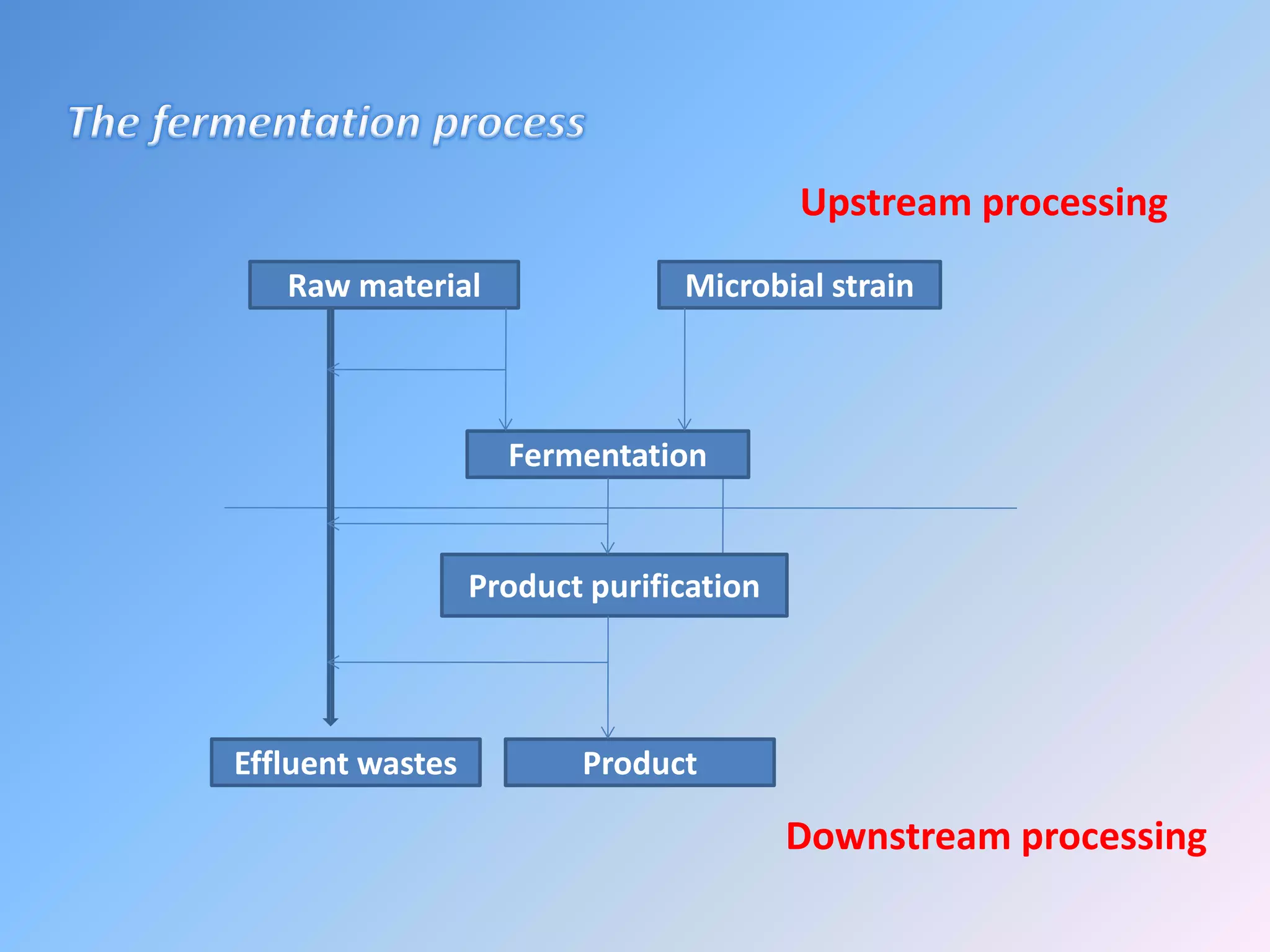
Raw material Microbial strain
Fermentation
Product purification
ProductEffluent wastes
Upstream processing
Downstream processing
Upstream processing
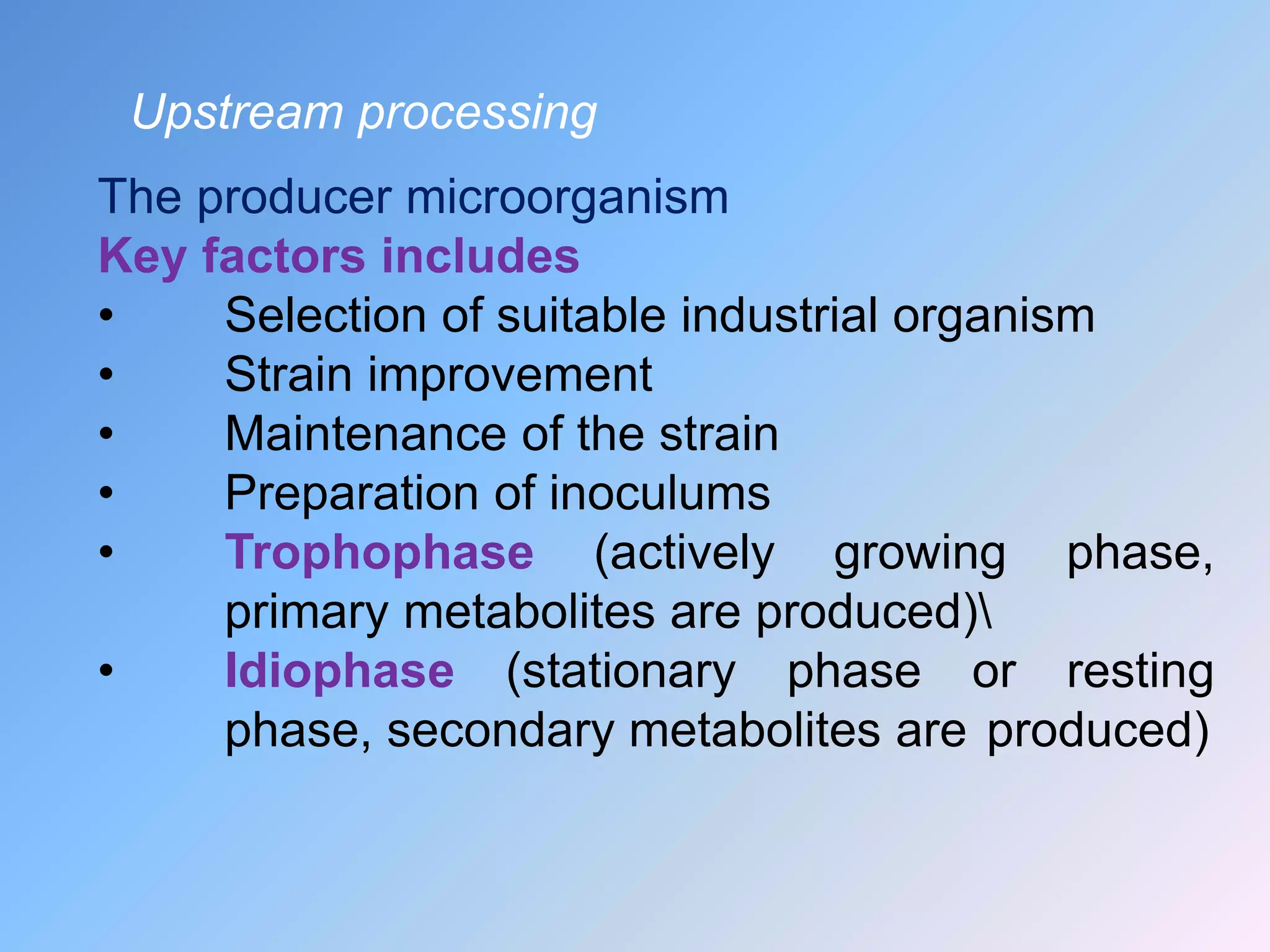
The producer microorganism
Key factors includes
• Selection of suitable industrial organism
• Strain improvement
• Maintenance of the strain
• Preparation of inoculums
• Trophophase (actively growing phase,
primary metabolites are produced)
• Idiophase (stationary phase or resting
phase, secondary metabolites are produced)
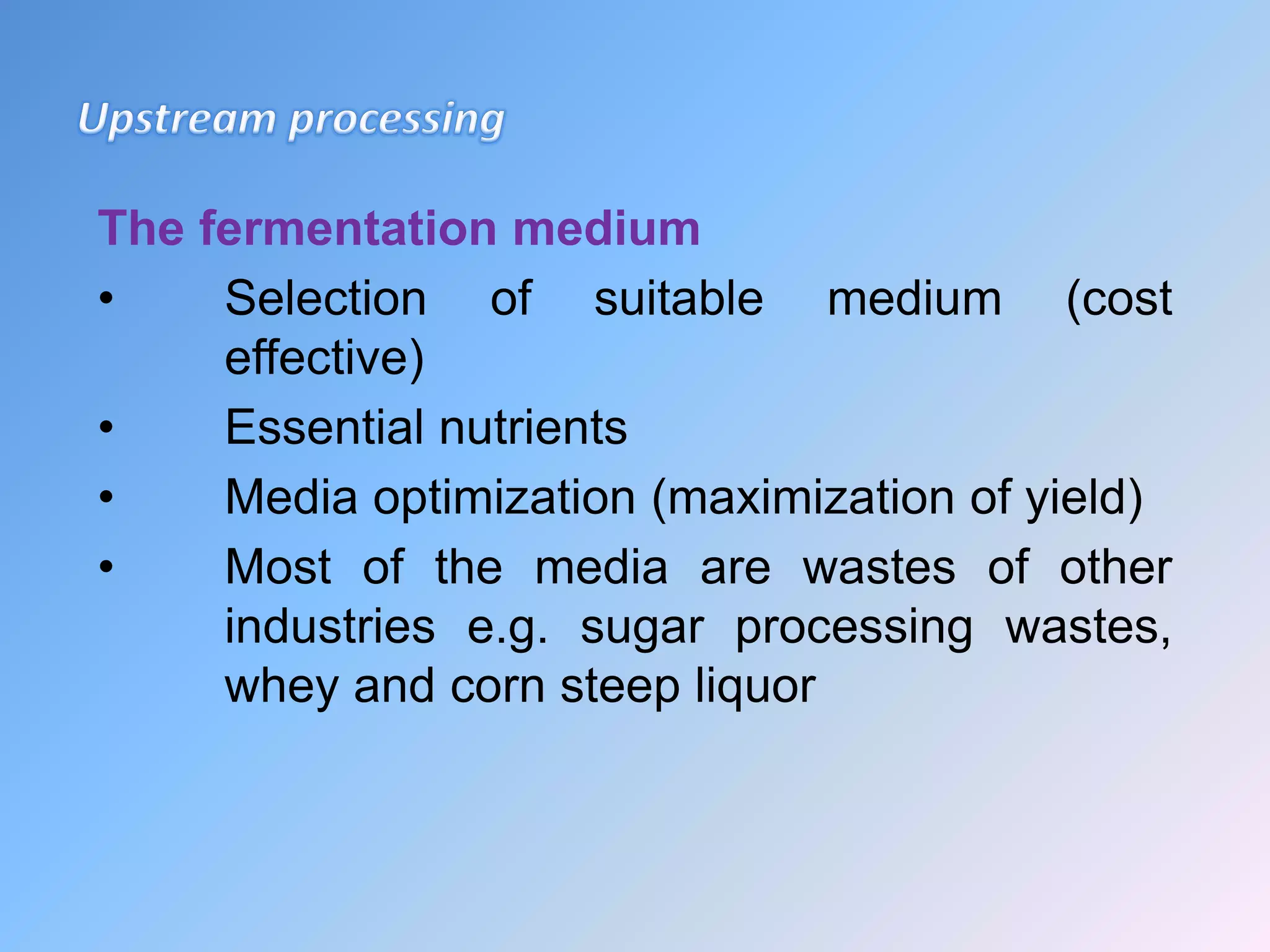
The fermentation medium
• Selection of suitable medium (cost
effective)
• Essential nutrients
• Media optimization (maximization of yield)
• Most of the media are wastes of other
industries e.g. sugar processing wastes,
whey and corn steep liquor
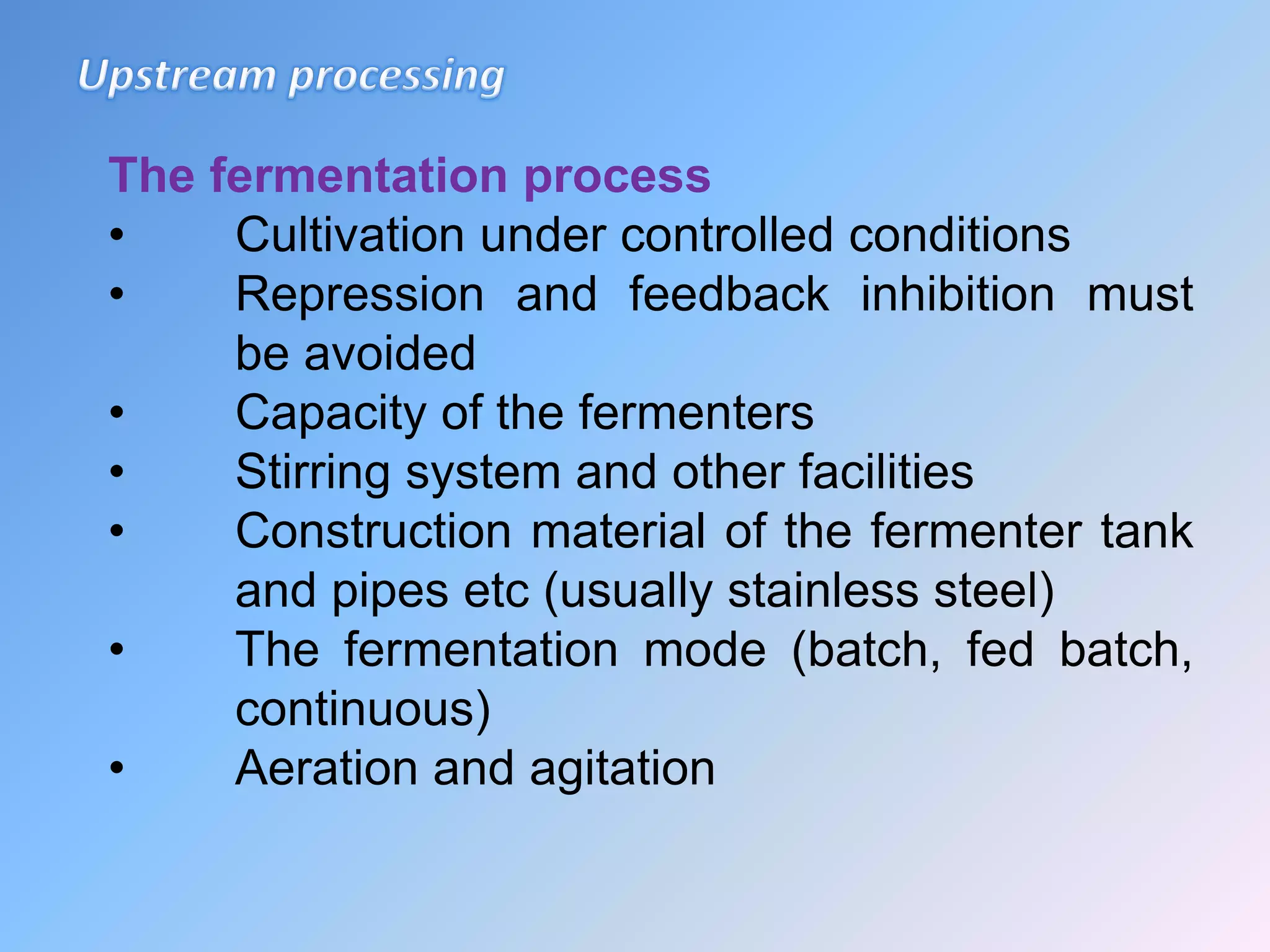
The fermentation process
• Cultivation under controlled conditions
• Repression and feedback inhibition must
be avoided
• Capacity of the fermenters
• Stirring system and other facilities
• Construction material of the fermenter tank
and pipes etc (usually stainless steel)
• The fermentation mode (batch, fed batch,
continuous)
• Aeration and agitation
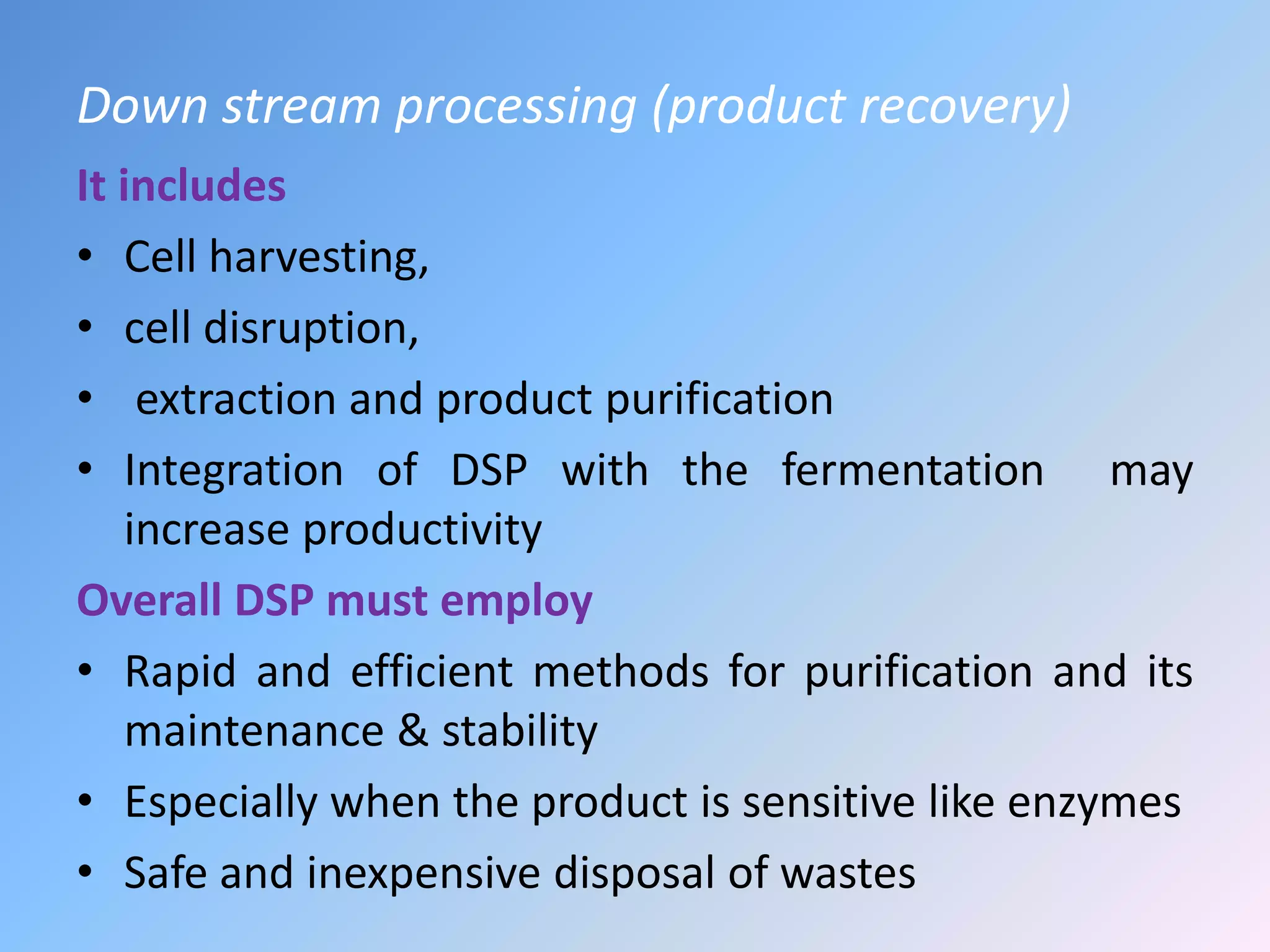
Down stream processing (product recovery)
It includes
• Cell harvesting,
• cell disruption,
• extraction and product purification
• Integration of DSP with the fermentation may
increase productivity
Overall DSP must employ
• Rapid and efficient methods for purification and its
maintenance & stability
• Especially when the product is sensitive like enzymes
• Safe and inexpensive disposal of wastes
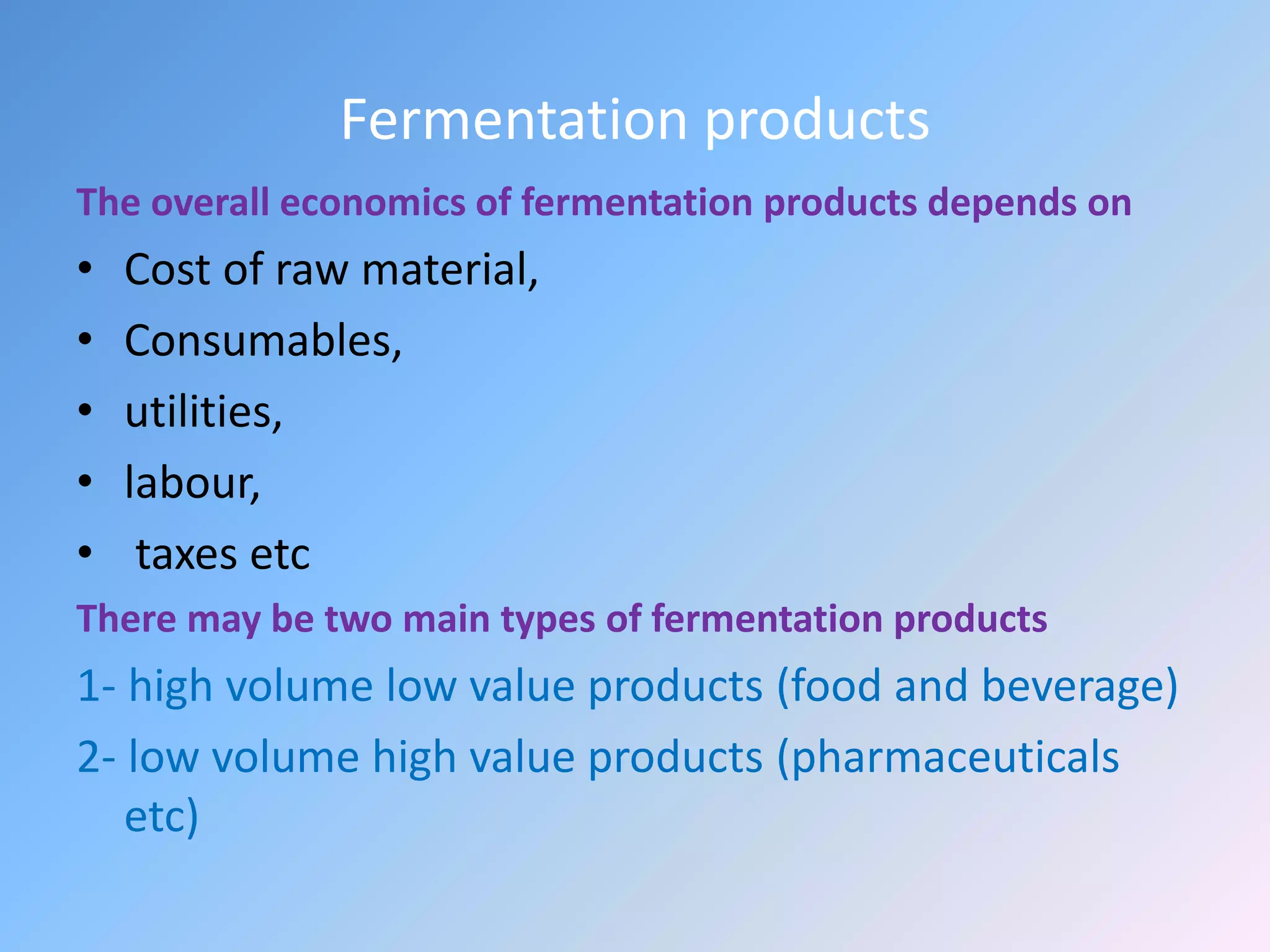
Fermentation products
The overall economics of fermentation products depends on
• Cost of raw material,
• Consumables,
• utilities,
• labour,
• taxes etc
There may be two main types of fermentation products
1- high volume low value products (food and beverage)
2- low volume high value products (pharmaceuticals
etc)
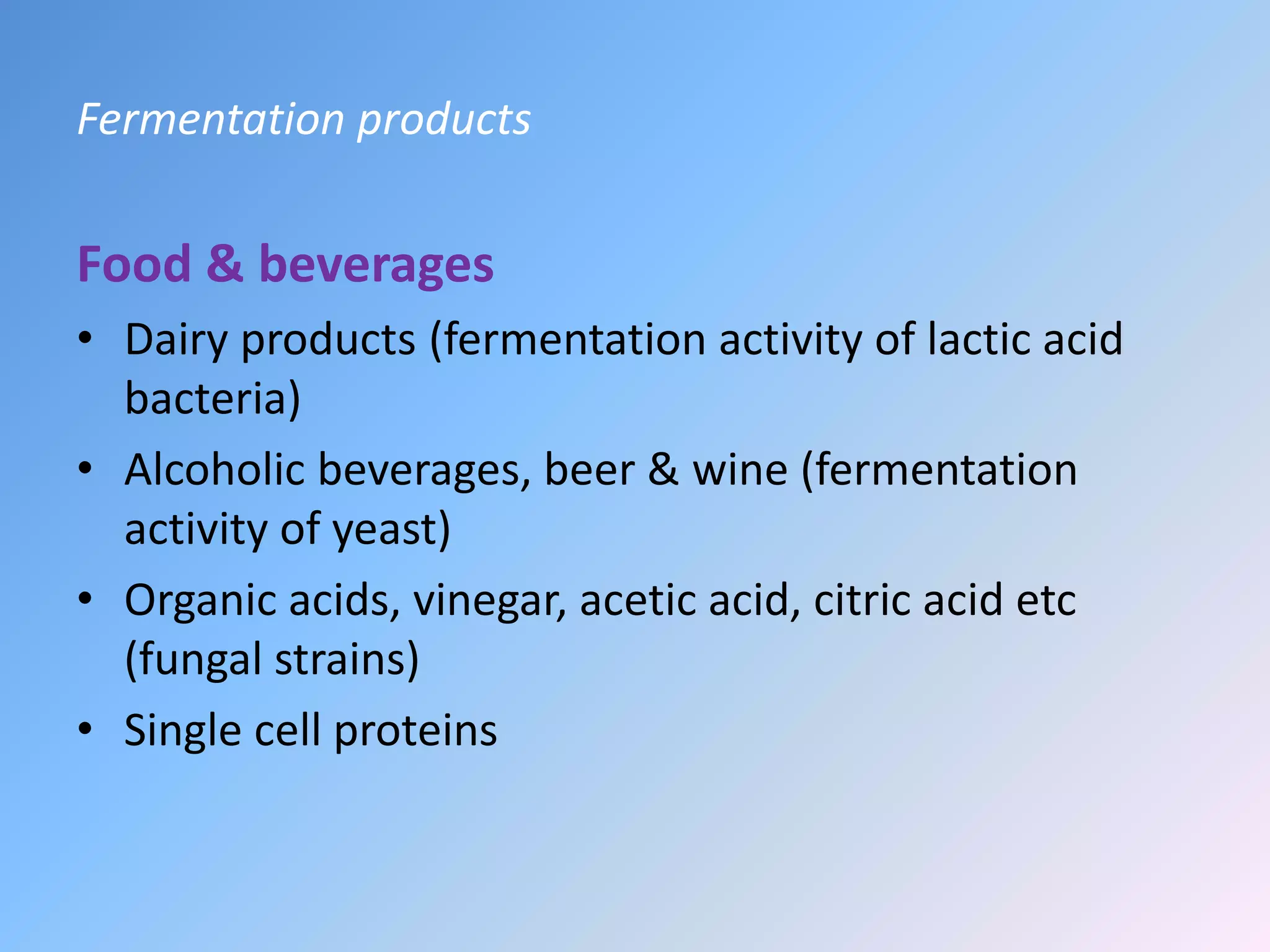
Fermentation products
Food & beverages
• Dairy products (fermentation activity of lactic acid
bacteria)
• Alcoholic beverages, beer & wine (fermentation
activity of yeast)
• Organic acids, vinegar, acetic acid, citric acid etc
(fungal strains)
• Single cell proteins
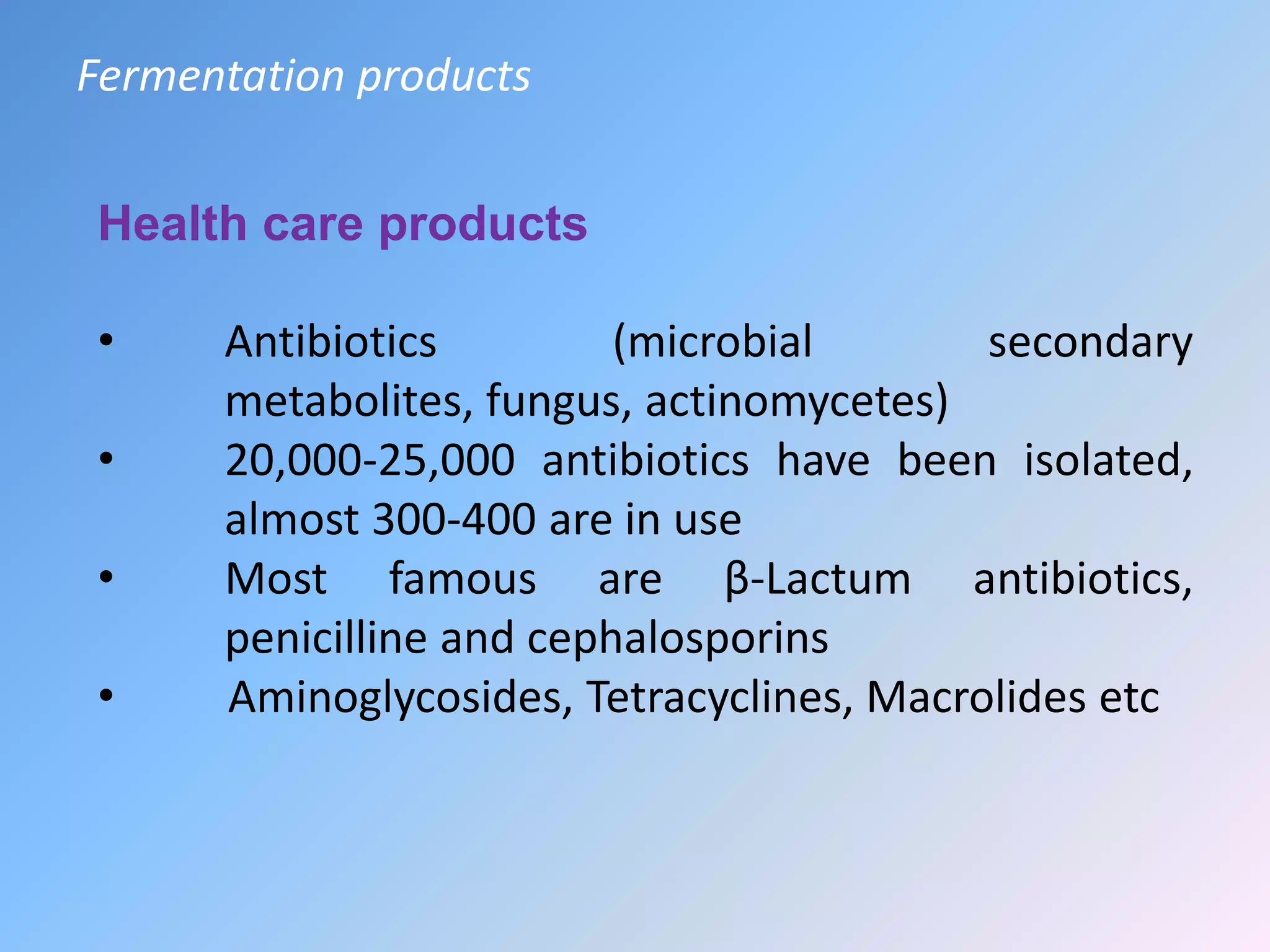
Health care products
• Antibiotics (microbial secondary
metabolites, fungus, actinomycetes)
• 20,000-25,000 antibiotics have been isolated,
almost 300-400 are in use
• Most famous are β-Lactum antibiotics,
penicilline and cephalosporins
• Aminoglycosides, Tetracyclines, Macrolides etc
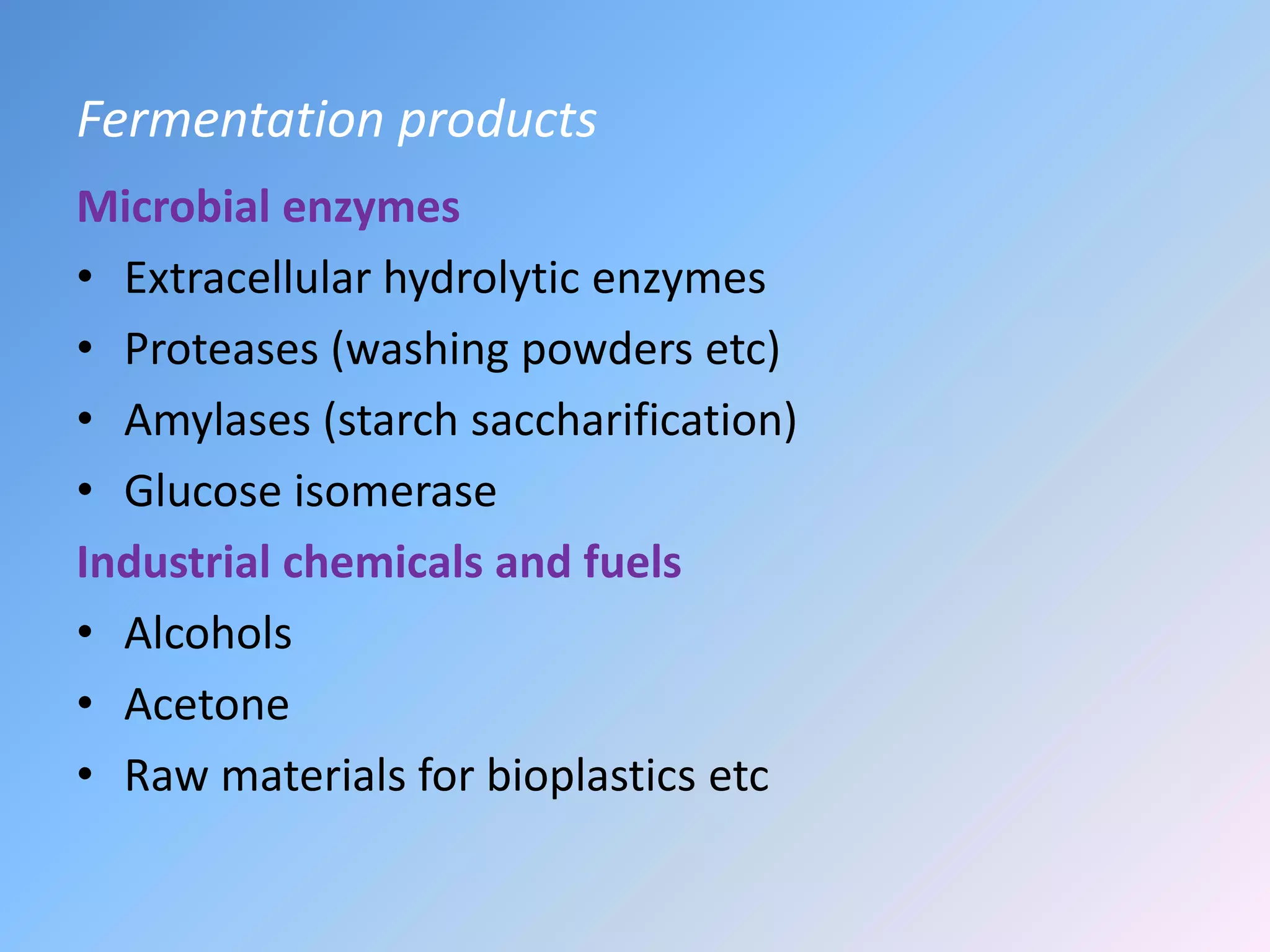
Fermentation products
Microbial enzymes
• Extracellular hydrolytic enzymes
• Proteases (washing powders etc)
• Amylases (starch saccharification)
• Glucose isomerase
Industrial chemicals and fuels
• Alcohols
• Acetone
• Raw materials for bioplastics etc
Environmental role
• Waste water treatment
• Degradation of xenobiotic compounds
• Metal reduction
• Leeching of metals (copper, iron, uranium etc)
• Bio control (replacement of pesticides and
insecticides)

Introduction of Industrial microbiology (Lecture 1)

  • 1.
  • 2.
    • The introduction(History and brief overview of the industrial microbiology ) • Secondary Metabolites (Basic concepts) • Industrial microorganisms and strain development • Fermentation media (substrate for fermentation) • Fermentation Systems (methods of fermentation)
  • 3.
    • Down streamProcessing (Product recovery) • Product development, regulation and safety • Antibiotics • Industrial fuels (ethanol production) • Quality control and Quality management
  • 4.
    Books • Industrial Microbiology-anintroduction (Michael J. Waites, N. L. Morgan, J. S. Rockey and G. Higton) • Biotechnology- A text book of industrial microbioloy (Wulf Cruger and Annelies cruger) • Industrial Microbiology (Prescott and Dunn,s)
  • 5.
    Definition • Industrial Microbiologyis the commercial exploitation of microorganisms, it involves processes and products that are of major economic , environmental and social importance through out the world • There are two key aspects of industrial microbiology 1- production of microbial products by fermentation 2- role of microorganisms in providing services like waste treatment, pollution control etc
  • 6.
    Historical perspectives • Traditionalfermentation process (thousand years before) • Scientific basis of these processes (150 years ago) • 19th century (1857 Pasteur, alcoholic fermentations, pasteurization) • Cagniard-Latour, Schwann (yeast activities in fermentation) • Pasteur publications (Etudes sur le Vin,1866. Etudes sur la Biere, 1876), an important catalyst
  • 7.
    • Hansen 1883(Carlsberg Brewery in Denmark, pure culture brewing by Carlsberg yeast No.1, S. carlsbergenisis, Now a days a variety of S. cerevisiae) • Start of 20th century (Progress was relatively slow, advancement in large scale sewage treatment) • Weizmann 1913-15 (first novel industrial scale fermentation, Acetone-butanol fermentation, Clostridum acetobutylicum) Historical perspectives
  • 8.
    Historical perspectives • In1920s (production of citric acid, Aspergillus niger, a mould) • 1940s rapid advances in fermentation technology (production of antibiotics, penicilline, due to world war II, the process of large scale submerged fermentation started) • Recent developments includes: production of monoclonal antibodies, (1970s Milstein& Kohler), Massive developments in Genetic engineering (recombinant DNA technology, last 30 years)
  • 9.
    • Help instrain improvement (by gene manipulation), all kinds of microbial strains can be developed including bacteria, fungi etc • Strains as a response can produce new or required product, may give high yield, can grow very fast, can use cheap substrate mostly wastes etc • May be useful in downstream processing (advance expression systems in which product recovery becomes very easy)
  • 10.
    Fermentation is amultidisciplinary activity ?????.. • A successful fermentation process require the contributions from a wide range of disciplines including: • Microbiology, • Biochemistry, • Genetics, • Molecular biology • Chemistry • Chemical and process engineering
  • 11.
    Consists of twostages • Upstream processing (USP) • Downstream processing (DSP) Upstream processing includes three main areas • The producer microorganism • The fermentation medium • The fermentation process
  • 12.
    Raw material Microbialstrain Fermentation Product purification ProductEffluent wastes Upstream processing Downstream processing
  • 13.
    Upstream processing The producermicroorganism Key factors includes • Selection of suitable industrial organism • Strain improvement • Maintenance of the strain • Preparation of inoculums • Trophophase (actively growing phase, primary metabolites are produced) • Idiophase (stationary phase or resting phase, secondary metabolites are produced)
  • 14.
    The fermentation medium •Selection of suitable medium (cost effective) • Essential nutrients • Media optimization (maximization of yield) • Most of the media are wastes of other industries e.g. sugar processing wastes, whey and corn steep liquor
  • 15.
    The fermentation process •Cultivation under controlled conditions • Repression and feedback inhibition must be avoided • Capacity of the fermenters • Stirring system and other facilities • Construction material of the fermenter tank and pipes etc (usually stainless steel) • The fermentation mode (batch, fed batch, continuous) • Aeration and agitation
  • 16.
    Down stream processing(product recovery) It includes • Cell harvesting, • cell disruption, • extraction and product purification • Integration of DSP with the fermentation may increase productivity Overall DSP must employ • Rapid and efficient methods for purification and its maintenance & stability • Especially when the product is sensitive like enzymes • Safe and inexpensive disposal of wastes
  • 17.
    Fermentation products The overalleconomics of fermentation products depends on • Cost of raw material, • Consumables, • utilities, • labour, • taxes etc There may be two main types of fermentation products 1- high volume low value products (food and beverage) 2- low volume high value products (pharmaceuticals etc)
  • 18.
    Fermentation products Food &beverages • Dairy products (fermentation activity of lactic acid bacteria) • Alcoholic beverages, beer & wine (fermentation activity of yeast) • Organic acids, vinegar, acetic acid, citric acid etc (fungal strains) • Single cell proteins
  • 19.
    Health care products •Antibiotics (microbial secondary metabolites, fungus, actinomycetes) • 20,000-25,000 antibiotics have been isolated, almost 300-400 are in use • Most famous are β-Lactum antibiotics, penicilline and cephalosporins • Aminoglycosides, Tetracyclines, Macrolides etc Fermentation products
  • 20.
    Fermentation products Microbial enzymes •Extracellular hydrolytic enzymes • Proteases (washing powders etc) • Amylases (starch saccharification) • Glucose isomerase Industrial chemicals and fuels • Alcohols • Acetone • Raw materials for bioplastics etc
  • 21.
    Environmental role • Wastewater treatment • Degradation of xenobiotic compounds • Metal reduction • Leeching of metals (copper, iron, uranium etc) • Bio control (replacement of pesticides and insecticides)