Tryptophan Operon
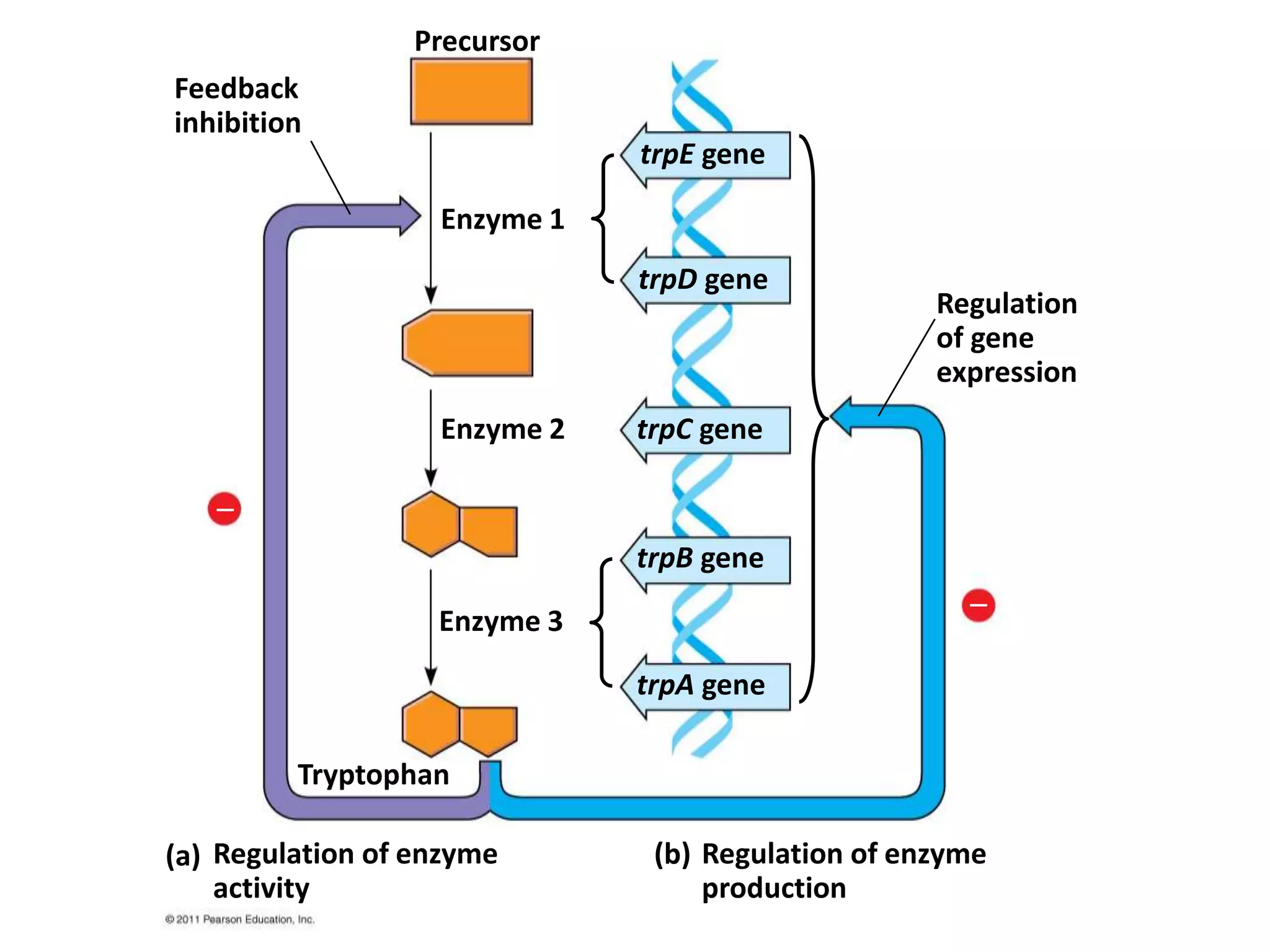
Precursor
Feedback
inhibition
Enzyme 1
Enzyme 2
Enzyme 3
Tryptophan
(a) (b)Regulation of enzyme
activity
Regulation of enzyme
production
Regulation
of gene
expression


trpE gene
trpD gene
trpC gene
trpB gene
trpA gene
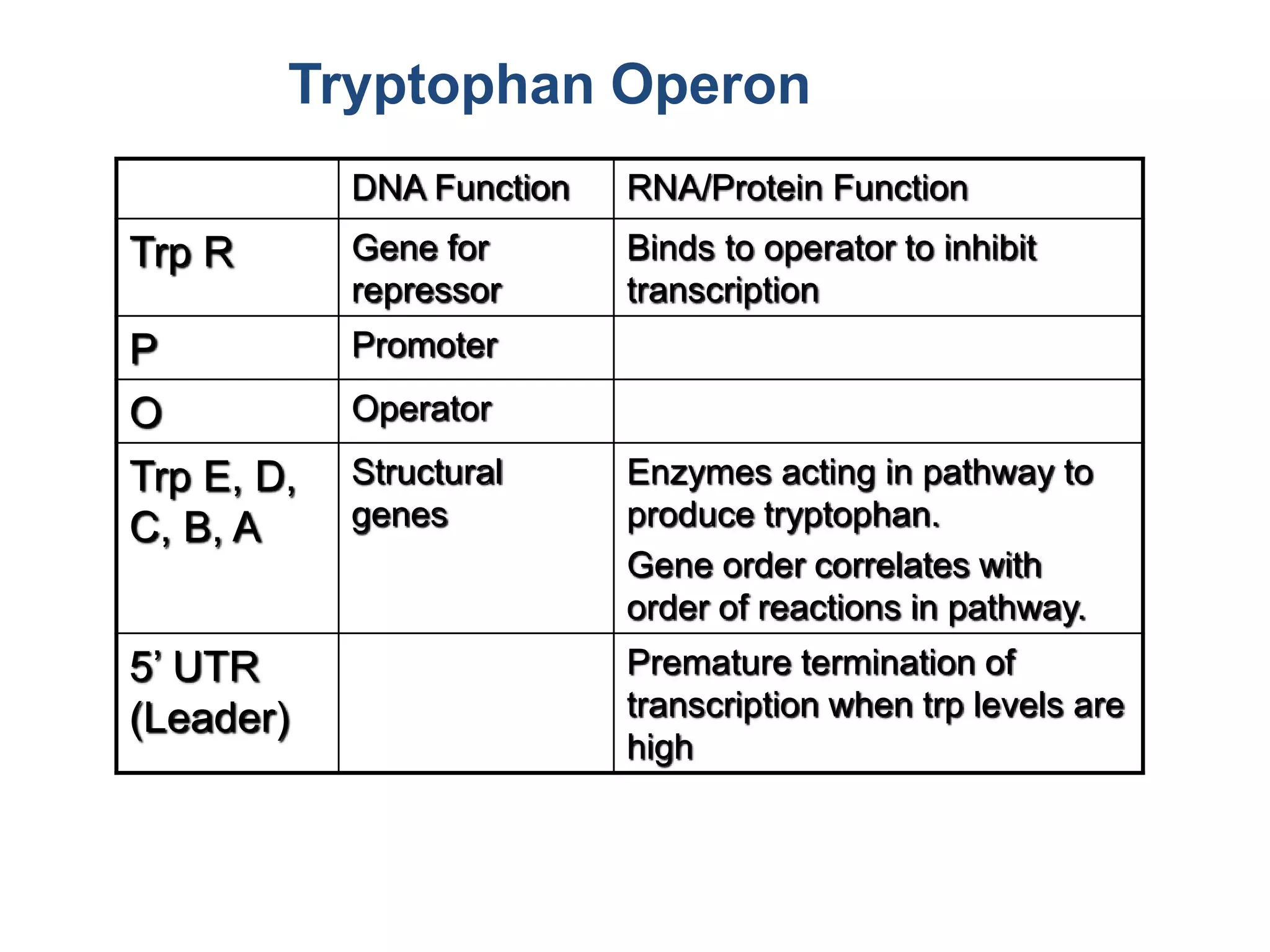
DNA Function RNA/Protein Function
Trp R Gene for
repressor
Binds to operator to inhibit
transcription
P Promoter
O Operator
Trp E, D,
C, B, A
Structural
genes
Enzymes acting in pathway to
produce tryptophan.
Gene order correlates with
order of reactions in pathway.
5’ UTR
(Leader)
Premature termination of
transcription when trp levels are
high
Tryptophan Operon
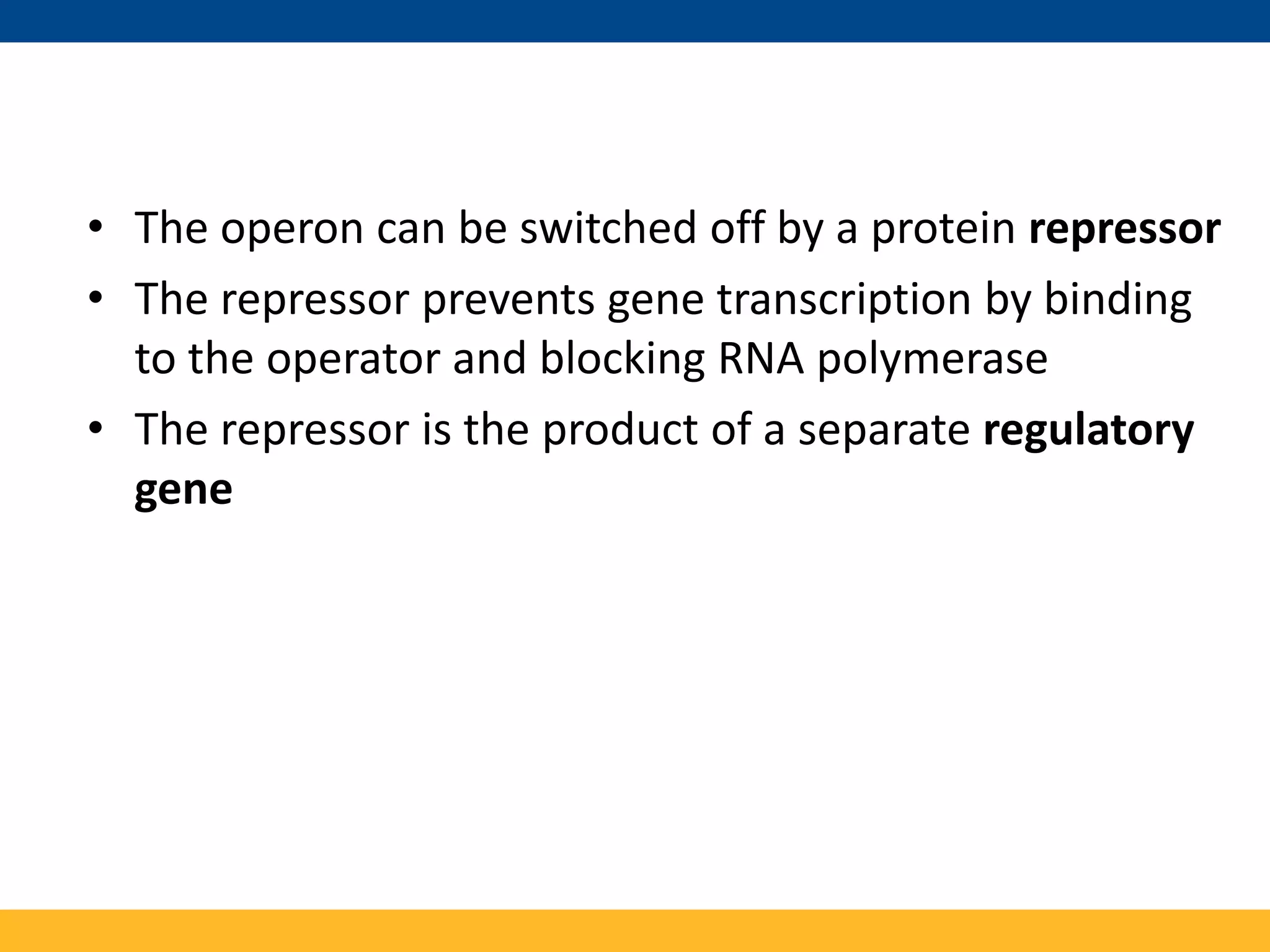
• The operon can be switched off by a protein repressor
• The repressor prevents gene transcription by binding
to the operator and blocking RNA polymerase
• The repressor is the product of a separate regulatory
gene
• The repressor can be in an active or inactive form,
depending on the presence of other molecules
• A corepressor is a molecule that cooperates with a
repressor protein to switch an operon off
• For example, E. coli can synthesize the amino acid
tryptophan
• By default the trp operon is on and the genes for
tryptophan synthesis are transcribed
• When tryptophan is present, it binds to the trp
repressor protein, which turns the operon off
• The repressor is active only in the presence of its
corepressor tryptophan; thus the trp operon is turned
off (repressed) if tryptophan levels are high
© 2011 Pearson Education, Inc.
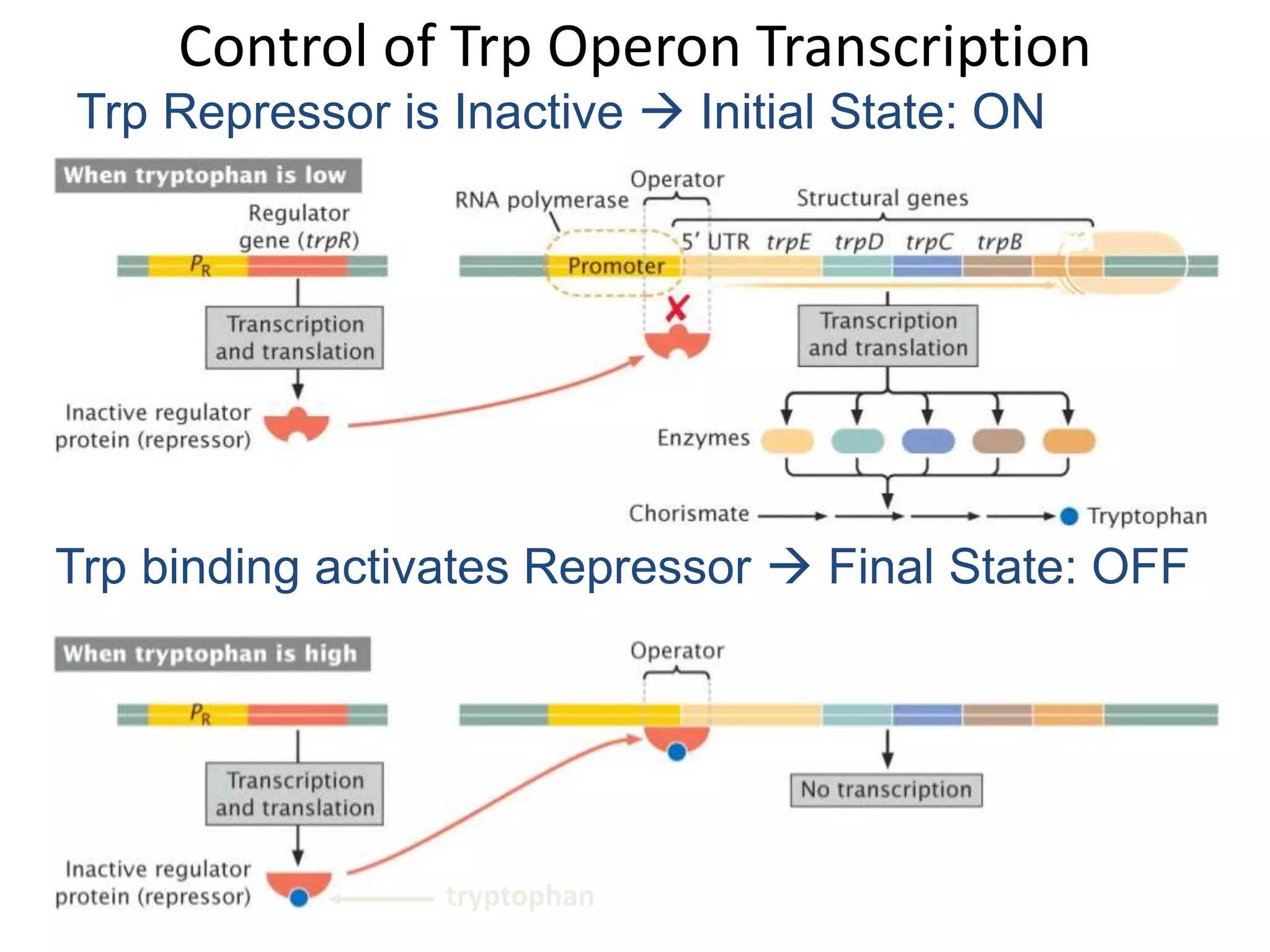
Control of Trp Operon Transcription
Trp Repressor is Inactive  Initial State: ON
Trp binding activates Repressor  Final State: OFF
tryptophan
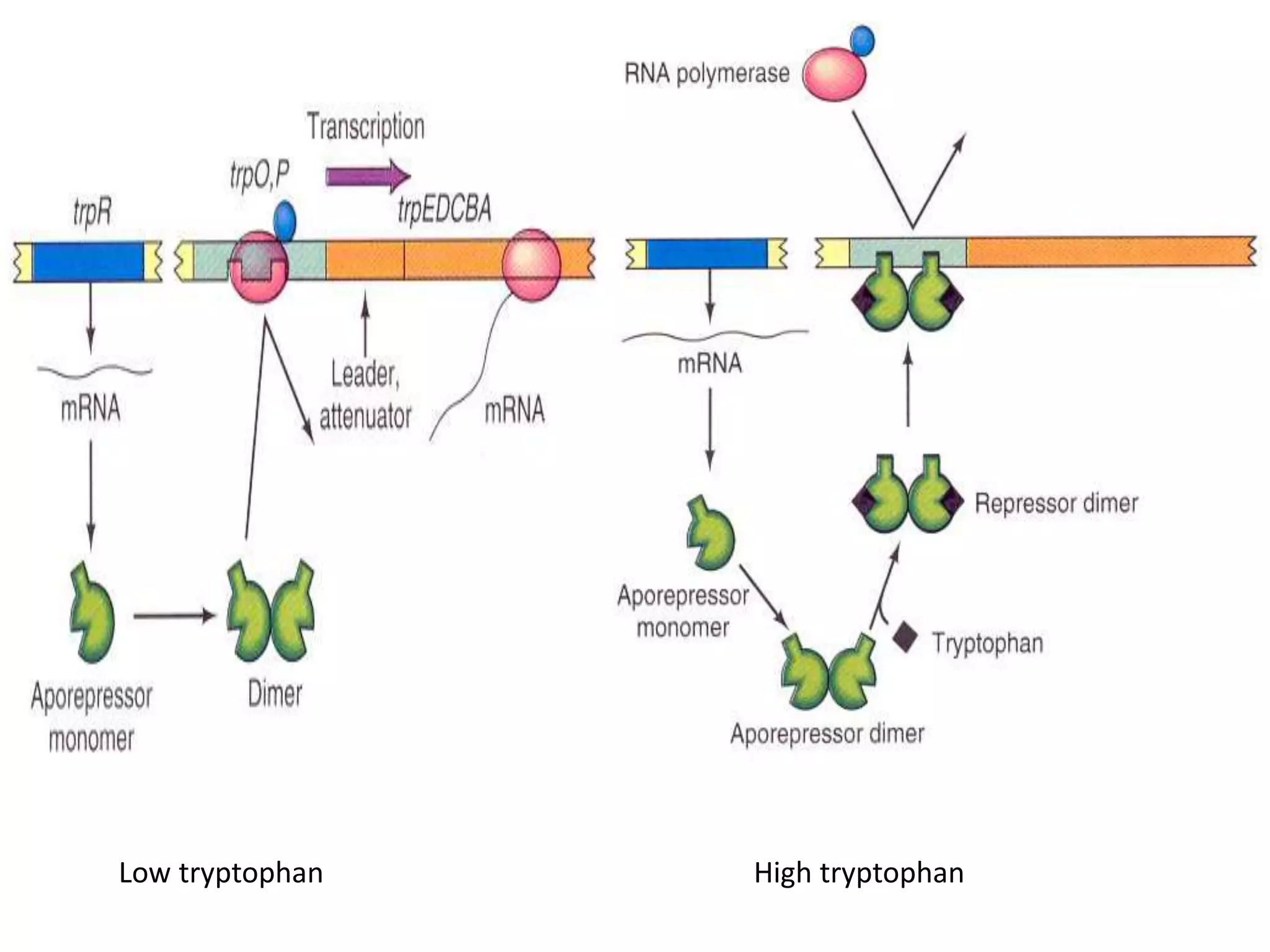
Low tryptophan High tryptophan
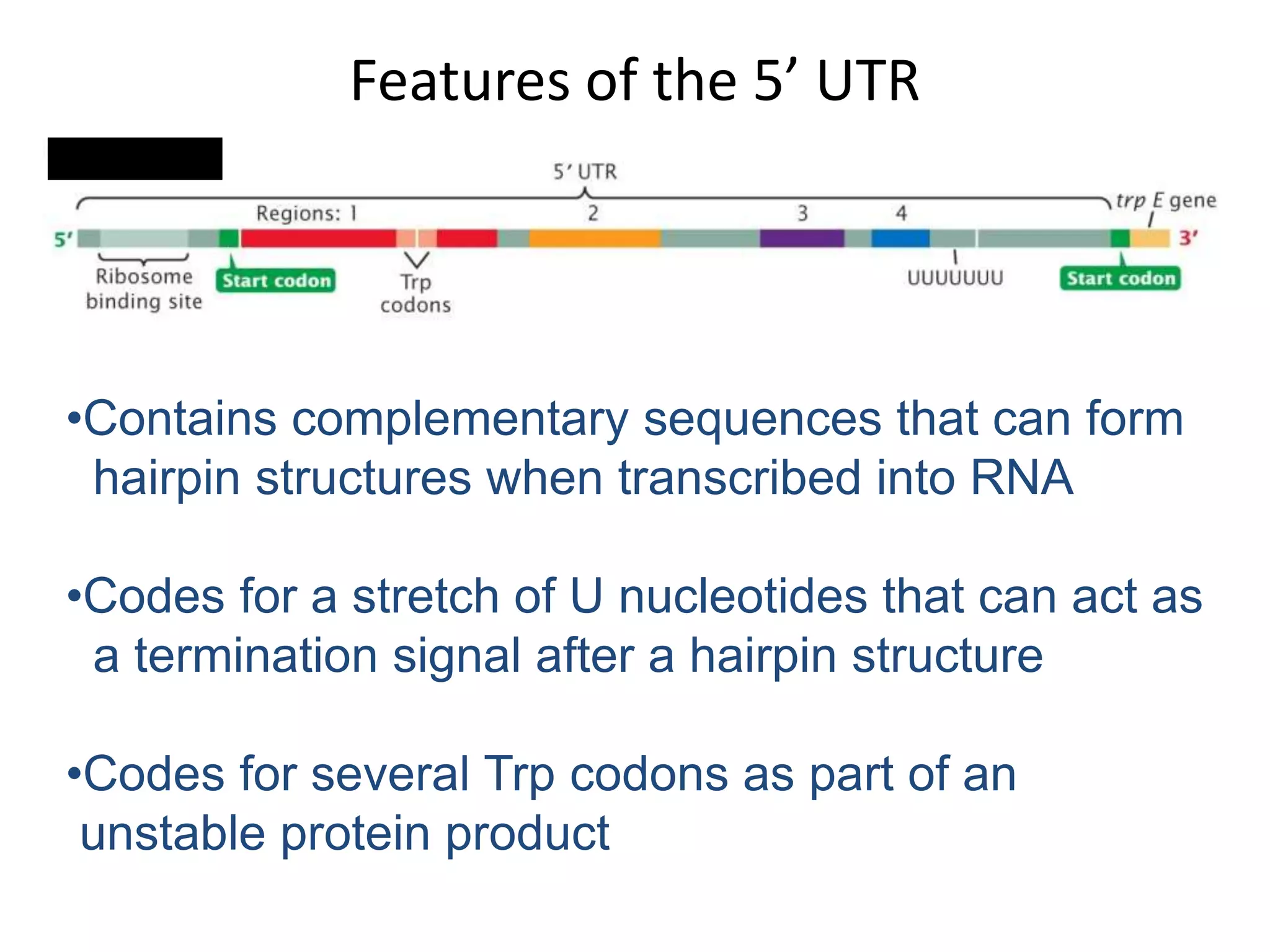
Features of the 5’ UTR
•Contains complementary sequences that can form
hairpin structures when transcribed into RNA
•Codes for a stretch of U nucleotides that can act as
a termination signal after a hairpin structure
•Codes for several Trp codons as part of an
unstable protein product
1. Operator site lies within the promoter
2. Allosteric transition
Allosteric protein-protein whose shape is changed
upon binding of a particular molecule  In the new
conformation the protein’s ability to react to a second
molecule is altered
3. Trp operon has another level of control  attenuation
4. Repressor lowers transcription 70-fold (as compared
to derepressed state)  attentuation permits another
10-fold control  total dynamic range of control =
700-fold
…
…
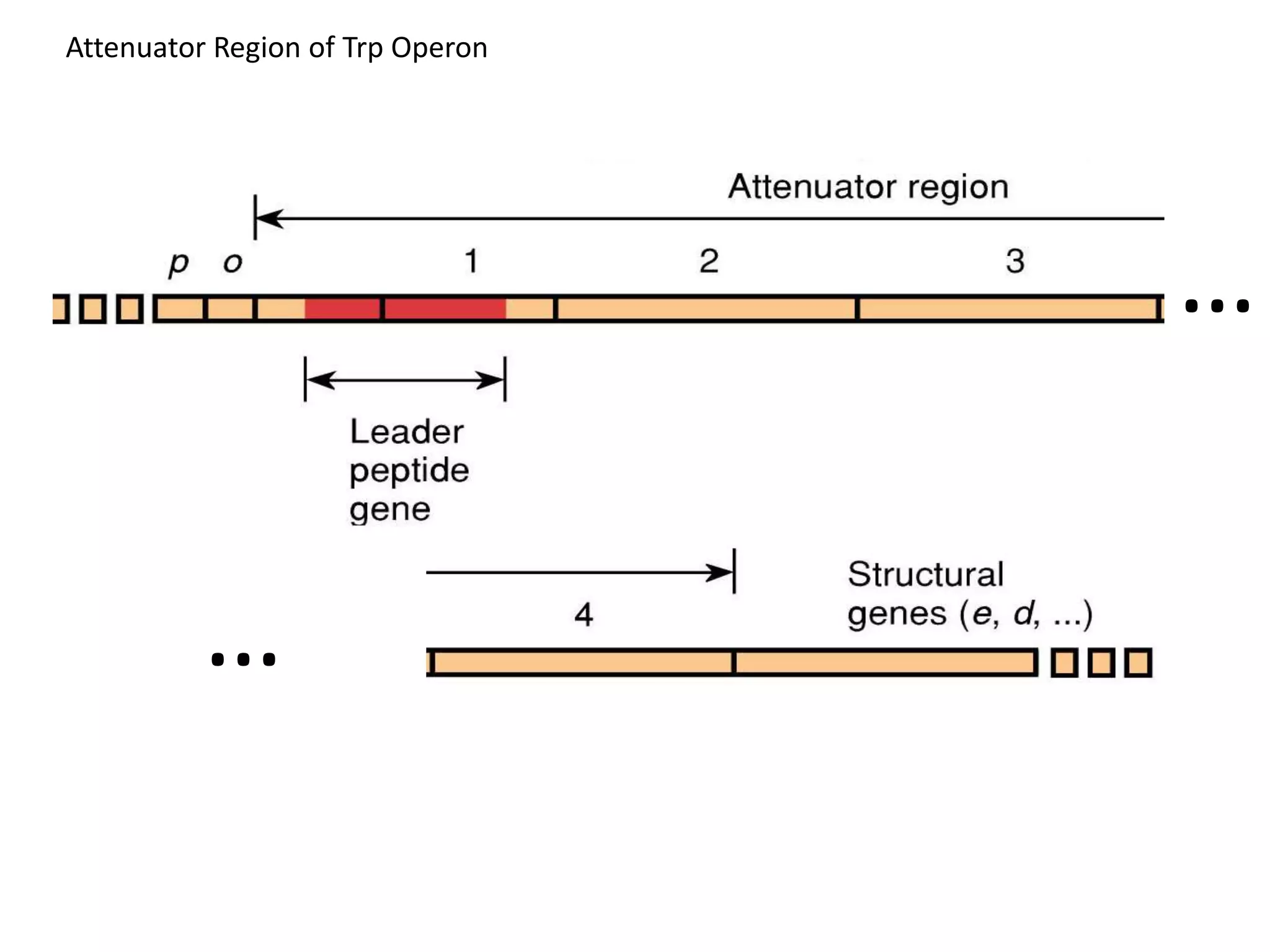
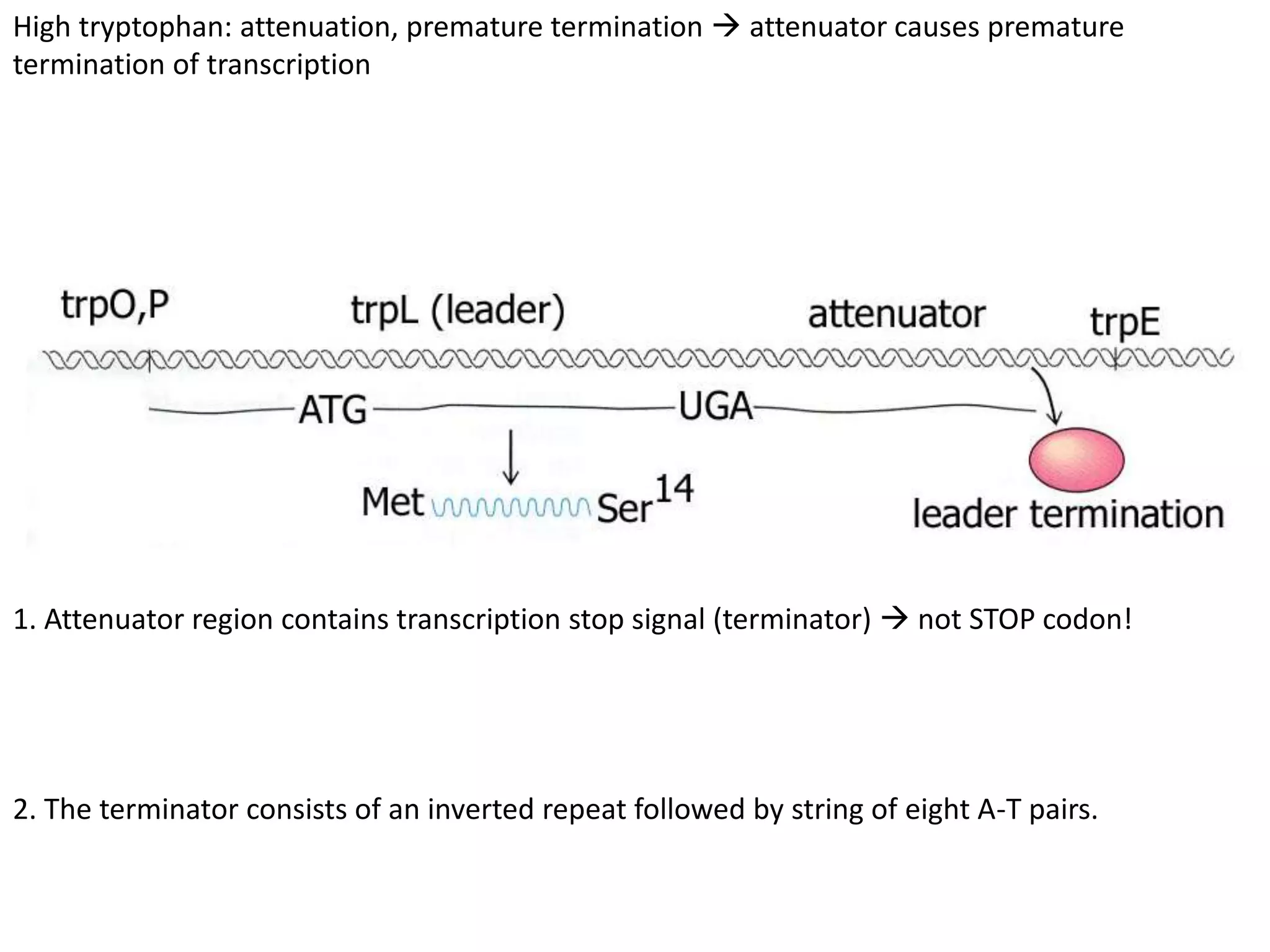
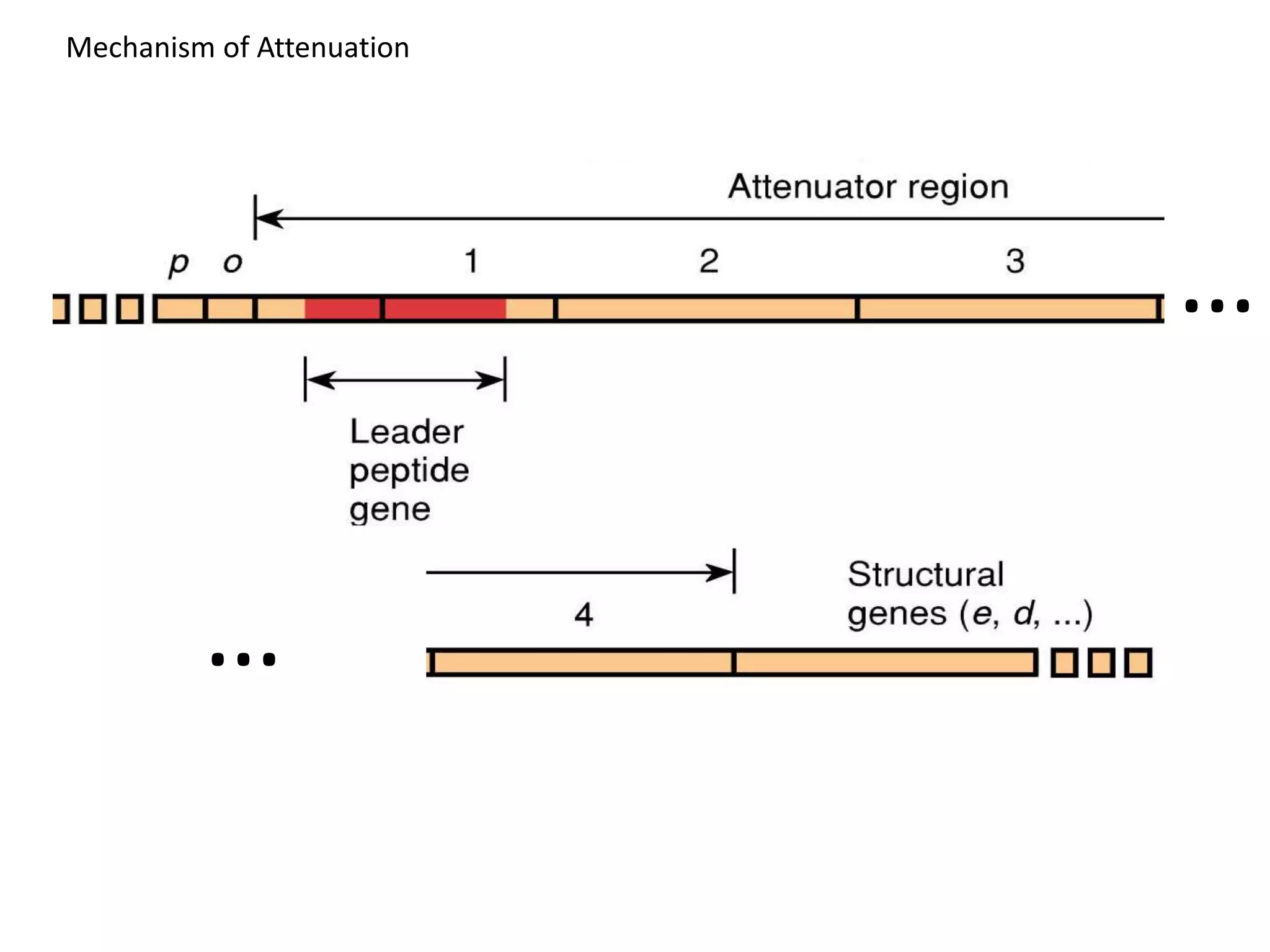
Attenuator Region of Trp Operon
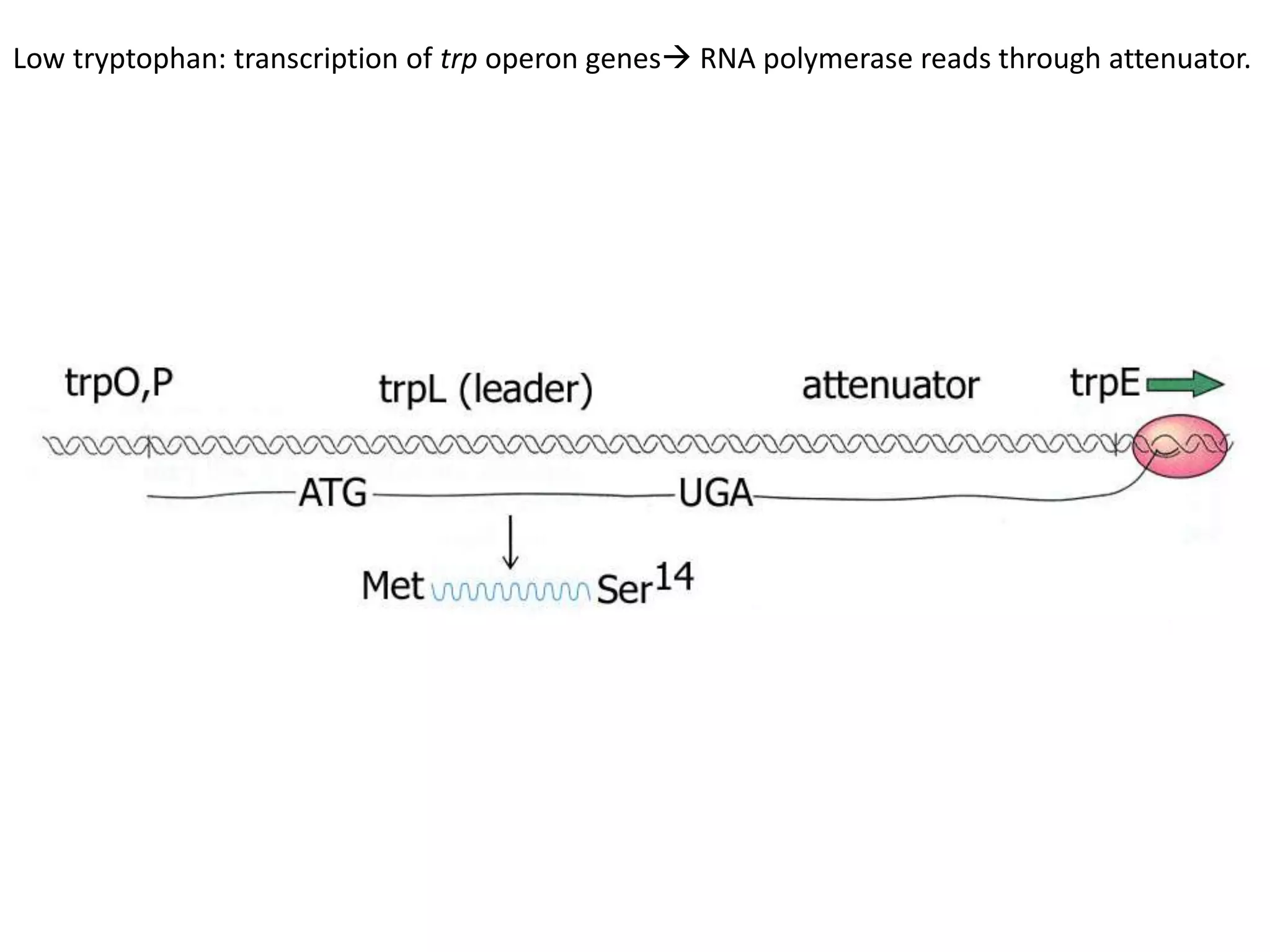
Low tryptophan: transcription of trp operon genes RNA polymerase reads through attenuator.
High tryptophan: attenuation, premature termination  attenuator causes premature
termination of transcription
1. Attenuator region contains transcription stop signal (terminator)  not STOP codon!
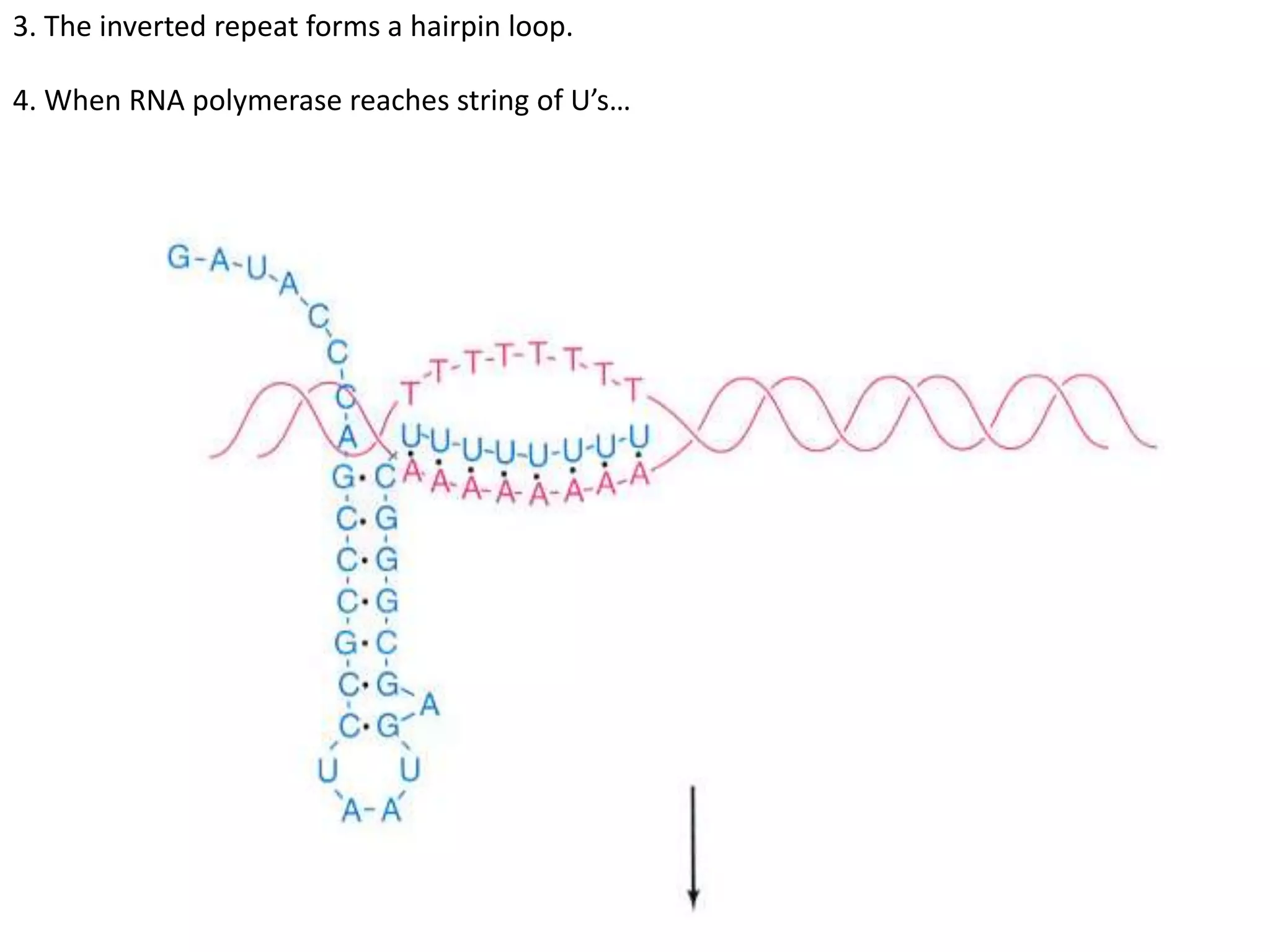
2. The terminator consists of an inverted repeat followed by string of eight A-T pairs.
3. The inverted repeat forms a hairpin loop.
4. When RNA polymerase reaches string of U’s…
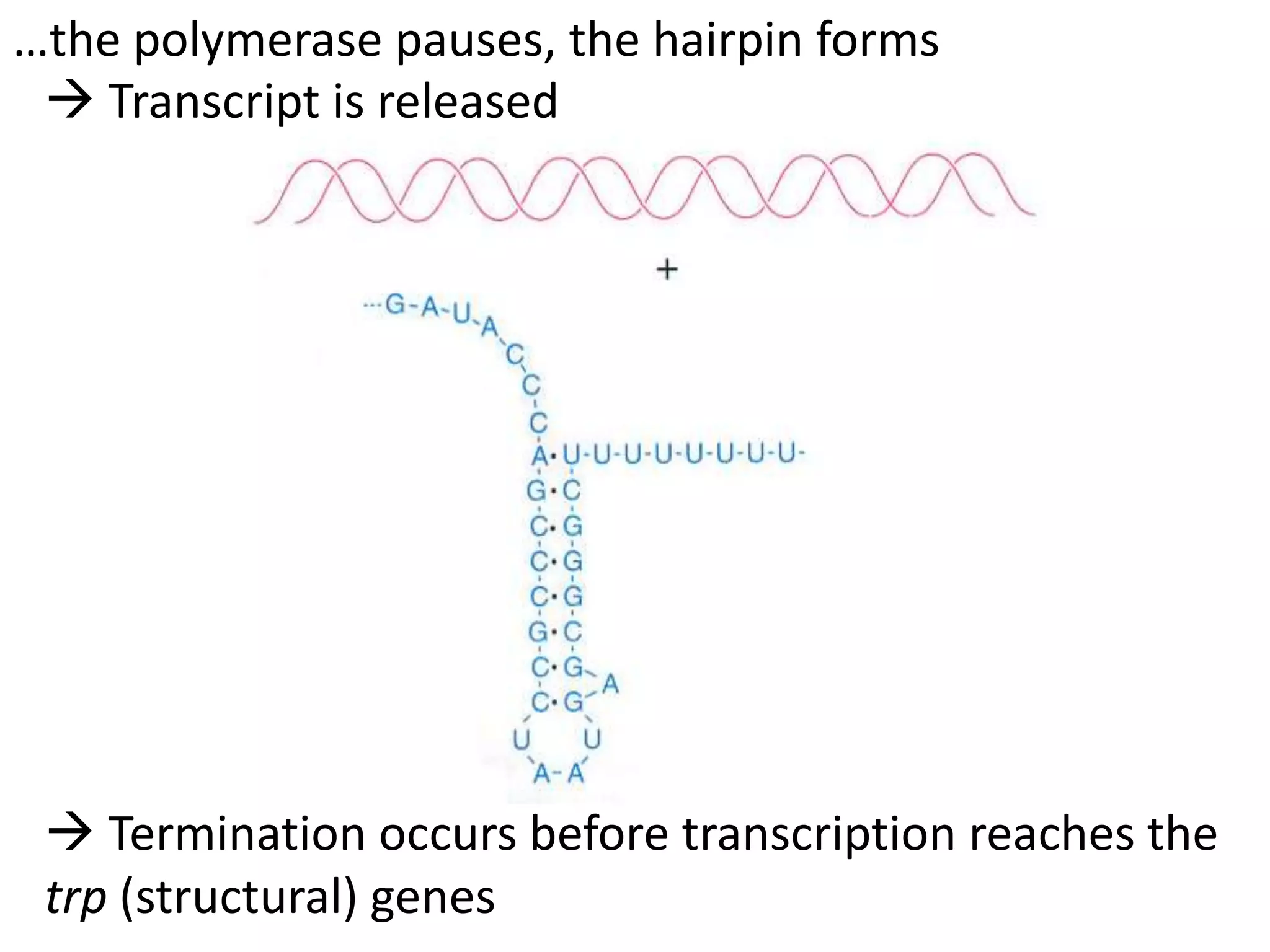
…the polymerase pauses, the hairpin forms
 Transcript is released
 Termination occurs before transcription reaches the
trp (structural) genes
Attenuation gives some insight into how the operon is
shut down, but how does the cell activate trp operon
expression (i.e. defeat attenuation)?
preventing hairpin formation would destroy
termination signal  transcription would proceed
…
…
Mechanism of Attenuation
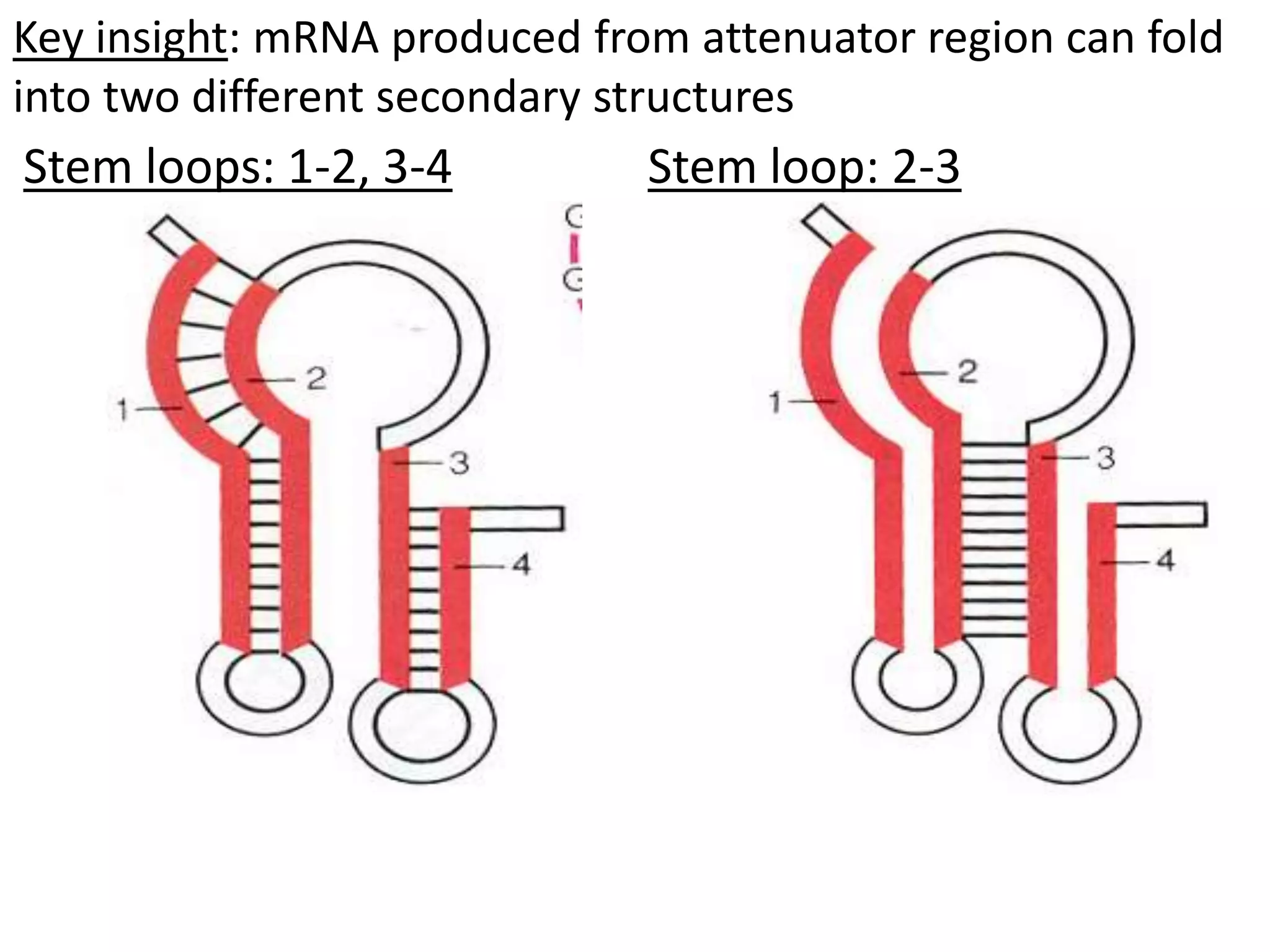
Key insight: mRNA produced from attenuator region can fold
into two different secondary structures
Stem loops: 1-2, 3-4 Stem loop: 2-3
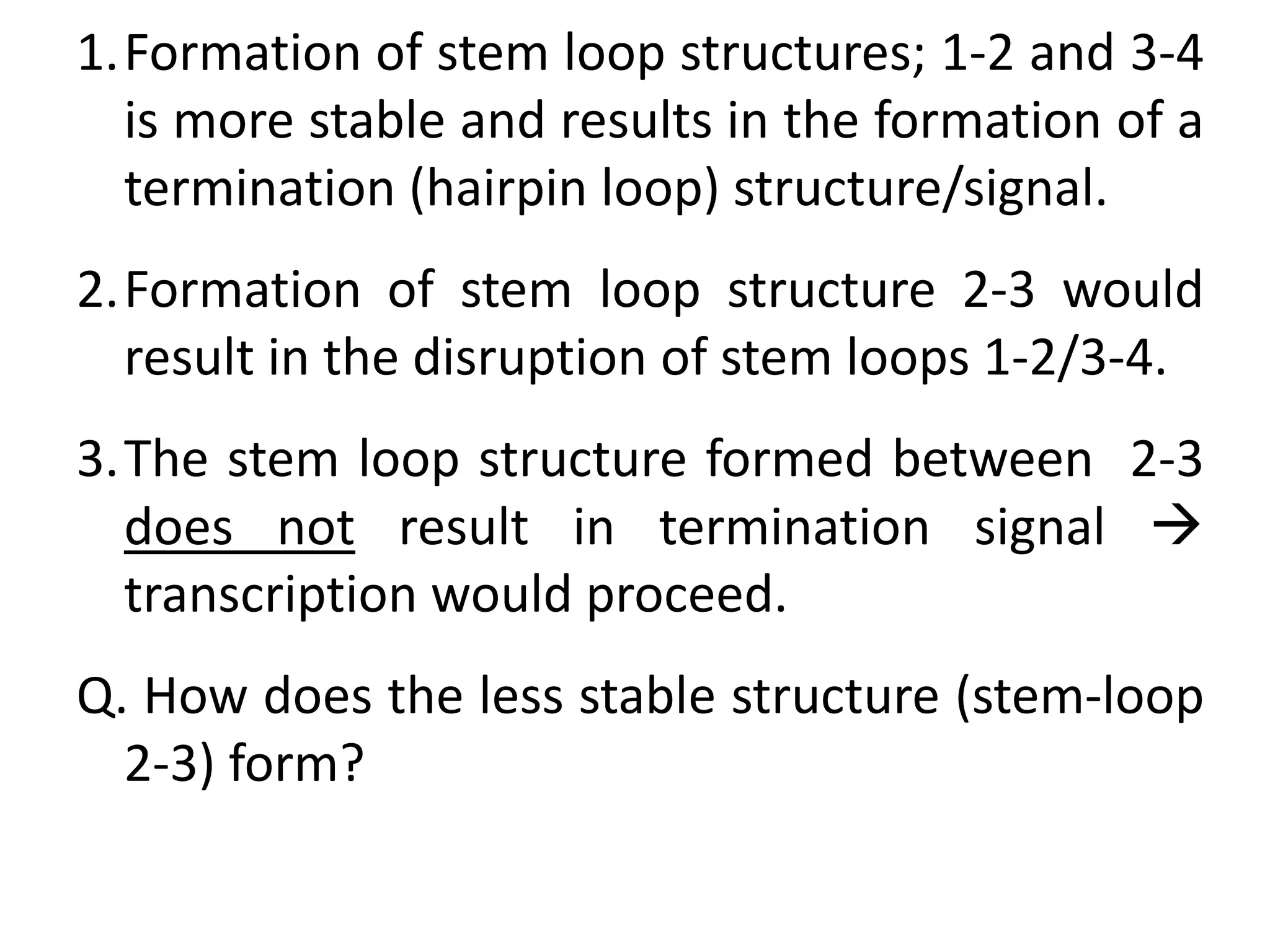
1.Formation of stem loop structures; 1-2 and 3-4
is more stable and results in the formation of a
termination (hairpin loop) structure/signal.
2.Formation of stem loop structure 2-3 would
result in the disruption of stem loops 1-2/3-4.
3.The stem loop structure formed between 2-3
does not result in termination signal 
transcription would proceed.
Q. How does the less stable structure (stem-loop
2-3) form?
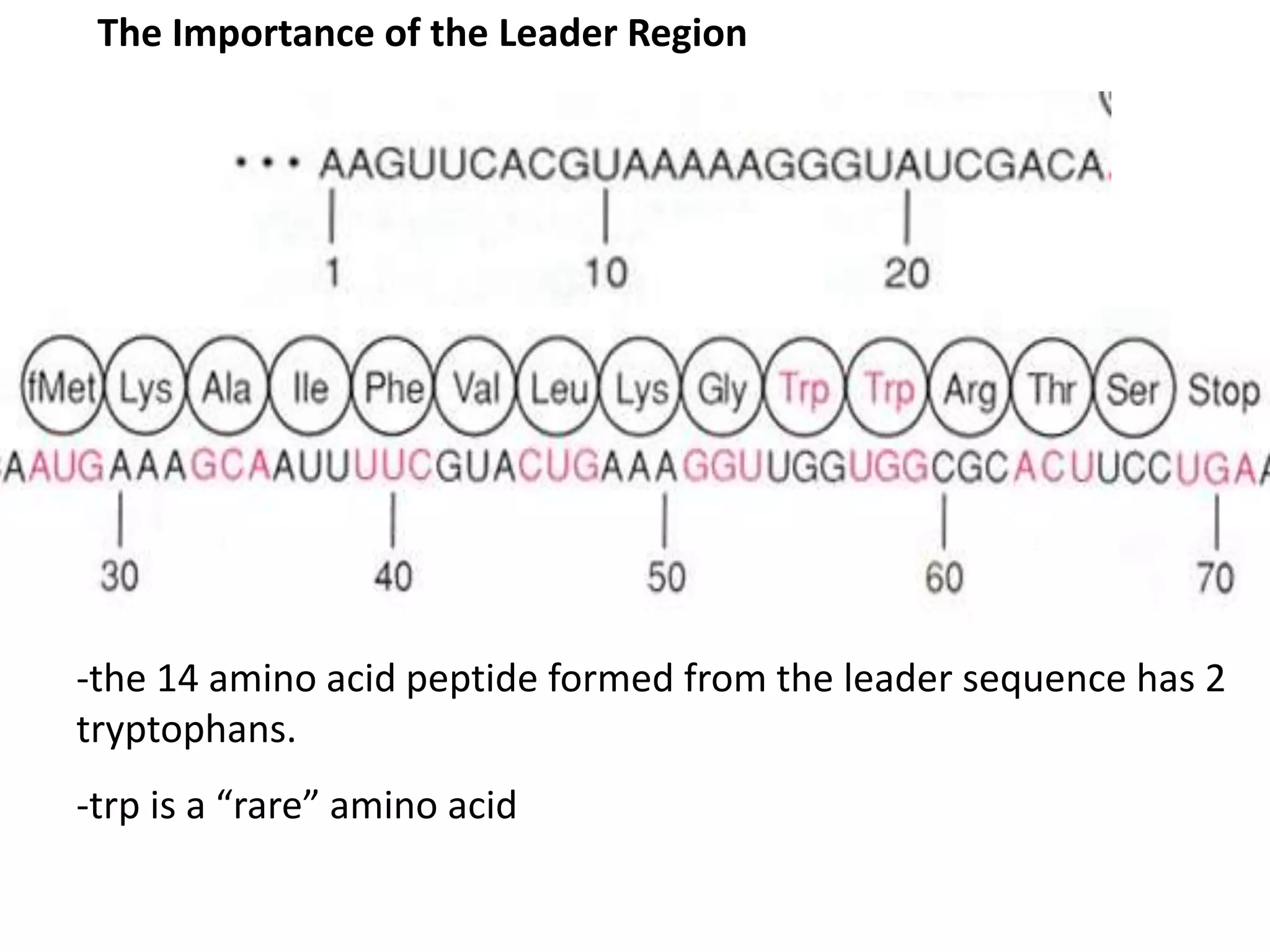
The Importance of the Leader Region
-the 14 amino acid peptide formed from the leader sequence has 2
tryptophans.
-trp is a “rare” amino acid
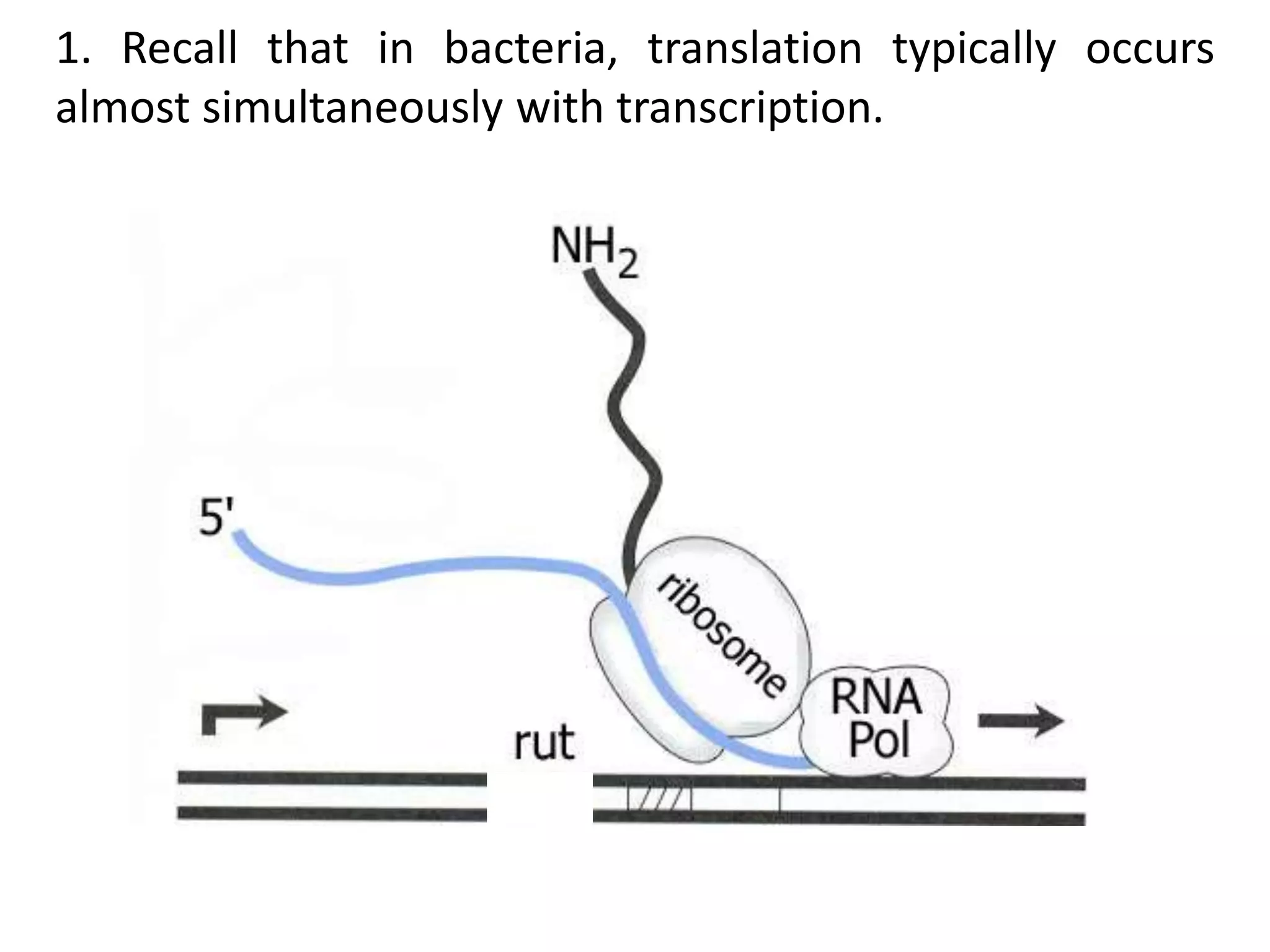
1. Recall that in bacteria, translation typically occurs
almost simultaneously with transcription.
2. Thus, as soon as trp leader region is transcribed,
translation begins.
Consider LOW Trp Conditions
3. During low tryptophan concentration, ribosome will
stall at trp sites.
4. The trp site is right in the middle of region 1 of the
attenuator
 Meanwhile RNA polymerase continues to transcribe
The stalled ribosome prevents the formation of stem loops 1-2/3-4
and promote the formation of stem loop structure 2-3
1. Stem loop structure 2-3 does not result in
transcriptional termination  whole operon mRNA
made.
2. What happens to the stalled ribosome?
(i) Since the genes in the operon have their own start
sites other ribosomes can come and translate those
proteins
(ii)Stalled ribosome can eventually either incorporate
trp-tRNA (+ 3 more a.a. before reaching stop codon)
or dissociate from mRNA
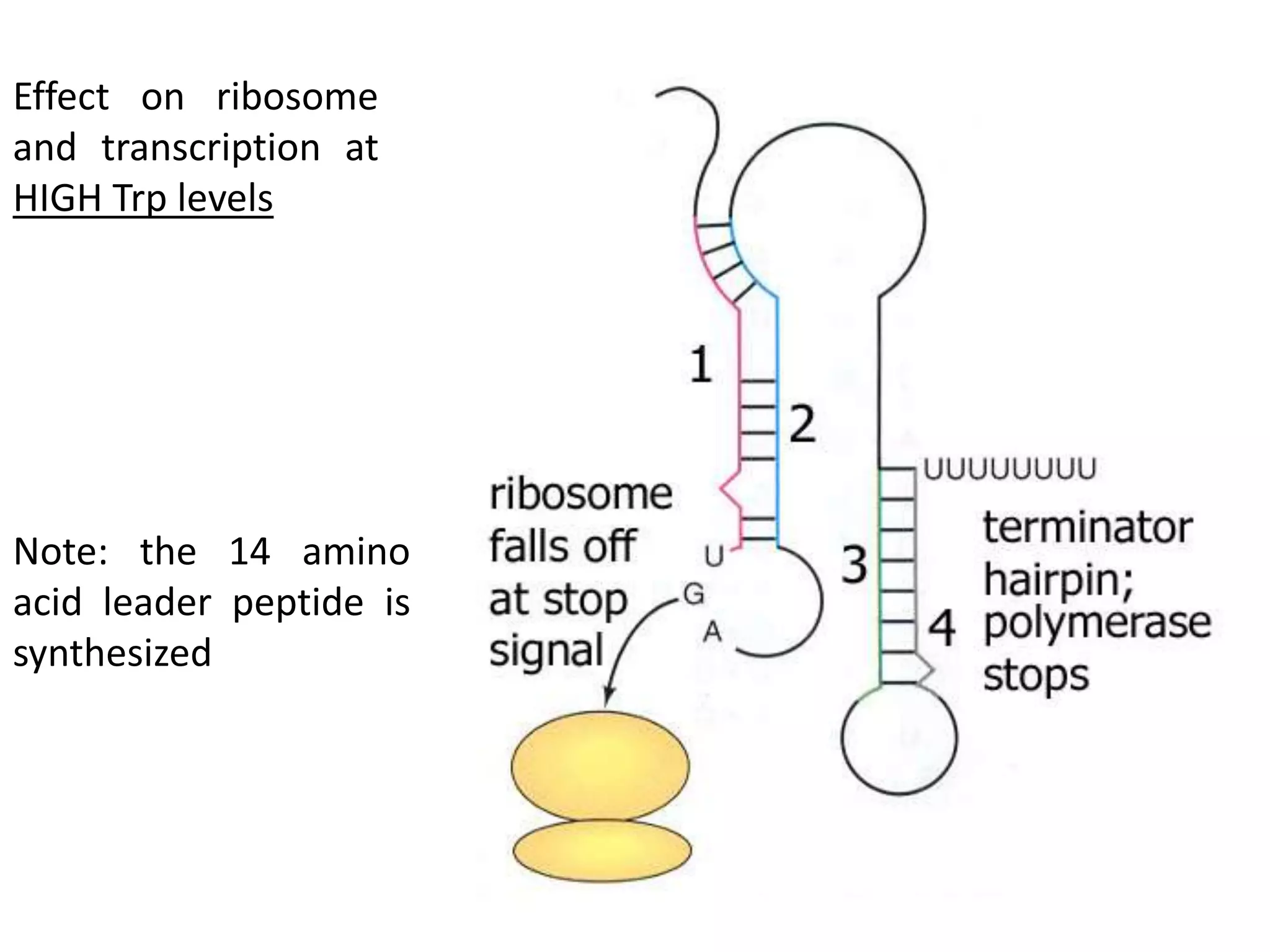
At HIGH Trp Conditions
1. When high levels of Trp-tRNA are present the two
tryptophan codons do not represent a barrier
translation  ribosome breezes through.
2. Ribosome continues through element 1 (no stalling)
and reaches stop signal (UGA)
3. With no ribosome  stem loops 1-2/2-3 form on
the mRNA  halting transcription before
polymerase has chance to reach trp structural
genes.
Effect on ribosome
and transcription at
HIGH Trp levels
Note: the 14 amino
acid leader peptide is
synthesized
-This mechanism involves: transcriptional-translational
coupling.
-Relies on rate of transcription & translation to be comparable
 if RNA polymerase >> ribosome, it might pass through
attenuator region before ribosome had a chance to stall at the
tryptophan codons.
Alternative RNA Structures from 5’ UTR
Termination signal due to
hairpin formed by 3+4 pairing
followed by string of uracils
No termination
signal formed
Formation of termination signal depends on
level of tryptophan carried by tRNA in the cell.
Attenuation
Premature Termination of Transcription
Ribosome translates
trp codons, preventing 2+3 pairing
3+4 pairing forms terminator
Antitermination
Ribosome stalls at trp codons,
allowing 2+3 pairing
Transcription continues
toward trp E, D, C. B, A
Summary of Trp Operon Regulation
Level of
Tryptophan
Trp Operon
Low
High
On
Trp repressor inactive
Lack of attenuation leads to high rate of
mRNA production
Off
Tryptophan + repressor = Active repressor
Reduction of mRNA production by attenuation

Tryptophan Operon

  • 1.
  • 2.
    Precursor Feedback inhibition Enzyme 1 Enzyme 2 Enzyme3 Tryptophan (a) (b)Regulation of enzyme activity Regulation of enzyme production Regulation of gene expression   trpE gene trpD gene trpC gene trpB gene trpA gene
  • 3.
    DNA Function RNA/ProteinFunction Trp R Gene for repressor Binds to operator to inhibit transcription P Promoter O Operator Trp E, D, C, B, A Structural genes Enzymes acting in pathway to produce tryptophan. Gene order correlates with order of reactions in pathway. 5’ UTR (Leader) Premature termination of transcription when trp levels are high Tryptophan Operon
  • 4.
    • The operoncan be switched off by a protein repressor • The repressor prevents gene transcription by binding to the operator and blocking RNA polymerase • The repressor is the product of a separate regulatory gene
  • 5.
    • The repressorcan be in an active or inactive form, depending on the presence of other molecules • A corepressor is a molecule that cooperates with a repressor protein to switch an operon off • For example, E. coli can synthesize the amino acid tryptophan
  • 6.
    • By defaultthe trp operon is on and the genes for tryptophan synthesis are transcribed • When tryptophan is present, it binds to the trp repressor protein, which turns the operon off • The repressor is active only in the presence of its corepressor tryptophan; thus the trp operon is turned off (repressed) if tryptophan levels are high © 2011 Pearson Education, Inc.
  • 7.
    Control of TrpOperon Transcription Trp Repressor is Inactive  Initial State: ON Trp binding activates Repressor  Final State: OFF tryptophan
  • 8.
  • 9.
    Features of the5’ UTR •Contains complementary sequences that can form hairpin structures when transcribed into RNA •Codes for a stretch of U nucleotides that can act as a termination signal after a hairpin structure •Codes for several Trp codons as part of an unstable protein product
  • 10.
    1. Operator sitelies within the promoter 2. Allosteric transition Allosteric protein-protein whose shape is changed upon binding of a particular molecule  In the new conformation the protein’s ability to react to a second molecule is altered 3. Trp operon has another level of control  attenuation 4. Repressor lowers transcription 70-fold (as compared to derepressed state)  attentuation permits another 10-fold control  total dynamic range of control = 700-fold
  • 11.
  • 12.
    Low tryptophan: transcriptionof trp operon genes RNA polymerase reads through attenuator.
  • 13.
    High tryptophan: attenuation,premature termination  attenuator causes premature termination of transcription 1. Attenuator region contains transcription stop signal (terminator)  not STOP codon! 2. The terminator consists of an inverted repeat followed by string of eight A-T pairs.
  • 14.
    3. The invertedrepeat forms a hairpin loop. 4. When RNA polymerase reaches string of U’s…
  • 15.
    …the polymerase pauses,the hairpin forms  Transcript is released  Termination occurs before transcription reaches the trp (structural) genes
  • 16.
    Attenuation gives someinsight into how the operon is shut down, but how does the cell activate trp operon expression (i.e. defeat attenuation)? preventing hairpin formation would destroy termination signal  transcription would proceed
  • 17.
  • 18.
    Key insight: mRNAproduced from attenuator region can fold into two different secondary structures Stem loops: 1-2, 3-4 Stem loop: 2-3
  • 19.
    1.Formation of stemloop structures; 1-2 and 3-4 is more stable and results in the formation of a termination (hairpin loop) structure/signal. 2.Formation of stem loop structure 2-3 would result in the disruption of stem loops 1-2/3-4. 3.The stem loop structure formed between 2-3 does not result in termination signal  transcription would proceed. Q. How does the less stable structure (stem-loop 2-3) form?
  • 20.
    The Importance ofthe Leader Region -the 14 amino acid peptide formed from the leader sequence has 2 tryptophans. -trp is a “rare” amino acid
  • 21.
    1. Recall thatin bacteria, translation typically occurs almost simultaneously with transcription.
  • 22.
    2. Thus, assoon as trp leader region is transcribed, translation begins. Consider LOW Trp Conditions 3. During low tryptophan concentration, ribosome will stall at trp sites. 4. The trp site is right in the middle of region 1 of the attenuator  Meanwhile RNA polymerase continues to transcribe
  • 23.
    The stalled ribosomeprevents the formation of stem loops 1-2/3-4 and promote the formation of stem loop structure 2-3
  • 24.
    1. Stem loopstructure 2-3 does not result in transcriptional termination  whole operon mRNA made. 2. What happens to the stalled ribosome? (i) Since the genes in the operon have their own start sites other ribosomes can come and translate those proteins (ii)Stalled ribosome can eventually either incorporate trp-tRNA (+ 3 more a.a. before reaching stop codon) or dissociate from mRNA
  • 25.
    At HIGH TrpConditions 1. When high levels of Trp-tRNA are present the two tryptophan codons do not represent a barrier translation  ribosome breezes through. 2. Ribosome continues through element 1 (no stalling) and reaches stop signal (UGA) 3. With no ribosome  stem loops 1-2/2-3 form on the mRNA  halting transcription before polymerase has chance to reach trp structural genes.
  • 26.
    Effect on ribosome andtranscription at HIGH Trp levels Note: the 14 amino acid leader peptide is synthesized
  • 27.
    -This mechanism involves:transcriptional-translational coupling. -Relies on rate of transcription & translation to be comparable  if RNA polymerase >> ribosome, it might pass through attenuator region before ribosome had a chance to stall at the tryptophan codons.
  • 28.
    Alternative RNA Structuresfrom 5’ UTR Termination signal due to hairpin formed by 3+4 pairing followed by string of uracils No termination signal formed Formation of termination signal depends on level of tryptophan carried by tRNA in the cell.
  • 29.
    Attenuation Premature Termination ofTranscription Ribosome translates trp codons, preventing 2+3 pairing 3+4 pairing forms terminator
  • 30.
    Antitermination Ribosome stalls attrp codons, allowing 2+3 pairing Transcription continues toward trp E, D, C. B, A
  • 31.
    Summary of TrpOperon Regulation Level of Tryptophan Trp Operon Low High On Trp repressor inactive Lack of attenuation leads to high rate of mRNA production Off Tryptophan + repressor = Active repressor Reduction of mRNA production by attenuation