WPE: 407
Environmental Studies
Chapter-1: Introduction
Curriculum Details
- Credit of the course is 3.
- Hour/Week 4.
- Total Hour 40.
- Total Week 10.
Part A Part B
1. Introduction
2. Air Pollution
3. Noise Pollution
4. Regulatory Issue
1. Water Pollution
2. Solid Waste In Wet Process
MARKS ALLOCATION
1.CLASS ATTENDANCE =8
2.CLASS TEST (5×4) =20
3.FINAL =72
TOTAL =100
1. Environmental Science by Dr. Y
. K. Singh.
2. Environmental Studies by Erach Bharucha
Reference Book:
Introduction
Lecture – 01
Topics to be covered
• Definition of Environment.
• Concept of Environment.
• Components of Environment.
• Pollution and its types.
• Pollutant and its types.
• Problems of Lecture- 01.
• The term 'environment' means, simply, 'nature’. Literary
environment means the surrounding external conditions
influencing development or growth of people, animal, plants,
living or working conditions etc.
• An Ecosystem(also called as environment) is a natural unit
consisting of humans, animals, all plants and micro-organisms
(Biotic factors) in an area functioning together with all of the non
living physical (Abiotic factors) of the environment.
WHAT IS ENVIRONMENT?
Concept of environment
• The combination of biotic and abiotic factors composes environment, which
surrounds us and other organisms.
• Abiotic factors includes water, air, soil, light, temperature, etc. that affects
human beings the least.
• Biotic factors consists all forms of life like humans, animals, plants, micro-
organisms, etc. that influence the environment much more in comparison to
abiotic factors.
• Human is an incorporated part of the environment and have very intimate
relationship with each other.
• It has been observed that water, soil, climate and language of human differ
from one place to other which is responsible for the generation of various
types of social and cultural activities all over the world.
• The people at hills have distinct life styles as compared to people in the low
land area. Similarly, people around the world differ in their food, cloth,
traditions, festivals, etc. All these are affected by the factors around them.
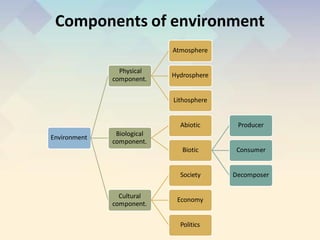
Components of environment
Environment
Physical
component.
Atmosphere
Hydrosphere
Lithosphere
Biological
component.
Abiotic
Biotic
Producer
Consumer
Decomposer
Cultural
component.
Society
Economy
Politics
(1) Physical Components:
• Physical component of environment includes air, water, soil,
light, temperature, climate, etc.
• These environmental components accounts for determination of
living conditions for the human population.
• Physical component of the environment is again classified into
three parts as follows:
• Atmosphere (gas)
• Hydrosphere (liquid)
• Lithosphere (solid)
These three parts portrays the three important states of matter
forming the environment.
Components of environment
(2) Biological Components:
• Biological component includes all living things like humans, plants,
animals and small micro-organisms like bacteria, algae and fungi.
These interrelate with the abiotic component of the environment.
• Interaction of these two components forms various ecosystems like
forest ecosystem, pond ecosystem, marine ecosystem, desert
ecosystem, etc.
• All ecosystems has three different types of living organisms; i.e.
producers, consumers and decomposers.
• Producer includes mainly green plants and other
photosynthetic bacteria which produces organic food materials.
• Consumers rely on green plants for their living.
• Decomposers are responsible to decompose dead plants and
animals for the running of the natural cycles.
(3) Cultural Components:
• Cultural elements such as economic, social and political elements
are essentially manmade features, which make cultural milieu.
• This component is mainly consists of various groups of population
with different living beings like birds, animals, etc.
NATURAL BLESSINGS
PEACEFUL ENVIRONMENT
UP ABOVE THE MOUNTAINS
RUSH INTO ADVENTURE
EMBRACE HEART WITH CALM
OCEAN
LOST IN GREEN
Where Blue Touches Green
SAD REALITY
WATER POLLUTION
TOXIC SEA WATER
NOISY SURROUNDINGS
INDUSTRIALIZATION- CURSE/BLESSING???
Pollution and Types
Pollution may be defined as an undesirable change in the
physical, chemical or biological characteristics of air, water and
land which affects the human life and other animals, living
conditions, industrial processes and cultural assets. Pollution
can be natural or manmade.
Types of Pollution:
1. Air Pollution
2. Water Pollution
3. Noise Pollution
4. Soil Pollution
5. Marine Pollution
6. Thermal Pollution
7. Nuclear Pollution
Pollutant and Types
Pollutant is a substance which causes the pollution such as CO2,
CO, dust particle, NO2,CFC gas etc.
Pollutants
Point source
comes from a single
source.easy to identify
and easy to address
Non point
source
comes from many places
all at once.Harder to
identify and harder to
address.
Bioegradable
Non-
biodegradable
Toxic
pollutants
Hazardous
pollutants
Carcinogenic
pollutants
Classification of Pollutants:
On the basis of natural disposal, pollutants are of two types:
(i)Non-biodegradable pollutants: Non degradable pollutant do
not degrade or may degrade at a very slow rate in
environment. These are inorganic compounds such as salts
(chlorides), metallic oxides waste producing materials like
aluminum cans, mercuric salts etc. More dangerous because it
is more difficult to remove.
(ii)Biodegradable pollutants: These include domestic sewage
that easily decomposes under natural processes and can be
rapidly decomposed by natural/ artificial methods. These are
garbage, sewage, livestock etc. These cause serious
problems when accumulated in large amounts as the pace of
deposition exceeds the pace of decomposition of disposal.
Important Problems(Lecture-01)
1. Define environment and discuss about its components.[6].{2016}.
2. Briefly describe the components of environment and
pollutants.[4]. {2019}
3. Define pollution and pollutant.[2]
4. Explain in brief about some common forms of
pollution.[4].{2015}.
5. Differentiate between degradable and non degradable
pollutants.[2].{2016}.
• kind of pollutions are observed in spinning/knitting/dyeing mill.
• Few examples of environmental pollution from textile processing.
• Major impact area of textile processing on environmental
pollutions.
• Benefits of pollution prevention for an industry.
• Guideline of production and control practices to compliance with
pollution.
• Important Questions of Lecture- 02.
Lecture – 02
Topics to be covered
Kind Of Pollutions Are Observed In
Spinning/Knitting/Dyeing Mill.
spinning process, Sulfur di-
II. During
oxide,
emitting
metal sulfate, exhaust gases
from
spinning and fluff generation
poly-condensation, melt
which
creates air pollution.
III. In Boiler, During generation
steam
sulfur di oxide, nitrous oxide are
produced which causes air pollution.
IV. In dyeing and bleaching stage
chlorine, chlorine di oxide, carrier,
aniline vapors, hydrogen sulfide are
produced.
Spinning and weaving/knitting industry generates air pollution and sound
pollution but wet processing industry creates air pollution and water pollution.
Air pollution:
I. In spinning, knitting and weaving
section high level of dust particle, fine
solid particle, projecting fibers fly on air
and may inhale in lung.
Noise Pollution:
I. In Spinning m/c from blowroom
to ring frame causes noise
pollution (range 80-94db).
II. In weaving section, loom shed
occurs noise pollution due to
shuttle movement, sley
III.
movement.(range 94-99db)
In knitting section high speed
automated m/c creates excess
noise.(range85-90db).
3. Water Pollution:
I. After dyeing process wastewater(effluent) which contains
strong chemical and intensive color with high load of BOD, COD,
Suspended solid(SS), TDS(total dissolve solid) all these causes
water pollution.
II. Below process and chemical are liable for water pollution in
textile industry:
a) De-sizing: starch, glucose, PVA, CMC, fat& wax, Resin.
b) Scouring: Caustic soda, soda ash, waxes & greases.
c) Bleaching: Hydrogen peroxide, acid, hypochlorite, chlorine,
caustic soda.
d) Mercerization: caustic soda.
e) Dyeing: Dyestuff, soda ash, mordant, reducing agent, acetic
acid.
f) Printing: Dyestuff, thickener (starch, gum oils), mordant, acid,
metallic salt.
g) Finishing: special finishes, Traces of starch, Tallow etc.
Few Example of Environmental pollution from
textile processing are:
1. Textile industry release hazardous waste material into the nearby
land.
2. Cotton consumes highest amount of harmful pesticides and
fertilizers. Majority of them fall on land thus pollutes land and make
them useless.
3. Cotton is highly water intensive crop and requires lots of toxic
pesticides to grow. About 16% of global pesticides used here. These
pesticides run off and pollute local ground water.
4. Textile dyes contains highly toxic chemicals including arsenic,
mercury, lead and other heavy metals which can not removed from
wastewater.
5. Finishing agent and dyes are next problem. Billion of gallon of water
is used annually to infuse and rinse finishing agent and dye into
fabric.
6. Water purification hampered due to mixing of hazardous chemical to
ground water that changes color, smell and PH of water.
7. Main sources of air pollution are boilers, thermo-pack, diesel
generators which generates gaseous pollutants such as
suspended particulate matter(SPM), sulfur di-oxide gas, nitrogen
di-oxide gas etc.
8. Major air pollution occurs during finishing stages where fabric are
coated by various plasticizers, water repellent, waxes, solvents
etc.
9. Again boilers, thermopack, diesel generators, compressor which
generates more 90db noise exceeding tolerable 75db and creates
noise pollution.
10. In spinning, weaving, knitting stage creates 80-99db sound.
Major impact area of textile processing on
environmental pollutions.
1. Raw materials: Use of pesticides in cotton fields has an
enormous negative environmental impact, cotton seed fly in
air. Dust storms are caused by cashmere goat over-grazing.
2. Manufacturing: Spinning and weaving/knitting industry
generates air and sound pollution again Textile dyeing and
finishing is a particularly high volume, high impact source of
water pollution and air pollution.
3. Good movements: Shipping long distance emits CO2 to
pollute air. By air shipment emits CO2 more than 40 times in
using a container ship.
4. Consumer care: Washing clothes in hot water(with
detergent) has large environmental costs and dry cleaning
requires a toxic persistent solvent.
Guideline Of Production And Control Practices To
Compliance With Pollution in a dyeing industry.
1. Do not use of less degradable surfactants(in washing and scouring
operation) and spinning oils.
2. Consider the use of transfer printing for synthetics, use water
based printing pastes where feasible.
3. Consider the use of cold pad batch dyeing.
4. Use jet dyers instead of winch dyers where feasible.
5. Avoid the use of benzidine based azo dyes and dyes containing
cadmium and other heavy metals, chlorine based dyes should not
be used.
6. Do not use mercury, arsenic, banned pesticides in the process.
7. Recover and reuse process chemicals and dye solution
8. Substitute less toxic dye comers whenever possible. Avoid comers
containing chlorine.
9. Use peroxide based bleaches instead of sulfur and chlorine based
where feasible.
10. Use counter current rinsing and improved clearing and
housekeeping.
Benefits of pollution prevention for an
industry.
Pollution prevention may result in several benefits for the textile
industry such as:
1. Various Loss reduction (process loss, productivity loss).
2. Reduction of chemical, water and energy consumption
resulting in increased production.
3. Reduced liability for waste produced.
4. Improved compliance with regulations.
5. Cleaner and healthy working environment.
1. What kind of pollutions are observed in spinning/knitting/dyeing
mill? Explain with example[5].{2015}.
2. What are the causes of environmental issues in textile
industry?[4].{2015}.{2015}
3. what are the major challenges we are facing today for
environmental issue?[7].{2015}.
4. describe the major impact area of textile processing on
environmental pollutions.[5].{2016}.
5. What ae the benefits of pollution prevention for an
industry?[4].{2016}{2017}.
6. Suggest some guideline of production and control practices to
compliance with pollution for dyeing industry.[4].[7]{2015}{2015}.
Important Problems(Lecture-02)
Lecture – 03
Topics to be covered
1. Green house and how it works?
2. Green house effect.
3. Similarities of Greenhouse with Our Earth.
4. Basic mechanism of green house effect.
5. Major greenhouse gases and their sources.
6. Impact of Green house effect.
7. Way of reducing green house gases.
8. Role of urbanization in climate change in Bangladesh.
Watch a short video
on
Green house effect
GreenHouse:
A greenhouse is also called
What is Greenhouse? And How it is worked?
a forcing structure, an artificial
environment in which plants are
“forced” to grow, despite the
harsh outside climate.
How it works?
Every greenhouse operates on
a simple physical principle called
“the greenhouse effect”.
Sunlight (short waves) passes
through transparent or translucent
materials such as glass or plastic.
When it strikes an opaque surface
inside (plant leaves, greenhouse floor, planters) some of the light energy is
changed into heat. The darker the surface, the more heat is generated. The
greenhouse glass are good at transmitting light, but not heat. Therefore, most of
the heat stays inside.
Once the short waves hit the ground, they warm it up. Then the warmed air rises
and heats up the greenhouse. Then long waves radiate to the atmosphere.
 What is green house effect?
It is a natural process that has been happening for millions of years.
Gases and clouds absorb infrared radiation emitted from Earth’s surface
and re-radiate it, heating the atmosphere and Earth’s surface.
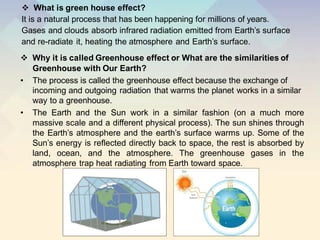
 Why it is called Greenhouse effect or What are the similarities of
Greenhouse with Our Earth?
• The process is called the greenhouse effect because the exchange of
incoming and outgoing radiation that warms the planet works in a similar
way to a greenhouse.
• The Earth and the Sun work in a similar fashion (on a much more
massive scale and a different physical process). The sun shines through
the Earth’s atmosphere and the earth’s surface warms up. Some of the
Sun’s energy is reflected directly back to space, the rest is absorbed by
land, ocean, and the atmosphere. The greenhouse gases in the
atmosphere trap heat radiating from Earth toward space.
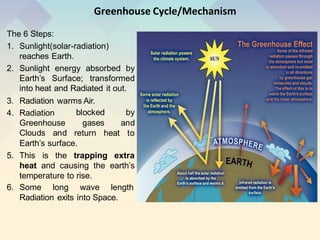
Greenhouse Cycle/Mechanism
The 6 Steps:
1. Sunlight(solar-radiation)
reaches Earth.
2. Sunlight energy absorbed by
Earth’s Surface; transformed
into heat and Radiated it out.
3. Radiation warms Air.
4. Radiation
Greenhouse
Clouds and return heat
blocked by
gases and
to
Earth’s surface.
5. This is the trapping extra
heat and causing the earth’s
temperature to rise.
6. Some long wave length
Radiation exits into Space.
What is Greenhouse gas
Greenhouse gases are gases
 that allow visible light and UV radiation (short-wavelength/high
frequency) to pass through them(because of the nature of their covalent
bonds in their molecules)
 but absorb the infrared radiation (longer-wavelength radiation) of the
same frequency from the Earth converting sunlight into infrared heat
 and re-radiates this infrared radiation back to the Earth.
Major
Greenhouse
gases
%Percentag
e
Carbon
dioxide(CO2)
76%
Methane(CH4) 16%
Nitrous
Oxide(N2O)
6%
Source Of Green House Gases
1. CO2 Sources:
Human: Burning fossil fuels and wood, forest fires, burning waste etc.
Natural: Respiration, decay of organic matter, natural forest fires.
2. CH4 Sources:
Human: Cattle farming, rice paddies (wet soil means any organic matter in it is
decomposed without oxygen), petroleum and natural gas production.
Natural: digestive tracts of ruminants, cattle, bogs or marshes, bacterial
fermentation – when organic matter is decomposed anaerobically, methane gas is
produced.
3. N2O Sources:
Human: use of nitrogen based fertilizers.
Natural: bacterial action.
4. CFCs:
Human: refrigerators, air- conditioning, aerosols in spraying cans, foaming agents.
5. SF6:
Human: electrical insulators
Some greenhouse gases are not naturally occurring – they are manmade
iv. Chlorofluoro Carbon
i. Carbon tetrafluoride
ii. Sulfur Hexafluoride
iii. Hexafluoroethane
What Would Happen If Green House Does Not Exist?
• This equilibrium of incoming and outgoing radiation that
makes the Earth habitable, with an average temperature of
about 59 degrees Fahrenheit (15 degrees Celsius),
according to NASA.
• Without this atmospheric equilibrium, Earth would be as
cold and lifeless as its moon, or as blazing hot as
Venus. The moon, which has almost no atmosphere, is
about minus 243 F (minus 153 C) on its dark side. Venus,
on the other hand, has a very dense atmosphere that traps
solar radiation; the average temperature on Venus is about
864 F (462 C).
Impacts of Greenhouse Effect?
1. Direct affects on temperature rise due to increase on amount of greenhouse
gases .
2. Global warming due to increase in the average temperature of Earth.
3. Rise of Sea Level due to melting glaciers/icecap.
4. Depletion of Ozone Layer.
5. Worsening of health effects and spreading of disease(malaria, cholera or
dengue).
6. Disruption of the water cycle.
7. Challenges to agriculture and the food supply.
8. Etc.
Way to reduce green house gases and Effect?
1. Use of less Energy:- Electricity (replacing incandescent light bulbs
with LED bulbs, adding insulation to your home wall, smart
thermostat, green roof top)
2. Generate Electricity without emissions (solar energy, geothermal,
wind turbines, tidal energy, ocean wave).
3. Travel without greenhouse gases- responsible for 14% gas
emission.(bicycle, electric car, hybrid car, biking, public
transportation).
4. Reduce emission from Industry- responsible for 20% gas emission.
5. Take carbon dioxide out of the air by carbon sink.(planting trees,
bamboo, conserving forest, grasslands etc.)
6. Reduce, recycle and reuse (reducing waste by purchasing reusable
products like getting a reusable water bottle, by recycling
househould waste you can save 2400 pound CO2 emission annually)
7. Don’t Buy Fast Fashion.
Important Problems(Lecture-03)
1. What is green house effect? Illustrate the ways to reduce
green house gases and its effect.[2+5.5].{2017}
2. Explain the basic mechanism of green house
effect.[2.5].{2015}.
3. Write down about five major greenhouse gases and their
sources.[3.5].{2016}.
4. What Would Happen If Green House Does Not Exist?
5. Impacts of Green house effect.
1. Climate Change.
2. Global warming and climate change.
3. Impacts of climate changes on the Environment and Human
Health.
Lecture – 04
Topics to be covered
CLIMATE CHANGES
• Climate change is the connected system of sun, earth and oceans, wind, rain and
snow, forests, deserts and savannas.
• Climate change of a place refers to significant tangible long term changes- which
can be described by rainfall, temperature change, sea level, droughts and so on
during a several decades or even a century.
 Global Warming
• Global warming is the slow increase in the average temperature of the
earth’s atmosphere because an increased amount of the energy (heat)
striking the earth from the sun is being trapped in the atmosphere and not
radiated out into space.
• Global warming, however, is the equivalent of a greenhouse with high
efficiency reflective glass installed the wrong way around.
 How global warming instigates climate changing?
• Much of the world is covered with ocean which heats up. When the ocean
heats up, more water evaporates into clouds resulting in heavy rainfall.
• A warmer atmosphere makes glaciers and mountain snow packs, the Polar ice
cap, and the great ice shield jutting off of Antarcticamelt raising sea levels.
• Changes in temperature change the great patterns of wind that bring the
monsoons in Asia and rain and snow around the world, making drought and
unpredictable weather more common.
1. The average temperature in many
regions has been increasing in
recent decades. The global
average surface temperature has
increased by 0.8° C over the last
century. In the near future, the
global mean surface temperature
will rise by 1.4° to 5.8°C. Warming
will be greatest over land areas,
and at high latitudes.
2. Many countries have experienced
increases in rainfall, particularly in
the countries situated in the mid to
high latitudes.
Impacts of Climate Changes on Environment and
Human Health
(Ref# Environmental Studies by Erach Bharucha; Page-182)
4. Global mean sea level is projected to rise
by 9 to 88cm (0.30 ft to 2.88 ft) by the year
2100. More than half of the world’s
population now lives within 60km of the
sea. They are likely to be seriously
impacted by an ingress of salt water and
by the rising sea. Some of the most
vulnerable regions are the Nile delta in
Egypt, the Ganges-Brahmaputra delta in
Bangladesh, and many small islands
including the Marshall Islands and the
Maldives
5. Storms, have been more frequent,
persistent and intense since mid-1970s
compared with the previous 100 years.
3. Human societies will be
affected by
of climate
droughts and
seriously
extremes
such as
floods.
6. Changes in climate may affect the distribution of vector species (e.g.
mosquitoes) which in turn will increase the spread of disease, such as malaria
and filariasis, to new areas which lack a strong public health infrastructure. The
seasonal transmission and distribution of many diseases that are transmitted by
mosquitoes (dengue, yellow fever) and by ticks (Lyme disease, tickborne
encephalitis) may spread due to climate change.
7. To a large extent, public health depends on safe drinking water,
sufficient food, secure shelter, and good social conditions. All these
factors are affected by climate change. Fresh water supplies may be
seriously affected, reducing the availability of clean water for drinking
and washing during drought as well as floods.
8. Water can be contaminated and sewage systems may be damaged. The
risk of spread of infectious diseases such as diarrhea diseases will
increase.
Important Problems(Lecture-04)
1. What do you mean by Climate Change? Write down the Impacts
of climate changes on the Environment and Human Health.
2. How Global warming leads to climate changes?

Introduction Environmental Studies need.pdf

  • 1.
  • 2.
    Curriculum Details - Creditof the course is 3. - Hour/Week 4. - Total Hour 40. - Total Week 10. Part A Part B 1. Introduction 2. Air Pollution 3. Noise Pollution 4. Regulatory Issue 1. Water Pollution 2. Solid Waste In Wet Process
  • 3.
    MARKS ALLOCATION 1.CLASS ATTENDANCE=8 2.CLASS TEST (5×4) =20 3.FINAL =72 TOTAL =100
  • 4.
    1. Environmental Scienceby Dr. Y . K. Singh. 2. Environmental Studies by Erach Bharucha Reference Book:
  • 5.
  • 6.
    Lecture – 01 Topicsto be covered • Definition of Environment. • Concept of Environment. • Components of Environment. • Pollution and its types. • Pollutant and its types. • Problems of Lecture- 01.
  • 7.
    • The term'environment' means, simply, 'nature’. Literary environment means the surrounding external conditions influencing development or growth of people, animal, plants, living or working conditions etc. • An Ecosystem(also called as environment) is a natural unit consisting of humans, animals, all plants and micro-organisms (Biotic factors) in an area functioning together with all of the non living physical (Abiotic factors) of the environment. WHAT IS ENVIRONMENT?
  • 8.
    Concept of environment •The combination of biotic and abiotic factors composes environment, which surrounds us and other organisms. • Abiotic factors includes water, air, soil, light, temperature, etc. that affects human beings the least. • Biotic factors consists all forms of life like humans, animals, plants, micro- organisms, etc. that influence the environment much more in comparison to abiotic factors. • Human is an incorporated part of the environment and have very intimate relationship with each other. • It has been observed that water, soil, climate and language of human differ from one place to other which is responsible for the generation of various types of social and cultural activities all over the world. • The people at hills have distinct life styles as compared to people in the low land area. Similarly, people around the world differ in their food, cloth, traditions, festivals, etc. All these are affected by the factors around them.
  • 9.
  • 10.
    (1) Physical Components: •Physical component of environment includes air, water, soil, light, temperature, climate, etc. • These environmental components accounts for determination of living conditions for the human population. • Physical component of the environment is again classified into three parts as follows: • Atmosphere (gas) • Hydrosphere (liquid) • Lithosphere (solid) These three parts portrays the three important states of matter forming the environment. Components of environment
  • 11.
    (2) Biological Components: •Biological component includes all living things like humans, plants, animals and small micro-organisms like bacteria, algae and fungi. These interrelate with the abiotic component of the environment. • Interaction of these two components forms various ecosystems like forest ecosystem, pond ecosystem, marine ecosystem, desert ecosystem, etc. • All ecosystems has three different types of living organisms; i.e. producers, consumers and decomposers. • Producer includes mainly green plants and other photosynthetic bacteria which produces organic food materials. • Consumers rely on green plants for their living. • Decomposers are responsible to decompose dead plants and animals for the running of the natural cycles. (3) Cultural Components: • Cultural elements such as economic, social and political elements are essentially manmade features, which make cultural milieu. • This component is mainly consists of various groups of population with different living beings like birds, animals, etc.
  • 12.
  • 13.
  • 14.
    UP ABOVE THEMOUNTAINS
  • 15.
  • 16.
  • 17.
  • 18.
  • 19.
  • 20.
  • 21.
  • 22.
  • 23.
  • 24.
    Pollution and Types Pollutionmay be defined as an undesirable change in the physical, chemical or biological characteristics of air, water and land which affects the human life and other animals, living conditions, industrial processes and cultural assets. Pollution can be natural or manmade. Types of Pollution: 1. Air Pollution 2. Water Pollution 3. Noise Pollution 4. Soil Pollution 5. Marine Pollution 6. Thermal Pollution 7. Nuclear Pollution
  • 25.
    Pollutant and Types Pollutantis a substance which causes the pollution such as CO2, CO, dust particle, NO2,CFC gas etc. Pollutants Point source comes from a single source.easy to identify and easy to address Non point source comes from many places all at once.Harder to identify and harder to address. Bioegradable Non- biodegradable Toxic pollutants Hazardous pollutants Carcinogenic pollutants
  • 26.
    Classification of Pollutants: Onthe basis of natural disposal, pollutants are of two types: (i)Non-biodegradable pollutants: Non degradable pollutant do not degrade or may degrade at a very slow rate in environment. These are inorganic compounds such as salts (chlorides), metallic oxides waste producing materials like aluminum cans, mercuric salts etc. More dangerous because it is more difficult to remove. (ii)Biodegradable pollutants: These include domestic sewage that easily decomposes under natural processes and can be rapidly decomposed by natural/ artificial methods. These are garbage, sewage, livestock etc. These cause serious problems when accumulated in large amounts as the pace of deposition exceeds the pace of decomposition of disposal.
  • 27.
    Important Problems(Lecture-01) 1. Defineenvironment and discuss about its components.[6].{2016}. 2. Briefly describe the components of environment and pollutants.[4]. {2019} 3. Define pollution and pollutant.[2] 4. Explain in brief about some common forms of pollution.[4].{2015}. 5. Differentiate between degradable and non degradable pollutants.[2].{2016}.
  • 28.
    • kind ofpollutions are observed in spinning/knitting/dyeing mill. • Few examples of environmental pollution from textile processing. • Major impact area of textile processing on environmental pollutions. • Benefits of pollution prevention for an industry. • Guideline of production and control practices to compliance with pollution. • Important Questions of Lecture- 02. Lecture – 02 Topics to be covered
  • 29.
    Kind Of PollutionsAre Observed In Spinning/Knitting/Dyeing Mill. spinning process, Sulfur di- II. During oxide, emitting metal sulfate, exhaust gases from spinning and fluff generation poly-condensation, melt which creates air pollution. III. In Boiler, During generation steam sulfur di oxide, nitrous oxide are produced which causes air pollution. IV. In dyeing and bleaching stage chlorine, chlorine di oxide, carrier, aniline vapors, hydrogen sulfide are produced. Spinning and weaving/knitting industry generates air pollution and sound pollution but wet processing industry creates air pollution and water pollution. Air pollution: I. In spinning, knitting and weaving section high level of dust particle, fine solid particle, projecting fibers fly on air and may inhale in lung.
  • 30.
    Noise Pollution: I. InSpinning m/c from blowroom to ring frame causes noise pollution (range 80-94db). II. In weaving section, loom shed occurs noise pollution due to shuttle movement, sley III. movement.(range 94-99db) In knitting section high speed automated m/c creates excess noise.(range85-90db).
  • 31.
    3. Water Pollution: I.After dyeing process wastewater(effluent) which contains strong chemical and intensive color with high load of BOD, COD, Suspended solid(SS), TDS(total dissolve solid) all these causes water pollution. II. Below process and chemical are liable for water pollution in textile industry: a) De-sizing: starch, glucose, PVA, CMC, fat& wax, Resin. b) Scouring: Caustic soda, soda ash, waxes & greases. c) Bleaching: Hydrogen peroxide, acid, hypochlorite, chlorine, caustic soda. d) Mercerization: caustic soda. e) Dyeing: Dyestuff, soda ash, mordant, reducing agent, acetic acid. f) Printing: Dyestuff, thickener (starch, gum oils), mordant, acid, metallic salt. g) Finishing: special finishes, Traces of starch, Tallow etc.
  • 32.
    Few Example ofEnvironmental pollution from textile processing are: 1. Textile industry release hazardous waste material into the nearby land. 2. Cotton consumes highest amount of harmful pesticides and fertilizers. Majority of them fall on land thus pollutes land and make them useless. 3. Cotton is highly water intensive crop and requires lots of toxic pesticides to grow. About 16% of global pesticides used here. These pesticides run off and pollute local ground water. 4. Textile dyes contains highly toxic chemicals including arsenic, mercury, lead and other heavy metals which can not removed from wastewater. 5. Finishing agent and dyes are next problem. Billion of gallon of water is used annually to infuse and rinse finishing agent and dye into fabric. 6. Water purification hampered due to mixing of hazardous chemical to ground water that changes color, smell and PH of water.
  • 33.
    7. Main sourcesof air pollution are boilers, thermo-pack, diesel generators which generates gaseous pollutants such as suspended particulate matter(SPM), sulfur di-oxide gas, nitrogen di-oxide gas etc. 8. Major air pollution occurs during finishing stages where fabric are coated by various plasticizers, water repellent, waxes, solvents etc. 9. Again boilers, thermopack, diesel generators, compressor which generates more 90db noise exceeding tolerable 75db and creates noise pollution. 10. In spinning, weaving, knitting stage creates 80-99db sound.
  • 34.
    Major impact areaof textile processing on environmental pollutions. 1. Raw materials: Use of pesticides in cotton fields has an enormous negative environmental impact, cotton seed fly in air. Dust storms are caused by cashmere goat over-grazing. 2. Manufacturing: Spinning and weaving/knitting industry generates air and sound pollution again Textile dyeing and finishing is a particularly high volume, high impact source of water pollution and air pollution. 3. Good movements: Shipping long distance emits CO2 to pollute air. By air shipment emits CO2 more than 40 times in using a container ship. 4. Consumer care: Washing clothes in hot water(with detergent) has large environmental costs and dry cleaning requires a toxic persistent solvent.
  • 35.
    Guideline Of ProductionAnd Control Practices To Compliance With Pollution in a dyeing industry. 1. Do not use of less degradable surfactants(in washing and scouring operation) and spinning oils. 2. Consider the use of transfer printing for synthetics, use water based printing pastes where feasible. 3. Consider the use of cold pad batch dyeing. 4. Use jet dyers instead of winch dyers where feasible. 5. Avoid the use of benzidine based azo dyes and dyes containing cadmium and other heavy metals, chlorine based dyes should not be used. 6. Do not use mercury, arsenic, banned pesticides in the process. 7. Recover and reuse process chemicals and dye solution 8. Substitute less toxic dye comers whenever possible. Avoid comers containing chlorine. 9. Use peroxide based bleaches instead of sulfur and chlorine based where feasible. 10. Use counter current rinsing and improved clearing and housekeeping.
  • 36.
    Benefits of pollutionprevention for an industry. Pollution prevention may result in several benefits for the textile industry such as: 1. Various Loss reduction (process loss, productivity loss). 2. Reduction of chemical, water and energy consumption resulting in increased production. 3. Reduced liability for waste produced. 4. Improved compliance with regulations. 5. Cleaner and healthy working environment.
  • 37.
    1. What kindof pollutions are observed in spinning/knitting/dyeing mill? Explain with example[5].{2015}. 2. What are the causes of environmental issues in textile industry?[4].{2015}.{2015} 3. what are the major challenges we are facing today for environmental issue?[7].{2015}. 4. describe the major impact area of textile processing on environmental pollutions.[5].{2016}. 5. What ae the benefits of pollution prevention for an industry?[4].{2016}{2017}. 6. Suggest some guideline of production and control practices to compliance with pollution for dyeing industry.[4].[7]{2015}{2015}. Important Problems(Lecture-02)
  • 38.
    Lecture – 03 Topicsto be covered 1. Green house and how it works? 2. Green house effect. 3. Similarities of Greenhouse with Our Earth. 4. Basic mechanism of green house effect. 5. Major greenhouse gases and their sources. 6. Impact of Green house effect. 7. Way of reducing green house gases. 8. Role of urbanization in climate change in Bangladesh.
  • 39.
    Watch a shortvideo on Green house effect
  • 40.
    GreenHouse: A greenhouse isalso called What is Greenhouse? And How it is worked? a forcing structure, an artificial environment in which plants are “forced” to grow, despite the harsh outside climate. How it works? Every greenhouse operates on a simple physical principle called “the greenhouse effect”. Sunlight (short waves) passes through transparent or translucent materials such as glass or plastic. When it strikes an opaque surface inside (plant leaves, greenhouse floor, planters) some of the light energy is changed into heat. The darker the surface, the more heat is generated. The greenhouse glass are good at transmitting light, but not heat. Therefore, most of the heat stays inside. Once the short waves hit the ground, they warm it up. Then the warmed air rises and heats up the greenhouse. Then long waves radiate to the atmosphere.
  • 41.
     What isgreen house effect? It is a natural process that has been happening for millions of years. Gases and clouds absorb infrared radiation emitted from Earth’s surface and re-radiate it, heating the atmosphere and Earth’s surface.  Why it is called Greenhouse effect or What are the similarities of Greenhouse with Our Earth? • The process is called the greenhouse effect because the exchange of incoming and outgoing radiation that warms the planet works in a similar way to a greenhouse. • The Earth and the Sun work in a similar fashion (on a much more massive scale and a different physical process). The sun shines through the Earth’s atmosphere and the earth’s surface warms up. Some of the Sun’s energy is reflected directly back to space, the rest is absorbed by land, ocean, and the atmosphere. The greenhouse gases in the atmosphere trap heat radiating from Earth toward space.
  • 42.
    Greenhouse Cycle/Mechanism The 6Steps: 1. Sunlight(solar-radiation) reaches Earth. 2. Sunlight energy absorbed by Earth’s Surface; transformed into heat and Radiated it out. 3. Radiation warms Air. 4. Radiation Greenhouse Clouds and return heat blocked by gases and to Earth’s surface. 5. This is the trapping extra heat and causing the earth’s temperature to rise. 6. Some long wave length Radiation exits into Space.
  • 43.
    What is Greenhousegas Greenhouse gases are gases  that allow visible light and UV radiation (short-wavelength/high frequency) to pass through them(because of the nature of their covalent bonds in their molecules)  but absorb the infrared radiation (longer-wavelength radiation) of the same frequency from the Earth converting sunlight into infrared heat  and re-radiates this infrared radiation back to the Earth. Major Greenhouse gases %Percentag e Carbon dioxide(CO2) 76% Methane(CH4) 16% Nitrous Oxide(N2O) 6%
  • 44.
    Source Of GreenHouse Gases 1. CO2 Sources: Human: Burning fossil fuels and wood, forest fires, burning waste etc. Natural: Respiration, decay of organic matter, natural forest fires. 2. CH4 Sources: Human: Cattle farming, rice paddies (wet soil means any organic matter in it is decomposed without oxygen), petroleum and natural gas production. Natural: digestive tracts of ruminants, cattle, bogs or marshes, bacterial fermentation – when organic matter is decomposed anaerobically, methane gas is produced. 3. N2O Sources: Human: use of nitrogen based fertilizers. Natural: bacterial action. 4. CFCs: Human: refrigerators, air- conditioning, aerosols in spraying cans, foaming agents. 5. SF6: Human: electrical insulators Some greenhouse gases are not naturally occurring – they are manmade iv. Chlorofluoro Carbon i. Carbon tetrafluoride ii. Sulfur Hexafluoride iii. Hexafluoroethane
  • 45.
    What Would HappenIf Green House Does Not Exist? • This equilibrium of incoming and outgoing radiation that makes the Earth habitable, with an average temperature of about 59 degrees Fahrenheit (15 degrees Celsius), according to NASA. • Without this atmospheric equilibrium, Earth would be as cold and lifeless as its moon, or as blazing hot as Venus. The moon, which has almost no atmosphere, is about minus 243 F (minus 153 C) on its dark side. Venus, on the other hand, has a very dense atmosphere that traps solar radiation; the average temperature on Venus is about 864 F (462 C).
  • 46.
    Impacts of GreenhouseEffect? 1. Direct affects on temperature rise due to increase on amount of greenhouse gases . 2. Global warming due to increase in the average temperature of Earth. 3. Rise of Sea Level due to melting glaciers/icecap. 4. Depletion of Ozone Layer. 5. Worsening of health effects and spreading of disease(malaria, cholera or dengue). 6. Disruption of the water cycle. 7. Challenges to agriculture and the food supply. 8. Etc.
  • 47.
    Way to reducegreen house gases and Effect? 1. Use of less Energy:- Electricity (replacing incandescent light bulbs with LED bulbs, adding insulation to your home wall, smart thermostat, green roof top) 2. Generate Electricity without emissions (solar energy, geothermal, wind turbines, tidal energy, ocean wave). 3. Travel without greenhouse gases- responsible for 14% gas emission.(bicycle, electric car, hybrid car, biking, public transportation). 4. Reduce emission from Industry- responsible for 20% gas emission. 5. Take carbon dioxide out of the air by carbon sink.(planting trees, bamboo, conserving forest, grasslands etc.) 6. Reduce, recycle and reuse (reducing waste by purchasing reusable products like getting a reusable water bottle, by recycling househould waste you can save 2400 pound CO2 emission annually) 7. Don’t Buy Fast Fashion.
  • 48.
    Important Problems(Lecture-03) 1. Whatis green house effect? Illustrate the ways to reduce green house gases and its effect.[2+5.5].{2017} 2. Explain the basic mechanism of green house effect.[2.5].{2015}. 3. Write down about five major greenhouse gases and their sources.[3.5].{2016}. 4. What Would Happen If Green House Does Not Exist? 5. Impacts of Green house effect.
  • 49.
    1. Climate Change. 2.Global warming and climate change. 3. Impacts of climate changes on the Environment and Human Health. Lecture – 04 Topics to be covered
  • 50.
    CLIMATE CHANGES • Climatechange is the connected system of sun, earth and oceans, wind, rain and snow, forests, deserts and savannas. • Climate change of a place refers to significant tangible long term changes- which can be described by rainfall, temperature change, sea level, droughts and so on during a several decades or even a century.
  • 51.
     Global Warming •Global warming is the slow increase in the average temperature of the earth’s atmosphere because an increased amount of the energy (heat) striking the earth from the sun is being trapped in the atmosphere and not radiated out into space. • Global warming, however, is the equivalent of a greenhouse with high efficiency reflective glass installed the wrong way around.  How global warming instigates climate changing? • Much of the world is covered with ocean which heats up. When the ocean heats up, more water evaporates into clouds resulting in heavy rainfall. • A warmer atmosphere makes glaciers and mountain snow packs, the Polar ice cap, and the great ice shield jutting off of Antarcticamelt raising sea levels. • Changes in temperature change the great patterns of wind that bring the monsoons in Asia and rain and snow around the world, making drought and unpredictable weather more common.
  • 52.
    1. The averagetemperature in many regions has been increasing in recent decades. The global average surface temperature has increased by 0.8° C over the last century. In the near future, the global mean surface temperature will rise by 1.4° to 5.8°C. Warming will be greatest over land areas, and at high latitudes. 2. Many countries have experienced increases in rainfall, particularly in the countries situated in the mid to high latitudes. Impacts of Climate Changes on Environment and Human Health (Ref# Environmental Studies by Erach Bharucha; Page-182)
  • 53.
    4. Global meansea level is projected to rise by 9 to 88cm (0.30 ft to 2.88 ft) by the year 2100. More than half of the world’s population now lives within 60km of the sea. They are likely to be seriously impacted by an ingress of salt water and by the rising sea. Some of the most vulnerable regions are the Nile delta in Egypt, the Ganges-Brahmaputra delta in Bangladesh, and many small islands including the Marshall Islands and the Maldives 5. Storms, have been more frequent, persistent and intense since mid-1970s compared with the previous 100 years. 3. Human societies will be affected by of climate droughts and seriously extremes such as floods.
  • 54.
    6. Changes inclimate may affect the distribution of vector species (e.g. mosquitoes) which in turn will increase the spread of disease, such as malaria and filariasis, to new areas which lack a strong public health infrastructure. The seasonal transmission and distribution of many diseases that are transmitted by mosquitoes (dengue, yellow fever) and by ticks (Lyme disease, tickborne encephalitis) may spread due to climate change.
  • 55.
    7. To alarge extent, public health depends on safe drinking water, sufficient food, secure shelter, and good social conditions. All these factors are affected by climate change. Fresh water supplies may be seriously affected, reducing the availability of clean water for drinking and washing during drought as well as floods. 8. Water can be contaminated and sewage systems may be damaged. The risk of spread of infectious diseases such as diarrhea diseases will increase.
  • 56.
    Important Problems(Lecture-04) 1. Whatdo you mean by Climate Change? Write down the Impacts of climate changes on the Environment and Human Health. 2. How Global warming leads to climate changes?