Introduction
In this report, we will be talking about the issue of should Government be
building more Affordable Housing in New Zealand. This issue arises from
the sky-rocketing prices for properties in Auckland. This is applicable to
rental properties, current home owners and new buyers in the market. As
compared to other goods and services, housing expenditure takes up a
large proportion of household income. Owning a house makes a person
believe that he is building a social capital and gets a sense of community.
Law, D. & Meehan, L. (2012, June)
The aim of this report is to look at the background of Auckland property
market, changes taking place, the reasons for these changes. Also we will
talk about the economic intuitions behind our policy and provide a
reasoning for or against the policy. In addition to that, we will talk about
the kinds of political pressure that can be expected from different lobby
groups and how to manage those pressures. And at the end, we will give
a recommendation as to why or why not the policy should be taken
forward and what should be done in regard to it.
Background
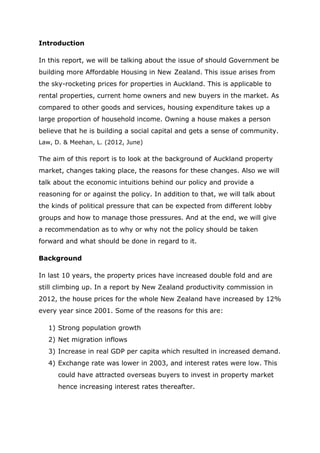
In last 10 years, the property prices have increased double fold and are
still climbing up. In a report by New Zealand productivity commission in
2012, the house prices for the whole New Zealand have increased by 12%
every year since 2001. Some of the reasons for this are:
1) Strong population growth
2) Net migration inflows
3) Increase in real GDP per capita which resulted in increased demand.
4) Exchange rate was lower in 2003, and interest rates were low. This
could have attracted overseas buyers to invest in property market
hence increasing interest rates thereafter.
Source: New Zealand Productivity Commission (2012), Statistics NZ
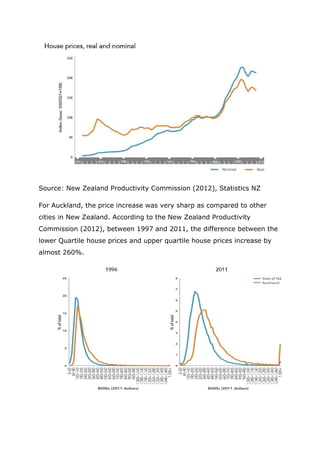
For Auckland, the price increase was very sharp as compared to other
cities in New Zealand. According to the New Zealand Productivity
Commission (2012), between 1997 and 2011, the difference between the
lower Quartile house prices and upper quartile house prices increase by
almost 260%.
Source: New Zealand Productivity Commission (2012)
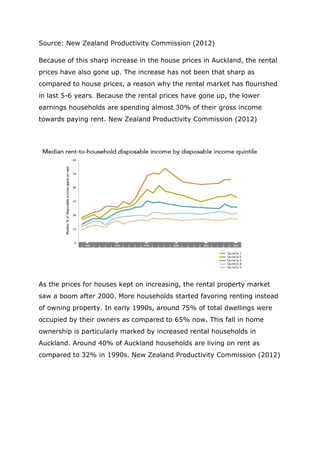
Because of this sharp increase in the house prices in Auckland, the rental
prices have also gone up. The increase has not been that sharp as
compared to house prices, a reason why the rental market has flourished
in last 5-6 years. Because the rental prices have gone up, the lower
earnings households are spending almost 30% of their gross income
towards paying rent. New Zealand Productivity Commission (2012)
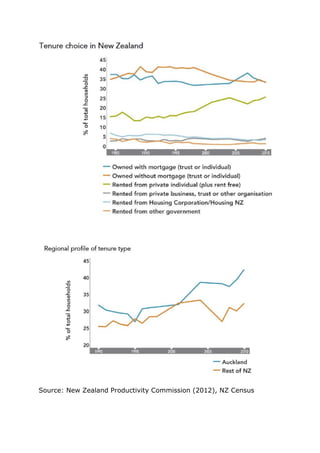
As the prices for houses kept on increasing, the rental property market
saw a boom after 2000. More households started favoring renting instead
of owning property. In early 1990s, around 75% of total dwellings were
occupied by their owners as compared to 65% now. This fall in home
ownership is particularly marked by increased rental households in
Auckland. Around 40% of Auckland households are living on rent as
compared to 32% in 1990s. New Zealand Productivity Commission (2012)
Source: New Zealand Productivity Commission (2012), NZ Census
Economic Intuition behind the policy
The main reasons why Auckland is facing this adverse housing crisis is:
1) Excess demand and under supply of land and houses.
2) Lack of housing choices for the buyers
3) Decreasing affordability and home ownership
According to Auckland Council (2013), a housing plan has been
introduced following which all the above mentioned issues can be dealt
with. Some of the recommendations are:
1) Increase housing supply in Auckland
2) Increase the quality of existing houses
3) Improve affordability
4) Increase the supply of affordable houses
Auckland council measures affordable housing based on the definition of
affordability and interprets it according to the amount of income
household has to spend to pay for property costs.
According to New Zealand Productivity Commission (2012), City Councils
have a major role in development, planning including release of land for
development and housing expansion. These government agencies are
responsible for issuing building consents as well. The Auckland city council
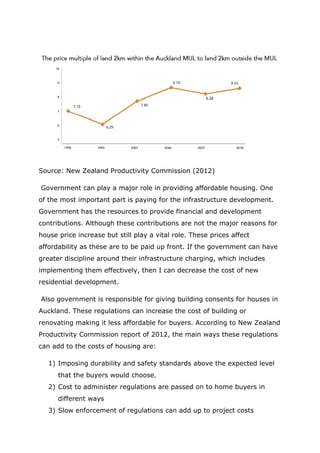
has proposed a compact city approach, under which there will be an
immediate release of land for residential development purposes so as to
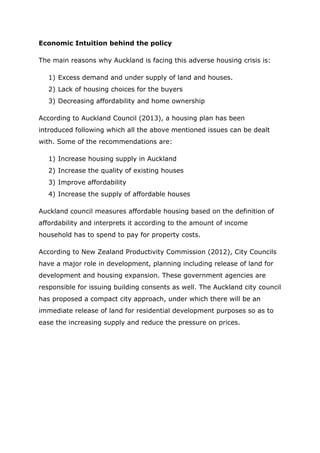
ease the increasing supply and reduce the pressure on prices.
Source: New Zealand Productivity Commission (2012)
Government can play a major role in providing affordable housing. One
of the most important part is paying for the infrastructure development.
Government has the resources to provide financial and development
contributions. Although these contributions are not the major reasons for
house price increase but still play a vital role. These prices affect
affordability as these are to be paid up front. If the government can have
greater discipline around their infrastructure charging, which includes
implementing them effectively, then I can decrease the cost of new
residential development.
Also government is responsible for giving building consents for houses in
Auckland. These regulations can increase the cost of building or
renovating making it less affordable for buyers. According to New Zealand
Productivity Commission report of 2012, the main ways these regulations
can add to the costs of housing are:
1) Imposing durability and safety standards above the expected level
that the buyers would choose.
2) Cost to administer regulations are passed on to home buyers in
different ways
3) Slow enforcement of regulations can add up to project costs
4) Incentives for building consent authorities to be risk averse can add
to the house costs
5) Building authorities take longer to process consent applications
which can add up to the costs
The government can speed up this consent process and can effectively
manage their infrastructure charging process so as to bring down the
costs of building and owning houses in Auckland. Government can achieve
economies of scale if it provides for more affordable housing and hence
create a positive externality for the whole community. Government by
providing/releasing more land quicker for house development will release
some pressure off the property market and this will encourage the home
buyers to buy houses. As this happens, the excess demand will be
complimented with an equal increase in supply. This will in turn help
reduce the pressure in the rental property market as more people will
move towards affordable housing. His will reduce the renal prices as well.
As more people will move towards affordable housing, this will help
increase the total revenue for the government in form of rates.
Government should built more affordable houses in Auckland because of
the increasing population in the city coupled with demographic changes
like ageing population, cultural and ethnic diversification and change in
family structures. As compared to 2000, there has been a huge boom in
migrants and people from other cities shifting their bases to Auckland.
This could be due to better facilities, better development, better
opportunities for highly paid jobs etc. But due to this increasing
population, the need for residential properties has increased also. The
supply of land by the government has not been able to match up with the
sharp increase in demand resulting in inflated house prices and high
rental prices. Auckland council is in process of implementing new policies
in order to provide more land for housing developments and better
affordability. But the process can be lengthy and can take time. By
providing better affordable homes to live in, government will be able to
increase its GDP per capita in real terms. This will improve the quality of
living and will attract more people to own homes as compared to rent
homes. Factors like time taken to acquire land, land use and planning
regulations, buildings consents etc. are controlled by government and are
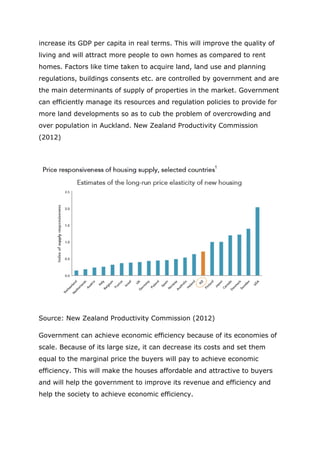
the main determinants of supply of properties in the market. Government
can efficiently manage its resources and regulation policies to provide for
more land developments so as to cub the problem of overcrowding and
over population in Auckland. New Zealand Productivity Commission
(2012)
Source: New Zealand Productivity Commission (2012)
Government can achieve economic efficiency because of its economies of
scale. Because of its large size, it can decrease its costs and set them
equal to the marginal price the buyers will pay to achieve economic
efficiency. This will make the houses affordable and attractive to buyers
and will help the government to improve its revenue and efficiency and
help the society to achieve economic efficiency.
Political issues
1) As with every other policy, this policy will also be subjected to a lot
of political criticism and lobbying. The main political issues could be:
2) Increased government expenditure in implementing better cost
efficient policies related to affordable housing
3) Decreased property prices and rental values will result in lowered
tax revenues from properties to government
4) Quicker supply of land and shortened building consent process will
cause higher administrative costs
5) Affordable housing will result in low foreign investment in property
market as the market may not look attractive to foreign investors.
All these issues are valid but the implementation of this policy will have
both short term and long tern positive effects for the people living in
Auckland. Some of the positive effects of this policy would be:
1) Proper land allocation to people who need it
2) Housing developments will help government handle the situation of
excess demand in property market which is the main reason behind
unaffordable housing in Auckland
3) As most of the people will be able to save a bigger portion of their
household income, they will be able to consume it or spend it on
other things which will also help government increase their revenue
4) Higher per capita GDP would result in better standard of living and
proper and healthy living environment which will increase the
efficiency of an individual
5) As more people will own houses, the more revenue government will
be able to extract by the way of controlled land rates.
Using all the above results and explanations, we can argue that the
benefits are far more compelling and profitable in short and long term as
compared to the costs which could be recovered in short time span. Also
according to the Heatley, P. (2012, October 29), the affordable housing
programme is underway which will help Auckland residents who find it
difficult to fund the household expenses out of their total income. Also,
the accommodation supplement will be efficiently redistributed amongst
those who really need it in order to support it.
Recommendations relating to the Policy
After all the explanations provided in the policy report, establishing cause
and effect relationships and providing evidence of how severe the
problem is and how it is effecting the Auckland population and the
government, we should recommend that building more state owned
houses, or social homes or affordable homes in Auckland by the
government is a good proposal and should be taken to the next step. This
recommendation is based on the evidence, data, statistics and the
reasoning provided above. The policy will help the people in Auckland who
cannot afford the high rental or house prices in Auckland regions, those
who pay almost 30% or more of their total household income to pay rent
or rates, to own properties or rent properties on much cheaper cost. This
will increase their wellbeing, standard of living GDP per capita and will
help the government to increase its revenue in other ways instead of
charging high taxes on properties.
References
1) New Zealand Productivity Commission. (2012). Housing
Affordability. Retrieved from
http://www.productivity.govt.nz/inquiry-content/1509?stage=4
2) Law, D. & Meehan, L. (2012, June). Housing Affordability in New
Zealand: Evidence from Household Surveys. Paper presented at the
New Zealand Association of Economists Conference. Retrieved from
http://www.nzae.org.nz/wp-content/uploads/2012/07/Law-Meehan-
Housing-Affordability-NZAE-2012.pdf
3) Auckland Council. (2013). Auckland's housing. In The Auckland
Plan. Auckland Council. Retrieved from
http://theplan.theaucklandplan.govt.nz/aucklands-housing/
4) Heatley, P. (2012, October 29). Affordable housing action well
underway [Press release]. Retrieved from
http://beehive.govt.nz/release/affordable-housing-action-well-
underway
5) Statistics New Zealand

Introductio1.docx

  • 1.
    Introduction In this report,we will be talking about the issue of should Government be building more Affordable Housing in New Zealand. This issue arises from the sky-rocketing prices for properties in Auckland. This is applicable to rental properties, current home owners and new buyers in the market. As compared to other goods and services, housing expenditure takes up a large proportion of household income. Owning a house makes a person believe that he is building a social capital and gets a sense of community. Law, D. & Meehan, L. (2012, June) The aim of this report is to look at the background of Auckland property market, changes taking place, the reasons for these changes. Also we will talk about the economic intuitions behind our policy and provide a reasoning for or against the policy. In addition to that, we will talk about the kinds of political pressure that can be expected from different lobby groups and how to manage those pressures. And at the end, we will give a recommendation as to why or why not the policy should be taken forward and what should be done in regard to it. Background In last 10 years, the property prices have increased double fold and are still climbing up. In a report by New Zealand productivity commission in 2012, the house prices for the whole New Zealand have increased by 12% every year since 2001. Some of the reasons for this are: 1) Strong population growth 2) Net migration inflows 3) Increase in real GDP per capita which resulted in increased demand. 4) Exchange rate was lower in 2003, and interest rates were low. This could have attracted overseas buyers to invest in property market hence increasing interest rates thereafter.
  • 2.
    Source: New ZealandProductivity Commission (2012), Statistics NZ For Auckland, the price increase was very sharp as compared to other cities in New Zealand. According to the New Zealand Productivity Commission (2012), between 1997 and 2011, the difference between the lower Quartile house prices and upper quartile house prices increase by almost 260%.
  • 3.
    Source: New ZealandProductivity Commission (2012) Because of this sharp increase in the house prices in Auckland, the rental prices have also gone up. The increase has not been that sharp as compared to house prices, a reason why the rental market has flourished in last 5-6 years. Because the rental prices have gone up, the lower earnings households are spending almost 30% of their gross income towards paying rent. New Zealand Productivity Commission (2012) As the prices for houses kept on increasing, the rental property market saw a boom after 2000. More households started favoring renting instead of owning property. In early 1990s, around 75% of total dwellings were occupied by their owners as compared to 65% now. This fall in home ownership is particularly marked by increased rental households in Auckland. Around 40% of Auckland households are living on rent as compared to 32% in 1990s. New Zealand Productivity Commission (2012)
  • 4.
    Source: New ZealandProductivity Commission (2012), NZ Census
  • 5.
    Economic Intuition behindthe policy The main reasons why Auckland is facing this adverse housing crisis is: 1) Excess demand and under supply of land and houses. 2) Lack of housing choices for the buyers 3) Decreasing affordability and home ownership According to Auckland Council (2013), a housing plan has been introduced following which all the above mentioned issues can be dealt with. Some of the recommendations are: 1) Increase housing supply in Auckland 2) Increase the quality of existing houses 3) Improve affordability 4) Increase the supply of affordable houses Auckland council measures affordable housing based on the definition of affordability and interprets it according to the amount of income household has to spend to pay for property costs. According to New Zealand Productivity Commission (2012), City Councils have a major role in development, planning including release of land for development and housing expansion. These government agencies are responsible for issuing building consents as well. The Auckland city council has proposed a compact city approach, under which there will be an immediate release of land for residential development purposes so as to ease the increasing supply and reduce the pressure on prices.
  • 6.
    Source: New ZealandProductivity Commission (2012) Government can play a major role in providing affordable housing. One of the most important part is paying for the infrastructure development. Government has the resources to provide financial and development contributions. Although these contributions are not the major reasons for house price increase but still play a vital role. These prices affect affordability as these are to be paid up front. If the government can have greater discipline around their infrastructure charging, which includes implementing them effectively, then I can decrease the cost of new residential development. Also government is responsible for giving building consents for houses in Auckland. These regulations can increase the cost of building or renovating making it less affordable for buyers. According to New Zealand Productivity Commission report of 2012, the main ways these regulations can add to the costs of housing are: 1) Imposing durability and safety standards above the expected level that the buyers would choose. 2) Cost to administer regulations are passed on to home buyers in different ways 3) Slow enforcement of regulations can add up to project costs
  • 7.
    4) Incentives forbuilding consent authorities to be risk averse can add to the house costs 5) Building authorities take longer to process consent applications which can add up to the costs The government can speed up this consent process and can effectively manage their infrastructure charging process so as to bring down the costs of building and owning houses in Auckland. Government can achieve economies of scale if it provides for more affordable housing and hence create a positive externality for the whole community. Government by providing/releasing more land quicker for house development will release some pressure off the property market and this will encourage the home buyers to buy houses. As this happens, the excess demand will be complimented with an equal increase in supply. This will in turn help reduce the pressure in the rental property market as more people will move towards affordable housing. His will reduce the renal prices as well. As more people will move towards affordable housing, this will help increase the total revenue for the government in form of rates. Government should built more affordable houses in Auckland because of the increasing population in the city coupled with demographic changes like ageing population, cultural and ethnic diversification and change in family structures. As compared to 2000, there has been a huge boom in migrants and people from other cities shifting their bases to Auckland. This could be due to better facilities, better development, better opportunities for highly paid jobs etc. But due to this increasing population, the need for residential properties has increased also. The supply of land by the government has not been able to match up with the sharp increase in demand resulting in inflated house prices and high rental prices. Auckland council is in process of implementing new policies in order to provide more land for housing developments and better affordability. But the process can be lengthy and can take time. By providing better affordable homes to live in, government will be able to
  • 8.
    increase its GDPper capita in real terms. This will improve the quality of living and will attract more people to own homes as compared to rent homes. Factors like time taken to acquire land, land use and planning regulations, buildings consents etc. are controlled by government and are the main determinants of supply of properties in the market. Government can efficiently manage its resources and regulation policies to provide for more land developments so as to cub the problem of overcrowding and over population in Auckland. New Zealand Productivity Commission (2012) Source: New Zealand Productivity Commission (2012) Government can achieve economic efficiency because of its economies of scale. Because of its large size, it can decrease its costs and set them equal to the marginal price the buyers will pay to achieve economic efficiency. This will make the houses affordable and attractive to buyers and will help the government to improve its revenue and efficiency and help the society to achieve economic efficiency.
  • 9.
    Political issues 1) Aswith every other policy, this policy will also be subjected to a lot of political criticism and lobbying. The main political issues could be: 2) Increased government expenditure in implementing better cost efficient policies related to affordable housing 3) Decreased property prices and rental values will result in lowered tax revenues from properties to government 4) Quicker supply of land and shortened building consent process will cause higher administrative costs 5) Affordable housing will result in low foreign investment in property market as the market may not look attractive to foreign investors. All these issues are valid but the implementation of this policy will have both short term and long tern positive effects for the people living in Auckland. Some of the positive effects of this policy would be: 1) Proper land allocation to people who need it 2) Housing developments will help government handle the situation of excess demand in property market which is the main reason behind unaffordable housing in Auckland 3) As most of the people will be able to save a bigger portion of their household income, they will be able to consume it or spend it on other things which will also help government increase their revenue 4) Higher per capita GDP would result in better standard of living and proper and healthy living environment which will increase the efficiency of an individual 5) As more people will own houses, the more revenue government will be able to extract by the way of controlled land rates. Using all the above results and explanations, we can argue that the benefits are far more compelling and profitable in short and long term as compared to the costs which could be recovered in short time span. Also according to the Heatley, P. (2012, October 29), the affordable housing
  • 10.
    programme is underwaywhich will help Auckland residents who find it difficult to fund the household expenses out of their total income. Also, the accommodation supplement will be efficiently redistributed amongst those who really need it in order to support it. Recommendations relating to the Policy After all the explanations provided in the policy report, establishing cause and effect relationships and providing evidence of how severe the problem is and how it is effecting the Auckland population and the government, we should recommend that building more state owned houses, or social homes or affordable homes in Auckland by the government is a good proposal and should be taken to the next step. This recommendation is based on the evidence, data, statistics and the reasoning provided above. The policy will help the people in Auckland who cannot afford the high rental or house prices in Auckland regions, those who pay almost 30% or more of their total household income to pay rent or rates, to own properties or rent properties on much cheaper cost. This will increase their wellbeing, standard of living GDP per capita and will help the government to increase its revenue in other ways instead of charging high taxes on properties.
  • 11.
    References 1) New ZealandProductivity Commission. (2012). Housing Affordability. Retrieved from http://www.productivity.govt.nz/inquiry-content/1509?stage=4 2) Law, D. & Meehan, L. (2012, June). Housing Affordability in New Zealand: Evidence from Household Surveys. Paper presented at the New Zealand Association of Economists Conference. Retrieved from http://www.nzae.org.nz/wp-content/uploads/2012/07/Law-Meehan- Housing-Affordability-NZAE-2012.pdf 3) Auckland Council. (2013). Auckland's housing. In The Auckland Plan. Auckland Council. Retrieved from http://theplan.theaucklandplan.govt.nz/aucklands-housing/ 4) Heatley, P. (2012, October 29). Affordable housing action well underway [Press release]. Retrieved from http://beehive.govt.nz/release/affordable-housing-action-well- underway 5) Statistics New Zealand