Introducing the
Round Trip through
SMIF / FIBO
Wednesday March 5th, 2017
Jim Logan
Director of Semantic Technologies and Interoperability
Product Manager of the Cameo Concept Modeler
What is SMIF?
• Semantic Modeling for Information Federation
• (Please see separate slide deck from Cory Casanave)
2
Setting the Stage: What is FIBO?
• Financial Industry Business Ontology
• Developed with business experts
• Provides:
• Unambiguous meaning for financial concepts
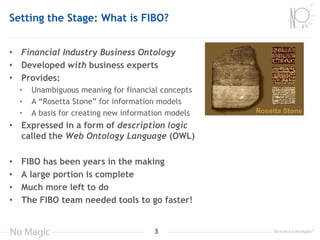
• A “Rosetta Stone” for information models
• A basis for creating new information models
• Expressed in a form of description logic
called the Web Ontology Language (OWL)
• FIBO has been years in the making
• A large portion is complete
• Much more left to do
• The FIBO team needed tools to go faster!
3
Setting the Stage: FIBO Tooling Needs
• Needed a business-facing
viewpoint
• Needed to work at a higher level
of abstraction
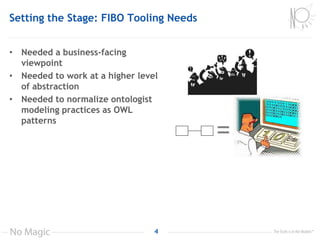
• Needed to normalize ontologist
modeling practices as OWL
patterns
4
=
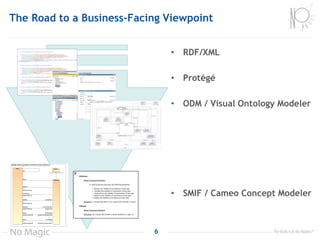
The Road to a Business-Facing Viewpoint
6
Figure 10.16 Reference and Referent Concepts and Relations
Financial Industry Business Ontology Foundations Final 69
• RDF/XML
• Protégé
• ODM / Visual Ontology Modeler
• SMIF / Cameo Concept Modeler
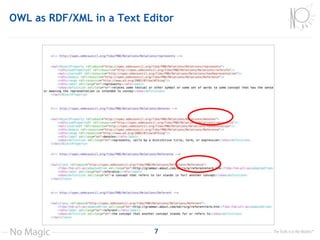
OWL as RDF/XML in a Text Editor
7
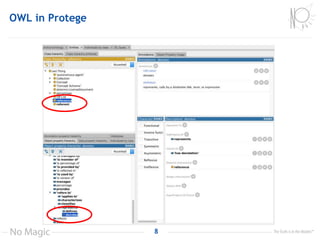
OWL in Protege
8
OWL in ODM / Visual Ontology Modeler
9
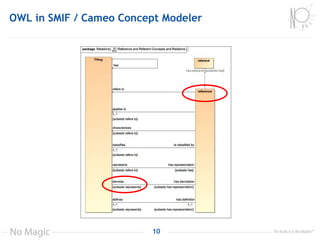
nce and Referent Concepts and Relations
OWL in SMIF / Cameo Concept Modeler
10
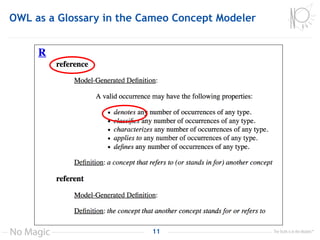
OWL as a Glossary in the Cameo Concept Modeler
11
Introducing the Cameo Concept Modeler (CCM)
• CCM was being developed at the same time as FIBO
• Started out as a Model Driven Architecture (MDA) tool that:
• Bridged the OMG’s UML-based architectural ecosystem and the Semantic
Web ecosystem
• Ingested just enough of foundational ontologies into normal-looking UML
• Extended / tailored foundational ontologies within an organization
• Allowed SMEs to review simple diagrams and natural language glossaries
• Emitted organization-specific ontologies out to OWL for reasoning
• Would transform concept models into system architecture and design
models
• Would provide semantic interoperability among information systems
• CCM was what the FIBO team needed when they started
• CCM was purposely not called “The Cameo OWL Editor”
• We deferred developing transformations and semantic
interoperability to help the FIBO team
12
Forward Engineering and Reverse Engineering
• Programmers used to program in machine code
• Then they programmed in assembly language and generated
machine code
• Then they programmed in higher-level languages and generated
assembly language
• Why?
• Higher-level languages are optimized for programmers
• Lower-level languages are optimized for machines
• A higher-level language can be transformed into a lower-level language
• Forward engineering is the transformation of a higher-level
language into a lower-level language
• Reverse engineering is the reconstruction of the abstractions in a
higher-level language from a lower-level language
14
What Is “Round Tripping”?
• Uses the metaphor of traveling to a place
and then returning again
• “Round tripping” is short for round trip
engineering
• Entails forward engineering from higher
level of abstraction to a lower level of
abstraction and then reversing the process
• To make this tractable, we forward and
reverse engineer sanctioned patterns
15
Round Tripping in SMIF/CCM
• Two viewpoints are needed for FIBO:
• SMIF: High-level abstractions for business experts
• OWL: Logical axioms for ontology experts
• CCM can now forward and reverse engineer between viewpoints
• A SMIF/CCM model emits sanctioned patterns in OWL, such as:
• Complex restrictions
• Property reification
• Phases and roles
• Ontologists can edit the emitted OWL
• CCM can read the edited OWL and merge changes into the model
while preserving diagrams
• The FIBO team has since standardized on both OWL and SMIF
16
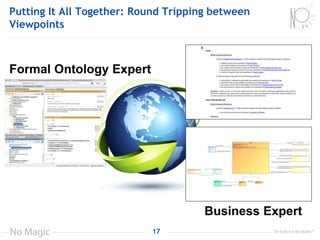
Putting It All Together: Round Tripping between
Viewpoints
17
Formal Ontology Expert
Business Expert
Fulfilling Additional FIBO Team Needs
• A TeamWork Cloud (TWC) server provides:
• Simultaneous modeling
• Versioning of models
• Branching of models
• Merging model changes between branches
• A Cameo Collaborator server enables:
• Ontologists to publish SMIF/CCM diagrams and glossaries to a web server
• Business experts to review and comment on diagrams and plain-English
glossaries using just a web browser
• The EDMC Wiki to accumulate comments from business experts
• New Cameo Concept Modeler features enable:
• Recognition of patterns in OWL to reconstruct higher-level abstractions
• Automatic merging of OWL changes into diagrams and glossaries
• Enforcement of “FIBO-sanctioned” patterns
• New Cameo Concept Modeler features have fed back into the
Semantic Modeling for Information Federation (SMIF) specification
18
In Summary
• SMIF: Semantic Modeling for Information Federation
• CCM: the Cameo Concept Modeler
• CCM provides a viewpoint with a higher level of abstraction
• CCM can now “round trip” back and forth between viewpoints
• The FIBO team has been using CCM, TWC, and Cameo Collaborator
• Coming SMIF features in CCM:
• Transform concept models into system architecture and design models
• Provide semantic interoperability among information systems
19
Thank you!
To find out more,
please contact:
Jim Logan
jlogan@nomagic.com

Introducing the Round Trip through SMIF / FIBO

  • 1.
    Introducing the Round Tripthrough SMIF / FIBO Wednesday March 5th, 2017 Jim Logan Director of Semantic Technologies and Interoperability Product Manager of the Cameo Concept Modeler
  • 2.
    What is SMIF? •Semantic Modeling for Information Federation • (Please see separate slide deck from Cory Casanave) 2
  • 3.
    Setting the Stage:What is FIBO? • Financial Industry Business Ontology • Developed with business experts • Provides: • Unambiguous meaning for financial concepts • A “Rosetta Stone” for information models • A basis for creating new information models • Expressed in a form of description logic called the Web Ontology Language (OWL) • FIBO has been years in the making • A large portion is complete • Much more left to do • The FIBO team needed tools to go faster! 3
  • 4.
    Setting the Stage:FIBO Tooling Needs • Needed a business-facing viewpoint • Needed to work at a higher level of abstraction • Needed to normalize ontologist modeling practices as OWL patterns 4 =
  • 5.
    The Road toa Business-Facing Viewpoint 6 Figure 10.16 Reference and Referent Concepts and Relations Financial Industry Business Ontology Foundations Final 69 • RDF/XML • Protégé • ODM / Visual Ontology Modeler • SMIF / Cameo Concept Modeler
  • 6.
    OWL as RDF/XMLin a Text Editor 7
  • 7.
  • 8.
    OWL in ODM/ Visual Ontology Modeler 9 nce and Referent Concepts and Relations
  • 9.
    OWL in SMIF/ Cameo Concept Modeler 10
  • 10.
    OWL as aGlossary in the Cameo Concept Modeler 11
  • 11.
    Introducing the CameoConcept Modeler (CCM) • CCM was being developed at the same time as FIBO • Started out as a Model Driven Architecture (MDA) tool that: • Bridged the OMG’s UML-based architectural ecosystem and the Semantic Web ecosystem • Ingested just enough of foundational ontologies into normal-looking UML • Extended / tailored foundational ontologies within an organization • Allowed SMEs to review simple diagrams and natural language glossaries • Emitted organization-specific ontologies out to OWL for reasoning • Would transform concept models into system architecture and design models • Would provide semantic interoperability among information systems • CCM was what the FIBO team needed when they started • CCM was purposely not called “The Cameo OWL Editor” • We deferred developing transformations and semantic interoperability to help the FIBO team 12
  • 12.
    Forward Engineering andReverse Engineering • Programmers used to program in machine code • Then they programmed in assembly language and generated machine code • Then they programmed in higher-level languages and generated assembly language • Why? • Higher-level languages are optimized for programmers • Lower-level languages are optimized for machines • A higher-level language can be transformed into a lower-level language • Forward engineering is the transformation of a higher-level language into a lower-level language • Reverse engineering is the reconstruction of the abstractions in a higher-level language from a lower-level language 14
  • 13.
    What Is “RoundTripping”? • Uses the metaphor of traveling to a place and then returning again • “Round tripping” is short for round trip engineering • Entails forward engineering from higher level of abstraction to a lower level of abstraction and then reversing the process • To make this tractable, we forward and reverse engineer sanctioned patterns 15
  • 14.
    Round Tripping inSMIF/CCM • Two viewpoints are needed for FIBO: • SMIF: High-level abstractions for business experts • OWL: Logical axioms for ontology experts • CCM can now forward and reverse engineer between viewpoints • A SMIF/CCM model emits sanctioned patterns in OWL, such as: • Complex restrictions • Property reification • Phases and roles • Ontologists can edit the emitted OWL • CCM can read the edited OWL and merge changes into the model while preserving diagrams • The FIBO team has since standardized on both OWL and SMIF 16
  • 15.
    Putting It AllTogether: Round Tripping between Viewpoints 17 Formal Ontology Expert Business Expert
  • 16.
    Fulfilling Additional FIBOTeam Needs • A TeamWork Cloud (TWC) server provides: • Simultaneous modeling • Versioning of models • Branching of models • Merging model changes between branches • A Cameo Collaborator server enables: • Ontologists to publish SMIF/CCM diagrams and glossaries to a web server • Business experts to review and comment on diagrams and plain-English glossaries using just a web browser • The EDMC Wiki to accumulate comments from business experts • New Cameo Concept Modeler features enable: • Recognition of patterns in OWL to reconstruct higher-level abstractions • Automatic merging of OWL changes into diagrams and glossaries • Enforcement of “FIBO-sanctioned” patterns • New Cameo Concept Modeler features have fed back into the Semantic Modeling for Information Federation (SMIF) specification 18
  • 17.
    In Summary • SMIF:Semantic Modeling for Information Federation • CCM: the Cameo Concept Modeler • CCM provides a viewpoint with a higher level of abstraction • CCM can now “round trip” back and forth between viewpoints • The FIBO team has been using CCM, TWC, and Cameo Collaborator • Coming SMIF features in CCM: • Transform concept models into system architecture and design models • Provide semantic interoperability among information systems 19
  • 18.
    Thank you! To findout more, please contact: Jim Logan jlogan@nomagic.com