Introduction to Science:
The Scientific Method
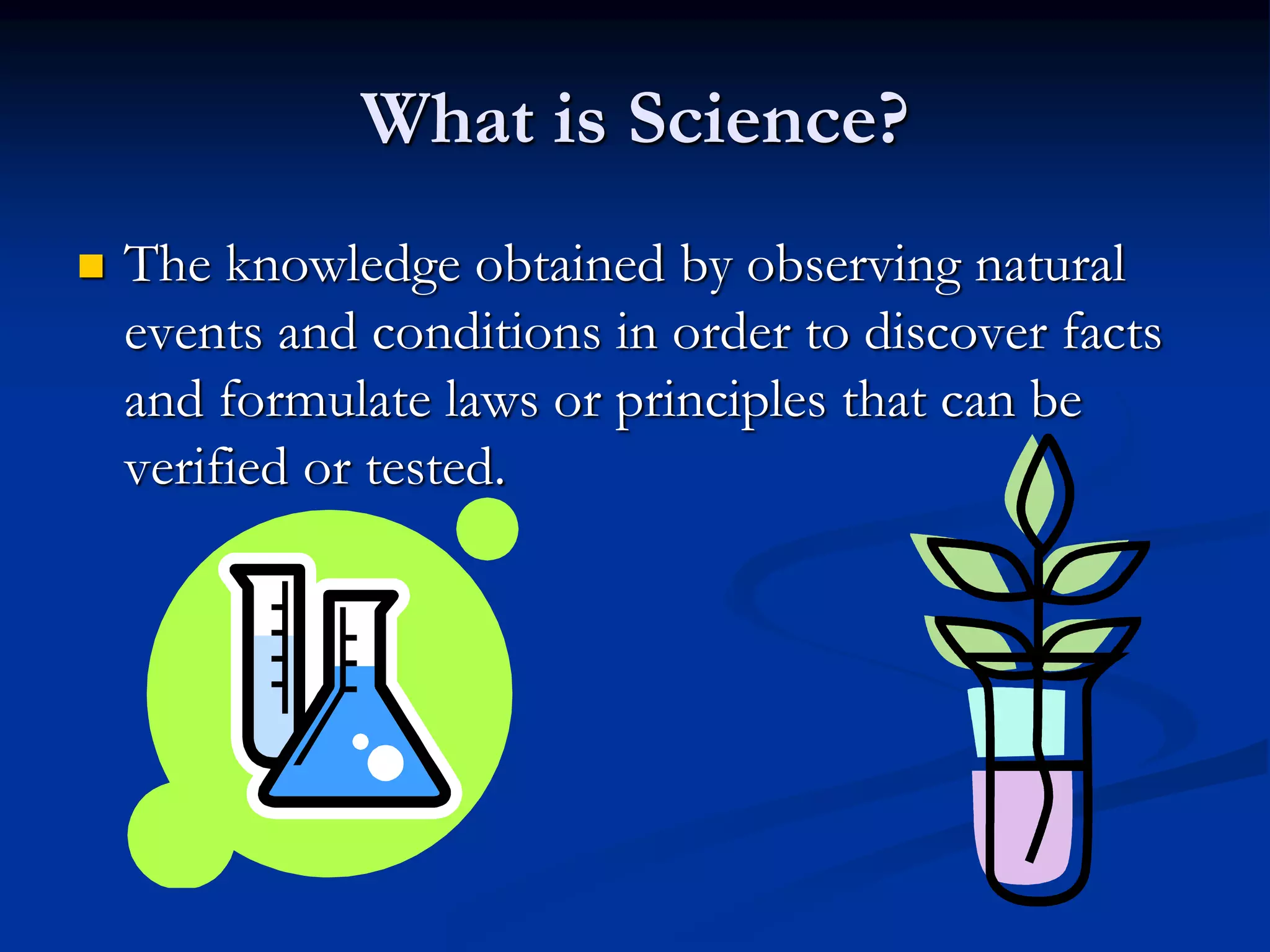
What is Science?
 The knowledge obtained by observing natural
events and conditions in order to discover facts
and formulate laws or principles that can be
verified or tested.
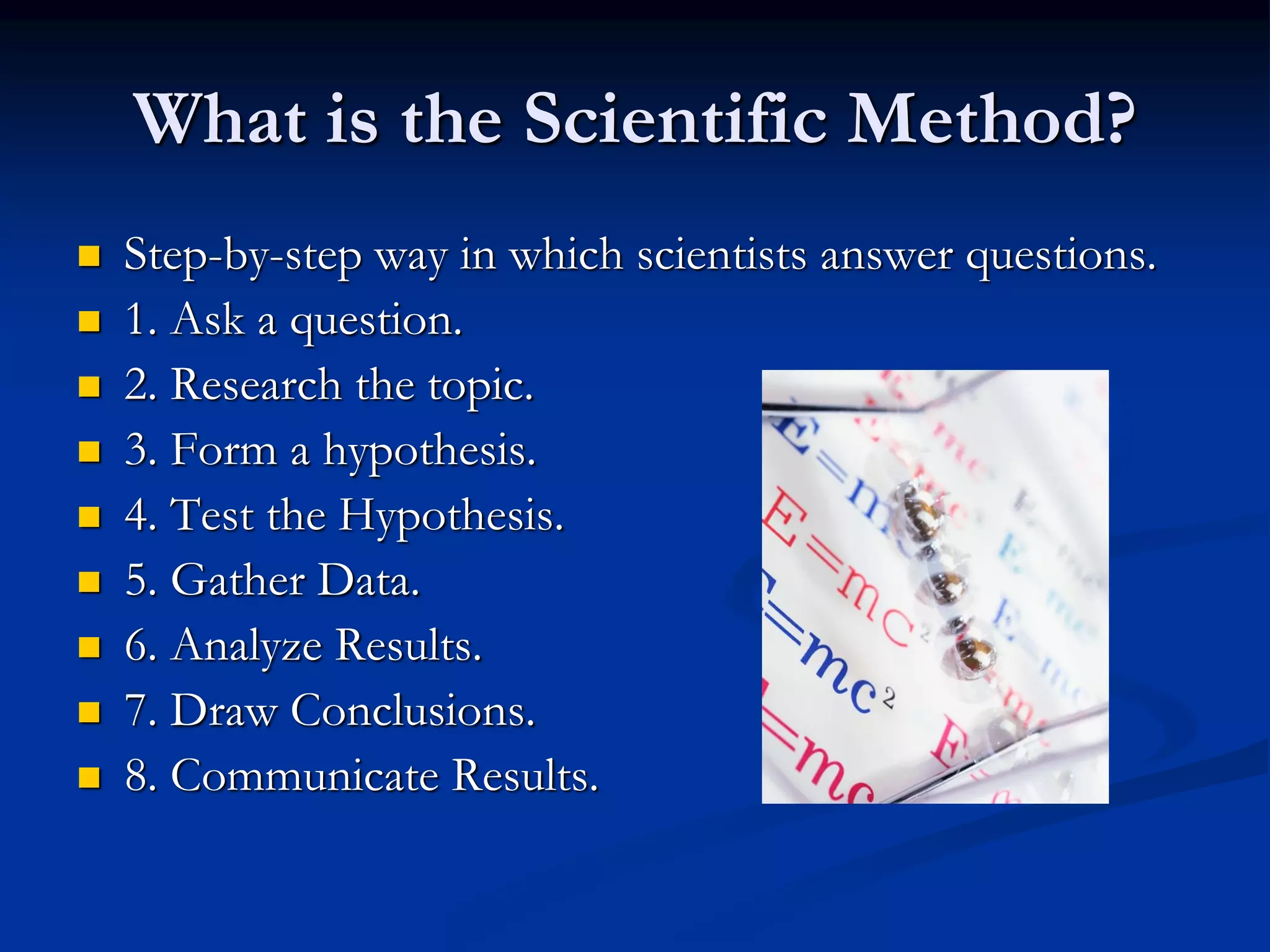
What is the Scientific Method?
 Step-by-step way in which scientists answer questions.
 1. Ask a question.
 2. Research the topic.
 3. Form a hypothesis.
 4. Test the Hypothesis.
 5. Gather Data.
 6. Analyze Results.
 7. Draw Conclusions.
 8. Communicate Results.
State the Problem/Questions
 Develop a clear statement defining the problem
 Make sure your problem is narrowed/specific
enough
Research
 Write down all information you already know
 Do research in books or using reliable websites
on the topic you are investigating
 Ask experts on the subject you are researching
 If you find an answer to your problem/question
you do not need to move on, you need to create
a new testable question
What is a hypothesis?
 An explanation that is based on prior scientific
research or observations and that can be tested.
 “Educated Guess”
 “If… then… because” Statement
 “IF I do this THEN this will happen
BECAUSE (explaining based on the research
you have found)
How do you test a hypothesis?
Experiment…
 Develop a test or experiment to prove or
disprove your hypothesis
 Must be run multiple times, a minimum of 3 trials
 Must have only 1 independent variable (the factor
being tested)
 Must include 2 setups
 Experimental setup
 Control setup
What are the parts of an
experiment?
A Controlled Experiment is an experiment that
tests only ONE factor at a time by using a
comparison of a control group and an
experimental group.
 Control Group
 The group that the scientist changes nothing in.
 Experimental Group
 The group that the scientist has changed something.
It is the variable in the experiment.
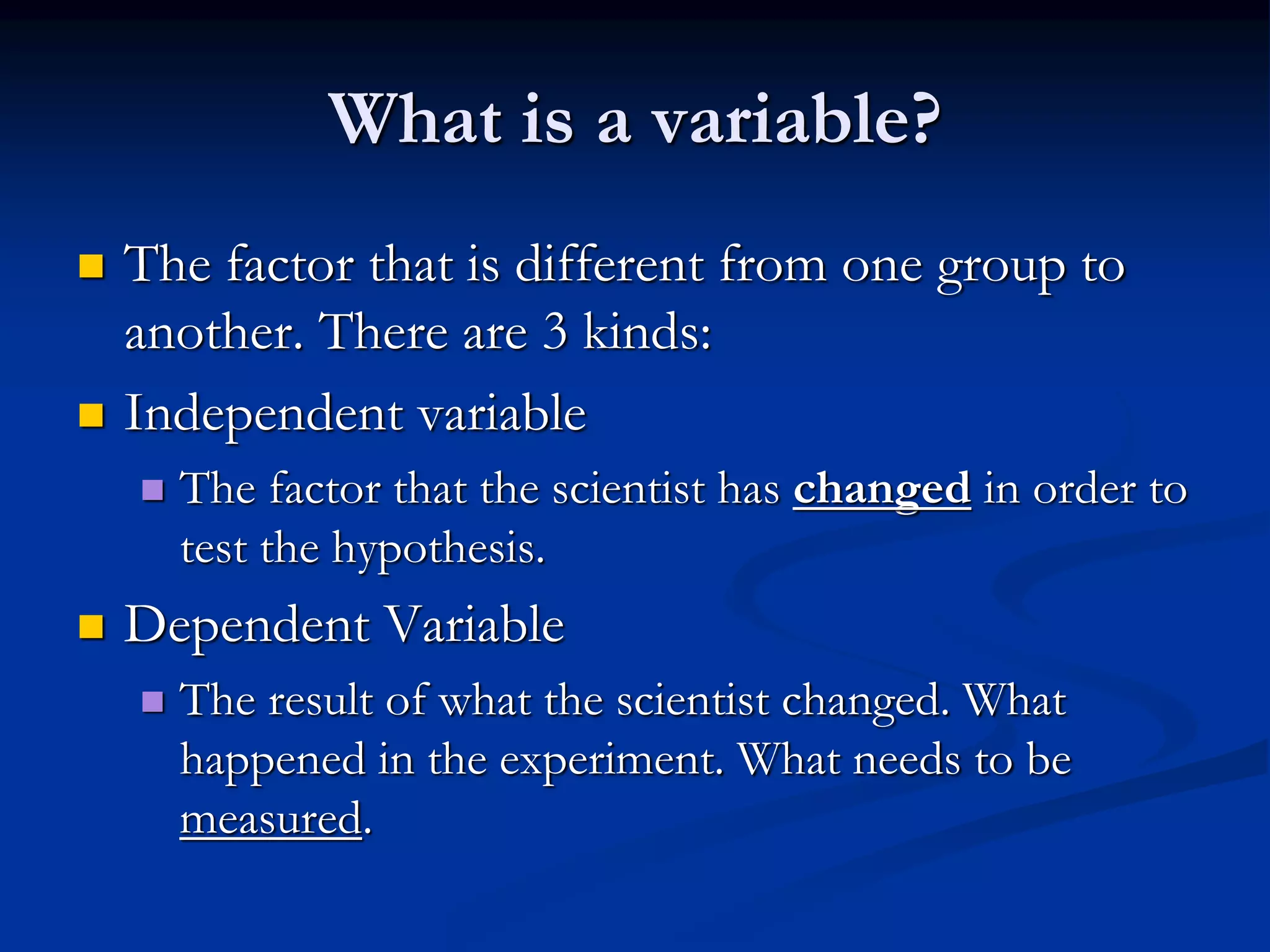
What is a variable?
 The factor that is different from one group to
another. There are 3 kinds:
 Independent variable
 The factor that the scientist has changed in order to
test the hypothesis.
 Dependent Variable
 The result of what the scientist changed. What
happened in the experiment. What needs to be
measured.
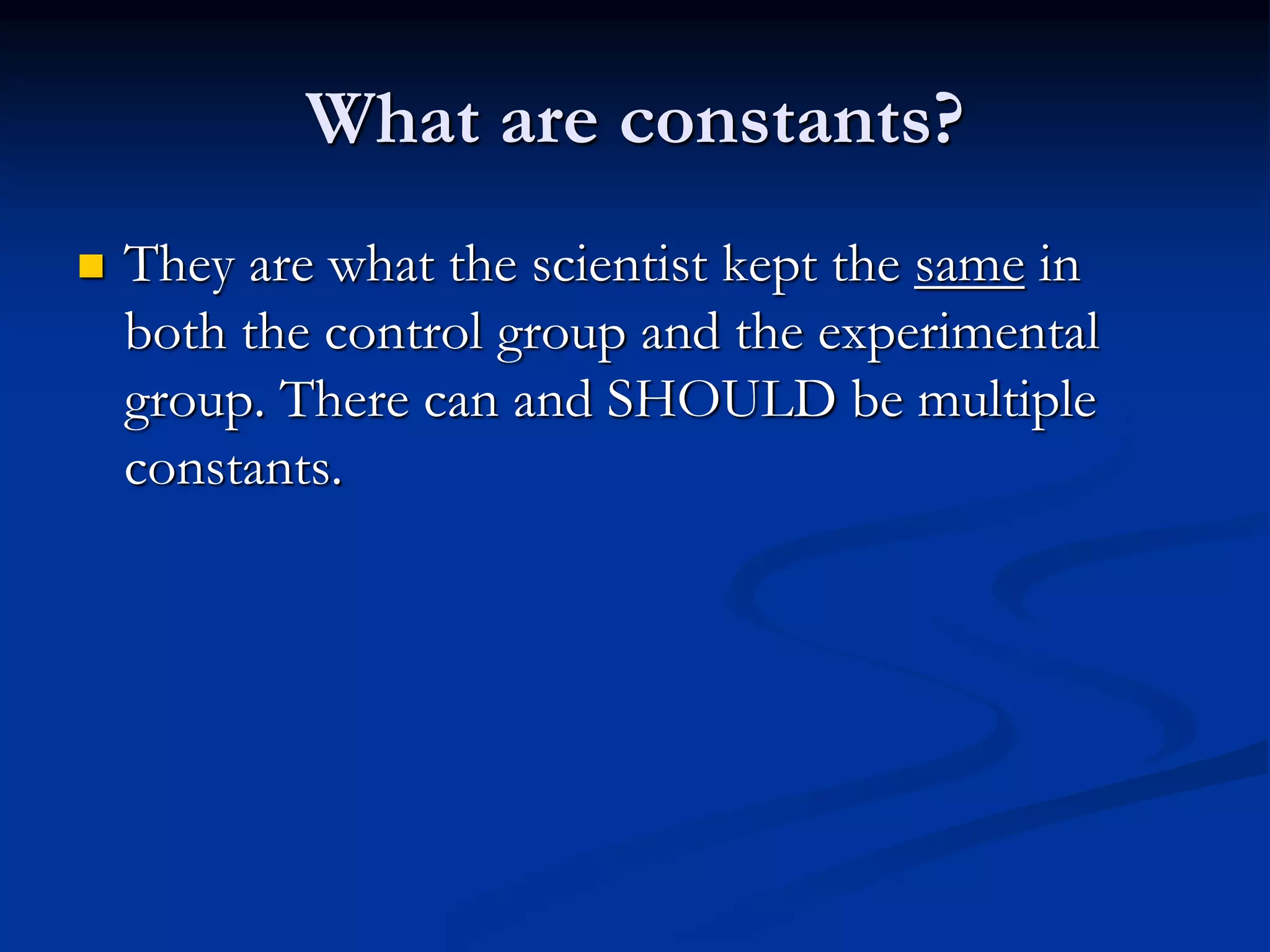
What are constants?
 They are what the scientist kept the same in
both the control group and the experimental
group. There can and SHOULD be multiple
constants.
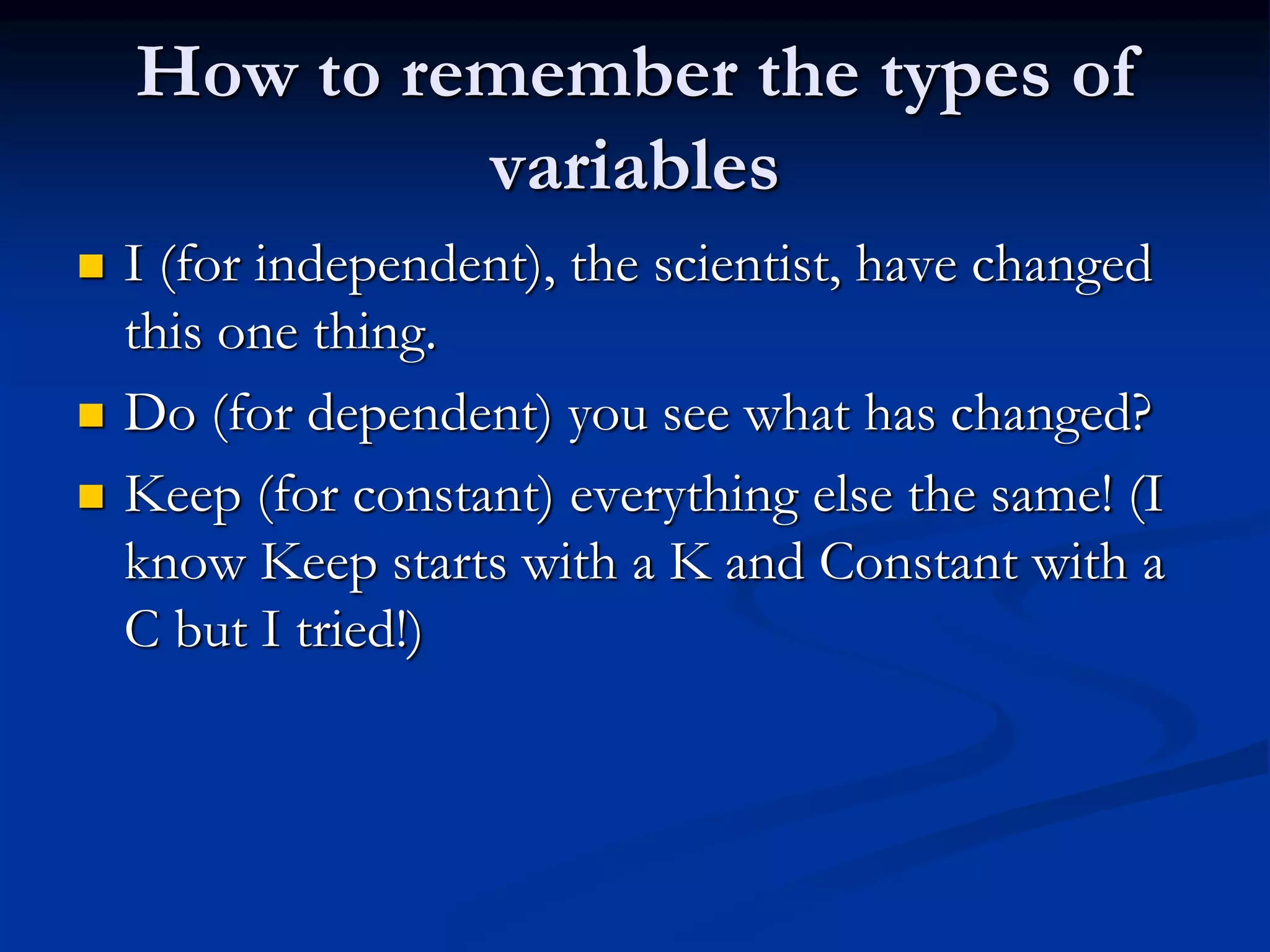
How to remember the types of
variables
 I (for independent), the scientist, have changed
this one thing.
 Do (for dependent) you see what has changed?
 Keep (for constant) everything else the same! (I
know Keep starts with a K and Constant with a
C but I tried!)
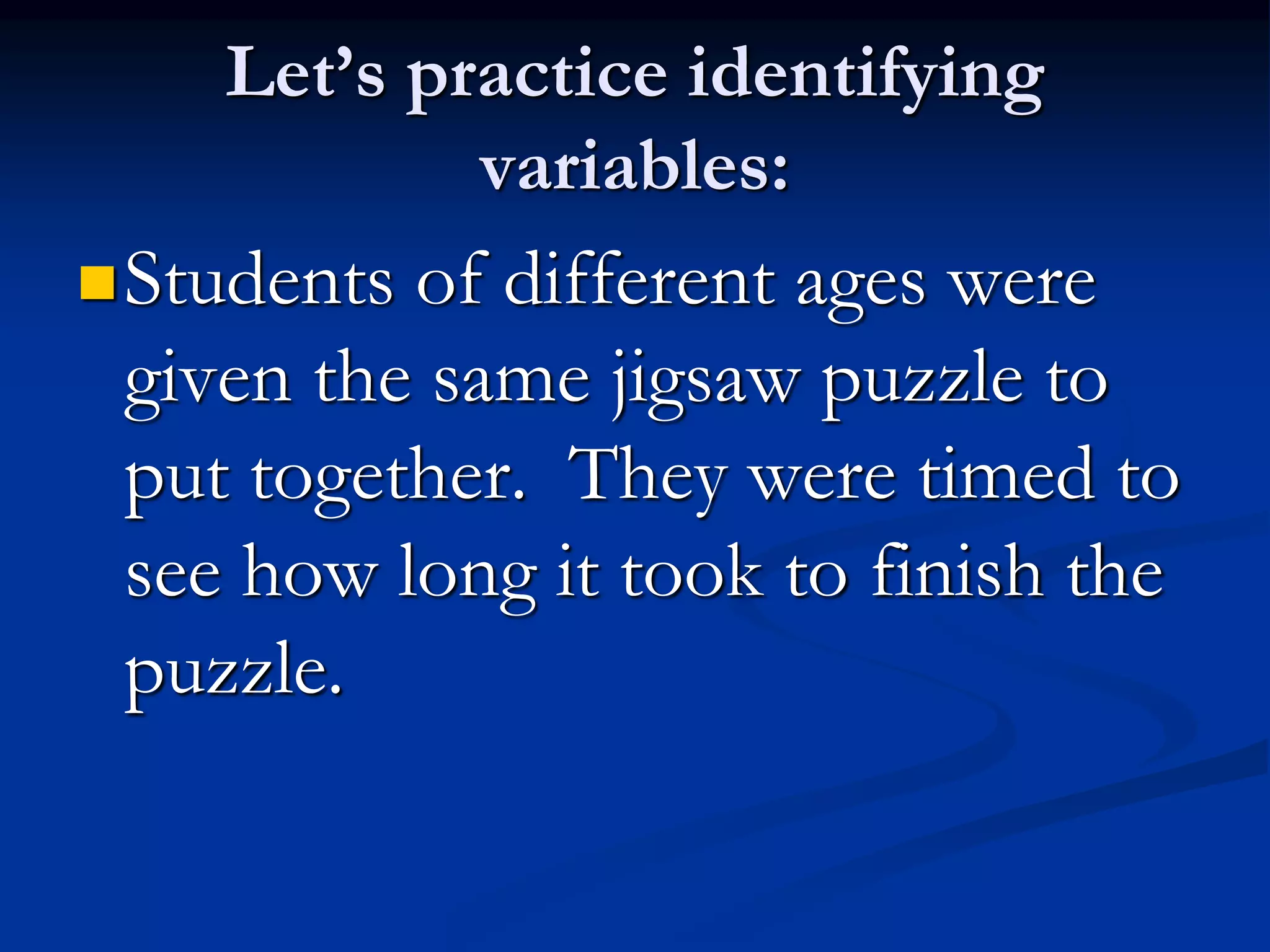
Let’s practice identifying
variables:
Students of different ages were
given the same jigsaw puzzle to
put together. They were timed to
see how long it took to finish the
puzzle.
Students of different ages were
given the same jigsaw puzzle to
put together. They were timed to
see how long it took to finish the
puzzle.
What is the Independent
Variable, the thing the scientist
changed?
Students of different ages were given
the same jigsaw puzzle to put
together. They were timed to see
how long it took to finish the puzzle.
 Independent Variable- The ages of the students
changed
Now what is the Dependent
Variable, the thing the scientist
must measure?
Students of different ages were given
the same jigsaw puzzle to put
together. They were timed to see
how long it took to finish the puzzle.
 Dependent Variable- The time it took to finish
the puzzle
What are some of the Constant
Variables, the variables that will
always stay the same?
Students of different ages were given
the same jigsaw puzzle to put
together. They were timed to see
how long it took to finish the puzzle.
 Constant Variable- The same puzzle, the same
table, the same room, the same room
temperature, the same tester, the same
stopwatch, etc.
How can you gather data?
 Make Observations.
 Any use of the senses to gather information.
 Qualitative Observations
 Anything that you see, smell, touch, taste, or hear.
 Ex. Blue, bitter, fizzing sound.
 Quantitative Observations
 Any observation that can be measured.
 Must include a number.
 Ex. 5 centimeters long
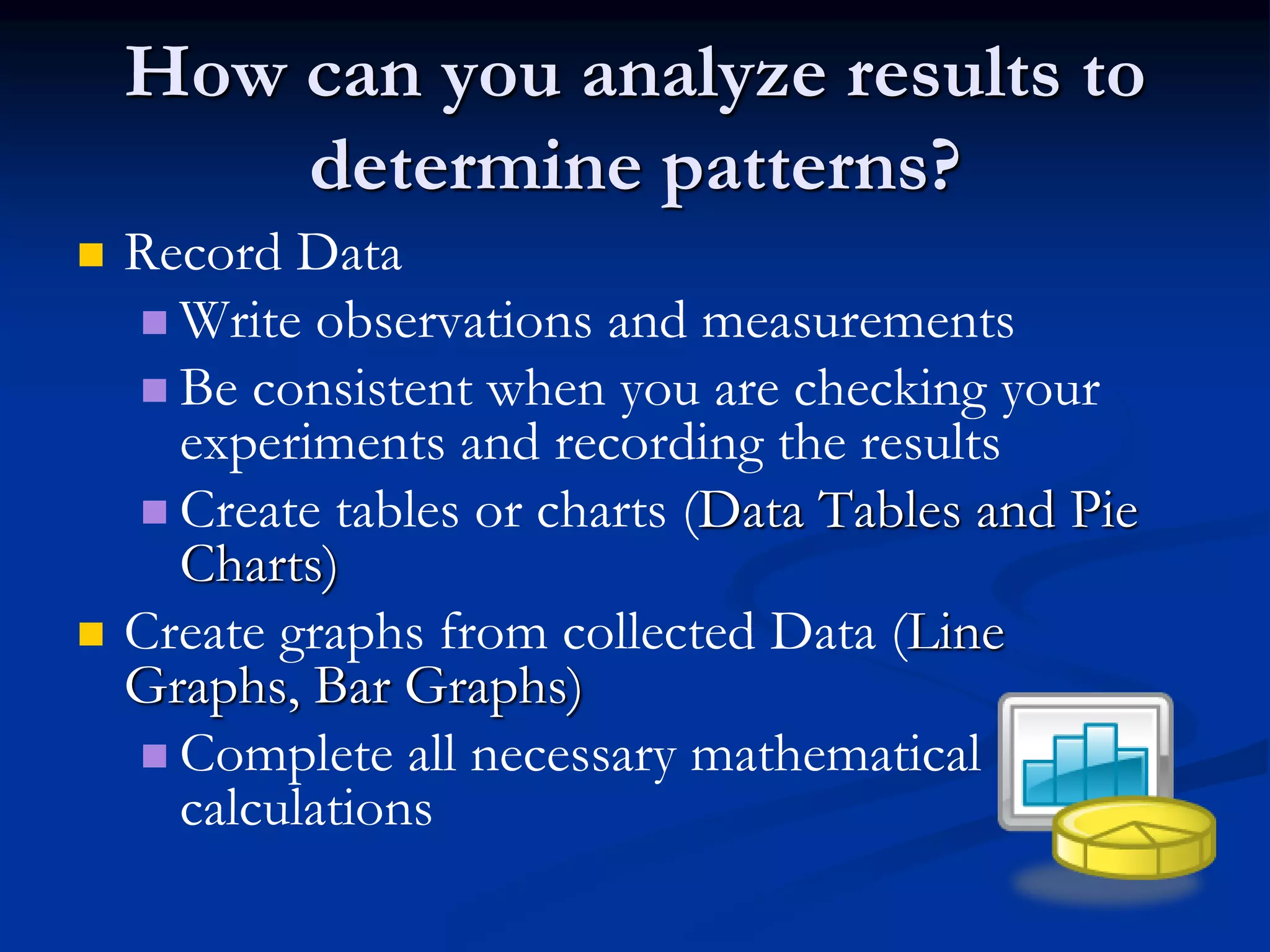
How can you analyze results to
determine patterns?
 Record Data
 Write observations and measurements
 Be consistent when you are checking your
experiments and recording the results
 Create tables or charts (Data Tables and Pie
Charts)
 Create graphs from collected Data (Line
Graphs, Bar Graphs)
 Complete all necessary mathematical
calculations
How can you draw conclusions?
 Answer the following questions in paragraph
form (Always explain in detail using scientific
vocabulary.):
 Do your results/data support your hypothesis? Why
or why not?
 What are ways you can improve your data?
 What would you do differently if you were to repeat
the experiment?
How would you communicate
results?
 Share data and information with others, such as
scientists.
 Publish your findings in a book, magazine,
journal, the internet.
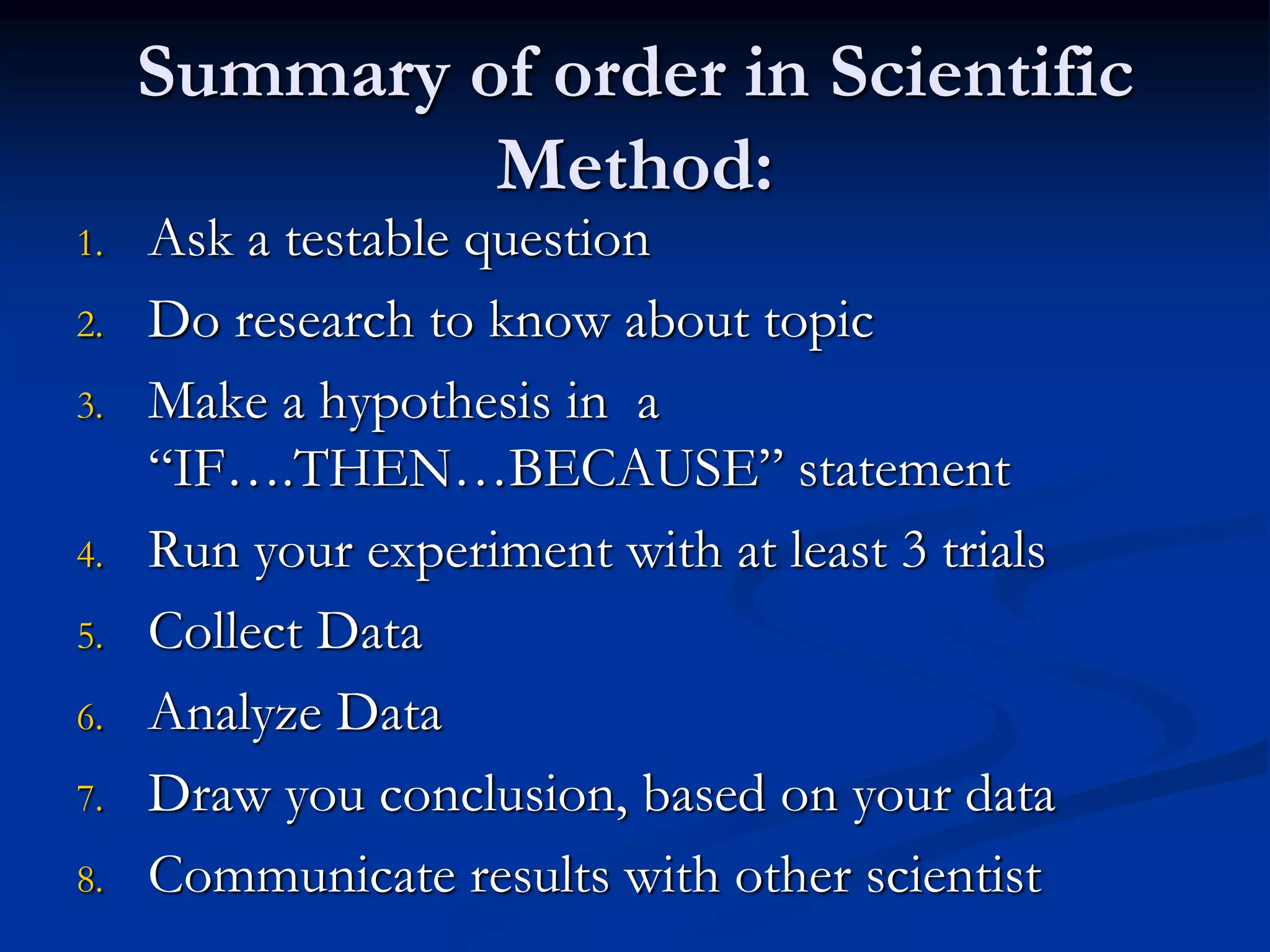
Summary of order in Scientific
Method:
1. Ask a testable question
2. Do research to know about topic
3. Make a hypothesis in a
“IF….THEN…BECAUSE” statement
4. Run your experiment with at least 3 trials
5. Collect Data
6. Analyze Data
7. Draw you conclusion, based on your data
8. Communicate results with other scientist
You Do Time
 On the left hand side of your IN, write a
hypothesis for these questions:
 1) Does fertilizer affect the growth rate of a
plant?
 2) Does air pressure affect the height a
basketball will bounce?
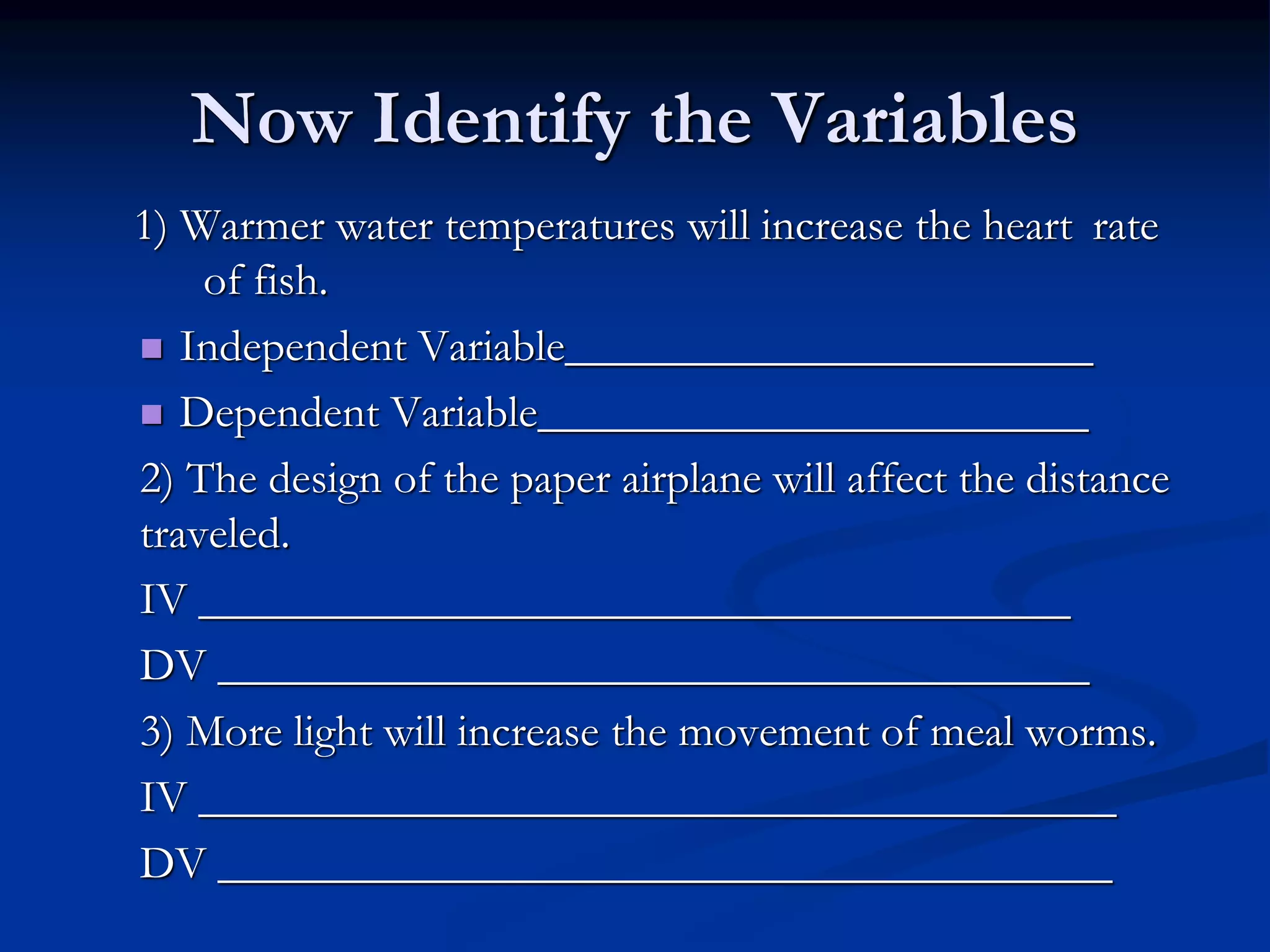
Now Identify the Variables
1) Warmer water temperatures will increase the heart rate
of fish.
 Independent Variable_______________________
 Dependent Variable________________________
2) The design of the paper airplane will affect the distance
traveled.
IV ______________________________________
DV ______________________________________
3) More light will increase the movement of meal worms.
IV ________________________________________
DV _______________________________________

Intro to sScience method ppt

  • 1.
  • 2.
    What is Science? The knowledge obtained by observing natural events and conditions in order to discover facts and formulate laws or principles that can be verified or tested.
  • 3.
    What is theScientific Method?  Step-by-step way in which scientists answer questions.  1. Ask a question.  2. Research the topic.  3. Form a hypothesis.  4. Test the Hypothesis.  5. Gather Data.  6. Analyze Results.  7. Draw Conclusions.  8. Communicate Results.
  • 4.
    State the Problem/Questions Develop a clear statement defining the problem  Make sure your problem is narrowed/specific enough
  • 5.
    Research  Write downall information you already know  Do research in books or using reliable websites on the topic you are investigating  Ask experts on the subject you are researching  If you find an answer to your problem/question you do not need to move on, you need to create a new testable question
  • 6.
    What is ahypothesis?  An explanation that is based on prior scientific research or observations and that can be tested.  “Educated Guess”  “If… then… because” Statement  “IF I do this THEN this will happen BECAUSE (explaining based on the research you have found)
  • 7.
    How do youtest a hypothesis? Experiment…  Develop a test or experiment to prove or disprove your hypothesis  Must be run multiple times, a minimum of 3 trials  Must have only 1 independent variable (the factor being tested)  Must include 2 setups  Experimental setup  Control setup
  • 8.
    What are theparts of an experiment? A Controlled Experiment is an experiment that tests only ONE factor at a time by using a comparison of a control group and an experimental group.  Control Group  The group that the scientist changes nothing in.  Experimental Group  The group that the scientist has changed something. It is the variable in the experiment.
  • 9.
    What is avariable?  The factor that is different from one group to another. There are 3 kinds:  Independent variable  The factor that the scientist has changed in order to test the hypothesis.  Dependent Variable  The result of what the scientist changed. What happened in the experiment. What needs to be measured.
  • 10.
    What are constants? They are what the scientist kept the same in both the control group and the experimental group. There can and SHOULD be multiple constants.
  • 11.
    How to rememberthe types of variables  I (for independent), the scientist, have changed this one thing.  Do (for dependent) you see what has changed?  Keep (for constant) everything else the same! (I know Keep starts with a K and Constant with a C but I tried!)
  • 12.
    Let’s practice identifying variables: Studentsof different ages were given the same jigsaw puzzle to put together. They were timed to see how long it took to finish the puzzle.
  • 13.
    Students of differentages were given the same jigsaw puzzle to put together. They were timed to see how long it took to finish the puzzle. What is the Independent Variable, the thing the scientist changed?
  • 14.
    Students of differentages were given the same jigsaw puzzle to put together. They were timed to see how long it took to finish the puzzle.  Independent Variable- The ages of the students changed Now what is the Dependent Variable, the thing the scientist must measure?
  • 15.
    Students of differentages were given the same jigsaw puzzle to put together. They were timed to see how long it took to finish the puzzle.  Dependent Variable- The time it took to finish the puzzle What are some of the Constant Variables, the variables that will always stay the same?
  • 16.
    Students of differentages were given the same jigsaw puzzle to put together. They were timed to see how long it took to finish the puzzle.  Constant Variable- The same puzzle, the same table, the same room, the same room temperature, the same tester, the same stopwatch, etc.
  • 17.
    How can yougather data?  Make Observations.  Any use of the senses to gather information.  Qualitative Observations  Anything that you see, smell, touch, taste, or hear.  Ex. Blue, bitter, fizzing sound.  Quantitative Observations  Any observation that can be measured.  Must include a number.  Ex. 5 centimeters long
  • 18.
    How can youanalyze results to determine patterns?  Record Data  Write observations and measurements  Be consistent when you are checking your experiments and recording the results  Create tables or charts (Data Tables and Pie Charts)  Create graphs from collected Data (Line Graphs, Bar Graphs)  Complete all necessary mathematical calculations
  • 19.
    How can youdraw conclusions?  Answer the following questions in paragraph form (Always explain in detail using scientific vocabulary.):  Do your results/data support your hypothesis? Why or why not?  What are ways you can improve your data?  What would you do differently if you were to repeat the experiment?
  • 20.
    How would youcommunicate results?  Share data and information with others, such as scientists.  Publish your findings in a book, magazine, journal, the internet.
  • 21.
    Summary of orderin Scientific Method: 1. Ask a testable question 2. Do research to know about topic 3. Make a hypothesis in a “IF….THEN…BECAUSE” statement 4. Run your experiment with at least 3 trials 5. Collect Data 6. Analyze Data 7. Draw you conclusion, based on your data 8. Communicate results with other scientist
  • 22.
    You Do Time On the left hand side of your IN, write a hypothesis for these questions:  1) Does fertilizer affect the growth rate of a plant?  2) Does air pressure affect the height a basketball will bounce?
  • 23.
    Now Identify theVariables 1) Warmer water temperatures will increase the heart rate of fish.  Independent Variable_______________________  Dependent Variable________________________ 2) The design of the paper airplane will affect the distance traveled. IV ______________________________________ DV ______________________________________ 3) More light will increase the movement of meal worms. IV ________________________________________ DV _______________________________________