Introduction
Richard Gill, Statistics lunch seminar MI,
19 October 2020
https://www.math.leidenuniv.nl/~gill
gill@math.leidenuniv.nl
This version: 17/10/21
• Family
• Cycling and walking
• Nature and the environment
• Art, film, reading, music, home wine brewing, …
• Running old mac’s, genealogy, …
• Fungi (especially edible mushrooms)
• Buddhism and meditation
• Fighting injustice
• Scientific integrity
• Forensic statistics
• Statistics in the media and in popular science
• Quantum information and quantum foundations
Interests
(Theravada; Vipassana)
Henk
Barendregt
Daniel
Ingram
• Twice, a main suspect in a criminal investigation
• Once, threatened with civil legal action by most evil law firm in NL
(mission: protect reputation of powerful people)
• Once, subject of a Leiden University investigation into alleged
violation of scientific integrity
• Several powerful enemies …
• Twice banned from editing Wikipedia
Fightinginjustice;scientificintegrity;forensicstatistics:
thedownside
R c a d Da d G
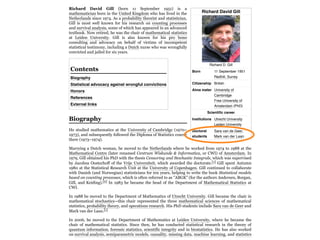
Richa d D. Gill
B 11 Se embe 1951
Redhill, S e
C e B i i h
A a a e U i e i f
Camb idge
F ee U i e i f
Am e dam (PhD)
Sc e c ca ee
I U ech U i e i
Leide U i e i
D c a
de
Sa a a de Gee ,
Ma k a de Laa
R a Da G ( 11 S 1951)
K
N 1974. A ,
G
,
. N ,
L . G
, D
.
B a
S a ca ad cac a a f c c
H
Refe e ce
E e a
H C (1970
1973), D S
(1973 1974).
M D , N 1974 1988
M C ( C W & I a a, C I) A . I
1979, G P D C a S a I a ,
J O , . 1 G A
1980 S R C . G
D ( N ) , S a a
ba , "ABGK" ( A , B ,
G , K ). 2 I 1983 D M S
C I.
I 1988 D M . G
, , . H P D S G
M L . 1
I 2006, D M L ,
. S ,
, , . H
, , , , ,
C
B a
M
F
I LE CI ED B EA
K A , B , D G , N K
5152 1993
C ' :
K A , D G
, 1100-1120
4257 1982
C
D G
M C , A (MC 124)
973 1980
A
GG N , D G , K A , IA
, 25-43
710 1992
L
D GILL
504 1981
A -
D G , J
, 1501-1555
503 1990
N - - M
( 1)
D G
J , 97-128
497 1989
A : B C -
D G , B L
B 1 (1-2), 59-79
351 1995
D G , M
A 61, 042312 (16 .)
269 2000
*
*
A 2015
C 18656 4895
- 47 29
10- 85 51
CI ED B EA
5152 1993
4257 1982
973 1980
710 1992
*
• The case of Lucia de B
• Martingale methods designed to fight quantum crackpots
adopted in “loophole-free” Bell experiments
• Major depressive episodes; heart failure; …
Life-changers
• Occasional master and bachelor project supervision
• Occasional master exam chair
• Participate in some seminars and study groups
AttheMI
LETTER doi:10.1038/nature15759
Loophole-free Bell inequality violation using
electron spins separated by 1.3 kilometres
B. Hensen1,2
, H. Bernien1,2
{, A. E. Dréau1,2
, A. Reiserer1,2
, N. Kalb1,2
, M. S. Blok1,2
, J. Ruitenberg1,2
, R. F. L. Vermeulen1,2
,
R. N. Schouten1,2
, C. Abellán3
, W. Amaya3
, V. Pruneri3,4
, M. W. Mitchell3,4
, M. Markham5
, D. J. Twitchen5
, D. Elkouss1
,
S. Wehner1
, T. H. Taminiau1,2
& R. Hanson1,2
More than 50 years ago1
, John Bell proved that no theory of nature
that obeys locality and realism2
can reproduce all the predictions of
quantum theory: in any local-realist theory, the correlations
between outcomes of measurements on distant particles satisfy
an inequality that can be violated if the particles are entangled.
Numerous Bell inequality tests have been reported3–13
; however,
all experiments reported so far required additional assump-
tions to obtain a contradiction with local realism, resulting in
‘loopholes’13–16
. Here we report a Bell experiment that is free of
any such additional assumption and thus directly tests the principles
underlying Bell’s inequality. We use an event-ready scheme17–19
that
enables the generation of robust entanglement between distant
electron spins (estimated state fidelity of 0.92 6 0.03). Efficient
spin read-out avoids the fair-sampling assumption (detection
loophole14,15
), while the use of fast random-basis selection and spin
read-out combined with a spatial separation of 1.3 kilometres
ensure the required locality conditions13
. We performed 245 trials
that tested the CHSH–Bell inequality20
S # 2 and found
S 5 2.42 6 0.20 (where S quantifies the correlation between mea-
surement outcomes). A null-hypothesis test yields a probability
of at most P 5 0.039 that a local-realist model for space-like sepa-
rated sites could produce data with a violation at least as large as
we observe, even when allowing for memory16,21
in the devices.
Our data hence imply statistically significant rejection of the
local-realist null hypothesis. This conclusion may be further con-
solidated in future experiments; for instance, reaching a value of
P 5 0.001 would require approximately 700 trials for an observed
S 5 2.4. With improvements, our experiment could be used for
testing less-conventional theories, and for implementing device-
independent quantum-secure communication22
and randomness
certification23,24
.
We consider a Bell test in the form proposed by Clauser, Horne,
Shimony and Holt (CHSH)20
(Fig. 1a). The test involves two boxes
labelled A and B. Each box accepts a binary input (0 or 1) and subse-
quently delivers a binary output (11 or 21). In each trial of the Bell
test, a random input bit is generated on each side and input to the
respective box. The random input bit triggers the box to produce an
sufficiently separated such that locality prevents communication
between the boxes during a trial, then the following inequality holds
under local realism:
S~ x:y
h i(0,0)z x:y
h i(0,1)z x:y
h i(1,0){ x:y
h i(1,1)
!
!
!
!
!
!ƒ2 ð1Þ
where Æx ? yæ(a,b) denotes the expectation value of the product of x and y
for input bits a and b. (A mathematical formulation of the concepts
underlying Bell’s inequality is found in, for example, ref. 25.)
Quantum theory predicts that the Bell inequality canbe significantly
violated in the following setting. We add one particle, for example an
electron, to each box. The spin degree of freedom of the electron forms
a two-level system with eigenstates j"æ and j#æ. For each trial, the two
spins are prepared into the entangled state jy{
i~ j:;i{j;:i
ð Þ
" ffiffiffi
2
p
.
The spin in box A is then measured along direction Z (for input bit
a 5 0) or X (for a 5 1) and the spin in box B is measured along
{ZzX
ð Þ
" ffiffiffi
2
p
(for b 5 0) or {Z{X
ð Þ
" ffiffiffi
2
p
(for b 5 1). If the mea-
surement outcomes are used as outputs of the boxes, then quantum
theory predicts a value of S~2
ffiffiffi
2
p
, which shows that the combination
of locality and realism is fundamentally incompatible with the predic-
tions of quantum mechanics.
Bell’s inequalityprovides a powerful recipe forprobing fundamental
properties of nature: all local-realist theories that specify where and
when the free random input bits and the output values are generated
can be experimentally tested against it.
Violating Bell’s inequality with entangled particles poses two main
challenges: excluding any possible communication between the boxes
(locality loophole13
) and guaranteeing efficient measurements (detec-
tion loophole14,15
). First, if communication is possible, a box can in
principle respond using knowledge of both input settings, rendering
the Bell inequality invalid. The locality conditions thus require boxes A
and B and their respective free-input-bit generations to be separated in
such a way that signals travelling at the speed of light (the maximum
allowed under special relativity) cannot communicate the local input
setting of box A to box B, before the output value of box B has been
recorded, and vice versa. Second, disregarding trials in which a box
does not produce an output bit (that is, assuming fair sampling) would
allow the boxes to select trials on the basis of the input setting. The fair
this case, the null hypothesis that an arbitrary local-realist model of
space-like separated sites governs our experiment is rejected with a P
value of 0.039 (Fig. 4b). This P value might be further tightened in
future experiments.
Our experiment realizes the first Bell test that simultaneously
addresses both the detection loophole and the locality loophole.
Being free of the experimental loopholes, the set-up tests local-realist
theories of nature without introducing extra assumptions such as fair
sampling, a limit on (sub-)luminal communication or the absence of
memory in the set-up. Our observation of a statistically significant
loophole-free Bell inequality violation thus indicates rejection of all
local-realist theories that accept that the number generators produce a
free random bit in a timely manner and that the outputs are final once
recorded in the electronics.
Strictly speaking, no Bell experiment can exclude all conceivable
local-realist theories, because it is fundamentally impossible to prove
when and where free random input bits and output values came into
existence13
. Even so, our loophole-free Bell test opens the possibility to
progressively bound such less-conventional theories: by increasing the
distance between A and B (for example, to test theories with increased
speed of physical influence); by using different random input bit gen-
erators (to test theories with specific free-will agents, for example,
humans); or by repositioning the random input bit generators (to
test theories where the inputs are already determined earlier, some-
times referred to as ‘freedom-of-choice’9
). In fact, our experiment
already enables tests of all models that predict that the random inputs
are determined a maximum of 690 ns before we record them
(Supplementary Information).
Combining the presented event-ready scheme with higher entang-
ling rates (for example, through the use of optical cavities) provides
prospects for the implementation of device-independent quantum key
22 23,24
12. Christensen, B. G. et al. Detection-loophole-free test of quantum nonlocality, an
applications. Phys. Rev. Lett. 111, 130406 (2013).
13. Brunner, N., Cavalcanti,D., Pironio, S., Scarani, V. & Wehner, S. Bellnonlocality.Re
Mod. Phys. 86, 419–478 (2014).
14. Garg, A. & Mermin, N. D. Detector inefficiencies in the Einstein-Podolsky-Rosen
experiment. Phys. Rev. D 35, 3831–3835 (1987).
15. Eberhard, P. H. Background level and counter efficiencies required for a loophol
free Einstein-Podolsky-Rosen experiment. Phys. Rev. A 47, R747–R750 (1993)
16. Barrett, J., Collins, D., Hardy, L., Kent, A. & Popescu, S. Quantum nonlocality, Be
inequalities, and the memory loophole. Phys. Rev. A 66, 042111 (2002).
17. Bell, J. S. Atomic-cascade photons and quantum-mechanical nonlocality.
Comments Atom. Mol. Phys. 9, 121–126 (1980).
18. Żukowski, M., Zeilinger, A., Horne, M. A. & Ekert, A. K. “Event-ready-detectors” B
experiment via entanglement swapping. Phys. Rev. Lett. 71, 4287–4290 (1993
19. Simon,C.&Irvine,W.T.M.Robustlong-distanceentanglementandaloophole-fr
Bell test with ions and photons. Phys. Rev. Lett. 91, 110405 (2003).
20. Clauser, J. F., Horne, M. A., Shimony, A. & Holt, R. A. Proposed experiment to tes
local hidden-variable theories. Phys. Rev. Lett. 23, 880–884 (1969).
21. Gill, R. D. Time, finite statistics, and Bell’s fifth position. In Proc. Foundations of
Probability and Physics 2 179–206 (Växjö Univ. Press, 2003).
22. Acı́n, A. et al. Device-independent security of quantum cryptography against
collective attacks. Phys. Rev. Lett. 98, 230501 (2007).
23. Colbeck, R. Quantum and Relativistic Protocols for Secure Multi-Party Computatio
PhD thesis, Univ. Cambridge (2007); http://arxiv.org/abs/0911.3814.
24. Pironio, S. et al. Random numbers certified by Bell’s theorem. Nature 464,
1021–1024 (2010).
25. Bell, J. S. Speakable and Unspeakable in Quantum Mechanics: Collected Papers o
Quantum Philosophy 2nd edn (Cambridge Univ. Press, 2004).
26. Gerhardt, I. et al.Experimentally faking the violation of Bell’s inequalities. Phys. Re
Lett. 107, 170404 (2011).
27. Robledo, L. et al. High-fidelity projective read-out of a solid-state spin quantum
register. Nature 477, 574–578 (2011).
28. Barrett, S. D. & Kok, P. Efficient high-fidelity quantum computation using matte
qubits and linear optics. Phys. Rev. A 71, 060310 (2005).
29. Bernien, H. et al. Heralded entanglement between solid-state qubits separated b
three metres. Nature 497, 86–90 (2013).
30. Abellan, C., Amaya, W., Mitrani, D., Pruneri, V. & Mitchell, M. W. Generation of fres
andpurerandomnumbersforloophole-freeBelltests.Preprintavailableathttp:
arxiv.org/abs/1506.02712.
31. Hong, C. K., Ou, Z. Y. & Mandel, L. Measurement of subpicosecond time interva
between two photons by interference. Phys. Rev. Lett. 59, 2044–2046 (1987).
RESEARCH LETTER
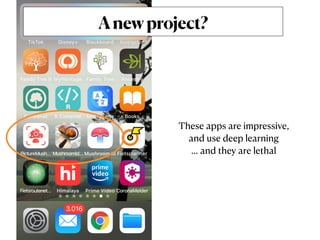
Anewproject?
These apps are impressive,
and use deep learning
… and they are lethal
Macrolepiota procera
Parasol mushroom
Grote parasolzwam
Amanita muscaria
Fly agaric
Vliegenzwam
Leucoagaricus leucothites
White dapperling
Blanke champignonparasol Laetiporus sulphureus
Chicken of the woods
Gewone zwavelzwam
Amanita phalloides
Death cap
Groene knolamaniet
Fistulina hepatica
Beefsteak mushroom
Biefstukzwam
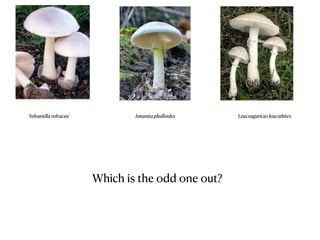
Volvariella volvacea Amanita phalloides Leucoagaricus leucothites
Which is the odd one out?
• Volvariella volvacea : straw mushroom /  tropische
beurszwam, rijststro-paddenstoel
• Amanita virosa : destroying angel / kleverige knolamaniet
• Leucoagaricus leucothites : white dapperling, white Agaricus
mushroom / Blanke champignonparasol
Answers
Each of the three is an odd one out on a number of different criteria
For example:
Volvariella volvacea is not native to Europe, the others are common here.
Amanita virosa is deadly, the others are delicious.
Leucoagaricus leucothites does not have a Dutch Wikipedia page (the Dutch find white mushrooms with white gills frightening)

Intro Richard Gill

  • 1.
    Introduction Richard Gill, Statisticslunch seminar MI, 19 October 2020 https://www.math.leidenuniv.nl/~gill gill@math.leidenuniv.nl This version: 17/10/21
  • 2.
    • Family • Cyclingand walking • Nature and the environment • Art, film, reading, music, home wine brewing, … • Running old mac’s, genealogy, … • Fungi (especially edible mushrooms) • Buddhism and meditation • Fighting injustice • Scientific integrity • Forensic statistics • Statistics in the media and in popular science • Quantum information and quantum foundations Interests (Theravada; Vipassana) Henk Barendregt Daniel Ingram
  • 3.
    • Twice, amain suspect in a criminal investigation • Once, threatened with civil legal action by most evil law firm in NL (mission: protect reputation of powerful people) • Once, subject of a Leiden University investigation into alleged violation of scientific integrity • Several powerful enemies … • Twice banned from editing Wikipedia Fightinginjustice;scientificintegrity;forensicstatistics: thedownside
  • 4.
    R c ad Da d G Richa d D. Gill B 11 Se embe 1951 Redhill, S e C e B i i h A a a e U i e i f Camb idge F ee U i e i f Am e dam (PhD) Sc e c ca ee I U ech U i e i Leide U i e i D c a de Sa a a de Gee , Ma k a de Laa R a Da G ( 11 S 1951) K N 1974. A , G , . N , L . G , D . B a S a ca ad cac a a f c c H Refe e ce E e a H C (1970 1973), D S (1973 1974). M D , N 1974 1988 M C ( C W & I a a, C I) A . I 1979, G P D C a S a I a , J O , . 1 G A 1980 S R C . G D ( N ) , S a a ba , "ABGK" ( A , B , G , K ). 2 I 1983 D M S C I. I 1988 D M . G , , . H P D S G M L . 1 I 2006, D M L , . S , , , . H , , , , , C B a
  • 5.
    M F I LE CIED B EA K A , B , D G , N K 5152 1993 C ' : K A , D G , 1100-1120 4257 1982 C D G M C , A (MC 124) 973 1980 A GG N , D G , K A , IA , 25-43 710 1992 L D GILL 504 1981 A - D G , J , 1501-1555 503 1990 N - - M ( 1) D G J , 97-128 497 1989 A : B C - D G , B L B 1 (1-2), 59-79 351 1995 D G , M A 61, 042312 (16 .) 269 2000 * * A 2015 C 18656 4895 - 47 29 10- 85 51 CI ED B EA 5152 1993 4257 1982 973 1980 710 1992 *
  • 6.
    • The caseof Lucia de B • Martingale methods designed to fight quantum crackpots adopted in “loophole-free” Bell experiments • Major depressive episodes; heart failure; … Life-changers • Occasional master and bachelor project supervision • Occasional master exam chair • Participate in some seminars and study groups AttheMI LETTER doi:10.1038/nature15759 Loophole-free Bell inequality violation using electron spins separated by 1.3 kilometres B. Hensen1,2 , H. Bernien1,2 {, A. E. Dréau1,2 , A. Reiserer1,2 , N. Kalb1,2 , M. S. Blok1,2 , J. Ruitenberg1,2 , R. F. L. Vermeulen1,2 , R. N. Schouten1,2 , C. Abellán3 , W. Amaya3 , V. Pruneri3,4 , M. W. Mitchell3,4 , M. Markham5 , D. J. Twitchen5 , D. Elkouss1 , S. Wehner1 , T. H. Taminiau1,2 & R. Hanson1,2 More than 50 years ago1 , John Bell proved that no theory of nature that obeys locality and realism2 can reproduce all the predictions of quantum theory: in any local-realist theory, the correlations between outcomes of measurements on distant particles satisfy an inequality that can be violated if the particles are entangled. Numerous Bell inequality tests have been reported3–13 ; however, all experiments reported so far required additional assump- tions to obtain a contradiction with local realism, resulting in ‘loopholes’13–16 . Here we report a Bell experiment that is free of any such additional assumption and thus directly tests the principles underlying Bell’s inequality. We use an event-ready scheme17–19 that enables the generation of robust entanglement between distant electron spins (estimated state fidelity of 0.92 6 0.03). Efficient spin read-out avoids the fair-sampling assumption (detection loophole14,15 ), while the use of fast random-basis selection and spin read-out combined with a spatial separation of 1.3 kilometres ensure the required locality conditions13 . We performed 245 trials that tested the CHSH–Bell inequality20 S # 2 and found S 5 2.42 6 0.20 (where S quantifies the correlation between mea- surement outcomes). A null-hypothesis test yields a probability of at most P 5 0.039 that a local-realist model for space-like sepa- rated sites could produce data with a violation at least as large as we observe, even when allowing for memory16,21 in the devices. Our data hence imply statistically significant rejection of the local-realist null hypothesis. This conclusion may be further con- solidated in future experiments; for instance, reaching a value of P 5 0.001 would require approximately 700 trials for an observed S 5 2.4. With improvements, our experiment could be used for testing less-conventional theories, and for implementing device- independent quantum-secure communication22 and randomness certification23,24 . We consider a Bell test in the form proposed by Clauser, Horne, Shimony and Holt (CHSH)20 (Fig. 1a). The test involves two boxes labelled A and B. Each box accepts a binary input (0 or 1) and subse- quently delivers a binary output (11 or 21). In each trial of the Bell test, a random input bit is generated on each side and input to the respective box. The random input bit triggers the box to produce an sufficiently separated such that locality prevents communication between the boxes during a trial, then the following inequality holds under local realism: S~ x:y h i(0,0)z x:y h i(0,1)z x:y h i(1,0){ x:y h i(1,1) ! ! ! ! ! !ƒ2 ð1Þ where Æx ? yæ(a,b) denotes the expectation value of the product of x and y for input bits a and b. (A mathematical formulation of the concepts underlying Bell’s inequality is found in, for example, ref. 25.) Quantum theory predicts that the Bell inequality canbe significantly violated in the following setting. We add one particle, for example an electron, to each box. The spin degree of freedom of the electron forms a two-level system with eigenstates j"æ and j#æ. For each trial, the two spins are prepared into the entangled state jy{ i~ j:;i{j;:i ð Þ " ffiffiffi 2 p . The spin in box A is then measured along direction Z (for input bit a 5 0) or X (for a 5 1) and the spin in box B is measured along {ZzX ð Þ " ffiffiffi 2 p (for b 5 0) or {Z{X ð Þ " ffiffiffi 2 p (for b 5 1). If the mea- surement outcomes are used as outputs of the boxes, then quantum theory predicts a value of S~2 ffiffiffi 2 p , which shows that the combination of locality and realism is fundamentally incompatible with the predic- tions of quantum mechanics. Bell’s inequalityprovides a powerful recipe forprobing fundamental properties of nature: all local-realist theories that specify where and when the free random input bits and the output values are generated can be experimentally tested against it. Violating Bell’s inequality with entangled particles poses two main challenges: excluding any possible communication between the boxes (locality loophole13 ) and guaranteeing efficient measurements (detec- tion loophole14,15 ). First, if communication is possible, a box can in principle respond using knowledge of both input settings, rendering the Bell inequality invalid. The locality conditions thus require boxes A and B and their respective free-input-bit generations to be separated in such a way that signals travelling at the speed of light (the maximum allowed under special relativity) cannot communicate the local input setting of box A to box B, before the output value of box B has been recorded, and vice versa. Second, disregarding trials in which a box does not produce an output bit (that is, assuming fair sampling) would allow the boxes to select trials on the basis of the input setting. The fair this case, the null hypothesis that an arbitrary local-realist model of space-like separated sites governs our experiment is rejected with a P value of 0.039 (Fig. 4b). This P value might be further tightened in future experiments. Our experiment realizes the first Bell test that simultaneously addresses both the detection loophole and the locality loophole. Being free of the experimental loopholes, the set-up tests local-realist theories of nature without introducing extra assumptions such as fair sampling, a limit on (sub-)luminal communication or the absence of memory in the set-up. Our observation of a statistically significant loophole-free Bell inequality violation thus indicates rejection of all local-realist theories that accept that the number generators produce a free random bit in a timely manner and that the outputs are final once recorded in the electronics. Strictly speaking, no Bell experiment can exclude all conceivable local-realist theories, because it is fundamentally impossible to prove when and where free random input bits and output values came into existence13 . Even so, our loophole-free Bell test opens the possibility to progressively bound such less-conventional theories: by increasing the distance between A and B (for example, to test theories with increased speed of physical influence); by using different random input bit gen- erators (to test theories with specific free-will agents, for example, humans); or by repositioning the random input bit generators (to test theories where the inputs are already determined earlier, some- times referred to as ‘freedom-of-choice’9 ). In fact, our experiment already enables tests of all models that predict that the random inputs are determined a maximum of 690 ns before we record them (Supplementary Information). Combining the presented event-ready scheme with higher entang- ling rates (for example, through the use of optical cavities) provides prospects for the implementation of device-independent quantum key 22 23,24 12. Christensen, B. G. et al. Detection-loophole-free test of quantum nonlocality, an applications. Phys. Rev. Lett. 111, 130406 (2013). 13. Brunner, N., Cavalcanti,D., Pironio, S., Scarani, V. & Wehner, S. Bellnonlocality.Re Mod. Phys. 86, 419–478 (2014). 14. Garg, A. & Mermin, N. D. Detector inefficiencies in the Einstein-Podolsky-Rosen experiment. Phys. Rev. D 35, 3831–3835 (1987). 15. Eberhard, P. H. Background level and counter efficiencies required for a loophol free Einstein-Podolsky-Rosen experiment. Phys. Rev. A 47, R747–R750 (1993) 16. Barrett, J., Collins, D., Hardy, L., Kent, A. & Popescu, S. Quantum nonlocality, Be inequalities, and the memory loophole. Phys. Rev. A 66, 042111 (2002). 17. Bell, J. S. Atomic-cascade photons and quantum-mechanical nonlocality. Comments Atom. Mol. Phys. 9, 121–126 (1980). 18. Żukowski, M., Zeilinger, A., Horne, M. A. & Ekert, A. K. “Event-ready-detectors” B experiment via entanglement swapping. Phys. Rev. Lett. 71, 4287–4290 (1993 19. Simon,C.&Irvine,W.T.M.Robustlong-distanceentanglementandaloophole-fr Bell test with ions and photons. Phys. Rev. Lett. 91, 110405 (2003). 20. Clauser, J. F., Horne, M. A., Shimony, A. & Holt, R. A. Proposed experiment to tes local hidden-variable theories. Phys. Rev. Lett. 23, 880–884 (1969). 21. Gill, R. D. Time, finite statistics, and Bell’s fifth position. In Proc. Foundations of Probability and Physics 2 179–206 (Växjö Univ. Press, 2003). 22. Acı́n, A. et al. Device-independent security of quantum cryptography against collective attacks. Phys. Rev. Lett. 98, 230501 (2007). 23. Colbeck, R. Quantum and Relativistic Protocols for Secure Multi-Party Computatio PhD thesis, Univ. Cambridge (2007); http://arxiv.org/abs/0911.3814. 24. Pironio, S. et al. Random numbers certified by Bell’s theorem. Nature 464, 1021–1024 (2010). 25. Bell, J. S. Speakable and Unspeakable in Quantum Mechanics: Collected Papers o Quantum Philosophy 2nd edn (Cambridge Univ. Press, 2004). 26. Gerhardt, I. et al.Experimentally faking the violation of Bell’s inequalities. Phys. Re Lett. 107, 170404 (2011). 27. Robledo, L. et al. High-fidelity projective read-out of a solid-state spin quantum register. Nature 477, 574–578 (2011). 28. Barrett, S. D. & Kok, P. Efficient high-fidelity quantum computation using matte qubits and linear optics. Phys. Rev. A 71, 060310 (2005). 29. Bernien, H. et al. Heralded entanglement between solid-state qubits separated b three metres. Nature 497, 86–90 (2013). 30. Abellan, C., Amaya, W., Mitrani, D., Pruneri, V. & Mitchell, M. W. Generation of fres andpurerandomnumbersforloophole-freeBelltests.Preprintavailableathttp: arxiv.org/abs/1506.02712. 31. Hong, C. K., Ou, Z. Y. & Mandel, L. Measurement of subpicosecond time interva between two photons by interference. Phys. Rev. Lett. 59, 2044–2046 (1987). RESEARCH LETTER
  • 7.
    Anewproject? These apps areimpressive, and use deep learning … and they are lethal
  • 8.
    Macrolepiota procera Parasol mushroom Groteparasolzwam Amanita muscaria Fly agaric Vliegenzwam Leucoagaricus leucothites White dapperling Blanke champignonparasol Laetiporus sulphureus Chicken of the woods Gewone zwavelzwam Amanita phalloides Death cap Groene knolamaniet Fistulina hepatica Beefsteak mushroom Biefstukzwam
  • 9.
    Volvariella volvacea Amanitaphalloides Leucoagaricus leucothites Which is the odd one out?
  • 10.
    • Volvariella volvacea: straw mushroom /  tropische beurszwam, rijststro-paddenstoel • Amanita virosa : destroying angel / kleverige knolamaniet • Leucoagaricus leucothites : white dapperling, white Agaricus mushroom / Blanke champignonparasol Answers Each of the three is an odd one out on a number of different criteria For example: Volvariella volvacea is not native to Europe, the others are common here. Amanita virosa is deadly, the others are delicious. Leucoagaricus leucothites does not have a Dutch Wikipedia page (the Dutch find white mushrooms with white gills frightening)