ENTREPRENEURSHIP
Lecture No: 23
Resource Person:
Malik Jawad Saboor
Assistant Professor
Department of Management Sciences
COMSATS University Islamabad.
Previous Lecture Review
• Define Elevator Pitch
• Elevator Pitch Must Haves & Cautions
• Elements of Pitch
• Dragon’s Den Video
OBJECTIVES
• Define Intrapreneurs
• Types of Corporate Entrepreneurship
• Compensation of Intrapreneurs
• Barriers to Intrapreneurship
• Freedom Factors attached to Intrapreneurship
• Advantages/ Disadvantages of Intrapreneurship
• How Companies can support Intrapreneurs
• Ten Commandments of Intrapreneurship
Definition;
• Entrepreneurship within an existing business.
• The development within a corporation of internal
markets, Or autonomous or semi-autonomous
business units, that produce products, services, or
technologies in a unique way.
• An opportunity for corporate managers to take
initiative & try new ideas.
• An internal corporate venture (ICV)
Intrapreneurship
Intrapreneurship is based on the concept of using
entrepreneurial skills within an established firm by
encouraging innovation by employees.
These employees can use start-up business techniques
within a firm (large, medium, or small) to create new
products or services from existing products or services, or
create new synergistic products or services for the
company.
This is accomplished by allowing and fostering non
traditional thinking and by encouraging and supporting
the use of “out of the box thinking” within the firm.
Examples
• Google allows engineers “20-percent time” so
that they’re free to work on projects in which
they they have a personal interest
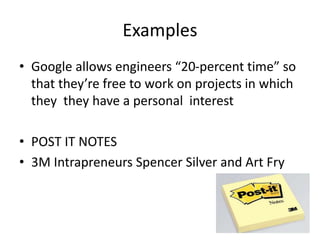
• POST IT NOTES
• 3M Intrapreneurs Spencer Silver and Art Fry
Models of Corporate Entrepreneurship
• Administrative Model
• Opportunistic Model
• Acquisitive Model
• Imitative Model
• Incubative Model
Compensation of Intrapreneurs
• Traditional
• SBU
• Corporate Spin Off
Skills required
• It takes a unique set of skills beyond creativity
in order to become a successful intrapreneur.
An intrapreneur must be willing to take some
risks at sharing and pushing an unique idea,
have the perseverance to wait for senior
management’s final approval to create and
launch a product or service, and possess the
drive to see the idea through to fruition, no
matter what.
The barriers
• Corporate bureaucracy
• Internal product competition
• Competing demands for resources
• Resistance to change
• Absence of “internal venture capitalists” for guidance
• employees’ lack of ownership reduces commitment
• Corporate environment not as free to creative people
as entrepreneurial environment.
Advantages of Intrapreneuring over
Entrepreneuring
• Capital Sources
• Access to customers
• Infrastructure
• Management Pools
• Leverage on an existing business
Disadvantages of Intrapreneuring over
Entrepreneuring
• Continuity of Sponsorship
• P & L Focus
• Short Term Mentality
• Corporate Meddling, Bureaucracy, Decision by
committee
• Lack of Passion
• Have to be big to be material
• Aversion to risk
13
10 Commandments of Intrapreneurs
 Do any job to make your project work, regardless of your job
description
 Share credit (for success) wisely
 It is easier to ask for forgiveness than permission
 Come to work each day willing to be fired
 Ask for advice before asking for resources
 Follow your intuition about people, build a team of the best
 Build a quiet coalition for your idea; Never bet on a race unless your
are running in it
 Be true to your goals, but realistic about ways to achieve them
 Honour your sponsors
Lecture Review
Reference: Entrepreneurship, New Venture Creation by Holt
Misc. Web Resources
• Define Intrapreneurs
• Types of Corporate Entrepreneurship
• Compensation of Intrapreneurs
• Barriers to Intrapreneurship
• Freedom Factors attached to Intrapreneurship
• Advantages/ Disadvantages of Intrapreneurship
• How Companies can support Intrapreneurs
• Ten Commandments of Intrapreneurship

Intrapreneurship dynamics in Pakistani Context

  • 1.
    ENTREPRENEURSHIP Lecture No: 23 ResourcePerson: Malik Jawad Saboor Assistant Professor Department of Management Sciences COMSATS University Islamabad.
  • 2.
    Previous Lecture Review •Define Elevator Pitch • Elevator Pitch Must Haves & Cautions • Elements of Pitch • Dragon’s Den Video
  • 3.
    OBJECTIVES • Define Intrapreneurs •Types of Corporate Entrepreneurship • Compensation of Intrapreneurs • Barriers to Intrapreneurship • Freedom Factors attached to Intrapreneurship • Advantages/ Disadvantages of Intrapreneurship • How Companies can support Intrapreneurs • Ten Commandments of Intrapreneurship
  • 4.
    Definition; • Entrepreneurship withinan existing business. • The development within a corporation of internal markets, Or autonomous or semi-autonomous business units, that produce products, services, or technologies in a unique way. • An opportunity for corporate managers to take initiative & try new ideas. • An internal corporate venture (ICV)
  • 5.
    Intrapreneurship Intrapreneurship is basedon the concept of using entrepreneurial skills within an established firm by encouraging innovation by employees. These employees can use start-up business techniques within a firm (large, medium, or small) to create new products or services from existing products or services, or create new synergistic products or services for the company. This is accomplished by allowing and fostering non traditional thinking and by encouraging and supporting the use of “out of the box thinking” within the firm.
  • 6.
    Examples • Google allowsengineers “20-percent time” so that they’re free to work on projects in which they they have a personal interest • POST IT NOTES • 3M Intrapreneurs Spencer Silver and Art Fry
  • 7.
    Models of CorporateEntrepreneurship • Administrative Model • Opportunistic Model • Acquisitive Model • Imitative Model • Incubative Model
  • 8.
    Compensation of Intrapreneurs •Traditional • SBU • Corporate Spin Off
  • 9.
    Skills required • Ittakes a unique set of skills beyond creativity in order to become a successful intrapreneur. An intrapreneur must be willing to take some risks at sharing and pushing an unique idea, have the perseverance to wait for senior management’s final approval to create and launch a product or service, and possess the drive to see the idea through to fruition, no matter what.
  • 10.
    The barriers • Corporatebureaucracy • Internal product competition • Competing demands for resources • Resistance to change • Absence of “internal venture capitalists” for guidance • employees’ lack of ownership reduces commitment • Corporate environment not as free to creative people as entrepreneurial environment.
  • 11.
    Advantages of Intrapreneuringover Entrepreneuring • Capital Sources • Access to customers • Infrastructure • Management Pools • Leverage on an existing business
  • 12.
    Disadvantages of Intrapreneuringover Entrepreneuring • Continuity of Sponsorship • P & L Focus • Short Term Mentality • Corporate Meddling, Bureaucracy, Decision by committee • Lack of Passion • Have to be big to be material • Aversion to risk
  • 13.
    13 10 Commandments ofIntrapreneurs  Do any job to make your project work, regardless of your job description  Share credit (for success) wisely  It is easier to ask for forgiveness than permission  Come to work each day willing to be fired  Ask for advice before asking for resources  Follow your intuition about people, build a team of the best  Build a quiet coalition for your idea; Never bet on a race unless your are running in it  Be true to your goals, but realistic about ways to achieve them  Honour your sponsors
  • 14.
    Lecture Review Reference: Entrepreneurship,New Venture Creation by Holt Misc. Web Resources • Define Intrapreneurs • Types of Corporate Entrepreneurship • Compensation of Intrapreneurs • Barriers to Intrapreneurship • Freedom Factors attached to Intrapreneurship • Advantages/ Disadvantages of Intrapreneurship • How Companies can support Intrapreneurs • Ten Commandments of Intrapreneurship