INTERPLAY BETWEEN CONSUMER MINDFULLNESS AND IMPLUSIVE BUYING
1.
Hannah Morales
Connor Hamilton
AlexanderAronowitz
Our Team
The Interplay Between Consumer Mindfulness and Impulsive Buying:
Exploring Key Behavioral Drivers.
Presented by
Soumyaranjan Panda Subhasis Bhattachary Sourav Pattanayak Soumya Suraj Samantaray
PGDM Student PGDM Student PGDM Student PGDM Student
Institute Of Management Of Information Science (IMIS), Bhubaneswar
2.
Contents
1. Abstract
2. Introduction
3.Literature Review
4. Objective of the study
5. Research Methodology
6. Data Analysis & Findings
7. Findings
8. References
9. Conclusion
3.
Abstract
Consumer behavior isincreasingly influenced by two contrasting forces—mindfulness and impulsivity—
which shape purchasing decisions. While mindfulness fosters conscious awareness and self-regulation,
impulsive buying reflects spontaneous, emotion-driven consumption patterns. This study aims to explore the
intricate relationship between consumer mindfulness and impulsive buying tendencies, identifying key
psychological and behavioral drivers behind purchasing decisions. Using a structured questionnaire-based
approach, this research assesses individuals' awareness, attention, and self-control in consumer contexts.
The study utilizes validated scales to measure consumer mindfulness, capturing levels of attentiveness,
present-moment focus, and decision awareness. Additionally, the research examines impulse buying
tendencies, exploring how emotional triggers, spontaneous actions, and minimal deliberation contribute to
unplanned purchases. The study sample comprises individuals from diverse age groups, educational
backgrounds, and occupational segments, ensuring a broad representation of consumer behavior.
Findings from this research will offer insights about mindfulness and impulsive buying, potentially leading
to more responsible consumption patterns. Marketers, policymakers, and behavioral economists can leverage
these insights to develop interventions that promote mindful decision-making while understanding the
emotional appeal of impulse-driven purchases.
4.
Introduction
In a worldincreasingly driven by consumerism and material excess, mindfulness has emerged as a
counterforce that promotes deliberate and conscious decision-making (Kabat-Zinn, 2003).
Mindfulness, defined as the awareness that arises through paying attention, on purpose, in the present
moment, and non-judgmentally, has been extensively studied in the context of mental well-being, stress
reduction, and overall life satisfaction (Brown & Ryan, 2003)
Mindful consumption refers to the practice of making conscious, intentional, and ethical purchasing
decisions that consider not just personal needs but also social and environmental impacts (Gupta &
Verma, 2018; Armstrong & Jackson, 2021)
Impulse buying (IB) refers to unplanned, sudden and immediate purchases upon exposure to impulse
stimuli (Bandyopadhyay, 2016) and is prevalent throughout the world.
Marketers often want to induce IB by using marketing-mix variables within their control, such as
product, price, place and promotion.
5.
Literature Review
Mindful consumption(MC) is the manifestation of mindfulness in consumer decision-making (Bahl et al.,
2016).
Milne and Villarroel (2019) explored different consumer segments' perspectives on mindful consumption,
offering insights into how mindfulness influences purchasing decisions across diverse groups.
Yiğit (2020) found that consumers with higher levels of mindfulness exhibit reduced impulse buying
tendencies.
Dhandra (2020) demonstrated that mindfulness fosters present-moment awareness, which in turn reduces
impulsive and addictive buying behaviour.
Amos, Holmes, and Keneson (2014) conducted a systematic literature review on impulse buying,
identifying key psychological, situational, and product-related factors that drive impulsive purchasing
while highlighting gaps in digital shopping research.
Iyer et al. (2020) provided a meta-analytic review, quantifying the impact of emotional states, promotional
activities, and environmental cues on impulse buying behavior, offering valuable insights for both
academic and practical applications.
6.
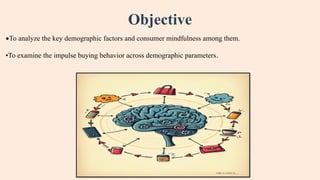
Objective
•To analyze thekey demographic factors and consumer mindfulness among them.
•To examine the impulse buying behavior across demographic parameters.
7.
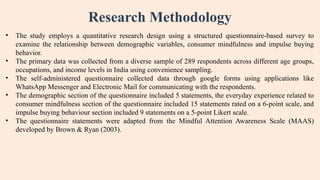
Research Methodology
• Thestudy employs a quantitative research design using a structured questionnaire-based survey to
examine the relationship between demographic variables, consumer mindfulness and impulse buying
behavior.
• The primary data was collected from a diverse sample of 289 respondents across different age groups,
occupations, and income levels in India using convenience sampling.
• The self-administered questionnaire collected data through google forms using applications like
WhatsApp Messenger and Electronic Mail for communicating with the respondents.
• The demographic section of the questionnaire included 5 statements, the everyday experience related to
consumer mindfulness section of the questionnaire included 15 statements rated on a 6-point scale, and
impulse buying behaviour section included 9 statements on a 5-point Likert scale.
• The questionnaire statements were adapted from the Mindful Attention Awareness Scale (MAAS)
developed by Brown & Ryan (2003).
8.
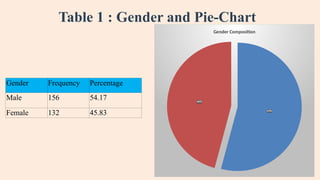
Table 1 :Gender and Pie-Chart
Gender Frequency Percentage
Male 156 54.17
Female 132 45.83 54%
46%
Gender Composition
9.
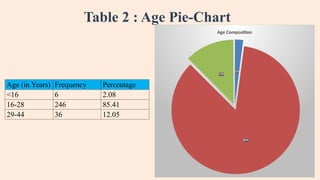
Table 2 :Age Pie-Chart
2%
85%
13%
Age Composition
Age (in Years) Frequency Percentage
<16 6 2.08
16-28 246 85.41
29-44 36 12.05
10.
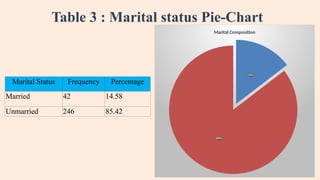
Table 3 :Marital status Pie-Chart
15%
85%
Marital Composition
Marital Status Frequency Percentage
Married 42 14.58
Unmarried 246 85.42
11.
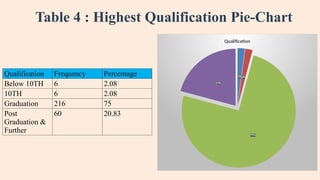
Table 4 :Highest Qualification Pie-Chart
2%2%
75%
21%
Qualification
Qualification Frequency Percentage
Below 10TH 6 2.08
10TH 6 2.08
Graduation 216 75
Post
Graduation &
Further
60 20.83
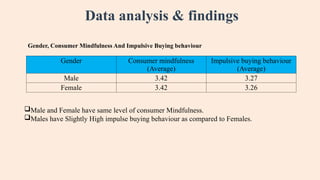
Data analysis &findings
Gender Consumer mindfulness
(Average)
Impulsive buying behaviour
(Average)
Male 3.42 3.27
Female 3.42 3.26
Gender, Consumer Mindfulness And Impulsive Buying behaviour
Male and Female have same level of consumer Mindfulness.
Males have Slightly High impulse buying behaviour as compared to Females.
14.
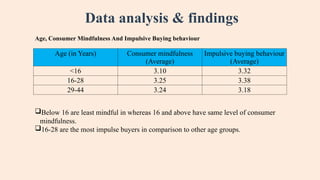
Data analysis &findings
Age (in Years) Consumer mindfulness
(Average)
Impulsive buying behaviour
(Average)
<16 3.10 3.32
16-28 3.25 3.38
29-44 3.24 3.18
Age, Consumer Mindfulness And Impulsive Buying behaviour
Below 16 are least mindful in whereas 16 and above have same level of consumer
mindfulness.
16-28 are the most impulse buyers in comparison to other age groups.
15.
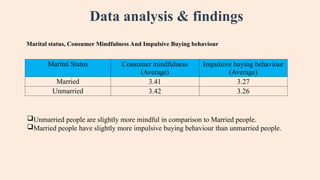
Data analysis &findings
Marital Status Consumer mindfulness
(Average)
Impulsive buying behaviour
(Average)
Married 3.41 3.27
Unmarried 3.42 3.26
Marital status, Consumer Mindfulness And Impulsive Buying behaviour
Unmarried people are slightly more mindful in comparison to Married people.
Married people have slightly more impulsive buying behaviour than unmarried people.
16.
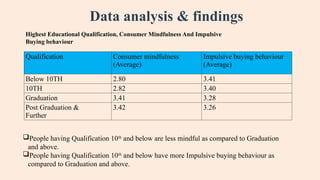
Data analysis &findings
Qualification Consumer mindfulness
(Average)
Impulsive buying behaviour
(Average)
Below 10TH 2.80 3.41
10TH 2.82 3.40
Graduation 3.41 3.28
Post Graduation &
Further
3.42 3.26
Highest Educational Qualification, Consumer Mindfulness And Impulsive
Buying behaviour
People having Qualification 10th
and below are less mindful as compared to Graduation
and above.
People having Qualification 10th
and below have more Impulsive buying behaviour as
compared to Graduation and above.
17.
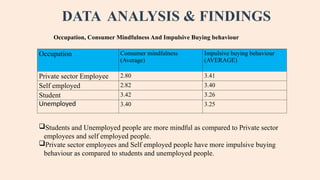
DATA ANALYSIS &FINDINGS
Occupation Consumer mindfulness
(Average)
Impulsive buying behaviour
(AVERAGE)
Private sector Employee 2.80 3.41
Self employed 2.82 3.40
Student 3.42 3.26
Unemployed 3.40 3.25
Occupation, Consumer Mindfulness And Impulsive Buying behaviour
Students and Unemployed people are more mindful as compared to Private sector
employees and self employed people.
Private sector employees and Self employed people have more impulsive buying
behaviour as compared to students and unemployed people.
18.
Findings
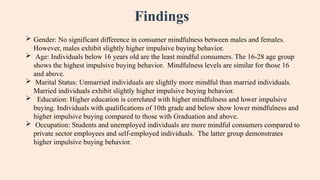
Gender: Nosignificant difference in consumer mindfulness between males and females.
However, males exhibit slightly higher impulsive buying behavior.
Age: Individuals below 16 years old are the least mindful consumers. The 16-28 age group
shows the highest impulsive buying behavior. Mindfulness levels are similar for those 16
and above.
Marital Status: Unmarried individuals are slightly more mindful than married individuals.
Married individuals exhibit slightly higher impulsive buying behavior.
Education: Higher education is correlated with higher mindfulness and lower impulsive
buying. Individuals with qualifications of 10th grade and below show lower mindfulness and
higher impulsive buying compared to those with Graduation and above.
Occupation: Students and unemployed individuals are more mindful consumers compared to
private sector employees and self-employed individuals. The latter group demonstrates
higher impulsive buying behavior.
19.
References
• Kabat-Zinn, J.(2003). Mindfulness-based interventions in context: Past, present, and future. Clinical
Psychology: Science and Practice, 10(2), 144–156.
• Brown, K. W., & Ryan, R. M. (2003). The benefits of being present: Mindfulness and its role in
psychological well-being. Journal of Personality and Social Psychology,84(4), 822–848.
• Gupta, S., & Verma, H. V. (2018). Mindful consumption behavior: Scale development and validation.
Asian Journal of Multidimensional Research, 8(5), 271–278.
• Armstrong, C. M., & Jackson, T. (2021). The mindful consumer: Balancing egoistic and altruistic
motivations to purchase sustainable apparel. Sustainability, 13(4), 2161.
• Bandyopadhyay, N. (2016). The role of self-esteem, negative affect and normative influence in impulse
buying: A study from India. Marketing Intelligence & Planning, 34(4), 523–539.
• Bahl, S., Milne, G. R., Ross, S. M., Mick, D. G., Grier, S. A., Chugani, S. K., Chan, S., Gould, S., Cho, Y.
N., Dorsey, J. D., & Schindler, R. M. (2016). Mindfulness: Its transformative potential for consumer,
societal, and environmental well-being. Journal of Public Policy & Marketing, 35(2), 198–210.
• Milne, G. R., & Villarreal, A. (2019). Consumer perspectives on mindful consumption: An exploratory
study. Journal of Consumer Marketing, 36(1), 21–31.
20.
• Yiğit, M.F. (2020). The effect of mindfulness on impulse buying behavior: The moderating role of
hedonic shopping value. Journal of Business Research-Turk, 12(3), 2330–2342.
• Dhandra, T. K. (2020). Does self-esteem mediate the relationship between mindfulness and impulsive
buying behavior? Services Marketing Quarterly, 41(3), 253–265.
• Amos, C., Holmes, G. R., & Keneson, W. C. (2014). A meta-analysis of consumer impulse buying.
Journal of Retailing and Consumer Services, 21(2), 86–97.
• Iyer, G. R., Blut, M., Xiao, S. H., & Grewal, D. (2020). Impulse buying: A meta-analytic review. Journal
of the Academy of Marketing Science, 48, 384–404.
• Brown, K. W., & Ryan, R. M. (2003). The benefits of being present: Mindfulness and its role in
psychological well-being. Journal of Personality and Social Psychology, 84(4), 822–848.