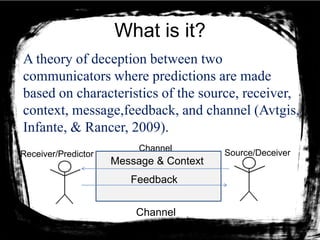
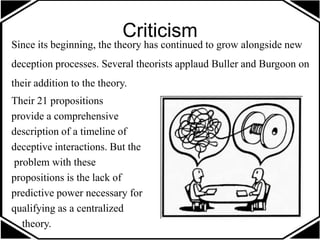
Interpersonal Deception Theory (IDT) is a communication theory that makes predictions about deception based on characteristics of the source, receiver, context, message, feedback, and channel. IDT views deception as a form of strategic communication aimed at effectiveness and appropriateness. To be an effective deceiver according to IDT, one must efficiently handle large amounts of information while allowing the receiver to actively engage with the deceptive message. IDT is used by psychologists, communication researchers, and sociologists and has been expanded on by theorists like Buller and Burgoon who developed 21 propositions to comprehensively describe the timeline of deceptive interactions.