By: Celeste Trevino
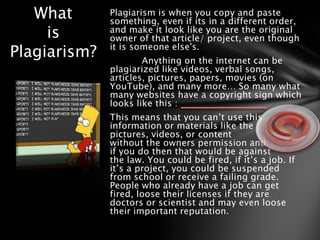
What       Plagiarism is when you copy and paste
              something, even if its in a different order,
     is       and make it look like you are the original
              owner of that article/ project, even though
Plagiarism?   it is someone else's.
                      Anything on the internet can be
              plagiarized like videos, verbal songs,
              articles, pictures, papers, movies (on
              YouTube), and many more… So many what
              many websites have a copyright sign which
              looks like this :
              This means that you can’t use this
              information or materials like the
              pictures, videos, or content
              without the owners permission and
              if you do then that would be against
              the law. You could be fired, if it’s a job. If
              it’s a project, you could be suspended
              from school or receive a failing grade.
              People who already have a job can get
              fired, loose their licenses if they are
              doctors or scientist and may even loose
              their important reputation.
Plagiarism affects you and everyone else.
YOU:
 You don’t learn a thing.
 You wont prosper. Your mind won’t grow if it’s not your
  project. You won’t take your time on it and it won’t make sense.
 You can be excluded from many things if you are caught plagiarizing.
 You can lose important things in your life.
 You will lose respect from other people because you can’t be trusted.
OTHER PEOPLE:
 You can get fined and owe a lot of money to the owners if you get
  caught.
 People may loose credit for their hard work.
 The owner may feel disrespected.
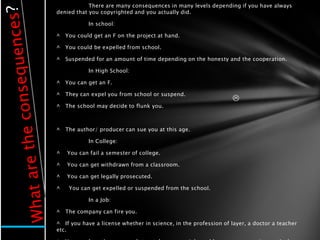
There are many consequences in many levels depending if you have always
denied that you copyrighted and you actually did.

            In school:

^   You could get an F on the project at hand.

^   You could be expelled from school.

^   Suspended for an amount of time depending on the honesty and the cooperation.

            In High School:

^   You can get an F.

^   They can expel you from school or suspend.
                                                                 
^   The school may decide to flunk you.


^   The author/ producer can sue you at this age.

            In College:

^   You can fail a semester of college.

^   You can get withdrawn from a classroom.

^   You can get legally prosecuted.

^    You can get expelled or suspended from the school.

            In a Job:

^   The company can fire you.

^ If you have a license whether in science, in the profession of layer, a doctor a teacher
etc.
DO NOT
PLAGIARIZE
What is Internet?
    The internet is a accumulation of cables and computers which
     holds a lot of business, personal, and governmental hardware
    computers. And a lot of information. The internet is not owned
     by anyone, the government can’t get access and take control
   over the internet, so its open to anyone who has a computer and
                                internet.


            The internet occupies one big hyperlink that “ links” to
   many other pages of information its like some PowerPoint's that
     you can make games and stuff through hyperlinking. But you
    link to HTML pages with free software’s, of the web browsers.


Paul Gil: What is the Internet?
http://netforbeginners.about.com/od/i/f/What-Is-The-Internet.htm
There are 3 Netiquette basics:

       Netiquette of Confidentiality:


          Netiquette of Sending:


          Netiquette of Replying
By The netiquette of confidentiality we
    mean to publish private information put the
   internet or sent to you: like any emails, phone
   numbers, business information put on emails,
 checks, job payments, copying and pasting emails
to other websites. Things that are of value and that
                     are private.
        Forwarding things that are not read is very
dangerous, some can be sent by family and trusted
 people, and others could be commercial and tell
 you to forward to any 50 people and sometimes
             they may carry viruses.
            Respecting copyright on pages is
important. You always need to make sure that you
   have double checked the copyright sign on
                   webpages.
Don’t use the picture at all…or just use it and list
m     the author/publisher if there is no copyright
                       sign.
Etiquette of Sending
                                                on the
                                               Internet
Include an E-mail Address!


                                         One big netiquette is sending: when sending any
                               message make them nice, on point, and short. Its saves time
                               these days for the people who are reading the message and
                             saves time for the person who is writing the message or e-mail.
                                     Of course write correctly and use spaces, so the person
                              who is reading the mail can actually understand the message.
                              When sending be descriptive: like make a short but on-point
                                         subject of what the e-mail is about.
There is a right
                          way to reply!
Netiquette Of Replying
You have to be careful with what you
write on social networks, like, Facebook, Twitter,
MySpace and other things.
       If you put letter in ALL CAPS this is a form of
shouting.
Be careful with pictures that are posted on the
internet.
Ethics Of the Internet

Ethics first of all are rules that are to be followed
               and codes of conduct.
 Like: Netiquette, Copyrighting rules, how you
use your digital technology if its video recorders,
       cameras, iPhones, iPods, iPads etc.
References
Consequences of Plagiarism: Baylor Unknown Author
http://mail.baylorschool.org/~jstover/plagiarism/consequences.htm
Plagiarism and its Consequences: (2012) Unknown Author
http://studiepol.phmetropol.dk/In+English/Studytools/developing+your+wri
ting+skills/Plagiarism+and+its+consequences?educationID=
Netiquette (Internet Etiquette) :(2000) Unknown Author Name
http://www.livinginternet.com/i/ia_nq.htm
Top 10 Netiquette Gudelines: (2007) Jace Shoemaker-Galloway
http://suite101.com/article/netiquette-guidelines-a26615
What is Plagiarism: (2012) Unknown Author
http://www.plagiarism.org/plag_article_what_is_plagiarism.html
Copyright in Cyberspace: Alexander Thomas Snyder (2011) Picture’
https://wikispaces.psu.edu/display/IST432SP11TEAM3/Copyright+in+Cybers
pace
Steal this story? Beware the Nets plagiarism cops: Diane Mapes (2009)
http://www.msnbc.msn.com/id/32657885/ns/technology_and_science-
tech_and_gadgets/t/steal-story-beware-nets-plagiarism-cops/

Internet manners

  • 1.
  • 3.
    What Plagiarism is when you copy and paste something, even if its in a different order, is and make it look like you are the original owner of that article/ project, even though Plagiarism? it is someone else's. Anything on the internet can be plagiarized like videos, verbal songs, articles, pictures, papers, movies (on YouTube), and many more… So many what many websites have a copyright sign which looks like this : This means that you can’t use this information or materials like the pictures, videos, or content without the owners permission and if you do then that would be against the law. You could be fired, if it’s a job. If it’s a project, you could be suspended from school or receive a failing grade. People who already have a job can get fired, loose their licenses if they are doctors or scientist and may even loose their important reputation.
  • 4.
    Plagiarism affects youand everyone else. YOU:  You don’t learn a thing.  You wont prosper. Your mind won’t grow if it’s not your project. You won’t take your time on it and it won’t make sense.  You can be excluded from many things if you are caught plagiarizing.  You can lose important things in your life.  You will lose respect from other people because you can’t be trusted. OTHER PEOPLE:  You can get fined and owe a lot of money to the owners if you get caught.  People may loose credit for their hard work.  The owner may feel disrespected.
  • 5.
    There are manyconsequences in many levels depending if you have always denied that you copyrighted and you actually did. In school: ^ You could get an F on the project at hand. ^ You could be expelled from school. ^ Suspended for an amount of time depending on the honesty and the cooperation. In High School: ^ You can get an F. ^ They can expel you from school or suspend.  ^ The school may decide to flunk you. ^ The author/ producer can sue you at this age. In College: ^ You can fail a semester of college. ^ You can get withdrawn from a classroom. ^ You can get legally prosecuted. ^ You can get expelled or suspended from the school. In a Job: ^ The company can fire you. ^ If you have a license whether in science, in the profession of layer, a doctor a teacher etc.
  • 6.
  • 8.
    What is Internet? The internet is a accumulation of cables and computers which holds a lot of business, personal, and governmental hardware computers. And a lot of information. The internet is not owned by anyone, the government can’t get access and take control over the internet, so its open to anyone who has a computer and internet. The internet occupies one big hyperlink that “ links” to many other pages of information its like some PowerPoint's that you can make games and stuff through hyperlinking. But you link to HTML pages with free software’s, of the web browsers. Paul Gil: What is the Internet? http://netforbeginners.about.com/od/i/f/What-Is-The-Internet.htm
  • 9.
    There are 3Netiquette basics:  Netiquette of Confidentiality:  Netiquette of Sending:  Netiquette of Replying
  • 10.
    By The netiquetteof confidentiality we mean to publish private information put the internet or sent to you: like any emails, phone numbers, business information put on emails, checks, job payments, copying and pasting emails to other websites. Things that are of value and that are private. Forwarding things that are not read is very dangerous, some can be sent by family and trusted people, and others could be commercial and tell you to forward to any 50 people and sometimes they may carry viruses. Respecting copyright on pages is important. You always need to make sure that you have double checked the copyright sign on webpages. Don’t use the picture at all…or just use it and list m the author/publisher if there is no copyright sign.
  • 11.
    Etiquette of Sending on the Internet Include an E-mail Address! One big netiquette is sending: when sending any message make them nice, on point, and short. Its saves time these days for the people who are reading the message and saves time for the person who is writing the message or e-mail. Of course write correctly and use spaces, so the person who is reading the mail can actually understand the message. When sending be descriptive: like make a short but on-point subject of what the e-mail is about.
  • 12.
    There is aright way to reply! Netiquette Of Replying
  • 13.
    You have tobe careful with what you write on social networks, like, Facebook, Twitter, MySpace and other things. If you put letter in ALL CAPS this is a form of shouting. Be careful with pictures that are posted on the internet.
  • 14.
    Ethics Of theInternet Ethics first of all are rules that are to be followed and codes of conduct. Like: Netiquette, Copyrighting rules, how you use your digital technology if its video recorders, cameras, iPhones, iPods, iPads etc.
  • 15.
    References Consequences of Plagiarism:Baylor Unknown Author http://mail.baylorschool.org/~jstover/plagiarism/consequences.htm Plagiarism and its Consequences: (2012) Unknown Author http://studiepol.phmetropol.dk/In+English/Studytools/developing+your+wri ting+skills/Plagiarism+and+its+consequences?educationID= Netiquette (Internet Etiquette) :(2000) Unknown Author Name http://www.livinginternet.com/i/ia_nq.htm Top 10 Netiquette Gudelines: (2007) Jace Shoemaker-Galloway http://suite101.com/article/netiquette-guidelines-a26615 What is Plagiarism: (2012) Unknown Author http://www.plagiarism.org/plag_article_what_is_plagiarism.html Copyright in Cyberspace: Alexander Thomas Snyder (2011) Picture’ https://wikispaces.psu.edu/display/IST432SP11TEAM3/Copyright+in+Cybers pace Steal this story? Beware the Nets plagiarism cops: Diane Mapes (2009) http://www.msnbc.msn.com/id/32657885/ns/technology_and_science- tech_and_gadgets/t/steal-story-beware-nets-plagiarism-cops/

Editor's Notes

  • #6 
  • #8 Internet Etiquette
  • #9 Paul Gil: What is the Internet?
  • #12 Include an E-mail Address!
  • #13 Netiquette Of Replying
  • #14 Minor Manners on Websites!