Walden University
ScholarWorks
Walden Dissertations and Doctoral Studies
Collection
2019
Internal Control Strategies for Compliance with the
Sarbanes-Oxley Act of 2002
Grant J. Lee
Walden University
Follow this and additional works at: https://scholarworks.waldenu.edu/dissertations
Part of the Accounting Commons
This Dissertation is brought to you for free and open access by the Walden Dissertations and Doctoral Studies Collection at ScholarWorks. It has been
accepted for inclusion in Walden Dissertations and Doctoral Studies by an authorized administrator of ScholarWorks. For more information, please
contact ScholarWorks@waldenu.edu.
brought to you by CORE
View metadata, citation and similar papers at core.ac.uk
provided by Walden University
Walden University
College of Management and Technology
This is to certify that the doctoral study by
Grant J. Lee
has been found to be complete and satisfactory in all respects,
and that any and all revisions required by
the review committee have been made.
Review Committee
Dr. Jill Murray, Committee Chairperson, Doctor of Business Administration Faculty
Dr. James Glenn, Committee Member, Doctor of Business Administration Faculty
Dr. Krista Laursen, University Reviewer, Doctor of Business Administration Faculty
Chief Academic Officer
Eric Riedel, Ph.D.
Walden University
2019
Abstract
Internal Control Strategies for Compliance with the Sarbanes-Oxley Act of 2002
by
Grant J. Lee
MAcc., Case Western Reserve University, 1993
BS, Bethany College, 1991
Doctoral Study Submitted in Partial Fulfillment
of the Requirements for the Degree of
Doctor of Business Administration
Walden University
March 2019
Abstract
Publicly traded corporations have dedicated time and money to adhering to the
requirements of the Sarbanes-Oxley Act (SOX) of 2002; however, some companies face
challenges in internal control compliance with SOX. Using the transformational
leadership theory as the conceptual framework, the purpose of this multiple case study
was to explore the strategies chief financial officers (CFOs) used to comply with
corporate financial internal control policies. Data were collected using face-to-face,
semistructured interviews with 3 CFOs of publicly traded manufacturing companies in
Michigan and a review of documents. The selection criteria for participants included
CFOs who have experience in SOX implementation and compliance in a manufacturing
industry and who had successful strategies that they used to comply with corporate
financial internal control policies. Transcript evaluation and member checking ensured
the reliability of the data collected. Data were analyzed using qualitative data-analysis
software and triangulation to interpret data collected from multiple sources. Four themes
emerged from the study: (a) internal control process and financial reporting, (b) control
process accountability, (c) compliance challenges, and (d) risk assessment. The findings
could contribute to social change by providing internal-control best practices to help
mitigate the elements of the fraud, confirm ethical behavior of employees, and impact
positive growth and progress in communities.
Internal Control Strategies for Compliance with the Sarbanes-Oxley Act of 2002
by
Grant Lee
MAcc., Case Western Reserve University, 1993
BS, Bethany College, 1991
Doctoral Study Submitted in Partial Fulfillment
of the Requirements for the Degree of
Doctor of Business Administration
Walden University
March 2019
Dedication
I would like to dedicate this study to my wife Susan and my seven children. This
has been an incredible journey with challenges along the way and I certainly received
unwavering support from my entire family from the start of my study to completion. I
also dedicate the completion of my study to my late mother, Dr. Jung Min Lee, who
always stressed the importance of education and recognized my passion for teaching.
Acknowledgments
I am very thankful to have had the opportunity to work with my committee
members, Dr. Jill Murray, Dr. James Glenn, and Dr. Krista Laursen. I am grateful for all
of the suggestions and insight you have all provided me during my journey. I would like
to express a special thank you to Dr. Murray for her constant support and encouragement.
Dr. Murray, you gave me the inspiration to continue to work toward my goal of
completing my study and I appreciate you so very much.
I am also thankful for the unwavering support my colleagues at Davenport
University have given me throughout the past seven years. Many of them shared their
own experiences in their doctoral journey, which inspired me to continue to work
diligently to reach this accomplishment.
i
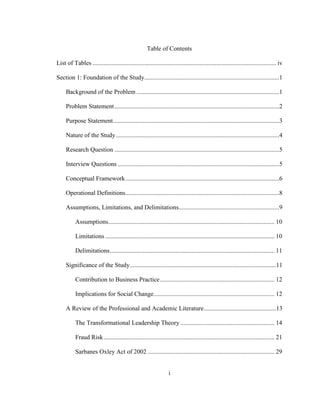
Table of Contents
List of Tables ..................................................................................................................... iv
Section 1: Foundation of the Study......................................................................................1
Background of the Problem ...........................................................................................1
Problem Statement.........................................................................................................2
Purpose Statement..........................................................................................................3
Nature of the Study........................................................................................................4
Research Question .........................................................................................................5
Interview Questions .......................................................................................................5
Conceptual Framework..................................................................................................6
Operational Definitions..................................................................................................8
Assumptions, Limitations, and Delimitations................................................................9
Assumptions.......................................................................................................... 10
Limitations............................................................................................................ 10
Delimitations......................................................................................................... 11
Significance of the Study.............................................................................................11
Contribution to Business Practice......................................................................... 12
Implications for Social Change............................................................................. 12
A Review of the Professional and Academic Literature..............................................13
The Transformational Leadership Theory ............................................................ 14
Fraud Risk............................................................................................................. 21
Sarbanes Oxley Act of 2002 ................................................................................. 29
ii
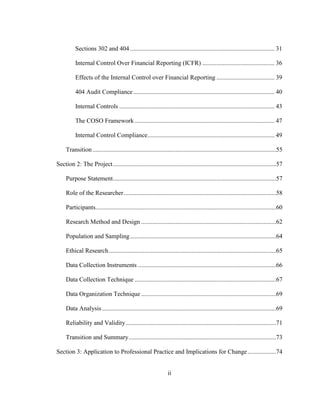
Sections 302 and 404 ............................................................................................ 31
Internal Control Over Financial Reporting (ICFR) .............................................. 36
Effects of the Internal Control over Financial Reporting ..................................... 39
404 Audit Compliance.......................................................................................... 40
Internal Controls ................................................................................................... 43
The COSO Framework ......................................................................................... 47
Internal Control Compliance................................................................................. 49
Transition.....................................................................................................................55
Section 2: The Project........................................................................................................57
Purpose Statement........................................................................................................57
Role of the Researcher.................................................................................................58
Participants...................................................................................................................60
Research Method and Design ......................................................................................62
Population and Sampling.............................................................................................64
Ethical Research...........................................................................................................65
Data Collection Instruments ........................................................................................66
Data Collection Technique ..........................................................................................67
Data Organization Technique ......................................................................................69
Data Analysis...............................................................................................................69
Reliability and Validity................................................................................................71
Transition and Summary..............................................................................................73
Section 3: Application to Professional Practice and Implications for Change ..................74
iii
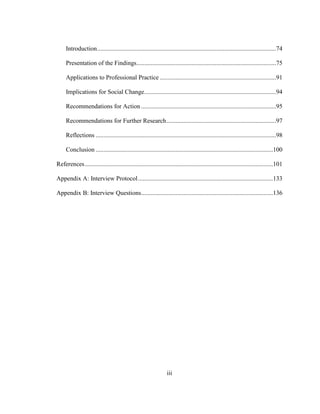
Introduction..................................................................................................................74
Presentation of the Findings.........................................................................................75
Applications to Professional Practice ..........................................................................91
Implications for Social Change....................................................................................94
Recommendations for Action ......................................................................................95
Recommendations for Further Research......................................................................97
Reflections ...................................................................................................................98
Conclusion .................................................................................................................100
References........................................................................................................................101
Appendix A: Interview Protocol......................................................................................133
Appendix B: Interview Questions....................................................................................136
iv
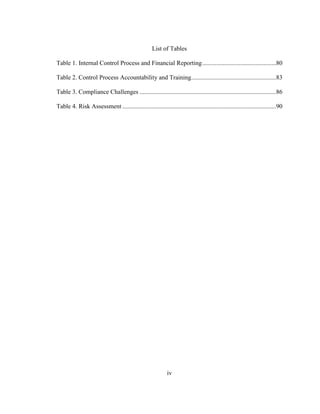
List of Tables
Table 1. Internal Control Process and Financial Reporting...............................................80
Table 2. Control Process Accountability and Training......................................................83
Table 3. Compliance Challenges .......................................................................................86
Table 4. Risk Assessment ..................................................................................................90
1
Section 1: Foundation of the Study
Ineffective company financial and accounting internal controls attributed to
questionable accounting practices and corporate misconduct between the years 2000 to
2008 (Kanagaretnam, Lobo, Ma, & Zhou, 2016), which resulted in significant instances
of financial scandals. The United States Congress enacted the Sarbanes-Oxley Act of
2002 (SOX) as a response to control fraudulent corporate financial malfeasance. Section
404 of the Sarbanes-Oxley Act requires managers to assess, and their auditors to express
an opinion on, the overall effectiveness of internal controls over financial reporting
(ICFR; Chen, Krishnan, Sami, Heibatollah, & Zhou, 2013). Managers and CFOs must
thoroughly review the internal control implementation for accuracy and effectiveness as
individuals depend on the accuracy of financial statements. All significant stakeholders
and regulatory authorities rely on the company’s financial statements to make important
decisions as it provides critical information for evaluating factors such as liquidity,
financing needs, and risk attributes (Van Auken & Yang, 2014).
Background of the Problem
The United States Congress enacted SOX in response to fraudulent corporate acts.
The purpose of the Act was to increase accountability of corporations and the accounting
firms they employ by imposing financial penalties and criminal sanctions on those parties
who participate in fraudulent acts (Wilbanks, 2016). Section 404 of the Sarbanes Oxley
Act of 2002 (SOX 404) required companies’ independent auditors to perform 404 audits,
where the audit team provides an opinion on their clients’ internal control over financial
reporting (ICFR) to measure operating effectiveness. Upon completion of an audit,
2
publicly traded companies are required to publish information in their annual reports
about the scope and effectiveness of their internal control structure (Yuping, Bedard, &
Hoitash, 2017).
Companies have realized it is safer and cheaper to establish their internal control
systems as they represent a protective barrier against various kinds of data manipulation
and fraud inside their companies (Dimitrijevic, Milovanovic, & Vesna, 2015). Companies
that have implemented effective internal controls over their financial reporting have
stronger earnings quality (He & Thornton, 2013). Companies without a healthy internal
control system in place are more likely to experience challenges, such as impairments in
their financial reporting (Feng, Li, McVay, & Skaife, 2015). Companies with internal
control weaknesses typically experience declines in their stock prices and capital as well
as more negative credit ratings (Balsam, Jiang, & Lu, 2014). Businesses must continue to
implement strategies to meet the requirements for effective internal control in all of their
processes.
Problem Statement
The enforcement mechanisms surrounding SOX 404 fail to provide strong
incentives to detect and disclose existing control weaknesses, which results in investors
having limited awareness of potential accounting problems (Rice, Webber, & Wu, 2015).
Companies who experience significant material internal control weaknesses in 404 audits
will have misstatements in financial information compared to companies without a
history of reported material internal control weaknesses (Myllymaki, 2014). The general
business problem is that some CFOs fail to comply with SOX 404, which may likely
3
result in ineffective internal controls over financial reporting and overall adverse audit
opinion. The specific business problem is that some CFOs lack leadership strategies to
ensure organizational SOX compliance with corporate financial internal control policies.
Purpose Statement
The purpose of this qualitative multiple case study design was to explore the
leadership strategies CFOs use to ensure organizational SOX compliance with corporate
financial internal control policies. The study population was three CFOs from different
manufacturing companies in Michigan. The selected CFOs were appropriate for this
study because they understood the scope of SOX 404 and had implemented efficient
company internal controls. Results of this study could benefit external users of a
company’s financial statements, such as shareholders and creditors. These groups can
benefit from a company’s stable internal controls structure, which reduces the risk of
asset loss and increases the reliability of financial statements. The findings of this study
may also contribute to social change as CFOs become increasingly aware of the need for
strong ethical practices as they develop strategies to implement SOX. The increase in
ethical behavior due to SOX has changed the corporate culture and employee behavior.
The change in ethical behavior points to a positive alteration in behavior patterns and
cultural values, which can help mitigate the elements of the fraud and decrease the
likelihood of fraud from occurring in the corporate environment. This positive change in
corporate culture and employee behavior can have a positive impact on the corporation’s
reputation and continue to instill community growth, such as providing employment
4
opportunities and building strong relationships with customers, suppliers and other
stakeholders.
Nature of the Study
The three research methods include qualitative, quantitative, and mixed methods.
(Raich, Müller, & Abfalter, 2014). In my study, I explored the strategies CFOs use to be
compliant with SOX 404. I chose the qualitative method. The researcher uses qualitative
means when there are no preselected or close-ended answers, which suggests the use of
interrogative strategies to answer the what, how and why questions (Barnham, 2015). My
research was exploratory as I utilized these types of questions to further explore
individuals’ experiences without having to prove a theory. The quantitative method
involves the formulation of hypotheses to test theories and provide an objective method
for studying phenomena of scientific interest (Lock & Seele, 2015). I did not check an
approach or confirm a hypothesis about a phenomenon. Thus the quantitative method was
not appropriate. Researchers use mixed methods research when they collect, analyze,
and integrate both quantitative and qualitative data within a study (Ivankova & Wingo,
2018). A mixed method approach was not a plausible method, as I did not test a
hypothesis, which is part of a quantitative study or the quantitative portion of a mixed
methods study.
The design of this research was a case study. A case study approach allows the
researcher to investigate into a real-life phenomenon of an individual or group and within
its environmental context (Ridder, 2017). The case study design was appropriate as I
planned to interview CFOs to obtain an understanding of strategies to improve internal
5
control as it relates to SOX 404. I explored alternative research designs including a
phenomenological study and an ethnographic study. A phenomenological design is the
exploration of lived experiences (Alfakhri, Harness, Nicholson, & Harness, 2018). The
objective of a phenomenological design is to examine unusual circumstances when this
study looked at business as usual practices. The purpose of an ethnographic model is to
look at the phenomena study in its social and cultural context (Baskerville & Myers,
2015). This plan did not fit the focus of my study as I was not concerned with the role of
culture.
Research Question
The overarching research question for this study was: what are the leadership
strategies CFOs use to ensure organizational SOX compliance with corporate financial
internal control policies?
Interview Questions
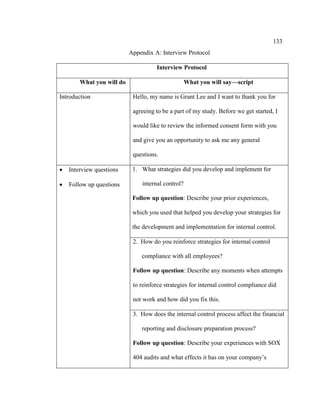
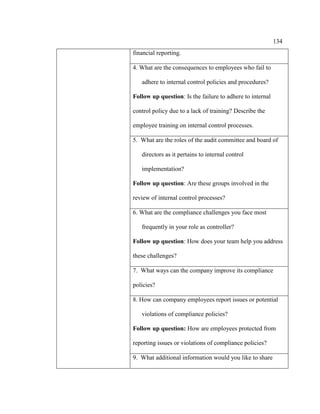
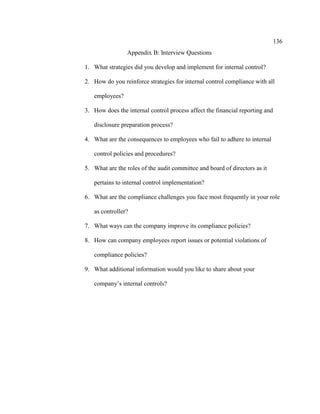
1. What financial internal control strategies did you develop and implement?
2. How do you reinforce strategy for financial internal control compliance
with all employees?
3. How does the internal control process affect the financial reporting and
disclosure preparation process?
4. What are the consequences to employees who fail to adhere to internal
control policies and procedures?
5. What are the roles of the audit committee and board of directors as it
pertains to internal control implementation?
6
6. What are the compliance challenges you face most frequently in your role
as the Chief Financial Officer?
7. What ways can the company improve its compliance policies?
8. How can company employees report issues or potential violations of
compliance policies?
9. What additional information would you like to share regarding your
company’s internal controls?
Conceptual Framework
The conceptual framework theory for this study was the transformational
leadership theory. Burns developed the method of transformational leadership in 1978
(Sun & Henderson, 2017). Transformational leadership fosters a profound change in that
new cultures and value systems take place of the former approach as leaders champion
and inspire followers (Burns, 2003). The transformational leadership model fostered pro-
organizational employee behavior (Effelsberg, Solga, & Gurt, 2014). Leaders can
influence followers by highlighting different aspects of social self-concept and changing
their views (Kark, & Shamir, 2002). Transformational leaders stimulate interest from
their employees to view their work differently in order so that the group receives the
benefits.
The strategic decision process affects the future financial stability of any
company. Management continues its efforts in following financial controls and the
assurance of complying with SOX. The decision process takes many forms, which
includes both long-range strategic planning and short-range executive problem solving
7
(Sibony, Lovallo, & Powell, 2017). A high level of transformational leadership assists in
the formation and implementation of complex strategic decisions (Colbert, Barrick, &
Bradley, 2014). The expectation exists that the transformational leader will continue to
implement financial controls and ensure SOX compliance due to their perception of being
action-oriented, trustworthy and ethical. Transformational leaders act as role models who
are forthright about organizational plans and prospects (Cotton & Stevenson, 2008).
Transformational leadership recognizes the need to coordinate diverse interest within the
organization and the necessity of successful implementation of strategic decisions.
Firms set up financial internal control systems to identify and manage risks and
financial fraud (Länsiluoto, Aapo, Jokipii, & Eklund, 2016). Companies utilize internal
controls as a tool to ensure strategic decision making while controlling risk and
increasing shareholder wealth. The passage of stricter regulations provides firms with
internal control systems the ability to give assurances of effective risk management
(Länsiluoto et al., 2016) through reliable management data and financial reporting and
compliance with laws and regulations. Unfortunately, there is an apparent risk that
companies can experience a failure of the internal control mechanism (Aziz, 2013).
This study, based on using the transformational leadership theory as a framework,
may provide CFOs with strategies that can help them ensure that the company complies
with internal control processes. Transformational leaders exhibit ethical behaviors,
consider the needs of their employees, and treat their employees fairly (Cotton &
Stevenson, 2008). CFOs should provide employees with an awareness of expectations in
internal control implementation and SOX compliance so that there exists employee
8
accountability in all areas. Transformational leadership positively impacts the
enforcement of internal controls. Transformational leadership represents a value-based
framework and involves a leadership style that leads to a beneficial follower and
organizational outcomes (Zacher, Pearce, Rooney, & McKenna, 2014). Leaders cannot
afford complacency when it comes to company transformation to achieve strategic and
operational objectives (Schroeder, 2015). The successful implementation of internal
controls provides management with growth opportunities as well as sound financial
statements. Transformational leaders provide inspirational motivation by articulating a
clear and stimulating vision (Caillier, 2015). The internal control process can improve,
which can benefit a company’s operations. Transformational leaders provide their
followers with individual consideration, such as support, mentoring and coaching
(Caillier, 2015). Transformational leaders who provide attention to their employees can
assist the employee in his role as it relates to internal control.
Operational Definitions
Financial and accounting managers use the following terms to discuss internal
control strategy. An understanding of these definitions is needed to comprehend adequate
internal control procedures.
Corporate Governance: A system of rules and processes, which ensures an active
relationship between a company and its stakeholders. Corporate governance includes the
accountability for business decisions, and risk management which proves that the
company is operating fairly (Chitimus, 2015).
9
COSO Internal Control Framework: Components necessary for a well-designed
system of internal control include a controlled environment, robust risk assessment, a
method to identify risks, information and communication which facilitates internal
control responsibilities, and ongoing monitoring activities (Dickins & Fay, 2017).
Internal audit: An independent consulting activity designed to assist an
organization to meet its goals and objectives efficiently and effectively. One of its values
is the ability to identify transgressions in daily operating processes and procedures such
that critical damage is prevented (Ma’ayan & Carmeli, 2016).
Internal control: Companies use internal control systems to measure a company’s
ability to initiate, authorize, record, process and report external financial data per
generally accepted accounting principles. A set of internal controls will ensure that there
is not more than a remote likelihood that a misstatement of a company’s financial reports
is more than inconsequential will not be prevented (Kanagaretnam et al., 2016).
Risk management: Risk management is a systematic framework for applying
psychological theories and concepts to judgments and behaviors associated with the
practice of risk management (Shefrin, 2016).
SOX Section 404: SOX Section 404 is designed to improve corporate controls by
requiring company management and external auditors to document and test Internal
Controls of Financial Reporting (Graham & Bedard, 2013).
Assumptions, Limitations, and Delimitations
The Sarbanes-Oxley Act of 2002 and its compliance requirements for an adequate
internal control system address significant issues. The following sections explain the
10
assumptions, limitations, and delimitations of this study to clarify the complexity of the
overall internal control framework of a manufacturing company. The explanation of
assumptions, limitations and delimitations provides the reader with a clear understanding
of the facts of the study.
Assumptions
Assumptions are things researchers believe to be true but lack evidence to prove
(Ellis & Levy, 2009). In this study, I made some assumptions regarding the strategies for
compliance with internal control processes. First, I assumed participants in this study
would answer my questions honestly, completely, and independently without bias.
Second, I assumed the results of the study can be shared with different manufacturing
companies, regardless of the industry. Finally, I assumed the outcomes could be valuable
to those corporate managers that desire to participate in internal control strategies.
Limitations
Restrictions in the research process are due to limitations. There exist specific
limits on the collection of evidence because of the different outcomes selected as tests of
usefulness or differences in the samples studied (Teixeira, 2014). One limitation of this
study was the geographical region selected for this study. The chosen participants from
manufacturing companies were located only in western Michigan, and this may not be
entirely representative of all manufacturing businesses in the United States. Another
limitation was the size of the companies selected to participate in this study. I chose to
research only medium to large-sized manufacturing companies and to omit small
businesses. A third limitation was the type of industry chosen for my research. I selected
11
the manufacturing industry while realizing that internal control strategies vary across all
kinds of industries.
Delimitations
Delimitations provide restrictions to characteristics of a study (Rufin & Medina,
2014). In this study, I explored internal control strategies directly with certified public
accountants (CPAs) and certified financial officers (CFOs) of the organization. The
participants in my study were limited to medium to large-sized corporations in western
Michigan. The scope of my research included a literature review of peer-reviewed
sources from 2013 – 2018. Finally, I interviewed CFOs who are familiar with their
company’s internal controls and financial reporting processes and procedures. I did not
question staff level employees who deal with internal control processes daily, which
might have been problematic as I might not have gathered sufficient information on
employee compliance with internal control procedures.
Significance of the Study
The strength of a company’s internal control system depends on key personnel to
carry out the functions. Employees should understand the purpose of internal control and
how it impacts a company’s operations. If a company has the necessary number of
employees required to operate its internal control system, management must ensure
control by implementing targeted internal controls, such as proper segregation of duties,
timely review, and an overall monitoring system for the accounting function (Peltier-
Rivest, 2018).
12
Contribution to Business Practice
CFOs of manufacturing companies continue to face challenges in both weak
internal control and financial reporting compliance. Inadequate internal controls represent
a risk to the overall company performance. Jahmani, Ansari, and Dowling (2014) stated
that 27% of firms with weak internal control issued restated statements, which potentially
harmed the company’s reputation. Ineffective internal control over financial reporting has
implications for a company’s operations as firms with weak inventory related controls
have lower inventory turnover ratios and likely to report impairments (Feng, Li, McVay,
& Skaife, 2015). The results of this study may contribute to improved business practice
by revealing insights on the efficiency and benefits of compliance, which will enhance
corporate capabilities, efficient management and the overall company’s ability to create
value and maximize its shareholders’ wealth (Aziz, 2013).
The corporate controller monitors the internal control system. An adequate
internal controls system requires time for complete implementation and development.
The longer the controller’s length of employment with the company and is responsible
for the internal control system, the lower the likelihood of control weakness (Campbell,
Li, Yu, & Zhang, 2016).
Implications for Social Change
The purpose of this study was to explore the strategies that CFOs use to
implement adequate internal control. The impact of positive social change includes the
awareness and understanding by nonaccounting employees of both the inefficiencies and
the risks that may occur from the noncompliance of internal controls and SOX 404. By
13
increasing awareness of how controls can positively affect a company’s financial
position, management may experience a sense of urgency to continue to implement best
practices for compliance. Management must ensure its employees understand the
importance of internal control. One of the objectives of internal controls includes the
improvement of operating efficiency (Duh, Chen, Lin, & Kuo, 2014) as it relates to the
overall company reporting requirements. An efficient internal control system reduces
risk-taking behavior and provides a business with a strategy to successfully reach its
performance targets and minimize failure (Kofi & Gene, 2016). Stakeholders of
companies who comply with SOX requirements maintain a level of confidence in the
company’s financial reporting, operations, and future. Society and communities can
benefit from SOX compliance companies through employment opportunities and the
company’s relationship with its customers, suppliers, and other stakeholders.
A Review of the Professional and Academic Literature
A literature review is a summary of the business problem, the theory related to
the business problem, the research findings of other authors, and a conclusion of the
results. The literature review includes critical analysis and synthesis of current research
from the peer-reviewed journal, published from 2014 to 2018. I searched the literature
using accounting subject matter such as internal controls, along with pertinent data about
the Sarbanes Oxley Act. I used the results of this literature review to provide an analysis
of leadership strategies within the context of ensuring SOX compliance with corporate
financial internal control policies. I referred to The Ulrich’s Periodical Directory to
ensure I had selected peer-reviewed articles. The review of the academic literature
14
provides an overview of the evolution of internal control, with a focus on
transformational leadership strategies. Search terms included transformational
leadership, internal controls, Sarbanes Oxley Act, COSO framework, and 404 audits. I
used 124 references in my literature review, and 122 (98%) of the total sources are peer-
reviewed. I used 226 references for my doctoral study and 194 resources have a
publication date less than 5 years from the date of CAO approval. The literature review
contains the following sections:
 The Transformational Leadership Theory
 Fraud Risk
 Sarbanes Oxley Act of 2002
 Sections 302 and 404
 Internal Control over Financial Reporting
 Effects of Internal Control over Financial Reporting
 404 Audit Compliance
 Internal Controls
 The COSO Framework
 Internal Control Compliance.
The Transformational Leadership Theory
The purpose of the study was to explore internal control methods and processes in
manufacturing industries. The research question was: what strategies CFOs use to ensure
organizational SOX compliance with corporate financial internal control policies? Many
authors have written topics about internal control. My research findings of internal
15
control practices may assist other CFOs efforts in leading their employees’ initiative in
the actual performance of internal control procedures, resulting in confident SOX 404
audit results.
The transformational leadership theory served the conceptual framework for my
study. The development of global leaders represents a critical aspect of personnel
management for multi-national corporations (Ramsey, Rutti, Lorenz, Barakat, &
Sant’anna, 2017). Global leaders lead organizations to maintain a competitive advantage.
A company’s internal control system represents a critical element in its sustainability.
Goal setting is becoming a prominent component of sustainability strategies (Palmer
&Flanagan 2016). Every organization has measurable goals, which proves beneficial to
the business when achieved under management leadership. Leaders focus on initiatives
that lead to positive team dynamics, and they should efficiently manage team dynamics to
achieve high performance (Webber & Webber, 2015). Leaders must develop effective
teams, which consists of the coordination of individuals’ skills and competencies in line
with goals. The transformational leadership theory explains the forms of leadership in
which companies are managed around a purpose in ways that transform and inspire
employees (Khalili, 2016). The efforts needed to inspire and motivate employees
effectively varies depending on the situation. The evaluation of leaders depends on
several factors, including (a) how transformational they need to be considering the
complexity of the task, (b) the radicalness of change, (c) the complexity and speed of
change, and (d) the demand on followers (VanWart, 2015).
16
The transformational leadership theory consists of four dimensions, which include
(a) idealized influence, (b) inspirational motivation, (c) intellectual stimulation, and (d)
individualized consideration (Arnold, 2017). Each type of transformational leadership
theory describes how leaders empower their employees in their pursuit of high
performance. Transformational leadership aims to direct individual efforts by
transforming and motivating their employees by appealing to the importance of
organizational outcomes (Bro, Anderson, & Bollingtoft, 2017). Key objectives in the
design of internal control systems exist, including the reliability of financial reporting, the
practical use of resources to optimize company goals, and the compliance with laws and
regulations (Al-Thuneibat, Al-Rehaily, & Basodan, 2015). Management must ensure its
employees possess the necessary tools, which would allow the achievement of the
internal control system objectives.
The idealized influence style describes leaders as those who avoid using their
power for personal interest or gain (Zineldin, 2017). These transformational leaders urge
their followers to focus on the organizational goals rather than individual goals (Pradhan
& Pradhan, 2015). The leader’s actions are appropriate for followers, and their efforts
display traits of a robust role model. The inspirational motivation attribute depicts leaders
as those who communicate high expectations and encourage others to remain committed
to the company vision (Zineldin, 2017). Management recognizes that all parties interested
in economic prosperity and corporate continuity to look for a robust internal control
system (Al-Thuneibat et al., 2015). The CEO of an entity bears the responsibility of
ensuring that employees understand and comply with the requirements of an internal
17
control system. Transformational leadership includes intellectual stimulation, where
leaders will listen to their followers with respect, and promote intelligence, and particular
problem solving while remaining calm and relaxed (Zineldin, 2017). The leader realizes
there are different ways of accomplishing tasks (Arnold, 2017). The concept of
innovation and creativity surfaces as followers discover alternative approaches for the
completion of a job. Leadership recognizes the innovative methods of reaching goals and
further promotes motivation and performance in their employees. Finally, those leaders
who possess the individualized consideration trait play the role of a coach or an advisor
who provides personal attention to their employees to develop specific competencies
(Zineldin, 2017). The leader works diligently with followers on a path to success.
As the global market continues to change, it is critical that management reacts in a
timely manner to change through transparency and monitoring of business processes
(Koetter & Kochanowski, 2015). Publicly traded companies continually face challenges
as they prove their processes are compliant with internal rules and legislatures (Koetter &
Kochanowski, 2015). Employees represent the source of knowledge required for process
compliance.
Transformational leaders instill a knowledgeable and supportive work
environment, which helps employees develop a set of values and beliefs related to
knowledge (Le & Lei, 2017). Transformational leaders play a key role in managing
knowledge, resulting in an increase in employee understanding of process and
compliance. Trust represents an integral part of the relationship between leaders and their
followers (Le & Lei, 2017). As employees increase their knowledge base in the business,
18
the trust level between the transformational leader and employee improves for the
betterment of the company.
Alternative theories. Greenleaf described servant leaders as individuals who
motivate followers by prioritizing employee needs before satisfying their own needs
(Liden, Wayne, Chenwei, & Meuser, 2014). This model portrays a servant leader through
many characteristics, including authenticity, humility, and accountability (Coetzer,
Bussin, & Geldenhuys, 2017). An authentic leader displays true intent and motivates
followers in a consistent behavior (Coetzer et al., 2017). Humility defines a leader as one
who acts with a humble attitude and values the talent of others (Coetzer et al., 2017). A
leader with accountability ensures transparent practices while holding others accountable
(Coetzer et al., 2017). This leader provides consistency in performance by the monitoring
the actions of others.
The servant leader plays an integral role in ensuring the adherence of company
internal controls. The useful servant leader displays initiative traits, assumes the risk, and
takes ownership of actions (Sousa & Dierendonck, 2017). The servant leadership theory,
(Coetzer et al., 2017), depicts the leader as an individual who desires to serve, lead and
develop others, and to achieve higher purpose objectives for the employees.
The servant leadership theory and transformational leadership theory have
common traits as they relate to organizational learning and performance (Choudhary,
Akhtar, and Zaheer, 2013). Employees perform and grow through organizational
learning. Both theories promote an approach where the focus on relationships and
communication provides tools for high levels of performance and organizational learning.
19
All organizations strive for high-performance to sustain competitive advantages in the
global environment (Choudhary et al., 2013). High-performance indicators include
profits, sales, and cost reduction. Both the servant leadership and transformation
leadership influence overall performance of their employees through effective
communication and consistent encouragement.
Transformational leaders motivate and inspire followers to perform beyond their
expectations for the collective goal of the team through their influence (Aw & Ayoko,
2017). Management hopes that motivation can promote commitment and drive within
their employees to ensure consistent compliance with internal controls. Transformational
leaders provide inspirational motivation by giving meaning and challenges to their
followers as they continue to encourage their followers (Aw & Ayoko, 2017).
Burns (1978) developed the transactional leadership theory, which conflicts in
various areas with the transformational leadership theory (Doucet, Fredette, Simard, &
Tremblay 2015). Both styles of leadership styles differ in the process by which the leader
motivates his employees (Keskes, 2014). Transactional leaders motivate their followers
by providing only praise and rewards in exchange for their efforts (Doucet et al., 2015).
Furthermore, transactional leaders display a form of punishment toward their followers
when behavior fails to meet expectation (Tyssen, Wald, & Spieth, 2014). The
transactional leadership theory lacks the essential elements that promote and encourage
trust and commitment to a common goal. Transformational leaders foster motivation
through trust (Aw & Ayoko, 2017). Transformational leaders inspire employees to trust
20
by allowing them the opportunity to share opinions and resolve conflict through problem-
solving.
Both the transactional leadership theory and the transformational leadership
theory differ in approach in both qualitative and quantitative creativity (Herrmann, &
Felfe, 2014). Transformational leaders excel in qualitative creativity as they display
intellectual stimulation when they encourage their employees to both think
unconventionally and to challenge the status quo (Herrmann, & Felfe, 2014).
Transactional leaders are limited in creativity when tasks lack direction (Antonokis &
House (2014).
According to Burns (1978), the difference between transformational and
transactional leadership is what leaders and their subordinates offer one another (Keskes,
2014). The transformational leadership style involves engagement between individuals,
resulting in levels of motivation, collaboration, and morality (Keskes, 2014). The
transformational leadership theory supports an ongoing process of cooperation with
unselfish concerns. The transactional leadership style lacks a collaborative effort, as only
one individual makes contact with the other for an exchange (Keskes, 2014). The
emphasis placed on individual goals as opposed to collective goals tends to reduce
cooperation within teams (Hamstra, Van Yperen, Wisse, & Sassenberg, 2014).
Transformational leadership will play a significant role in the future of the U.S.
workplace as a substantial demographic shift of 75 million workers enters retirement, and
younger workers will fill these vacant positions (Bodenhausen & Curtis, 2016). This
workplace shift represents a significant organizational change, and transformational
21
leaders must interact and build relationships with employees as they begin to identify
with the leader (Bodenhausen & Curtis, 2016). With this change comes the demand for
increased accounting contributions from leadership beyond the traditional role of
financial reporting. Management that has a transformational leadership style stimulates
and inspires followers by offering a compelling vision of the future (Nguyen, Mia,
Winata, & Chong, 2017). The complexity of accounting rules and regulations often
require management innovation.
Fraud Risk
There are two different types of fraud, including fraudulent financial reporting
and misappropriations of assets. Fraudulent acts committed by employees can have a
significant financial impact on a company. Companies counter risks of fraud by
implementing internal controls with the goal of diminishing dishonest behavior.
History of fraud. Historically, there were significant instances of fraudulent
crimes referred to as the white-collar crime. Sociologist Edwin Sutherland in 1939
defined white-collar criminals as individuals who devote substantial portions of their time
and energy to criminal offenses and they have acquired and developed personal identities
as criminals (Unithan, 2016). Studies prove that the values, attitudes, and
neurophysiology of corporate actors are central to the proclivity of crime (Fligstein &
Roehrkasse, 2016). More recently, other scholars defined white-collar crime as the
violation and manipulation of the norms of trust-of disclosure, disinterestedness and role
competence – represent the modus operandi of white-collar crime (Dearden, 2016). The
breach of trust results in the disassociation of the company involved in the related white-
22
collar crime.
There are some types of fraudulent acts committed by corporations. Two of the
more common types of fraud included bribes and corruption, which usually occurs in any
phase of an economic cycle. The financial impact of a fraudulent act can be financially
devastating to any company’s financial well-being.
During the period 2000-2008, some public companies within the global
community experienced significant accounting scandals and fraudulent acts, due to
individual businesses lacking adequate internal controls (Kanagaretnam et al., 2016).
Several impactful accounting scandals involved companies such as Waste Management,
Enron, WorldCom, and the Lehman Brothers scandals. Each of these scandals involved
inflated assets, billions of dollars of fake earnings, and many lost jobs.
From 2007 to 2009, fraudulent acts occurred within the mortgage securitization
industry. In 2008, a corporation experienced an average loss of $375,000 per deceptive
act (Tackett, 2010). Mortgage originators deceived borrowers about loan terms and
eligibility requirements (Fligstein & Roehrkasse, 2016). The number of instances of
predatory lending increased as the supply of good mortgages diminished. The Federal
Deposit Insurance Corporation (FDIC) defines predatory lending as the act of imposing
unfair and abusive loan terms on borrowers through aggressive sales tactics (Fligstein &
Roehrkasse, 2016). There exist various theories explaining the causes of mortgage fraud
during this period. One of the common arguments states that firms in industries who face
a crisis of profitability experience a higher chance of generating profit through illegal
behavior (Fligstein & Roehrkasse, 2016).
23
Fraudulent acts have a significant impact on the present accounting rules and
regulations that public and private corporations are required to follow. Corporate
deceptive actions, such as those committed by WorldCom and Enron, have taught the
corporate world and the public about the importance of clearly understanding all the
financial aspects of the business. The unethical behavior of employees may lead to a
decrease in company performance, low job satisfaction and high employee turnover
(Omar, Nawawi, & Puteh, 2016). Many companies implement the practice of modeling
its businesses by the tone at the top model, where management’s characteristics exercise
a significant influence on a company’s practices (Patelli & Pedrini, 2015).
During this particular period where companies and investors experienced the
effects of fraudulent acts, it appears evident that businesses lacked proper controls in its
processes and procedures. Substantial evidence suggests that the absence of appropriate
systems and methods contribute to the occurrence of fraudulent activities (Akkeren &
Buckby, 2017). Additionally, weak internal controls with an ineffective audit committee
contributed to asset misappropriation from company employees.
Fraud triangle. According to the Ethics & Compliance Initiative’s Global
Business Ethics Survey of more than 13,000 employees in 13 countries, one-third of all
workers have observed misconduct in their workplace over the past 12 months (Steffee,
2016). The risk of fraud should be a concern to management, auditors, and the public.
Any business entity experiences a negative impact both financially and in reputation, if
they experience any level of fraudulent acts. Any level of fraud risk assessment involves
the use of the fraud triangle. The risk of fraud increases within an organization when the
24
elements of the fraud triangle exist. (Murphy, & Free, 2016). The fraud triangle includes
(1) incentives and pressures, (2) opportunity, and (3) attitudes and rationalizations.
There are financial motivators, which relate to incentives and pressures. Examples
include poor economic performance, excessive high expectations to meet targets, rapid
growth and significant performance-based compensation (Roden, Cox, & Kim, 2016).
Companies who experience business challenges and have difficulties in achieving
objectives are those entities which tend to borrow more significant amounts of cash
through external financing options. Organizations who encourage stock option
compensation may be in a position that aligns with shareholder and managers’ interests,
thereby resulting in motivating behavior that enhances the firm’s stock price (Roden et
al., 2016).
There exist opportunities for fraudulent acts within any business. Chances for
deceptive acts may occur for various reasons, including the pressures and incentives for
employees to commit fraud, and the opportunity to commit fraud due to weak internal
controls (Reinstein & Taylor, 2017). Examples of opportunity include ineffective
monitoring of managers by an incompetent board of directors, high turnover rates, and
the domination of management by a single person (Roden et al., 2016). Members who
serve on the board of directors of an entity tend to lose their independence over time and
favor managements’ interest over shareholders, which can be problematic (Roden et al.,
2016).
The element of rationalization supports fraudulent behavior. Examples include
nonfinancial management’s participation in the selection of accounting principles,
25
aggressive or unrealistic forecasts, and strained relationship with the current or
predecessor auditor (Roden et al., 2016). Managers may rationalize the justification for a
fraudulent act if there is a need for a change in auditors due to a strained relationship with
the predecessor auditor (Lou & Wang, 2009).
Additional risk factors for fraudulent activity include corporate ethical climate,
tone at the top and corporate governance and accountability (Soltani, 2014). A company
which practices ethics in practice and its culture promotes fair and positive organizational
outcomes. Firms who institute standards for moral values will undoubtedly guide the
ethical behavior and decision making of its employees by communicating codes of
conduct and behavioral guidelines (Jacobs, Belschak, & Hartog, 2014). Unfortunately, an
organization’s ethical climate environment and its influence on individual’s professional
behavior can affect and promote an unethical workplace behavior (Domino, Wingreen, &
Blanton, 2015). A dishonest workplace can contribute to employee behavior as
employee’s levels of job satisfaction fluctuate depending on the work environment. It is
possible for employees, who disagree with their organizations’ value, may be less
committed to the company resulting in unethical behavior. From a management
perspective, an ethical culture within a company can promote a perception that
management has the freedom to act in any way desired, which can be a source of
managerial misconduct (Soltani, 2014).
Financial reporting scandals committed by high-level executives at Enron and
WorldCom raised concerns regarding tone at the top within organizations (Lail,
MacGregor, & Stuebs, 2015). Soltani (2014) defines the term tone at the top as the
26
manner in which the company’s board of directors, senior management and CEO
perceive their responsibilities in setting the pulse of an organization. Thus, the
management team influences their employees’ behavior. Leaders who instill a positive
tone at the top attitude for their companies promote transparent and full disclosure of
financial reporting. Management sets the overall position of the organization toward
creating and maintaining an ethical culture in the workplace (Warren, Peytcheva, &
Gaspar, 2015).
Some methods gauge the effectiveness of an entity’s tone at the top attitude
toward ethics and the handling of fraudulent events such as the handling of customer
complaints, the manner in which management communicates, and employee surveys.
Due to the financial crisis of 2008, companies have focused its attention on its process of
customer complaint handling, which requires fairness and ethical practices (Chalmers,
2016). If company management demonstrates poor customer complaint handling, it could
be an indication of potential fraudulent acts by the administration. The tone of
management’s communication to its employees may promote ethical practices. Employee
surveys serve as a convenient tool for companies to retrieve immediate feedback from its
employees. Recent employee surveys indicate that there exists a positive correlation
between ethical practices and trust (Bulatova, 2015). The tone at the top attitude
represents a key ingredient in the maintenance of an efficient internal control system
(Soltani, 2014). The ethics and values demonstrated by corporate leadership will shape
the overall company attitude, which impacts a company’s internal controls.
27
Corporate governance assists in the determination of established policies and
measurement of managerial and financial performance. Enforceable contracts and
effective management require reliable information that can be verified (Admanti, 2017).
Ineffective corporate governance raises concerns about the adequacy and effectiveness of
internal controls and the reliability of financial reports, resulting in doubt about the
integrity and ethical conduct of top executives (Halbouni, Sawsan, Obeid, & Garbou,
2016). Management has violated corporate governance in instances where financial
compensation ties to overall performance. Unethical managers often act in a manner that
appears as though they exceed financial targets (Admanti, 2017). Dishonest acts become
particularly damaging to the corporation as corporate fraud or misrepresentation can
remain hidden for an extended (Admanti, 2017). Ineffective corporate governance leads
to questions about the integrity of management, and the reliability of the internal control
system (Halbouni et al., 2016). Administration violating corporate governance can
decrease a firm’s value as their risky investments may lead to distorted investments and
possible bankruptcies (Admanti, 2017).
The current state of ethical culture and the corporate environment result in the
necessary preventative measures for fraud (Murphy & Free, 2016). Company
management desires its employees to act with integrity as they perform their daily job
responsibilities. An ethical culture should provide the management team with guidance
on unfortunate situations where necessary intervention addresses wrongful acts (Rodgers,
Soderbom, & Guiral, 2015). Employee awareness of illegal actions increases as the
28
disclosure and effective corporate governance prevails due to the number of fraudulent
corporate acts committed during the global financial crisis.
The whistleblowing act allows the disclosure by current and former employees of
illegal, immoral or illegitimate practices under the control of their employers (Taylor,
2018). The whistleblowing act is an effective method of deterrence against fraud.
Employee witnesses constitute a reliable source in support of the combat against illegal
corporate actions. A high quality audit committee implements a strong internal whistle-
blowing system, which has an impact on internal reporting (Lee & Fargher, 2018).
Effective whistleblowing programs provide governance and control mechanisms for
communicating all forms of wrongful acts for effective corrective implementation
(MacGegor, Robinson, & Stuebs, 2014). The transformational leader’s relationship with
his employees proves beneficial under a company’s whistleblowing program. Employees
who perceive organizational leaders and managers actively practicing transformational
leadership will likely participate in a company’s whistleblowing program (Callier, 2013).
Employees of transformational leaders often receive encouragement to confront and
challenge problems that may surface (Collier, 2013) through the act of whistleblowing.
Transformational leaders encourage work environments that are supportive of disclosing
wrongful acts.
Employees who share common beliefs and values shape corporate culture. (Liu,
2016). The transformation leader plays a vital role in the development of corporate
culture, and it begins with the hiring decision of employees. Employees often model
similar values and behaviors of their leaders, which helps in the development of corporate
29
culture. Usually, corporate corruption culture significantly affects corporate misconduct
such as earnings mismanagement and accounting fraud (Liu, 2016). An unethical
business environment results in poor employee performance and reported feelings of
alienation from work (Enciso, Milikin, & O’Rourke, 2017). Sound corporate culture
encourages and supports ethical acts and decision making by employees. Ethical cultures
allow the safeguarding of long-term performance success of any company (Enciso et al.,
2017).
Sarbanes Oxley Act of 2002
The Sarbanes Oxley Act of 2002 (SOX) consists of several critical sections that
focus on internal control compliance. Section 404 of SOX includes two parts. Section
404(a) relates to the internal controls over financial reporting, and to the output of the
accounting and control system of the company (Schroeder & Shepardson, 2016). Section
404(b) requires the auditor to express an opinion on such internal controls (Munsif,
Raghunandan & Rama, 2013). As companies continue to comply with section 404, its
shareholders will realize its benefits (Schroeder & Shepardson, 2016). Shareholder
confidence increases as internal control compliance equate to higher quality financial
statements. Successful companies recognize the importance of an internal control system
as a tool in ensuring the overall achievement of company objectives and in increasing
shareholders’ value (Aziz, 2013). Section 302 of SOX requires the quarterly certification
of an entity’s internal control structure by the CEO and CFO (Munsif et al., 2013). This
section requires the reporting of an entity’s disclosure controls and any significant
changes in internal controls over financial reporting (Munsif et al., 2013).
30
Internal control compliance. A lack of internal control compliance can cause
detrimental effects on a company’s overall financial position. Companies that disclose
ineffective internal controls experience an increase in adverse abnormal stock returns in
the year of the disclosure (Ge, Koester, & McVay, 2017). Research results show that
companies with ineffective internal controls fail to realize a present value of $1.7 million
in earnings in the three years following the disclosure (Ge et al., 2017). Noncompliance
with internal controls often leads to reported material weaknesses. U.S. regulators
repeatedly raise concerns that managers fail to detect and communicate material
inadequacies to stakeholders timely (Bentley-Goode, Newton, & Thompson, 2017).
Material weaknesses can adversely affect a company’s financial position. In fact, entity-
wide controls weaknesses result in a higher risk of reporting fraud (Donelson, Ege, &
McInnis, 2017).
Both internal auditors and external auditors perform significant duties and
responsibilities in measuring the success of corporate controllers in leading employees in
internal control compliance. The analysis of internal controls represents only a portion of
what an external auditor must perform throughout an audit. Auditor involvement in the
testing and reporting of internal controls assists investors in gathering relevant
information regarding an entity’s internal controls (Munsif et al., 2013). The internal
auditor’s in-depth knowledge of internal controls serves the external auditor well because
they are often involved in the testing of internal controls required by SOX (Burt, 2016).
The internal auditor’s relationship with employees and management provides critical
perspectives in the day-to-day activities of the business.
31
The cost of internal controls compliance remains a concern for many companies,
as the actual number of businesses who incur costs for internal control continue to
increase. The impact of internal control deficiencies, such as material weaknesses,
associates with greater borrowing costs for municipal bonds (Park, Matkin, & Marlowe,
2017). Companies continue to support SOX compliance, but also believe these benefits
do not outweigh the costs (Alexander, Bauguess, Bernile, Gennaro, Yoon-Ho, &
Marietta, 2013).
Sections 302 and 404
Studies previously completed by scholars on company internal control and its
related financial statement results have similarities and differences from my research. The
participants of my study are CFOs who work in manufacturing industries where the
metric focuses on manufacturing cycle time. The dispute about prior research is the
equity scope of the company. It is common for past research to examine enterprises
whose public float of common equity is higher than $700 million.
My study focuses on the leadership strategies CFOs implement to ensure
organizational SOX compliance with corporate financial internal control policies. I will
examine the Sarbanes Oxley Section 404 audit results of my participants of my study, as
it is a clear indicator of the strength of a company’s internal control structure. Although
all organizations differ in its manufacturing process, every section 404 audit examines the
underlying internal control structure of an entity and has an impact on the short term and
long term future of business. Each 404 audit opinion expresses the effectiveness of
internal control over financial reporting.
32
Key sections of SOX. The financial market underwent several high profile
business scandals between 2001 and 2003, which included management misconduct and
fraudulent financial reporting (Soltani, 2014). SOX implemented some critical changes in
the regulation of the economic practice and corporate governance. SOX implemented
some reforms to support and promote both corporate responsibility and financial
disclosure (Earle & Madek, 2007). Many consider SOX as a critical organizational
disclosure and governance reform as it intends to protect investors by improving the
accuracy and reliability of corporate disclosures (Arping & Sautner, 2013).
The restoration of investor confidence in the financial markets represented the
primary goal of the creation of SOX. After the SOX implementation, investors gained
confidence in the effectiveness of internal controls over the financial statement reporting
process, which helped reduce both the overall risk of the U.S. capital market and the cost
of capital (Vega, Smolarski, & Zhou, 2015).
Section 302 and 404 of the Sarbanes Oxley Act. The Sarbanes-Oxley Act of
2002 (SOX) consists of some segments, which all publicly traded companies must be in
full compliance. These compliance requirements represented an apparent shift from a
self-regulated profession to one of government regulated (Franklin, 2016). Section 302
and section 404 apply directly to internal control compliance. Section 302 mandates that
the SEC requires the CEO and CFO certify about internal control quarterly (Munsif et al.,
2013). The completed evaluation of internal control is required 90 days before the
issuance of the report.
33
Despite the intent of Section 302, CFO’s play a significant role in accounting
manipulations in conjunction with their CEO’s (Bishop, DeZoort, & Hermanson, 2017).
Accountants expect to follow ethical guidelines created for their profession, but many of
them breach the moral contract. For instance, a CEO may have high expectations for
success and often may influence the CFO to misrepresent data. Usually, the CEO exerts
pressure on the CFO to misstate financial statements to meet the target (Bishop et al.,
2017). The act of one employee influencing another employee into an unethical or
questionable action occurs when there is a substantial difference in authority between
both parties and the pressure to adhere to directions forces the CFO to make unfavorable
decisions. The two essential types of constraints include obedience pressure and
compliance pressure (Bishop et al., 2017). Obedience pressure results from an individual
being expected to follow instructions from those in positions of authority (Clayton &
Staden, 2015). Accountants often receive obedient influence and likely will make wrong
decisions (Clayton & Staden, 2015). Individuals who feel obedient pressure may
probably behave in ways, which are inconsistent with their values. Individuals who are
affected by compliance pressure choose to act in specific ways and make decisions based
on the opportunity for potential gain for rewards or approval (Bishop et al., 2017).
Section 404 of SOX required management and the external auditors to report on
the adequacy of internal controls over financial reporting within an organization
(Franklin, 2016). Companies recognize the importance of a sound and efficient internal
control system. A capable internal control system can significantly enhance the success
of any organization (Urbanik, 2016). Advantages of an efficient internal control system
34
include greater accountability and transparency. Increased accountability and
transparency helps improve the effectiveness of the company’s overall operations. The
process of internal controls enhances the reliability of a company’s financial statements,
and its adherence to existing laws and regulations (Kulikova & Satdarova, 2016).
Section 404 of the Sarbanes-Oxley Act of 2002 requires evaluation by both the
companies’ management and independent auditors of internal controls over financial
reporting along with the disclosure of control weaknesses leading to material
misstatements in financial reporting (Yuping, Bedard, & Hoitash, 2017). Section 404
required a revision to the audit process because it required two parts to the audit,
including a financial statement audit and an internal controls audit, referred to as 404(a)
and 404(b). The internal control over financial reporting provides assurance regarding the
reliability of both financial reporting and the financial statement preparation (Yangyang
& Chan, 2017). Section 404(a) describes management’s responsibility to adhere to
internal control policies, along with including a report on internal control in the
company’s annual report (Yangyang & Chan, 2017). Key requirements in Section 404(a)
include the required signature from the chief accounting officer (CAO) verifying that the
company tested financial controls and they appeared to be accurate. Section 404(b)
detailed the auditor’s responsibility for reporting the company’s internal control over
financial reporting (Yangyang & Chan, 2017). The unique relationship between the client
and the auditor often can be beneficial as auditors may be susceptible to the influence of
the transformational leader (Svanberg, Ohman, & Neidermeyer, 2017). Transformational
leaders possess a strong record of affecting behavior in many contexts and possible
35
influences on auditor objectivity. The transformational leader utilizes its relationship with
the auditors as a platform supporting its strategies to ensure SOX compliance with
corporate financial internal control policies.
Transformational leaders use idealized influence, individualized consideration,
intellectual stimulation, and inspirational motivation to build relationships, model values,
and share a vision (Martin, 2017). Transformational leaders play a crucial role in
motivating and inspiring employees in job performance. The expectation exists that
employees comply with SOX regulations, including internal control and financial
reporting compliance which may pose challenges in implementation. Transformational
leaders play a crucial role when organizations undergo significant change and need
inspiration (Martin, 2017).
Cost of compliance. The costs of compliance with SOX and Section 404 remain
high for many companies including smaller companies. The cost of SOX compliance
became an increasing concern for all companies who experienced significant unexpected
fees from Section 404 material weaknesses (Albring, Elder, & Xiaolu, 2018). The 404 (b)
audits created a greater demand for audit services, which enabled audit firms to charge
higher prices for all filers (Ettredge, Sherwood, & Sun, 2018).
The concept of benefits versus cost is essential in SOX discussion as it measures
its worthiness. The direct costs to complete a 404 audit vary with the size of the client.
The auditor industry specialization is negatively related to the change in audit fees during
the first year of (SOX) compliance (Fleming, Hee & Romanus, 2014). It was also found
that there were no significant cost savings associated with auditor industry specialization
36
in the second year of SOX compliance (Fleming, Hee & Romanus, 2014). Businesses
need more accounting personnel to fulfill the increased requirements of SOX guidelines.
SOX requires companies to implement segregation of accounting duties. Companies
comply with the internal controls requirement by meeting with the entity’s external
auditors at least on a quarterly basis to ensure a thorough review of current internal
control policies. The auditor’s goal is to make sure that proper controls do exist. The
demand for a time from the employees is evident in this area as employees devote a
significant amount of their time to the external auditors. Payroll costs increase
significantly due to Section 404 of the Sarbanes-Oxley Act. Many corporations have
chosen to pay its employees overtime benefits to complete routine daily responsibilities
and successfully meet the demands of the external auditors. Small and large firms
incurred increased audit fees due to compliance with SOX and estimate average annual
increase in costs for publicly traded corporations at $4.36 million (Shaw & Terando,
2014).
Internal Control Over Financial Reporting (ICFR)
SOX of 2002 requires that publicly traded companies have an auditor’s report on
its financial statements and an audit on the effectiveness of internal control over financial
reporting (Wedemeyer, 2014). The Public Company Accounting Oversights Board
(PCAOB) regulates and monitors the audit quality inspection process of publicly traded
companies, while inspecting auditors with publicly held clients and penalizing auditors
who fail to comply with standards (Acito, Hogan & Mergenthaler, 2018). The PCAOB
continues to maintain the highest standards of performance by demanding more rigor and
37
more precision in the audit of internal control, even though the restatements of financial
statements have become less severe in recent years (Files, Sharp, & Thompson, 2014).
The ICFR audit consists of five phases: planning, scoping, testing, evaluation, and
reporting. The planning phase of the ICFR audit focuses on the high-risk areas of the
review. Auditors must identify the controlled high-risk areas, and the failure to do so may
result in the material misstatement of the entity’s financial statements. Improper risk
assessments can compromise the efficacy of the ICOFR audit.
The scope of an ICFR audit involves a top-down approach to select the controls to
test. The scoping phase allows the gathering of sufficient evidence to support
management’s testing of the internal controls. Evidence may be obtained through the
examination of accounting records as well as from other sources such as observations and
confirmations (Kyunghee, Hoogduin, & Lucas, 2015). Unfortunately, there are
challenges in the collection of evidence during the audit. One issue surrounds the social
interaction between staff-level auditors and the client management and how face-to-face
communication enhances the professional skepticism of auditors' inquiries (Kachelmeier,
2018).
During the review, multiple meetings between staff-level auditors and client
leadership occur. The CFO and leadership team should resolve any challenges which
arise during interactions between the staff-level auditors and the client. Transformational
leaders increase follower task performance and encourage organizational citizenship
behavior, which helps improve corporate functions (Kopperud, Martinsen, &
Humborstad, 2014). This corporate attitude results in a positive relationship between
38
transformational leaders and positive outcomes of work engagement (Kopperud et al.,
2014). Work engagement involves employees giving high levels of effort and personal
investment in tasks, which includes ensuring SOX compliance with corporate financial
internal control policies.
The testing phase of the ICFR audit focuses on the test of controls that are critical
to support the auditor’s assessment of risk to each relevant assertion. Both the auditor
attributes and client attributes affect the testing phase of the audit. The auditor’s
experience determines the effectiveness and outcome of the testing phase of the ICFR
audit. Professional skepticism exists regarding the ability of auditors to interpret evidence
and the associated risks appropriately (Glover & Prawitt, 2014). The testing phase of the
audit increases in effectiveness as the auditor gains knowledge through his audit
experiences. The condition of the client’s ICFR audit affects the testing phase of the
ICFR audit. Clients who have stronger internal controls over their financial reporting
require less testing, resulting in a lower overall audit fee.
The evaluation phase of the ICFR audit assesses the severity of each identified
control deficiency. Auditing Standard No. 5 (AS5) determines whether the shortfall
represents a material weakness in the assessment of management’s internal control over
financial reporting. Furthermore, AS5 assists in the reduced audit work by eliminating
unnecessary excessive testing in the audit of internal controls, which results in a decrease
in the restatement of financial statements (Draeger, Herrmann, & Lawson, 2016).
The reporting phase of the ICFR audit determines the severity of each identified
control deficiency. The reporting phase concludes whether or not the level of seriousness
39
of the reported internal control deficiencies should be considered a material weakness.
The audit firm measures the seriousness by determining whether the company’s internal
controls fail in detecting a misstatement. Senior management must lead by example and
adopt an ethical tone in their communications and actions (Peltier-Rivest, 2017). Internal
control deficiencies can have adverse effects on a company’s overall financial position.
CFOs must actively use transformational leadership as an avenue for promoting the moral
development of subordinates and the alignment of interests (Peltier-Rivest, 2017).
Furthermore, CFOs supporting anti-fraud training programs increases the awareness of
internal control strategies.
Transformational leadership theory supports that leaders can transform followers
in a couple of ways. The first way is by increasing their awareness of task importance
(Neufeld, Zeying, Yulin, 2010). Adequate internal controls in each aspect of the business
process helps protect the overall financial condition. Transformational leaders must have
a valid business strategy that solidifies the company’s internal control over financial
reporting. Leaders transform their followers by focusing them on the team or
organizational goals through effective leadership communication and emphasize the
qualities of leadership that engage, align, inspire and move people to act (Bates & Atkins,
2017).
Effects of the Internal Control over Financial Reporting
The Public Company Accounting Oversights Board (PCAOB) annually inspects
the audit performance of large audit firms (Nagy, 2014). The PCAOB findings include a
list of any identified audit deficiencies and a detailed description of the audit firms’
40
quality controls. The PCAOB addresses the weaknesses of the ICFR audits and its
outcomes (Nagy, 2014) and its outcomes.
The PCAOB inspection reports affect the perceived quality of audit firms
(Robertson, Stefaniak, & Houston, 2014). All inspected audit firms offer feedback and
conclusions regarding their inspection report. The majority of companies provide mixed
reactions by both accepting criticism and defending their audit quality. Despite the
positive results of the PCAOB inspection reports, those businesses who actively support
the PCAOB criticism of their reported audit quality deficiencies potentially result in the
client’s change in auditors. On the other hand, those audit firms who concede to critique
will likely elicit a smaller decreased in perceived audit quality (Robertson et al., 2014).
404 Audit Compliance
Section 404 requires the client and the auditor to report on internal control over
financial reporting (Yunhao, Smith, & Jian, 2014). Management frequently encounters
significant weaknesses with a company’s internal control system, which may likely
prevent the entity from adequately assessing the internal control over its financial
reporting. These flaws could adversely affect the company’s 404 audits. A failed 404
review typically results in the negative portrayal of the company to both its present and
potential investors. These weaknesses represent threats to full section 404 compliance,
which can also negatively affect the integrity of the internal control system.
Management often deals directly with the complexity of transactions, such as
estimates and other unusual transactions. The complexity usually results in the discovery
of inadequate controls. Complex accounting estimates increase the risk of financial
41
reporting quality (Glendening, 2017). Complex accounting estimates may include fair
values, impairments, and valuation allowances. Accounting estimates represent items
included in the financial statements for which the measurement of some amounts is
uncertain (Glendening, 2017). Uncertainty in an organization’s general ledger accounts
can promote potential fraudulent events. Many companies may not employ the right
individuals who possess sufficient accounting knowledge required for the proper
recording of complex transactions. The incorrect record of accounting transactions results
in the reinstatement of financial reporting, which represents a significant SOX 404
failure. A restatement constitutes a violation of a firm’s commitment to capital providers
for providing materially accurate financial statements (Adams, Hayunga & Rasmussen,
2017). Adverse effects of a restatement of financial reporting include higher costs of
financing, greater monitoring of costs and potential residual losses in financial
arrangements (Adams et al., 2014).
Another challenge is the lack of a company-wide internal control management
program. A sound internal control system results in successful compliance with the
section 404 audit. It is critical that an entity’s management team take full accountability
and responsibility for the development of an efficient internal control system. It is crucial
that a business must hire and develop individuals with the capability of producing a
secure control environment. The human resource management practice represents
essential antecedents of various types of organizational climates (Guerci, Radaelli, Siletti,
Cirella, & Rami Shani, 2015). It is critical that the human resource function selects and
assists in the growth of individuals who serve as 404 control specialists.
42
Information technology (IT) controls represent technology security measures that
protect the company’s assets from misappropriation and fraud, while enhancing
performance through formal and informal controls (Liu & Deng, 2015). Material
weaknesses and lack of compliance in the internal controls related to information
technology (IT) represents threats to any organization (Haislip, Peters, & Richardson,
2016). IT internal controls assure that technical systems operate as intended to provide
reliable data and comply with regulations (Liu & Deng, 2015). The noncompliance with
IT internal controls can have a significant impact on any company (Liu & Deng, 2015).
An organization may experience adverse outcomes affected by a drop in stock prices.
Furthermore, a breakdown in IT-related controls likely results in weaknesses in the
company’s financial statements (Haislip, Peters, & Richardson, 2016).
Every company needs an effective IT governance, which ensures its efficiency
and effectiveness related to the internal control system (Rubino, Vitolla, & Garzoni,
2017). The standard IT governance framework is the Control Objectives for Information
and related Technology (COBIT). Many companies adopted COBIT to ensure an
adequate internal control system (Rubino et al., 2017). Management leaders have a
significant responsibility to ensure full compliance with the IT internal control process.
Managers should ensure their team examines all potential risks associated with the IT
internal control process (Kerr & Murthy, 2013). There must be continued monitoring and
reviewing of the IT internal control process by management.
Companies often lack consistent and complete accounting policies and
procedures, which can adversely affect section 404 compliance. Management must
43
review documents regularly and provide updates where necessary. The five components
of COSO represent the foundation for internal control (Rae, Sands, & Subramaniam,
2017) and reflects the importance of effective accounting policies and procedures. The
control activities represent policies and procedures that occur throughout the company
and need implementation. The monitoring of these events over time ensures the control
activities efficiently operate (Rae, Sands, & Subramaniam, 2017). Thus, the company
must prescribe controls for all financial operations, and there should be periodic reviews
as a reflection of regulatory and business changes.
As a company expands the scope of its risk assessment, the role of the monitoring
function increases (Rae, Sands, & Subramaniam, 2017). This expanded responsibility
allow management the opportunity to efficiently monitor and evaluate the ways risks are
managed (Rae, Sands, & Subramaniam, 2017). Management must ensure that the
company’s accounting policies and procedures align with all risk assessment results.
Internal Controls
The purpose of corporate disclosure ensures the mitigation of information
asymmetry between management and shareholders while allowing all stakeholders equal
access to material information (Rubin, Segal, & Segal, 2017). Shareholders and potential
investors of any company make their financial decisions based on the company’s
financial statement results. Over time, the level of investor confidence remains at a high
level as long as companies continue to have sound business statements. Given recent
high-profile frauds, investors experience an increased need for fraud risk assessment as
part of their investment decision making (Brazel, Jones, Thayer, & Warne, 2015).
44
Shareholders must trust that management maintains a degree of integrity and efficiency in
its operations, as they do not have the expertise nor are they in a position to observe and
monitor company activities. Unfortunately, recent occurrences of accounting scandals
involving large corporations have adversely affected the global economy, along with
reducing investor confidence in the market (Lin, Wang, Chiou, and Huang, 2014). When
a company commits financial improprieties, it also has an impact on its relationship with
both present and potential investors.
Internal control is a crucial business function to the success of any company. A
company’s internal control over operations comprises of policies and procedures intended
to improve the effectiveness and efficiency of a firm and safeguard its assets (Feng, Li, &
Skaife, 2015). Internal controls represent a process established by management with the
objective of providing reasonable assurance regarding the achievement of operation
efficiency, financial reporting reliability, and compliance with regulations (Radojeciv &
Radovic, 2014). Internal control monitors and analyzes business processes to compare
planned and actual business results (Radojeciv & Radovic, 2014). Companies create and
set up internal control systems to identify and manage risk (Lansiluoto et al., 2016). The
implementation of additional vital regulations has assisted entities in the formation of
efficient internal control systems, which help in controlling overall risk management. The
Committee of Sponsoring Organizations (COSO) framework proposes that an entity with
an adequate internal control system will run an efficient operation, with reliable financial
data (Lansiluoto et al., 2016).
45
Shareholders and potential investors of any company make their financial
decisions based on the company’s financial statement results. Over time, the level of
investor confidence remains at a high level as long as companies maintain financial
statements that are free from material misstatements. Unfortunately, recent occurrences
of accounting scandals involving large corporations have adversely affected the global
economy, along with reducing investor confidence in the market (Lin, Wang, Chiou, and
Huang, 2014). When a company commits financial improprieties, these actions have a
direct impact on the trust of present and potential investors. An efficient internal control
system provides a foundation for a company’s ability to produce reliable financial data
per generally accepted accounting principles (Kanagaretnam et al., 2016). A well-
functioning internal control system assures the proper authorization, recording, and
processing of transactions through compliance with policies and procedures intended to
enhance operating efficiency and safeguards assets (Feng et al., 2015).
The strength of a company’s internal control system depends on having sufficient
personnel with the expertise and work ethic to provide adequate, timely review and
monitoring of accounting functions, but also how the company frames the purpose for
implementing the control (Liu, Wright, & Wu, 2015). An efficient internal control system
is a critical element in corporate governance and financial statement audits. Internal
control improvements benefit management by (a) improving the outcome of its financial
reporting, (b) developing the financial examination, (c) mitigating audit risk, and (d)
leading to efficient business practices (Singleton, 2008). Unfortunately, many companies
lack the proper internal control structure.
46
Internal control is a crucial business function to the success of any company as it
ensures the production of reliable financial statements (Dickins, & Fay, 2017). Internal
control over operations consists of policies and procedures intended to improve the
effectiveness and efficiency of a company and safeguard its assets (Feng et al., 2015). A
company may implement an internal control system, but there is no guarantee of its
effectiveness (Kofi, & Gene, 2016). Inherent limitations in internal controls exist in any
company (Zakaria and Nawawi, 2016). If weak internal controls exist within an
organization, there will be an increased opportunity for fraudulent activity. The chance
for fraud increases as employees gain access to company assets and information (Zakaria
and Nawawi, 2016). The effects of fraud can pose adverse financial consequences to a
company. For instance, companies may experience a loss in sales, which leads to weaker
future performances. It can also influence a company’s efforts to reach goals. An efficient
management system is a precondition for achieving company goals (Dimitrijevic et al.,
2015).
An ineffective internal control system can hurt the decision-making abilities of
both present and potential investors (Clinton, Pinello, & Skaife, 2014). Issues such as
unreliable financial reporting and information uncertainty can result from weak internal
control systems. Dilemmas such as inaccurate forecasts can occur (Clinton et al., 2014).
An internal control system represents the first step in the process of protection
against fraud (Dimitrijevic et al., 2015). A system that protects a company’s assets must
be part of a company’s overall management plan. Unfortunately, even the most efficient
internal control techniques will not be a remedy for all wrong solutions or inefficient
47
management (Dimitrijevic et al., 2015). A competent management team correctly
identifies and addresses improper acts, with the goal of controlling wrongful conduct.
Furthermore, management must educate their employees on the purpose of internal
controls and its benefits.
An ineffective internal control system not only affects the current operations of a
business, but it can also have adverse operational implications for acquisition
performance (Harp & Barnes, 2018). Internal control weaknesses impact management’s
ability to forecast potential opportunities for acquisition accurately. Additionally, poor
quality internal control information likely will impede the development and execution of
an integration plan after acquisition (Harp & Barnes, 2018).
The COSO Framework
Internal control is a process aimed to improve the effectiveness of operational
activities of the company, to increase the reliability of financial statement and to achieve
consistency of company’s business to existing laws and regulations (Kulikova, &
Satdarova, 2016). A company’s internal control system must meet the requirements of the
Committee of Sponsoring Organizations of the Treadway Commission (COSO). COSO is
a joint initiative established to provide leadership to executive management in essential
areas such as internal control systems. A company’s management and its auditors
referred to the COSO framework of 1992 as appropriate guidance for internal controls
compliance. The original framework consists of five components of internal control,
including the control environment, control activities, risk assessment, information and
communication, and monitoring as well as the three categories of control objectives
48
(Janvrin, Payne, Byrnes, Schneider, & Curtis, 2012). The revised COSO framework of
2013 provides additional guidance for implementation and greater efficient internal
controls at a lower cost (Rittenberg, 2013). Necessary revisions to the original COSO
framework occurred in response to the constant changes in the corporate business
environment. The control environment sets the foundation for control within the entity
and provides a basis for the other components of internal control. The control activities
represent policies and procedures that ensure the successful execution of management
directives. The risk assessment identifies all risks relevant to the achievement of
company objectives. Pertinent information is communicated timely, which enables
successful work output. The monitoring of a process ensures and assesses the quality of
the internal control system’s performance over a period (Frazer, 2016).
The COSO framework provides a standard structure and approach for internal
auditors when assuring primary stakeholders on internal control and risk management
(Interview, 2015). The COSO internal control integrated framework addresses the
operating effectiveness and efficiency, reliability of financial reporting, applicable laws
and regulations compliance, and the safeguard of assets (Frazer, 2016). Every company
differs regarding size, industry, culture environment and operations. Companies adhere to
the COSO framework in all areas of their business for sustainability of legitimacy as the
framework is designed to provide reasonable assurance regarding the effectiveness of
operations and the reliability of financial reporting (Chen, Dong, Han, & Zhou, 2017).
49
Corporations experience severe consequences if their internal control systems fail
at any level. Weak internal control systems can increase the risk of financial fraud
(Donelson, Ege & McInnis, 2017).
There are critical changes in the revised 2013 COSO framework. Each of these
changes helped increase the effectiveness of internal controls. For instance, the new
structure required an increase in financial reporting including both within and outside of
the entity (Rittenberg, 2013). Another change included the development of 17 principles
about the framework’s five components of internal control (Rittenberg, 2013). These
policies made employees accountable for their role in ensuring compliance with internal
controls. If a system did not exist supporting one of the five components, then internal
control was deficient (Rittenberg, 2013). Additionally, the revised 2013 COSO
framework addressed the scope of fraud risk (Shapiro, 2014).
Internal Control Compliance
Public companies continue to encounter significant SOX compliance challenges.
Section 404 requires management and the auditor to report on internal control over
financial reporting (Yunhao, Smith, & Jian, 2014). The demand for SOX compliance
continues to increase, which places additional responsibility and accountability on the
corporation’s financial leaders. CFOs must have strategic plans in place to meet the
increasing demand for SOX compliance. CFOs face challenges as their own companies
continuously strive to become SOX compliant. CFOs need to employ individuals who
support and believe in the purpose of SOX. In a recent survey, only 19% of respondents
perceive a net benefit from Section 404 compliance (Alexander et al., 2013).
50
Additionally, the majority of respondents recognize compliance benefits, but do not
believe these benefits outweigh the costs (Alexander et al., 2013).
Public companies also face a challenge from the Public Company Accounting
Oversights Board inspections of their auditing firms. The Public Company Accounting
Oversights Board (PCAOB) represented a significant provision of SOX. Congress
established the PCAOB as a nonprofit corporation to manage the audits of public
companies with the mission to oversee the audits of public companies. The supervised
review of public companies would result in the protection of investor interests and further
the public interest in the preparation of accurate and independent audit reports (King, &
Case, 2014). The PCAOB maintained specific responsibilities, including the registration
of public accounting firms to conduct audits of corporations, and the creation of standards
in the areas of auditing, ethics independence and quality control (King & Case, 2014).
Before the implementation of SOX, the AICPA governed the review process of public
accounting firms through mandatory peer reviews. Post SOX, the PCAOB took control of
the review process, which placed stronger reigns on the regulation of accounting firms
(Church & Shefchik, 2012).
All public accounting firms that provide audit services to publicly traded
companies are required to register with the PCAOB (King & Case, 2014). Public
accounting firms must complete application forms to the PCAOB. Also, accounting firms
are required to pay both application fees and annual fees to the PCAOB. A firm’s annual
fees paid to depend primarily on the accounting firm’s clientele size. The most significant
fee amount paid is by public accounting firms with more than 500 clients. These
51
companies pay an annual fee of approximately $10,000 (King & Case, 2014). The
PCAOB has the authority over registration, standard-setting and inspection of public
accounting firms that audit publicly traded companies (Tanyi & Litt, 2017).
The PCAOB establishes and modifies auditing standards for public companies.
The purpose of these rules is the improvement of audit processes. The PCAOB recently
adopted some new audit standards, which addressed how auditors should deal with the
risks of material misstatement in financial statements. These particular measures focused
on the minimization of the chance that auditors will fail to detect material errors. The
PCAOB reports on how efficient auditors fulfill their oversight duties and in making
auditor acceptance and retention decisions (Acito, Hogan, & Mergenthaler, 2018).
The PCAOB annually inspects all registered public accounting firms with more
than 100 clients. The inspection includes the firm’s performance of audits, issuance of
audit reports and related matters (Aobdia, 2018). The frequency of review depends on
specific factors, primarily the size of the firm’s clientele. The PCAOB performs reviews
every three years for those business which have less than 100 clients per year (King &
Case, 2014). As of 2013, only nine public accounting firms received annual inspections.
The PCAOB prepares a summary report upon completion of each audit firm examination.
Depending on the specific content, certain portions of the summary findings are available
to the public.
The conclusions of these inspections vary regarding the degree of severity. The
number of restatements of financial statements have risen as a result of PCAOB
inspections. The failure on the part of the auditors to sufficiently test the internal controls
52
over financial reporting can result in financial restatements. In particular, the PCAOB
acknowledged that the accounting field needs to revisit the statement of cash flows as the
percentage of cash flow restatements have increased from 8.7% of all restatements in
2009 to 20.2% of all restatements in 2015 (Alfonso, Christie, Hollie, & Yu, 2018).
The PCAOB publishes two types of inspection reports, including a clean report
with no audit deficiencies and a report disclosing audit deficiencies related to Generally
Accepted Accounting Principles (GAAP) violations (Son, Song, & Park, 2017). The
PCAOB can enforce penalties and corrective action against all parties who are in direct
violation of rules and regulations. Studies have proven that the majority of infractions
were against smaller companies. More importantly, enforcement actions against all
corporations resulted in negative repercussions for both the audit firm and client.
The violation of rules and regulations varies. One common abuse is the disregard
for independence. The PCAOB views the independence violation as an extreme violation.
It is common for the firms to receive fines and to undertake remedial measures to satisfy
independence criteria (Son, Song, & Park, 2017). Another violation is the failure to
address the risks of material misstatement (Son, Song, & Park, 2017). The PCAOB
disciplined the partner of Grant Thornton Taiyo ASG LLC for not acting appropriately on
the risk factors related to the improper acceleration of revenue.
Compliance costs can influence the company’s overall perception and attitude
toward SOX. The price for SOX compliance has affected many of the smaller companies,
which caused the diversion of resources from other value-added activities of the
corporate operation (Franklin, 2016). Surveys continue to indicate that SOX’s costs
53
remain increasing in firm size, but at a decreasing rate, which means that larger firms pay
less for SOX-related services as a percentage of firm size than do smaller companies
(Coates & Srinivasan, 2014). Some public corporations chose to delist from the stock
exchange because of the compliance costs.
The costs of compliance with SOX and Section 404 remain high for many
companies including smaller companies. The cost of SOX compliance became an
increasing concern for all public companies as it relates to compliance costs resulting
from Section 404 audits, increased audit fees, and increased director remuneration costs.
(Cohen, Hayes, Krishnamoorthy, Monroe, & Wright, 2013). Survey results show that the
audit fees have increased by 74 percent for industrial firms during the post-SOX period
(Shaw & Terando, 2014).
The concept of benefits versus cost is essential in SOX discussion as it measures
its worthiness. The direct costs to complete a 404 audit vary with the size of the client.
Businesses need more accounting personnel to meet SOX guidelines. SOX requires
companies to implement robust segregation of accounting duties. Companies comply
with the internal controls requirement by meeting with the entity’s external auditors at
least on a quarterly basis to ensure a thorough review of current internal control policies.
The auditor’s goal is to make sure that proper controls do exist. The demand for a time
from the employees is evident in this area as employees devote a significant amount of
their time to the external auditors.
Payroll costs increase significantly due to Section 404 of the Sarbanes-Oxley Act.
Many corporations have chosen to pay its employees overtime benefits to complete
54
routine daily responsibilities and successfully meet the demands of the external auditors.
Small and large firms incurred increased audit fees due to the response of new audit
regulations requiring additional audit work and compliance with SOX (Dey & Lin, 2018),
The awareness of increased disclosure and effective corporate governance
prevails due to the number of fraudulent corporate acts committed during the global
financial crisis. Whistle-blowing, defined as the disclosure by former or current
employees of illegal, immoral, or illegitimate practices (Lee & Fargher, 2013), represents
an effective method of deterrence against fraud. Individuals who witness fraudulent acts
constitute a reliable source in support of the combat against illegal corporate actions.
Effective whistleblowing programs provide governance and control mechanisms for
communicating all forms of wrongful acts for effective corrective implementation
(MacGegor & Stuebs, 2014). Positive results occur from corporate whistle-blower
programs as white collar crime detection came from whistle-blowers. Whistleblowing
laws instill ethical behavior while deterring various wrongdoings from occurring and the
discovery of deficiencies (Yeoh, 2014).
Transformational-oriented leadership increased the extent to which employees in
agencies felt they could disclose wrongdoing without encountering retaliation (Caillier,
2017). Transformational leaders promote and encourage prosocial behaviors and a
mutually trusting relationship between the employees (Caillier, 2017). As a result, there
is a positive effect on employees reporting wrongdoings. Transformational leaders
promote a work environment of open communication and influence toward the
employees while encouraging employees to properly address unethical acts.
55
Transition
The purpose of this case study was to explore the strategies corporate financial
controllers follow to comply with corporate internal control policies. Internal control
implementation and compliance are integral to the successful operations of a company. I
provided the basis of my study by introducing the problem statement and purpose
statement in Section 1. Further in Section 1, I included a discussion of the
transformational leadership theory as the conceptual framework. The transformational
leadership theory consists of the leadership traits of management that successfully
perform in strategic planning and implementing processes. Also, included in this section
is the nature of the study and research question for my research. In the review of the
literature, I presented a historical perspective of corporate fraud, including the
implementation of the Sarbanes Oxley Act of 2002. I reviewed vital areas of the SOX
legislation such as internal control, internal control over financial reporting, and Section
404 audits. The literature review concluded with a summary of concerns over the
implementation of Section 404 audits.
In Section 2, I describe the project, including the choice of the qualitative method
and research design. In this section, I describe the role of the researcher and the necessary
strategies to engage with the participants. I determine the number of participants in my
study, including the selection process. I describe the informed consent process and other
critical attributes of ethical research, along with a review of the primary approach to data
collection, including the data collection instruments and data techniques.
56
In Section 3, I share the findings of this study as it relates to the transformational
leadership theory. I apply my results as they relate to professional practice, along with
noting all the implications for social change. Additionally, I outline any
recommendations for action and suggestions for further research on my study along with
reflections and conclusions on the completion of my investigation.
57
Section 2: The Project
In Section 2 of this study, I provide a detailed description of the research and the
methods used to complete this review. Section 2 begins with a restatement of my purpose
statement, along with a description of the role of the researcher. Other topics covered
include the research method and research design of this study. Finally, I discuss
information related to data collection instruments, data collection techniques, reliability,
and validity.
Purpose Statement
The purpose of this qualitative multiple case study design was to explore the
leadership strategies CFOs use to ensure organizational SOX compliance with corporate
financial internal control policies. The study population was three CFOs from different
manufacturing companies in Michigan. The selected CFOs were appropriate for this
study because they understood the scope of SOX 404 and had implemented efficient
company internal controls. Results of this study could benefit external users of a
company’s financial statements, such as shareholders and creditors. These groups can
benefit from a company’s stable internal controls structure, which reduces the risk of
asset loss and increases the reliability of financial statements. The findings of this study
may also contribute to social change as CFOs become increasingly aware of the need for
strong ethical practices as they develop strategies to implement SOX. The increase in
ethical behavior due to SOX has changed the corporate culture and employee behavior.
The change in ethical behavior points to a positive alteration in behavior patterns and
cultural values, which can help mitigate the elements of the fraud and decrease the
58
likelihood of fraud from occurring in the corporate environment. This positive change in
corporate culture and employee behavior can have a positive impact on the corporation’s
reputation and continue to instill community growth, such as providing employment
opportunities and building strong relationships with customers, suppliers and other
stakeholders.
Role of the Researcher
The researcher is integral in analyzing data and drawing meaningful insights
(Moon, 2015). The researcher must gain the trust with participants as mistrust often
relates to the fear of unfair treatment, or the relinquishment of their rights upon signing
the informed consent form (George, Duran, & Norris, 2014). The researcher has ethical
responsibilities toward the participants (Miller, 2015). I served as the primary data
collection instrument for this research. I am familiar with the internal control framework
and strategies as I worked for more than 20 years in various management positions in
internal audit and manufacturing accounting. I have substantial knowledge of
fundamental subject matter regarding the implementation and compliance of internal
control processes and procedures. My prior work experiences with employees on internal
control strategies assisted me in my dealings with participants in my present study.
Researchers must follow the protocol regarding the ethical treatment of
participants in a study. The Belmont Report described respect for persons as enacted in
the open communication of information relevant to study participation, aiming to practice
honor, truthfulness, and free choice with enrolled and potential participants (Bromley,
Miesell, Jones & Khodyakoy, 2015). The participants in this study possessed valuable
59
years of knowledge and experience. I ensured my actions were ethical and respectful at
all times with the research participants. The principles of respect toward the participant
means the researcher provides a careful, informed consent process (Bromley et al., 2015).
I minimized all potential harm toward the participant by assuring they were aware of their
right to refuse to participate at any time during the study, even after the completion of
data collection. I asked questions to each of the participants, who have sufficient
experience and knowledge to assess and judge every question. I informed all participants
of measures to protect their identities and maintain the confidentiality of all information
they provide for the study. I presented the results in a fair manner. The code of conduct
and ethical guidelines play a critical role in research settings (Giorgini, Mecca, Gibson,
Medeiros, & Mumford, 2015). The ethical guidelines assist in creating standards for
researchers.
My goal for this research was the presentation of results from an unbiased view.
Researchers share a concern regarding the differences between the observed patterns and
the actual patterns and the ability of stated preference data to predict real behavior
(Whitehead, Weddell, & Groothuis, 2016). As a former controller in the target
population, I encountered potential participants who were prior acquaintances. To
mitigate bias and avoid viewing data through a personal lens, I used an interview protocol
(see Appendix A). The utilization of interview protocols by evaluators occurs during the
development of a program’s services and outcomes (Gugiu & Rodriguez-Campos, 2007).
An interview protocol is critical when attempting to gain a clear understanding of a
historical topic and finding different methods of evaluating the subject (Briggs &
60
Murphy, 2011). An interview protocol helps limit inconsistency and omission (Morton,
Rivers, Charters, and Spinks (2013). An interview protocol outlines the procedures for
conducting interviews. An interview protocol was appropriate for my study because it
assisted in organizing the interview questions to get a clearer understanding of the
strategies the participants use for their internal controls.
A useful qualitative research interview allows the interviewee to become a
valuable resource while providing an opportunity for expressions of prior experience
(Janson, 2015). An interview protocol requires a pre-interview process where there is a
determination of the types of open-ended questions needed to obtain a clear
understanding of the subject. Open-ended questions encourage more in-depth responses
and to avoid any level of bias. I asked probing questions if I felt it was necessary to
obtain further information from replies, which are insufficient in content. The interview
protocol requires organization in interview questions. The logical layout of participant
inquiries allows for the efficient gathering of data from the participant.
Participants
The target population encompassed three CFOs from different manufacturing
companies in Michigan. The participants met the eligibility requirement within the scope
of the population. The eligibility requirement would be CFOs who had successful
strategies that they used to comply with corporate financial internal control policies. The
criteria I used for participant selection was critical to the success and validity of my
research. My past and current professional network represented viable sources for
61
potential participants for my study, and I made inquiries of these connections for possible
participant selection.
It is necessary to establish a productive working relationship with the participants
to gain knowledge from their experiences. There exist obstacles in developing working
relationships due to the close personal contact with the participants, the implications of
research design and the imposition on participants (Wallace & Sheldon, 2015). Upon
identification of the potential study participants, I completed verification of credentials,
including experience and certification. The relationship between the interviewer and the
participants is integral to the quality of the research results (Blackwood et al., 2015).
There exist strategies for establishing a working connection with participants. The central
research issue must be relevant to the participant (Hinkin, Holtom, & Klag, 2007). As the
participants understand the purpose of the research, they will have a better understanding
of how it impacts their overall operations. Another strategy is the obtaining of top
management support for the research initiative (Hinkin et al., 2017). Employees at
different levels of an entity likely would provide the support needed for the research as
directed by top management.
Researchers have an ethical responsibility toward the participants during any
aspect of the research (Miller, 2015). If at some point researchers need to reply to the
participants, they must act ethically during the process. The participants will possess a
thorough and complete understanding of the study through the informed consent form. I
shared the purpose of my research to the participants. I informed the participants that this
was strictly voluntary and they can choose to withdraw at any time during the process.
62
The overarching research question of this study was: what are the leadership
strategies CFOs use to ensure organizational SOX compliance with corporate financial
internal control policies? The chosen participants for my study possessed significant
experience in internal controls. The selected CFOs were appropriate for this study
because they understood the scope of SOX 404 and had implemented efficient company
internal controls.
Research Method and Design
Research Method
Researchers apply research methods to explore business issues. Methods include a
qualitative, quantitative, and mixed method of research. I studied each research option
and determined that the qualitative method was the appropriate method to explore
internal control compliance strategies. The qualitative approach focuses on applied and
theoretical discoveries based on questions through field study in natural conditions (Park
& Park, 2016). I made observations and interpretations as the collection of data takes
place in predictable situations. I observed the actual activity flow of company processes
and how controllers created and implemented strategies to comply with internal control
processes. The goal of a qualitative method is the exploration of the descriptive accounts
(Park & Park, 2016). Qualitative methods capture and describe the depth and richness of
the phenomena (Arino, LaBaron, & Milliken, 2016). The qualitative researcher uses
interrogative strategies to achieve broader levels of knowledge about the subject matter
(Barnham, 2015). The qualitative method assisted in my understanding of the strategy
63
CFOs used to comply with internal control processes through semistructured questions of
“why” and “how.”
I did not use the quantitative method as it is a deductive process that elicits
numbers and percentages that have the status of facts (Barnham, 2015). Quantitative
results examine relationships between variables as it relates to a hypothesis. In my study,
I explored a phenomenon and not a correlation of variables. I did not use the mixed
method. A mixed method requires the use of both qualitative and quantitative methods
within a single project (Carins, Rundle-Thiele & Fidock, 2016). While the study of
internal control strategies required in-depth analysis and research, it did not have a high
level of complexity requiring the use of multiple methods.
Research Design
The case study design served as the practical research design for my study. The
case study design helps the researcher understand the intricate complexity of a particular
case investigation (Park & Park, 2016). The purpose of my study centered on the real-life
events of the strategies controllers use to comply with internal control processes. A case
study approach provides a researcher with a view of an analysis of the context and
processes involved in the phenomenon under study (Awasthy, 2015). I chose the case
study design over other research designs. The generalized case-cohort design picks sub
cohorts from the underlying cohort by simple random sampling (Cao & Yu, 2017). The
narrative design provides the researcher with an increased understanding of real-life
individual and implicit behavior that encourages moral action by professionals (Smit,
2017). Neither of these models fit the purpose of my study.
64
Through my study, I ensured data saturation. Data saturation represents the point
at which no new information or themes presents itself in the data from the completion of
additional interviews (Boddy, 2016). I demonstrated that data saturation exists because
no further information became available. It is critical that data saturation occurs because
data saturation impacts the quality of the research conducted and hampers content
validity (Fusch and Ness, 2015). I performed continuous cycles of data collection and
data analysis until no further new findings exist.
Population and Sampling
Snowball sampling begins with a sample of primary subjects, who serve as seeds
for participant selection (Heckathorn & Cameron, 2017). A series of network linkages
allows the growth of the sample size until the target size has been attained (Heckathorn &
Cameron, 2017). In my study, this method involved the use of networking of CFOs of
manufacturing companies. I used available network options, such as the Institute of
Management Accountants, to obtain contact information for additional names of referred
controllers for my sample size.
The number of participants chosen represents the best option for efficient data
collection because of the range of different types of manufacturing businesses
represented. My study demonstrated the importance of internal control strategies in
manufacturing companies. The quality of the research results reflects the appropriate
amount of data collected, referred to as data saturation. I reached data saturation once
new themes no longer presented itself. I continued to interview until new topics no longer
existed, which meant the achievement of data saturation.
65
The interview of the participant took place at a selected conference room in the
facility. This setting was appropriate for this study for the convenience of the participant.
The environment also represented an ideal opportunity for a facility tour and observation
of processes.
Ethical Research
I used an informed consent form to inform the participants of the study and obtain
their agreement to participate. I included instructions for each participant explaining:
 The background of my research study
 A statement about the participant voluntary rights
 Instructions on withdrawing from the study.
In the case that the participant decides to leave the review, they would either send me an
email or call me to inform me of their decision. In the event of withdrawal, the participant
would receive a withdrawal form. I maintain all completed withdrawal documents from
the research project in a secure place. No type of compensation was available for the
participants in my study.
The protection of vulnerable research participants is the reason for consideration.
Throughout the research process, those participants susceptible to undue influences need
assurance of adequate protection (Gennet, Andorno, & Elger, 2015). The concept of
confidentiality is associated with anonymity, insofar as anonymity is one way to apply
secrecy by ensuring that individuals are not identified (Lancaster, 2017).
All agreement documents reside in the appendices. See Appendix A for the
interview protocol and Appendix B for the interview questions. I have secured the
66
collected data from my study in a safe place in my residence for five years, preserving the
confidentiality of all participants. Additionally, I complied with the Institutional Review
Board requirements established by Walden University, and the Walden IRB approval
number is 04-10-18-0306225. I have protected the participants and preserved the
individual identity by assigning each a number, which matches with their name.
Data Collection Instruments
I am the primary data collection instrument in this study. I used the semistructured
interview as my data collection method. A semistructured interview allows the researcher
to ask the participants a series of open-ended questions about their career, job profile,
managerial level and role (Shah, 2017). These inquiries may provide more significant in-
depth discussion about the company’s internal control process and the strategic plans of
compliance.
The semistructured interview method allows for the collection of detailed
insights, which is unavailable when using only publicly available data (Viscelli,
Hermanson, & Beasley, 2017). I ensured the validity of the data collected by the
following protocol. I included a list of predetermined questions, which may be necessary
during the interview in the event of unanticipated topics of discussion. I shared the
purpose of the meeting and my use of the data with the participants. All participants’
responses remain confidential and anonymous. I obtained permission from each
participant for the usage of tape recording during the interview.
The credibility of the research results depends on the validity of the data
collection instrument. The reliability of data often is measured by whether different
67
researchers will produce similar results when applying similar methods when using the
same data (Sorenson & Stanton, 2016). Validity considered as the extent to which a
measurement technique measures what it sets out to measure (Sorenson & Stanton,
2016). I enhanced the reliability and validity of the semistructured interview method by
performing a transcript review. A transcription of audio data is widespread in qualitative
research as it assists in the analysis of data (Meredith, 2016). A transcript review took
place upon completion of the interview to verify accuracy and to provide clarification. I
also used member checking to ensure the accuracy of the data collected. Using member
checking helps to reduce discrepancies and achieve consistent documentation (Erlingsson
& Brysiewicz, 2013). I used the interview questions (see Appendix B) to probe
participants in my study.
I examined secondary sources, in particular internal control processes with the
purpose of gathering data to understand company compliance with SOX. In addition, I
accessed and reviewed documents describing company ethics and compliance programs,
corporate governance, and leadership and supervisor responsibilities regarding SOX
compliance. I reviewed company annual reports to analyze performance in financial
statement and internal control over financial reporting.
Data Collection Technique
I used the semistructured interview technique for data collection. An interview
technique elicits facts and knowledge about the phenomenon under investigation using a
series of interview questions (Mojtahed, Nunes, Martins, & Peng, 2014). Researchers
commonly use interviews for data collection as it represents a useful technique in
68
revealing the story behind a participant’s experiences (Doody & Noonan, 2012). The
advantage of this method allows the researcher the opportunity for further information
and responses from the participants at a low cost. The interviewer must maintain a level
of social negotiation of meanings with the interviewee (Mojtahed, Nunes, Martins, &
Peng, 2014). Being able to see an interviewee may give more ready access to signs of
confusion, discomfort or distressed provoked by a line of inquiry (Irvine, Drew, &
Sainsbury, 2013). The participant may not respond appropriately if the researcher fails to
provide necessary input, which would assist in answering questions (Irvine, Drew, &
Sainsbury, 2013). There are some disadvantages of the semistructured interview
technique, including less control over the process than crucial informant interviews and
potential difficulty in the collection of sensitive information. Additionally, it may be
time-consuming to assemble groups for the interview process.
I examined secondary sources, such as internal control process documentation,
with the purpose of gathering data to understand company compliance with SOX. I also
observed corporate governance guidelines, to analyze the evaluation of management’s
focus on internal control. I gained a clearer understanding of the company ethics policy
by examining the ethics and compliance program guidelines.
Concerns with the issues of validity in qualitative research have increased
(Barnham, 2015). I used transcript review as it represents an integral part of validity
measurement. This process provides the interviewees with verbatim transcripts of their
interviews to verify accuracy and correcting errors (Hagens, Dobrow, & Chafe, 2009).
69
Data Organization Technique
Qualitative methods present challenges to the researcher such as managing,
organizing and analyzing the data (Vaughn, & Turner, 2016). Researchers use systems
for keeping track of data, such as research logs, reflective journals, and catalog systems.
Research logs represent a story or memoir describing the entire research process (Fluk,
2015). Reflective journals can be valuable through the process as it allows the researcher
to use journals as an examination of personal assumptions and clarify individual belief
systems (Ortlipp, 2008). Reflective journals enact potential validity criteria by recording
reflections, which provides evidence of transparency (Vicary, Young, & Hicks, 2016). A
catalog system assists in collecting the robust data and documenting the research
procedures (McLellan, MacQueen, & Neidig, 2003). I used research logs to ensure the
complete documentation of the entire research process. Furthermore, the research logs
will record the data directly from each of the participants.
I maintain all gathered data using password protected files and all documents in a
locked cabinet. I am the only individual with access to records. I will keep all records for
five years, as required by Walden University. I will destroy all documents after this
period, which protects the participants’ identity and personal information.
Data Analysis
Triangulation represents the appropriate data analysis process for this case study.
Triangulation refers to the use of multiple, different approaches generating a better
understanding of a given phenomenon (Turner, Cardinal, & Burton, 2017). I used
methodological triangulation by involving more than one method to gather data. I used
70
methods such as interviews and observations to increase my understanding of the
phenomenon.
I followed a logical and sequential process for the data analysis. Upon completion
of the interview process with the participants, I recorded the participants’ responses in a
Word document. I used computer programs and applications to categorize the collected
data. I also collected my secondary data from internal controls policies, company ethics
and compliance programs, and financial annual reports and organized my findings in
categories of themes. Qualitative data analysis software has the potential of making data
analysis more explicit and transparent (Paulus, Woods, Atkins, & Macklin, 2017). NVivo
is a type of qualitative data analysis software, which allowed me to perform coding,
mind-mapping and identifying themes. The software provides for the classification, sort,
and arrangement of a vast amount of information while examining complex relationships
in data (Paulus, Woods, Atkins and Macklin, 2017).
I focused on analyzing the collected data and synthesize critical themes, which
directly relate to the research question. The topics become the categories for analysis.
Thematic analysis is a qualitative method for uncovering a collection of ideas within a
data set (Fugard & Potts, 2015). Key themes developed early in the analytic process,
through engagement with data or theory (Braun & Clarke, 2016). I analyzed the data
collected and organize the information into themes. My analysis on the findings from
each theme in my study had a direct correlation to the transformational leadership
framework and the CFOs’ leadership characteristics.
71
Reliability and Validity
Qualitative research embraces multiple standards of quality, known as validity,
credibility or trustworthiness (Morrow 2005). The goal of reliability analysis and
triangulation is to assess both the stability and efficacy of qualitative findings (Watts,
Todd, Mulhearn, Medeiros, Mmford, & Connelly, (2017). The criteria for reliable and
valid data include dependability, creditability, transferability, and confirmability.
Reliability represents a critical element in ensuring consistency in research data and
findings. Careful design and rigor are vital elements to the dependability of research
(Stratford & Bradshaw, 2016). I ensured reliability through a thorough review of
participant transcripts. I followed a process of both capturing and transcribing participant
responses with the objective of presenting well-executed results and findings.
It is critical that all qualitative researchers incorporate strategies that enhance the
credibility of the study during research design (Noble & Smith, 2015). Qualitative
research is credible when its results are recognizable to individuals who share the
experience (Hammarberg & Kirkman, 2016). The credibility of the study further
enhances the participant’s belief in the study. The researcher performs an initial review of
the transcript to familiarize oneself with the data and to identify potential analytic
categories (Cornelissen, Mitton, Davidson, Reid, Hole, Visockas, & Smith, 2014).
Method triangulation involves the gathering of data through interviews, observations,
ongoing discussions and document analysis (Cornelissen et al., 2014).
Furthermore, the participants of the study are the individuals who are in a position
to judge the credibility of the results. I ensured credibility in my research by using
72
transcription review. The accuracy of the transcription plays a role in determining the
accuracy of the data analyzed and the degree of dependability (Stuckey, 2014). I used a
recording device to ensure the complete recording of participants’ responses. Each
participant maintains an assigned number that provides identity protection throughout the
interview process.
Transferability of the research findings is the criterion for evaluating external
validity (Hammarberg, & Kirkman, 2016). A study meets the standard of applicability
when the qualitative results can fit into contexts outside the study situation and when
researchers view the findings as meaningful and applicable to their own experiences.
(Hammarberg, & Kirkman, 2016). Transferability in research shows that the results have
applicability in other contexts (Erlingsson & Brysiewicz, 2013). I ensured transferability
by providing appropriate descriptions of my study so that the reader gains sufficient
understanding to make decisions applicable to their context.
Confirmability represents another element of reliability and validity in research.
Confirmability describes the extent to which the results of the study are determined by
the respondents and not by individual researcher bias, motivation, or interest (Erlingsson
& Brysiewicz, 2013). I addressed confirmability through an audit trail. An audit trail is a
technique, which involves the systematic recording and presentation of information about
the material gathered and the process involved in the project (Bowen, 2009). I used an
audit trail to record the research process and all decisions made.
Data saturation represents an integral part of the research, as it is a tool used for
ensuring quality data collection. The point of saturation occurs when the participants can
73
no longer provide any new perspectives on the overall research question (Boddy, 2016).
I ensured data saturation at the point where further aspects no longer are a part of the
data.
Transition and Summary
The purpose of this study is to examine the strategies corporate controllers use to
comply with corporate internal control. In Section 2, I provided an overview of the role
of the researcher and the requirements of the participants. In Section 2, I discussed the
research method and research design of the study. I justified the number of participants. I
provided insight into the ethical aspects of the research and the data collection
instruments and techniques. Lastly, I gave an overview of the reliability and validity of
the study.
In Section 3, I present my research findings. I also apply my results to
professional practice. In Section 3, I discuss any implications for social change, along
with recommendations for action and further research. I conclude this section with my
reflections on my experience within the doctoral study process along with a concluding
statement.
74
Section 3: Application to Professional Practice and Implications for Change
Introduction
In Section 3, I provide a thorough description of the findings of the research study
on strategies CFOs use to comply with corporate financial internal control policies. In
this section, I present (a) the presentation of the findings, (b) application to professional
practice, (c) implications for social change, (d) recommendations for action, (e)
recommendations for further research, (f) reflections, and (g) a conclusion. The purpose
of this qualitative multiple case study design was to explore the strategies CFOs use to
comply with corporate financial internal control policies. I chose the case study design as
it allows the researcher the opportunity to ask and explore the how and why of a
phenomenon (Awasthy, 2015).
I interviewed three participants who work with publicly traded manufacturing
companies in Michigan using face-to-face semistructured interviews with open-ended
questions. I met each participant in their offices to help ensure privacy and
confidentiality. My research data came from participants who had sufficient experience
and knowledge in their position as CFO to be able to provide adequate and accurate
answers to all interview questions. Each participant signed a consent form, which
indicated their willingness to participate in the study. I assigned a number to each
participant to protect each of their identities throughout the entire process.
The semistructured interviews contained nine questions. I audio recorded each
conversation with the participant, which lasted no longer than 45 minutes. I asked the
same questions to each of my participants to confirm the reliability of the study.
75
Throughout the interview process, I maintained a high level of respect and transparency
toward each participant. I also displayed a high level of competency in each of the
interview discussions. As a previous financial accounting controller, I was able to utilize
my prior experience to interact with each participant on the subject matter effectively. I
achieved data saturation once the information became repetitive and the participants
shared no additional new information. Upon completion of each interview, I transcribed
the audio interview into a Word document, I then emailed the complete transcription to
each participant to ensure accuracy. I used the NVivo Pro Software to analyze the data
and organize into themes while having the ability to retrieve necessary information
efficiently.
I also collected data from secondary sources, which included internal control
policies. I accessed and reviewed documents describing company ethics and compliance
programs, corporate governance, and leadership and supervisor responsibilities regarding
SOX compliance. I reviewed company annual reports to analyze performance in financial
statement and internal control over financial reporting.
Presentation of the Findings
The overarching research question for this study was the following: What are the
leadership strategies CFOs use to ensure organizational SOX compliance with corporate
financial internal control policies? I used the following interview questions to explore
strategies on how CFOs promote the importance of internal control processes and
financial statement integrity.
1. What financial internal control strategies did you develop and implement?
76
2. How do you reinforce strategy for financial internal control compliance with
all employees?
3. How does the internal control process affect the financial reporting and
disclosure preparation process?
4. What are the consequences for employees who fail to adhere to internal
control policies and procedures?
5. What are the roles of the audit committee and board of directors as it pertains
to internal control implementation?
6. What are the compliance challenges you face most frequently in your role as
the CFO?
7. What ways can the company improve its compliance policies?
8. How can company employees report issues or potential violations of
compliance policies?
9. What additional information would you like to share regarding your
company’s internal controls?
Upon completion of data analysis and coding, four themes emerged. These
themes included internal control process and financial reporting, control process
accountability, compliance challenges, and risk assessment. I coded the participants in
my study as P1, P2, and P3. I identified emergent themes through an analysis of the
information shared by each participant during their interview. These emergent themes
appeared to be relevant in further analyzing the strategies CFOs implement to ensure
SOX compliance with corporate financial internal control policies.
77
Theme One: Internal Control Process and Financial Reporting
Management has the responsibility for designing, implementing, and maintaining
effective internal controls (Grambling, & Schneider, 2018). The first theme to emerge
was the internal control process and its effects on financial reporting. In Table 1, I
reported the number of times the participants provided a reference to each interview
question. Questions 1, 3, and 5 related to this theme. Question 1 pertained to the
development and implementation of financial internal control strategies. All of the
participants shared their extensive experiences in internal control development and
agreed that periodic reviews of internal controls could ensure consistency and
effectiveness. P1 explained:
The company has grown, and we have beefed up our systems quite a bit so that
now we have specific resources tied to internal controls and our employees have
the responsibility in maintaining the internal control framework and to review and
test the output from the other folks in the group.
P1 further elaborated on the status of the company controls by stating, “Through a review
of our internal controls, we can answer what controls we say we had and did we do the
controls and perform them?” P2 mentioned, “We focus on the process and objectives of
internal control as we implement our internal control system.” P3 stated, “Internal
controls are reviewed twice a year, and then we perform a review of operating
effectiveness on internal controls twice a year, with the results included in our year-end
management assertion over internal controls.”
78
All of the participants in the study mentioned that management plays a critical
role in the design, implementation and annual review of the internal control process. P1
elaborated on the critical importance of reviewing specific balance sheet accounts that
need greater attention. P1 indicated that the company internal control review process
includes management’s analysis of accounts and reconciliation of bank statements to
ensure proper account reconciliations.
Question 3 pertained to the effects of internal controls on financial reporting.
SOX 404 required management to file a report on the company’s internal control over
financial reporting (Chen, Dong, Han, & Zhou, 2017). This report includes a statement
by the CFO stating management’s responsibility for financial reporting and their
assessment on the effectiveness of the internal control over financial reporting. The CFO
has accountability to the company’s internal control effectiveness and must report on the
effectiveness of internal control over financial reporting (Grambling, & Schneider, 2018).
All of the participants in this study indicated the importance of effective internal control
process as it directly relates to financial reporting. P1 said, “Our internal control systems
have strengthened over time, and we have specific resources tied to internal controls and
maintaining the internal control framework is vital for strong internal controls over
financial reporting.” P2 stated, “The internal control process is key as it interjects into the
overall financial reporting of our company. The internal control process affects our
overall financial statement review process.”
Section 302 of SOX requires executive officers to evaluate the effectiveness of
internal controls and report conclusions (Church & Schneider, 2016). Section 404(b) of
79
SOX requires the auditor to opine on the effectiveness of internal control over financial
reporting for companies with a public float greater than $75 million (Church &
Schneider, 2016.). All participants shared the same viewpoint that the key for successful
SOX 302 and SOX 404 results is proper planning and preparation. This means regular
meetings with staff and management with the goal of ensuring proper compliance with
internal control procedures. P3 reflected on the requirements of Section 302 and Section
404 certification process “as a critical component of the internal controls process and
reporting.”
Question 5 pertained to the roles of both the audit committee and Board of
Directors as it relates to internal control implementation. All participants shared a
common opinion of the importance of the work of the audit committee and the Board of
Directors as it relates to internal control implementation and compliance on a daily basis
and in preparation for the annual audits. P1 said:
The audit committee is there from an oversights perspective, and they receive an
update on a quarterly and annual basis from our external auditors as it relates to
internal control compliance. The audit committee stays updated on all issues
related to internal control.
P2 indicated that, the audit committee oversees the company to ensure processes and
procedures are being followed. P2 further explained that both the board of directors and
the audit committee monitors the internal control process, ensures the internal control
framework is in place and confirms every employee understands their obligations and
80
responsibilities. The CFOs are responsible for managing the internal control process and
providing updates to the audit committee. P3 said:
The audit committee receives quarterly updates from the corporate controller
about financial reporting. They receive an update from the director of internal
audit on compliance findings and the audit process. Additionally, they receive a
summary of SOX results as it relates to operating effectiveness testing. Both the
audit committee and the Board of Directors play very critical roles in internal
control implementation and compliance.
Table 1
Internal Control Process and Financial Reporting
Interview
Questions
Total
References
Participant 1 1,3,5 7
Participant 2 1,3,5 6
Participant 3 1,3,5 6
The key findings from the first theme included (a) management’s periodic review
of internal control processes, (b) management’s role in the implementation of internal
control processes, (c) sound internal controls affects financial reporting, and (d) proper
planning and preparation by management to ensure compliance with internal controls. I
analyzed company documents, which explained internal control processes. I reviewed
company annual reports, including the Report of Independent Registered Public
Accounting Firm. The external auditors provided their opinions on the company’s
financial statements and internal control over financial reporting.
81
The transformational leadership theory ties to these findings based on how leaders
measure performance value from their followers. Transformational leaders have a
significant impact on individual and team performance (Rao & Kareem Abdul, 2015).
My participants expected each of their employees to understand the purpose of internal
control processes and the importance of these controls as it pertained to the business. My
participants held each of their employees accountable for their actions to ensure
compliance with internal controls.
Theme Two: Control Process Accountability and Training
The value of capable processes and effective internal controls results in
accountability, integrity, and transparency in governance processes (Rendon, & Rendon,
2016). As companies gain a better understanding of internal control systems, they will
enhance their corporate governance practices that lead to the achievement of financial
and compliance objectives (Rae, Sands, & Subramaniam, 2017). Internal corporate
governance controls help to improve financial reporting while preventing the occurrence
of fraudulent acts.
The second theme to emerge from the study involved controlled process
accountability and training. In Table 2, I reported the number of times the participants
provided a reference to each interview question. Questions 1 and 2 related to control
process accountability. All of the participants in this study indicated the importance of
employees owning the internal control processes. Selected employees have the
responsibility for ensuring areas under their control follow proper internal control
82
procedures. Each participant in the study shared a similar opinion of employee
accountability regarding internal controls. P1 stated:
Employees are aware of adhering to internal controls because it is part of their
job, but I also have to make sure supervisors are reviewing it, or someone else is
reviewing it from a controls perspective so that we are doing all that we can do
from a check and balanced perspective.
P2 stated, “The strategy is to be compliant, and to have employees account for all of the
processes in place to keep the Balance Sheet clean.” P3 said:
We have a compliance program, with a controls framework, and we have
identified process owners who are typically managers in the area that owns and
executes the controls. They review controls twice a year, and they work in a
system with an application where they can make the necessary changes. Adequate
internal controls should be implemented to prevent the occurrence of fraud.
Questions 4 related to the training element of this theme. Question 4 dealt with
the consequences for employees who fail in internal control compliance. Each participant
believed that compliance training was necessary for all employees who would ensure
successful internal control compliance. P1 stated, “Employees address the internal
controls because it is part of the job, they receive the necessary training on internal
controls, and the supervisor reviews from a control perspective to make sure there are a
check and balance.” P2 stated, “Compliance training in internal controls is necessary for
areas such as monthly cycles, accounts payable.” P2 also stated, “We provide training on
particular topics involving internal controls.” P3 mentioned, “To address accountability,
83
we schedule training with employees who execute more of the transactional controls. Our
goal is to make sure employees know what to do with internal controls, and how to feel
accountable and empowered.”
Table 2
Control Process Accountability and Training
Interview
Questions
Total
References
Participant 1 1,2,4 5
Participant 2 1,2,4 4
Participant 3 1,2,4 6
The key findings from the second theme included (a) employee accountability of
internal controls, (b) employee training on internal controls. I reviewed company
documents which explained internal control processes, along with training manuals for
internal control implementation.
The transformational leadership theory ties to these findings based on how leaders
redesign the perception of their followers and creating new expectations. The
transformational leader can inspire their followers to adjust their value systems for the
purpose of working together and not for self-interest (Verissimo & Lacerda, 2015). Each
of my participants made all of their employees aware of the importance of internal
controls to company performance. My participants expected each of their employees to
understand the purpose of internal control processes and the importance of these controls
as it pertained to the business. My participants held each of their employees accountable
for their actions to ensure compliance with internal controls. Each of them expressed the
need for employee training and for additional training on a needed basis. Each participant
84
agreed that there are consequences to employees who violate internal control policy,
including loss of employment.
Theme Three: Compliance Challenges
The third theme to emerge from the study was compliance challenges. In Table 3,
I reported the number of times the participants provided a reference to each interview
question. Questions 6 and 7 related to compliance challenges and methods to improve
internal control compliance. Question 6 directly relates to the internal control compliance
challenges each participant faces in their role as the CFO. One problem that often arises
is the necessary work needed to meet the needs of external auditors. P1 mentioned, “A
compliance challenge is the work my staff and I have to complete to meet the compliance
requests from our external auditor.” The challenge lies in what controls appear
applicable to a company’s situation and what controls are unnecessary. P1 added, “From
an internal controls perspective, always battling our auditors’ request to have exhaustive
controls, to have reasonable but yet effective controls so that I do not have to have fifty
people, who address internal control and that is all that they do.” P2 stated, “It is often a
challenge to find the resources to complete the requests from auditors.” P3 added, “There
is so much pressure from the Public Company Accounting Oversights Board (PCAOB)
and our external auditors, which results in pressure on us to stay very close to all of our
processes to meet the auditor’s needs.”
Another challenge participants shared is the lack of formalized control activities,
which makes it challenging to measure compliance. P1 stated, “We need to make sure
that what we do is what we have to do, but not be burdensome for people to get bogged
85
down in internal controls just to do internal controls.” P2 mentioned, “There are
difficulties involved in the understanding of how to meet compliance standards and what
are the correct interpretations of the rules of compliance.” A lack of formalized control
activities often occurs during the introduction of new products. P3 mentioned,
“Compliance challenges surface around the introduction of new products into emerging
complex markets. When we bring in new businesses on, what levels of compliance are
we expected to complete?”
Each participant shared a common opinion that the CFOs must possess the
leadership traits for companies to implement internal control compliance and overcome
any compliance challenges. P1 and P3 both used the term “tone at the top” to describe
their leadership and commitment to maintain effective internal controls. All of the
participants shared similar opinions on the role of the CFO in internal control
compliance. P1 and P2 both described the CFO as” an individual who demonstrates the
commitment to be honest and act ethically when dealing with internal control
compliance.” Each participant believed that the CFO must effectively lead employees by
teaching the purpose of internal controls and how to implement internal controls in the
day to day functions.
Question 7 involved processes and procedures companies have implemented to
improve its compliance policies and address compliance challenges. Each participant
agreed that the improvement of compliance policies is a continuous process and they
continue to look for more efficient processes. P1 stated, “We listen to our external
auditors about what new testing methods are out there and how can we make our
86
processes more efficient. P2 stated, “We continue to review our processes to make them
better, for instance improving our monthly reconciliation process.” P3 stated, “There is
always room for improvement, especially in our experienced workforce. We have lower
level employees who may not have enough work experience to recognize potential
compliance violations and are uncomfortable reporting them. We need to continue to
provide the necessary training to assist our employees in their understanding of internal
control compliance.”
Table 3
Compliance Challenges
Interview
Questions
Total
References
Participant 1 6,7 5
Participant 2 6,7 4
Participant 3 6,7 5
The key findings from the third theme included (a) challenges to meet the
compliance requirements, (b) the leadership of CFOs to ensure SOX compliance. I
reviewed corporate governance guidelines, which provided valuable information about
management’s focus on overseeing and evaluating the internal control system, financial
reporting, and public disclosure. I examined Audit Committee Charters, whose
responsibilities included reviewing the effectiveness of disclosure controls, and the
effectiveness of internal controls over financial reporting.
The transformational leadership theory ties to these findings based on how leaders
continue to challenge their followers to meet goals and perform. Transformational
leadership behaviors are more effective when employees have a greater need for
87
leadership (Breevaart, Bakker, Demerouti, & Derks, 2016). The transformational leader
can accomplish this by using their own traits and personality to make a change by
example. The transformational leader practices taking personal accountability for their
actions. Each of my participants recognized that CFOs must lead by example and
continuously teach their employees the value of internal control.
Theme Four: Risk Assessment
Corporate risk management and the achievement of internal control through
compliance with a legal framework reinforces governance provisions (Aziz, 2013). Risk
assessment associates with the control activities, including the monitoring of activities
(Rae, Sands, & Subramaniam, 2017). The fourth theme to emerge from my study was the
importance of risk assessment. In Table 4, I reported the number of times the participants
provided a reference to each interview question. Questions 8 and 9 related to risk
assessment. Question 8 asked participants how employees report issues or potential
violations of compliance policies. All participants shared a common view of the
importance of monitoring internal control compliance to limit the risk of fraudulent
employee acts. All participants stated their companies have an anonymous service where
employees can freely report any concerns about potential violations of compliance
policies. P1 stated:
Our company website makes it possible for any employee to submit anonymously
any complaints confidentially. The employees should feel comfortable reporting
any concerns or issues. We communicate to our employees the anonymous
service and reminds all employees that their names will remain confidential.
88
P2 stated, “Our Company has an ethics hotline, and company management always
encourages employees of open lines of communication on any issue.” P3 said:
Our company hotline is available to all employees. Everyone is made aware of it,
and we hope all employees feel comfortable using it for any concerns they feel
should be reported. We encourage our employees to speak openly with their
supervisors, but if they do not feel comfortable doing this, they can always utilize
our company hotline.
Participants also discussed company procedures once they learned of the shared concerns
on the company hotline. P1 stated:
The audit committee and the Board of Directors are notified by the CFO of any
potential internal controls violations. Potential action items include additional
testing on the financial statements that would help us determine if there is any
significant impact on our financial reporting results.
P2 stated, “We work closely with the audit committee on any possible compliance
concern.” P3 stated, “Any concerns and comments go directly to the audit committee
director. The Vice President of Internal Audit is involved in the investigative process of
noncompliance.”
All participants were asked to provide any additional information regarding their
company’s internal control. All participants mentioned the need for an increase in
assessments of internal controls in higher risk areas. A shared opinion among the
participants involved the need to increase internal controls in the field of Information
Technology. The need for internal control compliance in IT evolved due to the way
89
advances in IT altered the methods in how companies run their business and prepare its
financial statements (Han, Rezaee, & Zhang, 2016). All three participants agreed that
companies use a lot of data and management and other departments depend on the data
for their financial reporting. They share a concern around what Information Technology
controls exist that ensures accurate and completion of data entry.
Additionally, participants were concerned about IT controls over the maintenance
and storage of accounting information. P1 stated:
We are building up our internal controls around our IT system because companies
now a day use a lot of electronic data. To have reliance around your financial
statements, you need to rely on your computer systems that generate the data. We
have gone through and worked with another third party, not our auditor to help us
beef up our internal controls related to the IT side.
P2 expressed the need for IT controls around complex IT software which handles all
company data. P2 mentioned the transformation of IT software over time and the need for
effective controls to ensure that all data is collected and analyzed.
All participants shared the concern that the internal controls of information
technology must be tested frequently to keep up with its rapid development and its impact
on the company business. P1 stated, “We do a lot toward system-related controls on the
IT side and when it comes to program changes that is a big one from an internal controls
perspective as well.” P1 mentioned the need for testing and documentation around all
company IT procedures and processes. P2 stated, ‘The need for internal control
compliance around the implementation of significant information technology software”.
90
P2 further mentioned company should benefit from the documentation of internal control
process of complex IT software. P3 stated, “Information technology is changing the
compliance efforts and employee skill set. The advancement of IT and its impact on
internal control compliance forces us to take a look at IT skills an employee may
possess.” P3 also mentioned how technology will change the future execution of controls
and how IT will impact SOX and control compliance.
Table 4
Risk Assessment
Interview
Questions
Total
References
Participant 1 8,9 5
Participant 2 8,9 5
Participant 3 8,9 6
The key findings from the fourth theme included (a) the monitoring of internal
control compliance to limit the risk of fraudulent acts, and (b) the need for assessments of
internal controls in high risk areas. Each participant shared the online resource for
employees to report any acts of internal control noncompliance. Each participant also
shared the need to develop more immediate resources to assist in IT controls.
The transformational leadership theory ties to these findings based on how leaders
continue to react to high risk areas of the business. Managers consistently face the
complexity of the technological and informational environment (El Toufaili, 2018).
Dynamic and efficient leadership is needed to ensure that organizations have a favorable
environment for employees to optimize productivity (El Toufaili, 2018). My participants
91
expressed concern about the complexity of critical areas, which could potentially affect
both the current and future status of their company.
Applications to Professional Practice
The findings from this study are relevant to improved business practice as the
study provides critical insight into the strategies CFOs implement to ensure
organizational SOX compliance with corporate financial internal control policies. The
specific business problem is that some CFOs lack leadership strategies to ensure
organizational SOX compliance with corporate financial internal control policies. The
CFOs can benefit from the awareness of findings of this study as they develop and
implement strategic processes specific to compliance with internal control policies. These
financial leaders can gain valuable insight into specific processes that will contribute to
accurate financial reporting. Using the results of this study can provide CFOs with
information on (a) how to improve financial reporting results, (b) how to develop
effective corporate governance on internal controls, and (c) internal control compliance
and (d) the identification of risk in internal controls.
The data I collected and the corresponding themes supported key preliminary
findings from my literature review. A finding from my study was the necessity of an
effective internal control system. A strong systems of internal control over financial
reporting (ICFR) are critical to the production of reliable financial statements (Dickens &
Fay, 2017). Effective internal control procedures contribute to accurate financial
reporting and an unqualified audit opinion on the financial statements. Companies with
weak internal control processes result in unreliable financial statements, which can be
92
detrimental to stakeholder perception. Weaknesses in entity-wide controls, not process-
level controls, are associated with a higher risk of reporting fraud (Donelson, Ege, &
McInnis, 2017). Publicly traded corporations are audited annually by external accounting
firms. Specifically, the auditors perform multiple audits for the company including a
financial statement audit and a SOX compliance audit. The accounting firm conducts a
SOX compliance audit to examine and validate the company’s compliance efforts in
internal control procedures. A key result from my findings proved that adequate internal
controls over financial reporting demonstrate reliable financial statements which can be
beneficial to all internal and external users.
A second key finding from my study was the type of leadership needed for
effective corporate governance on internal controls. Leaders of corporate governance
must advance the goals of identifiable stakeholder groups, such as customers, suppliers,
employees, and the local community (Siegel, 2015). The CFOs’ leadership qualities
represent an essential element to ensure company employees adhere to internal control
policies and maintain efficiency and effectiveness. CFOs can use the study’s conceptual
framework of the transformational leadership model for implementing strategies for
continued internal control compliance. A CFO shares valuable information to employees
about the importance of internal control compliance and its effects on the company.
Knowledge sharing is the process of exchanging knowledge between employees in an
organization to create new and valuable insight for each other (Le, & Lei, 2018). The
perception of the CFO is one of a role model who possesses credibility by leading by
example, promoting ethics and maintaining trustworthiness with employees. Williams,
93
Raffo, & Clark (2018) define credibility as the degree to which followers perceive their
leader is worthy of trust, and how well followers regard their leader as competent with
the necessary expertise and skills to do the job. The findings from my study supported the
CFOs’ accountability in the overall internal control structure. The CFOs need to
demonstrate a high degree of influence on their employees’ actions and behaviors as it
relates to internal control compliance.
Another key finding from my study was internal control compliance.
Organizations implement internal controls as a strategy to prevent and detect financial
fraud, and to ensure employees comply with laws, accounting standards, and
organizational policies (Park, Matkin, & Marlowe 2017). Researchers and corporations
may apply these findings to other publicly traded corporations to adopt effective
strategies of compliance to internal control processes. Publicly traded companies wish to
promote the financial health of their finances to the public. By considering the strategy of
internal control compliance, CFOs and other management leaders have a starting point in
the development of not only sound and accurate financial statements, but a sustainable
and prosperous economic future. The findings from my study supported the need for
internal compliance and also address the various challenges companies face in internal
control compliance. Corporate management should continue to review the effectiveness
of the implementation of internal control requirements, such as information,
communication, and monitoring (Al-Thuneibat, Al-Rehaily, & Basodan, 2015).
The final key finding from my study was the overall risk in internal controls.
There exist material weaknesses and lack of compliance in the internal controls of
94
specific areas of the business, which represents a risk to any business entity (Haislip,
Peters, & Richardson, 2016). The findings from my study addressed the necessity to
identify potential high-risk areas of internal control noncompliance, such as in
information technology (IT). IT advancement has positively changed the way companies
conduct their operations and prepare its financial statements. The complexities of IT
introduces additional unconventional risks for companies by creating challenges for
auditors when auditing the effectiveness of a company’s internal controls and detecting
accounting irregularities (Han, Rezaee, & Zhang, 2016).
Implications for Social Change
Researchers may utilize the results of this study in a manner that could benefit and
affect social change and behaviors. Society can benefit from this study as SOX instills
strong corporate governance. A solid corporate governance promotes employee
accountability and responsibility in the decisions made by every individual. Businesses
who possess a high degree of corporate governance promotes strong ethical values. The
management team promotes high ethical values to its employees. The emulation of
ethical behavior leads to effective processes and sound financial results, which benefits
society and communities at large. As employees continue to demonstrate ethical value in
their performance, the level of trust among all employees will improve. Self-motivation
for high performance should improve the awareness of actions that adversely affects
company reputation. Furthermore, a company who displays ethical behavior and is
financially strong has a positive impact on society through reasonable employee wages,
timely material purchases from suppliers, and fair prices charged to customers.
95
The findings of my study could further impact positive social change by the effect
of behaviors of nonaccounting employees. Societal ethical standards continue to evolve
and the understanding of ethical values is an important step in improving ethical
standards (Perryer & Scott-Ladd, 2014). SOX compliance potentially impacts the
awareness and understanding by nonaccounting employees of adverse outcomes and risks
associated with the noncompliance of internal controls. Individuals who do not have
accounting responsibilities should have a clear understanding of the importance of
internal control compliance as it shapes the behaviors and actions of all employees. The
opportunity for all employees to anonymously report possible acts of noncompliance of
internal controls further solidifies positive social change and strong ethical principles.
Recommendations for Action
The findings of my research can lead to some suggestions for actions of CFOs in
publicly traded companies to develop strategies to comply with corporate internal control
policies in conjunction with SOX. Other individuals who should pay attention to the
results of this study include accountants who are responsible for account reconciliations
and financial statement preparation and reporting. This group may consist of staff
accountants, accounting clerks, accounting managers, and controllers. Another critical
group comprises of nonaccountants, who often play an important role in SOX compliance
and internal controls. These individuals play an essential role in the daily operations and
processes of a company.
Some recommendations derived from reviewing the data findings and themes
include:
96
1. Management develops strong training programs for new employees, which
helps educate the SOX requirements and how it relates directly to the
company’s overall financial reporting.
2. Management provides annual training programs for all process control owners
on the SOX requirements. External auditors actively test all areas of internal
controls, and process control owners need to demonstrate SOX compliance.
3. Management promotes the importance of SOX and internal control
compliance to all employees.
4. Management prepares their company for multiple audits, including the annual
financial reviews and the audit of internal controls, through proper planning.
5. Management establishes accountability by allowing employees who are
responsible for areas of SOX compliance take ownership of the process. These
individuals would have the opportunity to contribute to the overall internal
control process of their areas and own the process.
6. Management monitors all reported deficiencies closely and reports them
immediately to the audit committee and its external auditors.
7. Management reassesses overall company risk often throughout the year as
changes within operations and processes can result in significant changes to
the control environment resulting in reported control deficiencies.
8. Management increases its efforts in understanding how information
technology can have a significant effect on the overall company internal
control structure.
97
I will share the results of my study through accounting literature or during
conferences held by the Institute of Internal Auditors to increase the awareness of
strategies needed to comply with corporate internal control policies. I will share these
results with both business and academic leaders to promote the importance of a sound
internal control structure within every organization. I will continue to recommend that
management continue to provide quarterly training sessions focusing on the internal
control accountability of all process owners of a company and not limited to only
accounting and finance personnel. Additional training on the understanding of process
flow and documentation is necessary to ensure proper preparation of annual SOX audits.
Recommendations for Further Research
This qualitative multiple case study intended to explore strategies CFOs use to
comply with corporate internal control policies in conjunction with SOX. Compliance of
internal control procedures represents a critical factor in the financial growth and long-
term outlook of any public corporation. The compliance audits results in a thorough
approach to financial reporting.
Future research opportunities can result from this study. Researchers can use the
findings from this study to develop a set of best practices for compliance with internal
control procedures. Also, researchers can implement processes to implement an overall
risk assessment, recognizing which areas of SOX compliance represent the most
significant risk to a company. Researchers can also examine the current internal control
structure of a corporation and provide additional information on what owners of specific
98
processes within the internal control structure need to work on to meet SOX requirements
and understand the benefits.
Future research opportunities may expand outside the geographical location of
Michigan. My participants in my study worked primarily in the manufacturing sector.
Researchers can use the findings from my study as a starting point and look into other
types of businesses to determine whether or not CFOs use the same strategy for internal
control compliance with SOX.
Reflections
In the process of completing this DBA doctoral study, I acquired valuable
knowledge and a more precise understanding of the strategies CFOs use to comply with
corporate financial internal control policies. Each participant shared their own opinions
and experiences freely in the compliance of financial internal control policies and
procedures and provided numerous real-life examples. I possess many years of internal
controls experience. To mitigate any possible personal biases or preconceived ideas and
values, I refrained from bias during the interview by ensuring that I do not offer any
opinion that might have influenced the interview outcomes. Therefore, I used an
interview protocol for each of my participants, which assisted me in not showing bias and
treating the participants in the same manner.
Each study participant has the accountability to ensure the integrity of the
company’s financial position. As the CFO, they must provide not only the accuracy and
validity of the company’s financial statements but the overall company compliance with
SOX. All of them are very knowledgeable about the Sarbanes-Oxley Act of 2002 and
99
understand the importance of compliance. Each company incorporates multiple training
sessions for their employees to confirm SOX compliance within the workforce. Each
participant demonstrated a passion for their jobs and was very open and willing to share
their experiences as it relates to their strategies to ensure SOX compliance.
After completing my study, I gained a stronger knowledge base on SOX law and
the company’s strategy toward internal control compliance. I gained a greater
appreciation of the CFO and their leadership skills that enable them to successfully direct
their teams in implementing solid internal controls and a stable financial position. They
each displayed an ideal portrait of a role model as they shared high expectations with
their employees and kept their employees focused on the goals of the company.
This experience allowed me to learn how to implement the process in my research
effectively. I learned the importance of reliability and validity in the research process,
along with data collection instruments and data collection techniques. I learned how to
interview, transcribe, and code data. I gained insight on the proper treatment of
participants, who play a valuable role in the overall research process, findings, and
conclusions. I believe my experience in this research study has adequately prepared me to
be successful in future research endeavors.
Using the findings from my doctoral study could provide present and future CFOs
with additional information to help develop strategies that would ensure SOX compliance
with corporate financial internal control policies. These strategies can help improve the
awareness of internal control policies, prevent unnecessary restatements of financial
statements, and protect the overall integrity of the company’s financial statements.
100
Conclusion
Some CFOs lack the strategies to ensure organizational SOX compliance with
corporate financial internal control policies. The purpose of this qualitative multiple case
study design was to explore the strategy CFOs use to comply with corporate financial
internal control policies. The four emerging themes from the data collection included (a)
internal control processes and financial reporting, (b) control process accountability and
training, (c) compliance challenges, and (d) risk assessment. The implications for positive
social change includes awareness by all employees of how internal controls can affect a
company’s financial position. An effective internal control system emphasizes employee
accountability for all processes, which results in efficient process control and enhanced
reliable financial statement reporting. Accurate financial statement reporting will increase
the confidence of both current and potential stakeholders of the company.
101
References
Acito, A., Hogan, C., & Mergenthaler, R. (2018). The effects of PCAOB inspections on
auditor-client relationships. Accounting Review, 93, 1-35. doi:10.2308/accr-51811
Adams, J., Hayunga, D., & Rasmussen, S. (2017). The restating of financial statements
by REITs. Journal of Accounting, Auditing & Finance, 32, 350-371.
doi:10.1177/0148558X15607748
Admati, A. (2017). A skeptical view of financialized corporate governance. Journal of
Economic Perspectives, 31, 131-150. doi:10.1257/jep.31.3.131
Akkeren, J., & Buckby, S. (2017). Perceptions on the causes of individual and fraudulent
co-offending: Views of forensic accountants. Journal of Business Ethics, 146,
383-404. doi:10.1007/s10551-015-2881-0
Albring, S., Elder, R., & Xiaolu, X. (2018). Unexpected fees and the prediction of
material weaknesses in internal control over financial reporting. Journal of
Accounting, Auditing & Finance, 33, 485-505. doi:10.1177/0148558X16662585
Alexander, C., Bauguess, S., Bernile, G., Gennaro, L., Yoon-Ho, A., & Marietta, J.
(2013). Economic effects of SOX 404 compliance: A corporate insider
perspective. Journal of Accounting and Economics, 56, 267-290.
doi:10.1016/j.jacceco.2013.09.002
Alfakhri, D., Harness, D., Nicholson, J., & Harness, T. (2018). The role of aesthetics and
design in hotelscape: A phenomenological investigation of cosmopolitan
consumers. Journal of Business Research, 85, 523-531.
doi:10.1016/j.jbusres.2017.10.031
102
Alfonso, E., Christie, A., Hollie, D., & Yu, S. (2018). Determinants and economic
consequences of cash flow restatements. Journal of Accounting & Public Policy,
37, 82-97. doi:10.1016/j.jaccpubpol.2018.01.001
Al-Thuneibat, A., Al-Rehaily, A., & Basodan, Y. (2015). The impact of internal control
requirements on profitability of Saudi shareholding companies. International
Journal of Commerce & Management, 25, 196-217.
doi:10.1108/IJCOMA-04-2013-0033
Antonakis, J., & House, R., (2014). Instrumental leadership: Measurement and extension
of transformation-transactional leadership theory. Leadership Quarterly, 25, 746-
771. doi:10.1016/j.leaqua.2014.04.005
Aobdia, D. (2018). The impact of the PCABO individual engagement inspection process-
preliminary evidence. Accounting Review, 4, 53-80. doi:10.2308/accr-51948
Arino, A., LaBaron, C., & Milliken, F. (2016). Publishing qualitative research in
academy of management discoveries. Academy of Management Discoveries, 2,
109-113. doi:10.5465/amd.2016.0034
Arnold, K., (2017). Transformational leadership and employee psychological well-being:
A review and direction for further research. Journal of Occupational Health
Psychology, 22,381-393. doi:10.1037/ocp0000062
Arping, S., & Sautner, Z. (2013). Did SOX section 404 make firms less opaque?
Evidence from cross-listed firms. Contemporary Accounting Research, 30, 1133-
1165. doi:10.1111/j.1911-3846.2012.01188.x
103
Aw, V., & Ayoko, O. (2017). The impact of followers’ conflict behaviors on teams’
transformational leadership, team member exchange and engagement.
International Journal of Conflict Management, 28, 509-532.
doi:10.1108/IJCMA-04-2016-0020
Awasthy, R. (2015). Journey of doing quasi-ethnographic study in organizations. Vision,
3, 219-226. doi:10.1177/0972262915593667
Aziz (2013). Managing corporate risk and achieving internal control through statutory
compliance. Journal of Financial Crime, 20, 25-38.
doi:10.1108/13590791311287328
Balsam, S., Jiang, W., & Lu, B. (2014). Equity incentives and internal control
weaknesses. Contemporary Accounting Research, 31, 178-201.
doi:10.1111/1911-3846.12018
Barnham, C. (2015). Quantitative and qualitative research. Journal of Marketing
Research, 57, 837-854. doi:10.2501/IJMR-2015-070
Baskerville, R., & Myers, M. (2015). Design ethnography in information systems.
Information Systems Journal, 25, 23-46. doi:10.1111/isj.12055
Bates, S., & Atkins, A. (2017). Bridge the gap from strategy to execution: culture change
that sticks. Strategic HR Review, 16, 222-228. doi:10.1108/SHR-07-2017-0048
Bentley-Goode, K., Newton, N., & Thompson, A. (2017). Business strategy, internal
control over financial reporting, and audit reporting quality. Auditing: A Journal
of Practice & Theory, 36, 49-69. doi:10.2308/ajpt-51693
104
Bishop, C., DeZoort, F, & Hermanson, D. (2017). The effect of CFO social influence
pressure and CFO accounting experience on CFO financial reporting decisions. A
Journal of Practice & Theory, 36, 21-41. doi:10.2308/ajpt-51507
Blackwood, R., Maio, R., Mrdjenovich, A., VandenBosch, T., Gordon, P., Shipman, E.,
& Hamiton, T. (2015). Analysis of the nature of IRB contingencies required for
informed consent document approval. Accountability in Research: Policies &
Quality Assurance, 22, 237-245. doi:10.1080/08989621.2014.956866
Boddy, C. (2016). Sample size for qualitative research. Qualitative Market Research: An
International Journal, 19, 426-432. doi:10.1108/QMR-06-2016-0053
Bodenhausen, C. & Curtis, C. (2016). Transformational leadership and employee
involvement: perspectives from millennial workforce entrants. Journal of Quality
Assurance in Hospitality & Tourism, 17, 371-387.
doi:10.1080/1528008X.2015.1048920
Bowen, G., (2009). Supporting a grounded theory with an audit trail: an illustration.
International Journal of Social Research Methodology, 12, 4, 305-316
doi:10.1080/13645570802156196
Braun, V., & Clarke, V. (2016). (Mis)Conceptualising themes, thematic analysis, and
other problems with Fugard and Potts’ (2015) sample-size tool for thematic
analysis. International Journal of Social Research Methodology, 19, 6, 739-743.
doi:10.1080/13645579.2016.1195588
105
Brazel, J., Jones, K., Thayer, J., & Warne, R. (2015). Understanding investor perceptions
of financial statement fraud and their use of red flages: evidence from the field.
Review of Accounting Studies, 20, 1373-1406. doi:10.1007/s11142-015-9326-y
Breevaart, K., Bakker, A., Demerouti, E., & Derks, D. (2016). Who takes the lead? A
multi-source diary study on leadership, work engagement, and job performance.
Journal of Organizational Behavior, 37, 309-325. doi:10.1002/job.2014
Briggs, M., & Murphy, J. (2011). Discovering and evaluating collaboration engineering
opportunities: An interview protocol based on the value frequency model. Group
Decision & Negotiation, 20, 315-346. doi:10.1007/s10726-009-9158-x
Bro, L., Anderson, L., & Bollingtoft, A. (2017). Low-hanging fruit: Leadership,
perceived prosocial impact, and employee motivation. International Journal of
Public Administration, 40, 717-729. doi:10.1080/01900692.2016.1187166
Bromley, E., Miesell, L., Jones, F., & Khodyakoy, D. (2015). Framing health matters.
From subject to participant: Ethics and the evolving role of community in health
research. America Journal of Public Health, 105, 900-908.
doi:10.2105/AJPH.2014.302403
Bulatova, J. (2015). The role of leadership in creation of organizational trust. Journal of
Business Management, 9, 28-93. Retrieved from
http://www.serialspublications.com/
Burns, J., (2003). Transforming leadership: A new pursuit of happiness. New York:
Atlantic Monthly Press
106
Burt, I. (2016). An understanding of the differences between internal and external
auditors in obtaining information about internal control weaknesses. Journal of
Management Accounting Research, 28, 83-99. doi:10.2308/jmar-51471
Caillier, J. (2013). Do employees feel comfortable blowing the whistle when their
supervisors practice transformational leadership? Journal of Public
Administration, 36, 1020-1028. doi:10.1080/01900692.2013.798812
Caillier (2015). Transformational leadership and whistle-blowing attitudes: is this
relationship mediated by organizational commitment and public service
motivation. American Review of Public Administration, 45, 458-475.
doi:10.1177/0275074013515299
Caillier, J. (2017). Do transformational-oriented leadership and transactional-oriented
leadership have an impact on whisle-blowing attitudes? A longitudinal
examination conducted in US federal agencies. Public Management Review, 19,
406-422. doi:10.1080/14719037.2016.1177109
Campbell, S., Li, Y., Yu, J., & Zhang, Z. (2016). The impact of occupational community
on the quality of internal control. Journal of Business Ethics, 139, 271-285.
doi:10.1007/s10551-015-2624-2
Carins, J., Rundle-Thiele, S., & Fidock, J. (2016). Seeing through a glass onion:
broadening and deepening formative research in social marketing through a mixed
methods approach. Journal of Marketing Management, 32, 11-12.
doi:10.1080/0267257X.2016.1217252.
107
Chalmers, S. (2016). Ethical fairness in financial services complaint handling.
International Journal of Bank Marketing, 34, 570-586.
doi:10.1108/IJBM-09-2014-0124
Chen, H., Dong, W., Han, H., & Zhou, N. (2017). A comprehensive and quantitative
internal controls index: construction, validation, and impact. Review of
Quantitative Finance & Accounting, 49, 337-377.
doi:10.1107/s11156-016-0593-x
Chen, L., Krishnan, J., Sami, H., Heibatollah, S., & Zhou, H. (2013). Auditor attestation
under SOX Section 404 and earnings informativeness. Auditing: A Journal of
Practice & Theory, 32, 61-84. doi:10.2308/ajpt-50334
Chitimus, E. (2015). Corporate governance and stakeholders’ accountability. SEA:
Practical Application of Science, 3, 135-140. Retrieved from
http://seaopenresearch.com
Choudhary, A., Akhtar, S., & Zaheer, A., (2013). Impact of transformational and servant
leadership on organizational performance: A comparative analysis. Journal of
Business Ethics, 116, 433-440. doi:10.1007/s10551-012-1470-8
Church, B., & Schneider, A. (2016). The impact of section 201 and 404(b) internal
control disclosures on prospective investors’ judgments and decision: an
experimental study. International Journal of Auditing, 20, 175-185.
doi:10.1111/ijau.12065
Church, B., & Shefchik, L. (2012). PCAOB inspections and large accounting firms.
Accounting Horizons, 26, 43-63. doi:10.2308/acch-50077
108
Clayton, B., & Staden, C. (2015). The impact of social influence pressure on the ethical
decision making of professional accountants: Australian and New Zealand
evidence. Australian Accounting Review, 25, 372-388. doi:10.1111/auar.12077
Clinton, S., Pinello, A., & Skaife, H. (2014). The implications of ineffective internal
control and SOX 404 reporting for financial analysts. A Journal of Accounting &
Public Policy, 33, 303-327. doi:10.1016/j.jaccpubpol.2014.04.005
Coates, J., & Srinivasan, S. (2014). SOX after ten years: A multidisciplinary review.
Accounting Horizons, 28, 627-671. doi:10.2308/acch-50759
Coetzer, M., Bussin, M., & Geldenhuys, M., (2017). The functions of a servant leader.
Administrative Sciences, 7, 1-32. doi:10.3390/admsci7010005
Cohen, J., Hayes, C., Krishnamoorthy, G., Monroe, G., & Wright, A. (2013). The
effectiveness of SOX regulation: An interview study of corporate directors.
Behavioral Research in Accounting, 25, 61-87. doi:10.2308/bria-50245
Colbert, Barrick, & Bradley (2014). Personality and leadership composition in top
management teams: implications for organizational effectiveness. Personal
Psychology, 67, 351-387. doi:10.1111/peps.12036
Cornelissen, E, Mitton, C., Davidson, A., Reid, C., Hole, R., Visockas, A., & Smith, N.
(2014). Changing priority setting practice: The role of implementation in practice
change. Health Policy, 117, 2, 266-274. doi:10.1016/j.healthpol.2014.04.010
Cotton, R., & Stevenson, W. (2008). Perfect storm: A cross-level study of
transformational leadership during scandal-exacerbated decline. Academy of
109
Management Annual Meeting Proceedings, 1, 1-6.
doi:10.5465/AMBPP.2008.33658666.
Dearden, T. (2016). Trust: the unwritten cost of white-collar crime. Journal of Financial
Crime, 23, 87-101 doi:10.1108/JFC-02-2015-0007
Dey, R., & Lim, L. (2018). Audit fee trends from 2000 to 2014. American Journal of
Business, 33, 61-80. doi:10.1108/AJB-10-2016-0033
Dickins, F., Fay, R. (2017). COSO 2013: Aligning internal controls and principles. Issues
in Accounting Education, 32, 3, 117-127. doi:10.2308/iace-51585
Dimitrijevic, D., Milovanovic, V., & Vesna, V. (2015). The role of a company’s internal
control system in fraud prevention. Financial Internet Quarterly E-Finance, 11,
34-44. doi:10.1515/fiqf-2016-0117
Domino, M., Wingreen, S., & Blanton, J. (2015). Social cognitive theory: The
antecednets and effects of ethical climate fit on organizational attitudes of
corporate accounting professionals – a reflection of client narcissism and fraud
attitude risk. Journal of Business Ethics, 131, 453-467.
doi:10.1007/s10551-014-2210-z
Donelson, D., Ege, M., & McInnis, J. (2017). Internal control weaknesses and financial
reporting fraud. A Journal of Practice & Theory, 36, 45-69.
doi:10.2308/ajpt-51608
Doody, O., & Noonan, M. (2012). Preparing and conducting interviews to collect data.
Qualitative Market Research: An International Journal, 20, 28-32.
doi:10.7748/nr2013.05.20.5.28.e327
110
Doucet, Fredette, Simard, & Tremblay (2015). Leader profiles and their effectiveness on
employees’ outcomes. Human Performance, 28, 244-264.
doi:10.1080/08959285.2015.1021039
Draeger, M., Herrmann, D., & Lawson, B. (2016). Changes in audit quality under
auditing standard no.5. Accounting & the Public Interest, 16, 57-83.
doi:10.2308/apin-51676
Duh, R., Chen, K., Lin, R., & Kuo, L. (2014). Do internal controls improve operating
efficiency of universities? Qualitative Market Research: An International
Journal, 221, 173-195. doi:10.1007/s10479-011-0875-6.
Earle, B., & Madek, G. (2007). The mirage of whistleblower protection under Sarbanes-
Oxley: A proposal for change. American Business Law Journal, 44, 1-54.
doi:10.1111/j.1744-1714.2007.00030.x
Effelsbert, Solga, & Gurt (2014). Getting followers to transcend their self-interest for the
benefit of their company: testing a core assumption of transformational leadership
theory. Business Psychology, 29, 131-143. doi:10.1007/s10869-013-9305-x
Ellis, T.J., & Levy, Y. (2009). Towards a guide for novice researchers on research
methodology: Review and proposed methods. Issues in Informing Science &
Informational Technology, 6, 323-337. Retrieved from
http://informingscience.org/
El Toufaili, B. (2018). The influence of subjective factors on the development of the
transformational style of leadership. Review of International Comparative
Management, 19, 124-135. doi:10.24818/RMCI.2018.2.124
111
Enciso, S., Milikin, C., & O’Rourke, J. (2017). Corporate culture and ethics: from words
to actions. Journal of Business Strategy, 38, 69-79.
doi:10.1108/JBS-01-2017-0001
Erlingsson, C., & Brysiewicz, P. (2013). Orientation among multiple truths: An
introduction to quality research. African Journal of Emergency Medicine, 92-99.
doi:10.1106/j.afjem.2012.04.005
Ettredge, M., Sherwood, M., & Sun, L. (2018). Effects of SOX 404(b) implementation on
audit fees by SEC filer size category. Journal of Accounting & Public Policy, 37,
21-38. doi:10.1016/j.jaccpubpol.2018.004
Feng, M., Li, C., McVay, S., & Skaife, H. (2015). Does ineffective internal control over
financial reporting affect a firm’s operations? Evidence from firms’ inventory
management. Accounting Review, 90, 529-557. doi:10.2308/accr-50909
Files, R., Sharp, N., & Thompson, A. (2014). Empirical evidence on repeat restatements.
Accounting Horizons, 28, 93-123. doi:10.2308/acch-50615
Fleming, D., Hee, K., & Romanus, R. (2014). Auditor industry specialization and audit
fees surrounding Section 404 implementation. Review of Accounting & Finance,
13, 353-370. doi:10.1108/RAF-09-2013-1019
Fligstein, N., & Roehrkasse, A. (2016). The causes of fraud in the financial crisis of 2007
to 2009. American Sociological Review, 81, 617-643.
doi:10.1177/0003122416645594
112
Fluk, L. (2015). Foregrounding the research log in information literacy instruction.
Journal of Academic Librarianship, 41, 4, 488-498.
doi:10.1016/j.acalib.2015.06.010
Franklin, M. (2016). Sarbanes-Oxley Section 404: A historical analysis. Journal of
Accounting & Finance, 16, 56-69. Retrieved from http://www.na-
businesspress.com
Frazer, L. (2016). Internal control: Is it a benefit or fad to small companies? A literature
dependency perspective. Journal of Accounting & Finance, 16, 149-161. Retrieve
from http://www.na-businesspress.com
Fugard, A. & Potts, H. (2015). Support thinking on sample sizes for thematic analyses: a
qualitative tool. International Journal of Social Research Methodology, 18, 6,
669-684. doi:10.1080/13645579.2015.1005453
Fusch, P., & Ness, L. (2015). Are we there yet? Data saturation in qualitative research.
The Qualitative Report, 20, 1408-1416. Retrieved from
http://www.nova.edu/ssss/QR/QR20/9fusch1.pdf
Ge, W., Koester, A., & McVay, S. (2017). Benefits and costs of Sarbanes-Oxley section
404(b) exemption: Evidence from small firms’ internal control disclosures.
Journal of Accounting and Economics, 63, 358-384.
doi:10.1016/j.jacceco.2017.01.001
Gennet, E., Andorno, R., & Elger, B. (2015). Does the new EU Regulation on clinical
trials adequately protect vulnerable research participants? Health Policy, 119,
925-931. doi:10.1016/j.healthpol.2015.04.007
113
George, S., Duran, N., & Norris, K. (2014). A systematic review of barriers and
facilitators to minority research participation among African Americans, Latinos,
Asian Americans, and Pacific Islanders. American Journal of Public Health, 104,
16-31. doi:10.2105/AJPH.2013.301706
Giorgini, V., Mecca, J., Gibson, C., Medeiros, K., & Mumford, M. (2015). Researcher
perceptions of ethical guidelines and codes of conduct. Accountability in
Research: Policies & Quality Assurance, 22, 123-138.
doi:10.1080/08989621.2014.955607
Glendening, M. (2017). Critical accounting estimate disclosures and the predictive value
of earnings. Accounting Horizons, 31, 1-12. doi:10.2308/acch-51801.
Glover, S., & Prawitt, D. (2014). Enhancing auditor professional skepticism: The
professional skepticism continuum. Current Issues in Auditing, 8, 1-10.
doi:10.2308/ciia-50895
Graham, L., & Bedard, J. (2013). The influence of auditor and client section 404
processes on remediation of internal control deficiencies at all levels of severity.
A Journal of Practice & Theory, 32, 45-69. doi:10.2308/ajpt-10355
Grambling, A., & Schneider, A. (2018). Effects of reporting relationship and type of
internal control deficiency on internal auditors’ internal control evaluations.
Managerial Auditing Journal, 33, 318-335. doi:10.1108/MAJ-07-2017-1606
Guerci, M., Radaelli, G., Siletti, E., Cirella, S., & Rami Shani, A. (2015). The impact of
human resource management practices and corporate sustainability on
114
organizational ethical climates: An employee perspective. Journal of Business
Ethics, 2, 325-342. doi:10.1007/s10551-013-1946-1
Gugiu, P., & Rodriguez-Campos, L. (2007). Semistructured interview protocol for
constructing logic models. Evaluation & Program Planning, 30, 339-350.
doi:10.1016/j.evalprogplan.2007.08.004
Hagens, V., Dobrow, M., & Chafe, R. (2009). Interviewee transcript review: assessing
the impact on qualitative research. BMC Medical Research Methodology, 9, 47.
doi:10.1186/1471-2288-9-47
Haislip, J., Peters, G., & Richardson, V. (2016). The effect of auditor IT expertise on
internal controls. International Journal of Accounting Information Systems, 20, 1-
15. doi:10.1186/1471-2288-9-47 10.1016/j.accinf.2016.01.001
Halbouni, S., Sawsan, S., Obeid, N., & Garbou, A. (2016). Corporate governance and
information technology in fraud prevention and detection. Managing Auditing
Journal, 31, 589-628. doi:10.1108/MAJ-02-2015-1163
Hammarberg, K., Kirkman, M., (2016). Qualitative research methods: when to use them
and how to judge them. Human Reproduction, 31, 3, 498-501.
doi:10.1093/humrep/dev334
Hamstra, M., Van Yperen, N., Wisse, B., & Sassenberg, K., (2014). Transformational
and transactional leadership and followers’ achievement goals. Journal of
Business and Psychology, 29, 413-425. doi:10.1007/s10869-013-9322-9
115
Han, Rezaee, & Zhang, J. (2016). The association between information technology
investments and audit risk. Journal of Information Systems, 30, 93-116.
doi:10.2308/isys-51317
Harp, N., & Barnes, B. (2018). Internal control weaknesses and acquisition performance.
Accounting Review, 93, 235-238. doi:10.2308/accr-51780
He, L., & Thornton, D. (2013). The impact of disclosures of internal control weaknesses
and remediations on investors’ perception of earnings quality. Accounting
Perspectives, 12, 102-140. doi:10.1111/1911-3838.12011
Heckathorn, D., & Cameron, C. (2017). Network sampling: From snowball and
multiplicity to respondent-driven sampling. Annual Review of Sociology, 43, 101-
119. doi:10.1146/annurev-soc-060116-053556
Herrmann, D., & Felfe, J., (2014). Effect of leadership style, creativity technique and
personal initiative on employee creativity. British Journal of Management, 25,
209-227. doi:10.1111/j.1467-8551.2012.00849.x
Hinkin, T., Holtom, B., & Klag, M. (2007). Developing mutually beneficial relationships
between researchers and organizations. Organizational Dynamics, 36, 1, 105-118.
doi:10.1016/j.orgdyn.2006.12.005
Interview (2015). Happy anniversary, COSO. Internal Auditor, 72, 77-79. Retrieved from
http://www.theiia.org/ecm/magazine.cfm?doc_id=540
Irvine, A., Drew, P., & Sainsbury, R. (2013). Am I not answering your questions
properly? Clarification, adequacy and responsiveness in semistructured telephone
116
and face-to-face interviews. Qualitative Research, 13, 1, 87-106.
doi:10.1177/1468794112439086
Ivankova, N., & Wingo, N. (2018). Applying mixed methods in action research:
Methodological potentials and advantages. American Behavioral Scientist, 62, 7,
978-997. doi:10.1177/0002764218772673
Jacobs, G., Belschak, F., & Hartog, D. (2014). (Un)ethical behavior and performance
appraisal: The role of affect, support, and organizational justice. Journal of
Business Ethics, 121, 1, 63-76. doi:10.1007/s10551-013-1687-1
Jahmani, Y., Ansari, M., & Dowling, W. (2014). Testing for internal control weaknesses
in accelerated filers. Academy of Accounting & Financial Studies Journal, 18, 97-
113. Retrieved from http://alliedacademies.org/Public/Default.aspx
Jansen, A. (2015). Positioning and subjectivation in research interviews: why bother
talking to a researcher? International Journal of Social Research Methodology,
18, 1, 27-39. doi:10.1080/13645579.2013.845711
Janvrin, D., Payne, E., Byrnes, P., Schneider, G., & Curtis, M. (2012). The updated
COSO internal control-integrated framdwork: recommendations and opportunities
for future research. Journal of Information Systems, 26, 189-213.
doi:10.2308/isys-50255
Kachelmeier, S. (2018). Testing auditor-client interactions without letting auditors and
clients fully interact: comments on Bennett and Hatfield. Organizations and
Society, 68, 58-62. doi:10.1016/j.aos.2018.03.007
117
Kanagaretnam, K., Lobo, G., Ma, C., & Zhou, J. (2016). National culture and internal
control material weaknesses around the world. Journal of Accounting, Auditing &
Finance, 31, 28-50. doi:10.1177/0148558X14560897
Kark & Shamir (2002). The influence of transformational leadership on followers’
relational versus collective self-concept. Academy of Management Proceedings &
Membership Directory, 1-6. doi:10.5465/APBPP.2002.7517557
Kerr, D., & Murthy, U. (2013). The importance of the CobiT framework IT processes for
effective internal control over financial reporting in organizations: An
international survey. Information & Management, 50, 590-597.
doi:10.1016/j.im.2013.07.012
Keskes, I., (2014). Relationship between leadership styles and dimensions of employee
organizational commitment: A critical review and discussion of future directions.
Intangible Capital, 10, 26-51. doi:10.3926/ic.476
Khalili, A., (2016). Linking transformational leadership, creativity, innovation, and
innovation supportive climate. Management Decision, 54, 2277-2293.
doi:10.1108/MD-03-2016-0196
King, D., & Case, C. (2014). Sarbanes-Oxley Act and the public company accounting
oversight board’s first eleven years. Journal of Business & Accounting, 7, 11-22.
Retrieved from http://asbbs.org/publications.html
Koetter, F. & Kochanowski, M. (2015). A model-driven approach for event-based
business process monitoring. Information Systems & e-Business Management, 13,
5-36. doi:10.1007/s10257-014-0233-8.
118
Kofi, A., & Gene, J. (2016). Effect of internal controls on credit risk among listed
Spanish banks. Intangible Capital, 12, 357-389. doi:10.3926/ic.703
Kopperud, K., Martinsen, O., & Humborstad, S. (2014). Engaging leaders in the eyes of
the beholder: On the relationship between transformational leadership, work
engagement, service climate, and self-other agreement. Journal of Leadership &
Organizational Studies, 21, 29-42. doi:10.1177/1548051813475666
Kulikova, L., & Satdarova, D. (2016). Internal control and compliance-control as
effective methods of management, detection, and prevention of financial
statement fraud. Academy of Strategic Management Journal, 15, 92-103.
Retrieved from http:alliedacademies.org/Public/Default.aspx
Kyunghee, Y., Hoogduin, L., & Li, Z. (2015). Big data as complementary audit evidence.
Accounting Horizons, 29, 431-438. doi:10.2308/acch-51076
Lail, B., MacGregor, J., & Stuebs, M. (2015). The influence of regulatory approach on
tone at the top. Journal of Business Ethics, 126, 25-37.
doi:10.1007/s10551-013-1992-8
Lancaster, K. (2017). Confidentiality, anonymity and power relations in elite
interviewing: conducting qualitative policy research in a politicized domain.
International Journal of Social Research Methodology, 20, 93-103.
doi:10.1080/13645579.2015.1123555
Lansiluoto, Jokippi, & Eklund (2016). Internal control effectiveness-a clustering
approach. Managerial Auditing Journal, 31, 5-34.
doi:10.1108/MAJ-08-2013-0910
119
Lee, G., & Fargher, N. (2013). Companies’ use of whistle-blowing to detect fraud: an
examination of corporate whistle-blowing policies. Journal of Business Ethics,
114, 283-295. doi:10.1007/s10551-012-1348-9
Lee, G., & Fargher, N. (2018). The role of the audit committee in their oversight of
whistle-blowing. A Journal of Practice & Theory, 37, 167-189. doi:10.2308/ajpt-
51769
Le, P. & Lei, H. (2017). How transformational leadership supports knowledge sharing.
Chinese Management Studies, 11, 479-497. doi:10.1108/CMS-02-2017-0039
Le, P. & Lei, H. (2018). The mediating role of trust in stimulating the relationship
between transformational leadership and knowledge sharing processes. Journal of
Knowledge Management, 22, 521-537. doi:10.1108/JKM-10-2016-0463
Liden, R., Wayne, S., Chenwei, L., & Meuser, J. (2014). Serving leadership and serving
culture: Influence on individual and unit performance. Academy of Management
Journal, 57, 1434-1452. doi:10.5465/amj.2013.0034
Lin, Y., Wang, Y., Chiou, J., & Huang, H. (2014). CEO characteristics and internal
control quality. Corporate Governance: An International Review, 22, 24-42.
doi:10.1111/corg.12042
Liu, S., & Deng, Z. (2015). How environment risks moderate the effect of control on
performance in information technology projects: Perspectives of project managers
and user liaisons. International Journal of Information Management, 35, 80-97.
doi:10.1016/j.ijinfomgt.2014.10.003
120
Liu, X. (2016). Corruption culture and corporate misconduct. Journal of Financial
Economics, 122, 307-327. doi:10.1016/j.jfineco.2016.06.005
Liu, X., Wright, A., & Wu, Y. (2015). Managers’ unethical fraudulent financial
reporting: The effect of control strength and control framing. Journal of Business
Ethics, 129, 295-310. doi:10.1007/s10551-014-2156-1
Lock, I., & Seele, P. (2015). Quantitative content analysis as a method of business ethics
research. A European Review, 24, 24-40. doi:10.1111/beer.12095
Lou, Y., & Wang, M. (2009). Fraud risk factor of the fraud triangle assessing the
likelihood of fraudulent financial reporting. Journal of Business & Economics
Research, 7(2), 61-78 doi.10.19030/jber.v7i2.2262
Ma’ayan, Y., & Carmeli, A. (2016). Internal audits as a source of ethical behavior,
efficiency, and effectiveness in work units. Journal of Business Ethics, 137, 347-
363. doi:10.1007/s10551-015-2561-0
MacGregor, J., Robinson, M., & Stuebs, M. (2014). Creating an effective whistleblowing
environment. Strategic Finance, 96, 35-40. Retrieved from
http://www.imanet.org/
Martin, J. (2017). Personal relationships and professional results: The positive impact of
transformational leaders on academic librarians. Journal of Academic
Librarianship, 43, 108-115. doi:10.1016/j.acalib.2017.01.012
McLellan, E., MacQueen, K., & Neidig, J. (2003). Beyond the qualitative review: data
preparation and transcription. Field Methods, 15, 1, 63-84.
doi:10.1177/1525822X02239573
121
Meredith, J. (2016). Transcribing screen-capture data: the process of developing a
transcription system for multi-modal text-based data. International Journal of
Social Research Methodology, 19, 663-676. doi:10.1080/13645579.2015.1082291
Miller, T. (2015). Going back: Stalking, talking and researcher responsibilities in
qualitative longitudinal research. International Journal of Social Research
Methodology, 18, 293-305. doi:10.1080/13645579.2015.1017902
Mojtahed, R., Nunes, M., Martins, J., & Peng, A. (2014). Equipping the constructivist
researcher: The combined use of semistructured interviews and decision-making
maps. Journal of Business Research Methods, 12, 87-95. Retrieved from
http://www.academic-conferences.org/ejournals.htm.
Moon, C. (2015). The (un)changing role of the researcher. International Journal of
Market Research, 18, 15-16. doi:10.2501/IJMR-2015.002
Morrow, S. (2005). Quality and trustworthiness in qualitative research in counseling
psychology. Journal of Counseling Psychology, 52, 2, 250-260.
doi:10.1037/0022-0167.52.2.250
Morton, A., Rivers, C., Charters, S., & Spinks, W. (2013). Champagne purchasing: the
influence of kudos and sentimentality. Qualitative Market Research: An
International Journal, 16, 2, 150-164. doi:10.1108/13522751311317567
Munsif, V., Raghunandan, K., & Rama, D., (2013). Early warnings of internal control
problems: Additional evidence. Auditing: A Journal of Practice & Theory, 32,
171-188. doi:10.2308/ajpt-50380
122
Murphy, P., & Free, C. (2016). Broadening the fraud triangle: Instrumental climate and
fraud Behavioral Research in Accounting, 28, 41-56. doi:10.2308/bria-51083
Myllymaki, E. (2014). The persistence in the association between Section 404 material
weaknesses and financial reporting quality. A Journal of Practice & Theory, 33,
1, 93-116. doi:10.2308/ajpt-50570
Nagy, A. (2014). PCAOB quality control inspection reports and auditor reputation. A
Journal of Practice & Theory, 33, 3, 87-104. doi:10.2308/ajpt-50752
Neufeld, D., Zeying, W., & Yulin, F. (2010). Remote leadership, communication
effectiveness and leader performance. Group Decision & Negotiation, 19, 227-
246. doi:10.1007/s10726-008-9142-x
Nguyen, T., Mia, L., Winata, L., & Chong, V. (2017). Effect of transformational-
leadership style and management control system on managerial performance.
Journal of Business Research, 70, 202-213. doi:10.1016/j.jbusres.2016.08.018
Noble, H., & Smith, J. (2015). Issues of validity and reliability in qualitative research.
Evidence Based Nursing, 18, 34-35. doi:10.1136/eb-2015-102054
Omar, M., Nawawi, A, & Puteh Salin, A. (2016). The causes, impact and prevention of
employee fraud. Journal of Financial Crime, 23, 1012-1027. doi:10.1108/JFC-04-
2015-0020
Ortlipp, M. (2008). Keeping and using reflective journals in the qualitative research
process. The Qualitative Report, 13, 4, 695-705. Retrieved from
http://www.nova.edu/sss/QR/QR13-4/ortlipp.pdf
123
Palmer, T. & Flanagan, D. (2016). The sustainable company: looking at goals for people,
planet and profits. Journal of Business Strategy, 37, 28-38.
doi:10.1108/JBS-09-2015-0095
Park, J., & Matkin, D., & Marlowe, J. (2017). Internal control deficiencies and municipal
borrowing costs. Public Budgeting & Finance, 37, 88-111.
doi:10.1111/pbaf.12120
Park, J., & Park, M. (2016). Qualitative versus quantitative research methods: Discovery
or justification? Journal of Marketing Thought, 3, 1-7.
doi:10.15577/jmt.2016.03.01.1
Patelli, L., & Pedrini, M. (2015). Is tone at the top associated with financial reporting
aggressiveness? Journal of Business Ethics, 126, 3-19.
doi:10.1007/s10551-013-1994-6
Paulus, T., Woods, M., Atkins, D., & Macklin, R. (2017). The discourse of QDAS:
reporting practices of ATLAS.ti and NVivo users with implications for best
practices. International Journal of Social Research Methodology, 20, 1, 35-47.
doi:10.1080/13645579.2015.1102454
Peltier-Rivest, D. (2018). A model for preventing corruption. Journal of Financial Crime,
25, 545-561. doi:10.1108/JFC-11-2014-0048.
Peltier-Rivest, D. (2017). The prevention and detection of corruption in pharmaceutical
companies. Pharmaceuticals Policy & Law, 19, 17-31.
doi:10.1080/15555240.2016.127378210.3233/PPL-170451
124
Perryer, C., & Scott-Ladd, B. (2014). Deceit, misuse and favours: Understanding and
measuring attitudes to ethichs. Journal of Business Ethics, 121, 123-134.
doi:10.1007/10551-012-1593-y
Pradhan & Pradhan, (2015). An empirical investigation of relationship among
transformational leadership, affective organizational commitment and contextual
performance. Vision, 19, 227-235. doi:10.1177/0972262915597089
Radojeciv, T., & Radovic, N. (2014). Application of information systems and internal
controls in hotel business. Journal of Applied Science, 2014 supplement, 777-780.
doi:10.15308/sinteza-2014-777-781
Rae, K., Sands, J., & Subramaniam, N. (2017). Associations among the five components
within COSO internal control-integrated framework as the underpinning of
quality corporate governance. Australasian Accounting Business & Finance
Journal, 11, 28-54. doi:10.14453/aabfj.v11i1.4
Raich, M., Muller, J., & Abfalter, D. (2014). Hybrid analysis of textual data.
Management Decision, 52, 737-754. doi:10.1108/MD-03-2012-0247
Ramsey, J., Rutti, R., Lorenz, M., Barakat, L., & Sant’anna, A., (2017). Developing
global transformational leaders. Journal of World Business, 52, 461-473.
doi:10.1016/j.jwb.2016.06.002
Rao, A. Srinivasa & Waheed, Kareem Abdul., (2015). Impact of transformational
leadership on team performance: An empirical study in UAE. Measuring Business
Excellence, 19, 30-56. doi:10.1108/MBE-07-2014-0022
125
Reinstein, A., & Taylor, E. (2017). Fences as controls to reduce accountants’
rationalization. Journal of Business Ethics, 141, 477-488.
doi:10.1007/s10551-015-2701-6
Rendon, J., & Rendon, R. (2016). Procurement fraud in the US Department of Defense.
Managerial Auditing Journal, 6/7, 748-767. doi:10.1108/MAJ-11-2015-1267
Rice, S., Weber, D., & Wu, B. (2015). Does SOX 494 have teeth? Consequences of the
failure to report existing internal control weaknesses. Accounting Review, 90,
1169-1200. doi:10.2308/accr-50974
Ridder, H. (2017). The theory contribution of case study research designs. Business
Research, 10, 281-305. doi:10.1007/s40685-017-0045-z
Rittenberg, L. (2013). COSO 2013. Internal Auditor, 70, 60-65. Retrieved from
http://www.theiia.org/ecm/magazine.cfm?doc_id=540
Robertson, J., Stefaniak, C., & Houston, R. (2014). Do PCAOB inspection reports
influence corporate executives’ perception of audit quality and the likelihood of
switching auditors? Accounting and the Public Interest, 14, 48-71.
doi:10.2308/apin-51121
Roden, D., Cox, S., & Kim, J. (2016). The fraud triangle as a predictor of corporate fraud.
Academy of Accounting & Financial Studies Journal, 20, 80-92. Retrieved from
http://alliedacademies.org/Public/Default.aspx
Rodgers, W., Soderbom, A., & Guiral, A. (2015). Corporate social responsibility
enhanced control systems reducing the likelihood of fraud. Journal of Business
Ethics, 131, 871-
126
Rubin, A., Segal, B., & Segal, D. (2017). The interpretation of unanticipated news arrival
and analysts’ skill. Journal of Financial & Quantitative Analysis, 52, 1491-1518.
doi:10.1017/S0022109017000539.
Rubino, M., Vitolla, F., & Garzoni, A. (2017). The impact of an IT governance
framework on the internal control environment. Records Management Journal,
27, 19-41. doi:10.1108/RMJ-03-2016-0007
Rufin, R., & Medina, C. (2014). Market delimitations, firm survival and growth in
service industries. Service Industries Journal, 30, 1401-1417.
doi:10.1080/02642060802621494
Schroeder, H. (2015). The role of the executive sponsor in organizational transformation.
Strategic Direction, 31, 1-3. doi:10.1108/SD-01-2015-0016
Schroeder, J., & Shepardson, M., (2016). Do SOX 404 control audits and management
assessments improve overall internal control system quality? Accounting Review,
91, 1513-1541. doi:10.2308/accr-51360
Shah, P. (2017). Why do firms delete brands? Insights from a qualitative study. Journal
of Marketing Management, 33, 446-463. doi:10.1080/0267257X.2017.1319405
Shapiro, D. (2014). COSO embraces enhanced fraud risk management. Journal of
Corporate Accounting & Finance (Wiley), 25, 33-38. Retrieved from
http://www.wiley.com.ezp.waldenulibrary.org
Shaw, W. & Terando, W. (2014). The cost of compliance to Sarbanes-Oxley: An
examination of the real estate investment industry. A Journal of Practice &
Theory, 33, 177-186. doi:10.2308/ajpt-50613
127
Shefrin, H. (2016). Behavioral insights for improving the practice of risk management.
Journal of Risk Management in Financial Institutions, 9, 112-119. Retrieved from
http://www.henrystewart.com/
Siboney, Lovallo, & Powell (2017). Behavioral strategy and the strategic decision
architecture of the firm. California Management Review, 59, 5-21.
doi:10.1177/0008125617712256
Siegel, D. (2015). Responsible leadership. Academy of Management Perspectives, 3015,
1-3. doi:10.5465/amp.2014.0081.test
Singleton, T. (2008). Internal controls: Strategies for smaller companies. Journal of
Corporate Accounting & Finance (Wiley), 19, 37-40. doi:10.1002/jcaf.20400
Smit, M. (2017). A narrative research design into the moral courage of professionals.
Perspectives on Philosophy of Management and Business Ethics, 51, 61-71.
doi:10.1007/978-3-319-46973-7_5
Soltani, B. (2014). The anatomy of corporate fraud: A comparative analysis of high
profile American and European corporate scandals. Journal of Business Ethics,
120, 251-274. doi:10.1007/s10551-013-1660-z
Son, M., Song, H., & Park, Y. (2017). PCOAB inspection reports and shareholder
ratification of the auditor. Accounting & the Public Interest, 17, 107-129.
doi:10.2308/apin-51802
Sorenson, L., & Stanton, N. (2016). Inter-rater reliability and content validity of network
analysis as a method for measuring distributed situation awareness. Theoretical
Issues in Ergonomics Science, 17, 42-63. doi:10.1080/1463922X.2015.1106619
128
Sousa, M., & Dierendonck, D., (2017). Servant leadership and the effect of the
interaction between humility, action, and hierarchical power on follower
engagement. Journal of Business Ethics, 141, 13-25.
doi:10.1007/s10551-015-2725-y
Steffee, S. (2016). COSO drafts ERM framework (2016). Internal Auditor, 73, 13-15.
Retrieved from http://www.theiia.org/ecm/magazine.cfm?doc_id=540
Stratford, E., & Bradshaw, M., (2016). Qualitative Research Design and Rigour,
Qualitative Research Methods in Human Geography, Oxford University Press, I
Hay (ed), Ontario, Canada, pp. 117-129. ISBN 978-0-19-901090-5 (2016
Stuckey, H., (2014). The first step in data analysis: Transcribing and managing
qualitative research data. Methodological Issues in Social Health and Diabetes
Research, 2, 1, 6-8. doi:10.4103/2321-0656.120254
Sun, R., & Henderson, A. (2017). Transformational leadership and organizational
processes: influencing public performance. Public Administration Review, 77,
554-565. doi:10.1111/puar.12654.
Svanberg, J., Ohman, P., & Neidermeyer, P. (2017). The relationship between
transformational client leadership and auditor objectivity. Auditing &
Accountability Journal, 30, 1142-1159. doi:10.1108/AAAJ-07-2015-2119
Tackett, J. (2010). Bribery and corruption. Journal of Corporate Accounting & Finance
(Wiley), 21, 5-9. doi:10.1002/jcaf.20589
129
Tanyi, P., & Litt, B. (2017). The unintended consequences of the frequency of PCAOB
inspections. Journal of Business Finance & Accounting, 44, 116-153.
doi:10.1111/jbfa.12230
Taylor, J. (2018). Internal whistle-blowing in the public service: A matter of trust. Public
Administration Review, 78, 717-726. doi:10.1111/puar.12946
Teixteria, A. (2014). The international accounting standards board and evidence –
informed standard-setting. Accounting in Europe, 11, 5-12.
doi:10.1080/17449480.2014.900269
Turner, S., Cardinal, L., & Burton, R. (2017). Research design for mixed methods.
Organizational Research Methods, 20, 2, 243-267.
doi:10.1177/1094428115610808
Tyssen, A., Wald, A., & Spieth, P., (2014). The challenge of transactional and
transformational leadership in projects. International Journal of Project
Management, 32, 365-375. doi:10.1016/j.ijproman.2013.05.010
Unithan, N. (2016). Crime as an identity. Social Science Journal, 53, 1-6.
doi:10.1016/j.soscij.2016.02.005
Urbanik, V. (2016). Making internal control a priority in local government. Journal of
Government Financial Management, 65, 20-25. Retrieved from
http://www.agacgfm.org
Van Auken, H., & Yang, K. (2014). Chinese SMEs’ uses of financial statements in
decision making. Journal of Developmental Entrepreneurship, 19, 4, 1-16.
doi:10.1142/S1084946714500277
130
VanWart, M., (2015). Evaluating transformational leaders: the challenging case of Eric
Shinseki and the U.S. Department of Veterans Affairs. Public Administration
Review, 75, 760-769. doi:10.1111/puar.12393
Vaughn, P., & Turner, C. (2016). Decoding via coding: Analyzing qualitative text data
through thematic coding and survey methodologies. Journal of Library
Administration, 56, 41-51. doi:10.1080/01930826.2015.1105035
Vega, J., Smolarski, J., & Zhou, H. (2015). Sarbanes-Oxley: changes in risk premium and
return volatility. Asian Review of Accounting, 23, 86-106.
doi:10.1108/ARA-01-2014-0018
Verissimo, J., & Lacerda, T. (2015). Does integrity matter for CSR practice in
organizations? The mediating role of transformational leadership. Business
Ethics: A European Review. 24, 34-51. doi:11.1111/beer.12065
Vicary, S., Young, A., & Hicks, S. (2016). A reflective journal as learning process and
contribution to quality and validity in interpretative phenomenological analysis.
Qualitative Social Work, 16, 4, 550-565. doi:10.1177/1473325016635244
Viscelli, T., Hermanson, D., & Beasley, M. (2017). The integration of ERM and strategy:
Implications for corporate governance. Accounting Horizons, 31, 69-82.
doi:10.2308/acch-51692
Wallace, M., & Sheldon, N. (2015). Business research ethics: Participant observer
perspectives. Journal of Business Ethics, 128, 267-277. doi:10.1007/s10551-014-
2102-2
131
Warren, D., Peytcheva, M., & Gaspar, J. (2015). When ethical tones at the top conflict:
Adapting priority rules to reconcile conflicting tones. Business Ethics Quarterly,
25, 559-582. doi:10.1017/beq.2015.40
Watts, L., Todd, M., Mulhearn, T., Medeiros, K., Mumford, M., & Connelly, S. (2017).
Quality evaluation methods in ethics education: A systematic review and analysis
of best practices. Accountability in Research: Policies & Quality Assurance, 24,
4, 225-252. Doi:10.1080/08989621.2016.1274975
Webber, S., & Webber, D. (2015). Launching and leading intense teams. Business
Horizons, 58, 449-457. doi:10.1016/j.bushor.2015.03.009
Wedemeyer, P. (2014). A perspective on the PCAOB – past and future. Accounting
Horizons, 28, 937-947. doi:10.2308/acch-50889
Wee, B. & Banister, D. (2016). How to write a literature review paper? Transport
Reviews, 36, 278-288. doi:10.1080/01441647.2015.1065456
Whitehead, J., Weddell, M., & Groothuis, P. (2016). Mitigating hypothetical bias in
stated preference data: Evidence from sports tourism. Economic Inquiry, 54, 605-
611. doi:10.1111/ecin.12253
Wilbanks, D. (2016). The Sarbanes-Oxley Act. Professional Safety, 2, 23-25. Retrieved
from http://www.asse.org/professional-safety.
Williams, R., Raffo, D., & Clark, D. (2018). Charisma as an attribute of transformational
leaders: what about credibility? Journal of Management Development, 37, 512-
524. doi:10.1108/JMD-03-2018-0088
132
Yangyang, F. & Chan, R. (2017). Is SOX 404(a) management internal control reporting
an effective alternative to SOX 404(b) internal control audits? A Journal of
Practice & Theory, 36, 71-89. doi:10.2308/ajpt-51669
Yeoh, P. (2014). Whistleblowing:Motivations, corporate self-regulation, and the law.
International Journal of Law & Management, 56, 459-474. doi:10.1108/IJLMA-
06-2013-0027
Yunhao, C., Smith, A., & Jian, C. (2014). Information technology capability, internal
control effectiveness, and audit fees and delays. Journal of Information Systems,
28, 149-180. doi: 10.2308/isys-50778
Yuping, Z., Bedard, J., & Hoitash, R. (2017). SOX 404, auditor effort, and the prevention
of financial report misstatements. A Journal of Practice & Theory, 36, 151-177.
doi:10.2308/ajpt-51687
Zacher, H., Pearce, L., Rooney, D., & McKenna, B. (2014). Leaders’ personal wisdom
and leader-member exchange quality: The role of individualized consideration.
Journal of Business Ethics, 121, 171-187. doi:10.1007/s10551-013-1692-4
Zakaria, K., Nawawi, A., & Salin, A. (2016). Internal controls and fraud-empirical
evidence from oil and gas company. Journal of Financial Crime, 23, 1154-1168.
doi:10.1108/JFC-04-2016-0021
Zineldin, M. (2017). Transformational leadership behavior, emotions, and outcomes:
Health psychology perspective in the workplace. Journal of Workplace
Behavioral Health, 32, 14-25. doi:10.1080/15555240.2016.1273782
133
Appendix A: Interview Protocol
Interview Protocol
What you will do What you will say—script
Introduction Hello, my name is Grant Lee and I want to thank you for
agreeing to be a part of my study. Before we get started, I
would like to review the informed consent form with you
and give you an opportunity to ask me any general
questions.
 Interview questions
 Follow up questions
1. What strategies did you develop and implement for
internal control?
Follow up question: Describe your prior experiences,
which you used that helped you develop your strategies for
the development and implementation for internal control.
2. How do you reinforce strategies for internal control
compliance with all employees?
Follow up question: Describe any moments when attempts
to reinforce strategies for internal control compliance did
not work and how did you fix this.
3. How does the internal control process affect the financial
reporting and disclosure preparation process?
Follow up question: Describe your experiences with SOX
404 audits and what effects it has on your company’s
134
financial reporting.
4. What are the consequences to employees who fail to
adhere to internal control policies and procedures?
Follow up question: Is the failure to adhere to internal
control policy due to a lack of training? Describe the
employee training on internal control processes.
5. What are the roles of the audit committee and board of
directors as it pertains to internal control
implementation?
Follow up question: Are these groups involved in the
review of internal control processes?
6. What are the compliance challenges you face most
frequently in your role as controller?
Follow up question: How does your team help you address
these challenges?
7. What ways can the company improve its compliance
policies?
8. How can company employees report issues or potential
violations of compliance policies?
Follow up question: How are employees protected from
reporting issues or violations of compliance policies?
9. What additional information would you like to share
135
about your company’s internal controls?
Wrap up interview
thanking participant
I want to thank you for your time and your responses to my
questions. Do you have any final questions or comments
you would like to discuss with me?
Schedule follow-up
member checking
interview
A follow up member checking interview will be scheduled
136
Appendix B: Interview Questions
1. What strategies did you develop and implement for internal control?
2. How do you reinforce strategies for internal control compliance with all
employees?
3. How does the internal control process affect the financial reporting and
disclosure preparation process?
4. What are the consequences to employees who fail to adhere to internal
control policies and procedures?
5. What are the roles of the audit committee and board of directors as it
pertains to internal control implementation?
6. What are the compliance challenges you face most frequently in your role
as controller?
7. What ways can the company improve its compliance policies?
8. How can company employees report issues or potential violations of
compliance policies?
9. What additional information would you like to share about your
company’s internal controls?

Internal Control Strategies.pdf

  • 1.
    Walden University ScholarWorks Walden Dissertationsand Doctoral Studies Walden Dissertations and Doctoral Studies Collection 2019 Internal Control Strategies for Compliance with the Sarbanes-Oxley Act of 2002 Grant J. Lee Walden University Follow this and additional works at: https://scholarworks.waldenu.edu/dissertations Part of the Accounting Commons This Dissertation is brought to you for free and open access by the Walden Dissertations and Doctoral Studies Collection at ScholarWorks. It has been accepted for inclusion in Walden Dissertations and Doctoral Studies by an authorized administrator of ScholarWorks. For more information, please contact ScholarWorks@waldenu.edu. brought to you by CORE View metadata, citation and similar papers at core.ac.uk provided by Walden University
  • 2.
    Walden University College ofManagement and Technology This is to certify that the doctoral study by Grant J. Lee has been found to be complete and satisfactory in all respects, and that any and all revisions required by the review committee have been made. Review Committee Dr. Jill Murray, Committee Chairperson, Doctor of Business Administration Faculty Dr. James Glenn, Committee Member, Doctor of Business Administration Faculty Dr. Krista Laursen, University Reviewer, Doctor of Business Administration Faculty Chief Academic Officer Eric Riedel, Ph.D. Walden University 2019
  • 3.
    Abstract Internal Control Strategiesfor Compliance with the Sarbanes-Oxley Act of 2002 by Grant J. Lee MAcc., Case Western Reserve University, 1993 BS, Bethany College, 1991 Doctoral Study Submitted in Partial Fulfillment of the Requirements for the Degree of Doctor of Business Administration Walden University March 2019
  • 4.
    Abstract Publicly traded corporationshave dedicated time and money to adhering to the requirements of the Sarbanes-Oxley Act (SOX) of 2002; however, some companies face challenges in internal control compliance with SOX. Using the transformational leadership theory as the conceptual framework, the purpose of this multiple case study was to explore the strategies chief financial officers (CFOs) used to comply with corporate financial internal control policies. Data were collected using face-to-face, semistructured interviews with 3 CFOs of publicly traded manufacturing companies in Michigan and a review of documents. The selection criteria for participants included CFOs who have experience in SOX implementation and compliance in a manufacturing industry and who had successful strategies that they used to comply with corporate financial internal control policies. Transcript evaluation and member checking ensured the reliability of the data collected. Data were analyzed using qualitative data-analysis software and triangulation to interpret data collected from multiple sources. Four themes emerged from the study: (a) internal control process and financial reporting, (b) control process accountability, (c) compliance challenges, and (d) risk assessment. The findings could contribute to social change by providing internal-control best practices to help mitigate the elements of the fraud, confirm ethical behavior of employees, and impact positive growth and progress in communities.
  • 5.
    Internal Control Strategiesfor Compliance with the Sarbanes-Oxley Act of 2002 by Grant Lee MAcc., Case Western Reserve University, 1993 BS, Bethany College, 1991 Doctoral Study Submitted in Partial Fulfillment of the Requirements for the Degree of Doctor of Business Administration Walden University March 2019
  • 6.
    Dedication I would liketo dedicate this study to my wife Susan and my seven children. This has been an incredible journey with challenges along the way and I certainly received unwavering support from my entire family from the start of my study to completion. I also dedicate the completion of my study to my late mother, Dr. Jung Min Lee, who always stressed the importance of education and recognized my passion for teaching.
  • 7.
    Acknowledgments I am verythankful to have had the opportunity to work with my committee members, Dr. Jill Murray, Dr. James Glenn, and Dr. Krista Laursen. I am grateful for all of the suggestions and insight you have all provided me during my journey. I would like to express a special thank you to Dr. Murray for her constant support and encouragement. Dr. Murray, you gave me the inspiration to continue to work toward my goal of completing my study and I appreciate you so very much. I am also thankful for the unwavering support my colleagues at Davenport University have given me throughout the past seven years. Many of them shared their own experiences in their doctoral journey, which inspired me to continue to work diligently to reach this accomplishment.
  • 8.
    i Table of Contents Listof Tables ..................................................................................................................... iv Section 1: Foundation of the Study......................................................................................1 Background of the Problem ...........................................................................................1 Problem Statement.........................................................................................................2 Purpose Statement..........................................................................................................3 Nature of the Study........................................................................................................4 Research Question .........................................................................................................5 Interview Questions .......................................................................................................5 Conceptual Framework..................................................................................................6 Operational Definitions..................................................................................................8 Assumptions, Limitations, and Delimitations................................................................9 Assumptions.......................................................................................................... 10 Limitations............................................................................................................ 10 Delimitations......................................................................................................... 11 Significance of the Study.............................................................................................11 Contribution to Business Practice......................................................................... 12 Implications for Social Change............................................................................. 12 A Review of the Professional and Academic Literature..............................................13 The Transformational Leadership Theory ............................................................ 14 Fraud Risk............................................................................................................. 21 Sarbanes Oxley Act of 2002 ................................................................................. 29
  • 9.
    ii Sections 302 and404 ............................................................................................ 31 Internal Control Over Financial Reporting (ICFR) .............................................. 36 Effects of the Internal Control over Financial Reporting ..................................... 39 404 Audit Compliance.......................................................................................... 40 Internal Controls ................................................................................................... 43 The COSO Framework ......................................................................................... 47 Internal Control Compliance................................................................................. 49 Transition.....................................................................................................................55 Section 2: The Project........................................................................................................57 Purpose Statement........................................................................................................57 Role of the Researcher.................................................................................................58 Participants...................................................................................................................60 Research Method and Design ......................................................................................62 Population and Sampling.............................................................................................64 Ethical Research...........................................................................................................65 Data Collection Instruments ........................................................................................66 Data Collection Technique ..........................................................................................67 Data Organization Technique ......................................................................................69 Data Analysis...............................................................................................................69 Reliability and Validity................................................................................................71 Transition and Summary..............................................................................................73 Section 3: Application to Professional Practice and Implications for Change ..................74
  • 10.
    iii Introduction..................................................................................................................74 Presentation of theFindings.........................................................................................75 Applications to Professional Practice ..........................................................................91 Implications for Social Change....................................................................................94 Recommendations for Action ......................................................................................95 Recommendations for Further Research......................................................................97 Reflections ...................................................................................................................98 Conclusion .................................................................................................................100 References........................................................................................................................101 Appendix A: Interview Protocol......................................................................................133 Appendix B: Interview Questions....................................................................................136
  • 11.
    iv List of Tables Table1. Internal Control Process and Financial Reporting...............................................80 Table 2. Control Process Accountability and Training......................................................83 Table 3. Compliance Challenges .......................................................................................86 Table 4. Risk Assessment ..................................................................................................90
  • 12.
    1 Section 1: Foundationof the Study Ineffective company financial and accounting internal controls attributed to questionable accounting practices and corporate misconduct between the years 2000 to 2008 (Kanagaretnam, Lobo, Ma, & Zhou, 2016), which resulted in significant instances of financial scandals. The United States Congress enacted the Sarbanes-Oxley Act of 2002 (SOX) as a response to control fraudulent corporate financial malfeasance. Section 404 of the Sarbanes-Oxley Act requires managers to assess, and their auditors to express an opinion on, the overall effectiveness of internal controls over financial reporting (ICFR; Chen, Krishnan, Sami, Heibatollah, & Zhou, 2013). Managers and CFOs must thoroughly review the internal control implementation for accuracy and effectiveness as individuals depend on the accuracy of financial statements. All significant stakeholders and regulatory authorities rely on the company’s financial statements to make important decisions as it provides critical information for evaluating factors such as liquidity, financing needs, and risk attributes (Van Auken & Yang, 2014). Background of the Problem The United States Congress enacted SOX in response to fraudulent corporate acts. The purpose of the Act was to increase accountability of corporations and the accounting firms they employ by imposing financial penalties and criminal sanctions on those parties who participate in fraudulent acts (Wilbanks, 2016). Section 404 of the Sarbanes Oxley Act of 2002 (SOX 404) required companies’ independent auditors to perform 404 audits, where the audit team provides an opinion on their clients’ internal control over financial reporting (ICFR) to measure operating effectiveness. Upon completion of an audit,
  • 13.
    2 publicly traded companiesare required to publish information in their annual reports about the scope and effectiveness of their internal control structure (Yuping, Bedard, & Hoitash, 2017). Companies have realized it is safer and cheaper to establish their internal control systems as they represent a protective barrier against various kinds of data manipulation and fraud inside their companies (Dimitrijevic, Milovanovic, & Vesna, 2015). Companies that have implemented effective internal controls over their financial reporting have stronger earnings quality (He & Thornton, 2013). Companies without a healthy internal control system in place are more likely to experience challenges, such as impairments in their financial reporting (Feng, Li, McVay, & Skaife, 2015). Companies with internal control weaknesses typically experience declines in their stock prices and capital as well as more negative credit ratings (Balsam, Jiang, & Lu, 2014). Businesses must continue to implement strategies to meet the requirements for effective internal control in all of their processes. Problem Statement The enforcement mechanisms surrounding SOX 404 fail to provide strong incentives to detect and disclose existing control weaknesses, which results in investors having limited awareness of potential accounting problems (Rice, Webber, & Wu, 2015). Companies who experience significant material internal control weaknesses in 404 audits will have misstatements in financial information compared to companies without a history of reported material internal control weaknesses (Myllymaki, 2014). The general business problem is that some CFOs fail to comply with SOX 404, which may likely
  • 14.
    3 result in ineffectiveinternal controls over financial reporting and overall adverse audit opinion. The specific business problem is that some CFOs lack leadership strategies to ensure organizational SOX compliance with corporate financial internal control policies. Purpose Statement The purpose of this qualitative multiple case study design was to explore the leadership strategies CFOs use to ensure organizational SOX compliance with corporate financial internal control policies. The study population was three CFOs from different manufacturing companies in Michigan. The selected CFOs were appropriate for this study because they understood the scope of SOX 404 and had implemented efficient company internal controls. Results of this study could benefit external users of a company’s financial statements, such as shareholders and creditors. These groups can benefit from a company’s stable internal controls structure, which reduces the risk of asset loss and increases the reliability of financial statements. The findings of this study may also contribute to social change as CFOs become increasingly aware of the need for strong ethical practices as they develop strategies to implement SOX. The increase in ethical behavior due to SOX has changed the corporate culture and employee behavior. The change in ethical behavior points to a positive alteration in behavior patterns and cultural values, which can help mitigate the elements of the fraud and decrease the likelihood of fraud from occurring in the corporate environment. This positive change in corporate culture and employee behavior can have a positive impact on the corporation’s reputation and continue to instill community growth, such as providing employment
  • 15.
    4 opportunities and buildingstrong relationships with customers, suppliers and other stakeholders. Nature of the Study The three research methods include qualitative, quantitative, and mixed methods. (Raich, Müller, & Abfalter, 2014). In my study, I explored the strategies CFOs use to be compliant with SOX 404. I chose the qualitative method. The researcher uses qualitative means when there are no preselected or close-ended answers, which suggests the use of interrogative strategies to answer the what, how and why questions (Barnham, 2015). My research was exploratory as I utilized these types of questions to further explore individuals’ experiences without having to prove a theory. The quantitative method involves the formulation of hypotheses to test theories and provide an objective method for studying phenomena of scientific interest (Lock & Seele, 2015). I did not check an approach or confirm a hypothesis about a phenomenon. Thus the quantitative method was not appropriate. Researchers use mixed methods research when they collect, analyze, and integrate both quantitative and qualitative data within a study (Ivankova & Wingo, 2018). A mixed method approach was not a plausible method, as I did not test a hypothesis, which is part of a quantitative study or the quantitative portion of a mixed methods study. The design of this research was a case study. A case study approach allows the researcher to investigate into a real-life phenomenon of an individual or group and within its environmental context (Ridder, 2017). The case study design was appropriate as I planned to interview CFOs to obtain an understanding of strategies to improve internal
  • 16.
    5 control as itrelates to SOX 404. I explored alternative research designs including a phenomenological study and an ethnographic study. A phenomenological design is the exploration of lived experiences (Alfakhri, Harness, Nicholson, & Harness, 2018). The objective of a phenomenological design is to examine unusual circumstances when this study looked at business as usual practices. The purpose of an ethnographic model is to look at the phenomena study in its social and cultural context (Baskerville & Myers, 2015). This plan did not fit the focus of my study as I was not concerned with the role of culture. Research Question The overarching research question for this study was: what are the leadership strategies CFOs use to ensure organizational SOX compliance with corporate financial internal control policies? Interview Questions 1. What financial internal control strategies did you develop and implement? 2. How do you reinforce strategy for financial internal control compliance with all employees? 3. How does the internal control process affect the financial reporting and disclosure preparation process? 4. What are the consequences to employees who fail to adhere to internal control policies and procedures? 5. What are the roles of the audit committee and board of directors as it pertains to internal control implementation?
  • 17.
    6 6. What arethe compliance challenges you face most frequently in your role as the Chief Financial Officer? 7. What ways can the company improve its compliance policies? 8. How can company employees report issues or potential violations of compliance policies? 9. What additional information would you like to share regarding your company’s internal controls? Conceptual Framework The conceptual framework theory for this study was the transformational leadership theory. Burns developed the method of transformational leadership in 1978 (Sun & Henderson, 2017). Transformational leadership fosters a profound change in that new cultures and value systems take place of the former approach as leaders champion and inspire followers (Burns, 2003). The transformational leadership model fostered pro- organizational employee behavior (Effelsberg, Solga, & Gurt, 2014). Leaders can influence followers by highlighting different aspects of social self-concept and changing their views (Kark, & Shamir, 2002). Transformational leaders stimulate interest from their employees to view their work differently in order so that the group receives the benefits. The strategic decision process affects the future financial stability of any company. Management continues its efforts in following financial controls and the assurance of complying with SOX. The decision process takes many forms, which includes both long-range strategic planning and short-range executive problem solving
  • 18.
    7 (Sibony, Lovallo, &Powell, 2017). A high level of transformational leadership assists in the formation and implementation of complex strategic decisions (Colbert, Barrick, & Bradley, 2014). The expectation exists that the transformational leader will continue to implement financial controls and ensure SOX compliance due to their perception of being action-oriented, trustworthy and ethical. Transformational leaders act as role models who are forthright about organizational plans and prospects (Cotton & Stevenson, 2008). Transformational leadership recognizes the need to coordinate diverse interest within the organization and the necessity of successful implementation of strategic decisions. Firms set up financial internal control systems to identify and manage risks and financial fraud (Länsiluoto, Aapo, Jokipii, & Eklund, 2016). Companies utilize internal controls as a tool to ensure strategic decision making while controlling risk and increasing shareholder wealth. The passage of stricter regulations provides firms with internal control systems the ability to give assurances of effective risk management (Länsiluoto et al., 2016) through reliable management data and financial reporting and compliance with laws and regulations. Unfortunately, there is an apparent risk that companies can experience a failure of the internal control mechanism (Aziz, 2013). This study, based on using the transformational leadership theory as a framework, may provide CFOs with strategies that can help them ensure that the company complies with internal control processes. Transformational leaders exhibit ethical behaviors, consider the needs of their employees, and treat their employees fairly (Cotton & Stevenson, 2008). CFOs should provide employees with an awareness of expectations in internal control implementation and SOX compliance so that there exists employee
  • 19.
    8 accountability in allareas. Transformational leadership positively impacts the enforcement of internal controls. Transformational leadership represents a value-based framework and involves a leadership style that leads to a beneficial follower and organizational outcomes (Zacher, Pearce, Rooney, & McKenna, 2014). Leaders cannot afford complacency when it comes to company transformation to achieve strategic and operational objectives (Schroeder, 2015). The successful implementation of internal controls provides management with growth opportunities as well as sound financial statements. Transformational leaders provide inspirational motivation by articulating a clear and stimulating vision (Caillier, 2015). The internal control process can improve, which can benefit a company’s operations. Transformational leaders provide their followers with individual consideration, such as support, mentoring and coaching (Caillier, 2015). Transformational leaders who provide attention to their employees can assist the employee in his role as it relates to internal control. Operational Definitions Financial and accounting managers use the following terms to discuss internal control strategy. An understanding of these definitions is needed to comprehend adequate internal control procedures. Corporate Governance: A system of rules and processes, which ensures an active relationship between a company and its stakeholders. Corporate governance includes the accountability for business decisions, and risk management which proves that the company is operating fairly (Chitimus, 2015).
  • 20.
    9 COSO Internal ControlFramework: Components necessary for a well-designed system of internal control include a controlled environment, robust risk assessment, a method to identify risks, information and communication which facilitates internal control responsibilities, and ongoing monitoring activities (Dickins & Fay, 2017). Internal audit: An independent consulting activity designed to assist an organization to meet its goals and objectives efficiently and effectively. One of its values is the ability to identify transgressions in daily operating processes and procedures such that critical damage is prevented (Ma’ayan & Carmeli, 2016). Internal control: Companies use internal control systems to measure a company’s ability to initiate, authorize, record, process and report external financial data per generally accepted accounting principles. A set of internal controls will ensure that there is not more than a remote likelihood that a misstatement of a company’s financial reports is more than inconsequential will not be prevented (Kanagaretnam et al., 2016). Risk management: Risk management is a systematic framework for applying psychological theories and concepts to judgments and behaviors associated with the practice of risk management (Shefrin, 2016). SOX Section 404: SOX Section 404 is designed to improve corporate controls by requiring company management and external auditors to document and test Internal Controls of Financial Reporting (Graham & Bedard, 2013). Assumptions, Limitations, and Delimitations The Sarbanes-Oxley Act of 2002 and its compliance requirements for an adequate internal control system address significant issues. The following sections explain the
  • 21.
    10 assumptions, limitations, anddelimitations of this study to clarify the complexity of the overall internal control framework of a manufacturing company. The explanation of assumptions, limitations and delimitations provides the reader with a clear understanding of the facts of the study. Assumptions Assumptions are things researchers believe to be true but lack evidence to prove (Ellis & Levy, 2009). In this study, I made some assumptions regarding the strategies for compliance with internal control processes. First, I assumed participants in this study would answer my questions honestly, completely, and independently without bias. Second, I assumed the results of the study can be shared with different manufacturing companies, regardless of the industry. Finally, I assumed the outcomes could be valuable to those corporate managers that desire to participate in internal control strategies. Limitations Restrictions in the research process are due to limitations. There exist specific limits on the collection of evidence because of the different outcomes selected as tests of usefulness or differences in the samples studied (Teixeira, 2014). One limitation of this study was the geographical region selected for this study. The chosen participants from manufacturing companies were located only in western Michigan, and this may not be entirely representative of all manufacturing businesses in the United States. Another limitation was the size of the companies selected to participate in this study. I chose to research only medium to large-sized manufacturing companies and to omit small businesses. A third limitation was the type of industry chosen for my research. I selected
  • 22.
    11 the manufacturing industrywhile realizing that internal control strategies vary across all kinds of industries. Delimitations Delimitations provide restrictions to characteristics of a study (Rufin & Medina, 2014). In this study, I explored internal control strategies directly with certified public accountants (CPAs) and certified financial officers (CFOs) of the organization. The participants in my study were limited to medium to large-sized corporations in western Michigan. The scope of my research included a literature review of peer-reviewed sources from 2013 – 2018. Finally, I interviewed CFOs who are familiar with their company’s internal controls and financial reporting processes and procedures. I did not question staff level employees who deal with internal control processes daily, which might have been problematic as I might not have gathered sufficient information on employee compliance with internal control procedures. Significance of the Study The strength of a company’s internal control system depends on key personnel to carry out the functions. Employees should understand the purpose of internal control and how it impacts a company’s operations. If a company has the necessary number of employees required to operate its internal control system, management must ensure control by implementing targeted internal controls, such as proper segregation of duties, timely review, and an overall monitoring system for the accounting function (Peltier- Rivest, 2018).
  • 23.
    12 Contribution to BusinessPractice CFOs of manufacturing companies continue to face challenges in both weak internal control and financial reporting compliance. Inadequate internal controls represent a risk to the overall company performance. Jahmani, Ansari, and Dowling (2014) stated that 27% of firms with weak internal control issued restated statements, which potentially harmed the company’s reputation. Ineffective internal control over financial reporting has implications for a company’s operations as firms with weak inventory related controls have lower inventory turnover ratios and likely to report impairments (Feng, Li, McVay, & Skaife, 2015). The results of this study may contribute to improved business practice by revealing insights on the efficiency and benefits of compliance, which will enhance corporate capabilities, efficient management and the overall company’s ability to create value and maximize its shareholders’ wealth (Aziz, 2013). The corporate controller monitors the internal control system. An adequate internal controls system requires time for complete implementation and development. The longer the controller’s length of employment with the company and is responsible for the internal control system, the lower the likelihood of control weakness (Campbell, Li, Yu, & Zhang, 2016). Implications for Social Change The purpose of this study was to explore the strategies that CFOs use to implement adequate internal control. The impact of positive social change includes the awareness and understanding by nonaccounting employees of both the inefficiencies and the risks that may occur from the noncompliance of internal controls and SOX 404. By
  • 24.
    13 increasing awareness ofhow controls can positively affect a company’s financial position, management may experience a sense of urgency to continue to implement best practices for compliance. Management must ensure its employees understand the importance of internal control. One of the objectives of internal controls includes the improvement of operating efficiency (Duh, Chen, Lin, & Kuo, 2014) as it relates to the overall company reporting requirements. An efficient internal control system reduces risk-taking behavior and provides a business with a strategy to successfully reach its performance targets and minimize failure (Kofi & Gene, 2016). Stakeholders of companies who comply with SOX requirements maintain a level of confidence in the company’s financial reporting, operations, and future. Society and communities can benefit from SOX compliance companies through employment opportunities and the company’s relationship with its customers, suppliers, and other stakeholders. A Review of the Professional and Academic Literature A literature review is a summary of the business problem, the theory related to the business problem, the research findings of other authors, and a conclusion of the results. The literature review includes critical analysis and synthesis of current research from the peer-reviewed journal, published from 2014 to 2018. I searched the literature using accounting subject matter such as internal controls, along with pertinent data about the Sarbanes Oxley Act. I used the results of this literature review to provide an analysis of leadership strategies within the context of ensuring SOX compliance with corporate financial internal control policies. I referred to The Ulrich’s Periodical Directory to ensure I had selected peer-reviewed articles. The review of the academic literature
  • 25.
    14 provides an overviewof the evolution of internal control, with a focus on transformational leadership strategies. Search terms included transformational leadership, internal controls, Sarbanes Oxley Act, COSO framework, and 404 audits. I used 124 references in my literature review, and 122 (98%) of the total sources are peer- reviewed. I used 226 references for my doctoral study and 194 resources have a publication date less than 5 years from the date of CAO approval. The literature review contains the following sections:  The Transformational Leadership Theory  Fraud Risk  Sarbanes Oxley Act of 2002  Sections 302 and 404  Internal Control over Financial Reporting  Effects of Internal Control over Financial Reporting  404 Audit Compliance  Internal Controls  The COSO Framework  Internal Control Compliance. The Transformational Leadership Theory The purpose of the study was to explore internal control methods and processes in manufacturing industries. The research question was: what strategies CFOs use to ensure organizational SOX compliance with corporate financial internal control policies? Many authors have written topics about internal control. My research findings of internal
  • 26.
    15 control practices mayassist other CFOs efforts in leading their employees’ initiative in the actual performance of internal control procedures, resulting in confident SOX 404 audit results. The transformational leadership theory served the conceptual framework for my study. The development of global leaders represents a critical aspect of personnel management for multi-national corporations (Ramsey, Rutti, Lorenz, Barakat, & Sant’anna, 2017). Global leaders lead organizations to maintain a competitive advantage. A company’s internal control system represents a critical element in its sustainability. Goal setting is becoming a prominent component of sustainability strategies (Palmer &Flanagan 2016). Every organization has measurable goals, which proves beneficial to the business when achieved under management leadership. Leaders focus on initiatives that lead to positive team dynamics, and they should efficiently manage team dynamics to achieve high performance (Webber & Webber, 2015). Leaders must develop effective teams, which consists of the coordination of individuals’ skills and competencies in line with goals. The transformational leadership theory explains the forms of leadership in which companies are managed around a purpose in ways that transform and inspire employees (Khalili, 2016). The efforts needed to inspire and motivate employees effectively varies depending on the situation. The evaluation of leaders depends on several factors, including (a) how transformational they need to be considering the complexity of the task, (b) the radicalness of change, (c) the complexity and speed of change, and (d) the demand on followers (VanWart, 2015).
  • 27.
    16 The transformational leadershiptheory consists of four dimensions, which include (a) idealized influence, (b) inspirational motivation, (c) intellectual stimulation, and (d) individualized consideration (Arnold, 2017). Each type of transformational leadership theory describes how leaders empower their employees in their pursuit of high performance. Transformational leadership aims to direct individual efforts by transforming and motivating their employees by appealing to the importance of organizational outcomes (Bro, Anderson, & Bollingtoft, 2017). Key objectives in the design of internal control systems exist, including the reliability of financial reporting, the practical use of resources to optimize company goals, and the compliance with laws and regulations (Al-Thuneibat, Al-Rehaily, & Basodan, 2015). Management must ensure its employees possess the necessary tools, which would allow the achievement of the internal control system objectives. The idealized influence style describes leaders as those who avoid using their power for personal interest or gain (Zineldin, 2017). These transformational leaders urge their followers to focus on the organizational goals rather than individual goals (Pradhan & Pradhan, 2015). The leader’s actions are appropriate for followers, and their efforts display traits of a robust role model. The inspirational motivation attribute depicts leaders as those who communicate high expectations and encourage others to remain committed to the company vision (Zineldin, 2017). Management recognizes that all parties interested in economic prosperity and corporate continuity to look for a robust internal control system (Al-Thuneibat et al., 2015). The CEO of an entity bears the responsibility of ensuring that employees understand and comply with the requirements of an internal
  • 28.
    17 control system. Transformationalleadership includes intellectual stimulation, where leaders will listen to their followers with respect, and promote intelligence, and particular problem solving while remaining calm and relaxed (Zineldin, 2017). The leader realizes there are different ways of accomplishing tasks (Arnold, 2017). The concept of innovation and creativity surfaces as followers discover alternative approaches for the completion of a job. Leadership recognizes the innovative methods of reaching goals and further promotes motivation and performance in their employees. Finally, those leaders who possess the individualized consideration trait play the role of a coach or an advisor who provides personal attention to their employees to develop specific competencies (Zineldin, 2017). The leader works diligently with followers on a path to success. As the global market continues to change, it is critical that management reacts in a timely manner to change through transparency and monitoring of business processes (Koetter & Kochanowski, 2015). Publicly traded companies continually face challenges as they prove their processes are compliant with internal rules and legislatures (Koetter & Kochanowski, 2015). Employees represent the source of knowledge required for process compliance. Transformational leaders instill a knowledgeable and supportive work environment, which helps employees develop a set of values and beliefs related to knowledge (Le & Lei, 2017). Transformational leaders play a key role in managing knowledge, resulting in an increase in employee understanding of process and compliance. Trust represents an integral part of the relationship between leaders and their followers (Le & Lei, 2017). As employees increase their knowledge base in the business,
  • 29.
    18 the trust levelbetween the transformational leader and employee improves for the betterment of the company. Alternative theories. Greenleaf described servant leaders as individuals who motivate followers by prioritizing employee needs before satisfying their own needs (Liden, Wayne, Chenwei, & Meuser, 2014). This model portrays a servant leader through many characteristics, including authenticity, humility, and accountability (Coetzer, Bussin, & Geldenhuys, 2017). An authentic leader displays true intent and motivates followers in a consistent behavior (Coetzer et al., 2017). Humility defines a leader as one who acts with a humble attitude and values the talent of others (Coetzer et al., 2017). A leader with accountability ensures transparent practices while holding others accountable (Coetzer et al., 2017). This leader provides consistency in performance by the monitoring the actions of others. The servant leader plays an integral role in ensuring the adherence of company internal controls. The useful servant leader displays initiative traits, assumes the risk, and takes ownership of actions (Sousa & Dierendonck, 2017). The servant leadership theory, (Coetzer et al., 2017), depicts the leader as an individual who desires to serve, lead and develop others, and to achieve higher purpose objectives for the employees. The servant leadership theory and transformational leadership theory have common traits as they relate to organizational learning and performance (Choudhary, Akhtar, and Zaheer, 2013). Employees perform and grow through organizational learning. Both theories promote an approach where the focus on relationships and communication provides tools for high levels of performance and organizational learning.
  • 30.
    19 All organizations strivefor high-performance to sustain competitive advantages in the global environment (Choudhary et al., 2013). High-performance indicators include profits, sales, and cost reduction. Both the servant leadership and transformation leadership influence overall performance of their employees through effective communication and consistent encouragement. Transformational leaders motivate and inspire followers to perform beyond their expectations for the collective goal of the team through their influence (Aw & Ayoko, 2017). Management hopes that motivation can promote commitment and drive within their employees to ensure consistent compliance with internal controls. Transformational leaders provide inspirational motivation by giving meaning and challenges to their followers as they continue to encourage their followers (Aw & Ayoko, 2017). Burns (1978) developed the transactional leadership theory, which conflicts in various areas with the transformational leadership theory (Doucet, Fredette, Simard, & Tremblay 2015). Both styles of leadership styles differ in the process by which the leader motivates his employees (Keskes, 2014). Transactional leaders motivate their followers by providing only praise and rewards in exchange for their efforts (Doucet et al., 2015). Furthermore, transactional leaders display a form of punishment toward their followers when behavior fails to meet expectation (Tyssen, Wald, & Spieth, 2014). The transactional leadership theory lacks the essential elements that promote and encourage trust and commitment to a common goal. Transformational leaders foster motivation through trust (Aw & Ayoko, 2017). Transformational leaders inspire employees to trust
  • 31.
    20 by allowing themthe opportunity to share opinions and resolve conflict through problem- solving. Both the transactional leadership theory and the transformational leadership theory differ in approach in both qualitative and quantitative creativity (Herrmann, & Felfe, 2014). Transformational leaders excel in qualitative creativity as they display intellectual stimulation when they encourage their employees to both think unconventionally and to challenge the status quo (Herrmann, & Felfe, 2014). Transactional leaders are limited in creativity when tasks lack direction (Antonokis & House (2014). According to Burns (1978), the difference between transformational and transactional leadership is what leaders and their subordinates offer one another (Keskes, 2014). The transformational leadership style involves engagement between individuals, resulting in levels of motivation, collaboration, and morality (Keskes, 2014). The transformational leadership theory supports an ongoing process of cooperation with unselfish concerns. The transactional leadership style lacks a collaborative effort, as only one individual makes contact with the other for an exchange (Keskes, 2014). The emphasis placed on individual goals as opposed to collective goals tends to reduce cooperation within teams (Hamstra, Van Yperen, Wisse, & Sassenberg, 2014). Transformational leadership will play a significant role in the future of the U.S. workplace as a substantial demographic shift of 75 million workers enters retirement, and younger workers will fill these vacant positions (Bodenhausen & Curtis, 2016). This workplace shift represents a significant organizational change, and transformational
  • 32.
    21 leaders must interactand build relationships with employees as they begin to identify with the leader (Bodenhausen & Curtis, 2016). With this change comes the demand for increased accounting contributions from leadership beyond the traditional role of financial reporting. Management that has a transformational leadership style stimulates and inspires followers by offering a compelling vision of the future (Nguyen, Mia, Winata, & Chong, 2017). The complexity of accounting rules and regulations often require management innovation. Fraud Risk There are two different types of fraud, including fraudulent financial reporting and misappropriations of assets. Fraudulent acts committed by employees can have a significant financial impact on a company. Companies counter risks of fraud by implementing internal controls with the goal of diminishing dishonest behavior. History of fraud. Historically, there were significant instances of fraudulent crimes referred to as the white-collar crime. Sociologist Edwin Sutherland in 1939 defined white-collar criminals as individuals who devote substantial portions of their time and energy to criminal offenses and they have acquired and developed personal identities as criminals (Unithan, 2016). Studies prove that the values, attitudes, and neurophysiology of corporate actors are central to the proclivity of crime (Fligstein & Roehrkasse, 2016). More recently, other scholars defined white-collar crime as the violation and manipulation of the norms of trust-of disclosure, disinterestedness and role competence – represent the modus operandi of white-collar crime (Dearden, 2016). The breach of trust results in the disassociation of the company involved in the related white-
  • 33.
    22 collar crime. There aresome types of fraudulent acts committed by corporations. Two of the more common types of fraud included bribes and corruption, which usually occurs in any phase of an economic cycle. The financial impact of a fraudulent act can be financially devastating to any company’s financial well-being. During the period 2000-2008, some public companies within the global community experienced significant accounting scandals and fraudulent acts, due to individual businesses lacking adequate internal controls (Kanagaretnam et al., 2016). Several impactful accounting scandals involved companies such as Waste Management, Enron, WorldCom, and the Lehman Brothers scandals. Each of these scandals involved inflated assets, billions of dollars of fake earnings, and many lost jobs. From 2007 to 2009, fraudulent acts occurred within the mortgage securitization industry. In 2008, a corporation experienced an average loss of $375,000 per deceptive act (Tackett, 2010). Mortgage originators deceived borrowers about loan terms and eligibility requirements (Fligstein & Roehrkasse, 2016). The number of instances of predatory lending increased as the supply of good mortgages diminished. The Federal Deposit Insurance Corporation (FDIC) defines predatory lending as the act of imposing unfair and abusive loan terms on borrowers through aggressive sales tactics (Fligstein & Roehrkasse, 2016). There exist various theories explaining the causes of mortgage fraud during this period. One of the common arguments states that firms in industries who face a crisis of profitability experience a higher chance of generating profit through illegal behavior (Fligstein & Roehrkasse, 2016).
  • 34.
    23 Fraudulent acts havea significant impact on the present accounting rules and regulations that public and private corporations are required to follow. Corporate deceptive actions, such as those committed by WorldCom and Enron, have taught the corporate world and the public about the importance of clearly understanding all the financial aspects of the business. The unethical behavior of employees may lead to a decrease in company performance, low job satisfaction and high employee turnover (Omar, Nawawi, & Puteh, 2016). Many companies implement the practice of modeling its businesses by the tone at the top model, where management’s characteristics exercise a significant influence on a company’s practices (Patelli & Pedrini, 2015). During this particular period where companies and investors experienced the effects of fraudulent acts, it appears evident that businesses lacked proper controls in its processes and procedures. Substantial evidence suggests that the absence of appropriate systems and methods contribute to the occurrence of fraudulent activities (Akkeren & Buckby, 2017). Additionally, weak internal controls with an ineffective audit committee contributed to asset misappropriation from company employees. Fraud triangle. According to the Ethics & Compliance Initiative’s Global Business Ethics Survey of more than 13,000 employees in 13 countries, one-third of all workers have observed misconduct in their workplace over the past 12 months (Steffee, 2016). The risk of fraud should be a concern to management, auditors, and the public. Any business entity experiences a negative impact both financially and in reputation, if they experience any level of fraudulent acts. Any level of fraud risk assessment involves the use of the fraud triangle. The risk of fraud increases within an organization when the
  • 35.
    24 elements of thefraud triangle exist. (Murphy, & Free, 2016). The fraud triangle includes (1) incentives and pressures, (2) opportunity, and (3) attitudes and rationalizations. There are financial motivators, which relate to incentives and pressures. Examples include poor economic performance, excessive high expectations to meet targets, rapid growth and significant performance-based compensation (Roden, Cox, & Kim, 2016). Companies who experience business challenges and have difficulties in achieving objectives are those entities which tend to borrow more significant amounts of cash through external financing options. Organizations who encourage stock option compensation may be in a position that aligns with shareholder and managers’ interests, thereby resulting in motivating behavior that enhances the firm’s stock price (Roden et al., 2016). There exist opportunities for fraudulent acts within any business. Chances for deceptive acts may occur for various reasons, including the pressures and incentives for employees to commit fraud, and the opportunity to commit fraud due to weak internal controls (Reinstein & Taylor, 2017). Examples of opportunity include ineffective monitoring of managers by an incompetent board of directors, high turnover rates, and the domination of management by a single person (Roden et al., 2016). Members who serve on the board of directors of an entity tend to lose their independence over time and favor managements’ interest over shareholders, which can be problematic (Roden et al., 2016). The element of rationalization supports fraudulent behavior. Examples include nonfinancial management’s participation in the selection of accounting principles,
  • 36.
    25 aggressive or unrealisticforecasts, and strained relationship with the current or predecessor auditor (Roden et al., 2016). Managers may rationalize the justification for a fraudulent act if there is a need for a change in auditors due to a strained relationship with the predecessor auditor (Lou & Wang, 2009). Additional risk factors for fraudulent activity include corporate ethical climate, tone at the top and corporate governance and accountability (Soltani, 2014). A company which practices ethics in practice and its culture promotes fair and positive organizational outcomes. Firms who institute standards for moral values will undoubtedly guide the ethical behavior and decision making of its employees by communicating codes of conduct and behavioral guidelines (Jacobs, Belschak, & Hartog, 2014). Unfortunately, an organization’s ethical climate environment and its influence on individual’s professional behavior can affect and promote an unethical workplace behavior (Domino, Wingreen, & Blanton, 2015). A dishonest workplace can contribute to employee behavior as employee’s levels of job satisfaction fluctuate depending on the work environment. It is possible for employees, who disagree with their organizations’ value, may be less committed to the company resulting in unethical behavior. From a management perspective, an ethical culture within a company can promote a perception that management has the freedom to act in any way desired, which can be a source of managerial misconduct (Soltani, 2014). Financial reporting scandals committed by high-level executives at Enron and WorldCom raised concerns regarding tone at the top within organizations (Lail, MacGregor, & Stuebs, 2015). Soltani (2014) defines the term tone at the top as the
  • 37.
    26 manner in whichthe company’s board of directors, senior management and CEO perceive their responsibilities in setting the pulse of an organization. Thus, the management team influences their employees’ behavior. Leaders who instill a positive tone at the top attitude for their companies promote transparent and full disclosure of financial reporting. Management sets the overall position of the organization toward creating and maintaining an ethical culture in the workplace (Warren, Peytcheva, & Gaspar, 2015). Some methods gauge the effectiveness of an entity’s tone at the top attitude toward ethics and the handling of fraudulent events such as the handling of customer complaints, the manner in which management communicates, and employee surveys. Due to the financial crisis of 2008, companies have focused its attention on its process of customer complaint handling, which requires fairness and ethical practices (Chalmers, 2016). If company management demonstrates poor customer complaint handling, it could be an indication of potential fraudulent acts by the administration. The tone of management’s communication to its employees may promote ethical practices. Employee surveys serve as a convenient tool for companies to retrieve immediate feedback from its employees. Recent employee surveys indicate that there exists a positive correlation between ethical practices and trust (Bulatova, 2015). The tone at the top attitude represents a key ingredient in the maintenance of an efficient internal control system (Soltani, 2014). The ethics and values demonstrated by corporate leadership will shape the overall company attitude, which impacts a company’s internal controls.
  • 38.
    27 Corporate governance assistsin the determination of established policies and measurement of managerial and financial performance. Enforceable contracts and effective management require reliable information that can be verified (Admanti, 2017). Ineffective corporate governance raises concerns about the adequacy and effectiveness of internal controls and the reliability of financial reports, resulting in doubt about the integrity and ethical conduct of top executives (Halbouni, Sawsan, Obeid, & Garbou, 2016). Management has violated corporate governance in instances where financial compensation ties to overall performance. Unethical managers often act in a manner that appears as though they exceed financial targets (Admanti, 2017). Dishonest acts become particularly damaging to the corporation as corporate fraud or misrepresentation can remain hidden for an extended (Admanti, 2017). Ineffective corporate governance leads to questions about the integrity of management, and the reliability of the internal control system (Halbouni et al., 2016). Administration violating corporate governance can decrease a firm’s value as their risky investments may lead to distorted investments and possible bankruptcies (Admanti, 2017). The current state of ethical culture and the corporate environment result in the necessary preventative measures for fraud (Murphy & Free, 2016). Company management desires its employees to act with integrity as they perform their daily job responsibilities. An ethical culture should provide the management team with guidance on unfortunate situations where necessary intervention addresses wrongful acts (Rodgers, Soderbom, & Guiral, 2015). Employee awareness of illegal actions increases as the
  • 39.
    28 disclosure and effectivecorporate governance prevails due to the number of fraudulent corporate acts committed during the global financial crisis. The whistleblowing act allows the disclosure by current and former employees of illegal, immoral or illegitimate practices under the control of their employers (Taylor, 2018). The whistleblowing act is an effective method of deterrence against fraud. Employee witnesses constitute a reliable source in support of the combat against illegal corporate actions. A high quality audit committee implements a strong internal whistle- blowing system, which has an impact on internal reporting (Lee & Fargher, 2018). Effective whistleblowing programs provide governance and control mechanisms for communicating all forms of wrongful acts for effective corrective implementation (MacGegor, Robinson, & Stuebs, 2014). The transformational leader’s relationship with his employees proves beneficial under a company’s whistleblowing program. Employees who perceive organizational leaders and managers actively practicing transformational leadership will likely participate in a company’s whistleblowing program (Callier, 2013). Employees of transformational leaders often receive encouragement to confront and challenge problems that may surface (Collier, 2013) through the act of whistleblowing. Transformational leaders encourage work environments that are supportive of disclosing wrongful acts. Employees who share common beliefs and values shape corporate culture. (Liu, 2016). The transformation leader plays a vital role in the development of corporate culture, and it begins with the hiring decision of employees. Employees often model similar values and behaviors of their leaders, which helps in the development of corporate
  • 40.
    29 culture. Usually, corporatecorruption culture significantly affects corporate misconduct such as earnings mismanagement and accounting fraud (Liu, 2016). An unethical business environment results in poor employee performance and reported feelings of alienation from work (Enciso, Milikin, & O’Rourke, 2017). Sound corporate culture encourages and supports ethical acts and decision making by employees. Ethical cultures allow the safeguarding of long-term performance success of any company (Enciso et al., 2017). Sarbanes Oxley Act of 2002 The Sarbanes Oxley Act of 2002 (SOX) consists of several critical sections that focus on internal control compliance. Section 404 of SOX includes two parts. Section 404(a) relates to the internal controls over financial reporting, and to the output of the accounting and control system of the company (Schroeder & Shepardson, 2016). Section 404(b) requires the auditor to express an opinion on such internal controls (Munsif, Raghunandan & Rama, 2013). As companies continue to comply with section 404, its shareholders will realize its benefits (Schroeder & Shepardson, 2016). Shareholder confidence increases as internal control compliance equate to higher quality financial statements. Successful companies recognize the importance of an internal control system as a tool in ensuring the overall achievement of company objectives and in increasing shareholders’ value (Aziz, 2013). Section 302 of SOX requires the quarterly certification of an entity’s internal control structure by the CEO and CFO (Munsif et al., 2013). This section requires the reporting of an entity’s disclosure controls and any significant changes in internal controls over financial reporting (Munsif et al., 2013).
  • 41.
    30 Internal control compliance.A lack of internal control compliance can cause detrimental effects on a company’s overall financial position. Companies that disclose ineffective internal controls experience an increase in adverse abnormal stock returns in the year of the disclosure (Ge, Koester, & McVay, 2017). Research results show that companies with ineffective internal controls fail to realize a present value of $1.7 million in earnings in the three years following the disclosure (Ge et al., 2017). Noncompliance with internal controls often leads to reported material weaknesses. U.S. regulators repeatedly raise concerns that managers fail to detect and communicate material inadequacies to stakeholders timely (Bentley-Goode, Newton, & Thompson, 2017). Material weaknesses can adversely affect a company’s financial position. In fact, entity- wide controls weaknesses result in a higher risk of reporting fraud (Donelson, Ege, & McInnis, 2017). Both internal auditors and external auditors perform significant duties and responsibilities in measuring the success of corporate controllers in leading employees in internal control compliance. The analysis of internal controls represents only a portion of what an external auditor must perform throughout an audit. Auditor involvement in the testing and reporting of internal controls assists investors in gathering relevant information regarding an entity’s internal controls (Munsif et al., 2013). The internal auditor’s in-depth knowledge of internal controls serves the external auditor well because they are often involved in the testing of internal controls required by SOX (Burt, 2016). The internal auditor’s relationship with employees and management provides critical perspectives in the day-to-day activities of the business.
  • 42.
    31 The cost ofinternal controls compliance remains a concern for many companies, as the actual number of businesses who incur costs for internal control continue to increase. The impact of internal control deficiencies, such as material weaknesses, associates with greater borrowing costs for municipal bonds (Park, Matkin, & Marlowe, 2017). Companies continue to support SOX compliance, but also believe these benefits do not outweigh the costs (Alexander, Bauguess, Bernile, Gennaro, Yoon-Ho, & Marietta, 2013). Sections 302 and 404 Studies previously completed by scholars on company internal control and its related financial statement results have similarities and differences from my research. The participants of my study are CFOs who work in manufacturing industries where the metric focuses on manufacturing cycle time. The dispute about prior research is the equity scope of the company. It is common for past research to examine enterprises whose public float of common equity is higher than $700 million. My study focuses on the leadership strategies CFOs implement to ensure organizational SOX compliance with corporate financial internal control policies. I will examine the Sarbanes Oxley Section 404 audit results of my participants of my study, as it is a clear indicator of the strength of a company’s internal control structure. Although all organizations differ in its manufacturing process, every section 404 audit examines the underlying internal control structure of an entity and has an impact on the short term and long term future of business. Each 404 audit opinion expresses the effectiveness of internal control over financial reporting.
  • 43.
    32 Key sections ofSOX. The financial market underwent several high profile business scandals between 2001 and 2003, which included management misconduct and fraudulent financial reporting (Soltani, 2014). SOX implemented some critical changes in the regulation of the economic practice and corporate governance. SOX implemented some reforms to support and promote both corporate responsibility and financial disclosure (Earle & Madek, 2007). Many consider SOX as a critical organizational disclosure and governance reform as it intends to protect investors by improving the accuracy and reliability of corporate disclosures (Arping & Sautner, 2013). The restoration of investor confidence in the financial markets represented the primary goal of the creation of SOX. After the SOX implementation, investors gained confidence in the effectiveness of internal controls over the financial statement reporting process, which helped reduce both the overall risk of the U.S. capital market and the cost of capital (Vega, Smolarski, & Zhou, 2015). Section 302 and 404 of the Sarbanes Oxley Act. The Sarbanes-Oxley Act of 2002 (SOX) consists of some segments, which all publicly traded companies must be in full compliance. These compliance requirements represented an apparent shift from a self-regulated profession to one of government regulated (Franklin, 2016). Section 302 and section 404 apply directly to internal control compliance. Section 302 mandates that the SEC requires the CEO and CFO certify about internal control quarterly (Munsif et al., 2013). The completed evaluation of internal control is required 90 days before the issuance of the report.
  • 44.
    33 Despite the intentof Section 302, CFO’s play a significant role in accounting manipulations in conjunction with their CEO’s (Bishop, DeZoort, & Hermanson, 2017). Accountants expect to follow ethical guidelines created for their profession, but many of them breach the moral contract. For instance, a CEO may have high expectations for success and often may influence the CFO to misrepresent data. Usually, the CEO exerts pressure on the CFO to misstate financial statements to meet the target (Bishop et al., 2017). The act of one employee influencing another employee into an unethical or questionable action occurs when there is a substantial difference in authority between both parties and the pressure to adhere to directions forces the CFO to make unfavorable decisions. The two essential types of constraints include obedience pressure and compliance pressure (Bishop et al., 2017). Obedience pressure results from an individual being expected to follow instructions from those in positions of authority (Clayton & Staden, 2015). Accountants often receive obedient influence and likely will make wrong decisions (Clayton & Staden, 2015). Individuals who feel obedient pressure may probably behave in ways, which are inconsistent with their values. Individuals who are affected by compliance pressure choose to act in specific ways and make decisions based on the opportunity for potential gain for rewards or approval (Bishop et al., 2017). Section 404 of SOX required management and the external auditors to report on the adequacy of internal controls over financial reporting within an organization (Franklin, 2016). Companies recognize the importance of a sound and efficient internal control system. A capable internal control system can significantly enhance the success of any organization (Urbanik, 2016). Advantages of an efficient internal control system
  • 45.
    34 include greater accountabilityand transparency. Increased accountability and transparency helps improve the effectiveness of the company’s overall operations. The process of internal controls enhances the reliability of a company’s financial statements, and its adherence to existing laws and regulations (Kulikova & Satdarova, 2016). Section 404 of the Sarbanes-Oxley Act of 2002 requires evaluation by both the companies’ management and independent auditors of internal controls over financial reporting along with the disclosure of control weaknesses leading to material misstatements in financial reporting (Yuping, Bedard, & Hoitash, 2017). Section 404 required a revision to the audit process because it required two parts to the audit, including a financial statement audit and an internal controls audit, referred to as 404(a) and 404(b). The internal control over financial reporting provides assurance regarding the reliability of both financial reporting and the financial statement preparation (Yangyang & Chan, 2017). Section 404(a) describes management’s responsibility to adhere to internal control policies, along with including a report on internal control in the company’s annual report (Yangyang & Chan, 2017). Key requirements in Section 404(a) include the required signature from the chief accounting officer (CAO) verifying that the company tested financial controls and they appeared to be accurate. Section 404(b) detailed the auditor’s responsibility for reporting the company’s internal control over financial reporting (Yangyang & Chan, 2017). The unique relationship between the client and the auditor often can be beneficial as auditors may be susceptible to the influence of the transformational leader (Svanberg, Ohman, & Neidermeyer, 2017). Transformational leaders possess a strong record of affecting behavior in many contexts and possible
  • 46.
    35 influences on auditorobjectivity. The transformational leader utilizes its relationship with the auditors as a platform supporting its strategies to ensure SOX compliance with corporate financial internal control policies. Transformational leaders use idealized influence, individualized consideration, intellectual stimulation, and inspirational motivation to build relationships, model values, and share a vision (Martin, 2017). Transformational leaders play a crucial role in motivating and inspiring employees in job performance. The expectation exists that employees comply with SOX regulations, including internal control and financial reporting compliance which may pose challenges in implementation. Transformational leaders play a crucial role when organizations undergo significant change and need inspiration (Martin, 2017). Cost of compliance. The costs of compliance with SOX and Section 404 remain high for many companies including smaller companies. The cost of SOX compliance became an increasing concern for all companies who experienced significant unexpected fees from Section 404 material weaknesses (Albring, Elder, & Xiaolu, 2018). The 404 (b) audits created a greater demand for audit services, which enabled audit firms to charge higher prices for all filers (Ettredge, Sherwood, & Sun, 2018). The concept of benefits versus cost is essential in SOX discussion as it measures its worthiness. The direct costs to complete a 404 audit vary with the size of the client. The auditor industry specialization is negatively related to the change in audit fees during the first year of (SOX) compliance (Fleming, Hee & Romanus, 2014). It was also found that there were no significant cost savings associated with auditor industry specialization
  • 47.
    36 in the secondyear of SOX compliance (Fleming, Hee & Romanus, 2014). Businesses need more accounting personnel to fulfill the increased requirements of SOX guidelines. SOX requires companies to implement segregation of accounting duties. Companies comply with the internal controls requirement by meeting with the entity’s external auditors at least on a quarterly basis to ensure a thorough review of current internal control policies. The auditor’s goal is to make sure that proper controls do exist. The demand for a time from the employees is evident in this area as employees devote a significant amount of their time to the external auditors. Payroll costs increase significantly due to Section 404 of the Sarbanes-Oxley Act. Many corporations have chosen to pay its employees overtime benefits to complete routine daily responsibilities and successfully meet the demands of the external auditors. Small and large firms incurred increased audit fees due to compliance with SOX and estimate average annual increase in costs for publicly traded corporations at $4.36 million (Shaw & Terando, 2014). Internal Control Over Financial Reporting (ICFR) SOX of 2002 requires that publicly traded companies have an auditor’s report on its financial statements and an audit on the effectiveness of internal control over financial reporting (Wedemeyer, 2014). The Public Company Accounting Oversights Board (PCAOB) regulates and monitors the audit quality inspection process of publicly traded companies, while inspecting auditors with publicly held clients and penalizing auditors who fail to comply with standards (Acito, Hogan & Mergenthaler, 2018). The PCAOB continues to maintain the highest standards of performance by demanding more rigor and
  • 48.
    37 more precision inthe audit of internal control, even though the restatements of financial statements have become less severe in recent years (Files, Sharp, & Thompson, 2014). The ICFR audit consists of five phases: planning, scoping, testing, evaluation, and reporting. The planning phase of the ICFR audit focuses on the high-risk areas of the review. Auditors must identify the controlled high-risk areas, and the failure to do so may result in the material misstatement of the entity’s financial statements. Improper risk assessments can compromise the efficacy of the ICOFR audit. The scope of an ICFR audit involves a top-down approach to select the controls to test. The scoping phase allows the gathering of sufficient evidence to support management’s testing of the internal controls. Evidence may be obtained through the examination of accounting records as well as from other sources such as observations and confirmations (Kyunghee, Hoogduin, & Lucas, 2015). Unfortunately, there are challenges in the collection of evidence during the audit. One issue surrounds the social interaction between staff-level auditors and the client management and how face-to-face communication enhances the professional skepticism of auditors' inquiries (Kachelmeier, 2018). During the review, multiple meetings between staff-level auditors and client leadership occur. The CFO and leadership team should resolve any challenges which arise during interactions between the staff-level auditors and the client. Transformational leaders increase follower task performance and encourage organizational citizenship behavior, which helps improve corporate functions (Kopperud, Martinsen, & Humborstad, 2014). This corporate attitude results in a positive relationship between
  • 49.
    38 transformational leaders andpositive outcomes of work engagement (Kopperud et al., 2014). Work engagement involves employees giving high levels of effort and personal investment in tasks, which includes ensuring SOX compliance with corporate financial internal control policies. The testing phase of the ICFR audit focuses on the test of controls that are critical to support the auditor’s assessment of risk to each relevant assertion. Both the auditor attributes and client attributes affect the testing phase of the audit. The auditor’s experience determines the effectiveness and outcome of the testing phase of the ICFR audit. Professional skepticism exists regarding the ability of auditors to interpret evidence and the associated risks appropriately (Glover & Prawitt, 2014). The testing phase of the audit increases in effectiveness as the auditor gains knowledge through his audit experiences. The condition of the client’s ICFR audit affects the testing phase of the ICFR audit. Clients who have stronger internal controls over their financial reporting require less testing, resulting in a lower overall audit fee. The evaluation phase of the ICFR audit assesses the severity of each identified control deficiency. Auditing Standard No. 5 (AS5) determines whether the shortfall represents a material weakness in the assessment of management’s internal control over financial reporting. Furthermore, AS5 assists in the reduced audit work by eliminating unnecessary excessive testing in the audit of internal controls, which results in a decrease in the restatement of financial statements (Draeger, Herrmann, & Lawson, 2016). The reporting phase of the ICFR audit determines the severity of each identified control deficiency. The reporting phase concludes whether or not the level of seriousness
  • 50.
    39 of the reportedinternal control deficiencies should be considered a material weakness. The audit firm measures the seriousness by determining whether the company’s internal controls fail in detecting a misstatement. Senior management must lead by example and adopt an ethical tone in their communications and actions (Peltier-Rivest, 2017). Internal control deficiencies can have adverse effects on a company’s overall financial position. CFOs must actively use transformational leadership as an avenue for promoting the moral development of subordinates and the alignment of interests (Peltier-Rivest, 2017). Furthermore, CFOs supporting anti-fraud training programs increases the awareness of internal control strategies. Transformational leadership theory supports that leaders can transform followers in a couple of ways. The first way is by increasing their awareness of task importance (Neufeld, Zeying, Yulin, 2010). Adequate internal controls in each aspect of the business process helps protect the overall financial condition. Transformational leaders must have a valid business strategy that solidifies the company’s internal control over financial reporting. Leaders transform their followers by focusing them on the team or organizational goals through effective leadership communication and emphasize the qualities of leadership that engage, align, inspire and move people to act (Bates & Atkins, 2017). Effects of the Internal Control over Financial Reporting The Public Company Accounting Oversights Board (PCAOB) annually inspects the audit performance of large audit firms (Nagy, 2014). The PCAOB findings include a list of any identified audit deficiencies and a detailed description of the audit firms’
  • 51.
    40 quality controls. ThePCAOB addresses the weaknesses of the ICFR audits and its outcomes (Nagy, 2014) and its outcomes. The PCAOB inspection reports affect the perceived quality of audit firms (Robertson, Stefaniak, & Houston, 2014). All inspected audit firms offer feedback and conclusions regarding their inspection report. The majority of companies provide mixed reactions by both accepting criticism and defending their audit quality. Despite the positive results of the PCAOB inspection reports, those businesses who actively support the PCAOB criticism of their reported audit quality deficiencies potentially result in the client’s change in auditors. On the other hand, those audit firms who concede to critique will likely elicit a smaller decreased in perceived audit quality (Robertson et al., 2014). 404 Audit Compliance Section 404 requires the client and the auditor to report on internal control over financial reporting (Yunhao, Smith, & Jian, 2014). Management frequently encounters significant weaknesses with a company’s internal control system, which may likely prevent the entity from adequately assessing the internal control over its financial reporting. These flaws could adversely affect the company’s 404 audits. A failed 404 review typically results in the negative portrayal of the company to both its present and potential investors. These weaknesses represent threats to full section 404 compliance, which can also negatively affect the integrity of the internal control system. Management often deals directly with the complexity of transactions, such as estimates and other unusual transactions. The complexity usually results in the discovery of inadequate controls. Complex accounting estimates increase the risk of financial
  • 52.
    41 reporting quality (Glendening,2017). Complex accounting estimates may include fair values, impairments, and valuation allowances. Accounting estimates represent items included in the financial statements for which the measurement of some amounts is uncertain (Glendening, 2017). Uncertainty in an organization’s general ledger accounts can promote potential fraudulent events. Many companies may not employ the right individuals who possess sufficient accounting knowledge required for the proper recording of complex transactions. The incorrect record of accounting transactions results in the reinstatement of financial reporting, which represents a significant SOX 404 failure. A restatement constitutes a violation of a firm’s commitment to capital providers for providing materially accurate financial statements (Adams, Hayunga & Rasmussen, 2017). Adverse effects of a restatement of financial reporting include higher costs of financing, greater monitoring of costs and potential residual losses in financial arrangements (Adams et al., 2014). Another challenge is the lack of a company-wide internal control management program. A sound internal control system results in successful compliance with the section 404 audit. It is critical that an entity’s management team take full accountability and responsibility for the development of an efficient internal control system. It is crucial that a business must hire and develop individuals with the capability of producing a secure control environment. The human resource management practice represents essential antecedents of various types of organizational climates (Guerci, Radaelli, Siletti, Cirella, & Rami Shani, 2015). It is critical that the human resource function selects and assists in the growth of individuals who serve as 404 control specialists.
  • 53.
    42 Information technology (IT)controls represent technology security measures that protect the company’s assets from misappropriation and fraud, while enhancing performance through formal and informal controls (Liu & Deng, 2015). Material weaknesses and lack of compliance in the internal controls related to information technology (IT) represents threats to any organization (Haislip, Peters, & Richardson, 2016). IT internal controls assure that technical systems operate as intended to provide reliable data and comply with regulations (Liu & Deng, 2015). The noncompliance with IT internal controls can have a significant impact on any company (Liu & Deng, 2015). An organization may experience adverse outcomes affected by a drop in stock prices. Furthermore, a breakdown in IT-related controls likely results in weaknesses in the company’s financial statements (Haislip, Peters, & Richardson, 2016). Every company needs an effective IT governance, which ensures its efficiency and effectiveness related to the internal control system (Rubino, Vitolla, & Garzoni, 2017). The standard IT governance framework is the Control Objectives for Information and related Technology (COBIT). Many companies adopted COBIT to ensure an adequate internal control system (Rubino et al., 2017). Management leaders have a significant responsibility to ensure full compliance with the IT internal control process. Managers should ensure their team examines all potential risks associated with the IT internal control process (Kerr & Murthy, 2013). There must be continued monitoring and reviewing of the IT internal control process by management. Companies often lack consistent and complete accounting policies and procedures, which can adversely affect section 404 compliance. Management must
  • 54.
    43 review documents regularlyand provide updates where necessary. The five components of COSO represent the foundation for internal control (Rae, Sands, & Subramaniam, 2017) and reflects the importance of effective accounting policies and procedures. The control activities represent policies and procedures that occur throughout the company and need implementation. The monitoring of these events over time ensures the control activities efficiently operate (Rae, Sands, & Subramaniam, 2017). Thus, the company must prescribe controls for all financial operations, and there should be periodic reviews as a reflection of regulatory and business changes. As a company expands the scope of its risk assessment, the role of the monitoring function increases (Rae, Sands, & Subramaniam, 2017). This expanded responsibility allow management the opportunity to efficiently monitor and evaluate the ways risks are managed (Rae, Sands, & Subramaniam, 2017). Management must ensure that the company’s accounting policies and procedures align with all risk assessment results. Internal Controls The purpose of corporate disclosure ensures the mitigation of information asymmetry between management and shareholders while allowing all stakeholders equal access to material information (Rubin, Segal, & Segal, 2017). Shareholders and potential investors of any company make their financial decisions based on the company’s financial statement results. Over time, the level of investor confidence remains at a high level as long as companies continue to have sound business statements. Given recent high-profile frauds, investors experience an increased need for fraud risk assessment as part of their investment decision making (Brazel, Jones, Thayer, & Warne, 2015).
  • 55.
    44 Shareholders must trustthat management maintains a degree of integrity and efficiency in its operations, as they do not have the expertise nor are they in a position to observe and monitor company activities. Unfortunately, recent occurrences of accounting scandals involving large corporations have adversely affected the global economy, along with reducing investor confidence in the market (Lin, Wang, Chiou, and Huang, 2014). When a company commits financial improprieties, it also has an impact on its relationship with both present and potential investors. Internal control is a crucial business function to the success of any company. A company’s internal control over operations comprises of policies and procedures intended to improve the effectiveness and efficiency of a firm and safeguard its assets (Feng, Li, & Skaife, 2015). Internal controls represent a process established by management with the objective of providing reasonable assurance regarding the achievement of operation efficiency, financial reporting reliability, and compliance with regulations (Radojeciv & Radovic, 2014). Internal control monitors and analyzes business processes to compare planned and actual business results (Radojeciv & Radovic, 2014). Companies create and set up internal control systems to identify and manage risk (Lansiluoto et al., 2016). The implementation of additional vital regulations has assisted entities in the formation of efficient internal control systems, which help in controlling overall risk management. The Committee of Sponsoring Organizations (COSO) framework proposes that an entity with an adequate internal control system will run an efficient operation, with reliable financial data (Lansiluoto et al., 2016).
  • 56.
    45 Shareholders and potentialinvestors of any company make their financial decisions based on the company’s financial statement results. Over time, the level of investor confidence remains at a high level as long as companies maintain financial statements that are free from material misstatements. Unfortunately, recent occurrences of accounting scandals involving large corporations have adversely affected the global economy, along with reducing investor confidence in the market (Lin, Wang, Chiou, and Huang, 2014). When a company commits financial improprieties, these actions have a direct impact on the trust of present and potential investors. An efficient internal control system provides a foundation for a company’s ability to produce reliable financial data per generally accepted accounting principles (Kanagaretnam et al., 2016). A well- functioning internal control system assures the proper authorization, recording, and processing of transactions through compliance with policies and procedures intended to enhance operating efficiency and safeguards assets (Feng et al., 2015). The strength of a company’s internal control system depends on having sufficient personnel with the expertise and work ethic to provide adequate, timely review and monitoring of accounting functions, but also how the company frames the purpose for implementing the control (Liu, Wright, & Wu, 2015). An efficient internal control system is a critical element in corporate governance and financial statement audits. Internal control improvements benefit management by (a) improving the outcome of its financial reporting, (b) developing the financial examination, (c) mitigating audit risk, and (d) leading to efficient business practices (Singleton, 2008). Unfortunately, many companies lack the proper internal control structure.
  • 57.
    46 Internal control isa crucial business function to the success of any company as it ensures the production of reliable financial statements (Dickins, & Fay, 2017). Internal control over operations consists of policies and procedures intended to improve the effectiveness and efficiency of a company and safeguard its assets (Feng et al., 2015). A company may implement an internal control system, but there is no guarantee of its effectiveness (Kofi, & Gene, 2016). Inherent limitations in internal controls exist in any company (Zakaria and Nawawi, 2016). If weak internal controls exist within an organization, there will be an increased opportunity for fraudulent activity. The chance for fraud increases as employees gain access to company assets and information (Zakaria and Nawawi, 2016). The effects of fraud can pose adverse financial consequences to a company. For instance, companies may experience a loss in sales, which leads to weaker future performances. It can also influence a company’s efforts to reach goals. An efficient management system is a precondition for achieving company goals (Dimitrijevic et al., 2015). An ineffective internal control system can hurt the decision-making abilities of both present and potential investors (Clinton, Pinello, & Skaife, 2014). Issues such as unreliable financial reporting and information uncertainty can result from weak internal control systems. Dilemmas such as inaccurate forecasts can occur (Clinton et al., 2014). An internal control system represents the first step in the process of protection against fraud (Dimitrijevic et al., 2015). A system that protects a company’s assets must be part of a company’s overall management plan. Unfortunately, even the most efficient internal control techniques will not be a remedy for all wrong solutions or inefficient
  • 58.
    47 management (Dimitrijevic etal., 2015). A competent management team correctly identifies and addresses improper acts, with the goal of controlling wrongful conduct. Furthermore, management must educate their employees on the purpose of internal controls and its benefits. An ineffective internal control system not only affects the current operations of a business, but it can also have adverse operational implications for acquisition performance (Harp & Barnes, 2018). Internal control weaknesses impact management’s ability to forecast potential opportunities for acquisition accurately. Additionally, poor quality internal control information likely will impede the development and execution of an integration plan after acquisition (Harp & Barnes, 2018). The COSO Framework Internal control is a process aimed to improve the effectiveness of operational activities of the company, to increase the reliability of financial statement and to achieve consistency of company’s business to existing laws and regulations (Kulikova, & Satdarova, 2016). A company’s internal control system must meet the requirements of the Committee of Sponsoring Organizations of the Treadway Commission (COSO). COSO is a joint initiative established to provide leadership to executive management in essential areas such as internal control systems. A company’s management and its auditors referred to the COSO framework of 1992 as appropriate guidance for internal controls compliance. The original framework consists of five components of internal control, including the control environment, control activities, risk assessment, information and communication, and monitoring as well as the three categories of control objectives
  • 59.
    48 (Janvrin, Payne, Byrnes,Schneider, & Curtis, 2012). The revised COSO framework of 2013 provides additional guidance for implementation and greater efficient internal controls at a lower cost (Rittenberg, 2013). Necessary revisions to the original COSO framework occurred in response to the constant changes in the corporate business environment. The control environment sets the foundation for control within the entity and provides a basis for the other components of internal control. The control activities represent policies and procedures that ensure the successful execution of management directives. The risk assessment identifies all risks relevant to the achievement of company objectives. Pertinent information is communicated timely, which enables successful work output. The monitoring of a process ensures and assesses the quality of the internal control system’s performance over a period (Frazer, 2016). The COSO framework provides a standard structure and approach for internal auditors when assuring primary stakeholders on internal control and risk management (Interview, 2015). The COSO internal control integrated framework addresses the operating effectiveness and efficiency, reliability of financial reporting, applicable laws and regulations compliance, and the safeguard of assets (Frazer, 2016). Every company differs regarding size, industry, culture environment and operations. Companies adhere to the COSO framework in all areas of their business for sustainability of legitimacy as the framework is designed to provide reasonable assurance regarding the effectiveness of operations and the reliability of financial reporting (Chen, Dong, Han, & Zhou, 2017).
  • 60.
    49 Corporations experience severeconsequences if their internal control systems fail at any level. Weak internal control systems can increase the risk of financial fraud (Donelson, Ege & McInnis, 2017). There are critical changes in the revised 2013 COSO framework. Each of these changes helped increase the effectiveness of internal controls. For instance, the new structure required an increase in financial reporting including both within and outside of the entity (Rittenberg, 2013). Another change included the development of 17 principles about the framework’s five components of internal control (Rittenberg, 2013). These policies made employees accountable for their role in ensuring compliance with internal controls. If a system did not exist supporting one of the five components, then internal control was deficient (Rittenberg, 2013). Additionally, the revised 2013 COSO framework addressed the scope of fraud risk (Shapiro, 2014). Internal Control Compliance Public companies continue to encounter significant SOX compliance challenges. Section 404 requires management and the auditor to report on internal control over financial reporting (Yunhao, Smith, & Jian, 2014). The demand for SOX compliance continues to increase, which places additional responsibility and accountability on the corporation’s financial leaders. CFOs must have strategic plans in place to meet the increasing demand for SOX compliance. CFOs face challenges as their own companies continuously strive to become SOX compliant. CFOs need to employ individuals who support and believe in the purpose of SOX. In a recent survey, only 19% of respondents perceive a net benefit from Section 404 compliance (Alexander et al., 2013).
  • 61.
    50 Additionally, the majorityof respondents recognize compliance benefits, but do not believe these benefits outweigh the costs (Alexander et al., 2013). Public companies also face a challenge from the Public Company Accounting Oversights Board inspections of their auditing firms. The Public Company Accounting Oversights Board (PCAOB) represented a significant provision of SOX. Congress established the PCAOB as a nonprofit corporation to manage the audits of public companies with the mission to oversee the audits of public companies. The supervised review of public companies would result in the protection of investor interests and further the public interest in the preparation of accurate and independent audit reports (King, & Case, 2014). The PCAOB maintained specific responsibilities, including the registration of public accounting firms to conduct audits of corporations, and the creation of standards in the areas of auditing, ethics independence and quality control (King & Case, 2014). Before the implementation of SOX, the AICPA governed the review process of public accounting firms through mandatory peer reviews. Post SOX, the PCAOB took control of the review process, which placed stronger reigns on the regulation of accounting firms (Church & Shefchik, 2012). All public accounting firms that provide audit services to publicly traded companies are required to register with the PCAOB (King & Case, 2014). Public accounting firms must complete application forms to the PCAOB. Also, accounting firms are required to pay both application fees and annual fees to the PCAOB. A firm’s annual fees paid to depend primarily on the accounting firm’s clientele size. The most significant fee amount paid is by public accounting firms with more than 500 clients. These
  • 62.
    51 companies pay anannual fee of approximately $10,000 (King & Case, 2014). The PCAOB has the authority over registration, standard-setting and inspection of public accounting firms that audit publicly traded companies (Tanyi & Litt, 2017). The PCAOB establishes and modifies auditing standards for public companies. The purpose of these rules is the improvement of audit processes. The PCAOB recently adopted some new audit standards, which addressed how auditors should deal with the risks of material misstatement in financial statements. These particular measures focused on the minimization of the chance that auditors will fail to detect material errors. The PCAOB reports on how efficient auditors fulfill their oversight duties and in making auditor acceptance and retention decisions (Acito, Hogan, & Mergenthaler, 2018). The PCAOB annually inspects all registered public accounting firms with more than 100 clients. The inspection includes the firm’s performance of audits, issuance of audit reports and related matters (Aobdia, 2018). The frequency of review depends on specific factors, primarily the size of the firm’s clientele. The PCAOB performs reviews every three years for those business which have less than 100 clients per year (King & Case, 2014). As of 2013, only nine public accounting firms received annual inspections. The PCAOB prepares a summary report upon completion of each audit firm examination. Depending on the specific content, certain portions of the summary findings are available to the public. The conclusions of these inspections vary regarding the degree of severity. The number of restatements of financial statements have risen as a result of PCAOB inspections. The failure on the part of the auditors to sufficiently test the internal controls
  • 63.
    52 over financial reportingcan result in financial restatements. In particular, the PCAOB acknowledged that the accounting field needs to revisit the statement of cash flows as the percentage of cash flow restatements have increased from 8.7% of all restatements in 2009 to 20.2% of all restatements in 2015 (Alfonso, Christie, Hollie, & Yu, 2018). The PCAOB publishes two types of inspection reports, including a clean report with no audit deficiencies and a report disclosing audit deficiencies related to Generally Accepted Accounting Principles (GAAP) violations (Son, Song, & Park, 2017). The PCAOB can enforce penalties and corrective action against all parties who are in direct violation of rules and regulations. Studies have proven that the majority of infractions were against smaller companies. More importantly, enforcement actions against all corporations resulted in negative repercussions for both the audit firm and client. The violation of rules and regulations varies. One common abuse is the disregard for independence. The PCAOB views the independence violation as an extreme violation. It is common for the firms to receive fines and to undertake remedial measures to satisfy independence criteria (Son, Song, & Park, 2017). Another violation is the failure to address the risks of material misstatement (Son, Song, & Park, 2017). The PCAOB disciplined the partner of Grant Thornton Taiyo ASG LLC for not acting appropriately on the risk factors related to the improper acceleration of revenue. Compliance costs can influence the company’s overall perception and attitude toward SOX. The price for SOX compliance has affected many of the smaller companies, which caused the diversion of resources from other value-added activities of the corporate operation (Franklin, 2016). Surveys continue to indicate that SOX’s costs
  • 64.
    53 remain increasing infirm size, but at a decreasing rate, which means that larger firms pay less for SOX-related services as a percentage of firm size than do smaller companies (Coates & Srinivasan, 2014). Some public corporations chose to delist from the stock exchange because of the compliance costs. The costs of compliance with SOX and Section 404 remain high for many companies including smaller companies. The cost of SOX compliance became an increasing concern for all public companies as it relates to compliance costs resulting from Section 404 audits, increased audit fees, and increased director remuneration costs. (Cohen, Hayes, Krishnamoorthy, Monroe, & Wright, 2013). Survey results show that the audit fees have increased by 74 percent for industrial firms during the post-SOX period (Shaw & Terando, 2014). The concept of benefits versus cost is essential in SOX discussion as it measures its worthiness. The direct costs to complete a 404 audit vary with the size of the client. Businesses need more accounting personnel to meet SOX guidelines. SOX requires companies to implement robust segregation of accounting duties. Companies comply with the internal controls requirement by meeting with the entity’s external auditors at least on a quarterly basis to ensure a thorough review of current internal control policies. The auditor’s goal is to make sure that proper controls do exist. The demand for a time from the employees is evident in this area as employees devote a significant amount of their time to the external auditors. Payroll costs increase significantly due to Section 404 of the Sarbanes-Oxley Act. Many corporations have chosen to pay its employees overtime benefits to complete
  • 65.
    54 routine daily responsibilitiesand successfully meet the demands of the external auditors. Small and large firms incurred increased audit fees due to the response of new audit regulations requiring additional audit work and compliance with SOX (Dey & Lin, 2018), The awareness of increased disclosure and effective corporate governance prevails due to the number of fraudulent corporate acts committed during the global financial crisis. Whistle-blowing, defined as the disclosure by former or current employees of illegal, immoral, or illegitimate practices (Lee & Fargher, 2013), represents an effective method of deterrence against fraud. Individuals who witness fraudulent acts constitute a reliable source in support of the combat against illegal corporate actions. Effective whistleblowing programs provide governance and control mechanisms for communicating all forms of wrongful acts for effective corrective implementation (MacGegor & Stuebs, 2014). Positive results occur from corporate whistle-blower programs as white collar crime detection came from whistle-blowers. Whistleblowing laws instill ethical behavior while deterring various wrongdoings from occurring and the discovery of deficiencies (Yeoh, 2014). Transformational-oriented leadership increased the extent to which employees in agencies felt they could disclose wrongdoing without encountering retaliation (Caillier, 2017). Transformational leaders promote and encourage prosocial behaviors and a mutually trusting relationship between the employees (Caillier, 2017). As a result, there is a positive effect on employees reporting wrongdoings. Transformational leaders promote a work environment of open communication and influence toward the employees while encouraging employees to properly address unethical acts.
  • 66.
    55 Transition The purpose ofthis case study was to explore the strategies corporate financial controllers follow to comply with corporate internal control policies. Internal control implementation and compliance are integral to the successful operations of a company. I provided the basis of my study by introducing the problem statement and purpose statement in Section 1. Further in Section 1, I included a discussion of the transformational leadership theory as the conceptual framework. The transformational leadership theory consists of the leadership traits of management that successfully perform in strategic planning and implementing processes. Also, included in this section is the nature of the study and research question for my research. In the review of the literature, I presented a historical perspective of corporate fraud, including the implementation of the Sarbanes Oxley Act of 2002. I reviewed vital areas of the SOX legislation such as internal control, internal control over financial reporting, and Section 404 audits. The literature review concluded with a summary of concerns over the implementation of Section 404 audits. In Section 2, I describe the project, including the choice of the qualitative method and research design. In this section, I describe the role of the researcher and the necessary strategies to engage with the participants. I determine the number of participants in my study, including the selection process. I describe the informed consent process and other critical attributes of ethical research, along with a review of the primary approach to data collection, including the data collection instruments and data techniques.
  • 67.
    56 In Section 3,I share the findings of this study as it relates to the transformational leadership theory. I apply my results as they relate to professional practice, along with noting all the implications for social change. Additionally, I outline any recommendations for action and suggestions for further research on my study along with reflections and conclusions on the completion of my investigation.
  • 68.
    57 Section 2: TheProject In Section 2 of this study, I provide a detailed description of the research and the methods used to complete this review. Section 2 begins with a restatement of my purpose statement, along with a description of the role of the researcher. Other topics covered include the research method and research design of this study. Finally, I discuss information related to data collection instruments, data collection techniques, reliability, and validity. Purpose Statement The purpose of this qualitative multiple case study design was to explore the leadership strategies CFOs use to ensure organizational SOX compliance with corporate financial internal control policies. The study population was three CFOs from different manufacturing companies in Michigan. The selected CFOs were appropriate for this study because they understood the scope of SOX 404 and had implemented efficient company internal controls. Results of this study could benefit external users of a company’s financial statements, such as shareholders and creditors. These groups can benefit from a company’s stable internal controls structure, which reduces the risk of asset loss and increases the reliability of financial statements. The findings of this study may also contribute to social change as CFOs become increasingly aware of the need for strong ethical practices as they develop strategies to implement SOX. The increase in ethical behavior due to SOX has changed the corporate culture and employee behavior. The change in ethical behavior points to a positive alteration in behavior patterns and cultural values, which can help mitigate the elements of the fraud and decrease the
  • 69.
    58 likelihood of fraudfrom occurring in the corporate environment. This positive change in corporate culture and employee behavior can have a positive impact on the corporation’s reputation and continue to instill community growth, such as providing employment opportunities and building strong relationships with customers, suppliers and other stakeholders. Role of the Researcher The researcher is integral in analyzing data and drawing meaningful insights (Moon, 2015). The researcher must gain the trust with participants as mistrust often relates to the fear of unfair treatment, or the relinquishment of their rights upon signing the informed consent form (George, Duran, & Norris, 2014). The researcher has ethical responsibilities toward the participants (Miller, 2015). I served as the primary data collection instrument for this research. I am familiar with the internal control framework and strategies as I worked for more than 20 years in various management positions in internal audit and manufacturing accounting. I have substantial knowledge of fundamental subject matter regarding the implementation and compliance of internal control processes and procedures. My prior work experiences with employees on internal control strategies assisted me in my dealings with participants in my present study. Researchers must follow the protocol regarding the ethical treatment of participants in a study. The Belmont Report described respect for persons as enacted in the open communication of information relevant to study participation, aiming to practice honor, truthfulness, and free choice with enrolled and potential participants (Bromley, Miesell, Jones & Khodyakoy, 2015). The participants in this study possessed valuable
  • 70.
    59 years of knowledgeand experience. I ensured my actions were ethical and respectful at all times with the research participants. The principles of respect toward the participant means the researcher provides a careful, informed consent process (Bromley et al., 2015). I minimized all potential harm toward the participant by assuring they were aware of their right to refuse to participate at any time during the study, even after the completion of data collection. I asked questions to each of the participants, who have sufficient experience and knowledge to assess and judge every question. I informed all participants of measures to protect their identities and maintain the confidentiality of all information they provide for the study. I presented the results in a fair manner. The code of conduct and ethical guidelines play a critical role in research settings (Giorgini, Mecca, Gibson, Medeiros, & Mumford, 2015). The ethical guidelines assist in creating standards for researchers. My goal for this research was the presentation of results from an unbiased view. Researchers share a concern regarding the differences between the observed patterns and the actual patterns and the ability of stated preference data to predict real behavior (Whitehead, Weddell, & Groothuis, 2016). As a former controller in the target population, I encountered potential participants who were prior acquaintances. To mitigate bias and avoid viewing data through a personal lens, I used an interview protocol (see Appendix A). The utilization of interview protocols by evaluators occurs during the development of a program’s services and outcomes (Gugiu & Rodriguez-Campos, 2007). An interview protocol is critical when attempting to gain a clear understanding of a historical topic and finding different methods of evaluating the subject (Briggs &
  • 71.
    60 Murphy, 2011). Aninterview protocol helps limit inconsistency and omission (Morton, Rivers, Charters, and Spinks (2013). An interview protocol outlines the procedures for conducting interviews. An interview protocol was appropriate for my study because it assisted in organizing the interview questions to get a clearer understanding of the strategies the participants use for their internal controls. A useful qualitative research interview allows the interviewee to become a valuable resource while providing an opportunity for expressions of prior experience (Janson, 2015). An interview protocol requires a pre-interview process where there is a determination of the types of open-ended questions needed to obtain a clear understanding of the subject. Open-ended questions encourage more in-depth responses and to avoid any level of bias. I asked probing questions if I felt it was necessary to obtain further information from replies, which are insufficient in content. The interview protocol requires organization in interview questions. The logical layout of participant inquiries allows for the efficient gathering of data from the participant. Participants The target population encompassed three CFOs from different manufacturing companies in Michigan. The participants met the eligibility requirement within the scope of the population. The eligibility requirement would be CFOs who had successful strategies that they used to comply with corporate financial internal control policies. The criteria I used for participant selection was critical to the success and validity of my research. My past and current professional network represented viable sources for
  • 72.
    61 potential participants formy study, and I made inquiries of these connections for possible participant selection. It is necessary to establish a productive working relationship with the participants to gain knowledge from their experiences. There exist obstacles in developing working relationships due to the close personal contact with the participants, the implications of research design and the imposition on participants (Wallace & Sheldon, 2015). Upon identification of the potential study participants, I completed verification of credentials, including experience and certification. The relationship between the interviewer and the participants is integral to the quality of the research results (Blackwood et al., 2015). There exist strategies for establishing a working connection with participants. The central research issue must be relevant to the participant (Hinkin, Holtom, & Klag, 2007). As the participants understand the purpose of the research, they will have a better understanding of how it impacts their overall operations. Another strategy is the obtaining of top management support for the research initiative (Hinkin et al., 2017). Employees at different levels of an entity likely would provide the support needed for the research as directed by top management. Researchers have an ethical responsibility toward the participants during any aspect of the research (Miller, 2015). If at some point researchers need to reply to the participants, they must act ethically during the process. The participants will possess a thorough and complete understanding of the study through the informed consent form. I shared the purpose of my research to the participants. I informed the participants that this was strictly voluntary and they can choose to withdraw at any time during the process.
  • 73.
    62 The overarching researchquestion of this study was: what are the leadership strategies CFOs use to ensure organizational SOX compliance with corporate financial internal control policies? The chosen participants for my study possessed significant experience in internal controls. The selected CFOs were appropriate for this study because they understood the scope of SOX 404 and had implemented efficient company internal controls. Research Method and Design Research Method Researchers apply research methods to explore business issues. Methods include a qualitative, quantitative, and mixed method of research. I studied each research option and determined that the qualitative method was the appropriate method to explore internal control compliance strategies. The qualitative approach focuses on applied and theoretical discoveries based on questions through field study in natural conditions (Park & Park, 2016). I made observations and interpretations as the collection of data takes place in predictable situations. I observed the actual activity flow of company processes and how controllers created and implemented strategies to comply with internal control processes. The goal of a qualitative method is the exploration of the descriptive accounts (Park & Park, 2016). Qualitative methods capture and describe the depth and richness of the phenomena (Arino, LaBaron, & Milliken, 2016). The qualitative researcher uses interrogative strategies to achieve broader levels of knowledge about the subject matter (Barnham, 2015). The qualitative method assisted in my understanding of the strategy
  • 74.
    63 CFOs used tocomply with internal control processes through semistructured questions of “why” and “how.” I did not use the quantitative method as it is a deductive process that elicits numbers and percentages that have the status of facts (Barnham, 2015). Quantitative results examine relationships between variables as it relates to a hypothesis. In my study, I explored a phenomenon and not a correlation of variables. I did not use the mixed method. A mixed method requires the use of both qualitative and quantitative methods within a single project (Carins, Rundle-Thiele & Fidock, 2016). While the study of internal control strategies required in-depth analysis and research, it did not have a high level of complexity requiring the use of multiple methods. Research Design The case study design served as the practical research design for my study. The case study design helps the researcher understand the intricate complexity of a particular case investigation (Park & Park, 2016). The purpose of my study centered on the real-life events of the strategies controllers use to comply with internal control processes. A case study approach provides a researcher with a view of an analysis of the context and processes involved in the phenomenon under study (Awasthy, 2015). I chose the case study design over other research designs. The generalized case-cohort design picks sub cohorts from the underlying cohort by simple random sampling (Cao & Yu, 2017). The narrative design provides the researcher with an increased understanding of real-life individual and implicit behavior that encourages moral action by professionals (Smit, 2017). Neither of these models fit the purpose of my study.
  • 75.
    64 Through my study,I ensured data saturation. Data saturation represents the point at which no new information or themes presents itself in the data from the completion of additional interviews (Boddy, 2016). I demonstrated that data saturation exists because no further information became available. It is critical that data saturation occurs because data saturation impacts the quality of the research conducted and hampers content validity (Fusch and Ness, 2015). I performed continuous cycles of data collection and data analysis until no further new findings exist. Population and Sampling Snowball sampling begins with a sample of primary subjects, who serve as seeds for participant selection (Heckathorn & Cameron, 2017). A series of network linkages allows the growth of the sample size until the target size has been attained (Heckathorn & Cameron, 2017). In my study, this method involved the use of networking of CFOs of manufacturing companies. I used available network options, such as the Institute of Management Accountants, to obtain contact information for additional names of referred controllers for my sample size. The number of participants chosen represents the best option for efficient data collection because of the range of different types of manufacturing businesses represented. My study demonstrated the importance of internal control strategies in manufacturing companies. The quality of the research results reflects the appropriate amount of data collected, referred to as data saturation. I reached data saturation once new themes no longer presented itself. I continued to interview until new topics no longer existed, which meant the achievement of data saturation.
  • 76.
    65 The interview ofthe participant took place at a selected conference room in the facility. This setting was appropriate for this study for the convenience of the participant. The environment also represented an ideal opportunity for a facility tour and observation of processes. Ethical Research I used an informed consent form to inform the participants of the study and obtain their agreement to participate. I included instructions for each participant explaining:  The background of my research study  A statement about the participant voluntary rights  Instructions on withdrawing from the study. In the case that the participant decides to leave the review, they would either send me an email or call me to inform me of their decision. In the event of withdrawal, the participant would receive a withdrawal form. I maintain all completed withdrawal documents from the research project in a secure place. No type of compensation was available for the participants in my study. The protection of vulnerable research participants is the reason for consideration. Throughout the research process, those participants susceptible to undue influences need assurance of adequate protection (Gennet, Andorno, & Elger, 2015). The concept of confidentiality is associated with anonymity, insofar as anonymity is one way to apply secrecy by ensuring that individuals are not identified (Lancaster, 2017). All agreement documents reside in the appendices. See Appendix A for the interview protocol and Appendix B for the interview questions. I have secured the
  • 77.
    66 collected data frommy study in a safe place in my residence for five years, preserving the confidentiality of all participants. Additionally, I complied with the Institutional Review Board requirements established by Walden University, and the Walden IRB approval number is 04-10-18-0306225. I have protected the participants and preserved the individual identity by assigning each a number, which matches with their name. Data Collection Instruments I am the primary data collection instrument in this study. I used the semistructured interview as my data collection method. A semistructured interview allows the researcher to ask the participants a series of open-ended questions about their career, job profile, managerial level and role (Shah, 2017). These inquiries may provide more significant in- depth discussion about the company’s internal control process and the strategic plans of compliance. The semistructured interview method allows for the collection of detailed insights, which is unavailable when using only publicly available data (Viscelli, Hermanson, & Beasley, 2017). I ensured the validity of the data collected by the following protocol. I included a list of predetermined questions, which may be necessary during the interview in the event of unanticipated topics of discussion. I shared the purpose of the meeting and my use of the data with the participants. All participants’ responses remain confidential and anonymous. I obtained permission from each participant for the usage of tape recording during the interview. The credibility of the research results depends on the validity of the data collection instrument. The reliability of data often is measured by whether different
  • 78.
    67 researchers will producesimilar results when applying similar methods when using the same data (Sorenson & Stanton, 2016). Validity considered as the extent to which a measurement technique measures what it sets out to measure (Sorenson & Stanton, 2016). I enhanced the reliability and validity of the semistructured interview method by performing a transcript review. A transcription of audio data is widespread in qualitative research as it assists in the analysis of data (Meredith, 2016). A transcript review took place upon completion of the interview to verify accuracy and to provide clarification. I also used member checking to ensure the accuracy of the data collected. Using member checking helps to reduce discrepancies and achieve consistent documentation (Erlingsson & Brysiewicz, 2013). I used the interview questions (see Appendix B) to probe participants in my study. I examined secondary sources, in particular internal control processes with the purpose of gathering data to understand company compliance with SOX. In addition, I accessed and reviewed documents describing company ethics and compliance programs, corporate governance, and leadership and supervisor responsibilities regarding SOX compliance. I reviewed company annual reports to analyze performance in financial statement and internal control over financial reporting. Data Collection Technique I used the semistructured interview technique for data collection. An interview technique elicits facts and knowledge about the phenomenon under investigation using a series of interview questions (Mojtahed, Nunes, Martins, & Peng, 2014). Researchers commonly use interviews for data collection as it represents a useful technique in
  • 79.
    68 revealing the storybehind a participant’s experiences (Doody & Noonan, 2012). The advantage of this method allows the researcher the opportunity for further information and responses from the participants at a low cost. The interviewer must maintain a level of social negotiation of meanings with the interviewee (Mojtahed, Nunes, Martins, & Peng, 2014). Being able to see an interviewee may give more ready access to signs of confusion, discomfort or distressed provoked by a line of inquiry (Irvine, Drew, & Sainsbury, 2013). The participant may not respond appropriately if the researcher fails to provide necessary input, which would assist in answering questions (Irvine, Drew, & Sainsbury, 2013). There are some disadvantages of the semistructured interview technique, including less control over the process than crucial informant interviews and potential difficulty in the collection of sensitive information. Additionally, it may be time-consuming to assemble groups for the interview process. I examined secondary sources, such as internal control process documentation, with the purpose of gathering data to understand company compliance with SOX. I also observed corporate governance guidelines, to analyze the evaluation of management’s focus on internal control. I gained a clearer understanding of the company ethics policy by examining the ethics and compliance program guidelines. Concerns with the issues of validity in qualitative research have increased (Barnham, 2015). I used transcript review as it represents an integral part of validity measurement. This process provides the interviewees with verbatim transcripts of their interviews to verify accuracy and correcting errors (Hagens, Dobrow, & Chafe, 2009).
  • 80.
    69 Data Organization Technique Qualitativemethods present challenges to the researcher such as managing, organizing and analyzing the data (Vaughn, & Turner, 2016). Researchers use systems for keeping track of data, such as research logs, reflective journals, and catalog systems. Research logs represent a story or memoir describing the entire research process (Fluk, 2015). Reflective journals can be valuable through the process as it allows the researcher to use journals as an examination of personal assumptions and clarify individual belief systems (Ortlipp, 2008). Reflective journals enact potential validity criteria by recording reflections, which provides evidence of transparency (Vicary, Young, & Hicks, 2016). A catalog system assists in collecting the robust data and documenting the research procedures (McLellan, MacQueen, & Neidig, 2003). I used research logs to ensure the complete documentation of the entire research process. Furthermore, the research logs will record the data directly from each of the participants. I maintain all gathered data using password protected files and all documents in a locked cabinet. I am the only individual with access to records. I will keep all records for five years, as required by Walden University. I will destroy all documents after this period, which protects the participants’ identity and personal information. Data Analysis Triangulation represents the appropriate data analysis process for this case study. Triangulation refers to the use of multiple, different approaches generating a better understanding of a given phenomenon (Turner, Cardinal, & Burton, 2017). I used methodological triangulation by involving more than one method to gather data. I used
  • 81.
    70 methods such asinterviews and observations to increase my understanding of the phenomenon. I followed a logical and sequential process for the data analysis. Upon completion of the interview process with the participants, I recorded the participants’ responses in a Word document. I used computer programs and applications to categorize the collected data. I also collected my secondary data from internal controls policies, company ethics and compliance programs, and financial annual reports and organized my findings in categories of themes. Qualitative data analysis software has the potential of making data analysis more explicit and transparent (Paulus, Woods, Atkins, & Macklin, 2017). NVivo is a type of qualitative data analysis software, which allowed me to perform coding, mind-mapping and identifying themes. The software provides for the classification, sort, and arrangement of a vast amount of information while examining complex relationships in data (Paulus, Woods, Atkins and Macklin, 2017). I focused on analyzing the collected data and synthesize critical themes, which directly relate to the research question. The topics become the categories for analysis. Thematic analysis is a qualitative method for uncovering a collection of ideas within a data set (Fugard & Potts, 2015). Key themes developed early in the analytic process, through engagement with data or theory (Braun & Clarke, 2016). I analyzed the data collected and organize the information into themes. My analysis on the findings from each theme in my study had a direct correlation to the transformational leadership framework and the CFOs’ leadership characteristics.
  • 82.
    71 Reliability and Validity Qualitativeresearch embraces multiple standards of quality, known as validity, credibility or trustworthiness (Morrow 2005). The goal of reliability analysis and triangulation is to assess both the stability and efficacy of qualitative findings (Watts, Todd, Mulhearn, Medeiros, Mmford, & Connelly, (2017). The criteria for reliable and valid data include dependability, creditability, transferability, and confirmability. Reliability represents a critical element in ensuring consistency in research data and findings. Careful design and rigor are vital elements to the dependability of research (Stratford & Bradshaw, 2016). I ensured reliability through a thorough review of participant transcripts. I followed a process of both capturing and transcribing participant responses with the objective of presenting well-executed results and findings. It is critical that all qualitative researchers incorporate strategies that enhance the credibility of the study during research design (Noble & Smith, 2015). Qualitative research is credible when its results are recognizable to individuals who share the experience (Hammarberg & Kirkman, 2016). The credibility of the study further enhances the participant’s belief in the study. The researcher performs an initial review of the transcript to familiarize oneself with the data and to identify potential analytic categories (Cornelissen, Mitton, Davidson, Reid, Hole, Visockas, & Smith, 2014). Method triangulation involves the gathering of data through interviews, observations, ongoing discussions and document analysis (Cornelissen et al., 2014). Furthermore, the participants of the study are the individuals who are in a position to judge the credibility of the results. I ensured credibility in my research by using
  • 83.
    72 transcription review. Theaccuracy of the transcription plays a role in determining the accuracy of the data analyzed and the degree of dependability (Stuckey, 2014). I used a recording device to ensure the complete recording of participants’ responses. Each participant maintains an assigned number that provides identity protection throughout the interview process. Transferability of the research findings is the criterion for evaluating external validity (Hammarberg, & Kirkman, 2016). A study meets the standard of applicability when the qualitative results can fit into contexts outside the study situation and when researchers view the findings as meaningful and applicable to their own experiences. (Hammarberg, & Kirkman, 2016). Transferability in research shows that the results have applicability in other contexts (Erlingsson & Brysiewicz, 2013). I ensured transferability by providing appropriate descriptions of my study so that the reader gains sufficient understanding to make decisions applicable to their context. Confirmability represents another element of reliability and validity in research. Confirmability describes the extent to which the results of the study are determined by the respondents and not by individual researcher bias, motivation, or interest (Erlingsson & Brysiewicz, 2013). I addressed confirmability through an audit trail. An audit trail is a technique, which involves the systematic recording and presentation of information about the material gathered and the process involved in the project (Bowen, 2009). I used an audit trail to record the research process and all decisions made. Data saturation represents an integral part of the research, as it is a tool used for ensuring quality data collection. The point of saturation occurs when the participants can
  • 84.
    73 no longer provideany new perspectives on the overall research question (Boddy, 2016). I ensured data saturation at the point where further aspects no longer are a part of the data. Transition and Summary The purpose of this study is to examine the strategies corporate controllers use to comply with corporate internal control. In Section 2, I provided an overview of the role of the researcher and the requirements of the participants. In Section 2, I discussed the research method and research design of the study. I justified the number of participants. I provided insight into the ethical aspects of the research and the data collection instruments and techniques. Lastly, I gave an overview of the reliability and validity of the study. In Section 3, I present my research findings. I also apply my results to professional practice. In Section 3, I discuss any implications for social change, along with recommendations for action and further research. I conclude this section with my reflections on my experience within the doctoral study process along with a concluding statement.
  • 85.
    74 Section 3: Applicationto Professional Practice and Implications for Change Introduction In Section 3, I provide a thorough description of the findings of the research study on strategies CFOs use to comply with corporate financial internal control policies. In this section, I present (a) the presentation of the findings, (b) application to professional practice, (c) implications for social change, (d) recommendations for action, (e) recommendations for further research, (f) reflections, and (g) a conclusion. The purpose of this qualitative multiple case study design was to explore the strategies CFOs use to comply with corporate financial internal control policies. I chose the case study design as it allows the researcher the opportunity to ask and explore the how and why of a phenomenon (Awasthy, 2015). I interviewed three participants who work with publicly traded manufacturing companies in Michigan using face-to-face semistructured interviews with open-ended questions. I met each participant in their offices to help ensure privacy and confidentiality. My research data came from participants who had sufficient experience and knowledge in their position as CFO to be able to provide adequate and accurate answers to all interview questions. Each participant signed a consent form, which indicated their willingness to participate in the study. I assigned a number to each participant to protect each of their identities throughout the entire process. The semistructured interviews contained nine questions. I audio recorded each conversation with the participant, which lasted no longer than 45 minutes. I asked the same questions to each of my participants to confirm the reliability of the study.
  • 86.
    75 Throughout the interviewprocess, I maintained a high level of respect and transparency toward each participant. I also displayed a high level of competency in each of the interview discussions. As a previous financial accounting controller, I was able to utilize my prior experience to interact with each participant on the subject matter effectively. I achieved data saturation once the information became repetitive and the participants shared no additional new information. Upon completion of each interview, I transcribed the audio interview into a Word document, I then emailed the complete transcription to each participant to ensure accuracy. I used the NVivo Pro Software to analyze the data and organize into themes while having the ability to retrieve necessary information efficiently. I also collected data from secondary sources, which included internal control policies. I accessed and reviewed documents describing company ethics and compliance programs, corporate governance, and leadership and supervisor responsibilities regarding SOX compliance. I reviewed company annual reports to analyze performance in financial statement and internal control over financial reporting. Presentation of the Findings The overarching research question for this study was the following: What are the leadership strategies CFOs use to ensure organizational SOX compliance with corporate financial internal control policies? I used the following interview questions to explore strategies on how CFOs promote the importance of internal control processes and financial statement integrity. 1. What financial internal control strategies did you develop and implement?
  • 87.
    76 2. How doyou reinforce strategy for financial internal control compliance with all employees? 3. How does the internal control process affect the financial reporting and disclosure preparation process? 4. What are the consequences for employees who fail to adhere to internal control policies and procedures? 5. What are the roles of the audit committee and board of directors as it pertains to internal control implementation? 6. What are the compliance challenges you face most frequently in your role as the CFO? 7. What ways can the company improve its compliance policies? 8. How can company employees report issues or potential violations of compliance policies? 9. What additional information would you like to share regarding your company’s internal controls? Upon completion of data analysis and coding, four themes emerged. These themes included internal control process and financial reporting, control process accountability, compliance challenges, and risk assessment. I coded the participants in my study as P1, P2, and P3. I identified emergent themes through an analysis of the information shared by each participant during their interview. These emergent themes appeared to be relevant in further analyzing the strategies CFOs implement to ensure SOX compliance with corporate financial internal control policies.
  • 88.
    77 Theme One: InternalControl Process and Financial Reporting Management has the responsibility for designing, implementing, and maintaining effective internal controls (Grambling, & Schneider, 2018). The first theme to emerge was the internal control process and its effects on financial reporting. In Table 1, I reported the number of times the participants provided a reference to each interview question. Questions 1, 3, and 5 related to this theme. Question 1 pertained to the development and implementation of financial internal control strategies. All of the participants shared their extensive experiences in internal control development and agreed that periodic reviews of internal controls could ensure consistency and effectiveness. P1 explained: The company has grown, and we have beefed up our systems quite a bit so that now we have specific resources tied to internal controls and our employees have the responsibility in maintaining the internal control framework and to review and test the output from the other folks in the group. P1 further elaborated on the status of the company controls by stating, “Through a review of our internal controls, we can answer what controls we say we had and did we do the controls and perform them?” P2 mentioned, “We focus on the process and objectives of internal control as we implement our internal control system.” P3 stated, “Internal controls are reviewed twice a year, and then we perform a review of operating effectiveness on internal controls twice a year, with the results included in our year-end management assertion over internal controls.”
  • 89.
    78 All of theparticipants in the study mentioned that management plays a critical role in the design, implementation and annual review of the internal control process. P1 elaborated on the critical importance of reviewing specific balance sheet accounts that need greater attention. P1 indicated that the company internal control review process includes management’s analysis of accounts and reconciliation of bank statements to ensure proper account reconciliations. Question 3 pertained to the effects of internal controls on financial reporting. SOX 404 required management to file a report on the company’s internal control over financial reporting (Chen, Dong, Han, & Zhou, 2017). This report includes a statement by the CFO stating management’s responsibility for financial reporting and their assessment on the effectiveness of the internal control over financial reporting. The CFO has accountability to the company’s internal control effectiveness and must report on the effectiveness of internal control over financial reporting (Grambling, & Schneider, 2018). All of the participants in this study indicated the importance of effective internal control process as it directly relates to financial reporting. P1 said, “Our internal control systems have strengthened over time, and we have specific resources tied to internal controls and maintaining the internal control framework is vital for strong internal controls over financial reporting.” P2 stated, “The internal control process is key as it interjects into the overall financial reporting of our company. The internal control process affects our overall financial statement review process.” Section 302 of SOX requires executive officers to evaluate the effectiveness of internal controls and report conclusions (Church & Schneider, 2016). Section 404(b) of
  • 90.
    79 SOX requires theauditor to opine on the effectiveness of internal control over financial reporting for companies with a public float greater than $75 million (Church & Schneider, 2016.). All participants shared the same viewpoint that the key for successful SOX 302 and SOX 404 results is proper planning and preparation. This means regular meetings with staff and management with the goal of ensuring proper compliance with internal control procedures. P3 reflected on the requirements of Section 302 and Section 404 certification process “as a critical component of the internal controls process and reporting.” Question 5 pertained to the roles of both the audit committee and Board of Directors as it relates to internal control implementation. All participants shared a common opinion of the importance of the work of the audit committee and the Board of Directors as it relates to internal control implementation and compliance on a daily basis and in preparation for the annual audits. P1 said: The audit committee is there from an oversights perspective, and they receive an update on a quarterly and annual basis from our external auditors as it relates to internal control compliance. The audit committee stays updated on all issues related to internal control. P2 indicated that, the audit committee oversees the company to ensure processes and procedures are being followed. P2 further explained that both the board of directors and the audit committee monitors the internal control process, ensures the internal control framework is in place and confirms every employee understands their obligations and
  • 91.
    80 responsibilities. The CFOsare responsible for managing the internal control process and providing updates to the audit committee. P3 said: The audit committee receives quarterly updates from the corporate controller about financial reporting. They receive an update from the director of internal audit on compliance findings and the audit process. Additionally, they receive a summary of SOX results as it relates to operating effectiveness testing. Both the audit committee and the Board of Directors play very critical roles in internal control implementation and compliance. Table 1 Internal Control Process and Financial Reporting Interview Questions Total References Participant 1 1,3,5 7 Participant 2 1,3,5 6 Participant 3 1,3,5 6 The key findings from the first theme included (a) management’s periodic review of internal control processes, (b) management’s role in the implementation of internal control processes, (c) sound internal controls affects financial reporting, and (d) proper planning and preparation by management to ensure compliance with internal controls. I analyzed company documents, which explained internal control processes. I reviewed company annual reports, including the Report of Independent Registered Public Accounting Firm. The external auditors provided their opinions on the company’s financial statements and internal control over financial reporting.
  • 92.
    81 The transformational leadershiptheory ties to these findings based on how leaders measure performance value from their followers. Transformational leaders have a significant impact on individual and team performance (Rao & Kareem Abdul, 2015). My participants expected each of their employees to understand the purpose of internal control processes and the importance of these controls as it pertained to the business. My participants held each of their employees accountable for their actions to ensure compliance with internal controls. Theme Two: Control Process Accountability and Training The value of capable processes and effective internal controls results in accountability, integrity, and transparency in governance processes (Rendon, & Rendon, 2016). As companies gain a better understanding of internal control systems, they will enhance their corporate governance practices that lead to the achievement of financial and compliance objectives (Rae, Sands, & Subramaniam, 2017). Internal corporate governance controls help to improve financial reporting while preventing the occurrence of fraudulent acts. The second theme to emerge from the study involved controlled process accountability and training. In Table 2, I reported the number of times the participants provided a reference to each interview question. Questions 1 and 2 related to control process accountability. All of the participants in this study indicated the importance of employees owning the internal control processes. Selected employees have the responsibility for ensuring areas under their control follow proper internal control
  • 93.
    82 procedures. Each participantin the study shared a similar opinion of employee accountability regarding internal controls. P1 stated: Employees are aware of adhering to internal controls because it is part of their job, but I also have to make sure supervisors are reviewing it, or someone else is reviewing it from a controls perspective so that we are doing all that we can do from a check and balanced perspective. P2 stated, “The strategy is to be compliant, and to have employees account for all of the processes in place to keep the Balance Sheet clean.” P3 said: We have a compliance program, with a controls framework, and we have identified process owners who are typically managers in the area that owns and executes the controls. They review controls twice a year, and they work in a system with an application where they can make the necessary changes. Adequate internal controls should be implemented to prevent the occurrence of fraud. Questions 4 related to the training element of this theme. Question 4 dealt with the consequences for employees who fail in internal control compliance. Each participant believed that compliance training was necessary for all employees who would ensure successful internal control compliance. P1 stated, “Employees address the internal controls because it is part of the job, they receive the necessary training on internal controls, and the supervisor reviews from a control perspective to make sure there are a check and balance.” P2 stated, “Compliance training in internal controls is necessary for areas such as monthly cycles, accounts payable.” P2 also stated, “We provide training on particular topics involving internal controls.” P3 mentioned, “To address accountability,
  • 94.
    83 we schedule trainingwith employees who execute more of the transactional controls. Our goal is to make sure employees know what to do with internal controls, and how to feel accountable and empowered.” Table 2 Control Process Accountability and Training Interview Questions Total References Participant 1 1,2,4 5 Participant 2 1,2,4 4 Participant 3 1,2,4 6 The key findings from the second theme included (a) employee accountability of internal controls, (b) employee training on internal controls. I reviewed company documents which explained internal control processes, along with training manuals for internal control implementation. The transformational leadership theory ties to these findings based on how leaders redesign the perception of their followers and creating new expectations. The transformational leader can inspire their followers to adjust their value systems for the purpose of working together and not for self-interest (Verissimo & Lacerda, 2015). Each of my participants made all of their employees aware of the importance of internal controls to company performance. My participants expected each of their employees to understand the purpose of internal control processes and the importance of these controls as it pertained to the business. My participants held each of their employees accountable for their actions to ensure compliance with internal controls. Each of them expressed the need for employee training and for additional training on a needed basis. Each participant
  • 95.
    84 agreed that thereare consequences to employees who violate internal control policy, including loss of employment. Theme Three: Compliance Challenges The third theme to emerge from the study was compliance challenges. In Table 3, I reported the number of times the participants provided a reference to each interview question. Questions 6 and 7 related to compliance challenges and methods to improve internal control compliance. Question 6 directly relates to the internal control compliance challenges each participant faces in their role as the CFO. One problem that often arises is the necessary work needed to meet the needs of external auditors. P1 mentioned, “A compliance challenge is the work my staff and I have to complete to meet the compliance requests from our external auditor.” The challenge lies in what controls appear applicable to a company’s situation and what controls are unnecessary. P1 added, “From an internal controls perspective, always battling our auditors’ request to have exhaustive controls, to have reasonable but yet effective controls so that I do not have to have fifty people, who address internal control and that is all that they do.” P2 stated, “It is often a challenge to find the resources to complete the requests from auditors.” P3 added, “There is so much pressure from the Public Company Accounting Oversights Board (PCAOB) and our external auditors, which results in pressure on us to stay very close to all of our processes to meet the auditor’s needs.” Another challenge participants shared is the lack of formalized control activities, which makes it challenging to measure compliance. P1 stated, “We need to make sure that what we do is what we have to do, but not be burdensome for people to get bogged
  • 96.
    85 down in internalcontrols just to do internal controls.” P2 mentioned, “There are difficulties involved in the understanding of how to meet compliance standards and what are the correct interpretations of the rules of compliance.” A lack of formalized control activities often occurs during the introduction of new products. P3 mentioned, “Compliance challenges surface around the introduction of new products into emerging complex markets. When we bring in new businesses on, what levels of compliance are we expected to complete?” Each participant shared a common opinion that the CFOs must possess the leadership traits for companies to implement internal control compliance and overcome any compliance challenges. P1 and P3 both used the term “tone at the top” to describe their leadership and commitment to maintain effective internal controls. All of the participants shared similar opinions on the role of the CFO in internal control compliance. P1 and P2 both described the CFO as” an individual who demonstrates the commitment to be honest and act ethically when dealing with internal control compliance.” Each participant believed that the CFO must effectively lead employees by teaching the purpose of internal controls and how to implement internal controls in the day to day functions. Question 7 involved processes and procedures companies have implemented to improve its compliance policies and address compliance challenges. Each participant agreed that the improvement of compliance policies is a continuous process and they continue to look for more efficient processes. P1 stated, “We listen to our external auditors about what new testing methods are out there and how can we make our
  • 97.
    86 processes more efficient.P2 stated, “We continue to review our processes to make them better, for instance improving our monthly reconciliation process.” P3 stated, “There is always room for improvement, especially in our experienced workforce. We have lower level employees who may not have enough work experience to recognize potential compliance violations and are uncomfortable reporting them. We need to continue to provide the necessary training to assist our employees in their understanding of internal control compliance.” Table 3 Compliance Challenges Interview Questions Total References Participant 1 6,7 5 Participant 2 6,7 4 Participant 3 6,7 5 The key findings from the third theme included (a) challenges to meet the compliance requirements, (b) the leadership of CFOs to ensure SOX compliance. I reviewed corporate governance guidelines, which provided valuable information about management’s focus on overseeing and evaluating the internal control system, financial reporting, and public disclosure. I examined Audit Committee Charters, whose responsibilities included reviewing the effectiveness of disclosure controls, and the effectiveness of internal controls over financial reporting. The transformational leadership theory ties to these findings based on how leaders continue to challenge their followers to meet goals and perform. Transformational leadership behaviors are more effective when employees have a greater need for
  • 98.
    87 leadership (Breevaart, Bakker,Demerouti, & Derks, 2016). The transformational leader can accomplish this by using their own traits and personality to make a change by example. The transformational leader practices taking personal accountability for their actions. Each of my participants recognized that CFOs must lead by example and continuously teach their employees the value of internal control. Theme Four: Risk Assessment Corporate risk management and the achievement of internal control through compliance with a legal framework reinforces governance provisions (Aziz, 2013). Risk assessment associates with the control activities, including the monitoring of activities (Rae, Sands, & Subramaniam, 2017). The fourth theme to emerge from my study was the importance of risk assessment. In Table 4, I reported the number of times the participants provided a reference to each interview question. Questions 8 and 9 related to risk assessment. Question 8 asked participants how employees report issues or potential violations of compliance policies. All participants shared a common view of the importance of monitoring internal control compliance to limit the risk of fraudulent employee acts. All participants stated their companies have an anonymous service where employees can freely report any concerns about potential violations of compliance policies. P1 stated: Our company website makes it possible for any employee to submit anonymously any complaints confidentially. The employees should feel comfortable reporting any concerns or issues. We communicate to our employees the anonymous service and reminds all employees that their names will remain confidential.
  • 99.
    88 P2 stated, “OurCompany has an ethics hotline, and company management always encourages employees of open lines of communication on any issue.” P3 said: Our company hotline is available to all employees. Everyone is made aware of it, and we hope all employees feel comfortable using it for any concerns they feel should be reported. We encourage our employees to speak openly with their supervisors, but if they do not feel comfortable doing this, they can always utilize our company hotline. Participants also discussed company procedures once they learned of the shared concerns on the company hotline. P1 stated: The audit committee and the Board of Directors are notified by the CFO of any potential internal controls violations. Potential action items include additional testing on the financial statements that would help us determine if there is any significant impact on our financial reporting results. P2 stated, “We work closely with the audit committee on any possible compliance concern.” P3 stated, “Any concerns and comments go directly to the audit committee director. The Vice President of Internal Audit is involved in the investigative process of noncompliance.” All participants were asked to provide any additional information regarding their company’s internal control. All participants mentioned the need for an increase in assessments of internal controls in higher risk areas. A shared opinion among the participants involved the need to increase internal controls in the field of Information Technology. The need for internal control compliance in IT evolved due to the way
  • 100.
    89 advances in ITaltered the methods in how companies run their business and prepare its financial statements (Han, Rezaee, & Zhang, 2016). All three participants agreed that companies use a lot of data and management and other departments depend on the data for their financial reporting. They share a concern around what Information Technology controls exist that ensures accurate and completion of data entry. Additionally, participants were concerned about IT controls over the maintenance and storage of accounting information. P1 stated: We are building up our internal controls around our IT system because companies now a day use a lot of electronic data. To have reliance around your financial statements, you need to rely on your computer systems that generate the data. We have gone through and worked with another third party, not our auditor to help us beef up our internal controls related to the IT side. P2 expressed the need for IT controls around complex IT software which handles all company data. P2 mentioned the transformation of IT software over time and the need for effective controls to ensure that all data is collected and analyzed. All participants shared the concern that the internal controls of information technology must be tested frequently to keep up with its rapid development and its impact on the company business. P1 stated, “We do a lot toward system-related controls on the IT side and when it comes to program changes that is a big one from an internal controls perspective as well.” P1 mentioned the need for testing and documentation around all company IT procedures and processes. P2 stated, ‘The need for internal control compliance around the implementation of significant information technology software”.
  • 101.
    90 P2 further mentionedcompany should benefit from the documentation of internal control process of complex IT software. P3 stated, “Information technology is changing the compliance efforts and employee skill set. The advancement of IT and its impact on internal control compliance forces us to take a look at IT skills an employee may possess.” P3 also mentioned how technology will change the future execution of controls and how IT will impact SOX and control compliance. Table 4 Risk Assessment Interview Questions Total References Participant 1 8,9 5 Participant 2 8,9 5 Participant 3 8,9 6 The key findings from the fourth theme included (a) the monitoring of internal control compliance to limit the risk of fraudulent acts, and (b) the need for assessments of internal controls in high risk areas. Each participant shared the online resource for employees to report any acts of internal control noncompliance. Each participant also shared the need to develop more immediate resources to assist in IT controls. The transformational leadership theory ties to these findings based on how leaders continue to react to high risk areas of the business. Managers consistently face the complexity of the technological and informational environment (El Toufaili, 2018). Dynamic and efficient leadership is needed to ensure that organizations have a favorable environment for employees to optimize productivity (El Toufaili, 2018). My participants
  • 102.
    91 expressed concern aboutthe complexity of critical areas, which could potentially affect both the current and future status of their company. Applications to Professional Practice The findings from this study are relevant to improved business practice as the study provides critical insight into the strategies CFOs implement to ensure organizational SOX compliance with corporate financial internal control policies. The specific business problem is that some CFOs lack leadership strategies to ensure organizational SOX compliance with corporate financial internal control policies. The CFOs can benefit from the awareness of findings of this study as they develop and implement strategic processes specific to compliance with internal control policies. These financial leaders can gain valuable insight into specific processes that will contribute to accurate financial reporting. Using the results of this study can provide CFOs with information on (a) how to improve financial reporting results, (b) how to develop effective corporate governance on internal controls, and (c) internal control compliance and (d) the identification of risk in internal controls. The data I collected and the corresponding themes supported key preliminary findings from my literature review. A finding from my study was the necessity of an effective internal control system. A strong systems of internal control over financial reporting (ICFR) are critical to the production of reliable financial statements (Dickens & Fay, 2017). Effective internal control procedures contribute to accurate financial reporting and an unqualified audit opinion on the financial statements. Companies with weak internal control processes result in unreliable financial statements, which can be
  • 103.
    92 detrimental to stakeholderperception. Weaknesses in entity-wide controls, not process- level controls, are associated with a higher risk of reporting fraud (Donelson, Ege, & McInnis, 2017). Publicly traded corporations are audited annually by external accounting firms. Specifically, the auditors perform multiple audits for the company including a financial statement audit and a SOX compliance audit. The accounting firm conducts a SOX compliance audit to examine and validate the company’s compliance efforts in internal control procedures. A key result from my findings proved that adequate internal controls over financial reporting demonstrate reliable financial statements which can be beneficial to all internal and external users. A second key finding from my study was the type of leadership needed for effective corporate governance on internal controls. Leaders of corporate governance must advance the goals of identifiable stakeholder groups, such as customers, suppliers, employees, and the local community (Siegel, 2015). The CFOs’ leadership qualities represent an essential element to ensure company employees adhere to internal control policies and maintain efficiency and effectiveness. CFOs can use the study’s conceptual framework of the transformational leadership model for implementing strategies for continued internal control compliance. A CFO shares valuable information to employees about the importance of internal control compliance and its effects on the company. Knowledge sharing is the process of exchanging knowledge between employees in an organization to create new and valuable insight for each other (Le, & Lei, 2018). The perception of the CFO is one of a role model who possesses credibility by leading by example, promoting ethics and maintaining trustworthiness with employees. Williams,
  • 104.
    93 Raffo, & Clark(2018) define credibility as the degree to which followers perceive their leader is worthy of trust, and how well followers regard their leader as competent with the necessary expertise and skills to do the job. The findings from my study supported the CFOs’ accountability in the overall internal control structure. The CFOs need to demonstrate a high degree of influence on their employees’ actions and behaviors as it relates to internal control compliance. Another key finding from my study was internal control compliance. Organizations implement internal controls as a strategy to prevent and detect financial fraud, and to ensure employees comply with laws, accounting standards, and organizational policies (Park, Matkin, & Marlowe 2017). Researchers and corporations may apply these findings to other publicly traded corporations to adopt effective strategies of compliance to internal control processes. Publicly traded companies wish to promote the financial health of their finances to the public. By considering the strategy of internal control compliance, CFOs and other management leaders have a starting point in the development of not only sound and accurate financial statements, but a sustainable and prosperous economic future. The findings from my study supported the need for internal compliance and also address the various challenges companies face in internal control compliance. Corporate management should continue to review the effectiveness of the implementation of internal control requirements, such as information, communication, and monitoring (Al-Thuneibat, Al-Rehaily, & Basodan, 2015). The final key finding from my study was the overall risk in internal controls. There exist material weaknesses and lack of compliance in the internal controls of
  • 105.
    94 specific areas ofthe business, which represents a risk to any business entity (Haislip, Peters, & Richardson, 2016). The findings from my study addressed the necessity to identify potential high-risk areas of internal control noncompliance, such as in information technology (IT). IT advancement has positively changed the way companies conduct their operations and prepare its financial statements. The complexities of IT introduces additional unconventional risks for companies by creating challenges for auditors when auditing the effectiveness of a company’s internal controls and detecting accounting irregularities (Han, Rezaee, & Zhang, 2016). Implications for Social Change Researchers may utilize the results of this study in a manner that could benefit and affect social change and behaviors. Society can benefit from this study as SOX instills strong corporate governance. A solid corporate governance promotes employee accountability and responsibility in the decisions made by every individual. Businesses who possess a high degree of corporate governance promotes strong ethical values. The management team promotes high ethical values to its employees. The emulation of ethical behavior leads to effective processes and sound financial results, which benefits society and communities at large. As employees continue to demonstrate ethical value in their performance, the level of trust among all employees will improve. Self-motivation for high performance should improve the awareness of actions that adversely affects company reputation. Furthermore, a company who displays ethical behavior and is financially strong has a positive impact on society through reasonable employee wages, timely material purchases from suppliers, and fair prices charged to customers.
  • 106.
    95 The findings ofmy study could further impact positive social change by the effect of behaviors of nonaccounting employees. Societal ethical standards continue to evolve and the understanding of ethical values is an important step in improving ethical standards (Perryer & Scott-Ladd, 2014). SOX compliance potentially impacts the awareness and understanding by nonaccounting employees of adverse outcomes and risks associated with the noncompliance of internal controls. Individuals who do not have accounting responsibilities should have a clear understanding of the importance of internal control compliance as it shapes the behaviors and actions of all employees. The opportunity for all employees to anonymously report possible acts of noncompliance of internal controls further solidifies positive social change and strong ethical principles. Recommendations for Action The findings of my research can lead to some suggestions for actions of CFOs in publicly traded companies to develop strategies to comply with corporate internal control policies in conjunction with SOX. Other individuals who should pay attention to the results of this study include accountants who are responsible for account reconciliations and financial statement preparation and reporting. This group may consist of staff accountants, accounting clerks, accounting managers, and controllers. Another critical group comprises of nonaccountants, who often play an important role in SOX compliance and internal controls. These individuals play an essential role in the daily operations and processes of a company. Some recommendations derived from reviewing the data findings and themes include:
  • 107.
    96 1. Management developsstrong training programs for new employees, which helps educate the SOX requirements and how it relates directly to the company’s overall financial reporting. 2. Management provides annual training programs for all process control owners on the SOX requirements. External auditors actively test all areas of internal controls, and process control owners need to demonstrate SOX compliance. 3. Management promotes the importance of SOX and internal control compliance to all employees. 4. Management prepares their company for multiple audits, including the annual financial reviews and the audit of internal controls, through proper planning. 5. Management establishes accountability by allowing employees who are responsible for areas of SOX compliance take ownership of the process. These individuals would have the opportunity to contribute to the overall internal control process of their areas and own the process. 6. Management monitors all reported deficiencies closely and reports them immediately to the audit committee and its external auditors. 7. Management reassesses overall company risk often throughout the year as changes within operations and processes can result in significant changes to the control environment resulting in reported control deficiencies. 8. Management increases its efforts in understanding how information technology can have a significant effect on the overall company internal control structure.
  • 108.
    97 I will sharethe results of my study through accounting literature or during conferences held by the Institute of Internal Auditors to increase the awareness of strategies needed to comply with corporate internal control policies. I will share these results with both business and academic leaders to promote the importance of a sound internal control structure within every organization. I will continue to recommend that management continue to provide quarterly training sessions focusing on the internal control accountability of all process owners of a company and not limited to only accounting and finance personnel. Additional training on the understanding of process flow and documentation is necessary to ensure proper preparation of annual SOX audits. Recommendations for Further Research This qualitative multiple case study intended to explore strategies CFOs use to comply with corporate internal control policies in conjunction with SOX. Compliance of internal control procedures represents a critical factor in the financial growth and long- term outlook of any public corporation. The compliance audits results in a thorough approach to financial reporting. Future research opportunities can result from this study. Researchers can use the findings from this study to develop a set of best practices for compliance with internal control procedures. Also, researchers can implement processes to implement an overall risk assessment, recognizing which areas of SOX compliance represent the most significant risk to a company. Researchers can also examine the current internal control structure of a corporation and provide additional information on what owners of specific
  • 109.
    98 processes within theinternal control structure need to work on to meet SOX requirements and understand the benefits. Future research opportunities may expand outside the geographical location of Michigan. My participants in my study worked primarily in the manufacturing sector. Researchers can use the findings from my study as a starting point and look into other types of businesses to determine whether or not CFOs use the same strategy for internal control compliance with SOX. Reflections In the process of completing this DBA doctoral study, I acquired valuable knowledge and a more precise understanding of the strategies CFOs use to comply with corporate financial internal control policies. Each participant shared their own opinions and experiences freely in the compliance of financial internal control policies and procedures and provided numerous real-life examples. I possess many years of internal controls experience. To mitigate any possible personal biases or preconceived ideas and values, I refrained from bias during the interview by ensuring that I do not offer any opinion that might have influenced the interview outcomes. Therefore, I used an interview protocol for each of my participants, which assisted me in not showing bias and treating the participants in the same manner. Each study participant has the accountability to ensure the integrity of the company’s financial position. As the CFO, they must provide not only the accuracy and validity of the company’s financial statements but the overall company compliance with SOX. All of them are very knowledgeable about the Sarbanes-Oxley Act of 2002 and
  • 110.
    99 understand the importanceof compliance. Each company incorporates multiple training sessions for their employees to confirm SOX compliance within the workforce. Each participant demonstrated a passion for their jobs and was very open and willing to share their experiences as it relates to their strategies to ensure SOX compliance. After completing my study, I gained a stronger knowledge base on SOX law and the company’s strategy toward internal control compliance. I gained a greater appreciation of the CFO and their leadership skills that enable them to successfully direct their teams in implementing solid internal controls and a stable financial position. They each displayed an ideal portrait of a role model as they shared high expectations with their employees and kept their employees focused on the goals of the company. This experience allowed me to learn how to implement the process in my research effectively. I learned the importance of reliability and validity in the research process, along with data collection instruments and data collection techniques. I learned how to interview, transcribe, and code data. I gained insight on the proper treatment of participants, who play a valuable role in the overall research process, findings, and conclusions. I believe my experience in this research study has adequately prepared me to be successful in future research endeavors. Using the findings from my doctoral study could provide present and future CFOs with additional information to help develop strategies that would ensure SOX compliance with corporate financial internal control policies. These strategies can help improve the awareness of internal control policies, prevent unnecessary restatements of financial statements, and protect the overall integrity of the company’s financial statements.
  • 111.
    100 Conclusion Some CFOs lackthe strategies to ensure organizational SOX compliance with corporate financial internal control policies. The purpose of this qualitative multiple case study design was to explore the strategy CFOs use to comply with corporate financial internal control policies. The four emerging themes from the data collection included (a) internal control processes and financial reporting, (b) control process accountability and training, (c) compliance challenges, and (d) risk assessment. The implications for positive social change includes awareness by all employees of how internal controls can affect a company’s financial position. An effective internal control system emphasizes employee accountability for all processes, which results in efficient process control and enhanced reliable financial statement reporting. Accurate financial statement reporting will increase the confidence of both current and potential stakeholders of the company.
  • 112.
    101 References Acito, A., Hogan,C., & Mergenthaler, R. (2018). The effects of PCAOB inspections on auditor-client relationships. Accounting Review, 93, 1-35. doi:10.2308/accr-51811 Adams, J., Hayunga, D., & Rasmussen, S. (2017). The restating of financial statements by REITs. Journal of Accounting, Auditing & Finance, 32, 350-371. doi:10.1177/0148558X15607748 Admati, A. (2017). A skeptical view of financialized corporate governance. Journal of Economic Perspectives, 31, 131-150. doi:10.1257/jep.31.3.131 Akkeren, J., & Buckby, S. (2017). Perceptions on the causes of individual and fraudulent co-offending: Views of forensic accountants. Journal of Business Ethics, 146, 383-404. doi:10.1007/s10551-015-2881-0 Albring, S., Elder, R., & Xiaolu, X. (2018). Unexpected fees and the prediction of material weaknesses in internal control over financial reporting. Journal of Accounting, Auditing & Finance, 33, 485-505. doi:10.1177/0148558X16662585 Alexander, C., Bauguess, S., Bernile, G., Gennaro, L., Yoon-Ho, A., & Marietta, J. (2013). Economic effects of SOX 404 compliance: A corporate insider perspective. Journal of Accounting and Economics, 56, 267-290. doi:10.1016/j.jacceco.2013.09.002 Alfakhri, D., Harness, D., Nicholson, J., & Harness, T. (2018). The role of aesthetics and design in hotelscape: A phenomenological investigation of cosmopolitan consumers. Journal of Business Research, 85, 523-531. doi:10.1016/j.jbusres.2017.10.031
  • 113.
    102 Alfonso, E., Christie,A., Hollie, D., & Yu, S. (2018). Determinants and economic consequences of cash flow restatements. Journal of Accounting & Public Policy, 37, 82-97. doi:10.1016/j.jaccpubpol.2018.01.001 Al-Thuneibat, A., Al-Rehaily, A., & Basodan, Y. (2015). The impact of internal control requirements on profitability of Saudi shareholding companies. International Journal of Commerce & Management, 25, 196-217. doi:10.1108/IJCOMA-04-2013-0033 Antonakis, J., & House, R., (2014). Instrumental leadership: Measurement and extension of transformation-transactional leadership theory. Leadership Quarterly, 25, 746- 771. doi:10.1016/j.leaqua.2014.04.005 Aobdia, D. (2018). The impact of the PCABO individual engagement inspection process- preliminary evidence. Accounting Review, 4, 53-80. doi:10.2308/accr-51948 Arino, A., LaBaron, C., & Milliken, F. (2016). Publishing qualitative research in academy of management discoveries. Academy of Management Discoveries, 2, 109-113. doi:10.5465/amd.2016.0034 Arnold, K., (2017). Transformational leadership and employee psychological well-being: A review and direction for further research. Journal of Occupational Health Psychology, 22,381-393. doi:10.1037/ocp0000062 Arping, S., & Sautner, Z. (2013). Did SOX section 404 make firms less opaque? Evidence from cross-listed firms. Contemporary Accounting Research, 30, 1133- 1165. doi:10.1111/j.1911-3846.2012.01188.x
  • 114.
    103 Aw, V., &Ayoko, O. (2017). The impact of followers’ conflict behaviors on teams’ transformational leadership, team member exchange and engagement. International Journal of Conflict Management, 28, 509-532. doi:10.1108/IJCMA-04-2016-0020 Awasthy, R. (2015). Journey of doing quasi-ethnographic study in organizations. Vision, 3, 219-226. doi:10.1177/0972262915593667 Aziz (2013). Managing corporate risk and achieving internal control through statutory compliance. Journal of Financial Crime, 20, 25-38. doi:10.1108/13590791311287328 Balsam, S., Jiang, W., & Lu, B. (2014). Equity incentives and internal control weaknesses. Contemporary Accounting Research, 31, 178-201. doi:10.1111/1911-3846.12018 Barnham, C. (2015). Quantitative and qualitative research. Journal of Marketing Research, 57, 837-854. doi:10.2501/IJMR-2015-070 Baskerville, R., & Myers, M. (2015). Design ethnography in information systems. Information Systems Journal, 25, 23-46. doi:10.1111/isj.12055 Bates, S., & Atkins, A. (2017). Bridge the gap from strategy to execution: culture change that sticks. Strategic HR Review, 16, 222-228. doi:10.1108/SHR-07-2017-0048 Bentley-Goode, K., Newton, N., & Thompson, A. (2017). Business strategy, internal control over financial reporting, and audit reporting quality. Auditing: A Journal of Practice & Theory, 36, 49-69. doi:10.2308/ajpt-51693
  • 115.
    104 Bishop, C., DeZoort,F, & Hermanson, D. (2017). The effect of CFO social influence pressure and CFO accounting experience on CFO financial reporting decisions. A Journal of Practice & Theory, 36, 21-41. doi:10.2308/ajpt-51507 Blackwood, R., Maio, R., Mrdjenovich, A., VandenBosch, T., Gordon, P., Shipman, E., & Hamiton, T. (2015). Analysis of the nature of IRB contingencies required for informed consent document approval. Accountability in Research: Policies & Quality Assurance, 22, 237-245. doi:10.1080/08989621.2014.956866 Boddy, C. (2016). Sample size for qualitative research. Qualitative Market Research: An International Journal, 19, 426-432. doi:10.1108/QMR-06-2016-0053 Bodenhausen, C. & Curtis, C. (2016). Transformational leadership and employee involvement: perspectives from millennial workforce entrants. Journal of Quality Assurance in Hospitality & Tourism, 17, 371-387. doi:10.1080/1528008X.2015.1048920 Bowen, G., (2009). Supporting a grounded theory with an audit trail: an illustration. International Journal of Social Research Methodology, 12, 4, 305-316 doi:10.1080/13645570802156196 Braun, V., & Clarke, V. (2016). (Mis)Conceptualising themes, thematic analysis, and other problems with Fugard and Potts’ (2015) sample-size tool for thematic analysis. International Journal of Social Research Methodology, 19, 6, 739-743. doi:10.1080/13645579.2016.1195588
  • 116.
    105 Brazel, J., Jones,K., Thayer, J., & Warne, R. (2015). Understanding investor perceptions of financial statement fraud and their use of red flages: evidence from the field. Review of Accounting Studies, 20, 1373-1406. doi:10.1007/s11142-015-9326-y Breevaart, K., Bakker, A., Demerouti, E., & Derks, D. (2016). Who takes the lead? A multi-source diary study on leadership, work engagement, and job performance. Journal of Organizational Behavior, 37, 309-325. doi:10.1002/job.2014 Briggs, M., & Murphy, J. (2011). Discovering and evaluating collaboration engineering opportunities: An interview protocol based on the value frequency model. Group Decision & Negotiation, 20, 315-346. doi:10.1007/s10726-009-9158-x Bro, L., Anderson, L., & Bollingtoft, A. (2017). Low-hanging fruit: Leadership, perceived prosocial impact, and employee motivation. International Journal of Public Administration, 40, 717-729. doi:10.1080/01900692.2016.1187166 Bromley, E., Miesell, L., Jones, F., & Khodyakoy, D. (2015). Framing health matters. From subject to participant: Ethics and the evolving role of community in health research. America Journal of Public Health, 105, 900-908. doi:10.2105/AJPH.2014.302403 Bulatova, J. (2015). The role of leadership in creation of organizational trust. Journal of Business Management, 9, 28-93. Retrieved from http://www.serialspublications.com/ Burns, J., (2003). Transforming leadership: A new pursuit of happiness. New York: Atlantic Monthly Press
  • 117.
    106 Burt, I. (2016).An understanding of the differences between internal and external auditors in obtaining information about internal control weaknesses. Journal of Management Accounting Research, 28, 83-99. doi:10.2308/jmar-51471 Caillier, J. (2013). Do employees feel comfortable blowing the whistle when their supervisors practice transformational leadership? Journal of Public Administration, 36, 1020-1028. doi:10.1080/01900692.2013.798812 Caillier (2015). Transformational leadership and whistle-blowing attitudes: is this relationship mediated by organizational commitment and public service motivation. American Review of Public Administration, 45, 458-475. doi:10.1177/0275074013515299 Caillier, J. (2017). Do transformational-oriented leadership and transactional-oriented leadership have an impact on whisle-blowing attitudes? A longitudinal examination conducted in US federal agencies. Public Management Review, 19, 406-422. doi:10.1080/14719037.2016.1177109 Campbell, S., Li, Y., Yu, J., & Zhang, Z. (2016). The impact of occupational community on the quality of internal control. Journal of Business Ethics, 139, 271-285. doi:10.1007/s10551-015-2624-2 Carins, J., Rundle-Thiele, S., & Fidock, J. (2016). Seeing through a glass onion: broadening and deepening formative research in social marketing through a mixed methods approach. Journal of Marketing Management, 32, 11-12. doi:10.1080/0267257X.2016.1217252.
  • 118.
    107 Chalmers, S. (2016).Ethical fairness in financial services complaint handling. International Journal of Bank Marketing, 34, 570-586. doi:10.1108/IJBM-09-2014-0124 Chen, H., Dong, W., Han, H., & Zhou, N. (2017). A comprehensive and quantitative internal controls index: construction, validation, and impact. Review of Quantitative Finance & Accounting, 49, 337-377. doi:10.1107/s11156-016-0593-x Chen, L., Krishnan, J., Sami, H., Heibatollah, S., & Zhou, H. (2013). Auditor attestation under SOX Section 404 and earnings informativeness. Auditing: A Journal of Practice & Theory, 32, 61-84. doi:10.2308/ajpt-50334 Chitimus, E. (2015). Corporate governance and stakeholders’ accountability. SEA: Practical Application of Science, 3, 135-140. Retrieved from http://seaopenresearch.com Choudhary, A., Akhtar, S., & Zaheer, A., (2013). Impact of transformational and servant leadership on organizational performance: A comparative analysis. Journal of Business Ethics, 116, 433-440. doi:10.1007/s10551-012-1470-8 Church, B., & Schneider, A. (2016). The impact of section 201 and 404(b) internal control disclosures on prospective investors’ judgments and decision: an experimental study. International Journal of Auditing, 20, 175-185. doi:10.1111/ijau.12065 Church, B., & Shefchik, L. (2012). PCAOB inspections and large accounting firms. Accounting Horizons, 26, 43-63. doi:10.2308/acch-50077
  • 119.
    108 Clayton, B., &Staden, C. (2015). The impact of social influence pressure on the ethical decision making of professional accountants: Australian and New Zealand evidence. Australian Accounting Review, 25, 372-388. doi:10.1111/auar.12077 Clinton, S., Pinello, A., & Skaife, H. (2014). The implications of ineffective internal control and SOX 404 reporting for financial analysts. A Journal of Accounting & Public Policy, 33, 303-327. doi:10.1016/j.jaccpubpol.2014.04.005 Coates, J., & Srinivasan, S. (2014). SOX after ten years: A multidisciplinary review. Accounting Horizons, 28, 627-671. doi:10.2308/acch-50759 Coetzer, M., Bussin, M., & Geldenhuys, M., (2017). The functions of a servant leader. Administrative Sciences, 7, 1-32. doi:10.3390/admsci7010005 Cohen, J., Hayes, C., Krishnamoorthy, G., Monroe, G., & Wright, A. (2013). The effectiveness of SOX regulation: An interview study of corporate directors. Behavioral Research in Accounting, 25, 61-87. doi:10.2308/bria-50245 Colbert, Barrick, & Bradley (2014). Personality and leadership composition in top management teams: implications for organizational effectiveness. Personal Psychology, 67, 351-387. doi:10.1111/peps.12036 Cornelissen, E, Mitton, C., Davidson, A., Reid, C., Hole, R., Visockas, A., & Smith, N. (2014). Changing priority setting practice: The role of implementation in practice change. Health Policy, 117, 2, 266-274. doi:10.1016/j.healthpol.2014.04.010 Cotton, R., & Stevenson, W. (2008). Perfect storm: A cross-level study of transformational leadership during scandal-exacerbated decline. Academy of
  • 120.
    109 Management Annual MeetingProceedings, 1, 1-6. doi:10.5465/AMBPP.2008.33658666. Dearden, T. (2016). Trust: the unwritten cost of white-collar crime. Journal of Financial Crime, 23, 87-101 doi:10.1108/JFC-02-2015-0007 Dey, R., & Lim, L. (2018). Audit fee trends from 2000 to 2014. American Journal of Business, 33, 61-80. doi:10.1108/AJB-10-2016-0033 Dickins, F., Fay, R. (2017). COSO 2013: Aligning internal controls and principles. Issues in Accounting Education, 32, 3, 117-127. doi:10.2308/iace-51585 Dimitrijevic, D., Milovanovic, V., & Vesna, V. (2015). The role of a company’s internal control system in fraud prevention. Financial Internet Quarterly E-Finance, 11, 34-44. doi:10.1515/fiqf-2016-0117 Domino, M., Wingreen, S., & Blanton, J. (2015). Social cognitive theory: The antecednets and effects of ethical climate fit on organizational attitudes of corporate accounting professionals – a reflection of client narcissism and fraud attitude risk. Journal of Business Ethics, 131, 453-467. doi:10.1007/s10551-014-2210-z Donelson, D., Ege, M., & McInnis, J. (2017). Internal control weaknesses and financial reporting fraud. A Journal of Practice & Theory, 36, 45-69. doi:10.2308/ajpt-51608 Doody, O., & Noonan, M. (2012). Preparing and conducting interviews to collect data. Qualitative Market Research: An International Journal, 20, 28-32. doi:10.7748/nr2013.05.20.5.28.e327
  • 121.
    110 Doucet, Fredette, Simard,& Tremblay (2015). Leader profiles and their effectiveness on employees’ outcomes. Human Performance, 28, 244-264. doi:10.1080/08959285.2015.1021039 Draeger, M., Herrmann, D., & Lawson, B. (2016). Changes in audit quality under auditing standard no.5. Accounting & the Public Interest, 16, 57-83. doi:10.2308/apin-51676 Duh, R., Chen, K., Lin, R., & Kuo, L. (2014). Do internal controls improve operating efficiency of universities? Qualitative Market Research: An International Journal, 221, 173-195. doi:10.1007/s10479-011-0875-6. Earle, B., & Madek, G. (2007). The mirage of whistleblower protection under Sarbanes- Oxley: A proposal for change. American Business Law Journal, 44, 1-54. doi:10.1111/j.1744-1714.2007.00030.x Effelsbert, Solga, & Gurt (2014). Getting followers to transcend their self-interest for the benefit of their company: testing a core assumption of transformational leadership theory. Business Psychology, 29, 131-143. doi:10.1007/s10869-013-9305-x Ellis, T.J., & Levy, Y. (2009). Towards a guide for novice researchers on research methodology: Review and proposed methods. Issues in Informing Science & Informational Technology, 6, 323-337. Retrieved from http://informingscience.org/ El Toufaili, B. (2018). The influence of subjective factors on the development of the transformational style of leadership. Review of International Comparative Management, 19, 124-135. doi:10.24818/RMCI.2018.2.124
  • 122.
    111 Enciso, S., Milikin,C., & O’Rourke, J. (2017). Corporate culture and ethics: from words to actions. Journal of Business Strategy, 38, 69-79. doi:10.1108/JBS-01-2017-0001 Erlingsson, C., & Brysiewicz, P. (2013). Orientation among multiple truths: An introduction to quality research. African Journal of Emergency Medicine, 92-99. doi:10.1106/j.afjem.2012.04.005 Ettredge, M., Sherwood, M., & Sun, L. (2018). Effects of SOX 404(b) implementation on audit fees by SEC filer size category. Journal of Accounting & Public Policy, 37, 21-38. doi:10.1016/j.jaccpubpol.2018.004 Feng, M., Li, C., McVay, S., & Skaife, H. (2015). Does ineffective internal control over financial reporting affect a firm’s operations? Evidence from firms’ inventory management. Accounting Review, 90, 529-557. doi:10.2308/accr-50909 Files, R., Sharp, N., & Thompson, A. (2014). Empirical evidence on repeat restatements. Accounting Horizons, 28, 93-123. doi:10.2308/acch-50615 Fleming, D., Hee, K., & Romanus, R. (2014). Auditor industry specialization and audit fees surrounding Section 404 implementation. Review of Accounting & Finance, 13, 353-370. doi:10.1108/RAF-09-2013-1019 Fligstein, N., & Roehrkasse, A. (2016). The causes of fraud in the financial crisis of 2007 to 2009. American Sociological Review, 81, 617-643. doi:10.1177/0003122416645594
  • 123.
    112 Fluk, L. (2015).Foregrounding the research log in information literacy instruction. Journal of Academic Librarianship, 41, 4, 488-498. doi:10.1016/j.acalib.2015.06.010 Franklin, M. (2016). Sarbanes-Oxley Section 404: A historical analysis. Journal of Accounting & Finance, 16, 56-69. Retrieved from http://www.na- businesspress.com Frazer, L. (2016). Internal control: Is it a benefit or fad to small companies? A literature dependency perspective. Journal of Accounting & Finance, 16, 149-161. Retrieve from http://www.na-businesspress.com Fugard, A. & Potts, H. (2015). Support thinking on sample sizes for thematic analyses: a qualitative tool. International Journal of Social Research Methodology, 18, 6, 669-684. doi:10.1080/13645579.2015.1005453 Fusch, P., & Ness, L. (2015). Are we there yet? Data saturation in qualitative research. The Qualitative Report, 20, 1408-1416. Retrieved from http://www.nova.edu/ssss/QR/QR20/9fusch1.pdf Ge, W., Koester, A., & McVay, S. (2017). Benefits and costs of Sarbanes-Oxley section 404(b) exemption: Evidence from small firms’ internal control disclosures. Journal of Accounting and Economics, 63, 358-384. doi:10.1016/j.jacceco.2017.01.001 Gennet, E., Andorno, R., & Elger, B. (2015). Does the new EU Regulation on clinical trials adequately protect vulnerable research participants? Health Policy, 119, 925-931. doi:10.1016/j.healthpol.2015.04.007
  • 124.
    113 George, S., Duran,N., & Norris, K. (2014). A systematic review of barriers and facilitators to minority research participation among African Americans, Latinos, Asian Americans, and Pacific Islanders. American Journal of Public Health, 104, 16-31. doi:10.2105/AJPH.2013.301706 Giorgini, V., Mecca, J., Gibson, C., Medeiros, K., & Mumford, M. (2015). Researcher perceptions of ethical guidelines and codes of conduct. Accountability in Research: Policies & Quality Assurance, 22, 123-138. doi:10.1080/08989621.2014.955607 Glendening, M. (2017). Critical accounting estimate disclosures and the predictive value of earnings. Accounting Horizons, 31, 1-12. doi:10.2308/acch-51801. Glover, S., & Prawitt, D. (2014). Enhancing auditor professional skepticism: The professional skepticism continuum. Current Issues in Auditing, 8, 1-10. doi:10.2308/ciia-50895 Graham, L., & Bedard, J. (2013). The influence of auditor and client section 404 processes on remediation of internal control deficiencies at all levels of severity. A Journal of Practice & Theory, 32, 45-69. doi:10.2308/ajpt-10355 Grambling, A., & Schneider, A. (2018). Effects of reporting relationship and type of internal control deficiency on internal auditors’ internal control evaluations. Managerial Auditing Journal, 33, 318-335. doi:10.1108/MAJ-07-2017-1606 Guerci, M., Radaelli, G., Siletti, E., Cirella, S., & Rami Shani, A. (2015). The impact of human resource management practices and corporate sustainability on
  • 125.
    114 organizational ethical climates:An employee perspective. Journal of Business Ethics, 2, 325-342. doi:10.1007/s10551-013-1946-1 Gugiu, P., & Rodriguez-Campos, L. (2007). Semistructured interview protocol for constructing logic models. Evaluation & Program Planning, 30, 339-350. doi:10.1016/j.evalprogplan.2007.08.004 Hagens, V., Dobrow, M., & Chafe, R. (2009). Interviewee transcript review: assessing the impact on qualitative research. BMC Medical Research Methodology, 9, 47. doi:10.1186/1471-2288-9-47 Haislip, J., Peters, G., & Richardson, V. (2016). The effect of auditor IT expertise on internal controls. International Journal of Accounting Information Systems, 20, 1- 15. doi:10.1186/1471-2288-9-47 10.1016/j.accinf.2016.01.001 Halbouni, S., Sawsan, S., Obeid, N., & Garbou, A. (2016). Corporate governance and information technology in fraud prevention and detection. Managing Auditing Journal, 31, 589-628. doi:10.1108/MAJ-02-2015-1163 Hammarberg, K., Kirkman, M., (2016). Qualitative research methods: when to use them and how to judge them. Human Reproduction, 31, 3, 498-501. doi:10.1093/humrep/dev334 Hamstra, M., Van Yperen, N., Wisse, B., & Sassenberg, K., (2014). Transformational and transactional leadership and followers’ achievement goals. Journal of Business and Psychology, 29, 413-425. doi:10.1007/s10869-013-9322-9
  • 126.
    115 Han, Rezaee, &Zhang, J. (2016). The association between information technology investments and audit risk. Journal of Information Systems, 30, 93-116. doi:10.2308/isys-51317 Harp, N., & Barnes, B. (2018). Internal control weaknesses and acquisition performance. Accounting Review, 93, 235-238. doi:10.2308/accr-51780 He, L., & Thornton, D. (2013). The impact of disclosures of internal control weaknesses and remediations on investors’ perception of earnings quality. Accounting Perspectives, 12, 102-140. doi:10.1111/1911-3838.12011 Heckathorn, D., & Cameron, C. (2017). Network sampling: From snowball and multiplicity to respondent-driven sampling. Annual Review of Sociology, 43, 101- 119. doi:10.1146/annurev-soc-060116-053556 Herrmann, D., & Felfe, J., (2014). Effect of leadership style, creativity technique and personal initiative on employee creativity. British Journal of Management, 25, 209-227. doi:10.1111/j.1467-8551.2012.00849.x Hinkin, T., Holtom, B., & Klag, M. (2007). Developing mutually beneficial relationships between researchers and organizations. Organizational Dynamics, 36, 1, 105-118. doi:10.1016/j.orgdyn.2006.12.005 Interview (2015). Happy anniversary, COSO. Internal Auditor, 72, 77-79. Retrieved from http://www.theiia.org/ecm/magazine.cfm?doc_id=540 Irvine, A., Drew, P., & Sainsbury, R. (2013). Am I not answering your questions properly? Clarification, adequacy and responsiveness in semistructured telephone
  • 127.
    116 and face-to-face interviews.Qualitative Research, 13, 1, 87-106. doi:10.1177/1468794112439086 Ivankova, N., & Wingo, N. (2018). Applying mixed methods in action research: Methodological potentials and advantages. American Behavioral Scientist, 62, 7, 978-997. doi:10.1177/0002764218772673 Jacobs, G., Belschak, F., & Hartog, D. (2014). (Un)ethical behavior and performance appraisal: The role of affect, support, and organizational justice. Journal of Business Ethics, 121, 1, 63-76. doi:10.1007/s10551-013-1687-1 Jahmani, Y., Ansari, M., & Dowling, W. (2014). Testing for internal control weaknesses in accelerated filers. Academy of Accounting & Financial Studies Journal, 18, 97- 113. Retrieved from http://alliedacademies.org/Public/Default.aspx Jansen, A. (2015). Positioning and subjectivation in research interviews: why bother talking to a researcher? International Journal of Social Research Methodology, 18, 1, 27-39. doi:10.1080/13645579.2013.845711 Janvrin, D., Payne, E., Byrnes, P., Schneider, G., & Curtis, M. (2012). The updated COSO internal control-integrated framdwork: recommendations and opportunities for future research. Journal of Information Systems, 26, 189-213. doi:10.2308/isys-50255 Kachelmeier, S. (2018). Testing auditor-client interactions without letting auditors and clients fully interact: comments on Bennett and Hatfield. Organizations and Society, 68, 58-62. doi:10.1016/j.aos.2018.03.007
  • 128.
    117 Kanagaretnam, K., Lobo,G., Ma, C., & Zhou, J. (2016). National culture and internal control material weaknesses around the world. Journal of Accounting, Auditing & Finance, 31, 28-50. doi:10.1177/0148558X14560897 Kark & Shamir (2002). The influence of transformational leadership on followers’ relational versus collective self-concept. Academy of Management Proceedings & Membership Directory, 1-6. doi:10.5465/APBPP.2002.7517557 Kerr, D., & Murthy, U. (2013). The importance of the CobiT framework IT processes for effective internal control over financial reporting in organizations: An international survey. Information & Management, 50, 590-597. doi:10.1016/j.im.2013.07.012 Keskes, I., (2014). Relationship between leadership styles and dimensions of employee organizational commitment: A critical review and discussion of future directions. Intangible Capital, 10, 26-51. doi:10.3926/ic.476 Khalili, A., (2016). Linking transformational leadership, creativity, innovation, and innovation supportive climate. Management Decision, 54, 2277-2293. doi:10.1108/MD-03-2016-0196 King, D., & Case, C. (2014). Sarbanes-Oxley Act and the public company accounting oversight board’s first eleven years. Journal of Business & Accounting, 7, 11-22. Retrieved from http://asbbs.org/publications.html Koetter, F. & Kochanowski, M. (2015). A model-driven approach for event-based business process monitoring. Information Systems & e-Business Management, 13, 5-36. doi:10.1007/s10257-014-0233-8.
  • 129.
    118 Kofi, A., &Gene, J. (2016). Effect of internal controls on credit risk among listed Spanish banks. Intangible Capital, 12, 357-389. doi:10.3926/ic.703 Kopperud, K., Martinsen, O., & Humborstad, S. (2014). Engaging leaders in the eyes of the beholder: On the relationship between transformational leadership, work engagement, service climate, and self-other agreement. Journal of Leadership & Organizational Studies, 21, 29-42. doi:10.1177/1548051813475666 Kulikova, L., & Satdarova, D. (2016). Internal control and compliance-control as effective methods of management, detection, and prevention of financial statement fraud. Academy of Strategic Management Journal, 15, 92-103. Retrieved from http:alliedacademies.org/Public/Default.aspx Kyunghee, Y., Hoogduin, L., & Li, Z. (2015). Big data as complementary audit evidence. Accounting Horizons, 29, 431-438. doi:10.2308/acch-51076 Lail, B., MacGregor, J., & Stuebs, M. (2015). The influence of regulatory approach on tone at the top. Journal of Business Ethics, 126, 25-37. doi:10.1007/s10551-013-1992-8 Lancaster, K. (2017). Confidentiality, anonymity and power relations in elite interviewing: conducting qualitative policy research in a politicized domain. International Journal of Social Research Methodology, 20, 93-103. doi:10.1080/13645579.2015.1123555 Lansiluoto, Jokippi, & Eklund (2016). Internal control effectiveness-a clustering approach. Managerial Auditing Journal, 31, 5-34. doi:10.1108/MAJ-08-2013-0910
  • 130.
    119 Lee, G., &Fargher, N. (2013). Companies’ use of whistle-blowing to detect fraud: an examination of corporate whistle-blowing policies. Journal of Business Ethics, 114, 283-295. doi:10.1007/s10551-012-1348-9 Lee, G., & Fargher, N. (2018). The role of the audit committee in their oversight of whistle-blowing. A Journal of Practice & Theory, 37, 167-189. doi:10.2308/ajpt- 51769 Le, P. & Lei, H. (2017). How transformational leadership supports knowledge sharing. Chinese Management Studies, 11, 479-497. doi:10.1108/CMS-02-2017-0039 Le, P. & Lei, H. (2018). The mediating role of trust in stimulating the relationship between transformational leadership and knowledge sharing processes. Journal of Knowledge Management, 22, 521-537. doi:10.1108/JKM-10-2016-0463 Liden, R., Wayne, S., Chenwei, L., & Meuser, J. (2014). Serving leadership and serving culture: Influence on individual and unit performance. Academy of Management Journal, 57, 1434-1452. doi:10.5465/amj.2013.0034 Lin, Y., Wang, Y., Chiou, J., & Huang, H. (2014). CEO characteristics and internal control quality. Corporate Governance: An International Review, 22, 24-42. doi:10.1111/corg.12042 Liu, S., & Deng, Z. (2015). How environment risks moderate the effect of control on performance in information technology projects: Perspectives of project managers and user liaisons. International Journal of Information Management, 35, 80-97. doi:10.1016/j.ijinfomgt.2014.10.003
  • 131.
    120 Liu, X. (2016).Corruption culture and corporate misconduct. Journal of Financial Economics, 122, 307-327. doi:10.1016/j.jfineco.2016.06.005 Liu, X., Wright, A., & Wu, Y. (2015). Managers’ unethical fraudulent financial reporting: The effect of control strength and control framing. Journal of Business Ethics, 129, 295-310. doi:10.1007/s10551-014-2156-1 Lock, I., & Seele, P. (2015). Quantitative content analysis as a method of business ethics research. A European Review, 24, 24-40. doi:10.1111/beer.12095 Lou, Y., & Wang, M. (2009). Fraud risk factor of the fraud triangle assessing the likelihood of fraudulent financial reporting. Journal of Business & Economics Research, 7(2), 61-78 doi.10.19030/jber.v7i2.2262 Ma’ayan, Y., & Carmeli, A. (2016). Internal audits as a source of ethical behavior, efficiency, and effectiveness in work units. Journal of Business Ethics, 137, 347- 363. doi:10.1007/s10551-015-2561-0 MacGregor, J., Robinson, M., & Stuebs, M. (2014). Creating an effective whistleblowing environment. Strategic Finance, 96, 35-40. Retrieved from http://www.imanet.org/ Martin, J. (2017). Personal relationships and professional results: The positive impact of transformational leaders on academic librarians. Journal of Academic Librarianship, 43, 108-115. doi:10.1016/j.acalib.2017.01.012 McLellan, E., MacQueen, K., & Neidig, J. (2003). Beyond the qualitative review: data preparation and transcription. Field Methods, 15, 1, 63-84. doi:10.1177/1525822X02239573
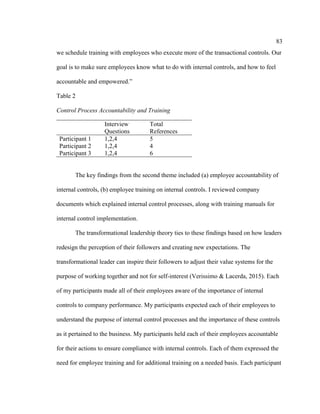
  • 132.
    121 Meredith, J. (2016).Transcribing screen-capture data: the process of developing a transcription system for multi-modal text-based data. International Journal of Social Research Methodology, 19, 663-676. doi:10.1080/13645579.2015.1082291 Miller, T. (2015). Going back: Stalking, talking and researcher responsibilities in qualitative longitudinal research. International Journal of Social Research Methodology, 18, 293-305. doi:10.1080/13645579.2015.1017902 Mojtahed, R., Nunes, M., Martins, J., & Peng, A. (2014). Equipping the constructivist researcher: The combined use of semistructured interviews and decision-making maps. Journal of Business Research Methods, 12, 87-95. Retrieved from http://www.academic-conferences.org/ejournals.htm. Moon, C. (2015). The (un)changing role of the researcher. International Journal of Market Research, 18, 15-16. doi:10.2501/IJMR-2015.002 Morrow, S. (2005). Quality and trustworthiness in qualitative research in counseling psychology. Journal of Counseling Psychology, 52, 2, 250-260. doi:10.1037/0022-0167.52.2.250 Morton, A., Rivers, C., Charters, S., & Spinks, W. (2013). Champagne purchasing: the influence of kudos and sentimentality. Qualitative Market Research: An International Journal, 16, 2, 150-164. doi:10.1108/13522751311317567 Munsif, V., Raghunandan, K., & Rama, D., (2013). Early warnings of internal control problems: Additional evidence. Auditing: A Journal of Practice & Theory, 32, 171-188. doi:10.2308/ajpt-50380
  • 133.
    122 Murphy, P., &Free, C. (2016). Broadening the fraud triangle: Instrumental climate and fraud Behavioral Research in Accounting, 28, 41-56. doi:10.2308/bria-51083 Myllymaki, E. (2014). The persistence in the association between Section 404 material weaknesses and financial reporting quality. A Journal of Practice & Theory, 33, 1, 93-116. doi:10.2308/ajpt-50570 Nagy, A. (2014). PCAOB quality control inspection reports and auditor reputation. A Journal of Practice & Theory, 33, 3, 87-104. doi:10.2308/ajpt-50752 Neufeld, D., Zeying, W., & Yulin, F. (2010). Remote leadership, communication effectiveness and leader performance. Group Decision & Negotiation, 19, 227- 246. doi:10.1007/s10726-008-9142-x Nguyen, T., Mia, L., Winata, L., & Chong, V. (2017). Effect of transformational- leadership style and management control system on managerial performance. Journal of Business Research, 70, 202-213. doi:10.1016/j.jbusres.2016.08.018 Noble, H., & Smith, J. (2015). Issues of validity and reliability in qualitative research. Evidence Based Nursing, 18, 34-35. doi:10.1136/eb-2015-102054 Omar, M., Nawawi, A, & Puteh Salin, A. (2016). The causes, impact and prevention of employee fraud. Journal of Financial Crime, 23, 1012-1027. doi:10.1108/JFC-04- 2015-0020 Ortlipp, M. (2008). Keeping and using reflective journals in the qualitative research process. The Qualitative Report, 13, 4, 695-705. Retrieved from http://www.nova.edu/sss/QR/QR13-4/ortlipp.pdf
  • 134.
    123 Palmer, T. &Flanagan, D. (2016). The sustainable company: looking at goals for people, planet and profits. Journal of Business Strategy, 37, 28-38. doi:10.1108/JBS-09-2015-0095 Park, J., & Matkin, D., & Marlowe, J. (2017). Internal control deficiencies and municipal borrowing costs. Public Budgeting & Finance, 37, 88-111. doi:10.1111/pbaf.12120 Park, J., & Park, M. (2016). Qualitative versus quantitative research methods: Discovery or justification? Journal of Marketing Thought, 3, 1-7. doi:10.15577/jmt.2016.03.01.1 Patelli, L., & Pedrini, M. (2015). Is tone at the top associated with financial reporting aggressiveness? Journal of Business Ethics, 126, 3-19. doi:10.1007/s10551-013-1994-6 Paulus, T., Woods, M., Atkins, D., & Macklin, R. (2017). The discourse of QDAS: reporting practices of ATLAS.ti and NVivo users with implications for best practices. International Journal of Social Research Methodology, 20, 1, 35-47. doi:10.1080/13645579.2015.1102454 Peltier-Rivest, D. (2018). A model for preventing corruption. Journal of Financial Crime, 25, 545-561. doi:10.1108/JFC-11-2014-0048. Peltier-Rivest, D. (2017). The prevention and detection of corruption in pharmaceutical companies. Pharmaceuticals Policy & Law, 19, 17-31. doi:10.1080/15555240.2016.127378210.3233/PPL-170451
  • 135.
    124 Perryer, C., &Scott-Ladd, B. (2014). Deceit, misuse and favours: Understanding and measuring attitudes to ethichs. Journal of Business Ethics, 121, 123-134. doi:10.1007/10551-012-1593-y Pradhan & Pradhan, (2015). An empirical investigation of relationship among transformational leadership, affective organizational commitment and contextual performance. Vision, 19, 227-235. doi:10.1177/0972262915597089 Radojeciv, T., & Radovic, N. (2014). Application of information systems and internal controls in hotel business. Journal of Applied Science, 2014 supplement, 777-780. doi:10.15308/sinteza-2014-777-781 Rae, K., Sands, J., & Subramaniam, N. (2017). Associations among the five components within COSO internal control-integrated framework as the underpinning of quality corporate governance. Australasian Accounting Business & Finance Journal, 11, 28-54. doi:10.14453/aabfj.v11i1.4 Raich, M., Muller, J., & Abfalter, D. (2014). Hybrid analysis of textual data. Management Decision, 52, 737-754. doi:10.1108/MD-03-2012-0247 Ramsey, J., Rutti, R., Lorenz, M., Barakat, L., & Sant’anna, A., (2017). Developing global transformational leaders. Journal of World Business, 52, 461-473. doi:10.1016/j.jwb.2016.06.002 Rao, A. Srinivasa & Waheed, Kareem Abdul., (2015). Impact of transformational leadership on team performance: An empirical study in UAE. Measuring Business Excellence, 19, 30-56. doi:10.1108/MBE-07-2014-0022
  • 136.
    125 Reinstein, A., &Taylor, E. (2017). Fences as controls to reduce accountants’ rationalization. Journal of Business Ethics, 141, 477-488. doi:10.1007/s10551-015-2701-6 Rendon, J., & Rendon, R. (2016). Procurement fraud in the US Department of Defense. Managerial Auditing Journal, 6/7, 748-767. doi:10.1108/MAJ-11-2015-1267 Rice, S., Weber, D., & Wu, B. (2015). Does SOX 494 have teeth? Consequences of the failure to report existing internal control weaknesses. Accounting Review, 90, 1169-1200. doi:10.2308/accr-50974 Ridder, H. (2017). The theory contribution of case study research designs. Business Research, 10, 281-305. doi:10.1007/s40685-017-0045-z Rittenberg, L. (2013). COSO 2013. Internal Auditor, 70, 60-65. Retrieved from http://www.theiia.org/ecm/magazine.cfm?doc_id=540 Robertson, J., Stefaniak, C., & Houston, R. (2014). Do PCAOB inspection reports influence corporate executives’ perception of audit quality and the likelihood of switching auditors? Accounting and the Public Interest, 14, 48-71. doi:10.2308/apin-51121 Roden, D., Cox, S., & Kim, J. (2016). The fraud triangle as a predictor of corporate fraud. Academy of Accounting & Financial Studies Journal, 20, 80-92. Retrieved from http://alliedacademies.org/Public/Default.aspx Rodgers, W., Soderbom, A., & Guiral, A. (2015). Corporate social responsibility enhanced control systems reducing the likelihood of fraud. Journal of Business Ethics, 131, 871-
  • 137.
    126 Rubin, A., Segal,B., & Segal, D. (2017). The interpretation of unanticipated news arrival and analysts’ skill. Journal of Financial & Quantitative Analysis, 52, 1491-1518. doi:10.1017/S0022109017000539. Rubino, M., Vitolla, F., & Garzoni, A. (2017). The impact of an IT governance framework on the internal control environment. Records Management Journal, 27, 19-41. doi:10.1108/RMJ-03-2016-0007 Rufin, R., & Medina, C. (2014). Market delimitations, firm survival and growth in service industries. Service Industries Journal, 30, 1401-1417. doi:10.1080/02642060802621494 Schroeder, H. (2015). The role of the executive sponsor in organizational transformation. Strategic Direction, 31, 1-3. doi:10.1108/SD-01-2015-0016 Schroeder, J., & Shepardson, M., (2016). Do SOX 404 control audits and management assessments improve overall internal control system quality? Accounting Review, 91, 1513-1541. doi:10.2308/accr-51360 Shah, P. (2017). Why do firms delete brands? Insights from a qualitative study. Journal of Marketing Management, 33, 446-463. doi:10.1080/0267257X.2017.1319405 Shapiro, D. (2014). COSO embraces enhanced fraud risk management. Journal of Corporate Accounting & Finance (Wiley), 25, 33-38. Retrieved from http://www.wiley.com.ezp.waldenulibrary.org Shaw, W. & Terando, W. (2014). The cost of compliance to Sarbanes-Oxley: An examination of the real estate investment industry. A Journal of Practice & Theory, 33, 177-186. doi:10.2308/ajpt-50613
  • 138.
    127 Shefrin, H. (2016).Behavioral insights for improving the practice of risk management. Journal of Risk Management in Financial Institutions, 9, 112-119. Retrieved from http://www.henrystewart.com/ Siboney, Lovallo, & Powell (2017). Behavioral strategy and the strategic decision architecture of the firm. California Management Review, 59, 5-21. doi:10.1177/0008125617712256 Siegel, D. (2015). Responsible leadership. Academy of Management Perspectives, 3015, 1-3. doi:10.5465/amp.2014.0081.test Singleton, T. (2008). Internal controls: Strategies for smaller companies. Journal of Corporate Accounting & Finance (Wiley), 19, 37-40. doi:10.1002/jcaf.20400 Smit, M. (2017). A narrative research design into the moral courage of professionals. Perspectives on Philosophy of Management and Business Ethics, 51, 61-71. doi:10.1007/978-3-319-46973-7_5 Soltani, B. (2014). The anatomy of corporate fraud: A comparative analysis of high profile American and European corporate scandals. Journal of Business Ethics, 120, 251-274. doi:10.1007/s10551-013-1660-z Son, M., Song, H., & Park, Y. (2017). PCOAB inspection reports and shareholder ratification of the auditor. Accounting & the Public Interest, 17, 107-129. doi:10.2308/apin-51802 Sorenson, L., & Stanton, N. (2016). Inter-rater reliability and content validity of network analysis as a method for measuring distributed situation awareness. Theoretical Issues in Ergonomics Science, 17, 42-63. doi:10.1080/1463922X.2015.1106619
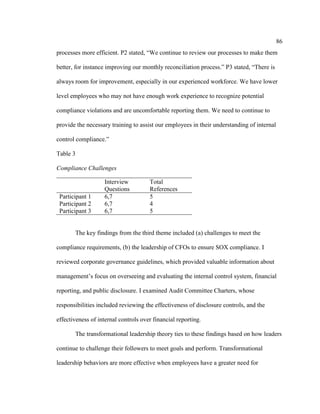
  • 139.
    128 Sousa, M., &Dierendonck, D., (2017). Servant leadership and the effect of the interaction between humility, action, and hierarchical power on follower engagement. Journal of Business Ethics, 141, 13-25. doi:10.1007/s10551-015-2725-y Steffee, S. (2016). COSO drafts ERM framework (2016). Internal Auditor, 73, 13-15. Retrieved from http://www.theiia.org/ecm/magazine.cfm?doc_id=540 Stratford, E., & Bradshaw, M., (2016). Qualitative Research Design and Rigour, Qualitative Research Methods in Human Geography, Oxford University Press, I Hay (ed), Ontario, Canada, pp. 117-129. ISBN 978-0-19-901090-5 (2016 Stuckey, H., (2014). The first step in data analysis: Transcribing and managing qualitative research data. Methodological Issues in Social Health and Diabetes Research, 2, 1, 6-8. doi:10.4103/2321-0656.120254 Sun, R., & Henderson, A. (2017). Transformational leadership and organizational processes: influencing public performance. Public Administration Review, 77, 554-565. doi:10.1111/puar.12654. Svanberg, J., Ohman, P., & Neidermeyer, P. (2017). The relationship between transformational client leadership and auditor objectivity. Auditing & Accountability Journal, 30, 1142-1159. doi:10.1108/AAAJ-07-2015-2119 Tackett, J. (2010). Bribery and corruption. Journal of Corporate Accounting & Finance (Wiley), 21, 5-9. doi:10.1002/jcaf.20589
  • 140.
    129 Tanyi, P., &Litt, B. (2017). The unintended consequences of the frequency of PCAOB inspections. Journal of Business Finance & Accounting, 44, 116-153. doi:10.1111/jbfa.12230 Taylor, J. (2018). Internal whistle-blowing in the public service: A matter of trust. Public Administration Review, 78, 717-726. doi:10.1111/puar.12946 Teixteria, A. (2014). The international accounting standards board and evidence – informed standard-setting. Accounting in Europe, 11, 5-12. doi:10.1080/17449480.2014.900269 Turner, S., Cardinal, L., & Burton, R. (2017). Research design for mixed methods. Organizational Research Methods, 20, 2, 243-267. doi:10.1177/1094428115610808 Tyssen, A., Wald, A., & Spieth, P., (2014). The challenge of transactional and transformational leadership in projects. International Journal of Project Management, 32, 365-375. doi:10.1016/j.ijproman.2013.05.010 Unithan, N. (2016). Crime as an identity. Social Science Journal, 53, 1-6. doi:10.1016/j.soscij.2016.02.005 Urbanik, V. (2016). Making internal control a priority in local government. Journal of Government Financial Management, 65, 20-25. Retrieved from http://www.agacgfm.org Van Auken, H., & Yang, K. (2014). Chinese SMEs’ uses of financial statements in decision making. Journal of Developmental Entrepreneurship, 19, 4, 1-16. doi:10.1142/S1084946714500277
  • 141.
    130 VanWart, M., (2015).Evaluating transformational leaders: the challenging case of Eric Shinseki and the U.S. Department of Veterans Affairs. Public Administration Review, 75, 760-769. doi:10.1111/puar.12393 Vaughn, P., & Turner, C. (2016). Decoding via coding: Analyzing qualitative text data through thematic coding and survey methodologies. Journal of Library Administration, 56, 41-51. doi:10.1080/01930826.2015.1105035 Vega, J., Smolarski, J., & Zhou, H. (2015). Sarbanes-Oxley: changes in risk premium and return volatility. Asian Review of Accounting, 23, 86-106. doi:10.1108/ARA-01-2014-0018 Verissimo, J., & Lacerda, T. (2015). Does integrity matter for CSR practice in organizations? The mediating role of transformational leadership. Business Ethics: A European Review. 24, 34-51. doi:11.1111/beer.12065 Vicary, S., Young, A., & Hicks, S. (2016). A reflective journal as learning process and contribution to quality and validity in interpretative phenomenological analysis. Qualitative Social Work, 16, 4, 550-565. doi:10.1177/1473325016635244 Viscelli, T., Hermanson, D., & Beasley, M. (2017). The integration of ERM and strategy: Implications for corporate governance. Accounting Horizons, 31, 69-82. doi:10.2308/acch-51692 Wallace, M., & Sheldon, N. (2015). Business research ethics: Participant observer perspectives. Journal of Business Ethics, 128, 267-277. doi:10.1007/s10551-014- 2102-2
  • 142.
    131 Warren, D., Peytcheva,M., & Gaspar, J. (2015). When ethical tones at the top conflict: Adapting priority rules to reconcile conflicting tones. Business Ethics Quarterly, 25, 559-582. doi:10.1017/beq.2015.40 Watts, L., Todd, M., Mulhearn, T., Medeiros, K., Mumford, M., & Connelly, S. (2017). Quality evaluation methods in ethics education: A systematic review and analysis of best practices. Accountability in Research: Policies & Quality Assurance, 24, 4, 225-252. Doi:10.1080/08989621.2016.1274975 Webber, S., & Webber, D. (2015). Launching and leading intense teams. Business Horizons, 58, 449-457. doi:10.1016/j.bushor.2015.03.009 Wedemeyer, P. (2014). A perspective on the PCAOB – past and future. Accounting Horizons, 28, 937-947. doi:10.2308/acch-50889 Wee, B. & Banister, D. (2016). How to write a literature review paper? Transport Reviews, 36, 278-288. doi:10.1080/01441647.2015.1065456 Whitehead, J., Weddell, M., & Groothuis, P. (2016). Mitigating hypothetical bias in stated preference data: Evidence from sports tourism. Economic Inquiry, 54, 605- 611. doi:10.1111/ecin.12253 Wilbanks, D. (2016). The Sarbanes-Oxley Act. Professional Safety, 2, 23-25. Retrieved from http://www.asse.org/professional-safety. Williams, R., Raffo, D., & Clark, D. (2018). Charisma as an attribute of transformational leaders: what about credibility? Journal of Management Development, 37, 512- 524. doi:10.1108/JMD-03-2018-0088
  • 143.
    132 Yangyang, F. &Chan, R. (2017). Is SOX 404(a) management internal control reporting an effective alternative to SOX 404(b) internal control audits? A Journal of Practice & Theory, 36, 71-89. doi:10.2308/ajpt-51669 Yeoh, P. (2014). Whistleblowing:Motivations, corporate self-regulation, and the law. International Journal of Law & Management, 56, 459-474. doi:10.1108/IJLMA- 06-2013-0027 Yunhao, C., Smith, A., & Jian, C. (2014). Information technology capability, internal control effectiveness, and audit fees and delays. Journal of Information Systems, 28, 149-180. doi: 10.2308/isys-50778 Yuping, Z., Bedard, J., & Hoitash, R. (2017). SOX 404, auditor effort, and the prevention of financial report misstatements. A Journal of Practice & Theory, 36, 151-177. doi:10.2308/ajpt-51687 Zacher, H., Pearce, L., Rooney, D., & McKenna, B. (2014). Leaders’ personal wisdom and leader-member exchange quality: The role of individualized consideration. Journal of Business Ethics, 121, 171-187. doi:10.1007/s10551-013-1692-4 Zakaria, K., Nawawi, A., & Salin, A. (2016). Internal controls and fraud-empirical evidence from oil and gas company. Journal of Financial Crime, 23, 1154-1168. doi:10.1108/JFC-04-2016-0021 Zineldin, M. (2017). Transformational leadership behavior, emotions, and outcomes: Health psychology perspective in the workplace. Journal of Workplace Behavioral Health, 32, 14-25. doi:10.1080/15555240.2016.1273782
  • 144.
    133 Appendix A: InterviewProtocol Interview Protocol What you will do What you will say—script Introduction Hello, my name is Grant Lee and I want to thank you for agreeing to be a part of my study. Before we get started, I would like to review the informed consent form with you and give you an opportunity to ask me any general questions.  Interview questions  Follow up questions 1. What strategies did you develop and implement for internal control? Follow up question: Describe your prior experiences, which you used that helped you develop your strategies for the development and implementation for internal control. 2. How do you reinforce strategies for internal control compliance with all employees? Follow up question: Describe any moments when attempts to reinforce strategies for internal control compliance did not work and how did you fix this. 3. How does the internal control process affect the financial reporting and disclosure preparation process? Follow up question: Describe your experiences with SOX 404 audits and what effects it has on your company’s
  • 145.
    134 financial reporting. 4. Whatare the consequences to employees who fail to adhere to internal control policies and procedures? Follow up question: Is the failure to adhere to internal control policy due to a lack of training? Describe the employee training on internal control processes. 5. What are the roles of the audit committee and board of directors as it pertains to internal control implementation? Follow up question: Are these groups involved in the review of internal control processes? 6. What are the compliance challenges you face most frequently in your role as controller? Follow up question: How does your team help you address these challenges? 7. What ways can the company improve its compliance policies? 8. How can company employees report issues or potential violations of compliance policies? Follow up question: How are employees protected from reporting issues or violations of compliance policies? 9. What additional information would you like to share
  • 146.
    135 about your company’sinternal controls? Wrap up interview thanking participant I want to thank you for your time and your responses to my questions. Do you have any final questions or comments you would like to discuss with me? Schedule follow-up member checking interview A follow up member checking interview will be scheduled
  • 147.
    136 Appendix B: InterviewQuestions 1. What strategies did you develop and implement for internal control? 2. How do you reinforce strategies for internal control compliance with all employees? 3. How does the internal control process affect the financial reporting and disclosure preparation process? 4. What are the consequences to employees who fail to adhere to internal control policies and procedures? 5. What are the roles of the audit committee and board of directors as it pertains to internal control implementation? 6. What are the compliance challenges you face most frequently in your role as controller? 7. What ways can the company improve its compliance policies? 8. How can company employees report issues or potential violations of compliance policies? 9. What additional information would you like to share about your company’s internal controls?