Intermolecular interaction of water hexamer water hexamer Yiming Chen October 5th, 2009
Contents Background Information Previous Investigations Energy Decomposition Analysis of  Water Hexamer Acknowledgement
Contents Background Information Intermolecular Interaction Water Clusters Energy Decomposition Analysis Previous Investigations Energy Decomposition Analysis of  Water Hexamer Acknowledgement
Intermolecular Interaction Forces act between stable molecules. Categories London Dispersion Force Dipole-Dipole Interaction Hydrogen Boding
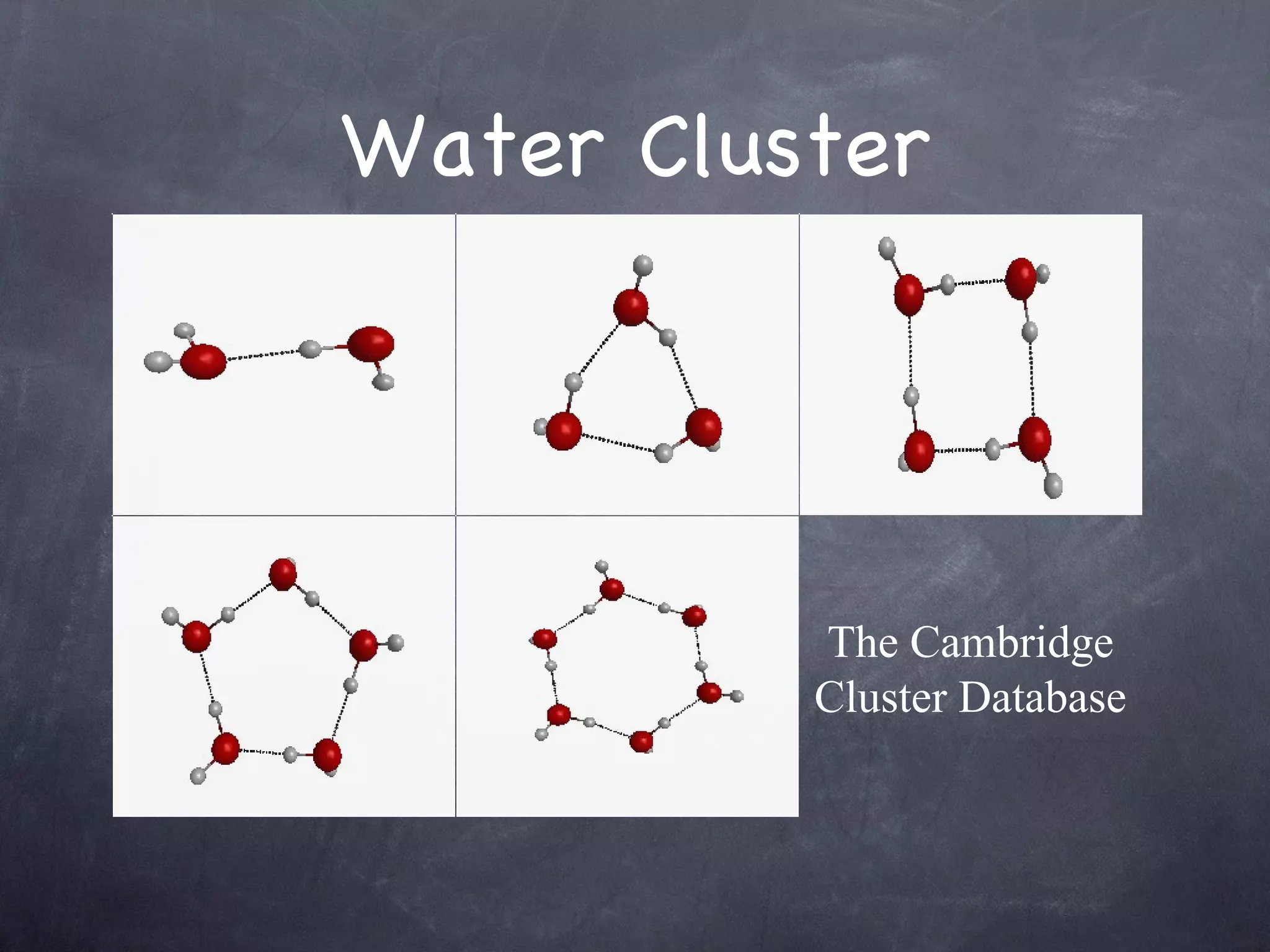
Water Cluster Definition: discrete hydrogen bonded assembly or cluster of molecules of water Examples: Dimer, Trimer, Tetramer, Pentamer, Hexamer, and etc.
Water Cluster The Cambridge Cluster Database
Water Cluster Why we study water clusters? Understanding cloud and ice formation Solution chemistry Large number of biochemical processes Molecular Dynamics
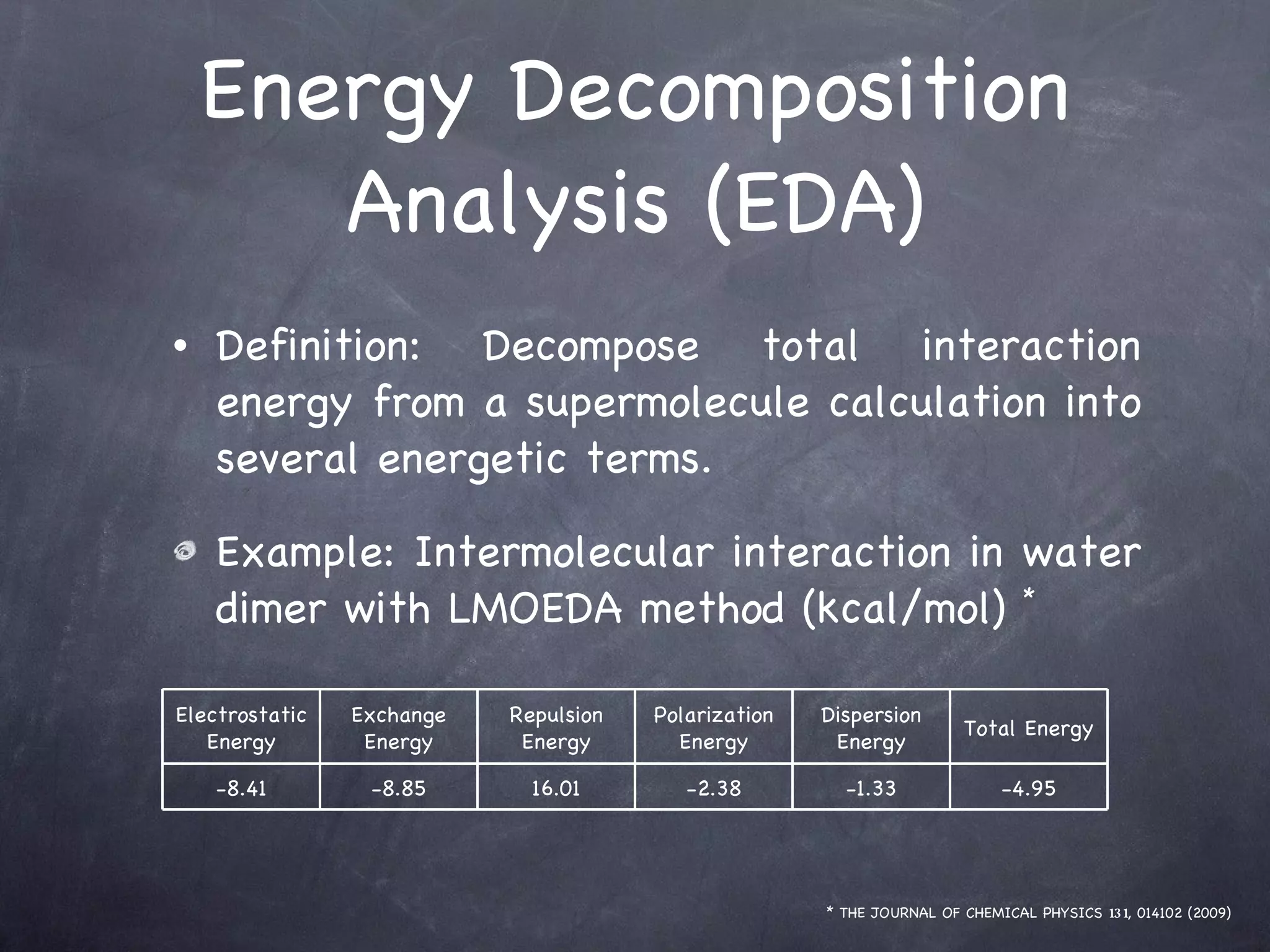
Energy Decomposition Analysis (EDA) Definition: Decompose total interaction energy from a supermolecule calculation into several energetic terms. Example: Intermolecular interaction in water dimer with LMOEDA method (kcal/mol)  * * THE JOURNAL OF CHEMICAL PHYSICS  131 , 014102 (2009) Electrostatic Energy Exchange Energy Repulsion Energy Polarization Energy Dispersion Energy Total Energy -8.41 -8.85 16.01 -2.38 -1.33 -4.95
Contents Background Information Previous Investigations Experimental Studies Theoretical Studies Energy Decomposition Analysis of  Water Hexamer Acknowledgement
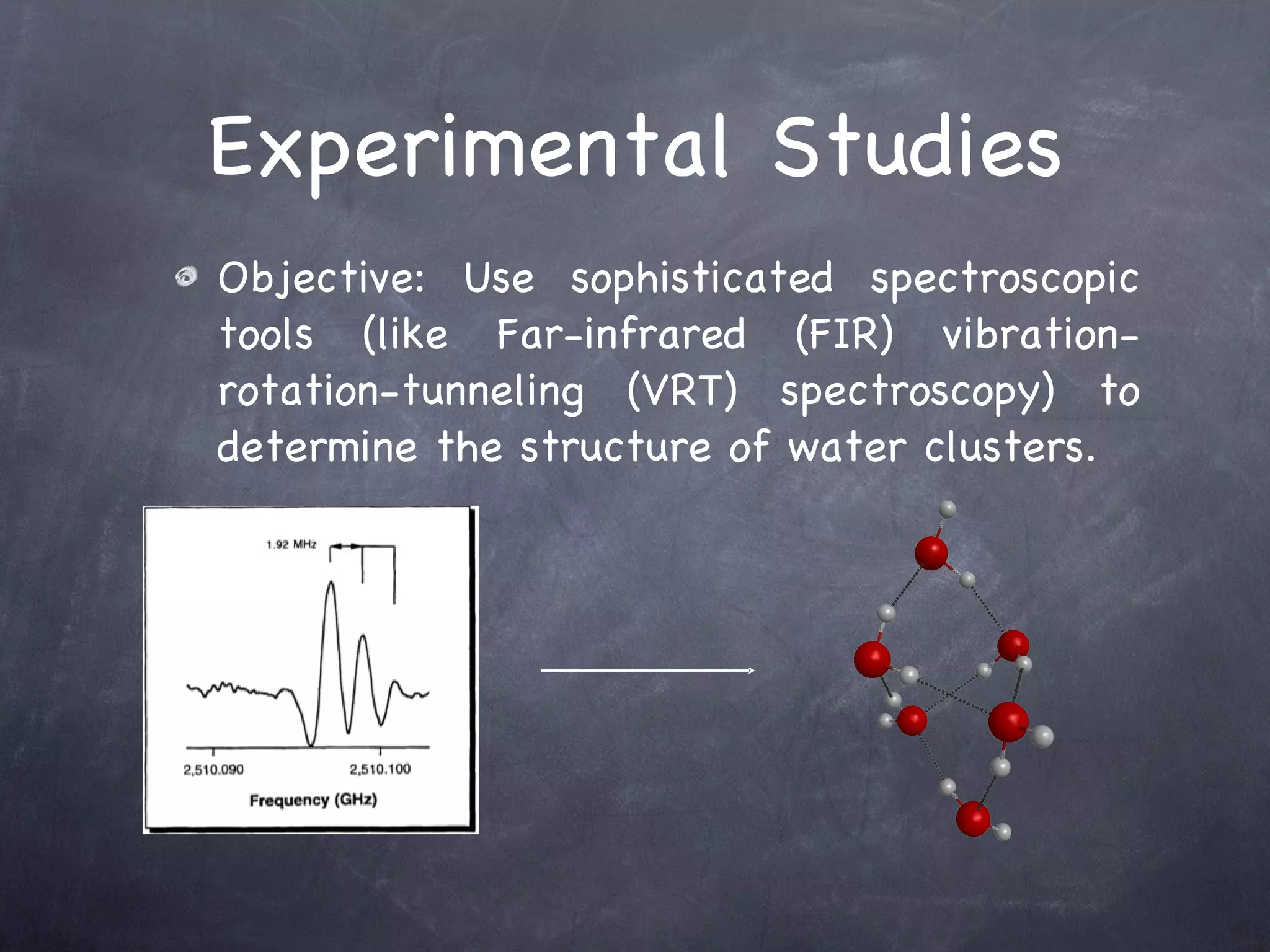
Experimental Studies Objective: Use sophisticated spectroscopic tools (like Far-infrared (FIR) vibration-rotation-tunneling (VRT) spectroscopy) to determine the structure of water clusters.
Experimental Studies The structures of (H 2 O ) n  (n=6-20) clusters have been characterized by spectroscopy method; Different structures of water clusters in different phases (Solid, gas, crystal) are detected; Supramolecular structures in bulk water is still difficult to study by experimental method.
Theoretical Studies Structures: larger clusters are predicted, like W20-W28 (bucky water), icosahedral network; Energy: Energetic low-lying clusters are found by theoretical calculation; Studies focus on intermolecular  interactions are still rare.
Contents Background Information Previous Investigations Energy Decomposition Analysis of  Water Hexamer Introduction of investigation Intermolecular interactions of water hexamers Many-body interaction: additivity of energy terms Acknowledgement
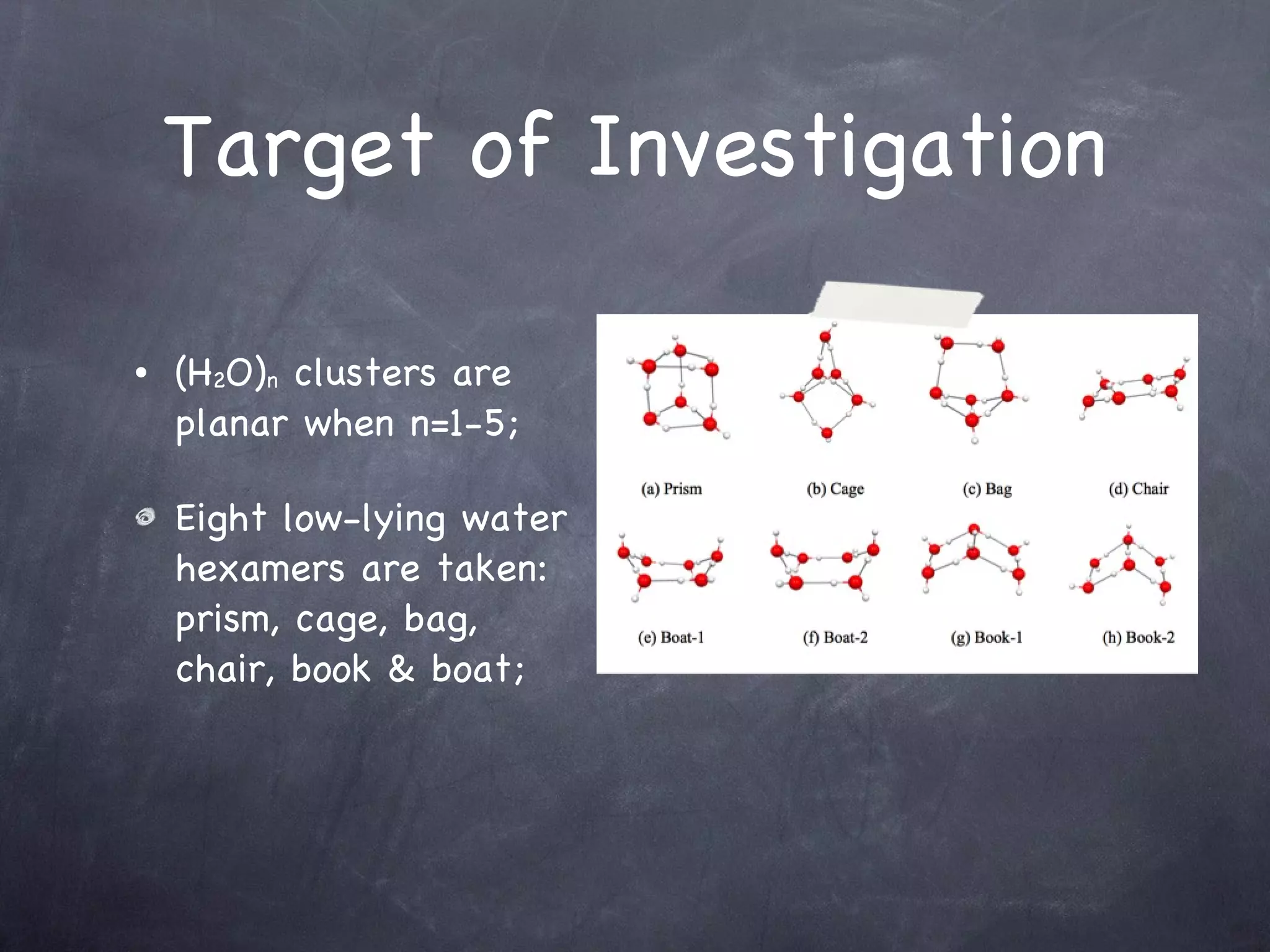
Target of Investigation (H 2 O) n  clusters are planar when n=1-5; Eight low-lying water hexamers are taken: prism, cage, bag, chair, book & boat;
Method of Investigation Software: Gamess ver. 118 (Aug. 14, 2009); Geometry Optimization: MP2/aug-cc-pVTZ; EDA: LMOEDA method proposed by Su and Li *  is taken to study the physical origins of intermolecular interactions, at MP2/aug-cc-pV5Z level; * THE JOURNAL OF CHEMICAL PHYSICS  131 , 014102 (2009)
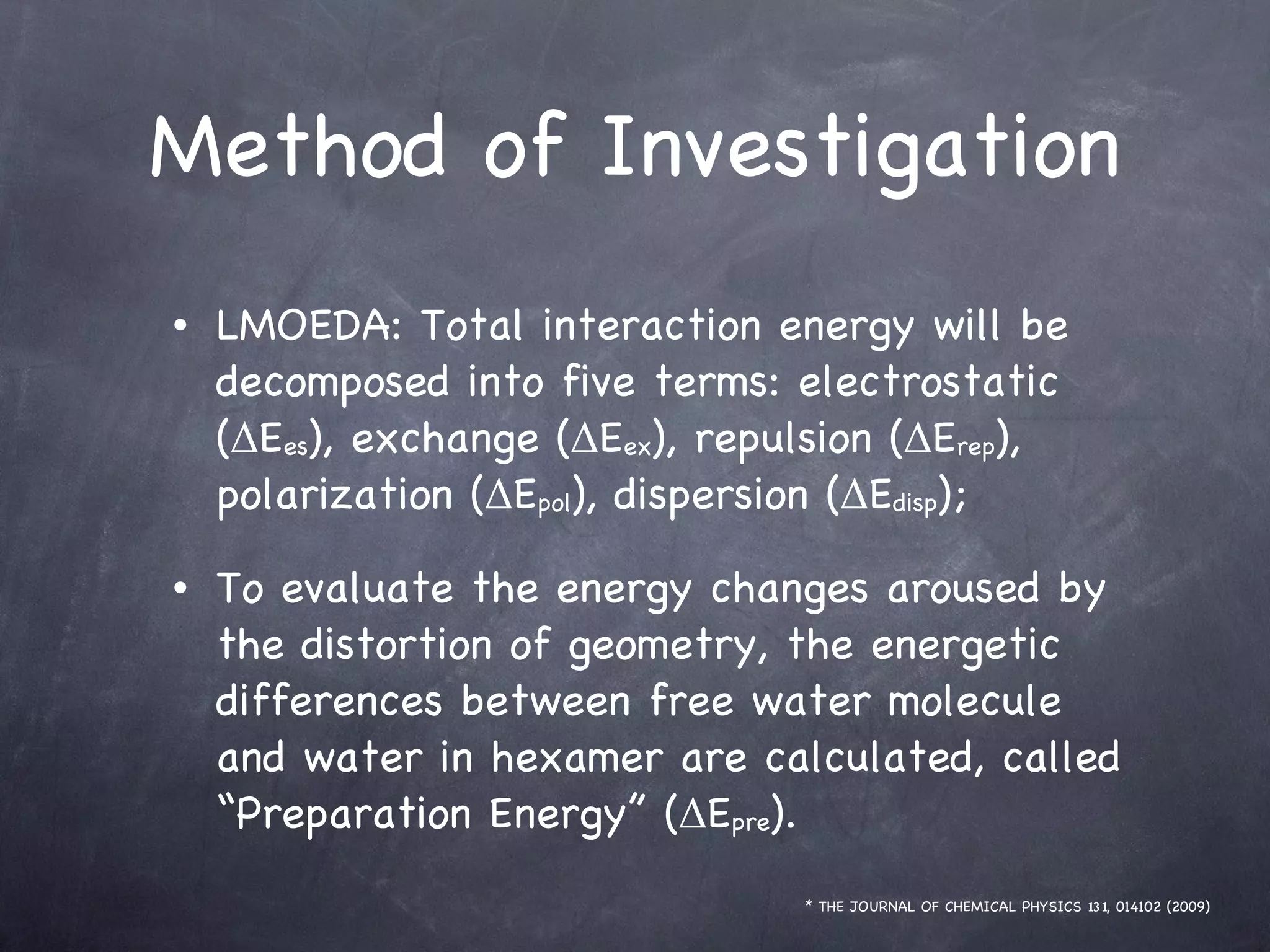
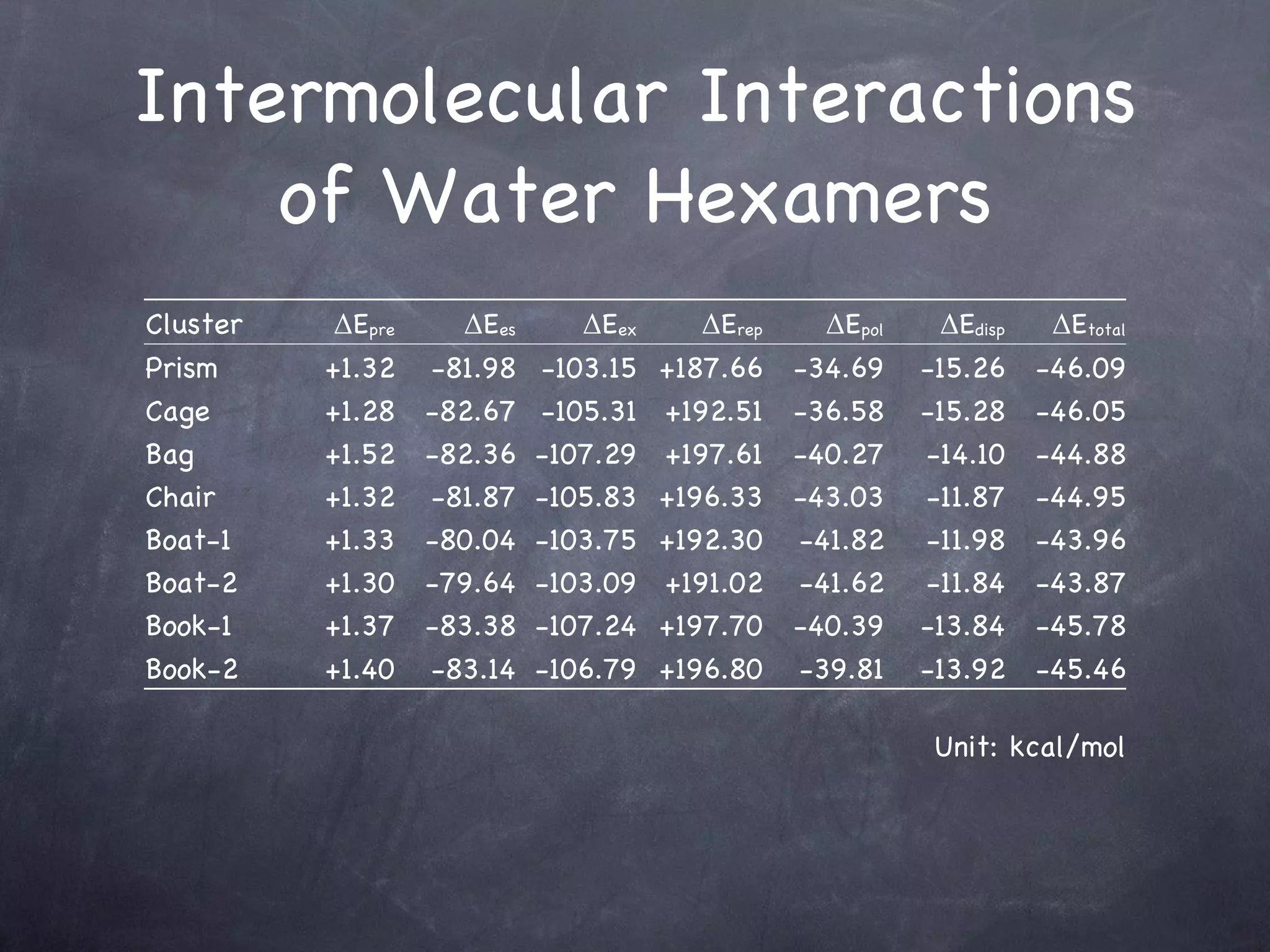
Method of Investigation LMOEDA: Total interaction energy will be decomposed into five terms: electrostatic (ΔE es ), exchange (ΔE ex ), repulsion (ΔE rep ), polarization (ΔE pol ), dispersion (ΔE disp ); To evaluate the energy changes aroused by the distortion of geometry, the energetic differences between free water molecule and water in hexamer are calculated, called “Preparation Energy” (ΔE pre ). * THE JOURNAL OF CHEMICAL PHYSICS  131 , 014102 (2009)
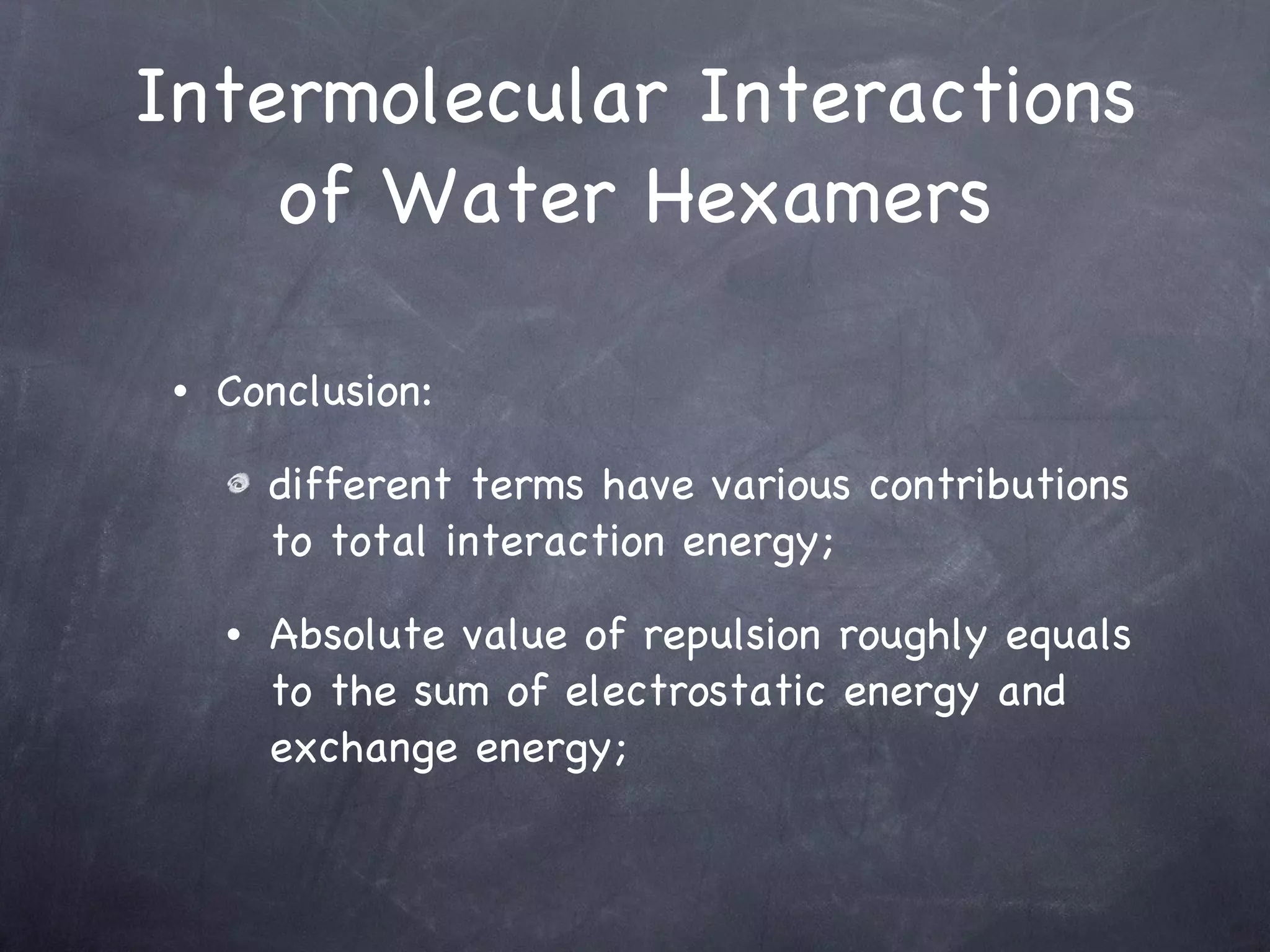
Intermolecular Interactions of Water Hexamers Unit: kcal/mol Cluster ΔE pre ΔE es ΔE ex ΔE rep ΔE pol ΔE disp ΔE total Prism +1.32 -81.98 -103.15 +187.66 -34.69 -15.26 -46.09 Cage +1.28 -82.67 -105.31 +192.51 -36.58 -15.28 -46.05 Bag +1.52 -82.36 -107.29 +197.61 -40.27 -14.10 -44.88 Chair +1.32 -81.87 -105.83 +196.33 -43.03 -11.87 -44.95 Boat-1 +1.33 -80.04 -103.75 +192.30 -41.82 -11.98 -43.96 Boat-2 +1.30 -79.64 -103.09 +191.02 -41.62 -11.84 -43.87 Book-1 +1.37 -83.38 -107.24 +197.70 -40.39 -13.84 -45.78 Book-2 +1.40 -83.14 -106.79 +196.80 -39.81 -13.92 -45.46
Intermolecular Interactions of Water Hexamers Conclusion: different terms have various contributions to total interaction energy; Absolute value of repulsion roughly equals to the sum of electrostatic energy and exchange energy;
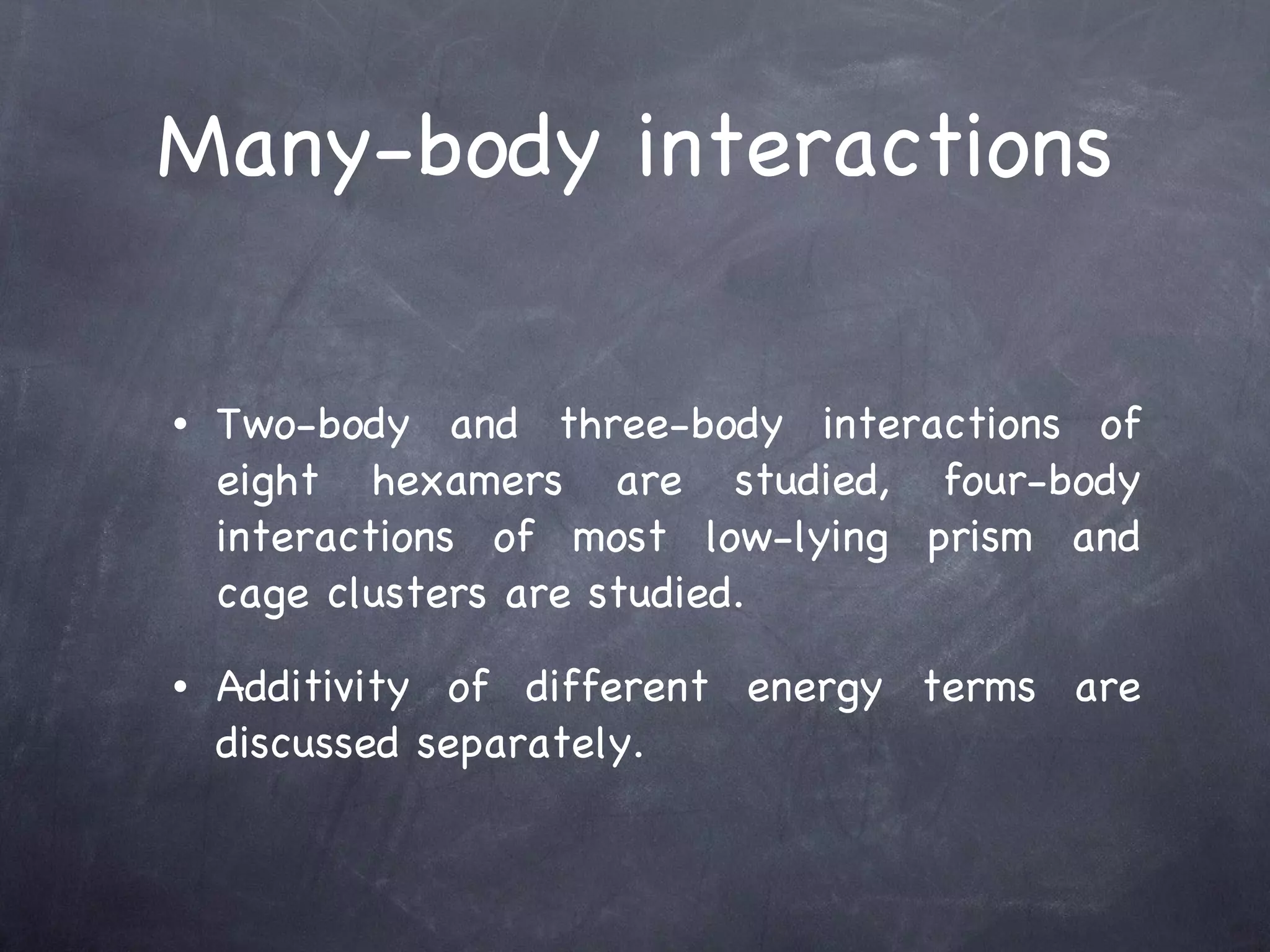
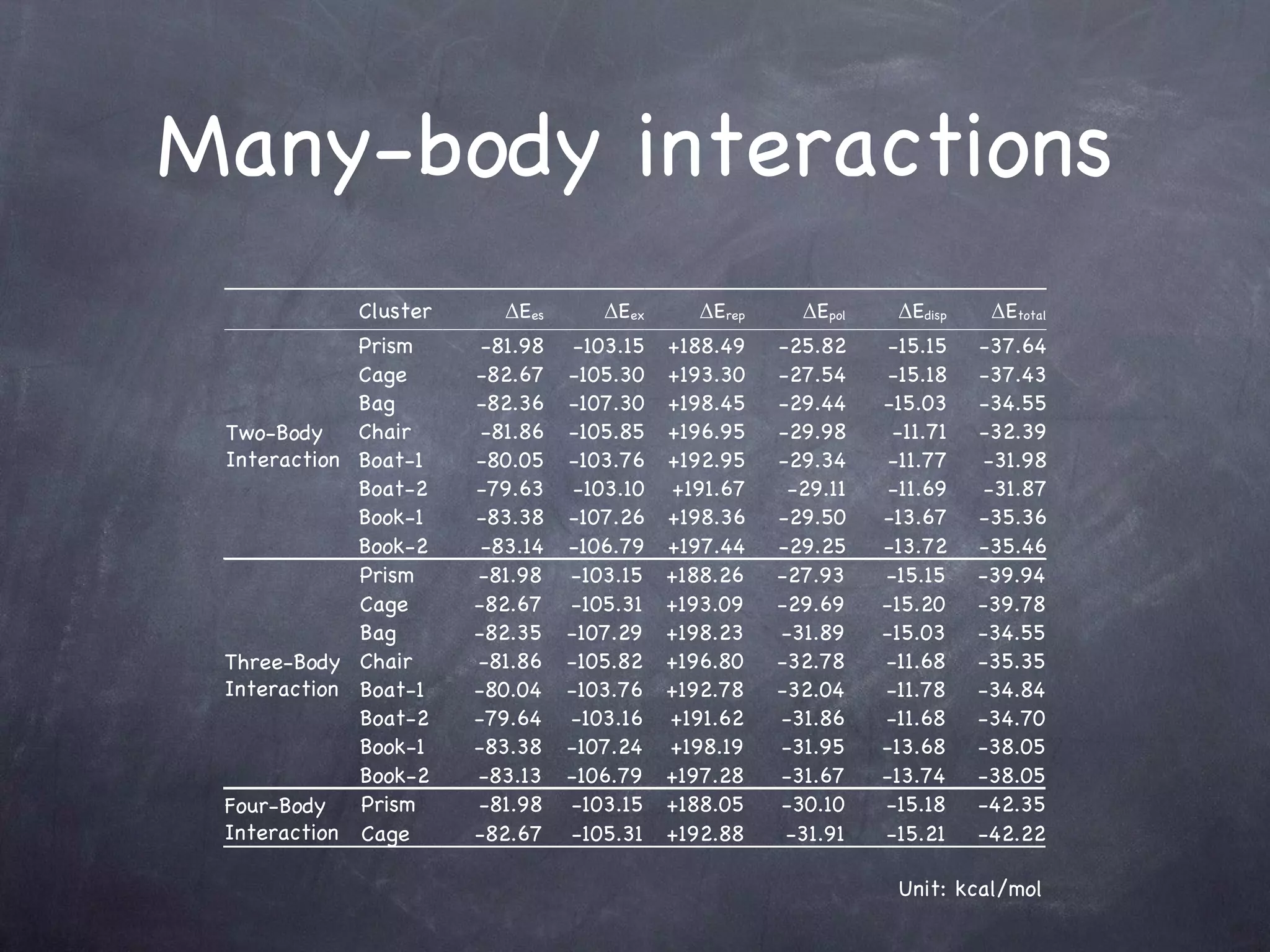
Many-body interactions Two-body and three-body interactions of eight hexamers are studied, four-body interactions of most low-lying prism and cage clusters are studied. Additivity of different energy terms are discussed separately.
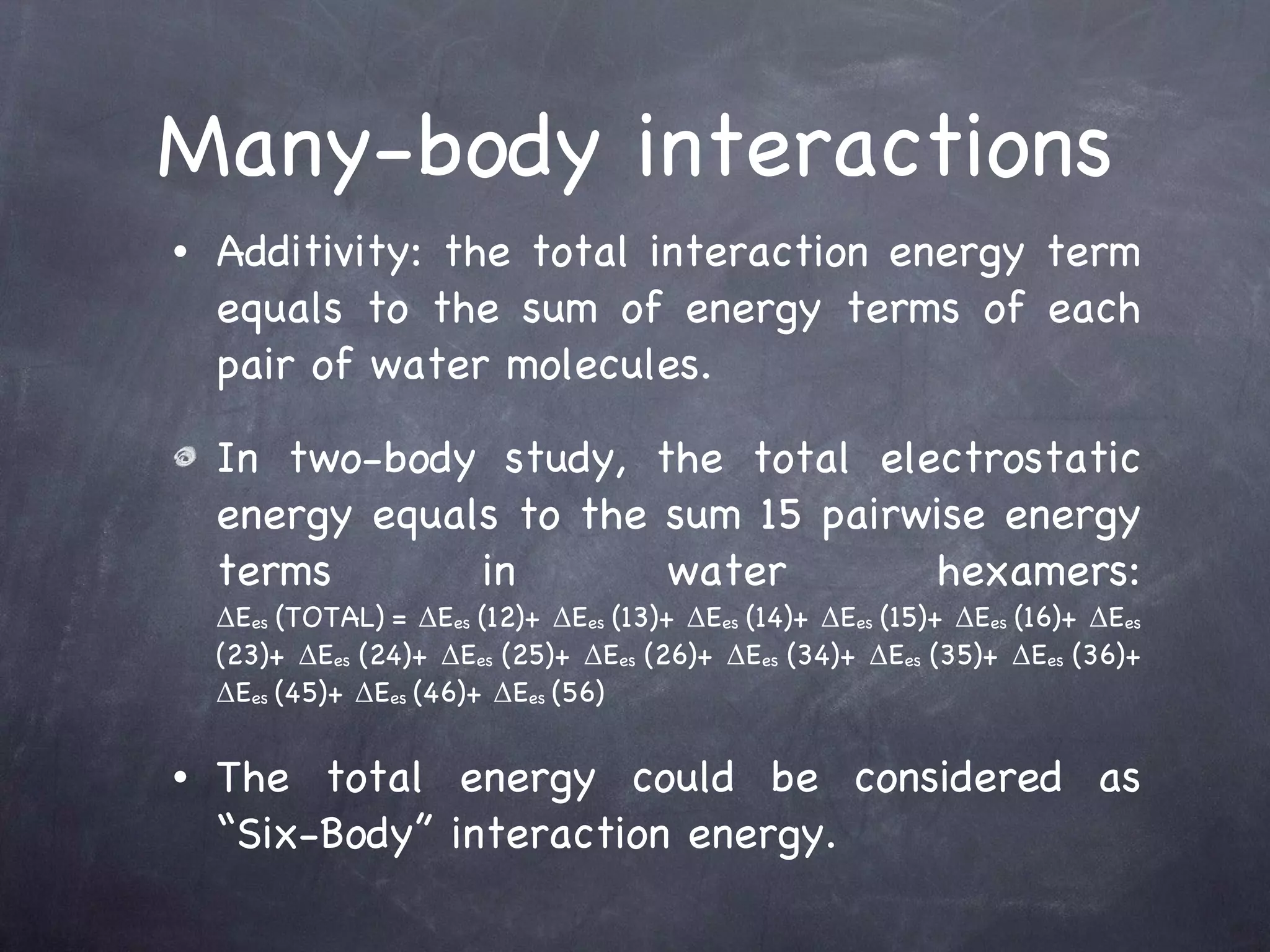
Many-body interactions Additivity: the total interaction energy term equals to the sum of energy terms of each pair of water molecules. In two-body study, the total electrostatic energy equals to the sum 15 pairwise energy terms in water hexamers: ΔE es  (TOTAL)   = ΔE es  (12)+ ΔE es  (13)+ ΔE es  (14)+ ΔE es  (15)+ ΔE es  (16)+ ΔE es  (23)+ ΔE es  (24)+ ΔE es  (25)+ ΔE es  (26)+ ΔE es  (34)+ ΔE es  (35)+ ΔE es  (36)+ ΔE es  (45)+ ΔE es  (46)+ ΔE es  (56) The total energy could be considered as “Six-Body” interaction energy.
Many-body interactions Unit: kcal/mol Cluster ΔE es ΔE ex ΔE rep ΔE pol ΔE disp ΔE total Two-Body Interaction Prism -81.98 -103.15 +188.49 -25.82 -15.15 -37.64 Cage -82.67 -105.30 +193.30 -27.54 -15.18 -37.43 Bag -82.36 -107.30 +198.45 -29.44 -15.03 -34.55 Chair -81.86 -105.85 +196.95 -29.98 -11.71 -32.39 Boat-1 -80.05 -103.76 +192.95 -29.34 -11.77 -31.98 Boat-2 -79.63 -103.10 +191.67 -29.11 -11.69 -31.87 Book-1 -83.38 -107.26 +198.36 -29.50 -13.67 -35.36 Book-2 -83.14 -106.79 +197.44 -29.25 -13.72 -35.46 Three-Body Interaction Prism -81.98 -103.15 +188.26 -27.93 -15.15 -39.94 Cage -82.67 -105.31 +193.09 -29.69 -15.20 -39.78 Bag -82.35 -107.29 +198.23 -31.89 -15.03 -34.55 Chair -81.86 -105.82 +196.80 -32.78 -11.68 -35.35 Boat-1 -80.04 -103.76 +192.78 -32.04 -11.78 -34.84 Boat-2 -79.64 -103.16 +191.62 -31.86 -11.68 -34.70 Book-1 -83.38 -107.24 +198.19 -31.95 -13.68 -38.05 Book-2 -83.13 -106.79 +197.28 -31.67 -13.74 -38.05 Four-Body Interaction Prism -81.98 -103.15 +188.05 -30.10 -15.18 -42.35 Cage -82.67 -105.31 +192.88 -31.91 -15.21 -42.22
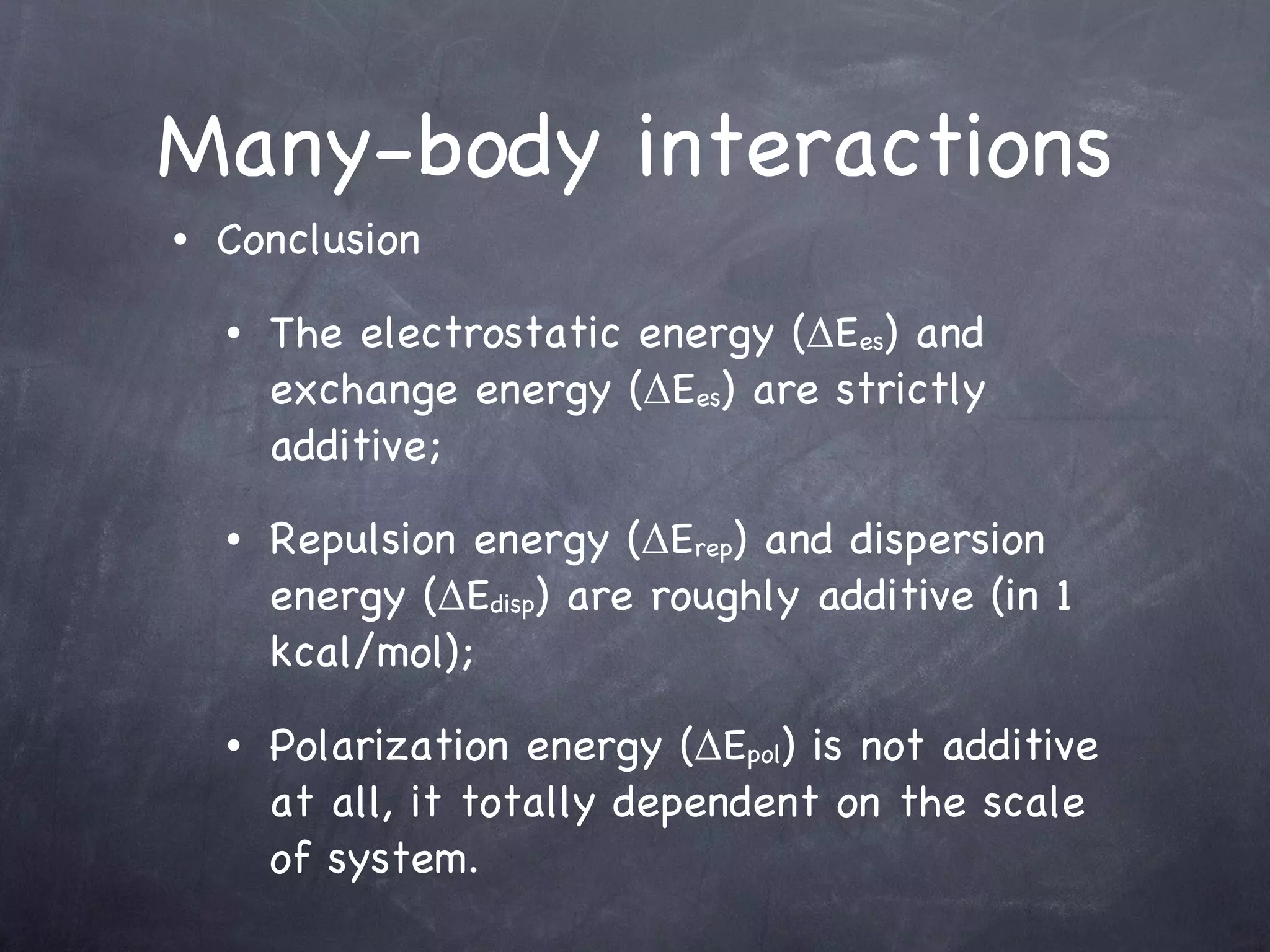
Many-body interactions Conclusion The electrostatic energy (ΔE es ) and exchange energy (ΔE es ) are strictly additive; Repulsion energy (ΔE rep ) and dispersion energy (ΔE disp ) are roughly additive (in 1 kcal/mol); Polarization energy (ΔE pol ) is not additive at all, it totally dependent on the scale of system.
Contents Background Information Previous Investigations Energy Decomposition Analysis of  Water Hexamer Acknowledgement
Acknowledgment Dr. Hui Li  Dr. Barry Cheung Dr. Peifeng Su Dejun Si Nandun Thellamurege
Thank you!

Intermolecular Interaction Of Water Hexamer

  • 1.
    Intermolecular interaction ofwater hexamer water hexamer Yiming Chen October 5th, 2009
  • 2.
    Contents Background InformationPrevious Investigations Energy Decomposition Analysis of Water Hexamer Acknowledgement
  • 3.
    Contents Background InformationIntermolecular Interaction Water Clusters Energy Decomposition Analysis Previous Investigations Energy Decomposition Analysis of Water Hexamer Acknowledgement
  • 4.
    Intermolecular Interaction Forcesact between stable molecules. Categories London Dispersion Force Dipole-Dipole Interaction Hydrogen Boding
  • 5.
    Water Cluster Definition:discrete hydrogen bonded assembly or cluster of molecules of water Examples: Dimer, Trimer, Tetramer, Pentamer, Hexamer, and etc.
  • 6.
    Water Cluster TheCambridge Cluster Database
  • 7.
    Water Cluster Whywe study water clusters? Understanding cloud and ice formation Solution chemistry Large number of biochemical processes Molecular Dynamics
  • 8.
    Energy Decomposition Analysis(EDA) Definition: Decompose total interaction energy from a supermolecule calculation into several energetic terms. Example: Intermolecular interaction in water dimer with LMOEDA method (kcal/mol) * * THE JOURNAL OF CHEMICAL PHYSICS 131 , 014102 (2009) Electrostatic Energy Exchange Energy Repulsion Energy Polarization Energy Dispersion Energy Total Energy -8.41 -8.85 16.01 -2.38 -1.33 -4.95
  • 9.
    Contents Background InformationPrevious Investigations Experimental Studies Theoretical Studies Energy Decomposition Analysis of Water Hexamer Acknowledgement
  • 10.
    Experimental Studies Objective:Use sophisticated spectroscopic tools (like Far-infrared (FIR) vibration-rotation-tunneling (VRT) spectroscopy) to determine the structure of water clusters.
  • 11.
    Experimental Studies Thestructures of (H 2 O ) n (n=6-20) clusters have been characterized by spectroscopy method; Different structures of water clusters in different phases (Solid, gas, crystal) are detected; Supramolecular structures in bulk water is still difficult to study by experimental method.
  • 12.
    Theoretical Studies Structures:larger clusters are predicted, like W20-W28 (bucky water), icosahedral network; Energy: Energetic low-lying clusters are found by theoretical calculation; Studies focus on intermolecular interactions are still rare.
  • 13.
    Contents Background InformationPrevious Investigations Energy Decomposition Analysis of Water Hexamer Introduction of investigation Intermolecular interactions of water hexamers Many-body interaction: additivity of energy terms Acknowledgement
  • 14.
    Target of Investigation(H 2 O) n clusters are planar when n=1-5; Eight low-lying water hexamers are taken: prism, cage, bag, chair, book & boat;
  • 15.
    Method of InvestigationSoftware: Gamess ver. 118 (Aug. 14, 2009); Geometry Optimization: MP2/aug-cc-pVTZ; EDA: LMOEDA method proposed by Su and Li * is taken to study the physical origins of intermolecular interactions, at MP2/aug-cc-pV5Z level; * THE JOURNAL OF CHEMICAL PHYSICS 131 , 014102 (2009)
  • 16.
    Method of InvestigationLMOEDA: Total interaction energy will be decomposed into five terms: electrostatic (ΔE es ), exchange (ΔE ex ), repulsion (ΔE rep ), polarization (ΔE pol ), dispersion (ΔE disp ); To evaluate the energy changes aroused by the distortion of geometry, the energetic differences between free water molecule and water in hexamer are calculated, called “Preparation Energy” (ΔE pre ). * THE JOURNAL OF CHEMICAL PHYSICS 131 , 014102 (2009)
  • 17.
    Intermolecular Interactions ofWater Hexamers Unit: kcal/mol Cluster ΔE pre ΔE es ΔE ex ΔE rep ΔE pol ΔE disp ΔE total Prism +1.32 -81.98 -103.15 +187.66 -34.69 -15.26 -46.09 Cage +1.28 -82.67 -105.31 +192.51 -36.58 -15.28 -46.05 Bag +1.52 -82.36 -107.29 +197.61 -40.27 -14.10 -44.88 Chair +1.32 -81.87 -105.83 +196.33 -43.03 -11.87 -44.95 Boat-1 +1.33 -80.04 -103.75 +192.30 -41.82 -11.98 -43.96 Boat-2 +1.30 -79.64 -103.09 +191.02 -41.62 -11.84 -43.87 Book-1 +1.37 -83.38 -107.24 +197.70 -40.39 -13.84 -45.78 Book-2 +1.40 -83.14 -106.79 +196.80 -39.81 -13.92 -45.46
  • 18.
    Intermolecular Interactions ofWater Hexamers Conclusion: different terms have various contributions to total interaction energy; Absolute value of repulsion roughly equals to the sum of electrostatic energy and exchange energy;
  • 19.
    Many-body interactions Two-bodyand three-body interactions of eight hexamers are studied, four-body interactions of most low-lying prism and cage clusters are studied. Additivity of different energy terms are discussed separately.
  • 20.
    Many-body interactions Additivity:the total interaction energy term equals to the sum of energy terms of each pair of water molecules. In two-body study, the total electrostatic energy equals to the sum 15 pairwise energy terms in water hexamers: ΔE es (TOTAL) = ΔE es (12)+ ΔE es (13)+ ΔE es (14)+ ΔE es (15)+ ΔE es (16)+ ΔE es (23)+ ΔE es (24)+ ΔE es (25)+ ΔE es (26)+ ΔE es (34)+ ΔE es (35)+ ΔE es (36)+ ΔE es (45)+ ΔE es (46)+ ΔE es (56) The total energy could be considered as “Six-Body” interaction energy.
  • 21.
    Many-body interactions Unit:kcal/mol Cluster ΔE es ΔE ex ΔE rep ΔE pol ΔE disp ΔE total Two-Body Interaction Prism -81.98 -103.15 +188.49 -25.82 -15.15 -37.64 Cage -82.67 -105.30 +193.30 -27.54 -15.18 -37.43 Bag -82.36 -107.30 +198.45 -29.44 -15.03 -34.55 Chair -81.86 -105.85 +196.95 -29.98 -11.71 -32.39 Boat-1 -80.05 -103.76 +192.95 -29.34 -11.77 -31.98 Boat-2 -79.63 -103.10 +191.67 -29.11 -11.69 -31.87 Book-1 -83.38 -107.26 +198.36 -29.50 -13.67 -35.36 Book-2 -83.14 -106.79 +197.44 -29.25 -13.72 -35.46 Three-Body Interaction Prism -81.98 -103.15 +188.26 -27.93 -15.15 -39.94 Cage -82.67 -105.31 +193.09 -29.69 -15.20 -39.78 Bag -82.35 -107.29 +198.23 -31.89 -15.03 -34.55 Chair -81.86 -105.82 +196.80 -32.78 -11.68 -35.35 Boat-1 -80.04 -103.76 +192.78 -32.04 -11.78 -34.84 Boat-2 -79.64 -103.16 +191.62 -31.86 -11.68 -34.70 Book-1 -83.38 -107.24 +198.19 -31.95 -13.68 -38.05 Book-2 -83.13 -106.79 +197.28 -31.67 -13.74 -38.05 Four-Body Interaction Prism -81.98 -103.15 +188.05 -30.10 -15.18 -42.35 Cage -82.67 -105.31 +192.88 -31.91 -15.21 -42.22
  • 22.
    Many-body interactions ConclusionThe electrostatic energy (ΔE es ) and exchange energy (ΔE es ) are strictly additive; Repulsion energy (ΔE rep ) and dispersion energy (ΔE disp ) are roughly additive (in 1 kcal/mol); Polarization energy (ΔE pol ) is not additive at all, it totally dependent on the scale of system.
  • 23.
    Contents Background InformationPrevious Investigations Energy Decomposition Analysis of Water Hexamer Acknowledgement
  • 24.
    Acknowledgment Dr. HuiLi Dr. Barry Cheung Dr. Peifeng Su Dejun Si Nandun Thellamurege
  • 25.