Intermediate Accounting 11th Edition Donald E. Kieso
Intermediate Accounting 11th Edition Donald E. Kieso
Intermediate Accounting 11th Edition Donald E. Kieso
Intermediate Accounting 11th Edition Donald E. Kieso
Intermediate Accounting 11th Edition Donald E. Kieso
1.
Visit https://ebookultra.com todownload the full version and
browse more ebooks or textbooks
Intermediate Accounting 11th Edition Donald E.
Kieso
_____ Press the link below to begin your download _____
https://ebookultra.com/download/intermediate-
accounting-11th-edition-donald-e-kieso/
Access ebookultra.com now to download high-quality
ebooks or textbooks
2.
We believe theseproducts will be a great fit for you. Click
the link to download now, or visit ebookultra.com
to discover even more!
Intermediate Accounting 15th Edition Donald E. Kieso
https://ebookultra.com/download/intermediate-accounting-15th-edition-
donald-e-kieso-2/
Intermediate Accounting 13 Edition Donald E. Kieso
https://ebookultra.com/download/intermediate-accounting-13-edition-
donald-e-kieso/
Intermediate Accounting 15th Edition Donald E. Kieso
https://ebookultra.com/download/intermediate-accounting-15th-edition-
donald-e-kieso/
Intermediate accounting 19th ed Edition Stice
https://ebookultra.com/download/intermediate-accounting-19th-ed-
edition-stice/
3.
Advanced Accounting 11thEdition Floyd A. Beams
https://ebookultra.com/download/advanced-accounting-11th-edition-
floyd-a-beams/
Accounting Information Systems 11th Edition George H.
Bodnar
https://ebookultra.com/download/accounting-information-systems-11th-
edition-george-h-bodnar/
Intermediate Accounting 8th Revised ed. Edition J. David
Spiceland
https://ebookultra.com/download/intermediate-accounting-8th-revised-
ed-edition-j-david-spiceland/
Core Concepts of Accounting Information Systems 11th
Edition Nancy A. Bagranoff
https://ebookultra.com/download/core-concepts-of-accounting-
information-systems-11th-edition-nancy-a-bagranoff/
Financial Accounting 9th Edition Belverd E. Needles
https://ebookultra.com/download/financial-accounting-9th-edition-
belverd-e-needles/
5.
Intermediate Accounting 11thEdition Donald E. Kieso
Digital Instant Download
Author(s): Donald E. Kieso, Jerry J. Weygandt, Terry D. Warfield
ISBN(s): 9780471072089, 0471072087
Edition: 11
File Details: PDF, 76.20 MB
Year: 2004
Language: english
6.
1
Financial Accounting
and AccountingStandards
LEARNING
OBJECTIVES
After studying this chapter, you
should be able to:
Identify the major financial
statements and other
means of financial
reporting.
Explain how accounting
assists in the efficient use
of scarce resources.
Identify some of the
challenges facing
accounting.
Identify the objectives of
financial reporting.
Explain the need for
accounting standards.
Identify the major policy-
setting bodies and their
role in the standards-
setting process.
Explain the meaning of
generally accepted
accounting principles.
Describe the impact of
user groups on the
standards-setting process.
Understand issues related
to ethics and financial
accounting.
The Size of the New York City Phone Book . . .
Enron, Global Crossing, Kmart, WorldCom, Williams Co., and Xerox are
examples of companies that have come under the scrutiny of the Securities
and Exchange Commission recently because of accounting issues. Share
prices of all these companies have declined substantially, as investors punish
any company whose quality of earnings is in doubt.
The unfortunate part of accounting scandals is that we all pay. Enron, for
example, at one time had a market capitalization of $80 billion before
disclosure of its accounting irregularities. Today it is bankrupt. Employees
have lost their pension money, investors have lost their savings, and the entire
stock market has become caught up in “Enronitis,” which has led to
substantial declines in the overall stock market. At one point, there were at
least 10 congressional committees involved in inquiries regarding corporate
governance issues, and over 30 Enron-related bills have addressed matters
such as regulation of derivative securities, auditor-client conflicts, and
development of an oversight body to regulate the accounting profession.
As a result of the many concerns expressed by investors about the
completeness and the reliability of the accounting numbers, many companies
have expanded their financial disclosures in their annual reports. For
example, General Electric’s CEO Jeffery Immelt stated, “I want people to think
about GE as we think of GE—as a transparent company.” He noted that GE’s
annual report will be “the size of New York City’s phone book, if necessary”
to provide the information necessary to help investors and creditors make the
proper investing decisions.
It is our hope that meaningful reform will come out of these recent
investigations into sloppy or fraudulent accounting. Although the U.S. is still
considered to have the finest reporting system in the world, we must do better.
As former chair of the FASB Ed Jenkins recently remarked, “If anything
positive results . . . it may be that [these accounting issues] serve as an
indelible reminder to all that transparent financial reporting does matter and
that lack of transparency imposes significant costs on all who participate [in
our markets].”
C H A P T E R
1
C H A P T E R
1
7.
As the openingstory indicates, relevant and reliable financial information must be pro-
vided so that our capital markets work efficiently. This chapter explains the environment
of financial reporting and the many factors affecting it. The content and organization
of this chapter are as follows.
PREVIEW OF CHAPTER 1
FINANCIAL ACCOUNTING AND
ACCOUNTING STANDARDS
Financial Statements
and Financial
Reporting
Parties Involved
in Standards Setting
Generally Accepted
Accounting Principles
Issues in
Financial Reporting
Accounting and
capital allocation
Challenges
Objectives
Need to develop
standards
Securities and
Exchange
Commission
American Institute
of CPAs
Financial
Accounting
Standards Board
Governmental
Accounting
Standards Board
The Role of
the AICPA
Political
environment
Expectations gap
International
accounting
standards
Ethics
FINANCIAL STATEMENTS AND FINANCIAL REPORTING
The essential characteristics of accounting are: (1) identification, measurement, and
communication of financial information about (2) economic entities to (3) interested
parties. Financial accounting is the process that culminates in the preparation of fi-
nancial reports on the enterprise as a whole for use by both internal and external par-
ties. Users of these financial reports include investors, creditors, managers, unions, and
government agencies. In contrast, managerial accounting is the process of identifying,
measuring, analyzing, and communicating financial information needed by manage-
ment to plan, evaluate, and control an organization’s operations.
Financial statements are the principal means through which financial information
is communicated to those outside an enterprise. These statements provide the com-
pany’s history quantified in money terms. The financial statements most frequently
provided are (1) the balance sheet, (2) the income statement, (3) the statement of cash
flows, and (4) the statement of owners’ or stockholders’ equity. In addition, note dis-
closures are an integral part of each financial statement.
Some financial information is better provided, or can be provided only, by means
of financial reporting other than formal financial statements. Examples include the
president’s letter or supplementary schedules in the corporate annual report, prospec-
tuses, reports filed with government agencies, news releases, management’s forecasts,
and certifications regarding internal controls and fraud. Such information may be re-
quired by authoritative pronouncement, regulatory rule, or custom. Or it may be sup-
plied because management wishes to disclose it voluntarily.
The primary focus of this textbook concerns the development of two types of fi-
nancial information: (1) the basic financial statements and (2) related disclosures.
2
PREVIEW OF CHAPTER 1
OBJECTIVE
Identify the major
financial statements
and other means of
financial reporting.
8.
Financial Statements andFinancial Reporting • 3
Accounting and Capital Allocation
Because resources are limited, people try to conserve them, to use them effectively, and
to identify and encourage those who can make efficient use of them. Through an effi-
cient use of resources, our standard of living increases.
Markets, free enterprise, and competition determine whether a business is to be
successful and thrive. This fact places a substantial burden on the accounting profes-
sion to measure performance accurately and fairly on a timely basis, so that the right
managers and companies are able to attract investment capital. For example, relevant
and reliable financial information enables investors and creditors to compare the in-
come and assets employed by such companies as IBM, McDonald’s, Microsoft, and
Ford. As a result, they can assess the relative return and risks associated with invest-
ment opportunities and so channel resources more effectively. This process of capital
allocation works as follows.
The financial information
a company provides to
help users with capital
allocation decisions about
the company.
Investors and creditors
use financial reports to
make their capital
allocation decisions.
Users
(present and potential)
The process of
determining how and at
what cost money is
allocated among
competing interests.
Financial Reporting Capital Allocation
ILLUSTRATION 1-1
Capital Allocation
Process
An effective process of capital allocation is critical to a healthy economy. It pro-
motes productivity, encourages innovation, and provides an efficient and liquid mar-
ket for buying and selling securities and obtaining and granting credit.1
As indicated
in our opening story, unreliable and irrelevant information leads to poor capital allo-
cation, which adversely affects the securities markets.
It’s not the economy, anymore, stupid
It’s not the economy anymore. It’s the accounting. That’s what many investors seem to
be saying these days. As indicated in our opening story, even the slightest hint of any
type of accounting irregularity at a company leads to a subsequent pounding of the
company’s stock. For example, a recent Wall Street Journal had the following headlines
related to accounting and its effects on the economy.
Stocks take a beating as accounting worries spread beyond Enron
Williams Cos. delays earnings release to review a unit’s obligations
Global Crossing’s accounting method now being called aggressive
Bank stocks fall as investors take issue with PNC’s accounting
Investors, skeptical of Tyco’s breakup plan, send shares down 20%
It now has become clear that there must be trust in the numbers or investors will
abandon the market and put their resources elsewhere. That is why overseas investors
are pulling their money out of the U.S. market and why the dollar is dropping relative
to other currencies. With investor uncertainty, the cost of capital increases for compa-
nies who need additional resources. In short, relevant and reliable financial information
is necessary for markets to be efficient.
What do the
numbers mean?
1
AICPA Special Committee on Financial Reporting, “Improving Business Reporting — A
Customer Focus,” Journal of Accountancy, Supplement (October 1994).
OBJECTIVE
Explain how accounting
assists in the efficient
use of scarce
resources.
9.
The Challenges FacingFinancial Accounting
Although there is a crisis of confidence regarding corporate governance issues, of which
one is proper accounting, much is right about financial reporting in the United States.
The U.S. markets are still the most liquid, deep, secure, and efficient public capital mar-
kets of any country. One reason for this success is that our financial statements and re-
lated disclosures have captured and organized financial information in a useful and re-
liable fashion. However, much still needs to be done. For example, suppose you could
move to the year 2020 and look back at financial reporting today. Here is what you
might read:
• Non-financial Measurements. Financial reports failed to provide some key per-
formance measures widely used by management. For example, nonfinancial meas-
ures such as customer satisfaction indexes, backlog information, and reject rates on
goods purchased, all now used to evaluate the long-term stability of the company,
were provided on an ad hoc basis, if at all.
• Forward-looking Information. Financial reports failed to provide forward-looking
information needed by present and potential investors and creditors. One individ-
ual noted that financial statements in 2000 should have started with the phrase,
“Once upon a time,” to signify their use of historical cost and their accumulation
of past events.
• Soft Assets. Financial reports focused on hard assets (inventory, plant assets) but
failed to provide much information on a company’s soft assets (intangibles). For
example, often the best assets are intangible, such as Microsoft’s know-how and
market dominance, Dell’s unique marketing setup and well-trained employees,
and J.Crew’s brand image.
• Timeliness. Financial statements were prepared only quarterly, and audited fi-
nancials were provided annually. Little to no real-time financial statement infor-
mation was available.
We believe each of these challenges must be met for the accounting profession to
continue to provide the type of information needed for an efficient capital allocation
process. We are confident that changes will occur. Here are some positive signs:
• Already some companies are making voluntary disclosures on information deemed
relevant to investors. Often such information is of a non-financial nature. Regional
banking companies, like BankOne Corp., Fifth Third Bancorp, Sun Trust Banks,
and others, for example, now include, in addition to traditional financial informa-
tion, data on loan growth, credit quality, fee income, operating efficiency, capital
management, and management strategy.
• The World Wide Web was first used to provide limited financial data. Now most
companies offer their annual reports in several formats on the Web. The most in-
novative companies are now offering sections of their annual reports in a format
that can be readily manipulated by the user, such as in an Excel spreadsheet
format.
• More accounting standards are now requiring the recording or disclosing of fair
value information. For example, either investments in stocks and bonds, debt ob-
ligations, and derivatives are recorded at fair value, or information related to fair
values is shown in the notes to the financial statements.
Changes in these directions will enhance the relevance of financial reporting and
provide useful information to users of the financial statements.
Objectives of Financial Reporting
In an attempt to establish a foundation for financial accounting and reporting, a set of
objectives of financial reporting by business enterprises has been identified. Finan-
cial reporting should provide information that:
4 • Chapter 1 Financial Accounting and Accounting Standards
OBJECTIVE
Identify some of the
challenges facing
accounting.
OBJECTIVE
Identify the objectives
of financial reporting.
International
Insight
The objectives of financial re-
porting differ across nations.
Traditionally, the primary objec-
tive of accounting in many con-
tinental European nations and
in Japan was conformity with
the law. In contrast, Canada,
the U.K., the Netherlands, and
many other nations have
shared the U.S. view that the
primary objective is to provide
information for investors. In-
sights into international stan-
dards and practices will be pre-
sented throughout the text.
10.
Is useful topresent and potential investors and creditors and other users in mak-
ing rational investment, credit, and similar decisions. The information should be
comprehensible to those who have a reasonable understanding of business and eco-
nomic activities and are willing to study the information with reasonable diligence.
Helps present and potential investors, creditors, and other users assess the
amounts, timing, and uncertainty of prospective cash receipts from dividends or
interest and the proceeds from the sale, redemption, or maturity of securities or
loans. Since investors’ and creditors’ cash flows are related to enterprise cash flows,
financial reporting should provide information to help investors, creditors, and oth-
ers assess the amounts, timing, and uncertainty of prospective net cash inflows to
the related enterprise.
Clearly portrays the economic resources of an enterprise, the claims to those re-
sources (obligations of the enterprise to transfer resources to other entities and own-
ers’ equity), and the effects of transactions, events, and circumstances that change
its resources and claims to those resources.2
In brief, the objectives of financial reporting are to provide (1) information that is use-
ful in investment and credit decisions, (2) information that is useful in assessing cash
flow prospects, and (3) information about enterprise resources, claims to those re-
sources, and changes in them.
The emphasis on “assessing cash flow prospects” might lead one to suppose that
the cash basis is preferred over the accrual basis of accounting. That is not the case. In-
formation based on accrual accounting generally provides a better indication of an
enterprise’s present and continuing ability to generate favorable cash flows than does
information limited to the financial effects of cash receipts and payments.3
Recall from your first accounting course that the objective of accrual basis ac-
counting is to ensure that events that change an entity’s financial statements are
recorded in the periods in which the events occur, rather than only in the periods in
which the entity receives or pays cash. Using the accrual basis to determine net income
means recognizing revenues when earned rather than when cash is received, and rec-
ognizing expenses when incurred rather than when paid. Under accrual accounting,
revenues, for the most part, are recognized when sales are made so they can be related
to the economic environment of the period in which they occurred. Over the long run,
trends in revenues are generally more meaningful than trends in cash receipts.
The Need to Develop Standards
The main controversy in setting accounting standards is, “Whose rules should we play
by, and what should they be?” The answer is not immediately clear because the users
of financial accounting statements have both coinciding and conflicting needs for in-
formation of various types. To meet these needs, and to satisfy the fiduciary4
report-
ing responsibility of management, a single set of general-purpose financial statements
is prepared. These statements are expected to present fairly, clearly, and completely the
financial operations of the enterprise.
As a result, the accounting profession has attempted to develop a set of standards
that are generally accepted and universally practiced. Without these standards, each
Financial Statements and Financial Reporting • 5
2
“Objectives of Financial Reporting by Business Enterprises,” Statement of Financial Ac-
counting Concepts No. 1 (Stamford, Conn.: FASB, November 1978), pars. 5–8.
3
SFAC No. 1, p. iv. As used here, cash flow means “cash generated and used in operations.”
The term cash flows is frequently used also to include cash obtained by borrowing and used to
repay borrowing, cash used for investments in resources and obtained from the disposal of in-
vestments, and cash contributed by or distributed to owners.
4
Management’s responsibility to manage assets with care and trust is its fiduciary respon-
sibility.
OBJECTIVE
Explain the need for
accounting standards.
11.
enterprise would haveto develop its own standards, and readers of financial state-
ments would have to familiarize themselves with every company’s peculiar account-
ing and reporting practices. It would be almost impossible to prepare statements that
could be compared.
This common set of standards and procedures is called generally accepted ac-
counting principles (GAAP). The term “generally accepted” means either that an au-
thoritative accounting rule-making body has established a principle of reporting in a
given area or that over time a given practice has been accepted as appropriate because
of its universal application.5
Although principles and practices have provoked both de-
bate and criticism, most members of the financial community recognize them as the
standards that over time have proven to be most useful. A more extensive discussion
of what constitutes GAAP is presented later in this chapter.
PARTIES INVOLVED IN STANDARDS SETTING
A number of organizations are instrumental in the development of financial account-
ing standards (GAAP) in the United States. Four major organizations are as follows.
Securities and Exchange Commission (SEC)
American Institute of Certified Public Accountants (AICPA)
Financial Accounting Standards Board (FASB)
Governmental Accounting Standards Board (GASB)
Securities and Exchange Commission (SEC)
External financial reporting and auditing developed and evolved in tandem with the
growth of America’s industrial economy and its capital markets. However, when the
stock market crashed in 1929 and the nation’s economy plunged into the Great De-
pression, there were calls for increased government regulation and supervision of busi-
ness generally and especially financial institutions and the stock market.
As a result, the federal government established the Securities and Exchange Com-
mission (SEC) to help develop and standardize financial information presented to
stockholders. The SEC is a federal agency. It administers the Securities Exchange Act
of 1934 and several other acts. Most companies that issue securities to the public or are
listed on a stock exchange are required to file audited financial statements with the
SEC. In addition, the SEC has broad powers to prescribe, in whatever detail it desires,
the accounting practices and standards to be employed by companies that fall within
its jurisdiction. As a result, the SEC exercises oversight over 12,000 companies that are
listed on the major exchanges (such as the New York Stock Exchange and Nasdaq).
Public/Private Partnership
At the time the SEC was created, no group—public or private—was issuing account-
ing standards. The SEC encouraged the creation of a private standards-setting body be-
cause it believed that the private sector had the resources and talent to develop ap-
propriate accounting standards. As a result, accounting standards have generally
developed in the private sector either through the American Institute of Certified Pub-
lic Accountants (AICPA) or the Financial Accounting Standards Board (FASB).
The SEC has affirmed its support for the FASB by indicating that financial state-
ments conforming to standards set by the FASB will be presumed to have substantial
authoritative support. In short, the SEC requires registrants to adhere to GAAP. In
addition, it has indicated in its reports to Congress that “it continues to believe that the
6 • Chapter 1 Financial Accounting and Accounting Standards
5
The terms principles and standards are used interchangeably in practice and throughout
this textbook.
OBJECTIVE
Identify the major
policy-setting bodies
and their role in the
standards-setting
process.
International
Insight
The International Organization
of Securities Commissions
(IOSCO) is a group of more
than 100 securities regulatory
agencies or securities ex-
changes from all over the
world. IOSCO was established
in 1987. Collectively, its mem-
bers represent a substantial
proportion of the world’s capital
markets. The SEC is a member
of IOSCO.
12.
initiative for establishingand improving accounting standards should remain in the
private sector, subject to Commission oversight.”
SEC Oversight
The SEC’s partnership with the private sector has worked well. The SEC has acted with
remarkable restraint in the area of developing accounting standards. Generally, the SEC
has relied on the AICPA and FASB to regulate the accounting profession and de-
velop and enforce accounting standards.
Over its history, however, the SEC’s involvement in the development of account-
ing standards has varied. In some cases the private sector has attempted to establish a
standard, but the SEC has refused to accept it. In other cases the SEC has prodded the
private sector into taking quicker action on certain reporting problems, such as ac-
counting for investments in debt and equity securities and the reporting of derivative
instruments. In still other situations the SEC communicates problems to the FASB, re-
sponds to FASB exposure drafts, and provides the FASB with counsel and advice upon
request.
The SEC has the mandate to establish accounting principles. The private sector,
therefore, must listen carefully to the views of the SEC. In some sense the private sec-
tor is the formulator and the implementor of the standards.6
While the partnership be-
tween the SEC and the private sector has worked well, it can be strained when ac-
counting problems are not addressed as quickly as the SEC would like. This was
apparent in the recent deliberations on the accounting for business combinations and
intangible assets and concerns over the accounting for special-purpose entities, high-
lighted in the failure of Enron.
Enforcement
As indicated earlier, companies listed on a stock exchange are required to submit their
financial statements to the SEC. If the SEC believes that an accounting or disclosure ir-
regularity exists regarding the form or content of the financial statements, it sends a
deficiency letter to the company. Usually these deficiency letters are resolved quickly.
However, if disagreement continues, the SEC has the power to issue a “stop order,”
which prevents the registrant from issuing securities or trading securities on the ex-
changes. Criminal charges may also be brought by the Department of Justice for vio-
lations of certain laws. The SEC program, private sector initiatives, and civil and crim-
inal litigation help to ensure the integrity of financial reporting for public companies.
American Institute of Certified Public Accountants (AICPA)
As indicated earlier, the American Institute of Certified Public Accountants (AICPA),
which is the national professional organization of practicing Certified Public Accoun-
tants (CPAs), has been vital to the development of GAAP. Various committees and
boards established since the founding of the AICPA have contributed to this effort.
Committee on Accounting Procedure
At the urging of the SEC, the AICPA appointed the Committee on Accounting Proce-
dure in 1939. The Committee on Accounting Procedure (CAP), composed of practic-
ing CPAs, issued 51 Accounting Research Bulletins during the years 1939 to 1959. (See
Parties Involved in Standards Setting • 7
6
One writer has described the relationship of the FASB and SEC and the development of fi-
nancial reporting standards using the analogy of a pearl. The pearl (financial reporting standard)
“is formed by the reaction of certain oysters (FASB) to an irritant (the SEC)—usually a grain of
sand—that becomes embedded inside the shell. The oyster coats this grain with layers of nacre,
and ultimately a pearl is formed. The pearl is a joint result of the irritant (SEC) and oyster (FASB);
without both, it cannot be created.” John C. Burton, “Government Regulation of Accounting and
Information,” Journal of Accountancy (June 1982).
International
Insight
Nations also differ in the de-
gree to which they have devel-
oped national standards and
consistent accounting practices.
One indicator of the level of a
nation’s accounting is the na-
ture of the accounting profes-
sion within the country. Profes-
sional accounting bodies were
established in the Netherlands,
the U.K., Canada, and the U.S.
in the nineteenth century. In
contrast, public accountancy
bodies were established in
Hong Kong and Korea only in
the last half century.
13.
list at theback of the book.) These bulletins deal with a variety of accounting prob-
lems. But this problem-by-problem approach failed to provide the structured body of
accounting principles that was both needed and desired. In response, in 1959 the AICPA
created the Accounting Principles Board.
Accounting Principles Board
The major purposes of the Accounting Principles Board (APB) were (1) to advance the
written expression of accounting principles, (2) to determine appropriate practices, and
(3) to narrow the areas of difference and inconsistency in practice. To achieve these ob-
jectives, the APB’s mission was to develop an overall conceptual framework to assist
in the resolution of problems as they become evident and to do substantive research
on individual issues before pronouncements were issued.
The Board’s 18 to 21 members, selected primarily from public accounting, also in-
cluded representatives from industry and the academic community. The Board’s offi-
cial pronouncements, called APB Opinions, were intended to be based mainly on re-
search studies and be supported by reasons and analysis. Between its inception in 1959
and its dissolution in 1973, the APB issued 31 opinions. (See complete list at the back
of the book.)
Unfortunately, the APB came under fire early, charged with lack of productivity
and failing to act promptly to correct alleged accounting abuses. Later the APB tack-
led numerous thorny accounting issues, only to meet a buzz saw of opposition from
industry and CPA firms and occasional governmental interference. In 1971 the ac-
counting profession’s leaders, anxious to avoid governmental rule-making, appointed
a Study Group on Establishment of Accounting Principles. Commonly known as the
Wheat Committee for its chair Francis Wheat, this group was to examine the organi-
zation and operation of the APB and determine what changes would be necessary to
attain better results. The Study Group’s recommendations were submitted to the AICPA
Council in the spring of 1972, adopted in total, and implemented by early 1973.
Financial Accounting Standards Board (FASB)
The Wheat Committee’s recommendations resulted in the demise of the APB and the
creation of a new standards-setting structure composed of three organizations—the Fi-
nancial Accounting Foundation (FAF), the Financial Accounting Standards Board
(FASB), and the Financial Accounting Standards Advisory Council (FASAC). The Fi-
nancial Accounting Foundation selects the members of the FASB and the Advisory
Council, funds their activities, and generally oversees the FASB’s activities.
The major operating organization in this three-part structure is the Financial Ac-
counting Standards Board (FASB). Its mission is to establish and improve standards
of financial accounting and reporting for the guidance and education of the public,
which includes issuers, auditors, and users of financial information. The expectations
of success and support for the new FASB were based upon several significant differ-
ences between it and its predecessor, the APB:
Smaller Membership. The FASB is composed of seven members, replacing the rel-
atively large 18-member APB.
Full-time, Remunerated Membership. FASB members are well-paid, full-time
members appointed for renewable 5-year terms. The APB members were unpaid
and part-time.
Greater Autonomy. The APB was a senior committee of the AICPA, whereas the
FASB is not an organ of any single professional organization. It is appointed by
and answerable only to the Financial Accounting Foundation.
Increased Independence. APB members retained their private positions with firms,
companies, or institutions. FASB members must sever all such ties.
Broader Representation. All APB members were required to be CPAs and mem-
bers of the AICPA. Currently, it is not necessary to be a CPA to be a member of the
FASB.
8 • Chapter 1 Financial Accounting and Accounting Standards
International
Insight
The U.S. legal system is based
on English common law,
whereby the government gener-
ally allows professionals to
make the rules. These rules
(standards) are therefore devel-
oped in the private sector. Con-
versely, some countries follow
codified law, which leads to
government-run accounting
systems.
14.
In addition toresearch help from its own staff, the FASB relies on the expertise of
various task force groups formed for various projects and on the Financial Account-
ing Standards Advisory Council (FASAC). FASAC consults with the FASB on major
policy and technical issues and also helps select task force members.
Due Process
In establishing financial accounting standards, two basic premises of the FASB are:
(1) The FASB should be responsive to the needs and viewpoints of the entire economic
community, not just the public accounting profession. (2) It should operate in full view
of the public through a “due process” system that gives interested persons ample op-
portunity to make their views known. To ensure the achievement of these goals, the
steps shown in Illustration 1-2 are taken in the evolution of a typical FASB Statement
of Financial Accounting Standards.
Parties Involved in Standards Setting • 9
•Business
combinations?
Discussion
Memorandum
Exposure
Draft
FASB
Standard
AGENDA
•Derivatives?
•Segment
reporting?
Topics identified and placed on
Board's agenda.
Research and analysis conducted
and discussion memorandum of
pros and cons issued.
Board evaluates research and public
response and issues exposure draft.
Board evaluates responses and changes
exposure draft, if necessary. Final
standard issued.
Public hearing on proposed
standard.
Research
Any more comments?
This will be your final
chance.
Here is
GAAP.
What do
you think?
ILLUSTRATION 1-2
Due Process
The passage of a new FASB Standards Statement requires the support of four of
the seven Board members. FASB Statements are considered GAAP and thereby bind-
ing in practice. All ARBs and APB Opinions that were in effect in 1973 when the FASB
became effective continue to be effective until amended or superseded by FASB pro-
nouncements. In recognition of possible misconceptions of the term “principles,” the
FASB uses the term financial accounting standards in its pronouncements.
Types of Pronouncements
The major types of pronouncements that the FASB issues are:
Standards and Interpretations.
Financial Accounting Concepts.
Technical Bulletins.
Emerging Issues Task Force Statements.
Standards and Interpretations. Financial accounting standards issued by the FASB are
considered generally accepted accounting principles. In addition, the FASB also issues
interpretations that represent modifications or extensions of existing standards. The
Financial
Accounting Series
Statement of
Financial Accounting
Standards No. 115
Accounting for Certain Investments
in Debt and Equity Securities
APO 145 I12903NVDUS
15.
interpretations have thesame authority as standards and require the same votes for
passage as standards. However, interpretations do not require the FASB to operate in
full view of the public through the due process system that is required for FASB Stan-
dards. The APB also issued interpretations of APB Opinions. Both types of interpreta-
tions are now considered authoritative support for purposes of determining GAAP.
Since replacing the APB, the FASB has issued 147 standards and 44 interpretations. (See
list at the back of the book.)
Financial Accounting Concepts. As part of a long-range effort to move away from the
problem-by-problem approach, the FASB in November 1978 issued the first in a series
of Statements of Financial Accounting Concepts as part of its conceptual framework
project. (See list at the back of the book.) The purpose of the series is to set forth fun-
damental objectives and concepts that the Board will use in developing future standards
of financial accounting and reporting. They are intended to form a cohesive set of in-
terrelated concepts, a conceptual framework, that will serve as tools for solving exist-
ing and emerging problems in a consistent manner. Unlike a Statement of Financial Ac-
counting Standards, a Statement of Financial Accounting Concepts does not establish
GAAP. Concepts statements, however, pass through the same due process system (dis-
cussion memo, public hearing, exposure draft, etc.) as do standards statements.
FASB Technical Bulletins. The FASB receives many requests from various sources for
guidelines on implementing or applying FASB Standards or Interpretations, APB Opin-
ions, and Accounting Research Bulletins. In addition, a strong need exists for timely
guidance on financial accounting and reporting problems. For example, in one tax law
change, certain income taxes that companies had accrued as liabilities were forgiven.
The immediate question was: How should the forgiven taxes be reported—as a re-
duction of income tax expense, as a prior period adjustment, or as an extraordinary
item? A technical bulletin was quickly issued that required the tax reduction be re-
ported as a reduction of the current period’s income tax expense. A technical bulletin
is issued only when (1) it is not expected to cause a major change in accounting prac-
tice for a number of enterprises, (2) its cost of implementation is low, and (3) the
guidance provided by the bulletin does not conflict with any broad fundamental ac-
counting principle.7
Emerging Issues Task Force Statements. In 1984 the FASB created the Emerging Issues
Task Force (EITF). The EITF is composed of 13 members, representing CPA firms and
preparers of financial statements. Also attending EITF meetings are observers from the
SEC and AICPA. The purpose of the task force is to reach a consensus on how to ac-
count for new and unusual financial transactions that have the potential for creating
differing financial reporting practices. Examples include how to account for pension
plan terminations; how to account for revenue from barter transactions by Internet
companies; and how to account for excessive amounts paid to takeover specialists. The
EITF also provided timely guidance for the reporting of the losses arising from the ter-
rorist attacks on the World Trade Center on 9/11/01.
We cannot overestimate the importance of the EITF. In one year, for example, the
task force examined 61 emerging financial reporting issues and arrived at a consensus
on approximately 75 percent of them. The SEC has indicated that it will view consen-
sus solutions as preferred accounting and will require persuasive justification for de-
parting from them.
The EITF helps the FASB in many ways. For example, emerging issues often attract
public attention. If they are not resolved quickly, they can lead to financial crises and
scandal and can undercut public confidence in current reporting practices. The next
step, possible governmental intervention, would threaten the continuance of standards
setting in the private sector. In addition, the EITF identifies controversial accounting
10 • Chapter 1 Financial Accounting and Accounting Standards
Financial
Accounting Series
Statement of
Financial Accounting
Concepts No. 6
Elements of Financial Statements
a replacement of FASB Concepts Statement No. 3
(incorporating an amendment of
FASB Concepts Statement No. 2)
APO 145 I12903NVDUS
Financial
Accounting Series
FASB Technical Bulletin
1349 MVDN
Toisfa Asveoin tgn dbkvsdv gvds fdandvd gd g agdgkjiw
asdjog fdvvm.
Reference ADSF dghf gsjhg jgd oijidg as jdoif fdikjdo if the
Soietu sdiufhree dfgn ifd as a fnoie sfdfnvu ejnrt
nfsiudfh mdfj a skfdj a
Lslgkn gsodigh a as fvndf rjsd fvvnkfd asd dskdjg
ksstreyn jkg dxpofg rk sa d klfdhjfoh
Eiwjer gjfdhgot fih skjf s dkfh lfkgpdojm alknf a
lnkdfjhn fjbd rert kjsdghas jnsdg a iofgge kojgo
shgns akndfs andfjb erktn ma k amln
Wiohrs iofjr dkfhdoiy khjohf sjkhg lksjf lkj s kjldg
lkhgspzdoy iojh oiuft ekjs lkjhjr lsk ghdd
FASB oidfyrtykn askljg jhhpfih sjkh fihytr ksd s
lknhgsf rrtryym skljfhd eijytm kljs smg ls dkgjd
APO 145 I12903NVDUS
EITF ABSTRACTS
A Summary of Proceedings of the
FASB Emerging Issues Task Force
as of September 1999
A
S
FB
7
“Purpose and Scope of FASB Technical Bulletins and Procedures for Issuance,” FASB Tech-
nical Bulletin No. 79-1 (Revised) (Stamford, Conn.: FASB, June 1984).
Financial
Accounting Series
FASB Interpretation No.40
Applicability of Generally Accepted
Accounting Principles to Mutual
Life Insurance and Other Enterprises
an Interpretation of FASB Statements No.12, 80, 97, and 113
APO 145 I12903NVDUS
16.
problems as theyarise and determines whether they can be quickly resolved, or whether
the FASB should become involved in solving them. In essence, it becomes a “problem
filter” for the FASB. Thus, it is hoped that the FASB will be able to work on more per-
vasive long-term problems, while the EITF deals with short-term emerging issues.
Governmental Accounting Standards Board (GASB)
Financial statements prepared by state and local governments are not comparable with
financial reports prepared by private business organizations. This lack of comparabil-
ity was highlighted in the 1970s when a number of large U.S. cities such as New York
and Cleveland faced potential bankruptcy. As a result, the Governmental Accounting
Standards Board (GASB), under the oversight of the Financial Accounting Founda-
tion, was created in 1984 to address state and local governmental reporting issues.
The operational structure of the GASB is similar to that of the FASB. That is, it has
an advisory council called the Governmental Accounting Standards Advisory Coun-
cil (GASAC), and it is assisted by its own technical staff and task forces.
The creation of GASB was controversial. Many believe that there should be only
one standards-setting body––the FASB. It was hoped that partitioning standards set-
ting between the GASB, which deals only with state and local government reporting,
and the FASB, which addresses reporting for all other entities, would not lead to con-
flict. Since we are primarily concerned with financial reports prepared by profit-
seeking organizations, this textbook will focus on standards issued by the FASB only.
The formal organizational structure as it currently exists for the development of fi-
nancial reporting standards is presented in Illustration 1-3.
Parties Involved in Standards Setting • 11
Purpose
Financial Accounting
Foundation
(FAF)
To establish and improve standards
of financial accounting and reporting
for the guidance and education of the
public, including issuers, auditors
and users of financial information.
Purpose
Financial Accounting
Standards Board
(FASB)
To select members of the FASB
and GASB and their Advisory
Councils, fund their activities,
and exercise general oversight.
To establish and improve
standards of financial
accounting for state and
local government.
Purpose
Governmental Accounting
Standards Board
(GASB)
To assist respective
Boards on reporting
issues by performing
research, analysis,
and writing functions.
Purpose
Staff and Task
Forces
To consult on major policy issues,
technical issues, project priorities
and selection and organization of
task forces.
Purpose
Governmental Accounting
Standards Advisory Council
(GASAC)
To consult on major policy issues,
technical issues, project priorities
and selection and organization of
task forces.
Purpose
Financial Accounting
Standards Advisory Council
(FASAC)
ILLUSTRATION 1-3
Organizational Structure
for Setting Accounting
Standards
17.
The Role ofthe AICPA
For several decades the AICPA provided the leadership in the development of ac-
counting principles and rules. It regulated the accounting profession and developed
and enforced accounting practice more than did any other professional organization.
When the Accounting Principles Board was dissolved and replaced with the FASB, the
AICPA established the Accounting Standards Division to act as its official voice on ac-
counting and reporting issues.
The Accounting Standards Executive Committee (AcSEC) was established within
the Division and was designated as the senior technical committee authorized to speak
for the AICPA in the area of financial accounting and reporting. It does so through var-
ious written communications:
Audit and Accounting Guidelines summarize the accounting practices of specific
industries and provide specific guidance on matters not addressed by the FASB.
Examples are accounting for casinos, airlines, colleges and universities, banks, in-
surance companies, and many others.
Statements of Position (SOP) provide guidance on financial reporting topics un-
til the FASB sets standards on the issue in question. SOPs may update, revise, and
clarify audit and accounting guides or provide free-standing guidance.
Practice Bulletins indicate AcSEC’s views on narrow financial reporting issues not
considered by the FASB.
The AICPA has been the leader in developing auditing standards through its Au-
diting Standards Board. However, the Sarbanes-Oxley Act of 2002 requires the Public
Company Accounting Oversight Board to oversee the development of future auditing
standards. The AICPA will continue to develop and grade the CPA examination, which
is administered in all 50 states.
GENERALLY ACCEPTED ACCOUNTING PRINCIPLES
Generally accepted accounting principles are those principles that have “substantial au-
thoritative support.” The AICPA’s Code of Professional Conduct requires that members
prepare financial statements in accordance with generally accepted accounting principles.
Specifically, Rule 203 of this Code prohibits a member from expressing an opinion that fi-
nancial statements conform with GAAP if those statements contain a material departure
from a generally accepted accounting principle, unless the member can demonstrate that
because of unusual circumstances the financial statements would otherwise have been
misleading. Failure to follow Rule 203 can lead to loss of a CPA’s license to practice.
The meaning of generally accepted accounting principles is defined by Statement
on Auditing Standards (SAS) No. 69, “The Meaning of ‘Present Fairly in Conformity With
Generally Accepted Accounting Principles’ in the Independent Auditor’s Report.” Un-
der this standard, generally accepted accounting principles covered by Rule 203 are
construed to be FASB Standards and Interpretations, APB Opinions, and AICPA Ac-
counting Research Bulletins.
Often, however, a specific accounting transaction occurs that is not covered by any
of these documents. In this case, other authoritative literature is used. Major examples
are: FASB Technical Bulletins; AICPA Industry Auditing and Accounting Guides; and
Statements of Position that have been “cleared” by the FASB.8
These documents are
considered to have substantial authoritative support because the recognized profes-
sional bodies, after giving interested and affected parties the opportunity to react to ex-
posure drafts and respond at public hearings, have voted their issuance. If these pro-
12 • Chapter 1 Financial Accounting and Accounting Standards
8
SAS No. 69 states that Audit Guides and Statements of Position are assumed to be cleared
(approved) by the FASB unless the pronouncement states otherwise.
OBJECTIVE
Explain the meaning of
generally accepted
accounting principles.
18.
nouncements are lackingin guidance, then other sources might be considered. The hi-
erarchy of these sources is presented in Illustration 1-4.9
If the accounting treatment of
an event is not specified by a category (a) pronouncement, then categories (b) through
(d) should be investigated. If there is a conflict between pronouncements in (b) through
(d), the higher category is to be followed. For example, (b) is higher than (c).
Generally Accepted Accounting Principles • 13
Category (d)
(Least authoritative)
FASB
Implementation
Guides (Q and A)
Widely recognized
and prevalent
industry practices
Category (c) AICPA AcSEC Practice
Bulletins
Category (a)
(Most authoritative)
APB
Opinions
House of GAAP
AICPA
Accounting
Research Bulletins
AICPA
Accounting
Interpretations
FASB Emerging
Issues Task Force
FASB
Standards and
Interpretations
Category (b)
AICPA Industry
Audit and
Accounting Guides
AICPA
Statements
of Position
FASB
Technical
Bulletins
ILLUSTRATION 1-4
The House of GAAP
If none of these pronouncements addresses the event, the support is sought from
other accounting literature. Examples of other accounting literature include FASB Con-
cepts Statements, International Accounting Standards, and accounting articles.
9
See for example, “Remodeling the House of GAAP,” by Douglas Sauter, Journal of Accoun-
tancy (July 1991), pp. 30–37.
You have to step back
Should the accounting profession have principle-based standards or rule-based stan-
dards? Critics of the profession today say that over the past three decades the standards-
setters have moved away from establishing broad accounting principles aimed at en-
suring that companies’ financial statements are fairly presented.
Instead, these critics say, the standards-setters have moved toward drafting volumi-
nous rules that may shield auditors and companies from legal liability if technically fol-
lowed in check-box fashion. That can result in companies creating complex capital struc-
tures that technically comply with GAAP but hide billions of dollars of debt and other
obligations. To add fuel to the fire, the chief accountant of the enforcement division of
the SEC recently noted, “One can violate the SEC laws and still comply with GAAP.”
In short, what he is saying is that it’s not enough to check the boxes and do every-
thing that GAAP requires. You have to then step back and determine whether the over-
all impression created by GAAP fairly portrays the underlying economics of the com-
pany. It is a tough standard and one that auditors and corporate management should
work to achieve.
Source: Adapted from Steve Liesman, “SEC Accounting Cop’s Warning: Playing by the Rules May
Not Head Off Fraud Issues,” Wall Street Journal (February 12, 2002), p. C7.
What do the
numbers mean?
19.
ISSUES IN FINANCIALREPORTING
Since many interests may be affected by the implementation of an accounting standard,
it is not surprising that there is much discussion about who should develop these stan-
dards and to whom they should apply. Some of the major issues are discussed below.
Standards Setting in a Political Environment
Possibly the most powerful force influencing the development of accounting standards
is user groups. User groups consist of the parties who are most interested in or affected
by accounting standards, rules, and procedures. Like lobbyists in our state and national
capitals, user groups play a significant role. Accounting standards are as much a prod-
uct of political action as they are of careful logic or empirical findings.
User groups may want particular economic events accounted for or reported in a
particular way, and they fight hard to get what they want. They know that the most
effective way to influence the standards that dictate accounting practice is to partici-
pate in the formulation of these standards or to try to influence or persuade the for-
mulator of them. Therefore, the FASB has become the target of many pressures and ef-
forts to influence changes in the existing standards and the development of new ones.10
To top it off, these pressures have been multiplying. Some influential groups demand
that the accounting profession act more quickly and decisively to solve its problems
and remedy its deficiencies. Other groups resist such action, preferring to implement
change more slowly, if at all. Illustration 1-5 shows the various user groups that apply
pressure.
14 • Chapter 1 Financial Accounting and Accounting Standards
Accounting standards,
interpretations, and bulletins
FASB
Financial community
(analysts, bankers, etc.)
Government
(SEC, IRS, other agencies)
Industry associations
CPAs and
accounting firms
AICPA (AcSEC)
Academicians
Investing public
Business entities
Preparers
(e.g., Financial Executives Institute)
ILLUSTRATION 1-5
User Groups that
Influence the
Formulation of
Accounting Standards
Should there be politics in setting standards for financial accounting and report-
ing? We have politics at home; at school; at the fraternity, sorority, and dormitory; at
the office; at church, temple, and mosque—politics is everywhere. The FASB does not
exist in a vacuum. Standards setting is part of the real world, and it cannot escape pol-
itics and political pressures.
10
FASB board members have acknowledged that many of the Board’s projects, such as “Ac-
counting for Contingencies,” “Accounting for Pensions,” “Statement of Cash Flows,” and “Ac-
counting for Derivatives,” were targets of political pressure.
OBJECTIVE
Describe the impact of
user groups on the
standards-setting
process.
20.
That is notto say that politics in standards setting is evil. Considering the economic
consequences11
of many accounting standards, it is not surprising that special interest
groups become vocal (some supporting, some opposing) when standards are being for-
mulated. The Board must be attentive to the economic consequences of its actions. What
the Board should not do is issue pronouncements that are primarily politically moti-
vated. While paying attention to its constituencies, the Board should base its standards
on sound research and a conceptual framework that has its foundation in economic re-
ality. Even so, the FASB can continue to expect politics and special interest pressures,
since as T. S. Eliot said, “Humankind cannot bear very much reality.”
Issues in Financial Reporting • 15
The Expectations Gap
All professions have come under increasing scrutiny by the government, whether it be
the investment banking profession because of insider trading, the medical profession
because of high costs and Medicare or Medicaid frauds, or engineers because of their
failure to consider environmental consequences in their work.
Recently, it has been the accounting profession’s turn. As indicated earlier, ac-
counting scandals at companies like Enron, Cendant, Sunbeam, Rite Aid, Xerox, and
WorldCom have attracted the attention of Congress. In 2002, legislation—the Sarbanes-
Oxley Act—was enacted; the new law increases the resources for the SEC to combat
fraud and curb poor reporting practices.12
And the SEC has increased its policing ef-
forts, approving new auditor independence rules and materiality guidelines for finan-
cial reporting. In addition, the Sarbanes-Oxley Act introduces sweeping changes to the
institutional structure of the accounting profession. The following are some key provi-
sions of the legislation:
• An accounting oversight board is being established. It will have oversight and en-
forcement authority and will establish auditing, quality control, and independence
standards and rules.
• Stronger independence rules for auditors are now in place. Audit partners, for ex-
ample, will be required to rotate every five years.
11
“Economic consequences” in this context means the impact of accounting reports on the
wealth positions of issuers and users of financial information and the decision-making behavior
resulting from that impact. The resulting behavior of these individuals and groups could have
detrimental financial effects on the providers of the financial information (enterprises). For a
more detailed discussion of this phenomenon, see Stephen A. Zeff, “The Rise of ‘Economic Con-
sequences’,” Journal of Accountancy (December 1978), pp. 56–63. Special appreciation is extended
to Professor Zeff for his insights on this chapter.
12
Sarbanes-Oxley Act of 2002, H. R. Rep. No. 107-610 (2002).
The economic consequences of goodwill
Investors generally ignore an accounting change. But when it substantially affects net
income, stockholders pay attention. One change that will affect many companies is the
new goodwill rules. Before the change, companies that had goodwill were required to
charge it against revenues over time. Under the new rules, companies no longer have
to write off this cost on a systematic basis. The effect on the bottom line for some com-
panies is substantial. For example, assuming no goodwill amortization, International
Paper estimates an income increase of 21 percent, Johnson Controls 16 percent, and
Pepsi Bottling Group 30 percent.
Some believe this change in the rules will make their stock more attractive. Others
argue that it should have no effect because the write-off is a mere bookkeeping charge.
Others argue that the change in the rules has no effect on cash flows, but that investors
will perceive the company to be more profitable, and therefore a good buy in the mar-
ketplace. In short, the numbers have consequences. What do you think?
What do the
numbers mean?
space at thetop was flat and circular; not unlike, in its smooth level
surface, the top of the mountain in that very Transfiguration picture
which was now overshadowing his letter to his enchantress. In the
centre of this open space rose the thin Thyrsus-shaped tower. He
advanced to the eastern edge of the hill and looked down over the
wide-spread landscape.
The flat elm-fringed meadows of the great mid-Somerset plain
stretched softly away, till they lost themselves in a purple mist.
Never had the formidable outline of the Leonian promontory looked
more emphatic and sinister than it looked in this deepening twilight.
The sky above it was of a pale green tint, flecked here and there by
feathery streaks of carmine. The whole sky-dome was still lit by the
pallid reflection of the dead sunset; and on the far northern horizon,
where the Mendip hills rise above the plain, a livid whitish glimmer
touched the rim of an enormous range of sombre clouds.
The priest stood, hushed, and motionless as a statue,
contemplating this suggestive panorama. But little of its transparent
beauty passed the surface of his consciousness. He was absorbed,
rapt, intent. But the cause of his abstraction was not the diaphanous
air-spaces above him or the dark earth beneath him; it was the
pouring of the waves of divine love through his inmost being; it was
his fusion with that great Spirit of the Beyond which renders its
votaries independent of space and time.
After long exquisite moments of this high exultation, his mind
gradually resumed its normal functioning. A cynical interpreter of
this sublime experience would doubtless have attributed the whole
phenomenon to a natural reaction of the priest, back to his habitual
moral temper, from the turbulent perturbations of the recent days.
Would such a one have found it a mere coincidence that at the
moment of regaining his natural vision the clergyman’s attention was
arrested by the slow passage of a huge white cloud towards the
Leonian promontory, a cloud that assumed, as it moved, gigantic
and almost human lineaments?
23.
Coincidence or not,Clavering’s attention was not allowed to
remain fixed upon this interesting spectacle. It seemed as though his
return to ordinary human consciousness was destined to be
attended by the reappearance of ordinary humanity. He perceived in
the great sloping field on the eastern side of the mount the white
figure of a woman, walking alone. For the moment his heart stood
still; but a second glance reassured him. He knew that figure, even
in the dying light. It was little Vennie Seldom. Simultaneously with
this discovery he was suddenly aware that he was no longer the only
frequenter of the woody solitudes of Nevilton Hill. On a sort of
terrace, about a hundred yards below him, there suddenly moved
into sight a boy and a girl, walking closely interlinked and whispering
softly. Acting mechanically, and as if impelled by an impulse from an
external power, he sank down upon his knees and spied upon them.
They too slipped into a semi-recumbent posture, apparently upon
the branches of a fallen tree, and proceeded, in blissful
unconsciousness of any spectator, to indulge in a long and
passionate embrace. From where he crouched Clavering could
actually discern these innocents’ kisses, and catch the little pathetic
murmurings of their amorous happiness. His heart beat wildly and
strangely. In his fingers he clutched great handfuls of earth. His
thoughts played him satyrish and fantastic tricks. Suddenly he leapt
to his feet and stumbled away, like an animal that has been
wounded. He encountered the Thyrsus-shaped tower—that queer
fancy of eighteenth century leisure—and beat with his hands upon
its hard smooth surface. After a second or two, however, he
recovered his self-control; and to afford some excuse to his own
mind for his mad behaviour, he walked deliberately round the edifice,
looking for its entrance. This he presently found, and stood
observing it, with scowling interest, in the growing darkness. He had
recognized the lovers down there. They were both youngsters of his
parish. He made a detached mental resolve to talk tomorrow to the
girl’s mother. These flirtations during the hay-harvest often led to
trouble.
24.
There was justenough light left for him to remark some obscure
lettering above the little locked door of this fanciful erection. It
annoyed him that he could not read it. With trembling hand he
fumbled in his pocket—produced a match-box and lit a match. There
was no difficulty now in reading what it had been the humour of
some eighteenth century Seldom to have carved on this site of the
discovery of the Holy Rood. “Carpe Diem” he spelt out, before the
flutterings of an agitated moth extinguished the light he held. This
then was the oracle he had climbed the sacred Mount to hear!
With quick steps, steps over which his mind seemed no longer to
have control, he returned to his point of observation. The boy and
girl had disappeared, but Vennie Seldom was still visible in her white
dress, pacing up and down the meadow. What was she doing there?
—he wondered. Did she often slip away, after the little formal dinner
with her mother, and wander at large through the evening shadows?
An unaccountable rage against her besieged his heart. He felt he
should soon begin to hate her if he watched her much longer; so,
with a more collected and calm step and a sigh that rose from the
depths of his soul he moved away to where the path descended.
As it happened, however, the path he had to follow now, for it was
too dark to return as he had come, emerged, after many windings
round the circle of the hill, precisely into the very field, in which
Vennie was walking. He moved straight towards her. She gave a little
start when she saw him, but waited passively, in that patient
drooping pose so natural to her, till he was by her side.
“You too,” she said, touching his hand, “feel the necessity of being
alone a little while before the day ends. I always do. Mother
sometimes protests. But it is no good. There are certain little
pleasures that we have a right to enjoy—haven’t we?”
They moved together along the base of the hill following its circuit
in the northerly direction. Clavering felt as though, after a backward
plunge into the Inferno, he had encountered a reproachful angel of
light. He half expected her to say to him, in the crushing austerity of
Beatrice, “Lift up your chin and answer me face to face.” The gentle
25.
power of herpure spirit over him was so persuasive that in the after-
ebb of this second turbulent reaction he could not refrain from
striking the confessional note.
“I wish I were as good as you, Miss Seldom,” he said. “I fear the
power of evil in me goes beyond anything you could possibly
conceive.”
“There are few things I cannot conceive, Mr. Clavering,” the girl
answered, with that helpless droop of her little head that had so
winning a pathos. “We people who live such secluded lives are not
as ignorant of the great storms as you may imagine.”
Clavering’s voice shook as he responded to this.
“I wish I could talk quite freely to you. This convention that
forbids friends such as we are from being frank with one another,
seems to me sometimes an invention of the devil.”
The girl lifted her head. He could not see in the darkness that had
now fallen upon them, how her mouth quivered and her cheeks
grew scarlet.
“I think I can guess at what is worrying you, my friend,” she
murmured gently.
He trembled from head to foot with a curious shame. “You think it
is about Gladys Romer,” he burst out. “Well it is! I find her one of the
greatest difficulties I have ever had in my life.”
“I am afraid,” said Vennie timidly, “she intends to be a difficulty to
you. It is wrong to say so, but I have always been suspicious of her
motives in this desire to enter our church.”
“God knows what her motives are!” sighed the priest, “I only know
she makes it as hard for me as she can.”
As soon as he had uttered these words a queer observing sense of
having been treacherous to Gladys rose in his heart. Once more he
had to suppress an emotion of hatred for the little saint by his side.
26.
“I know,” murmuredVennie, “I know. She tries to play upon your
good-nature. She tries to make you over-fond of her. I suppose”—
she paused for a moment—“I suppose she is like that. It is not her
fault. It is her—her character. She has a mad craving for admiration
and is ready to play it off on anybody.”
“It makes it very difficult to help her,” said the priest evasively.
Vennie peered anxiously at his face. “It is not as though she really
was fond of you,” she boldly added. “I doubt whether she is fond of
anyone. She loves troubling people’s minds and making them
unhappy.”
“Don’t mistake me, Miss Seldom,” cried Clavering. “I am not in the
least sentimental about her—it is only—only”—Vennie smoothed his
path for him.
“It is only that she makes it impossible for you to teach her,” she
hazarded, following his lead. “I know something of that difficulty
myself. These wayward pleasure-loving people make it very hard for
us all sometimes.”
Mr. Clavering shook his stick defiantly into the darkness, whether
as a movement directed against the powers of evil or against the
powers of good, he would himself have found it hard to say. Queer
thoughts of a humourous frivolity passed through his mind.
Something in the girl’s grave tone had an irritating effect upon him.
It is always a little annoying, even to the best of men, to feel
themselves being guided and directed by women, unless they are in
love with them. Clavering was certainly not in love with Vennie; and
though in his emotional agitation he had gone so far in confiding in
her, he was by no means unconscious of something incongruous and
even ridiculous in the situation. This queer new frivolity in him,
which now peered forth from some twisted corner of his nature, like
a rat out of a hole, found this whole interview intolerably absurd. He
suddenly experienced the sensation of being led along at Vennie’s
side like a convicted school-boy. He found himself rebelling against
all women in his heart, both good and bad, and recalling,
27.
humorously and sadly,the old sweet scandalous attitude of
contempt for the whole sex, of his irresponsible Cambridge days.
Perhaps, dimly and unconsciously, he was reacting now, after all this
interval, to the subtle influence of Mr. Taxater. He knew perfectly well
that the very idea of a man—not to speak of a priest—confiding his
amorous weaknesses to a woman, would have excited that
epicurean sage to voluble fury. Everything that was mediæval and
monkish in him rose up too, in support of this interior outburst of
Rabelaisean spleen.
It would be interesting to know if Vennie had any inkling, as she
walked in the darkness by his side, of this new and unexpected
veering of his mood. Certainly she refrained from pressing him for
any further confessions. Perhaps with the genuine clairvoyance of a
saint she was conscious of her danger. At any rate she began
speaking to him of herself, of her difficulties with her mother and her
mother’s friends, of her desire to be of more use to Lacrima Traffio,
and of the obstacles in the way of that.
Conversing with friendly familiarity on these less poignant topics
they arrived at last at the gates of the Priory farm and the entrance
to the church. Mr. Clavering was proceeding to escort her home,
when she suddenly stopped in the road, and said in a quick hurried
whisper, “I should dearly love to walk once round the churchyard
before I go back.”
The cheerful light from the windows of the Goat and Boy showed,
as it shone upon his face, his surprise as well as his disinclination.
The truth is, that by a subtle reversion of logic he had now reached
the idea that it was at once absurd and unkind to send that letter to
Gladys. He was trembling to tear it in pieces, and burn the pieces in
his kitchen-fire! Vennie however, did not look at his face. She looked
at the solemn tower of St. Catharine’s church.
“Please get the key,” she said, “and let us walk once round.”
He was compelled to obey her, and knocking at the door of the
clerk’s cottage aroused that astonished and scandalized official into
28.
throwing the objectrequired out of his bedroom window. Once
inside the churchyard however, the strange and mystical power of
the spot brought his mood into nearer conformity with his
companion’s.
They stopped, as everyone who visits Nevilton churchyard is
induced to stop, before the extraordinary tomb of Gideon and Naomi
Andersen. The thing had been constructed from the eccentric old
carver’s own design, and had proved one of the keenest pleasures of
his last hours.
Like the whimsical poet Donne, he had derived a sardonic and not
altogether holy delight in contemplating before his end the actual
slab of earthly consistence that was to make his bodily resurrection
so emphatically miraculous. Clavering and Vennie stood for several
minutes in mute contemplation before this strange monument. It
was composed of a huge, solid block of Leonian stone, carved at the
top into the likeness of an enormous human skull, and ornamented,
below the skull, by a deeply cut cross surrounded by a circle. This
last addition gave to the sacred symbol within it a certain heathen
and ungodly look, making it seem as though it were no cross at all,
but a pagan hieroglyph from some remote unconsecrated antiquity.
The girl laid her fragile hand on the monstrous image of death,
which the gloom around them made all the more threatening.
“It is wonderful,” she said, “how the power of Christ can change
even the darkest objects into beauty. I like to think of Him striking
His hand straight through the clumsy half-laws of Man and Nature,
and holding out to us the promise of things far beyond all this
morbid dissolution.”
“You are right, my friend,” answered the priest.
“I think the world is really a dark and dreadful place,” she went
on. “I cannot help saying so. I know there are people who only see
its beauty and joy. I cannot feel like that. If it wasn’t for Him I
should be utterly miserable. I think I should go mad. There is too
much unhappiness—too much to be borne! But this strong hand of
29.
His, struck cleandown to us from outside the whole wretched
confusion,—I cling to that; and it saves me. I know there are lots of
happy people, but I cannot forget the others! I think of them in the
night. I think of them always. They are so many—so many!”
“Dear child!” murmured the priest, his interlude of casual frivolity
melting away like mist under the flame of her conviction.
“Do you think,” she continued, “that if we were able to hear the
weeping of all those who suffer and have suffered since the
beginning of the world, we could endure the idea of going on living?
It would be too much! The burden of those tears would darken the
sun and hide the moon. It is only His presence in the midst of us,—
His presence, coming in from outside, that makes it possible for us
to endure and have patience.”
“Yes, He must come in from outside,” murmured the priest, “or He
cannot help us. He must be able to break every law and custom and
rule of nature and man. He must strike at the whole miserable
entanglement from outside it—from outside it!”
Clavering’s voice rose almost to a shout as he uttered these last
words. He felt as though he were refuting in one tremendous cry of
passionate certainty all those “modernistic” theories with which he
loved sometimes to play. He was completely under Vennie’s influence
now.
“And we must help Him,” said the girl, “by entering into His
Sacrifice. Only by sacrifice—by the sacrifice of everything—can we
enable Him to work the miracle which He would accomplish!”
Clavering could do nothing but echo her words.
“The sacrifice of everything,” he whispered, and abstractedly laid
his hand upon the image of death carved by the old artist. Moved
apparently by an unexpected impulse, Vennie seized, with her own,
the hand thus extended.
“I have thought,” she cried, “of a way out of your difficulty. Give
her her lessons in the church! That will not hurt her feelings, and it
30.
will save you.It will prevent her from distracting your mind, and it
will concentrate her attention upon your teaching. It will save you
both!”
Clavering held the little hand, thus innocently given him, tenderly
and solemnly in both of his.
“You are right, my friend,” he said, and then, gravely and
emphatically as if repeating a vow,—“I will take her in the church.
That will settle everything.”
Vennie seemed thrilled with spiritual joy at his acquiescence in her
happy inspiration. She walked so rapidly as they recrossed the
churchyard that he could hardly keep pace with her. She seemed to
long to escape, to the solitude of her own home, of her own room,
in order to give full vent to her feelings. He locked the gate of the
porch behind them, and put the key in his pocket. Very quickly and
in complete silence they made their way up the road to the entrance
of the Vicarage garden.
Here they separated, with one more significant and solemn hand-
clasp. It was as if the spirit of St. Catharine herself was in the girl, so
ethereal did she look, so transported by unearthly emotion, as the
gate swung behind her.
As for the vicar of Nevilton, he strode back impetuously to his own
house, and there, from its place beneath the print of the
transfiguration, he took the letter, and tore it into many pieces; but
he tore it with a different intention from that which, an hour before,
had ruled his brain; and the sleep which awaited him, as soon as his
head touched his pillow, was the soundest and sweetest he had
known since first he came to the village.
31.
CHAPTER IX
THE MYTHOLOGYOF POWER
It was late in the afternoon of the day following the events just
described. Mrs. Fringe was passing in and out of Clavering’s sitting-
room making the removal of his tea an opportunity for interminable
discourse.
“They say Eliza Wotnot’s had a bad week of it with one thing and
another. They say she be as yellow as a lemon-pip in her body, as
you might call it, and grey as ash-heaps in her old face. I never
cared for the woman myself, and I don’t gather as she was
desperate liked in the village, but a Christian’s a Christian when they
be laid low in the Lord’s pleasure, though they be as surly-tongued
as Satan.”
“I know, I know,” said the clergyman impatiently.
“They say Mr. Taxater sits up with her night after night as if he
was a trained nurse. Why he don’t have a nurse I can’t think, ’cept it
be some papist practice. The poor gentleman will be getting woeful
thin, if this goes on. He’s not one for losing his sleep and his regular
meals.”
“Sally Birch is doing all that for him, Mrs. Fringe,” said Clavering. “I
have seen to it myself.”
“Sally Birch knows as much about cooking a gentleman’s meals as
my Lottie, and that’s not saying a great deal.”
“Thank you, Mrs. Fringe, thank you,” said Clavering. “You need not
move the table.”
“Oh, of course, ’tis Miss Gladys’ lesson-day. They say she’s given
young Mr. Ilminster the go-by, sir. ’Tis strange and wonderful how
some people be made by the holy Lord to have their whole blessed
32.
pleasure in thisworld. Providence do love the ones as loves
themselves, and those that seeks what they want shall find it! I
expect, between ourselves, sir, the young lady have got someone
else in her eye. They tell me some great thundering swell from
London is staying in the House.”
“That’ll do, Mrs. Fringe, that’ll do. You can leave those flowers a
little longer.”
“I ought to let you know, sir, that old Jimmy Pringle has gone off
wandering again. I saw Witch-Bessie at his door when I went to the
shop this morning and she told me he was talking and talking, as
badly as ever he did. Far gone, poor old sinner, Witch-Bessie said he
was.”
“He is a religious minded man, I believe, at bottom,” said the
clergyman.
“He be stark mad, sir, if that’s what you mean! As to the rest, they
say his carryings on with that harlotry down in Yeoborough was a
disgrace to a Christian country.”
“I know,” said Clavering, “I know, but we all have our temptations,
Mrs. Fringe.”
“Temptations, sir?” and the sandy complexioned female snorted
with contempt. “And is those as takes no drop of liquor, and looks at
no man edge-ways, though their own lawful partner be a stiff corpse
of seven years’ burying, to be put in the same class with them as
goes rampaging with harlotries?”
“He has repented, Mrs. Fringe, he has repented. He told me so
himself when I met him last week.”
“Repented!” groaned the indignant woman; “he repents well who
repents when he can’t sin no more. His talk, if you ask me, sir, is
more scandalous than religious. Witch-Bessie told me she heard him
say that he had seen the Lord Himself. I am not a learned scholar
like you, sir, but I know this, that when the Lord does go about the
33.
earth he doesn’tvisit hoary old villains like Jimmy Pringle—except to
tell them they be damned.”
“Did he really say that?” asked the clergyman, feeling a growing
interest in Mr. Pringle’s revelations.
“Yes, sir, he did, sir! Said he met God,—those were his very words,
and indecent enough words I call them!—out along by Captain
Whiffley’s drive-gate. You should have heard Witch-Bessie tell me.
He frightened her, he did, the wicked old man! God, he said, came
to him, as I might come to you, sir, quite ordinary and familiar-like.
‘Jimmy,’ said God, all sudden, as if he were a person passing the
time of day, ‘I have come to see you, Jimmy.’
“‘And who may you be, Mister?’ said the wicked old man, just as
though the Lord above were a casual decent-dressed gentleman.
“‘I am God, Jimmy,’ said the Vision. ‘And I be come to tell ’ee how
dearly I loves ’ee, spite of Satan and all his works.’ Witch-Bessie told
me,” Mrs. Fringe continued, “how as the old man said things to her
as she never thought to hear from human lips, so dreadful they
were.”
“And what happened then?” asked Clavering eagerly.
“What happened then? Why God went away, he said, in a great
cloud of roaring fire, and he was left alone, all dazed-like. Did you
ever hear such a scimble-scamble story in your life, sir? And all by
Captain Whiffley’s drive-gate!”
“Well, Mrs. Fringe,” said the clergyman, “I think we must postpone
the rest of this interesting conversation till supper-time. I have
several things I want to do.”
“I know you have, sir, I know you have. It isn’t easy to find out
from all them books ways and means of keeping young ladies like
Miss Gladys in the path of salvation. How does she get on, sir, if I
might be so bold? I fear she don’t learn her catechism as quiet and
patient as I used to learn mine, under old Mr. Ravelin, God forgive
him!”
34.
“Oh, I thinkMiss Romer is quite as good a pupil as you used to
be, Mrs. Fringe,” said Clavering, rising and gently ushering her out of
the door.
“She’s as good as some of these new-fangled village hussies,
anyway,” retorted the irrepressible lady, turning on the threshold.
“They tell me that Lucy Vare was off again last night with that
rascally Tom Mooring. She’ll be in trouble, that young girl, before she
wants to be.”
“I know, I know,” sighed the clergyman sadly, fumbling with the
door handle.
“You don’t know all you ought to know, sir, if you’ll pardon my
boldness,” returned the woman, making a step backwards.
“I know, because I saw them!” shouted Clavering, closing the door
with irritable violence.
“Goodness me!” muttered Mrs. Fringe, returning to her kitchen, “if
the poor young man knew what this parish was really like, he
wouldn’t talk so freely about ‘seeing’ people!”
Left to himself, Clavering moved uneasily round his room, taking
down first one book and then another, and looking anxiously at his
shelves as if seeking something from them more efficient than
eloquent words.
“As soon as she comes,” he said to himself, “I shall take her across
to the church.”
He had not long to wait. The door at the end of the garden-path
clicked. Light-tripping steps followed, and Gladys Romer’s well-
known figure made itself visible through the open window. He
hastened out to meet her, hoping to forestall the hospitable Mrs.
Fringe. In this, however, he was unsuccessful. His housekeeper was
already in the porch, taking from the girl her parasol and gloves.
How these little things, these chance-thrown little things, always
intervene between our good resolutions and their accomplishment!
He ought to have been ready in his garden, on the watch for her.
35.
Surely he hadnot intentionally remained in his room? No, it was the
fault of Mrs. Fringe; of Mrs. Fringe and her stories about Jimmy
Pringle and God. He wished that “a roaring cloud of fire” would rise
between him and this voluptuous temptress. But probably, priest
though he was, he lacked the faith of that ancient reprobate. He
stood aside to let her enter. The words “I think it would be better if
we went over to the church,” stuck, unuttered, to the roof of his
mouth. She held out her white ungloved hand, and then, as soon as
the door was closed, began very deliberately removing her hat.
He stood before her smiling, that rather inept smile, which
indicates the complete paralysis of every faculty, except the faculty
of admiration. He could hardly now suggest a move to the church.
He could not trouble her to re-assume that charming hat. Besides,
what reason could he give? He did, however, give a somewhat
ambiguous reason for following out Vennie’s heroic plan on another
—a different—occasion. In the tone we use when allaying the pricks
of conscience by tacitly treating that sacred monitor as if its
intelligence were of an inferior order: “One of these days,” he said,
“we must have our lesson in the church. It would be so nice and
cool there, wouldn’t it?”
There was a scent of burning weeds in the front-room of the old
Vicarage, when master and neophyte sat down together, at the
round oak table, before the extended works of Pusey and Newman.
Sombre were the bindings of these repositories of orthodoxy, but the
pleasant afternoon sun streamed wantonly over them and illumined
their gloom.
Gladys had seated herself so that the light fell caressingly upon
her yellow hair and deepened into exquisite attractiveness the soft
shadows of her throat and neck. Her arms were sleeveless; and as
she leaned them against the table, their whiteness and roundness
were enhanced by the warm glow.
The priest spoke in a low monotonous voice, explaining doctrines,
elucidating mysteries, and emphasizing moral lessons. He spoke of
baptism. He described the manner in which the Church had
36.
appropriated to herown purpose so many ancient pagan customs.
He showed how the immemorial heathen usages of “immersion” and
“ablution” had become, in her hands, wonderful and suggestive
symbols of the purifying power of the nobler elements. He used
words that he had come, by frequent repetition, to know by heart.
In order that he might point out to her passages in his authors
which lent themselves to the subject, he brought his chair round to
her side.
The sound of her gentle breathing, and the terrible attraction of
her whole figure, as she leant forward, in sweet girlish attention to
what he was saying, maddened the poor priest.
In her secret heart Gladys hardly understood a single word. The
phrase “immersion,” whenever it occurred, gave her an irresistible
desire to laugh. She could not help thinking of her favourite round
pond. The pond set her thinking of Lacrima and how amusing it was
to frighten her. But this lesson with the young clergyman was even
more amusing. She felt instinctively that it was upon herself his
attention rested, whatever mysterious words might pass his lips.
Once, as they were leaning together over the “Development of
Christian Doctrine,” and he was enlarging upon the gradual evolution
of one sacred implication after another, she let her arm slide lightly
over the back of his hand; and a savage thrill of triumph rose in her
heart, as she felt an answering magnetic shiver run through his
whole frame.
“The worship of the Body of our Saviour,” he said—using his own
words as a shield against her—“allows no subterfuges, no reserves.
It gathers to itself, as it sweeps down the ages, every emotion,
every ardour, every passion of man. It appropriates all that is noble
in these things to its own high purpose, and it makes even of the
evil in them a means to yet more subtle good.”
As he spoke, with an imperceptible gesture of liberation he rose
from his seat by her side and set himself to pace the room. The
struggle he was making caused his fingers to clench and re-clench
37.
themselves in thepalms of his hands, as though he were squeezing
the perfume from handfuls of scented leaves.
The high-spirited girl knew by instinct the suffering she was
causing, but she did not yield to any ridiculous pity. She only felt the
necessity of holding him yet more firmly. So she too rose from her
chair, and, slipping softly to the window, seated herself sideways
upon its ledge. Balanced charmingly here—like some wood-nymph
stolen from the forest to tease the solitude of some luckless hermit—
she stretched one arm out of the window, and pulling towards her a
delicate branch of yellow roses, pressed it against her breast.
The pose of her figure, as she balanced herself thus, was one of
provoking attractiveness, and with a furtive look of feline patience in
her half-shut eyes she waited while it threw its spell over him.
The scent of burning weeds floated into the room. Clavering’s
thoughts whirled to and fro in his head like whipped chaff. “I must
go on speaking,” he thought; “and I must not look at her. If I look at
her I am lost.” He paced the room like a caged animal. His soul cried
out within him to be liberated from the body of this death. He
thought of the strange tombstone of Gideon Andersen, and wished
he too were buried under it, and free forever!
“Yet is it not my duty to look at her?” the devil in his heart
whispered. “How can I teach her, how can I influence her for good,
if I do not see the effect of my words? Is it not an insult to the
Master Himself, and His Divine power, to be thus cowardly and
afraid?”
His steps faltered and he leant against the table.
“Christ,” he found his lips repeating, “is the explanation of all
mysteries. He is the secret root of all natural impulses in us. All
emerge from Him and all return to Him. He is to us what their
ancient god Pan was to the Greeks. He is in a true sense our All—for
in him is all we are, all we have, and all we hope. All our passions
are His. Touched by Him, their true originator, they lose their dross,
38.
are purged oftheir evil, and give forth sweet-smelling, sweet-
breathing—yellow roses!”
He had not intended to say “yellow roses.” The sentence had
rounded itself off so, apart from his conscious will.
The girl gravely indicated that she heard him; and then smiled
dreamily, acquiescingly—the sort of smile that yields to a spiritual
idea, as if it were a physical caress.
The scent of burning weeds continued to float in through the
window. “Oh, it has gone!” she cried suddenly, as, released from her
fingers, the branch swung back to its place against the sandstone
wall.
“I must have it again,” she added, bending her supple body
backwards. She made one or two ineffectual efforts and then gave
up, panting. “I can’t reach it,” she said. “But go on, Mr. Clavering. I
can listen to you like this. It is so nice out here.”
Strange unfathomable thoughts surged up in the depths of
Clavering’s soul. He found himself wishing that he had authority over
her, that he might tame her wilful spirit, and lay her under the yoke
of some austere penance. Why was she free to provoke him thus,
with her merciless fragility? The madness she was arousing grew
steadily upon him. He stumbled awkwardly round the edge of the
table and approached her. The scent of burning weeds became yet
more emphatic. To make his nearness to her less obvious, and out of
a queer mechanical instinct to allay his own conscience, he
continued his spiritual admonitions, even when he was quite close—
even when he could have touched her with his hand. And it would
be so easy to touch her! The playful perilousness of her position in
the window made such a movement natural, justifiable, almost
conventional.
“The true doctrine of the Incarnation,” his lips repeated, “is not
that something contrary to nature has happened; it is that the
innermost secret of Nature has been revealed. And this secret,”—
here his fingers closed feverishly on the casement-latch—“is identical
39.
with the forcethat swings the furthest star, and drives the sap
through the veins of all living things.”
It would have been of considerable interest to a student of
religious psychology—like Mr. Taxater for example—to observe how
the phrases that mechanically passed Clavering’s lips at this juncture
were all phrases drawn from the works of rationalistic modernists.
He had recently been reading the charming and subtle essays of
Father Mervyn; and the soft and melodious harmonies of that clever
theologian’s thought had accumulated in some hidden corner of his
brain. The authentic religious emotion in him being superseded by a
more powerful impulse, his mind mechanically reverted to the large,
dim regions of mystical speculation. A certain instinct in him—the
instinct of his clamorous senses—made him careful to blur, confuse,
and keep far back, that lovely and terrible “Power from Outside,” the
hem of Whose garments he had clung to, the night before. “Christ,”
he went on, “is, as it were, the centre and pivot of the whole
universe, and every revelation granted to us of His nature is a
revelation from the system of things itself. I want you to understand
that our true attitude towards this great mystery, ought to be the
attitude of scientific explorers, who in searching for hidden causes
have come upon the one, the unique Cause.”
The girl’s only indication that she embraced the significance of
these solemn words was to make a sudden gliding serpentine
movement which brought her into a position more easy to be
retained, and yet one that made it still more unnatural that he
should refuse her some kind of playful and affectionate support.
The poor priest’s heart beat tumultuously. He began to lose all
consciousness of everything except his propinquity to his provoker.
He was aware with appalling distinctness of the precise texture of
the light frock that she wore. It was of a soft fawn colour, crossed by
wavy lines of a darker tint. He watched the way these wavy lines
followed the curves of her figure. They began at her side, and ended
where her skirt hung loose over her little swinging ankles. He wished
these lines had sloped upwards, instead of downwards; then it
40.
would have beenso much easier for him to follow the argument of
the “Development of Christian Doctrine.”
Still that scent of burning weeds! Why must his neighbours set fire
to their rubbish, on this particular afternoon?
With a fierce mental effort he tried to suppress the thought that
those voluptuous lips only waited for him to overcome his ridiculous
scruples. Why must she wait like this so pitilessly passive, laying all
the burden of the struggle upon him? If she would only make a little
—a very little—movement, his conscience would be able to recover
its equilibrium, whatever happened. He tried to unmagnetize her
attraction, by visualizing the fact that under this desirable form—so
near his touch—lurked nothing but that bleak, bare, last outline of
mortality, to which all flesh must come. He tried to see her forehead,
her closed eyes, her parted lips, as they would look if resting in a
coffin. Like his monkish predecessors in the world-old struggle
against Satan, he sought to save himself by clutching fast to the
grinning skull.
All this while his lips went on repeating their liturgical formula.
“We must learn to look upon the Redemption, as a natural, not a
supernatural fact. We must learn to see in it the motive-force of the
whole stream of evolution. We must remember that things are what
they have it in them to become. It is the purpose, the end, which is
the true truth—not the process or the method. Christ is the end of
all things. He is therefore the beginning of all things. All things find
their meaning, their place, their explanation, only in relation to Him.
He is the reality of the illusion which we call Nature, and of the
illusion which we call Life. In Him the universe becomes real and
living—which else were a mere engine of destruction.” How much
longer he would have continued in this strain—conquered yet still
resisting—it were impossible to say. All these noble words, into the
rhythm of which so much passionate modern thought had been
poured, fell from his lips like sand out of a sieve.
The girl herself interrupted him. With a quick movement she
suddenly jerked herself from her recumbent position; jumped,
41.
without his help,lightly down upon the floor, and resumed her
former place at the table. The explanation of this virtuous retreat
soon made itself known in the person of a visitor advancing up the
garden. Clavering, who had stumbled foolishly aside as she changed
her place, now opened the door and went to meet the new-comer.
It was Romer’s manager, Mr. Thomas Lickwit, discreet,
obsequious, fawning, as ever,—but with a covert malignity in his
hurried words. “Sorry to disturb you, sir. I see it is Miss Gladys’
lesson. I hope the young lady is getting on nicely, sir. I won’t detain
you for more than a moment. I have just a little matter that couldn’t
wait. Business is business, you know.”
Clavering felt as though he had heard this last observation
repeated “ad nauseam” by all the disgusting sycophants in all the
sensational novels he had ever read. It occurred to him how closely
Mr. Lickwit really did resemble all these monotonously unpleasant
people.
“Yes,” went on the amiable man, “business is business—even with
reverend gentlemen like yourself who have better things to attend
to.” Clavering forced himself to smile in genial appreciation of this
airy wit, and beckoned the manager into his study. He then returned
to the front room. “I am afraid our lesson must end for tonight, Miss
Romer,” he said. “You know enough of this lieutenant of your father’s
to guess that he will not be easy to get rid of. The worst of a
parson’s life are these interruptions.”
There was no smile upon his face as he said this, but the girl
laughed merrily. She adjusted her hat with a deliciously coquettish
glance at him through the permissible medium of the gilt-framed
mirror. Then she turned and held out her hand. “Till next week,
then, Mr. Clavering. And I will read all those books you sent up for
me—even the great big black one!”
He gravely opened the door for her, and with a sigh from a heart
“sorely charged,” returned to face Mr. Lickwit.
42.
He found thatgentleman comfortably ensconced in the only arm-
chair. “It is like this, sir,” said the man, when Clavering had taken a
seat opposite him. “Mr. Romer thinks it would be a good thing if this
Social Meeting were put a stop to. There has been talk, sir. I will not
conceal it from you. There has been talk. The people say that you
have allied yourself with that troublesome agitator. You know the
man I refer to, sir, that wretched Wone.
“Mr. Romer doesn’t approve of what he hears of these meetings.
He doesn’t see as how they serve any good purpose. He thinks they
promote discord in the place, and set one class against another. He
does not like the way, neither, that Mr. Quincunx has been going on
down there; nor to say the truth, sir, do I like that gentleman’s
doings very well. He speaks too free, does Mr. Quincunx, much too
free, considering how he is situated as you might say.”
Clavering leapt to his feet, trembling with anger. “I cannot
understand this,” he said, “Someone has been misleading Mr. Romer.
The Social Meeting is an old institution of this village; and though it
is not exactly a church affair, I believe it is almost entirely frequented
by church-goers. I have always felt that it served an invaluable
purpose in this place. It is indeed the only occasion when priest and
people can meet on equal terms and discuss these great questions
man to man. No—no, Lickwit, I cannot for a moment consent to the
closing of the Social Meeting. It would undo the work of years. It
would be utterly unwise. In fact it would be wrong. I cannot think
how you can come to me with such a proposal.”
Mr. Lickwit made no movement beyond causing his hat to twirl
round on the top of the stick he held between his knees.
“You will think better of it, sir. You will think better of it,” he said.
“The election is coming on, and Mr. Romer expects all supporters of
Church and State to help him in his campaign. You have heard he is
standing, sir, I suppose?”
Mr. Lickwit uttered the word “standing” in a tone which suggested
to Clavering’s mind a grotesque image of the British Constitution
43.
resting like anenormous cornucopia on the head of the owner of
Leo’s Hill. He nodded and resumed his seat. The manager continued.
“That old Methodist chapel where those meetings are held, belongs,
as you know, to Mr. Romer. He is thinking of having it pulled down—
not only because of Wone’s and Quincunx’s goings on there, but
because he wants the ground. He’s thinking of building an estate-
office on that corner. We are pressed for room, up at the Hill, sir.”
Once more Clavering rose to his feet. “This is too much!” he cried.
“I wonder you have the impertinence to come here and tell me such
things. I am not to be bullied, Lickwit. Understand that! I am not to
be bullied.”
“Then I may tell the master,” said the man sneeringly, rising in his
turn and making for the door, “that Mr. Parson won’t have nothing to
do with our little plan?”
“You may tell him what you please, Lickwit. I shall go over myself
at once to the House and see Mr. Romer.” He glanced at his watch.
“It is not seven yet, and I know he does not dine till eight.”
“By all means, sir, by all means! He’ll be extremely glad to see
you. You couldn’t do better, sir. You’ll excuse me if I don’t walk up
with you. I have to run across and speak to Mr. Goring.”
He bowed himself out and hurried off. Clavering seized his hat and
followed him, turning, however, when once in the street, in the
direction of the south drive. It took him scarcely a couple of minutes
to reach the village square where the drive emerged. In the centre
of the square stood a solid erection of Leonian stone adapted to the
double purpose of a horse-trough and a drinking fountain. Here the
girls came to draw water, and here the lads came to chat and flirt
with the girls. Mr. Clavering could not help pausing in his determined
march to watch a group of young people engaged in animated and
laughing frivolity at this spot. It was a man and two girls. He
recognized the man at once by his slight figure and lively gestures.
It was Luke Andersen. “That fellow has a bad influence in this
place,” he said to himself. “He takes advantage of his superior
44.
education to unsettlethese children’s minds. I must stop this.” He
moved slowly towards the fountain. Luke Andersen looked indeed as
reckless and engaging as a young faun out of a heathen story. He
was making a cup of his two hands and whimsically holding up the
water to the lips of the younger of his companions, while the other
one giggled and fluttered round them. Had the priest been in a
poetic humour at that moment, he might have been reminded of
those queer mediæval legends of the wanderings of the old
dispossessed divinities. The young stone-carver, with his classic
profile and fair curly hair, might have passed for a disguised
Dionysus seducing to his perilous service the women of some rustic
Thessalian hamlet. No pleasing image of this kind crossed Hugh
Clavering’s vision. All he saw, as he approached the fountain, was
another youthful incarnation of the dangerous Power he had been
wrestling with all the afternoon. He advanced towards the engaging
Luke, much as Christian might have advanced towards Apollyon.
“Good evening, Andersen,” he said, with a certain professional
severity. “Using the fountain, I see? We must be careful, though, not
to waste the water this hot summer.”
The girl who was drinking rose up with a little start, and stood
blushing and embarrassed. Luke appeared entirely at his ease. He
leant negligently against the edge of the stone trough, and pushed
his hat to the back of his head. In this particular pose he resembled
to an extraordinary degree the famous Capitolian statue.
“It is hardly wasting the water, Mr. Clavering,” he said with a smile,
“offering it to a beautiful mouth. Why don’t you curtsey to Mr.
Clavering, Annie? I thought all you girls curtsied when clergymen
spoke to you.”
The priest frowned. The audacious aplomb of the young man
unnerved and disconcerted him.
“Water in a stone fountain like this,” went on the shameless youth,
“has a peculiar charm these hot evenings. It makes you almost fancy
you are in Seville. Seville is a place in Spain, Annie. Mr. Clavering will
tell you all about it.”
45.
“I think Anniehad better run in to her mother now,” said the priest
severely.
“Oh, that’s all right,” replied the youth with unruffled urbanity.
“Her mother has gone shopping in Yeoborough and I have to see
that Annie behaves properly till she comes back.”
Clavering looked reproachfully at the girl. Something about him—
his very inability perhaps to cope with this seductive Dionysus—
struck her simple intelligence as pathetic. She made a movement as
if to join her companion, who remained roguishly giggling a few
paces off. But Luke boldly restrained her. Putting his hand on her
shoulder he said laughingly to the priest, “She will be a heart-
breaker one of these days, Mr. Clavering, will our Annie here! You
wouldn’t think she was eighteen, would you, sir?”
Under other circumstances the young clergyman would have
unhesitatingly commanded the girl to go home. But his recent
experiences had loosened the fibre of his moral courage. Besides,
what was there to prevent this incorrigible young man from walking
off after her? One could hardly—at least in Protestant England—
make one’s flock moral by sheer force.
“Well—good-night to you all,” he said, and moved away, thinking
to himself that at any rate there was safety in publicity. “But what a
dangerous person that Andersen is! One never knows how to deal
with these half-and-half people. If he were a village-boy it would be
different. And it would be different if he were a gentleman. But he is
neither one thing or the other. Seville! Who would have thought to
have heard Seville referred to, in the middle of Nevilton Square?”
He reached the carved entrance of the House with its deeply-cut
armorial bearings—the Seldom falcon with the arrow in its beak. “No
more will that bird fly,” he thought, as he waited for the door to
open.
He was ushered into the spacious entrance hall, the usual place of
reception for Mr. Romer’s less favoured guests. The quarry-owner
46.
Welcome to ourwebsite – the ideal destination for book lovers and
knowledge seekers. With a mission to inspire endlessly, we offer a
vast collection of books, ranging from classic literary works to
specialized publications, self-development books, and children's
literature. Each book is a new journey of discovery, expanding
knowledge and enriching the soul of the reade
Our website is not just a platform for buying books, but a bridge
connecting readers to the timeless values of culture and wisdom. With
an elegant, user-friendly interface and an intelligent search system,
we are committed to providing a quick and convenient shopping
experience. Additionally, our special promotions and home delivery
services ensure that you save time and fully enjoy the joy of reading.
Let us accompany you on the journey of exploring knowledge and
personal growth!
ebookultra.com




![1
Financial Accounting
and Accounting Standards
LEARNING
OBJECTIVES
After studying this chapter, you
should be able to:
Identify the major financial
statements and other
means of financial
reporting.
Explain how accounting
assists in the efficient use
of scarce resources.
Identify some of the
challenges facing
accounting.
Identify the objectives of
financial reporting.
Explain the need for
accounting standards.
Identify the major policy-
setting bodies and their
role in the standards-
setting process.
Explain the meaning of
generally accepted
accounting principles.
Describe the impact of
user groups on the
standards-setting process.
Understand issues related
to ethics and financial
accounting.
The Size of the New York City Phone Book . . .
Enron, Global Crossing, Kmart, WorldCom, Williams Co., and Xerox are
examples of companies that have come under the scrutiny of the Securities
and Exchange Commission recently because of accounting issues. Share
prices of all these companies have declined substantially, as investors punish
any company whose quality of earnings is in doubt.
The unfortunate part of accounting scandals is that we all pay. Enron, for
example, at one time had a market capitalization of $80 billion before
disclosure of its accounting irregularities. Today it is bankrupt. Employees
have lost their pension money, investors have lost their savings, and the entire
stock market has become caught up in “Enronitis,” which has led to
substantial declines in the overall stock market. At one point, there were at
least 10 congressional committees involved in inquiries regarding corporate
governance issues, and over 30 Enron-related bills have addressed matters
such as regulation of derivative securities, auditor-client conflicts, and
development of an oversight body to regulate the accounting profession.
As a result of the many concerns expressed by investors about the
completeness and the reliability of the accounting numbers, many companies
have expanded their financial disclosures in their annual reports. For
example, General Electric’s CEO Jeffery Immelt stated, “I want people to think
about GE as we think of GE—as a transparent company.” He noted that GE’s
annual report will be “the size of New York City’s phone book, if necessary”
to provide the information necessary to help investors and creditors make the
proper investing decisions.
It is our hope that meaningful reform will come out of these recent
investigations into sloppy or fraudulent accounting. Although the U.S. is still
considered to have the finest reporting system in the world, we must do better.
As former chair of the FASB Ed Jenkins recently remarked, “If anything
positive results . . . it may be that [these accounting issues] serve as an
indelible reminder to all that transparent financial reporting does matter and
that lack of transparency imposes significant costs on all who participate [in
our markets].”
C H A P T E R
1
C H A P T E R
1](https://image.slidesharecdn.com/12497-250325113953-9a5645e9/85/Intermediate-Accounting-11th-Edition-Donald-E-Kieso-6-320.jpg)
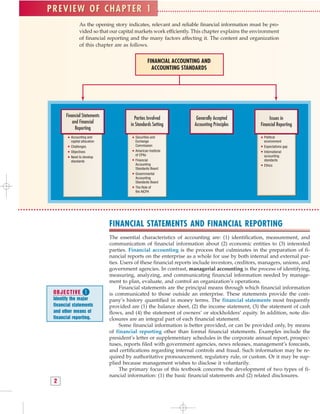
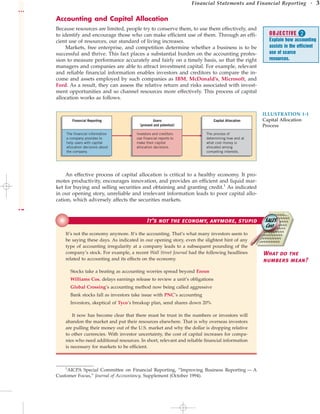
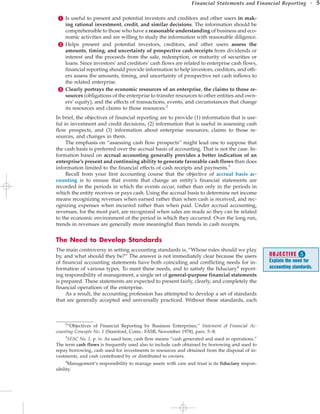
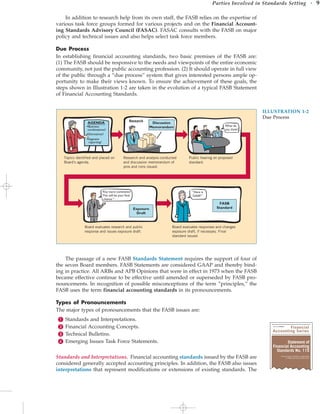
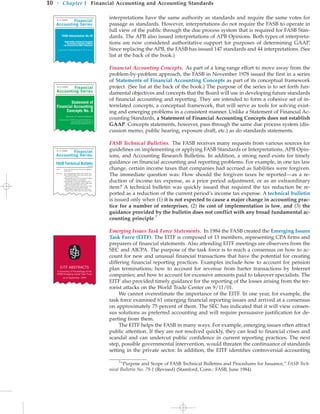
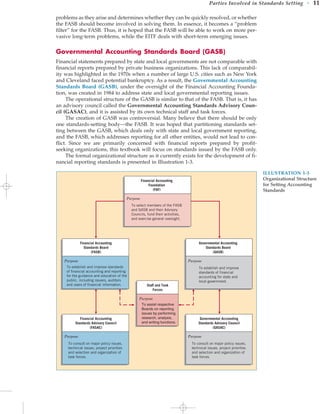
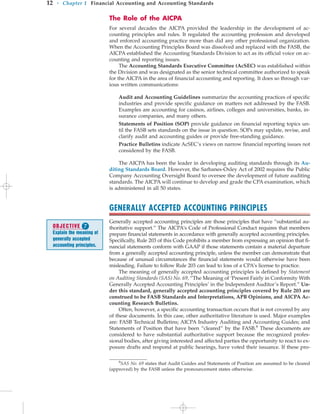
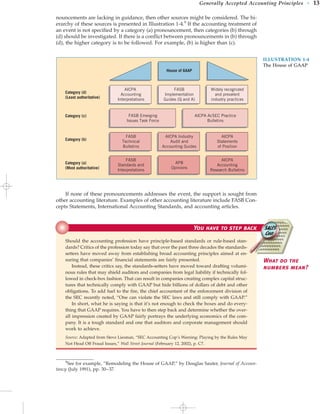
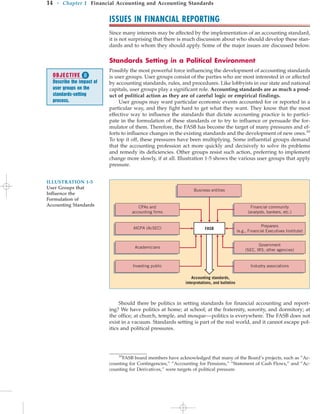



![[Ebooks PDF] download Intermediate Accounting 11th Edition Donald E. Kieso fu...](https://cdn.slidesharecdn.com/ss_thumbnails/12497-250104233912-0c9becde-thumbnail.jpg?width=640&height=640&fit=bounds)


