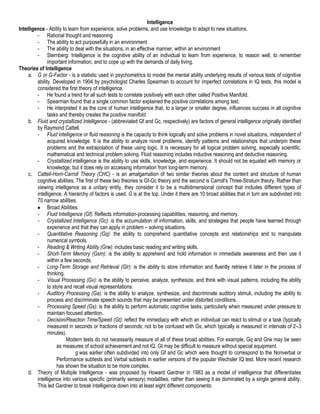
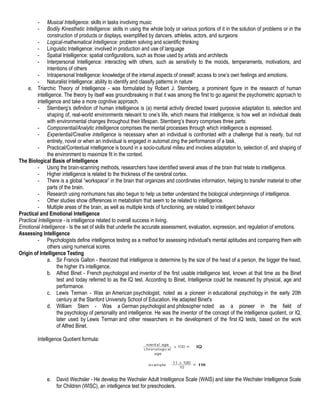
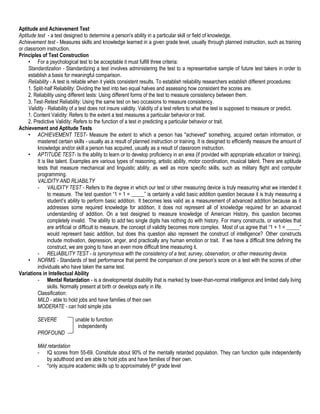
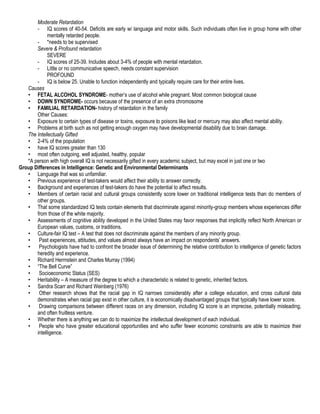
Intelligence<br />Intelligence - Ability to learn from experience, solve problems, and use knowledge to adapt to new situations.<br />Rational thought and reasoning
The ability to act purposefully in an environment
The ability to deal with the situations, in an effective manner, within an environment  Sternberg: Intelligence is the cognitive ability of an individual to learn from experience, to reason well, to remember important information, and to cope up with the demands of daily living.<br />Theories of Intelligence<br />G or G-Factor - is a statistic used in psychometrics to model the mental ability underlying results of various tests of cognitive ability. Developed in 1904 by psychologist Charles Spearman to account for imperfect correlations in IQ tests, this model is considered the first theory of intelligence.
He found a trend for all such tests to correlate positively with each other called Positive Manifold.

Intelligence(Handouts)

  • 1.
    Intelligence<br />Intelligence -Ability to learn from experience, solve problems, and use knowledge to adapt to new situations.<br />Rational thought and reasoning
  • 2.
    The ability toact purposefully in an environment
  • 3.
    The ability todeal with the situations, in an effective manner, within an environment Sternberg: Intelligence is the cognitive ability of an individual to learn from experience, to reason well, to remember important information, and to cope up with the demands of daily living.<br />Theories of Intelligence<br />G or G-Factor - is a statistic used in psychometrics to model the mental ability underlying results of various tests of cognitive ability. Developed in 1904 by psychologist Charles Spearman to account for imperfect correlations in IQ tests, this model is considered the first theory of intelligence.
  • 4.
    He found atrend for all such tests to correlate positively with each other called Positive Manifold.