INTELLIGENCEINTELLIGENCE
This section of the work will cover:
What intelligence is
Assessing intelligence
Use of IQ tests
The role of heredity and environment
A.A. What Intelligence IsWhat Intelligence Is
Intelligence
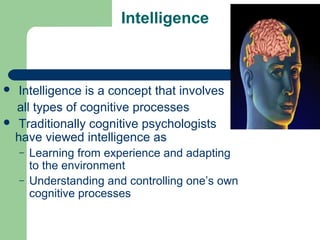
 Intelligence is a concept that involves
all types of cognitive processes
 Traditionally cognitive psychologists
have viewed intelligence as
– Learning from experience and adapting
to the environment
– Understanding and controlling one’s own
cognitive processes
1.1. DEFINING INTELLIGENCEDEFINING INTELLIGENCE
 “adaptive thinking or action” - Piaget
(1950)
 “the ability to learn quickly, solve
problems, understand complex and
abstract issues and generally behave in
a reasonable, rational and purposeful
manner” – Mwamwenda (1995)
1.1. DEFINING INTELLIGENCE (cont.)DEFINING INTELLIGENCE (cont.)
 “ the capacity to acquire knowledge, the ability to
think and reason in the abstract, and the
capability for solving problems” – Sternberg
 “the global capacity of the individual to act
purposefully, to think rationally and to deal
effectively with the environment” – Wechsler
(1975)
 “the human ability to solve problems or to make
something that is valued in one or more cultures”
– Gardner
2. THEORIES OF INTELLIGENCE2. THEORIES OF INTELLIGENCE
2.3. Cattell and Horn’s Fluid and Crystal Intelligences
Fluid Intelligence:
 reflects a person’s innate mental ability
 refers to one’s ability to solve the type of novel and abstract
problems that are not taught and are relatively free of
cultural influence
Crystallised Intelligence:
 refers to the ability to solve problems that depend on
knowledge gained as a result of education and life
experiences.
2. THEORIES OF INTELLIGENCE (cont.)2. THEORIES OF INTELLIGENCE (cont.)
2.5. Gardner’s Multiple Intelligences2.5. Gardner’s Multiple Intelligences
He proposed 8 relatively independent types of
intelligence:
1. Linguistic Intelligence is the capacity to use
language, e.g. poets, lawyers
2. Logical-mathematical Intelligence is the
ability to understand the principles underlying a
causal system, e.g. scientists, mathematicians
3. Spatial Intelligence refers to the ability to
represent the spatial world internally in your
mind, e.g. pilot, architect, painter, sculptor
4. Bodily Kinesthetic Intelligence is the
capacity to use your whole body or parts
thereof to solve a problem, make something or
put on some production, e.g. athletes,
dancers, actors
5. Musical Intelligence is the capacity to think in
music, e.g. musicians
6. Interpersonal Intelligence is understanding
other people, e.g. salespersons, therapists,
teachers, politicians
7. Intrapersonal Intelligence refers to having an
understanding of yourself.
8. Naturalist Intelligence refers to the human
ability to discriminate among living things
(plants, animals), as well as sensitivity to other
features of the natural world (clouds, rock
formation), e.g. farmers, geologists, botanists
Gardner’s Definition of Intelligence:
It is the human ability to solve problems
or to make something that is valued in
one or more cultures
With regard to the 8 intelligences, Gardner
believes:
 Most people can develop each intelligence to an
adequate level thru’ environmental enrichment.
 For most people, our abilities across the 8 intelligences
lie on a continuum.
 There are multiple ways to demonstrate proficiency in
one intelligence, e.g. an athlete may be an excellent
sprinter, but unable to dance coherently to any rhythm
 The 8 intelligences may be relatively independent on
paper, but in reality they work together in complex
ways, e.g. driving a car – logical-mathematical, spatial,
bodily kinesthetic intelligences may come into play.
 It is valuable for teachers to
assess the ‘real’ intelligence of their
learners and not just that which is
perceived thru’ tests and exams and
then to adjust class activities to cater
for all intelligences, e.g. time for acting,
drawing, sport, etc.
B. Assessing IntelligenceB. Assessing Intelligence
2.1.2.1. The Stanford-Binet Intelligence ScaleThe Stanford-Binet Intelligence Scale
 (Theodore) Simon-Binet designed an
intelligence test in order to determine “average”
intelligence. The test was later revised at
Stanford University (USA) and renamed the
Stanford-Binet Intelligence Scale and the
concept Intelligence Quotient (IQ) was added.
 The test is a standardised test of intelligence
composed of different subtests (memory,
verbal skills and mathematical skills, etc)
2.1.2.1. The Stanford-Binet Intelligence ScaleThe Stanford-Binet Intelligence Scale
(cont.)(cont.)
 The test can be used to determine the mental
age of learners and then using a formula, the IQ
can be determined.
 Research has shown that results of the Stanford-
Binet test correlate well with school success and
teachers’ evaluation of intelligence.
 The test was revised again in 1986 to
incorporate stratification according to economic
status, race, geographic region and community
size.
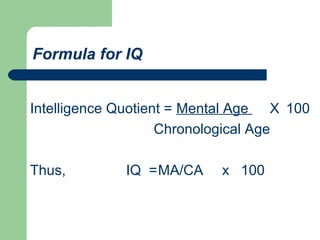
Formula for IQ
Intelligence Quotient = Mental Age X 100
Chronological Age
Thus, IQ =MA/CA x 100
Calculating IQ – Example:
1. A child of 6 years has a mental age of 6
years
IQ = 6 X 100 = 100
6
Such a child is considered to have average
intelligence.
Mental AgeMental Age
I Q= ________________ x 100I Q= ________________ x 100
Chronological AgeChronological Age
Calculating IQ – Example:
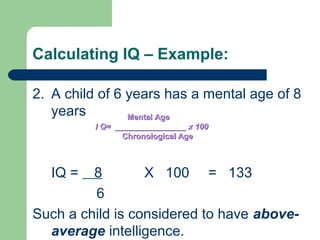
2. A child of 6 years has a mental age of 8
years
IQ = 8 X 100 = 133
6
Such a child is considered to have above-
average intelligence.
Mental AgeMental Age
I Q= ________________ x 100I Q= ________________ x 100
Chronological AgeChronological Age
3. The Wechsler Test
Most popular intelligence test used today.
3 versions:
- pre-school-primary
- elementary
- adults
Test is designed in 2 parts: verbal and
performance
3. The Wechsler Test (cont.)
 Verbal Test: require a question to be posed
orally and the student to respond verbally.
 Performance Test: requires the student to
visually process test material (read) and to
respond motorically (write, draw, etc).
 While interpretation of the specific scales of the
test requires specialised training (Clinician), the
information may be useful to a teacher in
adapting teaching methods and materials to suit
a learner’s strengths and weaknesses.
NORMAL CURVE/BELL CURVENORMAL CURVE/BELL CURVE
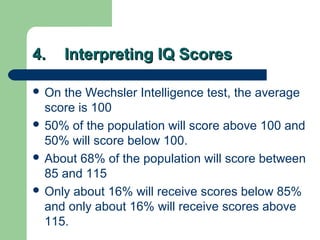
4.4. Interpreting IQ ScoresInterpreting IQ Scores
 On the Wechsler Intelligence test, the average
score is 100
 50% of the population will score above 100 and
50% will score below 100.
 About 68% of the population will score between
85 and 115
 Only about 16% will receive scores below 85%
and only about 16% will receive scores above
115.
4.4. Interpreting IQ Scores (cont)Interpreting IQ Scores (cont)
 The correlation between scores on the Wechsler test and
school achievement is fairly strong, 0,65 (the closer a
correlation is to 1, the stronger it is).
 However, research has questioned the degree of correlation
between a person’s IQ and his success in later life, as
factors such as motivation, years of formal education,
emotional stability, etc, plays a role
 Intelligence and the intelligence test, however, play an
important role in defining a number of exceptionalities,
including mental retardation, giftedness, and specific
learning disabilities.
C. Use of IQ testsC. Use of IQ tests
 IQ scores become relatively stable at age of 10 to
12.
 To be used with caution (test results may be
incorrect).
 Child can perform lower than actual potential (why?)
 Scores should be seen as confidential (not given to
child, parent or others since it may be wrongly
interpreted), e.g. A low IQ score may lead to
lowered expectations (child, teacher, parent).
AdvantagesAdvantages
 Students with special needs can be identified
(gifted, slow learners).
 Identification of learners with specific learning
difficulties and they can be assigned to certain
specialised programmes.
 Assist educational and vocational counsellors.
 Pre-school test can assist to see if children are
ready for school and can then be assisted in time.
 Prediction of academic achievement.
D. The role of heredity and environment
 Is intelligence a product of heredity or
environment?
 Environmentalists (eg. John Watson)
 Hereditists (eg. Jensen and Eyesenk)
 Interactionists (heredity sets the potential while
environment determines the extent to which it will
be fulfilled)
D. The role of heredity and environment
 Is intelligence a product of heredity or
environment?
 Environmentalists (eg. John Watson)
 Hereditists (eg. Jensen and Eyesenk)
 Interactionists (heredity sets the potential while
environment determines the extent to which it will
be fulfilled)
Heredity & Intelligence
 Intelligence is clearly a family characteristic.
 Heritability accounts for considerable amount
of total variance in general cognitive ability.
 Different cognitive abilities are influenced by
same genetic factors
Heredity & Intelligence
 Genetic research has made important discoveries
during last few decades.
– General cognitive ability = g
– g runs in families:
Adoption & twin studies
-identical twins reared apart are almost as similar for g
as identical twins reared together.
-Galton’s twin studies in 1876- studied how similarity of
twins changes over course of development
-heritability increases from infancy to adulthood
Twin Studies
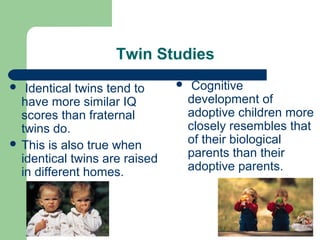
 Identical twins tend to
have more similar IQ
scores than fraternal
twins do.
 This is also true when
identical twins are raised
in different homes.
 Cognitive
development of
adoptive children more
closely resembles that
of their biological
parents than their
adoptive parents.
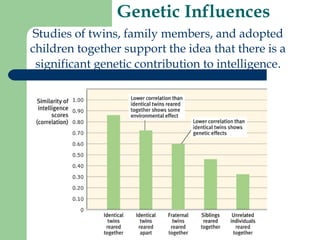
Genetic Influences
Studies of twins, family members, and adopted
children together support the idea that there is a
significant genetic contribution to intelligence.
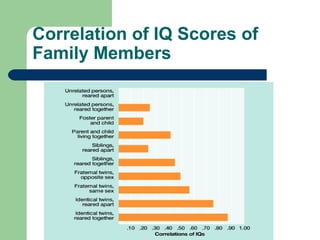
Correlation of IQ Scores of
Family Members
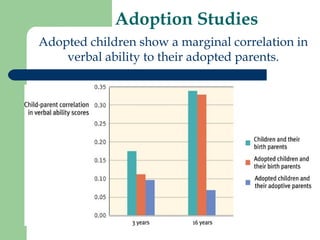
Adoption Studies
Adopted children show a marginal correlation in
verbal ability to their adopted parents.
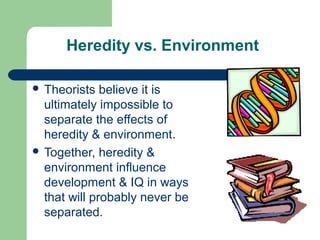
Heredity vs. Environment
 Theorists believe it is
ultimately impossible to
separate the effects of
heredity & environment.
 Together, heredity &
environment influence
development & IQ in ways
that will probably never be
separated.
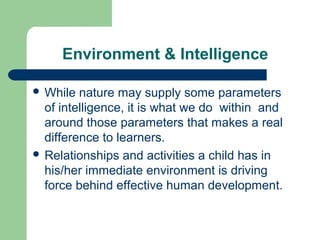
Environment & Intelligence
 While nature may supply some parameters
of intelligence, it is what we do within and
around those parameters that makes a real
difference to learners.
 Relationships and activities a child has in
his/her immediate environment is driving
force behind effective human development.
Non-genetic factors
 Parenting styles
 Nutrition
 Exposure to illness
 Parental educational
level
 Environmental
crowding
 Security of attachment
to caregiver
 Access to stimulating &
enriching experiences
 Access to sources of
knowledge
 Level of social support
 Noise level
 Schooling
 Stability of
neighborhoods
Environment & Intelligence
 Environment clearly has a big effect on IQ
scores
– Poor nutrition in early years of development leads
to lower IQ scores.
– Mother’s alcohol use during pregnancy leads to
lower IQ scores.
– Attending school positively effects IQ
– Families and cultures in which children are raised
have a significant impact on the cognitive abilities
children acquire.
Environment & Intelligence
 Permanently changing a child’s environment from
impoverished to enriched and stimulating can lead to
increases in intelligence scores up to 20 to 25 points.
 Slow but steady increase in the population’s IQ scores
due to better
-nutrition
-schooling
-stimulation (TV and Reading materials)
Racial / Ethnic Groups &
Intelligences
 In the past, studies have shown
considerable IQ differences between African
American and Caucasian children.
 Due to the environment
-economic circumstances affecting quality of
prenatal & postnatal nutrition
-availability of stimulating books and toys
-access to educational opportunities
Racial / Ethnic Groups &
Intelligences
 In recent years, African
American and Caucasian
children have become
increasingly similar in IQ
– Can be attributed to more
equitable environmental conditions
– Studies show that race has no
basis in biology
Teaching/learning Process
Implications
 Do not over-rely on models that assume a
nature orientation
 Not nature vs. nurture but rather how the two
work together
 What is inherited can be changed
 Race does not affect intelligence
Teaching/learning Process
Implications
 Learning how to Learn
 Children are more receptive to learning when
they feel wanted and valued and
environment is meaningful, accepting,
comfortable, orderly, and safe.
– Active and learner centered
– Connect with school’s social environment
Comment on the role of heredity or
environment (or both) as related to the
following research findings:
 Twins of the same sex are more alike than twins of the opposite sex.
 The correlation coefficient for IQ test scores of identical twins raised
together is 0.87 while that of identical twins raised apart is 0.75.
 Fraternal twins are more alike than other siblings as far as IQ-scores
are concerned.
 The IQ scores of adopted children and their non-biological parents
show a correlation coefficient of 0.20
 The correlation coefficient of ordinary siblings raised together is .55
while that for ordinary siblings raised apart is .47
 The correlation coefficient for IQ test scores of unrelated children
raised apart is .00 while that of unrelated children raised together is .
25
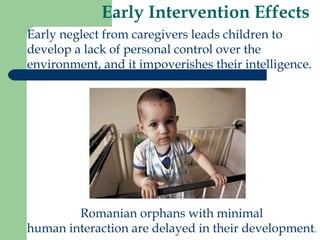
Early Intervention Effects
Early neglect from caregivers leads children to
develop a lack of personal control over the
environment, and it impoverishes their intelligence.
Romanian orphans with minimal
human interaction are delayed in their development.
Schooling Effects
Schooling is an experience that pays dividends, which
is reflected in intelligence scores. Increased schooling
correlates with higher intelligence scores.
To increase readiness for schoolwork,
projects like Head Start facilitate leaning.
Group Differences in Intelligence
Test Scores
Why do groups differ in intelligence? How can we
make sense of these differences?
Ethnic Similarities and Differences
1. Racial groups differ in their average
intelligence scores.
2. High-scoring people (and groups) are more
likely to attain high levels of education and
income.
To discuss this issue we begin with two disturbing
but agreed upon facts:
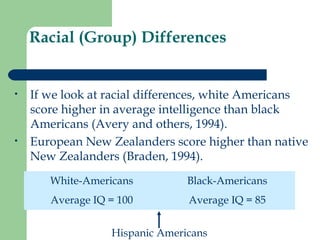
Racial (Group) Differences
• If we look at racial differences, white Americans
score higher in average intelligence than black
Americans (Avery and others, 1994).
• European New Zealanders score higher than native
New Zealanders (Braden, 1994).
White-Americans Black-Americans
Average IQ = 100 Average IQ = 85
Hispanic Americans
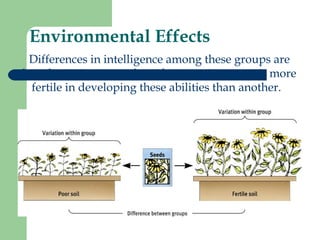
Environmental Effects
Differences in intelligence among these groups are
largely environmental, as if one environment is more
fertile in developing these abilities than another.
Reasons Why Environment Affects
Intelligence
1. Races are remarkably alike genetically.
2. Race is a social category.
3. Asian students outperform North American
students on math achievement and aptitude tests.
4. Today’s better prepared populations would
outperform populations of the 1930s on intelligence
tests.
5. White and black infants tend to score equally well
on tests predicting future intelligence.
6. Different ethnic groups have experienced periods
of remarkable achievement in different eras.
Gender Similarities and
Differences
There are seven ways in which males and females
differ in various abilities:
1. Girls are better spellers
2. Girls are verbally fluent and have large vocabularies
3. Girls are better at locating objects
4. Girls are more sensitive to touch, taste, and color
5. Boys outnumber girls in counts of underachievement
6. Boys outperform girls at math problem solving, but under perform
at math computation
7. Women detect emotions more easily than men do

Intelligence revised

  • 1.
  • 2.
    This section ofthe work will cover: What intelligence is Assessing intelligence Use of IQ tests The role of heredity and environment
  • 3.
    A.A. What IntelligenceIsWhat Intelligence Is
  • 4.
    Intelligence  Intelligence isa concept that involves all types of cognitive processes  Traditionally cognitive psychologists have viewed intelligence as – Learning from experience and adapting to the environment – Understanding and controlling one’s own cognitive processes
  • 5.
    1.1. DEFINING INTELLIGENCEDEFININGINTELLIGENCE  “adaptive thinking or action” - Piaget (1950)  “the ability to learn quickly, solve problems, understand complex and abstract issues and generally behave in a reasonable, rational and purposeful manner” – Mwamwenda (1995)
  • 6.
    1.1. DEFINING INTELLIGENCE(cont.)DEFINING INTELLIGENCE (cont.)  “ the capacity to acquire knowledge, the ability to think and reason in the abstract, and the capability for solving problems” – Sternberg  “the global capacity of the individual to act purposefully, to think rationally and to deal effectively with the environment” – Wechsler (1975)  “the human ability to solve problems or to make something that is valued in one or more cultures” – Gardner
  • 7.
    2. THEORIES OFINTELLIGENCE2. THEORIES OF INTELLIGENCE 2.3. Cattell and Horn’s Fluid and Crystal Intelligences Fluid Intelligence:  reflects a person’s innate mental ability  refers to one’s ability to solve the type of novel and abstract problems that are not taught and are relatively free of cultural influence Crystallised Intelligence:  refers to the ability to solve problems that depend on knowledge gained as a result of education and life experiences.
  • 8.
    2. THEORIES OFINTELLIGENCE (cont.)2. THEORIES OF INTELLIGENCE (cont.) 2.5. Gardner’s Multiple Intelligences2.5. Gardner’s Multiple Intelligences He proposed 8 relatively independent types of intelligence: 1. Linguistic Intelligence is the capacity to use language, e.g. poets, lawyers 2. Logical-mathematical Intelligence is the ability to understand the principles underlying a causal system, e.g. scientists, mathematicians
  • 9.
    3. Spatial Intelligencerefers to the ability to represent the spatial world internally in your mind, e.g. pilot, architect, painter, sculptor 4. Bodily Kinesthetic Intelligence is the capacity to use your whole body or parts thereof to solve a problem, make something or put on some production, e.g. athletes, dancers, actors 5. Musical Intelligence is the capacity to think in music, e.g. musicians
  • 10.
    6. Interpersonal Intelligenceis understanding other people, e.g. salespersons, therapists, teachers, politicians 7. Intrapersonal Intelligence refers to having an understanding of yourself. 8. Naturalist Intelligence refers to the human ability to discriminate among living things (plants, animals), as well as sensitivity to other features of the natural world (clouds, rock formation), e.g. farmers, geologists, botanists
  • 11.
    Gardner’s Definition ofIntelligence: It is the human ability to solve problems or to make something that is valued in one or more cultures
  • 12.
    With regard tothe 8 intelligences, Gardner believes:  Most people can develop each intelligence to an adequate level thru’ environmental enrichment.  For most people, our abilities across the 8 intelligences lie on a continuum.  There are multiple ways to demonstrate proficiency in one intelligence, e.g. an athlete may be an excellent sprinter, but unable to dance coherently to any rhythm  The 8 intelligences may be relatively independent on paper, but in reality they work together in complex ways, e.g. driving a car – logical-mathematical, spatial, bodily kinesthetic intelligences may come into play.
  • 13.
     It isvaluable for teachers to assess the ‘real’ intelligence of their learners and not just that which is perceived thru’ tests and exams and then to adjust class activities to cater for all intelligences, e.g. time for acting, drawing, sport, etc.
  • 14.
    B. Assessing IntelligenceB.Assessing Intelligence
  • 15.
    2.1.2.1. The Stanford-BinetIntelligence ScaleThe Stanford-Binet Intelligence Scale  (Theodore) Simon-Binet designed an intelligence test in order to determine “average” intelligence. The test was later revised at Stanford University (USA) and renamed the Stanford-Binet Intelligence Scale and the concept Intelligence Quotient (IQ) was added.  The test is a standardised test of intelligence composed of different subtests (memory, verbal skills and mathematical skills, etc)
  • 16.
    2.1.2.1. The Stanford-BinetIntelligence ScaleThe Stanford-Binet Intelligence Scale (cont.)(cont.)  The test can be used to determine the mental age of learners and then using a formula, the IQ can be determined.  Research has shown that results of the Stanford- Binet test correlate well with school success and teachers’ evaluation of intelligence.  The test was revised again in 1986 to incorporate stratification according to economic status, race, geographic region and community size.
  • 17.
    Formula for IQ IntelligenceQuotient = Mental Age X 100 Chronological Age Thus, IQ =MA/CA x 100
  • 18.
    Calculating IQ –Example: 1. A child of 6 years has a mental age of 6 years IQ = 6 X 100 = 100 6 Such a child is considered to have average intelligence. Mental AgeMental Age I Q= ________________ x 100I Q= ________________ x 100 Chronological AgeChronological Age
  • 19.
    Calculating IQ –Example: 2. A child of 6 years has a mental age of 8 years IQ = 8 X 100 = 133 6 Such a child is considered to have above- average intelligence. Mental AgeMental Age I Q= ________________ x 100I Q= ________________ x 100 Chronological AgeChronological Age
  • 20.
    3. The WechslerTest Most popular intelligence test used today. 3 versions: - pre-school-primary - elementary - adults Test is designed in 2 parts: verbal and performance
  • 21.
    3. The WechslerTest (cont.)  Verbal Test: require a question to be posed orally and the student to respond verbally.  Performance Test: requires the student to visually process test material (read) and to respond motorically (write, draw, etc).  While interpretation of the specific scales of the test requires specialised training (Clinician), the information may be useful to a teacher in adapting teaching methods and materials to suit a learner’s strengths and weaknesses.
  • 22.
  • 23.
    4.4. Interpreting IQScoresInterpreting IQ Scores  On the Wechsler Intelligence test, the average score is 100  50% of the population will score above 100 and 50% will score below 100.  About 68% of the population will score between 85 and 115  Only about 16% will receive scores below 85% and only about 16% will receive scores above 115.
  • 24.
    4.4. Interpreting IQScores (cont)Interpreting IQ Scores (cont)  The correlation between scores on the Wechsler test and school achievement is fairly strong, 0,65 (the closer a correlation is to 1, the stronger it is).  However, research has questioned the degree of correlation between a person’s IQ and his success in later life, as factors such as motivation, years of formal education, emotional stability, etc, plays a role  Intelligence and the intelligence test, however, play an important role in defining a number of exceptionalities, including mental retardation, giftedness, and specific learning disabilities.
  • 25.
    C. Use ofIQ testsC. Use of IQ tests  IQ scores become relatively stable at age of 10 to 12.  To be used with caution (test results may be incorrect).  Child can perform lower than actual potential (why?)  Scores should be seen as confidential (not given to child, parent or others since it may be wrongly interpreted), e.g. A low IQ score may lead to lowered expectations (child, teacher, parent).
  • 26.
    AdvantagesAdvantages  Students withspecial needs can be identified (gifted, slow learners).  Identification of learners with specific learning difficulties and they can be assigned to certain specialised programmes.  Assist educational and vocational counsellors.  Pre-school test can assist to see if children are ready for school and can then be assisted in time.  Prediction of academic achievement.
  • 27.
    D. The roleof heredity and environment  Is intelligence a product of heredity or environment?  Environmentalists (eg. John Watson)  Hereditists (eg. Jensen and Eyesenk)  Interactionists (heredity sets the potential while environment determines the extent to which it will be fulfilled)
  • 28.
    D. The roleof heredity and environment  Is intelligence a product of heredity or environment?  Environmentalists (eg. John Watson)  Hereditists (eg. Jensen and Eyesenk)  Interactionists (heredity sets the potential while environment determines the extent to which it will be fulfilled)
  • 29.
    Heredity & Intelligence Intelligence is clearly a family characteristic.  Heritability accounts for considerable amount of total variance in general cognitive ability.  Different cognitive abilities are influenced by same genetic factors
  • 30.
    Heredity & Intelligence Genetic research has made important discoveries during last few decades. – General cognitive ability = g – g runs in families: Adoption & twin studies -identical twins reared apart are almost as similar for g as identical twins reared together. -Galton’s twin studies in 1876- studied how similarity of twins changes over course of development -heritability increases from infancy to adulthood
  • 31.
    Twin Studies  Identicaltwins tend to have more similar IQ scores than fraternal twins do.  This is also true when identical twins are raised in different homes.  Cognitive development of adoptive children more closely resembles that of their biological parents than their adoptive parents.
  • 32.
    Genetic Influences Studies oftwins, family members, and adopted children together support the idea that there is a significant genetic contribution to intelligence.
  • 33.
    Correlation of IQScores of Family Members
  • 34.
    Adoption Studies Adopted childrenshow a marginal correlation in verbal ability to their adopted parents.
  • 35.
    Heredity vs. Environment Theorists believe it is ultimately impossible to separate the effects of heredity & environment.  Together, heredity & environment influence development & IQ in ways that will probably never be separated.
  • 36.
    Environment & Intelligence While nature may supply some parameters of intelligence, it is what we do within and around those parameters that makes a real difference to learners.  Relationships and activities a child has in his/her immediate environment is driving force behind effective human development.
  • 37.
    Non-genetic factors  Parentingstyles  Nutrition  Exposure to illness  Parental educational level  Environmental crowding  Security of attachment to caregiver  Access to stimulating & enriching experiences  Access to sources of knowledge  Level of social support  Noise level  Schooling  Stability of neighborhoods
  • 38.
    Environment & Intelligence Environment clearly has a big effect on IQ scores – Poor nutrition in early years of development leads to lower IQ scores. – Mother’s alcohol use during pregnancy leads to lower IQ scores. – Attending school positively effects IQ – Families and cultures in which children are raised have a significant impact on the cognitive abilities children acquire.
  • 39.
    Environment & Intelligence Permanently changing a child’s environment from impoverished to enriched and stimulating can lead to increases in intelligence scores up to 20 to 25 points.  Slow but steady increase in the population’s IQ scores due to better -nutrition -schooling -stimulation (TV and Reading materials)
  • 40.
    Racial / EthnicGroups & Intelligences  In the past, studies have shown considerable IQ differences between African American and Caucasian children.  Due to the environment -economic circumstances affecting quality of prenatal & postnatal nutrition -availability of stimulating books and toys -access to educational opportunities
  • 41.
    Racial / EthnicGroups & Intelligences  In recent years, African American and Caucasian children have become increasingly similar in IQ – Can be attributed to more equitable environmental conditions – Studies show that race has no basis in biology
  • 42.
    Teaching/learning Process Implications  Donot over-rely on models that assume a nature orientation  Not nature vs. nurture but rather how the two work together  What is inherited can be changed  Race does not affect intelligence
  • 43.
    Teaching/learning Process Implications  Learninghow to Learn  Children are more receptive to learning when they feel wanted and valued and environment is meaningful, accepting, comfortable, orderly, and safe. – Active and learner centered – Connect with school’s social environment
  • 44.
    Comment on therole of heredity or environment (or both) as related to the following research findings:  Twins of the same sex are more alike than twins of the opposite sex.  The correlation coefficient for IQ test scores of identical twins raised together is 0.87 while that of identical twins raised apart is 0.75.  Fraternal twins are more alike than other siblings as far as IQ-scores are concerned.  The IQ scores of adopted children and their non-biological parents show a correlation coefficient of 0.20  The correlation coefficient of ordinary siblings raised together is .55 while that for ordinary siblings raised apart is .47  The correlation coefficient for IQ test scores of unrelated children raised apart is .00 while that of unrelated children raised together is . 25
  • 45.
    Early Intervention Effects Earlyneglect from caregivers leads children to develop a lack of personal control over the environment, and it impoverishes their intelligence. Romanian orphans with minimal human interaction are delayed in their development.
  • 46.
    Schooling Effects Schooling isan experience that pays dividends, which is reflected in intelligence scores. Increased schooling correlates with higher intelligence scores. To increase readiness for schoolwork, projects like Head Start facilitate leaning.
  • 47.
    Group Differences inIntelligence Test Scores Why do groups differ in intelligence? How can we make sense of these differences?
  • 48.
    Ethnic Similarities andDifferences 1. Racial groups differ in their average intelligence scores. 2. High-scoring people (and groups) are more likely to attain high levels of education and income. To discuss this issue we begin with two disturbing but agreed upon facts:
  • 49.
    Racial (Group) Differences •If we look at racial differences, white Americans score higher in average intelligence than black Americans (Avery and others, 1994). • European New Zealanders score higher than native New Zealanders (Braden, 1994). White-Americans Black-Americans Average IQ = 100 Average IQ = 85 Hispanic Americans
  • 50.
    Environmental Effects Differences inintelligence among these groups are largely environmental, as if one environment is more fertile in developing these abilities than another.
  • 51.
    Reasons Why EnvironmentAffects Intelligence 1. Races are remarkably alike genetically. 2. Race is a social category. 3. Asian students outperform North American students on math achievement and aptitude tests. 4. Today’s better prepared populations would outperform populations of the 1930s on intelligence tests. 5. White and black infants tend to score equally well on tests predicting future intelligence. 6. Different ethnic groups have experienced periods of remarkable achievement in different eras.
  • 52.
    Gender Similarities and Differences Thereare seven ways in which males and females differ in various abilities: 1. Girls are better spellers 2. Girls are verbally fluent and have large vocabularies 3. Girls are better at locating objects 4. Girls are more sensitive to touch, taste, and color 5. Boys outnumber girls in counts of underachievement 6. Boys outperform girls at math problem solving, but under perform at math computation 7. Women detect emotions more easily than men do

Editor's Notes

  • #33 OBJECTIVE 15| Discuss the evidence for the genetic contribution to individual intelligence, and explain what psychologists mean by the heritability of intelligence.
  • #49 OBJECTIVE 17| Describe ethnic similarities and differences in intelligence test scores, and discuss some genetic and environmental factors that might explain them.
  • #53 OBJECTIVE 18| Describe gender differences in abilities.