Innovation is the process that translates knowledge into economic growth and social well-being. It encompasses a series of scientific, technological, organizational, financial and commercial activities
Erica M. Besso,Ph.D. Research Innovation Office 2
Defining Innovation
All innovation begins with creative ideas . . . One definition for
innovation is the successful implementation of creative ideas within
an organization…
Innovation is the process that translates knowledge into economic
growth and social well-being. It encompasses a series of scientific,
technological, organizational, financial and commercial activities....
It is the process whereby ideas for new (or improved) products,
processes or services are developed and commercialized in the
marketplace.
INNOVATION = INVENTION + COMMERCIALIZATION
3.
Erica M. Besso,Ph.D. Research Innovation Office 3
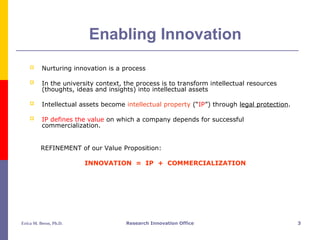
Enabling Innovation
Nurturing innovation is a process
In the university context, the process is to transform intellectual resources
(thoughts, ideas and insights) into intellectual assets
Intellectual assets become intellectual property (“IP”) through legal protection.
IP defines the value on which a company depends for successful
commercialization.
REFINEMENT of our Value Proposition:
INNOVATION = IP + COMMERCIALIZATION
4.
Erica M. Besso,Ph.D. Research Innovation Office 4
The VALUE Proposition
Funding a research project
Licensing a technology
Starting a company / spin-off
Buying a product
All of these invest in VALUE
5.
Erica M. Besso,Ph.D. Research Innovation Office 5
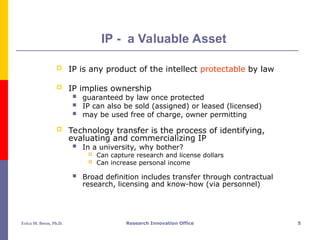
IP - a Valuable Asset
IP is any product of the intellect protectable by law
IP implies ownership
guaranteed by law once protected
IP can also be sold (assigned) or leased (licensed)
may be used free of charge, owner permitting
Technology transfer is the process of identifying,
evaluating and commercializing IP
In a university, why bother?
Can capture research and license dollars
Can increase personal income
Broad definition includes transfer through contractual
research, licensing and know-how (via personnel)
6.
Erica M. Besso,Ph.D. Research Innovation Office 6
University compared to Company
In a UNIVERSITY,
Professors, TA’s, Support Staff are all considered employees of the
university – but there is wide variability in work definition
All are bound by their university’s IP policy
At McGill, inventions are jointly owned by inventors and
University at the outset
There is no obligation to commercialize the IP developed, although
it is encouraged
In a COMPANY,
Your employment contract is based on “Work for Hire”
As an employee, you work on what the Company tells you to do
all Intellectual Property belongs solely to the company
You agree to work towards the company’s prime objectives of
commercial activity
profitable sale of products
7.
Erica M. Besso,Ph.D. Research Innovation Office 7
Work for Hire
Employee Company
8.
Erica M. Besso,Ph.D. Research Innovation Office 8
Inventions
What is an invention?
A technical concept, development, method or
composition of matter that :
Is novel, non-obvious and useful
Reflects creative thinking, makes a distinct
contribution to and advances the science
Is recognized by masters of that science
as such an advance
How do we get from invention to IP?
9.
Erica M. Besso,Ph.D. Research Innovation Office 9
From Invention to IP in the University
From Invention to IP in the University
Identification of
intellectual assets
Discovery-Invention
Evaluation of
Commercial Potential
Assessment of
Protectability
Decision to
Commercialize
R & D
Grants
&
Contracts
Due diligence
Commercialization
Licence
Alternatives
Spin-off Co.
Existing
Co.
Contracts
Inventor
IP created
New Research $$
Opportunities: POP, I2I
10.
Erica M. Besso,Ph.D. Research Innovation Office 10
PATENTS – some background
A landmark in the transition of England’s economy from the feudal to the
capitalist was, in 1623, the Statute of Monopolies of James I . It rendered
void all grants of monopolies and dispensations with one exception. The
exception was the grant of letters patent for inventions. These provided
the true and first inventor(s) of a given item 14 years of exclusive rights to
their invention. In exchange, the invention had to be fully described and
disclosed. These monopolies of short duration aimed to encourage
innovation and its application for the public good.
The ‘letters patent for inventions’ is the direct ancestor of today’s patents.
The earliest known patent for an invention in England is dated 1449
(granted by Henry VI for making stained glass for Eton College).
On July 31, 1790 Samuel Hopkins was issued the first US patent for a
process of making potash, an ingredient used in fertilizer. The patent was
signed by President George Washington.
11.
Erica M. Besso,Ph.D. Research Innovation Office 11
What is a PATENT ?
Intellectual property (IP)
Exclusive monopoly to make, use or sell an
invention for a limited period of time
Tool conferring legal protection to the holder of
the patent rights
Explicit description of how to practice the
innovation / invention
IMPORTANT to KNOW:
Public disclosure of an invention prior to filing a
patent application makes the invention un-patentable
12.
Erica M. Besso,Ph.D. Research Innovation Office 12
Further IP characteristics
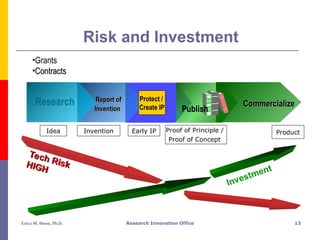
IP is valuable
Often, the value is not predictable at onset of a project
In universities, IP is usually at a very early stage
Early IP requires large $$ and time investments to
result in commercially successful product(s)
High risk
Exclusivity of eventual profit encourages investment
IP position needs contractual agreement
Agree with non-University partner BEFORE starting to
collaborate
Agree IN WRITING [IP rights, publication rights, etc.]
13.
Erica M. Besso,Ph.D. Research Innovation Office 13
Protect /
Create IP
Report of
Report of
Invention
Invention
Research
Research
Risk and Investment
Commercialize
Commercialize
•Grants
•Contracts
Contracts
Publish
Tech Risk
Tech Risk
HIGH
HIGH
Investment
Idea Invention Early IP Proof of Principle /
Proof of Concept
Product
14.
Erica M. Besso,Ph.D. Research Innovation Office 14
• Novel
• Non-Obvious
• Useful
STRATEGY:
Decrease the Risk / Strengthen the Invention
1. Ascertain invention is:
2. Protect invention IP
3. Add value by:
- developing
- demonstrating reliability
4. Establish that the invention has:
- a market
- acceptable competition
- willing Licensees
15.
Erica M. Besso,Ph.D. Research Innovation Office 15
Note:
All that is Patentable
is NOT necessarily
Commercializable !
16.
Erica M. Besso,Ph.D. Research Innovation Office 16
Protecting an Invention
File a patent application for potentially promising invention
To be eligible for patent protection must be:
Novel
In Canada and the US only, one-year grace period after first
public disclosure
Absolute novelty in the rest of the world
Non-obvious (prior art!!!)
Useful
Invention must perform some function (general utility)
Invention must actually be operable and do what is claimed
Invention must be of some benefit to society
Protection begins from the date of filing an application
This is called the “Priority date”
17.
Erica M. Besso,Ph.D. Research Innovation Office 17
Example: Electricity from Garbage 1
Eric, a professor, working in his laboratory invented a
machine that produced electricity from garbage.
Eric recorded all of his efforts in his laboratory notebook.
The invention was incredible:
• it produced cheap energy,
• it released no pollutants,
• it reduced the amount of garbage;
However, it had a problem - it did not work for more than one
minute at a time.
Eric could not solve this problem.
Sophie, a graduate student in Eric’s group, thought of a way
to solve the problem.
18.
Erica M. Besso,Ph.D. Research Innovation Office 18
Example: Electricity from Garbage 2
Many things needed to be done to apply Sophie's idea.
Eric's department chair, Mark, was asked to provide support
dollars to conduct the research and the support was granted.
Eric sent Chris, an undergraduate student assistant, to get all
equipment necessary for the work to be done.
Finally, after two months and many hours of work by Eric,
Sophie, and Chris, the garbage machine was creating
electricity for hours at a time.
All of the work they did was recorded in Eric's laboratory
notebook.
Sophie also kept a separate notebook of her research activities
and contributions.
19.
Erica M. Besso,Ph.D. Research Innovation Office 19
Example: Electricity from Garbage 3
Chris provided data for both Eric and Sophie.
The improved invention was a success.
The scientific world was amazed by the results.
The university is now telling Eric the invention is worth
millions and it will patent the invention.
Eric's university has a patent policy similar to McGill’s.
A publication describing the invention is co-authored
by Sophie, Chris and Eric. Are they all inventors?
Who will receive the millions?
20.
Erica M. Besso,Ph.D. Research Innovation Office 20
NOTE:
Authorship
does NOT equal
Inventorship !
21.
Erica M. Besso,Ph.D. Research Innovation Office 21
Inventorship
Who is an inventor?
Someone who has created something new or
contributed intellectually thereto
What is an intellectual contribution?
An inventor enables an idea
An invention is “enabled” if someone of ‘ordinary skill-
in-the-art’ could make or use the invention without an
undue amount of research or experimentation
Mark, Eric, Sophie, and Chris all contributed
to reduce the invention to practice – but they
are not all inventors.
22.
Erica M. Besso,Ph.D. Research Innovation Office 22
Inventorship 2
WHO THINKS THAT:
a student be an inventor or co-inventor?
a co-inventor has rights?
someone who worked on an invention but did not
contribute intellectually is a co-inventor?
HOW MUCH does someone have to contribute intellectually to
be considered an inventor?
How are Mark, Eric, Sophie, and Chris best described?
23.
Erica M. Besso,Ph.D. Research Innovation Office 23
Inventorship Disputes
What if there is an inventorship dispute?
Each person must provide documents
explaining their contribution to the invention
Link contribution to the claims, as they
appear in the patent application
Failure to resolve such dispute can be
cause to abandon commercialization
efforts.
24.
Erica M. Besso,Ph.D. Research Innovation Office 24
How can one protect oneself ?
DOCUMENT your work (preferably in a bound and dated
lab notebook)
Complete a Report of Invention and send it to OTT for
assessment
Don’t negotiate a “deal” without consulting
knowledgeable professionals (RIO, OTT are a good
start)
Don’t sign any document before fully understanding
what it means and what effect it will have
Be informed, ask questions
25.
Erica M. Besso,Ph.D. Research Innovation Office 25
Sharing the Benefits
Typically, the patent will be licensed to a company in
exchange for cash and royalties based on sales.
Do the co-inventors share the royalties equally?
This is decided by the inventors
% share is usually indicated on the Report of Invention
If different share distribution, then a written statement signed by
each party must be prepared.
Can the workers share the royalties?
This is decided by the inventors
26.
Erica M. Besso,Ph.D. Research Innovation Office 26
McGill’s Policy on IP
Applies to all employees of McGill
If inventors wish to commercialize their
invention, then they must disclose it to
the OTT
Students, if they are the sole inventors,
are not subject to this IP Policy.
27.
Erica M. Besso,Ph.D. Research Innovation Office 27
Steps leading to Commercialization
Assessment of report of invention
Is the invention novel? Can it be protected?
Is there a market? How large is the market? What is the competition?
How far is it from becoming a product? Are there resources to further
strengthen, demonstrate and refine the invention?
Filing for patent protection now have IP
Finding partners to develop this IP into product(s)
Making presentations (conferences, companies, VCs)
Prosecuting patent application(s)
Identifying a licensee
Finding financing
Negotiating license agreement(s)
28.
Erica M. Besso,Ph.D. Research Innovation Office 28
From Invention to IP
From Invention to IP in the University
in the University
Identification of
intellectual assets
Discovery-Invention
Evaluation of
Commercial Potential
Assessment of
Protectability
Decision to
Commercialize
R & D
Grants
&
Contracts
Due diligence
Commercialization
Licence
Alternatives
Spin-off Co.
Existing
Co.
Contracts
Inventor
IP created
RIO
OTT
New Research $$
Opportunities: POP, I2I
29.
Erica M. Besso,Ph.D. Research Innovation Office 29
To License, one must:
Satisfy a customer need
Solve a “pain”
Have a product, a process, a service
Know industry/company entry points
For a “successful” Spin-off, must have:
A market
A viable business model and plan
A management team
Critical resource mass ($, people, know how)
Defensible technology
Commercialization: Thinking in Commercial Terms
30.
Erica M. Besso,Ph.D. Research Innovation Office 30
Commercialization stages beyond the University
31.
Erica M. Besso,Ph.D. Research Innovation Office 31
Some McGill Spin-offs
McGill physicists John Strom-Olsen and Peter Rudkowski
pioneered a process by which molten liquids – metal, ceramics, or anything else that
melts – can be transformed into fine threads. This melt extraction process is the only
one of its kind. Pitney-Bowes purchased the intellectual property rights to this process
in 1987.
MXT Inc. formed in 1996 to realize the commercial potential of this technology.
Located in Montreal
Need addressed: Electronic article surveillance (EAS)
PRODUCT: Antitheft Tagging Technology
MXT specializes in the production of antitheft tagging material, ultra-fine fibers,
and electroplating.
Extremely fine wire with detectable sheath is only 137.5 microns thick. Just 5 cm of this
wire is needed to trigger EAS gates.
32.
Erica M. Besso,Ph.D. Research Innovation Office 32
ANAGENIS
McGill chemist Masad Damha and molecular biologist Michael Parniak
Developed proprietary antisense technologies
Anagenis Inc. formed in 1999 to realize the commercial potential of this technology.
Company was recently acquired by Topigen Inc.
Located in Montreal
Need addressed: Novel therapeutic approaches
PRODUCT: Technology inhibiting synthesis of protein encoded by mRNA
Several new classes of drugs currently under development
two drug candidates in Phase II trials for COPD [Chronic obstructive pulmonary
disease, a term referring to the two lung diseases, chronic bronchitis and emphysema]
and for asthma.
focused on inhibiting multiple inflammation targets underlying the chronic pulmonary
diseases.
33.
Erica M. Besso,Ph.D. Research Innovation Office 33
McGill chemist Mark Andrews and electrical engineer Ishiang Shih
Developed liquid crystal displays that use solid state polymer structures with
embedded optical, electrical and mechanical functionality.
Silk Displays Inc. formed in 2004 to realize the commercial potential of this
technology.
In 2008, company changed its name to Plastic Knowledge Inc.
Located in Montreal
Need addressed: Lightweight, flexible electronic devices
PRODUCT: Electronic circuits embedded in plastic
Promising new platform technology
Initially focused on rugged displays, used in harsh mobile and aerospace
applications.
Company working towards consumer applications such as large, wall mounted
televisions. Aim is to replace a broad range of "dumb" glass display substrates by
smart polymer structures.
34.
Erica M. Besso,Ph.D. Research Innovation Office 34
THANK YOU
Questions for me?
Four questions for YOU
35.
Erica M. Besso,Ph.D. Research Innovation Office 35
HOW MANY of YOU
Found most of this information novel?
Found most of this information
interesting?
Believe information on IP and
commercialization will be useful to
you?
Would like more info on
Entrepreneurship or innovation awards?
Patents and process?
If so give me your name & e-mail address
36.
Erica M. Besso,Ph.D. Research Innovation Office 36
Research Innovation Office
Erica Besso – tel ext 3897
Dawson Hall Room 303
Editor's Notes
#13 Proof of the concept means researching it – or taking it to the lab.
With commercial potential.
Of course, during the process the researcher must publish his research.
#16 - public disclosure includes any disclosure made available without a written CDA
#26 - OTT will pay for the protection of IP if this is deemed necessary. These costs are reimbursable by inventor if IP is not assigned to McGill.
- Provisional patent filings in time sensitive situations




![Erica M. Besso, Ph.D. Research Innovation Office 12
Further IP characteristics
IP is valuable
Often, the value is not predictable at onset of a project
In universities, IP is usually at a very early stage
Early IP requires large $$ and time investments to
result in commercially successful product(s)
High risk
Exclusivity of eventual profit encourages investment
IP position needs contractual agreement
Agree with non-University partner BEFORE starting to
collaborate
Agree IN WRITING [IP rights, publication rights, etc.]](https://image.slidesharecdn.com/rio-ip-commercialization-spring08-250224170453-9642bf08/85/Intellectual-Property-and-Commercialization-12-320.jpg)






![Erica M. Besso, Ph.D. Research Innovation Office 32
ANAGENIS
McGill chemist Masad Damha and molecular biologist Michael Parniak
Developed proprietary antisense technologies
Anagenis Inc. formed in 1999 to realize the commercial potential of this technology.
Company was recently acquired by Topigen Inc.
Located in Montreal
Need addressed: Novel therapeutic approaches
PRODUCT: Technology inhibiting synthesis of protein encoded by mRNA
Several new classes of drugs currently under development
two drug candidates in Phase II trials for COPD [Chronic obstructive pulmonary
disease, a term referring to the two lung diseases, chronic bronchitis and emphysema]
and for asthma.
focused on inhibiting multiple inflammation targets underlying the chronic pulmonary
diseases.](https://image.slidesharecdn.com/rio-ip-commercialization-spring08-250224170453-9642bf08/85/Intellectual-Property-and-Commercialization-32-320.jpg)


