Configurable Politics and Asymmetric Integration: Health e-Infrastructures in IndiaIntegrated e-infrastructure is beneficial for all, but it is hard to integrate when the politics do not support all aspects.
Pre-integration Different systems that did not work together and were not equally supported forced staff to do more work by making them re-enter data into different systems to get the different outcomes they needed. Some data also would get left out because it was in a different system.
Why e-Infrastructure?What is it? Research carried out regionally or globally through Internet collaborationsE-Infrastructure can provide researchers with shared access to large data collections, advanced ICT tools for data analysis, large-scale computing resources [1]More specifically patient and GIS data can be analyzed and reported easily on a regular basis[1]”What is e-Infrastrucutre” JISC. http://www.jisc.ac.uk/media/documents/publications/einfrastructure_rtf.rtf.
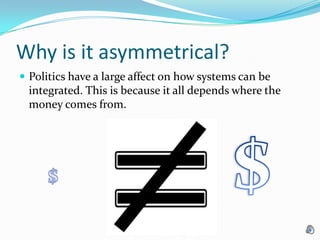
Why is it asymmetrical? Politics have a large affect on how systems can be integrated. This is because it all depends where the money comes from.$$
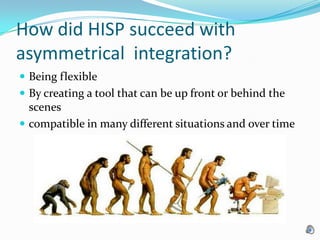
How did HISP succeed with asymmetrical  integration? Being flexibleBy creating a tool that can be up front or behind the scenes compatible in many different situations and over time
Critiques This article is told from the point of view of the underdog—a NGO that was not always politically supported. Although the researchers conducted interviews with many parties, I think the article was biased. The authors were involved with the process and trying to implement DHIS. Seemed like it was trying to sell itselfBarely mentioned things like training and lack of Internet connection
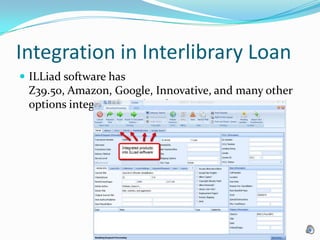
Integration in Interlibrary LoanILLiad software has Z39.50, Amazon, Google, Innovative, and many other options integrated in it’s software
Discussion QuestionIf everything is integrated then won’t everything be a monopoly?

Integration

  • 1.
    Configurable Politics andAsymmetric Integration: Health e-Infrastructures in IndiaIntegrated e-infrastructure is beneficial for all, but it is hard to integrate when the politics do not support all aspects.
  • 2.
    Pre-integration Different systemsthat did not work together and were not equally supported forced staff to do more work by making them re-enter data into different systems to get the different outcomes they needed. Some data also would get left out because it was in a different system.
  • 3.
    Why e-Infrastructure?What isit? Research carried out regionally or globally through Internet collaborationsE-Infrastructure can provide researchers with shared access to large data collections, advanced ICT tools for data analysis, large-scale computing resources [1]More specifically patient and GIS data can be analyzed and reported easily on a regular basis[1]”What is e-Infrastrucutre” JISC. http://www.jisc.ac.uk/media/documents/publications/einfrastructure_rtf.rtf.
  • 4.
    Why is itasymmetrical? Politics have a large affect on how systems can be integrated. This is because it all depends where the money comes from.$$
  • 5.
    How did HISPsucceed with asymmetrical integration? Being flexibleBy creating a tool that can be up front or behind the scenes compatible in many different situations and over time
  • 6.
    Critiques This articleis told from the point of view of the underdog—a NGO that was not always politically supported. Although the researchers conducted interviews with many parties, I think the article was biased. The authors were involved with the process and trying to implement DHIS. Seemed like it was trying to sell itselfBarely mentioned things like training and lack of Internet connection
  • 7.
    Integration in InterlibraryLoanILLiad software has Z39.50, Amazon, Google, Innovative, and many other options integrated in it’s software
  • 8.
    Discussion QuestionIf everythingis integrated then won’t everything be a monopoly?

Editor's Notes

  • #3 This is similar to the issues Edwards talks about with regards to inconsistent data in the field of climate change
  • #5 A system cannot be supported without money. Staff cannot be trained without money. If the power and resources cannot be distributed evenly then the integration is asymmetrical.
  • #8 Talk about how this makessearching easier