UNIT # 02
OBJECTIVES AND
ASSESSMENT
Resource person
Rashida Bhatti
INTRODUCTION
 Objectives are the desired outcomes of an effort.
Guided by these specific objectives instructional
activities are designed and subsequently
assessment is carried out through different
methods.
 The objective are key components for developing
a test and guiding principles for assessment.
 Bloom’s taxonomy provides a useful way of
describing the complexity of an objective by
classifying into one of the hierarchical categories
from simplest to complex.
 Therefore, the process of developing a test
should begin with the identification of content
domain at first stage and development of table of
specification at second stage.
Test
 A test is a device which is used to measure
behaviour of a person for a specific purpose.
 Moreover it is an instrument that typically uses
sets of items designed to measure a domain of
learning tasks.
 Tests are systematic method of collecting
information that lead to make inferences about
the characteristics of people or objects.
 teacher prepares tests while sampling the items
from a
 pool of items in such a way that it represents
the whole subject matter.
 The main categories of tests are Objective Type
and Subjective Type
Purposes of test
 Monitoring Student Progress
 Diagnosing Learning Problems
 Assigning Grades
 Classification and Selection of
Students
 Evaluating Instruction
Objectives
A learning objective refers to the statement of what
students will obtain through instruction of certain
content. In other words ‘an objective is a description of
a performance you want learners to be able to exhibit
before you consider them
competent. An objective describes an intended result of
instruction, rather than he process of instruction itself.’
(Mager, p. 5)
Characteristics/ Attributes of
the Objectives
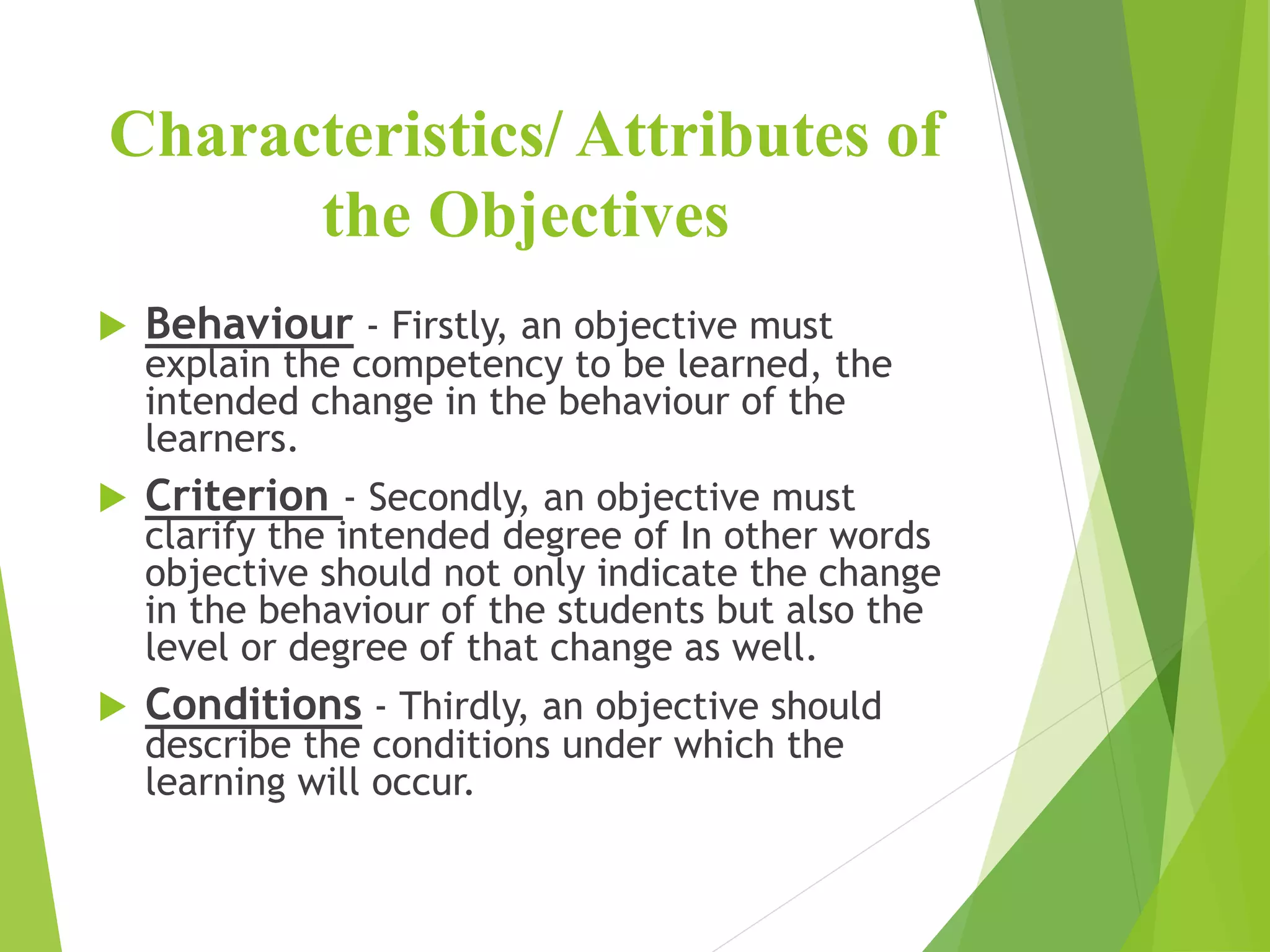
 Behaviour - Firstly, an objective must
explain the competency to be learned, the
intended change in the behaviour of the
learners.
 Criterion - Secondly, an objective must
clarify the intended degree of In other words
objective should not only indicate the change
in the behaviour of the students but also the
level or degree of that change as well.
 Conditions - Thirdly, an objective should
describe the conditions under which the
learning will occur.
Taxonomy of Educational
Objectives
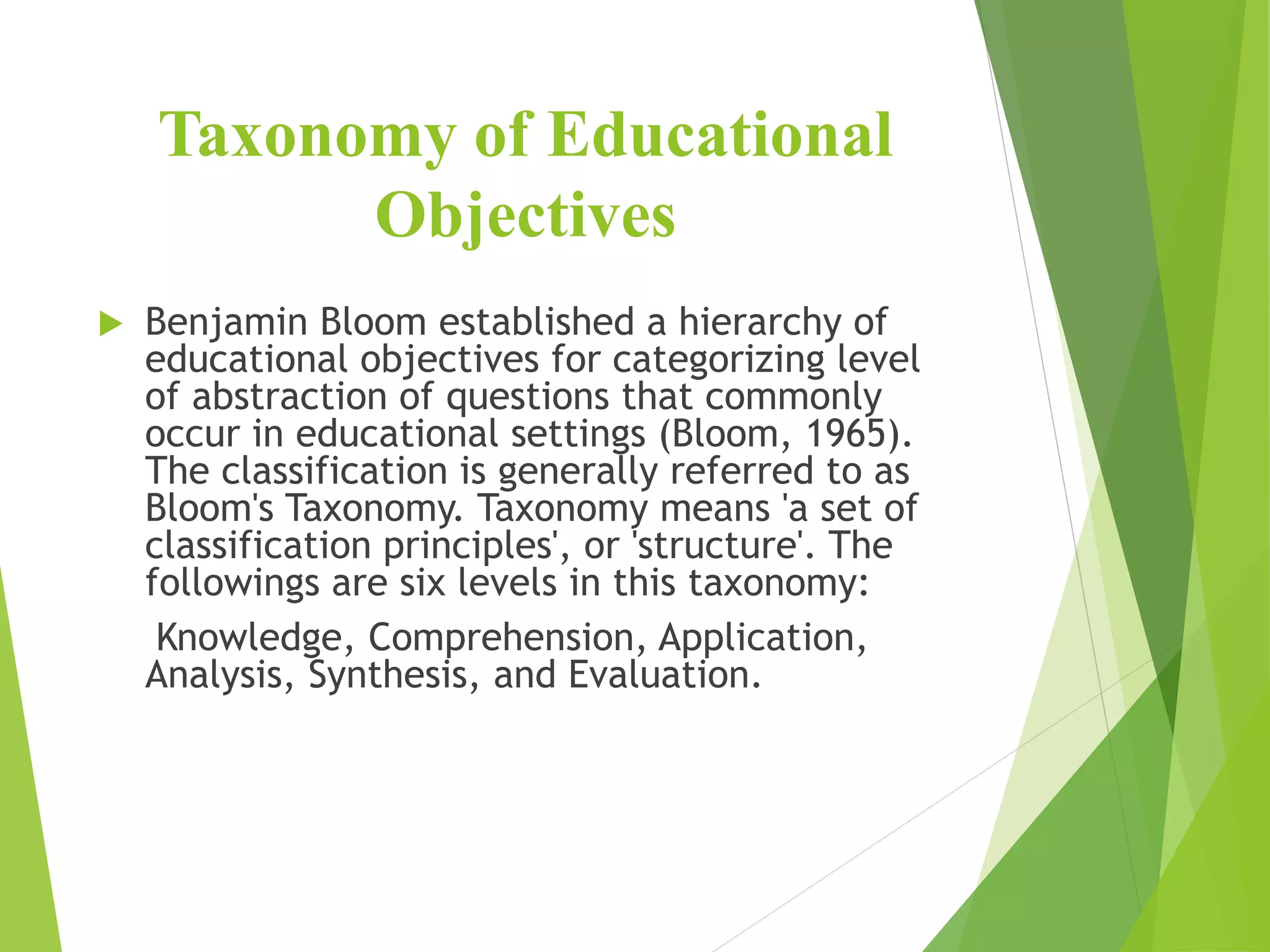
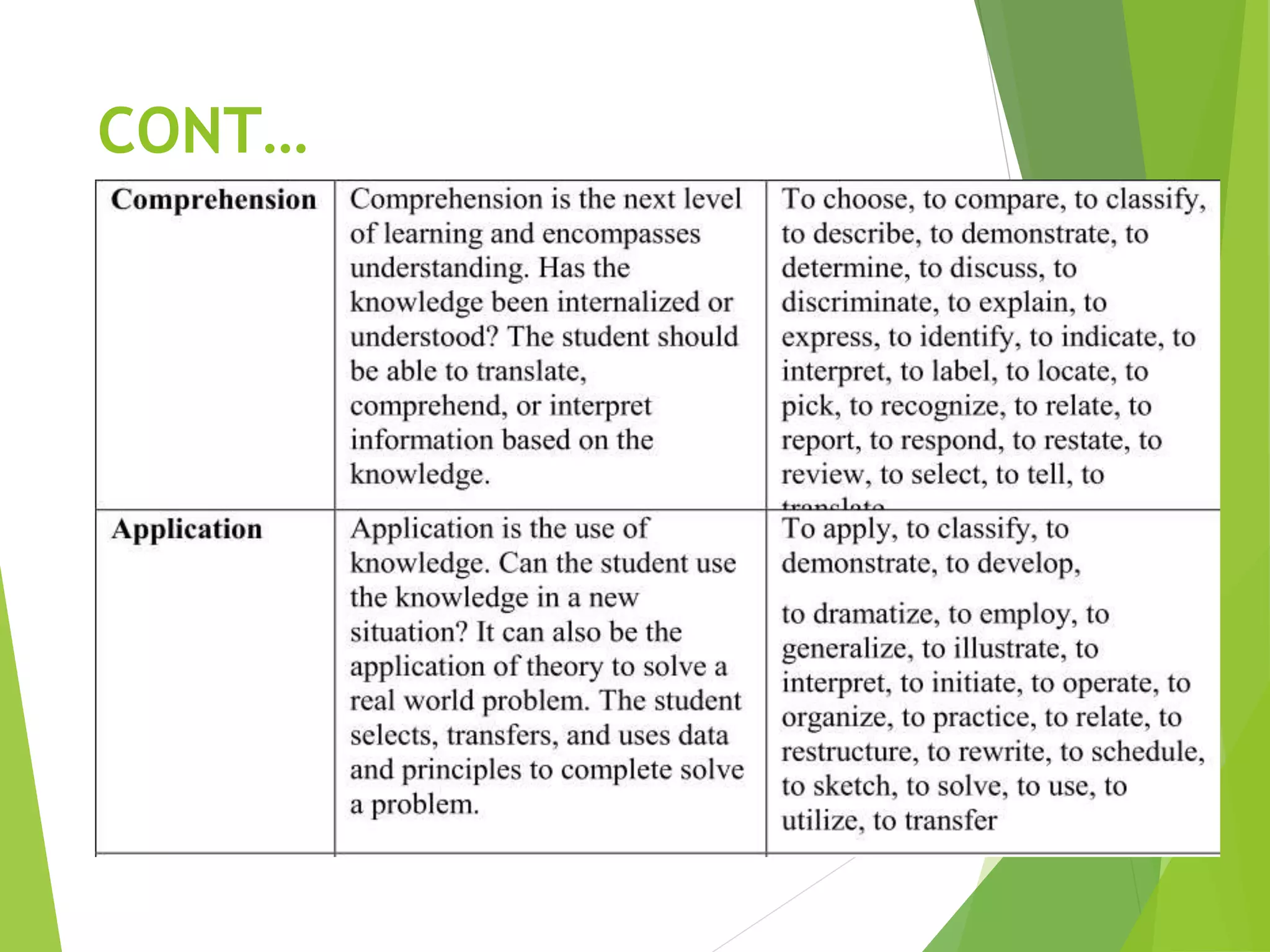
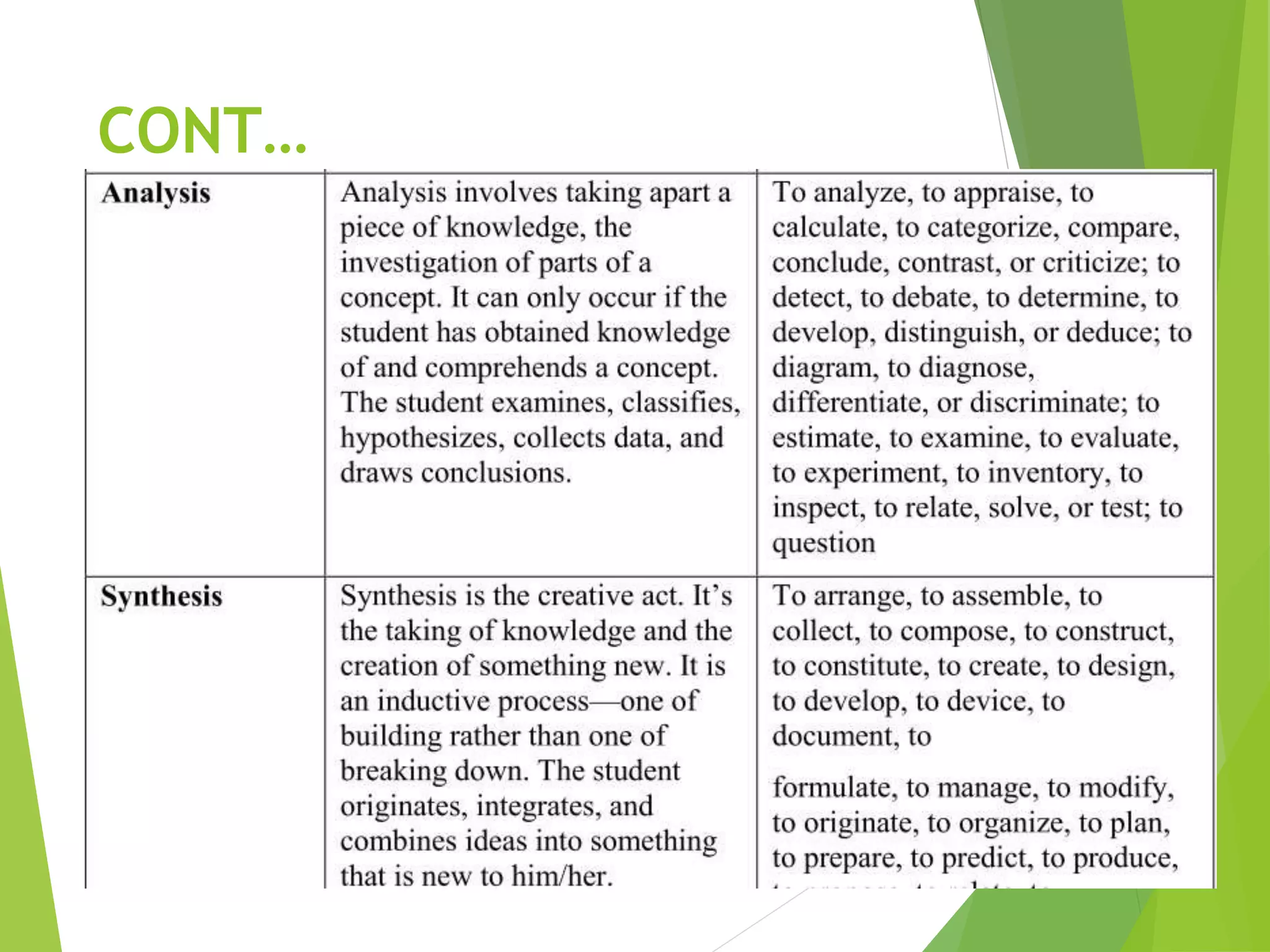
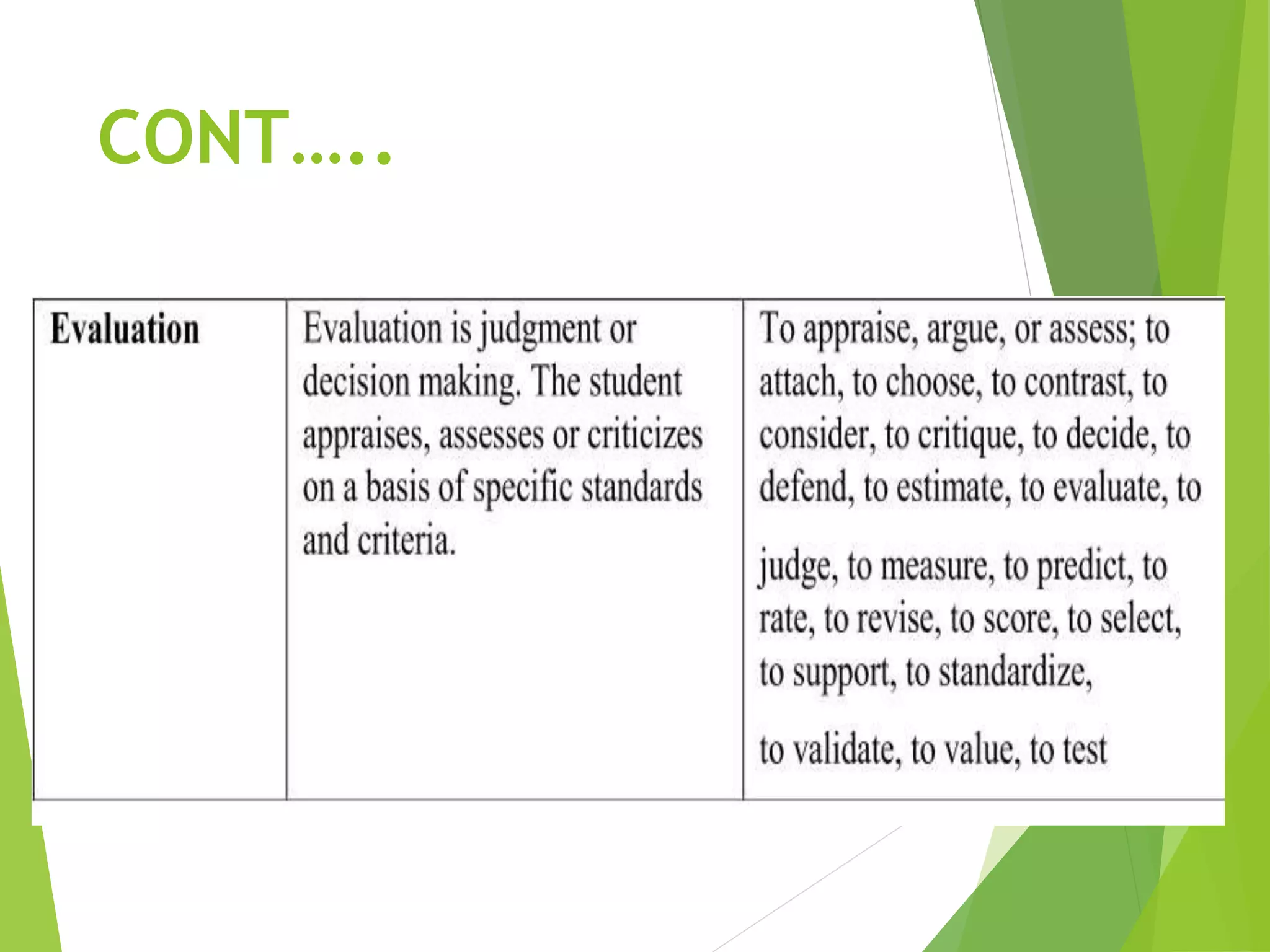
 Benjamin Bloom established a hierarchy of
educational objectives for categorizing level
of abstraction of questions that commonly
occur in educational settings (Bloom, 1965).
The classification is generally referred to as
Bloom's Taxonomy. Taxonomy means 'a set of
classification principles', or 'structure'. The
followings are six levels in this taxonomy:
Knowledge, Comprehension, Application,
Analysis, Synthesis, and Evaluation.
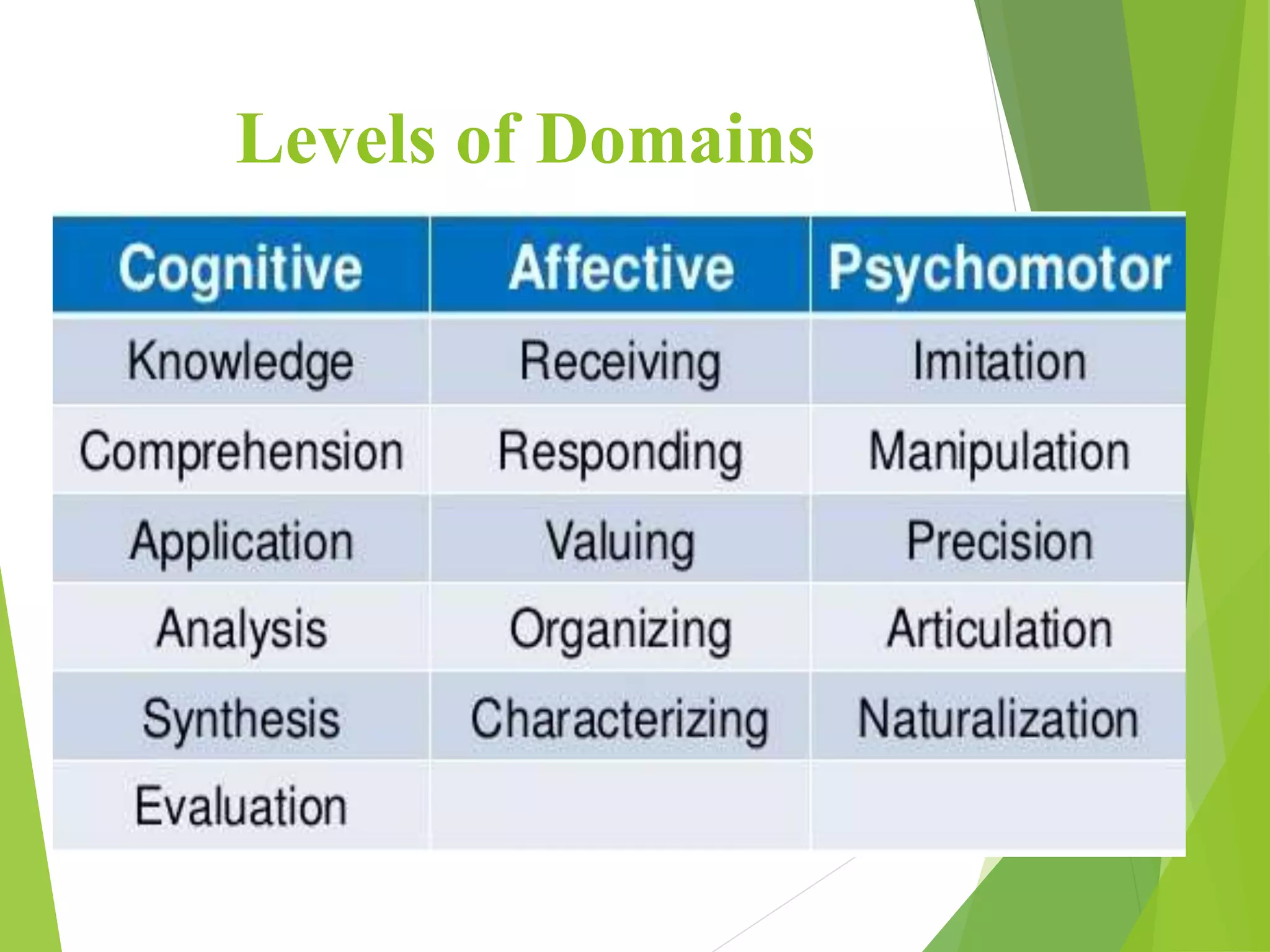
Levels of Domains
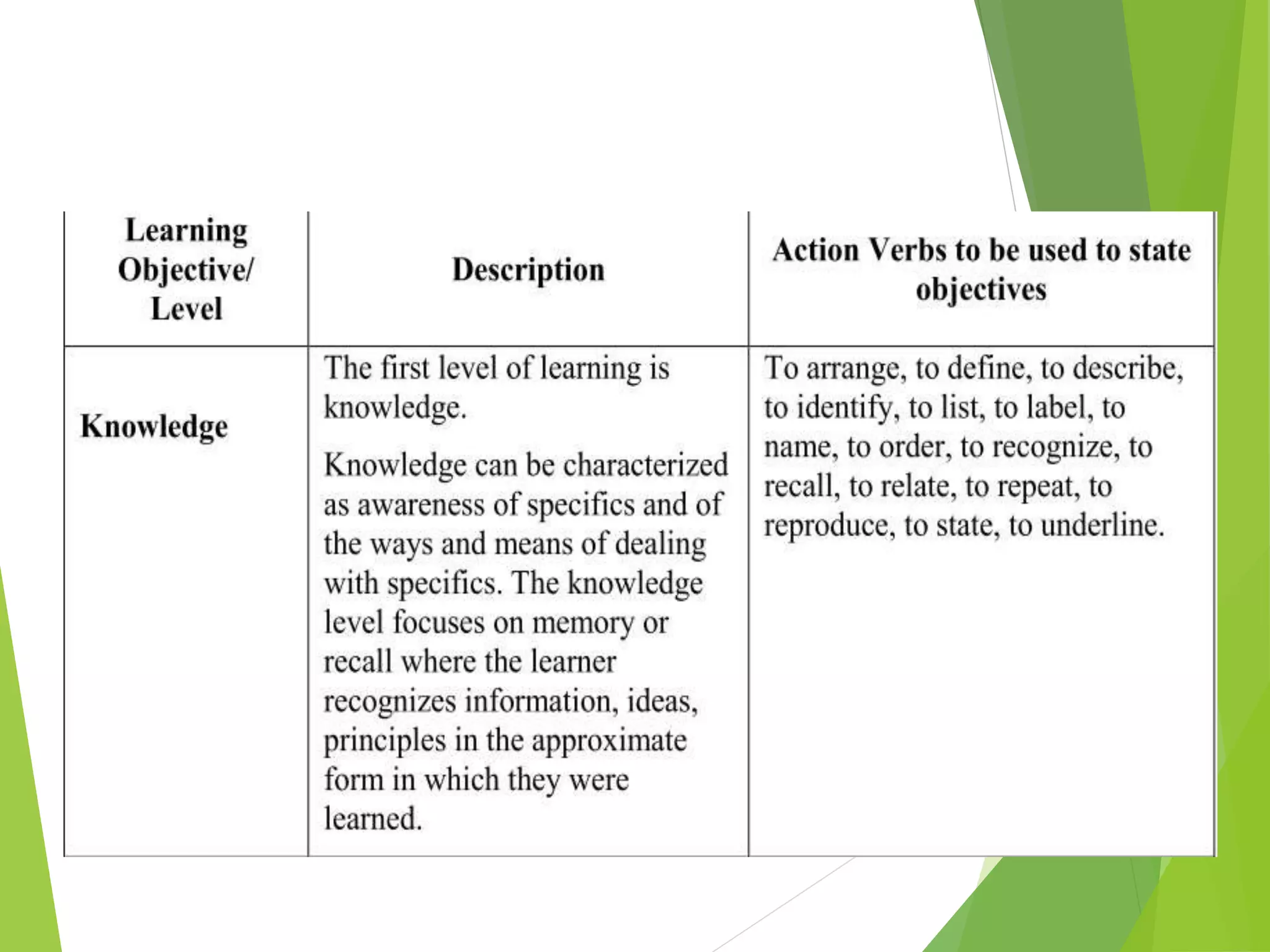
Writing Cognitive Domain
Objectives
CONT…
CONT…
CONT…..
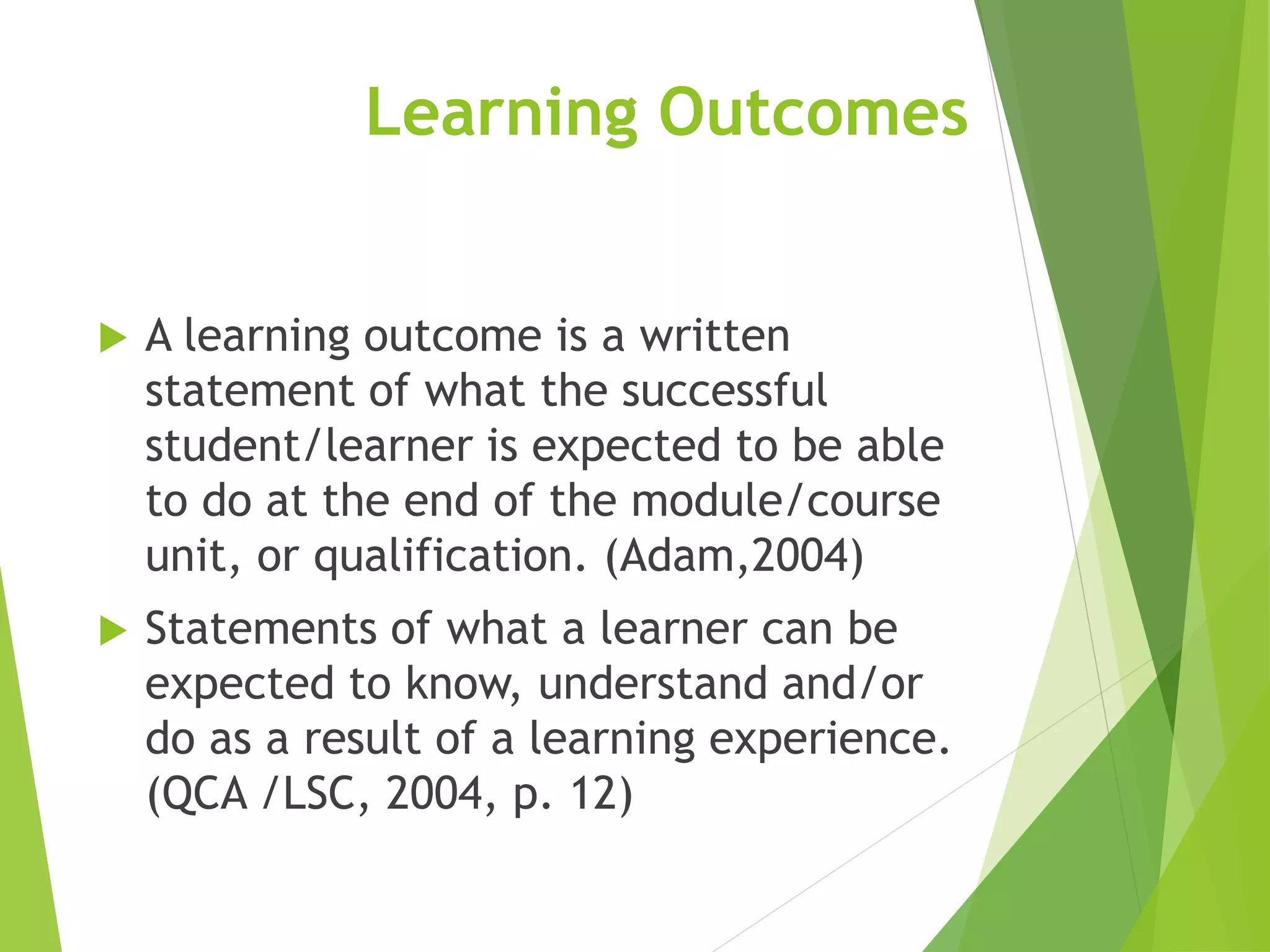
Learning Outcomes
 A learning outcome is a written
statement of what the successful
student/learner is expected to be able
to do at the end of the module/course
unit, or qualification. (Adam,2004)
 Statements of what a learner can be
expected to know, understand and/or
do as a result of a learning experience.
(QCA /LSC, 2004, p. 12)
Difference between
Objectives and Learning
Outcomes
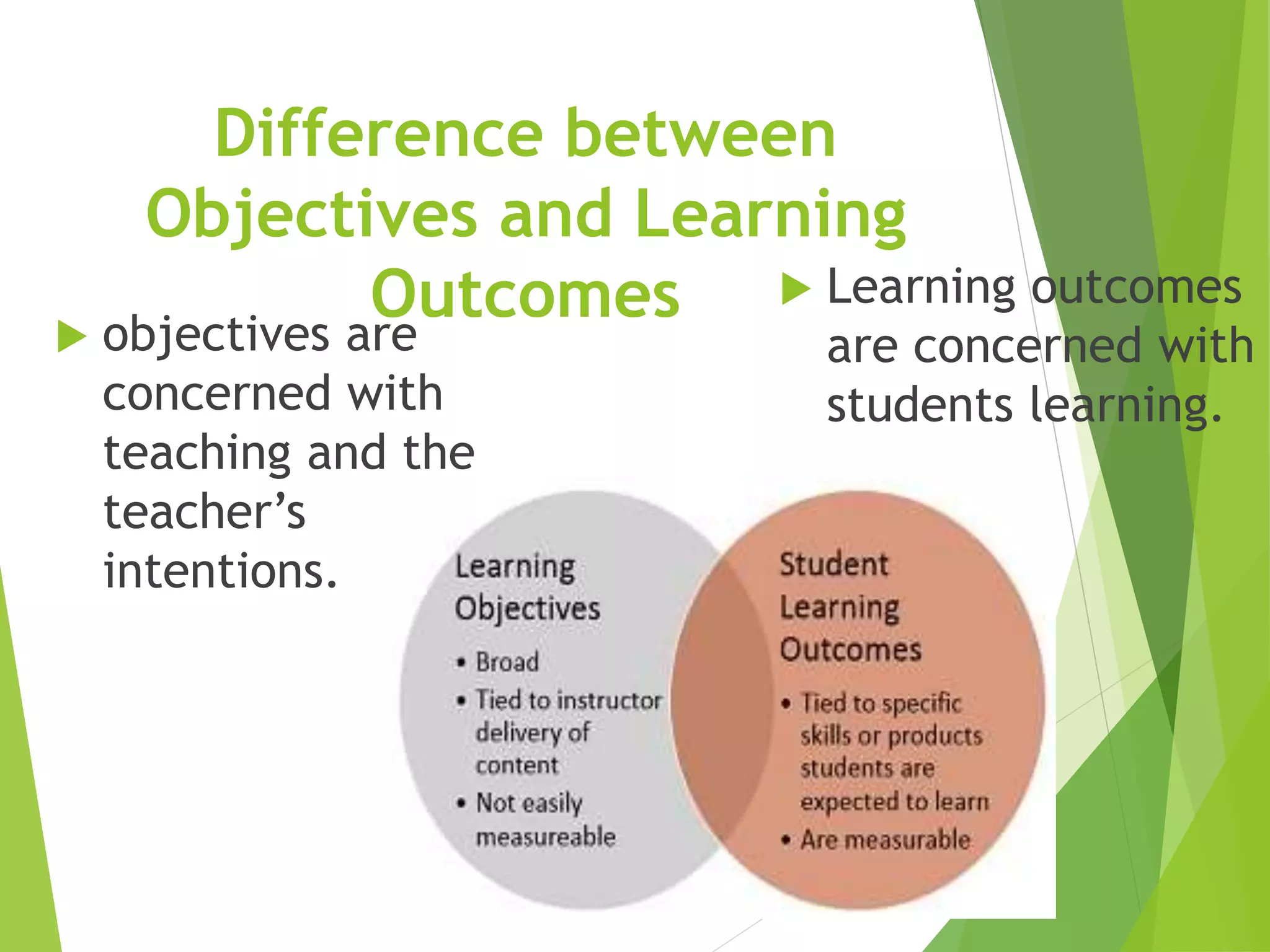
 objectives are
concerned with
teaching and the
teacher’s
intentions.
 Learning outcomes
are concerned with
students learning.
Importance of Learning
Outcomes
 Help students to learn more effectively.
They know where they stand and the
curriculum is made more open to them.
 Make it clear what students can hope to
gain from a particular course or lecture.
 Help instructors select the appropriate
teaching strategy
 Assist in setting examinations based on
the content delivered.
 Help in the selection of appropriate
assessment strategies.
SOLO Taxonomy
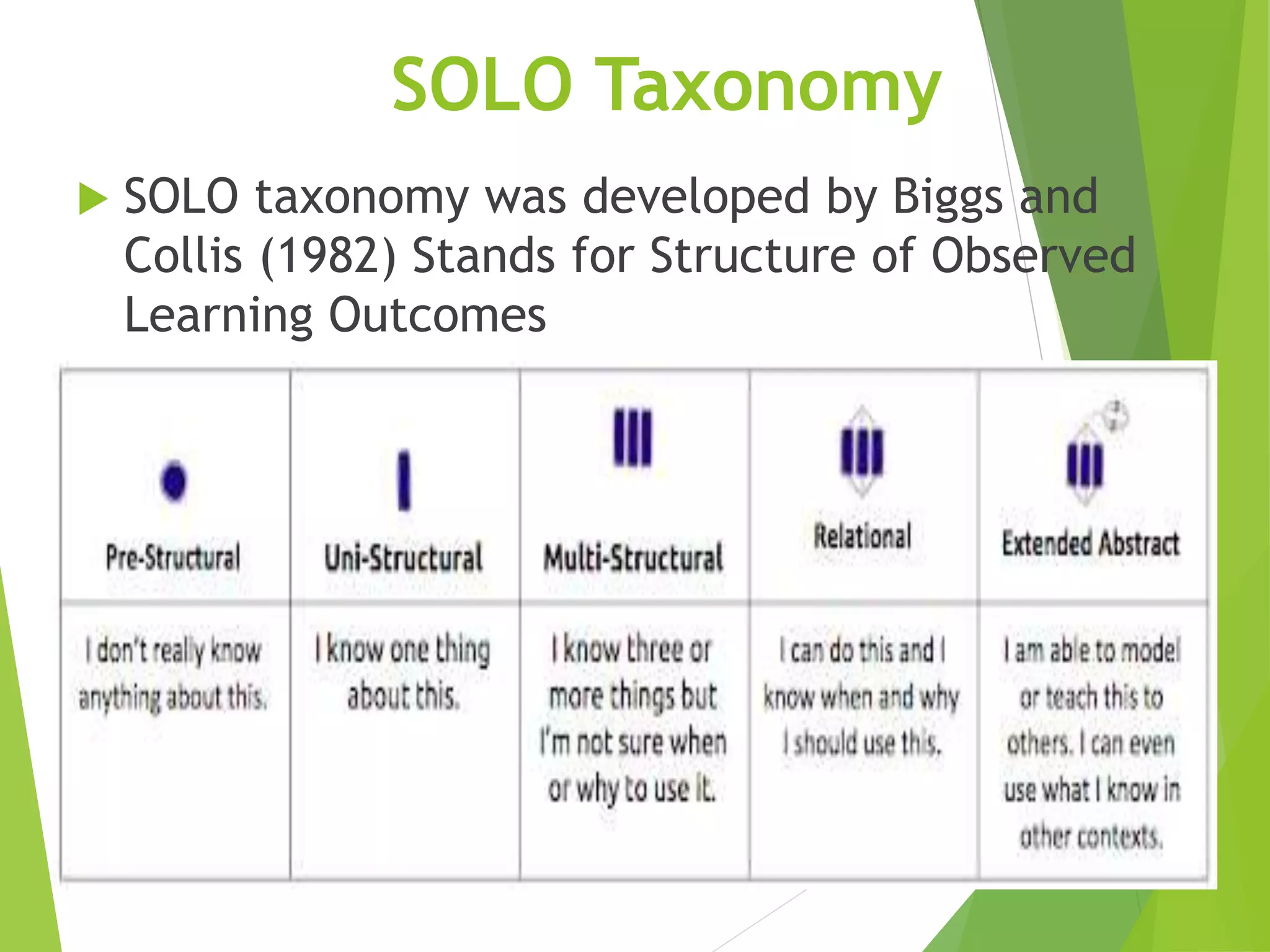
 SOLO taxonomy was developed by Biggs and
Collis (1982) Stands for Structure of Observed
Learning Outcomes
Preparation of Content
Outline
 Content refers to the major matter that will
be included in a measuring device. Selection
and preparation of content also depends on
the type of decisions a teacher has to make
about the students.
 A teacher should know that items selected
for the test come from instructional material
which a teacher has covered during
teaching.
PRINCIPLES FOR TEST CONTENT
1) Purpose of the test (diagnostic test,
classification, placement, or job employment)
2) Representative sample of the knowledge,
behaviour, or skill domain being measured.
3) Relevancy of the topic with the content of the
subject
4) Language of the content should be according to
the age and grade level of the students.
5) Developing table of specification.
Preparation of Table of
Specification
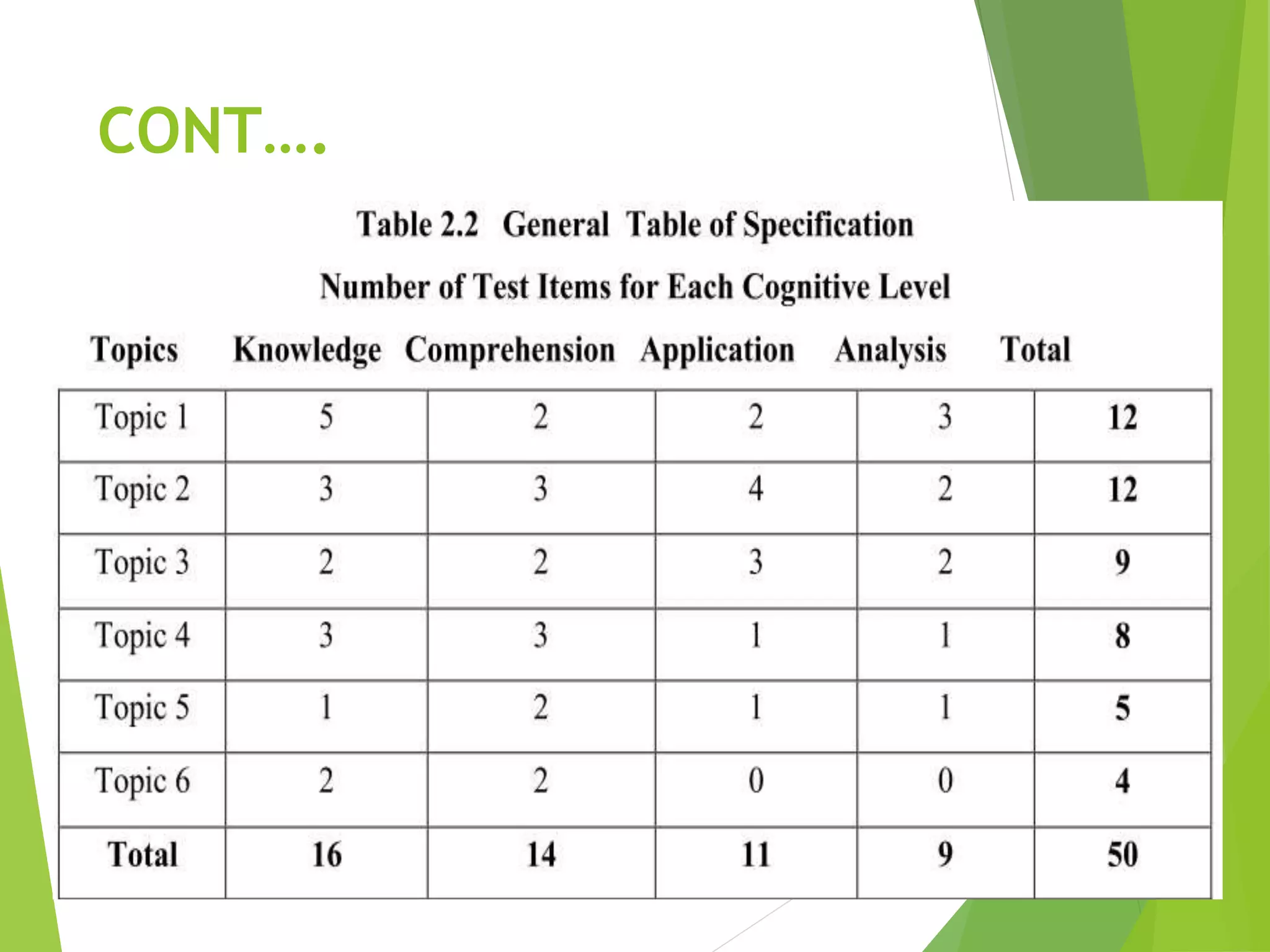
 Table of specification specifies the content of a
test.
 It is a two-way framework which ensures the
congruence between classroom instruction and test
content. This is one of the most popular procedures
used by test developers for defining the content-
domain.
 One dimension of the test reflects the content to be
covered and other dimension describes the kinds of
student cognitive behaviour to be assessed.
CONT….
THANK YOU

Objectives and Assessments

  • 1.
    UNIT # 02 OBJECTIVESAND ASSESSMENT Resource person Rashida Bhatti
  • 2.
    INTRODUCTION  Objectives arethe desired outcomes of an effort. Guided by these specific objectives instructional activities are designed and subsequently assessment is carried out through different methods.  The objective are key components for developing a test and guiding principles for assessment.  Bloom’s taxonomy provides a useful way of describing the complexity of an objective by classifying into one of the hierarchical categories from simplest to complex.  Therefore, the process of developing a test should begin with the identification of content domain at first stage and development of table of specification at second stage.
  • 3.
    Test  A testis a device which is used to measure behaviour of a person for a specific purpose.  Moreover it is an instrument that typically uses sets of items designed to measure a domain of learning tasks.  Tests are systematic method of collecting information that lead to make inferences about the characteristics of people or objects.  teacher prepares tests while sampling the items from a  pool of items in such a way that it represents the whole subject matter.  The main categories of tests are Objective Type and Subjective Type
  • 4.
    Purposes of test Monitoring Student Progress  Diagnosing Learning Problems  Assigning Grades  Classification and Selection of Students  Evaluating Instruction
  • 5.
    Objectives A learning objectiverefers to the statement of what students will obtain through instruction of certain content. In other words ‘an objective is a description of a performance you want learners to be able to exhibit before you consider them competent. An objective describes an intended result of instruction, rather than he process of instruction itself.’ (Mager, p. 5)
  • 6.
    Characteristics/ Attributes of theObjectives  Behaviour - Firstly, an objective must explain the competency to be learned, the intended change in the behaviour of the learners.  Criterion - Secondly, an objective must clarify the intended degree of In other words objective should not only indicate the change in the behaviour of the students but also the level or degree of that change as well.  Conditions - Thirdly, an objective should describe the conditions under which the learning will occur.
  • 7.
    Taxonomy of Educational Objectives Benjamin Bloom established a hierarchy of educational objectives for categorizing level of abstraction of questions that commonly occur in educational settings (Bloom, 1965). The classification is generally referred to as Bloom's Taxonomy. Taxonomy means 'a set of classification principles', or 'structure'. The followings are six levels in this taxonomy: Knowledge, Comprehension, Application, Analysis, Synthesis, and Evaluation.
  • 8.
  • 9.
  • 10.
  • 11.
  • 12.
  • 13.
    Learning Outcomes  Alearning outcome is a written statement of what the successful student/learner is expected to be able to do at the end of the module/course unit, or qualification. (Adam,2004)  Statements of what a learner can be expected to know, understand and/or do as a result of a learning experience. (QCA /LSC, 2004, p. 12)
  • 14.
    Difference between Objectives andLearning Outcomes  objectives are concerned with teaching and the teacher’s intentions.  Learning outcomes are concerned with students learning.
  • 15.
    Importance of Learning Outcomes Help students to learn more effectively. They know where they stand and the curriculum is made more open to them.  Make it clear what students can hope to gain from a particular course or lecture.  Help instructors select the appropriate teaching strategy  Assist in setting examinations based on the content delivered.  Help in the selection of appropriate assessment strategies.
  • 16.
    SOLO Taxonomy  SOLOtaxonomy was developed by Biggs and Collis (1982) Stands for Structure of Observed Learning Outcomes
  • 17.
    Preparation of Content Outline Content refers to the major matter that will be included in a measuring device. Selection and preparation of content also depends on the type of decisions a teacher has to make about the students.  A teacher should know that items selected for the test come from instructional material which a teacher has covered during teaching.
  • 18.
    PRINCIPLES FOR TESTCONTENT 1) Purpose of the test (diagnostic test, classification, placement, or job employment) 2) Representative sample of the knowledge, behaviour, or skill domain being measured. 3) Relevancy of the topic with the content of the subject 4) Language of the content should be according to the age and grade level of the students. 5) Developing table of specification.
  • 19.
    Preparation of Tableof Specification  Table of specification specifies the content of a test.  It is a two-way framework which ensures the congruence between classroom instruction and test content. This is one of the most popular procedures used by test developers for defining the content- domain.  One dimension of the test reflects the content to be covered and other dimension describes the kinds of student cognitive behaviour to be assessed.
  • 20.
  • 21.