Institutional Analysis of the Ministry
of Public Health at Central and
Provincial Levels
First Global Symposium on Health System Research
November 18, 2010
Overview
• Background
• Objectives
• Methodology
• Stewardship functions
• Strengths and challenges by stewardship functions
• Recommendations
Background
• Dilapidated health system and extremely poor health status
• MOPH assumed a stewardship role in the health sector and
left direct service provision to NGOs
• The division contributed to important gains in health for the
Afghan population
• At the central level, the Grants and Contracts Management
Unit (GCMU) provided a strong role in overseeing contracts
and coordinating donor inputs
Objectives
• To identify the strengths and weaknesses of MOPH at central
and provincial levels
• To help the Ministry to effectively carry out its stewardship
functions
Methodology
• Semi-structured Interviews with Ministry’s officials at the
central and provincial levels
• Field visits to Parwan, Baghlan, Samangan and Balkh
provinces
• Review of Ministry’s key documents
Stewardship Functions
– Setting strategies and objectives
– Development of technical guidelines
– Coordination
– Regulation and promotion of the private sector
– Budgeting and resource mobilization
– Accountability and public relations
– Monitoring and evaluation
– Human resource development
– IEC/BCC
– Emergency response
Setting Strategies and Objectives
Strengths Challenges
1. Clear and known
mechanisms for developing
strategies
2. Many guiding documents
developed by the MOPH
3. Senior MOPH officials
heavily involved
4. Documents widely shared
with development partners
1. Lack of an effective
mechanism for
dissemination and
explanation of key
documents to central and
provincial staff
2. Lack of involvement of
provincial officials
Technical Guidelines and Supervision
Strengths Challenges
1. Relevant technical
guidelines developed for
several components of the
Basic Package of Health
Services
2. Guidelines made available
to the NGOs
3. Staff of the health facilities
trained on how to use the
technical guidelines
1. Lack of technical guidelines
for mental health,
disability, and IEC
components of the BPHS
and treatment guidelines
for the EPHS
2. Inconsistencies in the
training of provincial staff
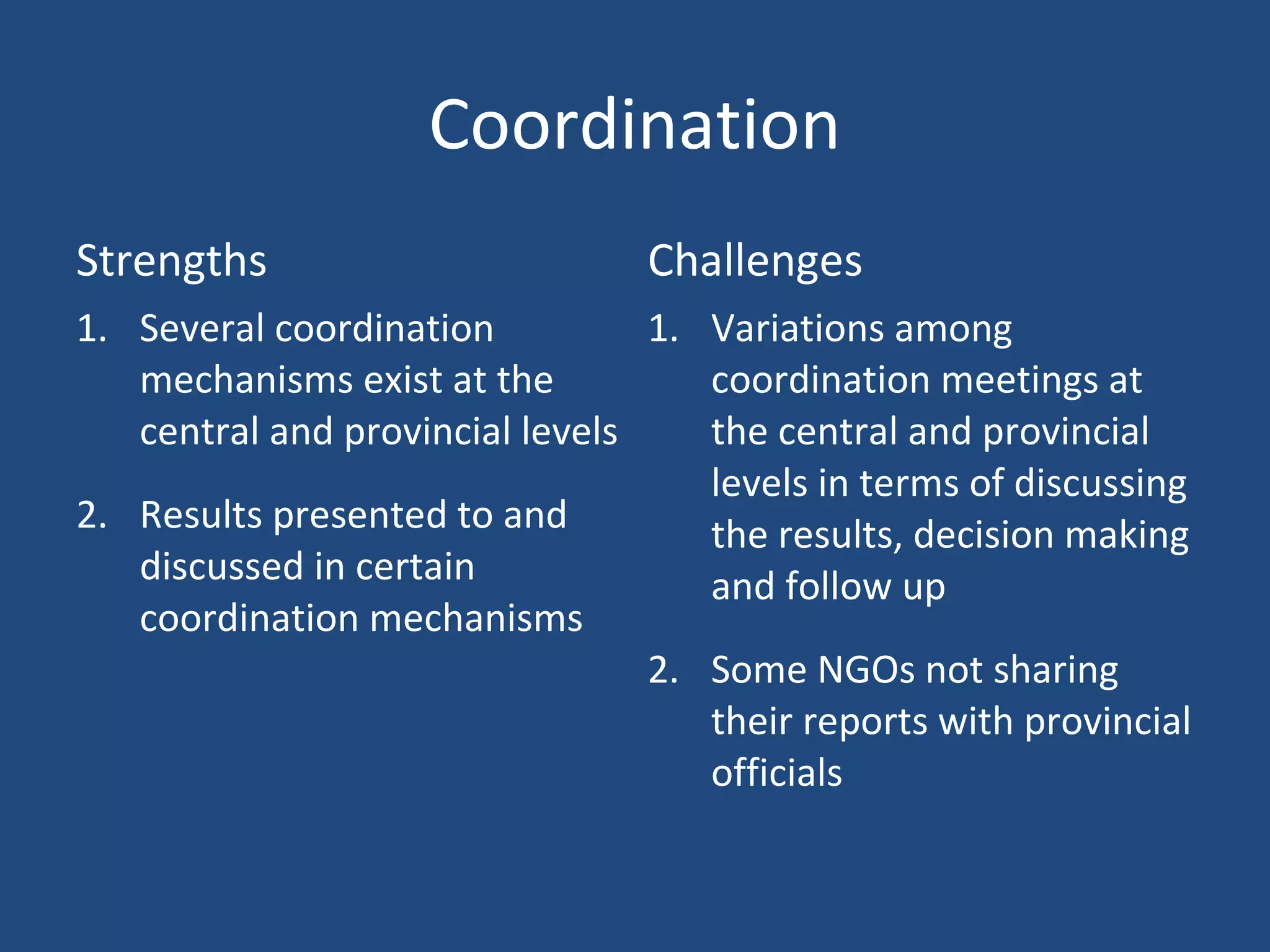
Coordination
Strengths Challenges
1. Several coordination
mechanisms exist at the
central and provincial levels
2. Results presented to and
discussed in certain
coordination mechanisms
1. Variations among
coordination meetings at
the central and provincial
levels in terms of discussing
the results, decision making
and follow up
2. Some NGOs not sharing
their reports with provincial
officials
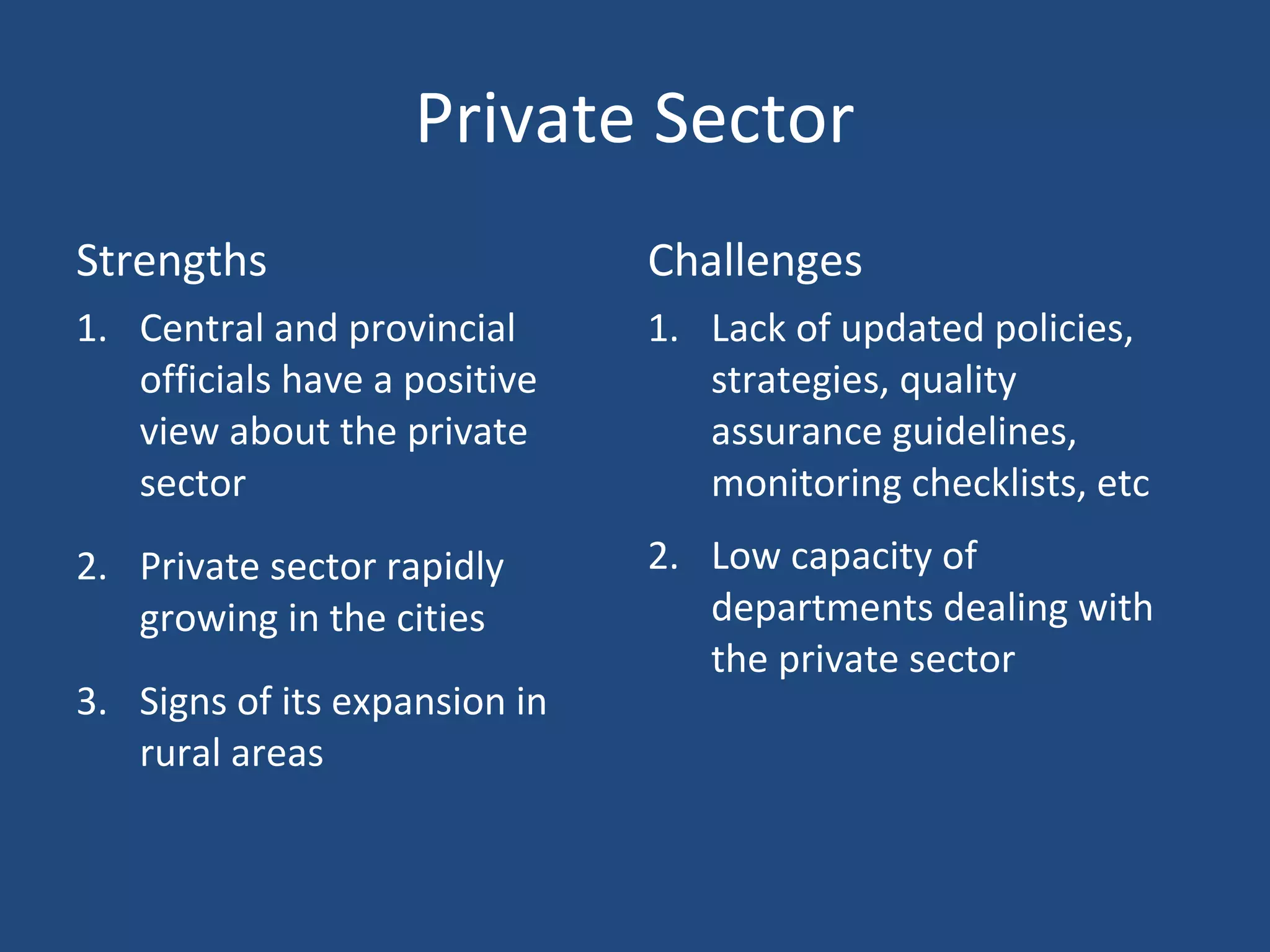
Private Sector
Strengths Challenges
1. Central and provincial
officials have a positive
view about the private
sector
2. Private sector rapidly
growing in the cities
3. Signs of its expansion in
rural areas
1. Lack of updated policies,
strategies, quality
assurance guidelines,
monitoring checklists, etc
2. Low capacity of
departments dealing with
the private sector
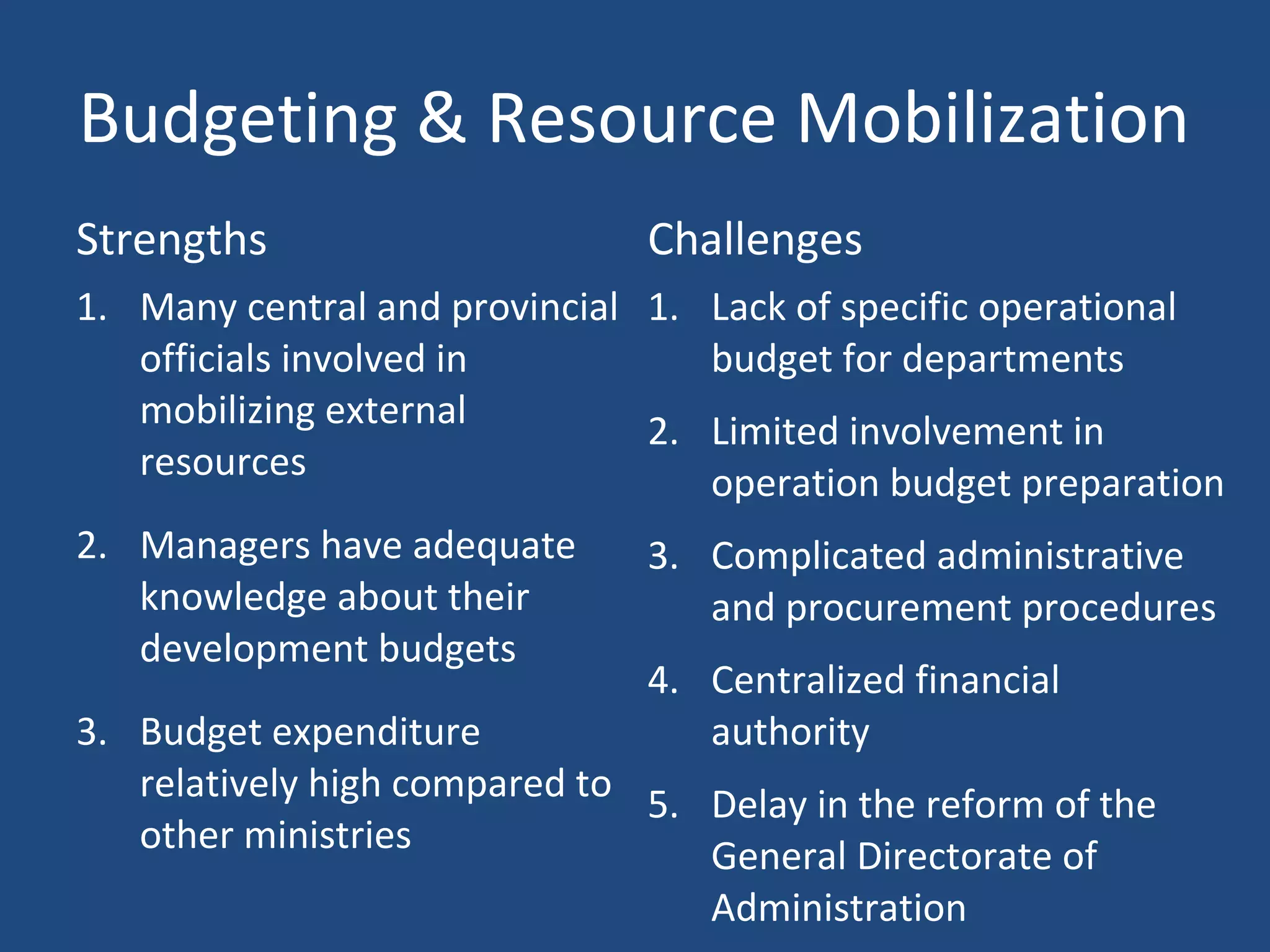
Budgeting & Resource Mobilization
Strengths Challenges
1. Many central and provincial
officials involved in
mobilizing external
resources
2. Managers have adequate
knowledge about their
development budgets
3. Budget expenditure
relatively high compared to
other ministries
1. Lack of specific operational
budget for departments
2. Limited involvement in
operation budget preparation
3. Complicated administrative
and procurement procedures
4. Centralized financial
authority
5. Delay in the reform of the
General Directorate of
Administration
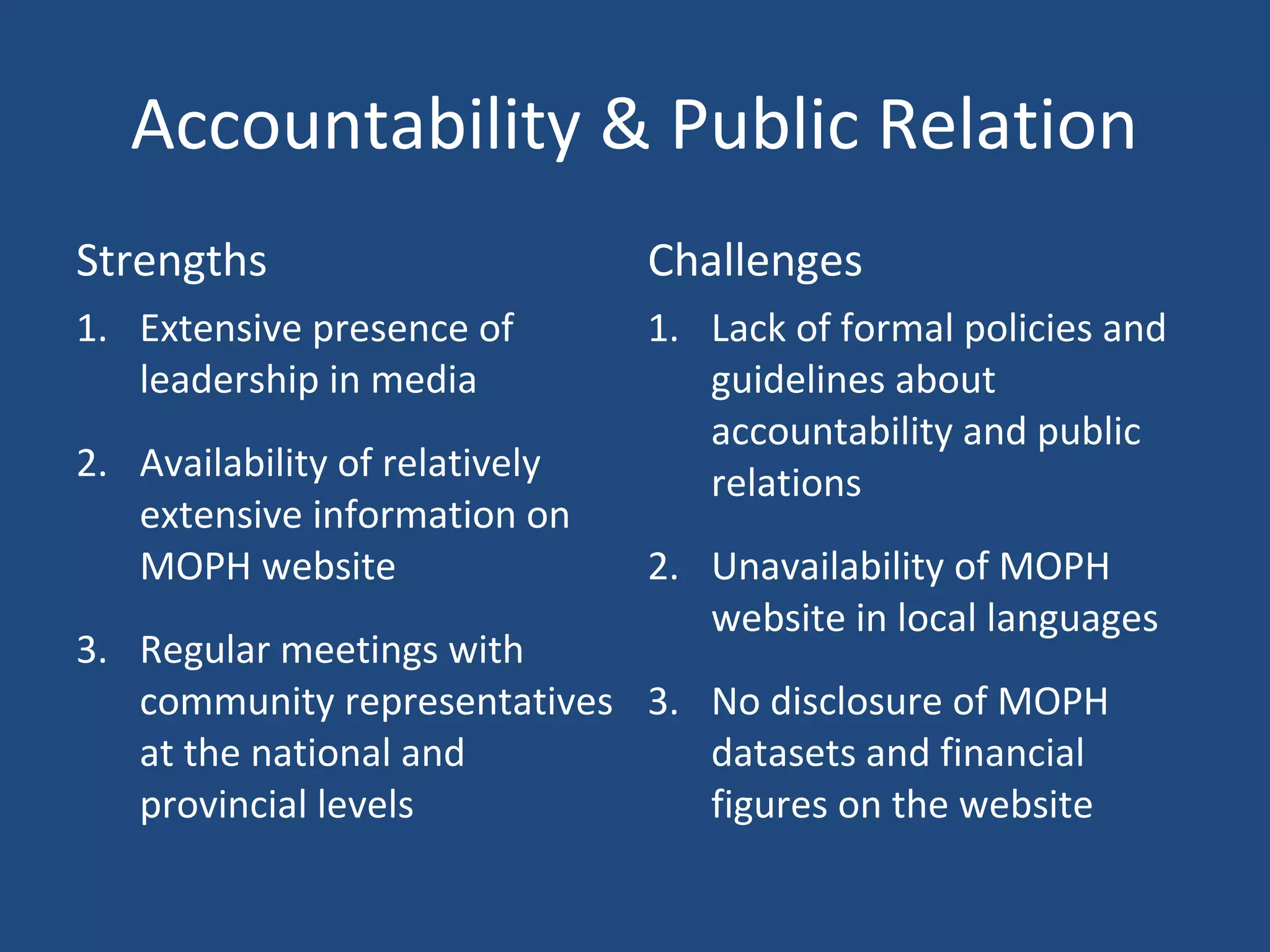
Accountability & Public Relation
Strengths Challenges
1. Extensive presence of
leadership in media
2. Availability of relatively
extensive information on
MOPH website
3. Regular meetings with
community representatives
at the national and
provincial levels
1. Lack of formal policies and
guidelines about
accountability and public
relations
2. Unavailability of MOPH
website in local languages
3. No disclosure of MOPH
datasets and financial
figures on the website
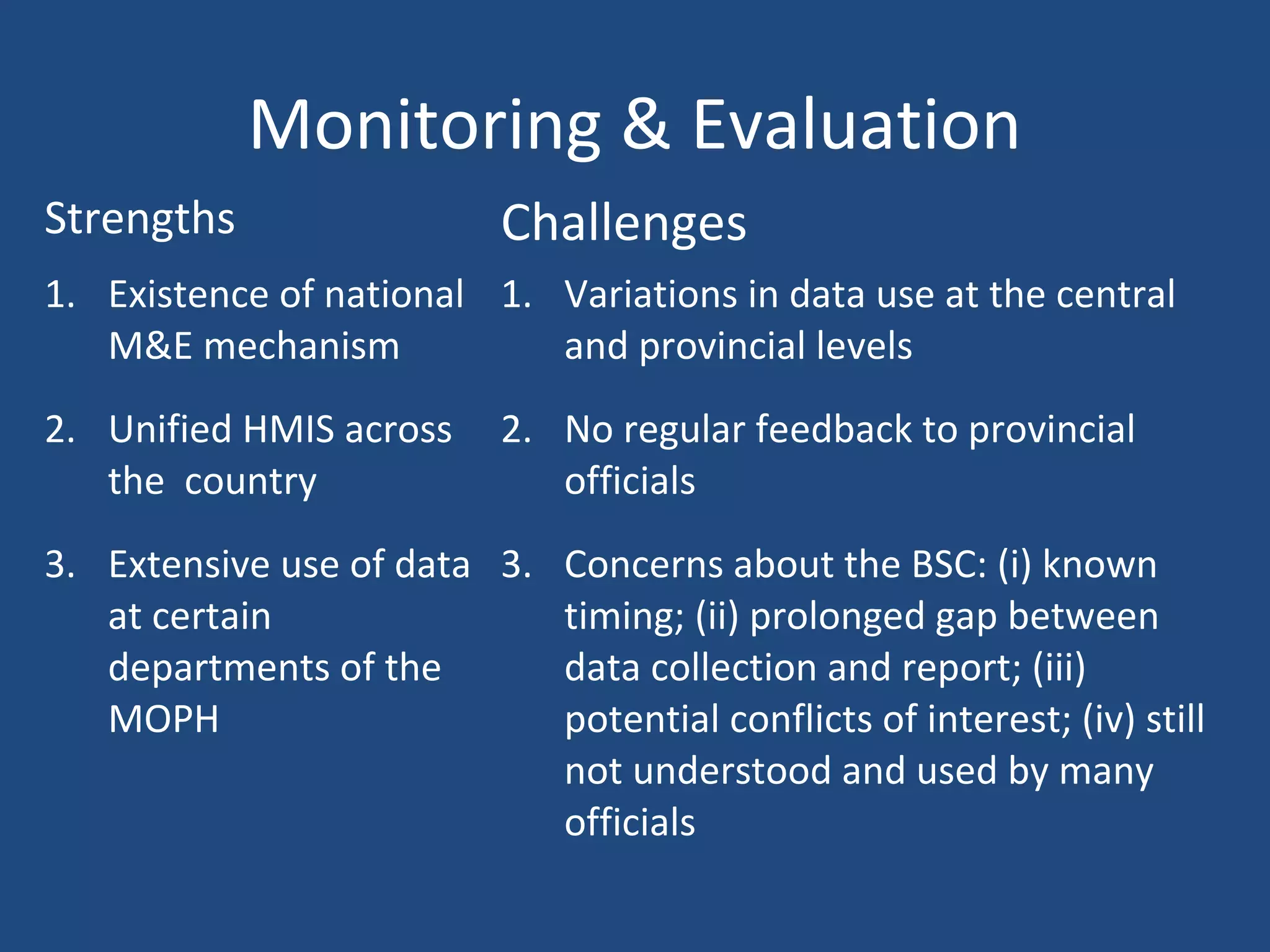
Monitoring & Evaluation
Strengths Challenges
1. Existence of national
M&E mechanism
2. Unified HMIS across
the country
3. Extensive use of data
at certain
departments of the
MOPH
1. Variations in data use at the central
and provincial levels
2. No regular feedback to provincial
officials
3. Concerns about the BSC: (i) known
timing; (ii) prolonged gap between
data collection and report; (iii)
potential conflicts of interest; (iv) still
not understood and used by many
officials
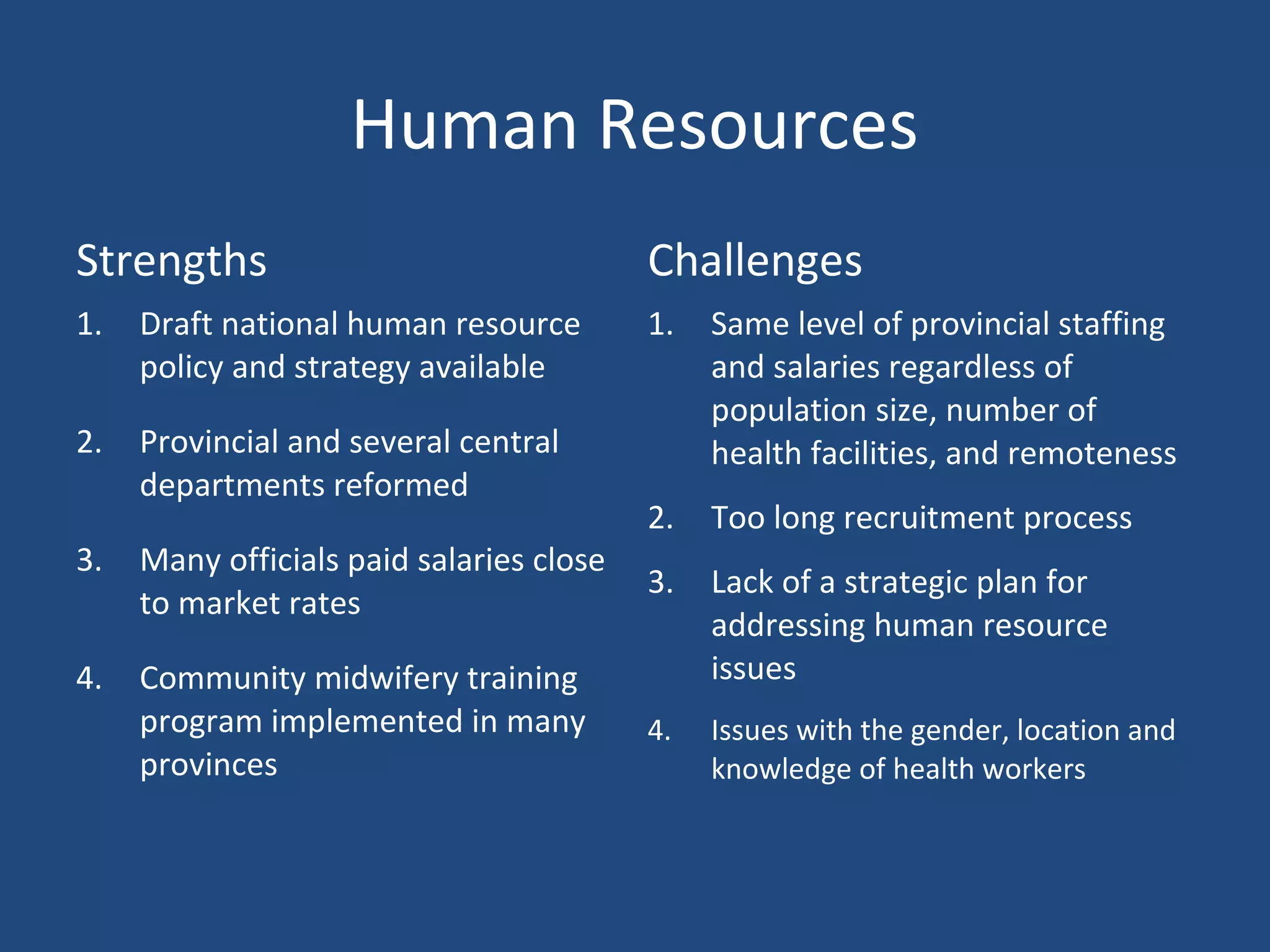
Human Resources
Strengths Challenges
1. Draft national human resource
policy and strategy available
2. Provincial and several central
departments reformed
3. Many officials paid salaries close
to market rates
4. Community midwifery training
program implemented in many
provinces
1. Same level of provincial staffing
and salaries regardless of
population size, number of
health facilities, and remoteness
2. Too long recruitment process
3. Lack of a strategic plan for
addressing human resource
issues
4. Issues with the gender, location and
knowledge of health workers
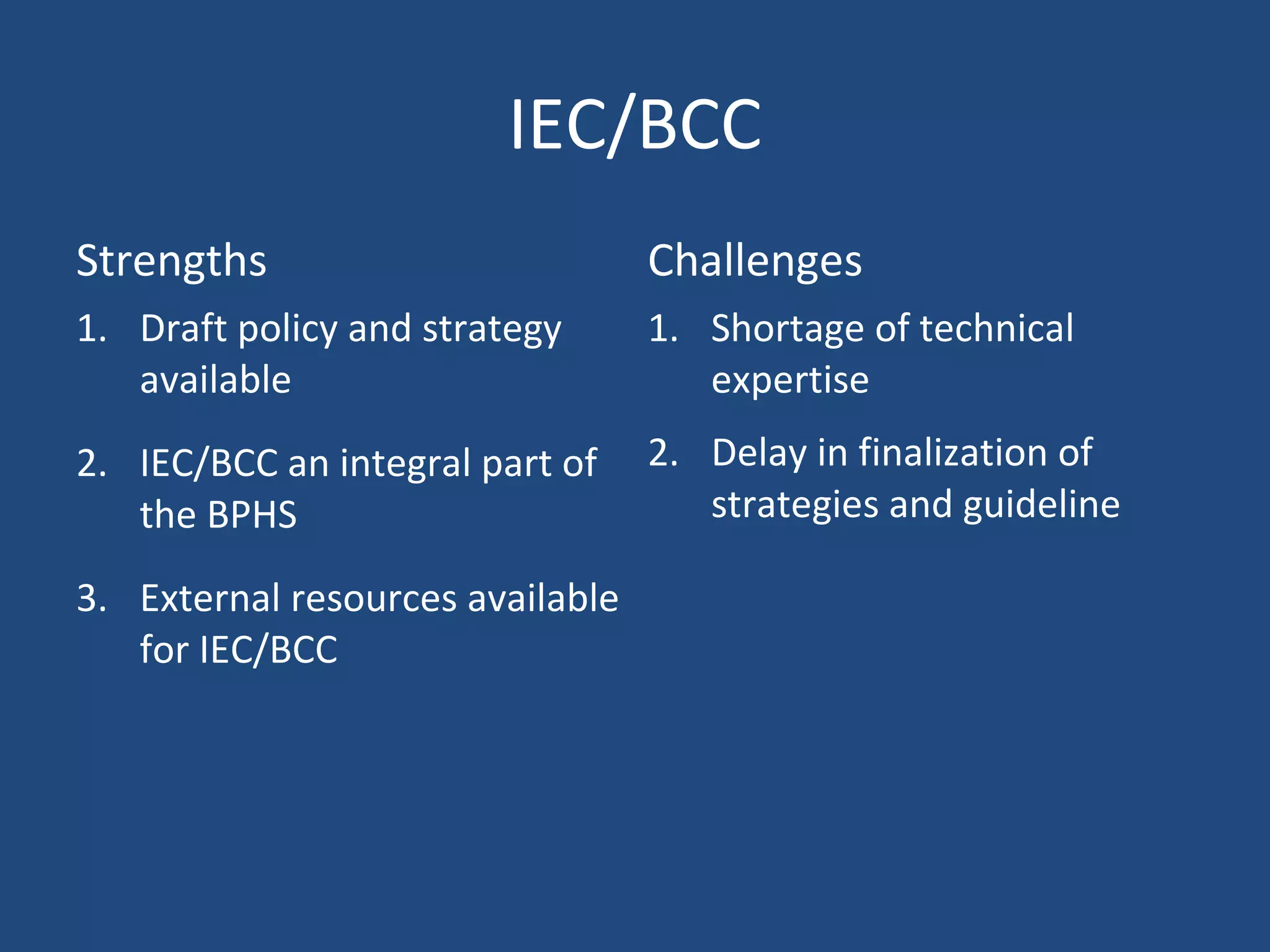
IEC/BCC
Strengths Challenges
1. Draft policy and strategy
available
2. IEC/BCC an integral part of
the BPHS
3. External resources available
for IEC/BCC
1. Shortage of technical
expertise
2. Delay in finalization of
strategies and guideline
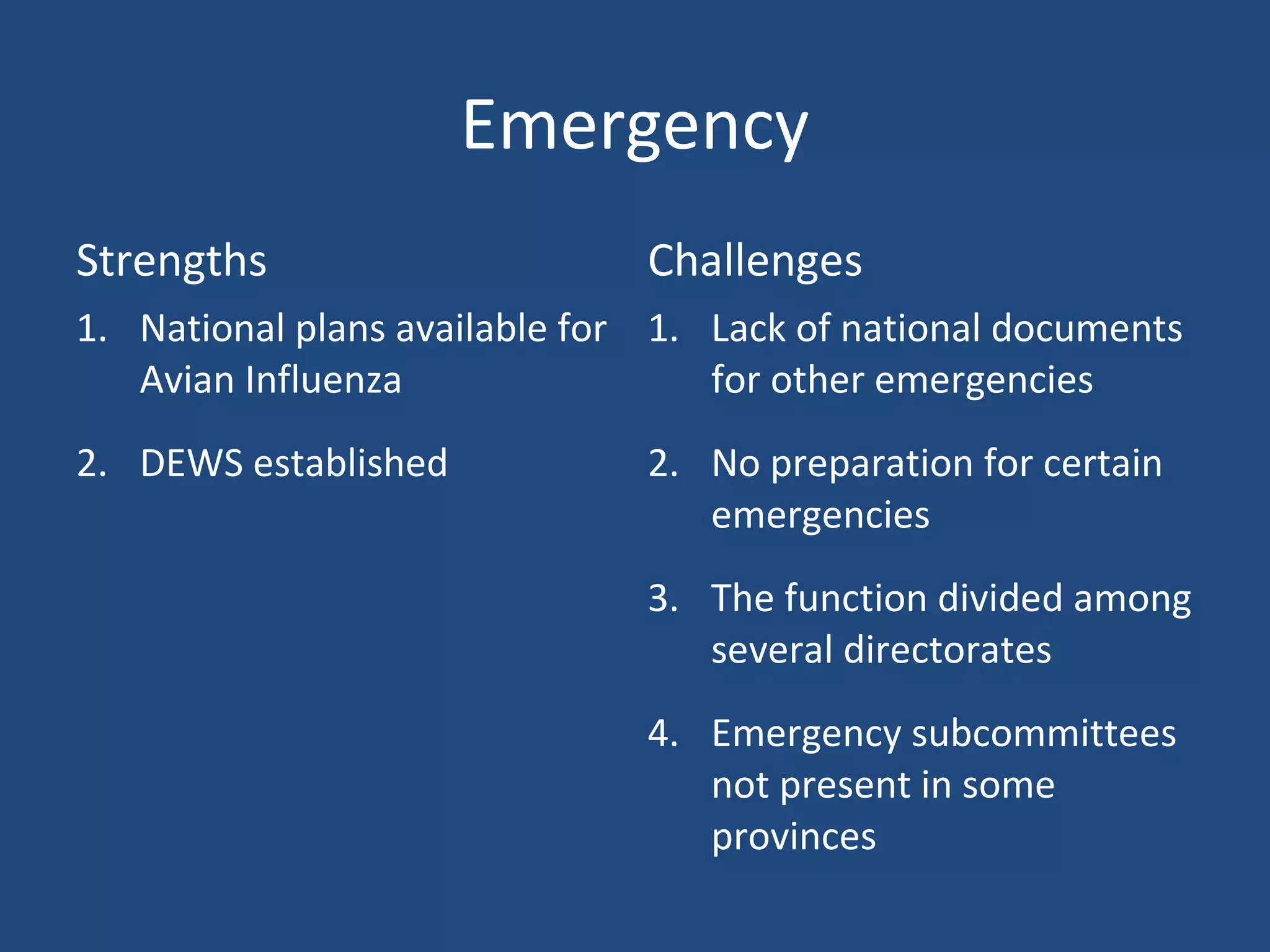
Emergency
Strengths Challenges
1. National plans available for
Avian Influenza
2. DEWS established
1. Lack of national documents
for other emergencies
2. No preparation for certain
emergencies
3. The function divided among
several directorates
4. Emergency subcommittees
not present in some
provinces
Conclusions
– Good progress in strengthening the stewardship functions
required for rapid expansion of services
– Many key areas still need to be reformed for sustaining
the momentum
• Budget and financial management
• Capacity building for peripheral levels
• …
– Need for a systematic approach to strengthening the
stewardship functions
Recommendations
Setting Strategies and Objectives
– Establish a formal mechanism for the distribution and
explanation of guiding documents to staff
– Consider reinitiating the provincial health quarterly
workshop
– Involve the provinces in the development and revision of
documents
– Finalize and publish the draft list of health indicators and
summary sheets
Technical Guidelines and Supervision
– Develop guidelines for mental health, disability, and IEC
parts of the BPHS and treatment guidelines for EPHS
– Conduct training need assessment and training on
technical guidelines at the provincial level
Coordination
– Make available the national and provincial profiles on
regular basis and make sure they are always part of
agenda
– Make sure NGOs are submitting their activity and financial
reports to provincial offices
– Hire provincial consultants
Private Sector
– Establish a technical and coordination mechanism among
the departments dealing with private sector
– Develop norms and standards
– Reform and strengthen the capacity of concerned
departments
Budgeting & Resource Mobilization
– Build on program budgeting initiative
– Decentralize budgeting and financial authority
– Reform the General Directorate of Administration
– Simplify procedures
– Develop resource mobilization strategy and guidelines
– Improve the negotiation and proposal writing skills of
the officials at the provincial level
Accountability & Public Relation
– Finalize and publish the draft public relation strategy and
guidelines
– Publish the website in local languages (requires more staff,
translators, and IT equipment; could be contracted out)
– Make the datasets and financial figures publicly available
Monitoring & Evaluation
– Finalize, prepare, and disseminate summary national and
provincial profiles on regular basis
– Conduct training need assessment and provide tailored
training on HMIS, BSC, etc
– Increase the salary of HMIS officers to levels paid by NGOs
– Evaluate the feasibility of: (i) making BSC entirely
independent; (ii) using M&E staff only for quality control
and double check; (iii) doing continuous on demand data
collection and analysis through out the year.
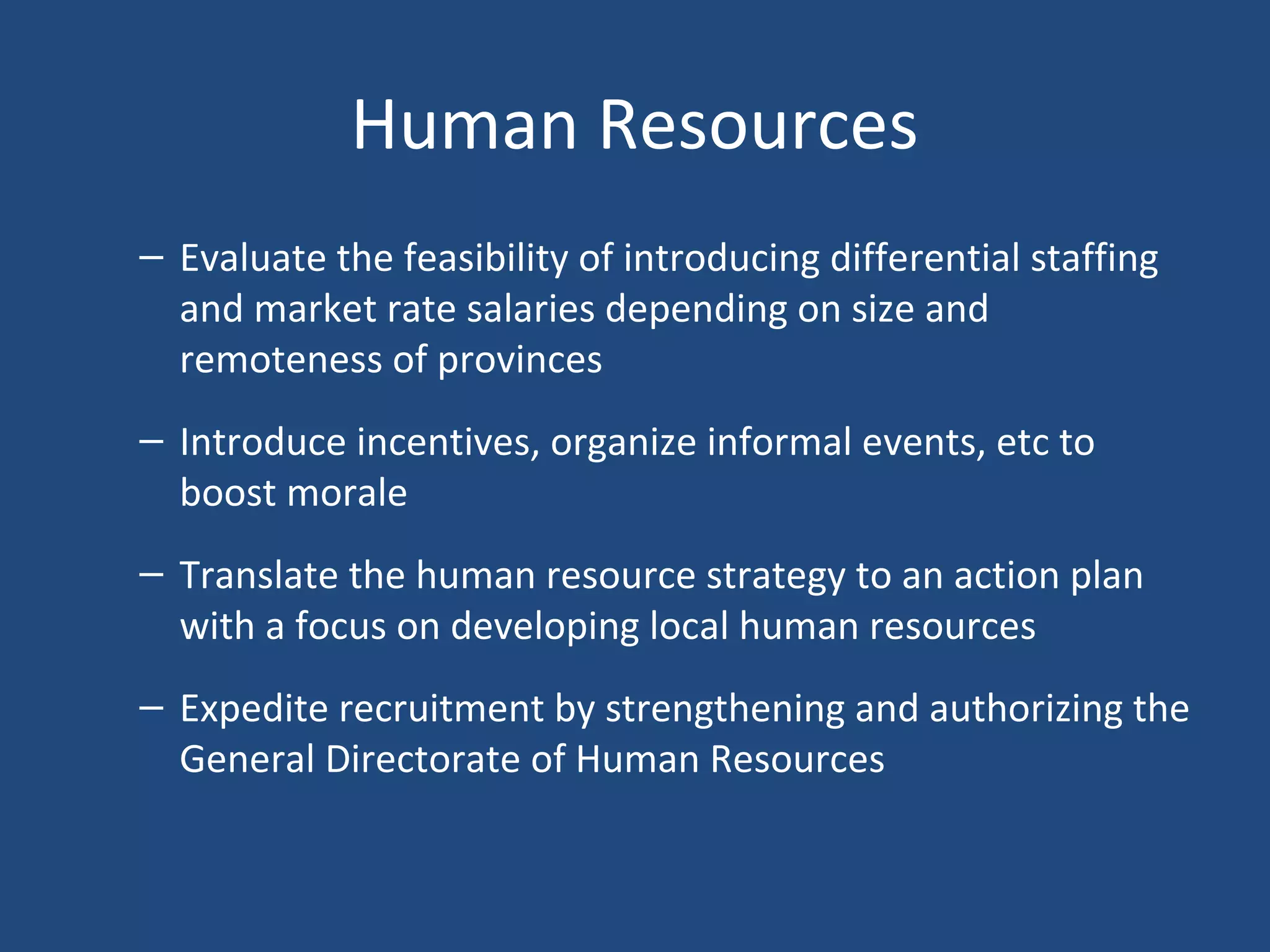
Human Resources
– Evaluate the feasibility of introducing differential staffing
and market rate salaries depending on size and
remoteness of provinces
– Introduce incentives, organize informal events, etc to
boost morale
– Translate the human resource strategy to an action plan
with a focus on developing local human resources
– Expedite recruitment by strengthening and authorizing the
General Directorate of Human Resources
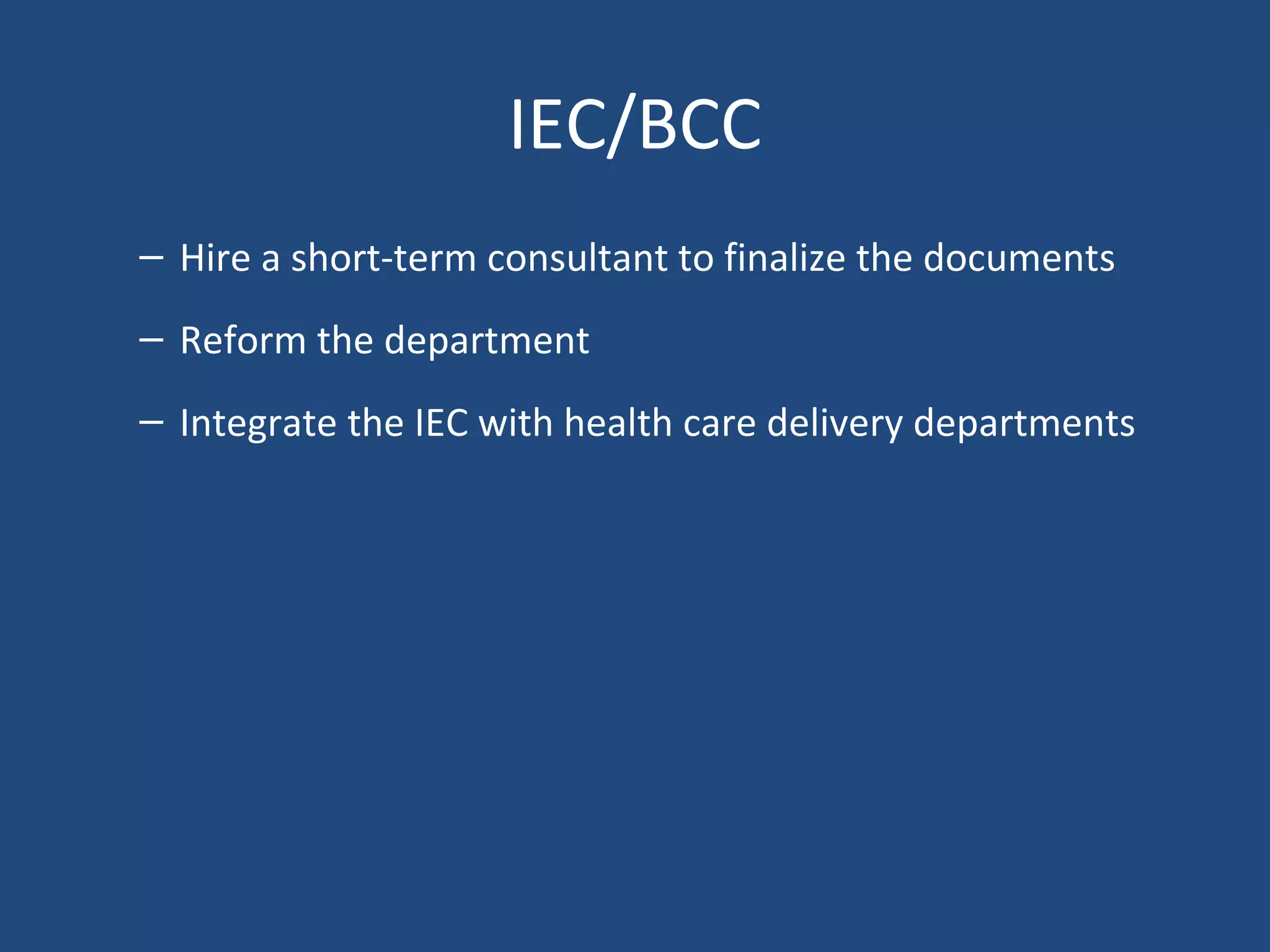
IEC/BCC
– Hire a short-term consultant to finalize the documents
– Reform the department
– Integrate the IEC with health care delivery departments
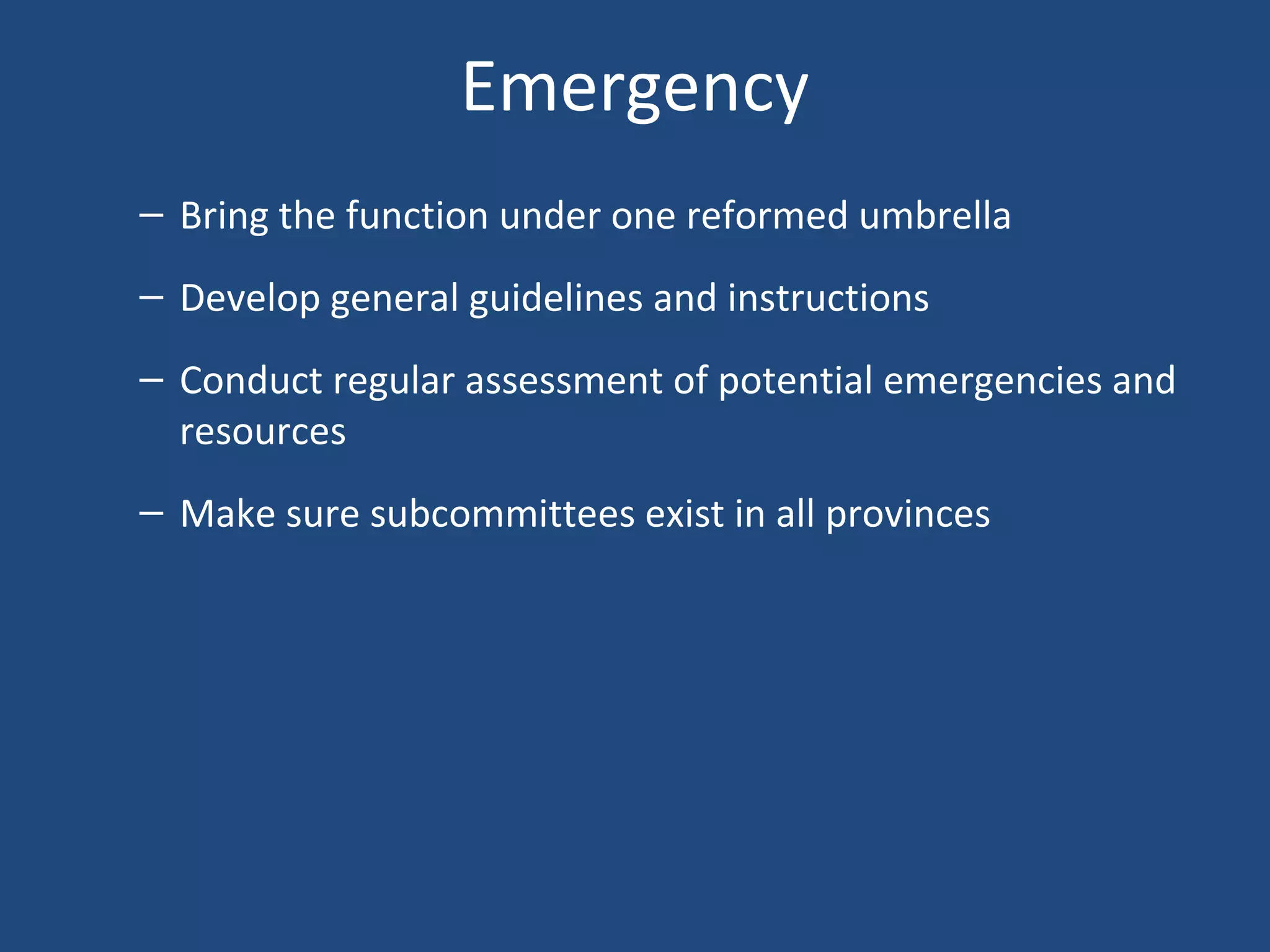
Emergency
– Bring the function under one reformed umbrella
– Develop general guidelines and instructions
– Conduct regular assessment of potential emergencies and
resources
– Make sure subcommittees exist in all provinces

Institutional Analysis of the Ministry of Public Health at Central and Provincial Levels

  • 1.
    Institutional Analysis ofthe Ministry of Public Health at Central and Provincial Levels First Global Symposium on Health System Research November 18, 2010
  • 2.
    Overview • Background • Objectives •Methodology • Stewardship functions • Strengths and challenges by stewardship functions • Recommendations
  • 3.
    Background • Dilapidated healthsystem and extremely poor health status • MOPH assumed a stewardship role in the health sector and left direct service provision to NGOs • The division contributed to important gains in health for the Afghan population • At the central level, the Grants and Contracts Management Unit (GCMU) provided a strong role in overseeing contracts and coordinating donor inputs
  • 4.
    Objectives • To identifythe strengths and weaknesses of MOPH at central and provincial levels • To help the Ministry to effectively carry out its stewardship functions
  • 5.
    Methodology • Semi-structured Interviewswith Ministry’s officials at the central and provincial levels • Field visits to Parwan, Baghlan, Samangan and Balkh provinces • Review of Ministry’s key documents
  • 6.
    Stewardship Functions – Settingstrategies and objectives – Development of technical guidelines – Coordination – Regulation and promotion of the private sector – Budgeting and resource mobilization – Accountability and public relations – Monitoring and evaluation – Human resource development – IEC/BCC – Emergency response
  • 7.
    Setting Strategies andObjectives Strengths Challenges 1. Clear and known mechanisms for developing strategies 2. Many guiding documents developed by the MOPH 3. Senior MOPH officials heavily involved 4. Documents widely shared with development partners 1. Lack of an effective mechanism for dissemination and explanation of key documents to central and provincial staff 2. Lack of involvement of provincial officials
  • 8.
    Technical Guidelines andSupervision Strengths Challenges 1. Relevant technical guidelines developed for several components of the Basic Package of Health Services 2. Guidelines made available to the NGOs 3. Staff of the health facilities trained on how to use the technical guidelines 1. Lack of technical guidelines for mental health, disability, and IEC components of the BPHS and treatment guidelines for the EPHS 2. Inconsistencies in the training of provincial staff
  • 9.
    Coordination Strengths Challenges 1. Severalcoordination mechanisms exist at the central and provincial levels 2. Results presented to and discussed in certain coordination mechanisms 1. Variations among coordination meetings at the central and provincial levels in terms of discussing the results, decision making and follow up 2. Some NGOs not sharing their reports with provincial officials
  • 10.
    Private Sector Strengths Challenges 1.Central and provincial officials have a positive view about the private sector 2. Private sector rapidly growing in the cities 3. Signs of its expansion in rural areas 1. Lack of updated policies, strategies, quality assurance guidelines, monitoring checklists, etc 2. Low capacity of departments dealing with the private sector
  • 11.
    Budgeting & ResourceMobilization Strengths Challenges 1. Many central and provincial officials involved in mobilizing external resources 2. Managers have adequate knowledge about their development budgets 3. Budget expenditure relatively high compared to other ministries 1. Lack of specific operational budget for departments 2. Limited involvement in operation budget preparation 3. Complicated administrative and procurement procedures 4. Centralized financial authority 5. Delay in the reform of the General Directorate of Administration
  • 12.
    Accountability & PublicRelation Strengths Challenges 1. Extensive presence of leadership in media 2. Availability of relatively extensive information on MOPH website 3. Regular meetings with community representatives at the national and provincial levels 1. Lack of formal policies and guidelines about accountability and public relations 2. Unavailability of MOPH website in local languages 3. No disclosure of MOPH datasets and financial figures on the website
  • 13.
    Monitoring & Evaluation StrengthsChallenges 1. Existence of national M&E mechanism 2. Unified HMIS across the country 3. Extensive use of data at certain departments of the MOPH 1. Variations in data use at the central and provincial levels 2. No regular feedback to provincial officials 3. Concerns about the BSC: (i) known timing; (ii) prolonged gap between data collection and report; (iii) potential conflicts of interest; (iv) still not understood and used by many officials
  • 14.
    Human Resources Strengths Challenges 1.Draft national human resource policy and strategy available 2. Provincial and several central departments reformed 3. Many officials paid salaries close to market rates 4. Community midwifery training program implemented in many provinces 1. Same level of provincial staffing and salaries regardless of population size, number of health facilities, and remoteness 2. Too long recruitment process 3. Lack of a strategic plan for addressing human resource issues 4. Issues with the gender, location and knowledge of health workers
  • 15.
    IEC/BCC Strengths Challenges 1. Draftpolicy and strategy available 2. IEC/BCC an integral part of the BPHS 3. External resources available for IEC/BCC 1. Shortage of technical expertise 2. Delay in finalization of strategies and guideline
  • 16.
    Emergency Strengths Challenges 1. Nationalplans available for Avian Influenza 2. DEWS established 1. Lack of national documents for other emergencies 2. No preparation for certain emergencies 3. The function divided among several directorates 4. Emergency subcommittees not present in some provinces
  • 17.
    Conclusions – Good progressin strengthening the stewardship functions required for rapid expansion of services – Many key areas still need to be reformed for sustaining the momentum • Budget and financial management • Capacity building for peripheral levels • … – Need for a systematic approach to strengthening the stewardship functions
  • 18.
  • 19.
    Setting Strategies andObjectives – Establish a formal mechanism for the distribution and explanation of guiding documents to staff – Consider reinitiating the provincial health quarterly workshop – Involve the provinces in the development and revision of documents – Finalize and publish the draft list of health indicators and summary sheets
  • 20.
    Technical Guidelines andSupervision – Develop guidelines for mental health, disability, and IEC parts of the BPHS and treatment guidelines for EPHS – Conduct training need assessment and training on technical guidelines at the provincial level
  • 21.
    Coordination – Make availablethe national and provincial profiles on regular basis and make sure they are always part of agenda – Make sure NGOs are submitting their activity and financial reports to provincial offices – Hire provincial consultants
  • 22.
    Private Sector – Establisha technical and coordination mechanism among the departments dealing with private sector – Develop norms and standards – Reform and strengthen the capacity of concerned departments
  • 23.
    Budgeting & ResourceMobilization – Build on program budgeting initiative – Decentralize budgeting and financial authority – Reform the General Directorate of Administration – Simplify procedures – Develop resource mobilization strategy and guidelines – Improve the negotiation and proposal writing skills of the officials at the provincial level
  • 24.
    Accountability & PublicRelation – Finalize and publish the draft public relation strategy and guidelines – Publish the website in local languages (requires more staff, translators, and IT equipment; could be contracted out) – Make the datasets and financial figures publicly available
  • 25.
    Monitoring & Evaluation –Finalize, prepare, and disseminate summary national and provincial profiles on regular basis – Conduct training need assessment and provide tailored training on HMIS, BSC, etc – Increase the salary of HMIS officers to levels paid by NGOs – Evaluate the feasibility of: (i) making BSC entirely independent; (ii) using M&E staff only for quality control and double check; (iii) doing continuous on demand data collection and analysis through out the year.
  • 26.
    Human Resources – Evaluatethe feasibility of introducing differential staffing and market rate salaries depending on size and remoteness of provinces – Introduce incentives, organize informal events, etc to boost morale – Translate the human resource strategy to an action plan with a focus on developing local human resources – Expedite recruitment by strengthening and authorizing the General Directorate of Human Resources
  • 27.
    IEC/BCC – Hire ashort-term consultant to finalize the documents – Reform the department – Integrate the IEC with health care delivery departments
  • 28.
    Emergency – Bring thefunction under one reformed umbrella – Develop general guidelines and instructions – Conduct regular assessment of potential emergencies and resources – Make sure subcommittees exist in all provinces