By thinking a little about your holiday destination
before you travel, and taking some simple steps
when you are there, you can gain so much more
from your holiday. You will also be making a positive
contribution to the people and the places you visit.
INSIDERGUIDETOSAINTLUCIA
Photo: Saint Lucia Tourist Board
2 Make Holidays Greener / Insider Guide to Saint Lucia
INSIDERGUIDETOSAINTLUCIA Saint Lucia is part of the
Windward Island Chain, a
sub-group of islands within
the West Indies. The island
is 27 miles long and 14 miles
wide with a combination
of high mountains, lush
rainforests, beautiful bays and
palm fringed beaches. The
two majestic volcanic cones
on the Southwest coast, Gros
Piton and Petit Piton, make
this island truly unique.
A BIT OF HISTORY
Saint Lucia was first inhabited by the
peaceful Arawak Indians, but they were
conquered by their old enemies, the
Caribs. Columbus was the first European
to land on the island in 1499. Because
of its strategic location in the Caribbean,
the French and British fought endlessly
for possession of the island. Saint Lucia
changed hands 14 times between the
two colonial powers before it was finally
ceded to the British in 1814. Saint Lucia
has been independent since 1979.
CULTURAL HERITAGE
Ask any Saint Lucian about their heritage
and they will tell you about their Creole
roots, something they are passionate
about preserving. Their ancestors were
expert hunters, farmers, fishermen, and
skilled artists. Their primary crops were
cassava, yams and sweet potatoes,
all of which still play a central role in
the island’s food. The Amerindians
were decimated by the arrival of the
Europeans, and only a small number of
Saint Lucians can still trace their roots
back to this group. Some of the few
particular aspects of Amerindian culture
that survive include farina and cassava
bread, fish-pots and some local craft
items. Some villages still practice the
ancient art of fishing in dug-out canoes.
DISCOVER THE REAL SAINT LUCIA
The island is small enough to explore in a
day but for a more leisurely itinerary we
suggest taking two or three days out to
discover the real Saint Lucia. Alongside
the more popular attractions there are a
number of community based tours where
you can experience the natural, cultural,
and historical heritage of Saint Lucia and
learn about traditional Creole practices
first-hand. For more information visit
www.heritagetoursstlucia.org
Saint Lucia has a little
bit of everything - great
food, beaches, forest,
rivers and nightlife. It
is the land of the people and
the light - it is not fake - it is
genuine hospitality.
Valance James, Tours Guide
Photo:SaintLuciaTouristBoard
GET OUT AND ABOUT
Taxis are a popular means of getting
around. Drivers are well informed and
friendly and are familiar with all points of
interest. Before you hire a taxi settle on
a price. All authorised taxis have special
number plates, powder blue with a TX
prefix.
Major roads connect all towns and
villages; it takes roughly one hour to drive
from Vieux Fort to Castries along the east
coast road, fifty minutes from Vieux Fort
to Soufrière, and forty-five minutes from
Soufrière to Castries along the west coast
road.
If you fancy renting a car, driving is pretty
easy as it is on the left hand side but for
more environmentally friendly travel and
a bit of an adventure you can always
take the bus.
Travelling by local transport is a really fun
way to get about and guests usually find
that local people show great respect. If
you ask people to assist it will be their
pleasure. All bus stops have signs and
the island is very well serviced. You can
get information on bus routes from the
Ministry of Transport or ask at your hotel.
With 29 miles of trails through 19,000
acres of rainforest there are some superb
walks all over the island. For the more
intrepid we recommend climbing Gros
Piton.
SOUVENIRS
Saint Lucia has an abundance of spices
with more diversity than any other island
in the Caribbean. The communities of
Soufriere and Choiseul Choiseul are a
great place to buy spices as well as place
mats made from straw. Typical wood
carvings are also available at the market
in Castries and Eudovic Art Studio on the
Morne.
The art of the people
is an expression of
the people - if you
take something back
made by their hands you will
have something of your holiday
forever.
Jallim Eudovic, Craft maker and artist
3 Make Holidays Greener / Insider Guide to Saint Lucia
INSIDERGUIDETOSAINTLUCIA
LEARN THE LOCAL LINGO!
The official language in Saint Lucia is
English. A French based Creole is also
spoken, a result of the island’s British-
French heritage. Making an effort to
say a few words in Creole patois will
really impress the locals. You might
find the following phrases helpful:
Bonjou
Good morning
Sou plé
Please
Mèsi
Thank you
Padonn
Excuse me/sorry
Sa ka fete?
How are you?
Pappy Show
That’s ridiculous! Foolishness or a
fool (can be used as an adjective or
a noun)
Bondyé
OMG
Sa nou menm
This is posted on every bus stop in
Saint Lucia as part of the Piton Beer
branding. It loosely means “It is ours”
Hees Salop
An expression used after something
amazing, exciting or funny
has occurred. It can also mean
promiscuous or nasty.
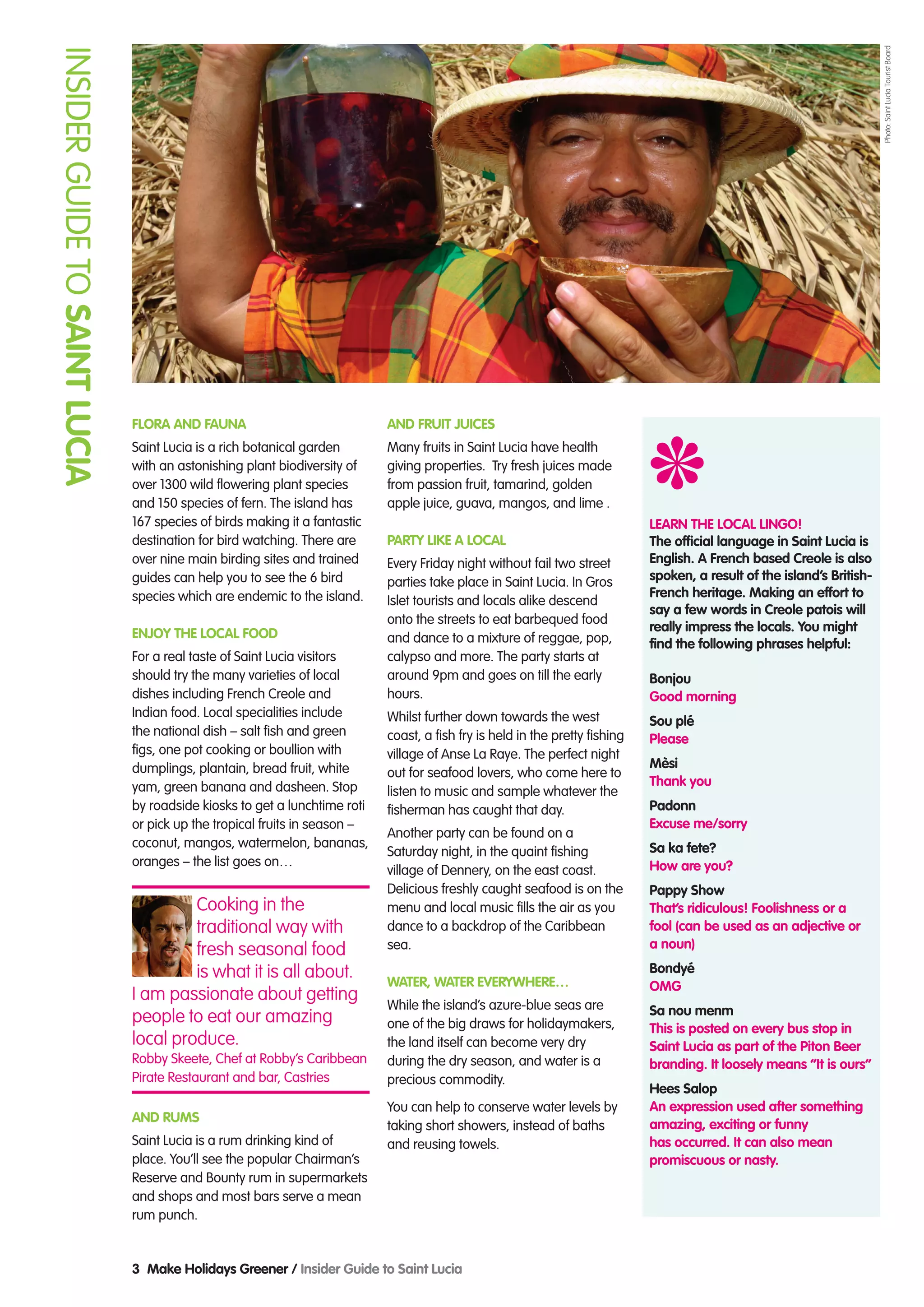
Photo:SaintLuciaTouristBoard
FLORA AND FAUNA
Saint Lucia is a rich botanical garden
with an astonishing plant biodiversity of
over 1300 wild flowering plant species
and 150 species of fern. The island has
167 species of birds making it a fantastic
destination for bird watching. There are
over nine main birding sites and trained
guides can help you to see the 6 bird
species which are endemic to the island.
ENJOY THE LOCAL FOOD
For a real taste of Saint Lucia visitors
should try the many varieties of local
dishes including French Creole and
Indian food. Local specialities include
the national dish – salt fish and green
figs, one pot cooking or boullion with
dumplings, plantain, bread fruit, white
yam, green banana and dasheen. Stop
by roadside kiosks to get a lunchtime roti
or pick up the tropical fruits in season –
coconut, mangos, watermelon, bananas,
oranges – the list goes on…
Cooking in the
traditional way with
fresh seasonal food
is what it is all about.
I am passionate about getting
people to eat our amazing
local produce.
Robby Skeete, Chef at Robby’s Caribbean
Pirate Restaurant and bar, Castries
AND RUMS
Saint Lucia is a rum drinking kind of
place. You’ll see the popular Chairman’s
Reserve and Bounty rum in supermarkets
and shops and most bars serve a mean
rum punch.
AND FRUIT JUICES
Many fruits in Saint Lucia have health
giving properties. Try fresh juices made
from passion fruit, tamarind, golden
apple juice, guava, mangos, and lime .
PARTY LIKE A LOCAL
Every Friday night without fail two street
parties take place in Saint Lucia. In Gros
Islet tourists and locals alike descend
onto the streets to eat barbequed food
and dance to a mixture of reggae, pop,
calypso and more. The party starts at
around 9pm and goes on till the early
hours.
Whilst further down towards the west
coast, a fish fry is held in the pretty fishing
village of Anse La Raye. The perfect night
out for seafood lovers, who come here to
listen to music and sample whatever the
fisherman has caught that day.
Another party can be found on a
Saturday night, in the quaint fishing
village of Dennery, on the east coast.
Delicious freshly caught seafood is on the
menu and local music fills the air as you
dance to a backdrop of the Caribbean
sea.
WATER, WATER EVERYWHERE…
While the island’s azure-blue seas are
one of the big draws for holidaymakers,
the land itself can become very dry
during the dry season, and water is a
precious commodity.
You can help to conserve water levels by
taking short showers, instead of baths
and reusing towels.
4 Make Holidays Greener / Insider Guide to Saint Lucia
INSIDERGUIDETOSAINTLUCIA
For further information on how to make holidays greener,
please visit www.makeholidaysgreener.org.uk
Photo:SaintLuciaTouristBoard
HELP TO PROTECT THE ENVIRONMENT
Hotels in Saint Lucia are increasingly
environmentally aware, offering internal
recycling options and encouraging
visitors to keep waste to a minimum, for
example through schemes which reduce
use of plastic bottles or through reuse of
towels. You can also help to do your bit
on the island by:
• Re-using a plastic glass, rather than
taking a new one for each drink. You
can also help by only using straws
when totally necessary.
• Taking a reusable shopping bag
with you.
• Removing all unnecessary
packaging before you leave home
• Be sparing with electricity -
remember to switch off lights and air
conditioning units when you leave
your room, and don’t leave the TV
on standby
• Re-use your towels and bed linen -
by not changing your towels every
day, you’ll be helping to save water,
electricity and chemicals used for
laundry.
HELP PROTECT CORAL REEFS
The coral reef around Saint Lucia is
suffering from environmental damage.
You can help protect it by not buying
souvenirs made from corals and other
marine species, being careful not to
touch the coral whilst snorkeling or
diving and choosing boat trips with
environmental policies.
Every major
community on the
island will suffer if the
reef is destroyed.
Ricky McDoom, Fisherman
HELP PROTECT TURTLE POPULATIONS
Leatherback turtles nest on the north
coast of the island from March to August.
You can do your part in helping to protect
these species by...
1. Not shining bright lights onto beaches
at night. This confuses turtles as they
mistake the lights for the moon when
making their escape to the sea.
2. During the day relax on your sunbed
close to the sea. Turtles use the soft sand
at the back of the beach for nesting, and
these nests can be crushed by umbrellas
and beds.
3. Many turtles are injured by jet skis and
other water sports equipment, so if you
plan on having fun in the sea, please
drive slowly!
For further information on how to make
holidays greener, please visit
www.makeholidaysgreener.org.uk
I know of no other
place where there is
such a wow factor
on arrival whether
by sea or air - to see the
backdrop of mountains and
lush vegetation especially
when the flamboyant trees are
in season.
Joseph Charles, Taxi Driver

Insider Guide To Saint Lucia

  • 1.
    By thinking alittle about your holiday destination before you travel, and taking some simple steps when you are there, you can gain so much more from your holiday. You will also be making a positive contribution to the people and the places you visit. INSIDERGUIDETOSAINTLUCIA Photo: Saint Lucia Tourist Board
  • 2.
    2 Make HolidaysGreener / Insider Guide to Saint Lucia INSIDERGUIDETOSAINTLUCIA Saint Lucia is part of the Windward Island Chain, a sub-group of islands within the West Indies. The island is 27 miles long and 14 miles wide with a combination of high mountains, lush rainforests, beautiful bays and palm fringed beaches. The two majestic volcanic cones on the Southwest coast, Gros Piton and Petit Piton, make this island truly unique. A BIT OF HISTORY Saint Lucia was first inhabited by the peaceful Arawak Indians, but they were conquered by their old enemies, the Caribs. Columbus was the first European to land on the island in 1499. Because of its strategic location in the Caribbean, the French and British fought endlessly for possession of the island. Saint Lucia changed hands 14 times between the two colonial powers before it was finally ceded to the British in 1814. Saint Lucia has been independent since 1979. CULTURAL HERITAGE Ask any Saint Lucian about their heritage and they will tell you about their Creole roots, something they are passionate about preserving. Their ancestors were expert hunters, farmers, fishermen, and skilled artists. Their primary crops were cassava, yams and sweet potatoes, all of which still play a central role in the island’s food. The Amerindians were decimated by the arrival of the Europeans, and only a small number of Saint Lucians can still trace their roots back to this group. Some of the few particular aspects of Amerindian culture that survive include farina and cassava bread, fish-pots and some local craft items. Some villages still practice the ancient art of fishing in dug-out canoes. DISCOVER THE REAL SAINT LUCIA The island is small enough to explore in a day but for a more leisurely itinerary we suggest taking two or three days out to discover the real Saint Lucia. Alongside the more popular attractions there are a number of community based tours where you can experience the natural, cultural, and historical heritage of Saint Lucia and learn about traditional Creole practices first-hand. For more information visit www.heritagetoursstlucia.org Saint Lucia has a little bit of everything - great food, beaches, forest, rivers and nightlife. It is the land of the people and the light - it is not fake - it is genuine hospitality. Valance James, Tours Guide Photo:SaintLuciaTouristBoard GET OUT AND ABOUT Taxis are a popular means of getting around. Drivers are well informed and friendly and are familiar with all points of interest. Before you hire a taxi settle on a price. All authorised taxis have special number plates, powder blue with a TX prefix. Major roads connect all towns and villages; it takes roughly one hour to drive from Vieux Fort to Castries along the east coast road, fifty minutes from Vieux Fort to Soufrière, and forty-five minutes from Soufrière to Castries along the west coast road. If you fancy renting a car, driving is pretty easy as it is on the left hand side but for more environmentally friendly travel and a bit of an adventure you can always take the bus. Travelling by local transport is a really fun way to get about and guests usually find that local people show great respect. If you ask people to assist it will be their pleasure. All bus stops have signs and the island is very well serviced. You can get information on bus routes from the Ministry of Transport or ask at your hotel. With 29 miles of trails through 19,000 acres of rainforest there are some superb walks all over the island. For the more intrepid we recommend climbing Gros Piton. SOUVENIRS Saint Lucia has an abundance of spices with more diversity than any other island in the Caribbean. The communities of Soufriere and Choiseul Choiseul are a great place to buy spices as well as place mats made from straw. Typical wood carvings are also available at the market in Castries and Eudovic Art Studio on the Morne. The art of the people is an expression of the people - if you take something back made by their hands you will have something of your holiday forever. Jallim Eudovic, Craft maker and artist
  • 3.
    3 Make HolidaysGreener / Insider Guide to Saint Lucia INSIDERGUIDETOSAINTLUCIA LEARN THE LOCAL LINGO! The official language in Saint Lucia is English. A French based Creole is also spoken, a result of the island’s British- French heritage. Making an effort to say a few words in Creole patois will really impress the locals. You might find the following phrases helpful: Bonjou Good morning Sou plé Please Mèsi Thank you Padonn Excuse me/sorry Sa ka fete? How are you? Pappy Show That’s ridiculous! Foolishness or a fool (can be used as an adjective or a noun) Bondyé OMG Sa nou menm This is posted on every bus stop in Saint Lucia as part of the Piton Beer branding. It loosely means “It is ours” Hees Salop An expression used after something amazing, exciting or funny has occurred. It can also mean promiscuous or nasty. Photo:SaintLuciaTouristBoard FLORA AND FAUNA Saint Lucia is a rich botanical garden with an astonishing plant biodiversity of over 1300 wild flowering plant species and 150 species of fern. The island has 167 species of birds making it a fantastic destination for bird watching. There are over nine main birding sites and trained guides can help you to see the 6 bird species which are endemic to the island. ENJOY THE LOCAL FOOD For a real taste of Saint Lucia visitors should try the many varieties of local dishes including French Creole and Indian food. Local specialities include the national dish – salt fish and green figs, one pot cooking or boullion with dumplings, plantain, bread fruit, white yam, green banana and dasheen. Stop by roadside kiosks to get a lunchtime roti or pick up the tropical fruits in season – coconut, mangos, watermelon, bananas, oranges – the list goes on… Cooking in the traditional way with fresh seasonal food is what it is all about. I am passionate about getting people to eat our amazing local produce. Robby Skeete, Chef at Robby’s Caribbean Pirate Restaurant and bar, Castries AND RUMS Saint Lucia is a rum drinking kind of place. You’ll see the popular Chairman’s Reserve and Bounty rum in supermarkets and shops and most bars serve a mean rum punch. AND FRUIT JUICES Many fruits in Saint Lucia have health giving properties. Try fresh juices made from passion fruit, tamarind, golden apple juice, guava, mangos, and lime . PARTY LIKE A LOCAL Every Friday night without fail two street parties take place in Saint Lucia. In Gros Islet tourists and locals alike descend onto the streets to eat barbequed food and dance to a mixture of reggae, pop, calypso and more. The party starts at around 9pm and goes on till the early hours. Whilst further down towards the west coast, a fish fry is held in the pretty fishing village of Anse La Raye. The perfect night out for seafood lovers, who come here to listen to music and sample whatever the fisherman has caught that day. Another party can be found on a Saturday night, in the quaint fishing village of Dennery, on the east coast. Delicious freshly caught seafood is on the menu and local music fills the air as you dance to a backdrop of the Caribbean sea. WATER, WATER EVERYWHERE… While the island’s azure-blue seas are one of the big draws for holidaymakers, the land itself can become very dry during the dry season, and water is a precious commodity. You can help to conserve water levels by taking short showers, instead of baths and reusing towels.
  • 4.
    4 Make HolidaysGreener / Insider Guide to Saint Lucia INSIDERGUIDETOSAINTLUCIA For further information on how to make holidays greener, please visit www.makeholidaysgreener.org.uk Photo:SaintLuciaTouristBoard HELP TO PROTECT THE ENVIRONMENT Hotels in Saint Lucia are increasingly environmentally aware, offering internal recycling options and encouraging visitors to keep waste to a minimum, for example through schemes which reduce use of plastic bottles or through reuse of towels. You can also help to do your bit on the island by: • Re-using a plastic glass, rather than taking a new one for each drink. You can also help by only using straws when totally necessary. • Taking a reusable shopping bag with you. • Removing all unnecessary packaging before you leave home • Be sparing with electricity - remember to switch off lights and air conditioning units when you leave your room, and don’t leave the TV on standby • Re-use your towels and bed linen - by not changing your towels every day, you’ll be helping to save water, electricity and chemicals used for laundry. HELP PROTECT CORAL REEFS The coral reef around Saint Lucia is suffering from environmental damage. You can help protect it by not buying souvenirs made from corals and other marine species, being careful not to touch the coral whilst snorkeling or diving and choosing boat trips with environmental policies. Every major community on the island will suffer if the reef is destroyed. Ricky McDoom, Fisherman HELP PROTECT TURTLE POPULATIONS Leatherback turtles nest on the north coast of the island from March to August. You can do your part in helping to protect these species by... 1. Not shining bright lights onto beaches at night. This confuses turtles as they mistake the lights for the moon when making their escape to the sea. 2. During the day relax on your sunbed close to the sea. Turtles use the soft sand at the back of the beach for nesting, and these nests can be crushed by umbrellas and beds. 3. Many turtles are injured by jet skis and other water sports equipment, so if you plan on having fun in the sea, please drive slowly! For further information on how to make holidays greener, please visit www.makeholidaysgreener.org.uk I know of no other place where there is such a wow factor on arrival whether by sea or air - to see the backdrop of mountains and lush vegetation especially when the flamboyant trees are in season. Joseph Charles, Taxi Driver