INORGANIC FERTILIZERS,
MANURES AND
BIOFERTILIZERS.
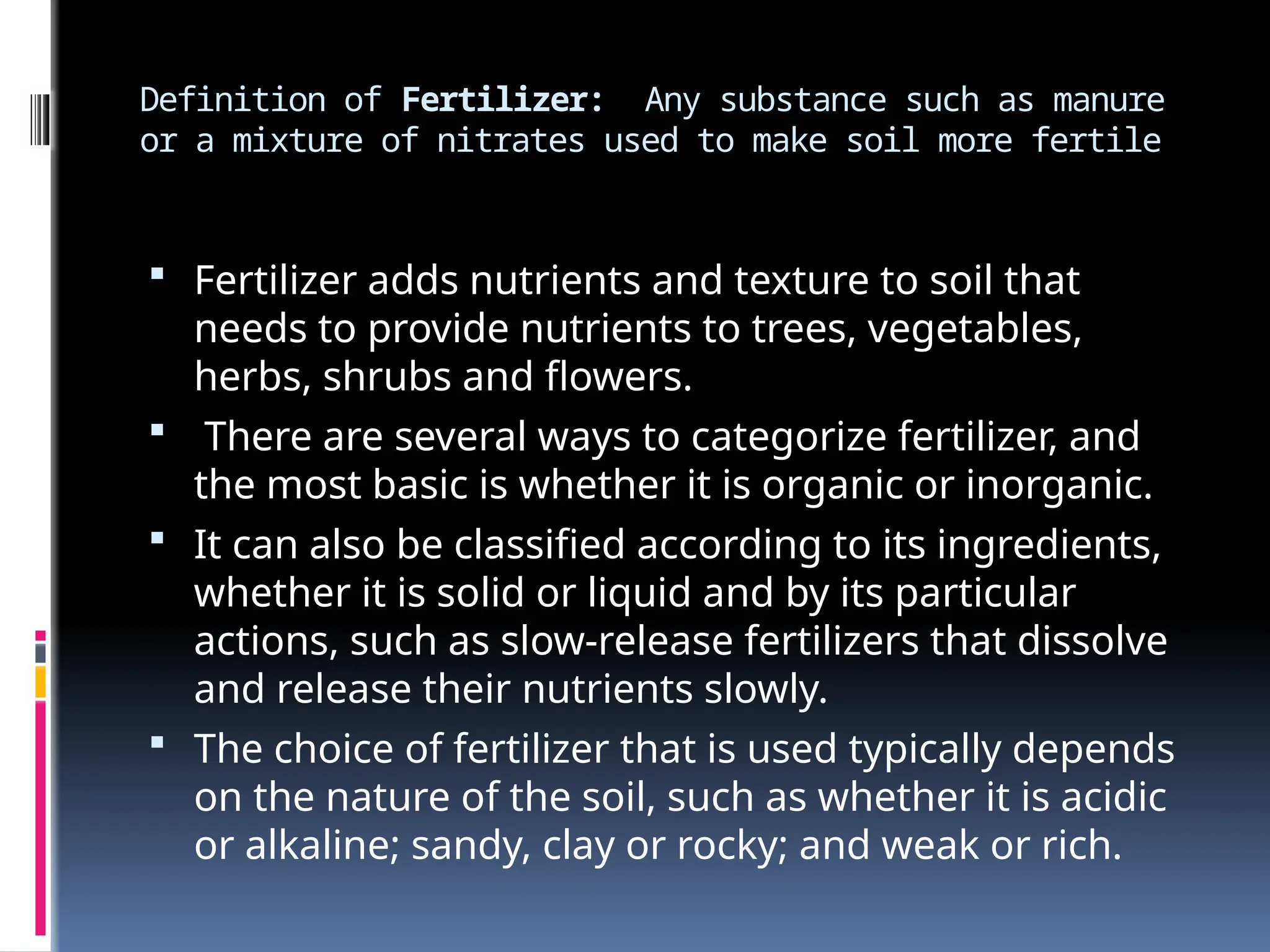
Definition of Fertilizer: Any substance such as manure
or a mixture of nitrates used to make soil more fertile
 Fertilizer adds nutrients and texture to soil that
needs to provide nutrients to trees, vegetables,
herbs, shrubs and flowers.
 There are several ways to categorize fertilizer, and
the most basic is whether it is organic or inorganic.
 It can also be classified according to its ingredients,
whether it is solid or liquid and by its particular
actions, such as slow-release fertilizers that dissolve
and release their nutrients slowly.
 The choice of fertilizer that is used typically depends
on the nature of the soil, such as whether it is acidic
or alkaline; sandy, clay or rocky; and weak or rich.
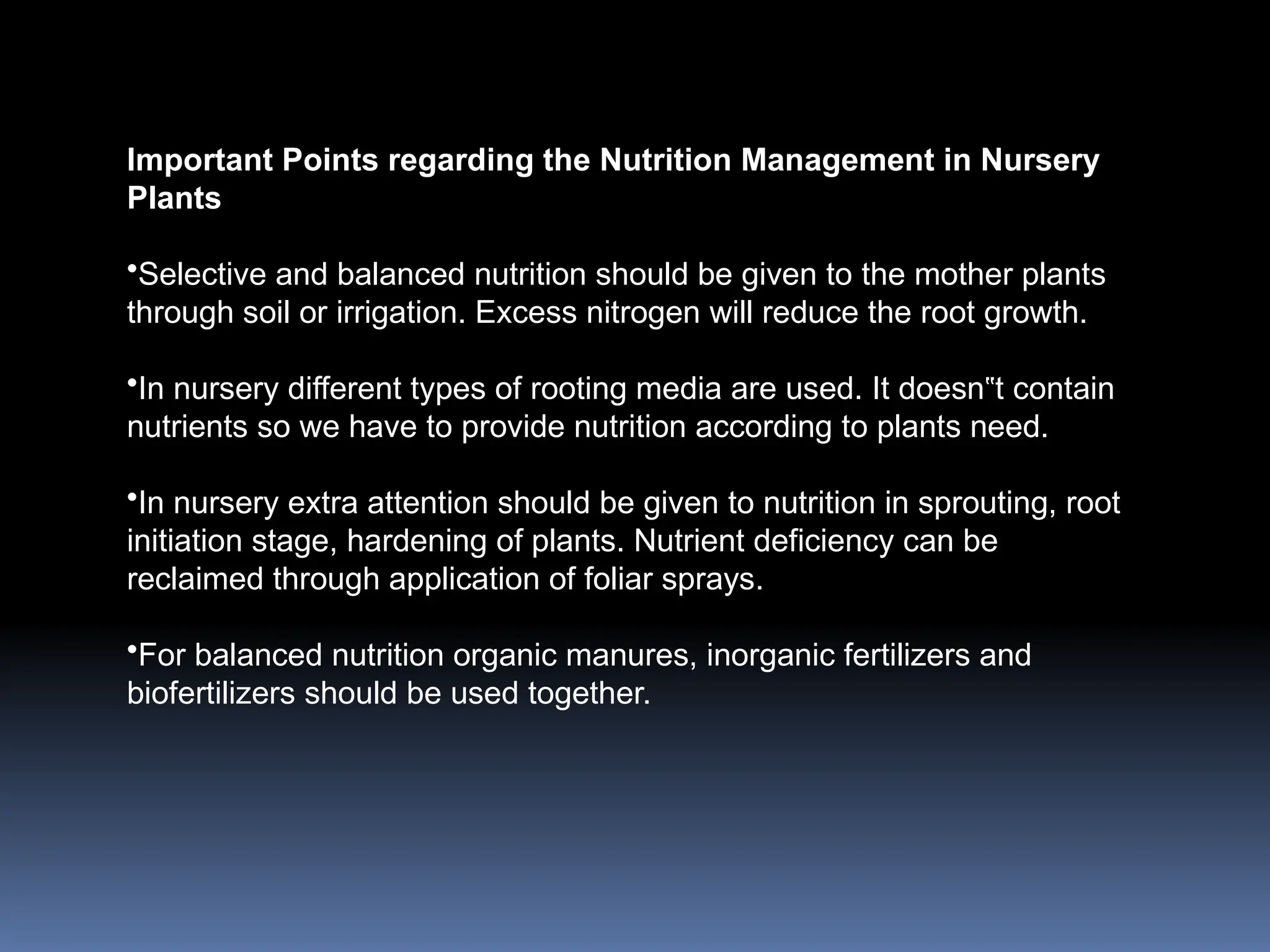
Important Points regarding the Nutrition Management in Nursery
Plants
•Selective and balanced nutrition should be given to the mother plants
through soil or irrigation. Excess nitrogen will reduce the root growth.
•In nursery different types of rooting media are used. It doesn t contain
‟
nutrients so we have to provide nutrition according to plants need.
•In nursery extra attention should be given to nutrition in sprouting, root
initiation stage, hardening of plants. Nutrient deficiency can be
reclaimed through application of foliar sprays.
•For balanced nutrition organic manures, inorganic fertilizers and
biofertilizers should be used together.
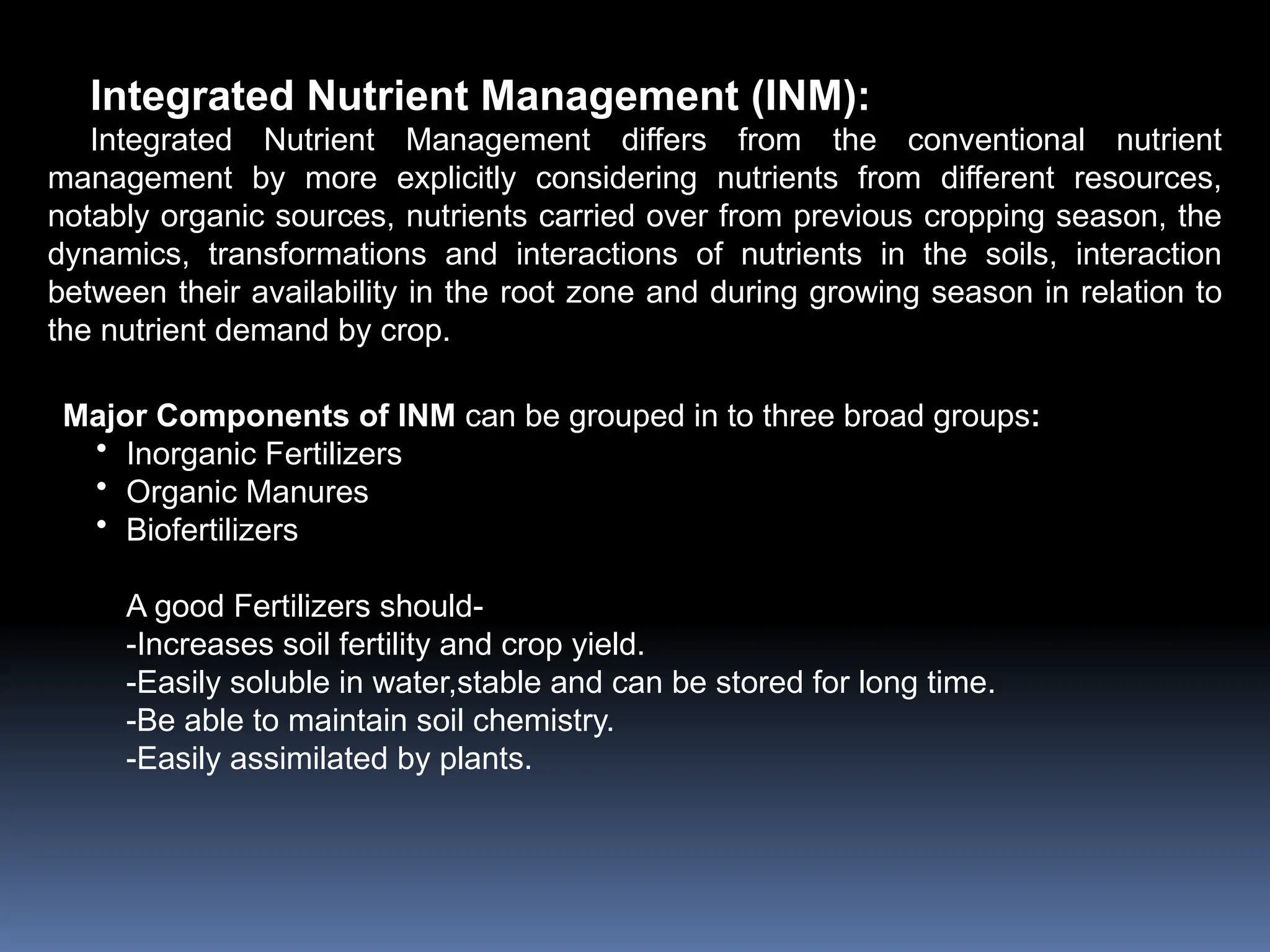
Integrated Nutrient Management (INM):
Integrated Nutrient Management differs from the conventional nutrient
management by more explicitly considering nutrients from different resources,
notably organic sources, nutrients carried over from previous cropping season, the
dynamics, transformations and interactions of nutrients in the soils, interaction
between their availability in the root zone and during growing season in relation to
the nutrient demand by crop.
Major Components of INM can be grouped in to three broad groups:
• Inorganic Fertilizers
• Organic Manures
• Biofertilizers
A good Fertilizers should-
-Increases soil fertility and crop yield.
-Easily soluble in water,stable and can be stored for long time.
-Be able to maintain soil chemistry.
-Easily assimilated by plants.
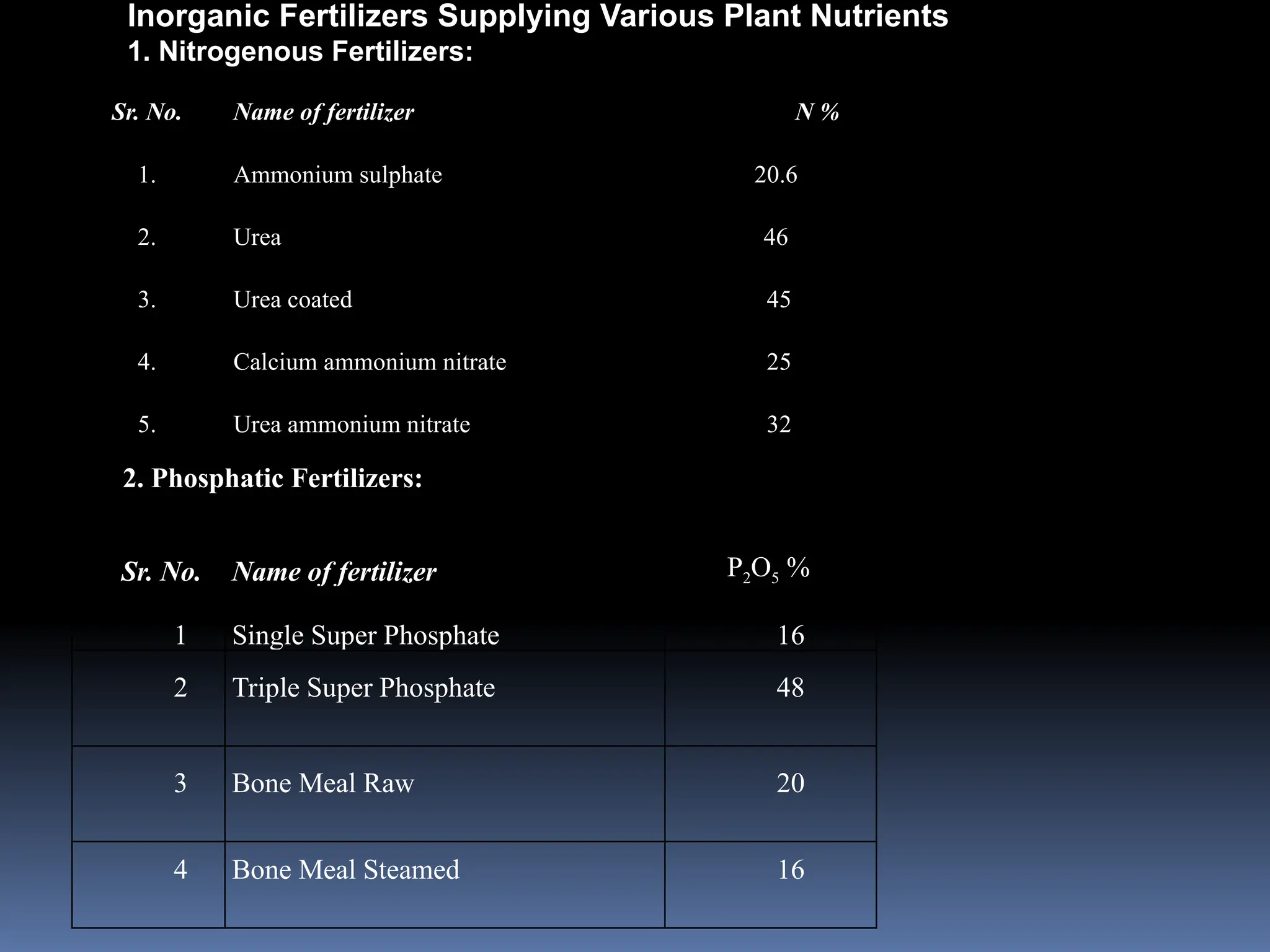
Sr. No. Name of fertilizer N %
1. Ammonium sulphate 20.6
2. Urea 46
3. Urea coated 45
4. Calcium ammonium nitrate 25
5. Urea ammonium nitrate 32
2. Phosphatic Fertilizers:
Sr. No. Name of fertilizer P2O5 %
1 Single Super Phosphate 16
2 Triple Super Phosphate 48
3 Bone Meal Raw 20
4 Bone Meal Steamed 16
Inorganic Fertilizers Supplying Various Plant Nutrients
1. Nitrogenous Fertilizers:
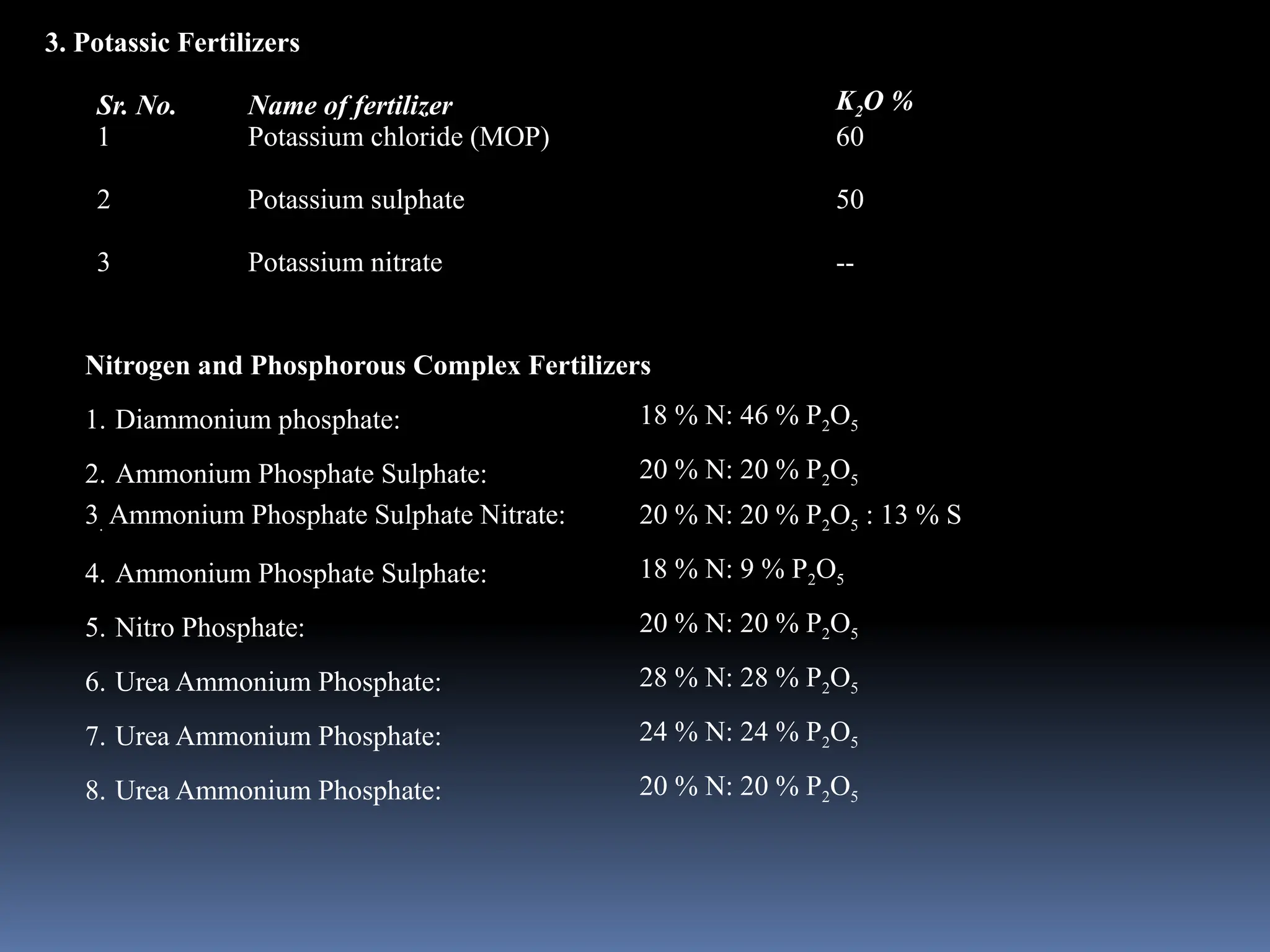
3. Potassic Fertilizers
Sr. No. Name of fertilizer K2O %
1 Potassium chloride (MOP) 60
2 Potassium sulphate 50
3 Potassium nitrate --
Nitrogen and Phosphorous Complex Fertilizers
1. Diammonium phosphate: 18 % N: 46 % P2O5
2. Ammonium Phosphate Sulphate: 20 % N: 20 % P2O5
3. Ammonium Phosphate Sulphate Nitrate: 20 % N: 20 % P2O5 : 13 % S
4. Ammonium Phosphate Sulphate: 18 % N: 9 % P2O5
5. Nitro Phosphate: 20 % N: 20 % P2O5
6. Urea Ammonium Phosphate: 28 % N: 28 % P2O5
7. Urea Ammonium Phosphate: 24 % N: 24 % P2O5
8. Urea Ammonium Phosphate: 20 % N: 20 % P2O5
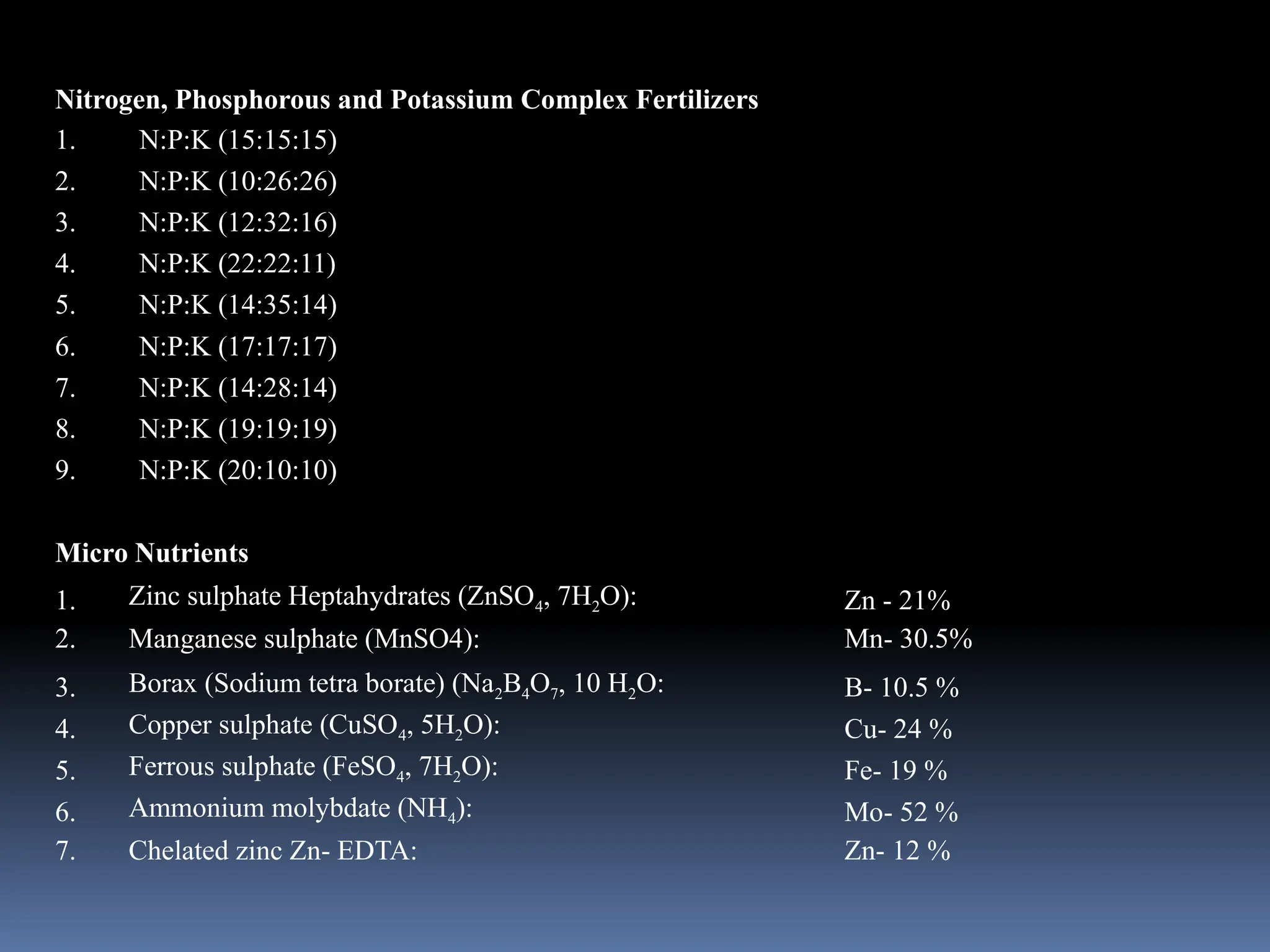
Nitrogen, Phosphorous and Potassium Complex Fertilizers
1. N:P:K (15:15:15)
2. N:P:K (10:26:26)
3. N:P:K (12:32:16)
4. N:P:K (22:22:11)
5. N:P:K (14:35:14)
6. N:P:K (17:17:17)
7. N:P:K (14:28:14)
8. N:P:K (19:19:19)
9. N:P:K (20:10:10)
Micro Nutrients
1. Zinc sulphate Heptahydrates (ZnSO4, 7H2O): Zn - 21%
2. Manganese sulphate (MnSO4): Mn- 30.5%
3. Borax (Sodium tetra borate) (Na2B4O7, 10 H2O: B- 10.5 %
4. Copper sulphate (CuSO4, 5H2O): Cu- 24 %
5. Ferrous sulphate (FeSO4, 7H2O): Fe- 19 %
6. Ammonium molybdate (NH4): Mo- 52 %
7. Chelated zinc Zn- EDTA: Zn- 12 %
Disadvantages of Inorganic Fertilizers
-Excessive use of these fertilizers spoil the quality of soil as they make the
soil either acidic or basic.
-Excessive use of fertilizers without adequate water supply can result in
wilting of crop.
-Surface run off of fertilizers like Nitrate and Phosphate into slow moving
water bodies causes Eutrophication.
-The excess fertilizers in the soil causes water pollution thus making water
unfit for drinking.
-Fertilizers enriched soil cannot support microbial life and hence there is less
humus and nutrient. This type of soil can be easily eroded by wind and rain.
Organic Fertilizers -The materials of biological origin which are commonly
used to maintain and increase the soil fertility can be grouped in two
categories:-
A) Manures
B) Biofertilizers
(A) Manures- Manures are the organic wastes that are made to decay
partially and added to the soil to increase its fertility,aeration and water
holding capacity,thereby helping to increase crop productivity.They supply
almost all the nutrient elements required by crops.
Types of Manures:-
1) Green Manures- Some of the plant most commonly used as green
manures in India are represented by the legumes such as Crotolaria
juncea (Sun Hemp),Vigna sinensis (Cow pea),Sesbaenia aculeata
(Daincha),Trifolium alexandrium (Egyptian C lover) and Lens esculenta
(Lentil or Masur)
1) Farmyard Manures- Farmyard Manures are obtained by the partial
Decay of the animal dung,farm refuse and crop residues such as
remnants of plant stalk,plant straw,dead leaves and twigs etc.
Residue of Gobar gas plant is a kind of Farmyard manure.
2) Composited Manures- It consists of rotten vegetables and animal
refuse.Composited manure is prepared by dumping all kinds of plants
materail including the waste of the vegetables and other organic
refuse in heap provided with thin sprinkling of chemical fertilizers like
ammonium sulphate,superphosphate,sodium nitrate and lime
etc.Heaps are occasionally turned,mixed to hasten decay.It takes 4-6
months for the formation of enriched composited manure.
(B) Biofertilizers- These are organisms that enrich the soil nutrients due
to their biological activity.
The main sources of biofertilizers are Bacteria,Cyanobacteria and Fungi.
Bacteria as Biofertilizers-
i) Symbiotic Nitrogen Fixing Bacteria-
Rhizobium in Leguminous Plants,
Frenkia in root nodules of several non-leguminous plants like
Casuarina,Alnus,Myrica and Rubus etc.
Xanthomonas and Mycobacterium in leaves of Ardisia plant
ii) Free Living (Non-Symbiotic) Nitrogen Fixing Bacteria-
Azotobacter and Bacillus polynxa in the soil fix the atmospheric
Nitrogen in the soil and make it available to crops like
cereals,millets,fruits and vegetables.
iii) Loose Association Of Nitrogen Fixing Bacteria-
Azospirillum lipoferum with the roots of certain Brazillian grasses
and Maize.
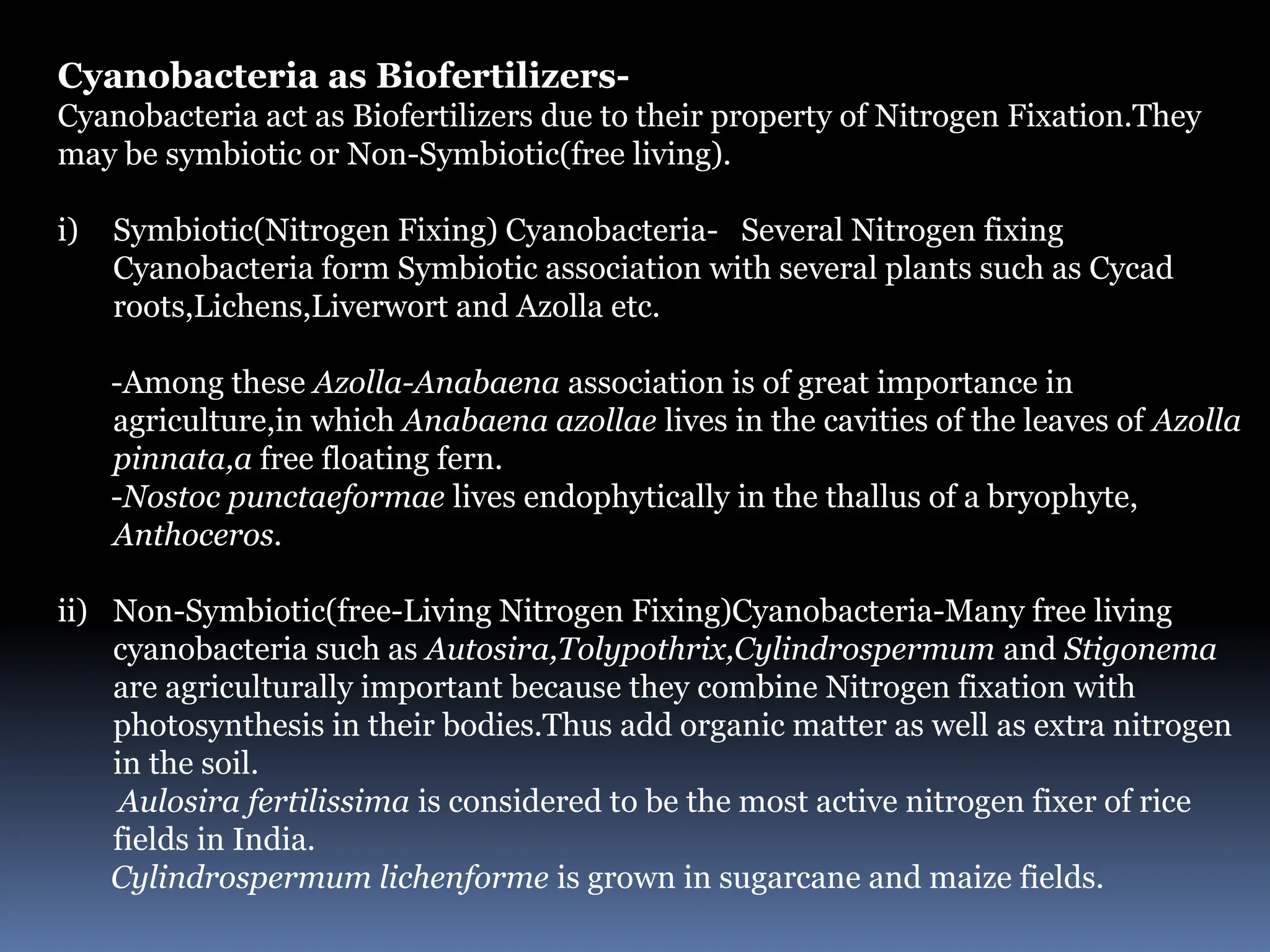
Cyanobacteria as Biofertilizers-
Cyanobacteria act as Biofertilizers due to their property of Nitrogen Fixation.They
may be symbiotic or Non-Symbiotic(free living).
i) Symbiotic(Nitrogen Fixing) Cyanobacteria- Several Nitrogen fixing
Cyanobacteria form Symbiotic association with several plants such as Cycad
roots,Lichens,Liverwort and Azolla etc.
-Among these Azolla-Anabaena association is of great importance in
agriculture,in which Anabaena azollae lives in the cavities of the leaves of Azolla
pinnata,a free floating fern.
-Nostoc punctaeformae lives endophytically in the thallus of a bryophyte,
Anthoceros.
ii) Non-Symbiotic(free-Living Nitrogen Fixing)Cyanobacteria-Many free living
cyanobacteria such as Autosira,Tolypothrix,Cylindrospermum and Stigonema
are agriculturally important because they combine Nitrogen fixation with
photosynthesis in their bodies.Thus add organic matter as well as extra nitrogen
in the soil.
Aulosira fertilissima is considered to be the most active nitrogen fixer of rice
fields in India.
Cylindrospermum lichenforme is grown in sugarcane and maize fields.
The cyanobacteria excete about 30-40% fixed Nitrogen ,thereby immediately
enriching the field.
After their death,More Nitrogen alongwith the other organic matter gets added to
the soil.
It is reported that they can fix the atmospheric Nitrogen @20-30 Kg/hectare.
Acc to one estimate,They have the potential to fix 7-8 lakh tonnes of atmospheric
Nitrogen,which is equivalent to 15-17 Lakh tonnes of Urea.
The chief advantage of using cyanobacteria as biofertilizer is that it does not
require any sophisticated technology and is also more economical than using
chemical fertilizers.
In Tamilnadu,the technique of Cyanobacteria inoculation in the rice fields is being
extensively followed.Phosphate and Potassium are supplied additionally.
Fungi As Biofertilizers
Mycorrhiza:-
It is symbiotic assosication of certain fungal hyphae with the roots of
some seed bearing plants.Mycorrhizal roots bear a sparse or dense wooly growth of
fine fungal hyphae on their surface.Root cap and Root hairs are absent and roots
become irregular,tuberous or coralloid.The fungus is restricted to the cortex of the
root the vascular strand and the growing tips are not affected.
Mycorrhiza are broadly grouped into two categories-
Ectomycorrhizae and Endomycorrhizae
(A)Ectomycorrhizae:-
It is a form of association in which the fungal hyphae forms a mantle on the
outer surface of the root.Thus,increases the surface area of absorption for the
plant for water and mineral uptake and results in greater plant vigour, growth
and increased yield.
The fungal hyphae absorb and store Nitrogen,Phosphorus, Potassium and Calcium
from the soil.They also convert the complex organic compounds into simple easily
available forms .
Ectomycorrhizae are found in Pines,Oak,Peaches, Fagus and Eucalyptus.
(B)Endomycorrhizae:-
It is a form of mycorrhizal association in which the
fungus does not form a mantle on the root surface but produces loosely
interwoven hyphae,Some of which live between and within the cells of the cortex
and other penetrate into the soil.Such association is found in many herbaceous
species like Orchids and some woody plants.
In some Endotrophic Mycorrhizae, Most of the hyphae live intercellularly
between the cells of the cortex and form temporary hyphael projections that
penetrate into the cortical cells where they may form swollen vesicles or finely
branched masses called Arbuscules.Such a fungal association is also called
Vesicular Arbuscular Mycorrhizae or VAM.VAM are important in the phosphate
nutrition of plants.
Many grasses and crop plants develop symbiotic association with
VAM.Mycorrhizal association reduces the dependence of the crop plants on these
supplements and converts a marginal land into an agricultural productive land.
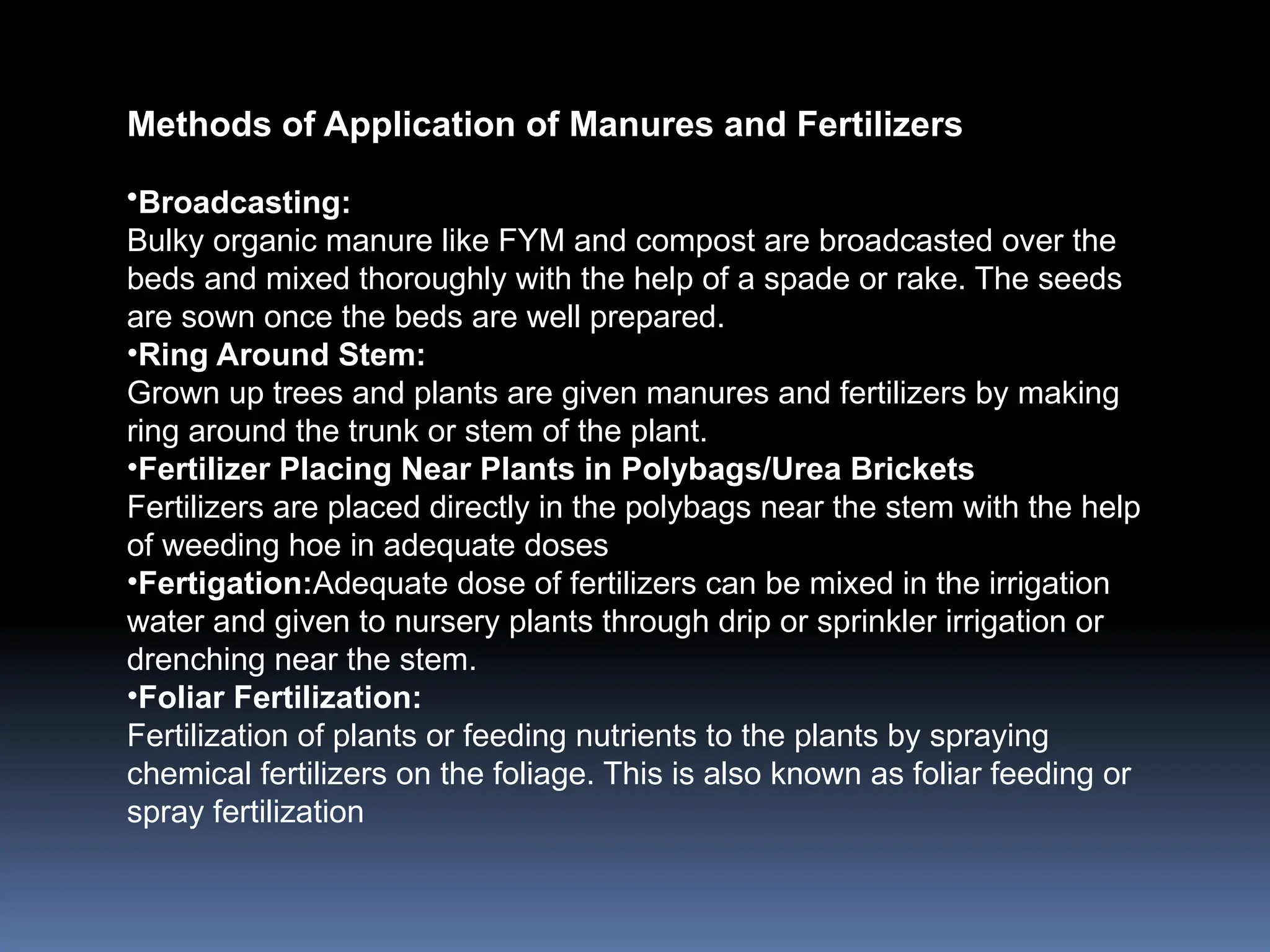
Methods of Application of Manures and Fertilizers
•Broadcasting:
Bulky organic manure like FYM and compost are broadcasted over the
beds and mixed thoroughly with the help of a spade or rake. The seeds
are sown once the beds are well prepared.
•Ring Around Stem:
Grown up trees and plants are given manures and fertilizers by making
ring around the trunk or stem of the plant.
•Fertilizer Placing Near Plants in Polybags/Urea Brickets
Fertilizers are placed directly in the polybags near the stem with the help
of weeding hoe in adequate doses
•Fertigation:Adequate dose of fertilizers can be mixed in the irrigation
water and given to nursery plants through drip or sprinkler irrigation or
drenching near the stem.
•Foliar Fertilization:
Fertilization of plants or feeding nutrients to the plants by spraying
chemical fertilizers on the foliage. This is also known as foliar feeding or
spray fertilization
Characteristics Chemical Fertilizer Organic Fertilizer
NPK Ratio 20 to 60% About 14%
Example Ammonium sulphate, ammonium
phosphate, ammonium nitrate,
urea, ammonium chloride and the
like.
Cottonseed meal, blood meal, fish
emulsion, and manure and sewage
sludge, etc.
Advantages Chemical fertilizers are rich
equally in three essential
nutrients that are needed for
crops and always ready for
immediate supply of nutrients to
plants if situation demands.
Adds natural nutrients to soil, increases
soil organic matter, improves soil
structure and tilth, improves water
holding capacity, reduces soil crusting
problems, reduces erosion from wind and
water, Slow and consistent release of
nutrients.
Disadvantages Several chemical fertilizers have
high acid content. They have the
ability to burn the skin. Changes
soil fertility.
Have slow release capability; distribution
of nutrients in organic fertilizers is not
equal.
Rate of
production
Immediate supply or slow release Slow release
About Chemical fertilizers are
manufactured from synthetic
material
Organic fertilizers are made from
materials derived from living things.
Preparation Artificially prepared. Prepared naturally. One can prepare

Inorganic Fertilizers, Manures and Biofertilizers.pptx

  • 1.
  • 2.
    Definition of Fertilizer:Any substance such as manure or a mixture of nitrates used to make soil more fertile  Fertilizer adds nutrients and texture to soil that needs to provide nutrients to trees, vegetables, herbs, shrubs and flowers.  There are several ways to categorize fertilizer, and the most basic is whether it is organic or inorganic.  It can also be classified according to its ingredients, whether it is solid or liquid and by its particular actions, such as slow-release fertilizers that dissolve and release their nutrients slowly.  The choice of fertilizer that is used typically depends on the nature of the soil, such as whether it is acidic or alkaline; sandy, clay or rocky; and weak or rich.
  • 3.
    Important Points regardingthe Nutrition Management in Nursery Plants •Selective and balanced nutrition should be given to the mother plants through soil or irrigation. Excess nitrogen will reduce the root growth. •In nursery different types of rooting media are used. It doesn t contain ‟ nutrients so we have to provide nutrition according to plants need. •In nursery extra attention should be given to nutrition in sprouting, root initiation stage, hardening of plants. Nutrient deficiency can be reclaimed through application of foliar sprays. •For balanced nutrition organic manures, inorganic fertilizers and biofertilizers should be used together.
  • 4.
    Integrated Nutrient Management(INM): Integrated Nutrient Management differs from the conventional nutrient management by more explicitly considering nutrients from different resources, notably organic sources, nutrients carried over from previous cropping season, the dynamics, transformations and interactions of nutrients in the soils, interaction between their availability in the root zone and during growing season in relation to the nutrient demand by crop. Major Components of INM can be grouped in to three broad groups: • Inorganic Fertilizers • Organic Manures • Biofertilizers A good Fertilizers should- -Increases soil fertility and crop yield. -Easily soluble in water,stable and can be stored for long time. -Be able to maintain soil chemistry. -Easily assimilated by plants.
  • 5.
    Sr. No. Nameof fertilizer N % 1. Ammonium sulphate 20.6 2. Urea 46 3. Urea coated 45 4. Calcium ammonium nitrate 25 5. Urea ammonium nitrate 32 2. Phosphatic Fertilizers: Sr. No. Name of fertilizer P2O5 % 1 Single Super Phosphate 16 2 Triple Super Phosphate 48 3 Bone Meal Raw 20 4 Bone Meal Steamed 16 Inorganic Fertilizers Supplying Various Plant Nutrients 1. Nitrogenous Fertilizers:
  • 6.
    3. Potassic Fertilizers Sr.No. Name of fertilizer K2O % 1 Potassium chloride (MOP) 60 2 Potassium sulphate 50 3 Potassium nitrate -- Nitrogen and Phosphorous Complex Fertilizers 1. Diammonium phosphate: 18 % N: 46 % P2O5 2. Ammonium Phosphate Sulphate: 20 % N: 20 % P2O5 3. Ammonium Phosphate Sulphate Nitrate: 20 % N: 20 % P2O5 : 13 % S 4. Ammonium Phosphate Sulphate: 18 % N: 9 % P2O5 5. Nitro Phosphate: 20 % N: 20 % P2O5 6. Urea Ammonium Phosphate: 28 % N: 28 % P2O5 7. Urea Ammonium Phosphate: 24 % N: 24 % P2O5 8. Urea Ammonium Phosphate: 20 % N: 20 % P2O5
  • 7.
    Nitrogen, Phosphorous andPotassium Complex Fertilizers 1. N:P:K (15:15:15) 2. N:P:K (10:26:26) 3. N:P:K (12:32:16) 4. N:P:K (22:22:11) 5. N:P:K (14:35:14) 6. N:P:K (17:17:17) 7. N:P:K (14:28:14) 8. N:P:K (19:19:19) 9. N:P:K (20:10:10) Micro Nutrients 1. Zinc sulphate Heptahydrates (ZnSO4, 7H2O): Zn - 21% 2. Manganese sulphate (MnSO4): Mn- 30.5% 3. Borax (Sodium tetra borate) (Na2B4O7, 10 H2O: B- 10.5 % 4. Copper sulphate (CuSO4, 5H2O): Cu- 24 % 5. Ferrous sulphate (FeSO4, 7H2O): Fe- 19 % 6. Ammonium molybdate (NH4): Mo- 52 % 7. Chelated zinc Zn- EDTA: Zn- 12 %
  • 8.
    Disadvantages of InorganicFertilizers -Excessive use of these fertilizers spoil the quality of soil as they make the soil either acidic or basic. -Excessive use of fertilizers without adequate water supply can result in wilting of crop. -Surface run off of fertilizers like Nitrate and Phosphate into slow moving water bodies causes Eutrophication. -The excess fertilizers in the soil causes water pollution thus making water unfit for drinking. -Fertilizers enriched soil cannot support microbial life and hence there is less humus and nutrient. This type of soil can be easily eroded by wind and rain.
  • 9.
    Organic Fertilizers -Thematerials of biological origin which are commonly used to maintain and increase the soil fertility can be grouped in two categories:- A) Manures B) Biofertilizers (A) Manures- Manures are the organic wastes that are made to decay partially and added to the soil to increase its fertility,aeration and water holding capacity,thereby helping to increase crop productivity.They supply almost all the nutrient elements required by crops. Types of Manures:- 1) Green Manures- Some of the plant most commonly used as green manures in India are represented by the legumes such as Crotolaria juncea (Sun Hemp),Vigna sinensis (Cow pea),Sesbaenia aculeata (Daincha),Trifolium alexandrium (Egyptian C lover) and Lens esculenta (Lentil or Masur)
  • 10.
    1) Farmyard Manures-Farmyard Manures are obtained by the partial Decay of the animal dung,farm refuse and crop residues such as remnants of plant stalk,plant straw,dead leaves and twigs etc. Residue of Gobar gas plant is a kind of Farmyard manure. 2) Composited Manures- It consists of rotten vegetables and animal refuse.Composited manure is prepared by dumping all kinds of plants materail including the waste of the vegetables and other organic refuse in heap provided with thin sprinkling of chemical fertilizers like ammonium sulphate,superphosphate,sodium nitrate and lime etc.Heaps are occasionally turned,mixed to hasten decay.It takes 4-6 months for the formation of enriched composited manure. (B) Biofertilizers- These are organisms that enrich the soil nutrients due to their biological activity. The main sources of biofertilizers are Bacteria,Cyanobacteria and Fungi.
  • 11.
    Bacteria as Biofertilizers- i)Symbiotic Nitrogen Fixing Bacteria- Rhizobium in Leguminous Plants, Frenkia in root nodules of several non-leguminous plants like Casuarina,Alnus,Myrica and Rubus etc. Xanthomonas and Mycobacterium in leaves of Ardisia plant ii) Free Living (Non-Symbiotic) Nitrogen Fixing Bacteria- Azotobacter and Bacillus polynxa in the soil fix the atmospheric Nitrogen in the soil and make it available to crops like cereals,millets,fruits and vegetables. iii) Loose Association Of Nitrogen Fixing Bacteria- Azospirillum lipoferum with the roots of certain Brazillian grasses and Maize.
  • 12.
    Cyanobacteria as Biofertilizers- Cyanobacteriaact as Biofertilizers due to their property of Nitrogen Fixation.They may be symbiotic or Non-Symbiotic(free living). i) Symbiotic(Nitrogen Fixing) Cyanobacteria- Several Nitrogen fixing Cyanobacteria form Symbiotic association with several plants such as Cycad roots,Lichens,Liverwort and Azolla etc. -Among these Azolla-Anabaena association is of great importance in agriculture,in which Anabaena azollae lives in the cavities of the leaves of Azolla pinnata,a free floating fern. -Nostoc punctaeformae lives endophytically in the thallus of a bryophyte, Anthoceros. ii) Non-Symbiotic(free-Living Nitrogen Fixing)Cyanobacteria-Many free living cyanobacteria such as Autosira,Tolypothrix,Cylindrospermum and Stigonema are agriculturally important because they combine Nitrogen fixation with photosynthesis in their bodies.Thus add organic matter as well as extra nitrogen in the soil. Aulosira fertilissima is considered to be the most active nitrogen fixer of rice fields in India. Cylindrospermum lichenforme is grown in sugarcane and maize fields.
  • 13.
    The cyanobacteria exceteabout 30-40% fixed Nitrogen ,thereby immediately enriching the field. After their death,More Nitrogen alongwith the other organic matter gets added to the soil. It is reported that they can fix the atmospheric Nitrogen @20-30 Kg/hectare. Acc to one estimate,They have the potential to fix 7-8 lakh tonnes of atmospheric Nitrogen,which is equivalent to 15-17 Lakh tonnes of Urea. The chief advantage of using cyanobacteria as biofertilizer is that it does not require any sophisticated technology and is also more economical than using chemical fertilizers. In Tamilnadu,the technique of Cyanobacteria inoculation in the rice fields is being extensively followed.Phosphate and Potassium are supplied additionally.
  • 14.
    Fungi As Biofertilizers Mycorrhiza:- Itis symbiotic assosication of certain fungal hyphae with the roots of some seed bearing plants.Mycorrhizal roots bear a sparse or dense wooly growth of fine fungal hyphae on their surface.Root cap and Root hairs are absent and roots become irregular,tuberous or coralloid.The fungus is restricted to the cortex of the root the vascular strand and the growing tips are not affected. Mycorrhiza are broadly grouped into two categories- Ectomycorrhizae and Endomycorrhizae (A)Ectomycorrhizae:- It is a form of association in which the fungal hyphae forms a mantle on the outer surface of the root.Thus,increases the surface area of absorption for the plant for water and mineral uptake and results in greater plant vigour, growth and increased yield. The fungal hyphae absorb and store Nitrogen,Phosphorus, Potassium and Calcium from the soil.They also convert the complex organic compounds into simple easily available forms . Ectomycorrhizae are found in Pines,Oak,Peaches, Fagus and Eucalyptus.
  • 15.
    (B)Endomycorrhizae:- It is aform of mycorrhizal association in which the fungus does not form a mantle on the root surface but produces loosely interwoven hyphae,Some of which live between and within the cells of the cortex and other penetrate into the soil.Such association is found in many herbaceous species like Orchids and some woody plants. In some Endotrophic Mycorrhizae, Most of the hyphae live intercellularly between the cells of the cortex and form temporary hyphael projections that penetrate into the cortical cells where they may form swollen vesicles or finely branched masses called Arbuscules.Such a fungal association is also called Vesicular Arbuscular Mycorrhizae or VAM.VAM are important in the phosphate nutrition of plants. Many grasses and crop plants develop symbiotic association with VAM.Mycorrhizal association reduces the dependence of the crop plants on these supplements and converts a marginal land into an agricultural productive land.
  • 16.
    Methods of Applicationof Manures and Fertilizers •Broadcasting: Bulky organic manure like FYM and compost are broadcasted over the beds and mixed thoroughly with the help of a spade or rake. The seeds are sown once the beds are well prepared. •Ring Around Stem: Grown up trees and plants are given manures and fertilizers by making ring around the trunk or stem of the plant. •Fertilizer Placing Near Plants in Polybags/Urea Brickets Fertilizers are placed directly in the polybags near the stem with the help of weeding hoe in adequate doses •Fertigation:Adequate dose of fertilizers can be mixed in the irrigation water and given to nursery plants through drip or sprinkler irrigation or drenching near the stem. •Foliar Fertilization: Fertilization of plants or feeding nutrients to the plants by spraying chemical fertilizers on the foliage. This is also known as foliar feeding or spray fertilization
  • 17.
    Characteristics Chemical FertilizerOrganic Fertilizer NPK Ratio 20 to 60% About 14% Example Ammonium sulphate, ammonium phosphate, ammonium nitrate, urea, ammonium chloride and the like. Cottonseed meal, blood meal, fish emulsion, and manure and sewage sludge, etc. Advantages Chemical fertilizers are rich equally in three essential nutrients that are needed for crops and always ready for immediate supply of nutrients to plants if situation demands. Adds natural nutrients to soil, increases soil organic matter, improves soil structure and tilth, improves water holding capacity, reduces soil crusting problems, reduces erosion from wind and water, Slow and consistent release of nutrients. Disadvantages Several chemical fertilizers have high acid content. They have the ability to burn the skin. Changes soil fertility. Have slow release capability; distribution of nutrients in organic fertilizers is not equal. Rate of production Immediate supply or slow release Slow release About Chemical fertilizers are manufactured from synthetic material Organic fertilizers are made from materials derived from living things. Preparation Artificially prepared. Prepared naturally. One can prepare