Biofertilizers: types, production
and application
By- Dr. Ekta Khare
Biofertilizers
• Biofertilizers is a substance which contains living
microorganisms, which when applied to seed, plant
surface, or soil, colonizes the rhizosphere or interior of the
plant and promotes growth by increasing the supply or
availability of primary nutrients to the host plant.
OR
• Biofertilizers are carrier-based microbial inoculants
containing sufficient cells of efficient strains of specific
microoranisms, that help in enhancing the soil fertility by
fixing atmospheric nitrogen, solubilization/ mineralization
of phosphorus or decomposing organic wastes, by
augmenting plant growth promoting substances with their
biological activities.
Characteristics of Biofertilizers
• They are reasonable and nature friendly fertilizers which
contain microbial inoculants of algae, fungi and bacteria
either alone or in combination.
• Highly suggested for improving soil fertility and health.
• They are easily applicable and do not require any extra
proficiency.
• They require in less quantity in comparison to synthetic
fertilizers.
• They help in enrichment of soil through micro- flora build up.
Types of biofertilizers (on the bases of
nature and function)
1. Nitrogen fixing: Nitrogen is most abundant and ubiquitous in the air, yet becomes
a limiting nutrient due to difficulty of its fixation and uptake by the plants. However,
certain microorganisms, some of which can form various associations with plants as
well, are capable of considerable nitrogen fixation. These microbes can be:
– Bacteria
• Free living: Free-living in the soil eg. Azotobacter
• Associative: Living in rhizosphere (associative/associated) without
endophytic symbioses. Eg. Azospirillum
• Symbiotic: Having symbiotic and other endophytic associations with plants.
Eg. Rhizobia, Frankia
– Blue grean algae (Cyanobacteria): have been reported to be helpful in enhancing
rice-field fertility for the cultivation of rice in many parts of the world. BGA can
further provide natural growth hormones, 172 proteins, vitamins, and minerals
to the soil. Eg. Anabaena, Nostoc, Tolypothrix, Cylindrospermum etc.
– Azolla: is a floating pteridophyte, which contains as endosymbiont the nitrogen-
fixing cyanobacterium Anabaena azollae. Azolla is either incorporated into the
soil before rice transplanting or grown as a dual crop along with rice.
2. Phosphate solubilizing:
The phosphorus-solubilizing bacteria (PSB) can increase phosphorus availability to
plants by dissolution of bound phosphates in soil by secreting organic acids
characterized by lower pH in their vicinity. Eg. Bacillus spp., Paenibacillus spp.,
Pseudomonas spp. etc.
3. Phosphate mobilizing:
The mycorrhizal fungi form obligate or facultative functional mutualistic symbioses
with more than 80% of all land plants, in which the fungus is dependent on host
for photosynthates and energy and in return provides a plethora of benefits to its
host. The mycelium of the fungus extends from host plant root surfaces into soil,
thereby increasing the surface area for more efficient nutrient access and
acquisition for the plant, especially from insoluble phosphorus sources and others
like calcium, copper, zinc, etc, eg. ectomycorrhiza (Laccaria spp., Pisolithus spp.,
Boletus spp., Amanita spp.), endomycorrhiza (eg. arbuscular mycorrhiza- Glomus
sp., Gigaspora sp., Acaulospora sp., Scutellospora sp., and Sclerocystis sp.)
4. Mineral-Solubilizing Biofertilizers
– Potassium solubilizing: Certain rhizobacteria can solubilize insoluble potassium
forms, which is another essential nutrient necessary for plant growth. Eg.
Bacillus edaphicus, B. mucilaginosus, and Paenibacillus glucanolyticus
– Silicate and zinc solubilizing: Another important mineral is zinc, which is
present at a low concentration in the Earth’s crust, due to which it is externally
applied as the costlier soluble zinc sulfate to overcome its deficiencies in plant.
Certain microbes can solubilize insoluble cheaper zinc compounds like zinc
oxide, zinc carbonate, and zinc sulfide in soil. Similarly, microorganisms can
hydrolyze silicates and aluminum silicates by supplying protons (that causes
hydrolysis) and organic acids. Eg. Bacillus subtilis, Thiobacillus thioxidans, and
Saccharomyces sp.
5. Plant growth promoting rhizobacteria: Besides nitrogen-fixing, phosphorus
and minerals solubilizing microbes, there are microbes that are suitable to be used
as biofertilizers as these enhance plant growth by synthesizing growth-promoting
chemicals like growth hormones (auxins, gibberellin etc.). These bacteria shows
more than one mechanism of plant growth promotion viz. nitrogen fixation,
phosphorus solubilization, production of antibiotics, cytokinins, chitinase, and
other hydrolytic enzymes and enhancement of soil porosity. Eg. Achromobacter,
Alcaligenes, Arthrobacter, Actinoplanes, Azotobacter, Bacillus, Pseudomonas
fluorescens, Rhizobium, Bradyrhizobium etc.
6. Compost Biofertilizers: Compost is a decomposing, brittle, murky material
forming a symbiotic food web within the soil, which contains about 2% (w/w) of
nitrogen, phosphorus, and potassium, along with microorganisms, earthworms,
and dung beetles.
• The microbial organic solid residue oxidation causes the formation of humus-
containing material, which can be used as an organic fertilizer that sufficiently
aerates, aggregates, buffers, and keeps the soil moist, besides providing beneficial
minerals to the crops and increasing soil microbial diversity.
• Compost is produced from a wide variety of materials like straw, leaves, cattle-
shed bedding, fruit and vegetable wastes, biogas plant slurry, industrial wastes,
city garbage, sewage sludge, factory waste, etc.
• The compost is formed from these materials by different decomposing
microorganisms like Trichoderma viridae, Aspergillus niger, A. terreus, Bacillus
spp., several Gram-negative bacteria (Pseudomonas, Serratia, Klebsiella, and
Enterobacter), etc. that have plant cell wall-degrading cellulolytic or lignolytic and
other activities, besides having proteolytic activity and antibiosis (by production of
antibiotics) that suppresses other parasitic or pathogenic microorganisms .
• Another important type (vermicompost) contains earthworm cocoons, excreta,
microorganisms (like bacteria, actinomycetes, fungi), and different organic matters,
which provide nitrogen, phosphorus, potassium, and several micronutrients, and
efficiently recycles animal wastes, agricultural residues, and industrial wastes cost-
effectively and uses low energy.
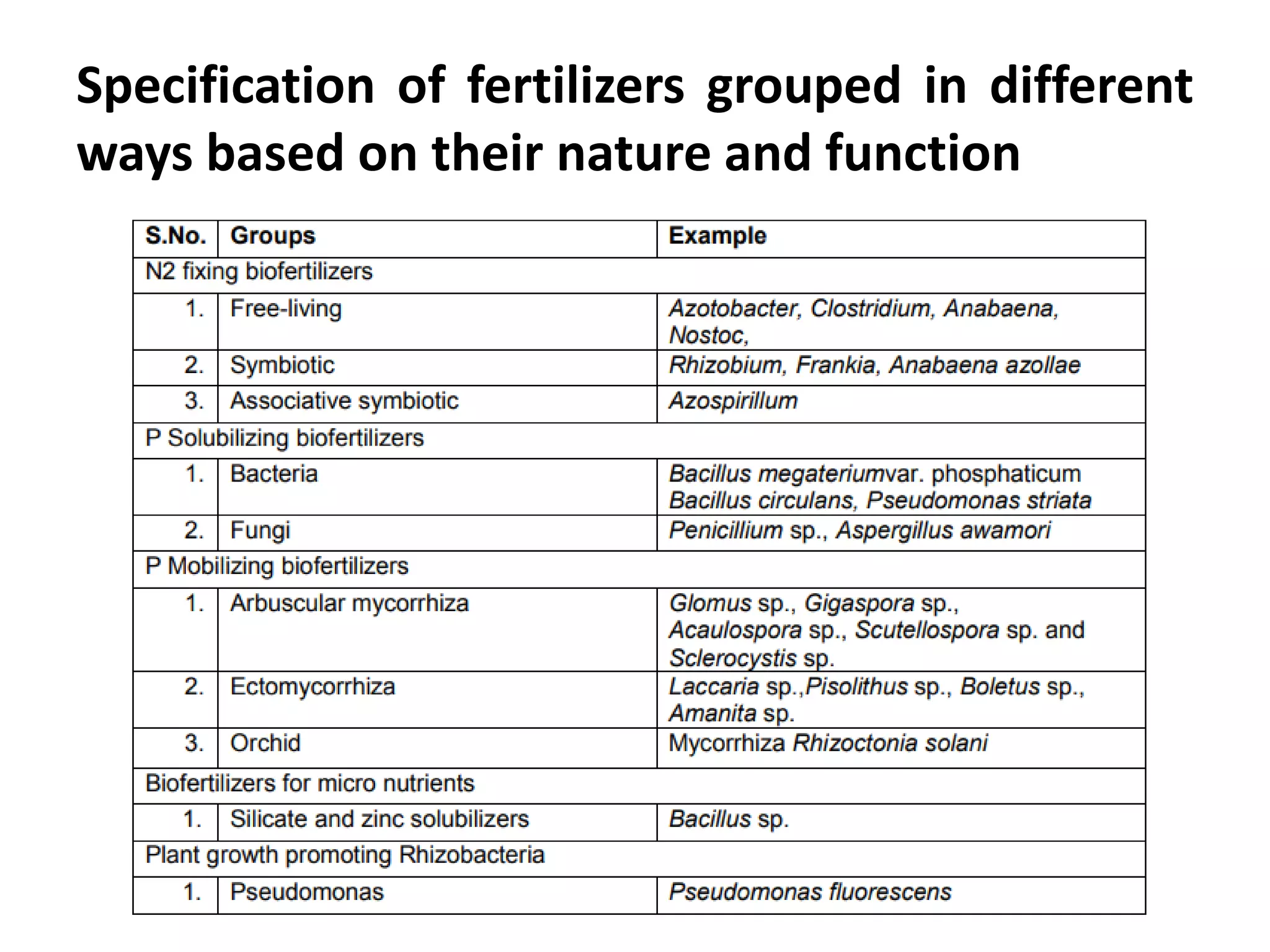
Specification of fertilizers grouped in different
ways based on their nature and function
Application of dust form of
biofertilizer
• Seed treatment: Seed treatment is a very effective, economic, and most
common method implemented for all types of bacterial inoculants. The
seeds are mixed and uniformly coated in a slurry (inoculant mixed with
200 mL of rice kanji or 1% jeggey) and then shade-dried, before being
sown within 24 h. Coating of lime after rhizobia inoculant treatment
enhances the efficacy.
• Seedling root dipping: This application is common for plantation crops
such as cereals, vegetables, fruits, trees, sugarcane, cotton, grapes,
banana, and tobacco where seedling roots are dipped in a water
suspension of biofertilizer (nitrogen-fixing Azotobacter or Azospirillum and
phosphorus-solubilizing microbial biofertilizer) for sufficient period of
time.
• Soil application: In this practice, biofertilizer is applied directly to the soil
either alone or in combination. Some examples of biofertilizers in which
soil application is employed are Rhizobium (for leguminous plants or trees)
and Azotobacter (for tea, coffee, rubber, coconuts, all fruit/agroforestry
plants), BGA and azolla in rice field, mycorrhiza in nursery beds.
Liquid bio-fertilizer application
methodology
• Seed treatment: Seed treatment is the most common method adopted for
all types of inoculants.
• The seed treatment is effective and economic. For small quantities of
seeds (up to 5 kg), the coating can be done in a plastic bag.
• For this purpose, a plastic bag sized 21” x 10” or larger can be used. The
bag should be filled with 2 kg or more of seeds.
• The bag should be closed in such a way so as to trap the air as much as
possible.
• The bag should be squeezed for 2 minutes or more until all the seeds are
uniformly wetted.
• Then the bag is opened, inflated again and shaken gently. The shaking can
stop after each seed gets a uniform layer of culture coating.
• The bag is opened and the seeds are dried in the shade for 20–30 minutes.
... Liquid bio-fertilizer application
methodology
Root dipping : This method is used for application of Azospirillum/PSM on
paddy transplanting/ vegetable crops.
• The required quantity of Azospirillum /PSM has to be mixed with 5–10
liters of water at one corner of the field and the roots of seedlings have to
be dipped for a minimum of half-an-hour before transplantation.
Soil application: Use 200ml of PSM per acre.
• Mix PSM with 400 to 600 kgs of cow dung FYM (farmyard manure) along
with ½ bag of rock phosphate if available.
• The mixture of PSM, cow dung and rock phosphate has to be kept under
any tree or in the shade overnight and 50% moisture should be
maintained.
• The mixture is used for soil application in rows or during leveling of soil.
PRECAUTIONS BEFORE BIOFERTILIZER
APPLICATION
• Biofertilizer packets need to be stored in a cool and dry place away from
direct sunlight and heat.
• Right combinations of biofertilizers have to be used.
• As Rhizobium is crop specific, one should use it for the specified crop only.
• Other chemicals should not be mixed with the biofertilizers.
• When purchasing, one should ensure that each packet is provided with all
necessary information like name of the product, name of the crop for
which it is intended, name and address of the manufacturer, date of
manufacture, date of expiry, batch number and instructions for use.
• The packet has to be used before its expiry, only for the specified crop and
by the recommended method of application.
• Biofertilizers are live products and require care in their storage.
• It is important to use biofertilizers along with chemical fertilizers and
organic manures. Biofertilizers are not a replacement of fertilizers but can
supplement plant nutrient requirements.
Role of Biofertilizers in Agriculture
• Biofertilizers supplement synthetic fertilizers and fulfil the nutrient
requirement of crops.
• Bio-fertilizers add 20-180 kg N/ha in soil and enhance crop production and
nutrient use efficiency in a particular optimum environment.
• They efficiently reduce use of synthetic fertilizers and create chemical free
yield.
• Application of bio-fertilizers results in improved nutrient and water
uptake, soil quality, rhizosphere development etc.
• These bio-fertilizers promote growth of plant through release of growth
simulating substances.
• These bio-fertilizers includes variety of micro-organism which successfully
reduces harmful pathogens resulting various diseases thus control many
diseases.
• Bio-fertilizers improve soil fertility, physical properties of soil, tilth and
crop- productivity.
Factors Affecting Bio-Fertilizer Response
• Efficiency of any inoculant and micro-organisms to be
determined by host plant and genotype.
• Quality of inoculant largely influences its results in term of
nitrogen fixation and solubilisation of particular nutrients.
• Package of practices and management of crop alter results of
bio- fertilizers.
• Soil physical and chemical properties highly influence impact
of different inoculants and micro-organisms.
• Climatic conditions like temperature, relative humidity, rainfall
and photoperiod affect response of biofertilizers significantly.
Constraints in Bio-Fertilizer Application
• There is lack of good quality of strain which
efficiently provide required nutrients in soil.
• Non- existence of storage facility makes it
difficult to adopt bio-fertilizers.
• Field conditions like extremely high or low pH,
temperature, nutrients deficiency not only
influence the response of inoculants but also
limits heir benefits.

Biofertilizers.pdf

  • 1.
    Biofertilizers: types, production andapplication By- Dr. Ekta Khare
  • 2.
    Biofertilizers • Biofertilizers isa substance which contains living microorganisms, which when applied to seed, plant surface, or soil, colonizes the rhizosphere or interior of the plant and promotes growth by increasing the supply or availability of primary nutrients to the host plant. OR • Biofertilizers are carrier-based microbial inoculants containing sufficient cells of efficient strains of specific microoranisms, that help in enhancing the soil fertility by fixing atmospheric nitrogen, solubilization/ mineralization of phosphorus or decomposing organic wastes, by augmenting plant growth promoting substances with their biological activities.
  • 3.
    Characteristics of Biofertilizers •They are reasonable and nature friendly fertilizers which contain microbial inoculants of algae, fungi and bacteria either alone or in combination. • Highly suggested for improving soil fertility and health. • They are easily applicable and do not require any extra proficiency. • They require in less quantity in comparison to synthetic fertilizers. • They help in enrichment of soil through micro- flora build up.
  • 4.
    Types of biofertilizers(on the bases of nature and function) 1. Nitrogen fixing: Nitrogen is most abundant and ubiquitous in the air, yet becomes a limiting nutrient due to difficulty of its fixation and uptake by the plants. However, certain microorganisms, some of which can form various associations with plants as well, are capable of considerable nitrogen fixation. These microbes can be: – Bacteria • Free living: Free-living in the soil eg. Azotobacter • Associative: Living in rhizosphere (associative/associated) without endophytic symbioses. Eg. Azospirillum • Symbiotic: Having symbiotic and other endophytic associations with plants. Eg. Rhizobia, Frankia – Blue grean algae (Cyanobacteria): have been reported to be helpful in enhancing rice-field fertility for the cultivation of rice in many parts of the world. BGA can further provide natural growth hormones, 172 proteins, vitamins, and minerals to the soil. Eg. Anabaena, Nostoc, Tolypothrix, Cylindrospermum etc. – Azolla: is a floating pteridophyte, which contains as endosymbiont the nitrogen- fixing cyanobacterium Anabaena azollae. Azolla is either incorporated into the soil before rice transplanting or grown as a dual crop along with rice.
  • 5.
    2. Phosphate solubilizing: Thephosphorus-solubilizing bacteria (PSB) can increase phosphorus availability to plants by dissolution of bound phosphates in soil by secreting organic acids characterized by lower pH in their vicinity. Eg. Bacillus spp., Paenibacillus spp., Pseudomonas spp. etc. 3. Phosphate mobilizing: The mycorrhizal fungi form obligate or facultative functional mutualistic symbioses with more than 80% of all land plants, in which the fungus is dependent on host for photosynthates and energy and in return provides a plethora of benefits to its host. The mycelium of the fungus extends from host plant root surfaces into soil, thereby increasing the surface area for more efficient nutrient access and acquisition for the plant, especially from insoluble phosphorus sources and others like calcium, copper, zinc, etc, eg. ectomycorrhiza (Laccaria spp., Pisolithus spp., Boletus spp., Amanita spp.), endomycorrhiza (eg. arbuscular mycorrhiza- Glomus sp., Gigaspora sp., Acaulospora sp., Scutellospora sp., and Sclerocystis sp.)
  • 6.
    4. Mineral-Solubilizing Biofertilizers –Potassium solubilizing: Certain rhizobacteria can solubilize insoluble potassium forms, which is another essential nutrient necessary for plant growth. Eg. Bacillus edaphicus, B. mucilaginosus, and Paenibacillus glucanolyticus – Silicate and zinc solubilizing: Another important mineral is zinc, which is present at a low concentration in the Earth’s crust, due to which it is externally applied as the costlier soluble zinc sulfate to overcome its deficiencies in plant. Certain microbes can solubilize insoluble cheaper zinc compounds like zinc oxide, zinc carbonate, and zinc sulfide in soil. Similarly, microorganisms can hydrolyze silicates and aluminum silicates by supplying protons (that causes hydrolysis) and organic acids. Eg. Bacillus subtilis, Thiobacillus thioxidans, and Saccharomyces sp. 5. Plant growth promoting rhizobacteria: Besides nitrogen-fixing, phosphorus and minerals solubilizing microbes, there are microbes that are suitable to be used as biofertilizers as these enhance plant growth by synthesizing growth-promoting chemicals like growth hormones (auxins, gibberellin etc.). These bacteria shows more than one mechanism of plant growth promotion viz. nitrogen fixation, phosphorus solubilization, production of antibiotics, cytokinins, chitinase, and other hydrolytic enzymes and enhancement of soil porosity. Eg. Achromobacter, Alcaligenes, Arthrobacter, Actinoplanes, Azotobacter, Bacillus, Pseudomonas fluorescens, Rhizobium, Bradyrhizobium etc.
  • 7.
    6. Compost Biofertilizers:Compost is a decomposing, brittle, murky material forming a symbiotic food web within the soil, which contains about 2% (w/w) of nitrogen, phosphorus, and potassium, along with microorganisms, earthworms, and dung beetles. • The microbial organic solid residue oxidation causes the formation of humus- containing material, which can be used as an organic fertilizer that sufficiently aerates, aggregates, buffers, and keeps the soil moist, besides providing beneficial minerals to the crops and increasing soil microbial diversity. • Compost is produced from a wide variety of materials like straw, leaves, cattle- shed bedding, fruit and vegetable wastes, biogas plant slurry, industrial wastes, city garbage, sewage sludge, factory waste, etc. • The compost is formed from these materials by different decomposing microorganisms like Trichoderma viridae, Aspergillus niger, A. terreus, Bacillus spp., several Gram-negative bacteria (Pseudomonas, Serratia, Klebsiella, and Enterobacter), etc. that have plant cell wall-degrading cellulolytic or lignolytic and other activities, besides having proteolytic activity and antibiosis (by production of antibiotics) that suppresses other parasitic or pathogenic microorganisms . • Another important type (vermicompost) contains earthworm cocoons, excreta, microorganisms (like bacteria, actinomycetes, fungi), and different organic matters, which provide nitrogen, phosphorus, potassium, and several micronutrients, and efficiently recycles animal wastes, agricultural residues, and industrial wastes cost- effectively and uses low energy.
  • 8.
    Specification of fertilizersgrouped in different ways based on their nature and function
  • 9.
    Application of dustform of biofertilizer • Seed treatment: Seed treatment is a very effective, economic, and most common method implemented for all types of bacterial inoculants. The seeds are mixed and uniformly coated in a slurry (inoculant mixed with 200 mL of rice kanji or 1% jeggey) and then shade-dried, before being sown within 24 h. Coating of lime after rhizobia inoculant treatment enhances the efficacy. • Seedling root dipping: This application is common for plantation crops such as cereals, vegetables, fruits, trees, sugarcane, cotton, grapes, banana, and tobacco where seedling roots are dipped in a water suspension of biofertilizer (nitrogen-fixing Azotobacter or Azospirillum and phosphorus-solubilizing microbial biofertilizer) for sufficient period of time. • Soil application: In this practice, biofertilizer is applied directly to the soil either alone or in combination. Some examples of biofertilizers in which soil application is employed are Rhizobium (for leguminous plants or trees) and Azotobacter (for tea, coffee, rubber, coconuts, all fruit/agroforestry plants), BGA and azolla in rice field, mycorrhiza in nursery beds.
  • 10.
    Liquid bio-fertilizer application methodology •Seed treatment: Seed treatment is the most common method adopted for all types of inoculants. • The seed treatment is effective and economic. For small quantities of seeds (up to 5 kg), the coating can be done in a plastic bag. • For this purpose, a plastic bag sized 21” x 10” or larger can be used. The bag should be filled with 2 kg or more of seeds. • The bag should be closed in such a way so as to trap the air as much as possible. • The bag should be squeezed for 2 minutes or more until all the seeds are uniformly wetted. • Then the bag is opened, inflated again and shaken gently. The shaking can stop after each seed gets a uniform layer of culture coating. • The bag is opened and the seeds are dried in the shade for 20–30 minutes.
  • 11.
    ... Liquid bio-fertilizerapplication methodology Root dipping : This method is used for application of Azospirillum/PSM on paddy transplanting/ vegetable crops. • The required quantity of Azospirillum /PSM has to be mixed with 5–10 liters of water at one corner of the field and the roots of seedlings have to be dipped for a minimum of half-an-hour before transplantation. Soil application: Use 200ml of PSM per acre. • Mix PSM with 400 to 600 kgs of cow dung FYM (farmyard manure) along with ½ bag of rock phosphate if available. • The mixture of PSM, cow dung and rock phosphate has to be kept under any tree or in the shade overnight and 50% moisture should be maintained. • The mixture is used for soil application in rows or during leveling of soil.
  • 12.
    PRECAUTIONS BEFORE BIOFERTILIZER APPLICATION •Biofertilizer packets need to be stored in a cool and dry place away from direct sunlight and heat. • Right combinations of biofertilizers have to be used. • As Rhizobium is crop specific, one should use it for the specified crop only. • Other chemicals should not be mixed with the biofertilizers. • When purchasing, one should ensure that each packet is provided with all necessary information like name of the product, name of the crop for which it is intended, name and address of the manufacturer, date of manufacture, date of expiry, batch number and instructions for use. • The packet has to be used before its expiry, only for the specified crop and by the recommended method of application. • Biofertilizers are live products and require care in their storage. • It is important to use biofertilizers along with chemical fertilizers and organic manures. Biofertilizers are not a replacement of fertilizers but can supplement plant nutrient requirements.
  • 13.
    Role of Biofertilizersin Agriculture • Biofertilizers supplement synthetic fertilizers and fulfil the nutrient requirement of crops. • Bio-fertilizers add 20-180 kg N/ha in soil and enhance crop production and nutrient use efficiency in a particular optimum environment. • They efficiently reduce use of synthetic fertilizers and create chemical free yield. • Application of bio-fertilizers results in improved nutrient and water uptake, soil quality, rhizosphere development etc. • These bio-fertilizers promote growth of plant through release of growth simulating substances. • These bio-fertilizers includes variety of micro-organism which successfully reduces harmful pathogens resulting various diseases thus control many diseases. • Bio-fertilizers improve soil fertility, physical properties of soil, tilth and crop- productivity.
  • 14.
    Factors Affecting Bio-FertilizerResponse • Efficiency of any inoculant and micro-organisms to be determined by host plant and genotype. • Quality of inoculant largely influences its results in term of nitrogen fixation and solubilisation of particular nutrients. • Package of practices and management of crop alter results of bio- fertilizers. • Soil physical and chemical properties highly influence impact of different inoculants and micro-organisms. • Climatic conditions like temperature, relative humidity, rainfall and photoperiod affect response of biofertilizers significantly.
  • 15.
    Constraints in Bio-FertilizerApplication • There is lack of good quality of strain which efficiently provide required nutrients in soil. • Non- existence of storage facility makes it difficult to adopt bio-fertilizers. • Field conditions like extremely high or low pH, temperature, nutrients deficiency not only influence the response of inoculants but also limits heir benefits.