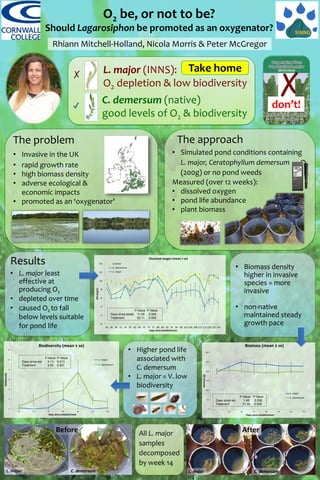
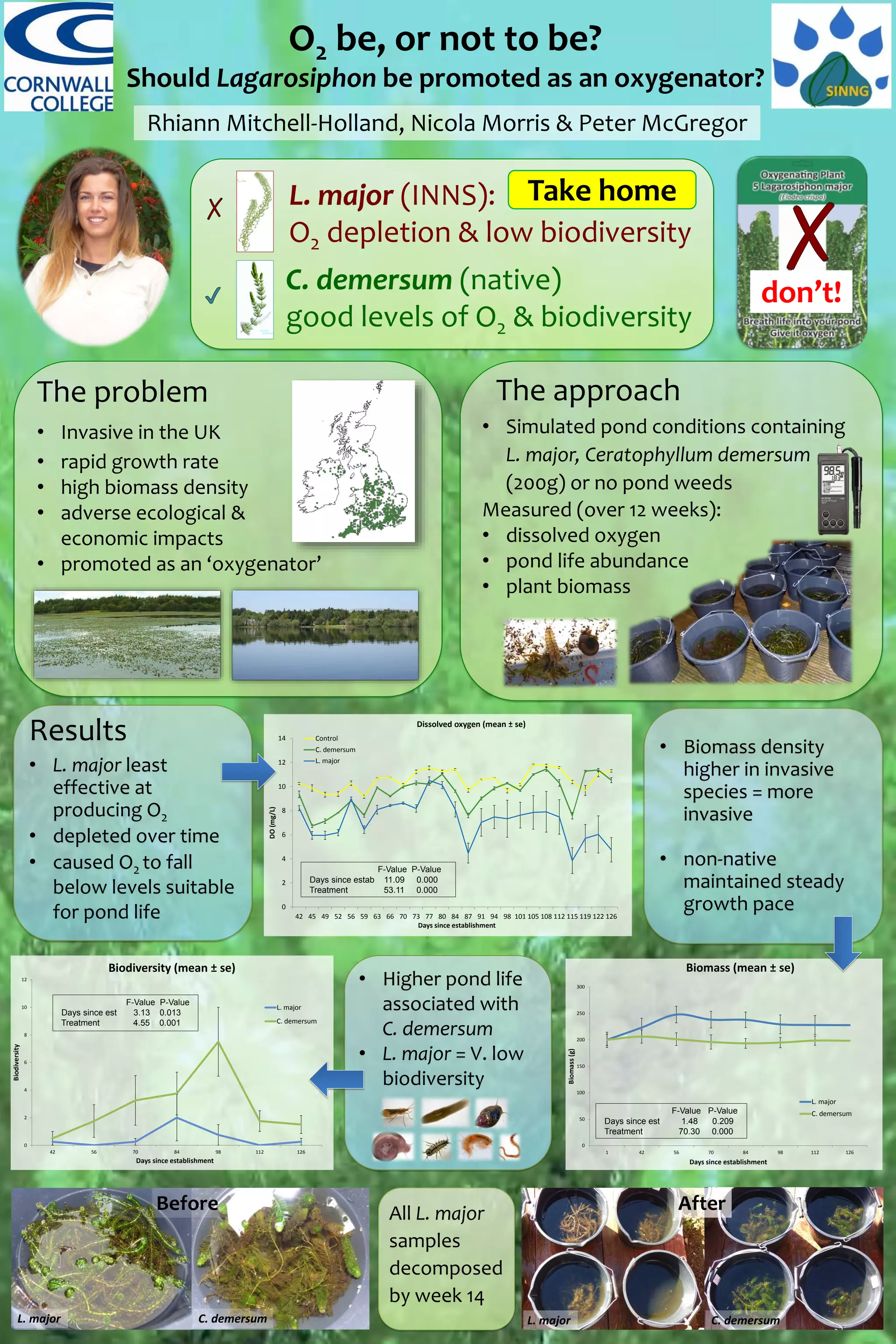
• Higher pond life
associated with
C. demersum
• L. major = V. low
biodiversity
O2 be, or not to be?
Should Lagarosiphon be promoted as an oxygenator?
Rhiann Mitchell-Holland, Nicola Morris & Peter McGregor
L. major (INNS):
O2 depletion & low biodiversity
• Simulated pond conditions containing
L. major, Ceratophyllum demersum
(200g) or no pond weeds
Measured (over 12 weeks):
• dissolved oxygen
• pond life abundance
• plant biomass
C. demersum (native)
good levels of O2 & biodiversity
The problem
• Invasive in the UK
• rapid growth rate
• high biomass density
• adverse ecological &
economic impacts
• promoted as an ‘oxygenator’
0
2
4
6
8
10
12
14
42 45 49 52 56 59 63 66 70 73 77 80 84 87 91 94 98 101 105 108 112 115 119 122 126
DO(mg/L)
Days since establishment
Dissolved oxygen (mean ± se)
Control
C. demersum
L. major
F-Value P-Value
Days since estab 11.09 0.000
Treatment 53.11 0.000
don’t!
0
2
4
6
8
10
12
42 56 70 84 98 112 126
Biodiversity
Days since establishment
Biodiversity (mean ± se)
L. major
C. demersum
F-Value P-Value
Days since est 3.13 0.013
Treatment 4.55 0.001
L. major C. demersum
0
50
100
150
200
250
300
1 42 56 70 84 98 112 126
Biomass(g)
Days since establishment
Biomass (mean ± se)
L. major
C. demersumF-Value P-Value
Days since est 1.48 0.209
Treatment 70.30 0.000
Take home
The approach
Results
• L. major least
effective at
producing O2
• depleted over time
• caused O2 to fall
below levels suitable
for pond life
• Biomass density
higher in invasive
species = more
invasive
• non-native
maintained steady
growth pace
L. major C. demersum
Before AfterAll L. major
samples
decomposed
by week 14

INNS Poster

  • 1.
    • Higher pondlife associated with C. demersum • L. major = V. low biodiversity O2 be, or not to be? Should Lagarosiphon be promoted as an oxygenator? Rhiann Mitchell-Holland, Nicola Morris & Peter McGregor L. major (INNS): O2 depletion & low biodiversity • Simulated pond conditions containing L. major, Ceratophyllum demersum (200g) or no pond weeds Measured (over 12 weeks): • dissolved oxygen • pond life abundance • plant biomass C. demersum (native) good levels of O2 & biodiversity The problem • Invasive in the UK • rapid growth rate • high biomass density • adverse ecological & economic impacts • promoted as an ‘oxygenator’ 0 2 4 6 8 10 12 14 42 45 49 52 56 59 63 66 70 73 77 80 84 87 91 94 98 101 105 108 112 115 119 122 126 DO(mg/L) Days since establishment Dissolved oxygen (mean ± se) Control C. demersum L. major F-Value P-Value Days since estab 11.09 0.000 Treatment 53.11 0.000 don’t! 0 2 4 6 8 10 12 42 56 70 84 98 112 126 Biodiversity Days since establishment Biodiversity (mean ± se) L. major C. demersum F-Value P-Value Days since est 3.13 0.013 Treatment 4.55 0.001 L. major C. demersum 0 50 100 150 200 250 300 1 42 56 70 84 98 112 126 Biomass(g) Days since establishment Biomass (mean ± se) L. major C. demersumF-Value P-Value Days since est 1.48 0.209 Treatment 70.30 0.000 Take home The approach Results • L. major least effective at producing O2 • depleted over time • caused O2 to fall below levels suitable for pond life • Biomass density higher in invasive species = more invasive • non-native maintained steady growth pace L. major C. demersum Before AfterAll L. major samples decomposed by week 14