Alaska Trauma
Registry Training
TRAUMA PROGRAM
RURAL AND COMMUNITY HEALTH SYSTEMS
STATE OF ALASKA, DIVISION OF PUBLIC HEALTH
Injury
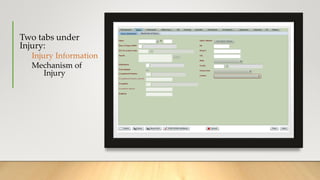
Two tabs under
Injury:
Injury Information
Mechanism of
Injury
Let’s look at the registry
Injury: Injury Information
• Injury Date and Time
• Please try to find both date and time
• Very important data for trauma system evaluation
• Estimates of date and time of injury should be based upon report by patient,
witness, family, or health care provider
• Very important data for QI review for survival
• Greater time between injury and treatment may adversely affect outcome
• ICD 10 Location Code
• Formerly called Place of Occurrence
• Place/site/location where the injury event occurred
• Take time to look through all the expanded list of ICD 10 location codes
• Primary mechanism code includes location (usually transport vehicle) then
list location of that transport vehicle
• Car crash  what type of street was patient’s car traveling on
• Do not enter “unknown”, use Y92.0 unspecified place
Injury: Injury Information
• ICD 10 Location Code
• Y92.0 – Y92.09 Non-Institutional (private) residence
• Y92.1 – Y92.19 Institutional (non-private) residence
• Y92.2 – Y92.29 School, Other institution and public administrative area
• Y92.3 – Y92.39 Sports and athletics area
• Y92.4 – Y92.48 Street, Highway and other paved roadways
• Y92.5 – Y92.59 Trade and Service area
• Y92.6 – Y92.69 Industrial and construction area
• Y92.7 – Y92.79 Farm
• Y92.8 – Y92.89 Other Places
• Y92.9 Unspecified Place
Injury: Injury Information
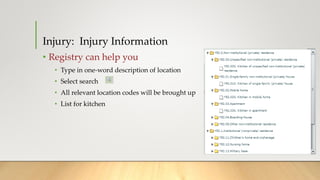
• Registry can help you
• Type in one-word description of location
• Select search
• All relevant location codes will be brought up
• List for kitchen
Injury: Injury Information
I
• ICD 10 Location Specify
• Opens only for “other” locations.
• Use only 1- or 2-words description of location
• Don’t repeat the primary mechanism specify information
Injury: Injury Information
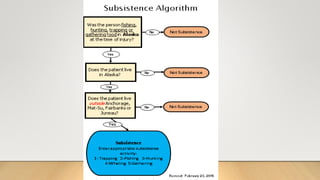
• Subsistence
• Person lives in Alaska EXCEPT from:
• Anchorage, Mat-Su, Fairbanks, or Juneau
• Hunting, fishing, trapping, whaling or gathering in Alaska at time of injury
• Not related to “subsistence license”
Injury: Injury Information
• Subsistence
• Work-Related
• Separate presentation to complete after injury section
Injury: Injury Information
• Injury Address: Street 1
• Incident physical street address
• Do not enter P.O. Box
• Street Intersection
• Mile Post # of Highway
• Can leave blank
• Only if no information of address is available
• Free-text address information
• 30 miles of Dutch Harbor in Bering Sea
Injury: Injury Information
• Injury Occurring in Ocean
• Injury City, County, Census Area, State will be the port of call where the
injured person is taken off the boat to get care.
• Person on cruise ship on inland passage falls & breaks hip, care provide in ship
clinic until arrive in port in Sitka.
• Enter zip code for Sitka
• Manually enter all injury address fields for Sitka
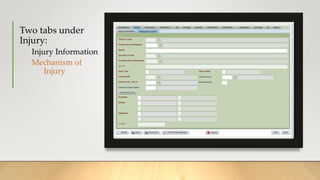
Two tabs under
Injury:
Injury Information
Mechanism of
Injury
Let’s look at the registry
Injury: Mechanism of Injury
• Primary ICD 10 Mechanism Code
• External cause code is used to describe the mechanism (or external factor)
that caused the injury event
• Mechanism MUST entered with all capital letters
• The Primary mechanism should describe the main reason a patient is
admitted to the hospital.
• The first mechanism code, should correspond to the injury cause of the most
serious diagnosis, due to an assault, accident, or self-harm UNLESS the
injury is from child or adult abuse, terrorism event, cataclysmic event or
transport accidents
Injury: Mechanism of Injury
• Hierarchy of Mechanism Codes
• The first listed External cause code should correspond to the cause
of the most serious diagnosis due to an assault, accident, or self-
harm, following the order of hierarchy listed below:
• Mechanism of Injury codes for children and adult abuse take priority over all
other codes.
• Mechanism of Injury codes for terrorism events take priority over all other
codes except child and adult abuse.
• Mechanism of Injury codes for cataclysmic events take priority over all other
codes except child and adult abuse and terrorism.
• Mechanism of Injury codes for transport accidents take priority over all other
codes except child and adult abuse, terrorism, and cataclysmic events.
Injury: Mechanism of Injury
• Child and Adult Abuse Mechanism Codes:
• Primary Mechanism: Enter mechanism code of “child abuse” or “adult abuse.
[T74, Adult and child abuse, neglect and other maltreatment, confirmed) or T76,
Adult and child abuse, neglect and other maltreatment, suspected) for abuse, neglect
and other maltreatment]
• Secondary Mechanism: Enter perpetrator – if a confirmed child abuse case.
• For confirmed cases, the external cause code section (X92 – Y09) should be
reported along with documented injuries. A perpetrator code (Y07) is reported
when the person who performed the abuse/neglect is known.
• For suspected but not confirmed cases, the perpetrator is not reported.
• Tertiary Mechanism: Enter type of mechanism – how assaulted – burned,
dropped, struck, etc.
Injury: Mechanism of Injury
• Primary Mechanism Specify
• Circumstances and activity of patient prior to and at time of injury
• Tell the story of what the patient was doing just prior to injury, what happened
to cause the injury; any contributing factors (weather, alcohol, etc.).
• Do NOT use abbreviations
• Use proper English with punctuation
• Do NOT enter in all Capitals
• Enter information about perpetrator – relationship to victim; alcohol
involvement.
• Work-related: Give as much detail about patient’s occupation and employer
(if known)
Injury: Mechanism of Injury
• Secondary ICD 10 Mechanism Code
• Additional External Cause Code used in conjunction with the Primary
External Cause Code if multiple external cause codes are required to
describe the injury event.
• Perpetrator T07 codes entered in this field.
Injury: Mechanism of Injury
• Injury Type
• Blunt
• Penetrating
• Burn
• Cold Injury
• Drowning
• NA (Poisonings Hanging, and Asphyxiations/Suffocations)
Injury: Mechanism of Injury
• Injury Type
• Auto-fills from primary mechanism code
• Double check
• Blank – must complete
• Definitions of each injury type in Data Dictionary
• Mandatory element
Injury: Mechanism of Injury
• Injury Intent
• Whether an injury was caused by an act carried out on purpose by oneself or
by another person(s), with the goal of injuring or killing
• Auto-fills from primary mechanism code
• The primary mechanism and injury intent must match
• If assault primary mechanism code  injury intent is intentional, assault
• Mandatory element
Injury: Mechanism of Injury
• Injury Intent
• Intentional, Self-Inflicted
• Intentional, Assault
• Unintentional
• Unintentional
• If no documentation stating intent was assault or self-inflicted, default to
unintentional
Injury: Mechanism of Injury
• Activity Code
• Supplemental codes
• Indicate the activity that contributed to or caused the injury
• Not used when reporting poisonings
Injury: Mechanism of Injury
• Injury Cause
• Categorizing the injury cause
• Optional
• Facility use
Injury: Mechanism of Injury
• External Cause Status
• Status of the person at the time the event
• Optional
• Civilian activity done for income or pay
• Military activity
• Volunteer activity
• Other external cause status
• Unspecified external cause status
•
Injury: Mechanism of Injury
• Protective Devices
• Evidence of the use of safety equipment may be reported or observed
• Enter patient use of safety equipment that is the industry standard
• Appropriate safety equipment not used enter “None”
• If there is no appropriate safety equipment for the activity enter “NA”
• Follow Alaska Data Dictionary (not NTDB’s)
Injury: Mechanism of Injury
• Protective Devices
• Restraints
• Seatbelts and shoulder harness
• For motor vehicle crash
• Reported or observed
• 3-point restraints  use 6, lap belt and shoulder harness
• Child restraints not properly used  enter None
Injury: Mechanism of Injury
• Protective Devices
• Airbags
• For motor vehicle crash
• Reported or observed
• Enter NA for vehicle without airbags
• Enter up to 4
Injury: Mechanism of Injury
• Protective Devices
• Equipment
• Measure using industry standard
• Personal floatation
• Life jacket, Mustang suit, gumby suit, floaties
• Protective Non-Clothing Gear
• Shin guards, ice cleats, chest plate, knee pads
• Helmet
• Bike helmet, hard hat, motorcycle helmet
• Protective Clothing
• Leathers, welder’s gloves, steel-toed shoes, bunny boots

Injury atr training final 2020

  • 1.
    Alaska Trauma Registry Training TRAUMAPROGRAM RURAL AND COMMUNITY HEALTH SYSTEMS STATE OF ALASKA, DIVISION OF PUBLIC HEALTH
  • 2.
  • 3.
    Two tabs under Injury: InjuryInformation Mechanism of Injury
  • 4.
    Let’s look atthe registry
  • 5.
    Injury: Injury Information •Injury Date and Time • Please try to find both date and time • Very important data for trauma system evaluation • Estimates of date and time of injury should be based upon report by patient, witness, family, or health care provider • Very important data for QI review for survival • Greater time between injury and treatment may adversely affect outcome
  • 6.
    • ICD 10Location Code • Formerly called Place of Occurrence • Place/site/location where the injury event occurred • Take time to look through all the expanded list of ICD 10 location codes • Primary mechanism code includes location (usually transport vehicle) then list location of that transport vehicle • Car crash  what type of street was patient’s car traveling on • Do not enter “unknown”, use Y92.0 unspecified place Injury: Injury Information
  • 7.
    • ICD 10Location Code • Y92.0 – Y92.09 Non-Institutional (private) residence • Y92.1 – Y92.19 Institutional (non-private) residence • Y92.2 – Y92.29 School, Other institution and public administrative area • Y92.3 – Y92.39 Sports and athletics area • Y92.4 – Y92.48 Street, Highway and other paved roadways • Y92.5 – Y92.59 Trade and Service area • Y92.6 – Y92.69 Industrial and construction area • Y92.7 – Y92.79 Farm • Y92.8 – Y92.89 Other Places • Y92.9 Unspecified Place Injury: Injury Information
  • 8.
    • Registry canhelp you • Type in one-word description of location • Select search • All relevant location codes will be brought up • List for kitchen Injury: Injury Information
  • 9.
    I • ICD 10Location Specify • Opens only for “other” locations. • Use only 1- or 2-words description of location • Don’t repeat the primary mechanism specify information Injury: Injury Information
  • 10.
    • Subsistence • Personlives in Alaska EXCEPT from: • Anchorage, Mat-Su, Fairbanks, or Juneau • Hunting, fishing, trapping, whaling or gathering in Alaska at time of injury • Not related to “subsistence license” Injury: Injury Information
  • 12.
    • Subsistence • Work-Related •Separate presentation to complete after injury section Injury: Injury Information
  • 13.
    • Injury Address:Street 1 • Incident physical street address • Do not enter P.O. Box • Street Intersection • Mile Post # of Highway • Can leave blank • Only if no information of address is available • Free-text address information • 30 miles of Dutch Harbor in Bering Sea Injury: Injury Information
  • 14.
    Injury: Injury Information •Injury Occurring in Ocean • Injury City, County, Census Area, State will be the port of call where the injured person is taken off the boat to get care. • Person on cruise ship on inland passage falls & breaks hip, care provide in ship clinic until arrive in port in Sitka. • Enter zip code for Sitka • Manually enter all injury address fields for Sitka
  • 15.
    Two tabs under Injury: InjuryInformation Mechanism of Injury
  • 16.
    Let’s look atthe registry
  • 17.
    Injury: Mechanism ofInjury • Primary ICD 10 Mechanism Code • External cause code is used to describe the mechanism (or external factor) that caused the injury event • Mechanism MUST entered with all capital letters • The Primary mechanism should describe the main reason a patient is admitted to the hospital. • The first mechanism code, should correspond to the injury cause of the most serious diagnosis, due to an assault, accident, or self-harm UNLESS the injury is from child or adult abuse, terrorism event, cataclysmic event or transport accidents
  • 18.
    Injury: Mechanism ofInjury • Hierarchy of Mechanism Codes • The first listed External cause code should correspond to the cause of the most serious diagnosis due to an assault, accident, or self- harm, following the order of hierarchy listed below: • Mechanism of Injury codes for children and adult abuse take priority over all other codes. • Mechanism of Injury codes for terrorism events take priority over all other codes except child and adult abuse. • Mechanism of Injury codes for cataclysmic events take priority over all other codes except child and adult abuse and terrorism. • Mechanism of Injury codes for transport accidents take priority over all other codes except child and adult abuse, terrorism, and cataclysmic events.
  • 19.
    Injury: Mechanism ofInjury • Child and Adult Abuse Mechanism Codes: • Primary Mechanism: Enter mechanism code of “child abuse” or “adult abuse. [T74, Adult and child abuse, neglect and other maltreatment, confirmed) or T76, Adult and child abuse, neglect and other maltreatment, suspected) for abuse, neglect and other maltreatment] • Secondary Mechanism: Enter perpetrator – if a confirmed child abuse case. • For confirmed cases, the external cause code section (X92 – Y09) should be reported along with documented injuries. A perpetrator code (Y07) is reported when the person who performed the abuse/neglect is known. • For suspected but not confirmed cases, the perpetrator is not reported. • Tertiary Mechanism: Enter type of mechanism – how assaulted – burned, dropped, struck, etc.
  • 20.
    Injury: Mechanism ofInjury • Primary Mechanism Specify • Circumstances and activity of patient prior to and at time of injury • Tell the story of what the patient was doing just prior to injury, what happened to cause the injury; any contributing factors (weather, alcohol, etc.). • Do NOT use abbreviations • Use proper English with punctuation • Do NOT enter in all Capitals • Enter information about perpetrator – relationship to victim; alcohol involvement. • Work-related: Give as much detail about patient’s occupation and employer (if known)
  • 21.
    Injury: Mechanism ofInjury • Secondary ICD 10 Mechanism Code • Additional External Cause Code used in conjunction with the Primary External Cause Code if multiple external cause codes are required to describe the injury event. • Perpetrator T07 codes entered in this field.
  • 22.
    Injury: Mechanism ofInjury • Injury Type • Blunt • Penetrating • Burn • Cold Injury • Drowning • NA (Poisonings Hanging, and Asphyxiations/Suffocations)
  • 23.
    Injury: Mechanism ofInjury • Injury Type • Auto-fills from primary mechanism code • Double check • Blank – must complete • Definitions of each injury type in Data Dictionary • Mandatory element
  • 24.
    Injury: Mechanism ofInjury • Injury Intent • Whether an injury was caused by an act carried out on purpose by oneself or by another person(s), with the goal of injuring or killing • Auto-fills from primary mechanism code • The primary mechanism and injury intent must match • If assault primary mechanism code  injury intent is intentional, assault • Mandatory element
  • 25.
    Injury: Mechanism ofInjury • Injury Intent • Intentional, Self-Inflicted • Intentional, Assault • Unintentional • Unintentional • If no documentation stating intent was assault or self-inflicted, default to unintentional
  • 26.
    Injury: Mechanism ofInjury • Activity Code • Supplemental codes • Indicate the activity that contributed to or caused the injury • Not used when reporting poisonings
  • 27.
    Injury: Mechanism ofInjury • Injury Cause • Categorizing the injury cause • Optional • Facility use
  • 28.
    Injury: Mechanism ofInjury • External Cause Status • Status of the person at the time the event • Optional • Civilian activity done for income or pay • Military activity • Volunteer activity • Other external cause status • Unspecified external cause status •
  • 29.
    Injury: Mechanism ofInjury • Protective Devices • Evidence of the use of safety equipment may be reported or observed • Enter patient use of safety equipment that is the industry standard • Appropriate safety equipment not used enter “None” • If there is no appropriate safety equipment for the activity enter “NA” • Follow Alaska Data Dictionary (not NTDB’s)
  • 30.
    Injury: Mechanism ofInjury • Protective Devices • Restraints • Seatbelts and shoulder harness • For motor vehicle crash • Reported or observed • 3-point restraints  use 6, lap belt and shoulder harness • Child restraints not properly used  enter None
  • 31.
    Injury: Mechanism ofInjury • Protective Devices • Airbags • For motor vehicle crash • Reported or observed • Enter NA for vehicle without airbags • Enter up to 4
  • 32.
    Injury: Mechanism ofInjury • Protective Devices • Equipment • Measure using industry standard • Personal floatation • Life jacket, Mustang suit, gumby suit, floaties • Protective Non-Clothing Gear • Shin guards, ice cleats, chest plate, knee pads • Helmet • Bike helmet, hard hat, motorcycle helmet • Protective Clothing • Leathers, welder’s gloves, steel-toed shoes, bunny boots