Alaska Trauma
Registry Training
TRAUMA PROGRAM
RURAL AND COMMUNITY HEALTH SYSTEMS
STATE OF ALASKA, DIVISION OF PUBLIC HEALTH
Where to Start
• Start with Demographic screens
• Answers in Demographic screen open or skip fields later
in the registry
• Each section has same issue
Demographic
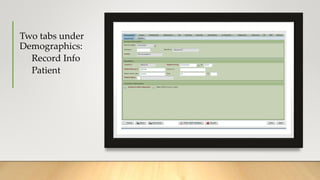
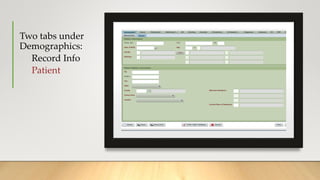
Two tabs under
Demographics:
Record Info
Patient
Let’s look at the registry
Demographic: Record Info
• Account Number
• Enter patient’s billing (account) number for this admission
• Optional information
• Required if no medical record number
• Important for registrars - look up hospital charges
Demographic: Record Info
• Patient Status
• Patient status designated by the prehospital providers, ED/hospital staff
and/or trauma team.
• Not as determined by registrar
• Four (4) choices
• Prehospital Unstable
• ER Unstable
• Potentially Unstable
• Stable Admit
Demographic: Patient Status
• Prehospital Unstable
• Designed by prehospital provider as unstable & requires full trauma team
response in ED
• Prehospital provider can be
• Ambulance crew
• Medevac crew
• Village clinic provider
Demographic: Patient Status
• ER Unstable
• Designed by ED as unstable & requires full trauma team response in ED
• ED staff can be
• Physician
• Nurse
• Designated Person @ your facility
Demographic: Patient Status
• Potentially Unstable
• Designated as potentially unstable & requires a partial trauma team response
in ER.
• Potentially unstable – has the potential to deteriorate but is currently stable
• Mechanism of injury
• Combination of traumatic injuries (e.g. chest & abdomen)
• Pediatric patient
• Designed by prehospital provider or emergency department.
Demographic: Patient Status
• Stable
• Majority of patients will be stable
• Does not require additional trauma team members
• Can be easily treated by your normal ED staff
• Direct admit
Demographic: Record Info
• Include in State Submission
• Cases meeting Alaska inclusion criteria
• Algorithms reference
• Trauma
• Foreign Bodies (Pediatrics)
• Foreign Bodies (Adults)
• Poisonings (Pediatrics)
• Poisonings (Adults)
• Cases that don’t meet
• Facility tracks
• Trauma activations send home from ED (except transfer from hospital to
hospital)
Demographic: Record Info
• Meets NTDB Inclusion Criteria
• Cases meeting NTDB inclusion criteria
• Injury Algorithms (reference box for NTDB)
• Trauma only
• Cases that don’t meet NTDB
• Poisonings
• Foreign Bodies
• Hypothermia
Demographic: Record Info
• Meets NTDB Inclusion Criteria
• If you are unsure, enter “Yes”
• ITDX NTDB (or TQIP) Validator will identify case as not meeting NTDB
criteria
• Go back and change to “No”
Two tabs under
Demographics:
Record Info
Patient
Let’s look at the registry
Demographic: Patient
• Race
• Refers to a person's physical appearance, such as skin color, eye color, hair
color, bone/jaw structure etc.
• May enter up to six
• Patient self-reports (family identifies)
• Problem – hospital doesn’t record race
Demographic: Patient
• Ethnicity
• Refers to cultural factors such as nationality, culture, ancestry, language and
beliefs.
• Hispanic
• Not Hispanic
Demographic: Patient
• Zip Code
• Enter patient’s home zip - autofill’s the city, county, census area, and country
• Double check
• Out of Country – Enter Unknown
• Manually enter City, State, County, Census Area and Country
• Patient Address Information: Street 1
• Enter patient’s physical home address - List street number, city, state, zip,
country
• Optional
• Do not enter a P.O. Box
Demographic: Patient
• Alternate Home Residence
• Status of patient’s residency
• Homeless: A person who lacks housing. The definition also includes a person living in
transitional housing or a supervised public or private facility providing temporary living
quarters.
• Undocumented Citizen: A national of another country who has entered or stayed in another
country without permission.
• Migrant: A person who temporarily leaves his/her principal place of residence within a country
in order to accept seasonal employment in the same or different country.
• Foreign Visitor: Any person legally visiting a country other than his/her usual place of
residence for any reason.
• Not Applicable
Demographic: Patient
• Current Place of Residence
• Description of the type of home at which the patient lives.
• Private Residence, except for Foster Home
• Group Home or Transitional Living Center
• Assisted-living Facility
• Correctional Institution
• Nursing Home or Other Long-term Care Facility
• Foster Home
• Inpatient Psychiatric Hospital
• Homeless or Homeless Shelter
• Military Barrack or College Dormitory
• Other

Demographic atr training final 2020

  • 1.
    Alaska Trauma Registry Training TRAUMAPROGRAM RURAL AND COMMUNITY HEALTH SYSTEMS STATE OF ALASKA, DIVISION OF PUBLIC HEALTH
  • 2.
    Where to Start •Start with Demographic screens • Answers in Demographic screen open or skip fields later in the registry • Each section has same issue
  • 3.
  • 4.
  • 5.
    Let’s look atthe registry
  • 6.
    Demographic: Record Info •Account Number • Enter patient’s billing (account) number for this admission • Optional information • Required if no medical record number • Important for registrars - look up hospital charges
  • 7.
    Demographic: Record Info •Patient Status • Patient status designated by the prehospital providers, ED/hospital staff and/or trauma team. • Not as determined by registrar • Four (4) choices • Prehospital Unstable • ER Unstable • Potentially Unstable • Stable Admit
  • 8.
    Demographic: Patient Status •Prehospital Unstable • Designed by prehospital provider as unstable & requires full trauma team response in ED • Prehospital provider can be • Ambulance crew • Medevac crew • Village clinic provider
  • 9.
    Demographic: Patient Status •ER Unstable • Designed by ED as unstable & requires full trauma team response in ED • ED staff can be • Physician • Nurse • Designated Person @ your facility
  • 10.
    Demographic: Patient Status •Potentially Unstable • Designated as potentially unstable & requires a partial trauma team response in ER. • Potentially unstable – has the potential to deteriorate but is currently stable • Mechanism of injury • Combination of traumatic injuries (e.g. chest & abdomen) • Pediatric patient • Designed by prehospital provider or emergency department.
  • 11.
    Demographic: Patient Status •Stable • Majority of patients will be stable • Does not require additional trauma team members • Can be easily treated by your normal ED staff • Direct admit
  • 12.
    Demographic: Record Info •Include in State Submission • Cases meeting Alaska inclusion criteria • Algorithms reference • Trauma • Foreign Bodies (Pediatrics) • Foreign Bodies (Adults) • Poisonings (Pediatrics) • Poisonings (Adults) • Cases that don’t meet • Facility tracks • Trauma activations send home from ED (except transfer from hospital to hospital)
  • 13.
    Demographic: Record Info •Meets NTDB Inclusion Criteria • Cases meeting NTDB inclusion criteria • Injury Algorithms (reference box for NTDB) • Trauma only • Cases that don’t meet NTDB • Poisonings • Foreign Bodies • Hypothermia
  • 14.
    Demographic: Record Info •Meets NTDB Inclusion Criteria • If you are unsure, enter “Yes” • ITDX NTDB (or TQIP) Validator will identify case as not meeting NTDB criteria • Go back and change to “No”
  • 15.
  • 16.
    Let’s look atthe registry
  • 17.
    Demographic: Patient • Race •Refers to a person's physical appearance, such as skin color, eye color, hair color, bone/jaw structure etc. • May enter up to six • Patient self-reports (family identifies) • Problem – hospital doesn’t record race
  • 18.
    Demographic: Patient • Ethnicity •Refers to cultural factors such as nationality, culture, ancestry, language and beliefs. • Hispanic • Not Hispanic
  • 19.
    Demographic: Patient • ZipCode • Enter patient’s home zip - autofill’s the city, county, census area, and country • Double check • Out of Country – Enter Unknown • Manually enter City, State, County, Census Area and Country • Patient Address Information: Street 1 • Enter patient’s physical home address - List street number, city, state, zip, country • Optional • Do not enter a P.O. Box
  • 20.
    Demographic: Patient • AlternateHome Residence • Status of patient’s residency • Homeless: A person who lacks housing. The definition also includes a person living in transitional housing or a supervised public or private facility providing temporary living quarters. • Undocumented Citizen: A national of another country who has entered or stayed in another country without permission. • Migrant: A person who temporarily leaves his/her principal place of residence within a country in order to accept seasonal employment in the same or different country. • Foreign Visitor: Any person legally visiting a country other than his/her usual place of residence for any reason. • Not Applicable
  • 21.
    Demographic: Patient • CurrentPlace of Residence • Description of the type of home at which the patient lives. • Private Residence, except for Foster Home • Group Home or Transitional Living Center • Assisted-living Facility • Correctional Institution • Nursing Home or Other Long-term Care Facility • Foster Home • Inpatient Psychiatric Hospital • Homeless or Homeless Shelter • Military Barrack or College Dormitory • Other