informed and uninformed search in artificial intelligence
1.
Informed and
Uninformed Searchin AI
This presentation explores the fundamentals of search
algorithms in AI, focusing on the differences between informed
and uninformed strategies. We'll delve into various algorithms,
highlighting their strengths and limitations.
Dhruv Jain
CSE/22/110
2.
Introduction to SearchAlgorithms
Core of Problem-Solving
Search algorithms are central to AI systems, providing
a structured method to find solutions in complex
spaces.
Navigating the Solution Space
These algorithms systematically explore potential
solutions, searching for the optimal path to a goal.
3.
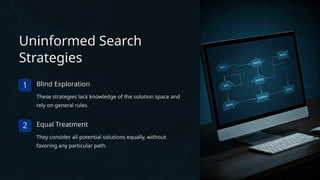
Uninformed Search
Strategies
1 BlindExploration
These strategies lack knowledge of the solution space and
rely on general rules.
2 Equal Treatment
They consider all potential solutions equally, without
favoring any particular path.
4.
Breadth-First Search
(BFS)
Layer-by-Layer
Expands outwardslevel by level, exploring all
nodes at a given depth before moving to the next.
Complete and Optimal
Guarantees finding the shortest path if one exists,
but can be inefficient for large spaces.
5.
Depth-First Search (DFS)
Branch-by-Branch
Exploresone branch fully before backtracking and exploring
other branches.
Suitable for Deep Spaces
Efficient for finding solutions quickly, but may not find
the optimal path.
6.
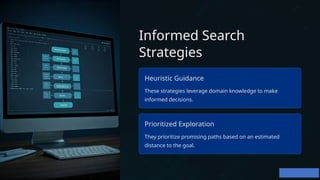
Informed Search
Strategies
Heuristic Guidance
Thesestrategies leverage domain knowledge to make
informed decisions.
Prioritized Exploration
They prioritize promising paths based on an estimated
distance to the goal.
7.
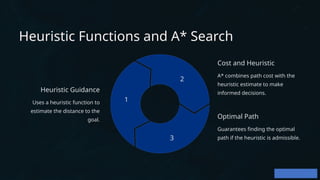
Heuristic Functions andA* Search
Heuristic Guidance
Uses a heuristic function to
estimate the distance to the
goal.
1
Cost and Heuristic
A* combines path cost with the
heuristic estimate to make
informed decisions.
2
Optimal Path
Guarantees finding the optimal
path if the heuristic is admissible.
3
8.
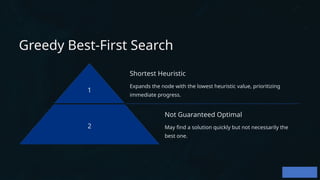
Greedy Best-First Search
1
ShortestHeuristic
Expands the node with the lowest heuristic value, prioritizing
immediate progress.
2
Not Guaranteed Optimal
May find a solution quickly but not necessarily the
best one.
9.
Conclusion and Key
Takeaways
Uninformedvs.
Informed
Uninformed
searches are blind,
while informed
ones use domain
knowledge.
A* Search
A* combines path
cost and heuristic
estimation to find
optimal paths.
Greedy Best-
First
Prioritizes
immediate
progress, but may
not find the best
solution.