Introduction
Did you know that Costa Rica is
recognized as the happiest country
in the world?
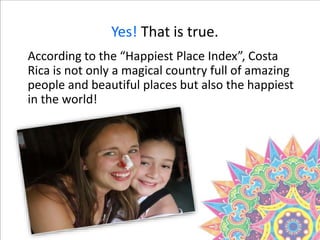
According to the “Happiest Place Index”, Costa
Rica is not only a magical country full of amazing
people and beautiful places but also the happiest
in the world!
Yes! That is true.
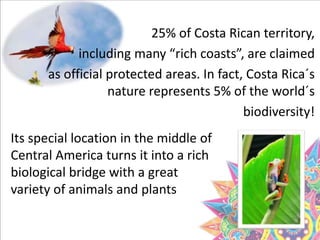
25% of Costa Rican territory,
including many “rich coasts”, are claimed
as official protected areas. In fact, Costa Rica´s
nature represents 5% of the world´s
biodiversity!
Its special location in the middle of
Central America turns it into a rich
biological bridge with a great
variety of animals and plants
Another outstanding characteristic of this small
but great country is its pacification,
strengthened by the abolishment of the army in
1948. Since then, peace has reigned all over the
land.
As an organization that strives to promote a
rewarding cultural exchange experience,
we welcome you to Costa Rica!
Welcome to
Costa Rica!
About the Program
It is important to remember that this is a
cultural exchange program, which means that
our main objective is learning and the exchange
of culture.
Although you will get to know
beautiful places, this won´t be the
program´s priority.
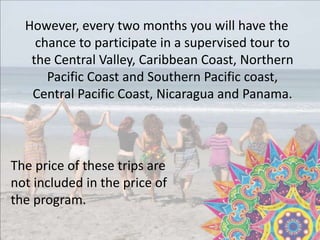
However, every two months you will have the
chance to participate in a supervised tour to
the Central Valley, Caribbean Coast, Northern
Pacific Coast and Southern Pacific coast,
Central Pacific Coast, Nicaragua and Panama.
The price of these trips are
not included in the price of
the program.
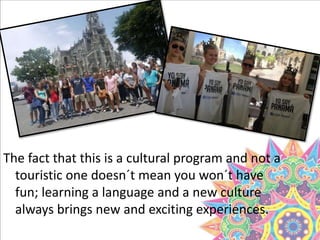
The fact that this is a cultural program and not a
touristic one doesn´t mean you won´t have
fun; learning a language and a new culture
always brings new and exciting experiences.
Orientation in Costa Rica
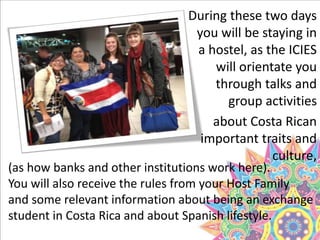
As soon as you arrive to the airport in San Jose,
you will meet Paola, Maria, Carmen and/or
Andrea, the representatives of ICIES, with whom
you will pass the next two days with, before
going to your host families.
Welcome Seminar
During these two days
you will be staying in
a hostel, as the ICIES
will orientate you
through talks and
group activities
about Costa Rican
important traits and
culture,
(as how banks and other institutions work here).
You will also receive the rules from your Host Family
and some relevant information about being an exchange
student in Costa Rica and about Spanish lifestyle.
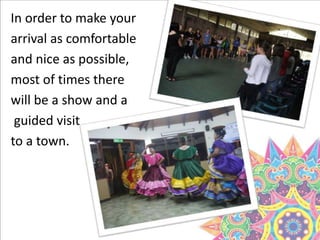
In order to make your
arrival as comfortable
and nice as possible,
most of times there
will be a show and a
guided visit
to a town.
Got a problem?
In the case you have any problem we will ask
you to make your coordinator your first contact.
This person will help the exchange student to
solve the problems by assisting her or him in the
best possible way.
We would like to remember you to
not use parents or family as the
main contact.
Well, remember that your family is on the
other side of the world and they will easily get
worried by not being able to immediately
assist you. Do not worry your loving ones
unnecessary and let`s avoid the risk of having
misunderstandings.
Remember that coordinators are here to help
you solve any problematic situation.
?
Culture
Do you know what culture is? There are
certainly many definitions and you may even
have your own.
The following one is from Ralph Linton
quoted from “Sociology, Themes and
Perspectives” by M. Haralambos and M.
Holborn (1990: third edition)
“The culture of a society is the way of life of its
members; the collection of ideas and habits
which they learn, share and transmit from
generation to generation. Members of society,
usually take their culture for granted. It has
become so much part of them that they are
often unaware of its existence. Culture defines
accepted ways of behaving for members of a
particular society. Such definitions vary from
society to society”
Exploring a new culture involves a sense of
adventure, spirit to take risks, humbleness to
learn from your mistakes, respect to others,
and the willingness to accept how others are.
You will adapt to new cultural
traditions which will
be composed of new friends,
family, teachers,
language, and different
situations.
When people from different cultures meet the
possibility of making friends and sharing nice
experiences is very probable, however, there
could also be misunderstandings and dislikes
in these encounters. Let´s remember that
great part of our personality and the way we
look at the world is influenced by the culture
in which we grew up.
If you are finding some situations frustrating
think for yourself; “Do I need
to change my sunglasses?”
Growing up in one culture
is often like wearing a pair
of colored glasses. Every
time you look through them
your view of the world is changed. If you have
green glasses, the world will seem green, if you
have blue glasses, then it will look blue and so
on. Sometimes we need to take off our glasses
and have a very fresh look at our new families,
friends and houses.
Learning to do this is something you can take
with you and use it anywhere in the world,
including Costa Rica, it will certainly make you
a better person, and remember, do not lose
the sense of humor and the ability to laugh at
yourself. There might be times when you
might make mistakes but do not worry; this is
also part of having an international
experience.
Believe us, it will be great!
Costa Rican Culture
Family is very important for Costa Ricans; these
are based on respect and sharing. Nuclear
groups are usually formed by a mother, a father,
and their children. Parents respect their children
very much, and youngsters must respect them
as well. Sons and daughters are used to discuss
their wishes and decisions with parents, looking
for approval and advice.
Although Costa Rica it´s a very safe place, you
cannot go anywhere without your parent´s
permission, and you shall not return home
late at night, they will certainly worry if they
do not know where you are. You can also
bring friends at home but you must ask
permission to your parents in advance,
normally is not allowed friends to sleep at
home.
If you are not used to do these kinds of rules,
this will be a cultural difference you must keep
in mind.
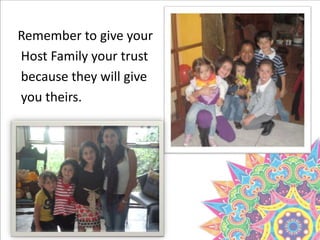
Remember to give your
Host Family your trust
because they will give
you theirs.
Costa Rica is very religious and traditional;
most of families are catholic and assist to
church on Sundays. As a guest you must try to
adapt to your new family´s culture. Religious
activities are part of cultural exchange, this is
why we would like you to try to participate
and be part of them.
Other Costa Rican characteristics that are very
different from European countries are time,
traffic and cleanness.
A meeting with friends?
Do you have an appointment at 2:00 pm in a
park or in a cafe? Normally people here are
not as punctual as in Europe. Generally you
can - apart from a few exceptions - assume
that your friend will need about twenty to
thirty extra minutes to arrive. This is part of
our culture so don't take it personally.
However, this also depends a lot on the
person, some people are very punctual, but
remember that it is common to find people
that is not that much.
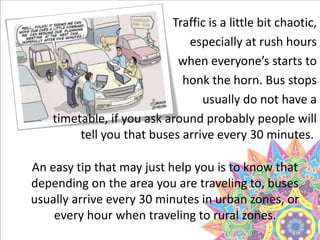
Traffic is a little bit chaotic,
especially at rush hours
when everyone’s starts to
honk the horn. Bus stops
usually do not have a
timetable, if you ask around probably people will
tell you that buses arrive every 30 minutes.
An easy tip that may just help you is to know that
depending on the area you are traveling to, buses
usually arrive every 30 minutes in urban zones, or
every hour when traveling to rural zones.
How can you overcome not knowing exactly the
time of buses arrival? You must decide it for
yourself, you can wait while reading a book,
listen to music, or you use this time to look
around you paying attention to details, watch
people etc. Try to use this opportunity to get
to know our culture a little bit more.
One good thing is that with time you will get
used to the buses` different schedules, or in
any case, you can always ask someone,
usually people are very kind, especially to
foreign people.
Last but no less, Costa Rica has many beautiful and
clean places, however, there are others that are very
dirty and smelly, like some cities. It is also important
to remember you that Costa Rica does not have an
advanced wastewater system, that is why we must
dispose toilet paper on the trash can and not on the
W.C., and that some houses do not have hot water
for showers
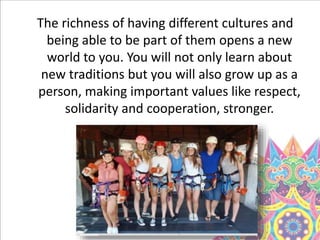
The richness of having different cultures and
being able to be part of them opens a new
world to you. You will not only learn about
new traditions but you will also grow up as a
person, making important values like respect,
solidarity and cooperation, stronger.
Cultural Change
According to Berg, “Individuals differ greatly in
the degree in which cultural shock affects them”
Although most of times cultural exchange
programs result in a great and positive way,
sometimes it may also turn in effects such
anxiety, frustration, stress, sickness, loneliness,
and desperation.
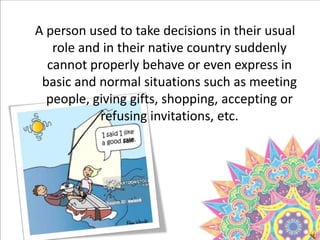
A person used to take decisions in their usual
role and in their native country suddenly
cannot properly behave or even express in
basic and normal situations such as meeting
people, giving gifts, shopping, accepting or
refusing invitations, etc.
If it happens, please do not
worry.
Cultural shock is completely normal and it can
be fixed. How? If you feel homesick, angry or
irritated, the Program will give you the
necessary support to overcome this situation.
However, because it is a 50/50 work, you must
also make an effort to stay strong and be open
to the new environment in which you are.
The process of cultural shock has four phases. The
first one starts with a sensation of beauty;
everything will seem very nice but when you get
to the second one you might feel loneliness and
rejection towards the things related to the new
culture; food, people, clothing, etc. The third
phase is characterized by a sensation of
acceptance, and finally, the best part of all: the
complete adaptation and acceptance of the new
culture.
Let´s enjoy and learn!
Ticos
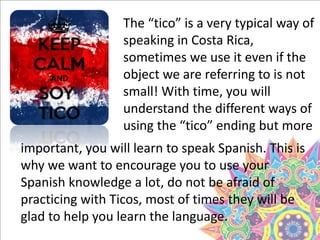
People born in Costa Rica are called “Ticos”
because they usually use the ending “tico” to
say something is little, for example, if you want
to refer to a chocolate as a small candy, you say
a “chocolaTICO”.
The “tico” is a very typical way of
speaking in Costa Rica,
sometimes we use it even if the
object we are referring to is not
small! With time, you will
understand the different ways of
using the “tico” ending but more
important, you will learn to speak Spanish. This is
why we want to encourage you to use your
Spanish knowledge a lot, do not be afraid of
practicing with Ticos, most of times they will be
glad to help you learn the language.
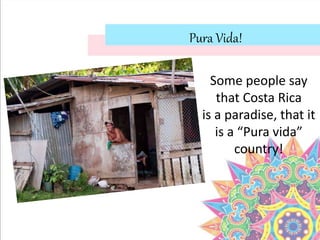
Pura Vida!
Some people say
that Costa Rica
is a paradise, that it
is a “Pura vida”
country!
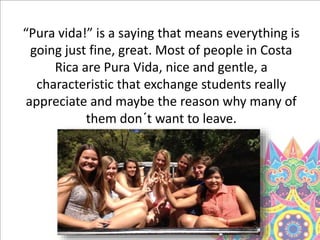
“Pura vida!” is a saying that means everything is
going just fine, great. Most of people in Costa
Rica are Pura Vida, nice and gentle, a
characteristic that exchange students really
appreciate and maybe the reason why many of
them don´t want to leave.
Language
Sometimes, when arriving to Costa Rica and finding
yourself surrounded by the Spanish language you
could feel confused and somehow frustrated while
adjusting. However, as you practice, particularly
with your Host Family and at your Host School, you
will be surprised at the improvement in your
language skills.
Costa Rica offers you one of the best Spanish
from Latin America. It is very clear and without
any strong accent, so it is easier to learn.
Spanish warmth and exuberance are often
expressed by talking in loud tones. At the
beginning of your stay, when you may not have
the complete fluency in the language yet, you
might think that some members of your host
family keep arguing among themselves because
of the tone used, but they really are not.
The way of speaking for many Costa Ricans is
blunt, so do not take it personally if you feel
they are speaking to you in a different tone or
way that you are not used to.
As well as the “pura vida” saying, Ticos also have
other phrases that at the beginning might be
confusing for foreign. When you make plans
with your friends, you should confirm the
appointment various times.
Sometimes Ticos say “Let’s do that on Saturday”
and you may save the day for your friend but
suddenly, he or she does not shows up! Costa
Rican use “Let’s do that” or “we are going to do
something together" to express the wish of
doing something with you at some moment, at
an uncertain time.
Little by little, you'll catch this mentality. Make
sure to speak about specific dates and time
when making plans, and asking a day before or
hours before if the plans still on.
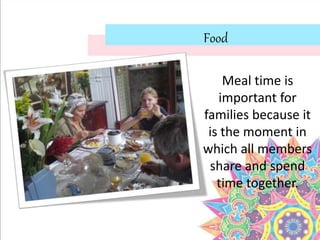
Food
Meal time is
important for
families because it
is the moment in
which all members
share and spend
time together.
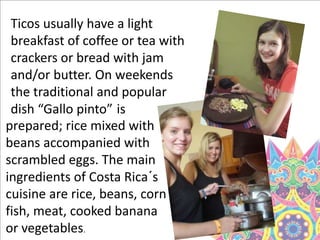
Ticos usually have a light
breakfast of coffee or tea with
crackers or bread with jam
and/or butter. On weekends
the traditional and popular
dish “Gallo pinto” is
prepared; rice mixed with
beans accompanied with
scrambled eggs. The main
ingredients of Costa Rica´s
cuisine are rice, beans, corn
fish, meat, cooked banana
or vegetables.
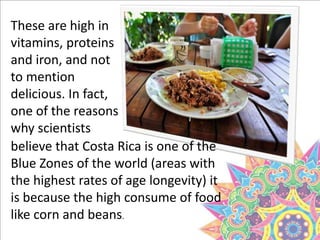
These are high in
vitamins, proteins
and iron, and not
to mention
delicious. In fact,
one of the reasons
why scientists
believe that Costa Rica is one of the
Blue Zones of the world (areas with
the highest rates of age longevity) it
is because the high consume of food
like corn and beans.
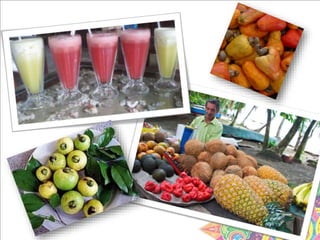
a fruit paradise. You will find delicious and
sweet papayas, mangos, pineapples, bananas
and watermelons, even some others fruits that
are very weird to find in Europe, like cases,
mamones, carambolas, marañones, and
manzanas de agua.
Do you know them? If not, you will probably
love them!
Are you into
fruits?
If you are, then you are lucky of
visiting Costa Rica because it is
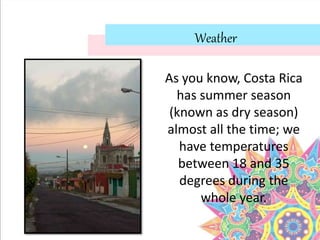
Weather
As you know, Costa Rica
has summer season
(known as dry season)
almost all the time; we
have temperatures
between 18 and 35
degrees during the
whole year.
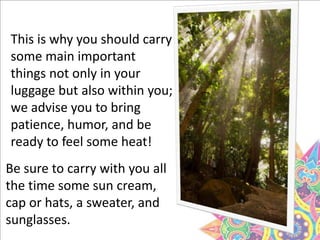
This is why you should carry
some main important
things not only in your
luggage but also within you;
we advise you to bring
patience, humor, and be
ready to feel some heat!
Be sure to carry with you all
the time some sun cream,
cap or hats, a sweater, and
sunglasses.
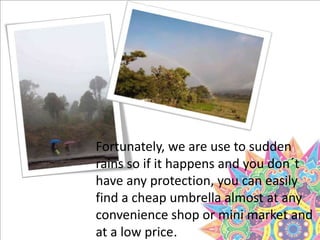
Fortunately, we are use to sudden
rains so if it happens and you don´t
have any protection, you can easily
find a cheap umbrella almost at any
convenience shop or mini market and
at a low price.
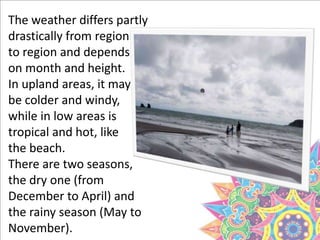
The weather differs partly
drastically from region
to region and depends
on month and height.
In upland areas, it may
be colder and windy,
while in low areas is
tropical and hot, like
the beach.
There are two seasons,
the dry one (from
December to April) and
the rainy season (May to
November).
Currency
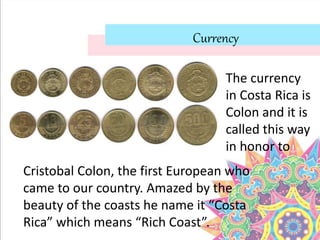
The currency
in Costa Rica is
Colon and it is
called this way
in honor to
Cristobal Colon, the first European who
came to our country. Amazed by the
beauty of the coasts he name it “Costa
Rica” which means “Rich Coast”.
In banks, you can change Euro or Dollar into Colon,
and in many commercial places you can pay with
Dollars but not with Euros. However, it is better to
use the national currency as long as you can.
Please bring 2 credit cards; one in case you want
to use it for personal expenses and another you
will keep in case of emergency; if there is an
accident and you need an operation, the private
hospital must be paid trough a deposit you will
have to do from the second credit card.
Later on, the insurance company will pay you
back.
Master card and Visa are accepted almost
everywhere and if you need to get cash there
are ATM´s that not only take these cards but
also Maestro.
Host Family
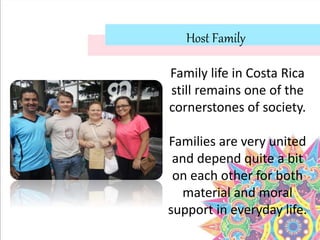
Family life in Costa Rica
still remains one of the
cornerstones of society.
Families are very united
and depend quite a bit
on each other for both
material and moral
support in everyday life.
Young people tend to stay at home for a long
time, generally until they get married, mostly
because it is difficult and expensive to find an
apartment after finishing high school and/or
when getting into college.
Children talk to their parents about almost
everything, they share their lives with their
parents much more than teenagers in other
countries do.
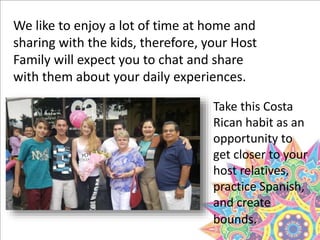
We like to enjoy a lot of time at home and
sharing with the kids, therefore, your Host
Family will expect you to chat and share
with them about your daily experiences.
Take this Costa
Rican habit as an
opportunity to
get closer to your
host relatives,
practice Spanish,
and create
bounds.
Costa Rican families are usually very big; the
central family could be formed by a father, a
mother, and two or four kids, but you will also
have to add all the aunts, uncles, cousins,
grandparents and close friends of the family. You
will meet a lot of people just by staying with one
Host Family.
Tico´s lifestyle is very nice and warm; usually
mothers are at home to be with their children
when they come back from school and to spend
time with them in the afternoons.
Costa Rican fathers generally work and spend
many hours a day away from home, because of
this, sometimes they don´t help much with the
domestic chores, however, they spend much of
their free time with the family and fully
participate raising the children.
Many Costa Rican mothers also have a job
outside home, in these cases domestic chores
are even more divided among all family
members.
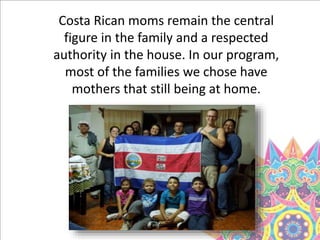
Costa Rican moms remain the central
figure in the family and a respected
authority in the house. In our program,
most of the families we chose have
mothers that still being at home.
Although some beaches are close to San Jose,
families are not used to go there very often;
weekends are used to share with the family,
going to church, watching television or visiting
grandfathers, some friends or relatives. Besides,
taking the whole family to the beach is
expensive; therefore it is saved for especial
occasions like holidays.
It is quite common for Tico siblings to exchange
and use their belongings (clothing, shoes, books,
accessories).
Observe whether or not this is the case in your
Host Family and pay close attention to the
values given to things possessed by your host
brothers and/or sisters. Wait until there is
enough confidence and the relationship is solid
enough before “joining in”.
Costa Rican homes are kept very clean and
people generally do not like to be untidy. You
should talk to your family about how they want
to keep your room and how often you should
clean it.
Families help each other with the house chores,
so they will expect you to collaborate with them
as well. If you don´t know how to collaborate
feel free to ask, your family will be glad and they
will specify to you in which tasks you can
collaborate.
Your Host Family will provide you a room with a
bed, desk and space to place your clothes and
belongings. In most houses there are not private
bathrooms for each room, so you will have to
share the main restroom with the rest of the
house members.
This means that as you are being accepted and
welcomed in a Host Family, you are the one who
should try to adapt to the Costa Rican culture, and
not the other way around. Make an effort and you
will see things will work out.
The different home-loving, conservative and
traditional dynamic of Costa Rican families might
be surprising for you, but if you come with an open
mind and a great desire to know and even live as a
Tico, you will find integrated sooner than you think.
“When in Rome, do as Romans”
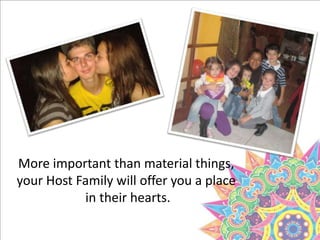
More important than material things,
your Host Family will offer you a place
in their hearts.
Although is becoming more and more rare for
grandparents to live in the same house as the
rest of the family, their opinions and advices are
still highly considered because there is a culture
of great respect towards elderly. Remember to
be patient with elderly people, they are more
experienced than you and sometimes have
structured ways of thinking.
Remember that if a family accepted to be a host
family, it is because they are willing to overcome
any cultural difference and to embrace the
marvelous experience of having a cultural
exchange. However, the success of the host
experience not only depends on them, but also
largely on you and your willingness to
demonstrate your effort, cooperation and
sensibility.
The emphasis will be put on you to adapt to the
family by giving careful consideration to the
particular rules set down by your host family
and to what is acceptable in Costa Rican culture,
this way you will be able to avoid making certain
mistakes which could upset your family´s
household. For this experience to be pleasant
and rewarding for both parts, you must respect
the rules and the culture of your guest country.
Don´t be afraid to ask questions if you don´t
understand something!
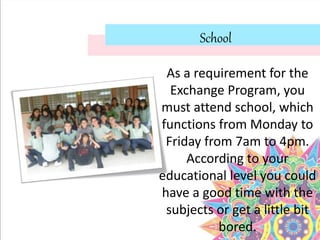
School
As a requirement for the
Exchange Program, you
must attend school, which
functions from Monday to
Friday from 7am to 4pm.
According to your
educational level you could
have a good time with the
subjects or get a little bit
bored.
Sometimes public schools have “free lessons”,
that means that you might not have a certain
class. This happens because sometimes the
professor is sick and there is no one to replace
him or her, or because there was some kind of
problem hiring the teacher on time.
If this gets to happen or if you think Costa Rican
schools are too easy for you, use your
knowledge to help your classmates, this way you
will make more friends, create new and positive
experiences and practice your Spanish.
Make your best effort and you will see that your
grades will increase little by little. Do not feel
bad if you feel a little bit lost at the beginning,
you can ask for help to your professors or
classmates, they will be glad to assist you.
Most schools start on February and end at the
beginning of December. The school year is
divided into three trimesters with 3 holidays
break; during Easter, on July and from December
to January.
If you start your Program in July and it is for ten
months, the second trimester has already
begun. In this case, you will have to catch up
with the school system.
The third trimester starts on September. By this
moment you will already speak some Spanish,
so you are supposed to get better grades. You
must also participate in every school activity.
From February to May next year, you will have
to get good grades.
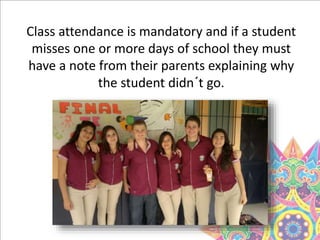
Class attendance is mandatory and if a student
misses one or more days of school they must
have a note from their parents explaining why
the student didn´t go.
Similarly, students are not allowed to arrive late
or leave school early without a written
permission from their parents.
Costa Rican students have a lot of homework to
do at home. You should try to complete all of it
from the very start of your stay, in order to get
used to it and to participate more actively in
school life.
Some schools – not many however – provide
extra-curricular activities in the afternoon
(sports and artistic groups etc).
If your school does not provides after school
activities you are permitted to organize them
with your local community. Please note that
extracurricular activities might or might not be
available in your community.
Depending on the activity, there will be a fee to
pay and students should not rely on their Host
Family to provide transport to and from these
activities. Public transportation is very advanced
and you will be able to use it to get to your
activities.
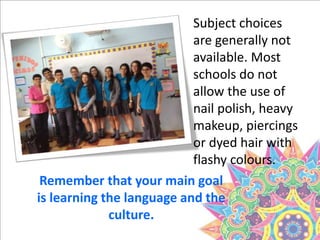
Subject choices
are generally not
available. Most
schools do not
allow the use of
nail polish, heavy
makeup, piercings
or dyed hair with
flashy colours.
Remember that your main goal
is learning the language and the
culture.
Final Tips
Now you know more about the program
and Costa Rican culture. Remember,
different cultures is equal to different life
styles so be open minded, have the
willing to learn and communicate, and
you will see how you will get adapted to
the country.
Bring a pair of old jeans and tennis for the first
two days; probably we will walk trough nature.
You can also use a raincoat, an old cell phone, a
laptop, and a thick sweater. In case you need to
buy some extra clothes, clothing is Costa Rica is
cheap.
As your Host Family will receive you with open
arms you can bring some gifts to them, as
chocolates, t-shirts with your country’s name, or
souvenirs.
Get ready to have a great experience!
To know a little bit more
about Costa Rica, you
can visit the following
videos:
https://www.youtube.com/
watch?v=fXj11L34yE
https://www.youtube.com/
watch?v=Td4yssC77e0

Informative simple

  • 2.
    Introduction Did you knowthat Costa Rica is recognized as the happiest country in the world?
  • 3.
    According to the“Happiest Place Index”, Costa Rica is not only a magical country full of amazing people and beautiful places but also the happiest in the world! Yes! That is true.
  • 4.
    25% of CostaRican territory, including many “rich coasts”, are claimed as official protected areas. In fact, Costa Rica´s nature represents 5% of the world´s biodiversity! Its special location in the middle of Central America turns it into a rich biological bridge with a great variety of animals and plants
  • 5.
    Another outstanding characteristicof this small but great country is its pacification, strengthened by the abolishment of the army in 1948. Since then, peace has reigned all over the land.
  • 6.
    As an organizationthat strives to promote a rewarding cultural exchange experience, we welcome you to Costa Rica! Welcome to Costa Rica!
  • 7.
    About the Program Itis important to remember that this is a cultural exchange program, which means that our main objective is learning and the exchange of culture. Although you will get to know beautiful places, this won´t be the program´s priority.
  • 8.
    However, every twomonths you will have the chance to participate in a supervised tour to the Central Valley, Caribbean Coast, Northern Pacific Coast and Southern Pacific coast, Central Pacific Coast, Nicaragua and Panama. The price of these trips are not included in the price of the program.
  • 9.
    The fact thatthis is a cultural program and not a touristic one doesn´t mean you won´t have fun; learning a language and a new culture always brings new and exciting experiences.
  • 10.
    Orientation in CostaRica As soon as you arrive to the airport in San Jose, you will meet Paola, Maria, Carmen and/or Andrea, the representatives of ICIES, with whom you will pass the next two days with, before going to your host families. Welcome Seminar
  • 11.
    During these twodays you will be staying in a hostel, as the ICIES will orientate you through talks and group activities about Costa Rican important traits and culture, (as how banks and other institutions work here). You will also receive the rules from your Host Family and some relevant information about being an exchange student in Costa Rica and about Spanish lifestyle.
  • 12.
    In order tomake your arrival as comfortable and nice as possible, most of times there will be a show and a guided visit to a town.
  • 13.
    Got a problem? Inthe case you have any problem we will ask you to make your coordinator your first contact. This person will help the exchange student to solve the problems by assisting her or him in the best possible way. We would like to remember you to not use parents or family as the main contact.
  • 14.
    Well, remember thatyour family is on the other side of the world and they will easily get worried by not being able to immediately assist you. Do not worry your loving ones unnecessary and let`s avoid the risk of having misunderstandings. Remember that coordinators are here to help you solve any problematic situation. ?
  • 15.
    Culture Do you knowwhat culture is? There are certainly many definitions and you may even have your own. The following one is from Ralph Linton quoted from “Sociology, Themes and Perspectives” by M. Haralambos and M. Holborn (1990: third edition)
  • 16.
    “The culture ofa society is the way of life of its members; the collection of ideas and habits which they learn, share and transmit from generation to generation. Members of society, usually take their culture for granted. It has become so much part of them that they are often unaware of its existence. Culture defines accepted ways of behaving for members of a particular society. Such definitions vary from society to society”
  • 17.
    Exploring a newculture involves a sense of adventure, spirit to take risks, humbleness to learn from your mistakes, respect to others, and the willingness to accept how others are. You will adapt to new cultural traditions which will be composed of new friends, family, teachers, language, and different situations.
  • 18.
    When people fromdifferent cultures meet the possibility of making friends and sharing nice experiences is very probable, however, there could also be misunderstandings and dislikes in these encounters. Let´s remember that great part of our personality and the way we look at the world is influenced by the culture in which we grew up. If you are finding some situations frustrating think for yourself; “Do I need to change my sunglasses?”
  • 19.
    Growing up inone culture is often like wearing a pair of colored glasses. Every time you look through them your view of the world is changed. If you have green glasses, the world will seem green, if you have blue glasses, then it will look blue and so on. Sometimes we need to take off our glasses and have a very fresh look at our new families, friends and houses.
  • 20.
    Learning to dothis is something you can take with you and use it anywhere in the world, including Costa Rica, it will certainly make you a better person, and remember, do not lose the sense of humor and the ability to laugh at yourself. There might be times when you might make mistakes but do not worry; this is also part of having an international experience. Believe us, it will be great!
  • 21.
    Costa Rican Culture Familyis very important for Costa Ricans; these are based on respect and sharing. Nuclear groups are usually formed by a mother, a father, and their children. Parents respect their children very much, and youngsters must respect them as well. Sons and daughters are used to discuss their wishes and decisions with parents, looking for approval and advice.
  • 22.
    Although Costa Ricait´s a very safe place, you cannot go anywhere without your parent´s permission, and you shall not return home late at night, they will certainly worry if they do not know where you are. You can also bring friends at home but you must ask permission to your parents in advance, normally is not allowed friends to sleep at home. If you are not used to do these kinds of rules, this will be a cultural difference you must keep in mind.
  • 23.
    Remember to giveyour Host Family your trust because they will give you theirs.
  • 24.
    Costa Rica isvery religious and traditional; most of families are catholic and assist to church on Sundays. As a guest you must try to adapt to your new family´s culture. Religious activities are part of cultural exchange, this is why we would like you to try to participate and be part of them. Other Costa Rican characteristics that are very different from European countries are time, traffic and cleanness.
  • 25.
    A meeting withfriends? Do you have an appointment at 2:00 pm in a park or in a cafe? Normally people here are not as punctual as in Europe. Generally you can - apart from a few exceptions - assume that your friend will need about twenty to thirty extra minutes to arrive. This is part of our culture so don't take it personally. However, this also depends a lot on the person, some people are very punctual, but remember that it is common to find people that is not that much.
  • 26.
    Traffic is alittle bit chaotic, especially at rush hours when everyone’s starts to honk the horn. Bus stops usually do not have a timetable, if you ask around probably people will tell you that buses arrive every 30 minutes. An easy tip that may just help you is to know that depending on the area you are traveling to, buses usually arrive every 30 minutes in urban zones, or every hour when traveling to rural zones.
  • 27.
    How can youovercome not knowing exactly the time of buses arrival? You must decide it for yourself, you can wait while reading a book, listen to music, or you use this time to look around you paying attention to details, watch people etc. Try to use this opportunity to get to know our culture a little bit more. One good thing is that with time you will get used to the buses` different schedules, or in any case, you can always ask someone,
  • 28.
    usually people arevery kind, especially to foreign people. Last but no less, Costa Rica has many beautiful and clean places, however, there are others that are very dirty and smelly, like some cities. It is also important to remember you that Costa Rica does not have an advanced wastewater system, that is why we must dispose toilet paper on the trash can and not on the W.C., and that some houses do not have hot water for showers
  • 29.
    The richness ofhaving different cultures and being able to be part of them opens a new world to you. You will not only learn about new traditions but you will also grow up as a person, making important values like respect, solidarity and cooperation, stronger.
  • 30.
    Cultural Change According toBerg, “Individuals differ greatly in the degree in which cultural shock affects them” Although most of times cultural exchange programs result in a great and positive way, sometimes it may also turn in effects such anxiety, frustration, stress, sickness, loneliness, and desperation.
  • 31.
    A person usedto take decisions in their usual role and in their native country suddenly cannot properly behave or even express in basic and normal situations such as meeting people, giving gifts, shopping, accepting or refusing invitations, etc.
  • 32.
    If it happens,please do not worry. Cultural shock is completely normal and it can be fixed. How? If you feel homesick, angry or irritated, the Program will give you the necessary support to overcome this situation. However, because it is a 50/50 work, you must also make an effort to stay strong and be open to the new environment in which you are.
  • 33.
    The process ofcultural shock has four phases. The first one starts with a sensation of beauty; everything will seem very nice but when you get to the second one you might feel loneliness and rejection towards the things related to the new culture; food, people, clothing, etc. The third phase is characterized by a sensation of acceptance, and finally, the best part of all: the complete adaptation and acceptance of the new culture. Let´s enjoy and learn!
  • 34.
    Ticos People born inCosta Rica are called “Ticos” because they usually use the ending “tico” to say something is little, for example, if you want to refer to a chocolate as a small candy, you say a “chocolaTICO”.
  • 35.
    The “tico” isa very typical way of speaking in Costa Rica, sometimes we use it even if the object we are referring to is not small! With time, you will understand the different ways of using the “tico” ending but more important, you will learn to speak Spanish. This is why we want to encourage you to use your Spanish knowledge a lot, do not be afraid of practicing with Ticos, most of times they will be glad to help you learn the language.
  • 36.
    Pura Vida! Some peoplesay that Costa Rica is a paradise, that it is a “Pura vida” country!
  • 37.
    “Pura vida!” isa saying that means everything is going just fine, great. Most of people in Costa Rica are Pura Vida, nice and gentle, a characteristic that exchange students really appreciate and maybe the reason why many of them don´t want to leave.
  • 38.
    Language Sometimes, when arrivingto Costa Rica and finding yourself surrounded by the Spanish language you could feel confused and somehow frustrated while adjusting. However, as you practice, particularly with your Host Family and at your Host School, you will be surprised at the improvement in your language skills.
  • 39.
    Costa Rica offersyou one of the best Spanish from Latin America. It is very clear and without any strong accent, so it is easier to learn. Spanish warmth and exuberance are often expressed by talking in loud tones. At the beginning of your stay, when you may not have the complete fluency in the language yet, you might think that some members of your host family keep arguing among themselves because of the tone used, but they really are not.
  • 40.
    The way ofspeaking for many Costa Ricans is blunt, so do not take it personally if you feel they are speaking to you in a different tone or way that you are not used to. As well as the “pura vida” saying, Ticos also have other phrases that at the beginning might be confusing for foreign. When you make plans with your friends, you should confirm the appointment various times.
  • 41.
    Sometimes Ticos say“Let’s do that on Saturday” and you may save the day for your friend but suddenly, he or she does not shows up! Costa Rican use “Let’s do that” or “we are going to do something together" to express the wish of doing something with you at some moment, at an uncertain time. Little by little, you'll catch this mentality. Make sure to speak about specific dates and time when making plans, and asking a day before or hours before if the plans still on.
  • 42.
    Food Meal time is importantfor families because it is the moment in which all members share and spend time together.
  • 43.
    Ticos usually havea light breakfast of coffee or tea with crackers or bread with jam and/or butter. On weekends the traditional and popular dish “Gallo pinto” is prepared; rice mixed with beans accompanied with scrambled eggs. The main ingredients of Costa Rica´s cuisine are rice, beans, corn fish, meat, cooked banana or vegetables.
  • 44.
    These are highin vitamins, proteins and iron, and not to mention delicious. In fact, one of the reasons why scientists believe that Costa Rica is one of the Blue Zones of the world (areas with the highest rates of age longevity) it is because the high consume of food like corn and beans.
  • 45.
    a fruit paradise.You will find delicious and sweet papayas, mangos, pineapples, bananas and watermelons, even some others fruits that are very weird to find in Europe, like cases, mamones, carambolas, marañones, and manzanas de agua. Do you know them? If not, you will probably love them! Are you into fruits? If you are, then you are lucky of visiting Costa Rica because it is
  • 47.
    Weather As you know,Costa Rica has summer season (known as dry season) almost all the time; we have temperatures between 18 and 35 degrees during the whole year.
  • 48.
    This is whyyou should carry some main important things not only in your luggage but also within you; we advise you to bring patience, humor, and be ready to feel some heat! Be sure to carry with you all the time some sun cream, cap or hats, a sweater, and sunglasses.
  • 49.
    Fortunately, we areuse to sudden rains so if it happens and you don´t have any protection, you can easily find a cheap umbrella almost at any convenience shop or mini market and at a low price.
  • 50.
    The weather differspartly drastically from region to region and depends on month and height. In upland areas, it may be colder and windy, while in low areas is tropical and hot, like the beach. There are two seasons, the dry one (from December to April) and the rainy season (May to November).
  • 51.
    Currency The currency in CostaRica is Colon and it is called this way in honor to Cristobal Colon, the first European who came to our country. Amazed by the beauty of the coasts he name it “Costa Rica” which means “Rich Coast”.
  • 52.
    In banks, youcan change Euro or Dollar into Colon, and in many commercial places you can pay with Dollars but not with Euros. However, it is better to use the national currency as long as you can. Please bring 2 credit cards; one in case you want to use it for personal expenses and another you will keep in case of emergency; if there is an accident and you need an operation, the private hospital must be paid trough a deposit you will have to do from the second credit card. Later on, the insurance company will pay you back.
  • 53.
    Master card andVisa are accepted almost everywhere and if you need to get cash there are ATM´s that not only take these cards but also Maestro.
  • 54.
    Host Family Family lifein Costa Rica still remains one of the cornerstones of society. Families are very united and depend quite a bit on each other for both material and moral support in everyday life.
  • 55.
    Young people tendto stay at home for a long time, generally until they get married, mostly because it is difficult and expensive to find an apartment after finishing high school and/or when getting into college. Children talk to their parents about almost everything, they share their lives with their parents much more than teenagers in other countries do.
  • 56.
    We like toenjoy a lot of time at home and sharing with the kids, therefore, your Host Family will expect you to chat and share with them about your daily experiences. Take this Costa Rican habit as an opportunity to get closer to your host relatives, practice Spanish, and create bounds.
  • 57.
    Costa Rican familiesare usually very big; the central family could be formed by a father, a mother, and two or four kids, but you will also have to add all the aunts, uncles, cousins, grandparents and close friends of the family. You will meet a lot of people just by staying with one Host Family. Tico´s lifestyle is very nice and warm; usually mothers are at home to be with their children when they come back from school and to spend time with them in the afternoons.
  • 58.
    Costa Rican fathersgenerally work and spend many hours a day away from home, because of this, sometimes they don´t help much with the domestic chores, however, they spend much of their free time with the family and fully participate raising the children. Many Costa Rican mothers also have a job outside home, in these cases domestic chores are even more divided among all family members.
  • 59.
    Costa Rican momsremain the central figure in the family and a respected authority in the house. In our program, most of the families we chose have mothers that still being at home.
  • 60.
    Although some beachesare close to San Jose, families are not used to go there very often; weekends are used to share with the family, going to church, watching television or visiting grandfathers, some friends or relatives. Besides, taking the whole family to the beach is expensive; therefore it is saved for especial occasions like holidays. It is quite common for Tico siblings to exchange and use their belongings (clothing, shoes, books, accessories).
  • 61.
    Observe whether ornot this is the case in your Host Family and pay close attention to the values given to things possessed by your host brothers and/or sisters. Wait until there is enough confidence and the relationship is solid enough before “joining in”. Costa Rican homes are kept very clean and people generally do not like to be untidy. You should talk to your family about how they want to keep your room and how often you should clean it.
  • 62.
    Families help eachother with the house chores, so they will expect you to collaborate with them as well. If you don´t know how to collaborate feel free to ask, your family will be glad and they will specify to you in which tasks you can collaborate. Your Host Family will provide you a room with a bed, desk and space to place your clothes and belongings. In most houses there are not private bathrooms for each room, so you will have to share the main restroom with the rest of the house members.
  • 63.
    This means thatas you are being accepted and welcomed in a Host Family, you are the one who should try to adapt to the Costa Rican culture, and not the other way around. Make an effort and you will see things will work out. The different home-loving, conservative and traditional dynamic of Costa Rican families might be surprising for you, but if you come with an open mind and a great desire to know and even live as a Tico, you will find integrated sooner than you think. “When in Rome, do as Romans”
  • 64.
    More important thanmaterial things, your Host Family will offer you a place in their hearts.
  • 65.
    Although is becomingmore and more rare for grandparents to live in the same house as the rest of the family, their opinions and advices are still highly considered because there is a culture of great respect towards elderly. Remember to be patient with elderly people, they are more experienced than you and sometimes have structured ways of thinking.
  • 66.
    Remember that ifa family accepted to be a host family, it is because they are willing to overcome any cultural difference and to embrace the marvelous experience of having a cultural exchange. However, the success of the host experience not only depends on them, but also largely on you and your willingness to demonstrate your effort, cooperation and sensibility.
  • 67.
    The emphasis willbe put on you to adapt to the family by giving careful consideration to the particular rules set down by your host family and to what is acceptable in Costa Rican culture, this way you will be able to avoid making certain mistakes which could upset your family´s household. For this experience to be pleasant and rewarding for both parts, you must respect the rules and the culture of your guest country. Don´t be afraid to ask questions if you don´t understand something!
  • 68.
    School As a requirementfor the Exchange Program, you must attend school, which functions from Monday to Friday from 7am to 4pm. According to your educational level you could have a good time with the subjects or get a little bit bored.
  • 69.
    Sometimes public schoolshave “free lessons”, that means that you might not have a certain class. This happens because sometimes the professor is sick and there is no one to replace him or her, or because there was some kind of problem hiring the teacher on time. If this gets to happen or if you think Costa Rican schools are too easy for you, use your knowledge to help your classmates, this way you will make more friends, create new and positive experiences and practice your Spanish.
  • 70.
    Make your besteffort and you will see that your grades will increase little by little. Do not feel bad if you feel a little bit lost at the beginning, you can ask for help to your professors or classmates, they will be glad to assist you. Most schools start on February and end at the beginning of December. The school year is divided into three trimesters with 3 holidays break; during Easter, on July and from December to January.
  • 71.
    If you startyour Program in July and it is for ten months, the second trimester has already begun. In this case, you will have to catch up with the school system. The third trimester starts on September. By this moment you will already speak some Spanish, so you are supposed to get better grades. You must also participate in every school activity. From February to May next year, you will have to get good grades.
  • 72.
    Class attendance ismandatory and if a student misses one or more days of school they must have a note from their parents explaining why the student didn´t go.
  • 73.
    Similarly, students arenot allowed to arrive late or leave school early without a written permission from their parents. Costa Rican students have a lot of homework to do at home. You should try to complete all of it from the very start of your stay, in order to get used to it and to participate more actively in school life. Some schools – not many however – provide extra-curricular activities in the afternoon (sports and artistic groups etc).
  • 74.
    If your schooldoes not provides after school activities you are permitted to organize them with your local community. Please note that extracurricular activities might or might not be available in your community. Depending on the activity, there will be a fee to pay and students should not rely on their Host Family to provide transport to and from these activities. Public transportation is very advanced and you will be able to use it to get to your activities.
  • 75.
    Subject choices are generallynot available. Most schools do not allow the use of nail polish, heavy makeup, piercings or dyed hair with flashy colours. Remember that your main goal is learning the language and the culture.
  • 76.
    Final Tips Now youknow more about the program and Costa Rican culture. Remember, different cultures is equal to different life styles so be open minded, have the willing to learn and communicate, and you will see how you will get adapted to the country.
  • 77.
    Bring a pairof old jeans and tennis for the first two days; probably we will walk trough nature. You can also use a raincoat, an old cell phone, a laptop, and a thick sweater. In case you need to buy some extra clothes, clothing is Costa Rica is cheap. As your Host Family will receive you with open arms you can bring some gifts to them, as chocolates, t-shirts with your country’s name, or souvenirs.
  • 78.
    Get ready tohave a great experience! To know a little bit more about Costa Rica, you can visit the following videos: https://www.youtube.com/ watch?v=fXj11L34yE https://www.youtube.com/ watch?v=Td4yssC77e0