#1 There are two video cases and three instructional videos available for this chapter.
#2 You might start the class discussion with a question to students asking them to talk about how they have used computers on the job. Alternatively, if few have a work history, ask about how they are using computers in their social lives, or student lives. Can they imagine life without computers and systems?
#5 Emphasize each element in the definition of “business.” What is meant by “formal organization”? Formal organizations get to be “formal” in part because they are chartered by the nation state (a country’s legal system). As a result, they have certain powers and obligations to perform. How might businesses differ depending on whether they make products or provide services? What role does profit play in business?
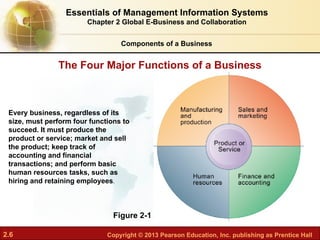
#6 Emphasize that each function is critical to any business, and explain that the product or service is at the center of the diagram because it “governs” the way each business approaches the four major business functions.
#7 You can describe any business in terms of these five elements. Ask a student who has work experience to describe the business entities as his/her current place of work.
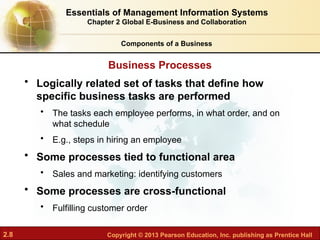
#8 Ask students to describe some example business processes based on their personal work experiences. Examples might include assembling a product, identifying customers, paying creditors, or hiring employees.
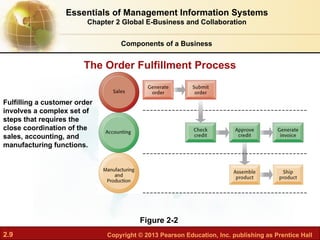
#9 Emphasize that each rectangle represents one part of the larger business process of order fulfillment. Notice that this business process spans more than one type mentioned on the previous slide.
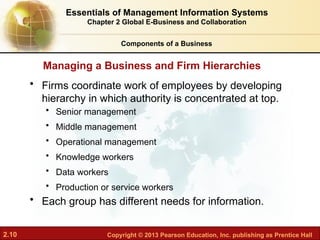
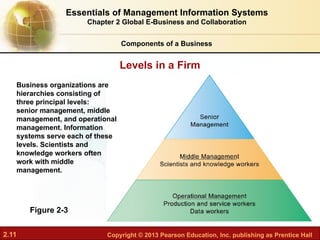
#10 Ask students what types of information are pertinent to each level of the hierarchy. Senior managers need summary information that can quickly inform them about the overall performance of the firm; middle managers need more specific information on the results of specific functional areas of the firm; and so on.
#11 Emphasize to students that different information systems are used by different levels of the pyramid.
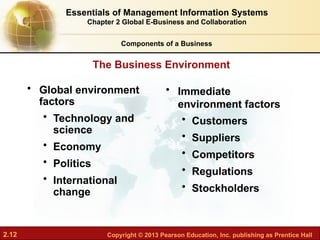
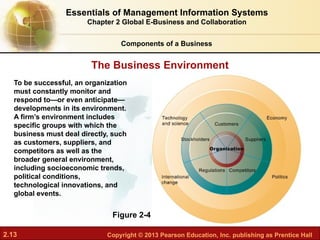
#12 Ask students to give examples of how factors like politics and international change affect business based on their own experiences. One obvious example is political disruption in the Middle East and its impact on oil and gas prices around the world.
#13 Emphasize to students that the outer ring consists of factors which are not a part of businesses and organizations, but nevertheless have a significant impact on the way a business is run and how well it performs. Obviously, the health of the larger economy effects businesses. How does development in technology and science impact business?
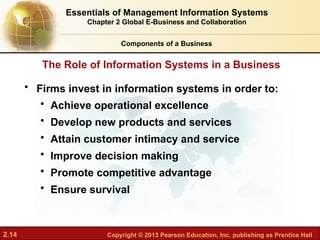
#14 To accomplish business objectives, businesses develop and use information systems.
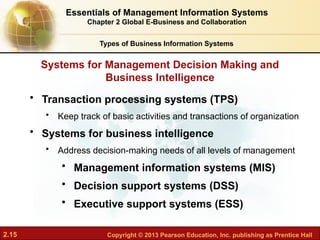
#15 The constituency perspective emphasizes which groups in the firm are served by specific systems.
#16 TPS systems are really the most basic kind of information system in a business, and they were among the first to be developed. A business is in large part a collection of transactions. Keeping track of all these transactions is the fundamental job of management. Without this, the business would soon collapse. Ask students for examples of a “transaction” in a business and make sure they understand the fundamental role of transactions.
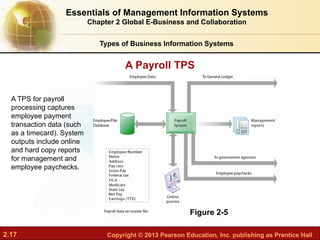
#17 A payroll system involves a transaction between the firm and its employees. Without such a system, no paychecks are sent. That’s pretty basic!
#18 MIS—management information systems—are used by middle and general managers to summarize and keep track of all the important transactions in a business firm. In some sense, being a manager means keeping track of transactions.
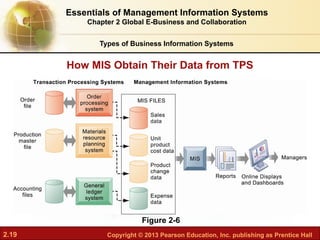
#19 In the system illustrated by this diagram, three TPS supply summarized transaction data to the MIS reporting system at the end of the time period. Managers gain access to the organizational data through the MIS, which provides them with the appropriate reports.
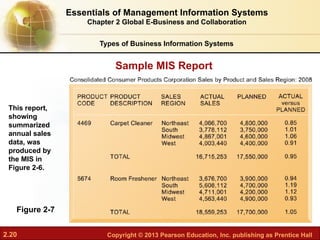
#20 MIS reports are intended to summarize performance of the firm at a fairly concrete, product by product, region by region level. Typically, they report performance against planned objectives, e.g., planned sales of carpet cleaner $4.8 million in the quarter, actual sales were $4 million. This disparity should alert a manager to find out why the sales shortfall occurred.
Today, MIS reports to middle management are increasingly delivered not as paper reports but online summaries of operations. Increasingly, these internal reports are available on mobile platforms like smartphones.
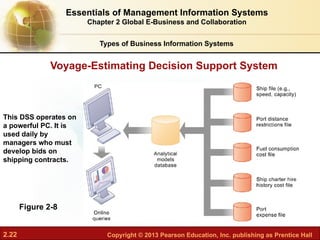
#22 DSS are usually aimed at solving a recurring, very specific problem, like in this illustration calculating the costs of ocean transportation for a firm based on a variety of factors.
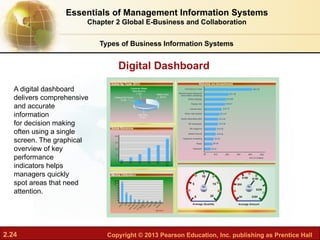
#23 ESS are high level systems aimed at senior managers that summarize the performance of the firm along key dimensions, e.g., sales by region, product sales, cost of goods used in production, and weekly summaries of financial data. Usually, this data is presented in an attractive “digital dashboard” interface.
#24 Why is it that digital dashboards are more effective than, say, spreadsheets with rows and columns of the same data? One answer is just the cognitive cost of looking for “information” in table of rows and columns is much greater than looking at a graphical representation of the same data.
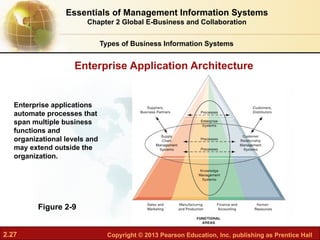
#26 ERP systems integrate business processes in manufacturing and production, finance and accounting, sales and marketing, and human resources into a single software system.
SCM systems help businesses manage relationships with their suppliers.
CRM systems help businesses manage relationships with their customers
KMS systems enable organizations to better manage processes for capturing and applying knowledge and expertise.
#27 Enterprise systems span functions, and span levels in the firm. This looks like a complicated diagram or concept, but the idea is simple: pull all the relevant information in a firm into a single database environment. Share it freely across all levels and specialties in the firm. In the past, where each silo of business had its own systems and databases, this was impossible. Whatever the marketing department “knew” was locked in marketing systems and databases which could not be access by managers in other departments.
#28 The alternative to enterprise systems is departmental systems. What’s wrong with each department, say marketing and accounting, having their own systems to serve their needs?
#29 Do students have any examples of supply chains based on their work experience? What are some of the difficulties they encountered? Some likely candidates are slow delivery, mistakes in delivery, inability to supply because of lack of inventory, delivery to wrong location, and so forth.
#30 Have students interacted with a CRM? Most have but don’t realize it. Most everyone has interacted with a call center over the phone. What has been the experience of your students dealing with call centers? Why do they think call centers are important to a business? What’s the worst experience they have had? Often it’s a cable company or other utility. Or a bad experience with a foreign-based call center where customer service reps could not be easily understood. Why can service at call centers be so poor?
#31 Most students will never have heard of a “knowledge management system.” In one sense its just a corporate library which contains documents, even books, but also reports, PowerPoint slides, spreadsheets, in short, a collection of everything a firm (the people in it) knows about the business. Everyone knows (or did know) what a library is. Another way to think about knowledge management is to think about Google being a collection of part of what is known or thought to be in the world. A good knowledge management system would allow employees to search a corporate database just like searching Google.
#32 The distinction between intranets and extranets is still common. Yet many companies simply talk about their “Web site” and the various areas of their Web site where access is confined to specific groups. Restricted areas of their Web sites are available only to employees (intranets). Other areas are open to outside suppliers, or customers (extranets). The important point is that no matter how you refer to the phenomenon, firms use their Web sites (many firms have multiple Web sites—some for strictly internal use, and some for use by outside parties) to deliver services and information to all the parties in their business value system, from suppliers to consumers.
#34 A number of factors are leading to a growing emphasis on collaboration in the firm. Work is changing, requiring more cooperation and coordination. Professions play a larger role in firms than before, and this often requires more consultation among experts than before. Organizations are flatter, with many more decisions made far down in the hierarchy. Organizations are more far flung around the globe, in multiple locations. There’s an emphasis on finding and sharing ideas, which requires collaboration. Finally, what it means to be a “good” employee these days is in part an ability to work with others and collaborate effectively. The culture of work has changed.
#35 Some of the benefits of collaboration and team work are greater productivity, faster reaction to market events, more innovation, and faster implementation times than previously without collaboration (command and control model). Ask students about their experience on the job with collaboration and team work. Have any worked in a more traditional “command and control” business?
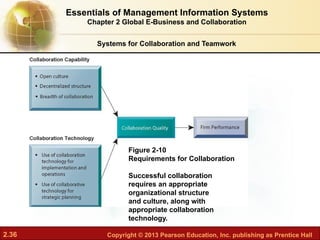
#36 The gist of modern literature on the firm is that firms which support collaboration, and actually do it, tend to perform better. Do students find this believable? What are some possible drawbacks to collaboration?
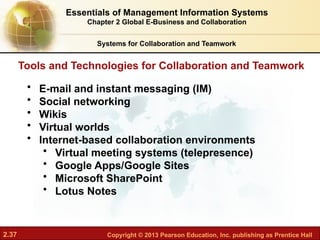
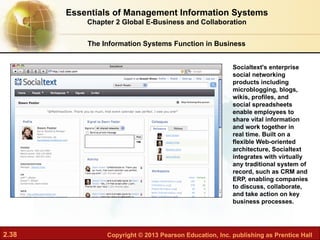
#37 There’s been an explosion in collaboration tools and environments. Businesses are just now learning how to use them.
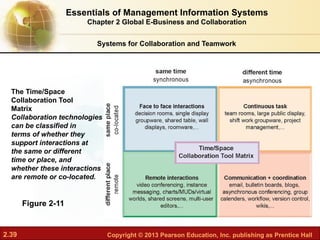
#39 You can use this matrix to identify solutions to the time/location issues that face a firm, and to choose specific collaboration technologies.
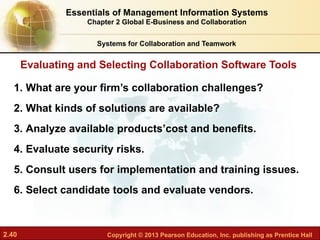
#40 The basic idea here is to identify the kind of problem you have and adopt those technologies that make sense. The key problems are time and location. Generally, no one has enough time and often key people are not in the right place. How to overcome these challenges in a cost effective manner is the difficult part.
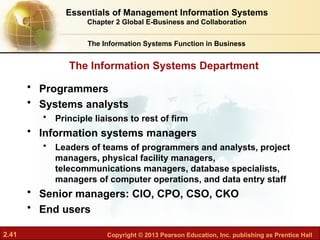
#41 While in very small businesses the IS department is a single individual who does everything, as businesses get larger they generally develop a specialized unit, department, or division that handles all IS and IT areas in the firm. These IS units are composed of senior managers (CIO), middle managers, and technical employees like network administrators and computer programmers. End users are often represented on the governing bodies of these units as well, and consultants (external specialists) also can play a large role in IS departments by bringing in needed skills on an ad hoc basis.
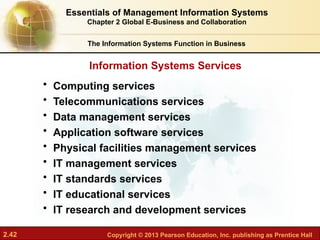
#42 IS services departments deliver specialized services to most other units of the organization, as well as providing the overall computer infrastructure in a firm that serves everyone.