Informal Letter
Formats for Informal Letter in the Malaysian school system:
Students are taught to:
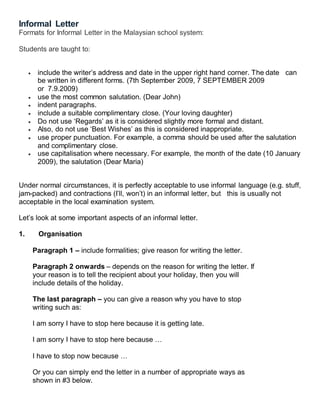
 include the writer’s address and date in the upper right hand corner. The date can
be written in different forms. (7th September 2009, 7 SEPTEMBER 2009
or 7.9.2009)
 use the most common salutation. (Dear John)
 indent paragraphs.
 include a suitable complimentary close. (Your loving daughter)
 Do not use ‘Regards’ as it is considered slightly more formal and distant.
 Also, do not use ‘Best Wishes’ as this is considered inappropriate.
 use proper punctuation. For example, a comma should be used after the salutation
and complimentary close.
 use capitalisation where necessary. For example, the month of the date (10 January
2009), the salutation (Dear Maria)
Under normal circumstances, it is perfectly acceptable to use informal language (e.g. stuff,
jam-packed) and contractions (I’ll, won’t) in an informal letter, but this is usually not
acceptable in the local examination system.
Let’s look at some important aspects of an informal letter.
1. Organisation
Paragraph 1 – include formalities; give reason for writing the letter.
Paragraph 2 onwards – depends on the reason for writing the letter. If
your reason is to tell the recipient about your holiday, then you will
include details of the holiday.
The last paragraph – you can give a reason why you have to stop
writing such as:
I am sorry I have to stop here because it is getting late.
I am sorry I have to stop here because …
I have to stop now because …
Or you can simply end the letter in a number of appropriate ways as
shown in #3 below.
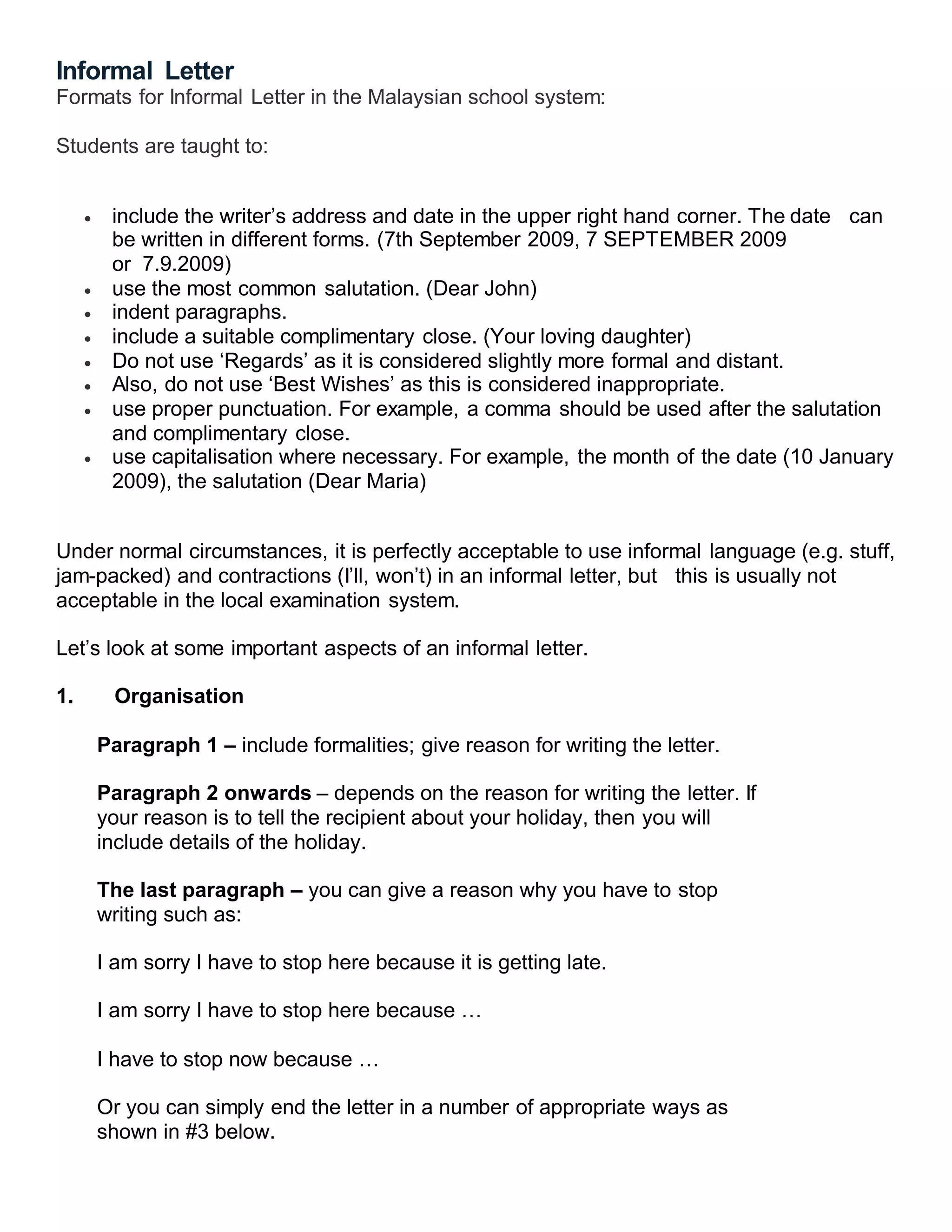
2. Some useful expressions on how to begin an informal letter
> I was pleasantly surprised to hear from you.
> Thank you for your letter. I was pleased to hear that you are in good
health.
> It was really nice hearing from you. I am glad that you like your new
school.
> I hope this letter finds you in the pink (of health).
> Thank you for the lovely birthday card.
3. Some useful expressions on how to end an informal letter
> I promise to write to you soon.
> I hope you will reply soon.
> Give my best wishes to your parents.
> I am looking forward to seeing you.
> I look forward to hearing from you.
> Do write and tell me how you are progressing.
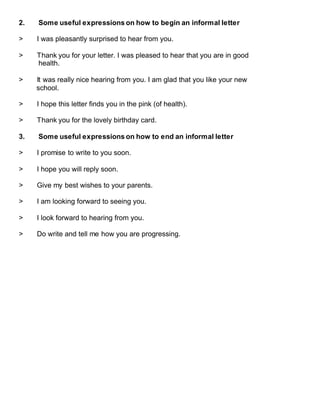
Sample Question
Your younger sister, who is studying in a boarding school, has written to complain that she finds the compulsory co-
curricular activities very tiring. Write a letter to her to explain the benefits of co-curricular activities.
Use the notes given below to write your letter.
1 > help you become a better person
2 > instill discipline
3 > learn good values - cooperation
4 > respect for others
5 > develop leadership skills
6 > learn to organize activities
7 > provide opportunities - to develop social skills
8 > to take part in competitions
9 > keep you healthy
10 > get a good testimonial
When writing your letter, remember to include the following:
> your address
> a proper salutation/greeting
> a complimentary close
> all the notes given above
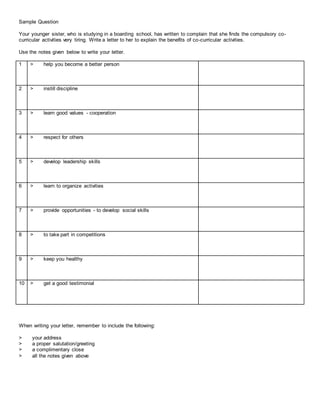
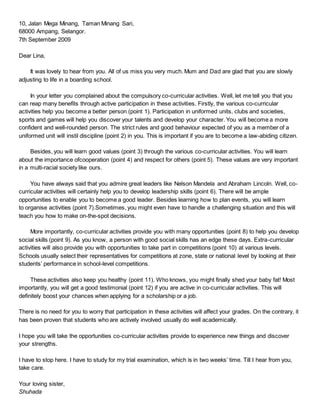
10, Jalan Mega Minang, Taman Minang Sari,
68000 Ampang, Selangor.
7th September 2009
Dear Lina,
It was lovely to hear from you. All of us miss you very much. Mum and Dad are glad that you are slowly
adjusting to life in a boarding school.
In your letter you complained about the compulsory co-curricular activities. Well, let me tell you that you
can reap many benefits through active participation in these activities. Firstly, the various co-curricular
activities help you become a better person (point 1). Participation in uniformed units, clubs and societies,
sports and games will help you discover your talents and develop your character. You will become a more
confident and well-rounded person. The strict rules and good behaviour expected of you as a member of a
uniformed unit will instil discipline (point 2) in you. This is important if you are to become a law-abiding citizen.
Besides, you will learn good values (point 3) through the various co-curricular activities. You will learn
about the importance ofcooperation (point 4) and respect for others (point 5). These values are very important
in a multi-racial society like ours.
You have always said that you admire great leaders like Nelson Mandela and Abraham Lincoln. Well, co-
curricular activities will certainly help you to develop leadership skills (point 6). There will be ample
opportunities to enable you to become a good leader. Besides learning how to plan events, you will learn
to organise activities (point 7).Sometimes, you might even have to handle a challenging situation and this will
teach you how to make on-the-spot decisions.
More importantly, co-curricular activities provide you with many opportunities (point 8) to help you develop
social skills (point 9). As you know, a person with good social skills has an edge these days. Extra-curricular
activities will also provide you with opportunities to take part in competitions (point 10) at various levels.
Schools usually select their representatives for competitions at zone, state or national level by looking at their
students’ performance in school-level competitions.
These activities also keep you healthy (point 11). Who knows, you might finally shed your baby fat! Most
importantly, you will get a good testimonial (point 12) if you are active in co-curricular activities. This will
definitely boost your chances when applying for a scholarship or a job.
There is no need for you to worry that participation in these activities will affect your grades. On the contrary, it
has been proven that students who are actively involved usually do well academically.
I hope you will take the opportunities co-curricular activities provide to experience new things and discover
your strengths.
I have to stop here. I have to study for my trial examination, which is in two weeks’ time. Till I hear from you,
take care.
Your loving sister,
Shuhada
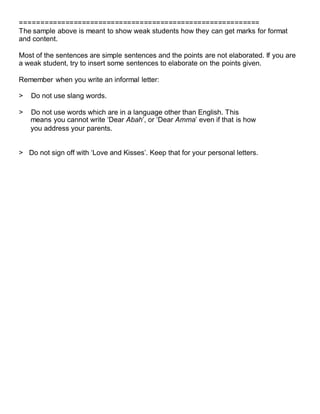
==========================================================
The sample above is meant to show weak students how they can get marks for format
and content.
Most of the sentences are simple sentences and the points are not elaborated. If you are
a weak student, try to insert some sentences to elaborate on the points given.
Remember when you write an informal letter:
> Do not use slang words.
> Do not use words which are in a language other than English. This
means you cannot write ‘Dear Abah’, or ‘Dear Amma’ even if that is how
you address your parents.
> Do not sign off with ‘Love and Kisses’. Keep that for your personal letters.

Informal letter

  • 1.
    Informal Letter Formats forInformal Letter in the Malaysian school system: Students are taught to:  include the writer’s address and date in the upper right hand corner. The date can be written in different forms. (7th September 2009, 7 SEPTEMBER 2009 or 7.9.2009)  use the most common salutation. (Dear John)  indent paragraphs.  include a suitable complimentary close. (Your loving daughter)  Do not use ‘Regards’ as it is considered slightly more formal and distant.  Also, do not use ‘Best Wishes’ as this is considered inappropriate.  use proper punctuation. For example, a comma should be used after the salutation and complimentary close.  use capitalisation where necessary. For example, the month of the date (10 January 2009), the salutation (Dear Maria) Under normal circumstances, it is perfectly acceptable to use informal language (e.g. stuff, jam-packed) and contractions (I’ll, won’t) in an informal letter, but this is usually not acceptable in the local examination system. Let’s look at some important aspects of an informal letter. 1. Organisation Paragraph 1 – include formalities; give reason for writing the letter. Paragraph 2 onwards – depends on the reason for writing the letter. If your reason is to tell the recipient about your holiday, then you will include details of the holiday. The last paragraph – you can give a reason why you have to stop writing such as: I am sorry I have to stop here because it is getting late. I am sorry I have to stop here because … I have to stop now because … Or you can simply end the letter in a number of appropriate ways as shown in #3 below.
  • 2.
    2. Some usefulexpressions on how to begin an informal letter > I was pleasantly surprised to hear from you. > Thank you for your letter. I was pleased to hear that you are in good health. > It was really nice hearing from you. I am glad that you like your new school. > I hope this letter finds you in the pink (of health). > Thank you for the lovely birthday card. 3. Some useful expressions on how to end an informal letter > I promise to write to you soon. > I hope you will reply soon. > Give my best wishes to your parents. > I am looking forward to seeing you. > I look forward to hearing from you. > Do write and tell me how you are progressing.
  • 3.
    Sample Question Your youngersister, who is studying in a boarding school, has written to complain that she finds the compulsory co- curricular activities very tiring. Write a letter to her to explain the benefits of co-curricular activities. Use the notes given below to write your letter. 1 > help you become a better person 2 > instill discipline 3 > learn good values - cooperation 4 > respect for others 5 > develop leadership skills 6 > learn to organize activities 7 > provide opportunities - to develop social skills 8 > to take part in competitions 9 > keep you healthy 10 > get a good testimonial When writing your letter, remember to include the following: > your address > a proper salutation/greeting > a complimentary close > all the notes given above
  • 4.
    10, Jalan MegaMinang, Taman Minang Sari, 68000 Ampang, Selangor. 7th September 2009 Dear Lina, It was lovely to hear from you. All of us miss you very much. Mum and Dad are glad that you are slowly adjusting to life in a boarding school. In your letter you complained about the compulsory co-curricular activities. Well, let me tell you that you can reap many benefits through active participation in these activities. Firstly, the various co-curricular activities help you become a better person (point 1). Participation in uniformed units, clubs and societies, sports and games will help you discover your talents and develop your character. You will become a more confident and well-rounded person. The strict rules and good behaviour expected of you as a member of a uniformed unit will instil discipline (point 2) in you. This is important if you are to become a law-abiding citizen. Besides, you will learn good values (point 3) through the various co-curricular activities. You will learn about the importance ofcooperation (point 4) and respect for others (point 5). These values are very important in a multi-racial society like ours. You have always said that you admire great leaders like Nelson Mandela and Abraham Lincoln. Well, co- curricular activities will certainly help you to develop leadership skills (point 6). There will be ample opportunities to enable you to become a good leader. Besides learning how to plan events, you will learn to organise activities (point 7).Sometimes, you might even have to handle a challenging situation and this will teach you how to make on-the-spot decisions. More importantly, co-curricular activities provide you with many opportunities (point 8) to help you develop social skills (point 9). As you know, a person with good social skills has an edge these days. Extra-curricular activities will also provide you with opportunities to take part in competitions (point 10) at various levels. Schools usually select their representatives for competitions at zone, state or national level by looking at their students’ performance in school-level competitions. These activities also keep you healthy (point 11). Who knows, you might finally shed your baby fat! Most importantly, you will get a good testimonial (point 12) if you are active in co-curricular activities. This will definitely boost your chances when applying for a scholarship or a job. There is no need for you to worry that participation in these activities will affect your grades. On the contrary, it has been proven that students who are actively involved usually do well academically. I hope you will take the opportunities co-curricular activities provide to experience new things and discover your strengths. I have to stop here. I have to study for my trial examination, which is in two weeks’ time. Till I hear from you, take care. Your loving sister, Shuhada
  • 5.
    ========================================================== The sample aboveis meant to show weak students how they can get marks for format and content. Most of the sentences are simple sentences and the points are not elaborated. If you are a weak student, try to insert some sentences to elaborate on the points given. Remember when you write an informal letter: > Do not use slang words. > Do not use words which are in a language other than English. This means you cannot write ‘Dear Abah’, or ‘Dear Amma’ even if that is how you address your parents. > Do not sign off with ‘Love and Kisses’. Keep that for your personal letters.