Suf Yan Gill
23-ARID-2260
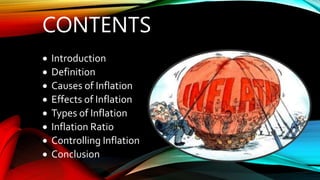
CONTENTS
 Introduction
 Definition
 Causes of Inflation
 Effects of Inflation
 Types of Inflation
 Inflation Ratio
 Controlling Inflation
 Conclusion
MEANING OF INFLATION
 In economics, inflation is a rise in the general
level of prices of goods and services in an
economy over a period of time. When the
general price level rises, each unit of currency
buys fewer goods and services
DEFINITIONS
• According to Webster's "An increase in the amount of
currency in circulation, resulting in a relatively sharp and
sudden fall in its value and rise in prices: it may be caused by
an increase in the volume of paper money issued or of gold
mined, or a relative increase in expenditures as when the
supply of goods fails to meet the demand”
• According to Prof. Samuelson "inflation occurs when
general level of prices & cost are rising".
CAUSES OF INFLATION
•Demand- pull Inflation
•Cost-push Inflation
•Built-in Inflation
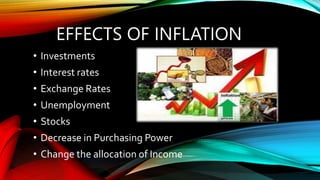
EFFECTS OF INFLATION
• Investments
• Interest rates
• Exchange Rates
• Unemployment
• Stocks
• Decrease in Purchasing Power
• Change the allocation of Income
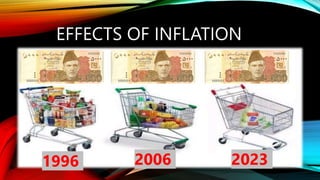
EFFECTS OF INFLATION
2023
2006
1996
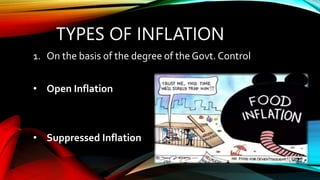
TYPES OF INFLATION
1. On the basis of the degree of the Govt. Control
• Open Inflation
• Suppressed Inflation
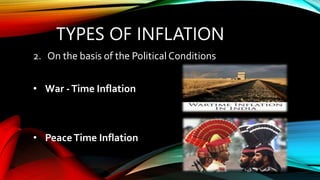
TYPES OF INFLATION
2. On the basis of the Political Conditions
• War -Time Inflation
• PeaceTime Inflation
TYPES OF INFLATION
3. On the basis of the Scope
• Sectoral Inflation
• Comprehensive Inflation
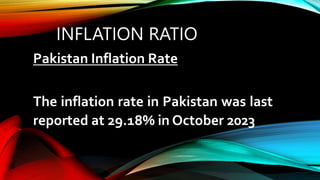
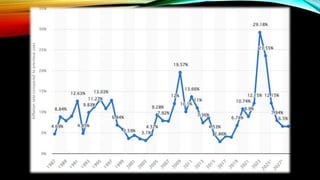
INFLATION RATIO
Pakistan Inflation Rate
The inflation rate in Pakistan was last
reported at 29.18% in October 2023
CONTROLLING INFLATION
There are broadly two ways of controlling inflation
in an Economy
1) Monetary Measures
2) Fiscal Measures
MONETARY MEASURES
The most important and commonly used method to control inflation is
monetary policy of the Central Bank. Most central banks use high
interest rates as the traditional way to fight or prevent inflation.
Measures used to control Inflation
1) Bank Rate Policy
2) CRR
3) Open Market Operations
FISCAL MEASURES
Fiscal measures to control inflation include taxation, government
expenditure and public borrowings.
Fiscal Measures used to control Inflation
1) Increase inTaxes
2) Increase in Savings
3) Surplus Budgets
CONCLUSIONS
In reality, low inflation rate and
an upward economic growth is
never possible . Nevertheless,
low inflation rate means slow
economic growth. Whenever,
money is in excess, there is
bidding by the consumers due
to which the cost of goods
escalate.
REFERENCES
• www.investopedia.com/terms/i/inflation
• www.economywatch.com/inflation/causes.html
• www.scribd.com.html
• www.mysmp.com/bonds/inflation.html
• www.tradingeconomics.com/india/inflation
ANY QUESTIONS?

inflation.pptx

  • 1.
  • 2.
    CONTENTS  Introduction  Definition Causes of Inflation  Effects of Inflation  Types of Inflation  Inflation Ratio  Controlling Inflation  Conclusion
  • 3.
    MEANING OF INFLATION In economics, inflation is a rise in the general level of prices of goods and services in an economy over a period of time. When the general price level rises, each unit of currency buys fewer goods and services
  • 4.
    DEFINITIONS • According toWebster's "An increase in the amount of currency in circulation, resulting in a relatively sharp and sudden fall in its value and rise in prices: it may be caused by an increase in the volume of paper money issued or of gold mined, or a relative increase in expenditures as when the supply of goods fails to meet the demand” • According to Prof. Samuelson "inflation occurs when general level of prices & cost are rising".
  • 5.
    CAUSES OF INFLATION •Demand-pull Inflation •Cost-push Inflation •Built-in Inflation
  • 6.
    EFFECTS OF INFLATION •Investments • Interest rates • Exchange Rates • Unemployment • Stocks • Decrease in Purchasing Power • Change the allocation of Income
  • 7.
  • 8.
    TYPES OF INFLATION 1.On the basis of the degree of the Govt. Control • Open Inflation • Suppressed Inflation
  • 9.
    TYPES OF INFLATION 2.On the basis of the Political Conditions • War -Time Inflation • PeaceTime Inflation
  • 10.
    TYPES OF INFLATION 3.On the basis of the Scope • Sectoral Inflation • Comprehensive Inflation
  • 11.
    INFLATION RATIO Pakistan InflationRate The inflation rate in Pakistan was last reported at 29.18% in October 2023
  • 13.
    CONTROLLING INFLATION There arebroadly two ways of controlling inflation in an Economy 1) Monetary Measures 2) Fiscal Measures
  • 14.
    MONETARY MEASURES The mostimportant and commonly used method to control inflation is monetary policy of the Central Bank. Most central banks use high interest rates as the traditional way to fight or prevent inflation. Measures used to control Inflation 1) Bank Rate Policy 2) CRR 3) Open Market Operations
  • 15.
    FISCAL MEASURES Fiscal measuresto control inflation include taxation, government expenditure and public borrowings. Fiscal Measures used to control Inflation 1) Increase inTaxes 2) Increase in Savings 3) Surplus Budgets
  • 16.
    CONCLUSIONS In reality, lowinflation rate and an upward economic growth is never possible . Nevertheless, low inflation rate means slow economic growth. Whenever, money is in excess, there is bidding by the consumers due to which the cost of goods escalate.
  • 17.
    REFERENCES • www.investopedia.com/terms/i/inflation • www.economywatch.com/inflation/causes.html •www.scribd.com.html • www.mysmp.com/bonds/inflation.html • www.tradingeconomics.com/india/inflation
  • 18.