

BY: Syed Shahid
Clinical instructor ISLAMIC UNIVERSITY KASHMIR
INFECTION
• An invasion of pathogens
or microorganisms into the
body that are capable of
producing disease.
• The invasion and
reproduction of
microorganisms in a body
tissue that can result in a
local or systemic clinical
response such as cellulitis,
fever etc.
MODES OF
TRANSMISSION
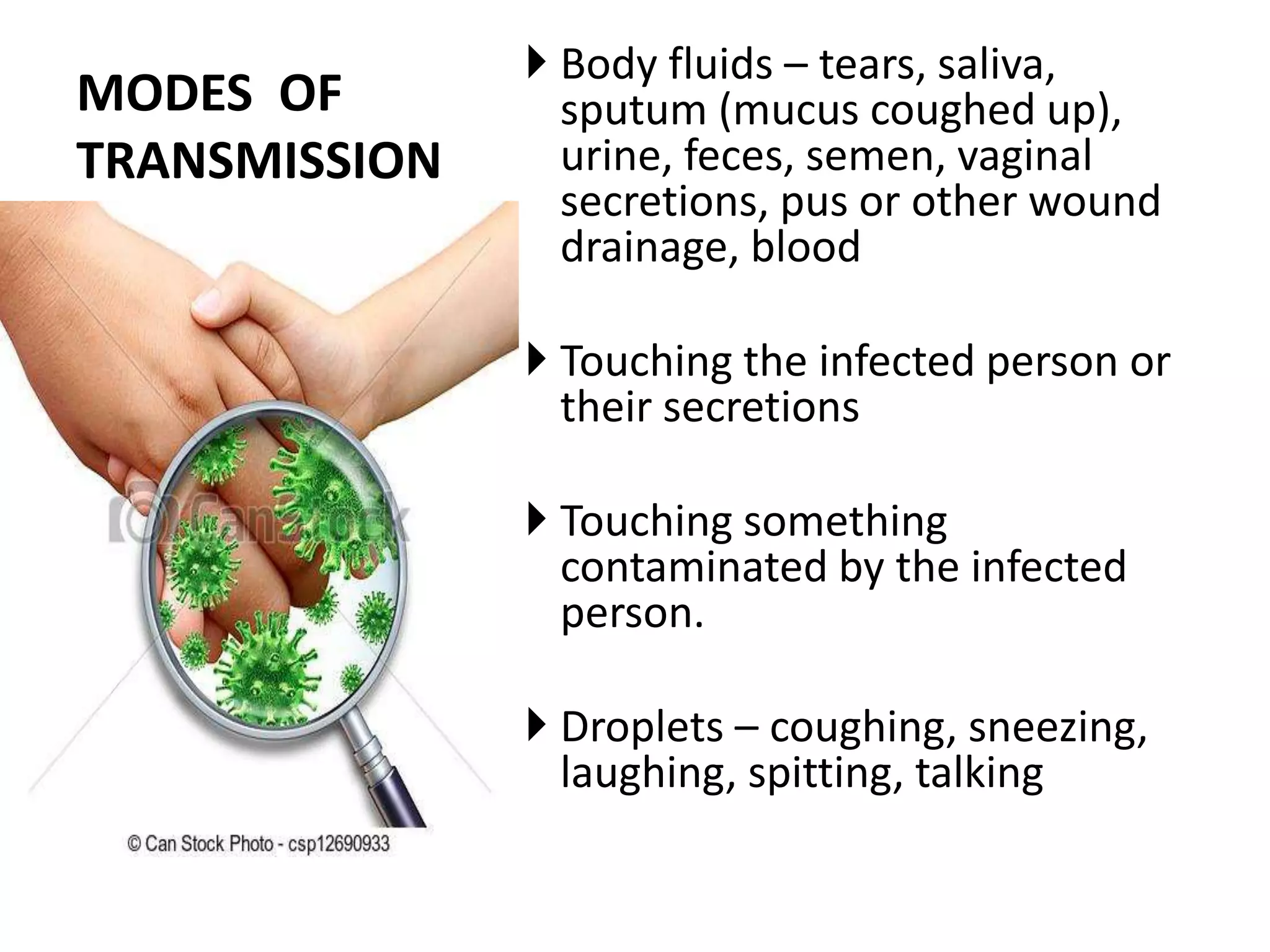
 Body fluids – tears, saliva,
sputum (mucus coughed up),
urine, feces, semen, vaginal
secretions, pus or other wound
drainage, blood
 Touching the infected person or
their secretions
 Touching something
contaminated by the infected
person.
 Droplets – coughing, sneezing,
laughing, spitting, talking
PORTALS OF
ENTRY
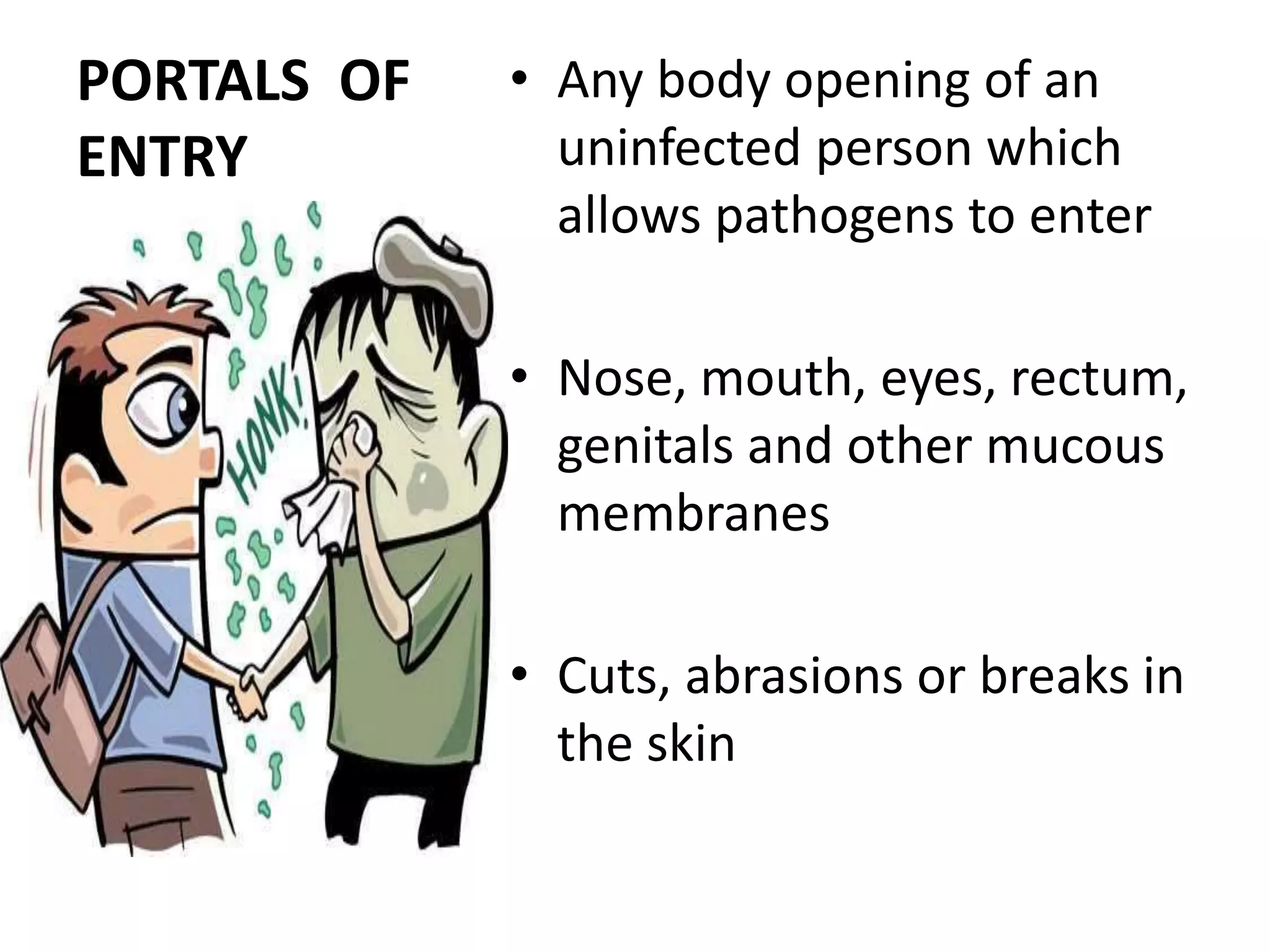
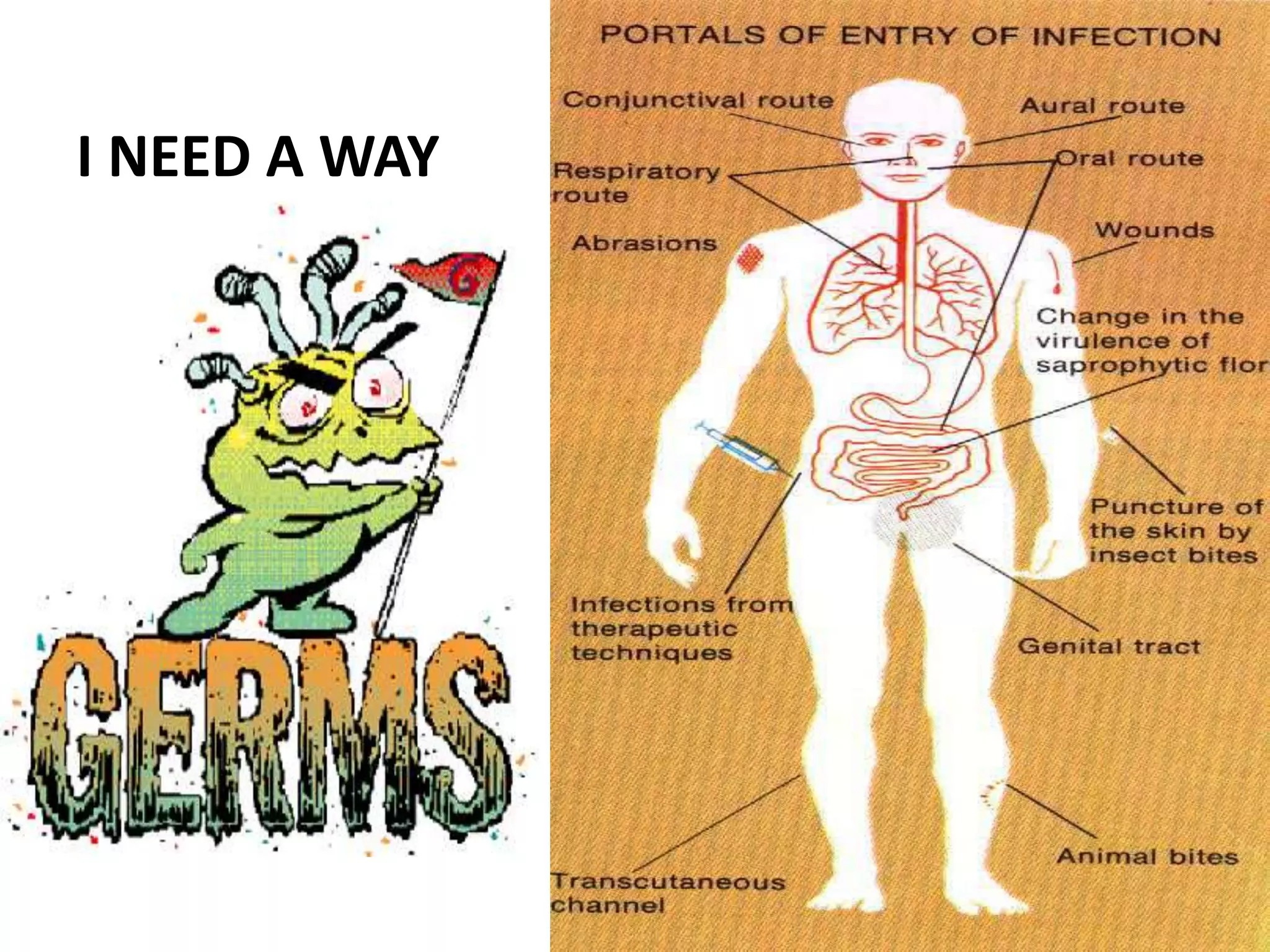
• Any body opening of an
uninfected person which
allows pathogens to enter
• Nose, mouth, eyes, rectum,
genitals and other mucous
membranes
• Cuts, abrasions or breaks in
the skin
I NEED A WAY
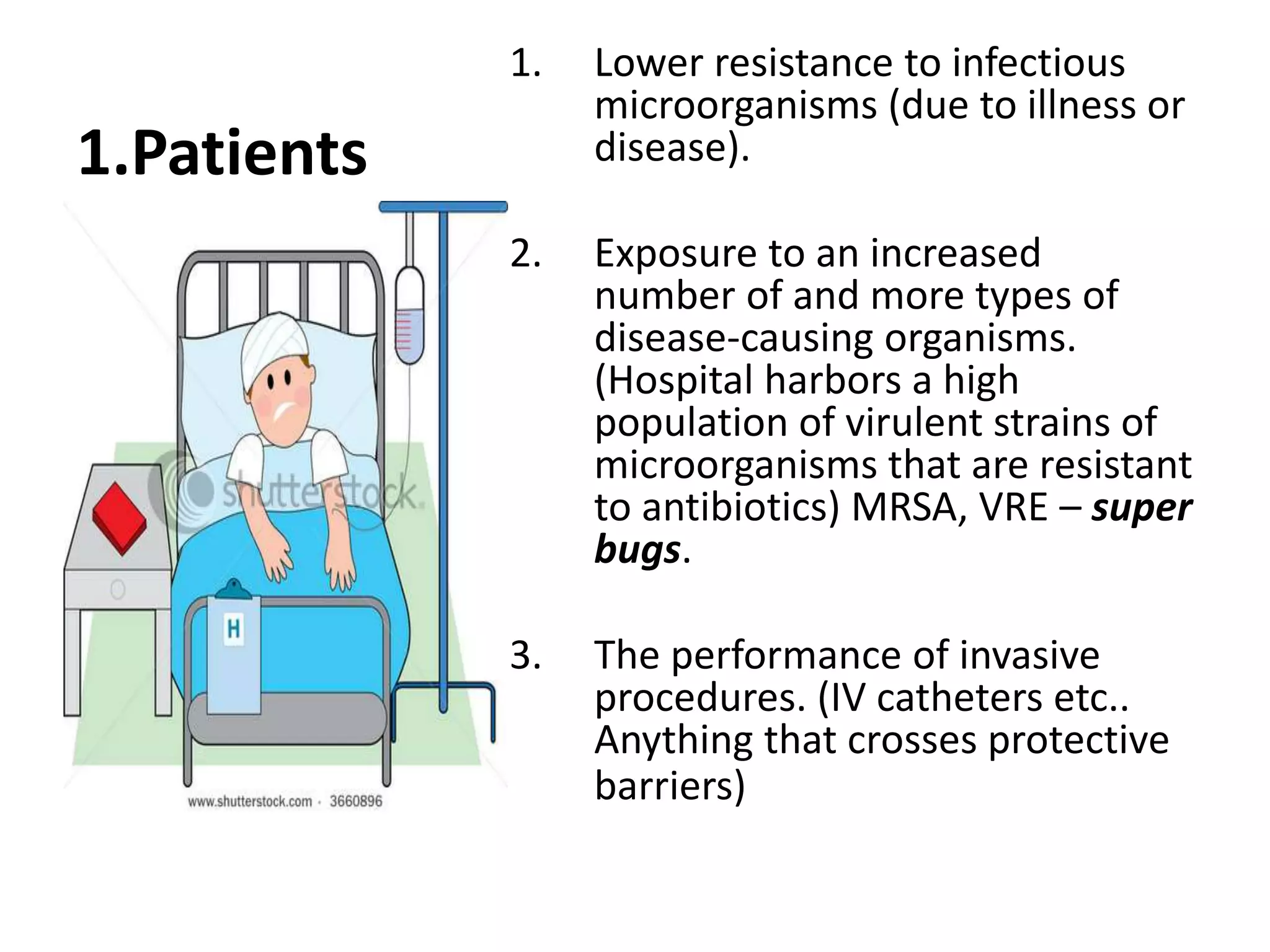
1.Patients
1. Lower resistance to infectious
microorganisms (due to illness or
disease).
2. Exposure to an increased
number of and more types of
disease-causing organisms.
(Hospital harbors a high
population of virulent strains of
microorganisms that are resistant
to antibiotics) MRSA, VRE – super
bugs.
3. The performance of invasive
procedures. (IV catheters etc..
Anything that crosses protective
barriers)
Attendants
• The relationship of hospital
infections with an
increased number of
attendants/visitors is
beyond doubt.
• They become the carriers
of infection putting both on
risk of developing
infections i.e. patients and
healthcare team.
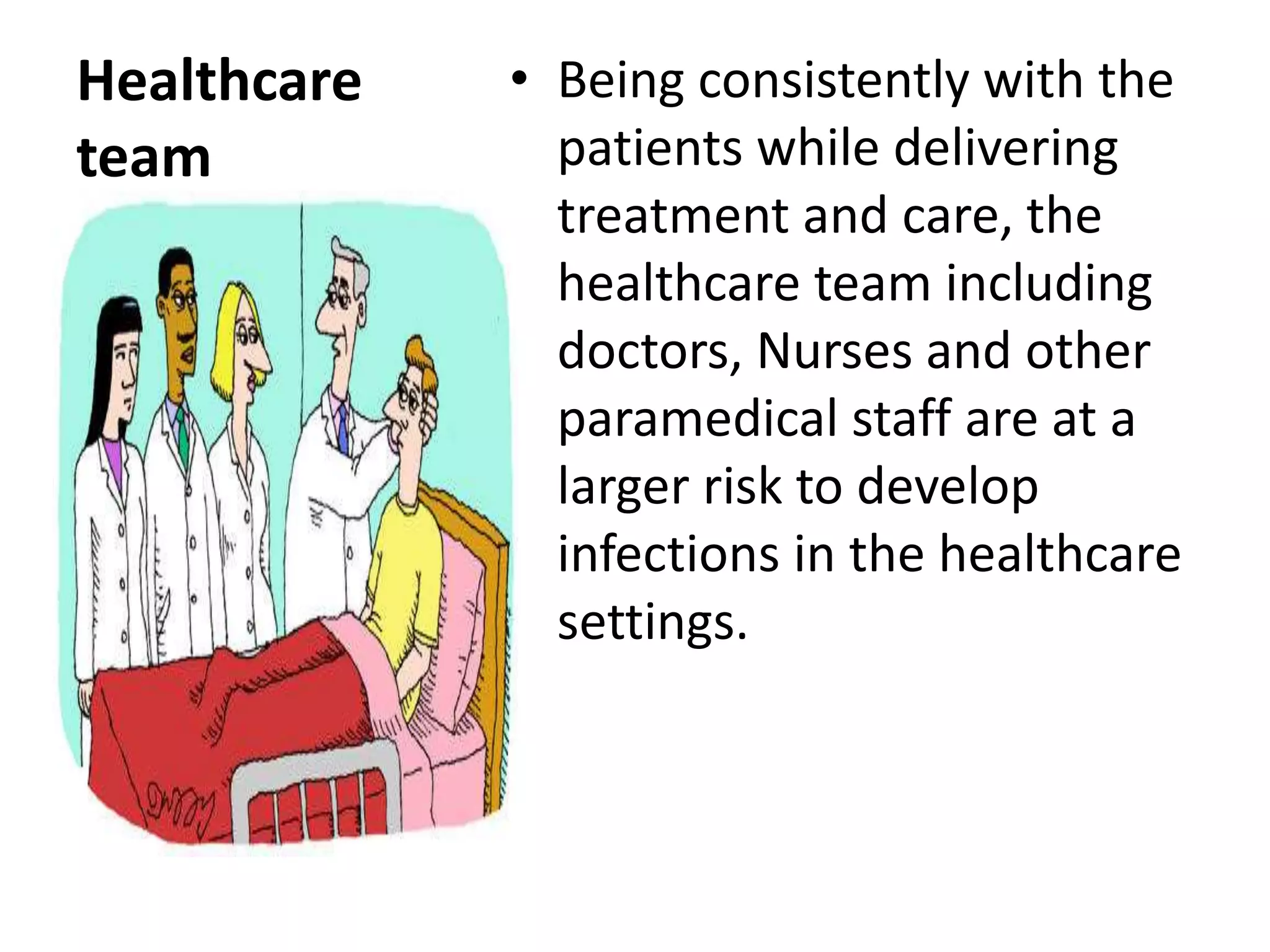
Healthcare
team
• Being consistently with the
patients while delivering
treatment and care, the
healthcare team including
doctors, Nurses and other
paramedical staff are at a
larger risk to develop
infections in the healthcare
settings.
Universal
precautions
Aiming at preventing spread
of infection:
Standard precautions: these
measures must be applied
during every patient care,
during exposure to any
potentially infected material
or body fluids as blood and
others.
Components:
Hand washing.
Personal protective
equipments (PPE).
Sharp disposal.
Handling of contaminated
material.
HAND
WASHING
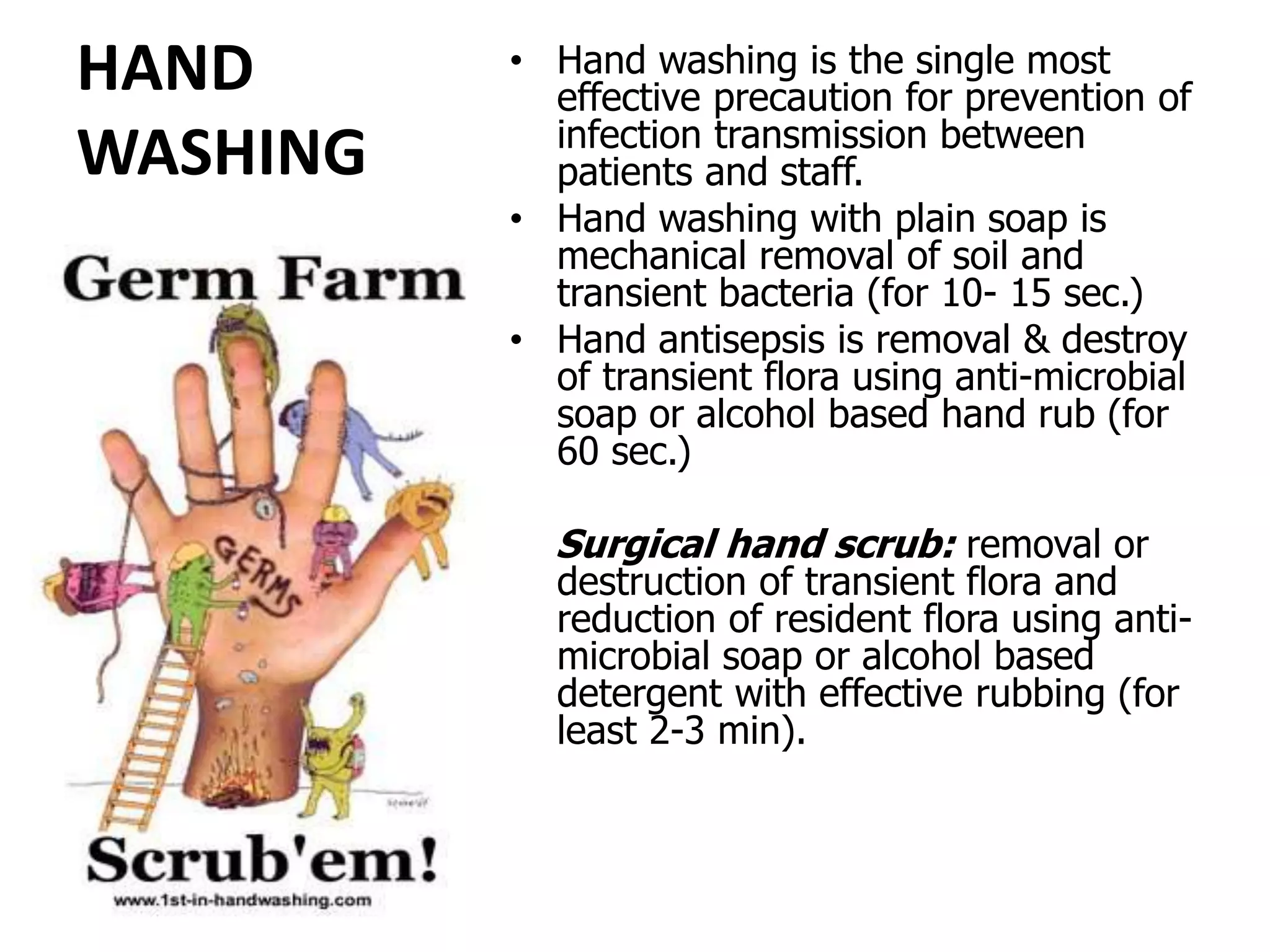
• Hand washing is the single most
effective precaution for prevention of
infection transmission between
patients and staff.
• Hand washing with plain soap is
mechanical removal of soil and
transient bacteria (for 10- 15 sec.)
• Hand antisepsis is removal & destroy
of transient flora using anti-microbial
soap or alcohol based hand rub (for
60 sec.)
Surgical hand scrub: removal or
destruction of transient flora and
reduction of resident flora using anti-
microbial soap or alcohol based
detergent with effective rubbing (for
least 2-3 min).
Contd..
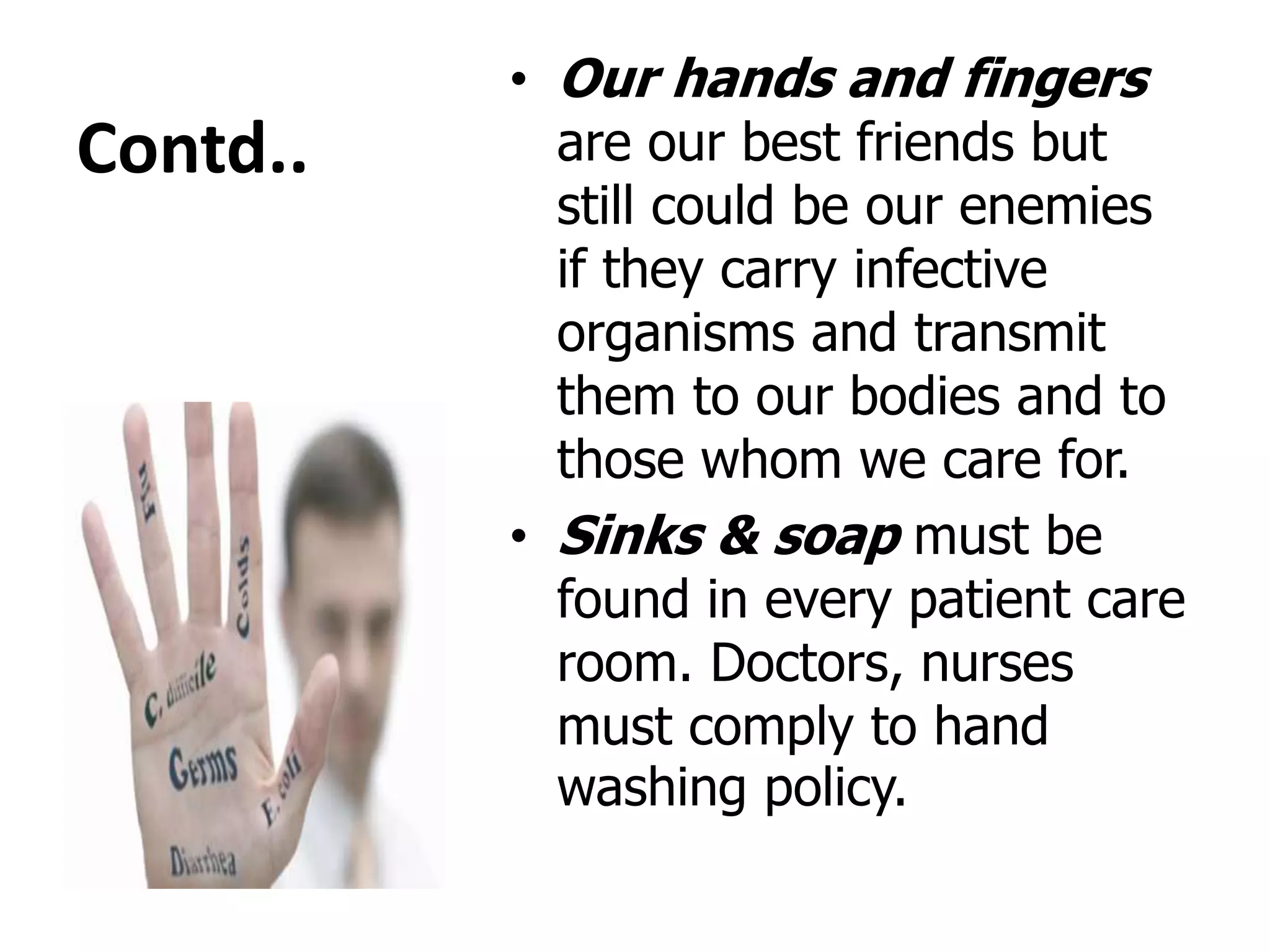
• Our hands and fingers
are our best friends but
still could be our enemies
if they carry infective
organisms and transmit
them to our bodies and to
those whom we care for.
• Sinks & soap must be
found in every patient care
room. Doctors, nurses
must comply to hand
washing policy.
When to Wash
our Hands
1. Before & after an aseptic
technique or invasive
procedure.
2. Before & after contact
with a patient or caring of
a wound or IV line.
3. After contact with body
fluids & excreta removal.
4. After handling of
contaminated equipment
or laundry.
5. Before the administration
of medicines
6. After cleaning of spillage.
Contd..
7. After using the toilet.
8. Before having meals.
9. At the beginning and end of duty.
10. Gloves cannot substitute hand washing
which must be done before putting on gloves
and after their removal.
…
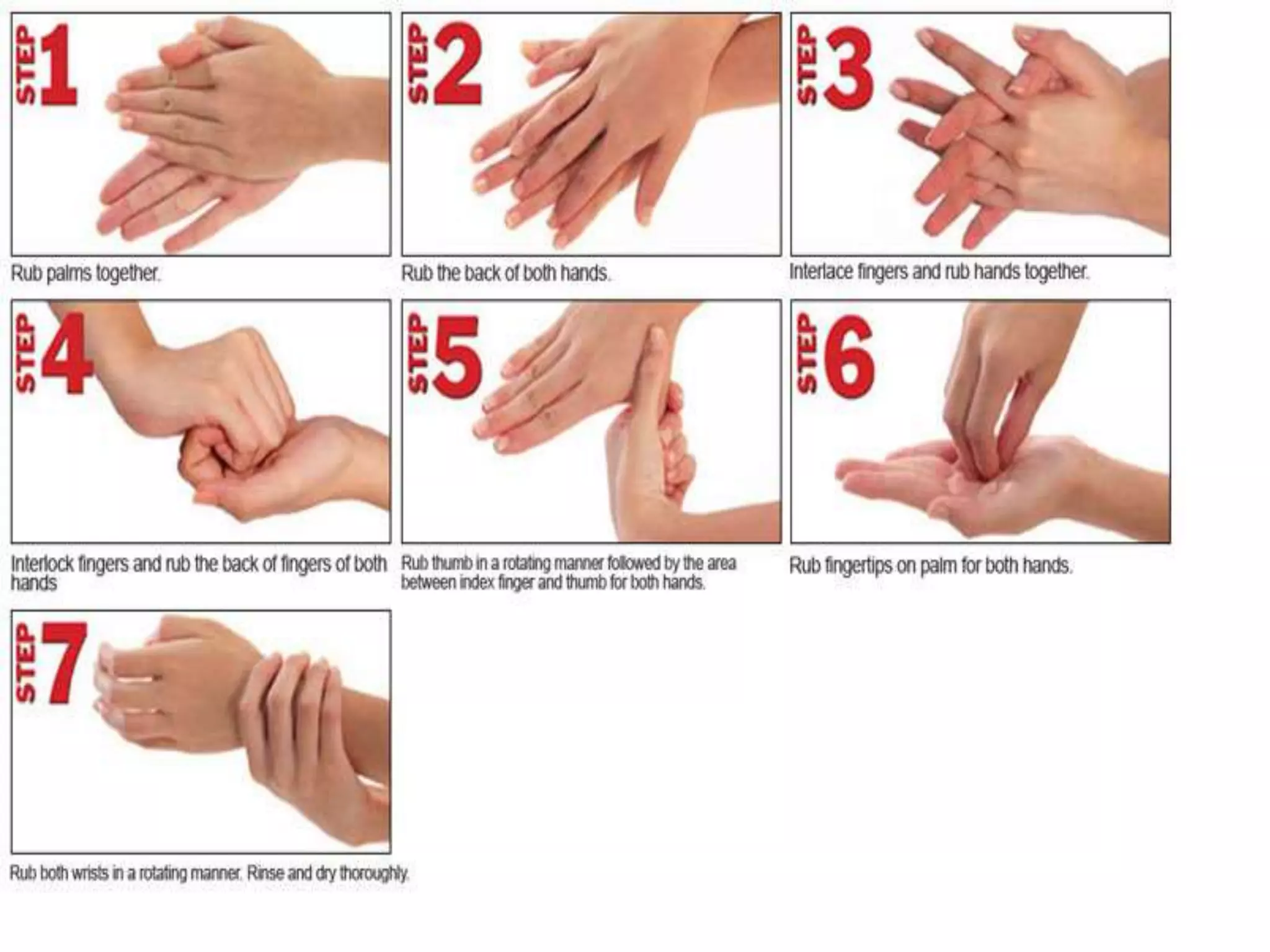
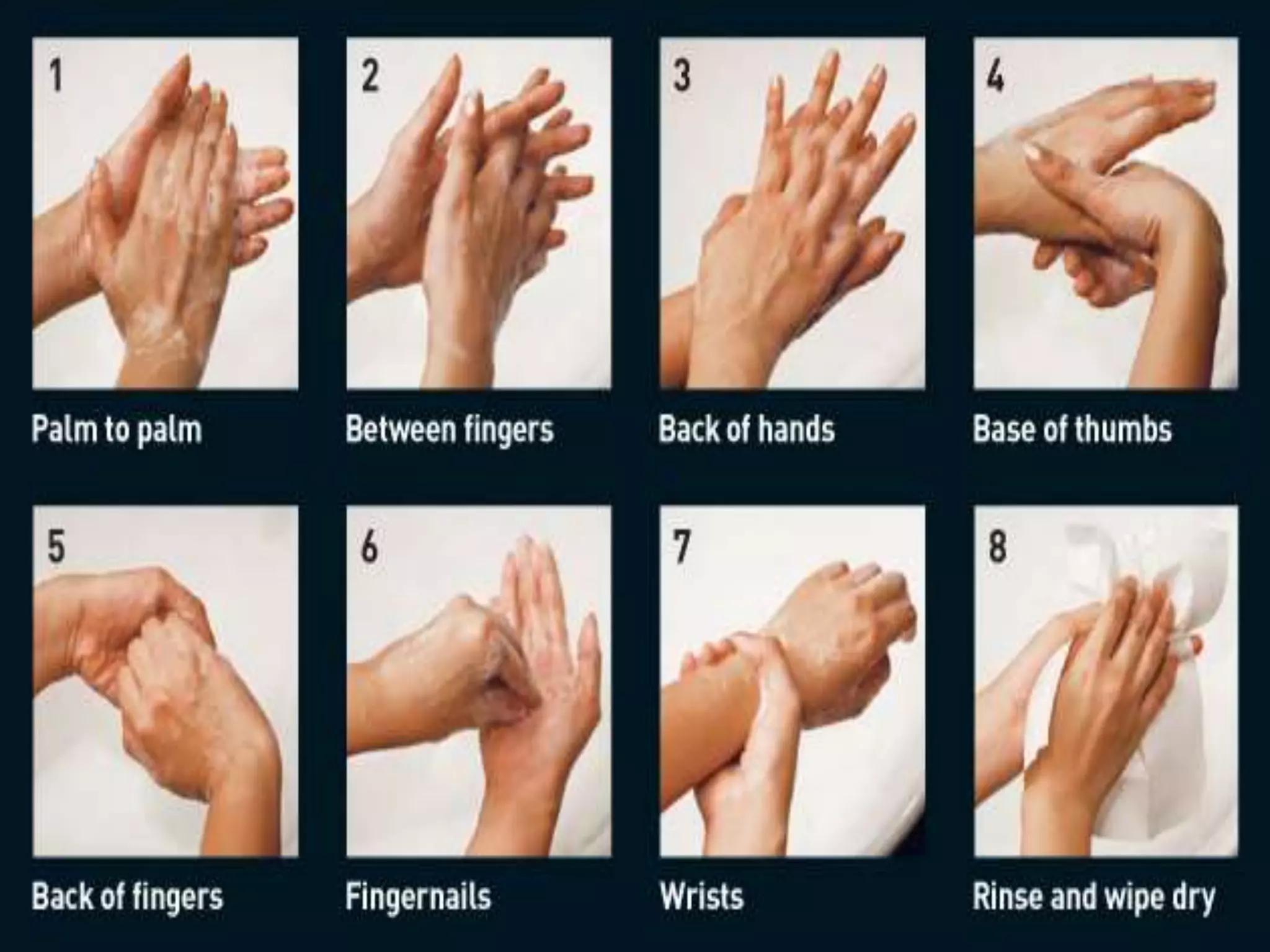
Jewelry must be removed. If unable to remove rings,
wash and dry thoroughly around them.
Wet your hands thoroughly before applying washing
agent.
Rub palm to palm.
Right palm over back of left hand and left palm over
back of right hand.
Palm to palm fingers interlaced.
Back of fingers to opposing palms with fingers
interlocked.
Wash each thumb by clasping and rotating in the palm
of the opposite hand.
Rotational rubbing back and forwards with clasped
fingers of right hand in left palm and vice versa.
Rinse hands under running water.
Dry hands thoroughly.
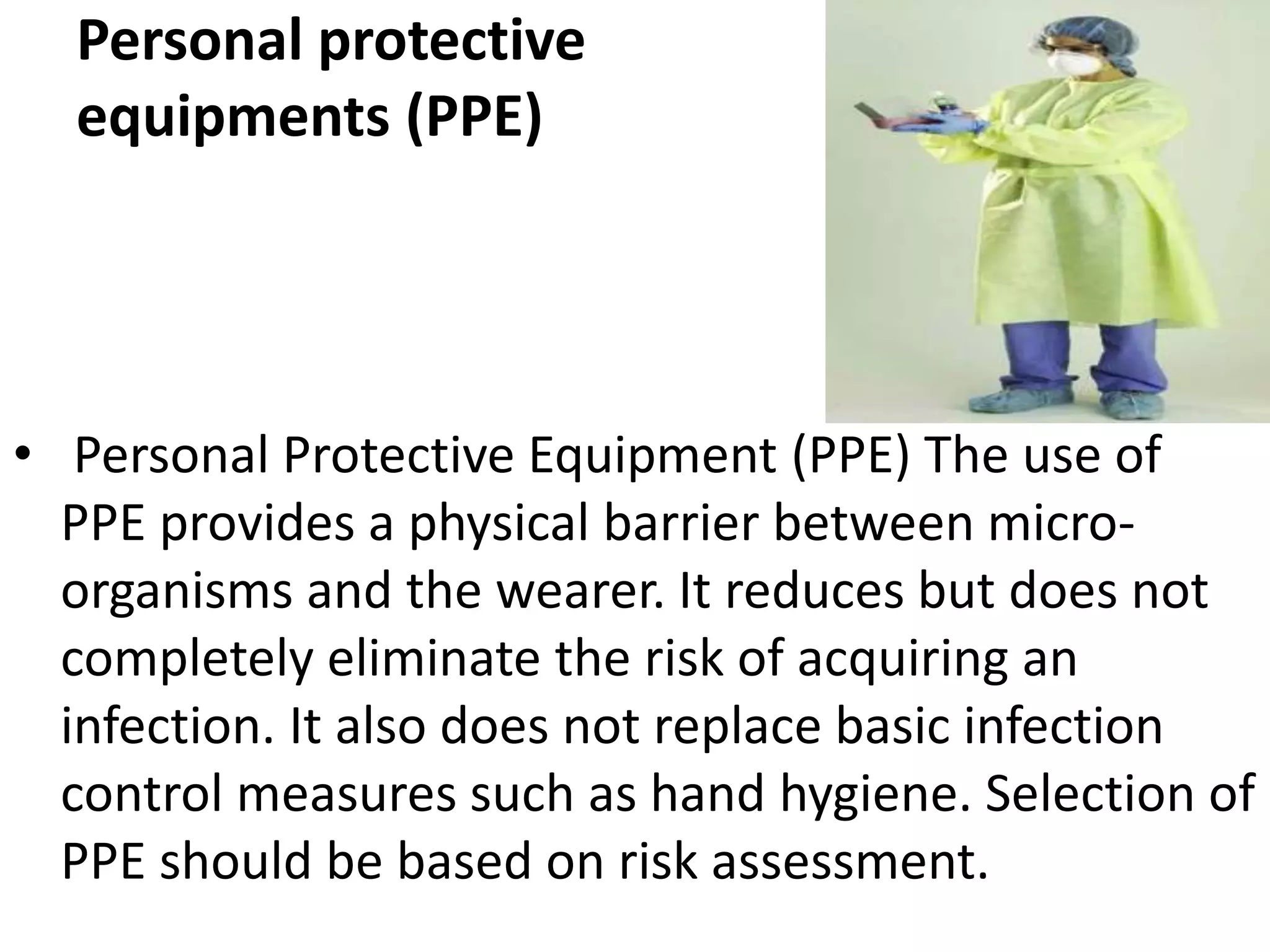
Personal protective
equipments (PPE)
• Personal Protective Equipment (PPE) The use of
PPE provides a physical barrier between micro-
organisms and the wearer. It reduces but does not
completely eliminate the risk of acquiring an
infection. It also does not replace basic infection
control measures such as hand hygiene. Selection of
PPE should be based on risk assessment.
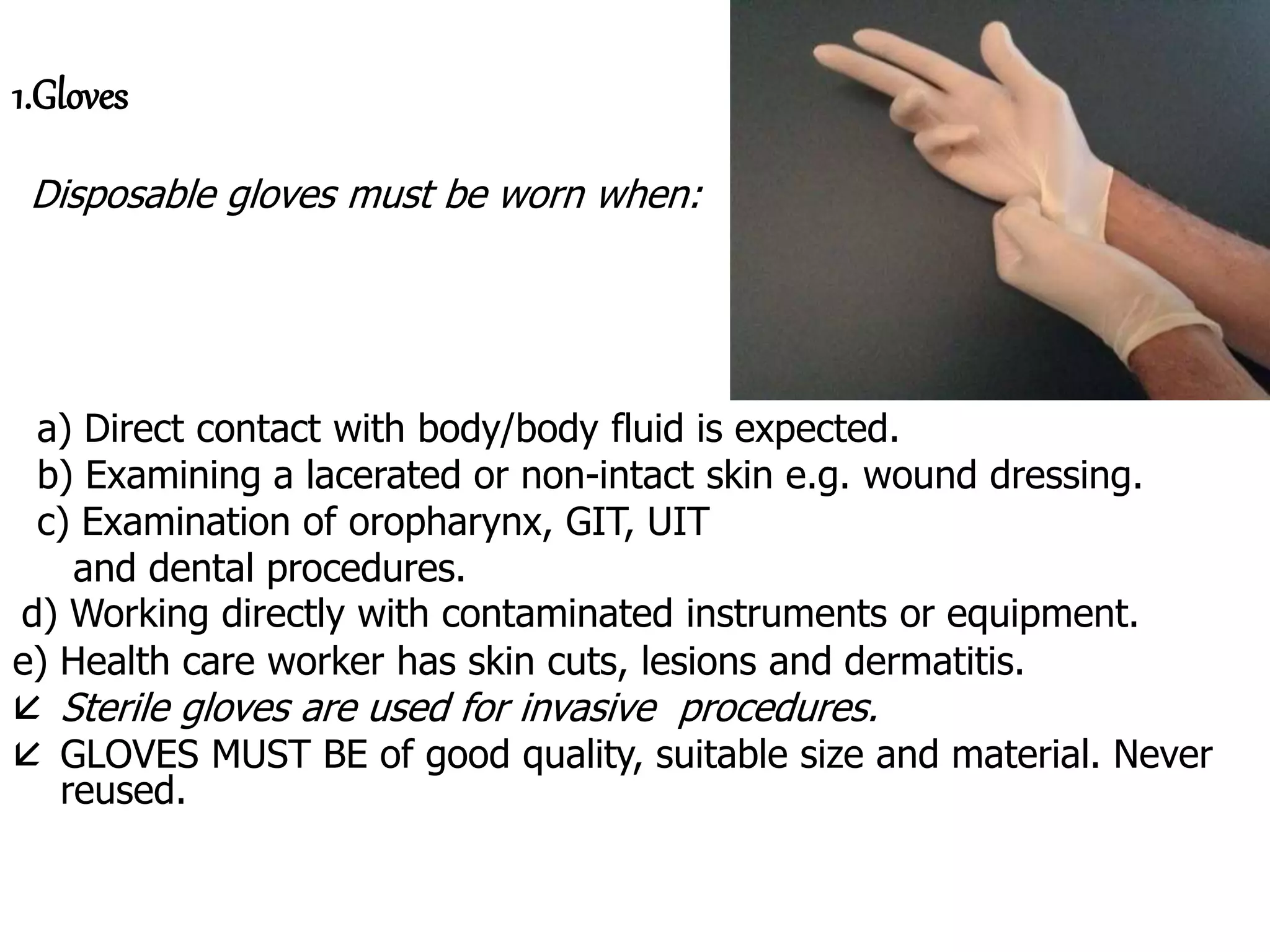
1.Gloves
Disposable gloves must be worn when:
a) Direct contact with body/body fluid is expected.
b) Examining a lacerated or non-intact skin e.g. wound dressing.
c) Examination of oropharynx, GIT, UIT
and dental procedures.
d) Working directly with contaminated instruments or equipment.
e) Health care worker has skin cuts, lesions and dermatitis.
 Sterile gloves are used for invasive procedures.
 GLOVES MUST BE of good quality, suitable size and material. Never
reused.
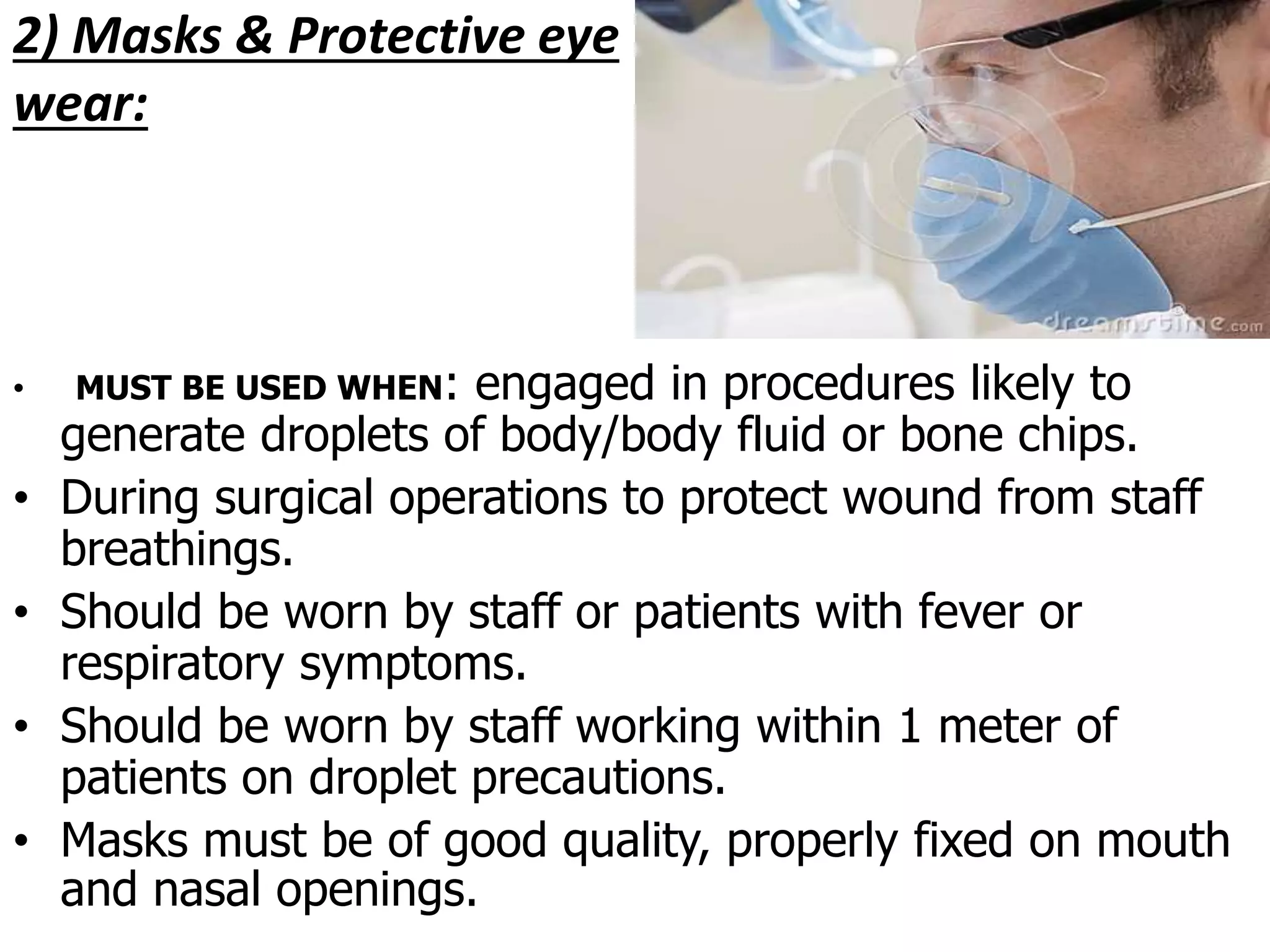
2) Masks & Protective eye
wear:
• MUST BE USED WHEN: engaged in procedures likely to
generate droplets of body/body fluid or bone chips.
• During surgical operations to protect wound from staff
breathings.
• Should be worn by staff or patients with fever or
respiratory symptoms.
• Should be worn by staff working within 1 meter of
patients on droplet precautions.
• Masks must be of good quality, properly fixed on mouth
and nasal openings.
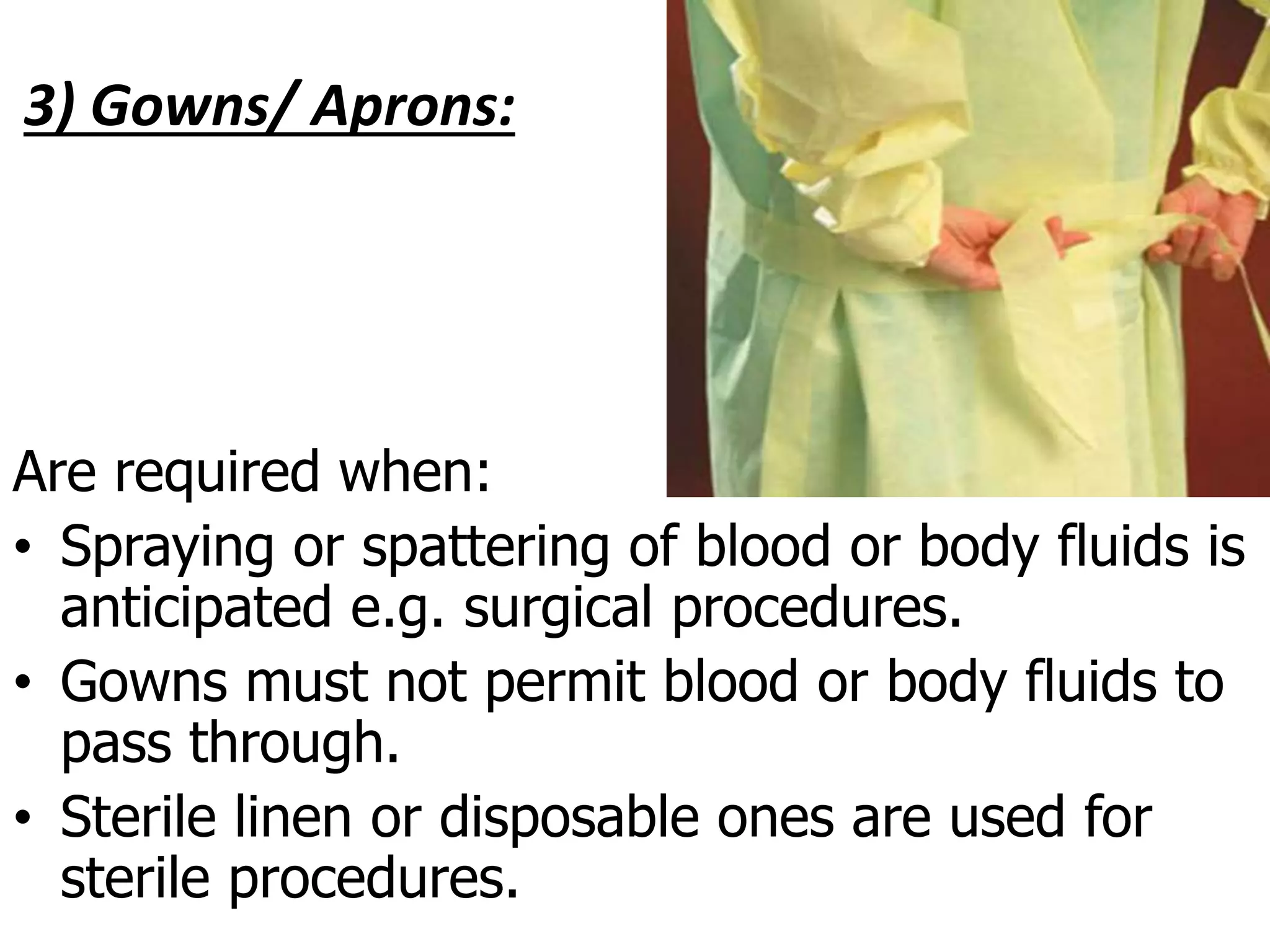
3) Gowns/ Aprons:
Are required when:
• Spraying or spattering of blood or body fluids is
anticipated e.g. surgical procedures.
• Gowns must not permit blood or body fluids to
pass through.
• Sterile linen or disposable ones are used for
sterile procedures.
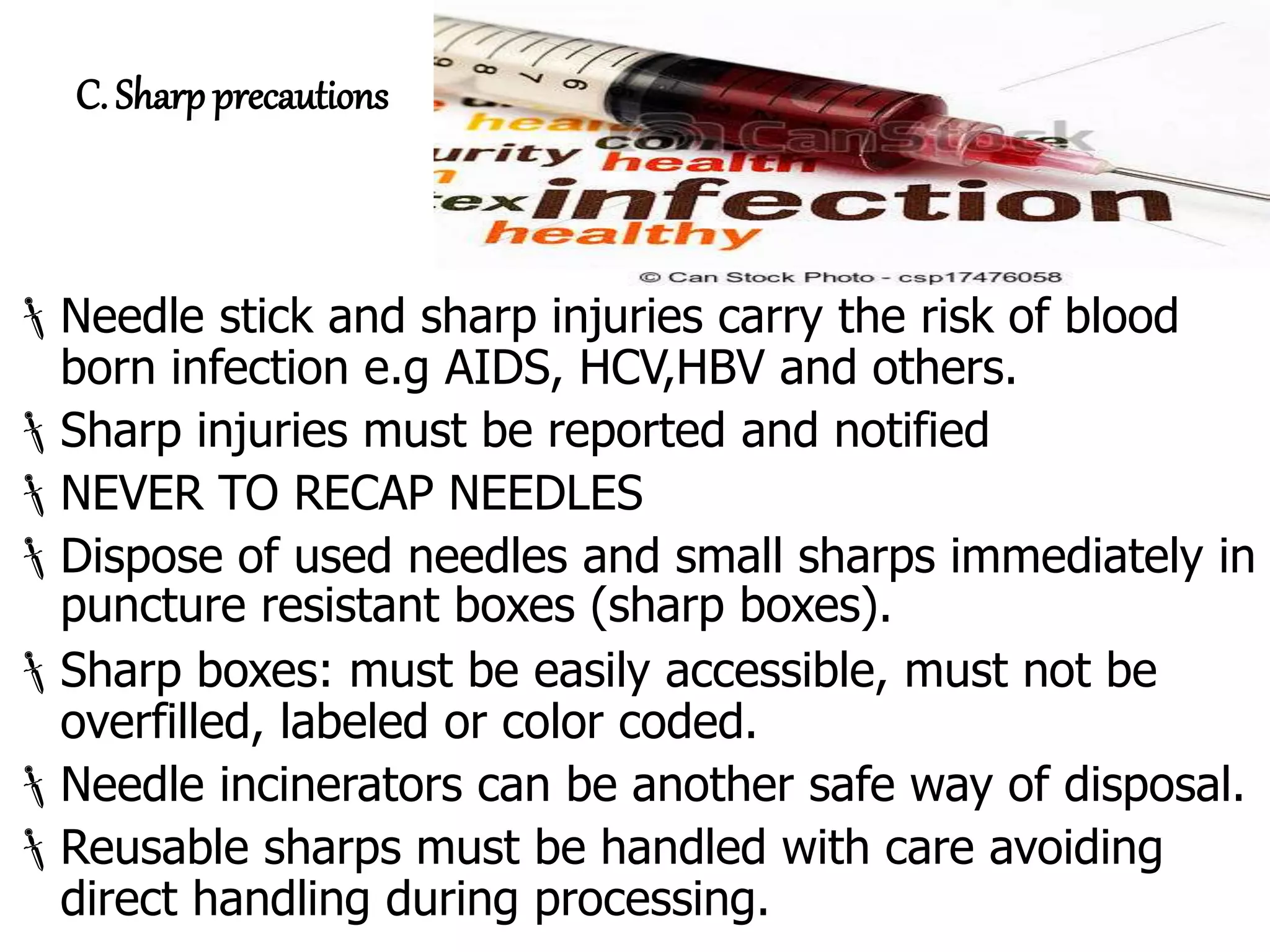
C. Sharp precautions
Needle stick and sharp injuries carry the risk of blood
born infection e.g AIDS, HCV,HBV and others.
Sharp injuries must be reported and notified
NEVER TO RECAP NEEDLES
Dispose of used needles and small sharps immediately in
puncture resistant boxes (sharp boxes).
Sharp boxes: must be easily accessible, must not be
overfilled, labeled or color coded.
Needle incinerators can be another safe way of disposal.
Reusable sharps must be handled with care avoiding
direct handling during processing.
D. Handling of Contaminated Material
1. Cleaning of blood/body fluid spills:
 Wear gloves.
 Wipe-up the spill with paper or towel.
 Apply disinfectant.
2. Cleaning & decontamination of equipment:
 Protective barriers must be worn.
3. Handling & processing lab specimens:
 Must be in strong plastic bags with biohazard label.
4. Handling and processing linen:
 Soiled linen must be handled with barrier precautions, sent
to laundry in coded bags.
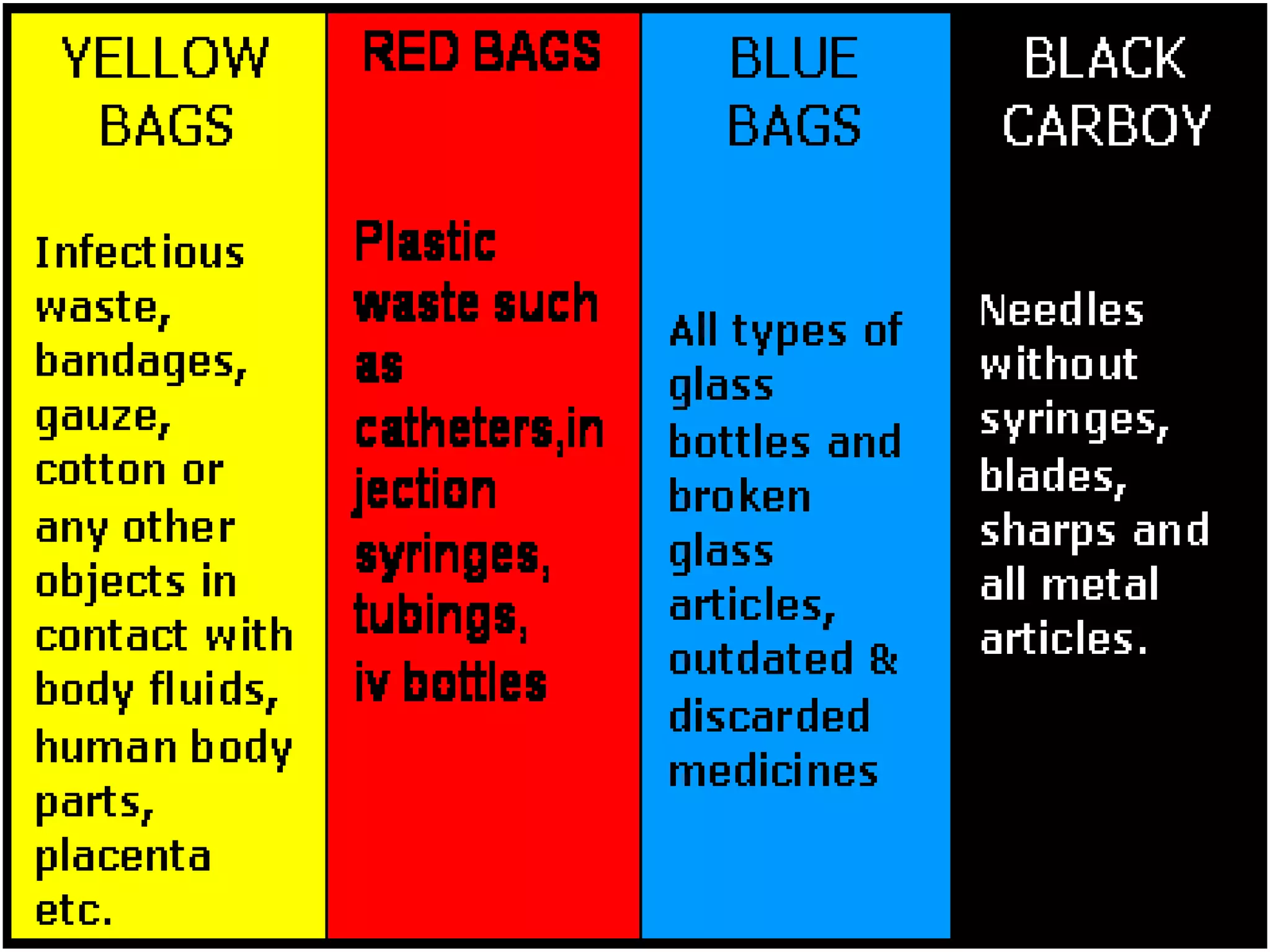
5. Handling and processing infectious waste:
 Must be placed in color coded, leakage
proof bags, collected with barrier precautions
 Contaminated waste incinerated or better autoclaved prior
to disposal in a landfill.
Environmental
control:
1. Including physical facility plans must meet quality and
infection control measures. Patient equipment positioning
and installation, traffic flow.
2. Cleaning of hospital environment and disinfection according
to policies.
3. Proper air ventilation.
4. Water pipes examination, check its quality.
5. Proper waste collection and disposal.
6. Cleaning and disinfection of equipment.
7. Proper linen collection, cleaning and distribution.
8. Food : ensure quality and safety.
9. Sterilization: Central sterilization department serving
all hospital departments compiling with infection control
precautions.
Staff health promotion and
education:
1. HCW are at risk of acquiring infection, they can
also transmit infection to patients and
other employee.
2. Employee health history must be reviewed,
immunizations recommendations to be
considered.
3. Release from work if sick, occupation injury
must be notified.
4. Continuous education to improve practice,
better performance of new techniques.
INFECTION CONTROL by syed shahid siraj

INFECTION CONTROL by syed shahid siraj

  • 1.
    BY: Syed Shahid Clinicalinstructor ISLAMIC UNIVERSITY KASHMIR
  • 2.
    INFECTION • An invasionof pathogens or microorganisms into the body that are capable of producing disease. • The invasion and reproduction of microorganisms in a body tissue that can result in a local or systemic clinical response such as cellulitis, fever etc.
  • 4.
    MODES OF TRANSMISSION  Bodyfluids – tears, saliva, sputum (mucus coughed up), urine, feces, semen, vaginal secretions, pus or other wound drainage, blood  Touching the infected person or their secretions  Touching something contaminated by the infected person.  Droplets – coughing, sneezing, laughing, spitting, talking
  • 5.
    PORTALS OF ENTRY • Anybody opening of an uninfected person which allows pathogens to enter • Nose, mouth, eyes, rectum, genitals and other mucous membranes • Cuts, abrasions or breaks in the skin
  • 6.
  • 9.
    1.Patients 1. Lower resistanceto infectious microorganisms (due to illness or disease). 2. Exposure to an increased number of and more types of disease-causing organisms. (Hospital harbors a high population of virulent strains of microorganisms that are resistant to antibiotics) MRSA, VRE – super bugs. 3. The performance of invasive procedures. (IV catheters etc.. Anything that crosses protective barriers)
  • 10.
    Attendants • The relationshipof hospital infections with an increased number of attendants/visitors is beyond doubt. • They become the carriers of infection putting both on risk of developing infections i.e. patients and healthcare team.
  • 11.
    Healthcare team • Being consistentlywith the patients while delivering treatment and care, the healthcare team including doctors, Nurses and other paramedical staff are at a larger risk to develop infections in the healthcare settings.
  • 13.
    Universal precautions Aiming at preventingspread of infection: Standard precautions: these measures must be applied during every patient care, during exposure to any potentially infected material or body fluids as blood and others. Components: Hand washing. Personal protective equipments (PPE). Sharp disposal. Handling of contaminated material.
  • 14.
    HAND WASHING • Hand washingis the single most effective precaution for prevention of infection transmission between patients and staff. • Hand washing with plain soap is mechanical removal of soil and transient bacteria (for 10- 15 sec.) • Hand antisepsis is removal & destroy of transient flora using anti-microbial soap or alcohol based hand rub (for 60 sec.) Surgical hand scrub: removal or destruction of transient flora and reduction of resident flora using anti- microbial soap or alcohol based detergent with effective rubbing (for least 2-3 min).
  • 15.
    Contd.. • Our handsand fingers are our best friends but still could be our enemies if they carry infective organisms and transmit them to our bodies and to those whom we care for. • Sinks & soap must be found in every patient care room. Doctors, nurses must comply to hand washing policy.
  • 17.
    When to Wash ourHands 1. Before & after an aseptic technique or invasive procedure. 2. Before & after contact with a patient or caring of a wound or IV line. 3. After contact with body fluids & excreta removal. 4. After handling of contaminated equipment or laundry. 5. Before the administration of medicines 6. After cleaning of spillage.
  • 18.
    Contd.. 7. After usingthe toilet. 8. Before having meals. 9. At the beginning and end of duty. 10. Gloves cannot substitute hand washing which must be done before putting on gloves and after their removal.
  • 20.
    … Jewelry must beremoved. If unable to remove rings, wash and dry thoroughly around them. Wet your hands thoroughly before applying washing agent. Rub palm to palm. Right palm over back of left hand and left palm over back of right hand. Palm to palm fingers interlaced. Back of fingers to opposing palms with fingers interlocked. Wash each thumb by clasping and rotating in the palm of the opposite hand. Rotational rubbing back and forwards with clasped fingers of right hand in left palm and vice versa. Rinse hands under running water. Dry hands thoroughly.
  • 23.
    Personal protective equipments (PPE) •Personal Protective Equipment (PPE) The use of PPE provides a physical barrier between micro- organisms and the wearer. It reduces but does not completely eliminate the risk of acquiring an infection. It also does not replace basic infection control measures such as hand hygiene. Selection of PPE should be based on risk assessment.
  • 24.
    1.Gloves Disposable gloves mustbe worn when: a) Direct contact with body/body fluid is expected. b) Examining a lacerated or non-intact skin e.g. wound dressing. c) Examination of oropharynx, GIT, UIT and dental procedures. d) Working directly with contaminated instruments or equipment. e) Health care worker has skin cuts, lesions and dermatitis.  Sterile gloves are used for invasive procedures.  GLOVES MUST BE of good quality, suitable size and material. Never reused.
  • 25.
    2) Masks &Protective eye wear: • MUST BE USED WHEN: engaged in procedures likely to generate droplets of body/body fluid or bone chips. • During surgical operations to protect wound from staff breathings. • Should be worn by staff or patients with fever or respiratory symptoms. • Should be worn by staff working within 1 meter of patients on droplet precautions. • Masks must be of good quality, properly fixed on mouth and nasal openings.
  • 26.
    3) Gowns/ Aprons: Arerequired when: • Spraying or spattering of blood or body fluids is anticipated e.g. surgical procedures. • Gowns must not permit blood or body fluids to pass through. • Sterile linen or disposable ones are used for sterile procedures.
  • 27.
    C. Sharp precautions Needlestick and sharp injuries carry the risk of blood born infection e.g AIDS, HCV,HBV and others. Sharp injuries must be reported and notified NEVER TO RECAP NEEDLES Dispose of used needles and small sharps immediately in puncture resistant boxes (sharp boxes). Sharp boxes: must be easily accessible, must not be overfilled, labeled or color coded. Needle incinerators can be another safe way of disposal. Reusable sharps must be handled with care avoiding direct handling during processing.
  • 28.
    D. Handling ofContaminated Material 1. Cleaning of blood/body fluid spills:  Wear gloves.  Wipe-up the spill with paper or towel.  Apply disinfectant. 2. Cleaning & decontamination of equipment:  Protective barriers must be worn. 3. Handling & processing lab specimens:  Must be in strong plastic bags with biohazard label. 4. Handling and processing linen:  Soiled linen must be handled with barrier precautions, sent to laundry in coded bags. 5. Handling and processing infectious waste:  Must be placed in color coded, leakage proof bags, collected with barrier precautions  Contaminated waste incinerated or better autoclaved prior to disposal in a landfill.
  • 30.
    Environmental control: 1. Including physicalfacility plans must meet quality and infection control measures. Patient equipment positioning and installation, traffic flow. 2. Cleaning of hospital environment and disinfection according to policies. 3. Proper air ventilation. 4. Water pipes examination, check its quality. 5. Proper waste collection and disposal. 6. Cleaning and disinfection of equipment. 7. Proper linen collection, cleaning and distribution. 8. Food : ensure quality and safety. 9. Sterilization: Central sterilization department serving all hospital departments compiling with infection control precautions.
  • 31.
    Staff health promotionand education: 1. HCW are at risk of acquiring infection, they can also transmit infection to patients and other employee. 2. Employee health history must be reviewed, immunizations recommendations to be considered. 3. Release from work if sick, occupation injury must be notified. 4. Continuous education to improve practice, better performance of new techniques.