Search vs Explore
Guest Lecture
INFO30005 Web Information Technologies
Semester 1, 2016
Patrick Pang
Interaction Design Lab
Department of Computing and Information Systems
The University of Melbourne
9 May 2016
Announcement
• This week’s tutorial will start in the computer lab.
2
Introduction
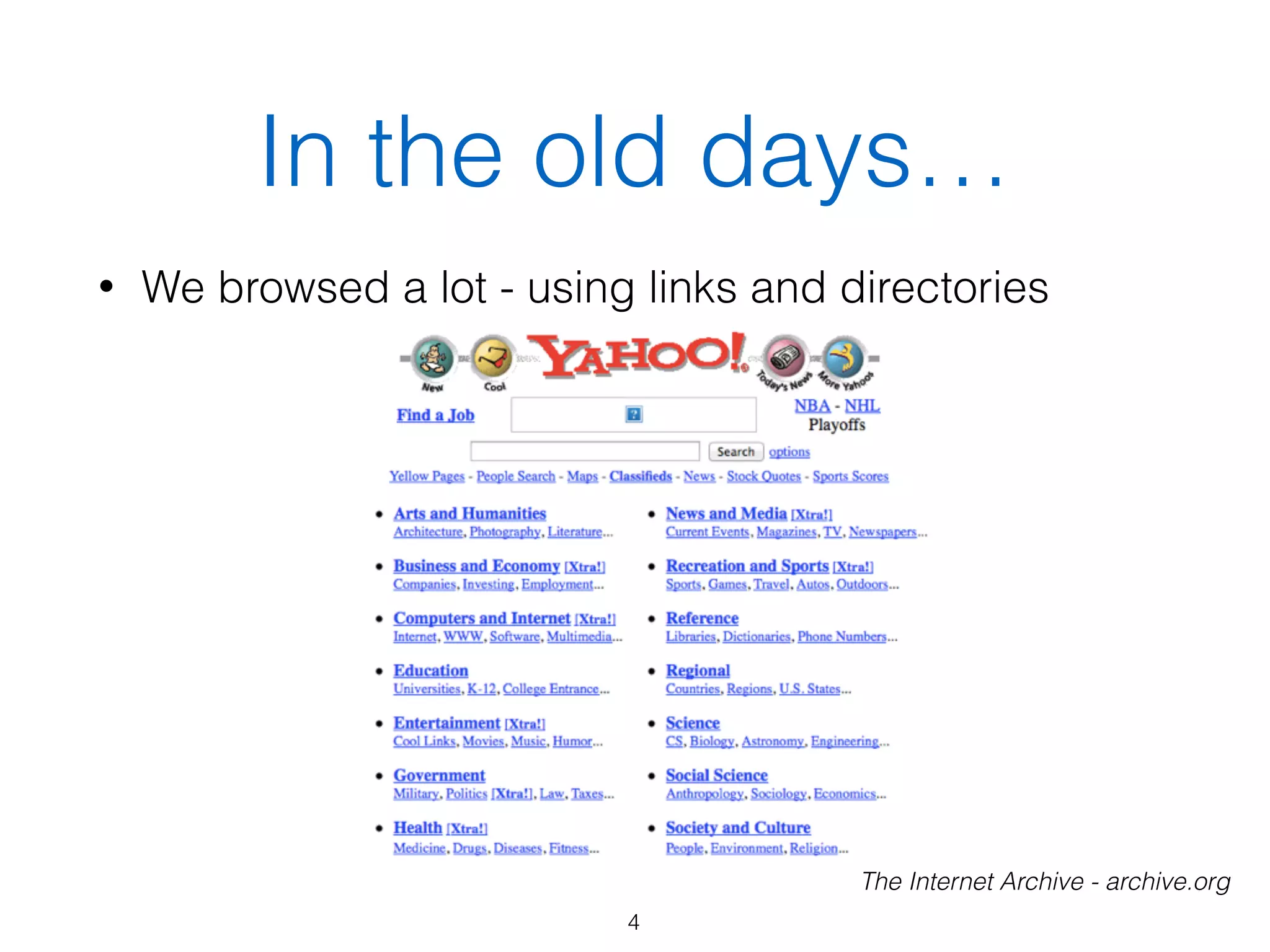
In the old days…
• We browsed a lot - using links and directories
4
The Internet Archive - archive.org
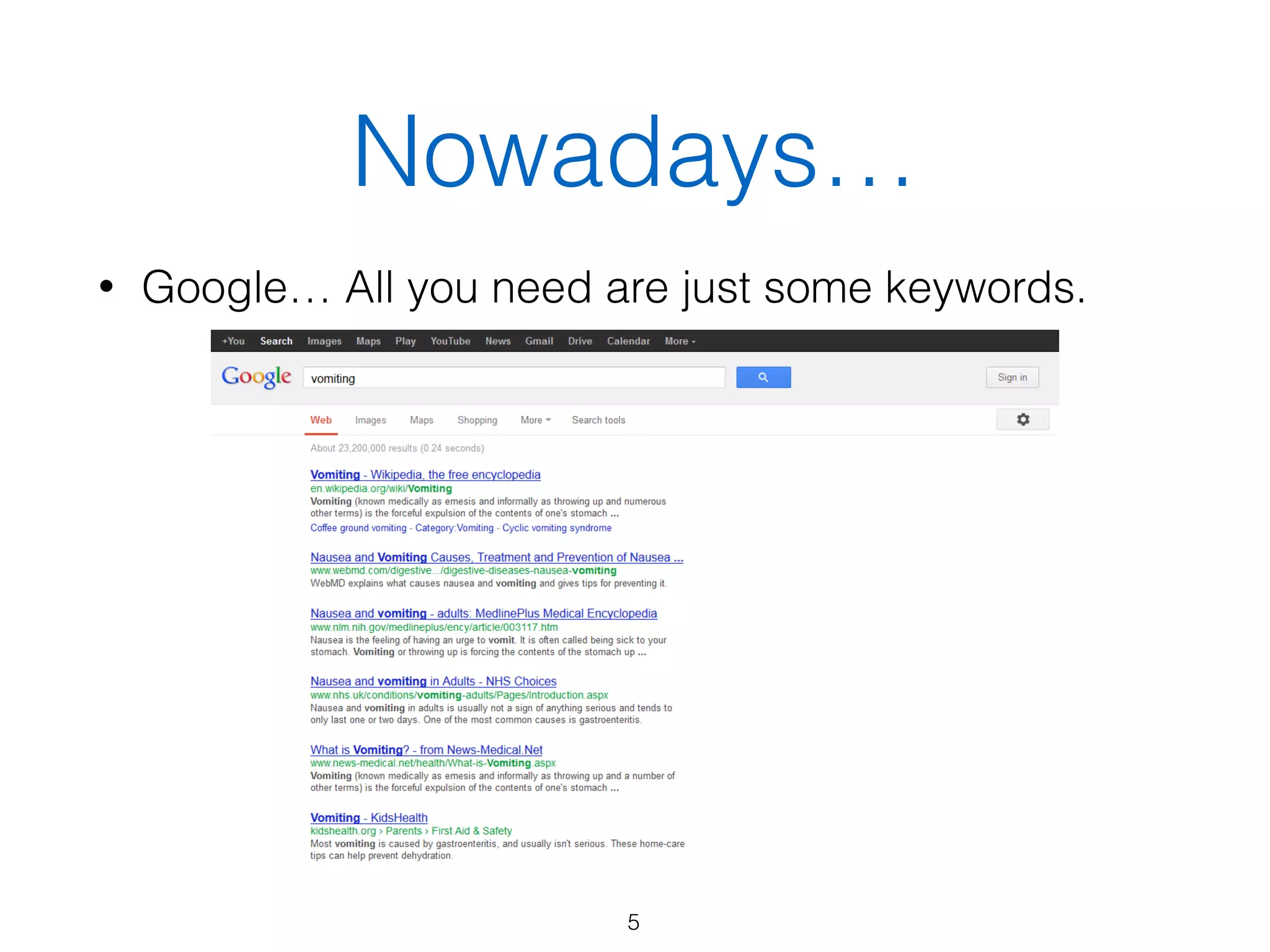
• Google… All you need are just some keywords.
Nowadays…
5
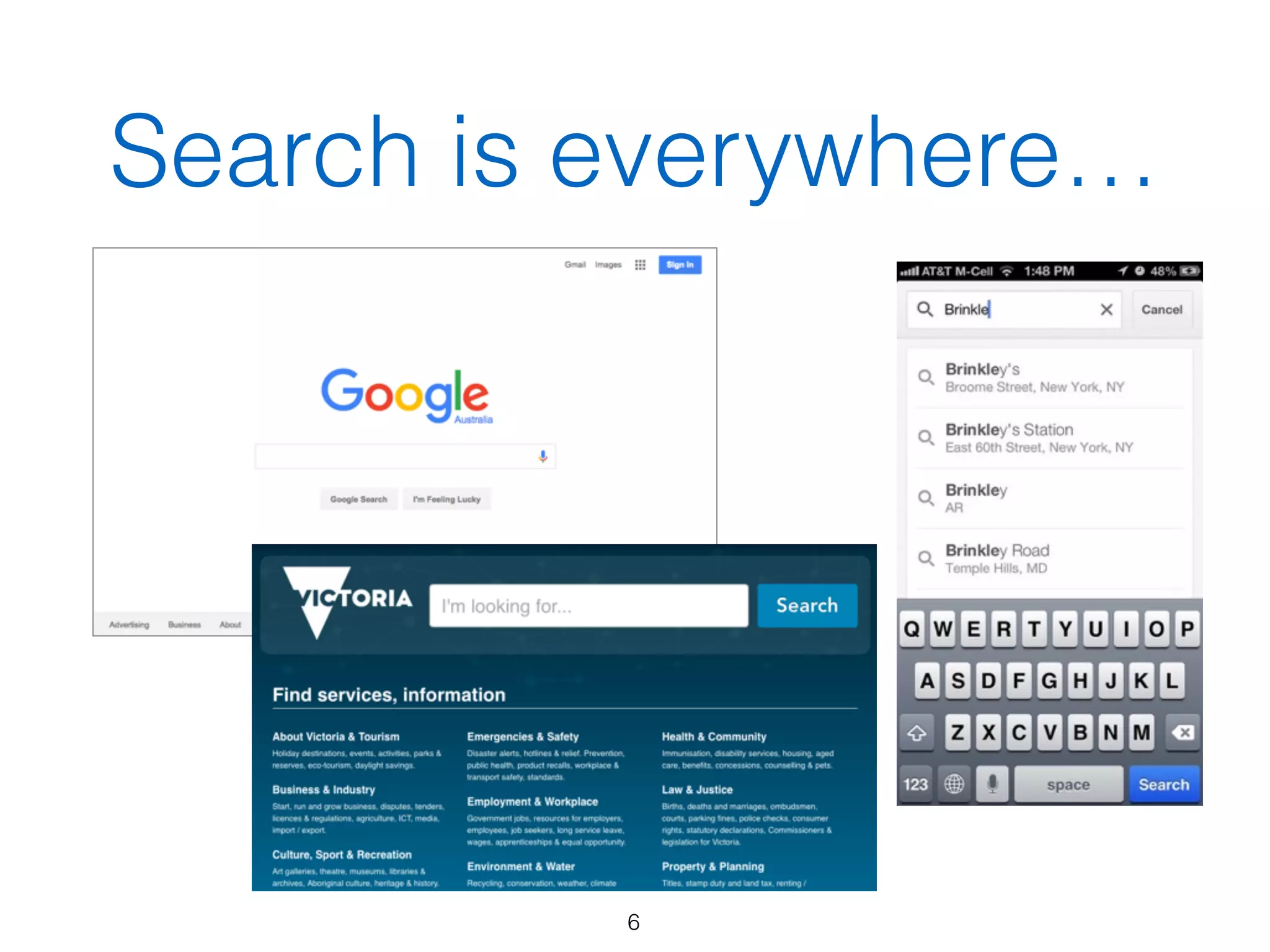
Search is everywhere…
6
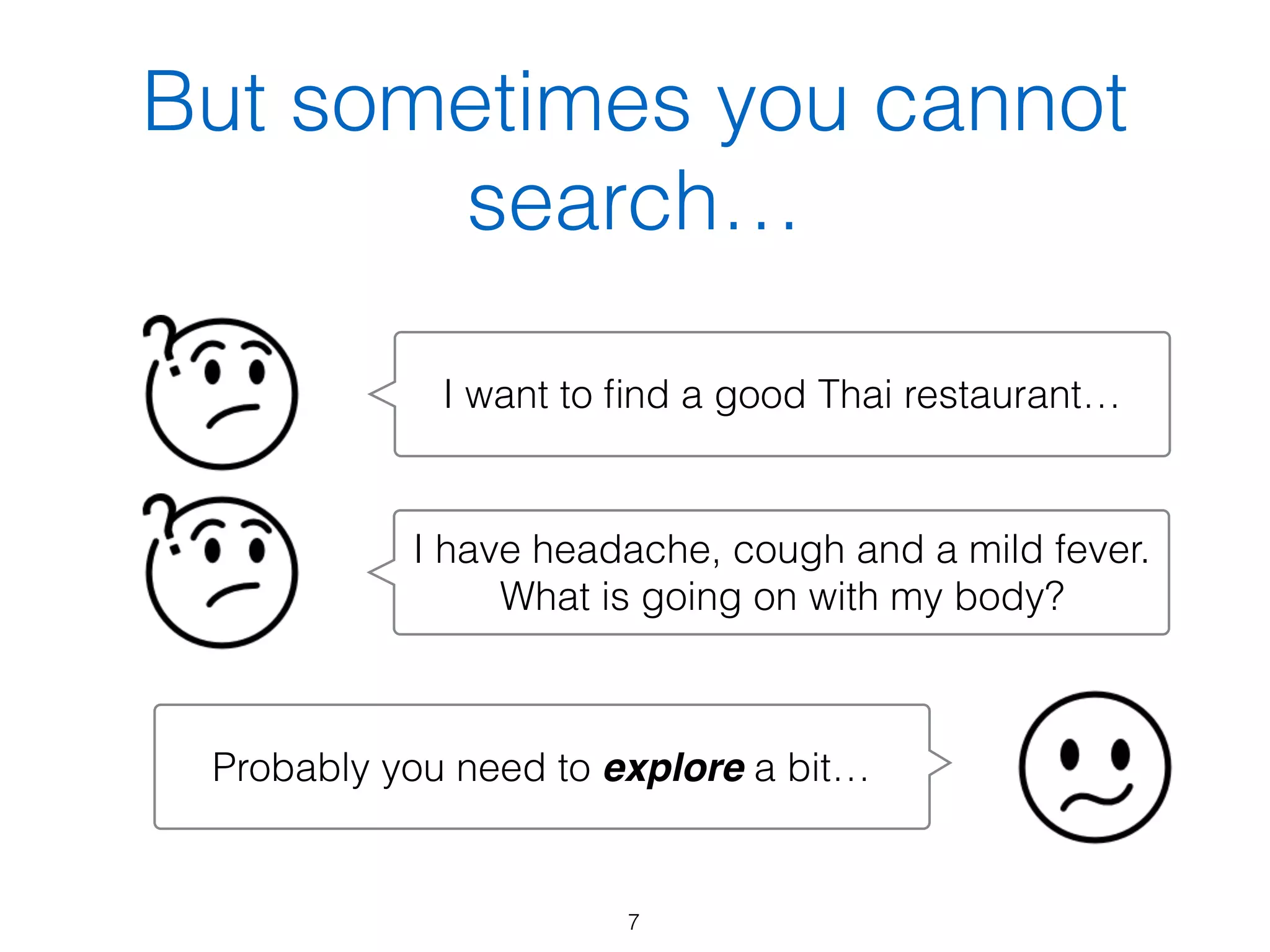
But sometimes you cannot
search…
7
I want to find a good Thai restaurant…
I have headache, cough and a mild fever.
What is going on with my body?
Probably you need to explore a bit…
Definition
8
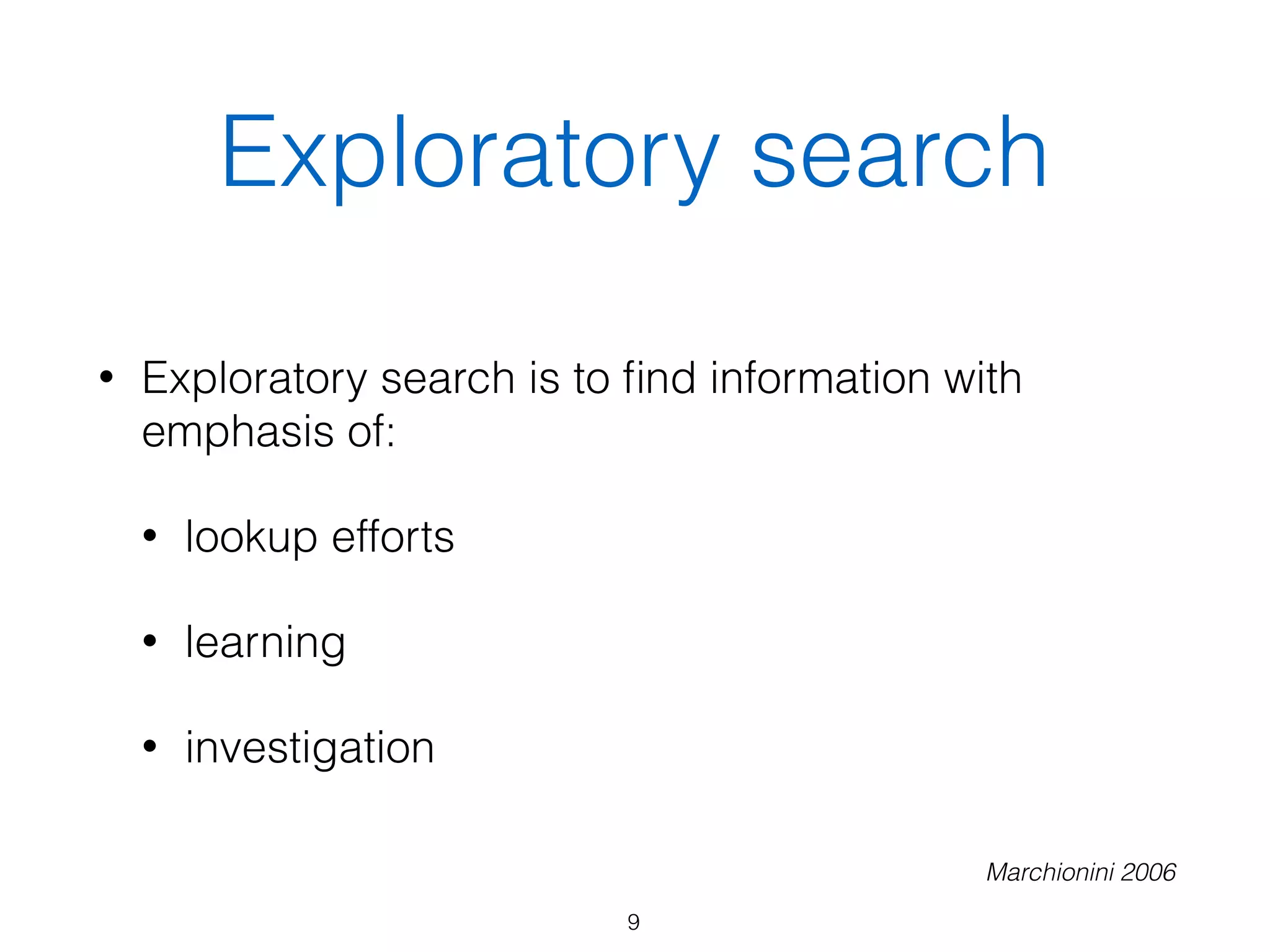
Exploratory search
• Exploratory search is to find information with
emphasis of:
• lookup efforts
• learning
• investigation
9
Marchionini 2006
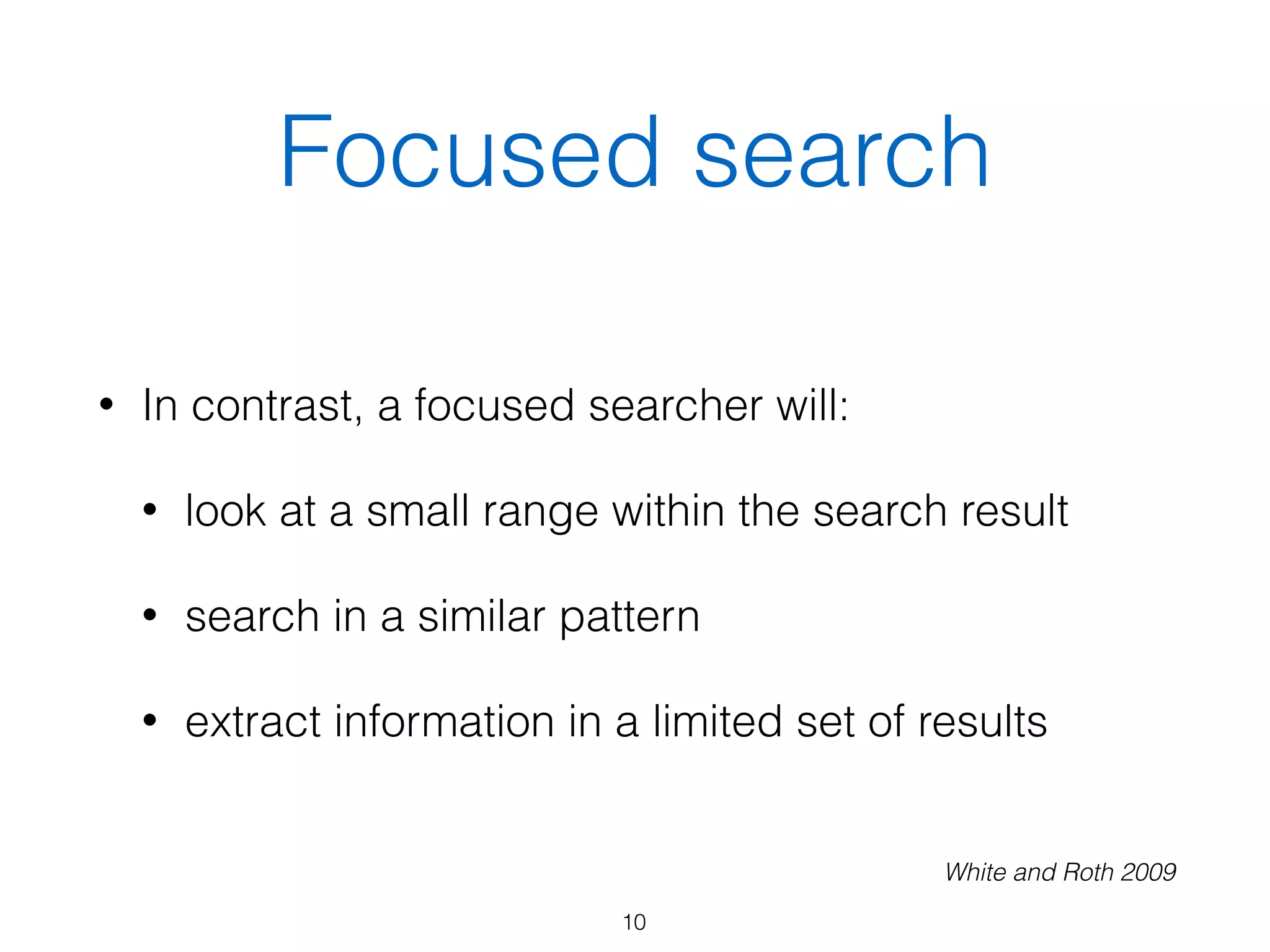
Focused search
• In contrast, a focused searcher will:
• look at a small range within the search result
• search in a similar pattern
• extract information in a limited set of results
10
White and Roth 2009
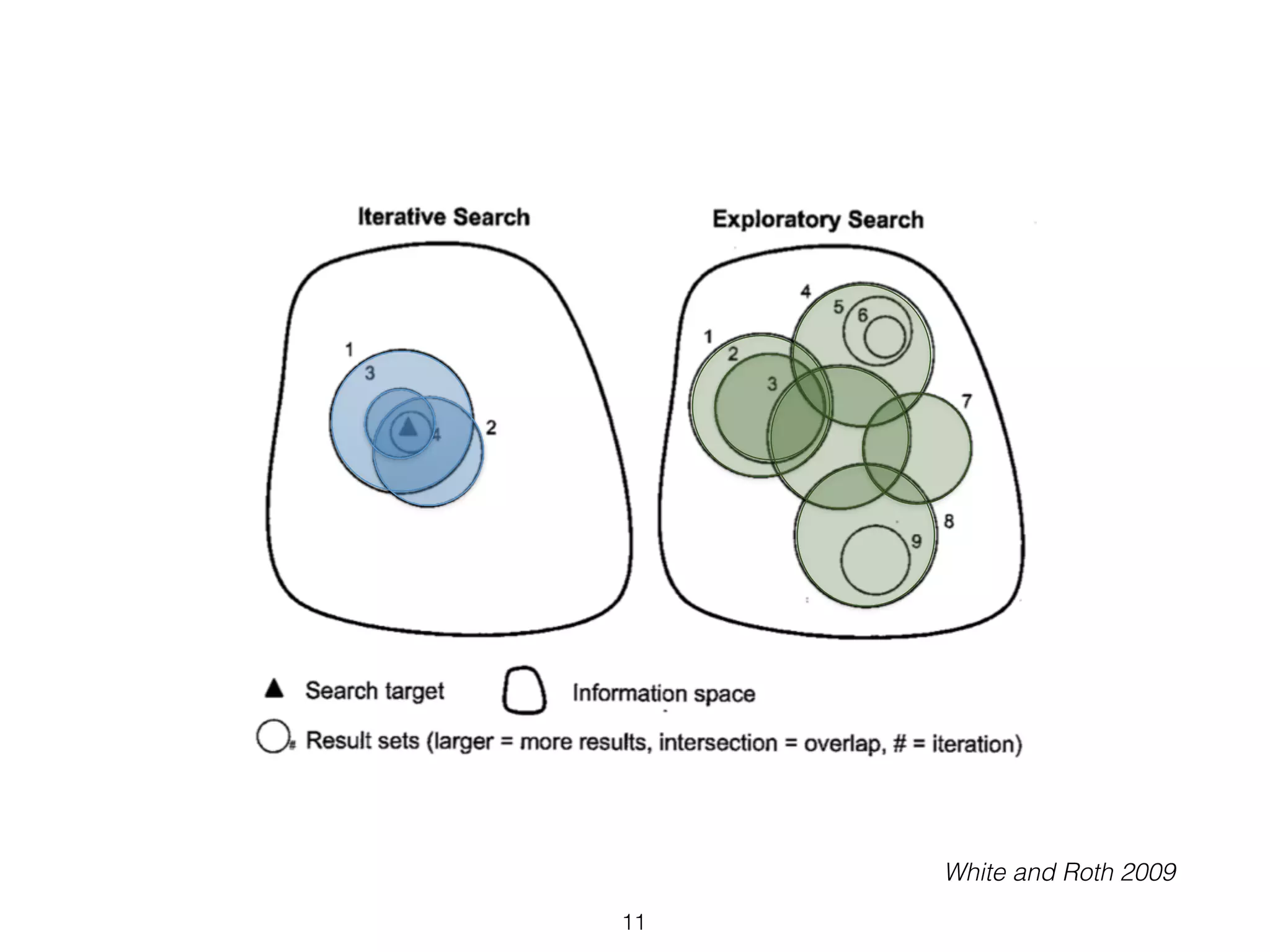
11
White and Roth 2009
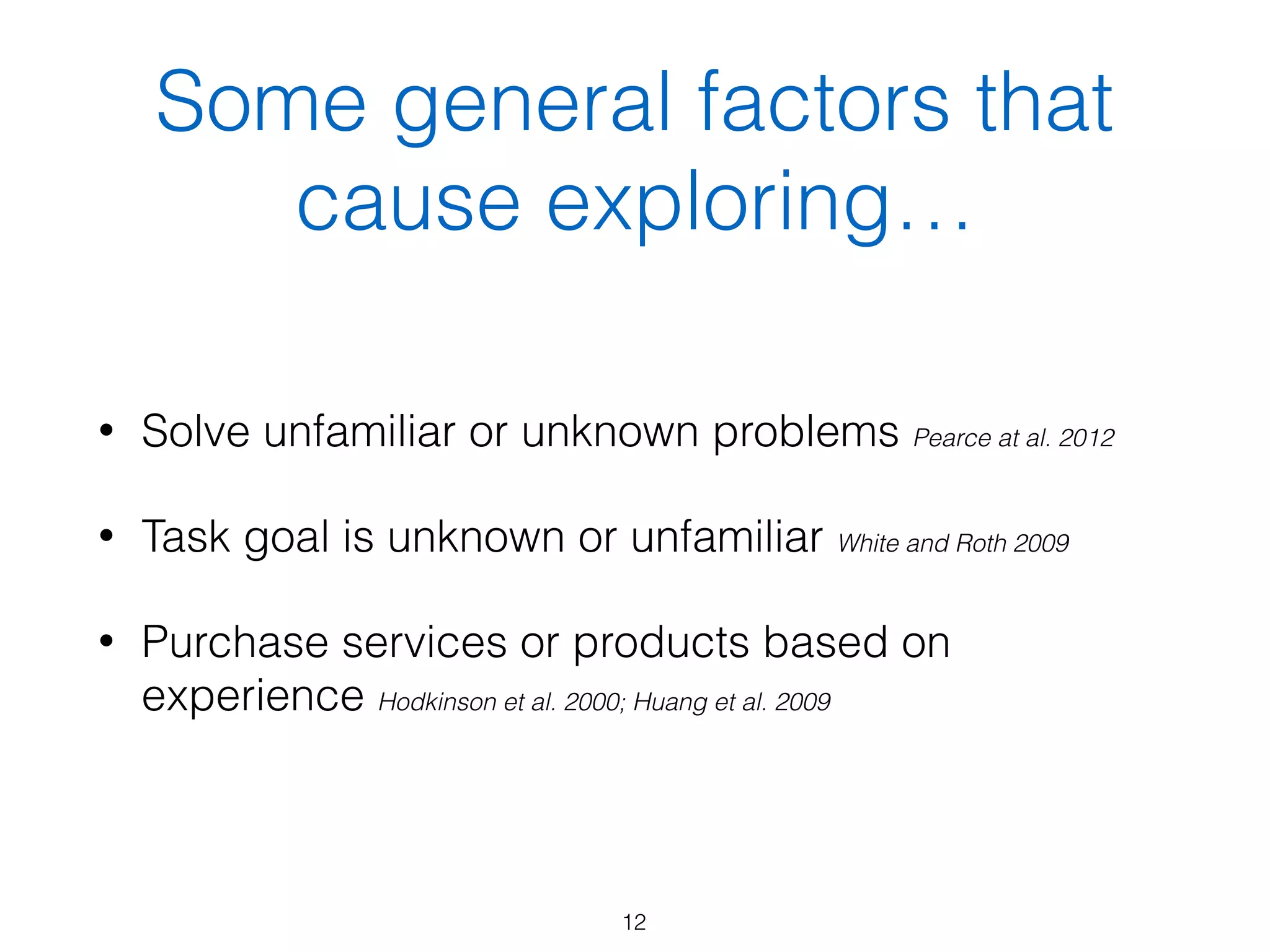
Some general factors that
cause exploring…
• Solve unfamiliar or unknown problems Pearce at al. 2012
• Task goal is unknown or unfamiliar White and Roth 2009
• Purchase services or products based on
experience Hodkinson et al. 2000; Huang et al. 2009
12
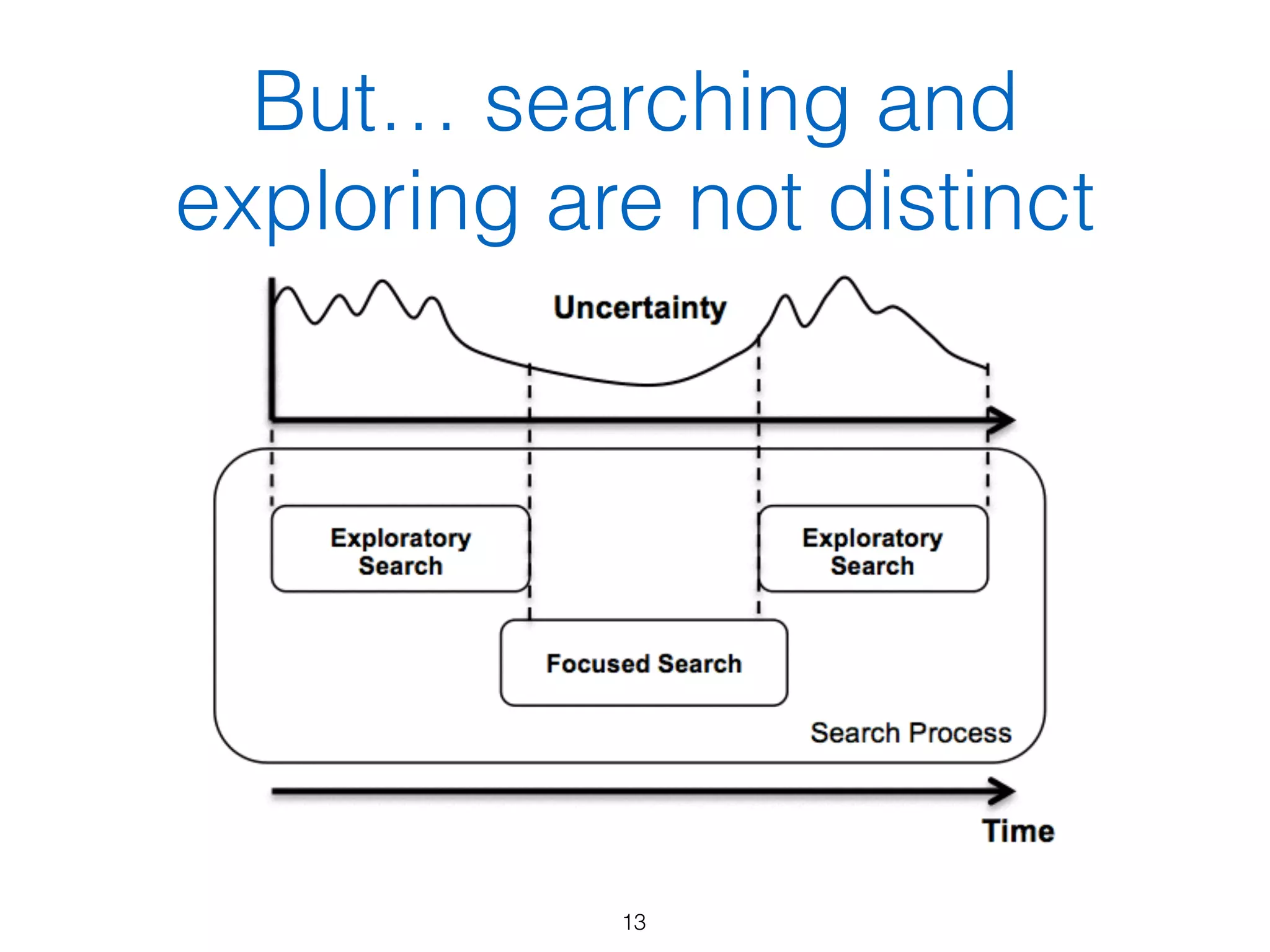
But… searching and
exploring are not distinct
13
Example
Scenario:
Find a nice Thai restaurant for dinner tonight.
14
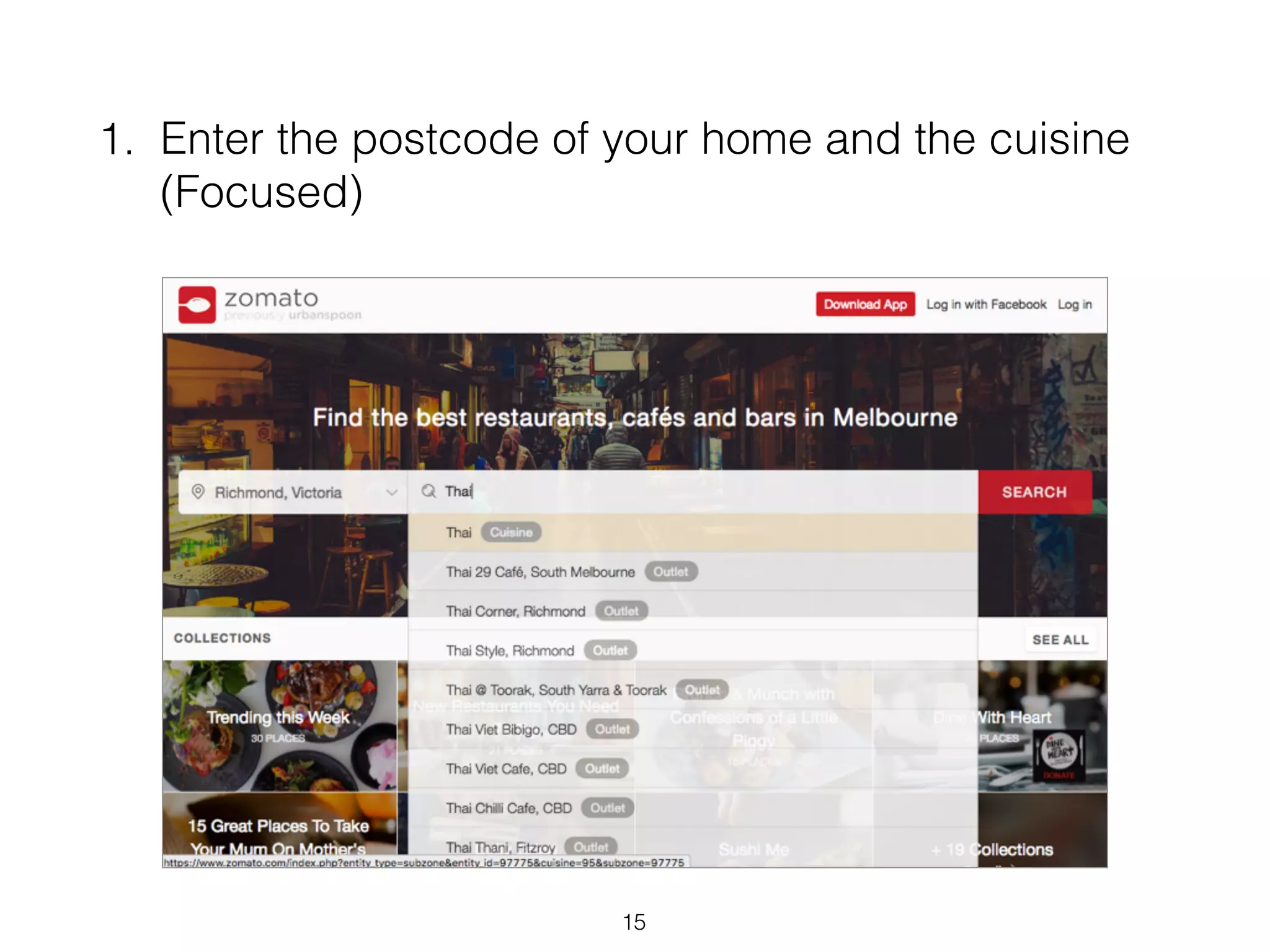
1. Enter the postcode of your home and the cuisine
(Focused)
15
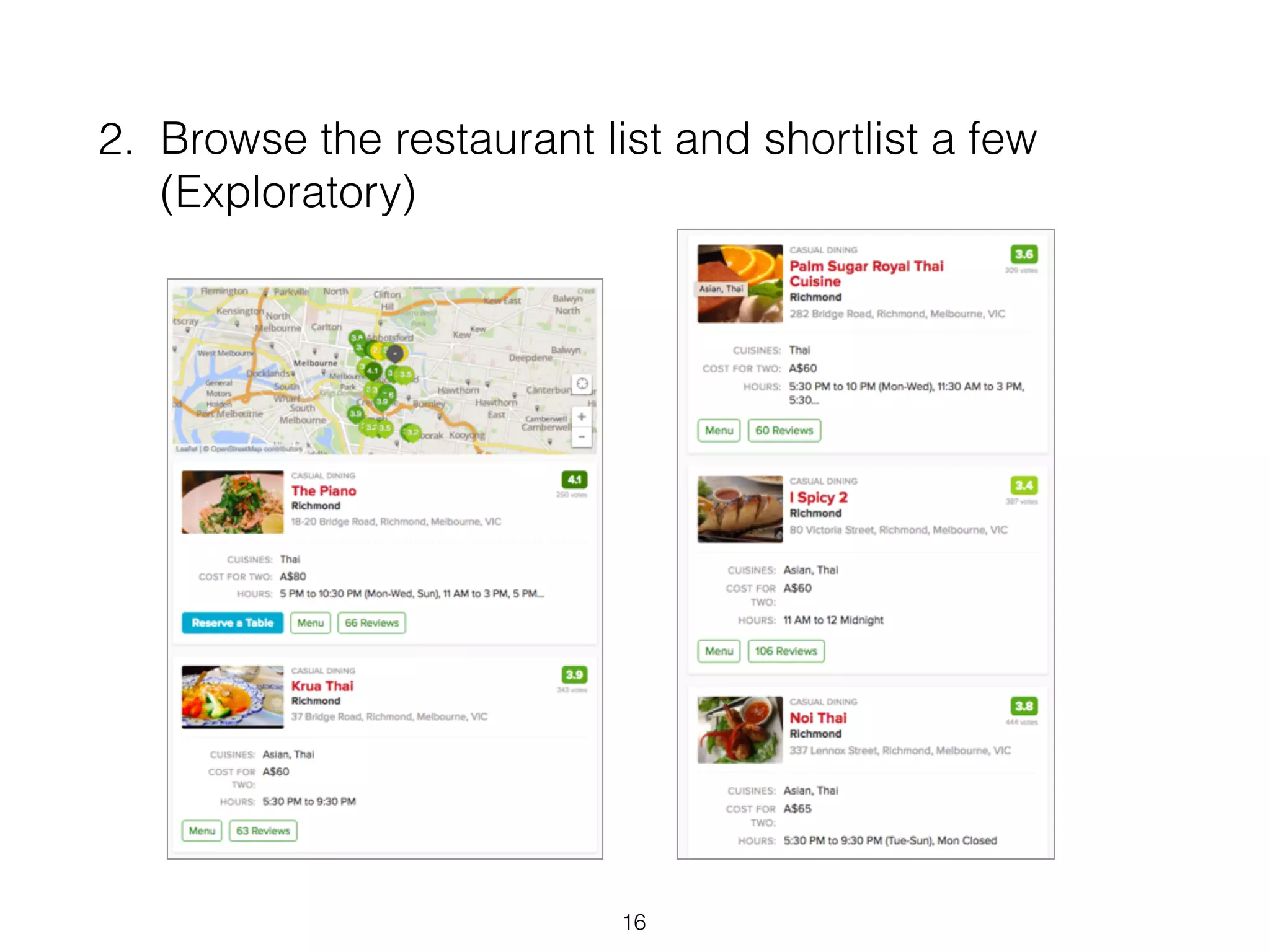
2. Browse the restaurant list and shortlist a few
(Exploratory)
16
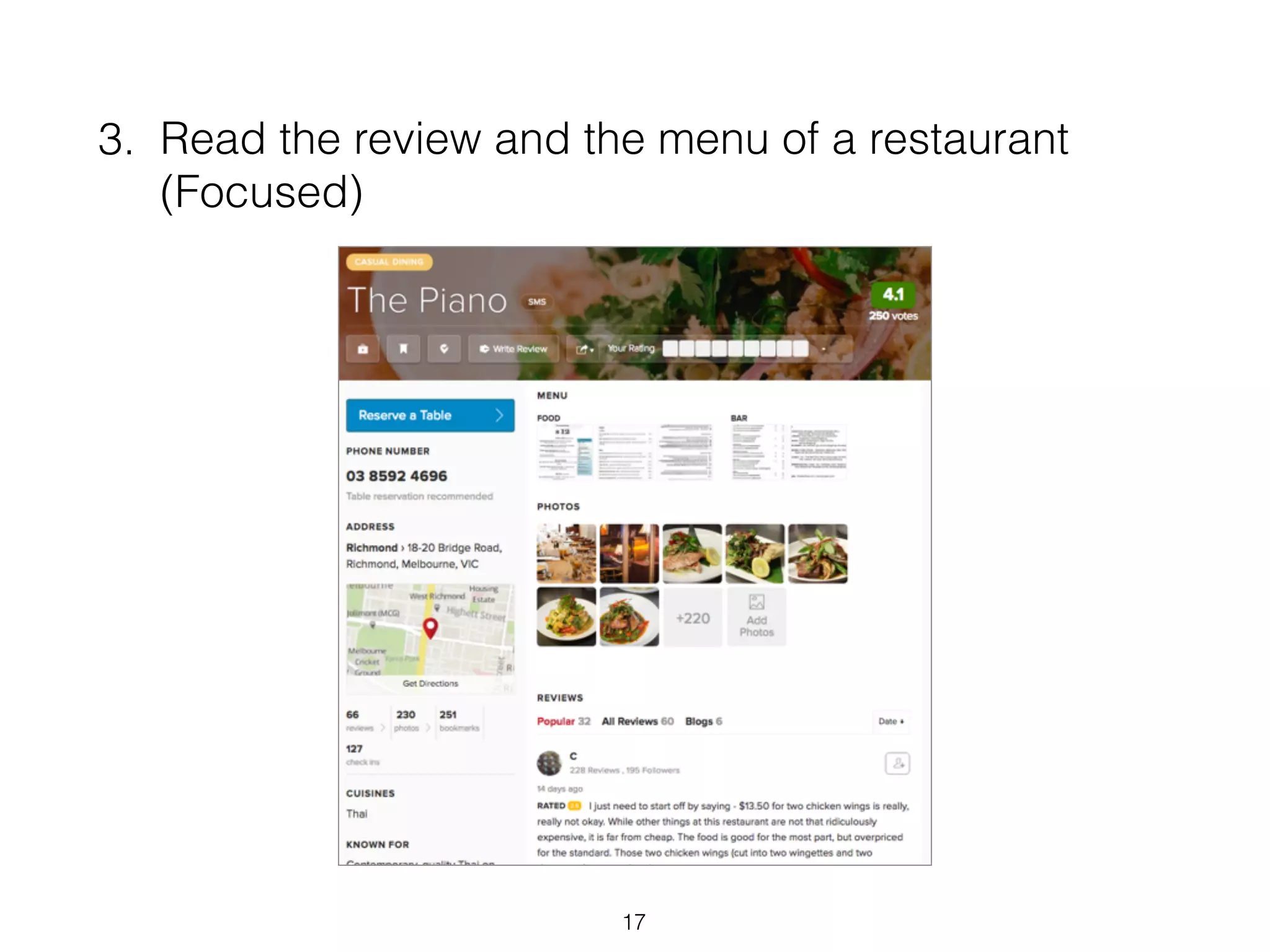
3. Read the review and the menu of a restaurant
(Focused)
17
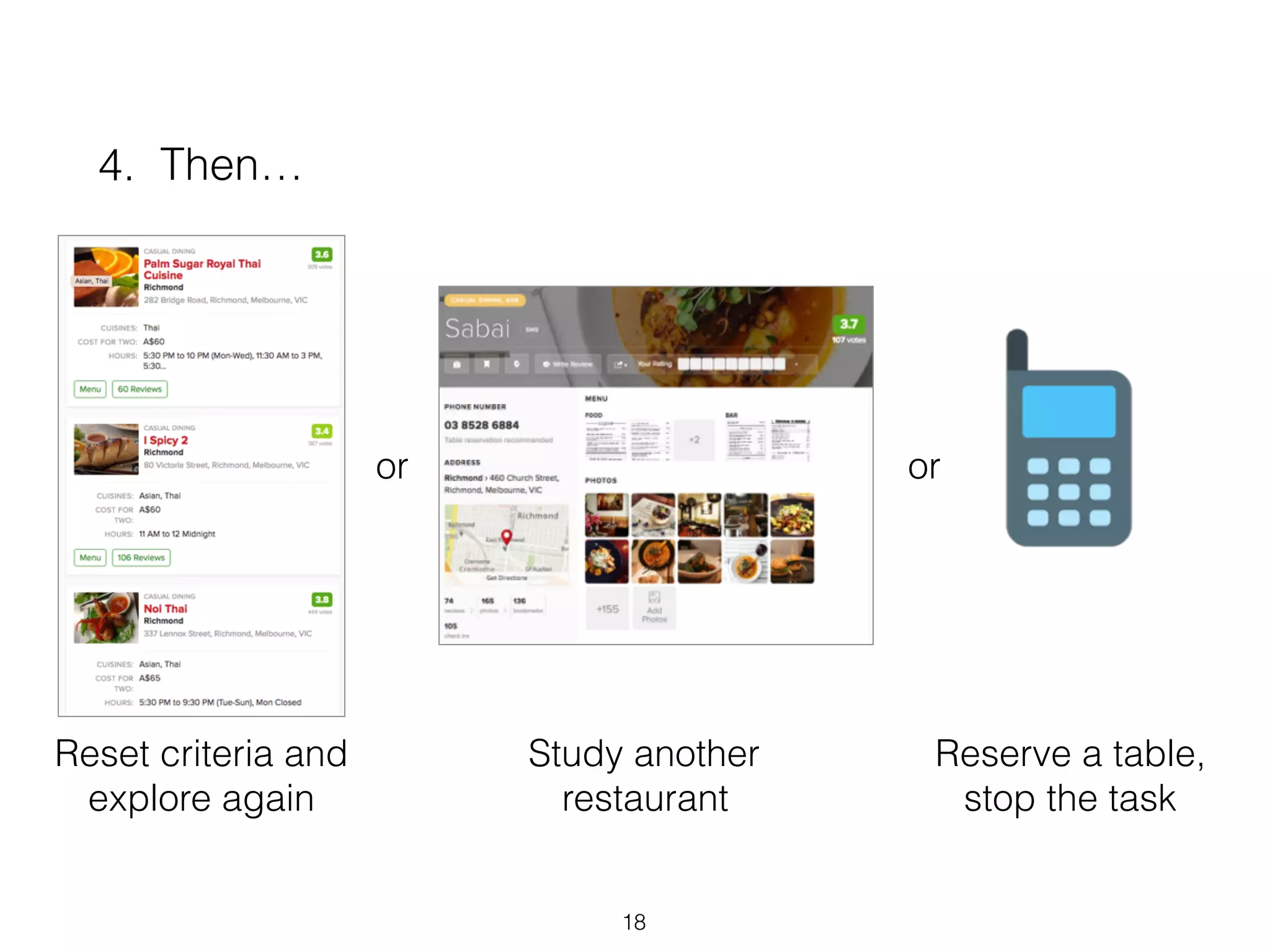
4. Then…
18
Reset criteria and
explore again
Study another
restaurant
Reserve a table,
stop the task
or or
Supporting
Exploratory Search
19
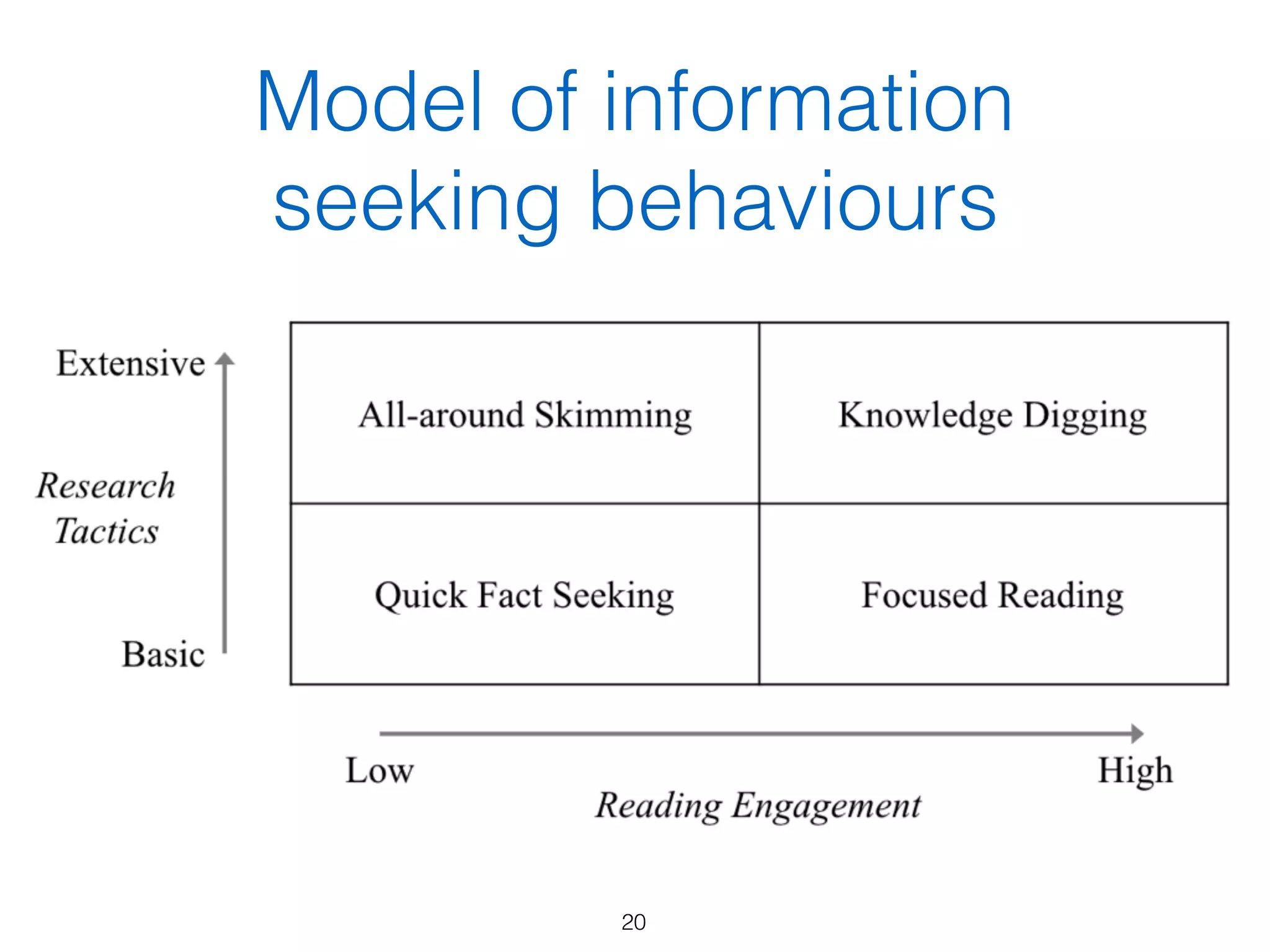
Model of information
seeking behaviours
20
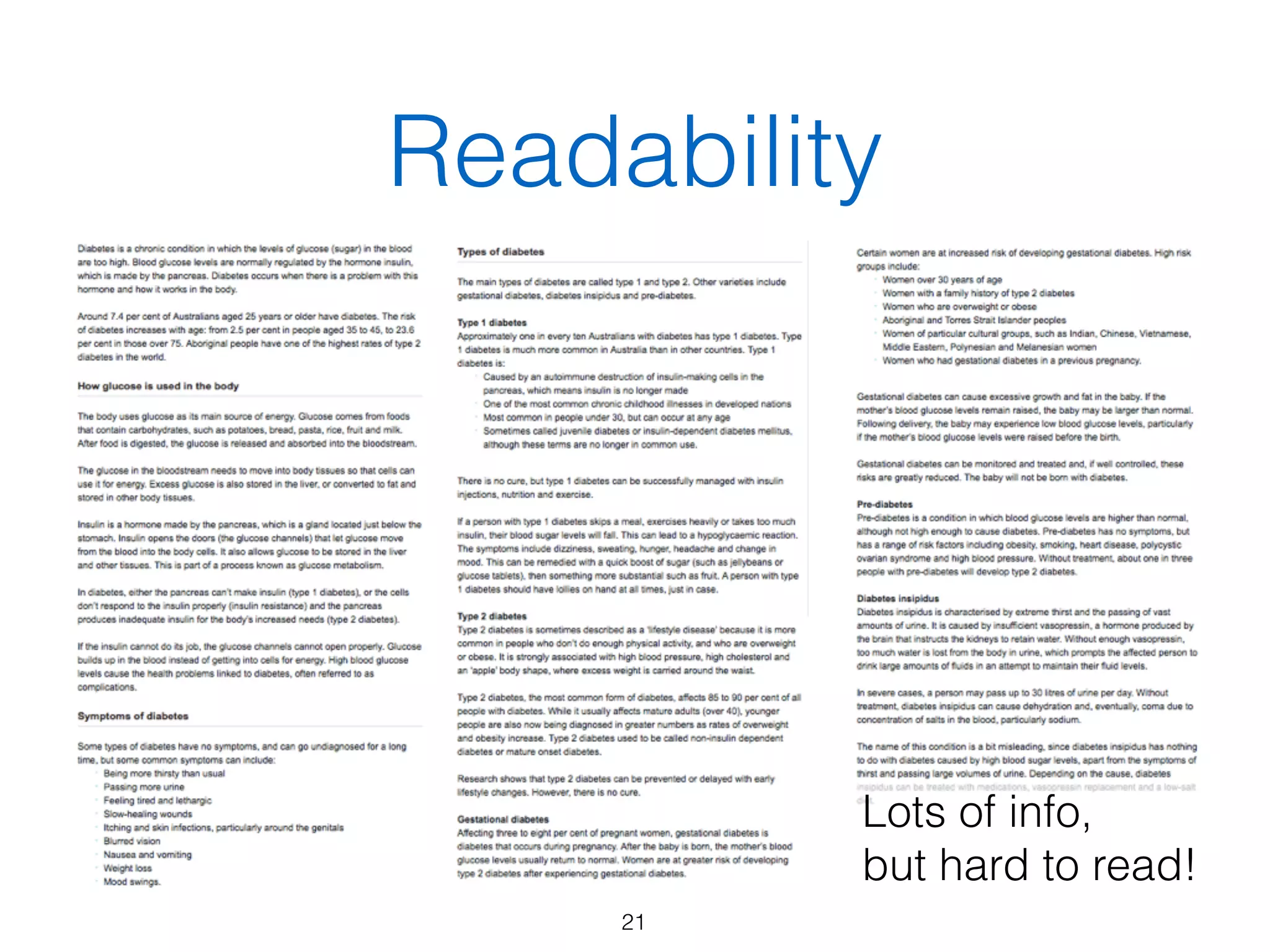
Readability
21
Lots of info,
but hard to read!
22
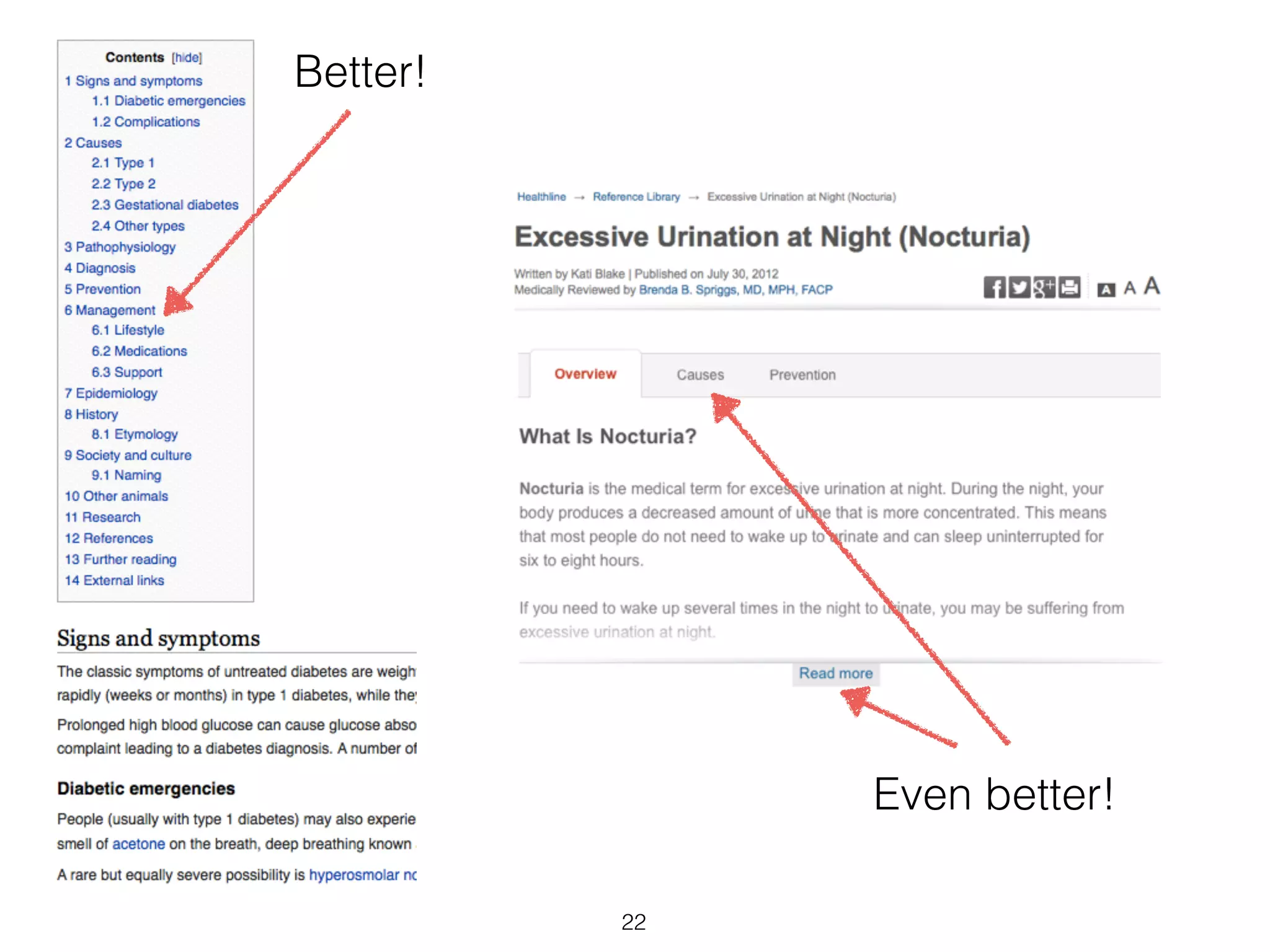
Better!
Even better!
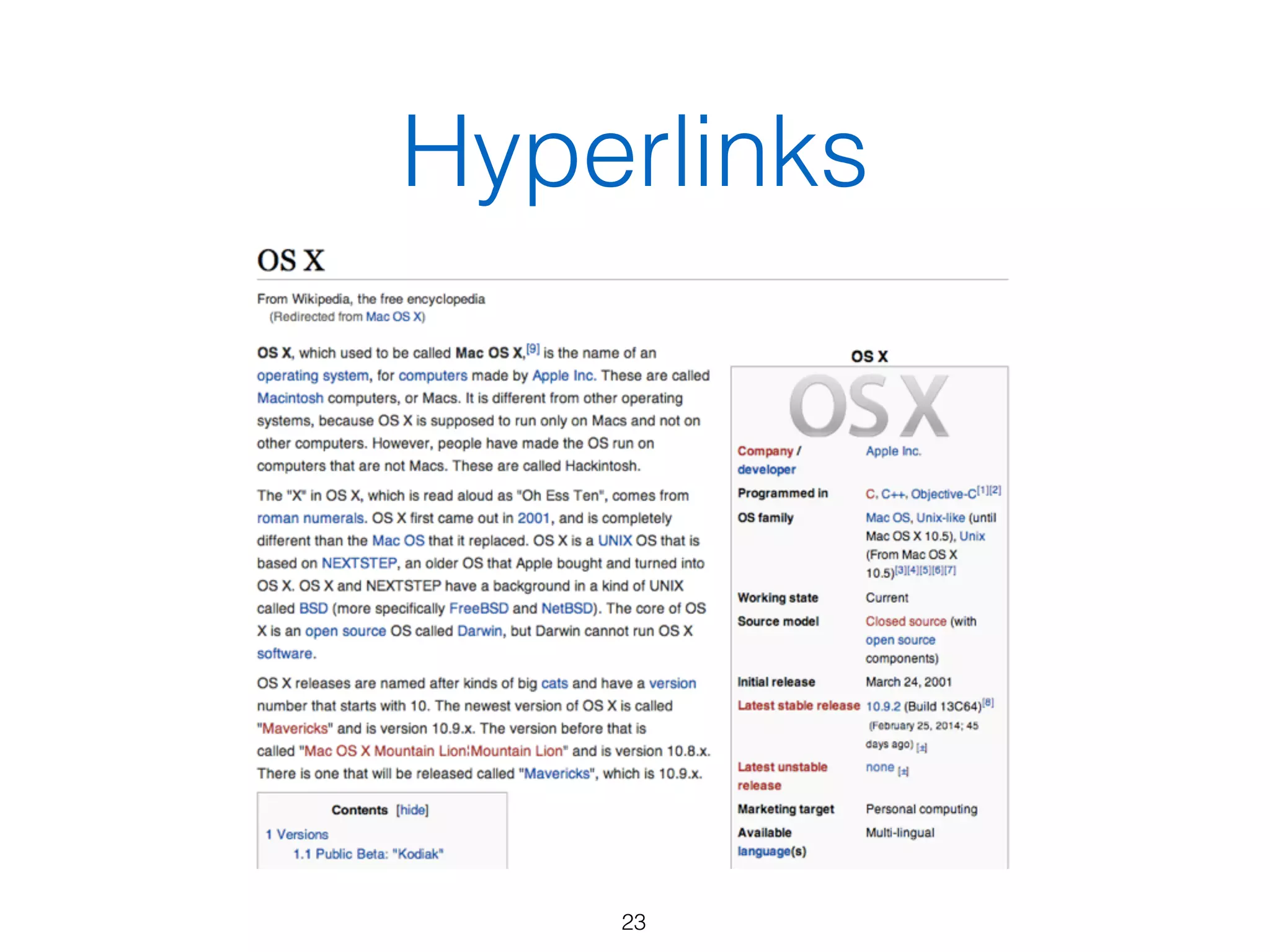
Hyperlinks
23
24
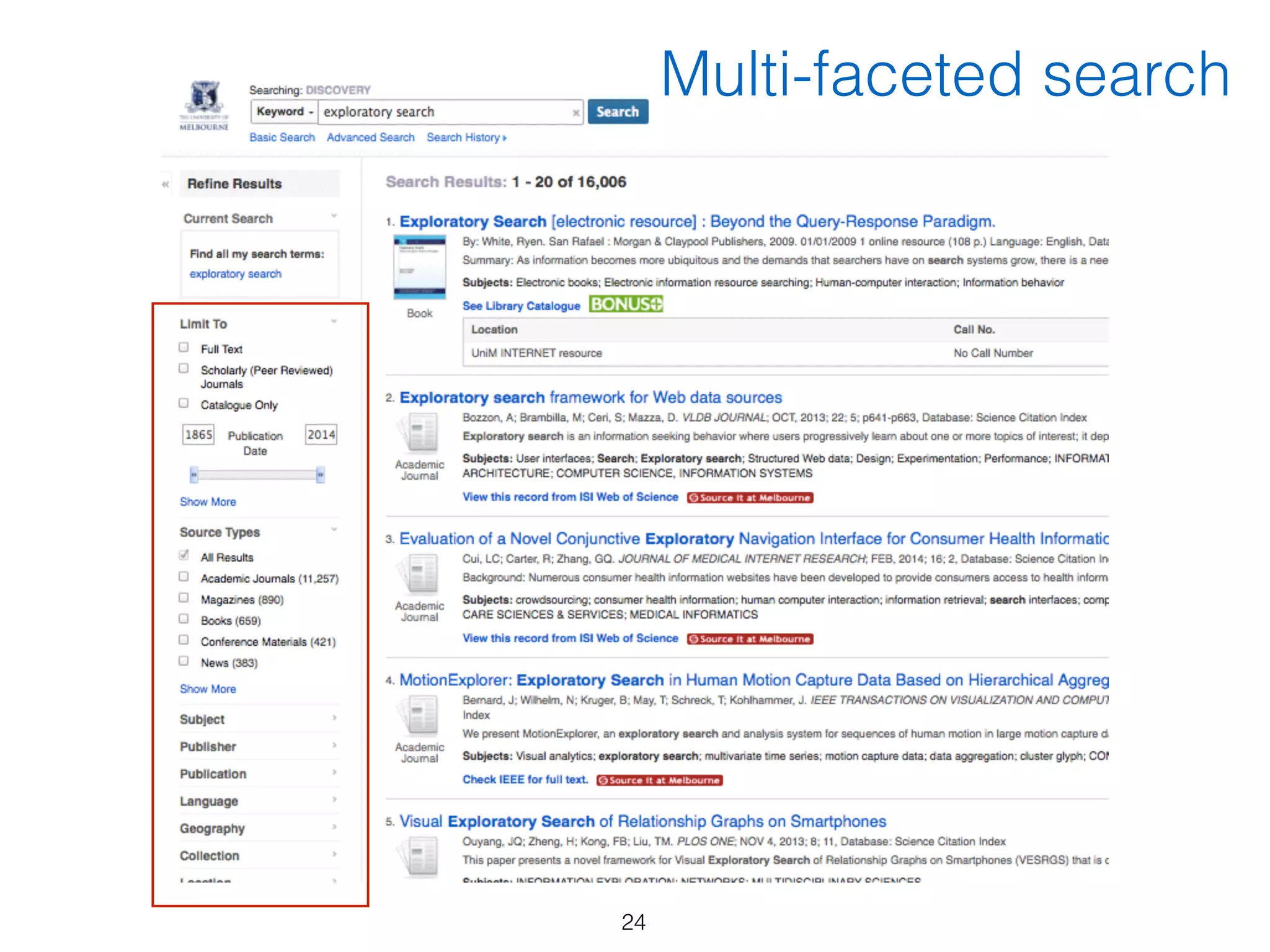
Multi-faceted search
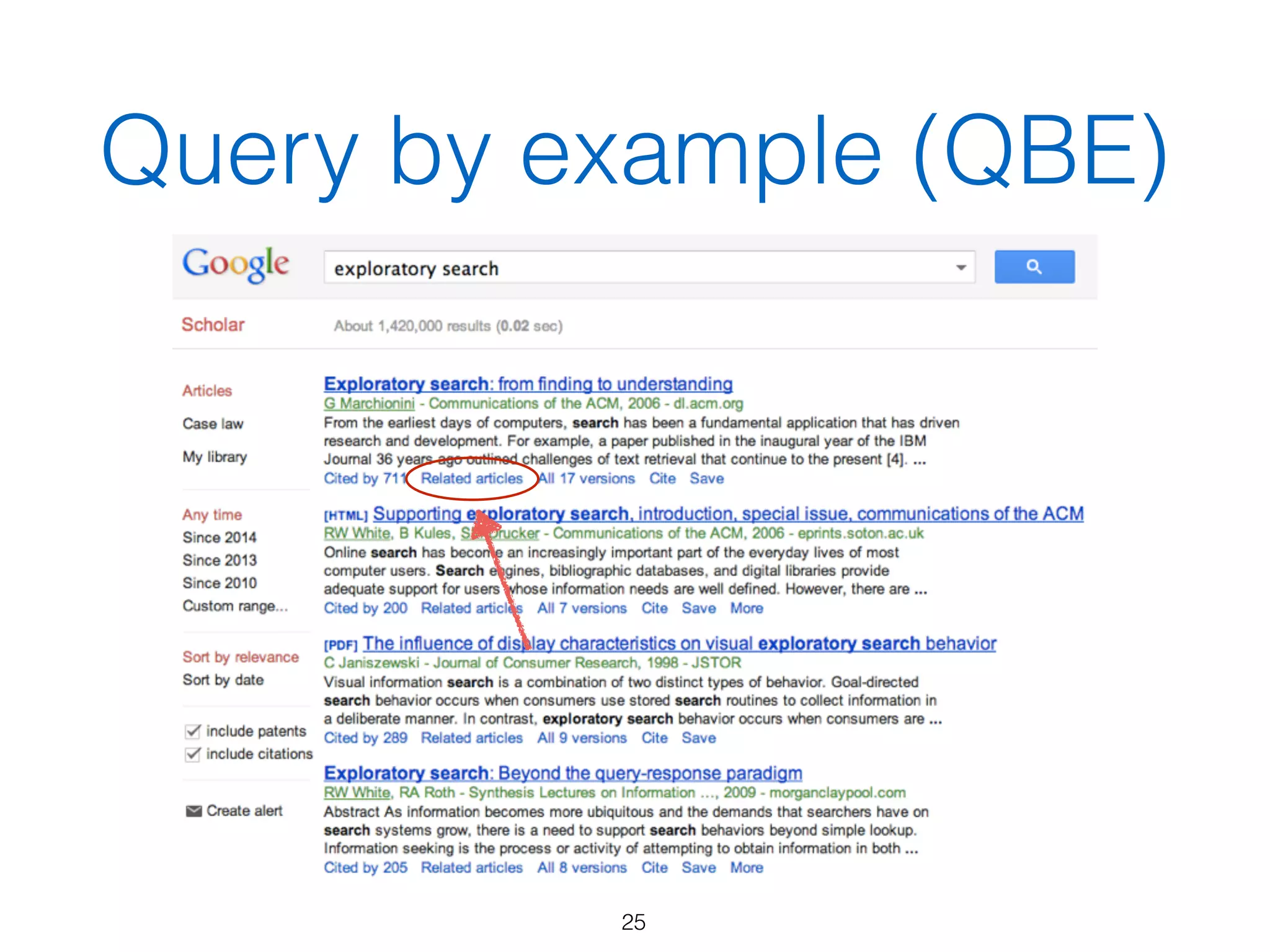
Query by example (QBE)
25
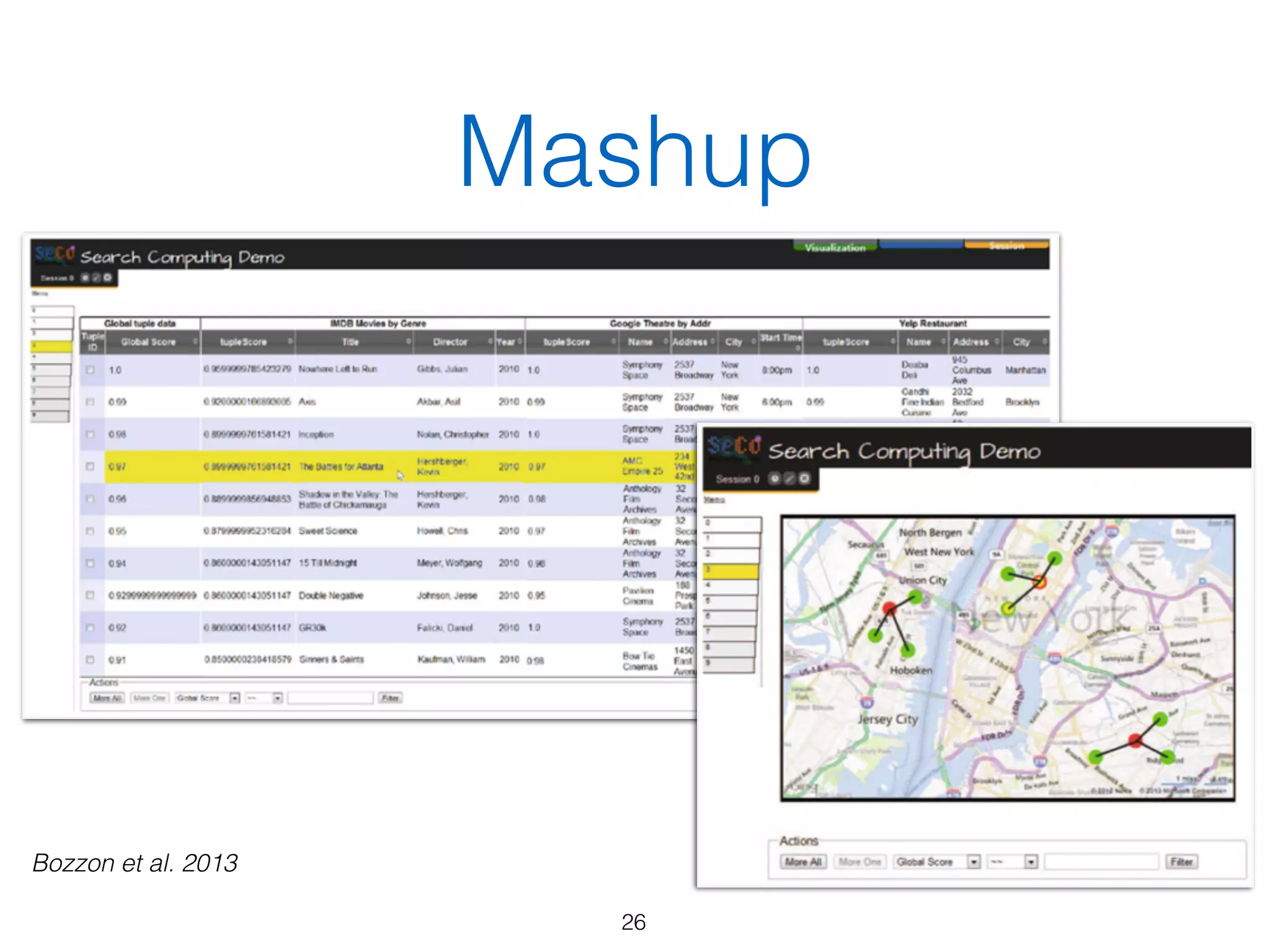
Mashup
26
Bozzon et al. 2013
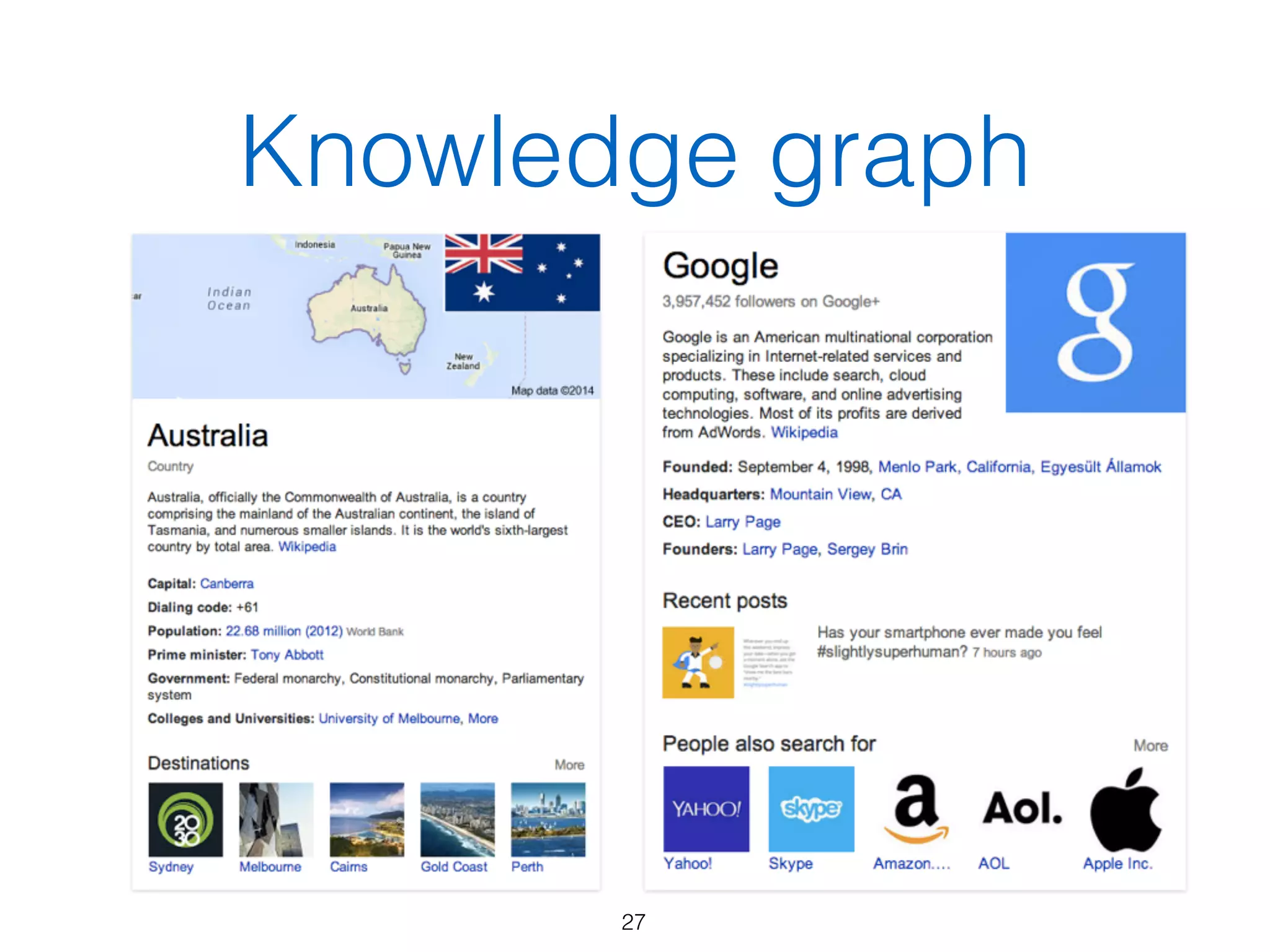
Knowledge graph
27
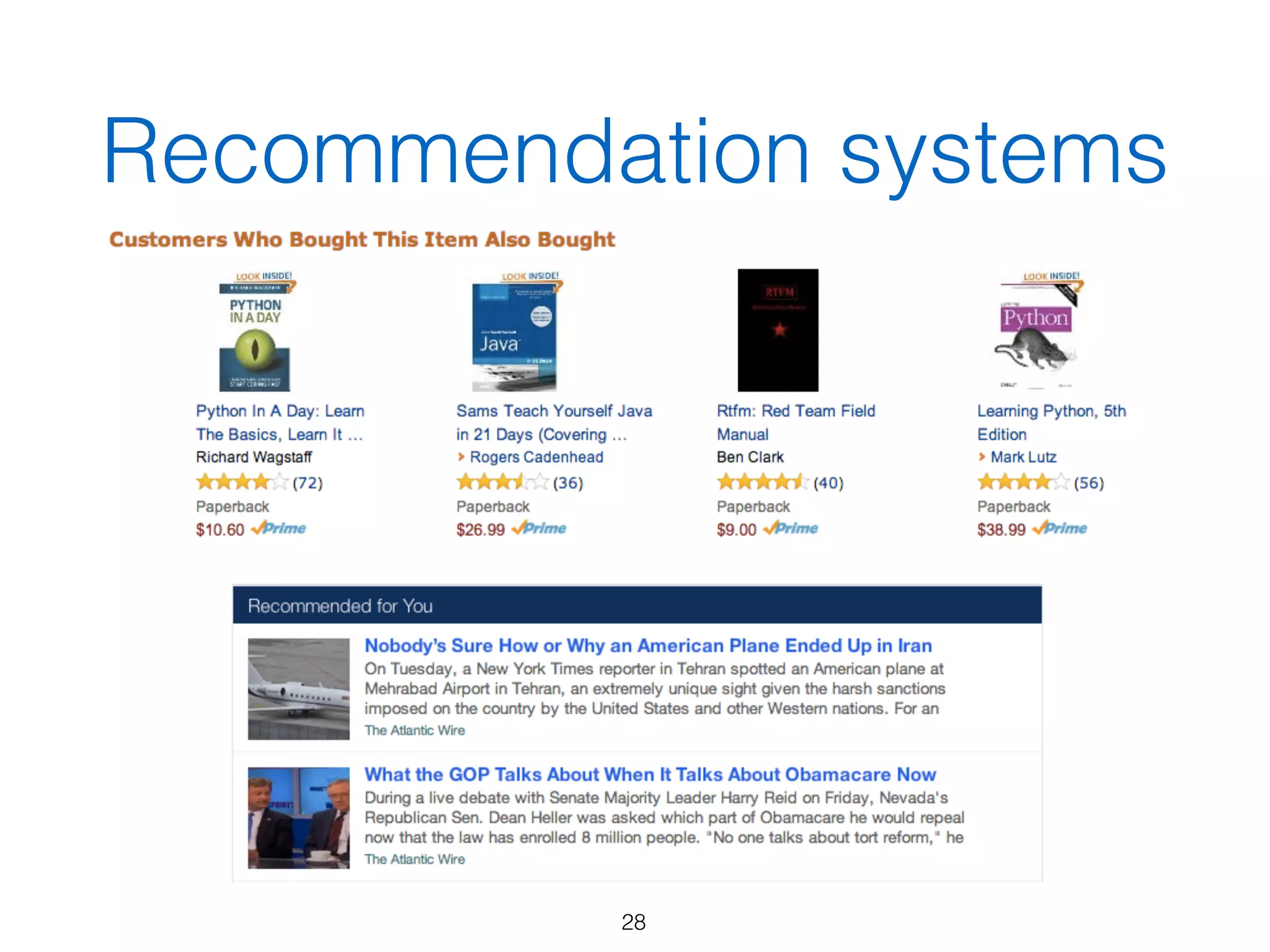
Recommendation systems
28
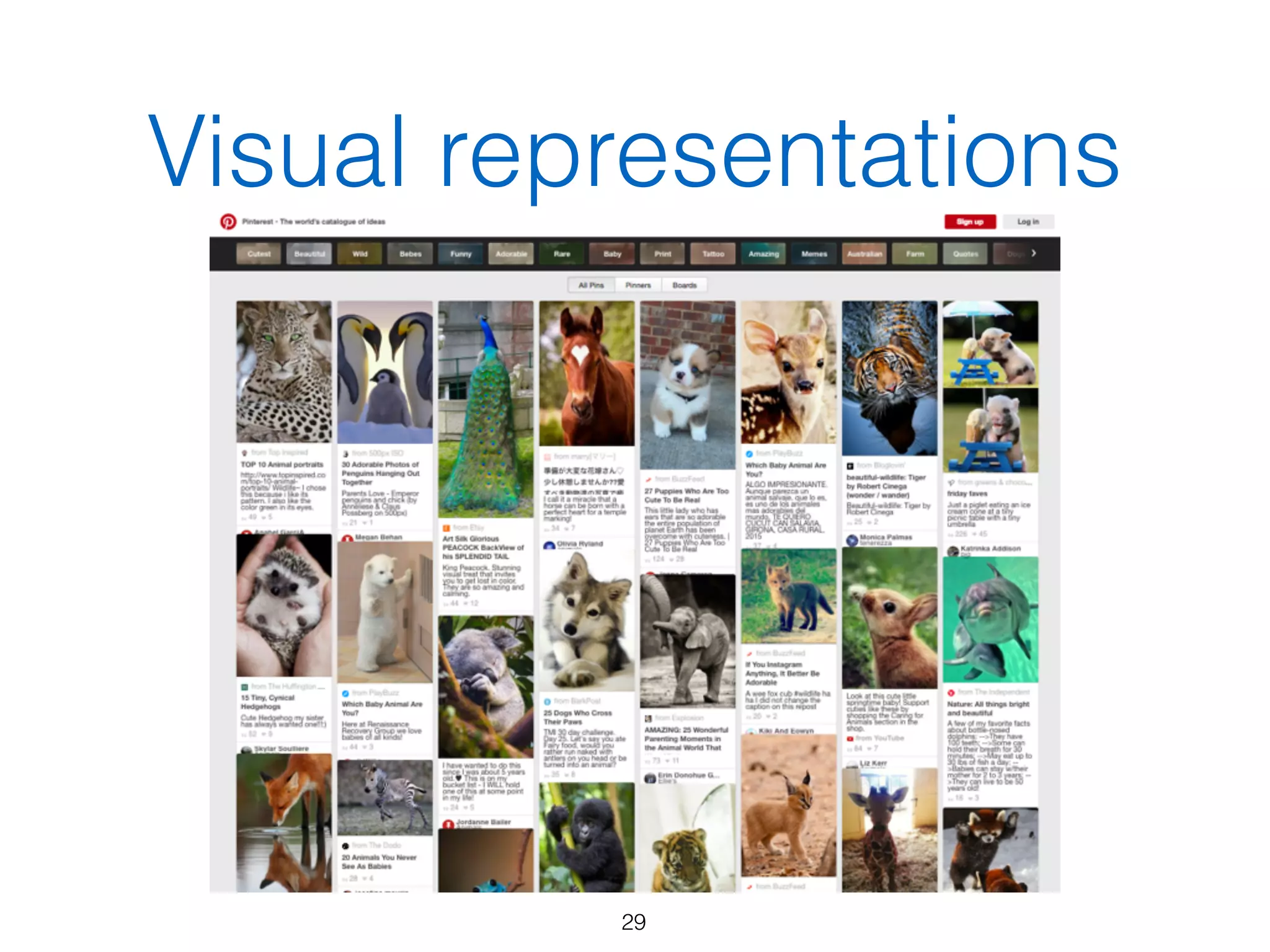
Visual representations
29
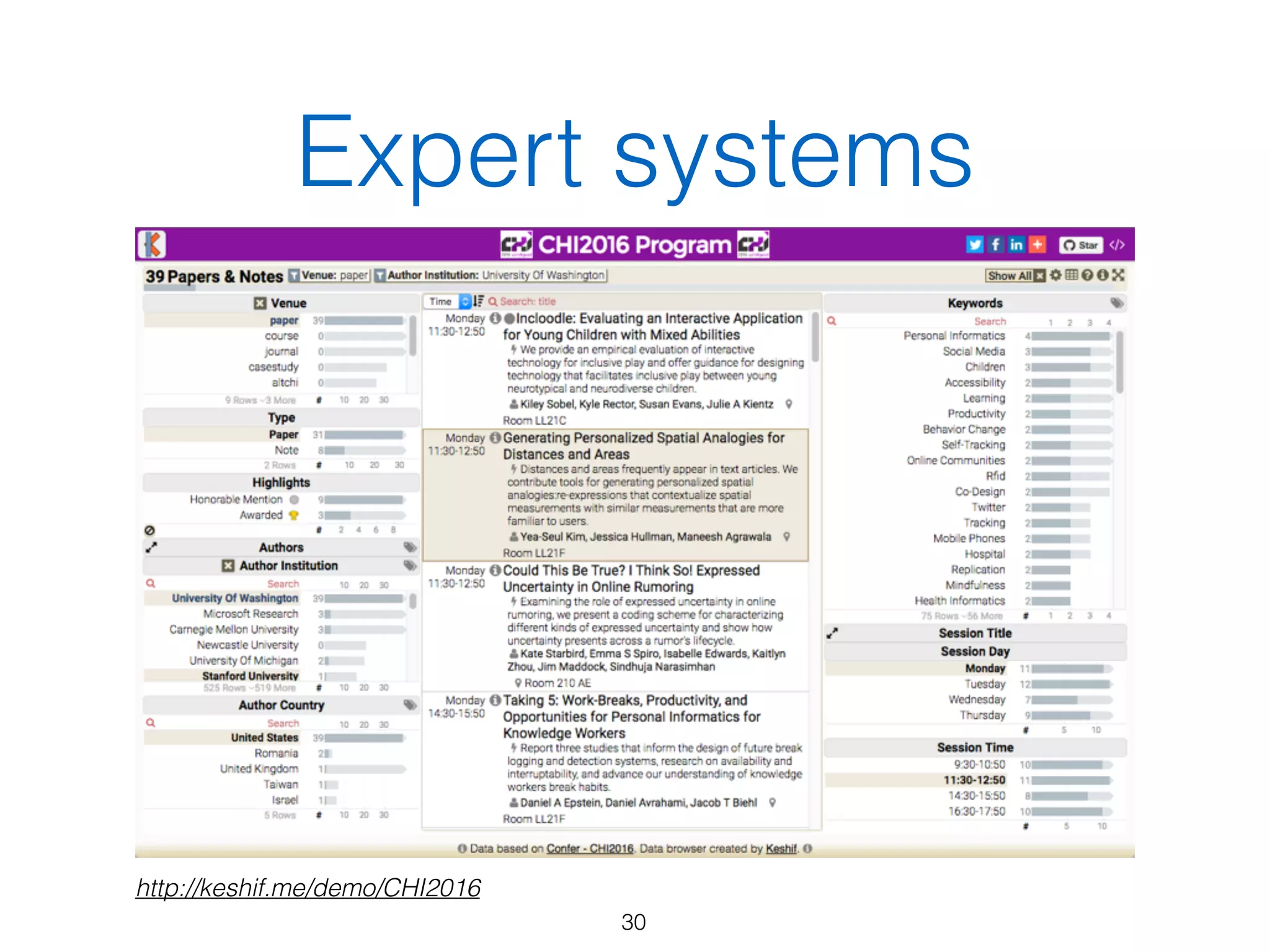
Expert systems
30
http://keshif.me/demo/CHI2016
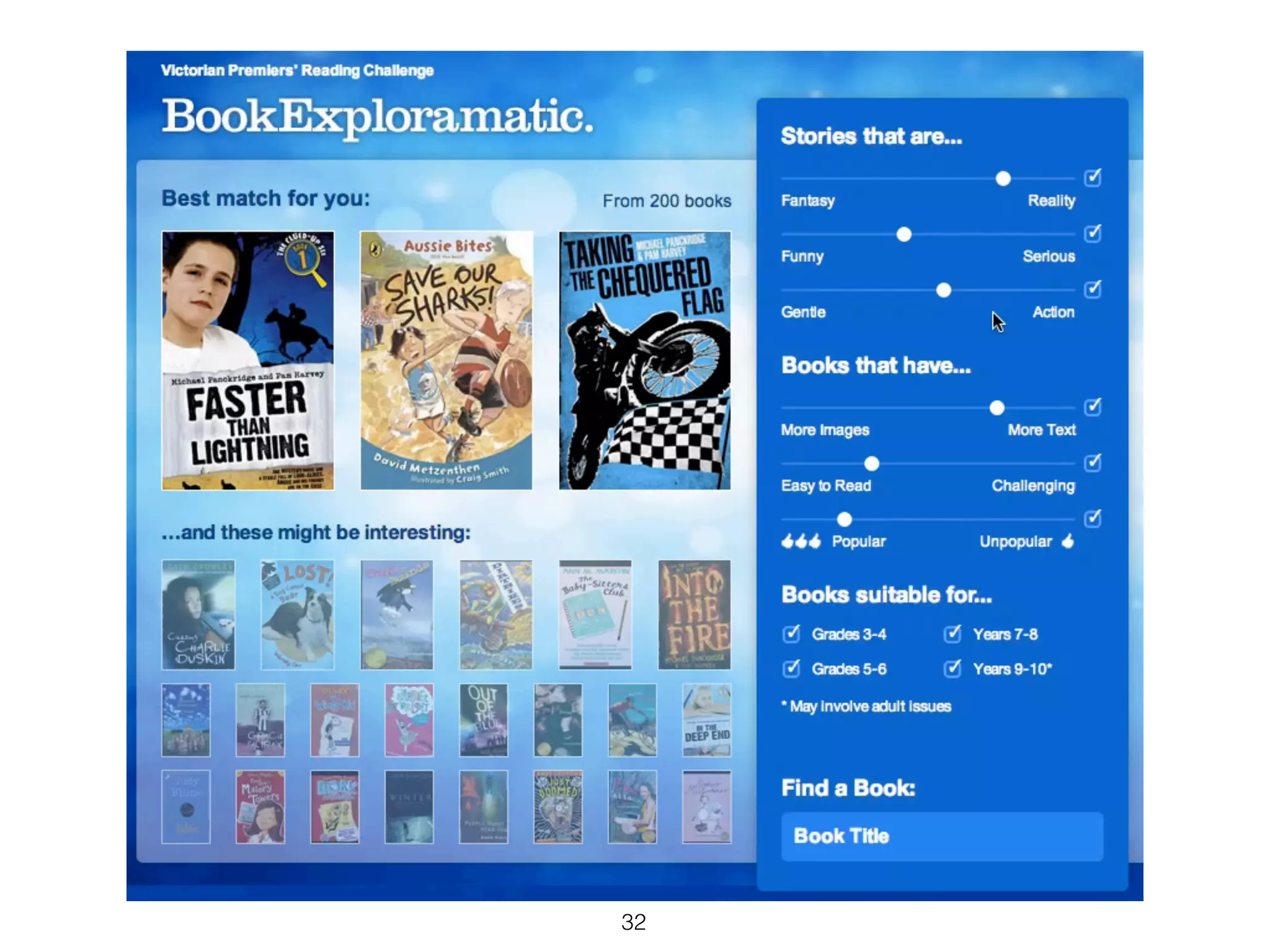
iFISH
31
• An interactive engine for playful exploration and

engagement
• http://people.eng.unimelb.edu.au/jonmp/projects/
iFISH/
• Demo site: http://www.bookfish.net.au/
32
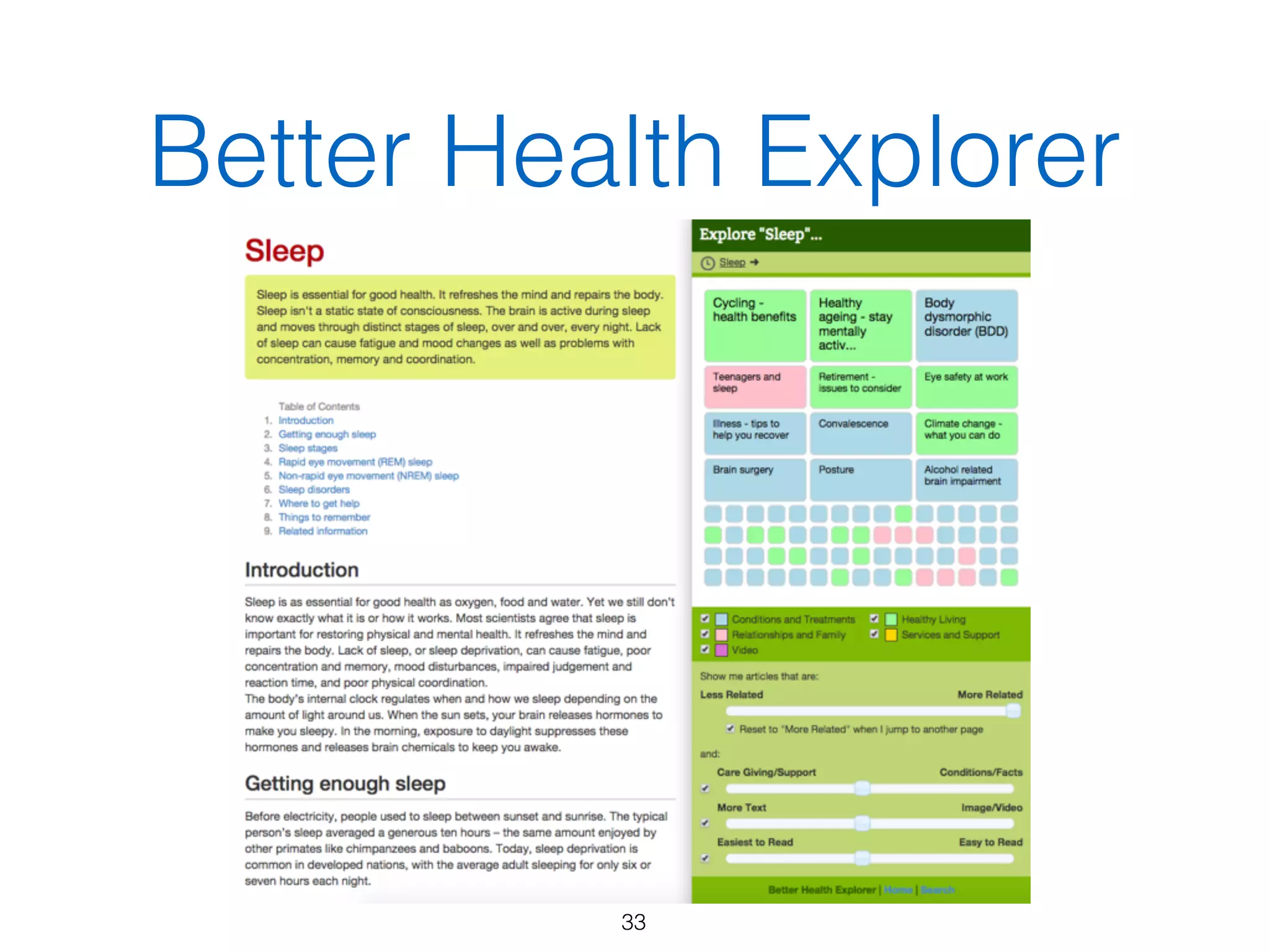
Better Health Explorer
33
The future of supporting
exploratory search
• New user interfaces?
• How to support both types of searching at the
same time?
• Mobile devices?
34
Summary
35
• Exploration exists, in additional to searching
• Exploration exposes a different behaviour
• Support exploration in your design
• Know your audience - your web application
enables searching, exploring or both?
36
Announcement
• This week’s tutorial will start in the computer lab.
37
Thank you!
www.patrickpang.net
mail@patrickpang.net
@pangpatrick
38
Reference
• Bozzon, A., Brambilla, M., Ceri, S., & Mazza, D. Exploratory search framework for Web data
sources. The VLDB Journal, 22(5), 641-663.
• Hodkinson, C., Kiel, G., & McColl-Kennedy, J.R. (2000). Consumer web search behaviour:
Diagrammatic illustration of wayfinding on the web. International Journal of Human-Computer
Studies, 52(5), 805-830.
• Huang, P., Lurie, N.H., & Mitra, S. (2009). Searching for experience on the web : An empirical
examination of consumer behavior for search and experience goods. Journal of Marketing, 73,
55-69.
• Marchionini, G. (2006). Exploratory search: From finding to understanding. Communications of
the ACM, 49(4), 41.
• Pearce, J., Chang, S., Kennedy, G., Ely, R.B.W., & Ainley, M. (2012). Search and explore: More
than one way to find what you want. 2012 Australian Computer-Human Interaction Conference
(OzCHI'12), Melbourne, Victoria, Australia.
• White, R., & Roth, R. (2009). Exploratory search: Beyond the query-response paradigm. San
Rafael, CA: Morgan and Claypool.
39

INFO30005 Guest Lecture: Search vs. Explore