FY22/23 Budget
Conference Committee Report Budget
April 20, 2021
FY 22/23 Budget Priorities
 Enact a responsible, balanced state budget that does not grow
government
 Strengthen our commitment to students and teachers
 Help small business and accelerate economic recovery
 Invest in law enforcement training facilities and programs
 Address critical health needs
 Make strategic investments in infrastructure
2
Enact a responsible, balanced state
budget
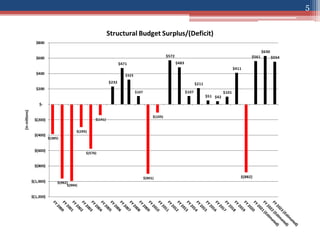
• Budget lives within our means
▫ Budget is balanced in both years of the biennium
• Conservative spending levels will provide
opportunities for future tax cuts and reforms
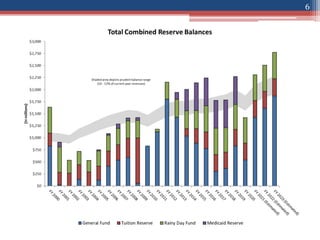
• Budget maintains healthy reserves in both years
of the biennium
▫ Healthy reserves protect taxpayers, guard against
future recessions, and ensure that Indiana
maintains a triple-A credit rating
3
Enact a responsible, balanced state
budget
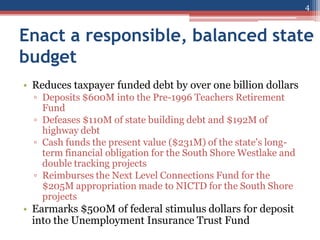
• Reduces taxpayer funded debt by over one billion dollars
▫ Deposits $600M into the Pre-1996 Teachers Retirement
Fund
▫ Defeases $110M of state building debt and $192M of
highway debt
▫ Cash funds the present value ($231M) of the state's long-
term financial obligation for the South Shore Westlake and
double tracking projects
▫ Reimburses the Next Level Connections Fund for the
$205M appropriation made to NICTD for the South Shore
projects
• Earmarks $500M of federal stimulus dollars for deposit
into the Unemployment Insurance Trust Fund
4
5
6
Strengthen our commitment to
students and teachers
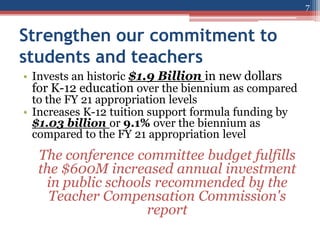
• Invests an historic $1.9 Billion in new dollars
for K-12 education over the biennium as compared
to the FY 21 appropriation levels
• Increases K-12 tuition support formula funding by
$1.03 billion or 9.1% over the biennium as
compared to the FY 21 appropriation level
The conference committee budget fulfills
the $600M increased annual investment
in public schools recommended by the
Teacher Compensation Commission's
report
7
Strengthen our commitment to
students and teachers
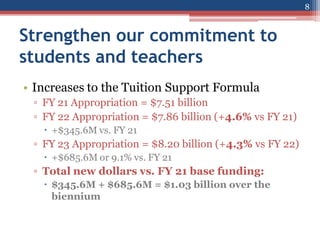
• Increases to the Tuition Support Formula
▫ FY 21 Appropriation = $7.51 billion
▫ FY 22 Appropriation = $7.86 billion (+4.6% vs FY 21)
 +$345.6M vs. FY 21
▫ FY 23 Appropriation = $8.20 billion (+4.3% vs FY 22)
 +$685.6M or 9.1% vs. FY 21
▫ Total new dollars vs. FY 21 base funding:
 $345.6M + $685.6M = $1.03 billion over the
biennium
8
9
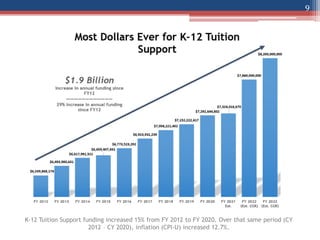
K-12 Tuition Support funding increased 15% from FY 2012 to FY 2020. Over that same period (CY
2012 – CY 2020), inflation (CPI-U) increased 12.7%.
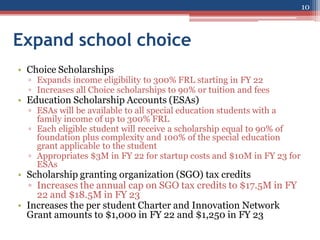
Expand school choice
• Choice Scholarships
▫ Expands income eligibility to 300% FRL starting in FY 22
▫ Increases all Choice scholarships to 90% or tuition and fees
• Education Scholarship Accounts (ESAs)
▫ ESAs will be available to all special education students with a
family income of up to 300% FRL
▫ Each eligible student will receive a scholarship equal to 90% of
foundation plus complexity and 100% of the special education
grant applicable to the student
▫ Appropriates $3M in FY 22 for startup costs and $10M in FY 23 for
ESAs
• Scholarship granting organization (SGO) tax credits
▫ Increases the annual cap on SGO tax credits to $17.5M in FY
22 and $18.5M in FY 23
• Increases the per student Charter and Innovation Network
Grant amounts to $1,000 in FY 22 and $1,250 in FY 23
10
Strengthen our commitment to
students and teachers, cont.
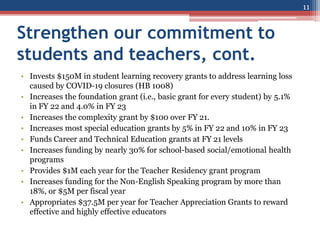
• Invests $150M in student learning recovery grants to address learning loss
caused by COVID-19 closures (HB 1008)
• Increases the foundation grant (i.e., basic grant for every student) by 5.1%
in FY 22 and 4.0% in FY 23
• Increases the complexity grant by $100 over FY 21.
• Increases most special education grants by 5% in FY 22 and 10% in FY 23
• Funds Career and Technical Education grants at FY 21 levels
• Increases funding by nearly 30% for school-based social/emotional health
programs
• Provides $1M each year for the Teacher Residency grant program
• Increases funding for the Non-English Speaking program by more than
18%, or $5M per fiscal year
• Appropriates $37.5M per year for Teacher Appreciation Grants to reward
effective and highly effective educators
11
Help small businesses and
accelerate economic recovery
• Invests $500M of federal stimulus dollars in the Regional Economic
Acceleration and Development Initiative (READI) to support communities
across the state and encourage innovative policies that will spur population
growth and economic expansion
• Directs $60M of federal stimulus dollars to the Hoosier Hospitality Small
Business Restart Grant Program to help small Hoosier businesses get back
on their feet (HB 1004)
• Creates the Career Accelerator Fund to incentive educational programs that
lead to high wage, high demand jobs, and capitalizes the fund with a $75M
appropriation from federal stimulus dollars
• Increases the annual cap on the Venture Capital Investment (VCI) tax credit
to $20M per year beginning in CY 22 and establishes a bonus credit amount
for investments in minority and women-owned businesses
• Appropriates $10M per year for Manufacturing Readiness Grants
• Increases the 21st Century Research and Technology fund annual
appropriation to $32.75M - a $3M increase each fiscal year
12
Invest in law enforcement
training facilities and programs
• Appropriates $70M to the Indiana Law Enforcement Academy (ILEA) to bring the
Law Enforcement Training Academy up to modern standards and enhance public
safety training (HB 1006)
• Creates a $10M grant program from federal stimulus dollars to ensure that all law
enforcement agencies around the state can purchase body cameras
• Appropriates $20M of federal stimulus dollars to the State Police to purchase body
cameras
• Provides $3M in annual funding to expand the successful High Tech Crimes Unit
program statewide
• Creates the Internet Crimes Against Children Fund and appropriates $1M each fiscal
year to the fund
• Provides $5M in annual funding to the Indiana Crime Guns Task Force
• Appropriates $3.5M per year for local law enforcement training grants
• Provides COVID-19 hazard pay stipends of $1,600 for Indiana State Police and
Capitol Police officers and Department of Corrections officers and employees
• Increases the salary matrix for State Police, Conservation, and Excise officers
13
Addressing critical health needs
14
• Restores full funding for mental health programs, including Recovery Works, and
appropriates an additional $100M over the biennium to fund mental health
initiatives
• Appropriates $50M in funding for the Health Issues and Challenges grant program
to spur the development of innovative policies that will improve the health
outcomes of Hoosiers (HB 1007)
• Provides $40M each year in additional funding to increase hourly pay to $15 per
hour for Direct Service Providers who serve individuals with intellectual and
developmental disabilities
• Appropriates $10M per year to increase Medicaid reimbursement rates for home
health care providers and $2M per year to increase rates for assisted living
providers
• Increases funding for sexual assault victims' assistance by 33%, or about $500K per
fiscal year
• Establishes a tax on electronic cigarettes
• Restores the CHOICE In-Home Services appropriation
• Funds the All-Payer Claims Database (HB 1402)
Make strategic investments in
infrastructure
• Appropriates $250M of federal stimulus dollars for broadband expansion
• Provides $160M of federal stimulus dollars for water infrastructure grants
• Allocates $550M to a capital reserve account for state building projects
▫ Eligible projects include a State Archives Building, new campus for the School
for the Deaf and the School for the Blind and Visually Impaired, State Park Inns
at Potato Creek and Prophetstown, cyber security infrastructure, and a new state
police post and lab in Evansville
• Appropriates $60M for Next Level Trails from federal stimulus dollars
• Directs $25M of federal stimulus dollars to support conservation land acquisition
and preservation
• Appropriates $900M to the Next Level Connections fund for future state
infrastructure projects
• Provides funding to upgrade several National Guard Armories and the Indiana
State Police post and laboratory in Lowell
• Provides $50M of one-time funding in FY 22 to cash fund the Fall Creek Pavilion at
the Indiana State Fairgrounds
15
Other budget highlights
16
• Fully funds a 1% COLA for public employee retirees
• Fully funds the Medicaid forecast
• Increases funding for graduate medical education
residency programs
• Restores university operating appropriations to FY
21 levels for FY 22 and increases funding by $27M
(2.0%) in FY 23
• Fully funds the state’s financial aid programs at the
projected expenditure levels for both fiscal years
• Appropriates $20M to the Department of Revenue
to complete the modernization of the agency’s tax
collection software
• Appropriates $400M for the reconstruction of the
Westville Correctional Facility
17

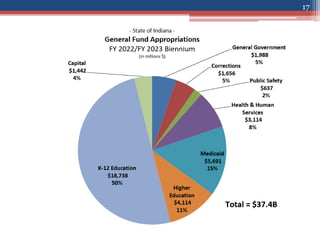
Indiana 2022-23 State Budget

  • 1.
    FY22/23 Budget Conference CommitteeReport Budget April 20, 2021
  • 2.
    FY 22/23 BudgetPriorities  Enact a responsible, balanced state budget that does not grow government  Strengthen our commitment to students and teachers  Help small business and accelerate economic recovery  Invest in law enforcement training facilities and programs  Address critical health needs  Make strategic investments in infrastructure 2
  • 3.
    Enact a responsible,balanced state budget • Budget lives within our means ▫ Budget is balanced in both years of the biennium • Conservative spending levels will provide opportunities for future tax cuts and reforms • Budget maintains healthy reserves in both years of the biennium ▫ Healthy reserves protect taxpayers, guard against future recessions, and ensure that Indiana maintains a triple-A credit rating 3
  • 4.
    Enact a responsible,balanced state budget • Reduces taxpayer funded debt by over one billion dollars ▫ Deposits $600M into the Pre-1996 Teachers Retirement Fund ▫ Defeases $110M of state building debt and $192M of highway debt ▫ Cash funds the present value ($231M) of the state's long- term financial obligation for the South Shore Westlake and double tracking projects ▫ Reimburses the Next Level Connections Fund for the $205M appropriation made to NICTD for the South Shore projects • Earmarks $500M of federal stimulus dollars for deposit into the Unemployment Insurance Trust Fund 4
  • 5.
  • 6.
  • 7.
    Strengthen our commitmentto students and teachers • Invests an historic $1.9 Billion in new dollars for K-12 education over the biennium as compared to the FY 21 appropriation levels • Increases K-12 tuition support formula funding by $1.03 billion or 9.1% over the biennium as compared to the FY 21 appropriation level The conference committee budget fulfills the $600M increased annual investment in public schools recommended by the Teacher Compensation Commission's report 7
  • 8.
    Strengthen our commitmentto students and teachers • Increases to the Tuition Support Formula ▫ FY 21 Appropriation = $7.51 billion ▫ FY 22 Appropriation = $7.86 billion (+4.6% vs FY 21)  +$345.6M vs. FY 21 ▫ FY 23 Appropriation = $8.20 billion (+4.3% vs FY 22)  +$685.6M or 9.1% vs. FY 21 ▫ Total new dollars vs. FY 21 base funding:  $345.6M + $685.6M = $1.03 billion over the biennium 8
  • 9.
    9 K-12 Tuition Supportfunding increased 15% from FY 2012 to FY 2020. Over that same period (CY 2012 – CY 2020), inflation (CPI-U) increased 12.7%.
  • 10.
    Expand school choice •Choice Scholarships ▫ Expands income eligibility to 300% FRL starting in FY 22 ▫ Increases all Choice scholarships to 90% or tuition and fees • Education Scholarship Accounts (ESAs) ▫ ESAs will be available to all special education students with a family income of up to 300% FRL ▫ Each eligible student will receive a scholarship equal to 90% of foundation plus complexity and 100% of the special education grant applicable to the student ▫ Appropriates $3M in FY 22 for startup costs and $10M in FY 23 for ESAs • Scholarship granting organization (SGO) tax credits ▫ Increases the annual cap on SGO tax credits to $17.5M in FY 22 and $18.5M in FY 23 • Increases the per student Charter and Innovation Network Grant amounts to $1,000 in FY 22 and $1,250 in FY 23 10
  • 11.
    Strengthen our commitmentto students and teachers, cont. • Invests $150M in student learning recovery grants to address learning loss caused by COVID-19 closures (HB 1008) • Increases the foundation grant (i.e., basic grant for every student) by 5.1% in FY 22 and 4.0% in FY 23 • Increases the complexity grant by $100 over FY 21. • Increases most special education grants by 5% in FY 22 and 10% in FY 23 • Funds Career and Technical Education grants at FY 21 levels • Increases funding by nearly 30% for school-based social/emotional health programs • Provides $1M each year for the Teacher Residency grant program • Increases funding for the Non-English Speaking program by more than 18%, or $5M per fiscal year • Appropriates $37.5M per year for Teacher Appreciation Grants to reward effective and highly effective educators 11
  • 12.
    Help small businessesand accelerate economic recovery • Invests $500M of federal stimulus dollars in the Regional Economic Acceleration and Development Initiative (READI) to support communities across the state and encourage innovative policies that will spur population growth and economic expansion • Directs $60M of federal stimulus dollars to the Hoosier Hospitality Small Business Restart Grant Program to help small Hoosier businesses get back on their feet (HB 1004) • Creates the Career Accelerator Fund to incentive educational programs that lead to high wage, high demand jobs, and capitalizes the fund with a $75M appropriation from federal stimulus dollars • Increases the annual cap on the Venture Capital Investment (VCI) tax credit to $20M per year beginning in CY 22 and establishes a bonus credit amount for investments in minority and women-owned businesses • Appropriates $10M per year for Manufacturing Readiness Grants • Increases the 21st Century Research and Technology fund annual appropriation to $32.75M - a $3M increase each fiscal year 12
  • 13.
    Invest in lawenforcement training facilities and programs • Appropriates $70M to the Indiana Law Enforcement Academy (ILEA) to bring the Law Enforcement Training Academy up to modern standards and enhance public safety training (HB 1006) • Creates a $10M grant program from federal stimulus dollars to ensure that all law enforcement agencies around the state can purchase body cameras • Appropriates $20M of federal stimulus dollars to the State Police to purchase body cameras • Provides $3M in annual funding to expand the successful High Tech Crimes Unit program statewide • Creates the Internet Crimes Against Children Fund and appropriates $1M each fiscal year to the fund • Provides $5M in annual funding to the Indiana Crime Guns Task Force • Appropriates $3.5M per year for local law enforcement training grants • Provides COVID-19 hazard pay stipends of $1,600 for Indiana State Police and Capitol Police officers and Department of Corrections officers and employees • Increases the salary matrix for State Police, Conservation, and Excise officers 13
  • 14.
    Addressing critical healthneeds 14 • Restores full funding for mental health programs, including Recovery Works, and appropriates an additional $100M over the biennium to fund mental health initiatives • Appropriates $50M in funding for the Health Issues and Challenges grant program to spur the development of innovative policies that will improve the health outcomes of Hoosiers (HB 1007) • Provides $40M each year in additional funding to increase hourly pay to $15 per hour for Direct Service Providers who serve individuals with intellectual and developmental disabilities • Appropriates $10M per year to increase Medicaid reimbursement rates for home health care providers and $2M per year to increase rates for assisted living providers • Increases funding for sexual assault victims' assistance by 33%, or about $500K per fiscal year • Establishes a tax on electronic cigarettes • Restores the CHOICE In-Home Services appropriation • Funds the All-Payer Claims Database (HB 1402)
  • 15.
    Make strategic investmentsin infrastructure • Appropriates $250M of federal stimulus dollars for broadband expansion • Provides $160M of federal stimulus dollars for water infrastructure grants • Allocates $550M to a capital reserve account for state building projects ▫ Eligible projects include a State Archives Building, new campus for the School for the Deaf and the School for the Blind and Visually Impaired, State Park Inns at Potato Creek and Prophetstown, cyber security infrastructure, and a new state police post and lab in Evansville • Appropriates $60M for Next Level Trails from federal stimulus dollars • Directs $25M of federal stimulus dollars to support conservation land acquisition and preservation • Appropriates $900M to the Next Level Connections fund for future state infrastructure projects • Provides funding to upgrade several National Guard Armories and the Indiana State Police post and laboratory in Lowell • Provides $50M of one-time funding in FY 22 to cash fund the Fall Creek Pavilion at the Indiana State Fairgrounds 15
  • 16.
    Other budget highlights 16 •Fully funds a 1% COLA for public employee retirees • Fully funds the Medicaid forecast • Increases funding for graduate medical education residency programs • Restores university operating appropriations to FY 21 levels for FY 22 and increases funding by $27M (2.0%) in FY 23 • Fully funds the state’s financial aid programs at the projected expenditure levels for both fiscal years • Appropriates $20M to the Department of Revenue to complete the modernization of the agency’s tax collection software • Appropriates $400M for the reconstruction of the Westville Correctional Facility
  • 17.