Indian Knowledge System (IKS) - Indian Astronomy-II
1.
Index
• Introduction
• GregorianCalendar
• Hindu Calendar
• Islamic Calendar
• The Indian Calendar and Panchaang
• Panchaang
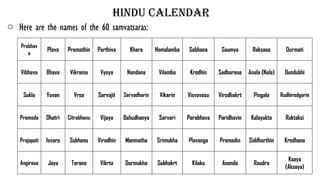
• Tithi
• Nakshtra
• Yoga
• Karana
• Vara
Introduction
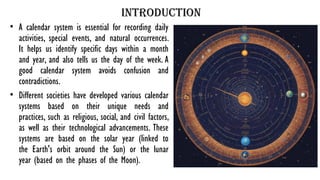
• A calendarsystem is essential for recording daily
activities, special events, and natural occurrences.
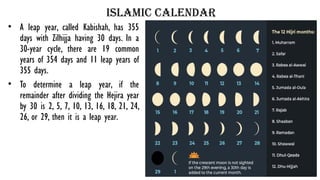
It helps us identify specific days within a month
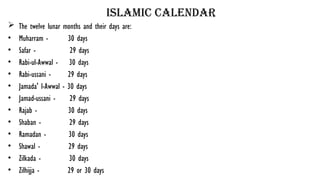
and year, and also tells us the day of the week. A
good calendar system avoids confusion and
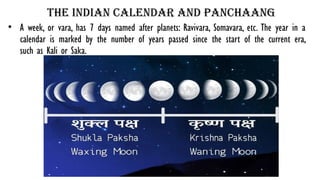
contradictions.
• Different societies have developed various calendar
systems based on their unique needs and
practices, such as religious, social, and civil factors,
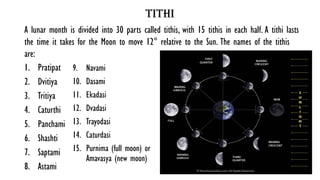
as well as their technological advancements. These
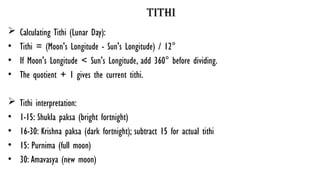
systems are based on the solar year (linked to
the Earth's orbit around the Sun) or the lunar
year (based on the phases of the Moon).
4.
Introduction
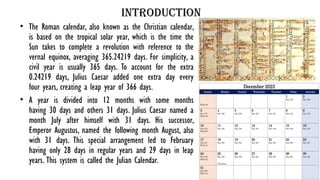
• The Romancalendar, also known as the Christian calendar,
is based on the tropical solar year, which is the time the
Sun takes to complete a revolution with reference to the
vernal equinox, averaging 365.24219 days. For simplicity, a
civil year is usually 365 days. To account for the extra
0.24219 days, Julius Caesar added one extra day every
four years, creating a leap year of 366 days.
• A year is divided into 12 months with some months
having 30 days and others 31 days. Julius Caesar named a
month July after himself with 31 days. His successor,
Emperor Augustus, named the following month August, also
with 31 days. This special arrangement led to February
having only 28 days in regular years and 29 days in leap
years. This system is called the Julian Calendar.
5.
Gregorian calendar
• Withthe introduction of the Julian Calendar, the
difference between the civil year and the natural
tropical year was greatly reduced. However, there
was still an excess of 11 minutes and 15
seconds each year. Over 100 years, this excess
added up to about 0.78 days.
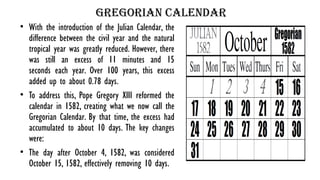
• To address this, Pope Gregory XIII reformed the
calendar in 1582, creating what we now call the
Gregorian Calendar. By that time, the excess had
accumulated to about 10 days. The key changes
were:
• The day after October 4, 1582, was considered
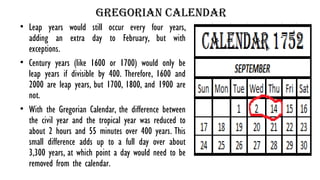
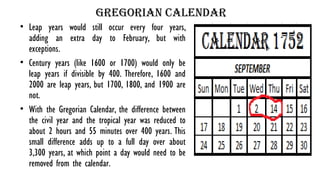
October 15, 1582, effectively removing 10 days.
6.
Gregorian calendar
• Leapyears would still occur every four years,
adding an extra day to February, but with
exceptions.
• Century years (like 1600 or 1700) would only be
leap years if divisible by 400. Therefore, 1600 and
2000 are leap years, but 1700, 1800, and 1900 are
not.
• With the Gregorian Calendar, the difference between
the civil year and the tropical year was reduced to
about 2 hours and 55 minutes over 400 years. This
small difference adds up to a full day over about
3,300 years, at which point a day would need to be
removed from the calendar.
7.
Gregorian calendar
• Leapyears would still occur every four years,
adding an extra day to February, but with
exceptions.
• Century years (like 1600 or 1700) would only be
leap years if divisible by 400. Therefore, 1600 and
2000 are leap years, but 1700, 1800, and 1900 are
not.
• With the Gregorian Calendar, the difference between
the civil year and the tropical year was reduced to
about 2 hours and 55 minutes over 400 years. This
small difference adds up to a full day over about
3,300 years, at which point a day would need to be
removed from the calendar.
8.
hindu calendar
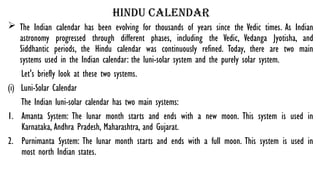
TheIndian calendar has been evolving for thousands of years since the Vedic times. As Indian
astronomy progressed through different phases, including the Vedic, Vedanga Jyotisha, and
Siddhantic periods, the Hindu calendar was continuously refined. Today, there are two main
systems used in the Indian calendar: the luni-solar system and the purely solar system.
Let's briefly look at these two systems.
(i) Luni-Solar Calendar
The Indian luni-solar calendar has two main systems:
1. Amanta System: The lunar month starts and ends with a new moon. This system is used in
Karnataka, Andhra Pradesh, Maharashtra, and Gujarat.
2. Purnimanta System: The lunar month starts and ends with a full moon. This system is used in
most north Indian states.
9.
hindu calendar
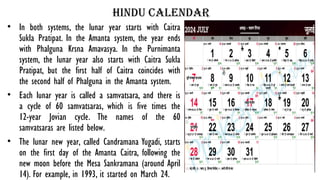
• Inboth systems, the lunar year starts with Caitra
Sukla Pratipat. In the Amanta system, the year ends
with Phalguna Krsna Amavasya. In the Purnimanta
system, the lunar year also starts with Caitra Sukla
Pratipat, but the first half of Caitra coincides with
the second half of Phalguna in the Amanta system.
• Each lunar year is called a samvatsara, and there is
a cycle of 60 samvatsaras, which is five times the
12-year Jovian cycle. The names of the 60
samvatsaras are listed below.
• The lunar new year, called Candramana Yugadi, starts
on the first day of the Amanta Caitra, following the
new moon before the Mesa Sankramana (around April
14). For example, in 1993, it started on March 24.
hindu calendar
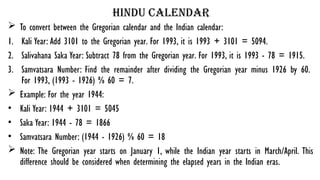
Toconvert between the Gregorian calendar and the Indian calendar:
1. Kali Year: Add 3101 to the Gregorian year. For 1993, it is 1993 + 3101 = 5094.
2. Salivahana Saka Year: Subtract 78 from the Gregorian year. For 1993, it is 1993 - 78 = 1915.
3. Samvatsara Number: Find the remainder after dividing the Gregorian year minus 1926 by 60.
For 1993, (1993 - 1926) % 60 = 7.
Example: For the year 1944:
• Kali Year: 1944 + 3101 = 5045
• Saka Year: 1944 - 78 = 1866
• Samvatsara Number: (1944 - 1926) % 60 = 18
Note: The Gregorian year starts on January 1, while the Indian year starts in March/April. This
difference should be considered when determining the elapsed years in the Indian eras.
12.
hindu calendar
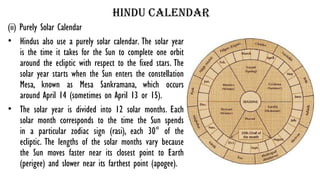
(ii) PurelySolar Calendar
• Hindus also use a purely solar calendar. The solar year
is the time it takes for the Sun to complete one orbit
around the ecliptic with respect to the fixed stars. The
solar year starts when the Sun enters the constellation
Mesa, known as Mesa Sankramana, which occurs
around April 14 (sometimes on April 13 or 15).
• The solar year is divided into 12 solar months. Each
solar month corresponds to the time the Sun spends
in a particular zodiac sign (rasi), each 30° of the
ecliptic. The lengths of the solar months vary because
the Sun moves faster near its closest point to Earth
(perigee) and slower near its farthest point (apogee).
13.
hindu calendar
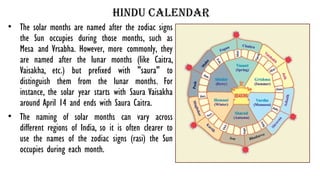
• Thesolar months are named after the zodiac signs
the Sun occupies during those months, such as
Mesa and Vrsabha. However, more commonly, they
are named after the lunar months (like Caitra,
Vaisakha, etc.) but prefixed with "saura" to
distinguish them from the lunar months. For
instance, the solar year starts with Saura Vaisakha
around April 14 and ends with Saura Caitra.
• The naming of solar months can vary across
different regions of India, so it is often clearer to
use the names of the zodiac signs (rasi) the Sun
occupies during each month.
14.
hindu calendar
(iii) HinduFesitval
• Most Hindu festivals are based on the luni-solar calendar, which includes both lunar and
solar elements.
Lunar Festivals:
• Lunar New Year (Candramana Yugadi): Falls on sukla pratipat of Caitra month.
• Sri Ramanavami: Celebrated eight days after the New Year, on sukla navami of Caitra.
• Sri Krishna Janmashtami: Falls on astami of krsna paksa in Sravana month.
• Ganesa Caturthi: Observed on sukla caturthi of Bhadrapada month.
• Mahalaya Amavasya: Falls on the last day of Bhadrapada month.
15.
hindu calendar
• Dasara(Dussehra): Celebrated from Asvayuja sukla pratipat to dasami, with Durga Puja in
Bengal and the famous Mysore Dasara procession.
• Vijayadasami: Marks the end of Dasara, celebrated as Ramlila in North India.
• Diwali (Dipavali): A major festival of lights, celebrated on Asvayuja krsna caturdasi and
amavasya.
• Maha Shivaratri: Observed on Magha krsna caturdasi.
• Holi (Holika Dahana): Celebrated on Phalguna purnima, known for colors in North India.
Solar Festivals:
• Solar New Year: Celebrated on the first day of Saura Vaisakha (around April 14), in Assam,
Bengal, Orissa, Tamil Nadu, and Kerala.
• Makara Sankranti: Celebrated on the first day of Saura Magha, popular in Tamil Nadu and
Kerala as Pongal, and as Magha Bihu in Assam.
16.
hindu calendar
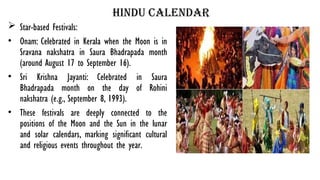
Star-basedFestivals:
• Onam: Celebrated in Kerala when the Moon is in
Sravana nakshatra in Saura Bhadrapada month
(around August 17 to September 16).
• Sri Krishna Jayanti: Celebrated in Saura
Bhadrapada month on the day of Rohini
nakshatra (e.g., September 8, 1993).
• These festivals are deeply connected to the
positions of the Moon and the Sun in the lunar
and solar calendars, marking significant cultural
and religious events throughout the year.
17.
islamic calendar
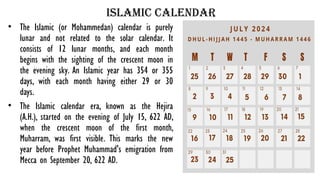
• TheIslamic (or Mohammedan) calendar is purely
lunar and not related to the solar calendar. It
consists of 12 lunar months, and each month
begins with the sighting of the crescent moon in
the evening sky. An Islamic year has 354 or 355
days, with each month having either 29 or 30
days.
• The Islamic calendar era, known as the Hejira
(A.H.), started on the evening of July 15, 622 AD,
when the crescent moon of the first month,
Muharram, was first visible. This marks the new
year before Prophet Muhammad's emigration from
Mecca on September 20, 622 AD.
18.
islamic calendar
Thetwelve lunar months and their days are:
• Muharram - 30 days
• Safar - 29 days
• Rabi-ul-Awwal - 30 days
• Rabi-ussani - 29 days
• Jamada' l-Awwal - 30 days
• Jamad-ussani - 29 days
• Rajab - 30 days
• Shaban - 29 days
• Ramadan - 30 days
• Shawal - 29 days
• Zilkada - 30 days
• Zilhijja - 29 or 30 days
19.
islamic calendar
• Aleap year, called Kabishah, has 355
days with Zilhijja having 30 days. In a
30-year cycle, there are 19 common
years of 354 days and 11 leap years of
355 days.
• To determine a leap year, if the
remainder after dividing the Hejira year
by 30 is 2, 5, 7, 10, 13, 16, 18, 21, 24,
26, or 29, then it is a leap year.
20.
The Indian calendarand panchaang
• In India, both solar and lunar calendars have been used for a long time. The lunar
month, which is the time between two new moons or full moons, is a natural time unit
and lasts about 354 days. This lunar year is aligned with the solar year of about 365
days by adding extra months, called adhikamasas, when a sankranti (solar transit) does
not occur in a lunar month.
• A lunar month has phases of the Moon, divided into two halves: sukla paksa (bright half)
and krishna paksa (dark half). In the sukla paksa, the Moon waxes from new to full
moon, passing through crescent, half, and gibbous phases. In the krishna paksa, the Moon
wanes from full to new moon. Each half, or paksa, has 15 days.
21.
The Indian calendarand panchaang
• A week, or vara, has 7 days named after planets: Ravivara, Somavara, etc. The year in a
calendar is marked by the number of years passed since the start of the current era,
such as Kali or Saka.
22.
What is thepanchaang ?
• In a traditional Hindu household, the annual Panchaang is essential. Hindus use the Panchaang
for all religious observances and to determine the dates of important festivals like Ganesh
Chaturthi, Sri Ram Navami, Sri Krishna Ashtami, and Yugadi, as well as special days like Ekadasi,
Dvadasi, Amavasya, and Purnima.
• The word "Panchaang" means "five parts," referring to:
1) Tithi (lunar day)
2) Nakshatra (star/constellation)
3) Vara (day of the week)
4) Yoga (a specific time period)
5) Karana (half of a lunar day)
• Besides these five parts, the Panchaang includes valuable information for astrological, religious,
and social purposes, as well as predicting planetary positions and sunrise and sunset timings.
23.
tithi
• In alunar month, from one new moon to the next, the Moon's shape and size change daily. On
Amavasya (new moon day), the Moon is invisible. The next day, a thin crescent moon appears
briefly after sunset in the west.
• During the Sukla Paksa (bright half of the month), the Moon's visible part increases, reaching
half on the 7th or 8th day and becoming full at the end of the fortnight.
• In the Krishna Paksa (dark half), the Moon wanes. From the full moon to the 7th or 8th day, it
appears gibbous, then half, and finally crescent before becoming invisible again on the new
moon day.
24.
tithi
1. Pratipat
2. Dvitiya
3.Tritiya
4. Caturthi
5. Panchami
6. Shashti
7. Saptami
8. Astami
9. Navami
10. Dasami
11. Ekadasi
12. Dvadasi
13. Trayodasi
14. Caturdasi
15. Purnima (full moon) or
Amavasya (new moon)
A lunar month is divided into 30 parts called tithis, with 15 tithis in each half. A tithi lasts
the time it takes for the Moon to move 12° relative to the Sun. The names of the tithis
are:
25.
tithi
Calculating Tithi(Lunar Day):
• Tithi = (Moon's Longitude - Sun's Longitude) / 12°
• If Moon's Longitude < Sun's Longitude, add 360° before dividing.
• The quotient + 1 gives the current tithi.
Tithi interpretation:
• 1-15: Shukla paksa (bright fortnight)
• 16-30: Krishna paksa (dark fortnight); subtract 15 for actual tithi
• 15: Purnima (full moon)
• 30: Amavasya (new moon)
26.
tithi
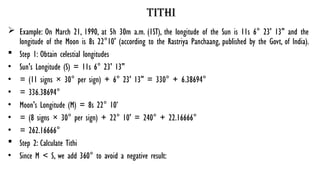
Example: OnMarch 21, 1990, at 5h 30m a.m. (1ST), the longitude of the Sun is 11s 6° 23' 13" and the
longitude of the Moon is 8s 22°10' (according to the Rastriya Panchaang, published by the Govt, of India).
Step 1: Obtain celestial longitudes
• Sun's Longitude (S) = 11s 6° 23' 13"
• = (11 signs × 30° per sign) + 6° 23' 13" = 330° + 6.38694°
• = 336.38694°
• Moon's Longitude (M) = 8s 22° 10’
• = (8 signs × 30° per sign) + 22° 10' = 240° + 22.16666°
• = 262.16666°
Step 2: Calculate Tithi
• Since M < S, we add 360° to avoid a negative result:
27.
tithi
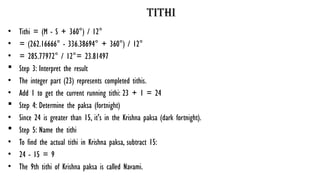
• Tithi =(M - S + 360°) / 12°
• = (262.16666° - 336.38694° + 360°) / 12°
• = 285.77972° / 12°= 23.81497
Step 3: Interpret the result
• The integer part (23) represents completed tithis.
• Add 1 to get the current running tithi: 23 + 1 = 24
Step 4: Determine the paksa (fortnight)
• Since 24 is greater than 15, it's in the Krishna paksa (dark fortnight).
Step 5: Name the tithi
• To find the actual tithi in Krishna paksa, subtract 15:
• 24 - 15 = 9
• The 9th tithi of Krishna paksa is called Navami.
28.
nakshatra
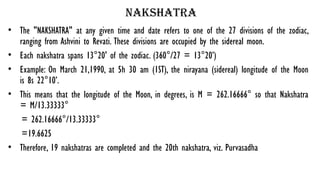
• The "NAKSHATRA"at any given time and date refers to one of the 27 divisions of the zodiac,
ranging from Ashvini to Revati. These divisions are occupied by the sidereal moon.
• Each nakshatra spans 13°20' of the zodiac. (360°/27 = 13°20’)
• Example: On March 21,1990, at 5h 30 am (1ST), the nirayana (sidereal) longitude of the Moon
is 8s 22°10’.
• This means that the longitude of the Moon, in degrees, is M = 262.16666° so that Nakshatra
= M/13.33333°
= 262.16666°/13.33333°
=19.6625
• Therefore, 19 nakshatras are completed and the 20th nakshatra, viz. Purvasadha
29.
Vara
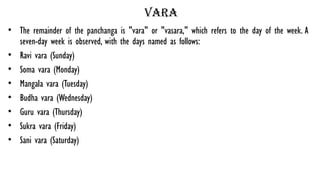
• The remainderof the panchanga is "vara" or "vasara," which refers to the day of the week. A
seven-day week is observed, with the days named as follows:
• Ravi vara (Sunday)
• Soma vara (Monday)
• Mangala vara (Tuesday)
• Budha vara (Wednesday)
• Guru vara (Thursday)
• Sukra vara (Friday)
• Sani vara (Saturday)
30.
Vara
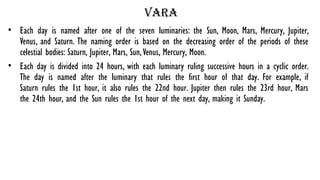
• Each dayis named after one of the seven luminaries: the Sun, Moon, Mars, Mercury, Jupiter,
Venus, and Saturn. The naming order is based on the decreasing order of the periods of these
celestial bodies: Saturn, Jupiter, Mars, Sun,Venus, Mercury, Moon.
• Each day is divided into 24 hours, with each luminary ruling successive hours in a cyclic order.
The day is named after the luminary that rules the first hour of that day. For example, if
Saturn rules the 1st hour, it also rules the 22nd hour. Jupiter then rules the 23rd hour, Mars
the 24th hour, and the Sun rules the 1st hour of the next day, making it Sunday.
31.
yoga
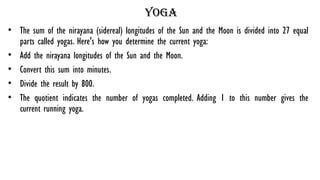
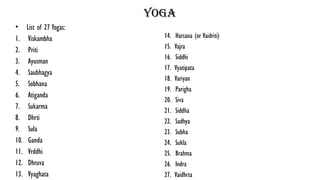
• The sumof the nirayana (sidereal) longitudes of the Sun and the Moon is divided into 27 equal
parts called yogas. Here's how you determine the current yoga:
• Add the nirayana longitudes of the Sun and the Moon.
• Convert this sum into minutes.
• Divide the result by 800.
• The quotient indicates the number of yogas completed. Adding 1 to this number gives the
current running yoga.
yoga
Example Calculation:
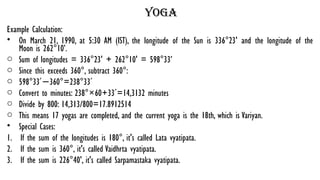
• OnMarch 21, 1990, at 5:30 AM (IST), the longitude of the Sun is 336°23' and the longitude of the
Moon is 262°10’.
o Sum of longitudes = 336°23' + 262°10' = 598°33’
o Since this exceeds 360°, subtract 360°:
o 598°33 360°=238°33
′− ′
o Convert to minutes: 238°×60+33 =14,3132 minutes
′
o Divide by 800: 14,313/800=17.8912514
o This means 17 yogas are completed, and the current yoga is the 18th, which is Variyan.
• Special Cases:
1. If the sum of the longitudes is 180°, it's called Lata vyatipata.
2. If the sum is 360°, it's called Vaidhrta vyatipata.
3. If the sum is 226°40', it's called Sarpamastaka vyatipata.
34.
karana
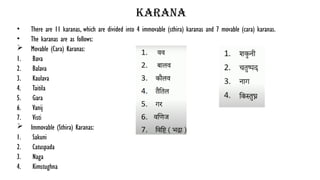
• There are11 karanas, which are divided into 4 immovable (sthira) karanas and 7 movable (cara) karanas.
• The karanas are as follows:
Movable (Cara) Karanas:
1. Bava
2. Balava
3. Kaulava
4. Taitila
5. Gara
6. Vanij
7. Visti
Immovable (Sthira) Karanas:
1. Sakuni
2. Catuspada
3. Naga
4. Kimstughna
35.
karana
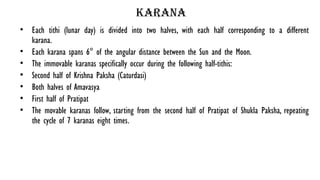
• Each tithi(lunar day) is divided into two halves, with each half corresponding to a different
karana.
• Each karana spans 6° of the angular distance between the Sun and the Moon.
• The immovable karanas specifically occur during the following half-tithis:
• Second half of Krishna Paksha (Caturdasi)
• Both halves of Amavasya
• First half of Pratipat
• The movable karanas follow, starting from the second half of Pratipat of Shukla Paksha, repeating
the cycle of 7 karanas eight times.
36.
karana
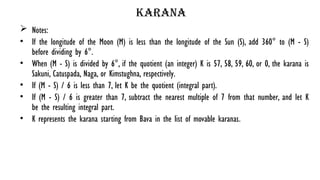
Notes:
• Ifthe longitude of the Moon (M) is less than the longitude of the Sun (S), add 360° to (M - S)
before dividing by 6°.
• When (M - S) is divided by 6°, if the quotient (an integer) K is 57, 58, 59, 60, or 0, the karana is
Sakuni, Catuspada, Naga, or Kimstughna, respectively.
• If (M - S) / 6 is less than 7, let K be the quotient (integral part).
• If (M - S) / 6 is greater than 7, subtract the nearest multiple of 7 from that number, and let K
be the resulting integral part.
• K represents the karana starting from Bava in the list of movable karanas.
37.
karana
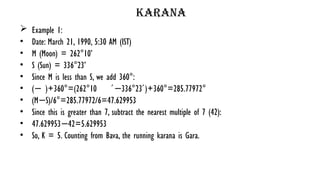
Example 1:
•Date: March 21, 1990, 5:30 AM (IST)
• M (Moon) = 262°10’
• S (Sun) = 336°23’
• Since M is less than S, we add 360°:
• ( )+360°=(262°10 336°23 )+360°=285.77972°
− ′− ′
• (M S)/6°=285.77972/6=47.629953
−
• Since this is greater than 7, subtract the nearest multiple of 7 (42):
• 47.629953 42=5.629953
−
• So, K = 5. Counting from Bava, the running karana is Gara.
38.
True Positions ofthe Sun and the Moon
Introduction
• Initially, it was assumed that the Sun and Moon move in circular orbits around the Earth at a
constant speed. However, observations showed that their movements are not uniform. To correct the
mean positions and obtain the true positions, we use the epicyclic theory, which is explained below.
• Epicyclic Theory (Mandaphala)The epicyclic theory suggests that while the mean Sun or Moon moves
along a large circular orbit, the actual (true) Sun or Moon moves along a smaller circle called an
epicycle, which is centered on the larger orbit.
• Key Terms:
1. Kaksavrtta: The large circular orbit with Earth at its center.
2. Nicoccarekha (Apse Line): A line from Earth to the farthest point of the true Sun or Moon on the
epicycle.
3. Mandocca (Apogee) and Mandanica (Perigee): Points on the epicycle where the true Sun or Moon is
farthest and closest to the Earth, respectively.
39.
True Positions ofthe Sun and the Moon
Movement:
• The mean Sun or Moon moves along the large circle from west to east.
• The true Sun or Moon moves along the epicycle from east to west at the same speed.
Mathematical Explanation:
• The difference between the mean and true positions is called the equation of the center (mandaphala).
• The maximum deviation observed (mandakendrajya) helps calculate the true position.
Example with the Sun:
1. The mean Sun moves from point A to point A' on the large orbit.
2. The true Sun moves from point U to point U' on the epicycle.
3. The angle between the mean Sun and the apogee is called the mean anomaly (m).
• Using the right-angled triangles formed:The length A'D (mandakendrajya) is calculated as sin Rsinm.The
𝑅 𝑚
distance SC, which approximates the arc A'S', is calculated as ( )sin ( Rr)sinm.This provides the equation of
𝑟𝑅 𝑚
the center:Equation of center=( )( sin )Equation of center=( Rr )(Rsinm)Where: sin Rsinm is the
𝑟𝑅 𝑅 𝑚 𝑅 𝑚
"Indian sine" of the Sun's anomaly (m).The maximum value of the equation of the center is the radius of the
epicycle (r).
40.
True Positions ofthe Sun and the Moon
This provides the equation of the center:Equation of center=( )( sin )Equation of center=(
𝑟𝑅 𝑅 𝑚
Rr )(Rsinm)Where: sin Rsinm is the "Indian sine" of the Sun's anomaly (m).The maximum
𝑅 𝑚
value of the equation of the center is the radius of the epicycle (r).Observations by Bhaskara
II:The maximum deviation (r) for the Sun is 2° 11' 30", leading to the Sun’s epicycle having a
circumference of 13.66°.The same theory applies to the Moon, with a maximum deviation of
302'.Variations in Texts:Some texts use a constant radius for the epicycles, while others, like
Aryabhatiyam and later Suryasiddhanta, consider varying radii.This explanation helps correct the
mean positions to find the true positions of the Sun and Moon using the epicyclic theory.