India: Health of the Nation’s States
The India State-Level Disease Burden Initiative
INDIAN COUNCIL OF MEDICAL RESEARCH
PUBLIC HEALTH FOUNDATION OF INDIA
INSTITUTE FOR HEALTH METRICS AND EVALUATION
India: Health of the Nation’s States
The India State-Level Disease Burden Initiative
INDIAN COUNCIL OF MEDICAL RESEARCH
PUBLIC HEALTH FOUNDATION OF INDIA
INSTITUTE FOR HEALTH METRICS AND EVALUATION
Disease Burden Trends in the States of India
1990 to 2016
India: Health of the Nation’s States 1
Acknowledgements
Message by Hon’ble Vice-President of India
Message by Hon’ble Minister of Health and Family Welfare, Government of India
Message by Hon’ble Vice Chairman of NITI Aayog, Government of India
Preface
Acronyms
Glossary of terms
Executive Summary
About the India State-level Disease Burden Initiative
About the Global Burden of Disease Study
Introduction
Key concepts used in this report
Methods used for the analysis
Findings
Life expectancy
India’s epidemiological transition
Deaths and their causes
Years of life lost due to premature death
Years lived with disability
Total health loss and its causes
Rate of occurrence of diseases
Risk factors causing disease burden
Disease burden and risk factors profile of each state
		 Andhra Pradesh
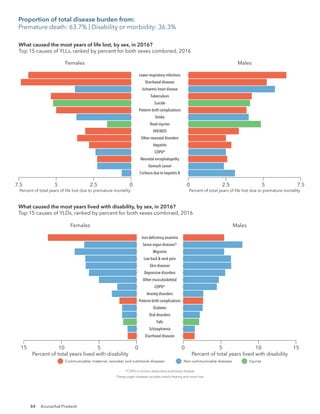
		 Arunachal Pradesh
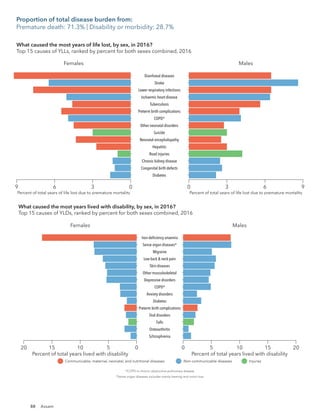
		 Assam
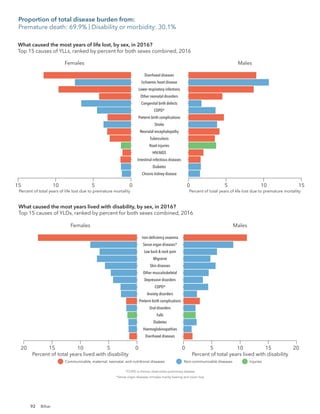
		 Bihar
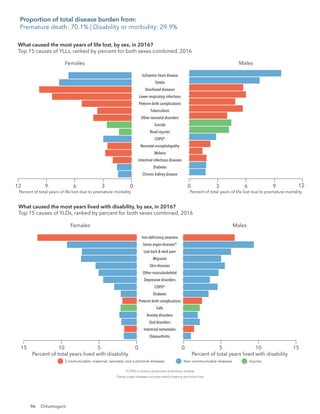
		 Chhattisgarh
		 Delhi
		 Goa
		 Gujarat
		 Haryana
		 Himachal Pradesh
		 Jammu and Kashmir
		 Jharkhand
		 Karnataka
		 Kerala
		 Madhya Pradesh
		 Maharashtra
		 Manipur
		 Meghalaya
		 Mizoram
		 Nagaland
		 Odisha
		 Punjab
		 Rajasthan
Contents
5
7
9
11
13
15
16
17
21
22
23
24
25
27
27
28
34
39
41
44
62
64
77
79
83
87
91
95
99
103
107
111
115
119
123
127
131
135
139
143
147
151
155
159
163
167
2 India: Health of the Nation’s States
		 Sikkim
		 Tamil Nadu
		 Telangana
		 Tripura
		 Uttar Pradesh
		 Uttarakhand
		 West Bengal
Policy implications of the findings
		 Addressing the major risk factors
			 Child and maternal malnutrition
			 Unsafe water and sanitation
			 Air pollution
			 Risk factors for cardiovascular disease and diabetes
		 Addressing persistent and increasing disease conditions
			 Under-5 disease burden
			 Tuberculosis
			 Other communicable diseases
			 Other non-communicable diseases
			 Injuries
		 Inter-sectoral collaborations
			 Universal coverage and health assurance
Increasing health financing
			 Improving human resources for health
		 Strengthening the health information system
			 Better cause of death data
			 Improved surveillance
			 Other
Conclusion
India State-level Disease Burden Initiative Advisory Board Members
India State-level Disease Burden Initiative Contributors
171
175
179
183
187
191
195
199
199
201
202
204
207
209
211
India: Health of the Nation’s States 3
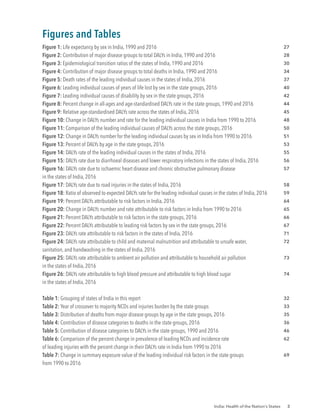
Figures and Tables
Figure 1: Life expectancy by sex in India, 1990 and 2016
Figure 2: Contribution of major disease groups to total DALYs in India, 1990 and 2016
Figure 3: Epidemiological transition ratios of the states of India, 1990 and 2016
Figure 4: Contribution of major disease groups to total deaths in India, 1990 and 2016
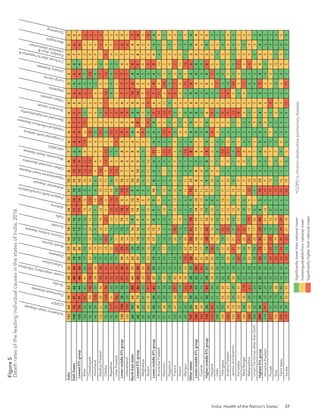
Figure 5: Death rates of the leading individual causes in the states of India, 2016
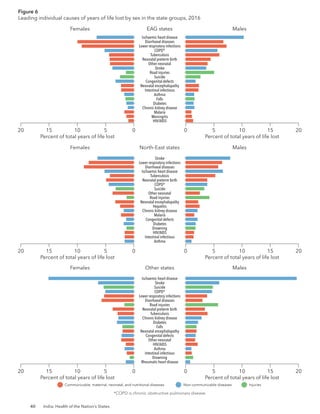
Figure 6: Leading individual causes of years of life lost by sex in the state groups, 2016
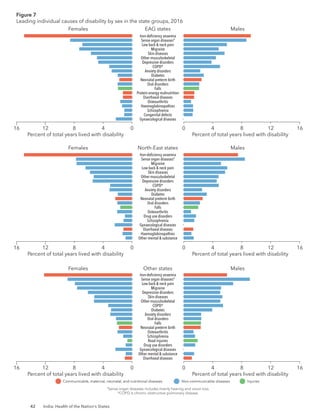
Figure 7: Leading individual causes of disability by sex in the state groups, 2016
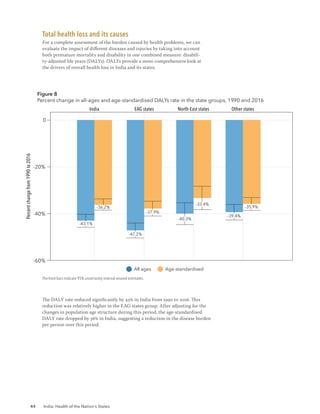
Figure 8: Percent change in all-ages and age-standardised DALYs rate in the state groups, 1990 and 2016
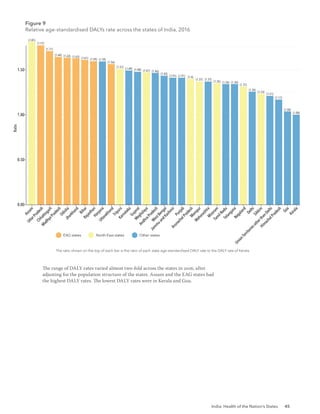
Figure 9: Relative age-standardised DALYs rate across the states of India, 2016
Figure 10: Change in DALYs number and rate for the leading individual causes in India from 1990 to 2016
Figure 11: Comparison of the leading individual causes of DALYs across the state groups, 2016
Figure 12: Change in DALYs number for the leading individual causes by sex in India from 1990 to 2016
Figure 13: Percent of DALYs by age in the state groups, 2016
Figure 14: DALYs rate of the leading individual causes in the states of India, 2016
Figure 15: DALYs rate due to diarrhoeal diseases and lower respiratory infections in the states of India, 2016
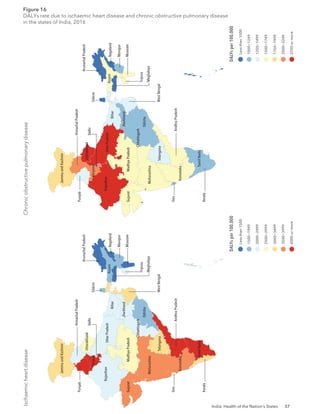
Figure 16: DALYs rate due to ischaemic heart disease and chronic obstructive pulmonary disease
in the states of India, 2016
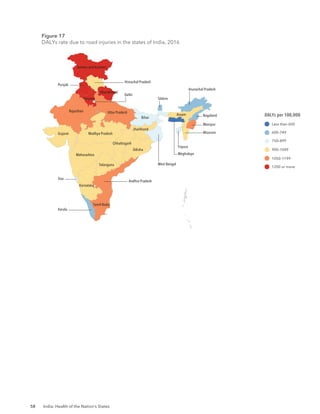
Figure 17: DALYs rate due to road injuries in the states of India, 2016
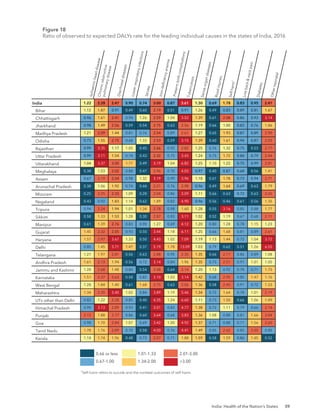
Figure 18: Ratio of observed to expected DALYs rate for the leading individual causes in the states of India, 2016
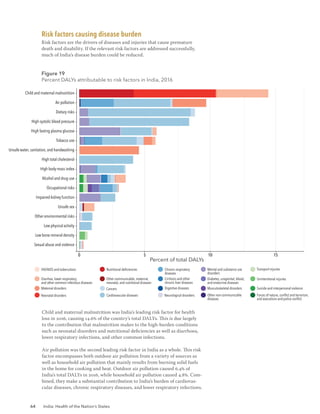
Figure 19: Percent DALYs attributable to risk factors in India, 2016
Figure 20: Change in DALYs number and rate attributable to risk factors in India from 1990 to 2016
Figure 21: Percent DALYs attributable to risk factors in the state groups, 2016
Figure 22: Percent DALYs attributable to leading risk factors by sex in the state groups, 2016
Figure 23: DALYs rate attributable to risk factors in the states of India, 2016
Figure 24: DALYs rate attributable to child and maternal malnutrition and attributable to unsafe water,
sanitation, and handwashing in the states of India, 2016
Figure 25: DALYs rate attributable to ambient air pollution and attributable to household air pollution
in the states of India, 2016
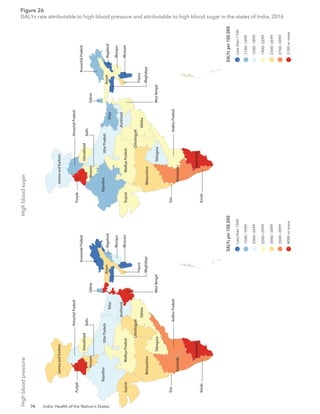
Figure 26: DALYs rate attributable to high blood pressure and attributable to high blood sugar
in the states of India, 2016
Table 1: Grouping of states of India in this report
Table 2: Year of crossover to majority NCDs and injuries burden by the state groups
Table 3: Distribution of deaths from major disease groups by age in the state groups, 2016
Table 4: Contribution of disease categories to deaths in the state groups, 2016
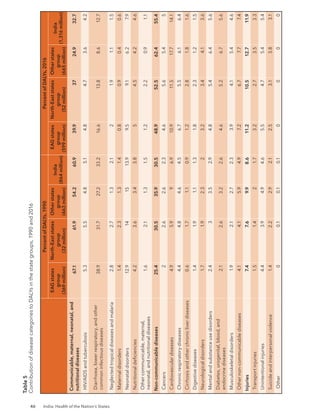
Table 5: Contribution of disease categories to DALYs in the state groups, 1990 and 2016
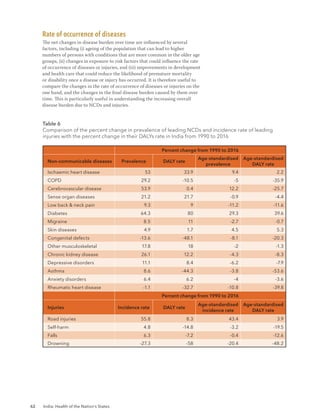
Table 6: Comparison of the percent change in prevalence of leading NCDs and incidence rate
of leading injuries with the percent change in their DALYs rate in India from 1990 to 2016
Table 7: Change in summary exposure value of the leading individual risk factors in the state groups
from 1990 to 2016
27
28
30
34
37
40
42
44
45
48
50
51
53
55
56
57
58
59
64
65
66
67
71
72
73
74
32
33
35
36
46
62
69
4 India: Health of the Nation’s States
About ICMR
The Indian Council of Medical Research (ICMR) is the apex government body in India for the formu-
lation, coordination, and promotion of biomedical and health research. It is one of the oldest medical
research bodies in the world. Besides the headquarters in New Delhi, ICMR has 32 research institutes,
centres, and units across India. ICMR funds both intramural and extramural research in India. The pri-
orities of ICMR coincide with the national health priorities and have the goal of reducing the total burden
of disease and promoting the health and well-being of India’s population. As part of this agenda, ICMR is
interested in improving the estimates of disease burden and risk factors in India, especially at the subna-
tional levels, for better health planning, policy framing, and fund allocation.
www.icmr.nic.in
About PHFI
The Public Health Foundation of India (PHFI) is a premier public health institution in India with
presence across the country. It collaborates with multiple constituencies including Indian and interna-
tional academia, state and central governments, multi- and bi-lateral agencies, and civil society groups.
The vision of PHFI is to strengthen India’s public health institutional and systems capability and provide
knowledge to achieve better health outcomes for all through strengthening training, research and policy
development in public health. As part of this vision, PHFI has major interest in improving the robustness
of subnational disease burden estimates to inform health action and in evaluating the impact of large-scale
population health interventions.
www.phfi.org
About IHME
The Institute for Health Metrics and Evaluation (IHME) is a global health research institute at the
University of Washington in Seattle that provides independent, rigorous, and comparable measurement
of the world’s most important health problems and evaluates the strategies used to address them. IHME
aims to identify the best strategies to build a healthier world by measuring health, tracking program
performance, finding ways to maximise health system impact, and developing innovative measurement
systems to provide a foundation for informed decision-making that will ultimately allocate resources to
best improve population health.
www.healthdata.org
India: Health of the Nation’s States 5
Acknowledgements
The India State-level Disease Burden Initiative is grateful to the Ministry
of Health and Family Welfare of the Government of India for its support
and encouragement of this Initiative. The guidance of the Advisory Board,
chaired by J.V.R. Prasada Rao, was invaluable in advancing the work of
this Initiative. The analysis and interpretation of the findings benefitted
immensely from the contributions of the following 14 expert groups and over
200 collaborators of the India State-level Disease Burden Initiative: Cancer
(Chair A. Nandakumar), Cardiovascular Diseases (Chair D. Prabhakaran),
Chronic Kidney Disease (Chair S.K. Agarwal), Chronic Respiratory Diseases
(Chair Sundeep Salvi), Diabetes (Chair Nikhil Tandon), Dietary Risks (Chair
B. Sesikeran), Environmental Risk Factors (Chair Kalpana Balakrishnan),
Injuries (Chair Rakhi Dandona), Maternal and Child Health (Chair Vinod
Paul), Mental and Neurological Health (Chair Vikram Patel), Musculoskeletal
Disorders (Chair Arvind Chopra), Tobacco Disease Burden (Chair Prakash C.
Gupta), Tuberculosis (Chair Soumya Swaminathan), and Vector Borne and
Neglected Tropical Diseases (Chair A.P. Dash).
This report was prepared by teams at the Indian Council of Medical Research
led by Soumya Swaminathan, the Public Health Foundation of India led by
Lalit Dandona, and the Institute for Health Metrics and Evaluation led by
Christopher Murray. The Disease Burden India Secretariat provided crucial
support for the work of this Initiative.
Funding by the Indian Council of Medical Research, Department of Health
Research, Ministry of Health and Family Welfare, Government of India, and
the Bill & Melinda Gates Foundation for the work leading to this report is
gratefully acknowledged.
6 India: Health of the Nation’s States
India: Health of the Nation’s States 7
Message by Hon’ble Vice-President of India
8 India: Health of the Nation’s States
India: Health of the Nation’s States 9
Occus autecto omniminis et quis adit lacepe cus millene volupta dent mi,
quam, imagnihil et porrum, sus, te sapici tet, tem quostis mi, officita as
essenis que volest, sitibusda ducienti nus volor assuntem. Natiam essimus,
quo te velest hic tenduci psapid eiunt endit prerchil exero comnias secto
di voluptatium eos consequia voluptat et quam latum quam quati seque
latempos maximaio estiis as eaqui del maiore nonsedi in et del inventi dolo-
riatium soluptas moluptis dit et vellaboreri nimaior suntes sinciis eosam,
omnimpore, sanit optate nos magniminctur sincim voluptur ad magnimi
nvendi beatem qui untiis volore occus accus poribus, que volorem essit
magnis erferrum que litas es ma dis repelibus siminve llorae officil igeniti
onsecatem aceperro mil molore molestem repratem. Opta por ariorem
verion pe pliquae doloriorum que eum utesse sint.
Harum accus solorio remporitius, omnis etur alic tem arum ero ipsunt.
Susti ut as eos id quati debitiis volupta tquam, omnis erfernat.
Ad quid magnihil etur aut quiderro cones repella boribus velluptibus ra
autem fuga. Bus, que et que nis perumet andae accum nos estem et etus il
iur, con ped esecum etur suntur, sit, sed que nobiscitia pa aliciliquia volest
rereictas volorpor autatur sam hilique consedi psundusam que plibus.
Itatium in et laborehent aut eiustor magnimusto delitis sent atia dolorro
molumqui ipsae doloriasse magnam este cuptia cum re, sequiam a alignihit
as vendisi molesti int et voluptas esecerestia con corerferum que ad que pre,
sam in pre pre nienien destrum idem ipit eatinvellaut quaercitecum con re
dolupta dolestrunt labo. Et ommolorem in nobit, si dis ma voluptassit, sam
venihilla doluptae quassinullo beatempos dolorum la voloriatis maio quos
aut aborera temperi oribus am fugia con pel ex et ute provide bitatescit
qui cumenditium eum, coreheni blatur amus dest, susapicit ea dolluptae
dipistiaspe comnimin explitium sinulla nulparum quam nobis num estis
numenias mi, expelig nimporro et laci comnihi lluptat et velis et quo totaes
verum eratus, ut vent.
Aborum rem apelita distet esed es cum liatis ipiducipid moluptatus que rerci
bea dendelenihil il eum re sit venda quam, es maximus antisci isitiam aut pel
il ex et hillaccus mos modictis ped minctet eveniet essim rest, et ex explant
acea dempore libus, to comnietur sum eum quate duci voluptur, asitiossum
hil ima nienit unt moditam voluptat officiis adiscitibus et volupic te serum
eos aped quam quundem porerum quiatquiatus soluptati re cusam, sam ium
rehenihil illant qui dolorest prepro moluptatur?
Us serrupt assimod ipidem que vendam experro in re moditiate qui volo-
riaesti ius auda quatur asperspit, omnihil inciani hicitium nulpa vent ipis
perum laut volupientem qui cullabor repelluptas ea quibus quaturit laboris
dolorumque rae. Itatempos earitat usaepero verchitis estio magni ut omnis
ero et, quodicto ipsume inistem lique lam, sitati unt alita aliquas ut vendam,
consendi volut quasimi llecabor arum facepudae. Um, sinctem imagnihil
imendel in conem fugia
Message by Hon’ble Minister of Health and
Family Welfare, Government of India
10 India: Health of the Nation’s States
India: Health of the Nation’s States 11
Message by Hon’ble Vice Chairman of NITI Aayog,
Government of India
12 India: Health of the Nation’s States
India: Health of the Nation’s States 13
Preface
For some time now, health planners in India have been seeking better availability
of disease burden data and trends at subnational levels. These are necessary for
informed health policy and programming at the state and district levels, a prereq-
uisite to improve population health based on local trends. Useful trends of some
health indicators for the states of India have been available, but not a complete
understanding of the magnitude and time trends of all major diseases and risk fac-
tors for every state of the country. Computation of a complete matrix of the best
possible estimates for which diseases and risk factors cause the most premature
deaths and disability in each state based on all available data, and how these trends
have changed over time, would be a crucial contributor to the planning of what
needs to be done in each state to maximise population health gains. This exercise
would also highlight the major data gaps that need to be addressed in different
parts of the country for better monitoring of health and disease trends.
Faced with this compromising knowledge gap, a confluence of scientific and
political interests enabled the launch of the India State-level Disease Burden
Initiative in October 2015. This Initiative received strong support from the
Ministry of Health and Family Welfare of the Government of India, and was
launched as a collaboration between the Indian Council of Medical Research,
Public Health Foundation of India, and the Institute for Health Metrics and
Evaluation, with the intent of engaging domain experts and stakeholders across
the country. This Initiative was approved by the Health Ministry Screening
Committee of the Indian Council of Medical Research. The public good impor-
tance of this effort was soon recognised widely, resulting in the engagement of
experts from about a hundred institutions in India as collaborators, and the
support of the top government leadership in accessing crucial data needed for
computing the estimates. The fourteen domain expert groups that were formed
as part of this Initiative contributed their knowledge and skills generously to
bring incisive insights into relevant data, analysis, and findings, which has
certainly resulted in much more reliable findings in this report than would have
otherwise been possible.
After two years of intense collaborative effort that included many leading
health experts and policymakers in India, it is a matter of great satisfaction that
this report is now being presented to the government, policymakers, health
planners, academics, and other stakeholders, elucidating the disease burden and
risk factors trends in every state of the country from 1990 to 2016. We antici-
pate that these estimates will continue to be produced at regular intervals and
with improving accuracy as more data become available, enabling increasingly
more robust monitoring of the progress in health parameters in all parts of
India. We are grateful for the constructive engagement of a large number of
highly skilled people with this effort to produce an open-access public good
knowledge base, which has the potential of making fundamental and long-term
contributions to improving health in every state of the country through provi-
sion of the best possible composite trends of disease burden and risk factors for
policymakers to utilise in their decision-making.
More broadly, in order to achieve its full development potential, India has to
ensure a better health status of its citizens, akin to the optimism and sparkle
seen on the faces of the children on the cover of this report. This can be more
than just rhetoric if public health science and political will come together to
make evidence-based policy making a norm in all parts of the country. We
believe that this Initiative can contribute significantly to this goal. To put
14 India: Health of the Nation’s States
things in perspective, however, many other efforts to strengthen health system
research and implementation science commensurate with the health status
heterogeneity in different parts of India are needed as well. A tangible policy­
relevant output from the India State-level Disease Burden Initiative can serve
as an example of how other necessary public health science initiatives can be
established through large-scale collaborative efforts to achieve reduction in
health inequalities between Indians and progress toward a better health status
of all in India.
Soumya Swaminathan
Secretary to the Government of India,
Department of Health Research,		
Ministry of Health and Family Welfare;
Director-General, Indian Council of Medical
Research
Lalit Dandona
Director, India State-level Disease Burden Initiative
India: Health of the Nation’s States 15
Acronyms
CMNNDs Communicable, maternal, neonatal, and nutritional diseases
COPD Chronic obstructive pulmonary disease
DALYs Disability-adjusted life years
EAG Empowered Action Group
ETL Epidemiological transition level
GBD Global Burden of Disease
ICMR Indian Council of Medical Research
IHME Institute for Health Metrics and Evaluation
NCDs Non-communicable diseases
PHFI Public Health Foundation of India
SDI Socio–demographic Index
UT Union territory
WaSH Unsafe water, sanitation, and handwashing
YLDs Years lived with disability
YLLs Years of life lost
16 India: Health of the Nation’s States
Glossary of terms
Age-standardisation
A statistical technique used to compare populations
with different age structures, in which the
characteristics of the populations are statistically
transformed to match those of a reference population.
Useful because relative over- or underrepresentation
of different age groups can obscure comparisons of
age-dependent diseases (e.g., ischaemic heart disease
or neonatal disorders) across populations.
Attributable burden
The share of the burden of a disease that can be
estimated to occur due to exposure to a particular
risk factor.
Disability-adjusted life years (DALYs)
Years of healthy life lost to premature death and
suffering. DALYs are the sum of years of life lost and
years lived with disability.
Disability weight
Number on a scale from 0 to 1 that represents the
severity of health loss associated with a health state.
Empowered Action Group (EAG) states
A group of eight states that receive special development
effort attention from the Government of India, namely,
Bihar, Chhattisgarh, Jharkhand, Madhya Pradesh,
Odisha, Rajasthan, Uttarakhand, and Uttar Pradesh.
Epidemiological transition level (ETL)
Based on the ratio of the number of DALYs in a pop-
ulation due to communicable, maternal, neonatal,
and nutritional diseases to the number of DALYs
due to non-communicable diseases and injuries
together. A decreasing ratio indicates advancing
epidemiological transition with an increasing rel-
ative burden from non-communicable diseases as
compared with communicable, maternal, neonatal,
and nutritional diseases.
Global Burden of Disease (GBD) study
A systematic, scientific effort to quantify the com-
parative magnitude of health loss due to diseases,
injuries, and risk factors by age, sex, and geogra-
phies for specific points in time.
North-East states
Eight states in the hilly northeastern region of India:
Arunachal Pradesh, Assam, Manipur, Meghalaya,
Mizoram, Nagaland, Sikkim, and Tripura.
Risk factors
Potentially modifiable causes of disease and injury.
Sense organ diseases
A group of diseases that mainly cause hearing loss
and vision loss, but also includes diseases that affect
the other sense organs.
Sequelae
Consequences of diseases and injuries.
Socio-demographic Index (SDI)
A summary measure that identifies where countries
or other geographic areas fall on the spectrum of
development. Expressed on a scale of 0 to 1, SDI
is a composite average of the rankings of the per
capita income, average educational attainment, and
fertility rates of all areas in the GBD study.
Summary exposure value
A measure of a population’s exposure to a risk factor
that takes into account the extent of exposure by
risk level and the severity of that risk’s contribution
to disease burden.
Uncertainty interval
A range of values that is likely to include the correct
estimate of health loss for a given cause. Narrow
uncertainty intervals indicate that evidence is
strong, while wide uncertainty intervals show that
evidence is weaker.
Years of life lost (YLLs)
Years of life lost due to premature mortality.
Years lived with disability (YLDs)
Measure of years lived with disability due to a
disease or injury, weighted for the severity of the
disability.
India: Health of the Nation’s States 17
Executive Summary
Introduction
With almost one-fifth of the world’s population living in India, the health status and the drivers of
health loss are expected to vary between different parts of the country and between the states. Accord-
ingly, effective efforts to improve population health in each state require systematic knowledge of the
local health status and trends. While state-level trends for some important health indicators have been
available in India, a comprehensive assessment of the diseases causing the most premature deaths and
disability in each state, the risk factors responsible for this burden, and their time trends have not been
available in a single standardised framework. The India State-level Disease Burden Initiative was launched
in October 2015 to address this crucial knowledge gap with support from the Ministry of Health and
Family Welfare of the Government of India. This is a collaborative effort between the Indian Council of
Medical Research, Public Health Foundation of India, Institute for Health Metrics and Evaluation, and
experts and stakeholders from about 100 institutions across India. The work of this Initiative is overseen
by an Advisory Board consisting of eminent policymakers and involves extensive engagement of 14
domain expert groups with the estimation process. Based on intense work over two years, this report
describes the distribution and trends of diseases and risk factors for every state of India from 1990 to 2016.
Methods and data
The estimates were produced as part of the Global Burden of Disease Study 2016. The analytical methods
of this study have been standardised over two decades of scientific work, which has been reported in over
16,000 peer-reviewed publications, making it the most widely used approach globally for disease burden
estimation. These methods enable standardised comparisons of health loss caused by different diseases
and risk factors, between geographic units, sexes, and age groups, and over time in a unified framework.
The key metric used for this comparison is disability-adjusted life years (DALYs), which is the sum of
the number of years of life lost due to premature death and a weighted measure of the years lived with
disability due to a disease or injury. The use of DALYs to track disease burden is recommended by India’s
National Health Policy of 2017.
Through an elaborate process, all data sources and inputs available to estimate disease burden in every
state and union territory of India were identified and attempts were made to access these data. These
included censuses, vital registration, Sample Registration System, large-scale national household surveys,
other population-level surveys and cohort studies, disease surveillance data, disease programme-level
data, administrative records of health services, disease registries, and a wide range of other studies con-
ducted across India. Access to several important datasets was facilitated by senior government officials.
Data were included in the analysis if they met quality and inclusion criteria.
Health status improving, but major inequalities between states
Life expectancy at birth improved in India from 59.7 years in 1990 to 70.3 years in 2016 for females, and
from 58.3 years to 66.9 years for males. There were, however, continuing inequalities between states, with
a range of 66.8 years in Uttar Pradesh to 78.7 years in Kerala for females, and from 63.6 years in Assam to
73.8 years in Kerala for males in 2016. The per person disease burden measured as DALYs rate dropped
by 36% from 1990 to 2016 in India, after adjusting for the changes in the population age structure during
this period. But there was an almost two-fold difference in this disease burden rate between the states
in 2016, with Assam, Uttar Pradesh, and Chhattisgarh having the highest rates, and Kerala and Goa the
lowest rates. While the disease burden rate in India has improved since 1990, it was 72% higher per person
than in Sri Lanka or China in 2016. The under-5 mortality rate has reduced substantially from 1990 in all
states, but there was a four-fold difference in this rate between the highest in Assam and Uttar Pradesh as
compared with the lowest in Kerala in 2016, highlighting the vast health inequalities between the states.
Large differences between states in the changing disease profile
Of the total disease burden in India measured as DALYs, 61% was due to communicable, maternal,
neonatal, and nutritional diseases (termed infectious and associated diseases in this summary for sim-
plicity) in 1990, which dropped to 33% in 2016. There was a corresponding increase in the contribution of
non-communicable diseases from 30% of the total disease burden in 1990 to 55% in 2016, and of injuries
18 India: Health of the Nation’s States
from 9% to 12%. Infectious and associated diseases made up the majority of disease burden in most of the
states in 1990, but this was less than half in all states in 2016. However, the year when infectious and associated
diseases transitioned to less than half of the total disease burden ranged from 1986 to 2010 for the various state
groups in different stages of this transition. The wide variations between the states in this epidemiological tran-
sition are reflected in the range of the contribution of major disease groups to the total disease burden in 2016:
48% to 75% for non-communicable diseases, 14% to 43% for infectious and associated diseases, and 9% to 14% for
injuries. Kerala, Goa, and Tamil Nadu have the largest dominance of non-communicable diseases and injuries
over infectious and associated diseases, whereas this dominance is present but relatively the lowest in Bihar,
Jharkhand, Uttar Pradesh, and Rajasthan.
Infectious and associated diseases reducing, but still high in many states
The burden of most infectious and associated diseases reduced in India from 1990 to 2016, but five of the ten
individual leading causes of disease burden in India in 2016 still belonged to this group: diarrhoeal diseases,
lower respiratory infections, iron-deficiency anaemia, preterm birth complications, and tuberculosis. The burden
caused by these conditions generally continues to be much higher in the Empowered Action Group (EAG) and
North-East state groups than in the other states, but there were notable variations between the states within
these groups as well. The range of disease burden or DALY rate among the states of India was 9 fold for diar-
rhoeal disease, 7 fold for lower respiratory infections, and 9 fold for tuberculosis in 2016, highlighting the need
for targeted efforts based on the specific trends in each state. The burden also differed between the sexes, with
diarrhoeal disease, iron-deficiency anaemia, and lower respiratory infections higher among females, and tuber-
culosis higher among males. The proportion of total disease burden caused by infectious and associated diseases
was highest among children, which contributed to the disproportionately higher overall disease burden suffered
by the under-5 years age group. For India as whole, the disease burden or DALY rate for diarrhoeal diseases,
iron-deficiency anaemia, and tuberculosis was 2.5 to 3.5 times higher than the average globally for other geogra-
phies at a similar level of development, indicating that this burden can be brought down substantially.
Rising burden of non-communicable diseases in all states
The contribution of most of the major non-communicable disease groups to the total disease burden has
increased all over India since 1990, including cardiovascular diseases, diabetes, chronic respiratory diseases,
mental health and neurological disorders, cancers, musculoskeletal disorders, and chronic kidney disease.
Among the leading non-communicable diseases, the largest disease burden or DALY rate increase from 1990
to 2016 was observed for diabetes, at 80%, and ischaemic heart disease, at 34%. In 2016, three of the five leading
individual causes of disease burden in India were non-communicable, with ischaemic heart disease and
chronic obstructive pulmonary disease as the top two causes and stroke as the fifth leading cause. The range of
disease burden or DALY rate among the states in 2016 was 9 fold for ischaemic heart disease, 4 fold for chronic
obstructive pulmonary disease, and 6 fold for stroke, and 4 fold for diabetes across India. While ischaemic heart
disease and diabetes generally had higher DALY rates in states that are at a more advanced epidemiological
transition stage toward non-communicable diseases, the DALY rates of chronic obstructive pulmonary disease
were generally higher in the EAG states that are at a relatively less advanced epidemiological transition stage. On
the other hand, the DALY rates of stroke varied across the states without any consistent pattern in relation to
the stage of epidemiological transition. This variety of trends of the different major non-communicable diseases
indicates that policy and health system interventions to tackle their increasing burden have to be informed by
the specific trends in each state.
Increasing but variable burden of injuries among states
The contribution of injuries to the total disease burden has increased in most states since 1990. The highest pro-
portion of disease burden due to injuries is in young adults. Road injuries and self-harm, which includes suicides
and non-fatal outcomes of self-harm, are the leading contributors to the injury burden in India. The range of
disease burden or DALY rate varied 3 fold for road injuries and 6 fold for self-harm among the states of India in
2016. There was no consistent relationship between the DALY rates of road injuries or self-harm versus the stage
of epidemiological transition of the states. The burden due to road injuries was much higher in males than in
females. The DALY rate for self-harm for India as a whole was 1.8 times higher than the average globally for other
geographies at a similar level of development in 2016.
India: Health of the Nation’s States 19
Unacceptably high risk of child and maternal malnutrition
While the disease burden due to child and maternal malnutrition has dropped in India substantially since
1990, this is still the single largest risk factor, responsible for 15% of the total disease burden in India in 2016.
This burden is highest in the major EAG states and Assam, and is higher in females than in males. Child and
maternal malnutrition contributes to disease burden mainly through increasing the risk of neonatal disorders,
nutritional deficiencies, diarrhoeal diseases, lower respiratory infections, and other common infections. As
a stark contrast, the disease burden due to child and maternal malnutrition in India was 12 times higher per
person than in China in 2016. Kerala had the lowest burden due to this risk among the Indian states, but even
this was 2.7 times higher per person than in China. This situation after decades of nutritional interventions in
the country must be rectified as one of the highest priorities for health improvement in India.
Unsafe water and sanitation improving, but not enough yet
Unsafe water and sanitation was the second leading risk responsible for disease burden in India in 1990, but
dropped to the seventh leading risk in 2016, contributing 5% of the total disease burden, mainly through diar-
rhoeal diseases and other infections. The burden due to this risk is also highest in several EAG states and Assam,
and higher in females than in males. The improvement in exposure to this risk from 1990 to 2016 was least in
the EAG states, indicating that higher focus is needed in these states for more rapid improvements. Remarkably,
the per person disease burden due to unsafe water and sanitation was 40 times higher in India than in China
in 2016. The massive effort of the ongoing Swachh Bharat Abhiyan in India has the potential to improve this
situation.
Household air pollution improving, outdoor air pollution worsening
The contribution of air pollution to disease burden remained high in India between 1990 and 2016, with levels of
exposure among the highest in the world. It causes burden through a mix of non-communicable and infectious
diseases, mainly cardiovascular diseases, chronic respiratory diseases, and lower respiratory infections. The
burden of household air pollution decreased during this period due to decreasing use of solid fuels for cooking,
and that of outdoor air pollution increased due to a variety of pollutants from power production, industry,
vehicles, construction, and waste burning. Household air pollution was responsible for 5% of the total disease
burden in India in 2016, and outdoor air pollution for 6%. The burden due to household air pollution is highest
in the EAG states, where its improvement since 1990 has also been the slowest. On the other hand, the burden
due to outdoor air pollution is highest in a mix of northern states, including Haryana, Uttar Pradesh, Punjab,
Rajasthan, Bihar, and West Bengal. Control of air pollution has to be ramped up through inter-sectoral collabo-
rations based on the specific situation of each state.
Rising risks for cardiovascular diseases and diabetes
Of the total disease burden in India in 1990, a tenth was caused by a group of risks including unhealthy diet,
high blood pressure, high blood sugar, high cholesterol, and overweight, which mainly contribute to ischaemic
heart disease, stroke, and diabetes. The contribution of this group of risks increased massively to a quarter of the
total disease burden in India in 2016. The combination of these risks was highest in Punjab, Tamil Nadu, Kerala,
Andhra Pradesh, and Maharashtra in 2016, but importantly, the contribution of these risks has increased in
every state of the country since 1990. The other significant contributor to cardiovascular diseases and diabetes,
as well as to cancers and some other diseases, is tobacco use, which was responsible for 6% of the total disease
burden in India in 2016. All of these risks are generally higher in males than in females. The sweeping increase of
the burden due to this combination of risks in every part of the country indicates emphatically that major efforts
need to be put in place to control their impact in every state before the situation gets totally out of control.
Importance of understanding the specific health situation of each state
Understanding the health and disease trends in groups of states at a similar level of development or epidemio-
logical transition is an important intermediate step in teasing apart the heterogeneity of disease and risk factor
epidemiology in India. However, effective action to improve health must finally be based on the specific health
situation of each state. This point is elucidated by significant variations in the burden from leading diseases and
risk factors in 2016 between the following pairs of states that have physical proximity and are at similar levels of
development and epidemiological transition.
20 India: Health of the Nation’s States
The major EAG states of Madhya Pradesh and Uttar Pradesh both have a relatively lower level of development indi-
cators and are at a similar less advanced epidemiological transition stage. However, Uttar Pradesh had 50% higher
disease burden per person from chronic obstructive pulmonary disease, 54% higher burden from tuberculosis, and
30% higher burden from diarrhoeal diseases, whereas Madhya Pradesh had 76% higher disease burden per person
from stroke. The cardiovascular risks were generally higher in Madhya Pradesh, and the unsafe water and sanitation
risk was relatively higher in Uttar Pradesh.
The two North-East India states of Manipur and Tripura are both at a lower-middle stage of epidemiological transition
but have quite different disease burden rates from specific leading diseases. Tripura had 49% higher per person burden
from ischaemic heart disease, 52% higher from stroke, 64% higher from chronic obstructive pulmonary disease, 159%
higher from iron-deficiency anaemia, 59% higher from lower respiratory infections, and 56% higher from neonatal
disorders. Manipur, on the other hand, had 88% higher per person burden from tuberculosis and 38% higher from road
injuries. Regarding the level of risks, child and maternal malnutrition, air pollution, and several of the cardiovascular
risks were higher in Tripura.
The two adjoining north Indian states of Himachal Pradesh and Punjab both have a relatively higher level of devel-
opment indicators and are at a similar more advanced epidemiological transition stage. However, there were striking
differences between them in the level of burden from specific leading diseases. Punjab had 157% higher per person
burden from diabetes, 134% higher burden from ischaemic heart disease, 49% higher burden from stroke, and 56%
higher burden from road injuries. On the other hand, Himachal Pradesh had 63% higher per person burden from
chronic obstructive pulmonary disease. Consistent with these findings, Punjab had substantially higher levels of car-
diovascular risks than Himachal Pradesh.
These examples highlight why it is necessary to understand the specific disease burden trends in each state, over and
above the useful broad insights provided by trends common for groups of states at similar levels of epidemiological
transition, if health action has to be planned for the specific context of each state. The chances of achieving the overall
health targets set by India would be much higher if the biggest health problems and risks in each state are tackled on
priority than with a more generic approach that does not take into account the specific disease burden trends in each
state.
Application of the state-level disease burden findings and future work
The findings in this report of the India State-level Disease Burden Initiative can be used for planning of state health
budgets, prioritisation of interventions relevant to each state, informing the government’s Health Assurance Mission
in each state, monitoring of health-related Sustainable Development Goals targets in each state, assessing impact of
large-scale interventions based on time trends of disease burden, and forecasting population health under various sce-
narios in each state. The findings are also available in easily understandable visual graphics in an online open-access
interactive visualisation tool at https://vizhub.healthdata.org/gbd-compare/india.
Future plans of the India State-level Disease Burden Initiative include annual updates of the estimates based on newly
available data, and more disaggregated findings such as the rural-urban estimates planned for next year and sub-state
level estimates subsequently when adequate data become available.
Conclusion
The disease burden and risk factor estimates for every state of India from 1990 to 2016 in this report are the most
comprehensive description of disease epidemiology attempted so far in a single standardised framework for every
part of the country. These included all available data and inputs from a large network of highly skilled collaborators.
This knowledge base can be a crucial aid for more informed policy and interventions to improve population health in
every state and union territory of India and in reducing health inequalities between the states. These findings and the
ongoing work of the India State-level Disease Burden Initiative could provide important inputs for the data-driven and
decentralised health planning and monitoring recommended by the National Health Policy 2017 and the NITI Aayog
Action Agenda 2017–2020.
India: Health of the Nation’s States 21
The India State-level Disease Burden Initiative is a collaboration between the
Indian Council of Medical Research, Public Health Foundation of India, and
Institute for Health Metrics and Evaluation at the University of Washington,
and experts and stakeholders currently from close to 100 institutions across
India. The goal of this Initiative, which was launched in October 2015, is to
produce the best possible state-level disease burden and risk factors trends
from 1990 onward as part of the Global Burden of Disease study, utilising all
identifiable epidemiological data from India and in close engagement with
the leading health scientists of India. The work of this Initiative is approved
by the Health Ministry Screening Committee of the Indian Council of
Medical Research.
The Advisory Board of this Initiative is chaired by a former Health Secretary
to the Government of India, and includes some of the leading health policy-
makers of the country. This Initiative is built upon extensive collaborations
across India and has 14 domain expert groups that are closely involved with
the estimation process and interpretation of findings. The work of the State-
level Disease Burden Initiative is directly guided by the Secretary to the Gov-
ernment of India, Department of Health Research, and Director General of
Indian Council of Medical Research. This work is coordinated by the Disease
Burden India Secretariat based at the Public Health Foundation of India.
The first comprehensive set of state-level disease burden and risk factors
estimates are being disseminated in this report. An online open-access inter-
active visualisation tool that will bring to life in an easily understandable
manner the disease burden and risk factors trends over time across the
Indian states is also being made available. An extensive engagement with
central and state-level policymakers is anticipated for utilisation of the
findings. The major anticipated utilisation of findings to inform policy
includes planning of state health budgets, prioritisation of interventions rel-
evant to each state, informing the government’s Health Assurance Mission
in each state, monitoring of health-related Sustainable Development Goals
targets in each state, assessing the impact of large-scale interventions based
on time trends of disease burden, and forecasting population health under
various scenarios in each state. It is envisaged that the data gaps identified in
this estimation process will inform enhancement of the health information
system of India.
More detailed topic-specific publications and policy reports will also be
produced for major diseases and risk factors for further granular insights to
plan their control. Annual production of state-level disease burden estimates
is planned, with estimates improving with increasing availability of data.
Additional disaggregation of estimates is planned – for example, rural-urban
estimates for each state next year, and geospatial mapping at a fine-grid level
for key diseases and risk factors. Capacity-building in India to generate and
analyse large-scale health data using strong methods is anticipated over the
next five years of this work.
About the India State-level Disease Burden Initiative
22 India: Health of the Nation’s States
The history and evolution of the Global Burden of Diseases, Injuries, and
Risk Factors Study (GBD), which was initiated over two decades ago for
a comprehensive quantitative assessment of population health, has been
described recently.1
Prior to GBD, previous studies generally examined
single causes or some groups of diseases, which often led to overestimation,
with the sum of the deaths from individual causes being much larger than
the total deaths in a population. The first preliminary GBD results for the
year 1990 were published in the World Bank’s World Development Report
1993. The construction of the metric disability-adjusted life years (DALYs),
methods, assumptions, and data sources were debated, and the revised GBD
1990 study results were published in The Lancet in 1997. Since that first effort,
four additional cycles of GBD estimates have been published for the years
2010, 2013, 2015, and 2016.
The GBD study can be described as a systematic, scientific effort to quantify
the comparative magnitude of health loss from diseases, injuries, and risks
by age, sex, and population over time. The goal of the study is to provide
decision-makers at the local, regional, national, and global levels with the
best possible and most up-to-date evidence on trends of population health
and their drivers so that decisions are increasingly more evidence-based.
During the past quarter-century, the scope, magnitude, and uses of the GBD
study have increased substantially, as has the global network of collaborators.
GBD 2016 had over 2,500 collaborators from 133 countries and three terri-
tories, half of whom were from low- or middle-income countries. With each
cycle of the GBD study, the granularity of the analysis has increased. GBD
2016 included more than 3.5 billion estimated quantities. Health-related
Sustainable Development Goal indicators are also reported, starting with
GBD 2015. GBD 2016 covered 195 countries and territories, with subna-
tional assessments for 12 countries, calculated for each year since 1990. It is
comprehensive, including 333 diseases and injuries, 2,982 sequelae of these
diseases and injuries, and 84 risks or combinations of risks. The increasing
scope of work is guided by the GBD Scientific Council since 2013 to resolve
scientific issues, decide on the adoption of new methods, diseases, or risks,
and review and critique preliminary findings. In addition, an Independent
Advisory Committee for GBD, chaired by Professor Peter Piot, provides an
overall review of the GBD work and strategic guidance on areas that can be
strengthened. The GBD study has now become an annual assessment of the
state of the world’s health.
With more than 16,000 peer-reviewed publications and reports generated
from the GBD work, and references to the GBD study cited more than
700,000 times according to Google Scholar, the GBD study has become the
most extensively used source for health, disease, and risk factors status of
populations around the world. GBD findings have been utilised to inform
prioritisation of specific policy interventions by many governments, and
many global organisations use GBD results extensively. Recent inclusion of
subnational estimates is further enhancing the utility of the GBD study to
inform improvements in population health. Subnational estimates of disease
burden have been reported previously by GBD for Brazil, China, Japan,
Kenya, Mexico, Saudi Arabia, South Africa, UK, and USA, and are being
reported for India and Indonesia in GBD 2016.
1. Murray CJL, Lopez AD. Measuring global health: motivation and evolution of the Global
Burden of Disease Study. Lancet 2017; 390: 1460–1464.
About the Global Burden of Disease Study
India: Health of the Nation’s States 23
India is home to a wealth of cultural, social, and ethnic diversity across its 1.3
billion people. Its 29 states and seven union territories – many of which have
populations larger than countries – vary widely in terms of their ecology,
economy, and demography, all of which impact health outcomes. Accurate,
comparable data on what is driving health loss is crucial for policymakers as
they strive to make the best decisions possible for improving health.
National-level data can obscure disparities across India’s varied landscape, so
a detailed understanding of health challenges at the state level is necessary
to ensure that policies are responsive to the specific context of each state.
While the central government policies have significant influence on health
initiatives across the country, health is a state subject in the Indian federal
structure, with the majority of public spending on health from the state
budgets. A robust disaggregated understanding of the disease burden and
risk factors trends in each state of India is therefore essential for effective
health system and policy action to improve population health at the state
level.
The Sample Registration Survey of India reports state-level estimates of key
indicators such as neonatal, infant, and under-5 mortality rates annually. The
major national surveys in India, the National Family Health Survey, Dis-
trict Level Household Survey, and the Annual Health Survey have provided
valuable periodic data on key health indicators, which are mostly related to
child and reproductive health. The National AIDS Control Organization of
India produces state-level estimates of HIV. In addition, a large number of
studies from many parts of India provide a variety of data on the distribution
of many diseases and risk factors. However, a comprehensive composite
assessment of all major diseases and risk factors together across all states of
India, providing estimates over an extended period of time, which is needed
for an informed health system and policy development in each state, has not
been available so far.
This report provides the first comprehensive set of findings for the distri-
bution of diseases and risk factors across all states of the country from 1990
to 2016. These findings have been produced by the India State-level Disease
Burden Initiative as part of the Global Burden of Disease study collaboration,
utilising all available data identified through an extensive effort involving
over 200 leading health scientists and policymakers in India from about
100 institutions. The generation of these estimates and their interpretation
have benefited from the insights of domain experts through an intensive
collaborative process over two years. The specific state-level findings pre-
sented in this report could serve as important tools for the data-driven and
decentralised health planning, and for the tracking of subnational disease
burden in India using DALYs, as recommended by the National Institution
for Transforming India (NITI Aayog) of the Government of India and the
National Health Policy 2017 released by the Ministry of Health and Family
Welfare.1,2
1. National Institution for Transforming India (NITI Aayog), Government of India.
Three-Year Action Agenda, 2017-18 to 2019-20. http://niti.gov.in/content/three-year-
action-agenda-2017-18-2019-20
2. Ministry of Health and Family Welfare, Government of India. National Health Policy
2017. New Delhi: Ministry of Health and Family Welfare; 2017. http://www.mohfw.nic.
in/documents/policy
Introduction
24 India: Health of the Nation’s States
In order to make informed decisions about how best to allocate resources,
policymakers need to understand the relative harm caused by different
health problems across time, geography, age, and sex. In response to this, the
GBD study approach uses methods and metrics that emphasise compara-
bility between different diseases.
Comparing the burden of health problems can be difficult. Some conditions
kill people early in life while others cause death at older ages. Some condi-
tions are not fatal but cause varying degrees of disability. The GBD’s prin-
cipal metric, the disability-adjusted life year (DALY), allows decision-makers
to directly compare the seemingly disparate impacts of diseases and injuries,
from heart disease to anaemia to road accidents.
DALYs express the premature death and disability attributable to a par-
ticular cause, and are made up of two components: years of life lost (YLLs)
and years of life lived with disability (YLDs). YLLs measure all the time
people lose when they die prematurely, before attaining their ideal life expec-
tancy. Ideal life expectancy is based on the highest life expectancy observed
in the world for that person’s age group. YLDs measure years of life lived
with any short- or long-term condition that prevents a person from living in
full health. They are calculated by multiplying an amount of time (expressed
in years) by a disability weight (a number that quantifies the severity of a
disability).
Adding together YLLs and YLDs yields DALYs, a measure that portrays
in one metric the total health loss a person experiences during their life.
Adding all instances of health loss in a population together – and thereby
estimating burden of premature death and disability – enables policymakers
and researchers to make comparative, actionable assessments of population
health.
Decision-makers can use DALYs to quickly compare the impact caused by
very different conditions, such as cancer and depression, since the conditions
are assessed using a single, comparable metric. Considering the number of
DALYs instead of causes of death alone provides a more accurate picture of
the main drivers of poor health. Information about changing disease pat-
terns is a crucial input for decision-making, effective resource allocation, and
policy planning.
Beyond providing a comparable and comprehensive picture of causes of pre-
mature death and disability, GBD also estimates the disease burden attrib-
utable to different risk factors. The GBD approach goes beyond risk factor
prevalence, such as the number of smokers or heavy drinkers in a population.
With comparative risk assessment, GBD incorporates both the prevalence
of a given risk factor as well as the relative harm caused by that risk factor. It
counts premature death and disability attributable to high blood pressure,
tobacco and alcohol use, air pollution, poor diet, and other risk factors that
lead to ill-health.
Key concepts used in this report
India: Health of the Nation’s States 25
Details of the methods used for the analysis leading to the findings in this
report are provided in technical papers.1,2,3,4,5,6
A brief summary follows.
Extensive attempts were made to identify and access all data sources that
could contribute to the estimation of disease burden and risk factors at the
population level in every state and union territory of India. The data sources
included censuses; vital registration; Sample Registration System; large-scale
national household surveys such as National Family Health Surveys, District
Level Household Surveys, Annual Health Survey, and surveys conducted by
the National Sample Survey Organization; representative population-level
surveys and cohort studies; surveillance system data on disease burden; pro-
gramme-level data on disease burden from government agencies; adminis-
trative records of health services; disease registries; and a wide range of other
studies conducted across India and systematic reviews of epidemiological
studies. The scope and quality of the data were assessed, and if the inclusion
criteria were met the data were included in the analysis.
The 14 expert groups formed as part of the State-level Disease Burden Ini-
tiative in India, which included many of the leading health experts in India,
engaged intensely to provide guidance on suitable sources of data, accessing
those data, participation in the analytical process, and interpretation of the
findings over a period of two years.
Life expectancy was estimated. Death rates, causes of death, prevalence
and incidence of diseases, exposure to risk factors, and YLLs, YLDs, and
DALYs were estimated for 333 disease conditions and injuries and 84 risk
factors for each state of India, the union territory of Delhi, and the union
territories other than Delhi from 1990 to 2016 as part of the GBD 2016 study.
Standardised methods that have been described in detail in the published
technical papers were used to compute the estimates.
1. GBD 2016 Mortality Collaborators. Global, regional and national under-5 mortality, adult
mortality, age-specific mortality and life expectancy 1970–2016: a systematic analysis for the
Global Burden of Disease Study 2016. Lancet 2017; 390: 1084–1150.
2. GBD 2016 Cause of Death Collaborators. Global, regional and national age-sex mortality
for 264 cause of death, 1980–2016: a systematic analysis for the Global Burden of Disease
Study 2016. Lancet 2017; 390: 1151–1210.
3. GBD 2016 Disease and Injury Incidence and Prevalence Collaborators. Global, regional
and national incidence, prevalence, and years lived with disability for 328 disease and
injuries for 195 countries, 1990–2016: a systematic analysis for the Global Burden of Disease
Study 2016. Lancet 2017; 390: 1211–1259.
4. GBD 2016 DALYs and HALE Collaborators. Global, regional and national disability-
adjusted life-years (DALYs) for 333 diseases and injuries and healthy life expectancy (HALE)
for 195 countries and territories, 1990–2016: a systematic analysis for the Global Burden of
Disease Study 2016. Lancet 2017; 390: 1260–1344.
5. GBD 2016 Risk factors Collaborators. Global, regional and national comparative risk
assessment of 84 behavioural, environmental and occupational and metabolic risks or
clusters of risks, 1990–2016: a systematic analysis for the Global Burden of Disease Study
2016. Lancet 2017; 390: 1345–1422.
6. India State-level Disease Burden Initiative Collaborators. Nations within a nation:
variations in epidemiological transition across the states of India, 1990–2016 in the Global
Burden of Disease Study. Lancet Epub 14 November 2017.
Methods used for the analysis
26 India: Health of the Nation’s States
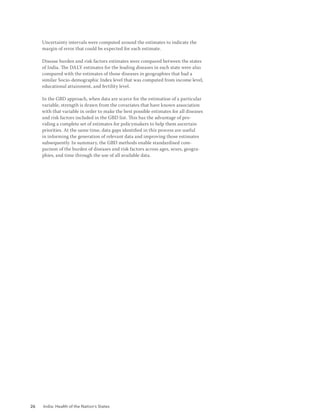
Uncertainty intervals were computed around the estimates to indicate the
margin of error that could be expected for each estimate.
Disease burden and risk factors estimates were compared between the states
of India. The DALY estimates for the leading diseases in each state were also
compared with the estimates of those diseases in geographies that had a
similar Socio-demographic Index level that was computed from income level,
educational attainment, and fertility level.
In the GBD approach, when data are scarce for the estimation of a particular
variable, strength is drawn from the covariates that have known association
with that variable in order to make the best possible estimates for all diseases
and risk factors included in the GBD list. This has the advantage of pro-
viding a complete set of estimates for policymakers to help them ascertain
priorities. At the same time, data gaps identified in this process are useful
in informing the generation of relevant data and improving those estimates
subsequently. In summary, the GBD methods enable standardised com-
parison of the burden of diseases and risk factors across ages, sexes, geogra-
phies, and time through the use of all available data.
India: Health of the Nation’s States 27
Life expectancy
One of the simplest measures for understanding overall health outcomes is
life expectancy at birth. If a country is generally expanding its longevity, it
usually means that people are dying prematurely at lower rates. Around the
world, people are living longer on average and populations are growing older.
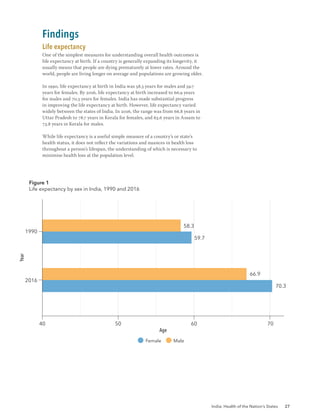
In 1990, life expectancy at birth in India was 58.3 years for males and 59.7
years for females. By 2016, life expectancy at birth increased to 66.9 years
for males and 70.3 years for females. India has made substantial progress
in improving the life expectancy at birth. However, life expectancy varied
widely between the states of India. In 2016, the range was from 66.8 years in
Uttar Pradesh to 78.7 years in Kerala for females, and 63.6 years in Assam to
73.8 years in Kerala for males.
While life expectancy is a useful simple measure of a country’s or state’s
health status, it does not reflect the variations and nuances in health loss
throughout a person’s lifespan, the understanding of which is necessary to
minimise health loss at the population level.
Findings
Figure 1
Life expectancy by sex in India, 1990 and 2016
2016
1990
50
40 60 70
66.9
70.3
58.3
59.7
Female Male
Year
Age
28 India: Health of the Nation’s States
India’s epidemiological transition
In tandem with its rapid social and economic development, India is under-
going a major epidemiological transition. Over the last 26 years, the coun-
try’s disease patterns have shifted: mortality due to communicable, maternal,
neonatal, and nutritional diseases (CMNNDs) has declined substantially and
India’s population is living longer, meaning that non-communicable diseases
(NCDs) and injuries are increasingly contributing to overall disease burden.
India’s health system therefore faces a dual challenge. Although the absolute
burden from diseases such as diarrhoea, lower respiratory infections,
tuberculosis, and neonatal disorders is being reduced, it remains high. At
the same time, the contribution to health loss of non-communicable condi-
tions such as heart disease, stroke, and diabetes is rising. The precise nature
of this challenge, though, varies across the country. While all states have
experienced a change in disease patterns to some degree, clear differences
emerge both in terms of the extent of this change and the rate at which it has
occurred.
Disability-adjusted life years (DALYs) are a summary measure of the health
loss burden caused by different conditions, and take into account both pre-
mature mortality and disability in one combined measure.
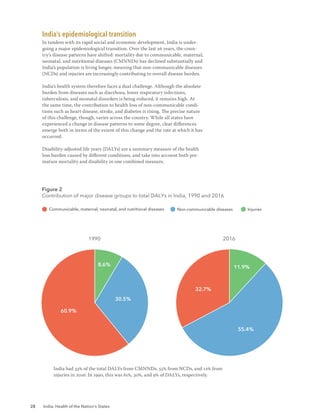
60.9%
30.5%
8.6%
1990
32.7%
55.4%
11.9%
2016
Communicable, maternal, neonatal, and nutritional diseases Non-communicable diseases Injuries
Figure 2
Contribution of major disease groups to total DALYs in India, 1990 and 2016
India had 33% of the total DALYs from CMNNDs, 55% from NCDs, and 12% from
injuries in 2016. In 1990, this was 61%, 30%, and 9% of DALYs, respectively.
India: Health of the Nation’s States 29
Epidemiological transition ratio is defined as the ratio of DALYs caused by
CMNNDs to those caused by NCDs and injuries. A ratio greater than one indi-
cates a higher burden of CMNNDs than NCDs and injuries, while a ratio less than
one indicates the opposite. The lower the ratio, the greater the contribution of
NCDs and injuries to a state’s overall disease burden. Most of the states had ratios
more than one in 1990, whereas all states had ratios less than one in 2016. This
means that the proportion of DALYs caused by NCDs and injuries has increased
heavily across the country since 1990, and in 2016 accounted for the majority of
premature death and disability for all states – a major shift in drivers of health
loss.
There are wide variations in the epidemiological transition ratio between indi-
vidual states, ranging from 0.16 in Kerala, which is far along in this progression, to
0.74 in Bihar, where the challenge of the double burden of diseases is more acute.
The states with ratio 0.56–0.75 in 2016 were considered as having the lowest epide-
miological transition level (ETL), those with ratio 0.41–0.55 as lower-middle ETL,
those with ratio 0.31–0.40 as higher-middle ETL, and those with ratio 0.30 or less
as highest ETL.
30 India: Health of the Nation’s States
1990
2016
Ratio
Less
than
0.31
0.31
−
0.40
0.41
−
0.55
0.56
−
0.75
0.76
−
1.00
1.01
−
1.30
1.31
−
1.70
More
than
1.70
0.31
−
0.40
0.41
−
0.55
0.56
−
0.75
0.76
−
1.00
1.01
−
1.30
1.31
−
1.70
More
than
1.70
Ratio
Less
than
0.31
The
states
of
Chhattisgarh,
Jharkhand,
Telangana,
and
Uttarakhand
did
not
exist
in
1990,
as
they
were
created
from
existing
larger
states
in
2000
or
later.
They
are
shown
in
the
1990
map
for
comparison
with
2016.
Delhi
[1.16]
Haryana
[1.34]
Himachal
Pradesh
[1.14]
Jammu
and
Kashmir
[1.14]
Punjab
[1.05]
Rajasthan
[2.05]
Uttarakhand
[1.4]
Arunachal
Pradesh
[1.96]
Assam
[1.66]
Bihar
[2.06]
Chhattisgarh
[1.97]
Jharkhand
[2.04]
Madhya
Pradesh
[2.05]
Manipur
[1.37]
Meghalaya
[1.98]
Mizoram
[1.18]
Nagaland
[1.52]
Odisha
[2.00]
Sikkim
[1.44]
Tripura
[1.38]
Uttar
Pradesh
[2.08]
West
Bengal
[1.34]
Andhra
Pradesh
[1.5]
Goa
[0.84]
Gujarat
[1.47]
Karnataka
[1.16]
Kerala
[0.49]
Maharashtra
[1.1]
Tamil
Nadu
[1.02]
Telangana
[1.33]
Delhi
[0.38]
Haryana
[0.4]
Himachal
Pradesh
[0.3]
Jammu
and
Kashmir
[0.34]
Punjab
[0.29]
Rajasthan
[0.66]
Uttarakhand
[0.46]
Arunachal
Pradesh
[0.55]
Assam
[0.62]
Bihar
[0.74]
Chhattisgarh
[0.6]
Jharkhand
[0.69]
Madhya
Pradesh
[0.6]
Manipur
[0.42]
Mizoram
[0.53]
Nagaland
[0.47]
Odisha
[0.58]
Sikkim
[0.45]
Tripura
[0.45]
Uttar
Pradesh
[0.68]
Andhra
Pradesh
[0.37]
Goa
[0.21]
Gujarat
[0.46]
Karnataka
[0.34]
Kerala
[0.16]
Maharashtra
[0.33]
Tamil
Nadu
[0.26]
Telangana
[0.38]
Meghalaya
[0.64]
West
Bengal
[0.33]
Figure 3
Epidemiological transition ratios of the states of India, 1990 and 2016
The
states
of
Chhattisgarh,
Jharkhand,
Telangana,
and
Uttarakhand
did
not
exist
in
1990,
as
they
were
created
from
existing
larger
states
in
2000
or
later.
Data
for
these
four
new
states
were
disaggregated
from
their
parent
states
based
on
their
current
district
composition.
These
states
are
shown
in
the
1990
map
for
comparison
with
2016.
India: Health of the Nation’s States 31
These findings highlight the fact that India’s states will require very different
policy approaches according to the nature of the disease burden they are facing.
The rest of this report takes a deeper look into the diseases and injuries that are
driving these trends across the states, in order to help decision-makers determine
just what those approaches should be.
The health planning for each state and union territory in India should ideally be
based on its specific disease and risk factors profile. However, it is also useful to
understand disease and risk factors trends among groups of states at similar levels
of development and epidemiological transition.
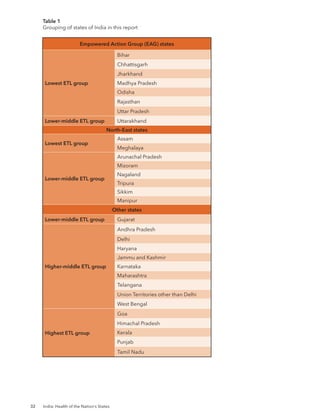
In India the development efforts are often focused on the relatively less developed
eight north Indian states and eight states in the hilly northeastern region. The
former are referred to as the Empowered Action Group (EAG) states and the
latter the North-East states. The remaining states and union territories are often
referred to as the “Other” states. We provide the disease and risk factors profile
of each state in this report, but also present trends by these state groups used
in India. In addition, we subdivided states within these groups by their ETL, as
described in the previous section. As the union territories other than Delhi have
relatively smaller populations, these six union territories of Andaman and Nicobar
Islands, Chandigarh, Dadra and Nagar Haveli, Daman and Diu, Lakshadweep, and
Puducherry were considered together in the analysis.
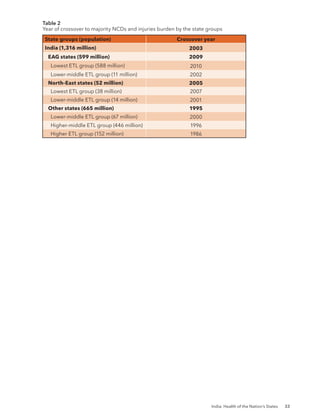
The year in which health loss from NCDs and injuries exceeded that from
CMNNDs varied widely between the state groups and sub-groups, ranging from
1986 to 2010 (Table 2). The epidemiological transition ratio dropped below one for
the EAG states group in 2009, for the North-East states group in 2005, and for the
other states group in 1995. This crossover year for India as a whole was 2003.
32 India: Health of the Nation’s States
Table 1
Grouping of states of India in this report
Empowered Action Group (EAG) states
Lowest ETL group
Bihar
Chhattisgarh
Jharkhand
Madhya Pradesh
Odisha
Rajasthan
Uttar Pradesh
Lower-middle ETL group Uttarakhand
North-East states
Lowest ETL group
Assam
Meghalaya
Lower-middle ETL group
Arunachal Pradesh
Mizoram
Nagaland
Tripura
Sikkim
Manipur
Other states
Lower-middle ETL group Gujarat
Higher-middle ETL group
Andhra Pradesh
Delhi
Haryana
Jammu and Kashmir
Karnataka
Maharashtra
Telangana
Union Territories other than Delhi
West Bengal
Highest ETL group
Goa
Himachal Pradesh
Kerala
Punjab
Tamil Nadu
India: Health of the Nation’s States 33
Table 2
Year of crossover to majority NCDs and injuries burden by the state groups
State groups (population) Crossover year
India (1,316 million) 2003
EAG states (599 million) 2009
Lowest ETL group (588 million) 2010
Lower-middle ETL group (11 million) 2002
North-East states (52 million) 2005
Lowest ETL group (38 million) 2007
Lower-middle ETL group (14 million) 2001
Other states (665 million) 1995
Lower-middle ETL group (67 million) 2000
Higher-middle ETL group (446 million) 1996
Higher ETL group (152 million) 1986
34 India: Health of the Nation’s States
Deaths and their causes
India’s epidemiological transition has been driven in part by the fact
that fewer lives are cut short by CMNNDs, and hence more people
survive to develop and die from NCDs or suffer injuries. What one is
likely to die of, though, depends both on age and where one lives. As
such, decision-makers need to understand trends in causes of death
across age groups and states in order to enact effective policies.
53.6% 37.9%
8.5%
1990
27.5%
61.8%
10.7%
2016
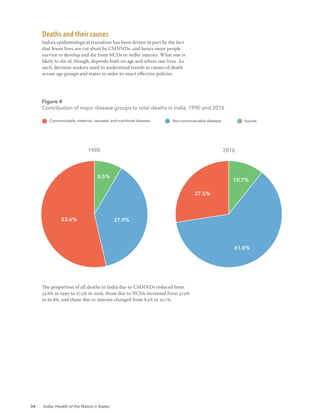
Figure 4
Contribution of major disease groups to total deaths in India, 1990 and 2016
Communicable, maternal, neonatal, and nutritional diseases Non-communicable diseases Injuries
The proportion of all deaths in India due to CMNNDs reduced from
53.6% in 1990 to 27.5% in 2016, those due to NCDs increased from 37.9%
to 61.8%, and those due to injuries changed from 8.5% to 10.7%.
India: Health of the Nation’s States 35
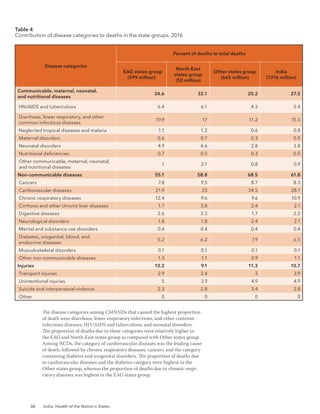
The death rate due to NCDs was over two times that due to CMNNDs in
India in 2016. The proportion of deaths and the death rates due to CMNNDs
were higher in EAG and North-East states group as compared with the
Other states group, whereas the proportion of deaths and the death rates
due to NCDs were highest in the Other states group. CMNNDs caused the
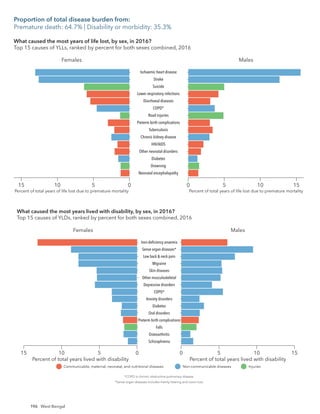
predominant proportion of deaths in the age group 0-14 years in all the states
groups. Injuries caused 34%–40% of the deaths in the age group 15-39 years
across the three states groups. NCDs were the dominant cause of death in
those 40 years or older. The proportion of deaths in the different age groups
differed widely across the individual states of India: 3%–19% of total deaths
in the 0-14 years age group, 7%–16% in the 15-39 years age group, 35%–44% in
the 40-69 years age group, and 30%–52% in those 70 or more years old.
Table 3
Distribution of deaths from major disease groups by age in the state groups, 2016
Age group
Death rate per 100,000
[percent of total deaths in that age group]
Communicable, maternal,
neonatal, and nutritional
diseases
Non-communicable
diseases
Injuries
EAG states group
0-14 years 277 [82.4] 37 [10.9] 23 [6.7]
15-39 years 76 [34.4] 70 [31.6] 75 [34.0]
40-69 years 278 [21.9] 873 [68.9] 116 [9.2]]
70 plus years 2609 [29.5] 5799 [65.5] 444 [5.0]
All ages 268 [34.6] 426 [55.1] 79 [10.2]
North-East states
group
0-14 years 261 [83.0] 32 [10.3] 21 [6.7]
15-39 years 77 [33.8] 82 [35.8] 69 [30.3]
40-69 years 238 [19.7] 881 [73.0] 88 [7.3]
70 plus years 2466 [27.2] 6260 [69.2] 327 [3.6]
All ages 236 [32.1] 433 [58.8] 67 [9.1]
Other states
group
0-14 years 157.5 [77.2] 30 [14.6] 17 [8.2]
15-39 years 41.9 [23.1] 68 [37.2] 72 [39.8]
40-69 years 133.7 [13.1] 785 [77.2] 98 [9.7]
70 plus years 1304.2 [17.3] 5784 [76.9] 435 [5.8]
All ages 145.3 [20.2] 493 [68.5] 81 [11.3]
India
0-14 years 225.6 [80.8] 34 [12.0] 20 [7.2]
15-39 years 58.4 [29.1] 69 [34.4] 73 [36.5]
40-69 years 195.8 [17.4] 824 [73.2] 105 [9.4]
70 plus years 1867.0 [23.0] 5805 [71.6] 435 [5.4]
All ages 204.6 [27.5] 460 [61.8] 80 [10.7]
36 India: Health of the Nation’s States
The disease categories among CMNNDs that caused the highest proportion
of death were diarrhoea, lower respiratory infections, and other common
infectious diseases; HIV/AIDS and tuberculosis; and neonatal disorders.
The proportion of deaths due to these categories were relatively higher in
the EAG and North-East states group as compared with Other states group.
Among NCDs, the category of cardiovascular diseases was the leading cause
of death, followed by chronic respiratory diseases, cancers, and the category
containing diabetes and urogenital disorders. The proportion of deaths due
to cardiovascular diseases and the diabetes category were highest in the
Other states group, whereas the proportion of deaths due to chronic respi-
ratory diseases was highest in the EAG states group.
Table 4
Contribution of disease categories to deaths in the state groups, 2016
Disease categories
Percent of deaths to total deaths
EAG states group
(599 million)
North-East
states group
(52 million)
Other states group
(665 million)
India
(1316 million)
Communicable, maternal, neonatal,
and nutritional diseases
34.6 32.1 20.2 27.5
HIV/AIDS and tuberculosis 6.4 6.1 4.3 5.4
Diarrhoea, lower respiratory, and other
common infectious diseases
19.9 17 11.2 15.5
Neglected tropical diseases and malaria 1.1 1.2 0.6 0.8
Maternal disorders 0.6 0.7 0.3 0.5
Neonatal disorders 4.9 4.6 2.8 3.8
   Nutritional deficiencies 0.7 0.5 0.3 0.5
Other communicable, maternal, neonatal,
and nutritional diseases
1 2.1 0.8 0.9
Non-communicable diseases 55.1 58.8 68.5 61.8
Cancers 7.8 9.5 8.7 8.3
Cardiovascular diseases 21.9 23 34.5 28.1
Chronic respiratory diseases 12.4 9.6 9.6 10.9
Cirrhosis and other chronic liver diseases 1.7 3.8 2.4 2.1
Digestive diseases 2.6 3.3 1.7 2.2
Neurological disorders 1.8 1.8 2.4 2.1
Mental and substance use disorders 0.4 0.4 0.4 0.4
Diabetes, urogenital, blood, and
endocrine diseases
5.2 6.2 7.9 6.5
Musculoskeletal disorders 0.1 0.1 0.1 0.1
Other non-communicable diseases 1.3 1.1 0.9 1.1
Injuries 10.2 9.1 11.3 10.7
Transport injuries 2.9 2.4 3 2.9
Unintentional injuries 5 3.9 4.9 4.9
Suicide and interpersonal violence 2.3 2.8 3.4 2.8
Other 0 0 0 0
India: Health of the Nation’s States 37
Figure
5
Death
rates
of
the
leading
individual
causes
in
the
states
of
India,
2016
Is
c
h
a
e
m
ic
h
e
a
r
t
d
is
e
a
s
e C
O
P
D
*
D
ia
r
r
h
o
e
a
l
d
is
e
a
s
e
s
S
tr
o
k
e
L
o
w
e
r
r
e
s
p
ir
a
to
r
y
in
fe
c
ti
o
n
s T
u
b
e
r
c
u
lo
s
is
D
ia
b
e
te
s
R
o
a
d
in
ju
r
ie
s
C
h
r
o
n
ic
k
id
n
e
y
d
is
e
a
s
e
S
u
ic
id
e
F
a
ll
s
A
s
th
m
a
P
r
e
te
r
m
b
ir
th
c
o
m
p
li
c
a
ti
o
n
s A
lz
h
e
im
e
r
d
is
e
a
s
e
H
y
p
e
r
te
n
s
iv
e
h
e
a
r
t
d
is
e
a
s
e O
th
e
r
n
e
o
n
a
ta
l
d
is
o
r
d
e
r
s R
h
e
u
m
a
ti
c
h
e
a
r
t
d
is
e
a
s
e H
IV
/
A
ID
S
C
o
n
g
e
n
it
a
l
b
ir
th
d
e
fe
c
ts In
te
s
ti
n
a
l
in
fe
c
ti
o
u
s
d
is
e
a
s
e
s N
e
o
n
a
ta
l
e
n
c
e
p
h
a
lo
p
a
th
y S
to
m
a
c
h
c
a
n
c
e
r
O
th
e
r
c
a
n
c
e
r
s
H
e
p
a
ti
ti
s
L
u
n
g
c
a
n
c
e
r
U
r
in
a
r
y
d
is
e
a
s
e
s
C
ir
r
h
o
s
is
d
u
e
to
h
e
p
a
ti
ti
s
B
P
a
r
a
ly
ti
c
il
e
u
s
& in
te
s
ti
n
a
l
o
b
s
tr
u
c
ti
o
n
M
e
n
in
g
it
is
D
r
o
w
n
in
g
India
EAG
States
Lowest
ETL
group
Bihar
Chhattisgarh
Jharkhand
Madhya
Pradesh
Odisha
Rajasthan
Uttar
Pradesh
Lower-middle
ETL
group
Uttarakhand
North-East
states
Lowest
ETL
group
Meghalaya
Assam
Lower-middle
ETL
group
Arunachal
Pradesh
Mizoram
Nagaland
Tripura
Sikkim
Manipur
Other
states
Lower-middle
ETL
group
Gujarat
Higher-middle
ETL
group
Haryana
Delhi
Telangana
Andhra
Pradesh
Jammu
and
Kashmir
Karnataka
West
Bengal
Maharashtra
Union
Territories
other
than
Delhi
Highest
ETL
group
Himachal
Pradesh
Punjab
Goa
Tamil
Nadu
Kerala
Significantly
lower
than
national
mean
Indistinguishable
from
national
mean
Significantly
higher
than
national
mean
132
64
59
53
38
33
23
19
18
18
16
14
11
11
10
8
8
7
6
6
6
6
6
5
5
5
5
5
5
5
100
76
81
44
48
44
18
20
13
13
15
17
14
10
10
13
10
6
8
9
7
7
5
6
5
6
4
7
6
5
100
76
81
44
48
43
18
20
13
13
15
17
14
10
10
13
9
6
8
9
7
7
5
6
5
6
4
7
6
5
103
55
83
41
41
25
19
14
13
7
12
13
12
8
10
13
11
8
13
6
11
3
5
6
4
3
5
5
4
6
93
40
84
90
48
41
22
18
15
20
15
10
16
9
10
13
10
7
5
8
7
5
6
7
4
10
5
8
4
6
96
38
120
37
34
38
18
19
15
9
11
9
10
8
8
9
8
8
6
5
7
6
5
6
3
4
6
9
4
7
122
61
69
56
48
38
19
19
12
18
14
14
16
10
10
14
9
7
7
11
5
5
5
6
5
7
4
7
6
6
72
38
129
98
46
43
20
18
24
15
22
9
9
12
11
9
12
12
5
5
8
8
7
10
5
12
4
9
4
5
95
111
51
32
52
41
10
22
10
12
12
23
16
10
8
13
8
5
5
13
6
7
5
4
4
4
3
4
5
5
99
97
80
30
53
58
19
22
11
15
17
23
14
10
10
13
9
3
9
11
7
9
6
5
5
7
4
9
7
4
120
100
35
33
51
40
24
29
16
13
19
18
9
13
10
7
8
8
5
9
5
9
6
7
7
7
4
7
6
5
120
100
35
33
51
40
24
29
16
13
19
18
9
13
10
7
8
8
5
9
5
9
6
7
7
7
4
7
6
5
66
55
65
80
43
37
22
16
17
16
9
13
13
9
10
9
9
8
6
6
8
5
8
14
6
4
9
7
4
7
64
60
72
86
45
42
23
16
18
16
9
14
14
9
10
10
9
6
7
6
9
4
9
16
5
4
9
8
4
8
39
22
41
32
33
35
13
10
12
8
8
5
8
8
6
5
5
3
5
9
7
5
8
5
5
3
9
7
5
3
66
63
75
91
46
43
23
16
18
16
9
15
15
9
11
11
10
7
7
5
9
4
9
17
5
4
9
8
4
8
72
43
44
61
37
22
19
16
17
17
8
9
9
10
8
5
6
11
4
5
4
7
6
7
8
4
9
4
3
4
37
23
35
29
26
25
14
13
11
16
9
5
9
7
5
6
4
11
4
4
5
14
6
11
4
3
10
4
3
4
27
58
35
18
33
19
14
17
14
7
12
10
7
10
5
7
3
11
5
12
5
21
11
6
20
5
7
7
5
3
51
18
17
42
28
22
11
13
12
5
9
4
5
8
6
3
5
14
3
8
4
10
4
8
3
3
9
4
3
4
107
67
60
97
45
16
18
15
20
30
7
15
13
12
9
6
9
5
5
3
5
3
6
8
7
5
7
6
3
4
65
31
14
19
38
19
14
12
13
12
15
5
7
8
6
6
4
4
3
6
3
7
6
6
5
4
11
5
3
3
69
32
55
62
40
33
33
22
20
13
5
6
6
11
11
4
7
19
3
6
4
4
4
4
11
5
14
2
3
5
167
55
39
58
28
23
28
19
22
21
18
11
9
12
10
5
7
8
5
4
5
5
6
4
6
4
6
3
4
4
160
64
31
33
31
42
21
17
16
17
17
14
13
11
8
8
7
8
7
5
7
2
6
4
5
4
4
3
6
4
160
64
31
33
31
42
21
17
16
17
17
14
13
11
8
8
7
8
7
5
7
2
6
4
5
4
4
3
6
4
154
56
42
69
28
21
23
18
20
22
16
11
9
11
9
5
8
9
5
4
5
6
5
5
5
4
6
3
4
5
175
82
41
34
34
35
25
28
18
16
14
15
8
12
10
9
7
6
5
8
5
9
6
4
6
7
5
5
5
4
108
22
11
22
19
20
18
14
16
8
10
4
8
7
6
8
7
4
4
6
5
2
6
3
7
4
5
4
4
2
135
50
54
44
22
18
19
17
14
22
17
11
10
11
9
3
7
13
5
5
5
8
6
7
3
4
4
2
4
3
163
56
52
51
26
19
24
20
17
25
19
12
11
11
10
4
8
11
6
6
6
9
6
8
4
5
5
3
4
4
143
74
31
39
34
18
16
31
21
9
12
13
6
10
8
6
7
3
5
2
3
13
5
5
10
3
3
3
4
4
169
63
53
57
24
21
42
18
21
31
17
14
11
12
9
5
8
9
7
3
7
8
5
2
5
5
7
3
5
5
146
48
38
118
31
19
16
16
22
24
11
10
8
11
9
5
8
8
4
2
3
6
6
6
7
5
6
3
4
6
164
64
39
61
32
24
23
18
21
19
19
12
9
12
10
5
7
8
4
4
4
3
5
4
5
4
9
4
4
5
100
22
13
25
17
18
18
15
22
17
20
4
7
9
16
3
7
7
5
2
4
5
5
3
4
3
6
2
4
3
204
44
34
45
25
19
43
22
32
23
24
8
5
16
14
2
7
6
5
3
3
4
6
2
7
4
4
3
4
4
114
97
33
29
26
22
13
17
17
13
21
16
5
17
9
4
6
6
4
4
4
6
6
3
5
4
3
5
3
2
261
47
36
43
30
22
44
29
29
10
16
8
5
15
10
5
7
7
4
7
4
2
8
3
6
6
4
3
4
3
136
31
14
46
21
11
33
13
19
11
18
5
4
13
7
3
3
7
4
0
2
6
6
1
3
3
12
3
2
4
208
40
41
40
26
24
53
23
35
30
29
8
6
13
16
2
7
5
5
3
4
5
3
2
5
4
4
3
4
5
170
39
20
59
17
8
28
14
32
21
18
6
3
22
15
1
5
5
5
0
1
4
11
2
11
2
5
1
3
4
*COPD
is
chronic
obstructive
pulmonary
disease.
38 India: Health of the Nation’s States
The leading individual cause of death in India in 2016 was ischaemic heart
disease, the death rate from which was twice as much as the next leading
cause. The other NCDs in the top 10 individual causes of death included
chronic obstructive pulmonary disease (COPD), stroke, diabetes, and
chronic kidney disease. Diarrhoeal diseases, lower respiratory infections,
and tuberculosis were the leading CMNND individual causes of death, and
road injuries and suicides were the leading injury individual causes of death
among the top 10 in India. There were wide variations in death rates from
the leading causes between the states. The highest death rate from ischaemic
heart disease among the states was 12 times the lowest rate, and these death
rates were generally higher among the states belonging to the higher epide-
miological transition level groups. On the other hand, the death rate from
COPD was generally higher in the EAG states, with the highest rate nine
times the lowest rate across the states of India. The death rates from diar-
rhoeal diseases and tuberculosis were also higher in the EAG states and had
a 12-fold and seven-fold variation in rates, respectively, between all the states.
The range of death rates from suicide was six-fold across the states.
India: Health of the Nation’s States 39
Years of life lost due to premature death
While deaths are a useful metric for understanding some aspects of popu-
lation health, they do not take into account the amount of life lost when a
person dies. For example, a death at the age of 80 is given the same weight
as a death at the age of 10. In addition to deaths, decision-makers also need
to know how much premature mortality is caused by a particular disease
or injury. Years of life lost (YLLs) is a measure that quantifies the number
of years of life a person loses at the age of their death, based on the highest
life expectancy for their age group anywhere in the world. YLLs therefore
give greater weight to causes of death that kill people at younger ages, such
as common childhood infections, than those that tend to occur later in life,
such as heart disease or stroke.
Ischaemic heart disease was the leading cause of YLLs in the Other states
group by a big margin and was also the leading cause in the EAG states
group, but stroke was the leading cause of YLLs in the North-East states
group. Infectious and neonatal causes were more prominent causes of YLLs
in the EAG and North-East states group than in the Other states group.
Suicide and road injuries were among the leading 10 causes of YLLs in all
state groups, with suicide as a prominent third leading cause in the Other
states group.
In order to ensure that health policies and interventions target those who
need them most, it is also vital that decision-makers understand how specific
diseases and injuries affect females and males differently. Across all three
states groups, ischaemic heart disease caused a much greater proportion of
total YLLs among males than among females, accounting for 14% of pre-
mature mortality for males in India as a whole compared to 10% for females.
Road injuries also caused a higher proportion of YLLs among males than
females. On the other hand, diarrhoeal diseases and lower respiratory infec-
tions were responsible for a higher proportion of YLLs among females. Policy
efforts to address causes of premature mortality in India should therefore
be responsive to these differences and the relative challenges that NCDs,
injuries, and CMNNDs pose along the lines of both sex and different parts of
the country.
40 India: Health of the Nation’s States
Females EAG states
10
15
20 5 0 0 5 10 15 20
Falls
Asthma
Intestinal infectious
Neonatal encephalopathy
Congenital defects
Suicide
Road injuries
Stroke
Other neonatal
Neonatal preterm birth
Tuberculosis
COPD*
Lower respiratory infections
Diarrhoeal diseases
Ischaemic heart disease
Males
HIV/AIDS
Meningitis
Malaria
Chronic kidney disease
Diabetes
Percent of total years of life lost Percent of total years of life lost
Figure 6
Leading individual causes of years of life lost by sex in the state groups, 2016
Females Other states
10
15
20 5 0 0 5 10 15 20
Other neonatal
Congenital defects
Neonatal encephalopathy
Falls
Diabetes
Chronic kidney disease
Tuberculosis
Neonatal preterm birth
Road injuries
Diarrhoeal diseases
Lower respiratory infections
COPD*
Suicide
Stroke
Ischaemic heart disease
Males
Rheumatic heart disease
Drowning
Intestinal infectious
Asthma
HIV/AIDS
Percent of total years of life lost Percent of total years of life lost
Communicable, maternal, neonatal, and nutritional diseases Non-communicable diseases Injuries
*COPD is chronic obstructive pulmonary disease.
Females North-East states
10
15
20 5 0 0 5 10 15 20
Congenital defects
Malaria
Chronic kidney disease
Hepatitis
Neonatal encephalopathy
Road injuries
Other neonatal
Suicide
COPD*
Neonatal preterm birth
Tuberculosis
Ischaemic heart disease
Diarrhoeal diseases
Lower respiratory infections
Stroke
Males
Asthma
Intestinal infectious
HIV/AIDS
Drowning
Diabetes
Percent of total years of life lost Percent of total years of life lost
India: Health of the Nation’s States 41
Years lived with disability
As more Indians live into adulthood and old age, they are increasingly likely
to experience poor health from disabling conditions. This has important
implications for the country’s health system, which will have to care for a
growing number of patients, many of them suffering from chronic condi-
tions. Years lived with disability (YLDs) is a measure that takes into account
both the number of individuals suffering from disability (or non-fatal poor
health as a result of a particular disease or injury), and also the severity of
the disability. The contribution of YLDs to the total disease burden (DALYs)
increased in India from 17% in 1990 to 33% in 2016. The YLD proportion in
2016 was highest in the Other states group at 36% and lowest in the EAG
states group at 30%.
42 India: Health of the Nation’s States
Females Other states
Schizophrenia
Osteoarthritis
Neonatal preterm birth
Falls
Oral disorders
Anxiety disorders
Diabetes
COPD*
Other musculoskeletal
Skin diseases
Depressive disorders
Migraine
Low back & neck pain
Sense organ diseases†
Iron-deficiency anaemia
Males
Diarrhoeal diseases
Other mental & substance
Gynaecological diseases
Drug use disorders
Road injuries
Figure 7
Leading individual causes of years of life lost by sex in the state groups, 2016
8
12
16 4 0 0 4 8 12 16
Percent of total years lived with disability Percent of total years lived with disability
Communicable, maternal, neonatal, and nutritional diseases Non-communicable diseases Injuries
†
Sense organ diseases includes mainly hearing and vision loss.
*COPD is chronic obstructive pulmonary disease.
Females EAG states
8
12
16 4 0 0 4 8 12 16
Diarrhoeal diseases
Protein-energy malnutrition
Falls
Oral disorders
Neonatal preterm birth
Diabetes
Anxiety disorders
COPD*
Depressive disorders
Other musculoskeletal
Skin diseases
Migraine
Low back & neck pain
Sense organ diseases†
Iron-deficiency anaemia
Males
Gynaecological diseases
Congenital defects
Schizophrenia
Haemoglobinopathies
Osteoarthritis
Percent of total years lived with disability Percent of total years lived with disability
Communicable, maternal, neonatal, and nutritional diseases Non-communicable diseases Injuries
Figure 7
Leading individual causes of disability by sex in the state groups, 2016
†
Sense organ diseases includes mainly hearing and visual loss.
*COPD is chronic obstructive pulmonary disease.
Females North-East states
Drug use disorders
Osteoarthritis
Falls
Oral disorders
Neonatal preterm birth
Diabetes
Anxiety disorders
COPD*
Depressive disorders
Other musculoskeletal
Skin diseases
Low back & neck pain
Migraine
Sense organ diseases†
Iron-deficiency anaemia
Males
Other mental & substance
Haemoglobinopathies
Diarrhoeal diseases
Gynaecological diseases
Schizophrenia
Figure 7
Leading individual causes of years of life lost by sex in the state groups, 2016
8
12
16 4 0 0 4 8 12 16
Percent of total years lived with disability Percent of total years lived with disability
Communicable, maternal, neonatal, and nutritional diseases Non-communicable diseases Injuries
†
Sense organ diseases includes mainly hearing and visual loss.
*COPD is chronic obstructive pulmonary disease.
India: Health of the Nation’s States 43
The majority of the leading individual causes of YLDs in 2016 were NCDs,
but iron-deficiency anaemia was the top cause across all three state
groups, accounting for 11% of all disability in India in 2016. Its effects were
most severe among females, contributing to 15% of YLDs in the EAG and
North-East states group and 12% in the Other states group. The NCD condi-
tions that were the leading contributors to disability burden in all three state
groups included sense organ diseases (hearing and vision loss), lower back
and neck pain, migraine, depressive disorders, skin diseases, and muscu-
loskeletal disorders. Among these, migraine and depressive disorders were
responsible for a higher proportion of YLDs among females than among
males in all three state groups. As many of these diseases are not fatal, these
rankings highlight the importance of looking specifically at YLDs to identify
major individual causes of poor health in the population, as these may be
overlooked by focusing on mortality. As India’s population structure moves
further toward a higher proportion of elderly, these diseases will likely make
an increasingly important contribution to the country’s disease burden and
will require stronger efforts to address them.
44 India: Health of the Nation’s States
Total health loss and its causes
For a complete assessment of the burden caused by health problems, we can
evaluate the impact of different diseases and injuries by taking into account
both premature mortality and disability in one combined measure: disabili-
ty-adjusted life years (DALYs). DALYs provide a more comprehensive look at
the drivers of overall health loss in India and its states.
The DALY rate reduced significantly by 43% in India from 1990 to 2016. This
reduction was relatively higher in the EAG states group. After adjusting for the
changes in population age structure during this period, the age-standardised
DALY rate dropped by 36% in India, suggesting a reduction in the disease burden
per person over this period.
Figure 8
Percent change in all-ages and age-standardised DALYs rate in the state groups, 1990 and 2016
-40%
-20%
-60%
0
All ages Age-standardised
Percent
change
from
1990
to
2016
India EAG states North-East states Other states
-43.1%
-36.2%
-47.2%
-37.9%
-40.2%
-33.4%
-39.4%
-35.9%
The limit bars indicate 95% uncertainty interval around estimates.
India: Health of the Nation’s States 45
The range of DALY rates varied almost two-fold across the states in 2016, after
adjusting for the population structure of the states. Assam and the EAG states had
the highest DALY rates. The lowest DALY rates were in Kerala and Goa.
Figure 9
Relative age-standardised DALYs rate across the states of India, 2016
The ratio shown on the top of each bar is the ratio of each state age-standardised DALY rate to the DALY rate of Kerala.
EAG states
Ratio
North-East states Other states
A
s
s
a
m
U
t
t
a
r
P
r
a
d
e
s
h
C
h
h
a
t
t
i
s
g
a
r
h
M
a
d
h
y
a
P
r
a
d
e
s
h
O
d
i
s
h
a
J
h
a
r
k
h
a
n
d
B
i
h
a
r
R
a
j
a
s
t
h
a
n
H
a
r
y
a
n
a
U
t
t
a
r
a
k
h
a
n
d
T
r
i
p
u
r
a
K
a
r
n
a
t
a
k
a
G
u
j
a
r
a
t
M
e
g
h
a
l
a
y
a
A
n
d
h
r
a
P
r
a
d
e
s
h
W
e
s
t
B
e
n
g
a
l
J
a
m
m
u
a
n
d
K
a
s
h
m
i
r
P
u
n
j
a
b
A
r
u
n
a
c
h
a
l
P
r
a
d
e
s
h
M
a
n
i
p
u
r
M
a
h
a
r
a
s
h
t
r
a
M
i
z
o
r
a
m
T
a
m
i
l
N
a
d
u
T
e
l
a
n
g
a
n
a
N
a
g
a
l
a
n
d
D
e
l
h
i
S
i
k
k
i
m
U
n
i
o
n
T
e
r
r
i
t
o
r
i
e
s
o
t
h
e
r
t
h
a
n
D
e
l
h
i
H
i
m
a
c
h
a
l
P
r
a
d
e
s
h
G
o
a
K
e
r
a
l
a
0.50
0.00
1.00
1.50
(1.81)
(1.77)
(1.71)
(1.64) (1.63) (1.63) (1.61) (1.59) (1.59)
(1.56)
(1.51)
(1.49) (1.48) (1.47) (1.46)
(1.43)
(1.41) (1.41) (1.4)
(1.37) (1.37)
(1.35) (1.34) (1.34)
(1.31)
(1.26)
(1.23)
(1.21)
(1.17)
(1.04)
(1.00)
46 India: Health of the Nation’s States
Table
5
Contribution
of
disease
categories
to
DALYs
in
the
state
groups,
1990
and
2016
Percent
of
DALYs,
1990
Percent
of
DALYs,
2016
EAG
states
group
(369
million)
North-East
states
group
(32
million)
Other
states
group
(463
million)
India
(864
million)
EAG
states
group
(599
million)
North-East
states
group
(52
million)
Other
states
group
(665
million)
India
(1,316
million)
Communicable,
maternal,
neonatal,
and
nutritional
diseases
67.1
61.9
54.2
60.9
39.9
37
24.9
32.7
HIV/AIDS
and
tuberculosis
5.3
5.5
4.8
5.1
4.8
4.7
3.6
4.2
Diarrhoea,
lower
respiratory,
and
other
common
infectious
diseases
38.9
31.7
27.2
33.2
16.6
13.8
8.6
12.7
Neglected
tropical
diseases
and
malaria
2.8
2.7
1.3
2.1
2
1.9
1.1
1.5
Maternal
disorders
1.4
2.3
1.3
1.4
0.8
0.9
0.4
0.6
Neonatal
disorders
12.9
14
15
13.9
9.5
9.1
6.2
7.9
   Nutritional
deficiencies
4.2
3.6
3.4
3.8
5
4.5
4.2
4.6
Other
communicable,
maternal,
neonatal,
and
nutritional
diseases
1.6
2.1
1.3
1.5
1.2
2.2
0.9
1.1
Non-communicable
diseases
25.4
30.5
35.9
30.5
48.9
52.5
62.4
55.4
Cancers
2
2.6
2.6
2.3
4.6
5.6
5.4
5
Cardiovascular
diseases
4.9
5.9
9
6.9
10.9
11.5
17.7
14.1
Chronic
respiratory
diseases
4.4
4.8
4.6
4.5
6.7
5.5
6.1
6.4
Cirrhosis
and
other
chronic
liver
diseases
0.6
1.7
1.1
0.9
1.2
2.8
1.8
1.6
Digestive
diseases
1.4
1.9
1.1
1.3
1.8
2.3
1.2
1.5
Neurological
disorders
1.7
1.9
2.3
2
3.2
3.4
4.1
3.6
Mental
and
substance
use
disorders
2.4
3
3.5
2.9
4.8
5.4
6.4
5.6
Diabetes,
urogenital,
blood,
and
endocrine
diseases
2.1
2.6
3.2
2.6
4.6
5.2
6.7
5.6
Musculoskeletal
disorders
1.9
2.1
2.7
2.3
3.9
4.1
5.4
4.6
Other
non-communicable
diseases
4.1
4.1
5.9
4.9
7.2
6.7
7.7
7.4
Injuries
7.4
7.6
9.9
8.6
11.2
10.5
12.7
11.9
Transport
injuries
1.5
1.4
2
1.7
3.2
2.7
3.5
3.3
Unintentional
injuries
4.4
3.9
4.9
4.6
5.5
4.7
5.4
5.4
Suicide
and
interpersonal
violence
1.4
2.2
2.9
2.1
2.5
3.1
3.8
3.1
Other
0
0.1
0.1
0.1
0
0
0
0
India: Health of the Nation’s States 47
The proportion of DALYs due to CMNNDs dropped substantially in all
three state groups between 1990 and 2016, making up 25% to 40% of the total
DALYs in 2016. There were large declines in the proportion of health loss
from diarrhoea, lower respiratory infections, and other common infec-
tions, and from neonatal disorders. These proportions, however, continued
to be higher in the EAG and North-East states groups than in the Other
states group. Conversely, the proportion of DALYs due to NCDs increased
substantially in all three state groups during this period to 49%-62% of the
total DALYs in 2016. This proportion continued to be highest in the Other
states group for most of the NCD categories. The proportion of DALYs due
to injuries also increased in all three state groups, contributing to 11%-13% of
the total DALYs in 2016. For India as whole, the disease categories that were
responsible for more than 5% of the total DALYs in 2016 included cardiovas-
cular diseases; diarrhoea, lower respiratory infections, and other common
infectious diseases; neonatal disorders; chronic respiratory diseases;
diabetes, urogenital and endocrine diseases; mental and substance abuse
disorders; unintentional injuries; and cancers.
48 India: Health of the Nation’s States
Leading causes 1990 Leading causes 2016
Mean % change number
of DALYs 1990-2016
Ischaemic heart disease [8.7%] 104.1%
COPD [4.8%] 36.3%
Diarrhoeal diseases [4.6%] -67.7%
Lower respiratory infect [4.3%] -61.5%
Stroke[3.5%] 52.9%
Iron-deficiency anemia [3.5%] 41.8%
Preterm birth complications [3.4%] -46.3%
Tuberculosis [3.2%] -44.5%
Sense organ diseases‡
[2.9%] 85.3%
Road injuries [2.9%] 65.1%
Self-harm§
[2.5%] 29.8%
Low back & neck pain [2.3%] 66.1%
Diabetes [2.2%] 174.2%
Other neonatal disorders [2.1%] -49.7%
Migraine [2.1%] 69.1%
Skin diseases [1.9%] 55.0%
Falls [1.8%] 41.3%
Congenital defects [1.8%] -20.9%*
Other musculoskeletal [1.6%] 79.7%
Chronic kidney disease [1.6%] 71.0%
Depressive disorders [1.6%] 65.1%
Neonatal encephalopathy [1.5%] -56.1%
Asthma [1.3%] -15.1%*
Intestinal infectious diseases [1.2%] -37.1%
HIV/AIDS [1.1%] 1,004.6%
Anxiety disorders [0.9%] 61.9%
Meningitis [0.8%] -46.7%
Rheumatic heart disease [0.8%] 2.5%*
Protein-energy malnutrition [0.7%] -42.3%
Drowning [0.7%] -36.0%
Malaria [0.7%]
Neonatal sepsis [0.6%]
Measles [0.4%]
Neonatal haemolytic [0.3%]
Tetanus [0.1%]
*Change not significant
The percent figure in bracket next to each cause is DALYs
from that cause out of the total DALYs.
†
COPD is chronic obstructive pulmonary disease.
‡
Sense organ diseases includes mainly hearing and vision loss.
Communicable, maternal,
neonatal, and nutritional diseases
Non-communicable diseases Injuries
Figure 10
Change in DALYs number and rate for the leading individual causes in India from 1990 to 2016
same or increase decrease
Mean % change DALY
rate 1990-2016
33.9%
-10.5%*
-78.8%
-74.7%
0.4%*
-6.9%
-64.8%
-63.5%
21.7%
8.3%
-14.8%*
9.0%
80.0%
-67.0%
11.0%
1.7%*
-7.2%*
-48.1%
18.0%
12.2%
8.4%
-71.2%
-44.3%
-58.7%
625.0%
6.2%
-65.0%
-32.7%
-62.1%
-58.0%
§
Self-harm refers to suicide and the nonfatal outcomes of self-harm.
Diarrhoeal diseases [12.4%]
Lower respiratory infect [9.8%]
Preterm birth complications [5.5%]
Tuberculosis [5.0%]
Measles [4.2%]
Ischaemic heart disease [3.7%]
Other neonatal disorders [3.6%]
COPD†
[3.1%]
Neonatal encephalopathy [3.0%]
Iron-deficiency anemia [2.1%]
Congenital defects [2.0%]
Stroke [2.0%]
Tetanus [1.8%]
Self-harm§
[1.7%]
Intestinal infectious diseases [1.6%]
Road injuries [1.5%]
Sense organ diseases‡
[1.3%]
Meningitis [1.3%]
Asthma [1.3%]
Low back & neck pain [1.2%]
Falls [1.1%]
Protein-energy malnutrition [1.1%]
Skin diseases [1.1%]
Migraine [1.1%]
Malaria [1.1%]
Drowning [1.0%]
Neonatal haemolytic [0.9%]
Neonatal sepsis [0.9%]
Depressive disorders [0.9%]
Chronic kidney disease [0.8%]
Other musculoskeletal [0.8%]
Diabetes [0.7%]
Rheumatic heart disease [0.7%]
Anxiety disorders [0.5%]
HIV/AIDS [0.1%]
1
2
3
4
5
6
7
8
9
10
11
12
13
14
15
16
17
18
19
20
21
22
23
24
25
26
27
102
1
2
3
4
5
6
7
8
9
10
11
12
13
14
15
16
17
18
19
20
21
22
23
24
25
26
27
109
When looking at the leading individual causes of DALYs in India, most
NCDs have risen in rank since 1990. Ischaemic heart disease and COPD were
the top two causes of DALYs in 2016, up from sixth and eighth place, respec-
tively, in 1990. Diabetes showed a particularly dramatic increase, from 35th
place to 13th. The number of DALYs caused by ischaemic heart disease rose
by 104% over this period and those caused by diabetes a striking 174%. Large
increases in DALYs are evident for the majority of non-communicable condi-
tions, including sense organ diseases, low back and neck pain, and depressive
disorders. Injuries have seen similar rises in their relative ranking, with road
injuries the 10th leading individual cause of health loss in 2016, followed by
self-harm in 11th place. Road injuries caused 65% more DALYs in 2016 than
they did in 1990. These trends are indicative not just of a population that is
increasing in age and therefore living long enough to develop and suffer from
chronic diseases, but also of the impact of lifestyle changes that come with a
rapidly industrialising, urbanising society – from changes in diet and activity
levels to more traffic on the roads.
In contrast, the CMNNDs that led the rankings in 1990 have seen notable
declines. Diarrhoeal disease and lower respiratory infections, which were
India’s top two individual causes of DALYs in 1990, dropped to third and
fourth place in 2016. Other conditions, such as preterm birth complications,
tuberculosis, and vaccine-preventable diseases like measles, also saw a drop
India: Health of the Nation’s States 49
in rank. The number of DALYs caused by diarrhoeal diseases fell by 68% over
this period, while preterm birth complications caused 46% less DALYs in
2016 than in 1990. This represents India’s significant achievement in ensuring
more children survive and thrive during their first weeks, months, and years
of life. However, there is a striking outlier to this progress: Iron-deficiency
anaemia showed an increase in both rank and health loss caused, suggesting
a need for renewed policy attention to this cause.
50 India: Health of the Nation’s States
However, these trends have not been uniform throughout the country. The
relative rankings of causes of disease burden vary markedly among the three
state groups. CMNND causes have not been superseded by NCD causes
to the same extent everywhere in India, and generally ranked much higher
in the EAG and North-East states groups than they did in the Other states
group. Diarrhoeal diseases remained the leading cause of health loss in the
North-East states group and second in the EAG states group, with lower
respiratory infections in third place for both of these groups. In contrast,
these conditions were in ninth and eleventh place in the Other states group.
Moreover, the proportion of health loss caused by CMNNDs tended to be
greater in the EAG and North-East states groups than in the Other states
group, with the heaviest burden in the EAG states group.
Alongside variations between state groups, decision-makers should also be
aware of differences in the causes of health loss among females and males.
Figure 11
Comparison of the leading individual causes of DALYs across the state groups, 2016
Leading causes EAG states Leading causes North-East states Leading causes Other states
Diarrhoeal diseases [6.2%] Stroke [5.3%]
Lower respiratory infect [5.0%]
Lower respiratory infect [5.8%]
COPD* [5.0%] Ischaemic heart disease [4.3%]
Tuberculosis [3.9%] COPD* [4.0%]
Neonatal preterm birth [3.7%]
Tuberculosis [3.5%]
Neonatal preterm birth [3.7%]
Iron-deficiency anaemia [3.6%] Road injuries [3.0%]
Neonatal preterm birth [3.0%]
Diarrhoeal [3.0%]
Other neonatal [2.9%] Iron-deficiency anaemia [3.5%]
Stroke [2.8%] Sense organ diseases†
[2.5%]
Road injuries [2.7%] Road injuries [2.4%] Diabetes [2.8%]
Sense organ diseases†
[2.6%] Self-harmº [2.3%]
Other neonatal [2.2%]
Diabetes [2.0%]
Lower respiratory infect [2.8%]
Congenital defects [2.1%] Low back & neck pain [2.7%]
Low back & neck pain [1.9%] Tuberculosis [2.4%]
Skin diseases [1.8%] Migraine [2.0%] Migraine [2.3%]
Chronic kidney disease [2.1%]
Falls [2.0%]
Self-harmº [1.8%] Neonatal encephalopathy [1.9%]
Migraine [1.8%] Low back & neck pain [1.9%]
Falls [1.7%] Skin diseases [1.9%] Skin diseases [2.0%]
Diabetes [1.7%] Hepatitis [1.8%]
Chronic kidney disease [1.6%]
Other musculoskeletal [1.6%]
Congenital defects [1.6%]
Depressive disorders [2.0%]
Other musculoskeletal [1.9%]
Congenital defects [1.5%]
Neonatal encephalopathy [1.3%]
HIV/AIDS [1.2%]
Neonatal encephalopathy [1.7%] ]
Intestinal infectious [1.6%]
Other musculoskeletal [1.4%]
Asthma [1.4%] Depressive disorders [1.5%]
Malaria [1.3%]
Falls [1.2%]
Asthma [1.2%]
Depressive disorders [1.3%] Other neonatal [1.2%]
Chronic kidney disease [1.2%] Asthma [1.1%]
Protein-energy malnutrition [1.0%] Anxiety disorders [1.0%]
Malaria [1.0%] HIV/AIDS [1.1%] Oral disorders [0.8%]
Meningitis [0.9%] Drowning [1.1%] Rheumatic heart disease [0.8%]
Intestinal infectious [0.7%]
Meningitis [0.7%]
Hypertensive heart disease [0.7%]
HIV/AIDS [0.9%] Intestinal infectious [1.0%]
Animal contact [0.9%] Cirrhosis hepatitis B [0.9%]
Anxiety disorders [0.9%]
Rheumatic heart disease [0.9%]
Communicable, maternal,
neonatal, and nutritional diseases
Non-communicable diseases Injuries
*COPD is chronic obstructive pulmonary disease.
†
Sense organ diseases includes mainly hearing and vision loss.
ºSelf-harm refers to suicide and the nonfatal outcomes of self-harm.
The percent figure in bracket next to each cause is DALYs from that
cause out of the total DALYs.
Ischaemic heart disease [6.3%] Diarrhoeal diseases [5.3%] Ischaemic heart disease [11.5%]
COPD* [4.6%]
Stroke [4.1%]
Iron-deficiency anaemia [3.4%]
Sense organ diseases†
[3.3%]
Self-harmº [3.2%]
Rank
1
2
3
4
5
6
7
8
9
10
11
12
13
14
15
16
17
18
19
20
21
22
23
24
25
26
27
28
29
30
India: Health of the Nation’s States 51
Figure 12
Change in DALYs number for the leading individual causes by sex in India from 1990 to 2016
Leading
causes
2016
Ischaemic
heart
disease
[6.6%]
Diarrhoeal
diseases
[5.5%]
Iron-deficiency
anemia
[4.9%]
Lower
respiratory
infect
[4.7%]
COPD
†
[4.4%]
Stroke
[3.4%]
Preterm
birth
complications
[3.2%]
Sense
organ
diseases
‡
[3.2%]
Migraine
[2.7%]
Leading
causes
1990
Diarrhoeal
diseases
[14.8%]
Lower
respiratory
infect
[10.3%]
Preterm
birth
complications
[4.9%]
Measles
[4.2%]
Tuberculosis
[4.1%]
Other
neonatal
disorders
[3.2%]
Ischaemic
heart
disease
[2.9%]
Iron-deficiency
anemia
[2.8%]
COPD
†
[2.7%]
Neonatal
encephalopathy
[2.5%]
Congenital
defects
[1.9%]
Stroke
[1.9%]
Self-harm
§
[1.8%]
Intestinal
infectious
diseases
[1.6%]
Tetanus
[1.6%]
Low
back
&
neck
pain
[1.4%]
Sense
organ
diseases
‡
[1.4%]
Meningitis
[1.4%]
Migraine
[1.3%]
Protein-energy
malnutrition
[1.3%]
Asthma
[1.3%]
Malaria
[1.2%]
Skin
diseases
[1.2%]
Falls
[1.1%]
Maternal
hemorrhage
[1.0%]
Depressive
disorders
[1.0%]
Whooping
cough
[0.9%]
Neonatal
sepsis
[0.9%]
Other
musculoskeletal
[0.8%]
Encephalitis
[0.8%]
Rheumatic
heart
disease
[0.8%]
Road
injuries
[0.7%]
Chronic
kidney
disease
[0.7%]
Diabetes
[0.7%]
Anxiety
disorders
[0.6%]
Gynecological
diseases
[0.4%]
Breast
cancer
[0.3%]
Low
back
&
neck
pain
[2.7%]
Tuberculosis
[2.5%]
Self-harm
§
[2.4%]*
Diabetes
[2.2%]
Skin
diseases
[2.1%]
Other
neonatal
disorders
[2.1%]
Congenital
defects
[2.1%]*
Depressive
disorders
[2.0%]
Other
musculoskeletal
[1.9%]
Falls
[1.8%]
Chronic
kidney
disease
[1.4%]
Neonatal
encephalopathy
[1.4%]
Asthma
[1.4%]*
Road
injuries
[1.2%]
Intestinal
infectious
diseases
[1.1%]
Anxiety
disorders
[1.1%]
Rheumatic
heart
disease
[1.0%]*
Protein-energy
malnutrition
[0.9%]
Gynecological
diseases
[0.9%]
Breast
cancer
[0.9%]
Malaria
[0.9%]*
Meningitis
[0.8%]
HIV/AIDS
[0.8%]
Encephalitis
[0.7%]*
Neonatal
sepsis
[0.7%]*
Maternal
hemorrhage
[0.5%]
Measles
[0.4%]
Whooping
cough
[0.2%]*
Tetanus
[0.1%]
HIV/AIDS
[0.0%]
Leading
causes
2016
Ischaemic
heart
disease
[10.4%]
COPD
†
[5.2%]
Road
injuries
[4.3%]
Lower
respiratory
infect
[4.0%]
Diarrhoeal
diseases
[3.9%]
Tuberculosis
[3.8%]
Stroke
[3.6%]
Preterm
birth
complications
[3.5%]
Self-harm
§
[2.6%]
Sense
organ
diseases
‡
[2.6%]
Diabetes
[2.3%]
Iron-deficiency
anemia
[2.2%]
Other
neonatal
disorders
[2.0%]
Low
back
&
neck
pain
[1.9%]
Falls
[1.9%]
Chronic
kidney
disease
[1.8%]
Skin
diseases
[1.7%]
Congenital
defects
[1.6%]*
Neonatal
encephalopathy
[1.6%]
Migraine
[1.5%]
Other
musculoskeletal
[1.4%]
Depressive
disorders
[1.3%]
HIV/AIDS
[1.3%]
Intestinal
infectious
diseases
[1.2%]
Asthma
[1.2%]*
Drowning
[0.9%]
Alcohol
use
disorders
[0.9%]
Interpersonal
violence
[0.8%]
Meningitis
[0.8%]
Cirrhosis
hepatitis
B
[0.8%]
Animal
contact
[0.8%]*
Hepatitis
[0.7%]
Protein-energy
malnutrition
[0.6%]
Malaria
[0.6%]*
Neonatal
sepsis
[0.6%]
Neonatal
hemolytic
[0.3%]
Measles
[0.3%]
Tetanus
[0.1%]
Leading
causes
1990
Diarrhoeal
diseases
[10.1%]
Lower
respiratory
infect
[9.4%]
Preterm
birth
complications
[6.0%]
Tuberculosis
[5.8%]
Ischaemic
heart
disease
[4.4%]
Measles
[4.2%]
Other
neonatal
disorders
[4.0%]
COPD
†
[3.4%]
Neonatal
encephalopathy
[3.4%]
Road
injuries
[2.2%]
Congenital
defects
[2.1%]
Stroke
[2.1%]
Tetanus
[2.0%]
Intestinal
infectious
diseases
[1.7%]
Self-harm
§
[1.6%]
Iron-deficiency
anemia
[1.5%]
Asthma
[1.4%]
Meningitis
[1.3%]
Sense
organ
diseases
‡
[1.3%]
Drowning
[1.3%]
Falls
[1.2%]
Neonatal
hemolytic
[1.1%]
Skin
diseases
[1.0%]
Protein-energy
malnutrition
[1.0%]
Chronic
kidney
disease
[1.0%]
Low
back
&
neck
pain
[0.9%]
Malaria
[0.9%]
Neonatal
sepsis
[0.9%]
Animal
contact
[0.8%]
Hepatitis
[0.8%]
Migraine
[0.8%]
Other
musculoskeletal
[0.7%]
Diabetes
[0.7%]
Depressive
disorders
[0.7%]
Interpersonal
violence
[0.6%]
Alcohol
use
disorders
[0.5%]
Cirrhosis
hepatitis
B
[0.4%]
HIV/AIDS
[0.1%]
Females
Males
1
2
3
4
5
6
7
8
9
1
2
3
4
5
6
7
8
9
10
11
12
13
14
15
16
17
18
19
20
21
22
23
24
25
26
27
28
29
30
34
36
52
10
11
12
13
14
15
16
17
18
19
20
21
22
23
24
25
26
27
28
29
30
31
32
34
35
48
54
81
112
111
31
35
40
45
1
2
3
4
5
6
7
8
9
1
2
3
4
5
6
7
8
9
10
11
12
13
14
15
16
17
18
19
20
21
22
23
24
25
26
27
28
29
30
33
36
48
10
11
12
13
14
15
16
17
18
19
20
21
22
23
24
25
26
27
28
29
30
31
33
37
47
48
61
62
90
100
31
34
39
42
Communicable,
maternal,
neonatal,
and
nutritional
diseases
Non-communicable
diseases
Injuries
same
or
increase
decrease
*
Change
not
significant.
†
COPD
is
chronic
obstructive
pulmonary
disease.
‡
Sense
organ
diseases
includes
mainly
hearing
and
vision
loss.
The
percent
figure
in
bracket
next
to
each
cause
is
DALYs
from
that
cause
out
of
the
total
DALYs.
Change in number of DALYs and percent change in rate for the leading individual causes from 1990 to 2016
among males and females, India
§
Self-harm
refers
to
suicide
and
the
nonfatal
outcomes
of
self-harm.
52 India: Health of the Nation’s States
While ischaemic heart disease was the leading individual cause of DALYs for
both sexes combined in 2016, for males this was followed by COPD and road
injuries, with both conditions seeing rapid increases in ranking since 1990.
For females, diarrhoeal diseases and iron-deficiency anaemia were in second
and third place, with anaemia climbing from eighth place over this period.
This shows that females continue to suffer a higher burden from CMNNDs,
while several leading NCDs and injuries cause a higher burden among males.
This is also evident when looking at the proportion of health loss caused by
each condition. Anaemia, for example, caused 4.9% of DALYs among females
in 2016 as compared with 2.2% among males, and the proportion of DALYs
from diarrhoea and lower respiratory infections was responsible for a larger
percent of DALYs among females. A notable exception to this trend is tuber-
culosis, which ranks as the sixth leading cause of DALYs for males and 11th
for females, and also causes substantially more health loss for males than
females. On the other hand, ischaemic heart disease caused 10.4% of DALYs
among males and 6.6% among females in 2016 despite being the leading
cause for both.
Different disease profiles are associated with different age groups, and so
looking at the age structure of India’s disease burden illuminates patterns
that are of utility to policymakers as they seek to target interventions.
India: Health of the Nation’s States 53
Figure 13
Percent of DALYs by age in the state groups, 2016
EAG states
North-East states
Other states
The number in the bracket on top of each vertical bar is the ratio of percent DALYs to population for that age group.
The number in parentheses after each age group on the x-axis is the percent of population in that age group.
Communicable, maternal, neonatal, and nutritional diseases
Percent
of
total
DALYs
Non-communicable diseases Injuries
U
n
d
e
r
5
(
1
0
.
2
%
)
5
t
o
9
(
1
1
.
3
%
)
1
0
t
o
1
4
(
1
1
%
)
1
5
t
o
1
9
(
1
0
.
1
%
)
2
0
t
o
2
4
(
8
.
8
%
)
2
5
t
o
2
9
(
8
%
)
3
0
t
o
3
4
(
7
.
5
%
)
3
5
t
o
3
9
(
6
.
5
%
)
4
0
t
o
4
4
(
5
.
7
%
)
4
5
t
o
4
9
(
4
.
8
%
)
5
0
t
o
5
4
(
4
.
2
%
)
5
5
t
o
5
9
(
3
.
6
%
)
6
0
t
o
6
4
(
3
.
1
%
)
6
5
t
o
6
9
(
2
.
1
%
)
7
0
t
o
7
4
(
1
.
4
%
)
7
5
t
o
7
9
(
0
.
9
%
)
8
0
t
o
8
4
(
0
.
5
%
)
8
5
+
(
0
.
3
%
)
Percent
of
total
DALYs
U
n
d
e
r
5
(
8
.
5
%
)
5
t
o
9
(
1
0
.
4
%
)
1
0
t
o
1
4
(
1
0
.
2
%
)
1
5
t
o
1
9
(
9
.
8
%
)
2
0
t
o
2
4
(
9
.
4
%
)
2
5
t
o
2
9
(
9
.
4
%
)
3
0
t
o
3
4
(
8
.
3
%
)
3
5
t
o
3
9
(
7
.
3
%
)
4
0
t
o
4
4
(
6
.
2
%
)
4
5
t
o
4
9
(
5
.
4
%
)
5
0
t
o
5
4
(
4
.
5
%
)
5
5
t
o
5
9
(
3
.
5
%
)
6
0
t
o
6
4
(
2
.
6
%
)
6
5
t
o
6
9
(
1
.
7
%
)
7
0
t
o
7
4
(
1
.
2
%
)
7
5
t
o
7
9
(
0
.
9
%
)
8
0
t
o
8
4
(
0
.
5
%
)
8
5
+
(
0
.
2
%
)
Percent
of
total
DALYs
Age
U
n
d
e
r
5
(
7
%
)
5
t
o
9
(
8
%
)
1
0
t
o
1
4
(
8
.
4
%
)
1
5
t
o
1
9
(
8
.
8
%
)
2
0
t
o
2
4
(
9
.
3
%
)
2
5
t
o
2
9
(
9
.
2
%
)
3
0
t
o
3
4
(
8
.
5
%
)
3
5
t
o
3
9
(
7
.
6
%
)
4
0
t
o
4
4
(
6
.
8
%
)
4
5
t
o
4
9
(
6
.
1
%
)
5
0
t
o
5
4
(
5
.
5
%
)
5
5
t
o
5
9
(
4
.
6
%
)
6
0
t
o
6
4
(
3
.
6
%
)
6
5
t
o
6
9
(
2
.
6
%
)
7
0
t
o
7
4
(
1
.
7
%
)
7
5
t
o
7
9
(
1
.
2
%
)
8
0
t
o
8
4
(
0
.
6
%
)
8
5
+
(
0
.
4
%
)
5
0
10
15
20
25
[0.33] [0.32]
[0.45] [0.55] [0.6] [0.67] [0.79] [0.9] [1.11] [1.35]
[1.68]
[2.13]
[2.64]
[3.26]
[3.51]
[4.35]
[4.11]
[2.26]
5
0
10
15
20
25
[0.33] [0.32]
[0.47]
[0.57]
[0.62] [0.69] [0.82] [0.94]
[1.16] [1.45] [1.79]
[2.21]
[2.82]
[3.32]
[3.58]
[4.46]
[5.7]
[2.31]
5
0
10
15
20
25
[0.3] [0.31]
[0.46]
[0.55]
[0.6] [0.68] [0.8] [0.92]
[1.11]
[1.35] [1.69] [2.12]
[2.59]
[3.19]
[3.53]
[4.46]
[4.37]
[1.68]
54 India: Health of the Nation’s States
There are different patterns of health loss across the lifespan. Age groups
under-5 and 45 plus years suffered a higher proportion of the total DALY
burden as compared with their proportion in the population across all three
state groups of India in 2016, as shown by the ratios in the figure. However,
the relative magnitude of the disease burden across the age groups differs
between the state groups. While the under-5 age group had the highest
proportion of DALYs in all state groups, this ranged between 23% of the total
DALYs in the EAG states group, 19% in the North-East states group, and
12% in the Other states group. On the other hand, the proportion of DALYs
in the middle and older age groups was highest in the Other states group.
CMNNDs were responsible for the vast majority of the DALYs proportion
among children under 5, which reduced with increasing age up to the middle
ages, followed by a modest increasing trend in the older age groups. For India
as a whole, the proportion of DALYs due to NCDs was more than half of the
total starting with the 30-34 year age group, increasing to 79% in the 65-69
year age group. The proportion of total DALYs due to injuries was highest in
the 15-39 year age groups, ranging from 18% to 28%.
It is necessary to assess patterns of health loss across each state of India in
order to inform health policy and interventions that address the specific
situation of each state.
India: Health of the Nation’s States 55
Figure
14
DALYs
rate
of
the
leading
individual
causes
in
the
states
of
India,
2016
Is
c
h
a
e
m
ic
h
e
a
r
t
d
is
e
a
s
e
D
ia
r
r
h
o
e
a
l
d
is
e
a
s
e
s
L
o
w
e
r
r
e
s
p
ir
a
to
r
y
in
fe
c
ti
o
n
s S
tr
o
k
e
Ir
o
n
-d
e
fi
c
ie
n
c
y
a
n
e
m
ia
P
r
e
te
r
m
b
ir
th
c
o
m
p
li
c
a
ti
o
n
s T
u
b
e
r
c
u
lo
s
is
S
e
n
s
e
o
r
g
a
n
d
is
e
a
s
e
s
R
o
a
d
in
ju
r
ie
s
S
e
lf
-h
a
r
m
†
L
o
w
b
a
c
k
&
n
e
c
k
p
a
in
D
ia
b
e
te
s
O
th
e
r
n
e
o
n
a
ta
l
d
is
o
r
d
e
r
s M
ig
r
a
in
e
S
k
in
d
is
e
a
s
e
s
F
a
ll
s
C
o
n
g
e
n
it
a
l
b
ir
th
d
e
fe
c
ts O
th
e
r
m
u
s
c
u
lo
s
k
e
le
ta
l
d
is
o
r
d
e
r
s
C
h
r
o
n
ic
k
id
n
e
y
d
is
e
a
s
e
D
e
p
r
e
s
s
iv
e
d
is
o
r
d
e
r
s
N
e
o
n
a
ta
l
e
n
c
e
p
h
a
lo
p
a
th
y A
s
th
m
a
In
te
s
ti
n
a
l
in
fe
c
ti
o
u
s
d
is
e
a
s
e
s H
IV
/
A
ID
S
A
n
x
ie
ty
d
is
o
r
d
e
r
s
M
e
n
in
g
it
is
R
h
e
u
m
a
ti
c
h
e
a
r
t
d
is
e
a
s
e P
r
o
te
in
-e
n
e
r
g
y
m
a
ln
u
tr
it
io
n D
r
o
w
n
in
g
India
EAG
States
Lowest
ETL
group
Bihar
Chhattisgarh
Jharkhand
Madhya
Pradesh
Odisha
Rajasthan
Uttar
Pradesh
Lower-middle
ETL
group
Uttarakhand
North-East
states
Lowest
ETL
group
Meghalaya
Assam
Lower-middle
ETL
group
Arunachal
Pradesh
Mizoram
Nagaland
Tripura
Sikkim
Manipur
Other
states
Lower-middle
ETL
group
Gujarat
Higher-middle
ETL
group
Haryana
Delhi
Telangana
Andhra
Pradesh
Jammu
and
Kashmir
Karnataka
West
Bengal
Maharashtra
Union
Territories
other
than
Delhi
Highest
ETL
group
Himachal
Pradesh
Punjab
Goa
Tamil
Nadu
Kerala
Significantly
lower
than
national
mean
Indistinguishable
from
national
mean
Significantly
higher
than
national
mean
3062
1700
1642
1537
1243
1235
1195
1126
1023
1009
884
806
792
736
733
684
652
638
584
583
581
532
450
417
375
310
288
286
265
262
2382
1923
2351
2195
1061
1376
1413
1493
974
1040
692
729
643
1098
692
697
644
788
537
453
485
641
533
616
332
292
358
326
374
288
2376
1917
2354
2182
1061
1376
1411
1487
975
1030
692
729
638
1098
692
696
645
787
537
453
486
641
531
612
331
292
355
325
371
286
2431
1452
2827
2378
1032
1610
1287
871
947
773
369
695
611
1150
659
661
576
1205
509
446
424
972
423
402
432
290
311
385
292
345
2347
1219
2193
1933
2142
1196
1624
1362
1086
920
999
797
776
1109
731
712
646
515
576
537
468
660
339
523
406
250
246
351
396
330
2313
1146
3420
1577
932
1471
1147
1322
925
1018
467
720
632
801
680
686
538
571
526
492
486
607
343
357
432
321
256
296
315
391
2883
1599
1835
2090
1293
1335
1582
1294
985
997
903
764
741
1212
707
700
601
707
551
441
496
428
448
714
381
243
358
320
415
354
1766
1177
2978
1555
2259
1246
989
1382
1082
913
765
847
730
780
739
710
810
488
612
792
739
689
329
338
625
316
236
380
241
263
2343
2570
1490
2706
775
1397
1640
1400
970
1171
614
663
443
1159
710
687
506
524
544
359
474
528
679
846
288
328
326
261
344
313
2313
2402
2380
2240
734
1319
1458
1991
955
1170
788
719
651
1144
682
714
721
841
523
402
462
592
665
720
188
292
447
313
449
210
2773
2410
1059
1962
793
1008
1056
1284
996
1481
654
814
795
619
734
747
698
554
569
517
505
462
552
620
413
317
369
266
309
280
2773
2410
1059
1962
793
1008
1056
1284
996
1481
654
814
795
619
734
747
698
554
569
517
505
462
552
620
413
317
369
266
309
280
1592
1482
1944
1828
1935
1282
1370
1304
908
879
840
699
740
791
727
697
457
575
578
595
563
702
444
385
418
318
239
312
223
401
1583
1582
2231
1976
2113
1451
1487
1508
911
884
824
677
762
913
724
699
470
633
583
610
572
809
476
393
351
310
253
343
254
461
957
767
1344
1500
791
1218
960
1255
769
579
429
658
468
430
693
714
433
523
506
437
581
646
284
637
193
301
299
207
223
174
1638
1653
2309
2018
2229
1472
1534
1531
923
911
859
678
787
955
727
698
473
642
590
625
571
824
493
371
365
311
249
355
257
486
1614
1208
1158
1422
1447
820
1049
745
902
863
883
762
681
457
736
689
421
418
562
555
539
410
357
365
603
337
201
226
137
237
957
786
1204
1210
739
887
1023
888
758
717
819
671
527
531
699
713
469
469
502
412
608
448
251
249
592
303
232
150
197
247
663
1624
919
1306
455
678
933
639
885
903
335
763
513
622
733
689
547
492
554
473
467
476
383
780
609
312
261
91
112
162
1167
648
526
1087
993
537
746
762
763
722
254
689
440
263
723
728
458
325
514
438
503
350
257
527
793
313
181
188
82
243
2330
1676
1464
1847
2259
1197
1411
545
1004
816
1547
811
734
574
748
672
387
490
600
644
513
455
518
185
291
319
201
310
198
239
1526
961
606
1527
488
954
893
644
808
712
629
713
549
494
707
677
684
364
517
444
500
311
303
398
213
303
214
158
141
150
1568
1021
1364
1159
1488
463
827
1024
947
1125
657
797
947
324
752
678
320
341
582
632
610
366
240
400
1010
415
178
232
68
272
3790
1516
981
922
1352
1104
986
781
1076
992
1061
883
930
406
770
672
675
508
627
699
669
421
375
241
410
326
230
249
169
227
3736
1694
959
1257
830
1228
1390
1453
994
927
867
830
729
669
744
671
700
705
587
537
536
661
444
306
459
290
328
254
243
236
3736
1694
959
1257
830
1228
1390
1453
994
927
867
830
729
669
744
671
700
705
587
537
536
661
444
306
459
290
328
254
243
236
3514
1530
1048
932
1606
1114
1040
714
1060
943
1105
869
807
412
769
675
640
494
631
652
666
425
385
228
449
329
227
263
169
242
4244
2091
1109
1311
814
1293
950
1157
951
1473
796
805
817
748
734
693
582
511
580
584
703
432
485
522
317
315
292
246
309
207
2569
921
485
799
561
925
900
850
834
826
403
722
869
696
763
691
519
438
580
536
475
451
192
423
238
322
233
247
159
95
3257
1442
1391
780
1051
1055
1142
585
1068
930
1113
877
733
286
769
660
723
473
598
492
786
439
381
292
706
326
202
243
148
173
4023
1585
1292
951
1214
1294
1150
611
1065
1066
1246
878
841
320
768
655
753
572
615
580
790
559
434
354
570
325
236
292
136
218
3256
1976
821
1268
906
953
814
583
950
1614
464
779
586
489
728
670
528
513
556
683
490
302
403
147
167
315
215
238
122
204
3892
1726
1228
777
1349
1106
1210
746
1123
950
1522
876
1202
451
785
670
689
696
618
677
619
614
445
167
471
325
267
295
217
257
3203
1377
993
1074
2821
1157
894
669
1067
857
1207
871
600
420
774
685
498
395
624
715
570
309
376
139
433
341
215
290
157
307
3658
1638
927
937
1341
1077
1044
808
1071
916
920
892
788
414
763
679
687
448
680
679
734
369
376
242
387
326
218
222
184
243
2321
818
443
608
629
990
876
691
890
862
899
825
784
225
774
682
773
468
563
708
633
363
228
147
372
326
245
244
78
166
4487
1292
781
671
986
987
665
598
1181
1066
1075
960
1377
209
789
659
775
461
641
922
729
301
299
193
296
337
183
210
110
185
2463
2176
749
825
656
813
710
673
1103
912
630
915
512
391
777
675
807
389
607
515
593
377
442
256
332
331
163
179
69
118
5758
1335
881
887
979
1093
650
656
1082
1425
481
902
1314
422
768
672
588
457
636
850
505
368
293
434
376
298
220
237
118
140
2933
1089
402
614
1058
645
542
351
1098
758
559
976
1090
297
794
660
718
385
632
613
613
230
249
21
414
271
114
99
130
192
4788
1246
920
714
938
1199
727
754
1184
1121
1435
949
1628
165
790
655
921
474
638
1026
857
348
296
183
271
314
196
229
125
218
3309
1187
438
380
1153
515
548
228
1273
706
928
1039
1094
87
807
653
624
454
658
858
679
138
284
14
270
420
133
161
80
167
†
Self-harm
refers
to
suicide
and
the
nonfatal
outcomes
of
self-harm.
C
h
r
o
n
ic
o
b
s
tr
u
c
ti
v
e
p
u
lm
o
n
a
r
y
d
is
e
a
s
e
56 India: Health of the Nation’s States
Diarrhoeal
diseases
Lower
respiratory
infections
DALYs
per
100,000
Less
than
800
800−1199
1200−1599
1600−1999
2000−2399
2400−2799
2800−3199
3200
or
more
750−999
1000−1249
1250−1499
1500−1749
1750−1999
2000−2499
2500
or
more
DALYs
per
100,000
Less
than
750
Delhi
Haryana
Himachal
Pradesh
Jammu
and
Kashmir
Punjab
Rajasthan
Uttarakhand
Arunachal
Pradesh
Assam
Bihar
Chhattisgarh
Jharkhand
Madhya
Pradesh
Manipur
Meghalaya
Mizoram
Nagaland
Odisha
Sikkim
Tripura
Uttar
Pradesh
West
Bengal
Andhra
Pradesh
Goa
Gujarat
Karnataka
Kerala
Maharashtra
Tamil
Nadu
Telangana
Delhi
Haryana
Himachal
Pradesh
Jammu
and
Kashmir
Punjab
Rajasthan
Uttarakhand
Arunachal
Pradesh
Assam
Bihar
Chhattisgarh
Jharkhand
Madhya
Pradesh
Manipur
Mizoram
Nagaland
Odisha
Sikkim
Tripura
Uttar
Pradesh
Andhra
Pradesh
Goa
Gujarat
Karnataka
Kerala
Maharashtra
Tamil
Nadu
Telangana
Meghalaya
West
Bengal
Figure 15
DALYs rate due to diarrhoeal diseases and lower respiratory infections in the states of India, 2016
India: Health of the Nation’s States 57
Ischaemic
heart
disease
Chronic
obstructive
pulmonary
disease
DALYs
per
100,000
DALYs
per
100,000
Less
than
1500
1500−1999
2000−2499
2500−2999
3000−3499
3500−3999
4000
or
more
Less
than
1000
1000−1249
1250−1499
1500−1749
1750−1999
2000−2249
2250
or
more
Delhi
Haryana
Himachal
Pradesh
Jammu
and
Kashmir
Punjab
Rajasthan
Uttarakhand
Arunachal
Pradesh
Assam
Bihar
Chhattisgarh
Jharkhand
Madhya
Pradesh
Manipur
Meghalaya
Mizoram
Nagaland
Odisha
Sikkim
Tripura
Uttar
Pradesh
West
Bengal
Andhra
Pradesh
Goa
Gujarat
Karnataka
Kerala
Maharashtra
Tamil
Nadu
Telangana
Delhi
Haryana
Himachal
Pradesh
Jammu
and
Kashmir
Punjab
Rajasthan
Uttarakhand
Arunachal
Pradesh
Assam
Bihar
Chhattisgarh
Jharkhand
Madhya
Pradesh
Manipur
Mizoram
Nagaland
Odisha
Sikkim
Tripura
Uttar
Pradesh
Andhra
Pradesh
Goa
Gujarat
Karnataka
Kerala
Maharashtra
Tamil
Nadu
Telangana
Meghalaya
West
Bengal
Figure 16
DALYs rate due to ischaemic heart disease and chronic obstructive pulmonary disease
in the states of India, 2016
58 India: Health of the Nation’s States
DALYs per 100,000
Less than 600
600–749
750–899
900–1049
1050–1199
1200 or more
Figure 17
DALYs rate due to road injuries in the states of India, 2016
Delhi
Haryana
Himachal Pradesh
Jammu and Kashmir
Punjab
Rajasthan
Uttarakhand
Arunachal Pradesh
Assam
Bihar
Chhattisgarh
Jharkhand
Madhya Pradesh
Manipur
Meghalaya
Mizoram
Nagaland
Odisha
Sikkim
Tripura
Uttar Pradesh
West Bengal
Andhra Pradesh
Goa
Gujarat
Karnataka
Kerala
Maharashtra
Tamil Nadu
Telangana
India: Health of the Nation’s States 59
Figure 18
Ratio of observed to expected DALYs rate for the leading individual causes in the states of India, 2016
India
Bihar
Chhattisgarh
Jharkhand
Madhya Pradesh
Odisha
Rajasthan
Uttar Pradesh
Uttarakhand
Meghalaya
Assam
Arunachal Pradesh
Mizoram
Nagaland
Tripura
Sikkim
Manipur
Gujarat
Haryana
Delhi
Telangana
Andhra Pradesh
Jammu and Kashmir
Karnataka
West Bengal
Maharashtra
UTs other than Delhi
Himachal Pradesh
Punjab
Goa
Tamil Nadu
Kerala
0.66 or less 1.01-1.33
0.67-1.00 1.34-2.00
2.01-3.00
>3.00
Is
c
h
a
e
m
ic
h
e
a
r
t
d
is
e
a
s
e
C
h
r
o
n
ic
o
b
s
tr
u
c
ti
v
e
p
u
lm
o
n
a
r
y
d
is
e
a
s
e
D
ia
r
r
h
o
e
a
l
d
is
e
a
s
e
s
L
o
w
e
r
r
e
s
p
ir
a
to
r
y
in
fe
c
ti
o
n
s
S
tr
o
k
e
Ir
o
n
-d
e
fi
c
ie
n
c
y
a
n
e
m
ia
P
r
e
te
r
m
b
ir
th
c
o
m
p
li
c
a
ti
o
n
s
T
u
b
e
r
c
u
lo
s
is
S
e
n
s
e
o
r
g
a
n
d
is
e
a
s
e
s
R
o
a
d
in
ju
r
ie
s
S
e
lf
-h
a
r
m
†
L
o
w
b
a
c
k
&
n
e
c
k
p
a
in
D
ia
b
e
te
s
O
th
e
r
n
e
o
n
a
ta
l
1.22 2.28 2.47 0.90 0.74 3.00 0.87 3.61 1.30 0.69 1.78 0.83 0.95 2.41
1.12 1.87 0.91 0.49 0.60 2.19 0.51 0.91 1.26 0.49 0.83 0.89 0.81 1.67
0.96 1.61 2.41 0.94 1.26 2.59 1.04 3.52 1.39 0.61 2.08 0.86 0.93 3.14
0.98 1.49 2.56 0.59 0.54 2.75 0.63 2.56 1.19 0.66 1.00 0.83 0.76 1.86
1.21 2.09 1.44 0.81 0.76 2.54 0.89 2.61 1.27 0.65 1.93 0.87 0.89 2.90
0.73 1.55 2.75 0.68 1.33 2.53 0.59 3.15 1.39 0.60 1.61 0.94 0.87 2.03
0.99 3.35 1.17 1.05 0.45 2.66 0.92 2.82 1.25 0.76 1.32 0.75 0.53 2.77
0.99 3.11 1.54 0.74 0.43 2.32 0.75 3.43 1.24 0.75 1.72 0.84 0.79 2.44
1.04 3.37 3.00 1.77 0.49 3.19 1.04 6.82 1.25 1.10 1.22 0.75 0.99 2.81
0.38 1.03 2.02 0.88 0.47 2.96 0.70 4.03 0.97 0.40 0.87 0.68 0.56 1.41
0.67 2.19 2.54 0.98 1.32 3.19 0.99 3.96 1.18 0.61 1.78 0.73 0.94 2.71
0.38 1.06 1.92 0.74 0.44 2.21 0.76 2.98 0.96 0.49 1.64 0.69 0.63 1.79
0.25 2.25 2.33 1.09 0.28 2.04 0.86 3.09 1.11 0.66 0.63 0.72 0.63 2.65
0.43 0.92 1.83 1.14 0.62 1.89 0.82 4.90 0.96 0.56 0.46 0.61 0.56 1.35
0.94 2.24 1.94 1.01 1.34 2.78 0.98 1.60 1.28 0.55 3.16 0.85 0.88 1.77
0.58 1.33 1.53 1.28 0.30 2.87 0.83 3.11 1.02 0.52 1.19 0.67 0.68 2.11
0.61 1.39 2.76 0.83 0.90 1.27 0.69 4.12 1.20 0.80 1.28 0.78 1.15 1.23
1.45 2.32 2.05 0.93 0.50 3.44 1.18 6.11 1.25 0.66 1.68 0.81 0.89 2.61
1.57 2.97 3.67 1.33 0.50 4.43 1.02 7.09 1.19 1.13 1.44 0.72 1.04 3.72
0.85 1.45 3.71 1.47 0.37 5.19 1.78 13.09 1.03 0.79 0.62 0.51 1.26 6.55
1.27 1.97 2.81 0.56 0.63 2.88 0.95 2.35 1.35 0.66 2.17 0.86 0.89 1.08
1.61 2.13 1.94 0.56 0.72 3.14 0.84 1.96 1.35 0.73 2.51 0.91 1.01 1.05
1.28 2.68 1.48 0.84 0.54 2.48 0.64 2.14 1.20 1.13 0.92 0.78 0.71 1.75
1.51 2.37 2.63 0.58 0.82 3.10 1.03 3.14 1.42 0.68 2.95 0.85 1.47 1.76
1.28 1.84 1.40 0.61 1.68 2.75 0.63 2.06 1.36 0.58 2.45 0.91 0.72 1.33
1.34 2.35 3.40 1.02 0.84 3.89 1.19 5.46 1.34 0.72 1.64 0.78 1.01 2.19
0.82 1.22 2.28 0.85 0.40 4.35 1.24 6.60 1.11 0.73 1.50 0.66 1.06 1.49
0.90 3.13 2.89 0.93 0.41 3.01 0.83 4.77 1.38 0.72 1.11 0.79 0.66 2.14
2.15 1.88 2.77 0.86 0.60 3.64 0.68 3.83 1.36 1.08 0.88 0.81 1.66 2.04
0.98 1.70 2.84 1.07 0.69 3.42 1.00 4.92 1.37 0.71 0.88 0.71 1.56 2.60
1.78 1.76 2.89 0.70 0.58 4.00 0.76 4.41 1.49 0.85 2.62 0.85 2.05 0.80
1.18 1.74 1.96 0.48 0.73 2.07 0.71 1.88 1.59 0.58 1.59 0.86 1.45 0.52
†
Self-harm refers to suicide and the nonfatal outcomes of self-harm.
60 India: Health of the Nation’s States
Among the leading CMNND individual causes, the DALY rate for diar-
rhoeal diseases was highest in Jharkhand, Odisha, and Bihar, followed by
Uttar Pradesh and Assam in 2016. The DALY rate for lower respiratory
infections was highest in Rajasthan, Bihar, Uttar Pradesh, Madhya Pradesh,
and Assam, followed by Uttarakhand and Chhattisgarh. Bihar, Assam, and
Jharkhand had the highest DALY rate for iron-deficiency anaemia, followed
by Rajasthan, Madhya Pradesh, and Uttar Pradesh. The DALY rate for neo-
natal preterm birth complications was highest in Rajasthan, Chhattisgarh,
Madhya Pradesh, and Assam. For tuberculosis the DALY rate was highest
in Uttar Pradesh, followed by Assam, Gujarat, Rajasthan, Odisha, Chhat-
tisgarh, Jharkhand, and Madhya Pradesh. The wide range of DALY rates for
the leading CMNND causes across the states of India are highlighted by the
finding that the range of DALY rates was nine-fold for diarrhoeal diseases,
seven-fold for lower respiratory infections, and nine-fold for tuberculosis.
Another way in which policymakers can assess the relative success of a state
or country in confronting the burden of a particular disease is by com-
paring its observed DALY rate with the DALY rate that would be expected
on average for geographic units globally that are at a similar level of devel-
opment. This can be done using the Socio-demographic Index (SDI) level
as a measure of development, which is based on income level, educational
attainment, and fertility level. Diarrhoeal diseases, iron-deficiency anaemia,
tuberculosis, and other neonatal disorders had higher DALY rates in almost
all states as compared with the average globally for their respective SDI
levels. For India as a whole, the DALY rate for diarrhoeal diseases was 2.5
times, for iron-deficiency anaemia 3.0 times, for tuberculosis 3.5 times, and
for other neonatal disorders 2.4 times higher than the average globally for its
SDI level.
Among the leading NCD individual causes, the DALY rate for ischaemic
heart disease was highest in Punjab and Tamil Nadu, followed by Haryana,
Andhra Pradesh, Karnataka, Gujarat, and Maharashtra. For COPD, the
highest DALY rates were in Rajasthan, Uttarakhand, and Uttar Pradesh, fol-
lowed by Himachal Pradesh, Haryana, and Jammu and Kashmir. The DALY
rate for stroke was highest in West Bengal, followed by Odisha, Tripura,
Assam, and Chhattisgarh. Tamil Nadu had the highest DALY rate for dia-
betes, followed by Punjab, Karnataka, Kerala, Goa, and Manipur. The range
of DALY rates across the states of India was nine-fold for ischaemic heart
disease, four-fold for COPD, six-fold for stroke, and four-fold for diabetes.
The DALY rate for COPD was higher in most states as compared with the
average globally for their respective SDI levels, and it was 2.3 times higher in
India than the average globally for its SDI level. Punjab stood out as having
over two times the DALY rate for ischaemic heart disease than the average
globally for its SDI level.
Among the leading injuries individual causes, the DALY rate for road injuries
was highest in Jammu and Kashmir, Uttarakhand, Haryana, and Punjab,
followed by Rajasthan and Uttar Pradesh. For self-harm, the highest DALY
rates were in Tripura, Karnataka, and Tamil Nadu, followed by Andhra
Pradesh, West Bengal and Telangana. The range of DALY rates across the
states of India was three-fold for road injuries and six-fold for self-harm.
The DALY rate for suicide in India as a whole was 1.8 times higher than the
average globally for its SDI level.
India: Health of the Nation’s States 61
These state-specific DALY rates highlight that there are some broad trends
across the EAG, North-East, and Other states groupings, and across the
various epidemiological transition level groupings. However, there are
many variations within these groupings. This points to the utility of these
groupings as an intermediate step in understanding broad disease trends
in groups of states, but at the same time emphasises the need for titrating
health policy and interventions to the specific disease burden situation in
each state.
62 India: Health of the Nation’s States
Rate of occurrence of diseases
The net changes in disease burden over time are influenced by several
factors, including (i) ageing of the population that can lead to higher
numbers of persons with conditions that are more common in the older age
groups, (ii) changes in exposure to risk factors that could influence the rate
of occurrence of diseases or injuries, and (iii) improvements in development
and health care that could reduce the likelihood of premature mortality
or disability once a disease or injury has occurred. It is therefore useful to
compare the changes in the rate of occurrence of diseases or injuries on the
one hand, and the changes in the final disease burden caused by them over
time. This is particularly useful in understanding the increasing overall
disease burden due to NCDs and injuries.
Table 6
Comparison of the percent change in prevalence of leading NCDs and incidence rate of leading
injuries with the percent change in their DALYs rate in India from 1990 to 2016
Percent change from 1990 to 2016
Non-communicable diseases Prevalence DALY rate
Age-standardised
prevalence
Age-standardised
DALY rate
Ischaemic heart disease 53 33.9 9.4 2.2
COPD 29.2 -10.5 -5 -35.9
Cerebrovascular disease 53.9 0.4 12.2 -25.7
Sense organ diseases 21.2 21.7 -0.9 -4.4
Low back & neck pain 9.3 9 -11.2 -11.6
Diabetes 64.3 80 29.3 39.6
Migraine 8.5 11 -2.7 -0.7
Skin diseases 4.9 1.7 4.5 5.3
Congenital defects -13.6 -48.1 -8.1 -20.3
Other musculoskeletal 17.8 18 -2 -1.3
Chronic kidney disease 26.1 12.2 -4.3 -8.3
Depressive disorders 11.1 8.4 -6.2 -7.9
Asthma 8.6 -44.3 -3.8 -53.6
Anxiety disorders 6.4 6.2 -4 -3.6
Rheumatic heart disease -1.1 -32.7 -10.8 -39.8
Percent change from 1990 to 2016
Injuries Incidence rate DALY rate
Age-standardised
incidence rate
Age-standardised
DALY rate
Road injuries 55.8 8.3 43.4 3.9
Self-harm 4.8 -14.8 -3.2 -19.5
Falls 6.3 -7.2 -0.4 -12.6
Drowning -27.3 -58 -20.4 -48.2
India: Health of the Nation’s States 63
The prevalence of most leading NCDs increased in India from 1990 to 2016,
but the age-standardised prevalence remained similar for many NCDs and
increased for diabetes, cerebrovascular disease, ischaemic heart disease, and
skin diseases. This indicates that the overall increase in NCD prevalence
in India is a mixed phenomenon, with ageing of the population causing an
increase in many NCDs, along with an additional increase due to exposure
to risk factors for the causes that have an age-standardised increase in
prevalence. The percent increase in prevalence was more than or similar to
the percent change in the DALY rates for most of the leading NCDs, indi-
cating that while the prevalence has been increasing on the one hand, the
improvements in health interventions have countered the increase in disease
burden to some degree. However, progress in the control of NCDs needs a
much bigger and more organised effort in order to achieve stronger declining
trends in the DALY rates of most NCDs.
Among the leading causes of injuries, the percent increase in the incidence
rate of road injuries from 1990 to 2016 was quite high even after adjusting for
the changes in the population age structure during this period. However, the
increase the DALY rate for road injuries was quite modest. There was a slight
increase in the prevalence of suicide and falls, but a decrease in the DALY
rate. This again indicates the impact of improving health interventions.
64 India: Health of the Nation’s States
Child and maternal malnutrition was India’s leading risk factor for health
loss in 2016, causing 14.6% of the country’s total DALYs. This is due largely
to the contribution that malnutrition makes to the high-burden conditions
such as neonatal disorders and nutritional deficiencies as well as diarrhoea,
lower respiratory infections, and other common infections.
Air pollution was the second leading risk factor in India as a whole. This risk
factor encompasses both outdoor air pollution from a variety of sources as
well as household air pollution that mainly results from burning solid fuels
in the home for cooking and heat. Outdoor air pollution caused 6.4% of
India’s total DALYs in 2016, while household air pollution caused 4.8%. Com-
bined, they make a substantial contribution to India’s burden of cardiovas-
cular diseases, chronic respiratory diseases, and lower respiratory infections.
Risk factors causing disease burden
Risk factors are the drivers of diseases and injuries that cause premature
death and disability. If the relevant risk factors are addressed successfully,
much of India’s disease burden could be reduced.
HIV/AIDS and tuberculosis
Diarrhea, lower respiratory,
and other common infectious diseases
Maternal disorders
Neonatal disorders
Nutritional deficiencies
Other communicable, maternal,
neonatal, and nutritional diseases
Cancers
Cardiovascular diseases
Chronic respiratory
diseases
Cirrhosis and other
chronic liver diseases
Digestive diseases
Neurological disorders
Mental and substance use
disorders
Musculoskeletal disorders
Transport injuries
Unintentional injuries
Suicide and interpersonal violence
Forces of nature, conflict and terrorism,
and executions and police conflict
Diabetes, urogenital, blood,
and endocrine diseases
Other non-communicable
diseases
Percent of total DALYs
0 5 10 15
Child and maternal malnutrition
Dietary risks
Air pollution
High fasting plasma glucose
High systolic blood pressure
Unsafe water, sanitation, and handwashing
Tobacco use
High body-mass index
High total cholesterol
Occupational risks
Alcohol and drug use
Unsafe sex
Impaired kidney function
Low physical activity
Other environmental risks
Low bone mineral density
Sexual abuse and violence
Figure 19
Percent DALYs attributable to risk factors in India, 2016
India: Health of the Nation’s States 65
The behavioural and metabolic risk factors associated with the rising burden
of NCDs have become quite prominent in India. Dietary risks, which include
diets low in fruit, vegetables, and whole grains, but high in salt and fat, were
India’s third leading risk factor, followed closely by high blood pressure and
high blood sugar (high fasting plasma glucose). These risks drive health
loss mainly from cardiovascular disease and diabetes, and also from cancer
in the case of dietary risks. Despite the increasing global awareness of the
health risks it poses, tobacco use, including smoking, secondhand smoke,
and smokeless tobacco, remains a major risk factor in India and caused 5.9%
of the total DALYs in 2016.
Unsafe water, sanitation, and handwashing was the second leading risk
factor in 1990, but its ranking dropped to seventh in 2016. However, it is even
now responsible for 4.6% of the disease burden through diarrhoeal diseases
and other infections.
In line with India’s epidemiological transition, the composition of risk
factors that drives its disease burden has also changed over time. This is a
process linked to socioeconomic development. While the burden of poor
health attributable to risks such as malnutrition and unsafe water, sanitation,
and handwashing has fallen since 1990, it still remains quite high. At the
same time, the burden caused by risks such as unhealthy diets, high blood
pressure, high blood sugar, high cholesterol, and high body mass index is on
the rise.
The large increases in DALYs caused by metabolic risks such as high blood
pressure, high blood sugar, and high body mass index, alongside behavioural
ones such as dietary risks, warrant serious attention from policymakers.
These trends indicate that strong strategies will need to be implemented to
curb their trajectory, in order to prevent and control NCDs in India. Tackling
environmental risk factors, such as outdoor air pollution, will also be an
important part of this effort. While the total burden from air pollution in
India declined between 1990 and 2016, this was largely driven by efforts to
reduce the use of solid fuels in households. Outdoor air pollution continues
to pose a significant and growing challenge to population health.
Malnutrition [14.6%] -64.3% -76.6%
Air pollution [9.8%] -23.6% -49.9%
70.8% 12.1%
89.3% 24.2%
127.9% 49.6%
14.7% -24.7%
-69.0% -79.6%
106.2% 35.3%
281.6% 150.5%
80.6% 18.5%
32.4% -13.1%
76.4% 15.8%
214.4% 106.4%
63.4% 7.2%
109.6% 37.6%
127.4% 49.3%
Dietary risks [8.9%]
High blood pressure [8.5%]
High fasting plasma glucose [6.0%]
[5.9%]
WaSH* [4.6%]
High total cholesterol [4.1%]
High body mass index [3.6%]
Alcohol & drug use [3.6%]
Occupational risks [3.0%]
Impaired kidney function [2.8%]
Unsafe sex [1.1%]
Other environmental [1.0%]
Low physical activity [0.9%]
Low bone mineral density [0.6%]
Sexual abuse & violence [0.3%] 48.0% -2.9%
Tobacco use
Malnutrition [35.5%]
WaSH* [12.8%]
Air pollution [11.1%]
Dietary risks [4.5%]
Tobacco use [4.4%]
High blood pressure [3.9%]
High fasting plasma glucose [2.3%]
Occupational risks [2.0%]
High total cholesterol [1.7%]
Alcohol & drug use [1.7%]
Impaired kidney function [1.4%]
High body mass index [0.8%]
Other environmental [0.5%]
Low physical activity [0.4%]
Unsafe sex [0.3%]
Low bone mineral density [0.2%]
Sexual abuse & violence [0.2%]
1
2
3
4
5
6
7
8
9
10
11
12
13
14
15
1
2
3
4
5
6
7
8
9
10
11
12
13
14
15
16
17
16
17
Leading causes 1990
Figure 20
Change in DALYs number and rate attributable to risk factors in India from 1990 to 2016
Leading causes 2016
The percent figure in bracket next to each risk factor is DALYs attributable to that risk factor out of the total DALYs.
Behavioural risks Environmental/occupational risks Metabolic risks
* WaSH is unsafe water, sanitation, and handwashing.
Mean % change number
of DALYs 1990-2016
Mean % change
DALY rate 1990-2016
Figure 20
Change in DALYs number and rate attributable to risk factors in India from 1990 to 2016
66 India: Health of the Nation’s States
Given that India’s states differ widely in both their level of development and
disease burden, it follows that the profile of health risks their populations
face would also be very different. In order to more effectively reduce the
disease burden in India, it is necessary to understand the variations in health
risk factors across the states of India and also how these differ between the
two sexes.
Considering broad state groupings, the proportion of total DALYs due
to child and maternal malnutrition was much higher in the EAG and
North-East states groups than in the Other states group in 2016. The pro-
portion for air pollution was also higher in the EAG states group. On the
other hand, the proportion of total DALYs due to dietary risks, high systolic
blood pressure, high fasting plasma glucose, high cholesterol, and high body
mass index was highest in the Other states group in 2016.
Figure 21
Percent DALYs attributable to risk factors in the state groups, 2016
0 5 10 15
Child and maternal malnutrition
Air pollution
Dietary risks
High systolic blood pressure
Tobacco use
High fasting plasma glucose
Unsafe water, sanitation, and handwashing
Alcohol and drug use
High total cholesterol
High body-mass index
EAG states North-East states Other states
Percent of total DALYs
India: Health of the Nation’s States 67
Females
40 30 20 10 0 0 10 20 30 40
High total cholesterol
Occupational risks
Alcohol & drug use
High fasting plasma glucose
Tobacco use
High blood pressure
WaSH†
Dietary risks
Air pollution
Malnutrition*
Males
Percent of total DALYs Percent of total DALYs
Figure 22
Percent DALYs attributable to leading risk factors by sex in the state groups, 2016
EAG states
Females
40 30 20 10 0 0 10 20 30 40
Occupational risks
High body mass index
Alcohol & drug use
High fasting plasma glucose
WaSH†
Tobacco use
Dietary risks
High blood pressure
Air pollution
Malnutrition*
Males
Percent of total DALYs Percent of total DALYs
*Malnutrition is child and maternal malnutrition.
†
WaSH is unsafe water, sanitation, and handwashing.
North-East states
Females
40 30 20 10 0 0 10 20 30 40
Impaired kidney function
Alcohol & drug use
High body mass index
High total cholesterol
Tobacco use
High fasting plasma glucose
Air pollution
Malnutrition*
High blood pressure
Dietary risks
Males
Percent of total DALYs Percent of total DALYs
Behavioural Environmental/occupational Metabolic
Other states
68 India: Health of the Nation’s States
While child and maternal malnutrition was the leading risk factor in the
EAG and North-East states groups in 2016, it was third in the Other states
group, overtaken by dietary risks and high blood pressure. Unsafe sanitation
remained the fourth leading risk in the EAG and sixth in the North-East, but
did not feature in the top 10 risks for Other states. Though malnutrition is a
serious risk for both sexes, it was a much bigger contributor to health loss for
females than for males across all three state groups. Similarly, unsafe water,
sanitation, and handwashing, another risk factor associated with lower levels
of socioeconomic development, was a much more significant risk for females.
India has had a long history of efforts to reduce malnutrition and improve
sanitation, and these findings bolster the case for further strengthening
programmes that provide focused nutritional support and safe sanitation to
women and children, particularly girls.
Conversely, dietary risks, high blood pressure, high blood sugar, high choles-
terol, and high body mass index all ranked higher and caused considerably
more health loss in the Other states group than in the EAG and North-East
states groups. Males tend to face a relatively higher burden from risk factors
associated with NCDs, with a greater proportion of their health loss caused
by dietary risks and high blood pressure, blood sugar, and cholesterol as
compared with females. Alcohol and drug use and tobacco use were also
much larger contributors to disease burden among males, suggesting a need
for more targeted preventive measures for these risks. These trends can be
seen across all three state groups.
India: Health of the Nation’s States 69
Table 7
Change in summary exposure value of the leading individual risk factors in the state groups from 1990 to 2016
Summary exposure value 2016 Percent change from 1990 to 2016
Risk factor
Percent
contribution
to DALYs in
India, 2016
EAG states
group
North-East
states group
Other
states
group
India
EAG
states
group
North-East
states
group
Other states
group
India
Short gestation for birth weight 6.5 11.6 11.5 12.2 11.9 2.3 3.4 2.8 2.5
Low birth weight for gestation 3.4 8.7 8.7 8.3 8.5 -0.6 -0.7 -1.8 -1.1
Child wasting 3.3 8.5 8.4 9.7 9.1 -31.8 -28.9 -22.9 -27.3
Iron deficiency 3.6 14.8 14.8 13.8 14.3 1.6 -1.1 0.9 1.3
Unsafe water source 3.3 38.2 26.2 26.9 32 -11.2 -20.8 -23.9 -16.9
Unsafe sanitation 2.5 59.9 47.2 36 47.3 -32.1 -40.7 -55.1 -43.5
Ambient particulate matter
pollution
6.4 78 54.4 60.5 68.2 14.7 21.6 16.7 16.6
Household air pollution from
solid fuels
4.8 38.4 28.2 17.9 27.6 -40.1 -52.9 -66 -52.2
High systolic blood pressure 8.5 22.2 24.3 24.2 23.3 0.6 3.5 7.7 4.3
High fasting plasma glucose 6 2.8 2.7 4.1 3.5 46.3 19.9 36.8 37.4
High total cholesterol 4.1 9.8 8.7 13.3 11.5 11 16.6 19 14.8
High body mass index 3.6 3.7 5.2 5.7 4.8 87.3 105.9 148.2 119.8
Impaired kidney function 2.8 4.8 4.8 5.3 5 4.8 5.1 4.1 4.1
Diet low in fruits 2.8 74.4 71.7 71.9 73 -16.4 -19.1 -16.2 -16.4
Diet low in nuts and seeds 2.3 88.2 88.9 64.7 76.4 -3.9 -3.1 -22 -12.2
Smoking 4.5 9.1 11.4 8.8 9 -20.8 -19.9 -24.8 -22.9
Alcohol use 2.9 3.1 3.6 4 3.6 71.6 86.5 84.5 76.7
This list includes the individual risk factors that contributed more than 2% of DALYs in India, 2016
70 India: Health of the Nation’s States
It is useful to understand the changes in people’s exposure to health risk
factors that have taken place over time in different parts of the country
in order to set priorities for interventions and tailor appropriate policy
responses. Summary exposure value is a measure that estimates exposure to
a particular risk, taking into account both the severity of exposure and the
size of the population that is exposed to it. Instead of classifying exposure
to a risk as either present or not present, summary exposure value allows
for the estimation of continuous risk exposure, or exposure that happens at
different times and in different amounts. This is important because in reality
people are exposed to many risk factors intermittently or continuously,
rather than all at once or not at all. The summary exposure value metric also
takes into account the severity of exposure to a risk factor, since some risk
factors are more likely to lead to health problems than others.
Among the leading components of child and maternal malnutrition, the
summary exposure value for child wasting reduced from 1990 to 2016 in
India by 27%. On the other hand, the summary exposure values for short
gestation, low birth weight, and iron deficiency did not change much during
this period in any of the three states groups. The summary exposure value
of unsafe sanitation reduced from 1990 to 2016 in India by 44% and that of
unsafe water by 17%.This reduction was least in the EAG states group where
the magnitude of exposure to these risks continued to be the highest.
Looking at the two different types of air pollution, there were divergent
trends in the summary exposure value. Exposure to household air pollution
from solid fuels has dropped by 52% in India since 1990. This decrease was
lowest in the EAG states group and intermediate in the North-East states
group, and the magnitude of this exposure also remained highest in the
EAG states groups and intermediate in the North-East states group in 2016.
On the other hand, the summary exposure value of outdoor air pollution
increased by 17% in India from 1990 to 2016. The magnitude of this exposure
was higher in the EAG states group as compared with the North-East and
Other states groups.
The summary exposure value for high body mass index increased by 120%,
for high blood sugar increased by 37%, and for cholesterol by 15% for India as
a whole from 1990 to 2016. These increases were observed in all three state
groups. The exposure level of high blood pressure was relatively higher than
these risks in 2016, but the change in its level since 1990 was modest. The
exposure level of smoking decreased during this period in all three state
groups, but that of alcohol use increased across all three state groups.
India: Health of the Nation’s States 71
It is important to understand the scale of health loss attributable to indi-
vidual risk factors across states. Looking at the rate of DALYs caused by each
risk factor for each state gives a better sense of exactly how much health loss
each causes.
Figure 23
DALYs rate attributable to risk factors in the states of India, 2016
C
h
il
d
a
n
d
m
a
t
e
r
n
a
l
m
a
ln
u
t
r
it
io
n
A
ir
p
o
ll
u
t
io
n
D
ie
t
a
r
y
r
is
k
s
H
ig
h
s
y
s
t
o
li
c
b
lo
o
d
p
r
e
s
s
u
r
e
H
ig
h
fa
s
t
in
g
p
la
s
m
a
g
lu
c
o
s
e
T
o
b
a
c
c
o
u
s
e
U
n
s
a
fe
w
a
t
e
r
,
s
a
n
it
a
t
io
n
,
a
n
d
h
a
n
d
w
a
s
h
in
g
H
ig
h
t
o
t
a
l
c
h
o
le
s
t
e
r
o
l
H
ig
h
b
o
d
y
m
a
s
s
in
d
e
x
A
lc
o
h
o
l
a
n
d
d
r
u
g
u
s
e
O
c
c
u
p
a
t
io
n
a
l
r
is
k
s
Im
p
a
ir
e
d
k
id
n
e
y
fu
n
c
t
io
n
U
n
s
a
fe
s
e
x
O
t
h
e
r
e
n
v
ir
o
n
m
e
n
t
a
l
r
is
k
s
L
o
w
p
h
y
s
ic
a
l
a
c
t
iv
it
y
L
o
w
b
o
n
e
m
in
e
r
a
l
d
e
n
s
it
y
S
e
x
u
a
l
a
b
u
s
e
a
n
d
v
io
le
n
c
e
India
EAG States
Lowest ETL group
Bihar
Chhattisgarh
Jharkhand
Madhya Pradesh
Odisha
Rajasthan
Uttar Pradesh
Lower-middle ETL group
Uttarakhand
North-East states
Lowest ETL group
Meghalaya
Assam
Lower-middle ETL group
Arunachal Pradesh
Mizoram
Nagaland
Tripura
Sikkim
Manipur
Other states
Lower-middle ETL group
Gujarat
Higher-middle ETL group
Haryana
Delhi
Telangana
Andhra Pradesh
Jammu and Kashmir
Karnataka
West Bengal
Maharashtra
Union Territories other than Delhi
Highest ETL group
Himachal Pradesh
Punjab
Goa
Tamil Nadu
Kerala
Significantly lower than national mean
Indistinguishable from national mean
Significantly higher than national mean
5169 3469 3159 3000 2112 2081 1626 1464 1262 1260 1069 978 403 358 336 217 105
6978 4099 2498 2338 1662 2108 2389 1061 940 1192 1062 754 363 346 256 201 96
7344 4337 2702 2563 1808 2206 2617 1121 1022 1302 1136 844 405 374 272 222 107
8045 4308 2580 2362 1407 1780 2928 1006 564 862 982 737 439 367 241 161 102
6364 3667 3054 3085 2093 1735 2224 1292 1154 1224 988 957 439 384 280 210 103
6005 3117 2407 2405 1564 1023 3332 804 835 902 927 772 440 314 230 171 98
6663 3809 2899 2760 2150 2214 1879 1375 956 1285 1041 810 413 351 372 200 100
4960 3201 2720 2979 2018 1565 2904 821 1234 1472 965 1188 562 383 249 276 150
7331 4528 2292 2052 1289 2317 1570 1309 969 1186 1128 622 312 253 217 168 79
7195 4390 2273 2013 1613 2445 2421 935 1005 1303 1136 663 256 358 230 217 85
4818 3300 2622 2680 1958 3141 970 1381 1691 1302 1140 831 432 314 405 253 94
4818 3300 2622 2680 1958 3141 970 1381 1691 1302 1140 831 432 314 405 253 94
5946 3052 2509 2762 1814 2242 1914 762 1172 1471 958 923 396 309 193 136 100
6749 3329 2634 2903 1849 2258 2205 737 1328 1537 978 951 345 326 190 136 102
4720 1798 1416 1431 1064 1878 1294 466 490 1331 726 593 197 194 112 101 71
6928 3464 2741 3032 1918 2292 2285 761 1402 1555 1000 983 358 338 196 139 104
3746 2293 2169 2374 1719 2198 1118 830 747 1291 905 843 535 261 202 136 94
4139 1436 1308 1394 1108 1375 1099 426 557 1097 721 565 531 179 111 125 120
3408 1585 1070 983 1030 3255 848 301 510 1200 891 575 575 166 125 169 87
2607 1408 1546 1893 1063 1129 510 663 504 1347 695 646 621 184 139 118 69
5131 3598 3069 3363 2303 2746 1478 1157 849 1254 1092 1079 298 327 286 134 93
3703 1620 1473 1803 1232 1472 478 747 996 1095 847 634 220 200 157 160 68
2494 1822 2264 2369 1993 2316 1287 876 905 1469 889 916 878 307 204 139 109
3478 2933 3805 3615 2540 2043 917 1881 1558 1305 1084 1184 440 373 419 239 113
5013 3102 3544 3090 1987 2108 879 1844 786 1364 1079 930 456 302 343 217 79
5013 3102 3544 3090 1987 2108 879 1844 786 1364 1079 930 456 302 343 217 79
3556 3016 3697 3540 2247 2048 993 1753 1327 1312 1079 1142 472 361 376 220 116
4603 3928 3587 3298 2189 3032 981 2281 1701 1658 1166 1031 320 289 391 214 111
3473 1890 2246 2118 2281 1619 370 1364 1532 1243 894 796 291 230 244 149 77
3596 2710 3134 2747 1871 1578 1330 1598 1446 974 1064 894 627 372 322 255 124
4050 3007 3992 3655 2234 2085 1238 2044 1858 1146 1099 1049 546 401 572 259 140
3296 3029 3162 3001 1634 3039 787 1551 1580 1003 1072 1070 209 258 300 185 66
3766 2871 3392 3692 2931 1946 1149 1885 849 1463 1167 1156 541 466 398 232 110
3445 3761 4311 4252 1945 2834 1010 1731 1054 1261 1097 1319 440 328 301 172 111
3382 2816 3745 3387 2316 1570 835 1728 1474 1487 1052 1173 444 350 395 243 124
2760 1355 2196 2409 1991 1336 380 1181 1845 1374 833 983 378 207 230 233 98
2375 2443 4260 4113 3657 1815 712 2177 2507 1192 1087 1440 366 451 578 304 120
2614 2318 2251 2470 1321 1838 678 1255 967 1153 1126 793 380 249 242 256 68
3016 3523 4920 5167 3370 1633 793 2232 2971 1228 1222 1482 415 325 545 242 85
1945 1482 2552 2938 2400 825 272 1432 1915 1306 937 994 375 226 318 254 88
2676 2412 4815 4106 4336 1878 862 2396 2699 1278 1069 1557 369 592 654 354 159
1212 1698 3060 3646 3015 1867 363 1896 2070 991 1016 1313 318 316 526 263 80
72 India: Health of the Nation’s States
Child
and
maternal
malnutrition
Unsafe
water,
sanitation,
and
handwashing
DALYs
per
100,000
Less
than
2000
2000−2999
3000−3999
4000−4999
5000−5999
6000−6999
7000−7999
8000
or
more
400−799
800−1199
1200−1599
1600−1999
2000−2399
2400
or
more
DALYs
per
100,000
Less
than
400
Delhi
Haryana
Himachal
Pradesh
Jammu
and
Kashmir
Punjab
Rajasthan
Uttarakhand
Arunachal
Pradesh
Assam
Bihar
Chhattisgarh
Jharkhand
Madhya
Pradesh
Manipur
Meghalaya
Mizoram
Nagaland
Odisha
Sikkim
Tripura
Uttar
Pradesh
West
Bengal
Andhra
Pradesh
Goa
Gujarat
Karnataka
Kerala
Maharashtra
Tamil
Nadu
Telangana
Delhi
Haryana
Himachal
Pradesh
Jammu
and
Kashmir
Punjab
Rajasthan
Uttarakhand
Arunachal
Pradesh
Assam
Bihar
Chhattisgarh
Jharkhand
Madhya
Pradesh
Manipur
Mizoram
Nagaland
Odisha
Sikkim
Tripura
Uttar
Pradesh
Andhra
Pradesh
Goa
Gujarat
Karnataka
Kerala
Maharashtra
Tamil
Nadu
Telangana
Meghalaya
West
Bengal
Figure 24
DALYs rate attributable to child and maternal malnutrition and attributable to
unsafe water, sanitation, and handwashing in the states of India, 2016
India: Health of the Nation’s States 73
Ambient
air
pollution
Household
air
pollution
DALYs
per
100,000
Less
than
1250
1250−1499
1500−1749
1750−1999
2000−2249
2250−2499
2500−2749
2750
or
more
750−999
1000−1249
1250−1499
1500−1749
1750−1999
2000−2249
2250
or
more
DALYs
per
100,000
Less
than
750
Delhi
Haryana
Himachal
Pradesh
Jammu
and
Kashmir
Punjab
Rajasthan
Uttarakhand
Arunachal
Pradesh
Assam
Bihar
Chhattisgarh
Jharkhand
Madhya
Pradesh
Manipur
Meghalaya
Mizoram
Nagaland
Odisha
Sikkim
Tripura
Uttar
Pradesh
West
Bengal
Andhra
Pradesh
Goa
Gujarat
Karnataka
Kerala
Maharashtra
Tamil
Nadu
Telangana
Delhi
Haryana
Himachal
Pradesh
Jammu
and
Kashmir
Punjab
Rajasthan
Uttarakhand
Arunachal
Pradesh
Assam
Bihar
Chhattisgarh
Jharkhand
Madhya
Pradesh
Manipur
Mizoram
Nagaland
Odisha
Sikkim
Tripura
Uttar
Pradesh
Andhra
Pradesh
Goa
Gujarat
Karnataka
Kerala
Maharashtra
Tamil
Nadu
Telangana
Meghalaya
West
Bengal
Figure 25
DALYs rate attributable to ambient air pollution and attributable to household air pollution in the states of India, 2016
74 India: Health of the Nation’s States
High
blood
pressure
High
blood
sugar
DALYs
per
100,000
Less
than
1500
1500−1999
2000−2499
2500−2999
3000−3499
3500−3999
4000
or
more
DALYs
per
100,000
Less
than
1100
1100−1499
1500−1899
1900−2299
2300−2699
2700−3099
3100
or
more
Delhi
Haryana
Himachal
Pradesh
Jammu
and
Kashmir
Punjab
Rajasthan
Uttarakhand
Arunachal
Pradesh
Assam
Bihar
Chhattisgarh
Jharkhand
Madhya
Pradesh
Manipur
Meghalaya
Mizoram
Nagaland
Odisha
Sikkim
Tripura
Uttar
Pradesh
West
Bengal
Andhra
Pradesh
Goa
Gujarat
Karnataka
Kerala
Maharashtra
Tamil
Nadu
Telangana
Delhi
Haryana
Himachal
Pradesh
Jammu
and
Kashmir
Punjab
Rajasthan
Uttarakhand
Arunachal
Pradesh
Assam
Bihar
Chhattisgarh
Jharkhand
Madhya
Pradesh
Manipur
Mizoram
Nagaland
Odisha
Sikkim
Tripura
Uttar
Pradesh
Andhra
Pradesh
Goa
Gujarat
Karnataka
Kerala
Maharashtra
Tamil
Nadu
Telangana
Meghalaya
West
Bengal
Figure 26
DALYs rate attributable to high blood pressure and attributable to high blood sugar in the states of India, 2016
India: Health of the Nation’s States 75
The DALY rates attributable to child and maternal malnutrition and to
unsafe water and sanitation tended to be higher in the EAG states group
and Assam. The rate for malnutrition was highest in Bihar, Rajasthan, and
Uttar Pradesh, and for unsafe water and sanitation was highest in Jharkhand,
Bihar, and Odisha in 2016.
For household air pollution, too, the DALY rate in 2016 was higher in the
EAG states and Assam, with the highest rates in Rajasthan, Bihar, and Uttar
Pradesh. The DALY rate pattern for outdoor air pollution was more mixed,
with the highest rates in Haryana and Uttar Pradesh, followed by Punjab,
Rajasthan, Bihar, and West Bengal.
Considering the DALY rates attributable to unhealthy diet, high blood
pressure, high blood sugar, high cholesterol, and high body mass index in
2016, all of these were among the highest in Punjab and Tamil Nadu; four
of these were high in Kerala, Andhra Pradesh, and Maharashtra; three of
these were high in Karnataka and West Bengal; and two of these were high
in Goa and Haryana. The DALY rate attributable to tobacco use was highest
in Mizoram, Uttarakhand, Jammu and Kashmir, Haryana, West Bengal, and
Tripura.
76 India: Health of the Nation’s States
India: Health of the Nation’s States 77
The following key findings are illustrated for each state of India and the union
territory of Delhi to inform policymakers of the most pressing disease burden and
risk factors that need to be addressed to improve population health:
1. Life expectancy by sex in 1990 and 2016
2. Under-5 mortality rate from 1990 to 2016
3. Leading causes of death by age in 2016
4. Leading causes of years of life lost due to premature death by sex in 2016
5. Leading causes of years lived with disability by sex in 2016
6. Changes in leading individual causes of DALYs from 1990 to 2016
7. Age-distribution of DALYs in 2016
8. Changes in risk factors contributing to DALYs from 1990 to 2016
9. Leading risk factors contributing to DALYs by sex in 2016
Disease burden and risk factors profile of each state
78
79
39.2
33.7
33.4
0
50
100
150
1990 1995 2000 2005 2010 2016
Year
Deaths
per
1,000
live
births
Andhra Pradesh under-5 rate India under-5 rate Comparative average rate globally for similar
Socio-demographic Index as Andhra Pradesh
How much did the under-5 mortality rate change from 1990 to 2016?
Under-5 mortality rate, both sexes combined, 1990-2016
2016 life expectancy
Females: 71.9 years Males: 67.3 years
1990 life expectancy
Females: 58.4 years Males: 57.7 years
Andhra Pradesh
1.5%
29.1%
2.5%
42.1%
1.2%
2.1%
1%
9.6%
1.2%
5.8%
3.8%
0−14 years [7.6% of total deaths]
2.5%
3.2%
3.7%
9.9%
8.5%
5.8%
14.9%
11.3%
9.2%
19.9%
11%
15−39 years [11.7% of total deaths]
4.6%
7.7%
11.7%
40%
9.8%
3.1%
7%
2.9%
4.6%
2.8%
5.7%
40−69 years [43.7% of total deaths]
2%
17.7%
6.5%
36.8%
14.1%
1%
1.4%
4.4%
8%
5.2%
2.9%
70+ years [37% of total deaths]
HIV/AIDS & tuberculosis
Diarrhoea/LRI*/other
NTDs†
& malaria
Maternal disorders
Neonatal disorders
Nutritional deficiencies
Other communicable diseases
Cancers
Cardiovascular diseases
Chronic respiratory diseases
Cirrhosis
Digestive diseases
Neurological disorders
Diabetes/urog‡
/blood/endo§
Other non-communicable
Transport injuries
Unintentional injuries
Suicide & violence
Other causes of death
*LRI is lower respiratory infections.
†
NTDs are neglected tropical diseases.
‡
Urog is urogenital diseases.
§
Endo is endocrine diseases.
What caused the most deaths in different age groups in 2016?
Percent contribution of top 10 causes of death by age group, both sexes, 2016
How much did the under-5 mortality rate change from 1990 to 2016?
Under-5 mortality rate, both sexes combined, 1990-2016
What caused the most deaths in different age groups in 2016?
Percent contribution of top 10 causes of death by age group, both sexes, 2016
Andhra Pradesh
80
What caused the most years of life lost, by sex, in 2016?
Top 15 causes of YLLs, ranked by percent for both sexes combined, 2016
Females
20 15 10 5 0 0 5 10 15 20
Falls
Congenital birth defects
Chronic kidney disease
Diabetes
HIV/AIDS
Neonatal encephalopathy
Tuberculosis
Road injuries
Preterm birth complications
Lower respiratory infections
COPD*
Stroke
Diarrhoeal diseases
Suicide
Ischaemic heart disease
Males
Percent of total years of life lost due to premature mortality Percent of total years of life lost due to premature mortality
*COPD is chronic obstructive pulmonary disease.
Communicable, maternal, neonatal, and nutritional diseases Non-communicable diseases Injuries
Females
12 8 4 0 0 4 8 12
Road injuries
Osteoarthritis
Preterm birth complications
Oral disorders
Falls
Anxiety disorders
Diabetes
COPD*
Other musculoskeletal
Skin diseases
Migraine
Depressive disorders
Low back & neck pain
Sense organ diseases*
Iron-deficiency anaemia
Males
Percent of total years lived with disability Percent of total years lived with disability
What caused the most years lived with disability, by sex, in 2016?
Top 15 causes of YLDs, ranked by percent for both sexes combined, 2016
*COPD is chronic obstructive pulmonary disease.
*Sense organ diseases includes mainly hearing and vision loss.
Communicable, maternal, neonatal, and nutritional diseases Non-communicable diseases Injuries
16 16
Proportion of total disease burden from:
Premature death: 64.4% | Disability or morbidity: 35.6%
Andhra Pradesh
81
Andhra Pradesh
Ischaemic heart disease [11.6%]
COPD†
[4.6%]
Iron-deficiency anaemia [3.7%]
Diarrhoeal diseases [3.7%]
Self-harm§
[3.6%]*
Stroke [3.5%]*
Preterm birth complications [3.3%]
Road injuries [3.1%]
Sense organ diseases‡
[3.1%]
Lower respiratory infections [2.7%]
Low back & neck pain [2.5%]
Diabetes [2.4%]
Depressive disorders [2.3%]
Migraine [2.2%]
Falls [2.2%]*
Tuberculosis [1.8%]
Congenital birth defects [1.6%]
Neonatal encephalopathy [1.6%]
Intestinal infectious diseases [1.0%]
Other neonatal disorders [0.9%]
Neonatal haemolytic disease [0.4%]
Measles [0.2%]
Diarrhoeal diseases [16.4%]
Lower respiratory infections [8.1%]
Preterm birth complications [6.6%]
Ischaemic heart disease [4.4%]
Tuberculosis [4.1%]
Measles [3.8%]
Neonatal encephalopathy [3.7%]
COPD†
[2.4%]
Congenital birth defects [2.4%]
Self-harm§
[2.3%]
Iron-deficiency anaemia [2.2%]
Other neonatal disorders [2.2%]
Stroke [2.0%]
Neonatal haemolytic disease [1.6%]
Intestinal infectious diseases [1.5%]
Road injuries [1.5%]
Sense organ diseases‡
[1.3%]
Low back & neck pain [1.2%]
Falls [1.2%]
Depressive disorders [1.1%]
Migraine [1.1%]
Diabetes [0.7%]
1
2
3
4
5
6
7
8
9
10
11
12
13
14
15
1
2
3
4
5
6
7
8
9
10
11
12
13
14
15
18
22
24
27
49
82
20
19
20
22
23
34
16
18
Leading causes of DALYs 1990
How have the leading causes of death and disability combined changed from 1990 to 2016?
Change in top 15 causes of DALYs, both sexes, ranked by number of DALYs, 1990–2016
Leading causes of DALYs 2016
Communicable, maternal,
neonatal, and nutritional diseases
Non-communicable diseases Injuries same or increase decrease
*Change not significant.
The percent figure in brackets next to each cause is
DALYs from that cause out of total DALYs.
†
COPD is chronic obstructive pulmonary disease.
‡
Sense organ diseases includes mainly hearing and vision loss.
§
Self-harm refers to suicide and the nonfatal outcomes of self-harm.
The number in the bracket on top of each vertical bar is the ratio of percent DALYs to population for that age group.
The number in parentheses after each age group on the x-axis is the percent of population in that age group.
Communicable, maternal, neonatal, and nutritional diseases
Percent
of
total
DALYs
Age
Non-communicable diseases Injuries
U
n
d
e
r
5
(
7
%
)
5
t
o
9
(
8
%
)
1
0
t
o
1
4
(
8
%
)
1
5
t
o
1
9
(
9
%
)
2
0
t
o
2
4
(
9
%
)
2
5
t
o
2
9
(
9
%
)
3
0
t
o
3
4
(
9
%
)
3
5
t
o
3
9
(
8
%
)
4
0
t
o
4
4
(
7
%
)
4
5
t
o
4
9
(
6
%
)
5
0
t
o
5
4
(
5
%
)
5
5
t
o
5
9
(
4
%
)
6
0
t
o
6
4
(
4
%
)
6
5
t
o
6
9
(
3
%
)
7
0
t
o
7
4
(
2
%
)
7
5
t
o
7
9
(
1
%
)
8
0
t
o
8
4
(
1
%
)
8
5
+
(
<
1
%
)
What caused the most death and disability combined across age groups in 2016?
Percent of DALYs by age group, both sexes, 2016
5
0
10
[0.3]
[0.31]
[0.46]
[0.55]
[0.61] [0.68]
[0.8] [0.92]
[1.1]
[1.36] [1.66]
[2.07]
[2.59]
[3.11]
[3.55]
[4.04]
[4.51]
[1.75]
How have the leading causes of death and disability combined changed from 1990 to 2016?
Change in top 15 causes of DALYs, both sexes, ranked by number of DALYs, 1990–2016
What caused the most death and disability combined across age groups in 2016?
Percent of DALYs by age group, both sexes, 2016
Proportion of total disease burden from:
CMNNDs: 27.0% | NCDs: 59.7% | Injuries: 13.3%
82
Risk factors 1990 Risk factors 2016
The percent figure in bracket next to each risk is DALYs from that risk out of total DALYs. *Malnutrition is child and maternal malnutrition.
†
WaSH is unsafe water, sanitation, and handwashing.
What risk factors are driving the most death and disability combined?
Contribution of top 10 risks to DALYs number, both sexes, ranked by number of DALYs,
same or increase decrease
Behavioural Environmental/occupational Metabolic
Malnutrition* [36.9%]
WaSH†
[16.4%]
Air pollution [9.5%]
Dietary risks [5.1%]
High blood pressure [4.4%]
Tobacco use [4.2%]
High total cholesterol [2.3%]
High fasting plasma glucose [2.2%]
Occupational risks [1.9%]
High body-mass index [0.6%]
Alcohol & drug use [1.4%]
Malnutrition* [11.7%]
Dietary risks [11.5%]
High blood pressure [10.5%]
Air pollution [8.7%]
High fasting plasma glucose [6.4%]
Tobacco use [6.0%]
High total cholesterol [5.9%]
High body-mass index [5.4%]
WaSH†
[3.6%]
Alcohol & drug use [3.3%]
Occupational risks [3.2%]
1
2
3
4
5
6
7
8
9
10
13
1
2
3
4
5
6
7
8
9
10
11
Risk factors 1990 Risk factors 2016
The percent figure in bracket next to each risk is DALYs from that risk out of total DALYs. *Malnutrition is child and maternal malnutrition.
†
WaSH is unsafe water, sanitation, and handwashing.
What risk factors are driving the most death and disability combined?
Contribution of top 10 risks to DALYs number, both sexes, ranked by number of DALYs, 1990-2016
same or increase decrease
Behavioural Environmental/occupational Metabolic
Malnutrition* [36.9%]
WaSH†
[16.4%]
Air pollution [9.5%]
Dietary risks [5.1%]
High blood pressure [4.4%]
Tobacco use [4.2%]
High total cholesterol [2.3%]
High fasting plasma glucose [2.2%]
Occupational risks [1.9%]
High body-mass index [0.6%]
Alcohol & drug use [1.4%]
Malnutrition* [11.7%]
Dietary risks [11.5%]
High blood pressure [10.5%]
Air pollution [8.7%]
High fasting plasma glucose [6.4%]
Tobacco use [6.0%]
High total cholesterol [5.9%]
High body-mass index [5.4%]
WaSH†
[3.6%]
Alcohol & drug use [3.3%]
Occupational risks [3.2%]
1
2
3
4
5
6
7
8
9
10
13
1
2
3
4
5
6
7
8
9
10
11
Females
12 8 4 0 0 4 8 12
Alcohol & drug use
WaSH†
High body-mass index
High total cholesterol
Tobacco use
High fasting plasma glucose
Air pollution
High blood pressure
Dietary risks
Malnutrition*
Males
Percent of years of life lost and years lived with disability Percent of years of life lost and years lived with disability
How did the risk factors differ by sex in 2016?
Percent of total DALYs attributable to top 10 risks, ranked by percent for both sexes combined, 2016
Behavioural Environmental/occupational Metabolic
*Malnutrition is child and maternal malnutrition.
†
WaSH is unsafe water, sanitation, and handwashing.
What risk factors are driving the most death and disability combined?
Contribution of top 10 risks to DALYs number, both sexes, ranked by number of DALYs, 1990-2016
Andhra Pradesh
83
0
50
100
150
1990 1995 2000 2005 2010 2016
Year
Deaths
per
1,000
live
births
Arunachal Pradesh under-5 rate India under-5 rate Comparative average rate globally for similar
Socio-demographic Index as Arunachal Pradesh
39.2
30.6
32.5
How much did the under-5 mortality rate change from 1990 to 2016?
Under-5 mortality rate, both sexes combined, 1990-2016
2016 life expectancy
Females: 72.7 years Males: 68.2 years
1990 life expectancy
Females: 60.8 years Males: 59.4 years
Arunachal Pradesh
1.8%
35.1%
4.2%
34%
1.3%
4.2%
1.6%
6.6%
1.3%
5.3%
4.6%
14.9%
7.9%
4.6%
7.6%
7.6%
8.5% 4.4%
8.7%
7.1%
16.3%
12.4%
8.7%
7.7%
21.8%
20.5%
6.6%
9.7%
3.1%
7%
3.5%
2.9%
8.4%
4.9%
21.5%
10.7%
24.4%
11.1%
2.7%
2.6%
5.2%
9.1%
4.1%
3.7%
0−14 years [14.4% of total deaths] 15−39 years [16.4% of total deaths]
40−69 years [39.5% of total deaths] 70+ years [29.7% of total deaths]
What caused the most deaths in different age groups in 2016?
Percent contribution of top 10 causes of death by age group, both sexes, 2016
HIV/AIDS & tuberculosis
Diarrhoea/LRI*/other
NTDs†
& malaria
Maternal disorders
Neonatal disorders
Nutritional deficiencies
Other communicable diseases
Cancers
Cardiovascular diseases
Chronic respiratory diseases
Cirrhosis
Digestive diseases
Neurological disorders
Diabetes/urog‡
/blood/endo§
Other non-communicable
Transport injuries
Unintentional injuries
Suicide & violence
Other causes of death
*LRI is lower respiratory infections.
†
NTDs are neglected tropical diseases.
‡
Urog is urogenital diseases.
§
Endo is endocrine diseases.
How much did the under-5 mortality rate change from 1990 to 2016?
Under-5 mortality rate, both sexes combined, 1990-2016
What caused the most deaths in different age groups in 2016?
Percent contribution of top 10 causes of death by age group, both sexes, 2016
Arunachal Pradesh
84
Females
7.5 5 2.5 0
Cirrhosis due to hepatitis B
Stomach cancer
Neonatal encephalopathy
COPD*
Hepatitis
Other neonatal disorders
HIV/AIDS
Road injuries
Stroke
Preterm birth complications
Suicide
Tuberculosis
Ischaemic heart disease
Diarrhoeal diseases
Lower respiratory infections
Males
0 2.5 5 7.5
Percent of total years of life lost due to premature mortality Percent of total years of life lost due to premature mortality
*COPD is chronic obstructive pulmonary disease.
Communicable, maternal, neonatal, and nutritional diseases Non-communicable diseases Injuries
What caused the most years of life lost, by sex, in 2016?
Top 15 causes of YLLs, ranked by percent for both sexes combined, 2016
Females
10 5 0 0 5 10
Diarrhoeal diseases
Schizophrenia
Falls
Oral disorders
Diabetes
Preterm birth complications
Anxiety disorders
COPD*
Other musculoskeletal
Depressive disorders
Skin diseases
Low back & neck pain
Migraine
Sense organ diseases*
Iron-deficiency anaemia
Males
Percent of total years lived with disability Percent of total years lived with disability
*COPD is chronic obstructive pulmonary disease.
*Sense organ diseases includes mainly hearing and vision loss.
Communicable, maternal, neonatal, and nutritional diseases Non-communicable diseases Injuries
15 15
What caused the most years lived with disability, by sex, in 2016?
Top 15 causes of YLDs, ranked by percent for both sexes combined, 2016
Proportion of total disease burden from:
Premature death: 63.7% | Disability or morbidity: 36.3%
Arunachal Pradesh
85
Arunachal Pradesh
Diarrhoeal diseases [15.3%]
Lower respiratory infections [9.2%]
Malaria [6.8%]
Tuberculosis [5.8%]
Measles [4.0%]
Preterm birth complications [3.7%]
Hepatitis [2.8%]
Other neonatal disorders [2.6%]
Neonatal encephalopathy [2.2%]
Iron-deficiency anaemia [1.6%]
Self-harm§
[1.5%]
COPD†
[1.5%]
Meningitis [1.5%]
Ischaemic heart disease [1.4%]
Road injuries [1.4%]
Stroke [1.4%]
Sense organ diseases‡
[1.3%]
Low back & neck pain [1.2%]
Skin diseases [1.2%]
Migraine [1.1%]
Depressive disorders [1.0%]
Lower respiratory infections [4.3%]
Diarrhoeal diseases [4.3%]
Preterm birth complications [3.7%]*
Ischaemic heart disease [3.4%]
Tuberculosis [3.2%]
Iron-deficiency anaemia [3.2%]
[2.9%]
COPD†
[2.8%]
Sense organ diseases‡
[2.7%]
Stroke [2.6%]
Road injuries [2.6%]
Skin diseases [2.5%]
Migraine [2.5%]
Low back & neck pain [2.4%]
Depressive disorders [2.2%]
Other neonatal disorders [1.9%]*
Hepatitis [1.9%]
Neonatal encephalopathy [1.6%]*
Malaria [1.0%]
Meningitis [0.8%]*
Measles [0.4%]
Self-harm§
1
2
3
4
5
6
7
8
9
10
11
12
13
14
15
1
2
3
4
5
6
7
8
9
10
11
12
13
14
15
17
23
29
36
54
18
19
20
23
26
16
17
Leading causes of DALYs 1990
How have the leading causes of death and disability combined changed from 1990 to 2016?
Change in top 15 causes of DALYs, both sexes, ranked by number of DALYs, 1990–2016
Leading causes of DALYs 2016
Communicable, maternal,
neonatal, and nutritional diseases
Non-communicable diseases Injuries same or increase decrease
*Change not significant.
The percent figure in brackets next to each cause is
DALYs from that cause out of total DALYs.
†
COPD is chronic obstructive pulmonary disease.
‡
Sense organ diseases includes mainly hearing and vision loss.
§
Self-harm refers to suicide and the nonfatal outcomes of self-harm.
The number in the bracket on top of each vertical bar is the ratio of percent DALYs to population for that age group.
The number in parentheses after each age group on the x-axis is the percent of population in that age group.
Communicable, maternal, neonatal, and nutritional diseases
Percent
of
total
DALYs
Age
Non-communicable diseases Injuries
U
n
d
e
r
5
(
1
0
%
)
5
t
o
9
(
1
1
%
)
1
0
t
o
1
4
(
1
2
%
)
1
5
t
o
1
9
(
1
1
%
)
2
0
t
o
2
4
(
9
%
)
2
5
t
o
2
9
(
9
%
)
3
0
t
o
3
4
(
8
%
)
3
5
t
o
3
9
(
7
%
)
4
0
t
o
4
4
(
6
%
)
4
5
t
o
4
9
(
5
%
)
5
0
t
o
5
4
(
4
%
)
5
5
t
o
5
9
(
3
%
)
6
0
t
o
6
4
(
2
%
)
6
5
t
o
6
9
(
1
%
)
7
0
t
o
7
4
(
1
%
)
7
5
t
o
7
9
(
1
%
)
8
0
t
o
8
4
(
<
1
%
)
8
5
+
(
<
1
%
)
What caused the most death and disability combined across age groups in 2016?
Percent of DALYs by age group, both sexes, 2016
5
0
10
15
20
[0.35]
[2.01]
[0.36]
[0.52] [0.65]
[0.72] [0.81] [0.94]
[1.09] [1.32] [1.63]
[2.04]
[2.49]
[3.11]
[3.73]
[4.27]
[4.94]
[5.52]
How have the leading causes of death and disability combined changed from 1990 to 2016?
Change in top 15 causes of DALYs, both sexes, ranked by number of DALYs, 1990–2016
What caused the most death and disability combined across age groups in 2016?
Percent of DALYs by age group, both sexes, 2016
Proportion of total disease burden from:
CMNNDs: 35.5% | NCDs: 52.9% | Injuries: 11.6%
86 Arunachal Pradesh
Risk factors 1990 Risk factors 2016
The percent figure in bracket next to each risk is DALYs from that risk out of total DALYs. *Malnutrition is child and maternal malnutrition.
†
WaSH is unsafe water, sanitation, and handwashing.
What risk factors are driving the most death and disability combined?
Contribution of top 10 risks to DALYs number, both sexes, ranked by number of DALYs, 19
same or increase decrease
Behavioural Environmental/occupational Metabolic
Malnutrition* [32.2%]
WaSH†
[15.2%]
Air pollution [7.7%]
Tobacco use [3.6%]
Dietary risks [2.3%]
High blood pressure [2.2%]
Occupational risks [1.9%]
Alcohol & drug use [1.6%]
High fasting plasma glucose [1.4%]
Impaired kidney function [0.9%]
Malnutrition* [14.8%]
Air pollution [5.1%]
High blood pressure [5.0%]
Tobacco use [4.9%]
Dietary risks [4.7%]
High fasting plasma glucose [4.0%]
WaSH†
[3.9%]
Alcohol & drug use [3.9%]
Occupational risks [2.6%]
Impaired kidney function [2.0%]
1
2
3
4
5
6
7
8
9
10
1
2
3
4
5
6
7
8
9
10
Risk factors 1990 Risk factors 2016
The percent figure in bracket next to each risk is DALYs from that risk out of total DALYs. *Malnutrition is child and maternal malnutrition.
†
WaSH is unsafe water, sanitation, and handwashing.
What risk factors are driving the most death and disability combined?
Contribution of top 10 risks to DALYs number, both sexes, ranked by number of DALYs, 1990-2016
same or increase decrease
Behavioural Environmental/occupational Metabolic
Malnutrition* [32.2%]
WaSH†
[15.2%]
Air pollution [7.7%]
Tobacco use [3.6%]
Dietary risks [2.3%]
High blood pressure [2.2%]
Occupational risks [1.9%]
Alcohol & drug use [1.6%]
High fasting plasma glucose [1.4%]
Impaired kidney function [0.9%]
Malnutrition* [14.8%]
Air pollution [5.1%]
High blood pressure [5.0%]
Tobacco use [4.9%]
Dietary risks [4.7%]
High fasting plasma glucose [4.0%]
WaSH†
[3.9%]
Alcohol & drug use [3.9%]
Occupational risks [2.6%]
Impaired kidney function [2.0%]
1
2
3
4
5
6
7
8
9
10
1
2
3
4
5
6
7
8
9
10
Females
15 10 5 0 0 5 10 15
Impaired kidney function
Occupational risks
Alcohol & drug use
WaSH†
High fasting plasma glucose
Dietary risks
Tobacco use
High blood pressure
Air pollution
Malnutrition*
Males
Percent of years of life lost and years lived with disability Percent of years of life lost and years lived with disability
How did the risk factors differ by sex in 2016?
Percent of total DALYs attributable to top 10 risks, ranked by percent for both sexes combined, 2016
Behavioural Environmental/occupational Metabolic
*Malnutrition is child and maternal malnutrition.
†
WaSH is unsafe water, sanitation, and handwashing.
What risk factors are driving the most death and disability combined?
Contribution of top 10 risks to DALYs number, both sexes, ranked by number of DALYs, 1990-2016
87
0
50
100
150
1990 1995 2000 2005 2010 2016
Year
Deaths
per
1,000
live
births
Assam under-5 rate India under-5 rate Comparative average rate globally for similar
Socio-demographic Index as Assam
39.2
52.2
37.8
How much did the under-5 mortality rate change from 1990 to 2016?
Under-5 mortality rate, both sexes combined, 1990-2016
2016 life expectancy
Females: 66.9 years Males: 63.5 years
1990 life expectancy
Females: 56.6 years Males: 55.6 years
Assam
1.1%
35%
4.1%
38.1%
1.8%
2.9%
0.9%
1.1%
5.7%
5.3%
3.8%
12%
10.3%
5.6%
5.1%
5.6%
11% 5.2%
8.5%
8.4%
12.6%
15.7%
7.7%
9.2%
2.3%
15%
28.7%
10.5%
5.4%
4.3%
7%
3.1%
6.8%
3.8%
22.6%
6.9%
28.9%
16.5%
1.6%
3.2%
3.3%
7.7%
2.6%
2.8%
0−14 years [13% of total deaths] 15−39 years [13.6% of total deaths]
40−69 years [39.8% of total deaths] 70+ years [33.5% of total deaths]
What caused the most deaths in different age groups in 2016?
Percent contribution of top 10 causes of death by age group, both sexes, 2016
HIV/AIDS & tuberculosis
Diarrhoea/LRI*/other
NTDs†
& malaria
Maternal disorders
Neonatal disorders
Nutritional deficiencies
Other communicable diseases
Cancers
Cardiovascular diseases
Chronic respiratory diseases
Cirrhosis
Digestive diseases
Neurological disorders
Diabetes/urog‡
/blood/endo§
Other non-communicable
Transport injuries
Unintentional injuries
Suicide & violence
Other causes of death
*LRI is lower respiratory infections.
†
NTDs are neglected tropical diseases.
‡
Urog is urogenital diseases.
§
Endo is endocrine diseases.
How much did the under-5 mortality rate change from 1990 to 2016?
Under-5 mortality rate, both sexes combined, 1990-2016
What caused the most deaths in different age groups in 2016?
Percent contribution of top 10 causes of death by age group, both sexes, 2016
Assam
88
Females
9 6 3 0
Diabetes
Congenital birth defects
Chronic kidney disease
Road injuries
Hepatitis
Neonatal encephalopathy
Suicide
Other neonatal disorders
COPD*
Preterm birth complications
Tuberculosis
Ischaemic heart disease
Lower respiratory infections
Stroke
Diarrhoeal diseases
Males
0 3 6 9
Percent of total years of life lost due to premature mortality Percent of total years of life lost due to premature mortality
*COPD is chronic obstructive pulmonary disease.
Communicable, maternal, neonatal, and nutritional diseases Non-communicable diseases Injuries
What caused the most years of life lost, by sex, in 2016?
Top 15 causes of YLLs, ranked by percent for both sexes combined, 2016
Females
10
15 5 0 0 5 10 15
Schizophrenia
Osteoarthritis
Falls
Oral disorders
Preterm birth complications
Diabetes
Anxiety disorders
COPD*
Depressive disorders
Other musculoskeletal
Skin diseases
Low back & neck pain
Migraine
Sense organ diseases*
Iron-deficiency anaemia
Males
Percent of total years lived with disability Percent of total years lived with disability
*COPD is chronic obstructive pulmonary disease.
*Sense organ diseases includes mainly hearing and vision loss.
Communicable, maternal, neonatal, and nutritional diseases Non-communicable diseases Injuries
20 20
What caused the most years lived with disability, by sex, in 2016?
Top 15 causes of YLDs, ranked by percent for both sexes combined, 2016
Proportion of total disease burden from:
Premature death: 71.3% | Disability or morbidity: 28.7%
Assam
89
Assam
Diarrhoeal diseases [14.0%]
Lower respiratory infections [7.9%]
Tuberculosis [5.6%]
Preterm birth complications [4.9%]
Measles [4.7%]
Other neonatal disorders [4.1%]
COPD†
[3.4%]
Neonatal encephalopathy [3.2%]
Stroke [3.0%]
Iron-deficiency anaemia [2.4%]
Ischaemic heart disease [1.7%]
Self-harm§
[1.6%]
Asthma [1.5%]
Malaria [1.4%]
Intestinal infectious diseases [1.4%]
Hepatitis [1.3%]
Sense organ diseases‡
[1.1%]
Road injuries [1.1%]
Diabetes [0.7%]
Diarrhoeal diseases [5.8%]
Stroke [5.6%]
Lower respiratory infections [5.1%]
COPD†
[4.1%]*
Ischaemic heart disease [4.1%]
Preterm birth complications [3.8%]*
Tuberculosis [3.8%]
Iron-deficiency anaemia [3.7%]
Other neonatal disorders [2.4%]
Sense organ diseases‡
[2.3%]
Road injuries [2.3%]
Self-harm§
[2.2%]*
Hepatitis [2.1%]
Neonatal encephalopathy [2.1%]
Diabetes [2.0%]
Asthma [1.2%]*
Malaria [1.2%]*
Intestinal infectious diseases [0.9%]
Measles [0.6%]
1
2
3
4
5
6
7
8
9
10
11
12
13
14
15
1
2
3
4
5
6
7
8
9
10
11
12
13
14
15
23
27
46
26
21
37
18
20
Leading causes of DALYs 1990
How have the leading causes of death and disability combined changed from 1990 to 2016?
Change in top 15 causes of DALYs, both sexes, ranked by number of DALYs, 1990–2016
Leading causes of DALYs 2016
Communicable, maternal,
neonatal, and nutritional diseases
Non-communicable diseases Injuries same or increase decrease
*Change not significant.
The percent figure in brackets next to each cause is
DALYs from that cause out of total DALYs.
†
COPD is chronic obstructive pulmonary disease.
‡
Sense organ diseases includes mainly hearing and vision loss.
§
Self-harm refers to suicide and the nonfatal outcomes of self-harm.
The number in the bracket on top of each vertical bar is the ratio of percent DALYs to population for that age group.
The number in parentheses after each age group on the x-axis is the percent of population in that age group.
Communicable, maternal, neonatal, and nutritional diseases
Percent
of
total
DALYs
Age
Non-communicable diseases Injuries
U
n
d
e
r
5
(
9
%
)
5
t
o
9
(
1
0
%
)
1
0
t
o
1
4
(
1
0
%
)
1
5
t
o
1
9
(
9
%
)
2
0
t
o
2
4
(
9
%
)
2
5
t
o
2
9
(
9
%
)
3
0
t
o
3
4
(
8
%
)
3
5
t
o
3
9
(
7
%
)
4
0
t
o
4
4
(
6
%
)
4
5
t
o
4
9
(
6
%
)
5
0
t
o
5
4
(
5
%
)
5
5
t
o
5
9
(
4
%
)
6
0
t
o
6
4
(
3
%
)
6
5
t
o
6
9
(
2
%
)
7
0
t
o
7
4
(
1
%
)
7
5
t
o
7
9
(
1
%
)
8
0
t
o
8
4
(
1
%
)
8
5
+
(
<
1
%
)
What caused the most death and disability combined across age groups in 2016?
Percent of DALYs by age group, both sexes, 2016
[2.4]
[0.33] [0.32]
[0.46]
[0.57]
[0.61] [0.68] [0.8] [0.93]
[1.13] [1.41] [1.75]
[2.16]
[2.71]
[3.27]
[3.71]
[4.13]
[4.41]
5
0
10
15
20
How have the leading causes of death and disability combined changed from 1990 to 2016?
Change in top 15 causes of DALYs, both sexes, ranked by number of DALYs, 1990–2016
What caused the most death and disability combined across age groups in 2016?
Percent of DALYs by age group, both sexes, 2016
Proportion of total disease burden from:
CMNNDs: 38.5% | NCDs: 51.2% | Injuries: 10.3%
90 Assam
Risk factors 1990 Risk factors 2016
The percent figure in bracket next to each risk is DALYs from that risk out of total DALYs. *Malnutrition is child and maternal malnutrition.
†
WaSH is unsafe water, sanitation, and handwashing.
What risk factors are driving the most death and disability combined?
Contribution of top 10 risks to DALYs number, both sexes, ranked by number of DALYs, 19
same or increase decrease
Behavioural Environmental/occupational Metabolic
Malnutrition* [35.4%]
WaSH†
[14.1%]
Air pollution [9.3%]
Tobacco use [4.4%]
Dietary risks [3.7%]
High blood pressure [3.6%]
High fasting plasma glucose [2.1%]
Alcohol & drug use [2.0%]
Occupational risks [1.9%]
Impaired kidney function [1.3%]
Malnutrition* [17.4%]
Air pollution [8.7%]
High blood pressure [7.6%]
Dietary risks [6.9%]
Tobacco use [5.7%]
WaSH†
[5.7%]
High fasting plasma glucose [4.8%]
Alcohol & drug use [3.9%]
High body-mass index [3.5%]
Occupational risks [2.5%]
1
2
3
4
5
6
7
8
9
10
1
2
3
4
5
6
7
8
9
10
High body-mass index [1.0%] Impaired kidney function [2.5%]
11 11
Risk factors 1990 Risk factors 2016
The percent figure in bracket next to each risk is DALYs from that risk out of total DALYs. *Malnutrition is child and maternal malnutrition.
†
WaSH is unsafe water, sanitation, and handwashing.
What risk factors are driving the most death and disability combined?
Contribution of top 10 risks to DALYs number, both sexes, ranked by number of DALYs, 1990-2016
same or increase decrease
Behavioural Environmental/occupational Metabolic
Malnutrition* [32.2%]
WaSH†
[15.2%]
Air pollution [7.7%]
Tobacco use [3.6%]
Dietary risks [2.3%]
High blood pressure [2.2%]
Occupational risks [1.9%]
Alcohol & drug use [1.6%]
High fasting plasma glucose [1.4%]
Impaired kidney function [0.9%]
Malnutrition* [14.8%]
Air pollution [5.1%]
High blood pressure [5.0%]
Tobacco use [4.9%]
Dietary risks [4.7%]
High fasting plasma glucose [4.0%]
WaSH†
[3.9%]
Alcohol & drug use [3.9%]
Occupational risks [2.6%]
Impaired kidney function [2.0%]
1
2
3
4
5
6
7
8
9
10
1
2
3
4
5
6
7
8
9
10
Females
15 10 5 0 0 5 10 15
Occupational risks
High body-mass index
Alcohol & drug use
High fasting plasma glucose
WaSH†
Tobacco use
Dietary risks
High blood pressure
Air pollution
Malnutrition*
Males
20 20
Percent of years of life lost and years lived with disability Percent of years of life lost and years lived with disability
How did the risk factors differ by sex in 2016?
Percent of total DALYs attributable to top 10 risks, ranked by percent for both sexes combined, 2016
Behavioural Environmental/occupational Metabolic
*Malnutrition is child and maternal malnutrition.
†
WaSH is unsafe water, sanitation, and handwashing.
What risk factors are driving the most death and disability combined?
Contribution of top 10 risks to DALYs number, both sexes, ranked by number of DALYs, 1990-2016
91
0
50
100
150
1990 1995 2000 2005 2010 2016
Year
Deaths
per
1,000
live
births
Bihar under-5 rate India under-5 rate Comparative average rate globally for similar
Socio-demographic Index as Bihar
39.2
45.8
66.4
How much did the under-5 mortality rate change from 1990 to 2016?
Under-5 mortality rate, both sexes combined, 1990-2016
2016 life expectancy
Females: 67.7 years Males: 67.7 years
1990 life expectancy
Females: 57.9 years Males: 58.9 years
Bihar
39.5%
3.9%
31.8%
1.5%
2.4%
0.9%
9.5%
1.1%
5.5%
0.9%
3.1%
11.8%
13.4%
7.2%
5.7%
12.8%
4.1%
3.9%
9%
10.4%
8.2%
13.5%
6.3%
11.9%
11%
33.3%
12.1%
3.9%
2.4%
6.7%
2.5%
4.5%
5.5%
2.5%
23.2%
5.4%
33.1%
16.4%
1.4%
1.6%
3.6%
6.9%
3.6%
2.4%
0−14 years [18.6% of total deaths] 15−39 years [11.6% of total deaths]
40−69 years [38.2% of total deaths] 70+ years [31.6% of total deaths]
What caused the most deaths in different age groups in 2016?
Percent contribution of top 10 causes of death by age group, both sexes, 2016
HIV/AIDS & tuberculosis
Diarrhoea/LRI*/other
NTDs†
& malaria
Maternal disorders
Neonatal disorders
Nutritional deficiencies
Other communicable diseases
Cancers
Cardiovascular diseases
Chronic respiratory diseases
Cirrhosis
Digestive diseases
Neurological disorders
Diabetes/urog‡
/blood/endo§
Other non-communicable
Transport injuries
Unintentional injuries
Suicide & violence
Other causes of death
*LRI is lower respiratory infections.
†
NTDs are neglected tropical diseases.
‡
Urog is urogenital diseases.
§
Endo is endocrine diseases.
How much did the under-5 mortality rate change from 1990 to 2016?
Under-5 mortality rate, both sexes combined, 1990-2016
What caused the most deaths in different age groups in 2016?
Percent contribution of top 10 causes of death by age group, both sexes, 2016
Bihar
92
Females
10 5 0
Chronic kidney disease
Diabetes
Intestinal infectious diseases
HIV/AIDS
Road injuries
Tuberculosis
Neonatal encephalopathy
Stroke
Preterm birth complications
COPD*
Congenital birth defects
Other neonatal disorders
Lower respiratory infections
Ischaemic heart disease
Diarrhoeal diseases
Males
0 5 10
Percent of total years of life lost due to premature mortality Percent of total years of life lost due to premature mortality
*COPD is chronic obstructive pulmonary disease.
Communicable, maternal, neonatal, and nutritional diseases Non-communicable diseases Injuries
What caused the most years of life lost, by sex, in 2016?
Top 15 causes of YLLs, ranked by percent for both sexes combined, 2016
15 15
Females
10
15 5 0 0 5 10 15
Diarrhoeal diseases
Haemoglobinopathies
Diabetes
Falls
Oral disorders
Preterm birth complications
Anxiety disorders
COPD*
Depressive disorders
Other musculoskeletal
Skin diseases
Migraine
Low back & neck pain
Sense organ diseases*
Iron-deficiency anaemia
Males
Percent of total years lived with disability Percent of total years lived with disability
*COPD is chronic obstructive pulmonary disease.
*Sense organ diseases includes mainly hearing and vision loss.
Communicable, maternal, neonatal, and nutritional diseases Non-communicable diseases Injuries
20 20
What caused the most years lived with disability, by sex, in 2016?
Top 15 causes of YLDs, ranked by percent for both sexes combined, 2016
Proportion of total disease burden from:
Premature death: 69.9% | Disability or morbidity: 30.1%
Bihar
93
Bihar
Diarrhoeal diseases [14.1%]
Lower respiratory infections [12.3%]
Measles [7.0%]
Preterm birth complications [4.2%]
Tuberculosis [3.8%]
Other neonatal disorders [3.4%]
Ischaemic heart disease [2.8%]
COPD†
[2.7%]
Neonatal encephalopathy [2.6%]
Leishmaniasis [2.5%]
Iron-deficiency anaemia [2.5%]
Congenital birth defects [2.1%]
Tetanus [1.8%]
Falls [1.3%]
Stroke [1.3%]
Sense organ diseases‡
[1.2%]
Low back & neck pain [1.1%]
Road injuries [1.1%]
Skin diseases [1.0%]
Diarrhoeal diseases [7.6%]
Ischaemic heart disease [6.6%]
Lower respiratory infections [6.4%]
Iron-deficiency anaemia [4.3%]
COPD†
[3.9%]
Preterm birth complications [3.5%]*
Congenital birth defects [3.3%]*
Other neonatal disorders [3.1%]*
Stroke [2.8%]
Neonatal encephalopathy [2.6%]*
Sense organ diseases‡
[2.5%]
Tuberculosis [2.4%]
Road injuries [2.1%]
Low back & neck pain [1.9%]
Skin diseases [1.8%]
Falls [1.6%]*
Leishmaniasis [0.7%]
Measles [0.6%]
Tetanus [0.1%]
1
2
3
4
5
6
7
8
9
10
11
12
13
14
15
1
2
3
4
5
6
7
8
9
10
11
12
13
14
15
18
41
101
35
22
25
17
20
Leading causes of DALYs 1990
How have the leading causes of death and disability combined changed from 1990 to 2016?
Change in top 15 causes of DALYs, both sexes, ranked by number of DALYs, 1990–2016
Leading causes of DALYs 2016
Communicable, maternal,
neonatal, and nutritional diseases
Non-communicable diseases Injuries same or increase decrease
*Change not significant.
The percent figure in brackets next to each cause is
DALYs from that cause out of total DALYs.
†
COPD is chronic obstructive pulmonary disease.
‡
Sense organ diseases includes mainly hearing and vision loss.
§
Self-harm refers to suicide and the nonfatal outcomes of self-harm.
The number in the bracket on top of each vertical bar is the ratio of percent DALYs to population for that age group.
The number in parentheses after each age group on the x-axis is the percent of population in that age group.
Communicable, maternal, neonatal, and nutritional diseases
Percent
of
total
DALYs
Age
Non-communicable diseases Injuries
U
n
d
e
r
5
(
1
2
%
)
5
t
o
9
(
1
3
%
)
1
0
t
o
1
4
(
1
2
%
)
1
5
t
o
1
9
(
9
%
)
2
0
t
o
2
4
(
8
%
)
2
5
t
o
2
9
(
8
%
)
3
0
t
o
3
4
(
8
%
)
3
5
t
o
3
9
(
6
%
)
4
0
t
o
4
4
(
5
%
)
4
5
t
o
4
9
(
4
%
)
5
0
t
o
5
4
(
4
%
)
5
5
t
o
5
9
(
3
%
)
6
0
t
o
6
4
(
3
%
)
6
5
t
o
6
9
(
2
%
)
7
0
t
o
7
4
(
1
%
)
7
5
t
o
7
9
(
1
%
)
8
0
t
o
8
4
(
<
1
%
)
8
5
+
(
<
1
%
)
What caused the most death and disability combined across age groups in 2016?
Percent of DALYs by age group, both sexes, 2016
[2.41]
[0.35]
[0.33] [0.45] [0.54] [0.6] [0.66] [0.76] [0.87] [1.05] [1.3]
[1.61]
[2.03]
[2.56]
[3.11]
[3.54]
[4.05]
[4.43]
0
10
20
How have the leading causes of death and disability combined changed from 1990 to 2016?
Change in top 15 causes of DALYs, both sexes, ranked by number of DALYs, 1990–2016
What caused the most death and disability combined across age groups in 2016?
Percent of DALYs by age group, both sexes, 2016
Proportion of total disease burden from:
CMNNDs: 42.6% | NCDs: 47.6% | Injuries: 9.8%
94 Bihar
Risk factors 1990 Risk factors 2016
The percent figure in bracket next to each risk is DALYs from that risk out of total DALYs. *Malnutrition is child and maternal malnutrition.
†
WaSH is unsafe water, sanitation, and handwashing.
What risk factors are driving the most death and disability combined?
Contribution of top 10 risks to DALYs number, both sexes, ranked by number of DALYs, 19
same or increase decrease
Behavioural Environmental/occupational Metabolic
Malnutrition* [39.7%]
WaSH†
[14.9%]
Air pollution [12.7%]
Tobacco use [3.8%]
Dietary risks [3.3%]
High blood pressure [2.8%]
Occupational risks [1.9%]
High fasting plasma glucose [1.5%]
High total cholesterol [1.3%]
Alcohol & drug use [1.2%]
Malnutrition* [21.7%]
Air pollution [11.6%]
WaSH†
[7.9%]
Dietary risks [7.0%]
High blood pressure [6.4%]
Tobacco use [4.8%]
High fasting plasma glucose [3.8%]
High total cholesterol [2.7%]
Occupational risks [2.7%]
Alcohol & drug use [2.3%]
1
2
3
4
5
6
7
8
9
10
1
2
3
4
5
6
7
8
9
10
Risk factors 1990 Risk factors 2016
The percent figure in bracket next to each risk is DALYs from that risk out of total DALYs. *Malnutrition is child and maternal malnutrition.
†
WaSH is unsafe water, sanitation, and handwashing.
What risk factors are driving the most death and disability combined?
Contribution of top 10 risks to DALYs number, both sexes, ranked by number of DALYs, 1990-2016
same or increase decrease
Behavioural Environmental/occupational Metabolic
Malnutrition* [32.2%]
WaSH†
[15.2%]
Air pollution [7.7%]
Tobacco use [3.6%]
Dietary risks [2.3%]
High blood pressure [2.2%]
Occupational risks [1.9%]
Alcohol & drug use [1.6%]
High fasting plasma glucose [1.4%]
Impaired kidney function [0.9%]
Malnutrition* [14.8%]
Air pollution [5.1%]
High blood pressure [5.0%]
Tobacco use [4.9%]
Dietary risks [4.7%]
High fasting plasma glucose [4.0%]
WaSH†
[3.9%]
Alcohol & drug use [3.9%]
Occupational risks [2.6%]
Impaired kidney function [2.0%]
1
2
3
4
5
6
7
8
9
10
1
2
3
4
5
6
7
8
9
10
Females
15 10 5 0 0 5 10 15
Alcohol & drug use
Occupational risks
High total cholesterol
High fasting plasma glucose
Tobacco use
High blood pressure
Dietary risks
WaSH†
Air pollution
Malnutrition*
Males
20 20
Percent of years of life lost and years lived with disability Percent of years of life lost and years lived with disability
How did the risk factors differ by sex in 2016?
Percent of total DALYs attributable to top 10 risks, ranked by percent for both sexes combined, 2016
Behavioural Environmental/occupational Metabolic
*Malnutrition is child and maternal malnutrition.
†
WaSH is unsafe water, sanitation, and handwashing.
What risk factors are driving the most death and disability combined?
Contribution of top 10 risks to DALYs number, both sexes, ranked by number of DALYs, 1990-2016
95
0
50
100
150
1990 1995 2000 2005 2010 2016
Year
Deaths
per
1,000
live
births
Chhattisgarh under-5 rate India under-5 rate Comparative average rate globally for similar
Socio-demographic Index as Chhattisgarh
39.2
46.9
37.8
How much did the under-5 mortality rate change from 1990 to 2016?
Under-5 mortality rate, both sexes combined, 1990-2016
2016 life expectancy
Females: 68.3 years Males: 64.6 years
1990 life expectancy
Females: 58.9 years Males: 55.7 years
Chhattisgarh
1.4%
32%
5.8%
41.3%
2.9%
1.6%
1%
5.1%
0.9%
4.8%
3.2%
10.8%
12%
3.3%
5.6%
11.4%
3.6%
4.7%
9.8%
9.9%
16.1%
12.8%
7.6%
11.4%
11.6%
33.5%
7.2%
2.7%
4%
7.3%
2.8%
4.4%
7.5%
4%
26.5%
6.1%
31.4%
9.7%
0.8%
2.8%
3.3%
8.1%
4%
3.2%
0−14 years [12% of total deaths] 15−39 years [12% of total deaths]
40−69 years [41.9% of total deaths] 70+ years [34.1% of total deaths]
What caused the most deaths in different age groups in 2016?
Percent contribution of top 10 causes of death by age group, both sexes, 2016
HIV/AIDS & tuberculosis
Diarrhoea/LRI*/other
NTDs†
& malaria
Maternal disorders
Neonatal disorders
Nutritional deficiencies
Other communicable diseases
Cancers
Cardiovascular diseases
Chronic respiratory diseases
Cirrhosis
Digestive diseases
Neurological disorders
Diabetes/urog‡
/blood/endo§
Other non-communicable
Transport injuries
Unintentional injuries
Suicide & violence
Other causes of death
*LRI is lower respiratory infections.
†
NTDs are neglected tropical diseases.
‡
Urog is urogenital diseases.
§
Endo is endocrine diseases.
How much did the under-5 mortality rate change from 1990 to 2016?
Under-5 mortality rate, both sexes combined, 1990-2016
What caused the most deaths in different age groups in 2016?
Percent contribution of top 10 causes of death by age group, both sexes, 2016
Chhattisgarh
96
Females
9 6 3 0 0 3 6 9
Chronic kidney disease
Diabetes
Intestinal infectious diseases
Malaria
Neonatal encephalopathy
COPD*
Road injuries
Suicide
Other neonatal disorders
Tuberculosis
Preterm birth complications
Lower respiratory infections
Diarrhoeal diseases
Stroke
Ischaemic heart disease
Males
Percent of total years of life lost due to premature mortality Percent of total years of life lost due to premature mortality
*COPD is chronic obstructive pulmonary disease.
Communicable, maternal, neonatal, and nutritional diseases Non-communicable diseases Injuries
What caused the most years of life lost, by sex, in 2016?
Top 15 causes of YLLs, ranked by percent for both sexes combined, 2016
12 12
Females
10
15 5 0 0 5 10 15
Osteoarthritis
Intestinal nematodes
Oral disorders
Anxiety disorders
Falls
Preterm birth complications
Diabetes
COPD*
Depressive disorders
Other musculoskeletal
Skin diseases
Migraine
Low back & neck pain
Sense organ diseases*
Iron-deficiency anaemia
Males
Percent of total years lived with disability Percent of total years lived with disability
*COPD is chronic obstructive pulmonary disease.
*Sense organ diseases includes mainly hearing and vision loss.
Communicable, maternal, neonatal, and nutritional diseases Non-communicable diseases Injuries
What caused the most years lived with disability, by sex, in 2016?
Top 15 causes of YLDs, ranked by percent for both sexes combined, 2016
Proportion of total disease burden from:
Premature death: 70.1% | Disability or morbidity: 29.9%
Chhattisgarh
97
Chhattisgarh
Lower respiratory infections [11.5%]
Diarrhoeal diseases [10.4%]
Preterm birth complications [6.7%]
Other neonatal disorders [5.2%]
Malaria [4.8%]
Tuberculosis [4.6%]
Neonatal encephalopathy [3.8%]
Measles [3.4%]
Stroke [2.6%]
Intestinal infectious diseases [2.2%]
Ischaemic heart disease [2.1%]
Iron-deficiency anaemia [1.8%]
Protein-energy malnutrition [1.6%]
Congenital birth defects [1.6%]
COPD†
[1.5%]
Sense organ diseases‡
[1.3%]
Self-harm§
[1.3%]
Road injuries [1.2%]
Low back & neck pain [1.0%]
Migraine [0.9%]
Diabetes [0.5%]
Ischaemic heart disease [6.1%]
Diarrhoeal diseases [5.7%]
Stroke [5.5%]
Lower respiratory infections [5.0%]
Preterm birth complications [4.2%]
Tuberculosis [3.5%]
COPD†
[3.1%]
Iron-deficiency anaemia [3.1%]
Other neonatal disorders [2.9%]
Sense organ diseases‡
[2.8%]
Self-harm§
[2.6%]
Road injuries [2.4%]
Low back & neck pain [2.0%]
Diabetes [2.0%]
Migraine [1.9%]
Neonatal encephalopathy [1.7%]
Malaria [1.5%]
Intestinal infectious diseases [1.4%]
Congenital birth defects [1.3%]*
Protein-energy malnutrition [1.0%]
Measles [0.5%]
1
2
3
4
5
6
7
8
9
10
11
12
13
14
15
1
2
3
4
5
6
7
8
9
10
11
12
13
14
15
17
22
23
20
20
24
17
19
26
49
27
41
Leading causes of DALYs 1990
How have the leading causes of death and disability combined changed from 1990 to 2016?
Change in top 15 causes of DALYs, both sexes, ranked by number of DALYs, 1990–2016
Leading causes of DALYs 2016
Communicable, maternal,
neonatal, and nutritional diseases
Non-communicable diseases Injuries same or increase decrease
*Change not significant.
The percent figure in brackets next to each cause is
DALYs from that cause out of total DALYs.
†
COPD is chronic obstructive pulmonary disease.
‡
Sense organ diseases includes mainly hearing and vision loss.
§
Self-harm refers to suicide and the nonfatal outcomes of self-harm.
[2.17]
[0.31] [0.31]
[0.45]
[0.55] [0.59] [0.66]
[0.78]
[0.9]
[1.1] [1.38] [1.7] [2.12]
[2.65]
[3.2]
[3.63]
[4.09]
[4.43]
The number in the bracket on top of each vertical bar is the ratio of percent DALYs to population for that age group.
The number in parentheses after each age group on the x-axis is the percent of population in that age group.
Communicable, maternal, neonatal, and nutritional diseases
Percent
of
total
DALYs
Age
Non-communicable diseases Injuries
U
n
d
e
r
5
(
9
%
)
5
t
o
9
(
1
0
%
)
1
0
t
o
1
4
(
1
0
%
)
1
5
t
o
1
9
(
1
0
%
)
2
0
t
o
2
4
(
9
%
)
2
5
t
o
2
9
(
8
%
)
3
0
t
o
3
4
(
8
%
)
3
5
t
o
3
9
(
7
%
)
4
0
t
o
4
4
(
7
%
)
4
5
t
o
4
9
(
6
%
)
5
0
t
o
5
4
(
5
%
)
5
5
t
o
5
9
(
4
%
)
6
0
t
o
6
4
(
3
%
)
6
5
t
o
6
9
(
2
%
)
7
0
t
o
7
4
(
1
%
)
7
5
t
o
7
9
(
1
%
)
8
0
t
o
8
4
(
<
1
%
)
8
5
+
(
<
1
%
)
What caused the most death and disability combined across age groups in 2016?
Percent of DALYs by age group, both sexes, 2016
0
5
10
15
20
How have the leading causes of death and disability combined changed from 1990 to 2016?
Change in top 15 causes of DALYs, both sexes, ranked by number of DALYs, 1990–2016
What caused the most death and disability combined across age groups in 2016?
Percent of DALYs by age group, both sexes, 2016
Proportion of total disease burden from:
CMNNDs: 37.7% | NCDs: 50.4% | Injuries: 11.9%
98 Chhattisgarh
Risk factors 1990 Risk factors 2016
The percent figure in bracket next to each risk is DALYs from that risk out of total DALYs. *Malnutrition is child and maternal malnutrition.
†
WaSH is unsafe water, sanitation, and handwashing.
What risk factors are driving the most death and disability combined?
Contribution of top 10 risks to DALYs number, both sexes, ranked by number of DALYs, 19
same or increase decrease
Behavioural Environmental/occupational Metabolic
Malnutrition* [37.6%]
WaSH†
[11.4%]
Air pollution [10.8%]
Tobacco use [3.6%]
Dietary risks [3.6%]
High blood pressure [3.6%]
High fasting plasma glucose [1.6%]
Occupational risks [1.6%]
Alcohol & drug use [1.2%]
High total cholesterol [1.1%]
Malnutrition* [16.4%]
Air pollution [9.5%]
High blood pressure [8.0%]
Dietary risks [7.9%]
WaSH†
[5.7%]
High fasting plasma glucose [5.4%]
Tobacco use [4.5%]
High total cholesterol [3.3%]
Alcohol & drug use [3.2%]
High body-mass index [3.0%]
1
2
3
4
5
6
7
8
9
10
1
2
3
4
5
6
7
8
9
10
High body-mass index [0.6%] Occupational risks [2.5%]
12 11
Risk factors 1990 Risk factors 2016
The percent figure in bracket next to each risk is DALYs from that risk out of total DALYs. *Malnutrition is child and maternal malnutrition.
†
WaSH is unsafe water, sanitation, and handwashing.
What risk factors are driving the most death and disability combined?
Contribution of top 10 risks to DALYs number, both sexes, ranked by number of DALYs, 1990-2016
same or increase decrease
Behavioural Environmental/occupational Metabolic
Malnutrition* [32.2%]
WaSH†
[15.2%]
Air pollution [7.7%]
Tobacco use [3.6%]
Dietary risks [2.3%]
High blood pressure [2.2%]
Occupational risks [1.9%]
Alcohol & drug use [1.6%]
High fasting plasma glucose [1.4%]
Impaired kidney function [0.9%]
Malnutrition* [14.8%]
Air pollution [5.1%]
High blood pressure [5.0%]
Tobacco use [4.9%]
Dietary risks [4.7%]
High fasting plasma glucose [4.0%]
WaSH†
[3.9%]
Alcohol & drug use [3.9%]
Occupational risks [2.6%]
Impaired kidney function [2.0%]
1
2
3
4
5
6
7
8
9
10
1
2
3
4
5
6
7
8
9
10
Females
15 10 5 0 0 5 10 15
High body-mass index
Alcohol & drug use
High total cholesterol
Tobacco use
High fasting plasma glucose
WaSH†
Dietary risks
High blood pressure
Air pollution
Malnutrition*
Males
20 20
Percent of years of life lost and years lived with disability Percent of years of life lost and years lived with disability
How did the risk factors differ by sex in 2016?
Percent of total DALYs attributable to top 10 risks, ranked by percent for both sexes combined, 2016
Behavioural Environmental/occupational Metabolic
*Malnutrition is child and maternal malnutrition.
†
WaSH is unsafe water, sanitation, and handwashing.
What risk factors are driving the most death and disability combined?
Contribution of top 10 risks to DALYs number, both sexes, ranked by number of DALYs, 1990-2016
99
0
50
100
150
1990 1995 2000 2005 2010 2016
Year
Deaths
per
1,000
live
births
Delhi under-5 rate India under-5 rate Comparative average rate globally for similar
Socio-demographic Index as Delhi
39.2
31.4
12.7
How much did the under-5 mortality rate change from 1990 to 2016?
Under-5 mortality rate, both sexes combined, 1990-2016
2016 life expectancy
Females: 74.7 years Males: 70.8 years
1990 life expectancy
Females: 65.6 years Males: 63.5 years
Delhi
28.3%
2.5%
45%
1.5%
0.9%
2.3%
1.3%
8.2%
1.6%
4.3%
4%
11.5%
8.4%
2.5%
9.1%
14.9%
5.2% 5.7%
12.4%
8.1%
10.7%
11.6%
6.1%
4.7%
19.8%
35.6%
6.3%
4.2%
2.2%
9%
3.4%
3.4%
5.2%
2.6%
9.4%
9%
43.2%
9.5%
1.2%
1.9%
4.8%
11.6%
4.3%
2.6%
40−69 years [41.2% of total deaths] 70+ years [33.2% of total deaths]
0−14 years [10.8% of total deaths] 15−39 years [14.8% of total deaths]
What caused the most deaths in different age groups in 2016?
Percent contribution of top 10 causes of death by age group, both sexes, 2016
HIV/AIDS & tuberculosis
Diarrhoea/LRI*/other
NTDs†
& malaria
Maternal disorders
Neonatal disorders
Nutritional deficiencies
Other communicable diseases
Cancers
Cardiovascular diseases
Chronic respiratory diseases
Cirrhosis
Digestive diseases
Neurological disorders
Diabetes/urog‡
/blood/endo§
Other non-communicable
Transport injuries
Unintentional injuries
Suicide & violence
Other causes of death
*LRI is lower respiratory infections.
†
NTDs are neglected tropical diseases.
‡
Urog is urogenital diseases.
§
Endo is endocrine diseases.
How much did the under-5 mortality rate change from 1990 to 2016?
Under-5 mortality rate, both sexes combined, 1990-2016
What caused the most deaths in different age groups in 2016?
Percent contribution of top 10 causes of death by age group, both sexes, 2016
Delhi
100
Females
15 10 5 0 0 5 10 15
Congenital birth defects
Diabetes
Diarrhoeal diseases
Suicide
Intestinal infectious diseases
COPD*
Neonatal encephalopathy
Chronic kidney disease
Stroke
Preterm birth complications
Road injuries
Other neonatal disorders
Tuberculosis
Lower respiratory infections
Ischaemic heart disease
Males
Percent of total years of life lost due to premature mortality Percent of total years of life lost due to premature mortality
*COPD is chronic obstructive pulmonary disease.
Communicable, maternal, neonatal, and nutritional diseases Non-communicable diseases Injuries
What caused the most years of life lost, by sex, in 2016?
Top 15 causes of YLLs, ranked by percent for both sexes combined, 2016
20 20
Females
7.5
10.0
12.5 2.5
5.0 0
Drug use disorders
Schizophrenia
Falls
Preterm birth complications
Oral disorders
Anxiety disorders
Depressive disorders
COPD*
Diabetes
Other musculoskeletal
Skin diseases
Low back & neck pain
Migraine
Sense organ diseases*
Iron-deficiency anaemia
Males
5.0
2.5
0 10.0
7.5 12.5
Percent of total years lived with disability Percent of total years lived with disability
*COPD is chronic obstructive pulmonary disease.
*Sense organ diseases includes mainly hearing and vision loss.
Communicable, maternal, neonatal, and nutritional diseases Non-communicable diseases Injuries
What caused the most years lived with disability, by sex, in 2016?
Top 15 causes of YLDs, ranked by percent for both sexes combined, 2016
Proportion of total disease burden from:
Premature death: 59.2% | Disability or morbidity: 40.8%
Delhi
101
Delhi
Lower respiratory infections [7.4%]
Diarrhoeal diseases [6.9%]
Preterm birth complications [5.7%]
Other neonatal disorders [5.4%]
Ischaemic heart disease [5.3%]
Tuberculosis [5.2%]
Neonatal encephalopathy [3.8%]
Meningitis [2.6%]
Intestinal infectious diseases [2.5%]
Congenital birth defects [2.3%]
Iron-deficiency anaemia [2.3%]
Road injuries [2.2%]
COPD†
[1.9%]
Measles [1.8%]
Sense organ diseases‡
[1.6%]
Stroke [1.6%]
Skin diseases [1.5%]
Migraine [1.5%]
Low back & neck pain [1.5%]
Diabetes [1.3%]
Other musculoskeletal disorders [1.2%]
Ischaemic heart disease [9.6%]
Iron-deficiency anaemia [3.4%]
COPD†
[3.4%]
Preterm birth complications [3.4%]*
Diabetes [3.2%]
Tuberculosis [3.2%]
Sense organ diseases‡
[3.1%]
Road injuries [3.1%]
Lower respiratory infections [3.0%]
Migraine [2.8%]
Low back & neck pain [2.7%]
Other neonatal disorders [2.6%]*
Skin diseases [2.6%]
Other musculoskeletal disorders [2.1%]
Stroke [2.1%]
Diarrhoeal diseases [1.8%]
Neonatal encephalopathy [1.7%]
Congenital birth defects [1.6%]*
Intestinal infectious diseases [1.6%]
Meningitis [0.9%]
Measles [0.1%]
1
2
3
4
5
6
7
8
9
10
11
12
13
14
15
1
2
3
4
5
6
7
8
9
10
11
12
13
14
15
18
21
22
20
18
19
16
17
29
105
22
24
Leading causes of DALYs 1990
How have the leading causes of death and disability combined changed from 1990 to 2016?
Change in top 15 causes of DALYs, both sexes, ranked by number of DALYs, 1990–2016
Leading causes of DALYs 2016
Communicable, maternal,
neonatal, and nutritional diseases
Non-communicable diseases Injuries same or increase decrease
*Change not significant.
The percent figure in brackets next to each cause is
DALYs from that cause out of total DALYs.
†
COPD is chronic obstructive pulmonary disease.
‡
Sense organ diseases includes mainly hearing and vision loss.
§
Self-harm refers to suicide and the nonfatal outcomes of self-harm.
[2.23]
[0.37] [0.36]
[0.49]
[0.59]
[0.65]
[0.73]
[0.85]
[0.98] [1.18] [1.46] [1.82]
[2.25]
[2.8]
[3.35]
[3.84]
[4.52]
[5.22]
The number in the bracket on top of each vertical bar is the ratio of percent DALYs to population for that age group.
The number in parentheses after each age group on the x-axis is the percent of population in that age group.
Communicable, maternal, neonatal, and nutritional diseases
Percent
of
total
DALYs
Age
Non-communicable diseases Injuries
What caused the most death and disability combined across age groups in 2016?
Percent of DALYs by age group, both sexes, 2016
U
n
d
e
r
5
(
7
%
)
5
t
o
9
(
9
%
)
1
0
t
o
1
4
(
9
%
)
1
5
t
o
1
9
(
9
%
)
2
0
t
o
2
4
(
1
0
%
)
2
5
t
o
2
9
(
1
1
%
)
3
0
t
o
3
4
(
1
0
%
)
3
5
t
o
3
9
(
8
%
)
4
0
t
o
4
4
(
7
%
)
4
5
t
o
4
9
(
6
%
)
5
0
t
o
5
4
(
5
%
)
5
5
t
o
5
9
(
4
%
)
6
0
t
o
6
4
(
3
%
)
6
5
t
o
6
9
(
2
%
)
7
0
t
o
7
4
(
1
%
)
7
5
t
o
7
9
(
1
%
)
8
0
t
o
8
4
(
<
1
%
)
8
5
+
(
<
1
%
)
0
4
8
12
16
How have the leading causes of death and disability combined changed from 1990 to 2016?
Change in top 15 causes of DALYs, both sexes, ranked by number of DALYs, 1990–2016
What caused the most death and disability combined across age groups in 2016?
Percent of DALYs by age group, both sexes, 2016
Proportion of total disease burden from:
CMNNDs: 27.8% | NCDs: 61.2% | Injuries: 11.0%
102 Delhi
Risk factors 1990 Risk factors 2016
The percent figure in bracket next to each risk is DALYs from that risk out of total DALYs. *Malnutrition is child and maternal malnutrition.
†
WaSH is unsafe water, sanitation, and handwashing.
What risk factors are driving the most death and disability combined?
Contribution of top 10 risks to DALYs number, both sexes, ranked by number of DALYs, 19
same or increase decrease
Behavioural Environmental/occupational Metabolic
Malnutrition* [30.5%]
Air pollution [7.4%]
WaSH†
[6.2%]
Dietary risks [5.5%]
High blood pressure [4.7%]
Tobacco use [4.4%]
High fasting plasma glucose [4.0%]
Alcohol & drug use [2.9%]
High total cholesterol [2.7%]
Occupational risks [2.0%]
Malnutrition* [12.9%]
High fasting plasma glucose [8.5%]
Dietary risks [8.4%]
High blood pressure [7.9%]
Air pollution [7.0%]
Tobacco use [6.0%]
High body-mass index [5.7%]
High total cholesterol [5.1%]
Alcohol & drug use [4.6%]
Occupational risks [3.3%]
1
2
3
4
5
6
7
8
9
10
1
2
3
4
5
6
7
8
9
10
High body-mass index [1.8%] WaSH†
[1.4%]
11 12
Risk factors 1990 Risk factors 2016
The percent figure in bracket next to each risk is DALYs from that risk out of total DALYs. *Malnutrition is child and maternal malnutrition.
†
WaSH is unsafe water, sanitation, and handwashing.
What risk factors are driving the most death and disability combined?
Contribution of top 10 risks to DALYs number, both sexes, ranked by number of DALYs, 1990-2016
same or increase decrease
Behavioural Environmental/occupational Metabolic
Malnutrition* [32.2%]
WaSH†
[15.2%]
Air pollution [7.7%]
Tobacco use [3.6%]
Dietary risks [2.3%]
High blood pressure [2.2%]
Occupational risks [1.9%]
Alcohol & drug use [1.6%]
High fasting plasma glucose [1.4%]
Impaired kidney function [0.9%]
Malnutrition* [14.8%]
Air pollution [5.1%]
High blood pressure [5.0%]
Tobacco use [4.9%]
Dietary risks [4.7%]
High fasting plasma glucose [4.0%]
WaSH†
[3.9%]
Alcohol & drug use [3.9%]
Occupational risks [2.6%]
Impaired kidney function [2.0%]
1
2
3
4
5
6
7
8
9
10
1
2
3
4
5
6
7
8
9
10
Females
12 8 4 0 0 4 8 12
Occupational risks
Alcohol & drug use
High total cholesterol
High body-mass index
Tobacco use
Air pollution
High blood pressure
Dietary risks
High fasting plasma glucose
Malnutrition*
Males
16 16
Percent of years of life lost and years lived with disability Percent of years of life lost and years lived with disability
How did the risk factors differ by sex in 2016?
Percent of total DALYs attributable to top 10 risks, ranked by percent for both sexes combined, 2016
*Malnutrition is child and maternal malnutrition.
Behavioural Environmental/occupational Metabolic
What risk factors are driving the most death and disability combined?
Contribution of top 10 risks to DALYs number, both sexes, ranked by number of DALYs, 1990-2016
103
0
50
100
150
1990 1995 2000 2005 2010 2016
Year
Deaths
per
1,000
live
births
Goa under-5 rate India under-5 rate Comparative average rate globally for similar
Socio-demographic Index as Goa
16
13.5
39.2
How much did the under-5 mortality rate change from 1990 to 2016?
Under-5 mortality rate, both sexes combined, 1990-2016
2016 life expectancy
Females: 78.4 years Males: 73.0 years
1990 life expectancy
Females: 69.2 years Males: 66.1 years
Goa
2.9%
22%
2.7%
42.1%
2% 1.2%
1.4%
12.4%
1.6%
6.6%
5%
10.5%
4.5%
7.7%
13.4%
12.7%
2.5%
5.1%
12.1%
8.3%
15.1%
8%
3.6%
4.5%
14.4%
37.4%
6.6%
9.5%
10.4%
2.8%
3.9%
1.9%
4.9%
1.4%
9.6%
7.5%
42.8%
9.5%
2.4%
1.3%
5.6%
12.3%
5.3%
2.1%
0−14 years [4.7% of total deaths] 15−39 years [9.4% of total deaths]
40−69 years [42.6% of total deaths] 70+ years [43.3% of total deaths]
What caused the most deaths in different age groups in 2016?
Percent contribution of top 10 causes of death by age group, both sexes, 2016
HIV/AIDS & tuberculosis
Diarrhoea/LRI*/other
NTDs†
& malaria
Maternal disorders
Neonatal disorders
Nutritional deficiencies
Other communicable diseases
Cancers
Cardiovascular diseases
Chronic respiratory diseases
Cirrhosis
Digestive diseases
Neurological disorders
Diabetes/urog‡
/blood/endo§
Other non-communicable
Transport injuries
Unintentional injuries
Suicide & violence
Other causes of death
*LRI is lower respiratory infections.
†
NTDs are neglected tropical diseases.
‡
Urog is urogenital diseases.
§
Endo is endocrine diseases.
How much did the under-5 mortality rate change from 1990 to 2016?
Under-5 mortality rate, both sexes combined, 1990-2016
What caused the most deaths in different age groups in 2016?
Percent contribution of top 10 causes of death by age group, both sexes, 2016
Goa
104
Females
20 15 10 5 0 0 5 10 15 20
Cirrhosis due to hepatitis C
Preterm birth complications
Tuberculosis
Cirrhosis due to alcohol use
Falls
HIV/AIDS
Cirrhosis due to hepatitis B
Chronic kidney disease
Suicide
COPD*
Road injuries
Lower respiratory infections
Diabetes
Stroke
Ischaemic heart disease
Males
Percent of total years of life lost due to premature mortality Percent of total years of life lost due to premature mortality
*COPD is chronic obstructive pulmonary disease.
Communicable, maternal, neonatal, and nutritional diseases Non-communicable diseases Injuries
What caused the most years of life lost, by sex, in 2016?
Top 15 causes of YLLs, ranked by percent for both sexes combined, 2016
Females
9 3
6 0
Schizophrenia
Preterm birth complications
Osteoarthritis
Anxiety disorders
Oral disorders
Falls
Diabetes
COPD*
Depressive disorders
Skin diseases
Other musculoskeletal
Iron-deficiency anaemia
Migraine
Low back & neck pain
Sense organ diseases*
Males
6
3
0 9
Percent of total years lived with disability Percent of total years lived with disability
*COPD is chronic obstructive pulmonary disease.
*Sense organ diseases includes mainly hearing and vision loss.
Communicable, maternal, neonatal, and nutritional diseases Non-communicable diseases Injuries
12 12
What caused the most years lived with disability, by sex, in 2016?
Top 15 causes of YLDs, ranked by percent for both sexes combined, 2016
Proportion of total disease burden from:
Premature death: 56.1% | Disability or morbidity: 43.9%
Goa
105
Goa
Ischaemic heart disease [11.0%]
Sense organ diseases‡
[4.1%]
Diabetes [4.1%]
COPD†
[4.1%]
Stroke [4.0%]*
Low back & neck pain [3.6%]
Migraine [3.0%]
Road injuries [2.8%]
Falls [2.7%]
Skin diseases [2.5%]
Iron-deficiency anaemia [2.4%]
Other musculoskeletal disorders [2.4%]
Lower respiratory infections [2.3%]
Depressive disorders [2.3%]
Chronic kidney disease [2.3%]
[2.1%]*
Preterm birth complications [2.0%]
Diarrhoeal diseases [1.5%]
Congenital birth defects [1.4%]
Tuberculosis [1.3%]
Other neonatal disorders [1.1%]
Neonatal encephalopathy [0.9%]
Neonatal haemolytic disease [0.4%]
Lower respiratory infections [7.8%]
Diarrhoeal diseases [7.0%]
Preterm birth complications [6.0%]
Ischaemic heart disease [5.6%]
Congenital birth defects [4.0%]
Other neonatal disorders [3.9%]
Tuberculosis [3.8%]
Neonatal haemolytic disease [2.8%]
Stroke [2.8%]
Neonatal encephalopathy [2.6%]
COPD†
[2.6%]
Self-harm§
[2.2%]
Sense organ diseases‡
[2.1%]
Low back & neck pain [2.0%]
Iron-deficiency anaemia [1.9%]
Road injuries [1.8%]
Migraine [1.8%]
Skin diseases [1.8%]
Falls [1.7%]
Depressive disorders [1.4%]
Chronic kidney disease [1.3%]
Other musculoskeletal disorders [1.3%]
Diabetes [1.2%]
Self-harm§
1
2
3
4
5
6
7
8
9
10
11
12
13
14
15
1
2
3
4
5
6
7
8
9
10
11
12
13
14
15
16
20
21
17
18
19
16
17
22
26
31
60
24
25
21
22
Leading causes of DALYs 1990
How have the leading causes of death and disability combined changed from 1990 to 2016?
Change in top 15 causes of DALYs, both sexes, ranked by number of DALYs, 1990–2016
Leading causes of DALYs 2016
Communicable, maternal,
neonatal, and nutritional diseases
Non-communicable diseases Injuries same or increase decrease
*Change not significant.
The percent figure in brackets next to each cause is
DALYs from that cause out of total DALYs.
†
COPD is chronic obstructive pulmonary disease.
‡
Sense organ diseases includes mainly hearing and vision loss.
§
Self-harm refers to suicide and the nonfatal outcomes of self-harm.
[1.11]
[0.27]
[0.3]
[0.44]
[0.53]
[0.59]
[0.67]
[0.78] [0.89]
[1.07]
[1.3]
[1.62]
[2.01]
[2.49]
[2.95]
[3.39]
[4.05]
[4.81]
The number in the bracket on top of each vertical bar is the ratio of percent DALYs to population for that age group.
The number in parentheses after each age group on the x-axis is the percent of population in that age group.
Communicable, maternal, neonatal, and nutritional diseases
Percent
of
total
DALYs
Age
Non-communicable diseases Injuries
What caused the most death and disability combined across age groups in 2016?
Percent of DALYs by age group, both sexes, 2016
U
n
d
e
r
5
(
8
%
)
5
t
o
9
(
6
%
)
1
0
t
o
1
4
(
6
%
)
1
5
t
o
1
9
(
7
%
)
2
0
t
o
2
4
(
8
%
)
2
5
t
o
2
9
(
9
%
)
3
0
t
o
3
4
(
9
%
)
3
5
t
o
3
9
(
8
%
)
4
0
t
o
4
4
(
7
%
)
4
5
t
o
4
9
(
7
%
)
5
0
t
o
5
4
(
6
%
)
5
5
t
o
5
9
(
6
%
)
6
0
t
o
6
4
(
4
%
)
6
5
t
o
6
9
(
3
%
)
7
0
t
o
7
4
(
2
%
)
7
5
t
o
7
9
(
1
%
)
8
0
t
o
8
4
(
1
%
)
8
5
+
(
<
1
%
)
0
2.5
5.0
7.5
10.0
How have the leading causes of death and disability combined changed from 1990 to 2016?
Change in top 15 causes of DALYs, both sexes, ranked by number of DALYs, 1990–2016
What caused the most death and disability combined across age groups in 2016?
Percent of DALYs by age group, both sexes, 2016
Proportion of total disease burden from:
CMNNDs: 17.6% | NCDs: 70.9% | Injuries: 11.5%
106 Goa
Risk factors 1990 Risk factors 2016
The percent figure in bracket next to each risk is DALYs from that risk out of total DALYs. *Malnutrition is child and maternal malnutrition.
†
WaSH is unsafe water, sanitation, and handwashing.
What risk factors are driving the most death and disability combined?
Contribution of top 10 risks to DALYs number, both sexes, ranked by number of DALYs, 19
same or increase decrease
Behavioural Environmental/occupational Metabolic
Malnutrition* [26.9%]
Air pollution [8.1%]
WaSH†
[7.0%]
Dietary risks [6.6%]
High blood pressure [6.2%]
Tobacco use [3.2%]
High fasting plasma glucose [3.2%]
High total cholesterol [2.8%]
Alcohol & drug use [2.5%]
Occupational risks [2.2%]
High blood pressure [11.0%]
Dietary risks [9.6%]
High fasting plasma glucose [9.0%]
Malnutrition* [7.3%]
High body-mass index [7.2%]
Air pollution [5.6%]
High total cholesterol [5.4%]
Alcohol & drug use [4.9%]
Impaired kidney function [3.7%]
Occupational risks [3.5%]
1
2
3
4
5
6
7
8
9
10
1
2
3
4
5
6
7
8
9
10
Impaired kidney function [2.1%] Tobacco use [3.1%]
11 11
High body-mass index [1.9%] WaSH
†
[1.0%]
12 14
Risk factors 1990 Risk factors 2016
The percent figure in bracket next to each risk is DALYs from that risk out of total DALYs. *Malnutrition is child and maternal malnutrition.
†
WaSH is unsafe water, sanitation, and handwashing.
What risk factors are driving the most death and disability combined?
Contribution of top 10 risks to DALYs number, both sexes, ranked by number of DALYs, 1990-2016
same or increase decrease
Behavioural Environmental/occupational Metabolic
Malnutrition* [32.2%]
WaSH†
[15.2%]
Air pollution [7.7%]
Tobacco use [3.6%]
Dietary risks [2.3%]
High blood pressure [2.2%]
Occupational risks [1.9%]
Alcohol & drug use [1.6%]
High fasting plasma glucose [1.4%]
Impaired kidney function [0.9%]
Malnutrition* [14.8%]
Air pollution [5.1%]
High blood pressure [5.0%]
Tobacco use [4.9%]
Dietary risks [4.7%]
High fasting plasma glucose [4.0%]
WaSH†
[3.9%]
Alcohol & drug use [3.9%]
Occupational risks [2.6%]
Impaired kidney function [2.0%]
1
2
3
4
5
6
7
8
9
10
1
2
3
4
5
6
7
8
9
10
Females
10 5 0 0 5 10
Occupational risks
Impaired kidney function
Alcohol & drug use
High total cholesterol
Air pollution
High body-mass index
Malnutrition*
High fasting plasma glucose
Dietary risks
High blood pressure
Males
Percent of years of life lost and years lived with disability Percent of years of life lost and years lived with disability
How did the risk factors differ by sex in 2016?
Percent of total DALYs attributable to top 10 risks, ranked by percent for both sexes combined, 2016
*Malnutrition is child and maternal malnutrition.
Behavioural Environmental/occupational Metabolic
What risk factors are driving the most death and disability combined?
Contribution of top 10 risks to DALYs number, both sexes, ranked by number of DALYs, 1990-2016
107
0
50
100
150
1990 1995 2000 2005 2010 2016
Year
Deaths
per
1,000
live
births
Gujarat under-5 rate India under-5 rate Comparative average rate globally for similar
Socio-demographic Index as Gujarat
39.2
37.1
28.5
How much did the under-5 mortality rate change from 1990 to 2016?
Under-5 mortality rate, both sexes combined, 1990-2016
2016 life expectancy
Females: 71.5 years Males: 67.3 years
1990 life expectancy
Females: 62.2 years Males: 59.8 years
Gujarat
1.3%
28.9%
4.3%
41.5%
1.4%
1.3%
1.2%
9.5%
1.2%
5.4%
3.9%
15.1%
7.6%
5.7%
14.7%
2.6%
3%4.1%
10.6%
9.8%
15.4%
11.5%
9.2%
6.2%
12.5%
36.6%
12%
2.7%
6.7%
2.6%
4.2%
2%
5.4% 4.5%
13.4%
5.8%
37.8%
17.1%
0.8%
1.5%
4.3%
7.9%
4.6%
2.2%
0−14 years [10.6% of total deaths] 15−39 years [11.9% of total deaths]
40−69 years [40.2% of total deaths] 70+ years [37.3% of total deaths]
What caused the most deaths in different age groups in 2016?
Percent contribution of top 10 causes of death by age group, both sexes, 2016
HIV/AIDS & tuberculosis
Diarrhoea/LRI*/other
NTDs†
& malaria
Maternal disorders
Neonatal disorders
Nutritional deficiencies
Other communicable diseases
Cancers
Cardiovascular diseases
Chronic respiratory diseases
Cirrhosis
Digestive diseases
Neurological disorders
Diabetes/urog‡
/blood/endo§
Other non-communicable
Transport injuries
Unintentional injuries
Suicide & violence
Other causes of death
*LRI is lower respiratory infections.
†
NTDs are neglected tropical diseases.
‡
Urog is urogenital diseases.
§
Endo is endocrine diseases.
How much did the under-5 mortality rate change from 1990 to 2016?
Under-5 mortality rate, both sexes combined, 1990-2016
What caused the most deaths in different age groups in 2016?
Percent contribution of top 10 causes of death by age group, both sexes, 2016
Gujarat
108
Females
20 15 10 5 0 0 5 10 15 20
HIV/AIDS
Falls
Chronic kidney disease
Congenital birth defects
Neonatal encephalopathy
Other neonatal disorders
Stroke
Road injuries
Diarrhoeal diseases
Suicide
Preterm birth complications
COPD*
Lower respiratory infections
Tuberculosis
Ischaemic heart disease
Males
Percent of total years of life lost due to premature mortality Percent of total years of life lost due to premature mortality
*COPD is chronic obstructive pulmonary disease.
Communicable, maternal, neonatal, and nutritional diseases Non-communicable diseases Injuries
What caused the most years of life lost, by sex, in 2016?
Top 15 causes of YLLs, ranked by percent for both sexes combined, 2016
Females
15 5
10 0
Osteoarthritis
Haemoglobinopathies
Oral disorders
Preterm birth complications
Falls
Anxiety disorders
Diabetes
COPD*
Depressive disorders
Other musculoskeletal
Skin diseases
Migraine
Low back & neck pain
Sense organ diseases*
Iron-deficiency anaemia
Males
5
0 10 15
Percent of total years lived with disability Percent of total years lived with disability
*COPD is chronic obstructive pulmonary disease.
*Sense organ diseases includes mainly hearing and vision loss.
Communicable, maternal, neonatal, and nutritional diseases Non-communicable diseases Injuries
What caused the most years lived with disability, by sex, in 2016?
Top 15 causes of YLDs, ranked by percent for both sexes combined, 2016
Proportion of total disease burden from:
Premature death: 66.2% | Disability or morbidity: 33.8%
Gujarat
109
Gujarat
Ischaemic heart disease [10.9%]
COPD†
[4.9%]
Tuberculosis [4.2%]
Preterm birth complications [4.1%]
Lower respiratory infections [3.7%]
Iron-deficiency anaemia [3.6%]
Sense organ diseases‡
[2.9%]
Diarrhoeal diseases [2.8%]
Road injuries [2.7%]
Self-harm§
[2.5%]
Low back & neck pain [2.4%]
Stroke [2.4%]
Migraine [2.2%]
Diabetes [2.1%]
Congenital birth defects [2.1%]*
Other neonatal disorders [2.0%]
Neonatal encephalopathy [1.9%]
Asthma [1.3%]*
Meningitis [1.0%]
Measles [0.3%]
Diarrhoeal diseases [11.3%]
Lower respiratory infections [9.1%]
Preterm birth complications [6.4%]
Tuberculosis [5.9%]
Ischaemic heart disease [4.6%]
Other neonatal disorders [4.1%]
Neonatal encephalopathy [4.0%]
Measles [3.4%]
COPD†
[3.4%]
Congenital birth defects [2.5%]
Iron-deficiency anaemia [2.3%]
Meningitis [1.8%]
Asthma [1.5%]
Self-harm§
[1.5%]
Sense organ diseases‡
[1.4%]
Stroke [1.4%]
Road injuries [1.4%]
Low back & neck pain [1.3%]
Migraine [1.2%]
Diabetes [0.7%]
1
2
3
4
5
6
7
8
9
10
11
12
13
14
15
1
2
3
4
5
6
7
8
9
10
11
12
13
14
15
18
24
25
19
20
23
17
19
64
37
Leading causes of DALYs 1990
How have the leading causes of death and disability combined changed from 1990 to 2016?
Change in top 15 causes of DALYs, both sexes, ranked by number of DALYs, 1990–2016
Leading causes of DALYs 2016
Communicable, maternal,
neonatal, and nutritional diseases
Non-communicable diseases Injuries same or increase decrease
*Change not significant.
The percent figure in brackets next to each cause is
DALYs from that cause out of total DALYs.
†
COPD is chronic obstructive pulmonary disease.
‡
Sense organ diseases includes mainly hearing and vision loss.
§
Self-harm refers to suicide and the nonfatal outcomes of self-harm.
The number in the bracket on top of each vertical bar is the ratio of percent DALYs to population for that age group.
The number in parentheses after each age group on the x-axis is the percent of population in that age group.
Communicable, maternal, neonatal, and nutritional diseases
Percent
of
total
DALYs
Age
Non-communicable diseases Injuries
What caused the most death and disability combined across age groups in 2016?
Percent of DALYs by age group, both sexes, 2016
[0.32] [0.32]
[0.45]
[0.55]
[0.6]
[0.68] [0.79]
[0.9]
[1.09]
[1.36] [1.69]
[2.09]
[2.6]
[3.12]
[3.53]
[4.09]
[4.55]
[2.07]
U
n
d
e
r
5
(
9
%
)
5
t
o
9
(
9
%
)
1
0
t
o
1
4
(
9
%
)
1
5
t
o
1
9
(
9
%
)
2
0
t
o
2
4
(
9
%
)
2
5
t
o
2
9
(
9
%
)
3
0
t
o
3
4
(
9
%
)
3
5
t
o
3
9
(
7
%
)
4
0
t
o
4
4
(
7
%
)
4
5
t
o
4
9
(
6
%
)
5
0
t
o
5
4
(
5
%
)
5
5
t
o
5
9
(
4
%
)
6
0
t
o
6
4
(
3
%
)
6
5
t
o
6
9
(
2
%
)
7
0
t
o
7
4
(
1
%
)
7
5
t
o
7
9
(
1
%
)
8
0
t
o
8
4
(
1
%
)
8
5
+
(
<
1
%
)
0
5
10
15
How have the leading causes of death and disability combined changed from 1990 to 2016?
Change in top 15 causes of DALYs, both sexes, ranked by number of DALYs, 1990–2016
What caused the most death and disability combined across age groups in 2016?
Percent of DALYs by age group, both sexes, 2016
Proportion of total disease burden from:
CMNNDs: 31.6% | NCDs: 56.7% | Injuries: 11.7%
110 Gujarat
Risk factors 1990 Risk factors 2016
The percent figure in bracket next to each risk is DALYs from that risk out of total DALYs. *Malnutrition is child and maternal malnutrition.
†
WaSH is unsafe water, sanitation, and handwashing.
What risk factors are driving the most death and disability combined?
Contribution of top 10 risks to DALYs number, both sexes, ranked by number of DALYs, 19
same or increase decrease
Behavioural Environmental/occupational Metabolic
Malnutrition* [36.1%]
WaSH†
[11.3%]
Air pollution [10.2%]
Dietary risks [4.7%]
Tobacco use [4.4%]
High blood pressure [4.0%]
High total cholesterol [2.2%]
High fasting plasma glucose [2.1%]
Alcohol & drug use [2.1%]
Occupational risks [2.1%]
Malnutrition* [14.6%]
Dietary risks [10.4%]
Air pollution [9.1%]
High blood pressure [9.0%]
Tobacco use [6.2%]
High fasting plasma glucose [5.8%]
High total cholesterol [5.4%]
Alcohol & drug use [4.0%]
Occupational risks [3.1%]
Impaired kidney function [2.7%]
1
2
3
4
5
6
7
8
9
10
1
2
3
4
5
6
7
8
9
10
Impaired kidney function [1.3%] WaSH†
[2.6%]
11 11
Risk factors 1990 Risk factors 2016
The percent figure in bracket next to each risk is DALYs from that risk out of total DALYs. *Malnutrition is child and maternal malnutrition.
†
WaSH is unsafe water, sanitation, and handwashing.
What risk factors are driving the most death and disability combined?
Contribution of top 10 risks to DALYs number, both sexes, ranked by number of DALYs, 1990-2016
same or increase decrease
Behavioural Environmental/occupational Metabolic
Malnutrition* [32.2%]
WaSH†
[15.2%]
Air pollution [7.7%]
Tobacco use [3.6%]
Dietary risks [2.3%]
High blood pressure [2.2%]
Occupational risks [1.9%]
Alcohol & drug use [1.6%]
High fasting plasma glucose [1.4%]
Impaired kidney function [0.9%]
Malnutrition* [14.8%]
Air pollution [5.1%]
High blood pressure [5.0%]
Tobacco use [4.9%]
Dietary risks [4.7%]
High fasting plasma glucose [4.0%]
WaSH†
[3.9%]
Alcohol & drug use [3.9%]
Occupational risks [2.6%]
Impaired kidney function [2.0%]
1
2
3
4
5
6
7
8
9
10
1
2
3
4
5
6
7
8
9
10
Females
10 5 0 0
Impaired kidney function
Occupational risks
Alcohol & drug use
High total cholesterol
High fasting plasma glucose
Tobacco use
High blood pressure
Air pollution
Dietary risks
Malnutrition*
Males
15 10 15
5
Percent of years of life lost and years lived with disability Percent of years of life lost and years lived with disability
How did the risk factors differ by sex in 2016?
Percent of total DALYs attributable to top 10 risks, ranked by percent for both sexes combined, 2016
*Malnutrition is child and maternal malnutrition.
Behavioural Environmental/occupational Metabolic
What risk factors are driving the most death and disability combined?
Contribution of top 10 risks to DALYs number, both sexes, ranked by number of DALYs, 1990-2016
111
0
50
100
150
1990 1995 2000 2005 2010 2016
Year
Deaths
per
1,000
live
births
Haryana under-5 rate India under-5 rate Comparative average rate globally for similar
Socio-demographic Index as Haryana
39.2
34.6
22.9
How much did the under-5 mortality rate change from 1990 to 2016?
Under-5 mortality rate, both sexes combined, 1990-2016
2016 life expectancy
Females: 71.3 years Males: 65.0 years
1990 life expectancy
Females: 62.1 years Males: 60.1 years
Haryana
1.2%
35%
3.1% 37.3%
2.9%
1.4%
1.1%
7.4%
1.7%
4.8%
4.1%
9.5%
8.5%
6.9%
15.8%
2.6%
2.9%
4.3%
16.2%
9.1%
13%
11.1%
6.6%
6%
14.2%
35.3%
13.2%
2.9%
2.2%
7.2%
3.8%
3.6%
5.1%
3.4%
14.6%
7.7%
34.1%
18.9%
1.8%
4.2%
8.3%
1.1%
3.6%
2.5%
0−14 years [8.3% of total deaths] 15−39 years [12.5% of total deaths]
40−69 years [40.7% of total deaths] 70+ years [38.5% of total deaths]
What caused the most deaths in different age groups in 2016?
Percent contribution of top 10 causes of death by age group, both sexes, 2016
HIV/AIDS & tuberculosis
Diarrhoea/LRI*/other
NTDs†
& malaria
Maternal disorders
Neonatal disorders
Nutritional deficiencies
Other communicable diseases
Cancers
Cardiovascular diseases
Chronic respiratory diseases
Cirrhosis
Digestive diseases
Neurological disorders
Diabetes/urog‡
/blood/endo§
Other non-communicable
Transport injuries
Unintentional injuries
Suicide & violence
Other causes of death
*LRI is lower respiratory infections.
†
NTDs are neglected tropical diseases.
‡
Urog is urogenital diseases.
§
Endo is endocrine diseases.
How much did the under-5 mortality rate change from 1990 to 2016?
Under-5 mortality rate, both sexes combined, 1990-2016
What caused the most deaths in different age groups in 2016?
Percent contribution of top 10 causes of death by age group, both sexes, 2016
Haryana
112
Females
20 15 10 5 0 0 5 10 15 20
Congenital birth defects
Neonatal encephalopathy
Chronic kidney disease
Diabetes
Intestinal infectious diseases
Preterm birth complications
Other neonatal disorders
Stroke
Suicide
Diarrhoeal diseases
Tuberculosis
Road injuries
Lower respiratory infections
COPD*
Ischaemic heart disease
Males
Percent of total years of life lost due to premature mortality Percent of total years of life lost due to premature mortality
*COPD is chronic obstructive pulmonary disease.
Communicable, maternal, neonatal, and nutritional diseases Non-communicable diseases Injuries
What caused the most years of life lost, by sex, in 2016?
Top 15 causes of YLLs, ranked by percent for both sexes combined, 2016
Females
16 4
8
12 0
Road injuries
Osteoarthritis
Falls
Preterm birth complications
Oral disorders
Anxiety disorders
Diabetes
Depressive disorders
COPD*
Skin diseases
Other musculoskeletal
Migraine
Low back & neck pain
Sense organ diseases*
Iron-deficiency anaemia
Males
4
0 8 12 16
Percent of total years lived with disability Percent of total years lived with disability
*COPD is chronic obstructive pulmonary disease.
*Sense organ diseases includes mainly hearing and vision loss.
Communicable, maternal, neonatal, and nutritional diseases Non-communicable diseases Injuries
What caused the most years lived with disability, by sex, in 2016?
Top 15 causes of YLDs, ranked by percent for both sexes combined, 2016
Proportion of total disease burden from:
Premature death: 67.3% | Disability or morbidity: 32.7%
Haryana
113
Haryana
Diarrhoeal diseases [15.0%]
Lower respiratory infections [7.8%]
COPD†
[4.7%]
Ischaemic heart disease [4.6%]
Other neonatal disorders [4.4%]
Preterm birth complications [4.4%]
Tuberculosis [4.3%]
Neonatal encephalopathy [2.8%]
Iron-deficiency anaemia [2.5%]
Measles [2.5%]
Intestinal infectious diseases [2.5%]
Road injuries [2.0%]
Congenital birth defects [1.8%]
Asthma [1.7%]
Self-harm§
[1.6%]
Sense organ diseases‡
[1.5%]
Stroke [1.4%]
Low back & neck pain [1.3%]
Migraine [1.1%]
Diabetes [0.7%]
Ischaemic heart disease [11.7%]
COPD†
[5.8%]
Road injuries [4.1%]
Lower respiratory infections [3.6%]
Iron-deficiency anaemia [3.6%]
Tuberculosis [3.2%]*
Diarrhoeal diseases [3.1%]
Sense organ diseases‡
[2.6%]
Preterm birth complications [2.6%]
Diabetes [2.3%]
Stroke [2.3%]
Low back & neck pain [2.2%]
Self-harm§
[2.2%]
Other neonatal disorders [2.1%]
Migraine [2.0%]
Intestinal infectious diseases [1.4%]
Congenital birth defects [1.4%]*
Asthma [1.3%]*
Neonatal encephalopathy [1.2%]
Measles [0.3%]
1
2
3
4
5
6
7
8
9
10
11
12
13
14
15
1
2
3
4
5
6
7
8
9
10
11
12
13
14
15
21
23
24
22
19
23
16
18
72
31
Leading causes of DALYs 1990
How have the leading causes of death and disability combined changed from 1990 to 2016?
Change in top 15 causes of DALYs, both sexes, ranked by number of DALYs, 1990–2016
Leading causes of DALYs 2016
Communicable, maternal,
neonatal, and nutritional diseases
Non-communicable diseases Injuries same or increase decrease
*Change not significant.
The percent figure in brackets next to each cause is
DALYs from that cause out of total DALYs.
†
COPD is chronic obstructive pulmonary disease.
‡
Sense organ diseases includes mainly hearing and vision loss.
§
Self-harm refers to suicide and the nonfatal outcomes of self-harm.
The number in the bracket on top of each vertical bar is the ratio of percent DALYs to population for that age group.
The number in parentheses after each age group on the x-axis is the percent of population in that age group.
Communicable, maternal, neonatal, and nutritional diseases
Percent
of
total
DALYs
Age
Non-communicable diseases Injuries
What caused the most death and disability combined across age groups in 2016?
Percent of DALYs by age group, both sexes, 2016
[1.81]
[0.3] [0.31]
[0.46]
[0.57] [0.62] [0.7] [0.84]
[0.97] [1.18]
[1.45]
[1.8]
[2.2]
[2.75]
[3.29]
[3.71]
[4.22]
[4.58]
U
n
d
e
r
5
(
8
%
)
5
t
o
9
(
9
%
)
1
0
t
o
1
4
(
9
%
)
1
5
t
o
1
9
(
1
0
%
)
2
0
t
o
2
4
(
1
0
%
)
2
5
t
o
2
9
(
9
%
)
3
0
t
o
3
4
(
8
%
)
3
5
t
o
3
9
(
7
%
)
4
0
t
o
4
4
(
6
%
)
4
5
t
o
4
9
(
5
%
)
5
0
t
o
5
4
(
5
%
)
5
5
t
o
5
9
(
4
%
)
6
0
t
o
6
4
(
3
%
)
6
5
t
o
6
9
(
2
%
)
7
0
t
o
7
4
(
1
%
)
7
5
t
o
7
9
(
1
%
)
8
0
t
o
8
4
(
1
%
)
8
5
+
(
<
1
%
)
0
4
8
12
16
How have the leading causes of death and disability combined changed from 1990 to 2016?
Change in top 15 causes of DALYs, both sexes, ranked by number of DALYs, 1990–2016
What caused the most death and disability combined across age groups in 2016?
Percent of DALYs by age group, both sexes, 2016
Proportion of total disease burden from:
CMNNDs: 28.5% | NCDs: 58.8% | Injuries: 12.7%
114 Haryana
Risk factors 1990 Risk factors 2016
The percent figure in bracket next to each risk is DALYs from that risk out of total DALYs. *Malnutrition is child and maternal malnutrition.
†
WaSH is unsafe water, sanitation, and handwashing.
What risk factors are driving the most death and disability combined?
Contribution of top 10 risks to DALYs number, both sexes, ranked by number of DALYs, 19
same or increase decrease
Behavioural Environmental/occupational Metabolic
Malnutrition* [33.8%]
WaSH†
[15.0%]
Air pollution [11.5%]
Tobacco use [5.1%]
Dietary risks [4.7%]
High blood pressure [3.3%]
High total cholesterol [2.2%]
Occupational risks [2.2%]
High fasting plasma glucose [2.1%]
Alcohol & drug use [1.9%]
Malnutrition* [12.7%]
Air pollution [10.9%]
Dietary risks [9.9%]
High blood pressure [9.1%]
Tobacco use [8.4%]
High total cholesterol [6.3%]
High fasting plasma glucose [6.1%]
High body-mass index [4.7%]
Alcohol & drug use [4.6%]
Occupational risks [3.2%]
1
2
3
4
5
6
7
8
9
10
1
2
3
4
5
6
7
8
9
10
High body-mass index [1.0%] WaSH†
[2.7%]
12 12
Risk factors 1990 Risk factors 2016
The percent figure in bracket next to each risk is DALYs from that risk out of total DALYs. *Malnutrition is child and maternal malnutrition.
†
WaSH is unsafe water, sanitation, and handwashing.
What risk factors are driving the most death and disability combined?
Contribution of top 10 risks to DALYs number, both sexes, ranked by number of DALYs, 1990-2016
same or increase decrease
Behavioural Environmental/occupational Metabolic
Malnutrition* [32.2%]
WaSH†
[15.2%]
Air pollution [7.7%]
Tobacco use [3.6%]
Dietary risks [2.3%]
High blood pressure [2.2%]
Occupational risks [1.9%]
Alcohol & drug use [1.6%]
High fasting plasma glucose [1.4%]
Impaired kidney function [0.9%]
Malnutrition* [14.8%]
Air pollution [5.1%]
High blood pressure [5.0%]
Tobacco use [4.9%]
Dietary risks [4.7%]
High fasting plasma glucose [4.0%]
WaSH†
[3.9%]
Alcohol & drug use [3.9%]
Occupational risks [2.6%]
Impaired kidney function [2.0%]
1
2
3
4
5
6
7
8
9
10
1
2
3
4
5
6
7
8
9
10
Females
10 5 0 0
Occupational risks
Alcohol & drug use
High body-mass index
High fasting plasma glucose
High total cholesterol
Tobacco use
High blood pressure
Dietary risks
Air pollution
Malnutrition*
Males
15 10 15
5
Percent of years of life lost and years lived with disability Percent of years of life lost and years lived with disability
How did the risk factors differ by sex in 2016?
Percent of total DALYs attributable to top 10 risks, ranked by percent for both sexes combined, 2016
*Malnutrition is child and maternal malnutrition.
Behavioural Environmental/occupational Metabolic
What risk factors are driving the most death and disability combined?
Contribution of top 10 risks to DALYs number, both sexes, ranked by number of DALYs, 1990-2016
115
0
50
100
150
1990 1995 2000 2005 2010 2016
Year
Deaths
per
1,000
live
births
Himachal Pradesh under-5 rate India under-5 rate Comparative average rate globally for similar
Socio-demographic Index as Himachal Pradesh
39.2
27.2
20.9
How much did the under-5 mortality rate change from 1990 to 2016?
Under-5 mortality rate, both sexes combined, 1990-2016
2016 life expectancy
Females: 76.9 years Males: 71.0 years
1990 life expectancy
Females: 65.4 years Males: 64.2 years
Himachal Pradesh
1.2%
30.6%
2.4%
40.6%
1.4%
1.6%
0.9%
8.9%
1.8%
6.3%
4.4%
11.5%
8%
8.2%
11.8%
3%
2.8%
3.9%
14.4%
9.9%
15.4%
11.1%
5.8%
6.1%
16.4%
30.4%
16.2%
2.7%
2.9%
6.1%
3.1%
4.8%
5.5%
2.6%
13.4%
7.7%
28.4%
25.8%
2.1%
6%
6.2%
0.8%
5%
2.1%
0−14 years [6.1% of total deaths] 15−39 years [9.2% of total deaths]
40−69 years [35.5% of total deaths] 70+ years [49.3% of total deaths]
What caused the most deaths in different age groups in 2016?
Percent contribution of top 10 causes of death by age group, both sexes, 2016
HIV/AIDS & tuberculosis
Diarrhoea/LRI*/other
NTDs†
& malaria
Maternal disorders
Neonatal disorders
Nutritional deficiencies
Other communicable diseases
Cancers
Cardiovascular diseases
Chronic respiratory diseases
Cirrhosis
Digestive diseases
Neurological disorders
Diabetes/urog‡
/blood/endo§
Other non-communicable
Transport injuries
Unintentional injuries
Suicide & violence
Other causes of death
*LRI is lower respiratory infections.
†
NTDs are neglected tropical diseases.
‡
Urog is urogenital diseases.
§
Endo is endocrine diseases.
How much did the under-5 mortality rate change from 1990 to 2016?
Under-5 mortality rate, both sexes combined, 1990-2016
What caused the most deaths in different age groups in 2016?
Percent contribution of top 10 causes of death by age group, both sexes, 2016
Himachal Pradesh
116
Females
15 10 5 0 0 5 10 15
HIV/AIDS
Asthma
Neonatal encephalopathy
Other neonatal disorders
Chronic kidney disease
Preterm birth complications
Falls
Stroke
Diarrhoeal diseases
Suicide
Tuberculosis
Road injuries
Lower respiratory infections
COPD*
Ischaemic heart disease
Males
Percent of total years of life lost due to premature mortality Percent of total years of life lost due to premature mortality
*COPD is chronic obstructive pulmonary disease.
Communicable, maternal, neonatal, and nutritional diseases Non-communicable diseases Injuries
What caused the most years of life lost, by sex, in 2016?
Top 15 causes of YLLs, ranked by percent for both sexes combined, 2016
20 20
Females
3
6
9 0
Schizophrenia
Osteoarthritis
Preterm birth complications
Diabetes
Oral disorders
Anxiety disorders
Falls
Depressive disorders
Other musculoskeletal
Skin diseases
COPD*
Migraine
Iron-deficiency anaemia
Low back & neck pain
Sense organ diseases*
Males
3
0 6 9
Percent of total years lived with disability Percent of total years lived with disability
*COPD is chronic obstructive pulmonary disease.
*Sense organ diseases includes mainly hearing and vision loss.
Communicable, maternal, neonatal, and nutritional diseases Non-communicable diseases Injuries
12 12
What caused the most years lived with disability, by sex, in 2016?
Top 15 causes of YLDs, ranked by percent for both sexes combined, 2016
Proportion of total disease burden from:
Premature death: 59.0% | Disability or morbidity: 41.0%
Himachal Pradesh
117
Himachal Pradesh
Diarrhoeal diseases [15.0%]
Lower respiratory infections [7.0%]
COPD†
[5.3%]
Tuberculosis [4.8%]
Ischaemic heart disease [4.3%]
Preterm birth complications [4.1%]
Neonatal encephalopathy [3.9%]
Other neonatal disorders [3.2%]
Iron-deficiency anaemia [2.0%]
Sense organ diseases‡
[1.9%]
Stroke [1.8%]
Measles [1.8%]
Congenital birth defects [1.8%]
Asthma [1.7%]
Low back & neck pain [1.7%]
Falls [1.7%]
Road injuries [1.6%]
Self-harm§
[1.6%]
Skin diseases [1.5%]
Migraine [1.5%]
Ischaemic heart disease [8.7%]
COPD†
[7.7%]
Sense organ diseases‡
[3.9%]
Low back & neck pain [3.2%]
Road injuries [3.2%]
Lower respiratory infections [2.9%]
Iron-deficiency anaemia [2.9%]
Falls [2.8%]
Migraine [2.7%]
Diarrhoeal diseases [2.7%]
Preterm birth complications [2.5%]
Skin diseases [2.4%]
Tuberculosis [2.4%]
Stroke [2.3%]*
Self-harm§
[2.2%]*
Asthma [1.6%]
Other neonatal disorders [1.4%]
Congenital birth defects [1.4%]
Neonatal encephalopathy [1.3%]
Measles [0.1%]
1
2
3
4
5
6
7
8
9
10
11
12
13
14
15
1
2
3
4
5
6
7
8
9
10
11
12
13
14
15
20
22
23
21
18
19
16
17
97
20
Leading causes of DALYs 1990
How have the leading causes of death and disability combined changed from 1990 to 2016?
Change in top 15 causes of DALYs, both sexes, ranked by number of DALYs, 1990–2016
Leading causes of DALYs 2016
Communicable, maternal,
neonatal, and nutritional diseases
Non-communicable diseases Injuries same or increase decrease
*Change not significant.
The percent figure in brackets next to each cause is
DALYs from that cause out of total DALYs.
†
COPD is chronic obstructive pulmonary disease.
‡
Sense organ diseases includes mainly hearing and vision loss.
§
Self-harm refers to suicide and the nonfatal outcomes of self-harm.
[1.69]
[0.32]
[0.32]
[0.45]
[0.54]
[0.6]
[0.68] [0.78] [0.89]
[1.07]
[1.3]
[1.62]
[2.0]
[2.49]
[2.94]
[3.38]
[4.02]
[4.67]
The number in the bracket on top of each vertical bar is the ratio of percent DALYs to population for that age group.
The number in parentheses after each age group on the x-axis is the percent of population in that age group.
Communicable, maternal, neonatal, and nutritional diseases
Percent
of
total
DALYs
Age
Non-communicable diseases Injuries
What caused the most death and disability combined across age groups in 2016?
Percent of DALYs by age group, both sexes, 2016
U
n
d
e
r
5
(
6
%
)
5
t
o
9
(
8
%
)
1
0
t
o
1
4
(
8
%
)
1
5
t
o
1
9
(
9
%
)
2
0
t
o
2
4
(
9
%
)
2
5
t
o
2
9
(
9
%
)
3
0
t
o
3
4
(
9
%
)
3
5
t
o
3
9
(
8
%
)
4
0
t
o
4
4
(
7
%
)
4
5
t
o
4
9
(
6
%
)
5
0
t
o
5
4
(
6
%
)
5
5
t
o
5
9
(
5
%
)
6
0
t
o
6
4
(
4
%
)
6
5
t
o
6
9
(
2
%
)
7
0
t
o
7
4
(
2
%
)
7
5
t
o
7
9
(
1
%
)
8
0
t
o
8
4
(
1
%
)
8
5
+
(
1
%
)
0
2.5
5.0
7.5
10.0
12.5
How have the leading causes of death and disability combined changed from 1990 to 2016?
Change in top 15 causes of DALYs, both sexes, ranked by number of DALYs, 1990–2016
What caused the most death and disability combined across age groups in 2016?
Percent of DALYs by age group, both sexes, 2016
Proportion of total disease burden from:
CMNNDs: 23.1% | NCDs: 64.5% | Injuries: 12.4%
118 Himachal Pradesh
Risk factors 1990 Risk factors 2016
The percent figure in bracket next to each risk is DALYs from that risk out of total DALYs. *Malnutrition is child and maternal malnutrition.
†
WaSH is unsafe water, sanitation, and handwashing.
What risk factors are driving the most death and disability combined?
Contribution of top 10 risks to DALYs number, both sexes, ranked by number of DALYs, 19
same or increase decrease
Behavioural Environmental/occupational Metabolic
Malnutrition* [30.0%]
WaSH†
[14.9%]
Air pollution [10.5%]
Dietary risks [4.9%]
Tobacco use [4.9%]
High blood pressure [4.7%]
Occupational risks [2.7%]
High total cholesterol [2.0%]
Alcohol & drug use [1.9%]
High fasting plasma glucose [1.9%]
Malnutrition* [9.2%]
High blood pressure [8.7%]
Air pollution [8.2%]
Dietary risks [8.0%]
Tobacco use [6.5%]
High fasting plasma glucose [4.7%]
High total cholesterol [4.4%]
Alcohol & drug use [4.1%]
Occupational risks [4.0%]
High body-mass index [3.4%]
1
2
3
4
5
6
7
8
9
10
1
2
3
4
5
6
7
8
9
10
High body-mass index [0.8%] WaSH†
[2.4%]
12 12
Risk factors 1990 Risk factors 2016
The percent figure in bracket next to each risk is DALYs from that risk out of total DALYs. *Malnutrition is child and maternal malnutrition.
†
WaSH is unsafe water, sanitation, and handwashing.
What risk factors are driving the most death and disability combined?
Contribution of top 10 risks to DALYs number, both sexes, ranked by number of DALYs, 1990-2016
same or increase decrease
Behavioural Environmental/occupational Metabolic
Malnutrition* [32.2%]
WaSH†
[15.2%]
Air pollution [7.7%]
Tobacco use [3.6%]
Dietary risks [2.3%]
High blood pressure [2.2%]
Occupational risks [1.9%]
Alcohol & drug use [1.6%]
High fasting plasma glucose [1.4%]
Impaired kidney function [0.9%]
Malnutrition* [14.8%]
Air pollution [5.1%]
High blood pressure [5.0%]
Tobacco use [4.9%]
Dietary risks [4.7%]
High fasting plasma glucose [4.0%]
WaSH†
[3.9%]
Alcohol & drug use [3.9%]
Occupational risks [2.6%]
Impaired kidney function [2.0%]
1
2
3
4
5
6
7
8
9
10
1
2
3
4
5
6
7
8
9
10
Females
5 2.5 0 0
High body-mass index
Occupational risks
Alcohol & drug use
High total cholesterol
High fasting plasma glucose
Tobacco use
Dietary risks
Air pollution
High blood pressure
Malnutrition*
Males
7.5 5 7.5 10
2.5
10
12.5 12.5
Percent of years of life lost and years lived with disability Percent of years of life lost and years lived with disability
How did the risk factors differ by sex in 2016?
Percent of total DALYs attributable to top 10 risks, ranked by percent for both sexes combined, 2016
*Malnutrition is child and maternal malnutrition.
Behavioural Environmental/occupational Metabolic
What risk factors are driving the most death and disability combined?
Contribution of top 10 risks to DALYs number, both sexes, ranked by number of DALYs, 1990-2016
119
0
50
100
150
1990 1995 2000 2005 2010 2016
Year
Deaths
per
1,000
live
births
Jammu and Kashmir under-5 rate India under-5 rate Comparative average rate globally for similar
Socio-demographic Index as Jammu and Kashmir
39.2
32.1
31
How much did the under-5 mortality rate change from 1990 to 2016?
Under-5 mortality rate, both sexes combined, 1990-2016
2016 life expectancy
Females: 71.8 years Males: 68.3 years
1990 life expectancy
Females: 60.9 years Males: 60.2 years
Jammu and Kashmir
32%
2.5%
36.4%
1.2%
2.8%
1.7%
1%
8.9%
2.8%
6.6%
4.2% 6.5%
7.5%
3.2%
7.6%
15.4%
2.6%
4.9%
20.9%
9.9%
10.2%
11.2%
3.9%
6.3%
14.9%
36%
14.4%
2.2%
2%
7.3%
4.9%
3.8%
4.5%
2.3%
14.2%
7.5%
37.4%
19.2%
1.5%
4.1%
7.6%
1.1%
3.2%
1.9%
0−14 years [8% of total deaths] 15−39 years [12.1% of total deaths]
40−69 years [37.8% of total deaths] 70+ years [42.1% of total deaths]
What caused the most deaths in different age groups in 2016?
Percent contribution of top 10 causes of death by age group, both sexes, 2016
HIV/AIDS & tuberculosis
Diarrhoea/LRI*/other
NTDs†
& malaria
Maternal disorders
Neonatal disorders
Nutritional deficiencies
Other communicable diseases
Cancers
Cardiovascular diseases
Chronic respiratory diseases
Cirrhosis
Digestive diseases
Neurological disorders
Diabetes/urog‡
/blood/endo§
Other non-communicable
Transport injuries
Unintentional injuries
Suicide & violence
Other causes of death
*LRI is lower respiratory infections.
†
NTDs are neglected tropical diseases.
‡
Urog is urogenital diseases.
§
Endo is endocrine diseases.
How much did the under-5 mortality rate change from 1990 to 2016?
Under-5 mortality rate, both sexes combined, 1990-2016
What caused the most deaths in different age groups in 2016?
Percent contribution of top 10 causes of death by age group, both sexes, 2016
Jammu and Kashmir
120
Females
15 10 5 0 0 5 10 15
Falls
Diabetes
Stomach cancer
Congenital birth defects
Suicide
Other neonatal disorders
Tuberculosis
Preterm birth complications
Chronic kidney disease
Diarrhoeal diseases
Stroke
Lower respiratory infections
COPD*
Road injuries
Ischaemic heart disease
Males
Percent of total years of life lost due to premature mortality Percent of total years of life lost due to premature mortality
*COPD is chronic obstructive pulmonary disease.
Communicable, maternal, neonatal, and nutritional diseases Non-communicable diseases Injuries
What caused the most years of life lost, by sex, in 2016?
Top 15 causes of YLLs, ranked by percent for both sexes combined, 2016
20 20
Females
5
10 0
Road injuries
Osteoarthritis
Falls
Oral disorders
Preterm birth complications
Diabetes
Anxiety disorders
Depressive disorders
Other musculoskeletal
COPD*
Skin diseases
Migraine
Low back & neck pain
Sense organ diseases*
Iron-deficiency anaemia
Males
5
0 10
Percent of total years lived with disability Percent of total years lived with disability
*COPD is chronic obstructive pulmonary disease.
*Sense organ diseases includes mainly hearing and vision loss.
Communicable, maternal, neonatal, and nutritional diseases Non-communicable diseases Injuries
15 15
What caused the most years lived with disability, by sex, in 2016?
Top 15 causes of YLDs, ranked by percent for both sexes combined, 2016
Proportion of total disease burden from:
Premature death: 64.2% | Disability or morbidity: 35.8%
Jammu and Kashmir
121
Jammu and Kashmir
Ischaemic heart disease [10.7%]
COPD†
[6.5%]
Road injuries [5.3%]
Lower respiratory infections [4.2%]
Iron-deficiency anaemia [3.1%]
Sense organ diseases‡
[3.1%]
Stroke [3.0%]*
Diarrhoeal diseases [2.7%]
Preterm birth complications [2.7%]
Low back & neck pain [2.6%]
Migraine [2.4%]
Chronic kidney disease [2.3%]
Skin diseases [2.2%]
Diabetes [1.9%]
Tuberculosis [1.9%]
Congenital birth defects [1.7%]
Other neonatal disorders [1.6%]
Neonatal encephalopathy [1.0%]
Neonatal haemolytic disease [0.5%]
Measles [0.2%]
Diarrhoeal diseases [11.3%]
Lower respiratory infections [9.9%]
Ischaemic heart disease [5.2%]
Preterm birth complications [4.5%]
COPD†
[4.2%]
Tuberculosis [4.0%]
Road injuries [3.4%]
Other neonatal disorders [3.0%]
Measles [2.8%]
Neonatal encephalopathy [2.6%]
Stroke [2.2%]
Congenital birth defects [2.1%]
Iron-deficiency anaemia [2.0%]
Neonatal haemolytic disease [1.6%]
Sense organ diseases‡
[1.5%]
Low back & neck pain [1.4%]
Chronic kidney disease [1.3%]
Skin diseases [1.2%]
Migraine [1.2%]
Diabetes [0.6%]
1
2
3
4
5
6
7
8
9
10
11
12
13
14
15
1
2
3
4
5
6
7
8
9
10
11
12
13
14
15
18
25
42
20
20
21
16
19
73
40
Leading causes of DALYs 1990
How have the leading causes of death and disability combined changed from 1990 to 2016?
Change in top 15 causes of DALYs, both sexes, ranked by number of DALYs, 1990–2016
Leading causes of DALYs 2016
Communicable, maternal,
neonatal, and nutritional diseases
Non-communicable diseases Injuries same or increase decrease
*Change not significant.
The percent figure in brackets next to each cause is
DALYs from that cause out of total DALYs.
†
COPD is chronic obstructive pulmonary disease.
‡
Sense organ diseases includes mainly hearing and vision loss.
§
Self-harm refers to suicide and the nonfatal outcomes of self-harm.
[1.88]
[0.33] [0.34]
[0.49]
[0.59]
[0.65]
[0.72] [0.85] [0.98] [1.2]
[1.5] [1.86] [2.33]
[2.9]
[3.51]
[3.98]
[4.62]
[5.15]
The number in the bracket on top of each vertical bar is the ratio of percent DALYs to population for that age group.
The number in parentheses after each age group on the x-axis is the percent of population in that age group.
Communicable, maternal, neonatal, and nutritional diseases
Percent
of
total
DALYs
Age
Non-communicable diseases Injuries
What caused the most death and disability combined across age groups in 2016?
Percent of DALYs by age group, both sexes, 2016
U
n
d
e
r
5
(
7
%
)
5
t
o
9
(
1
1
%
)
1
0
t
o
1
4
(
1
1
%
)
1
5
t
o
1
9
(
1
0
%
)
2
0
t
o
2
4
(
9
%
)
2
5
t
o
2
9
(
9
%
)
3
0
t
o
3
4
(
8
%
)
3
5
t
o
3
9
(
7
%
)
4
0
t
o
4
4
(
6
%
)
4
5
t
o
4
9
(
5
%
)
5
0
t
o
5
4
(
5
%
)
5
5
t
o
5
9
(
4
%
)
6
0
t
o
6
4
(
3
%
)
6
5
t
o
6
9
(
2
%
)
7
0
t
o
7
4
(
1
%
)
7
5
t
o
7
9
(
1
%
)
8
0
t
o
8
4
(
1
%
)
8
5
+
(
<
1
%
)
0
5
10
How have the leading causes of death and disability combined changed from 1990 to 2016?
Change in top 15 causes of DALYs, both sexes, ranked by number of DALYs, 1990–2016
What caused the most death and disability combined across age groups in 2016?
Percent of DALYs by age group, both sexes, 2016
Proportion of total disease burden from:
CMNNDs: 25.3% | NCDs: 61.3% | Injuries: 13.4%
122 Jammu and Kashmir
Risk factors 1990 Risk factors 2016
The percent figure in bracket next to each risk is DALYs from that risk out of total DALYs. *Malnutrition is child and maternal malnutrition.
†
WaSH is unsafe water, sanitation, and handwashing.
What risk factors are driving the most death and disability combined?
Contribution of top 10 risks to DALYs number, both sexes, ranked by number of DALYs, 19
same or increase decrease
Behavioural Environmental/occupational Metabolic
Malnutrition* [30.6%]
Air pollution [12.4%]
WaSH†
[11.7%]
Tobacco use [7.2%]
Dietary risks [6.0%]
High blood pressure [4.8%]
Occupational risks [2.4%]
High total cholesterol [2.3%]
High fasting plasma glucose [2.1%]
Impaired kidney function [2.0%]
Malnutrition* [10.9%]
Dietary risks [10.4%]
Tobacco use [10.0%]
Air pollution [10.0%]
High blood pressure [9.9%]
High fasting plasma glucose [5.4%]
High body-mass index [5.2%]
High total cholesterol [5.1%]
Occupational risks [3.5%]
Impaired kidney function [3.5%]
1
2
3
4
5
6
7
8
9
10
1
2
3
4
5
6
7
8
9
10
High body-mass index [1.3%] WaSH†
[2.6%]
12 12
Risk factors 1990 Risk factors 2016
The percent figure in bracket next to each risk is DALYs from that risk out of total DALYs. *Malnutrition is child and maternal malnutrition.
†
WaSH is unsafe water, sanitation, and handwashing.
What risk factors are driving the most death and disability combined?
Contribution of top 10 risks to DALYs number, both sexes, ranked by number of DALYs, 1990-2016
same or increase decrease
Behavioural Environmental/occupational Metabolic
Malnutrition* [32.2%]
WaSH†
[15.2%]
Air pollution [7.7%]
Tobacco use [3.6%]
Dietary risks [2.3%]
High blood pressure [2.2%]
Occupational risks [1.9%]
Alcohol & drug use [1.6%]
High fasting plasma glucose [1.4%]
Impaired kidney function [0.9%]
Malnutrition* [14.8%]
Air pollution [5.1%]
High blood pressure [5.0%]
Tobacco use [4.9%]
Dietary risks [4.7%]
High fasting plasma glucose [4.0%]
WaSH†
[3.9%]
Alcohol & drug use [3.9%]
Occupational risks [2.6%]
Impaired kidney function [2.0%]
1
2
3
4
5
6
7
8
9
10
1
2
3
4
5
6
7
8
9
10
Females
5 0 0
Impaired kidney function
Occupational risks
High total cholesterol
High body-mass index
High fasting plasma glucose
High blood pressure
Air pollution
Tobacco use
Dietary risks
Malnutrition*
Males
10
5
10
Percent of years of life lost and years lived with disability Percent of years of life lost and years lived with disability
How did the risk factors differ by sex in 2016?
Percent of total DALYs attributable to top 10 risks, ranked by percent for both sexes combined, 2016
*Malnutrition is child and maternal malnutrition.
Behavioural Environmental/occupational Metabolic
What risk factors are driving the most death and disability combined?
Contribution of top 10 risks to DALYs number, both sexes, ranked by number of DALYs, 1990-2016
123
0
50
100
150
1990 1995 2000 2005 2010 2016
Year
Deaths
per
1,000
live
births
Jharkhand under-5 rate India under-5 rate Comparative average rate globally for similar
Socio-demographic Index as Jharkhand
39.2
43.1
45
How much did the under-5 mortality rate change from 1990 to 2016?
Under-5 mortality rate, both sexes combined, 1990-2016
2016 life expectancy
Females: 67.8 years Males: 67.0 years
1990 life expectancy
Females: 57.7 years Males: 57.2 years
Jharkhand
1.3%
39.4%
4.8%
32.8%
2%
1.6%
1%
5.9%
1.4%
6.2%
3.7%
14.1%
15%
4.3%
5.4%
9.8%
4.1%
3.7%
11%
10.3%
9%
13.4%
8.4%
16.1%
11%
28.9%
8.6%
3.9%
4.1%
6.6%
2.9%
4.4%
5.3% 4.1%
33.2%
5.6%
27.2%
10.1%
1.1%
2.7%
3.4%
6.5%
3.6%
2.4%
0−14 years [13% of total deaths] 15−39 years [12.3% of total deaths]
40−69 years [41.2% of total deaths] 70+ years [33.5% of total deaths]
What caused the most deaths in different age groups in 2016?
Percent contribution of top 10 causes of death by age group, both sexes, 2016
HIV/AIDS & tuberculosis
Diarrhoea/LRI*/other
NTDs†
& malaria
Maternal disorders
Neonatal disorders
Nutritional deficiencies
Other communicable diseases
Cancers
Cardiovascular diseases
Chronic respiratory diseases
Cirrhosis
Digestive diseases
Neurological disorders
Diabetes/urog‡
/blood/endo§
Other non-communicable
Transport injuries
Unintentional injuries
Suicide & violence
Other causes of death
*LRI is lower respiratory infections.
†
NTDs are neglected tropical diseases.
‡
Urog is urogenital diseases.
§
Endo is endocrine diseases.
How much did the under-5 mortality rate change from 1990 to 2016?
Under-5 mortality rate, both sexes combined, 1990-2016
What caused the most deaths in different age groups in 2016?
Percent contribution of top 10 causes of death by age group, both sexes, 2016
Jharkhand
124
Females
16 12 8 4 0 0 4 8 12 16
Drowning
Chronic kidney disease
HIV/AIDS
Congenital birth defects
Suicide
Neonatal encephalopathy
COPD*
Other neonatal disorders
Stroke
Preterm birth complications
Road injuries
Tuberculosis
Lower respiratory infections
Ischaemic heart disease
Diarrhoeal diseases
Males
Percent of total years of life lost due to premature mortality Percent of total years of life lost due to premature mortality
*COPD is chronic obstructive pulmonary disease.
Communicable, maternal, neonatal, and nutritional diseases Non-communicable diseases Injuries
What caused the most years of life lost, by sex, in 2016?
Top 15 causes of YLLs, ranked by percent for both sexes combined, 2016
Females
5
15 10 0
Diarrhoeal diseases
Protein-energy malnutrition
Falls
Oral disorders
Diabetes
Preterm birth complications
Anxiety disorders
COPD*
Depressive disorders
Other musculoskeletal
Skin diseases
Migraine
Low back & neck pain
Sense organ diseases*
Iron-deficiency anaemia
Males
5
0 10 15
Percent of total years lived with disability Percent of total years lived with disability
*COPD is chronic obstructive pulmonary disease.
*Sense organ diseases includes mainly hearing and vision loss.
Communicable, maternal, neonatal, and nutritional diseases Non-communicable diseases Injuries
20 20
What caused the most years lived with disability, by sex, in 2016?
Top 15 causes of YLDs, ranked by percent for both sexes combined, 2016
Proportion of total disease burden from:
Premature death: 67.9% | Disability or morbidity: 32.1%
Jharkhand
125
Jharkhand
Diarrhoeal diseases [9.8%]
Ischaemic heart disease [6.6%]
Lower respiratory infections [4.5%]
Iron-deficiency anaemia [4.2%]
Tuberculosis [3.8%]
Preterm birth complications [3.3%]
COPD†
[3.3%]
Road injuries [2.9%]
Stroke [2.7%]
Sense organ diseases‡
[2.6%]
Other neonatal disorders [2.3%]
Low back & neck pain [2.0%]
Skin diseases [1.9%]
Migraine [1.9%]
Diabetes [1.8%]
Neonatal encephalopathy [1.7%]
Congenital birth defects [1.6%]*
Drowning [1.1%]
Malaria [0.9%]*
Measles [0.5%]
Leishmaniasis [0.4%]
Tetanus [0.1%]
Diarrhoeal diseases [13.5%]
Lower respiratory infections [10.5%]
Measles [5.5%]
Tuberculosis [5.2%]
Preterm birth complications [4.8%]
Other neonatal disorders [3.9%]
Tetanus [3.1%]
Neonatal encephalopathy [2.9%]
Ischaemic heart disease [2.7%]
Iron-deficiency anaemia [2.2%]
Malaria [1.7%]
Leishmaniasis [1.7%]
Drowning [1.7%]
Stroke [1.6%]
Congenital birth defects [1.6%]
Road injuries [1.5%]
COPD†
[1.5%]
Sense organ diseases‡
[1.2%]
Low back & neck pain [1.0%]
Skin diseases [1.0%]
Migraine [0.9%]
Diabetes [0.6%]
1
2
3
4
5
6
7
8
9
10
11
12
13
14
15
1
2
3
4
5
6
7
8
9
10
11
12
13
14
15
16
24
29
17
20
24
16
17
44
26
28
38
57
99
Leading causes of DALYs 1990
How have the leading causes of death and disability combined changed from 1990 to 2016?
Change in top 15 causes of DALYs, both sexes, ranked by number of DALYs, 1990–2016
Leading causes of DALYs 2016
Communicable, maternal,
neonatal, and nutritional diseases
Non-communicable diseases Injuries same or increase decrease
*Change not significant.
The percent figure in brackets next to each cause is
DALYs from that cause out of total DALYs.
†
COPD is chronic obstructive pulmonary disease.
‡
Sense organ diseases includes mainly hearing and vision loss.
§
Self-harm refers to suicide and the nonfatal outcomes of self-harm.
[2.25]
[0.35]
[0.34] [0.48]
[0.59]
[0.64]
[0.71] [0.83] [0.95] [1.15]
[1.43]
[1.76]
[2.21]
[2.79]
[3.38]
[3.85]
[4.38]
[4.77]
The number in the bracket on top of each vertical bar is the ratio of percent DALYs to population for that age group.
The number in parentheses after each age group on the x-axis is the percent of population in that age group.
Communicable, maternal, neonatal, and nutritional diseases
Percent
of
total
DALYs
Age
Non-communicable diseases Injuries
What caused the most death and disability combined across age groups in 2016?
Percent of DALYs by age group, both sexes, 2016
U
n
d
e
r
5
(
9
%
)
5
t
o
9
(
1
4
%
)
1
0
t
o
1
4
(
1
2
%
)
1
5
t
o
1
9
(
9
%
)
2
0
t
o
2
4
(
8
%
)
2
5
t
o
2
9
(
8
%
)
3
0
t
o
3
4
(
8
%
)
3
5
t
o
3
9
(
7
%
)
4
0
t
o
4
4
(
5
%
)
4
5
t
o
4
9
(
5
%
)
5
0
t
o
5
4
(
4
%
)
5
5
t
o
5
9
(
4
%
)
6
0
t
o
6
4
(
3
%
)
6
5
t
o
6
9
(
2
%
)
7
0
t
o
7
4
(
1
%
)
7
5
t
o
7
9
(
1
%
)
8
0
t
o
8
4
(
<
1
%
)
8
5
+
(
<
1
%
)
0
5
15
20
10
How have the leading causes of death and disability combined changed from 1990 to 2016?
Change in top 15 causes of DALYs, both sexes, ranked by number of DALYs, 1990–2016
What caused the most death and disability combined across age groups in 2016?
Percent of DALYs by age group, both sexes, 2016
Proportion of total disease burden from:
CMNNDs: 40.8% | NCDs: 48.3% | Injuries: 10.9%
126 Jharkhand
Risk factors 1990 Risk factors 2016
The percent figure in bracket next to each risk is DALYs from that risk out of total DALYs. *Malnutrition is child and maternal malnutrition.
†
WaSH is unsafe water, sanitation, and handwashing.
What risk factors are driving the most death and disability combined?
Contribution of top 10 risks to DALYs number, both sexes, ranked by number of DALYs, 19
same or increase decrease
Behavioural Environmental/occupational Metabolic
Malnutrition* [37.7%]
WaSH†
[14.1%]
Air pollution [10.3%]
Dietary risks [3.5%]
High blood pressure [3.3%]
Tobacco use [3.0%]
High fasting plasma glucose [1.8%]
Occupational risks [1.6%]
Alcohol & drug use [1.2%]
Impaired kidney function [1.1%]
Malnutrition* [17.1%]
WaSH†
[9.5%]
Air pollution [8.9%]
Dietary risks [6.9%]
High blood pressure [6.9%]
High fasting plasma glucose [4.5%]
Tobacco use [2.9%]
Occupational risks [2.6%]
Alcohol & drug use [2.6%]
High body-mass index [2.4%]
1
2
3
4
5
6
7
8
9
10
1
2
3
4
5
6
7
8
9
10
High body-mass index [0.5%] Impaired kidney function [2.2%]
12 12
Risk factors 1990 Risk factors 2016
The percent figure in bracket next to each risk is DALYs from that risk out of total DALYs. *Malnutrition is child and maternal malnutrition.
†
WaSH is unsafe water, sanitation, and handwashing.
What risk factors are driving the most death and disability combined?
Contribution of top 10 risks to DALYs number, both sexes, ranked by number of DALYs, 1990-2016
same or increase decrease
Behavioural Environmental/occupational Metabolic
Malnutrition* [32.2%]
WaSH†
[15.2%]
Air pollution [7.7%]
Tobacco use [3.6%]
Dietary risks [2.3%]
High blood pressure [2.2%]
Occupational risks [1.9%]
Alcohol & drug use [1.6%]
High fasting plasma glucose [1.4%]
Impaired kidney function [0.9%]
Malnutrition* [14.8%]
Air pollution [5.1%]
High blood pressure [5.0%]
Tobacco use [4.9%]
Dietary risks [4.7%]
High fasting plasma glucose [4.0%]
WaSH†
[3.9%]
Alcohol & drug use [3.9%]
Occupational risks [2.6%]
Impaired kidney function [2.0%]
1
2
3
4
5
6
7
8
9
10
1
2
3
4
5
6
7
8
9
10
Females
5
10 0
High body-mass index
Alcohol & drug use
Occupational risks
Tobacco use
High fasting plasma glucose
High blood pressure
Dietary risks
Air pollution
WaSH†
Malnutrition*
Males
15
20 15
10 20
5
0
Percent of years of life lost and years lived with disability Percent of years of life lost and years lived with disability
How did the risk factors differ by sex in 2016?
Percent of total DALYs attributable to top 10 risks, ranked by percent for both sexes combined, 2016
Behavioural Environmental/occupational Metabolic
*Malnutrition is child and maternal malnutrition.
†
WaSH is unsafe water, sanitation, and handwashing.
What risk factors are driving the most death and disability combined?
Contribution of top 10 risks to DALYs number, both sexes, ranked by number of DALYs, 1990-2016
127
0
50
100
150
1990 1995 2000 2005 2010 2016
Year
Deaths
per
1,000
live
births
Karnataka under-5 rate India under-5 rate Comparative average rate globally for similar
Socio-demographic Index as Karnataka
39.2
32.2
28.5
How much did the under-5 mortality rate change from 1990 to 2016?
Under-5 mortality rate, both sexes combined, 1990-2016
2016 life expectancy
Females: 71.1 years Males: 67.1 years
1990 life expectancy
Females: 62.5 years Males: 59.0 years
Karnataka
1.2%
23.7%
2.2%
44.9%
1.3%
1.2%
1.3%
12.3%
1.4%
5.7%
4.6%
9.9%
7.4%
2.3%
6.5%
13.9%
4.3%
4.5%
10.1%
8.2%
22.9%
9.8%
4.8%
6.7%
13.7%
37.2%
10.6%
4%
8.8%
2.5%
3.5%
3.4%
4.8%
1.7%
16.1%
7%
36.8%
13.9%
1.1%
1.3%
3.9%
11.9%
3.9%
2.3%
0−14 years [7% of total deaths] 15−39 years [11.4% of total deaths]
40−69 years [41.6% of total deaths] 70+ years [40% of total deaths]
What caused the most deaths in different age groups in 2016?
Percent contribution of top 10 causes of death by age group, both sexes, 2016
HIV/AIDS & tuberculosis
Diarrhoea/LRI*/other
NTDs†
& malaria
Maternal disorders
Neonatal disorders
Nutritional deficiencies
Other communicable diseases
Cancers
Cardiovascular diseases
Chronic respiratory diseases
Cirrhosis
Digestive diseases
Neurological disorders
Diabetes/urog‡
/blood/endo§
Other non-communicable
Transport injuries
Unintentional injuries
Suicide & violence
Other causes of death
*LRI is lower respiratory infections.
†
NTDs are neglected tropical diseases.
‡
Urog is urogenital diseases.
§
Endo is endocrine diseases.
How much did the under-5 mortality rate change from 1990 to 2016?
Under-5 mortality rate, both sexes combined, 1990-2016
What caused the most deaths in different age groups in 2016?
Percent contribution of top 10 causes of death by age group, both sexes, 2016
Karnataka
128
Females
15 10 5 0 0 5 10 15
HIV/AIDS
Other neonatal disorders
Chronic kidney disease
Congenital birth defects
Neonatal encephalopathy
Tuberculosis
Diabetes
Lower respiratory infections
Road injuries
Preterm birth complications
Diarrhoeal diseases
COPD*
Stroke
Suicide
Ischaemic heart disease
Males
Percent of total years of life lost due to premature mortality Percent of total years of life lost due to premature mortality
*COPD is chronic obstructive pulmonary disease.
Communicable, maternal, neonatal, and nutritional diseases Non-communicable diseases Injuries
What caused the most years of life lost, by sex, in 2016?
Top 15 causes of YLLs, ranked by percent for both sexes combined, 2016
20 20
Females
5
10 0
Schizophrenia
Osteoarthritis
Preterm birth complications
Oral disorders
Falls
Anxiety disorders
Diabetes
COPD*
Other musculoskeletal
Depressive disorders
Skin diseases
Migraine
Low back & neck pain
Iron-deficiency anaemia
Sense organ diseases*
Males
5
0 10
Percent of total years lived with disability Percent of total years lived with disability
*COPD is chronic obstructive pulmonary disease.
*Sense organ diseases includes mainly hearing and vision loss.
Communicable, maternal, neonatal, and nutritional diseases Non-communicable diseases Injuries
15 15
What caused the most years lived with disability, by sex, in 2016?
Top 15 causes of YLDs, ranked by percent for both sexes combined, 2016
Proportion of total disease burden from:
Premature death: 65.9% | Disability or morbidity: 34.1%
Karnataka
129
Karnataka
Diarrhoeal diseases [11.7%]
Preterm birth complications [7.9%]
Lower respiratory infections [6.6%]
Ischaemic heart disease [4.8%]
Other neonatal disorders [4.0%]
Tuberculosis [3.8%]
Measles [3.8%]
Neonatal encephalopathy [3.6%]
COPD†
[3.6%]
Congenital birth defects [3.0%]
Self-harm§
[2.9%]
Stroke [2.3%]
Iron-deficiency anaemia [2.1%]
Sense organ diseases‡
[1.6%]
Asthma [1.5%]
Low back & neck pain [1.4%]
Road injuries [1.3%]
Migraine [1.2%]
Diabetes [1.1%]
Ischaemic heart disease [11.0%]
COPD†
[4.9%]
Self-harm§
[4.3%]
Stroke [3.8%]
Diarrhoeal diseases [3.5%]
Preterm birth complications [3.4%]
Diabetes [3.4%]
Sense organ diseases‡
[3.2%]
Iron-deficiency anaemia [3.1%]
Road injuries [2.7%]
Low back & neck pain [2.5%]
Migraine [2.2%]
Lower respiratory infections [2.2%]
Tuberculosis [2.1%]
Congenital birth defects [2.0%]
Neonatal encephalopathy [1.7%]
Other neonatal disorders [1.3%]
Asthma [1.3%]
Measles [0.2%]
1
2
3
4
5
6
7
8
9
10
11
12
13
14
15
1
2
3
4
5
6
7
8
9
10
11
12
13
14
15
21
24
74
23
21
23
17
18
Leading causes of DALYs 1990
How have the leading causes of death and disability combined changed from 1990 to 2016?
Change in top 15 causes of DALYs, both sexes, ranked by number of DALYs, 1990–2016
Leading causes of DALYs 2016
Communicable, maternal,
neonatal, and nutritional diseases
Non-communicable diseases Injuries same or increase decrease
*Change not significant.
The percent figure in brackets next to each cause is
DALYs from that cause out of total DALYs.
†
COPD is chronic obstructive pulmonary disease.
‡
Sense organ diseases includes mainly hearing and vision loss.
§
Self-harm refers to suicide and the nonfatal outcomes of self-harm.
[1.73]
[0.29] [0.3]
[0.44]
[0.54]
[0.6] [0.68]
[0.8] [0.92]
[1.11]
[1.36]
[1.7] [2.1]
[2.65]
[3.17]
[3.6]
[4.12]
[4.58]
The number in the bracket on top of each vertical bar is the ratio of percent DALYs to population for that age group.
The number in parentheses after each age group on the x-axis is the percent of population in that age group.
Communicable, maternal, neonatal, and nutritional diseases
Percent
of
total
DALYs
Age
Non-communicable diseases Injuries
What caused the most death and disability combined across age groups in 2016?
Percent of DALYs by age group, both sexes, 2016
U
n
d
e
r
5
(
7
%
)
5
t
o
9
(
8
%
)
1
0
t
o
1
4
(
8
%
)
1
5
t
o
1
9
(
9
%
)
2
0
t
o
2
4
(
1
0
%
)
2
5
t
o
2
9
(
1
0
%
)
3
0
t
o
3
4
(
8
%
)
3
5
t
o
3
9
(
8
%
)
4
0
t
o
4
4
(
7
%
)
4
5
t
o
4
9
(
6
%
)
5
0
t
o
5
4
(
5
%
)
5
5
t
o
5
9
(
4
%
)
6
0
t
o
6
4
(
4
%
)
6
5
t
o
6
9
(
3
%
)
7
0
t
o
7
4
(
2
%
)
7
5
t
o
7
9
(
1
%
)
8
0
t
o
8
4
(
1
%
)
8
5
+
(
<
1
%
)
0
5
10
How have the leading causes of death and disability combined changed from 1990 to 2016?
Change in top 15 causes of DALYs, both sexes, ranked by number of DALYs, 1990–2016
What caused the most death and disability combined across age groups in 2016?
Percent of DALYs by age group, both sexes, 2016
Proportion of total disease burden from:
CMNNDs: 25.1% | NCDs: 62.0% | Injuries: 12.9%
130 Karnataka
Risk factors 1990 Risk factors 2016
The percent figure in brackets next to each risk is DALYs from that risk out of total DALYs. *Malnutrition is child and maternal malnutrition.
†
WaSH is unsafe water, sanitation, and handwashing.
What risk factors are driving the most death and disability combined?
Contribution of top 10 risks to DALYs number, both sexes, ranked by number of DALYs, 19
same or increase decrease
Behavioural Environmental/occupational Metabolic
Malnutrition* [34.3%]
WaSH†
[11.7%]
Air pollution [9.1%]
Dietary risks [5.2%]
High blood pressure [4.7%]
Tobacco use [4.1%]
High fasting plasma glucose [3.2%]
Occupational risks [2.3%]
High total cholesterol [2.2%]
Alcohol & drug use [1.8%]
Malnutrition* [10.7%]
High blood pressure [10.5%]
Dietary risks [9.6%]
High fasting plasma glucose [8.3%]
Air pollution [8.2%]
Tobacco use [5.5%]
High total cholesterol [5.4%]
Alcohol & drug use [4.1%]
Occupational risks [3.3%]
Impaired kidney function [3.3%]
1
2
3
4
5
6
7
8
9
10
1
2
3
4
5
6
7
8
9
10
Impaired kidney function [1.6%] WaSH†
[3.3%]
11 11
Risk factors 1990 Risk factors 2016
The percent figure in bracket next to each risk is DALYs from that risk out of total DALYs. *Malnutrition is child and maternal malnutrition.
†
WaSH is unsafe water, sanitation, and handwashing.
What risk factors are driving the most death and disability combined?
Contribution of top 10 risks to DALYs number, both sexes, ranked by number of DALYs, 1990-2016
same or increase decrease
Behavioural Environmental/occupational Metabolic
Malnutrition* [32.2%]
WaSH†
[15.2%]
Air pollution [7.7%]
Tobacco use [3.6%]
Dietary risks [2.3%]
High blood pressure [2.2%]
Occupational risks [1.9%]
Alcohol & drug use [1.6%]
High fasting plasma glucose [1.4%]
Impaired kidney function [0.9%]
Malnutrition* [14.8%]
Air pollution [5.1%]
High blood pressure [5.0%]
Tobacco use [4.9%]
Dietary risks [4.7%]
High fasting plasma glucose [4.0%]
WaSH†
[3.9%]
Alcohol & drug use [3.9%]
Occupational risks [2.6%]
Impaired kidney function [2.0%]
1
2
3
4
5
6
7
8
9
10
1
2
3
4
5
6
7
8
9
10
Females
5
10 0
Impaired kidney function
Occupational risks
Alcohol & drug use
High total cholesterol
Tobacco use
Air pollution
High fasting plasma glucose
Dietary risks
High blood pressure
Malnutrition*
Males
5
0 10
Percent of years of life lost and years lived with disability Percent of years of life lost and years lived with disability
How did the risk factors differ by sex in 2016?
Percent of total DALYs attributable to top 10 risks, ranked by percent for both sexes combined, 2016
Behavioural Environmental/occupational Metabolic
*Malnutrition is child and maternal malnutrition.
What risk factors are driving the most death and disability combined?
Contribution of top 10 risks to DALYs number, both sexes, ranked by number of DALYs, 1990-2016
131
0
50
100
150
1990 1995 2000 2005 2010 2016
Year
Deaths
per
1,000
live
births
Kerala under-5 rate India under-5 rate Comparative average rate globally for similar
Socio-demographic Index as Kerala
39.2
12.8
19.1
How much did the under-5 mortality rate change from 1990 to 2016?
Under-5 mortality rate, both sexes combined, 1990-2016
2016 life expectancy
Females: 78.7 years Males: 73.8 years
1990 life expectancy
Females: 74.5 years Males: 67.6 years
Kerala
1.5%
18.4%
2.5%
36.2%
1.7%
3.5%
21.2%
2%
6.9%
1.4%
4.7%
7.4%
4.6%
9.7%
14.8%
3.6%
1.8%
5.5% 12.6%
7.3%
24.4%
8.2%
2.6%
4.2%
21.5%
37.8%
6.4%
3.6%
9.6%
3%
3.3%
3.9%
4.2%
0.9%
8.3%
8.6%
45.7%
9.3%
1%
0.9%
6.9%
11.4%
4.5%
2.4%
0−14 years [2.7% of total deaths] 15−39 years [6.5% of total deaths]
40−69 years [38.4% of total deaths] 70+ years [52.4% of total deaths]
What caused the most deaths in different age groups in 2016?
Percent contribution of top 10 causes of death by age group, both sexes, 2016
HIV/AIDS & tuberculosis
Diarrhoea/LRI*/other
NTDs†
& malaria
Maternal disorders
Neonatal disorders
Nutritional deficiencies
Other communicable diseases
Cancers
Cardiovascular diseases
Chronic respiratory diseases
Cirrhosis
Digestive diseases
Neurological disorders
Diabetes/urog‡
/blood/endo§
Other non-communicable
Transport injuries
Unintentional injuries
Suicide & violence
Other causes of death
*LRI is lower respiratory infections.
†
NTDs are neglected tropical diseases.
‡
Urog is urogenital diseases.
§
Endo is endocrine diseases.
How much did the under-5 mortality rate change from 1990 to 2016?
Under-5 mortality rate, both sexes combined, 1990-2016
What caused the most deaths in different age groups in 2016?
Percent contribution of top 10 causes of death by age group, both sexes, 2016
Kerala
132
Females
20 15 10 5 0 0 5 10 15 20
Hypertensive heart disease
Preterm birth complications
Tracheal, bronchus, and lung cancer
Other cancers
Diarrhoeal diseases
Falls
Congenital birth defects
Lower respiratory infections
Diabetes
Road injuries
COPD*
Chronic kidney disease
Suicide
Stroke
Ischaemic heart disease
Males
Percent of total years of life lost due to premature mortality Percent of total years of life lost due to premature mortality
*COPD is chronic obstructive pulmonary disease.
Communicable, maternal, neonatal, and nutritional diseases Non-communicable diseases Injuries
What caused the most years of life lost, by sex, in 2016?
Top 15 causes of YLLs, ranked by percent for both sexes combined, 2016
25 25
Females
3
9 6
12 0
Schizophrenia
Osteoarthritis
Preterm birth complications
Falls
Oral disorders
Anxiety disorders
Iron-deficiency anaemia
COPD*
Skin diseases
Diabetes
Other musculoskeletal
Depressive disorders
Migraine
Low back & neck pain
Sense organ diseases*
Males
3
0 9
6 12
Percent of total years lived with disability Percent of total years lived with disability
*COPD is chronic obstructive pulmonary disease.
*Sense organ diseases includes mainly hearing and vision loss.
Communicable, maternal, neonatal, and nutritional diseases Non-communicable diseases Injuries
What caused the most years lived with disability, by sex, in 2016?
Top 15 causes of YLDs, ranked by percent for both sexes combined, 2016
Proportion of total disease burden from:
Premature death: 54.8% | Disability or morbidity: 45.2%
Kerala
133
Kerala
Ischaemic heart disease [12.2%]
Sense organ diseases‡
[4.6%]
COPD†
[4.4%]
Stroke [4.2%]
Diabetes [4.0%]
Low back & neck pain [3.8%]
Self-harm§
[3.4%]*
Chronic kidney disease [3.2%]
Migraine [2.9%]
Road injuries [2.6%]
Depressive disorders [2.5%]
Other musculoskeletal disorders [2.4%]
Skin diseases [2.4%]
Falls [2.3%]
Preterm birth complications [2.0%]
Congenital birth defects [1.7%]
Diarrhoeal diseases [1.6%]
Lower respiratory infections [1.4%]
Tuberculosis [0.8%]
Neonatal encephalopathy [0.5%]
Ischaemic heart disease [7.1%]
Congenital birth defects [6.1%]
Preterm birth complications [6.1%]
Lower respiratory infections [4.8%]
Self-harm§
[3.7%]
COPD†
[3.7%]
Stroke [3.5%]
Diarrhoeal diseases [3.0%]
Neonatal encephalopathy [2.8%]
Sense organ diseases‡
[2.7%]
Low back & neck pain [2.5%]
Tuberculosis [2.4%]
Migraine [2.1%]
Skin diseases [2.0%]
Road injuries [2.0%]
Diabetes [1.8%]
Depressive disorders [1.8%]
Chronic kidney disease [1.8%]
Falls [1.6%]
Other musculoskeletal disorders [1.6%]
1
2
3
4
5
6
7
8
9
10
11
12
13
14
15
1
2
3
4
5
6
7
8
9
10
11
12
13
14
15
17
42
22
20
30
18
19
21
17
18
Leading causes of DALYs 1990
How have the leading causes of death and disability combined changed from 1990 to 2016?
Change in top 15 causes of DALYs, both sexes, ranked by number of DALYs, 1990–2016
Leading causes of DALYs 2016
Communicable, maternal,
neonatal, and nutritional diseases
Non-communicable diseases Injuries same or increase decrease
*Change not significant.
The percent figure in brackets next to each cause is
DALYs from that cause out of total DALYs.
†
COPD is chronic obstructive pulmonary disease.
‡
Sense organ diseases includes mainly hearing and vision loss.
§
Self-harm refers to suicide and the nonfatal outcomes of self-harm.
[0.91]
[0.25]
[0.29]
[0.42]
[0.51]
[0.56]
[0.63]
[0.74]
[0.85]
[1.02]
[1.25]
[1.56]
[1.94]
[2.39]
[2.84]
[3.24]
[3.9]
[4.67]
The number in the bracket on top of each vertical bar is the ratio of percent DALYs to population for that age group.
The number in parentheses after each age group on the x-axis is the percent of population in that age group.
Communicable, maternal, neonatal, and nutritional diseases
Percent
of
total
DALYs
Age
Non-communicable diseases Injuries
What caused the most death and disability combined across age groups in 2016?
Percent of DALYs by age group, both sexes, 2016
U
n
d
e
r
5
(
6
%
)
5
t
o
9
(
7
%
)
1
0
t
o
1
4
(
7
%
)
1
5
t
o
1
9
(
7
%
)
2
0
t
o
2
4
(
8
%
)
2
5
t
o
2
9
(
8
%
)
3
0
t
o
3
4
(
8
%
)
3
5
t
o
3
9
(
8
%
)
4
0
t
o
4
4
(
7
%
)
4
5
t
o
4
9
(
7
%
)
5
0
t
o
5
4
(
7
%
)
5
5
t
o
5
9
(
7
%
)
6
0
t
o
6
4
(
5
%
)
6
5
t
o
6
9
(
3
%
)
7
0
t
o
7
4
(
2
%
)
7
5
t
o
7
9
(
2
%
)
8
0
t
o
8
4
(
1
%
)
8
5
+
(
1
%
)
0
3
9
12
6
How have the leading causes of death and disability combined changed from 1990 to 2016?
Change in top 15 causes of DALYs, both sexes, ranked by number of DALYs, 1990–2016
What caused the most death and disability combined across age groups in 2016?
Percent of DALYs by age group, both sexes, 2016
Proportion of total disease burden from:
CMNNDs: 13.6% | NCDs: 74.6% | Injuries: 11.8%
134 Kerala
Risk factors 1990 Risk factors 2016
The percent figure in bracket next to each risk is DALYs from that risk out of total DALYs. *Malnutrition is child and maternal malnutrition.
†
WaSH is unsafe water, sanitation, and handwashing.
What risk factors are driving the most death and disability combined?
Contribution of top 10 risks to DALYs number, both sexes, ranked by number of DALYs, 19
same or increase decrease
Behavioural Environmental/occupational Metabolic
Malnutrition* [17.4%]
Air pollution [9.3%]
Dietary risks [8.1%]
High blood pressure [7.9%]
Tobacco use [6.5%]
High fasting plasma glucose [5.9%]
High total cholesterol [4.0%]
WaSH†
[3.3%]
Occupational risks [3.0%]
Impaired kidney function [2.8%]
High blood pressure [13.4%]
Dietary risks [11.2%]
High fasting plasma glucose [11.1%]
High body-mass index [7.6%]
High total cholesterol [7.0%]
Tobacco use [6.9%]
Air pollution [6.2%]
Impaired kidney function [4.8%]
Malnutrition* [4.4%]
Occupational risks [3.7%]
1
2
3
4
5
6
7
8
9
10
1
2
3
4
5
6
7
8
9
10
High body-mass index [1.7%] WaSH†
[1.3%]
12 13
Risk factors 1990 Risk factors 2016
The percent figure in bracket next to each risk is DALYs from that risk out of total DALYs. *Malnutrition is child and maternal malnutrition.
†
WaSH is unsafe water, sanitation, and handwashing.
What risk factors are driving the most death and disability combined?
Contribution of top 10 risks to DALYs number, both sexes, ranked by number of DALYs, 1990-2016
same or increase decrease
Behavioural Environmental/occupational Metabolic
Malnutrition* [32.2%]
WaSH†
[15.2%]
Air pollution [7.7%]
Tobacco use [3.6%]
Dietary risks [2.3%]
High blood pressure [2.2%]
Occupational risks [1.9%]
Alcohol & drug use [1.6%]
High fasting plasma glucose [1.4%]
Impaired kidney function [0.9%]
Malnutrition* [14.8%]
Air pollution [5.1%]
High blood pressure [5.0%]
Tobacco use [4.9%]
Dietary risks [4.7%]
High fasting plasma glucose [4.0%]
WaSH†
[3.9%]
Alcohol & drug use [3.9%]
Occupational risks [2.6%]
Impaired kidney function [2.0%]
1
2
3
4
5
6
7
8
9
10
1
2
3
4
5
6
7
8
9
10
Females
Occupational risks
Malnutrition*
Impaired kidney function
Air pollution
Tobacco use
High total cholesterol
High body-mass index
High fasting plasma glucose
Dietary risks
High blood pressure
Males
8 12
4
0 16
8 4
12
16 0
Percent of years of life lost and years lived with disability Percent of years of life lost and years lived with disability
How did the risk factors differ by sex in 2016?
Percent of total DALYs attributable to top 10 risks, ranked by percent for both sexes combined, 2016
Behavioural Environmental/occupational Metabolic
*Malnutrition is child and maternal malnutrition.
What risk factors are driving the most death and disability combined?
Contribution of top 10 risks to DALYs number, both sexes, ranked by number of DALYs, 1990-2016
135
How much did the under-5 mortality rate change from 1990 to 2016?
Under-5 mortality rate, both sexes combined, 1990-2016
0
50
100
150
1990 1995 2000 2005 2010 2016
Year
Deaths
per
1,000
live
births
Madhya Pradesh under-5 rate India under-5 rate Comparative average rate globally for similar
Socio-demographic Index as Madhya Pradesh
39.2
45.2
43.9
2016 life expectancy
Females: 69.3 years Males: 65.3 years
1990 life expectancy
Females: 55.9 years Males: 55.6 years
Madhya Pradesh
1%
36.1%
3.7% 37%
3.4%
1.5%
0.8%
7%
1%
5.4%
3.3%
11.9%
11.7%
3.4%
5.9%
11.9%
3%
3.6%
11%
11.2%
15.6%
10.8%
7.8%
9.7%
13.2%
32.9%
11.5%
2.5%
3.2%
5.8%
3%
4.4%
5.9%
3.6%
22.6%
6.5%
32.9%
14.3%
0.7%
2.3%
3.7%
6.9%
3.8%
2.7%
0−14 years [13.2% of total deaths] 15−39 years [11.7% of total deaths]
40−69 years [37.7% of total deaths] 70+ years [37.3% of total deaths]
What caused the most deaths in different age groups in 2016?
Percent contribution of top 10 causes of death by age group, both sexes, 2016
HIV/AIDS & tuberculosis
Diarrhoea/LRI*/other
NTDs†
& malaria
Maternal disorders
Neonatal disorders
Nutritional deficiencies
Other communicable diseases
Cancers
Cardiovascular diseases
Chronic respiratory diseases
Cirrhosis
Digestive diseases
Neurological disorders
Diabetes/urog‡
/blood/endo§
Other non-communicable
Transport injuries
Unintentional injuries
Suicide & violence
Other causes of death
*LRI is lower respiratory infections.
†
NTDs are neglected tropical diseases.
‡
Urog is urogenital diseases.
§
Endo is endocrine diseases.
How much did the under-5 mortality rate change from 1990 to 2016?
Under-5 mortality rate, both sexes combined, 1990-2016
What caused the most deaths in different age groups in 2016?
Percent contribution of top 10 causes of death by age group, both sexes, 2016
Madhya Pradesh
136
Females
10 5 0 0 5 10
Diabetes
Falls
Neonatal encephalopathy
Congenital birth defects
Intestinal infectious diseases
Road injuries
Suicide
COPD*
Other neonatal disorders
Tuberculosis
Stroke
Preterm birth complications
Diarrhoeal diseases
Lower respiratory infections
Ischaemic heart disease
Males
Percent of total years of life lost due to premature mortality Percent of total years of life lost due to premature mortality
*COPD is chronic obstructive pulmonary disease.
Communicable, maternal, neonatal, and nutritional diseases Non-communicable diseases Injuries
What caused the most years of life lost, by sex, in 2016?
Top 15 causes of YLLs, ranked by percent for both sexes combined, 2016
15 15
Females
4
12 8
16 0
Haemoglobinopathies
Osteoarthritis
Falls
Preterm birth complications
Oral disorders
Anxiety disorders
Diabetes
COPD*
Depressive disorders
Other musculoskeletal
Skin diseases
Migraine
Low back & neck pain
Sense organ diseases*
Iron-deficiency anaemia
Males
4
0 12
8 16
Percent of total years lived with disability Percent of total years lived with disability
*COPD is chronic obstructive pulmonary disease.
*Sense organ diseases includes mainly hearing and vision loss.
Communicable, maternal, neonatal, and nutritional diseases Non-communicable diseases Injuries
What caused the most years lived with disability, by sex, in 2016?
Top 15 causes of YLDs, ranked by percent for both sexes combined, 2016
Proportion of total disease burden from:
Premature death: 69.9% | Disability or morbidity: 30.1%
Madhya Pradesh
137
Madhya Pradesh
Ischaemic heart disease [7.7%]
Lower respiratory infections [5.6%]
Diarrhoeal diseases [4.9%]
COPD†
[4.2%]
Preterm birth complications [4.2%]
Iron-deficiency anaemia [3.5%]
Tuberculosis [3.4%]
Stroke [3.4%]
Other neonatal disorders [3.2%]
Road injuries [2.6%]
Sense organ diseases‡
[2.6%]
Self-harm§
[2.4%]
Low back & neck pain [2.0%]
Diabetes [2.0%]
Intestinal infectious diseases [1.9%]
Congenital birth defects [1.9%]*
Neonatal encephalopathy [1.1%]
Protein-energy malnutrition [1.1%]
Meningitis [1.0%]
Measles [0.5%]
Lower respiratory infections [14.2%]
Diarrhoeal diseases [11.6%]
Preterm birth complications [6.1%]
Other neonatal disorders [5.3%]
Tuberculosis [4.9%]
Measles [4.8%]
Ischaemic heart disease [2.6%]
COPD†
[2.6%]
Intestinal infectious diseases [2.5%]
Neonatal encephalopathy [2.1%]
Protein-energy malnutrition [2.1%]
Iron-deficiency anaemia [1.9%]
Stroke [1.7%]
Congenital birth defects [1.6%]
Meningitis [1.6%]
Self-harm§
[1.2%]
Sense organ diseases‡
[1.1%]
Road injuries [1.0%]
Low back & neck pain [1.0%]
Diabetes [0.5%]
1
2
3
4
5
6
7
8
9
10
11
12
13
14
15
1
2
3
4
5
6
7
8
9
10
11
12
13
14
15
16
48
37
25
27
24
22
24
19
20
Leading causes of DALYs 1990
How have the leading causes of death and disability combined changed from 1990 to 2016?
Change in top 15 causes of DALYs, both sexes, ranked by number of DALYs, 1990–2016
Leading causes of DALYs 2016
Communicable, maternal,
neonatal, and nutritional diseases
Non-communicable diseases Injuries same or increase decrease
*Change not significant.
The percent figure in brackets next to each cause is
DALYs from that cause out of total DALYs.
†
COPD is chronic obstructive pulmonary disease.
‡
Sense organ diseases includes mainly hearing and vision loss.
§
Self-harm refers to suicide and the nonfatal outcomes of self-harm.
[2.24]
[0.32] [0.31]
[0.44]
[0.54] [0.6]
[0.67] [0.78] [0.9] [1.1] [1.36] [1.68] [2.08]
[2.59]
[3.13]
[3.54]
[4.03]
[4.4]
The number in the bracket on top of each vertical bar is the ratio of percent DALYs to population for that age group.
The number in parentheses after each age group on the x-axis is the percent of population in that age group.
Communicable, maternal, neonatal, and nutritional diseases
Percent
of
total
DALYs
Age
Non-communicable diseases Injuries
What caused the most death and disability combined across age groups in 2016?
Percent of DALYs by age group, both sexes, 2016
U
n
d
e
r
5
(
1
0
%
)
5
t
o
9
(
1
0
%
)
1
0
t
o
1
4
(
1
0
%
)
1
5
t
o
1
9
(
1
0
%
)
2
0
t
o
2
4
(
9
%
)
2
5
t
o
2
9
(
8
%
)
3
0
t
o
3
4
(
8
%
)
3
5
t
o
3
9
(
7
%
)
4
0
t
o
4
4
(
6
%
)
4
5
t
o
4
9
(
5
%
)
5
0
t
o
5
4
(
4
%
)
5
5
t
o
5
9
(
4
%
)
6
0
t
o
6
4
(
3
%
)
6
5
t
o
6
9
(
2
%
)
7
0
t
o
7
4
(
2
%
)
7
5
t
o
7
9
(
1
%
)
8
0
t
o
8
4
(
1
%
)
8
5
+
(
<
1
%
)
0
5
15
20
10
How have the leading causes of death and disability combined changed from 1990 to 2016?
Change in top 15 causes of DALYs, both sexes, ranked by number of DALYs, 1990–2016
What caused the most death and disability combined across age groups in 2016?
Percent of DALYs by age group, both sexes, 2016
Proportion of total disease burden from:
CMNNDs: 37.5% | NCDs: 50.5% | Injuries: 12.0%
138 Madhya Pradesh
Risk factors 1990 Risk factors 2016
The percent figure in bracket next to each risk is DALYs from that risk out of total DALYs. *Malnutrition is child and maternal malnutrition.
†
WaSH is unsafe water, sanitation, and handwashing.
What risk factors are driving the most death and disability combined?
Contribution of top 10 risks to DALYs number, both sexes, ranked by number of DALYs, 19
same or increase decrease
Behavioural Environmental/occupational Metabolic
Malnutrition* [42.1%]
Air pollution [13.0%]
WaSH†
[12.7%]
Tobacco use [4.6%]
Dietary risks [3.3%]
High blood pressure [3.0%]
High fasting plasma glucose [1.8%]
Occupational risks [1.7%]
Alcohol & drug use [1.4%]
High total cholesterol [1.2%]
Malnutrition* [17.7%]
Air pollution [10.1%]
Dietary risks [7.7%]
High blood pressure [7.3%]
Tobacco use [5.9%]
High fasting plasma glucose [5.7%]
WaSH†
[5.0%]
High total cholesterol [3.7%]
Alcohol & drug use [3.4%]
Occupational risks [2.8%]
1
2
3
4
5
6
7
8
9
10
1
2
3
4
5
6
7
8
9
10
Risk factors 1990 Risk factors 2016
The percent figure in bracket next to each risk is DALYs from that risk out of total DALYs. *Malnutrition is child and maternal malnutrition.
†
WaSH is unsafe water, sanitation, and handwashing.
What risk factors are driving the most death and disability combined?
Contribution of top 10 risks to DALYs number, both sexes, ranked by number of DALYs, 1990-2016
same or increase decrease
Behavioural Environmental/occupational Metabolic
Malnutrition* [32.2%]
WaSH†
[15.2%]
Air pollution [7.7%]
Tobacco use [3.6%]
Dietary risks [2.3%]
High blood pressure [2.2%]
Occupational risks [1.9%]
Alcohol & drug use [1.6%]
High fasting plasma glucose [1.4%]
Impaired kidney function [0.9%]
Malnutrition* [14.8%]
Air pollution [5.1%]
High blood pressure [5.0%]
Tobacco use [4.9%]
Dietary risks [4.7%]
High fasting plasma glucose [4.0%]
WaSH†
[3.9%]
Alcohol & drug use [3.9%]
Occupational risks [2.6%]
Impaired kidney function [2.0%]
1
2
3
4
5
6
7
8
9
10
1
2
3
4
5
6
7
8
9
10
Females
Occupational risks
Alcohol & drug use
High total cholesterol
WaSH†
High fasting plasma glucose
Tobacco use
High blood pressure
Dietary risks
Air pollution
Malnutrition*
Males
10 15
5
0 20
10 5
15
20 0
Percent of years of life lost and years lived with disability Percent of years of life lost and years lived with disability
How did the risk factors differ by sex in 2016?
Percent of total DALYs attributable to top 10 risks, ranked by percent for both sexes combined, 2016
Behavioural Environmental/occupational Metabolic
*Malnutrition is child and maternal malnutrition.
†
WaSH is unsafe water, sanitation, and handwashing.
What risk factors are driving the most death and disability combined?
Contribution of top 10 risks to DALYs number, both sexes, ranked by number of DALYs, 1990-2016
139
0
50
100
150
1990 1995 2000 2005 2010 2016
Year
Deaths
per
1,000
live
births
Maharashtra under-5 rate India under-5 rate Comparative average rate globally for similar
Socio-demographic Index as Maharashtra
39.2
27.5
21.6
How much did the under-5 mortality rate change from 1990 to 2016?
Under-5 mortality rate, both sexes combined, 1990-2016
2016 life expectancy
Females: 69.3 years Males: 65.3 years
1990 life expectancy
Females: 55.9 years Males: 55.6 years
Maharashtra
26.1%
2.9%
45.4%
1.8%
1.3%
1.4%
0.8%
8.8%
1.5%
5.8%
4.2%
10.7%
7.6%
5.5%
13.9%
2.1%
6.1%
4.5%
12.3%
10.2%
16.2%
11%
5.4%
6.7%
11.5%
37.8%
10%
5.7%
7.5%
2.9%
4.3%
2.4%
5.8%
2.2%
14.8%
5.6%
39.7%
15.4%
1.5%
1.5%
4.3%
7.9%
4.6%
2.6%
0−14 years [6% of total deaths] 15−39 years [10.7% of total deaths]
40−69 years [40.7% of total deaths] 70+ years [42.5% of total deaths]
What caused the most deaths in different age groups in 2016?
Percent contribution of top 10 causes of death by age group, both sexes, 2016
HIV/AIDS & tuberculosis
Diarrhoea/LRI*/other
NTDs†
& malaria
Maternal disorders
Neonatal disorders
Nutritional deficiencies
Other communicable diseases
Cancers
Cardiovascular diseases
Chronic respiratory diseases
Cirrhosis
Digestive diseases
Neurological disorders
Diabetes/urog‡
/blood/endo§
Other non-communicable
Transport injuries
Unintentional injuries
Suicide & violence
Other causes of death
*LRI is lower respiratory infections.
†
NTDs are neglected tropical diseases.
‡
Urog is urogenital diseases.
§
Endo is endocrine diseases.
How much did the under-5 mortality rate change from 1990 to 2016?
Under-5 mortality rate, both sexes combined, 1990-2016
What caused the most deaths in different age groups in 2016?
Percent contribution of top 10 causes of death by age group, both sexes, 2016
Maharashtra
140
Females
20 10
15 5 0 0 5 10 15 20
Neonatal encephalopathy
HIV/AIDS
Other neonatal disorders
Diabetes
Falls
Chronic kidney disease
Tuberculosis
Road injuries
Preterm birth complications
Diarrhoeal diseases
Suicide
Lower respiratory infections
COPD*
Stroke
Ischaemic heart disease
Males
Percent of total years of life lost due to premature mortality Percent of total years of life lost due to premature mortality
*COPD is chronic obstructive pulmonary disease.
Communicable, maternal, neonatal, and nutritional diseases Non-communicable diseases Injuries
What caused the most years of life lost, by sex, in 2016?
Top 15 causes of YLLs, ranked by percent for both sexes combined, 2016
Females
5
10 0
Haemoglobinopathies
Osteoarthritis
Falls
Preterm birth complications
Oral disorders
Anxiety disorders
Diabetes
COPD*
Skin diseases
Other musculoskeletal
Depressive disorders
Migraine
Low back & neck pain
Sense organ diseases*
Iron-deficiency anaemia
Males
5
0 10
Percent of total years lived with disability Percent of total years lived with disability
*COPD is chronic obstructive pulmonary disease.
*Sense organ diseases includes mainly hearing and vision loss.
Communicable, maternal, neonatal, and nutritional diseases Non-communicable diseases Injuries
15 15
What caused the most years lived with disability, by sex, in 2016?
Top 15 causes of YLDs, ranked by percent for both sexes combined, 2016
Proportion of total disease burden from:
Premature death: 63.7% | Disability or morbidity: 36.3%
Maharashtra
141
Maharashtra
Ischaemic heart disease [11.2%]
COPD†
[5.0%]*
Stroke [4.1%]
Iron-deficiency anaemia [3.3%]
Sense organ diseases‡
[3.3%]
Preterm birth complications [3.2%]
Lower respiratory infections [2.9%]
Diarrhoeal diseases [2.8%]
Self-harm§
[2.8%]
Road injuries [2.8%]
Low back & neck pain [2.7%]
Tuberculosis [2.5%]
Diabetes [2.4%]
Migraine [2.3%]
Depressive disorders [2.2%]
Congenital birth defects [1.4%]
Other neonatal disorders [1.3%]
Asthma [1.2%]
Neonatal encephalopathy [1.1%]
Measles [0.1%]
Diarrhoeal diseases [8.9%]
Preterm birth complications [7.3%]
Lower respiratory infections [7.2%]
Tuberculosis [6.4%]
Ischaemic heart disease [5.2%]
COPD†
[4.1%]
Other neonatal disorders [3.4%]
Neonatal encephalopathy [2.6%]
Measles [2.6%]
Stroke [2.6%]
Iron-deficiency anaemia [2.3%]
Congenital birth defects [2.1%]
Road injuries [2.0%]
Self-harm§
[2.0%]
Asthma [1.6%]
Sense organ diseases‡
[1.6%]
Low back & neck pain [1.4%]
Migraine [1.3%]
Depressive disorders [1.2%]
Diabetes [0.9%]
1
2
3
4
5
6
7
8
9
10
11
12
13
14
15
1
2
3
4
5
6
7
8
9
10
11
12
13
14
15
20
1
04
29
23
24
21
19
23
16
17
Leading causes of DALYs 1990
How have the leading causes of death and disability combined changed from 1990 to 2016?
Change in top 15 causes of DALYs, both sexes, ranked by number of DALYs, 1990–2016
Leading causes of DALYs 2016
Communicable, maternal,
neonatal, and nutritional diseases
Non-communicable diseases Injuries same or increase decrease
*Change not significant.
The percent figure in brackets next to each cause is
DALYs from that cause out of total DALYs.
†
COPD is chronic obstructive pulmonary disease.
‡
Sense organ diseases includes mainly hearing and vision loss.
§
Self-harm refers to suicide and the nonfatal outcomes of self-harm.
[1.6]
[0.29]
[0.31]
[0.45]
[0.54]
[0.6]
[0.68] [0.81]
[0.92] [1.11]
[1.36]
[1.69] [2.08]
[2.61]
[3.14]
[3.61]
[4.15]
[4.66]
The number in the bracket on top of each vertical bar is the ratio of percent DALYs to population for that age group.
The number in parentheses after each age group on the x-axis is the percent of population in that age group.
Communicable, maternal, neonatal, and nutritional diseases
Percent
of
total
DALYs
Age
Non-communicable diseases Injuries
What caused the most death and disability combined across age groups in 2016?
Percent of DALYs by age group, both sexes, 2016
U
n
d
e
r
5
(
7
%
)
5
t
o
9
(
8
%
)
1
0
t
o
1
4
(
8
%
)
1
5
t
o
1
9
(
9
%
)
2
0
t
o
2
4
(
1
0
%
)
2
5
t
o
2
9
(
9
%
)
3
0
t
o
3
4
(
9
%
)
3
5
t
o
3
9
(
7
%
)
4
0
t
o
4
4
(
7
%
)
4
5
t
o
4
9
(
6
%
)
5
0
t
o
5
4
(
5
%
)
5
5
t
o
5
9
(
4
%
)
6
0
t
o
6
4
(
4
%
)
6
5
t
o
6
9
(
3
%
)
7
0
t
o
7
4
(
2
%
)
7
5
t
o
7
9
(
1
%
)
8
0
t
o
8
4
(
1
%
)
8
5
+
(
<
1
%
)
0
2.5
7.5
10.0
12.5
5.0
How have the leading causes of death and disability combined changed from 1990 to 2016?
Change in top 15 causes of DALYs, both sexes, ranked by number of DALYs, 1990–2016
What caused the most death and disability combined across age groups in 2016?
Percent of DALYs by age group, both sexes, 2016
Proportion of total disease burden from:
CMNNDs: 24.6% | NCDs: 63.1% | Injuries: 12.3%
142 Maharashtra
What risk factors are driving the most death and disability combined?
Contribution of top 10 risks to DALYs number, both sexes, ranked by number of DALYs, 19
Risk factors 1990 Risk factors 2016
The percent figure in bracket next to each risk is DALYs from that risk out of total DALYs. *Malnutrition is child and maternal malnutrition.
†
WaSH is unsafe water, sanitation, and handwashing.
same or increase decrease
Behavioural Environmental/occupational Metabolic
Malnutrition* [30.1%]
Air pollution [9.8%]
WaSH†
[8.9%]
Dietary risks [6.3%]
High blood pressure [5.1%]
Tobacco use [4.6%]
High fasting plasma glucose [3.2%]
Alcohol & drug use [2.7%]
High total cholesterol [2.4%]
Occupational risks [2.2%]
Dietary risks [11.5%]
High blood pressure [10.4%]
Malnutrition* [10.3%]
Air pollution [8.6%]
High fasting plasma glucose [7.1%]
High total cholesterol [5.3%]
Tobacco use [4.8%]
Alcohol & drug use [4.6%]
High body-mass index [4.5%]
Impaired kidney function [3.6%]
1
2
3
4
5
6
7
8
9
10
1
2
3
4
5
6
7
8
9
10
Impaired kidney function [1.9%] Occupational risks [3.2%]
11 11
High body-mass index [0.9%] WaSH†
[2.6%]
12 12
Risk factors 1990 Risk factors 2016
The percent figure in bracket next to each risk is DALYs from that risk out of total DALYs. *Malnutrition is child and maternal malnutrition.
†
WaSH is unsafe water, sanitation, and handwashing.
What risk factors are driving the most death and disability combined?
Contribution of top 10 risks to DALYs number, both sexes, ranked by number of DALYs, 1990-2016
same or increase decrease
Behavioural Environmental/occupational Metabolic
Malnutrition* [32.2%]
WaSH†
[15.2%]
Air pollution [7.7%]
Tobacco use [3.6%]
Dietary risks [2.3%]
High blood pressure [2.2%]
Occupational risks [1.9%]
Alcohol & drug use [1.6%]
High fasting plasma glucose [1.4%]
Impaired kidney function [0.9%]
Malnutrition* [14.8%]
Air pollution [5.1%]
High blood pressure [5.0%]
Tobacco use [4.9%]
Dietary risks [4.7%]
High fasting plasma glucose [4.0%]
WaSH†
[3.9%]
Alcohol & drug use [3.9%]
Occupational risks [2.6%]
Impaired kidney function [2.0%]
1
2
3
4
5
6
7
8
9
10
1
2
3
4
5
6
7
8
9
10
Females
Impaired kidney function
High body-mass index
Alcohol & drug use
Tobacco use
High total cholesterol
High fasting plasma glucose
Air pollution
Malnutrition*
High blood pressure
Dietary risks
Males
10
5
0 15
10 5
15 0
Percent of years of life lost and years lived with disability Percent of years of life lost and years lived with disability
How did the risk factors differ by sex in 2016?
Percent of total DALYs attributable to top 10 risks, ranked by percent for both sexes combined, 2016
Behavioural Environmental/occupational Metabolic
*Malnutrition is child and maternal malnutrition.
What risk factors are driving the most death and disability combined?
Contribution of top 10 risks to DALYs number, both sexes, ranked by number of DALYs, 1990-2016
143
0
50
100
150
1990 1995 2000 2005 2010 2016
Year
Deaths
per
1,000
live
births
Manipur under-5 rate India under-5 rate Comparative average rate globally for similar
Socio-demographic Index as Manipur
39.2
24.8
29.3
How much did the under-5 mortality rate change from 1990 to 2016?
Under-5 mortality rate, both sexes combined, 1990-2016
2016 life expectancy
Females: 72.8 years Males: 68.0 years
1990 life expectancy
Females: 65.0 years Males: 62.9 years
Manipur
2.2%
37%
3.3%
36.1%
1.5%
1.2%
5.9%
1.9%
5.7%
0.9%
4.2%
18.1%
10.8%
1.9% 4.6%
9.6%
8.2% 4.8%
12.2%
5.7%
15.1%
9.1%
9.4%
9.5%
12.3%
28.7%
5.7%
10.2%
10.1%
3.8%
2.4%
2.7%
5.3% 4.9%
24.1%
6.4%
29.1%
9.2%
3%
1.5%
4.7%
11.9%
2.3%
2.8%
0−14 years [7.1% of total deaths] 15−39 years [13.3% of total deaths]
40−69 years [39.6% of total deaths] 70+ years [40% of total deaths]
What caused the most deaths in different age groups in 2016?
Percent contribution of top 10 causes of death by age group, both sexes, 2016
HIV/AIDS & tuberculosis
Diarrhoea/LRI*/other
NTDs†
& malaria
Maternal disorders
Neonatal disorders
Nutritional deficiencies
Other communicable diseases
Cancers
Cardiovascular diseases
Chronic respiratory diseases
Cirrhosis
Digestive diseases
Neurological disorders
Diabetes/urog‡
/blood/endo§
Other non-communicable
Transport injuries
Unintentional injuries
Suicide & violence
Other causes of death
*LRI is lower respiratory infections.
†
NTDs are neglected tropical diseases.
‡
Urog is urogenital diseases.
§
Endo is endocrine diseases.
How much did the under-5 mortality rate change from 1990 to 2016?
Under-5 mortality rate, both sexes combined, 1990-2016
What caused the most deaths in different age groups in 2016?
Percent contribution of top 10 causes of death by age group, both sexes, 2016
Manipur
144
Females
10 5
7.5 2.5 0 0 2.5 5 7.5 10
Intestinal infectious diseases
Interpersonal violence
Cirrhosis due to hepatitis B
Preterm birth complications
Chronic kidney disease
COPD*
Diabetes
Suicide
HIV/AIDS
Tuberculosis
Road injuries
Lower respiratory infections
Diarrhoeal diseases
Stroke
Ischaemic heart disease
Males
Percent of total years of life lost due to premature mortality Percent of total years of life lost due to premature mortality
*COPD is chronic obstructive pulmonary disease.
Communicable, maternal, neonatal, and nutritional diseases Non-communicable diseases Injuries
What caused the most years of life lost, by sex, in 2016?
Top 15 causes of YLLs, ranked by percent for both sexes combined, 2016
Females
2.5
7.5
10.0 5.0 0
Osteoarthritis
Drug use disorders
Falls
Oral disorders
Diabetes
Preterm birth complications
Anxiety disorders
COPD*
Iron-deficiency anaemia
Other musculoskeletal
Depressive disorders
Skin diseases
Migraine
Low back & neck pain
Sense organ diseases*
Males
2.5
0 5.0 7.5 10.0
Percent of total years lived with disability Percent of total years lived with disability
*COPD is chronic obstructive pulmonary disease.
*Sense organ diseases includes mainly hearing and vision loss.
Communicable, maternal, neonatal, and nutritional diseases Non-communicable diseases Injuries
What caused the most years lived with disability, by sex, in 2016?
Top 15 causes of YLDs, ranked by percent for both sexes combined, 2016
Proportion of total disease burden from:
Premature death: 64.5% | Disability or morbidity: 35.5%
Manipur
145
Manipur
Ischaemic heart disease [5.2%]
Stroke [5.0%]
Diarrhoeal diseases [4.5%]
Lower respiratory infections [3.9%]
Road injuries [3.7%]
Tuberculosis [3.4%]
COPD†
[3.4%]
HIV/AIDS [3.4%]
Sense organ diseases‡
[3.1%]
Diabetes [3.1%]
Preterm birth complications [2.8%]*
Low back & neck pain [2.6%]
Migraine [2.5%]
Skin diseases [2.2%]
Self-harm§
[2.2%]
Intestinal infectious diseases [1.3%]
Neonatal encephalopathy [1.2%]
Other neonatal disorders [1.1%]
Measles [0.3%]
Whooping cough [0.2%]*
Tetanus [0.1%]
Diarrhoeal diseases [11.9%]
Lower respiratory infections [9.6%]
Tuberculosis [5.4%]
Preterm birth complications [4.0%]
Measles [3.7%]
Stroke [2.7%]
Other neonatal disorders [2.6%]
Ischaemic heart disease [2.6%]
Neonatal encephalopathy [2.6%]
Tetanus [2.5%]
COPD†
[2.2%]
Intestinal infectious diseases [2.1%]
Road injuries [1.9%]
Sense organ diseases‡
[1.7%]
Whooping cough [1.6%]
Low back & neck pain [1.5%]
Skin diseases [1.4%]
Migraine [1.4%]
Self-harm§
[1.4%]
Diabetes [1.2%]
HIV/AIDS [0.1%]
1
2
3
4
5
6
7
8
9
10
11
12
13
14
15
1
2
3
4
5
6
7
8
9
10
11
12
13
14
15
23
93
74
25
28
70
24
20
21
17
18
101
Leading causes of DALYs 1990
How have the leading causes of death and disability combined changed from 1990 to 2016?
Change in top 15 causes of DALYs, both sexes, ranked by number of DALYs, 1990–2016
Leading causes of DALYs 2016
Communicable, maternal,
neonatal, and nutritional diseases
Non-communicable diseases Injuries same or increase decrease
*Change not significant.
The percent figure in brackets next to each cause is
DALYs from that cause out of total DALYs.
†
COPD is chronic obstructive pulmonary disease.
‡
Sense organ diseases includes mainly hearing and vision loss.
§
Self-harm refers to suicide and the nonfatal outcomes of self-harm.
[1.53]
[0.28]
[0.31]
[0.49]
[0.6]
[0.67] [0.76] [0.9] [1.03]
[1.24]
[1.52] [1.89]
[2.34]
[2.93]
[3.51] [4.02]
[4.64]
[5.18]
The number in the bracket on top of each vertical bar is the ratio of percent DALYs to population for that age group.
The number in parentheses after each age group on the x-axis is the percent of population in that age group.
Communicable, maternal, neonatal, and nutritional diseases
Percent
of
total
DALYs
Age
Non-communicable diseases Injuries
What caused the most death and disability combined across age groups in 2016?
Percent of DALYs by age group, both sexes, 2016
U
n
d
e
r
5
(
8
%
)
5
t
o
9
(
9
%
)
1
0
t
o
1
4
(
1
0
%
)
1
5
t
o
1
9
(
1
0
%
)
2
0
t
o
2
4
(
1
0
%
)
2
5
t
o
2
9
(
1
0
%
)
3
0
t
o
3
4
(
9
%
)
3
5
t
o
3
9
(
7
%
)
4
0
t
o
4
4
(
6
%
)
4
5
t
o
4
9
(
5
%
)
5
0
t
o
5
4
(
5
%
)
5
5
t
o
5
9
(
4
%
)
6
0
t
o
6
4
(
3
%
)
6
5
t
o
6
9
(
2
%
)
7
0
t
o
7
4
(
1
%
)
7
5
t
o
7
9
(
1
%
)
8
0
t
o
8
4
(
1
%
)
8
5
+
(
<
1
%
)
0
10
5
How have the leading causes of death and disability combined changed from 1990 to 2016?
Change in top 15 causes of DALYs, both sexes, ranked by number of DALYs, 1990–2016
What caused the most death and disability combined across age groups in 2016?
Percent of DALYs by age group, both sexes, 2016
Proportion of total disease burden from:
CMNNDs: 29.5% | NCDs: 58.5% | Injuries: 12.0%
146 Manipur
What risk factors are driving the most death and disability combined?
Contribution of top 10 risks to DALYs number, both sexes, ranked by number of DALYs, 19
Risk factors 1990 Risk factors 2016
The percent figure in bracket next to each risk is DALYs from that risk out of total DALYs. *Malnutrition is child and maternal malnutrition.
†
WaSH is unsafe water, sanitation, and handwashing.
same or increase decrease
Behavioural Environmental/occupational Metabolic
Malnutrition* [27.4%]
WaSH†
[12.1%]
Air pollution [9.1%]
Tobacco use [5.5%]
Dietary risks [4.4%]
High blood pressure [4.0%]
High fasting plasma glucose [2.9%]
Alcohol & drug use [2.2%]
Occupational risks [2.1%]
Impaired kidney function [1.7%]
Malnutrition* [8.3%]
High blood pressure [7.9%]
Tobacco use [7.7%]
Dietary risks [7.5%]
High fasting plasma glucose [6.6%]
Air pollution [6.1%]
Alcohol & drug use [4.9%]
WaSH†
[4.3%]
Impaired kidney function [3.0%]
High body-mass index [3.0%]
1
2
3
4
5
6
7
8
9
10
1
2
3
4
5
6
7
8
9
10
High body-mass index [0.9%] Occupational risks [3.0%]
12 11
Risk factors 1990 Risk factors 2016
The percent figure in bracket next to each risk is DALYs from that risk out of total DALYs. *Malnutrition is child and maternal malnutrition.
†
WaSH is unsafe water, sanitation, and handwashing.
What risk factors are driving the most death and disability combined?
Contribution of top 10 risks to DALYs number, both sexes, ranked by number of DALYs, 1990-2016
same or increase decrease
Behavioural Environmental/occupational Metabolic
Malnutrition* [32.2%]
WaSH†
[15.2%]
Air pollution [7.7%]
Tobacco use [3.6%]
Dietary risks [2.3%]
High blood pressure [2.2%]
Occupational risks [1.9%]
Alcohol & drug use [1.6%]
High fasting plasma glucose [1.4%]
Impaired kidney function [0.9%]
Malnutrition* [14.8%]
Air pollution [5.1%]
High blood pressure [5.0%]
Tobacco use [4.9%]
Dietary risks [4.7%]
High fasting plasma glucose [4.0%]
WaSH†
[3.9%]
Alcohol & drug use [3.9%]
Occupational risks [2.6%]
Impaired kidney function [2.0%]
1
2
3
4
5
6
7
8
9
10
1
2
3
4
5
6
7
8
9
10
Females
High body-mass index
Impaired kidney function
WaSH†
Alcohol & drug use
Air pollution
High fasting plasma glucose
Dietary risks
Tobacco use
High blood pressure
Malnutrition*
Males
7.5
2.5
0 10
5
2.5
7.5
10 0
5
Percent of years of life lost and years lived with disability Percent of years of life lost and years lived with disability
How did the risk factors differ by sex in 2016?
Percent of total DALYs attributable to top 10 risks, ranked by percent for both sexes combined, 2016
Behavioural Environmental/occupational Metabolic
*Malnutrition is child and maternal malnutrition.
†
WaSH is unsafe water, sanitation, and handwashing.
What risk factors are driving the most death and disability combined?
Contribution of top 10 risks to DALYs number, both sexes, ranked by number of DALYs, 1990-2016
147
0
50
100
150
1990 1995 2000 2005 2010 2016
Year
Deaths
per
1,000
live
births
Meghalaya under-5 rate India under-5 rate Comparative average rate globally for similar
Socio-demographic Index as Meghalaya
39.2
36.3
33.3
How much did the under-5 mortality rate change from 1990 to 2016?
Under-5 mortality rate, both sexes combined, 1990-2016
2016 life expectancy
Females: 72.4 years Males: 66.8 years
1990 life expectancy
Females: 63.1 years Males: 59.8 years
Meghalaya
1.5%
38.4%
11.2%
30.4%
0.9%
1.7%
1%
1.2%
6.4%
3.5%
3.8%
12.8%
13.5%
4.7%
7.7%
8.8%
9%
5%
7%
7.3%
10.1%
14.1%
9.4%
9.4%
24.9%
20.6%
6.1%
8.2%
5%
6.5%
1.7%
2.7%
5.5% 6.1%
23.4%
10.3%
25.7%
9.6%
2.5%
3.9%
5.1%
8.3%
2.9%
2.3%
0−14 years [15.3% of total deaths] 15−39 years [15.7% of total deaths]
40−69 years [37.6% of total deaths] 70+ years [31.5% of total deaths]
What caused the most deaths in different age groups in 2016?
Percent contribution of top 10 causes of death by age group, both sexes, 2016
HIV/AIDS & tuberculosis
Diarrhoea/LRI*/other
NTDs†
& malaria
Maternal disorders
Neonatal disorders
Nutritional deficiencies
Other communicable diseases
Cancers
Cardiovascular diseases
Chronic respiratory diseases
Cirrhosis
Digestive diseases
Neurological disorders
Diabetes/urog‡
/blood/endo§
Other non-communicable
Transport injuries
Unintentional injuries
Suicide & violence
Other causes of death
*LRI is lower respiratory infections.
†
NTDs are neglected tropical diseases.
‡
Urog is urogenital diseases.
§
Endo is endocrine diseases.
How much did the under-5 mortality rate change from 1990 to 2016?
Under-5 mortality rate, both sexes combined, 1990-2016
What caused the most deaths in different age groups in 2016?
Percent contribution of top 10 causes of death by age group, both sexes, 2016
Meghalaya
148
Females
10 5
7.5 2.5 0 0 2.5 5 7.5 10
Congenital birth defects
COPD*
Other neonatal disorders
Suicide
Road injuries
Oesophageal cancer
Neonatal encephalopathy
Intestinal infectious diseases
Preterm birth complications
Stroke
Malaria
Ischaemic heart disease
Tuberculosis
Diarrhoeal diseases
Lower respiratory infections
Males
Percent of total years of life lost due to premature mortality Percent of total years of life lost due to premature mortality
*COPD is chronic obstructive pulmonary disease.
Communicable, maternal, neonatal, and nutritional diseases Non-communicable diseases Injuries
What caused the most years of life lost, by sex, in 2016?
Top 15 causes of YLLs, ranked by percent for both sexes combined, 2016
Females
4
12 8 0
Asthma
Protein-energy malnutrition
Falls
Diabetes
Oral disorders
Preterm birth complications
Anxiety disorders
COPD*
Other musculoskeletal
Depressive disorders
Low back & neck pain
Skin diseases
Migraine
Sense organ diseases*
Iron-deficiency anaemia
Males
4
0 8 12
Percent of total years lived with disability Percent of total years lived with disability
*COPD is chronic obstructive pulmonary disease.
*Sense organ diseases includes mainly hearing and vision loss.
Communicable, maternal, neonatal, and nutritional diseases Non-communicable diseases Injuries
16 16
What caused the most years lived with disability, by sex, in 2016?
Top 15 causes of YLDs, ranked by percent for both sexes combined, 2016
Proportion of total disease burden from:
Premature death: 64.1% | Disability or morbidity: 35.9%
Meghalaya
149
Meghalaya
Lower respiratory infections [5.1%]
Diarrhoeal diseases [4.6%]
Tuberculosis [4.3%]
Iron-deficiency anaemia [4.1%]
Preterm birth complications [3.3%]*
Ischaemic heart disease [3.3%]
Malaria [2.8%]
Stroke [2.7%]
Sense organ diseases‡
[2.6%]
COPD†
[2.6%]
Skin diseases [2.4%]
Migraine [2.4%]
Low back & neck pain [2.2%]
Neonatal encephalopathy [2.2%]*
Intestinal infectious diseases [2.2%]
Congenital birth defects [1.8%]*
Other neonatal disorders [1.5%]*
Neonatal sepsis [0.9%]*
Measles [0.4%]
Tetanus [0.1%]
Diarrhoeal diseases [12.6%]
Lower respiratory infections [10.5%]
Malaria [7.3%]
Tuberculosis [5.9%]
Preterm birth complications [4.4%]
Neonatal encephalopathy [3.5%]
Measles [3.1%]
Intestinal infectious diseases [2.7%]
Iron-deficiency anaemia [2.4%]
Other neonatal disorders [2.1%]
COPD†
[1.8%]
Congenital birth defects [1.6%]
Tetanus [1.5%]
Stroke [1.5%]
Neonatal sepsis [1.4%]
Ischaemic heart disease [1.4%]
Sense organ diseases‡
[1.4%]
Skin diseases [1.3%]
Low back & neck pain [1.2%]
Migraine [1.2%]
1
2
3
4
5
6
7
8
9
10
11
12
13
14
15
1
2
3
4
5
6
7
8
9
10
11
12
13
14
15
19
118
22
31
56
24
19
21
17
18
Leading causes of DALYs 1990
How have the leading causes of death and disability combined changed from 1990 to 2016?
Change in top 15 causes of DALYs, both sexes, ranked by number of DALYs, 1990–2016
Leading causes of DALYs 2016
Communicable, maternal,
neonatal, and nutritional diseases
Non-communicable diseases Injuries same or increase decrease
*Change not significant.
The percent figure in brackets next to each cause is
DALYs from that cause out of total DALYs.
†
COPD is chronic obstructive pulmonary disease.
‡
Sense organ diseases includes mainly hearing and vision loss.
§
Self-harm refers to suicide and the nonfatal outcomes of self-harm.
[2.27]
[0.38] [0.37]
[0.54] [0.65] [0.69]
[0.77] [0.91]
[1.04]
[1.28] [1.58]
[1.98]
[2.44]
[3.05]
[3.63]
[4.14]
[4.75]
[5.32]
The number in the bracket on top of each vertical bar is the ratio of percent DALYs to population for that age group.
The number in parentheses after each age group on the x-axis is the percent of population in that age group.
Communicable, maternal, neonatal, and nutritional diseases
Percent
of
total
DALYs
Age
Non-communicable diseases Injuries
What caused the most death and disability combined across age groups in 2016?
Percent of DALYs by age group, both sexes, 2016
U
n
d
e
r
5
(
9
%
)
5
t
o
9
(
1
3
%
)
1
0
t
o
1
4
(
1
2
%
)
1
5
t
o
1
9
(
1
1
%
)
2
0
t
o
2
4
(
1
0
%
)
2
5
t
o
2
9
(
9
%
)
3
0
t
o
3
4
(
8
%
)
3
5
t
o
3
9
(
6
%
)
4
0
t
o
4
4
(
5
%
)
4
5
t
o
4
9
(
5
%
)
5
0
t
o
5
4
(
4
%
)
5
5
t
o
5
9
(
3
%
)
6
0
t
o
6
4
(
2
%
)
6
5
t
o
6
9
(
1
%
)
7
0
t
o
7
4
(
1
%
)
7
5
t
o
7
9
(
1
%
)
8
0
t
o
8
4
(
<
1
%
)
8
5
+
(
<
1
%
)
0
15
20
5
10
How have the leading causes of death and disability combined changed from 1990 to 2016?
Change in top 15 causes of DALYs, both sexes, ranked by number of DALYs, 1990–2016
What caused the most death and disability combined across age groups in 2016?
Percent of DALYs by age group, both sexes, 2016
Proportion of total disease burden from:
CMNNDs: 39.1% | NCDs: 52.3% | Injuries: 8.6%
150 Meghalaya
What risk factors are driving the most death and disability combined?
Contribution of top 10 risks to DALYs number, both sexes, ranked by number of DALYs, 19
Risk factors 1990 Risk factors 2016
The percent figure in bracket next to each risk is DALYs from that risk out of total DALYs. *Malnutrition is child and maternal malnutrition.
†
WaSH is unsafe water, sanitation, and handwashing.
same or increase decrease
Behavioural Environmental/occupational Metabolic
Malnutrition* [31.9%]
WaSH†
[12.9%]
Air pollution [8.9%]
Tobacco use [4.4%]
Dietary risks [2.6%]
High blood pressure [2.2%]
Alcohol & drug use [1.9%]
Occupational risks [1.7%]
High fasting plasma glucose [1.5%]
Impaired kidney function [1.0%]
Malnutrition* [16.0%]
Tobacco use [6.4%]
Air pollution [6.1%]
High blood pressure [4.9%]
Dietary risks [4.8%]
Alcohol & drug use [4.5%]
WaSH†
[4.4%]
High fasting plasma glucose [3.6%]
Occupational risks [2.5%]
Impaired kidney function [2.0%]
1
2
3
4
5
6
7
8
9
10
1
2
3
4
5
6
7
8
9
10
Risk factors 1990 Risk factors 2016
The percent figure in bracket next to each risk is DALYs from that risk out of total DALYs. *Malnutrition is child and maternal malnutrition.
†
WaSH is unsafe water, sanitation, and handwashing.
What risk factors are driving the most death and disability combined?
Contribution of top 10 risks to DALYs number, both sexes, ranked by number of DALYs, 1990-2016
same or increase decrease
Behavioural Environmental/occupational Metabolic
Malnutrition* [32.2%]
WaSH†
[15.2%]
Air pollution [7.7%]
Tobacco use [3.6%]
Dietary risks [2.3%]
High blood pressure [2.2%]
Occupational risks [1.9%]
Alcohol & drug use [1.6%]
High fasting plasma glucose [1.4%]
Impaired kidney function [0.9%]
Malnutrition* [14.8%]
Air pollution [5.1%]
High blood pressure [5.0%]
Tobacco use [4.9%]
Dietary risks [4.7%]
High fasting plasma glucose [4.0%]
WaSH†
[3.9%]
Alcohol & drug use [3.9%]
Occupational risks [2.6%]
Impaired kidney function [2.0%]
1
2
3
4
5
6
7
8
9
10
1
2
3
4
5
6
7
8
9
10
Females
Impaired kidney function
Occupational risks
High fasting plasma glucose
WaSH†
Alcohol & drug use
Dietary risks
High blood pressure
Air pollution
Tobacco use
Malnutrition*
Males
5
0 15
10
5
15 0
10
Percent of years of life lost and years lived with disability Percent of years of life lost and years lived with disability
How did the risk factors differ by sex in 2016?
Percent of total DALYs attributable to top 10 risks, ranked by percent for both sexes combined, 2016
Behavioural Environmental/occupational Metabolic
*Malnutrition is child and maternal malnutrition.
†
WaSH is unsafe water, sanitation, and handwashing.
What risk factors are driving the most death and disability combined?
Contribution of top 10 risks to DALYs number, both sexes, ranked by number of DALYs, 1990-2016
151
0
50
100
150
1990 1995 2000 2005 2010 2016
Year
Deaths
per
1,000
live
births
Mizoram under-5 rate India under-5 rate Comparative average rate globally for similar
Socio-demographic Index as Mizoram
39.2
30.6
26.2
How much did the under-5 mortality rate change from 1990 to 2016?
Under-5 mortality rate, both sexes combined, 1990-2016
2016 life expectancy
Females: 73.8 years Males: 68.3 years
1990 life expectancy
Females: 66.7 years Males: 64.0 years
Mizoram
30.6%
15.8%
34%
0.9%
1.3%
1.3%
0.9%
6.6%
1%
3.8%
3.7%
13.8%
13.8%
5.5%
10.3%
4.6% 5.7% 4.4%
11.7%
6.7%
7.8%
15.7%
5.9%
8.9%
30%
11.8%
12.3%
5.9%
4.7%
6.6%
3.3%
3.2%
7.3%
2.9%
19.9%
15%
14.1%
21%
2%
3.9%
5.3%
8.2%
4%
3.6%
0−14 years [12% of total deaths] 15−39 years [13.7% of total deaths]
40−69 years [37.8% of total deaths] 70+ years [36.6% of total deaths]
What caused the most deaths in different age groups in 2016?
Percent contribution of top 10 causes of death by age group, both sexes, 2016
HIV/AIDS & tuberculosis
Diarrhoea/LRI*/other
NTDs†
& malaria
Maternal disorders
Neonatal disorders
Nutritional deficiencies
Other communicable diseases
Cancers
Cardiovascular diseases
Chronic respiratory diseases
Cirrhosis
Digestive diseases
Neurological disorders
Diabetes/urog‡
/blood/endo§
Other non-communicable
Transport injuries
Unintentional injuries
Suicide & violence
Other causes of death
*LRI is lower respiratory infections.
†
NTDs are neglected tropical diseases.
‡
Urog is urogenital diseases.
§
Endo is endocrine diseases.
How much did the under-5 mortality rate change from 1990 to 2016?
Under-5 mortality rate, both sexes combined, 1990-2016
What caused the most deaths in different age groups in 2016?
Percent contribution of top 10 causes of death by age group, both sexes, 2016
Mizoram
152
Females
10 5
7.5 2.5 0 0 2.5 5 7.5 10
Stroke
Neonatal encephalopathy
Tracheal, bronchus, and lung cancer
Stomach cancer
HIV/AIDS
Tuberculosis
Ischaemic heart disease
Other neonatal disorders
Preterm birth complications
Diarrhoeal diseases
Intestinal infectious diseases
Road injuries
COPD*
Lower respiratory infections
Malaria
Males
Percent of total years of life lost due to premature mortality Percent of total years of life lost due to premature mortality
*COPD is chronic obstructive pulmonary disease.
Communicable, maternal, neonatal, and nutritional diseases Non-communicable diseases Injuries
What caused the most years of life lost, by sex, in 2016?
Top 15 causes of YLLs, ranked by percent for both sexes combined, 2016
Females
2.5
7.5
10.0 5.0 0
Schizophrenia
Drug use disorders
Falls
Oral disorders
Diabetes
Preterm birth complications
Anxiety disorders
Depressive disorders
Other musculoskeletal
COPD*
Skin diseases
Iron-deficiency anaemia
Migraine
Low back & neck pain
Sense organ diseases*
Males
2.5
0 5.0 7.5 10.0
Percent of total years lived with disability Percent of total years lived with disability
*COPD is chronic obstructive pulmonary disease.
*Sense organ diseases includes mainly hearing and vision loss.
Communicable, maternal, neonatal, and nutritional diseases Non-communicable diseases Injuries
What caused the most years lived with disability, by sex, in 2016?
Top 15 causes of YLDs, ranked by percent for both sexes combined, 2016
Proportion of total disease burden from:
Premature death: 64.6% | Disability or morbidity: 35.4%
Mizoram
153
Mizoram
Lower respiratory infections [9.9%]
Diarrhoeal diseases [6.7%]
Malaria [5.1%]
Intestinal infectious diseases [4.6%]
Tuberculosis [4.1%]
Preterm birth complications [3.7%]
COPD†
[3.2%]
Other neonatal disorders [3.1%]
Neonatal encephalopathy [2.6%]
Road injuries [2.2%]
Congenital birth defects [2.1%]
Sense organ diseases‡
[1.8%]
Skin diseases [1.8%]
Low back & neck pain [1.7%]
Iron-deficiency anaemia [1.7%]
Migraine [1.7%]
Ischaemic heart disease [1.3%]
COPD†
[5.5%]
Malaria [4.7%]*
Lower respiratory infections [4.4%]
Preterm birth complications [3.2%]*
Diarrhoeal diseases [3.1%]
Road injuries [3.0%]
Sense organ diseases‡
[3.0%]
Intestinal infectious diseases [2.6%]
Low back & neck pain [2.6%]
Migraine [2.5%]
Skin diseases [2.3%]
Iron-deficiency anaemia [2.3%]
Ischaemic heart disease [2.2%]
Tuberculosis [2.2%]
Other neonatal disorders [2.1%]*
Congenital birth defects [1.7%]*
Neonatal encephalopathy [1.6%]*
1
2
3
4
5
6
7
8
9
10
11
12
13
14
15
1
2
3
4
5
6
7
8
9
10
11
12
13
14
15
22
23
16
20
Leading causes of DALYs 1990
How have the leading causes of death and disability combined changed from 1990 to 2016?
Change in top 15 causes of DALYs, both sexes, ranked by number of DALYs, 1990–2016
Leading causes of DALYs 2016
Communicable, maternal,
neonatal, and nutritional diseases
Non-communicable diseases Injuries same or increase decrease
*Change not significant.
The percent figure in brackets next to each cause is
DALYs from that cause out of total DALYs.
†
COPD is chronic obstructive pulmonary disease.
‡
Sense organ diseases includes mainly hearing and vision loss.
§
Self-harm refers to suicide and the nonfatal outcomes of self-harm.
[1.95]
[0.32] [0.33]
[0.48]
[0.58] [0.65]
[0.73]
[0.86] [0.97]
[1.18]
[1.45]
[1.83]
[2.25]
[2.81]
[3.37] [3.85]
[4.46]
[5.02]
The number in the bracket on top of each vertical bar is the ratio of percent DALYs to population for that age group.
The number in parentheses after each age group on the x-axis is the percent of population in that age group.
Communicable, maternal, neonatal, and nutritional diseases
Percent
of
total
DALYs
Age
Non-communicable diseases Injuries
What caused the most death and disability combined across age groups in 2016?
Percent of DALYs by age group, both sexes, 2016
U
n
d
e
r
5
(
9
%
)
5
t
o
9
(
1
0
%
)
1
0
t
o
1
4
(
9
%
)
1
5
t
o
1
9
(
1
0
%
)
2
0
t
o
2
4
(
1
0
%
)
2
5
t
o
2
9
(
9
%
)
3
0
t
o
3
4
(
9
%
)
3
5
t
o
3
9
(
7
%
)
4
0
t
o
4
4
(
6
%
)
4
5
t
o
4
9
(
5
%
)
5
0
t
o
5
4
(
5
%
)
5
5
t
o
5
9
(
4
%
)
6
0
t
o
6
4
(
2
%
)
6
5
t
o
6
9
(
2
%
)
7
0
t
o
7
4
(
1
%
)
7
5
t
o
7
9
(
1
%
)
8
0
t
o
8
4
(
<
1
%
)
8
5
+
(
<
1
%
)
0
15
20
5
10
How have the leading causes of death and disability combined changed from 1990 to 2016?
Change in top 15 causes of DALYs, both sexes, ranked by number of DALYs, 1990–2016
What caused the most death and disability combined across age groups in 2016?
Percent of DALYs by age group, both sexes, 2016
Proportion of total disease burden from:
CMNNDs: 34.6% | NCDs: 55.5% | Injuries: 9.8%
154 Mizoram
What risk factors are driving the most death and disability combined?
Contribution of top 10 risks to DALYs number, both sexes, ranked by number of DALYs, 19
Risk factors 1990 Risk factors 2016
The percent figure in bracket next to each risk is DALYs from that risk out of total DALYs. *Malnutrition is child and maternal malnutrition.
†
WaSH is unsafe water, sanitation, and handwashing.
same or increase decrease
Behavioural Environmental/occupational Metabolic
Malnutrition* [22.4%]
Air pollution [8.3%]
Tobacco use [7.3%]
WaSH†
[7.3%]
Dietary risks [2.5%]
Alcohol & drug use [2.4%]
Occupational risks [2.4%]
High blood pressure [2.2%]
High fasting plasma glucose [1.8%]
Impaired kidney function [1.3%]
Malnutrition* [11.5%]
Tobacco use [11.0%]
Air pollution [5.4%]
Alcohol & drug use [4.1%]
Dietary risks [3.6%]
High fasting plasma glucose [3.5%]
High blood pressure [3.3%]
Occupational risks [3.0%]
WaSH†
[2.9%]
Impaired kidney function [1.9%]
1
2
3
4
5
6
7
8
9
10
1
2
3
4
5
6
7
8
9
10
Risk factors 1990 Risk factors 2016
The percent figure in bracket next to each risk is DALYs from that risk out of total DALYs. *Malnutrition is child and maternal malnutrition.
†
WaSH is unsafe water, sanitation, and handwashing.
What risk factors are driving the most death and disability combined?
Contribution of top 10 risks to DALYs number, both sexes, ranked by number of DALYs, 1990-2016
same or increase decrease
Behavioural Environmental/occupational Metabolic
Malnutrition* [32.2%]
WaSH†
[15.2%]
Air pollution [7.7%]
Tobacco use [3.6%]
Dietary risks [2.3%]
High blood pressure [2.2%]
Occupational risks [1.9%]
Alcohol & drug use [1.6%]
High fasting plasma glucose [1.4%]
Impaired kidney function [0.9%]
Malnutrition* [14.8%]
Air pollution [5.1%]
High blood pressure [5.0%]
Tobacco use [4.9%]
Dietary risks [4.7%]
High fasting plasma glucose [4.0%]
WaSH†
[3.9%]
Alcohol & drug use [3.9%]
Occupational risks [2.6%]
Impaired kidney function [2.0%]
1
2
3
4
5
6
7
8
9
10
1
2
3
4
5
6
7
8
9
10
Females
Unsafe sex
WaSH†
Occupational risks
High blood pressure
High fasting plasma glucose
Dietary risks
Alcohol & drug use
Air pollution
Tobacco use
Malnutrition*
Males
5
0 15
10
5
15 0
10
Percent of years of life lost and years lived with disability Percent of years of life lost and years lived with disability
How did the risk factors differ by sex in 2016?
Percent of total DALYs attributable to top 10 risks, ranked by percent for both sexes combined, 2016
Behavioural Environmental/occupational Metabolic
*Malnutrition is child and maternal malnutrition.
†WaSH is unsafe water, sanitation, and handwashing.
What risk factors are driving the most death and disability combined?
Contribution of top 10 risks to DALYs number, both sexes, ranked by number of DALYs, 1990-2016
155
0
50
100
150
1990 1995 2000 2005 2010 2016
Year
Deaths
per
1,000
live
births
Nagaland under-5 rate India under-5 rate Comparative average rate globally for similar
Socio-demographic Index as Nagaland
39.2
28.9
22.1
How much did the under-5 mortality rate change from 1990 to 2016?
Under-5 mortality rate, both sexes combined, 1990-2016
2016 life expectancy
Females: 74.5 years Males: 69.1 years
1990 life expectancy
Females: 64.9 years Males: 63.1 years
Nagaland
3.8%
36.5%
5.7%
31.8%
3.6%
1.3%
1%
5.4%
1.3%
5.4%
4.2%
8%
17.1%
10%
4%
6.8%
10% 4.3%
9.2%
9.1%
7.7%
13.8%
8.8%
6.5%
18.9%
27.9%
5.1%
9.2%
3.5%
6.8%
2.9%
3.8%
6.7%
3.9%
16.2%
9.2%
34.9%
8.8%
2.5%
3%
5.7%
8.5%
4%
3.3%
0−14 years [11% of total deaths] 15−39 years [16.4% of total deaths]
40−69 years [37.8% of total deaths] 70+ years [34.8% of total deaths]
What caused the most deaths in different age groups in 2016?
Percent contribution of top 10 causes of death by age group, both sexes, 2016
HIV/AIDS & tuberculosis
Diarrhoea/LRI*/other
NTDs†
& malaria
Maternal disorders
Neonatal disorders
Nutritional deficiencies
Other communicable diseases
Cancers
Cardiovascular diseases
Chronic respiratory diseases
Cirrhosis
Digestive diseases
Neurological disorders
Diabetes/urog‡
/blood/endo§
Other non-communicable
Transport injuries
Unintentional injuries
Suicide & violence
Other causes of death
*LRI is lower respiratory infections.
†
NTDs are neglected tropical diseases.
‡
Urog is urogenital diseases.
§
Endo is endocrine diseases.
How much did the under-5 mortality rate change from 1990 to 2016?
Under-5 mortality rate, both sexes combined, 1990-2016
What caused the most deaths in different age groups in 2016?
Percent contribution of top 10 causes of death by age group, both sexes, 2016
Nagaland
156
Females
5
7.5 2.5 0 0 2.5 5 7.5
Neonatal encephalopathy
Malaria
Cirrhosis due to hepatitis B
COPD*
Chronic kidney disease
Hepatitis
Diarrhoeal diseases
Preterm birth complications
Intestinal infectious diseases
Road injuries
Tuberculosis
HIV/AIDS
Stroke
Lower respiratory infections
Ischaemic heart disease
Males
Percent of total years of life lost due to premature mortality Percent of total years of life lost due to premature mortality
*COPD is chronic obstructive pulmonary disease.
Communicable, maternal, neonatal, and nutritional diseases Non-communicable diseases Injuries
What caused the most years of life lost, by sex, in 2016?
Top 15 causes of YLLs, ranked by percent for both sexes combined, 2016
10 10
Females
2.5
7.5
10.0 5.0 0
Iodine deficiency
Drug use disorders
Oral disorders
Falls
Diabetes
Preterm birth complications
Anxiety disorders
COPD*
Depressive disorders
Other musculoskeletal
Iron-deficiency anaemia
Low back & neck pain
Skin diseases
Migraine
Sense organ diseases*
Males
2.5
0 5.0 7.5 10.0
Percent of total years lived with disability Percent of total years lived with disability
*COPD is chronic obstructive pulmonary disease.
*Sense organ diseases includes mainly hearing and vision loss.
Communicable, maternal, neonatal, and nutritional diseases Non-communicable diseases Injuries
What caused the most years lived with disability, by sex, in 2016?
Top 15 causes of YLDs, ranked by percent for both sexes combined, 2016
Proportion of total disease burden from:
Premature death: 61.0% | Disability or morbidity: 39.0%
Nagaland
157
Nagaland
Ischaemic heart disease [4.6%]
Lower respiratory infections [4.3%]
Stroke [3.9%]
HIV/AIDS [3.1%]
Sense organ diseases‡
[3.0%]
Tuberculosis [3.0%]
Preterm birth complications [2.9%]*
Skin diseases [2.9%]
Migraine [2.8%]
Road injuries [2.8%]
Low back & neck pain [2.7%]
COPD†
[2.6%]
Iron-deficiency anaemia [2.1%]
Intestinal infectious diseases [2.1%]
Diarrhoeal diseases [2.1%]
Hepatitis [1.5%]
Neonatal encephalopathy [1.4%]*
Malaria [1.3%]*
Other neonatal disorders [1.0%]*
Neonatal haemolytic disease [0.6%]
Measles [0.5%]
Tetanus [0.1%]
Lower respiratory infections [11.3%]
Diarrhoeal diseases [7.9%]
Tuberculosis [4.8%]
Preterm birth complications [4.1%]
Measles [3.7%]
Intestinal infectious diseases [2.9%]
Hepatitis [2.6%]
Stroke [2.5%]
Ischaemic heart disease [2.5%]
Malaria [2.4%]
Neonatal encephalopathy [2.4%]
Tetanus [2.4%]
Neonatal haemolytic disease [1.9%]
COPD†
[1.8%]
Other neonatal disorders [1.7%]
Road injuries [1.7%]
Sense organ diseases‡
[1.6%]
Skin diseases [1.5%]
Low back & neck pain [1.5%]
Migraine [1.4%]
Iron-deficiency anaemia [1.2%]
HIV/AIDS [0.1%]
1
2
3
4
5
6
7
8
9
10
11
12
13
14
15
1
2
3
4
5
6
7
8
9
10
11
12
13
14
15
21
22
24
30
44
59
103
21
22
24
26
94
16
17
Leading causes of DALYs 1990
How have the leading causes of death and disability combined changed from 1990 to 2016?
Change in top 15 causes of DALYs, both sexes, ranked by number of DALYs, 1990–2016
Leading causes of DALYs 2016
Communicable, maternal,
neonatal, and nutritional diseases
Non-communicable diseases Injuries same or increase decrease
*Change not significant.
The percent figure in brackets next to each cause is
DALYs from that cause out of total DALYs.
†
COPD is chronic obstructive pulmonary disease.
‡
Sense organ diseases includes mainly hearing and vision loss.
§
Self-harm refers to suicide and the nonfatal outcomes of self-harm.
[2.16]
[0.35]
[0.37]
[0.55]
[0.66] [0.74] [0.84]
[0.98] [1.11]
[1.34] [1.65]
[2.07]
[2.55]
[3.17]
[3.81] [4.35]
[5.12]
[5.8]
The number in the bracket on top of each vertical bar is the ratio of percent DALYs to population for that age group.
The number in parentheses after each age group on the x-axis is the percent of population in that age group.
Communicable, maternal, neonatal, and nutritional diseases
Percent
of
total
DALYs
Age
Non-communicable diseases Injuries
What caused the most death and disability combined across age groups in 2016?
Percent of DALYs by age group, both sexes, 2016
U
n
d
e
r
5
(
6
%
)
5
t
o
9
(
1
2
%
)
1
0
t
o
1
4
(
1
2
%
)
1
5
t
o
1
9
(
1
2
%
)
2
0
t
o
2
4
(
1
1
%
)
2
5
t
o
2
9
(
9
%
)
3
0
t
o
3
4
(
8
%
)
3
5
t
o
3
9
(
7
%
)
4
0
t
o
4
4
(
6
%
)
4
5
t
o
4
9
(
5
%
)
5
0
t
o
5
4
(
4
%
)
5
5
t
o
5
9
(
3
%
)
6
0
t
o
6
4
(
2
%
)
6
5
t
o
6
9
(
1
%
)
7
0
t
o
7
4
(
1
%
)
7
5
t
o
7
9
(
1
%
)
8
0
t
o
8
4
(
<
1
%
)
8
5
+
(
<
1
%
)
0
12
16
4
8
How have the leading causes of death and disability combined changed from 1990 to 2016?
Change in top 15 causes of DALYs, both sexes, ranked by number of DALYs, 1990–2016
What caused the most death and disability combined across age groups in 2016?
Percent of DALYs by age group, both sexes, 2016
Proportion of total disease burden from:
CMNNDs: 32.2% | NCDs: 57.2% | Injuries: 10.6%
158 Nagaland
What risk factors are driving the most death and disability combined?
Contribution of top 10 risks to DALYs number, both sexes, ranked by number of DALYs, 19
Risk factors 1990 Risk factors 2016
The percent figure in bracket next to each risk is DALYs from that risk out of total DALYs. *Malnutrition is child and maternal malnutrition.
†
WaSH is unsafe water, sanitation, and handwashing.
Risk factors 1990 Risk factors 2016
same or increase decrease
Behavioural Environmental/occupational Metabolic
Malnutrition* [27.3%]
Air pollution [10.0%]
WaSH†
[8.1%]
High blood pressure [4.1%]
Dietary risks [3.9%]
Tobacco use [3.7%]
Alcohol & drug use [2.3%]
Occupational risks [2.0%]
High fasting plasma glucose [1.6%]
Impaired kidney function [1.4%]
Malnutrition* [10.2%]
High blood pressure [7.5%]
Dietary risks [6.1%]
Air pollution [5.6%]
Alcohol & drug use [5.3%]
Tobacco use [4.4%]
High fasting plasma glucose [4.2%]
Occupational risks [2.7%]
High total cholesterol [2.6%]
Impaired kidney function [2.6%]
1
2
3
4
5
6
7
8
9
10
1
2
3
4
5
6
7
8
9
10
High total cholesterol [1.3%] WaSH†
[9.5%]
11 12
Risk factors 1990 Risk factors 2016
The percent figure in bracket next to each risk is DALYs from that risk out of total DALYs. *Malnutrition is child and maternal malnutrition.
†
WaSH is unsafe water, sanitation, and handwashing.
What risk factors are driving the most death and disability combined?
Contribution of top 10 risks to DALYs number, both sexes, ranked by number of DALYs, 1990-2016
same or increase decrease
Behavioural Environmental/occupational Metabolic
Malnutrition* [32.2%]
WaSH†
[15.2%]
Air pollution [7.7%]
Tobacco use [3.6%]
Dietary risks [2.3%]
High blood pressure [2.2%]
Occupational risks [1.9%]
Alcohol & drug use [1.6%]
High fasting plasma glucose [1.4%]
Impaired kidney function [0.9%]
Malnutrition* [14.8%]
Air pollution [5.1%]
High blood pressure [5.0%]
Tobacco use [4.9%]
Dietary risks [4.7%]
High fasting plasma glucose [4.0%]
WaSH†
[3.9%]
Alcohol & drug use [3.9%]
Occupational risks [2.6%]
Impaired kidney function [2.0%]
1
2
3
4
5
6
7
8
9
10
1
2
3
4
5
6
7
8
9
10
Females
Impaired kidney function
High total cholesterol
Occupational risks
High fasting plasma glucose
Tobacco use
Alcohol & drug use
Air pollution
Dietary risks
High blood pressure
Malnutrition*
Males
5
0 10
5 0
10
Percent of years of life lost and years lived with disability Percent of years of life lost and years lived with disability
How did the risk factors differ by sex in 2016?
Percent of total DALYs attributable to top 10 risks, ranked by percent for both sexes combined, 2016
Behavioural Environmental/occupational Metabolic
*Malnutrition is child and maternal malnutrition.
What risk factors are driving the most death and disability combined?
Contribution of top 10 risks to DALYs number, both sexes, ranked by number of DALYs, 1990-2016
159
0
50
100
150
1990 1995 2000 2005 2010 2016
Year
Deaths
per
1,000
live
births
Odisha under-5 rate India under-5 rate Comparative average rate globally for similar
Socio-demographic Index as Odisha
39.2
38.5
40.8
How much did the under-5 mortality rate change from 1990 to 2016?
Under-5 mortality rate, both sexes combined, 1990-2016
2016 life expectancy
Females: 68.6 years Males: 66.1 years
1990 life expectancy
Females: 55.3 years Males: 53.7 years
Odisha
1.4%
27.9%
12.7%
38.1%
1.9%
1.8%
1.1%
5.7%
0.8%
5%
3.5%
13%
12.4%
3.8%
3.8%
5.9%
9.9%
5.4%
9%
9.5%
12.3%
14.9%
8.3%
14.6%
12.3%
27.9%
5.6%
2.4%
5%
8.2%
2.6%
5.1%
7.8%
3.6%
31.5%
0.8%
6.3%
26.5%
8.1%
3.5%
3.7%
7.7%
5%
3.4%
0−14 years [9% of total deaths] 15−39 years [10.8% of total deaths]
40−69 years [41.3% of total deaths] 70+ years [38.9% of total deaths]
What caused the most deaths in different age groups in 2016?
Percent contribution of top 10 causes of death by age group, both sexes, 2016
HIV/AIDS & tuberculosis
Diarrhoea/LRI*/other
NTDs†
& malaria
Maternal disorders
Neonatal disorders
Nutritional deficiencies
Other communicable diseases
Cancers
Cardiovascular diseases
Chronic respiratory diseases
Cirrhosis
Digestive diseases
Neurological disorders
Diabetes/urog‡
/blood/endo§
Other non-communicable
Transport injuries
Unintentional injuries
Suicide & violence
Other causes of death
*LRI is lower respiratory infections.
†
NTDs are neglected tropical diseases.
‡
Urog is urogenital diseases.
§
Endo is endocrine diseases.
How much did the under-5 mortality rate change from 1990 to 2016?
Under-5 mortality rate, both sexes combined, 1990-2016
What caused the most deaths in different age groups in 2016?
Percent contribution of top 10 causes of death by age group, both sexes, 2016
Odisha
160
Females
10 5 0 0 5 10
Falls
HIV/AIDS
Chronic kidney disease
Neonatal encephalopathy
COPD*
Suicide
Other neonatal disorders
Road injuries
Preterm birth complications
Malaria
Tuberculosis
Lower respiratory infections
Ischaemic heart disease
Stroke
Diarrhoeal diseases
Males
Percent of total years of life lost due to premature mortality Percent of total years of life lost due to premature mortality
*COPD is chronic obstructive pulmonary disease.
Communicable, maternal, neonatal, and nutritional diseases Non-communicable diseases Injuries
What caused the most years of life lost, by sex, in 2016?
Top 15 causes of YLLs, ranked by percent for both sexes combined, 2016
15 15
Females
5
15 10 0
Osteoarthritis
Diarrhoeal diseases
Preterm birth complications
Oral disorders
Falls
Diabetes
Anxiety disorders
COPD*
Other musculoskeletal
Skin diseases
Migraine
Depressive disorders
Low back & neck pain
Sense organ diseases*
Iron-deficiency anaemia
Males
5
0 10 15
Percent of total years lived with disability Percent of total years lived with disability
*COPD is chronic obstructive pulmonary disease.
*Sense organ diseases includes mainly hearing and vision loss.
Communicable, maternal, neonatal, and nutritional diseases Non-communicable diseases Injuries
What caused the most years lived with disability, by sex, in 2016?
Top 15 causes of YLDs, ranked by percent for both sexes combined, 2016
Proportion of total disease burden from:
Premature death: 69.0% | Disability or morbidity: 31.0%
Odisha
161
Odisha
Diarrhoeal diseases [7.6%]
Stroke [5.8%]
Ischaemic heart disease [4.5%]
Lower respiratory infections [4.0%]
Tuberculosis [3.5%]
Iron-deficiency anaemia [3.2%]
Malaria [3.1%]*
COPD†
[3.0%]*
Sense organ diseases‡
[2.8%]
Preterm birth complications [2.5%]
Road injuries [2.3%]
Low back & neck pain [2.2%]
Falls [2.1%]
Chronic kidney disease [2.0%]
Other neonatal disorders [2.0%]
Neonatal encephalopathy [1.8%]
Congenital birth defects [1.2%]
Hepatitis [1.0%]
Measles [0.2%]
Tetanus [0.1%]
Diarrhoeal diseases [13.1%]
Lower respiratory infections [10.0%]
Tuberculosis [5.9%]
Measles [5.2%]
Malaria [4.4%]
Other neonatal disorders [4.2%]
Preterm birth complications [4.1%]
Neonatal encephalopathy [3.6%]
Stroke [2.7%]
COPD†
[2.2%]
Tetanus [1.8%]
Congenital birth defects [1.7%]
Iron-deficiency anaemia [1.7%]
Ischaemic heart disease [1.5%]
Hepatitis [1.4%]
Sense organ diseases‡
[1.1%]
Falls [1.0%]
Low back & neck pain [1.0%]
Road injuries [0.9%]
Chronic kidney disease [0.9%]
1
2
3
4
5
6
7
8
9
10
11
12
13
14
15
1
2
3
4
5
6
7
8
9
10
11
12
13
14
15
21
24
25
83
131
24
28
30
20
23
Leading causes of DALYs 1990
How have the leading causes of death and disability combined changed from 1990 to 2016?
Change in top 15 causes of DALYs, both sexes, ranked by number of DALYs, 1990–2016
Leading causes of DALYs 2016
Communicable, maternal,
neonatal, and nutritional diseases
Non-communicable diseases Injuries same or increase decrease
*Change not significant.
The percent figure in brackets next to each cause is
DALYs from that cause out of total DALYs.
†
COPD is chronic obstructive pulmonary disease.
‡
Sense organ diseases includes mainly hearing and vision loss.
§
Self-harm refers to suicide and the nonfatal outcomes of self-harm.
[1.8]
[0.3] [0.3]
[0.44]
[0.54]
[0.59] [0.65]
[0.78]
[0.89]
[1.08]
[1.33]
[1.65]
[2.05]
[2.58]
[3.13]
[3.55]
[4.03]
[4.37]
The number in the bracket on top of each vertical bar is the ratio of percent DALYs to population for that age group.
The number in parentheses after each age group on the x-axis is the percent of population in that age group.
Communicable, maternal, neonatal, and nutritional diseases
Percent
of
total
DALYs
Age
Non-communicable diseases Injuries
What caused the most death and disability combined across age groups in 2016?
Percent of DALYs by age group, both sexes, 2016
U
n
d
e
r
5
(
9
%
)
5
t
o
9
(
9
%
)
1
0
t
o
1
4
(
9
%
)
1
5
t
o
1
9
(
9
%
)
2
0
t
o
2
4
(
9
%
)
2
5
t
o
2
9
(
9
%
)
3
0
t
o
3
4
(
8
%
)
3
5
t
o
3
9
(
7
%
)
4
0
t
o
4
4
(
7
%
)
4
5
t
o
4
9
(
6
%
)
5
0
t
o
5
4
(
5
%
)
5
5
t
o
5
9
(
4
%
)
6
0
t
o
6
4
(
4
%
)
6
5
t
o
6
9
(
2
%
)
7
0
t
o
7
4
(
2
%
)
7
5
t
o
7
9
(
1
%
)
8
0
t
o
8
4
(
1
%
)
8
5
+
(
<
1
%
)
0
15
5
10
How have the leading causes of death and disability combined changed from 1990 to 2016?
Change in top 15 causes of DALYs, both sexes, ranked by number of DALYs, 1990–2016
What caused the most death and disability combined across age groups in 2016?
Percent of DALYs by age group, both sexes, 2016
Proportion of total disease burden from:
CMNNDs: 36.9% | NCDs: 52.1% | Injuries: 11.1%
162 Odisha
What risk factors are driving the most death and disability combined?
Contribution of top 10 risks to DALYs number, both sexes, ranked by number of DALYs, 19
Risk factors 1990 Risk factors 2016
The percent figure in bracket next to each risk is DALYs from that risk out of total DALYs. *Malnutrition is child and maternal malnutrition.
†
WaSH is unsafe water, sanitation, and handwashing.
Risk factors 1990 Risk factors 2016
same or increase decrease
Behavioural Environmental/occupational Metabolic
Malnutrition* [35.5%]
WaSH†
[13.7%]
Air pollution [10.0%]
Tobacco use [3.6%]
High blood pressure [3.2%]
Dietary risks [3.2%]
Alcohol & drug use [1.7%]
High fasting plasma glucose [1.6%]
Occupational risks [1.6%]
Impaired kidney function [1.3%]
Malnutrition* [12.7%]
Air pollution [8.2%]
High blood pressure [7.6%]
WaSH†
[7.4%]
Dietary risks [7.0%]
High fasting plasma glucose [5.2%]
Tobacco use [4.0%]
Alcohol & drug use [3.8%]
High body-mass index [3.2%]
Impaired kidney function [3.0%]
1
2
3
4
5
6
7
8
9
10
1
2
3
4
5
6
7
8
9
10
High body-mass index [0.5%] Occupational risks [2.5%]
12 11
Risk factors 1990 Risk factors 2016
The percent figure in bracket next to each risk is DALYs from that risk out of total DALYs. *Malnutrition is child and maternal malnutrition.
†
WaSH is unsafe water, sanitation, and handwashing.
What risk factors are driving the most death and disability combined?
Contribution of top 10 risks to DALYs number, both sexes, ranked by number of DALYs, 1990-2016
same or increase decrease
Behavioural Environmental/occupational Metabolic
Malnutrition* [32.2%]
WaSH†
[15.2%]
Air pollution [7.7%]
Tobacco use [3.6%]
Dietary risks [2.3%]
High blood pressure [2.2%]
Occupational risks [1.9%]
Alcohol & drug use [1.6%]
High fasting plasma glucose [1.4%]
Impaired kidney function [0.9%]
Malnutrition* [14.8%]
Air pollution [5.1%]
High blood pressure [5.0%]
Tobacco use [4.9%]
Dietary risks [4.7%]
High fasting plasma glucose [4.0%]
WaSH†
[3.9%]
Alcohol & drug use [3.9%]
Occupational risks [2.6%]
Impaired kidney function [2.0%]
1
2
3
4
5
6
7
8
9
10
1
2
3
4
5
6
7
8
9
10
Females
Impaired kidney function
High body-mass index
Alcohol & drug use
Tobacco use
High fasting plasma glucose
Dietary risks
WaSH†
High blood pressure
Air pollution
Malnutrition*
Males
4 0
12 8 8 12
0 4
Percent of years of life lost and years lived with disability Percent of years of life lost and years lived with disability
How did the risk factors differ by sex in 2016?
Percent of total DALYs attributable to top 10 risks, ranked by percent for both sexes combined, 2016
Behavioural Environmental/occupational Metabolic
*Malnutrition is child and maternal malnutrition.
†
WaSH is unsafe water, sanitation, and handwashing.
What risk factors are driving the most death and disability combined?
Contribution of top 10 risks to DALYs number, both sexes, ranked by number of DALYs, 1990-2016
163
0
50
100
150
1990 1995 2000 2005 2010 2016
Year
Deaths
per
1,000
live
births
Punjab under-5 rate India under-5 rate Comparative average rate globally for similar
Socio-demographic Index as Punjab
39.2
29.4
23.6
How much did the under-5 mortality rate change from 1990 to 2016?
Under-5 mortality rate, both sexes combined, 1990-2016
2016 life expectancy
Females: 72.2 years Males: 68.0 years
1990 life expectancy
Females: 64.2 years Males: 62.2 years
Punjab
32.7%
2%
38.2%
1.6%
1.4%
1.6%
1.2%
9.4%
2.1%
5.1%
4.7% 8.5%
8.2%
2.7%
5.7%
21.7%
3.1%
5.5%
16.2%
9.2%
9.3%
9.9%
4.2%
5.5%
11.5%
44.2%
6.9%
3%
1.8%
10.9%
4.1%
3.6%
4.4%
2.3%
12.2%
5.5%
46.6%
9.4%
1.3%
4.4%
11.6%
1%
3.5%
2.1%
0−14 years [5.2% of total deaths] 15−39 years [10.3% of total deaths]
40−69 years [39.1% of total deaths] 70+ years [45.4% of total deaths]
What caused the most deaths in different age groups in 2016?
Percent contribution of top 10 causes of death by age group, both sexes, 2016
HIV/AIDS & tuberculosis
Diarrhoea/LRI*/other
NTDs†
& malaria
Maternal disorders
Neonatal disorders
Nutritional deficiencies
Other communicable diseases
Cancers
Cardiovascular diseases
Chronic respiratory diseases
Cirrhosis
Digestive diseases
Neurological disorders
Diabetes/urog‡
/blood/endo§
Other non-communicable
Transport injuries
Unintentional injuries
Suicide & violence
Other causes of death
*LRI is lower respiratory infections.
†
NTDs are neglected tropical diseases.
‡
Urog is urogenital diseases.
§
Endo is endocrine diseases.
How much did the under-5 mortality rate change from 1990 to 2016?
Under-5 mortality rate, both sexes combined, 1990-2016
What caused the most deaths in different age groups in 2016?
Percent contribution of top 10 causes of death by age group, both sexes, 2016
Punjab
164 Punjab
Females
20
30 10 0 0 10 20 30
Neonatal encephalopathy
HIV/AIDS
Preterm birth complications
Other neonatal disorders
Intestinal infectious diseases
Suicide
Tuberculosis
Chronic kidney disease
Diarrhoeal diseases
COPD*
Diabetes
Lower respiratory infections
Stroke
Road injuries
Ischaemic heart disease
Males
Percent of total years of life lost due to premature mortality Percent of total years of life lost due to premature mortality
*COPD is chronic obstructive pulmonary disease.
Communicable, maternal, neonatal, and nutritional diseases Non-communicable diseases Injuries
What caused the most years of life lost, by sex, in 2016?
Top 15 causes of YLLs, ranked by percent for both sexes combined, 2016
Females
5
10 0
Road injuries
Osteoarthritis
Falls
Preterm birth complications
Oral disorders
Anxiety disorders
Diabetes
Depressive disorders
COPD*
Other musculoskeletal
Skin diseases
Migraine
Low back & neck pain
Sense organ diseases*
Iron-deficiency anaemia
Males
5
0 10
Percent of total years lived with disability Percent of total years lived with disability
*COPD is chronic obstructive pulmonary disease.
*Sense organ diseases includes mainly hearing and vision loss.
Communicable, maternal, neonatal, and nutritional diseases Non-communicable diseases Injuries
15 15
What caused the most years lived with disability, by sex, in 2016?
Top 15 causes of YLDs, ranked by percent for both sexes combined, 2016
Proportion of total disease burden from:
Premature death: 64.9% | Disability or morbidity: 35.1%
165
Ischaemic heart disease [17.1%]
Road injuries [4.2%]
COPD†
[4.0%]*
Diabetes [3.9%]
Iron-deficiency anaemia [3.2%]
Sense organ diseases‡
[3.2%]
Stroke [2.9%]
Low back & neck pain [2.7%]
Lower respiratory infections [2.6%]
Diarrhoeal diseases [2.6%]
Chronic kidney disease [2.5%]
Migraine [2.3%]
Skin diseases [2.0%]
Tuberculosis [1.9%]
Preterm birth complications [1.9%]
Congenital birth defects [1.4%]
Intestinal infectious diseases [1.3%]
Other neonatal disorders [1.3%]
Neonatal encephalopathy [1.1%]
Meningitis [0.7%]
Diarrhoeal diseases [12.9%]
Ischaemic heart disease [8.2%]
Lower respiratory infections [6.5%]
Preterm birth complications [4.1%]
Tuberculosis [3.9%]
Neonatal encephalopathy [3.8%]
Other neonatal disorders [3.5%]
COPD†
[3.4%]
Congenital birth defects [2.7%]
Iron-deficiency anaemia [2.5%]
Intestinal infectious diseases [2.4%]
Road injuries [2.3%]
Stroke [2.1%]
Sense organ diseases‡
[1.7%]
Meningitis [1.7%]
Low back & neck pain [1.6%]
Chronic kidney disease [1.4%]
Skin diseases [1.4%]
Migraine [1.3%]
Diabetes [1.3%]
1
2
3
4
5
6
7
8
9
10
11
12
13
14
15
1
2
3
4
5
6
7
8
9
10
11
12
13
14
15
20
21
22
24
35
19
20
21
16
18
Leading causes of DALYs 1990
How have the leading causes of death and disability combined changed from 1990 to 2016?
Change in top 15 causes of DALYs, both sexes, ranked by number of DALYs, 1990–2016
Leading causes of DALYs 2016
Communicable, maternal,
neonatal, and nutritional diseases
Non-communicable diseases Injuries same or increase decrease
*Change not significant.
The percent figure in brackets next to each cause is
DALYs from that cause out of total DALYs.
†
COPD is chronic obstructive pulmonary disease.
‡
Sense organ diseases includes mainly hearing and vision loss.
§
Self-harm refers to suicide and the nonfatal outcomes of self-harm.
[1.58]
[0.29]
[0.3]
[0.44]
[0.55]
[0.6]
[0.68] [0.79]
[0.9]
[1.1]
[1.36] [1.68]
[2.08]
[2.61]
[3.15]
[3.57]
[4.12]
[4.61]
The number in the bracket on top of each vertical bar is the ratio of percent DALYs to population for that age group.
The number in parentheses after each age group on the x-axis is the percent of population in that age group.
Communicable, maternal, neonatal, and nutritional diseases
Percent
of
total
DALYs
Age
Non-communicable diseases Injuries
What caused the most death and disability combined across age groups in 2016?
Percent of DALYs by age group, both sexes, 2016
U
n
d
e
r
5
(
6
%
)
5
t
o
9
(
8
%
)
1
0
t
o
1
4
(
8
%
)
1
5
t
o
1
9
(
9
%
)
2
0
t
o
2
4
(
1
0
%
)
2
5
t
o
2
9
(
9
%
)
3
0
t
o
3
4
(
8
%
)
3
5
t
o
3
9
(
7
%
)
4
0
t
o
4
4
(
7
%
)
4
5
t
o
4
9
(
6
%
)
5
0
t
o
5
4
(
5
%
)
5
5
t
o
5
9
(
4
%
)
6
0
t
o
6
4
(
4
%
)
6
5
t
o
6
9
(
3
%
)
7
0
t
o
7
4
(
2
%
)
7
5
t
o
7
9
(
1
%
)
8
0
t
o
8
4
(
1
%
)
8
5
+
(
1
%
)
0
9
3
6
How have the leading causes of death and disability combined changed from 1990 to 2016?
Change in top 15 causes of DALYs, both sexes, ranked by number of DALYs, 1990–2016
What caused the most death and disability combined across age groups in 2016?
Percent of DALYs by age group, both sexes, 2016
Proportion of total disease burden from:
CMNNDs: 22.4% | NCDs: 66.0% | Injuries: 11.6%
Punjab
166 Punjab
Risk factors 1990 Risk factors 2016
The percent figure in bracket next to each risk is DALYs from that risk out of total DALYs. *Malnutrition is child and maternal malnutrition.
†
WaSH is unsafe water, sanitation, and handwashing.
What risk factors are driving the most death and disability combined?
Contribution of top 10 risks to DALYs number, both sexes, ranked by number of DALYs, 19
same or increase decrease
Behavioural Environmental/occupational Metabolic
Malnutrition* [29.7%]
WaSH†
[12.8%]
Air pollution [11.5%]
Dietary risks [8.3%]
High blood pressure [7.3%]
Tobacco use [4.0%]
High fasting plasma glucose [4.0%]
High total cholesterol [3.4%]
Occupational risks [2.4%]
High body-mass index [2.4%]
High blood pressure [15.3%]
Dietary risks [14.6%]
Air pollution [10.4%]
High fasting plasma glucose [10.0%]
Malnutrition* [8.9%]
High body-mass index [8.8%]
High total cholesterol [6.6%]
Tobacco use [4.8%]
Impaired kidney function [4.4%]
Alcohol & drug use [3.6%]
1
2
3
4
5
6
7
8
9
10
1
2
3
4
5
6
7
8
9
10
Impaired kidney function [2.3%] Occupational risks [3.6%]
11 11
Alcohol & drug use [1.8%] WaSH
†
[2.4%]
12 12
Risk factors 1990 Risk factors 2016
The percent figure in bracket next to each risk is DALYs from that risk out of total DALYs. *Malnutrition is child and maternal malnutrition.
†
WaSH is unsafe water, sanitation, and handwashing.
What risk factors are driving the most death and disability combined?
Contribution of top 10 risks to DALYs number, both sexes, ranked by number of DALYs, 1990-2016
same or increase decrease
Behavioural Environmental/occupational Metabolic
Malnutrition* [32.2%]
WaSH†
[15.2%]
Air pollution [7.7%]
Tobacco use [3.6%]
Dietary risks [2.3%]
High blood pressure [2.2%]
Occupational risks [1.9%]
Alcohol & drug use [1.6%]
High fasting plasma glucose [1.4%]
Impaired kidney function [0.9%]
Malnutrition* [14.8%]
Air pollution [5.1%]
High blood pressure [5.0%]
Tobacco use [4.9%]
Dietary risks [4.7%]
High fasting plasma glucose [4.0%]
WaSH†
[3.9%]
Alcohol & drug use [3.9%]
Occupational risks [2.6%]
Impaired kidney function [2.0%]
1
2
3
4
5
6
7
8
9
10
1
2
3
4
5
6
7
8
9
10
Females
Alcohol & drug use
Impaired kidney function
Tobacco use
High total cholesterol
High body-mass index
Malnutrition*
High fasting plasma glucose
Air pollution
Dietary risks
High blood pressure
Males
5 0
15 10 10 15
0 5
Percent of years of life lost and years lived with disability Percent of years of life lost and years lived with disability
How did the risk factors differ by sex in 2016?
Percent of total DALYs attributable to top 10 risks, ranked by percent for both sexes combined, 2016
Behavioural Environmental/occupational Metabolic
*Malnutrition is child and maternal malnutrition.
What risk factors are driving the most death and disability combined?
Contribution of top 10 risks to DALYs number, both sexes, ranked by number of DALYs, 1990-2016
167
0
50
100
150
1990 1995 2000 2005 2010 2016
Year
Deaths
per
1,000
live
births
Rajasthan under-5 rate India under-5 rate Comparative average rate globally for similar
Socio-demographic Index as Rajasthan
39.2
45
44
How much did the under-5 mortality rate change from 1990 to 2016?
Under-5 mortality rate, both sexes combined, 1990-2016
2016 life expectancy
Females: 70.1 years Males: 65.5 years
1990 life expectancy
Females: 59.4 years Males: 57.2 years
Rajasthan
1.1%
41.7%
2.9%
36.6%
2.3%
1.2%
0.7%
4.7%
1.1%
4.8%
2.9%
12.4%
12.4%
6.1%
6.4%
10.6%
3.6% 2.9%
14.2%
9.8%
10.9%
10.7%
8.8%
8.8%
13.5%
27.5%
20.4%
2.2%
2.1%
4.2%
3.4%
3.8%
5.1%
3.9%
18.4%
6.7%
24.1%
30.4%
1.6%
4%
4.6%
0.8%
3.3%
2.1%
0−14 years [14.9% of total deaths] 15−39 years [11.6% of total deaths]
40−69 years [36.9% of total deaths] 70+ years [36.6% of total deaths]
What caused the most deaths in different age groups in 2016?
Percent contribution of top 10 causes of death by age group, both sexes, 2016
HIV/AIDS & tuberculosis
Diarrhoea/LRI*/other
NTDs†
& malaria
Maternal disorders
Neonatal disorders
Nutritional deficiencies
Other communicable diseases
Cancers
Cardiovascular diseases
Chronic respiratory diseases
Cirrhosis
Digestive diseases
Neurological disorders
Diabetes/urog‡
/blood/endo§
Other non-communicable
Transport injuries
Unintentional injuries
Suicide & violence
Other causes of death
*LRI is lower respiratory infections.
†
NTDs are neglected tropical diseases.
‡
Urog is urogenital diseases.
§
Endo is endocrine diseases.
How much did the under-5 mortality rate change from 1990 to 2016?
Under-5 mortality rate, both sexes combined, 1990-2016
What caused the most deaths in different age groups in 2016?
Percent contribution of top 10 causes of death by age group, both sexes, 2016
Rajasthan
168
Females
10 5 0 0 5 10
Falls
Congenital birth defects
Neonatal encephalopathy
Asthma
Suicide
Stroke
Intestinal infectious diseases
Road injuries
Other neonatal disorders
Tuberculosis
Diarrhoeal diseases
Preterm birth complications
COPD*
Ischaemic heart disease
Lower respiratory infections
Males
Percent of total years of life lost due to premature mortality Percent of total years of life lost due to premature mortality
*COPD is chronic obstructive pulmonary disease.
Communicable, maternal, neonatal, and nutritional diseases Non-communicable diseases Injuries
What caused the most years of life lost, by sex, in 2016?
Top 15 causes of YLLs, ranked by percent for both sexes combined, 2016
15 15
Females
4
8
12
16 0
Osteoarthritis
Protein-energy malnutrition
Falls
Preterm birth complications
Oral disorders
Diabetes
Anxiety disorders
Depressive disorders
COPD*
Other musculoskeletal
Skin diseases
Low back & neck pain
Migraine
Sense organ diseases*
Iron-deficiency anaemia
Males
4
0 8 12 16
Percent of total years lived with disability Percent of total years lived with disability
*COPD is chronic obstructive pulmonary disease.
*Sense organ diseases includes mainly hearing and vision loss.
Communicable, maternal, neonatal, and nutritional diseases Non-communicable diseases Injuries
What caused the most years lived with disability, by sex, in 2016?
Top 15 causes of YLDs, ranked by percent for both sexes combined, 2016
Proportion of total disease burden from:
Premature death: 69.7% | Disability or morbidity: 30.3%
Rajasthan
169
Rajasthan
Lower respiratory infections [7.4%]
COPD†
[7.0%]
Ischaemic heart disease [6.4%]
Preterm birth complications [4.5%]*
Diarrhoeal diseases [4.1%]
Tuberculosis [3.8%]
Iron-deficiency anaemia [3.8%]
Road injuries [3.2%]
Other neonatal disorders [3.2%]*
Sense organ diseases‡
[2.6%]
Intestinal infectious diseases [2.3%]
Stroke [2.1%]
Migraine [1.9%]
Skin diseases [1.9%]
Asthma [1.9%]*
Neonatal encephalopathy [1.4%]*
Meningitis [0.9%]*
Measles [0.3%]
Tetanus [0.1%]
Lower respiratory infections [14.0%]
Diarrhoeal diseases [13.0%]
Tuberculosis [6.2%]
Preterm birth complications [5.0%]
Other neonatal disorders [4.0%]
Measles [3.5%]
COPD†
[3.4%]
Intestinal infectious diseases [3.1%]
Ischaemic heart disease [2.7%]
Iron-deficiency anaemia [2.3%]
Tetanus [2.2%]
Neonatal encephalopathy [2.0%]
Asthma [1.6%]
Road injuries [1.5%]
Meningitis [1.4%]
Sense organ diseases‡
[1.3%]
Stroke [1.2%]
Skin diseases [1.0%]
Migraine [1.0%]
1
2
3
4
5
6
7
8
9
10
11
12
13
14
15
1
2
3
4
5
6
7
8
9
10
11
12
13
14
15
19
28
55
109
21
22
16
18
Leading causes of DALYs 1990
How have the leading causes of death and disability combined changed from 1990 to 2016?
Change in top 15 causes of DALYs, both sexes, ranked by number of DALYs, 1990–2016
Leading causes of DALYs 2016
Communicable, maternal,
neonatal, and nutritional diseases
Non-communicable diseases Injuries same or increase decrease
*Change not significant.
The percent figure in brackets next to each cause is
DALYs from that cause out of total DALYs.
†
COPD is chronic obstructive pulmonary disease.
‡
Sense organ diseases includes mainly hearing and vision loss.
§
Self-harm refers to suicide and the nonfatal outcomes of self-harm.
[2.34]
[0.33] [0.32]
[0.45]
[0.54] [0.59] [0.66] [0.77] [0.89] [1.09]
[1.36] [1.68] [2.09]
[2.59]
[3.11]
[3.51]
[4.0]
[4.38]
The number in the bracket on top of each vertical bar is the ratio of percent DALYs to population for that age group.
.0The number in parentheses after each age group on the x-axis is the percent of population in that age group.
Communicable, maternal, neonatal, and nutritional diseases
Percent
of
total
DALYs
Age
Non-communicable diseases Injuries
What caused the most death and disability combined across age groups in 2016?
Percent of DALYs by age group, both sexes, 2016
U
n
d
e
r
5
(
1
0
%
)
5
t
o
9
(
1
1
%
)
1
0
t
o
1
4
(
1
1
%
)
1
5
t
o
1
9
(
1
0
%
)
2
0
t
o
2
4
(
9
%
)
2
5
t
o
2
9
(
8
%
)
3
0
t
o
3
4
(
8
%
)
3
5
t
o
3
9
(
6
%
)
4
0
t
o
4
4
(
6
%
)
4
5
t
o
4
9
(
5
%
)
5
0
t
o
5
4
(
4
%
)
5
5
t
o
5
9
(
4
%
)
6
0
t
o
6
4
(
3
%
)
6
5
t
o
6
9
(
2
%
)
7
0
t
o
7
4
(
1
%
)
7
5
t
o
7
9
(
1
%
)
8
0
t
o
8
4
(
1
%
)
8
5
+
(
<
1
%
)
0
20
25
5
10
15
How have the leading causes of death and disability combined changed from 1990 to 2016?
Change in top 15 causes of DALYs, both sexes, ranked by number of DALYs, 1990–2016
What caused the most death and disability combined across age groups in 2016?
Percent of DALYs by age group, both sexes, 2016
Proportion of total disease burden from:
CMNNDs: 39.9% | NCDs: 49.3% | Injuries: 10.8%
170 Rajasthan
What risk factors are driving the most death and disability combined?
Contribution of top 10 risks to DALYs number, both sexes, ranked by number of DALYs, 19
Risk factors 1990 Risk factors 2016
The percent figure in bracket next to each risk is DALYs from that risk out of total DALYs. *Malnutrition is child and maternal malnutrition.
†
WaSH is unsafe water, sanitation, and handwashing.
same or increase decrease
Behavioural Environmental/occupational Metabolic
Malnutrition* [38.7%]
WaSH†
[13.8%]
Air pollution [13.7%]
Tobacco use [4.9%]
Dietary risks [3.2%]
High blood pressure [2.7%]
Occupational risks [2.0%]
Alcohol & drug use [1.6%]
High total cholesterol [1.5%]
High fasting plasma glucose [1.5%]
Malnutrition* [20.1%]
Air pollution [12.4%]
Tobacco use [6.3%]
Dietary risks [6.3%]
High blood pressure [5.6%]
WaSH†
[4.3%]
High total cholesterol [3.6%
High fasting plasma glucose [3.5%]
Alcohol & drug use [3.2%]
Occupational risks [3.1%]
1
2
3
4
5
6
7
8
9
10
1
2
3
4
5
6
7
8
9
10
Risk factors 1990 Risk factors 2016
The percent figure in bracket next to each risk is DALYs from that risk out of total DALYs. *Malnutrition is child and maternal malnutrition.
†
WaSH is unsafe water, sanitation, and handwashing.
What risk factors are driving the most death and disability combined?
Contribution of top 10 risks to DALYs number, both sexes, ranked by number of DALYs, 1990-2016
same or increase decrease
Behavioural Environmental/occupational Metabolic
Malnutrition* [32.2%]
WaSH†
[15.2%]
Air pollution [7.7%]
Tobacco use [3.6%]
Dietary risks [2.3%]
High blood pressure [2.2%]
Occupational risks [1.9%]
Alcohol & drug use [1.6%]
High fasting plasma glucose [1.4%]
Impaired kidney function [0.9%]
Malnutrition* [14.8%]
Air pollution [5.1%]
High blood pressure [5.0%]
Tobacco use [4.9%]
Dietary risks [4.7%]
High fasting plasma glucose [4.0%]
WaSH†
[3.9%]
Alcohol & drug use [3.9%]
Occupational risks [2.6%]
Impaired kidney function [2.0%]
1
2
3
4
5
6
7
8
9
10
1
2
3
4
5
6
7
8
9
10
Females
Occupational risks
Alcohol & drug use
High fasting plasma glucose
High total cholesterol
WaSH†
High blood pressure
Dietary risks
Tobacco use
Air pollution
Malnutrition*
Males
10 20
0 5 15 25
15 5
25 20 10 0
Percent of years of life lost and years lived with disability Percent of years of life lost and years lived with disability
How did the risk factors differ by sex in 2016?
Percent of total DALYs attributable to top 10 risks, ranked by percent for both sexes combined, 2016
Behavioural Environmental/occupational Metabolic
*Malnutrition is child and maternal malnutrition.
†WaSH is unsafe water, sanitation, and handwashing.
What risk factors are driving the most death and disability combined?
Contribution of top 10 risks to DALYs number, both sexes, ranked by number of DALYs, 1990-2016
171
0
50
100
150
1990 1995 2000 2005 2010 2016
Year
Deaths
per
1,000
live
births
Sikkim under-5 rate India under-5 rate Comparative average rate globally for similar
Socio-demographic Index as Sikkim
39.2
22.5
26.2
How much did the under-5 mortality rate change from 1990 to 2016?
Under-5 mortality rate, both sexes combined, 1990-2016
2016 life expectancy
Females: 75.8 years Males: 70.5 years
1990 life expectancy
Females: 63.5 years Males: 61.9 years
Sikkim
1.3%
38.9%
2.7%
36.9%
1%
1.8%
1.6%
5.7%
1%
4.8%
4.2%
9%
9.7%
7.8%
9.8%
10.9%
3.1%
4.4%
10.5%
8.7%
14.6%
11.5%
5.7%
7.1%
18.9%
25.4%
7.8%
11.5%
3.2%
7.4%
2.6%
4.4%
6%
3.4%
15.9%
9.7%
29.1%
13.6%
3.3%
2.7%
5.4%
9.1%
5.2%
2.6%
0−14 years [11.9% of total deaths] 15−39 years [14.4% of total deaths]
40−69 years [38.1% of total deaths] 70+ years [35.7% of total deaths]
What caused the most deaths in different age groups in 2016?
Percent contribution of top 10 causes of death by age group, both sexes, 2016
HIV/AIDS & tuberculosis
Diarrhoea/LRI*/other
NTDs†
& malaria
Maternal disorders
Neonatal disorders
Nutritional deficiencies
Other communicable diseases
Cancers
Cardiovascular diseases
Chronic respiratory diseases
Cirrhosis
Digestive diseases
Neurological disorders
Diabetes/urog‡
/blood/endo§
Other non-communicable
Transport injuries
Unintentional injuries
Suicide & violence
Other causes of death
*LRI is lower respiratory infections.
†
NTDs are neglected tropical diseases.
‡
Urog is urogenital diseases.
§
Endo is endocrine diseases.
How much did the under-5 mortality rate change from 1990 to 2016?
Under-5 mortality rate, both sexes combined, 1990-2016
What caused the most deaths in different age groups in 2016?
Percent contribution of top 10 causes of death by age group, both sexes, 2016
Sikkim
172
Females
7.5 5
10
12.5 2.5 0 0 5
2.5 10
7.5 12.5
Cirrhosis due to hepatitis C
Chronic kidney disease
Intestinal infectious diseases
Cirrhosis due to hepatitis B
Falls
Stroke
Diarrhoeal diseases
Other neonatal disorders
COPD*
Road injuries
Tuberculosis
Suicide
Preterm birth complications
Ischaemic heart disease
Lower respiratory infections
Males
Percent of total years of life lost due to premature mortality Percent of total years of life lost due to premature mortality
*COPD is chronic obstructive pulmonary disease.
Communicable, maternal, neonatal, and nutritional diseases Non-communicable diseases Injuries
What caused the most years of life lost, by sex, in 2016?
Top 15 causes of YLLs, ranked by percent for both sexes combined, 2016
Females
5
10 0
Schizophrenia
Asthma
Oral disorders
Preterm birth complications
Falls
Diabetes
Anxiety disorders
COPD*
Depressive disorders
Other musculoskeletal
Skin diseases
Migraine
Low back & neck pain
Sense organ diseases*
Iron-deficiency anaemia
Males
5
0 10
Percent of total years lived with disability Percent of total years lived with disability
*COPD is chronic obstructive pulmonary disease.
*Sense organ diseases includes mainly hearing and vision loss.
Communicable, maternal, neonatal, and nutritional diseases Non-communicable diseases Injuries
15 15
What caused the most years lived with disability, by sex, in 2016?
Top 15 causes of YLDs, ranked by percent for both sexes combined, 2016
Proportion of total disease burden from:
Premature death: 60.2% | Disability or morbidity: 39.8%
Sikkim
173
Sikkim
Lower respiratory infections [5.8%]
Ischaemic heart disease [5.8%]
COPD†
[3.7%]
Iron-deficiency anaemia [3.6%]
Preterm birth complications [3.4%]
Sense organ diseases‡
[3.1%]
Low back & neck pain [2.7%]
Road injuries [2.7%]
Migraine [2.7%]
Falls [2.6%]
Skin diseases [2.6%]
Tuberculosis [2.5%]
Self-harm§
[2.4%]*
Diarrhoeal diseases [2.3%]
Diabetes [2.1%]
Other neonatal disorders [1.9%]
Intestinal infectious diseases [1.5%]
Neonatal encephalopathy [1.2%]
Hepatitis [1.0%]
Measles [0.2%]
Diarrhoeal diseases [12.2%]
Lower respiratory infections [11.7%]
Tuberculosis [5.6%]
Preterm birth complications [4.9%]
Other neonatal disorders [4.3%]
Ischaemic heart disease [3.0%]
COPD†
[2.3%]
Neonatal encephalopathy [2.2%]
Iron-deficiency anaemia [2.2%]
Hepatitis [2.0%]
Measles [1.8%]
Intestinal infectious diseases [1.8%]
Falls [1.6%]
Self-harm§
[1.5%]
Sense organ diseases‡
[1.5%]
Low back & neck pain [1.4%]
Skin diseases [1.3%]
Migraine [1.3%]
Road injuries [1.3%]
Diabetes [0.6%]
1
2
3
4
5
6
7
8
9
10
11
12
13
14
15
1
2
3
4
5
6
7
8
9
10
11
12
13
14
15
18
22
25
30
76
36
20
21
17
19
Leading causes of DALYs 1990
How have the leading causes of death and disability combined changed from 1990 to 2016?
Change in top 15 causes of DALYs, both sexes, ranked by number of DALYs, 1990–2016
Leading causes of DALYs 2016
Communicable, maternal,
neonatal, and nutritional diseases
Non-communicable diseases Injuries same or increase decrease
*Change not significant.
The percent figure in brackets next to each cause is
DALYs from that cause out of total DALYs.
†
COPD is chronic obstructive pulmonary disease.
‡
Sense organ diseases includes mainly hearing and vision loss.
§
Self-harm refers to suicide and the nonfatal outcomes of self-harm.
[0.34]
[0.36]
[0.52]
[0.62]
[0.67] [0.76]
[0.89]
[1.03] [1.25]
[1.54] [1.94]
[2.4] [2.99]
[3.58]
[4.1]
[4.85]
[5.5]
The number in the bracket on top of each vertical bar is the ratio of percent DALYs to population for that age group.
The number in parentheses after each age group on the x-axis is the percent of population in that age group.
Communicable, maternal, neonatal, and nutritional diseases
Percent
of
total
DALYs
Age
Non-communicable diseases Injuries
What caused the most death and disability combined across age groups in 2016?
Percent of DALYs by age group, both sexes, 2016
[1.65]
U
n
d
e
r
5
(
1
1
%
)
5
t
o
9
(
9
%
)
1
0
t
o
1
4
(
1
0
%
)
1
5
t
o
1
9
(
1
1
%
)
2
0
t
o
2
4
(
1
0
%
)
2
5
t
o
2
9
(
1
0
%
)
3
0
t
o
3
4
(
9
%
)
3
5
t
o
3
9
(
7
%
)
4
0
t
o
4
4
(
6
%
)
4
5
t
o
4
9
(
5
%
)
5
0
t
o
5
4
(
4
%
)
5
5
t
o
5
9
(
3
%
)
6
0
t
o
6
4
(
2
%
)
6
5
t
o
6
9
(
2
%
)
7
0
t
o
7
4
(
1
%
)
7
5
t
o
7
9
(
1
%
)
8
0
t
o
8
4
(
<
1
%
)
8
5
+
(
<
1
%
)
0
5
10
15
How have the leading causes of death and disability combined changed from 1990 to 2016?
Change in top 15 causes of DALYs, both sexes, ranked by number of DALYs, 1990–2016
What caused the most death and disability combined across age groups in 2016?
Percent of DALYs by age group, both sexes, 2016
Proportion of total disease burden from:
CMNNDs: 30.9% | NCDs: 57.5% | Injuries: 11.6%
174 Sikkim
What risk factors are driving the most death and disability combined?
Contribution of top 10 risks to DALYs number, both sexes, ranked by number of DALYs, 19
Risk factors 1990 Risk factors 2016
The percent figure in bracket next to each risk is DALYs from that risk out of total DALYs. *Malnutrition is child and maternal malnutrition.
†
WaSH is unsafe water, sanitation, and handwashing.
Risk factors 1990 Risk factors 2016
same or increase decrease
Behavioural Environmental/occupational Metabolic
Malnutrition* [33.9%]
WaSH†
[12.0%]
Air pollution [10.1%]
Tobacco use [5.0%]
High blood pressure [3.9%]
Dietary risks [3.7%]
Occupational risks [2.3%]
Alcohol & drug use [1.9%]
High fasting plasma glucose [1.8%]
High total cholesterol [1.4%]
Malnutrition* [14.1%]
High blood pressure [6.9%]
Air pollution [6.2%]
Dietary risks [5.6%]
Tobacco use [5.6%]
High fasting plasma glucose [4.7%]
Alcohol & drug use [4.2%]
High body-mass index [3.8%]
Occupational risks [3.2%]
High total cholesterol [2.8%]
1
2
3
4
5
6
7
8
9
10
1
2
3
4
5
6
7
8
9
10
High body-mass index [0.8%] WaSH†
[1.8%]
12 12
Risk factors 1990 Risk factors 2016
The percent figure in bracket next to each risk is DALYs from that risk out of total DALYs. *Malnutrition is child and maternal malnutrition.
†
WaSH is unsafe water, sanitation, and handwashing.
What risk factors are driving the most death and disability combined?
Contribution of top 10 risks to DALYs number, both sexes, ranked by number of DALYs, 1990-2016
same or increase decrease
Behavioural Environmental/occupational Metabolic
Malnutrition* [32.2%]
WaSH†
[15.2%]
Air pollution [7.7%]
Tobacco use [3.6%]
Dietary risks [2.3%]
High blood pressure [2.2%]
Occupational risks [1.9%]
Alcohol & drug use [1.6%]
High fasting plasma glucose [1.4%]
Impaired kidney function [0.9%]
Malnutrition* [14.8%]
Air pollution [5.1%]
High blood pressure [5.0%]
Tobacco use [4.9%]
Dietary risks [4.7%]
High fasting plasma glucose [4.0%]
WaSH†
[3.9%]
Alcohol & drug use [3.9%]
Occupational risks [2.6%]
Impaired kidney function [2.0%]
1
2
3
4
5
6
7
8
9
10
1
2
3
4
5
6
7
8
9
10
Females
High total cholesterol
Occupational risks
High body-mass index
Alcohol & drug use
High fasting plasma glucose
Tobacco use
Dietary risks
Air pollution
High blood pressure
Malnutrition*
Males
15
0 5 10
10 5
15 0
Percent of years of life lost and years lived with disability Percent of years of life lost and years lived with disability
How did the risk factors differ by sex in 2016?
Percent of total DALYs attributable to top 10 risks, ranked by percent for both sexes combined, 2016
Behavioural Environmental/occupational Metabolic
*Malnutrition is child and maternal malnutrition.
What risk factors are driving the most death and disability combined?
Contribution of top 10 risks to DALYs number, both sexes, ranked by number of DALYs, 1990-2016
175
How much did the under-5 mortality rate change from 1990 to 2016?
Under-5 mortality rate, both sexes combined, 1990-2016
0
50
100
150
1990 1995 2000 2005 2010 2016
Year
Deaths
per
1,000
live
births
Tamil Nadu under-5 rate India under-5 rate Comparative average rate globally for similar
Socio-demographic Index as Tamil Nadu
39.2
21.3
23.5
2016 life expectancy
Females: 73.5 years Males: 68.9 years
1990 life expectancy
Females: 61.9 years Males: 59.4 years
Tamil Nadu
27.1%
2.8%
39.7%
1%
1.1%
1.2%
13%
1.7%
7%
1.1%
4.3%
7.1%
6.9%
4.6%
16.6%
2.5%
1.8%
5.7%
13%
8.6%
25%
8.3%
4.6%
6.4%
10.9%
40.4%
6.4%
2.3%
12.2%
3.5%
4.9%
3.4%
4.9%
2.6%
14%
5.3%
39.6%
8.3%
1.4%
4.1%
14.8%
1%
6.5%
2.5%
0−14 years [4.1% of total deaths] 15−39 years [9.7% of total deaths]
40−69 years [43.2% of total deaths] 70+ years [43% of total deaths]
What caused the most deaths in different age groups in 2016?
Percent contribution of top 10 causes of death by age group, both sexes, 2016
HIV/AIDS & tuberculosis
Diarrhoea/LRI*/other
NTDs†
& malaria
Maternal disorders
Neonatal disorders
Nutritional deficiencies
Other communicable diseases
Cancers
Cardiovascular diseases
Chronic respiratory diseases
Cirrhosis
Digestive diseases
Neurological disorders
Diabetes/urog‡
/blood/endo§
Other non-communicable
Transport injuries
Unintentional injuries
Suicide & violence
Other causes of death
*LRI is lower respiratory infections.
†
NTDs are neglected tropical diseases.
‡
Urog is urogenital diseases.
§
Endo is endocrine diseases.
How much did the under-5 mortality rate change from 1990 to 2016?
Under-5 mortality rate, both sexes combined, 1990-2016
What caused the most deaths in different age groups in 2016?
Percent contribution of top 10 causes of death by age group, both sexes, 2016
Tamil Nadu
176
Females
20 10 0
Neonatal encephalopathy
Hypertensive heart disease
Congenital birth defects
Preterm birth complications
Falls
Tuberculosis
Lower respiratory infections
COPD*
Diarrhoeal diseases
Stroke
Chronic kidney disease
Road injuries
Diabetes
Suicide
Ischaemic heart disease
Males
0 10 20
Percent of total years of life lost due to premature mortality Percent of total years of life lost due to premature mortality
*COPD is chronic obstructive pulmonary disease.
Communicable, maternal, neonatal, and nutritional diseases Non-communicable diseases Injuries
What caused the most years of life lost, by sex, in 2016?
Top 15 causes of YLLs, ranked by percent for both sexes combined, 2016
Females
5
10 0
Schizophrenia
Osteoarthritis
Preterm birth complications
Oral disorders
Falls
Anxiety disorders
COPD*
Skin diseases
Other musculoskeletal
Diabetes
Migraine
Depressive disorders
Low back & neck pain
Sense organ diseases*
Iron-deficiency anaemia
Males
5
0 10
Percent of total years lived with disability Percent of total years lived with disability
*COPD is chronic obstructive pulmonary disease.
*Sense organ diseases includes mainly hearing and vision loss.
Communicable, maternal, neonatal, and nutritional diseases Non-communicable diseases Injuries
15 15
What caused the most years lived with disability, by sex, in 2016?
Top 15 causes of YLDs, ranked by percent for both sexes combined, 2016
Proportion of total disease burden from:
Premature death: 62.0% | Disability or morbidity: 38.0%
Tamil Nadu
177
Tamil Nadu
Ischaemic heart disease [14.3%]
Diabetes [4.9%]
Self-harm§
[4.3%]*
COPD†
[3.7%]*
Iron-deficiency anaemia [3.6%]
Sense organ diseases‡
[3.5%]
Road injuries [3.3%]
Chronic kidney disease [3.1%]
Low back & neck pain [2.8%]
Stroke [2.8%]*
Falls [2.7%]*
Diarrhoeal diseases [2.8%]
Depressive disorders [2.5%]
Migraine [2.3%]
Tuberculosis [2.3%]
Preterm birth complications [2.2%]
Lower respiratory infections [2.1%]
Congenital birth defects [1.4%]
Neonatal encephalopathy [1.0%]
Other neonatal disorders [0.5%]
Measles [0.1%]
Diarrhoeal diseases [10.8%]
Lower respiratory infections [6.9%]
Preterm birth complications [6.8%]
Ischaemic heart disease [6.6%]
Tuberculosis [4.9%]
Neonatal encephalopathy [4.6%]
Congenital birth defects [3.7%]
Self-harm§
[3.6%]
Measles [2.6%]
COPD†
[2.5%]
Iron-deficiency anaemia [2.4%]
Stroke [2.2%]
Other neonatal disorders [2.2%]
Road injuries [1.8%]
Chronic kidney disease [1.8%]
Falls [1.7%]
Sense organ diseases‡
[1.6%]
Low back & neck pain [1.4%]
Diabetes [1.4%]
Depressive disorders [1.2%]
Migraine [1.2%]
1
2
3
4
5
6
7
8
9
10
11
12
13
14
15
1
2
3
4
5
6
7
8
9
10
11
12
13
14
15
16
17
20
22
42
100
23
22
18
20
16
17
Leading causes of DALYs 1990
How have the leading causes of death and disability combined changed from 1990 to 2016?
Change in top 15 causes of DALYs, both sexes, ranked by number of DALYs, 1990–2016
Leading causes of DALYs 2016
Communicable, maternal,
neonatal, and nutritional diseases
Non-communicable diseases Injuries same or increase decrease
*Change not significant.
The percent figure in brackets next to each cause is
DALYs from that cause out of total DALYs.
†
COPD is chronic obstructive pulmonary disease.
‡
Sense organ diseases includes mainly hearing and vision loss.
§
Self-harm refers to suicide and the nonfatal outcomes of self-harm.
[1.2]
[0.27]
[0.29]
[0.44]
[0.53]
[0.58]
[0.66]
[0.78]
[0.91]
[1.1]
[1.35]
[1.68]
[2.08]
[2.59]
[3.12]
[3.58]
[4.14]
[4.64]
The number in the bracket on top of each vertical bar is the ratio of percent DALYs to population for that age group.
The number in parentheses after each age group on the x-axis is the percent of population in that age group.
Communicable, maternal, neonatal, and nutritional diseases
Percent
of
total
DALYs
Age
Non-communicable diseases Injuries
What caused the most death and disability combined across age groups in 2016?
Percent of DALYs by age group, both sexes, 2016
U
n
d
e
r
5
(
7
%
)
5
t
o
9
(
7
%
)
1
0
t
o
1
4
(
7
%
)
1
5
t
o
1
9
(
8
%
)
2
0
t
o
2
4
(
8
%
)
2
5
t
o
2
9
(
9
%
)
3
0
t
o
3
4
(
9
%
)
3
5
t
o
3
9
(
8
%
)
4
0
t
o
4
4
(
7
%
)
4
5
t
o
4
9
(
7
%
)
5
0
t
o
5
4
(
6
%
)
5
5
t
o
5
9
(
5
%
)
6
0
t
o
6
4
(
4
%
)
6
5
t
o
6
9
(
3
%
)
7
0
t
o
7
4
(
2
%
)
7
5
t
o
7
9
(
1
%
)
8
0
t
o
8
4
(
1
%
)
8
5
+
(
<
1
%
)
0
2.5
5.0
7.5
10.0
How have the leading causes of death and disability combined changed from 1990 to 2016?
Change in top 15 causes of DALYs, both sexes, ranked by number of DALYs, 1990–2016
What caused the most death and disability combined across age groups in 2016?
Percent of DALYs by age group, both sexes, 2016
Proportion of total disease burden from:
CMNNDs: 20.4% | NCDs: 65.3% | Injuries: 14.3%
178 Tamil Nadu
Risk factors 1990 Risk factors 2016
The percent figure in bracket next to each risk is DALYs from that risk out of total DALYs. *Malnutrition is child and maternal malnutrition.
†
WaSH is unsafe water, sanitation, and handwashing.
What risk factors are driving the most death and disability combined?
Contribution of top 10 risks to DALYs number, both sexes, ranked by number of DALYs, 19
same or increase decrease
Behavioural Environmental/occupational Metabolic
Malnutrition* [31.0%]
WaSH†
[10.9%]
Air pollution [9.6%]
Dietary risks [7.7%]
High blood pressure [5.9%]
Tobacco use [4.9%]
High fasting plasma glucose [4.9%]
High total cholesterol [3.2%]
Impaired kidney function [2.6%]
Occupational risks [2.0%]
Dietary risks [14.4%]
High fasting plasma glucose [12.9%]
High blood pressure [12.3%]
High body-mass index [8.1%]
Malnutrition* [8.0%]
Air pollution [7.2%]
High total cholesterol [7.2%]
Tobacco use [5.6%]
Impaired kidney function [4.7%]
Alcohol & drug use [3.8%]
1
2
3
4
5
6
7
8
9
10
1
2
3
4
5
6
7
8
9
10
Alcohol & drug use [1.8%] Occupational risks [3.2%]
11 11
High body-mass index [1.5%] WaSH
†
[2.6%]
12 12
Risk factors 1990 Risk factors 2016
The percent figure in bracket next to each risk is DALYs from that risk out of total DALYs. *Malnutrition is child and maternal malnutrition.
†
WaSH is unsafe water, sanitation, and handwashing.
What risk factors are driving the most death and disability combined?
Contribution of top 10 risks to DALYs number, both sexes, ranked by number of DALYs, 1990-2016
same or increase decrease
Behavioural Environmental/occupational Metabolic
Malnutrition* [32.2%]
WaSH†
[15.2%]
Air pollution [7.7%]
Tobacco use [3.6%]
Dietary risks [2.3%]
High blood pressure [2.2%]
Occupational risks [1.9%]
Alcohol & drug use [1.6%]
High fasting plasma glucose [1.4%]
Impaired kidney function [0.9%]
Malnutrition* [14.8%]
Air pollution [5.1%]
High blood pressure [5.0%]
Tobacco use [4.9%]
Dietary risks [4.7%]
High fasting plasma glucose [4.0%]
WaSH†
[3.9%]
Alcohol & drug use [3.9%]
Occupational risks [2.6%]
Impaired kidney function [2.0%]
1
2
3
4
5
6
7
8
9
10
1
2
3
4
5
6
7
8
9
10
Females
Alcohol & drug use
Impaired kidney function
Tobacco use
High total cholesterol
Air pollution
Malnutrition*
High body-mass index
High blood pressure
High fasting plasma glucose
Dietary risks
Males
15
0 5 10
10 5
15 0
Percent of years of life lost and years lived with disability Percent of years of life lost and years lived with disability
How did the risk factors differ by sex in 2016?
Percent of total DALYs attributable to top 10 risks, ranked by percent for both sexes combined, 2016
Behavioural Environmental/occupational Metabolic
*Malnutrition is child and maternal malnutrition.
What risk factors are driving the most death and disability combined?
Contribution of top 10 risks to DALYs number, both sexes, ranked by number of DALYs, 1990-2016
179
0
50
100
150
1990 1995 2000 2005 2010 2016
Year
Deaths
per
1,000
live
births
Telangana under-5 rate India under-5 rate Comparative average rate globally for similar
Socio-demographic Index as Telangana
39.2
30.6
29.3
How much did the under-5 mortality rate change from 1990 to 2016?
Under-5 mortality rate, both sexes combined, 1990-2016
2016 life expectancy
Females: 73.2 years Males: 69.4 years
1990 life expectancy
Females: 61.8 years Males: 60.2 years
Telangana
2.4%
30.5%
2.4%
42.5%
1.2%
1.6%
1%
8.7%
1.2%
5.1%
3.4%
13%
8.9%
2.5%
5.9%
13.5%
2.8%
3.3%
10.4%
9.1%
20.5%
10%
5.5%
8.5%
12.2%
38.1%
10%
2.9%
6.5%
2.8%
4.8%
3%
5.8%
2.3%
19%
6.6%
35.3%
14.3%
1%
1.5%
4.6%
7.3%
5.2%
2.9%
0−14 years [7.6% of total deaths] 15−39 years [11.4% of total deaths]
40−69 years [43.1% of total deaths] 70+ years [37.9% of total deaths]
What caused the most deaths in different age groups in 2016?
Percent contribution of top 10 causes of death by age group, both sexes, 2016
HIV/AIDS & tuberculosis
Diarrhoea/LRI*/other
NTDs†
& malaria
Maternal disorders
Neonatal disorders
Nutritional deficiencies
Other communicable diseases
Cancers
Cardiovascular diseases
Chronic respiratory diseases
Cirrhosis
Digestive diseases
Neurological disorders
Diabetes/urog‡
/blood/endo§
Other non-communicable
Transport injuries
Unintentional injuries
Suicide & violence
Other causes of death
*LRI is lower respiratory infections.
†
NTDs are neglected tropical diseases.
‡
Urog is urogenital diseases.
§
Endo is endocrine diseases.
How much did the under-5 mortality rate change from 1990 to 2016?
Under-5 mortality rate, both sexes combined, 1990-2016
What caused the most deaths in different age groups in 2016?
Percent contribution of top 10 causes of death by age group, both sexes, 2016
Telangana
180
Females
20 5
10
15 0
Congenital birth defects
Chronic kidney disease
Diabetes
Falls
Neonatal encephalopathy
Tuberculosis
HIV/AIDS
Road injuries
Lower respiratory infections
Preterm birth complications
COPD*
Stroke
Suicide
Diarrhoeal diseases
Ischaemic heart disease
Males
0 15
10
5 20
Percent of total years of life lost due to premature mortality Percent of total years of life lost due to premature mortality
*COPD is chronic obstructive pulmonary disease.
Communicable, maternal, neonatal, and nutritional diseases Non-communicable diseases Injuries
What caused the most years of life lost, by sex, in 2016?
Top 15 causes of YLLs, ranked by percent for both sexes combined, 2016
Females
5
10 0
Osteoarthritis
Road injuries
Preterm birth complications
Oral disorders
Anxiety disorders
Falls
Diabetes
COPD*
Other musculoskeletal
Skin diseases
Migraine
Depressive disorders
Low back & neck pain
Iron-deficiency anaemia
Sense organ diseases*
Males
5
0 10
Percent of total years lived with disability Percent of total years lived with disability
*COPD is chronic obstructive pulmonary disease.
*Sense organ diseases includes mainly hearing and vision loss.
Communicable, maternal, neonatal, and nutritional diseases Non-communicable diseases Injuries
15 15
What caused the most years lived with disability, by sex, in 2016?
Top 15 causes of YLDs, ranked by percent for both sexes combined, 2016
Proportion of total disease burden from:
Premature death: 61.6% | Disability or morbidity: 38.4%
Telangana
181
Telangana
Ischaemic heart disease [10.3%]
COPD†
[4.6%]
Diarrhoeal diseases [4.4%]
Preterm birth complications [3.6%]
Self-harm§
[3.5%]*
Sense organ diseases‡
[3.4%]
Iron-deficiency anaemia [3.3%]
Stroke [3.3%]*
Road injuries [2.9%]
Low back & neck pain [2.8%]
Depressive disorders [2.5%]
Lower respiratory infections [2.5%]
Migraine [2.4%]
Diabetes [2.3%]
Falls [2.3%]
Tuberculosis [1.9%]
Congenital birth defects [1.5%]
Neonatal encephalopathy [1.4%]
Other neonatal disorders [0.9%]
Neonatal haemolytic disease [0.4%]
Measles [0.2%]
Diarrhoeal diseases [13.2%]
Lower respiratory infections [7.5%]
Preterm birth complications [7.2%]
Ischaemic heart disease [4.9%]
Measles [4.4%]
Neonatal encephalopathy [3.7%]
Tuberculosis [3.2%]
COPD†
[2.8%]
Self-harm§
[2.6%]
Iron-deficiency anaemia [2.2%]
Other neonatal disorders [2.2%]
Stroke [2.2%]
Congenital birth defects [2.1%]
Neonatal haemolytic disease [1.6%]
Sense organ diseases‡
[1.5%]
Road injuries [1.5%]
Low back & neck pain [1.4%]
Falls [1.3%]
Migraine [1.2%]
Depressive disorders [1.2%]
Diabetes [0.8%]
1
2
3
4
5
6
7
8
9
10
11
12
13
14
15
1
2
3
4
5
6
7
8
9
10
11
12
13
14
15
19
21
22
26
52
75
36
23
19
22
17
18
Leading causes of DALYs 1990
How have the leading causes of death and disability combined changed from 1990 to 2016?
Change in top 15 causes of DALYs, both sexes, ranked by number of DALYs, 1990–2016
Leading causes of DALYs 2016
Communicable, maternal,
neonatal, and nutritional diseases
Non-communicable diseases Injuries same or increase decrease
*Change not significant.
The percent figure in brackets next to each cause is
DALYs from that cause out of total DALYs.
†
COPD is chronic obstructive pulmonary disease.
‡
Sense organ diseases includes mainly hearing and vision loss.
§
Self-harm refers to suicide and the nonfatal outcomes of self-harm.
[1.69]
[0.31]
[0.32]
[0.46]
[0.55]
[0.61] [0.69]
[0.8] [0.92]
[1.1]
[1.35] [1.66]
[2.07]
[2.6]
[3.12]
[3.57]
[4.14]
[4.7]
The number in the bracket on top of each vertical bar is the ratio of percent DALYs to population for that age group.
The number in parentheses after each age group on the x-axis is the percent of population in that age group.
Communicable, maternal, neonatal, and nutritional diseases
Percent
of
total
DALYs
Age
Non-communicable diseases Injuries
What caused the most death and disability combined across age groups in 2016?
Percent of DALYs by age group, both sexes, 2016
U
n
d
e
r
5
(
7
%
)
5
t
o
9
(
8
%
)
1
0
t
o
1
4
(
8
%
)
1
5
t
o
1
9
(
9
%
)
2
0
t
o
2
4
(
9
%
)
2
5
t
o
2
9
(
9
%
)
3
0
t
o
3
4
(
9
%
)
3
5
t
o
3
9
(
8
%
)
4
0
t
o
4
4
(
7
%
)
4
5
t
o
4
9
(
6
%
)
5
0
t
o
5
4
(
5
%
)
5
5
t
o
5
9
(
4
%
)
6
0
t
o
6
4
(
4
%
)
6
5
t
o
6
9
(
3
%
)
7
0
t
o
7
4
(
2
%
)
7
5
t
o
7
9
(
1
%
)
8
0
t
o
8
4
(
1
%
)
8
5
+
(
<
1
%
)
0
5
10
How have the leading causes of death and disability combined changed from 1990 to 2016?
Change in top 15 causes of DALYs, both sexes, ranked by number of DALYs, 1990–2016
What caused the most death and disability combined across age groups in 2016?
Percent of DALYs by age group, both sexes, 2016
Proportion of total disease burden from:
CMNNDs: 27.6% | NCDs: 59.2% | Injuries: 13.2%
182 Telangana
What risk factors are driving the most death and disability combined?
Contribution of top 10 risks to DALYs number, both sexes, ranked by number of DALYs, 19
Risk factors 1990 Risk factors 2016
The percent figure in bracket next to each risk is DALYs from that risk out of total DALYs. *Malnutrition is child and maternal malnutrition.
†
WaSH is unsafe water, sanitation, and handwashing.
same or increase decrease
Behavioural Environmental/occupational Metabolic
Malnutrition* [35.1%]
WaSH†
[13.5%]
Air pollution [10.1%]
Dietary risks [5.7%]
High blood pressure [4.2%]
Tobacco use [4.0%]
High fasting plasma glucose [2.4%]
Occupational risks [2.3%]
High total cholesterol [2.3%]
High body-mass index [1.8%]
Malnutrition* [11.4%]
Dietary risks [9.9%]
High blood pressure [8.7%]
Air pollution [8.6%]
High fasting plasma glucose [5.9%]
High total cholesterol [5.1%]
Tobacco use [5.0%]
High body-mass index [4.6%]
WaSH†
[4.2%]
Occupational risks [3.4%]
1
2
3
4
5
6
7
8
9
10
1
2
3
4
5
6
7
8
9
10
Risk factors 1990 Risk factors 2016
The percent figure in bracket next to each risk is DALYs from that risk out of total DALYs. *Malnutrition is child and maternal malnutrition.
†
WaSH is unsafe water, sanitation, and handwashing.
What risk factors are driving the most death and disability combined?
Contribution of top 10 risks to DALYs number, both sexes, ranked by number of DALYs, 1990-2016
same or increase decrease
Behavioural Environmental/occupational Metabolic
Malnutrition* [32.2%]
WaSH†
[15.2%]
Air pollution [7.7%]
Tobacco use [3.6%]
Dietary risks [2.3%]
High blood pressure [2.2%]
Occupational risks [1.9%]
Alcohol & drug use [1.6%]
High fasting plasma glucose [1.4%]
Impaired kidney function [0.9%]
Malnutrition* [14.8%]
Air pollution [5.1%]
High blood pressure [5.0%]
Tobacco use [4.9%]
Dietary risks [4.7%]
High fasting plasma glucose [4.0%]
WaSH†
[3.9%]
Alcohol & drug use [3.9%]
Occupational risks [2.6%]
Impaired kidney function [2.0%]
1
2
3
4
5
6
7
8
9
10
1
2
3
4
5
6
7
8
9
10
Females
Occupational risks
WaSH†
High body-mass index
Tobacco use
High total cholesterol
High fasting plasma glucose
Air pollution
High blood pressure
Dietary risks
Malnutrition*
Males
10
0 5
5
10 0
Percent of years of life lost and years lived with disability Percent of years of life lost and years lived with disability
How did the risk factors differ by sex in 2016?
Percent of total DALYs attributable to top 10 risks, ranked by percent for both sexes combined, 2016
Behavioural Environmental/occupational Metabolic
*Malnutrition is child and maternal malnutrition.
†
WaSH is unsafe water, sanitation, and handwashing.
What risk factors are driving the most death and disability combined?
Contribution of top 10 risks to DALYs number, both sexes, ranked by number of DALYs, 1990-2016
183
How much did the under-5 mortality rate change from 1990 to 2016?
Under-5 mortality rate, both sexes combined, 1990-2016
0
50
100
150
1990 1995 2000 2005 2010 2016
Year
Deaths
per
1,000
live
births
Tripura under-5 rate India under-5 rate Comparative average rate globally for similar
Socio-demographic Index as Tripura
39.2
40.4
35.1
2016 life expectancy
Females: 71.5 years Males: 66.3 years
1990 life expectancy
Females: 61.6years Males: 58.9 years
Tripura
1.1%
33.2%
6.7%
38.4%
1.5%
1.9%
0.9%
6.1%
0.9%
4.9%
4.2%
6.7%
8.7%
3.6%
4.4%
14%
4.6%
4.2% 8.7%
7%
25.2%
13%
3.7%
8.4%
12.5%
36.6%
11.2%
4.6%
3.9%
7%
2.5%
3.7%
6%
1.6%
20.1%
5.2%
37%
16.7%
1.2%
2.7%
4%
7.1%
2%
2.4%
0−14 years [10.1% of total deaths] 15−39 years [11.7% of total deaths]
40−69 years [35.8% of total deaths] 70+ years [42.4% of total deaths]
HIV/AIDS & tuberculosis
Diarrhoea/LRI*/other
NTDs†
& malaria
Maternal disorders
Neonatal disorders
Nutritional deficiencies
Other communicable diseases
Cancers
Cardiovascular diseases
Chronic respiratory diseases
Cirrhosis
Digestive diseases
Neurological disorders
Diabetes/urog‡
/blood/endo§
Other non-communicable
Transport injuries
Unintentional injuries
Suicide & violence
Other causes of death
*LRI is lower respiratory infections.
†
NTDs are neglected tropical diseases.
‡
Urog is urogenital diseases.
§
Endo is endocrine diseases.
What caused the most deaths in different age groups in 2016?
Percent contribution of top 10 causes of death by age group, both sexes, 2016
How much did the under-5 mortality rate change from 1990 to 2016?
Under-5 mortality rate, both sexes combined, 1990-2016
What caused the most deaths in different age groups in 2016?
Percent contribution of top 10 causes of death by age group, both sexes, 2016
Tripura
184
Females
12 3
6
9 0
Asthma
Congenital birth defects
Neonatal encephalopathy
Tuberculosis
Malaria
Chronic kidney disease
Other neonatal disorders
Road injuries
Preterm birth complications
COPD*
Diarrhoeal diseases
Suicide
Lower respiratory infections
Stroke
Ischaemic heart disease
Males
0 9
6
3 12
Percent of total years of life lost due to premature mortality Percent of total years of life lost due to premature mortality
*COPD is chronic obstructive pulmonary disease.
Communicable, maternal, neonatal, and nutritional diseases Non-communicable diseases Injuries
What caused the most years of life lost, by sex, in 2016?
Top 15 causes of YLLs, ranked by percent for both sexes combined, 2016
Females
5
10
15 0
Osteoarthritis
Asthma
Falls
Oral disorders
Preterm birth complications
Anxiety disorders
Diabetes
COPD*
Depressive disorders
Other musculoskeletal
Skin diseases
Migraine
Low back & neck pain
Sense organ diseases*
Iron-deficiency anaemia
Males
5
0 10 15
Percent of total years lived with disability Percent of total years lived with disability
*COPD is chronic obstructive pulmonary disease.
*Sense organ diseases includes mainly hearing and vision loss.
Communicable, maternal, neonatal, and nutritional diseases Non-communicable diseases Injuries
What caused the most years lived with disability, by sex, in 2016?
Top 15 causes of YLDs, ranked by percent for both sexes combined, 2016
Proportion of total disease burden from:
Premature death: 66.7% | Disability or morbidity: 33.3%
Tripura
185
Tripura
Ischaemic heart disease [6.7%]
Stroke [6.5%]
Lower respiratory infections [5.3%]
COPD†
[4.8%]
Self-harm§
[4.5%]
Diarrhoeal diseases [4.2%]
Preterm birth complications [4.1%]
Iron-deficiency anaemia [3.4%]
Sense organ diseases‡
[2.9%]
Road injuries [2.4%]
Low back & neck pain [2.3%]
Migraine [2.1%]
Diabetes [2.1%]
Skin diseases [1.9%]
Chronic kidney disease [1.9%]
Other neonatal disorders [1.7%]
Tuberculosis [1.6%]
Malaria [1.5%]*
Asthma [1.5%]*
Neonatal encephalopathy [1.3%]
Neonatal sepsis [1.0%]*
Measles [0.3%]
Lower respiratory infections [11.2%]
Diarrhoeal diseases [10.7%]
Preterm birth complications [7.0%]
COPD†
[3.8%]
Stroke [3.5%]
Ischaemic heart disease [3.3%]
Other neonatal disorders [3.2%]
Measles [2.9%]
Self-harm§
[2.8%]
Neonatal encephalopathy [2.8%]
Tuberculosis [2.7%]
Malaria [2.5%]
Iron-deficiency anaemia [2.2%]
Asthma [1.7%]
Neonatal sepsis [1.7%]
Sense organ diseases‡
[1.5%]
Low back & neck pain [1.3%]
Road injuries [1.3%]
Skin diseases [1.2%]
Migraine [1.2%]
Chronic kidney disease [0.9%]
Diabetes [0.7%]
1
2
3
4
5
6
7
8
9
10
11
12
13
14
15
1
2
3
4
5
6
7
8
9
10
11
12
13
14
15
17
18
19
20
23
25
28
66
33
23
21
22
18
20
Leading causes of DALYs 1990
How have the leading causes of death and disability combined changed from 1990 to 2016?
Change in top 15 causes of DALYs, both sexes, ranked by number of DALYs, 1990–2016
Leading causes of DALYs 2016
Communicable, maternal,
neonatal, and nutritional diseases
Non-communicable diseases Injuries same or increase decrease
*Change not significant.
The percent figure in brackets next to each cause is
DALYs from that cause out of total DALYs.
†
COPD is chronic obstructive pulmonary disease.
‡
Sense organ diseases includes mainly hearing and vision loss.
§
Self-harm refers to suicide and the nonfatal outcomes of self-harm.
[2.15]
[0.33] [0.32]
[0.45]
[0.54]
[0.59] [0.67]
[0.78] [0.9]
[1.1]
[1.37] [1.71]
[2.1]
[2.63]
[3.16]
[3.59]
[4.11]
[4.56]
The number in the bracket on top of each vertical bar is the ratio of percent DALYs to population for that age group.
The number in parentheses after each age group on the x-axis is the percent of population in that age group.
Communicable, maternal, neonatal, and nutritional diseases
Percent
of
total
DALYs
Age
Non-communicable diseases Injuries
What caused the most death and disability combined across age groups in 2016?
Percent of DALYs by age group, both sexes, 2016
U
n
d
e
r
5
(
8
%
)
5
t
o
9
(
9
%
)
1
0
t
o
1
4
(
9
%
)
1
5
t
o
1
9
(
9
%
)
2
0
t
o
2
4
(
1
0
%
)
2
5
t
o
2
9
(
9
%
)
3
0
t
o
3
4
(
9
%
)
3
5
t
o
3
9
(
8
%
)
4
0
t
o
4
4
(
6
%
)
4
5
t
o
4
9
(
6
%
)
5
0
t
o
5
4
(
5
%
)
5
5
t
o
5
9
(
4
%
)
6
0
t
o
6
4
(
3
%
)
6
5
t
o
6
9
(
2
%
)
7
0
t
o
7
4
(
1
%
)
7
5
t
o
7
9
(
1
%
)
8
0
t
o
8
4
(
1
%
)
8
5
+
(
<
1
%
)
0
5
10
15
How have the leading causes of death and disability combined changed from 1990 to 2016?
Change in top 15 causes of DALYs, both sexes, ranked by number of DALYs, 1990–2016
What caused the most death and disability combined across age groups in 2016?
Percent of DALYs by age group, both sexes, 2016
Proportion of total disease burden from:
CMNNDs: 31.1% | NCDs: 57.0% | Injuries: 12.0%
186 Tripura
What risk factors are driving the most death and disability combined?
Contribution of top 10 risks to DALYs number, both sexes, ranked by number of DALYs, 19
Risk factors 1990 Risk factors 2016
The percent figure in bracket next to each risk is DALYs from that risk out of total DALYs. *Malnutrition is child and maternal malnutrition.
†
WaSH is unsafe water, sanitation, and handwashing.
Risk factors 1990 Risk factors 2016
same or increase decrease
Behavioural Environmental/occupational Metabolic
Malnutrition* [33.9%]
Air pollution [12.3%]
WaSH†
[11.3%]
Tobacco use [5.7%]
Dietary risks [5.1%]
High blood pressure [4.8%]
High fasting plasma glucose [2.4%]
Occupational risks [2.2%]
Alcohol & drug use [1.6%]
Impaired kidney function [1.5%]
Malnutrition* [14.8%]
Air pollution [10.4%]
High blood pressure [9.7%]
Dietary risks [8.8%]
Tobacco use [7.9%]
High fasting plasma glucose [6.6%]
WaSH†
[4.3%]
Alcohol & drug use [3.6%]
High total cholesterol [3.3%]
Occupational risks [3.1%]
1
2
3
4
5
6
7
8
9
10
1
2
3
4
5
6
7
8
9
10
High total cholesterol [1.5%] Impaired kidney function [3.1%]
11 11
Risk factors 1990 Risk factors 2016
The percent figure in bracket next to each risk is DALYs from that risk out of total DALYs. *Malnutrition is child and maternal malnutrition.
†
WaSH is unsafe water, sanitation, and handwashing.
What risk factors are driving the most death and disability combined?
Contribution of top 10 risks to DALYs number, both sexes, ranked by number of DALYs, 1990-2016
same or increase decrease
Behavioural Environmental/occupational Metabolic
Malnutrition* [32.2%]
WaSH†
[15.2%]
Air pollution [7.7%]
Tobacco use [3.6%]
Dietary risks [2.3%]
High blood pressure [2.2%]
Occupational risks [1.9%]
Alcohol & drug use [1.6%]
High fasting plasma glucose [1.4%]
Impaired kidney function [0.9%]
Malnutrition* [14.8%]
Air pollution [5.1%]
High blood pressure [5.0%]
Tobacco use [4.9%]
Dietary risks [4.7%]
High fasting plasma glucose [4.0%]
WaSH†
[3.9%]
Alcohol & drug use [3.9%]
Occupational risks [2.6%]
Impaired kidney function [2.0%]
1
2
3
4
5
6
7
8
9
10
1
2
3
4
5
6
7
8
9
10
Females
Occupational risks
High total cholesterol
Alcohol & drug use
WaSH†
High fasting plasma glucose
Tobacco use
Dietary risks
High blood pressure
Air pollution
Malnutrition*
Males
5
15 10 0 10
0 5 15
Percent of years of life lost and years lived with disability Percent of years of life lost and years lived with disability
How did the risk factors differ by sex in 2016?
Percent of total DALYs attributable to top 10 risks, ranked by percent for both sexes combined, 2016
Behavioural Environmental/occupational Metabolic
*Malnutrition is child and maternal malnutrition.
†
WaSH is unsafe water, sanitation, and handwashing.
What risk factors are driving the most death and disability combined?
Contribution of top 10 risks to DALYs number, both sexes, ranked by number of DALYs, 1990-2016
187
0
50
100
150
1990 1995 2000 2005 2010 2016
Year
Deaths
per
1,000
live
births
Uttar Pradesh under-5 rate India under-5 rate Comparative average rate globally for similar
Socio-demographic Index as Uttar Pradesh
39.2
48.3
48.7
How much did the under-5 mortality rate change from 1990 to 2016?
Under-5 mortality rate, both sexes combined, 1990-2016
2016 life expectancy
Females: 66.8 years Males: 64.6 years
1990 life expectancy
Females: 53.5 years Males: 54.9 years
Uttar Pradesh
1%
40.1%
3%
33.7%
3%
1.5%
0.8%
7.4%
1.2%
5%
3.3%
13.5%
12.5%
4.9%
6.4%
9%
3.3% 3.5%
12.4%
9.6%
13.6%
11.4%
10.3%
10.5%
12.7%
23.7%
18.8%
2.2%
3.5%
5.6%
3.2%
4.5%
5.1% 5.1%
24.5%
6.2%
24%
21.1%
2.3%
3.5%
6.2%
0.7%
4.1%
2.3%
0−14 years [14.1% of total deaths] 15−39 years [11.9% of total deaths]
40−69 years [38.1% of total deaths] 70+ years [35.9% of total deaths]
What caused the most deaths in different age groups in 2016?
Percent contribution of top 10 causes of death by age group, both sexes, 2016
HIV/AIDS & tuberculosis
Diarrhoea/LRI*/other
NTDs†
& malaria
Maternal disorders
Neonatal disorders
Nutritional deficiencies
Other communicable diseases
Cancers
Cardiovascular diseases
Chronic respiratory diseases
Cirrhosis
Digestive diseases
Neurological disorders
Diabetes/urog‡
/blood/endo§
Other non-communicable
Transport injuries
Unintentional injuries
Suicide & violence
Other causes of death
*LRI is lower respiratory infections.
†
NTDs are neglected tropical diseases.
‡
Urog is urogenital diseases.
§
Endo is endocrine diseases.
How much did the under-5 mortality rate change from 1990 to 2016?
Under-5 mortality rate, both sexes combined, 1990-2016
What caused the most deaths in different age groups in 2016?
Percent contribution of top 10 causes of death by age group, both sexes, 2016
Uttar Pradesh
188
Females
3
6
9 0
Falls
Asthma
Neonatal encephalopathy
Stroke
Congenital birth defects
Intestinal infectious diseases
Suicide
Road injuries
Other neonatal disorders
Preterm birth complications
Tuberculosis
COPD*
Diarrhoeal diseases
Lower respiratory infections
Ischaemic heart disease
Males
0 9
6
3
Percent of total years of life lost due to premature mortality Percent of total years of life lost due to premature mortality
*COPD is chronic obstructive pulmonary disease.
Communicable, maternal, neonatal, and nutritional diseases Non-communicable diseases Injuries
What caused the most years of life lost, by sex, in 2016?
Top 15 causes of YLLs, ranked by percent for both sexes combined, 2016
12 12
Females
4
8
12
16 0
Haemoglobinopathies
Protein-energy malnutrition
Oral disorders
Preterm birth complications
Falls
Diabetes
Anxiety disorders
Depressive disorders
COPD*
Other musculoskeletal
Skin diseases
Migraine
Low back & neck pain
Sense organ diseases*
Iron-deficiency anaemia
Males
4
0 8 16
12
Percent of total years lived with disability Percent of total years lived with disability
*COPD is chronic obstructive pulmonary disease.
*Sense organ diseases includes mainly hearing and vision loss.
Communicable, maternal, neonatal, and nutritional diseases Non-communicable diseases Injuries
What caused the most years lived with disability, by sex, in 2016?
Top 15 causes of YLDs, ranked by percent for both sexes combined, 2016
Proportion of total disease burden from:
Premature death: 71.6% | Disability or morbidity: 28.4%
Uttar Pradesh
189
Uttar Pradesh
COPD†
[6.1%]
Diarrhoeal diseases [6.0%]
Ischaemic heart disease [5.8%]
Lower respiratory infections [5.7%]
Tuberculosis [5.0%]
Preterm birth complications [3.7%]*
Iron-deficiency anaemia [3.3%]
Road injuries [3.0%]
Other neonatal disorders [2.9%]*
Sense organ diseases‡
[2.4%]
Congenital birth defects [2.1%]*
Self-harm§
[2.0%]
Stroke [1.9%]
Falls [1.8%]
Intestinal infectious diseases [1.8%]
Asthma [1.7%]*
Neonatal encephalopathy [1.5%]
Protein-energy malnutrition [1.1%]
Measles [0.7%]
Tetanus [0.3%]
Diarrhoeal diseases [15.7%]
Lower respiratory infections [11.2%]
Tuberculosis [5.5%]
Tetanus [4.6%]
Measles [4.5%]
Preterm birth complications [3.7%]
Other neonatal disorders [3.6%]
COPD†
[3.6%]
Neonatal encephalopathy [2.5%]
Intestinal infectious diseases [2.3%]
Ischaemic heart disease [2.2%]
Iron-deficiency anaemia [1.8%]
Protein-energy malnutrition [1.7%]
Asthma [1.6%]
Congenital birth defects [1.5%]
Road injuries [1.5%]
Sense organ diseases‡
[1.1%]
Self-harm§
[1.1%]
Falls [1.0%]
Stroke [1.0%]
1
2
3
4
5
6
7
8
9
10
11
12
13
14
15
1
2
3
4
5
6
7
8
9
10
11
12
13
14
15
19
21
24
33
68
22
19
21
16
18
Leading causes of DALYs 1990
How have the leading causes of death and disability combined changed from 1990 to 2016?
Change in top 15 causes of DALYs, both sexes, ranked by number of DALYs, 1990–2016
Leading causes of DALYs 2016
Communicable, maternal,
neonatal, and nutritional diseases
Non-communicable diseases Injuries same or increase decrease
*Change not significant.
The percent figure in brackets next to each cause is
DALYs from that cause out of total DALYs.
†
COPD is chronic obstructive pulmonary disease.
‡
Sense organ diseases includes mainly hearing and vision loss.
§
Self-harm refers to suicide and the nonfatal outcomes of self-harm.
[2.26]
[0.32] [0.31]
[0.46] [0.56] [0.6] [0.67] [0.79] [0.92] [1.12]
[1.41]
[1.74]
[2.17]
[2.71]
[3.28]
[3.71]
[4.15]
[4.44]
The number in the bracket on top of each vertical bar is the ratio of percent DALYs to population for that age group.
The number in parentheses after each age group on the x-axis is the percent of population in that age group.
Communicable, maternal, neonatal, and nutritional diseases
Percent
of
total
DALYs
Age
Non-communicable diseases Injuries
What caused the most death and disability combined across age groups in 2016?
Percent of DALYs by age group, both sexes, 2016
U
n
d
e
r
5
(
1
0
%
)
5
t
o
9
(
1
1
%
)
1
0
t
o
1
4
(
1
1
%
)
1
5
t
o
1
9
(
1
1
%
)
2
0
t
o
2
4
(
9
%
)
2
5
t
o
2
9
(
8
%
)
3
0
t
o
3
4
(
7
%
)
3
5
t
o
3
9
(
6
%
)
4
0
t
o
4
4
(
5
%
)
4
5
t
o
4
9
(
5
%
)
5
0
t
o
5
4
(
4
%
)
5
5
t
o
5
9
(
3
%
)
6
0
t
o
6
4
(
3
%
)
6
5
t
o
6
9
(
2
%
)
7
0
t
o
7
4
(
1
%
)
7
5
t
o
7
9
(
1
%
)
8
0
t
o
8
4
(
1
%
)
8
5
+
(
<
1
%
)
0
5
10
15
20
25
How have the leading causes of death and disability combined changed from 1990 to 2016?
Change in top 15 causes of DALYs, both sexes, ranked by number of DALYs, 1990–2016
What caused the most death and disability combined across age groups in 2016?
Percent of DALYs by age group, both sexes, 2016
Proportion of total disease burden from:
CMNNDs: 40.5% | NCDs: 47.9% | Injuries: 11.6%
190 Uttar Pradesh
What risk factors are driving the most death and disability combined?
Contribution of top 10 risks to DALYs number, both sexes, ranked by number of DALYs, 19
Risk factors 1990 Risk factors 2016
The percent figure in bracket next to each risk is DALYs from that risk out of total DALYs. *Malnutrition is child and maternal malnutrition.
†
WaSH is unsafe water, sanitation, and handwashing.
Risk factors 1990 Risk factors 2016
same or increase decrease
Behavioural Environmental/occupational Metabolic
Malnutrition* [38.0%]
WaSH†
[16.2%]
Air pollution [12.2%]
Tobacco use [4.1%]
Dietary risks [2.8%]
High blood pressure [2.1%]
Occupational risks [1.8%]
Alcohol & drug use [1.5%]
High fasting plasma glucose [1.4%]
High total cholesterol [0.9%]
Malnutrition* [18.2%]
Air pollution [11.1%]
Tobacco use [6.2%]
WaSH†
[6.1%]
Dietary risks [5.7%]
High blood pressure [5.1%]
High fasting plasma glucose [4.1%]
Alcohol & drug use [3.3%]
Occupational risks [2.9%]
High body-mass index [2.5%]
1
2
3
4
5
6
7
8
9
10
1
2
3
4
5
6
7
8
9
10
High body-mass index [0.7%] High total cholesterol [2.4%]
12 11
Risk factors 1990 Risk factors 2016
The percent figure in bracket next to each risk is DALYs from that risk out of total DALYs. *Malnutrition is child and maternal malnutrition.
†
WaSH is unsafe water, sanitation, and handwashing.
What risk factors are driving the most death and disability combined?
Contribution of top 10 risks to DALYs number, both sexes, ranked by number of DALYs, 1990-2016
same or increase decrease
Behavioural Environmental/occupational Metabolic
Malnutrition* [32.2%]
WaSH†
[15.2%]
Air pollution [7.7%]
Tobacco use [3.6%]
Dietary risks [2.3%]
High blood pressure [2.2%]
Occupational risks [1.9%]
Alcohol & drug use [1.6%]
High fasting plasma glucose [1.4%]
Impaired kidney function [0.9%]
Malnutrition* [14.8%]
Air pollution [5.1%]
High blood pressure [5.0%]
Tobacco use [4.9%]
Dietary risks [4.7%]
High fasting plasma glucose [4.0%]
WaSH†
[3.9%]
Alcohol & drug use [3.9%]
Occupational risks [2.6%]
Impaired kidney function [2.0%]
1
2
3
4
5
6
7
8
9
10
1
2
3
4
5
6
7
8
9
10
Females
High body-mass index
Occupational risks
Alcohol & drug use
High fasting plasma glucose
High blood pressure
Dietary risks
WaSH†
Tobacco use
Air pollution
Malnutrition*
Males
5
15
20 10 0 15
5
0 10 20
Percent of years of life lost and years lived with disability Percent of years of life lost and years lived with disability
How did the risk factors differ by sex in 2016?
Percent of total DALYs attributable to top 10 risks, ranked by percent for both sexes combined, 2016
Behavioural Environmental/occupational Metabolic
*Malnutrition is child and maternal malnutrition.
†
WaSH is unsafe water, sanitation, and handwashing.
What risk factors are driving the most death and disability combined?
Contribution of top 10 risks to DALYs number, both sexes, ranked by number of DALYs, 1990-2016
191
0
50
100
150
1990 1995 2000 2005 2010 2016
Year
Deaths
per
1,000
live
births
Uttarakhand under-5 rate India under-5 rate Comparative average rate globally for similar
Socio-demographic Index as Uttarakhand
39.2
46.2
24.9
How much did the under-5 mortality rate change from 1990 to 2016?
Under-5 mortality rate, both sexes combined, 1990-2016
2016 life expectancy
Females: 71.1 years Males: 65.3 years
1990 life expectancy
Females: 60.5 years Males: 57.8 years
Uttarakhand
1.2%
38.9%
2.9%
32.2%
2.3%
2%
1.1%
6.7%
2.3%
6.2%
4.3%
12.4%
10%
6.7%
10.4%
2.6%
2.6%
4%
17.7%
9.5%
12.6%
11.6%
8.1%
7.1%
14%
28.2%
16.6%
2.5%
2.8%
6.8%
4.2%
4.3%
5.4% 3.8%
15.9%
7.3%
27%
23.1%
2.2%
4.6%
8%
1.1%
4.6%
2.4%
0−14 years [10.3% of total deaths] 15−39 years [10.9% of total deaths]
40−69 years [38.7% of total deaths] 70+ years [40% of total deaths]
What caused the most deaths in different age groups in 2016?
Percent contribution of top 10 causes of death by age group, both sexes, 2016
HIV/AIDS & tuberculosis
Diarrhoea/LRI*/other
NTDs†
& malaria
Maternal disorders
Neonatal disorders
Nutritional deficiencies
Other communicable diseases
Cancers
Cardiovascular diseases
Chronic respiratory diseases
Cirrhosis
Digestive diseases
Neurological disorders
Diabetes/urog‡
/blood/endo§
Other non-communicable
Transport injuries
Unintentional injuries
Suicide & violence
Other causes of death
*LRI is lower respiratory infections.
†
NTDs are neglected tropical diseases.
‡
Urog is urogenital diseases.
§
Endo is endocrine diseases.
How much did the under-5 mortality rate change from 1990 to 2016?
Under-5 mortality rate, both sexes combined, 1990-2016
What caused the most deaths in different age groups in 2016?
Percent contribution of top 10 causes of death by age group, both sexes, 2016
Uttarakhand
192
Females
15 5
10 0
Congenital birth defects
Neonatal encephalopathy
Diabetes
Falls
Other neonatal disorders
Intestinal infectious diseases
Suicide
Stroke
Preterm birth complications
Diarrhoeal diseases
Tuberculosis
Road injuries
COPD*
Lower respiratory infections
Ischaemic heart disease
Males
0 10
5 15
Percent of total years of life lost due to premature mortality Percent of total years of life lost due to premature mortality
*COPD is chronic obstructive pulmonary disease.
Communicable, maternal, neonatal, and nutritional diseases Non-communicable diseases Injuries
What caused the most years of life lost, by sex, in 2016?
Top 15 causes of YLLs, ranked by percent for both sexes combined, 2016
Females
2.5
7.5 5.0
10.0
12.5 0
Schizophrenia
Osteoarthritis
Falls
Oral disorders
Preterm birth complications
Anxiety disorders
Diabetes
Depressive disorders
Other musculoskeletal
COPD*
Skin diseases
Migraine
Low back & neck pain
Sense organ diseases*
Iron-deficiency anemia
Males
2.5
0 5.0 7.5 12.5
10.0
Percent of total years lived with disability Percent of total years lived with disability
*COPD is chronic obstructive pulmonary disease.
*Sense organ diseases includes mainly hearing and vision loss.
Communicable, maternal, neonatal, and nutritional diseases Non-communicable diseases Injuries
What caused the most years lived with disability, by sex, in 2016?
Top 15 causes of YLDs, ranked by percent for both sexes combined, 2016
Proportion of total disease burden from:
Premature death: 68.0% | Disability or morbidity: 32.0%
Uttarakhand
193
Uttarakhand
Ischaemic heart disease [7.8%]
COPD†
[6.8%]
Lower respiratory infections [5.5%]
Road injuries [4.2%]
Tuberculosis [3.6%]
Diarrhoeal diseases [3.0%]
Preterm birth complications [3.0%]*
Iron-deficiency anaemia [2.8%]
Sense organ diseases‡
[2.8%]
Low back & neck pain [2.3%]
Diabetes [2.2%]
Stroke [2.2%]
Skin diseases [2.1%]
Migraine [2.1%]
Falls [2.0%]
Intestinal infectious diseases [1.7%]
Other neonatal disorders [1.7%]
Asthma [1.6%]*
Neonatal encephalopathy [1.3%]
Tetanus [0.3%]
Measles [0.2%]
Diarrhoeal diseases [12.7%]
Lower respiratory infections [8.3%]
Tuberculosis [7.1%]
COPD†
[4.2%]
Preterm birth complications [3.9%]
Ischaemic heart disease [3.7%]
Tetanus [3.5%]
Other neonatal disorders [2.8%]
Intestinal infectious diseases [2.7%]
Road injuries [2.5%]
Neonatal encephalopathy [2.4%]
Measles [2.2%]
Iron-deficiency anaemia [2.1%]
Stroke [1.6%]
Asthma [1.5%]
Sense organ diseases‡
[1.4%]
Skin diseases [1.3%]
Falls [1.2%]
Low back & neck pain [1.2%]
Migraine [1.1%]
Diabetes [0.7%]
1
2
3
4
5
6
7
8
9
10
11
12
13
14
15
1
2
3
4
5
6
7
8
9
10
11
12
13
14
15
17
18
21
24
73
25
82
37
21
23
17
19
Leading causes of DALYs 1990
How have the leading causes of death and disability combined changed from 1990 to 2016?
Change in top 15 causes of DALYs, both sexes, ranked by number of DALYs, 1990–2016
Leading causes of DALYs 2016
Communicable, maternal,
neonatal, and nutritional diseases
Non-communicable diseases Injuries same or increase decrease
*Change not significant.
The percent figure in brackets next to each cause is
DALYs from that cause out of total DALYs.
†
COPD is chronic obstructive pulmonary disease.
‡
Sense organ diseases includes mainly hearing and vision loss.
§
Self-harm refers to suicide and the nonfatal outcomes of self-harm.
[2.21]
[0.33] [0.31]
[0.45]
[0.54]
[0.59] [0.66] [0.78] [0.89]
[1.09]
[1.34] [1.67]
[2.08]
[2.6]
[3.11]
[3.53]
[4.02]
[4.45]
The number in the bracket on top of each vertical bar is the ratio of percent DALYs to population for that age group.
The number in parentheses after each age group on the x-axis is the percent of population in that age group.
Communicable, maternal, neonatal, and nutritional diseases
Percent
of
total
DALYs
Age
Non-communicable diseases Injuries
What caused the most death and disability combined across age groups in 2016?
Percent of DALYs by age group, both sexes, 2016
U
n
d
e
r
5
(
8
%
)
5
t
o
9
(
1
0
%
)
1
0
t
o
1
4
(
1
0
%
)
1
5
t
o
1
9
(
1
1
%
)
2
0
t
o
2
4
(
1
0
%
)
2
5
t
o
2
9
(
8
%
)
3
0
t
o
3
4
(
8
%
)
3
5
t
o
3
9
(
7
%
)
4
0
t
o
4
4
(
6
%
)
4
5
t
o
4
9
(
5
%
)
5
0
t
o
5
4
(
5
%
)
5
5
t
o
5
9
(
4
%
)
6
0
t
o
6
4
(
4
%
)
6
5
t
o
6
9
(
2
%
)
7
0
t
o
7
4
(
2
%
)
7
5
t
o
7
9
(
1
%
)
8
0
t
o
8
4
(
1
%
)
8
5
+
(
<
1
%
)
0
5
10
15
How have the leading causes of death and disability combined changed from 1990 to 2016?
Change in top 15 causes of DALYs, both sexes, ranked by number of DALYs, 1990–2016
What caused the most death and disability combined across age groups in 2016?
Percent of DALYs by age group, both sexes, 2016
Proportion of total disease burden from:
CMNNDs: 31.7% | NCDs: 55.5% | Injuries: 12.9%
194 Uttarakhand
What risk factors are driving the most death and disability combined?
Contribution of top 10 risks to DALYs number, both sexes, ranked by number of DALYs, 19
Risk factors 1990 Risk factors 2016
The percent figure in bracket next to each risk is DALYs from that risk out of total DALYs. *Malnutrition is child and maternal malnutrition.
†
WaSH is unsafe water, sanitation, and handwashing.
Risk factors 1990 Risk factors 2016
same or increase decrease
Behavioural Environmental/occupational Metabolic
Malnutrition* [29.2%]
WaSH†
[12.9%]
Air pollution [10.8%]
Tobacco use [6.4%]
Dietary risks [4.4%]
High blood pressure [4.0%]
High fasting plasma glucose [2.1%]
Occupational risks [2.1%]
Alcohol & drug use [1.8%]
High total cholesterol [1.7%]
Malnutrition* [13.5%]
Air pollution [9.3%]
Tobacco use [8.8%]
High blood pressure [7.5%]
Dietary risks [7.4%]
High fasting plasma glucose [5.5%]
High body-mass index [4.7%]
High total cholesterol [3.9%]
Alcohol & drug use [3.7%]
Occupational risks [3.2%]
1
2
3
4
5
6
7
8
9
10
1
2
3
4
5
6
7
8
9
10
High body-mass index [1.0%] WaSH†
[2.7%]
12 11
Risk factors 1990 Risk factors 2016
The percent figure in bracket next to each risk is DALYs from that risk out of total DALYs. *Malnutrition is child and maternal malnutrition.
†
WaSH is unsafe water, sanitation, and handwashing.
What risk factors are driving the most death and disability combined?
Contribution of top 10 risks to DALYs number, both sexes, ranked by number of DALYs, 1990-2016
same or increase decrease
Behavioural Environmental/occupational Metabolic
Malnutrition* [32.2%]
WaSH†
[15.2%]
Air pollution [7.7%]
Tobacco use [3.6%]
Dietary risks [2.3%]
High blood pressure [2.2%]
Occupational risks [1.9%]
Alcohol & drug use [1.6%]
High fasting plasma glucose [1.4%]
Impaired kidney function [0.9%]
Malnutrition* [14.8%]
Air pollution [5.1%]
High blood pressure [5.0%]
Tobacco use [4.9%]
Dietary risks [4.7%]
High fasting plasma glucose [4.0%]
WaSH†
[3.9%]
Alcohol & drug use [3.9%]
Occupational risks [2.6%]
Impaired kidney function [2.0%]
1
2
3
4
5
6
7
8
9
10
1
2
3
4
5
6
7
8
9
10
Females
Occupational risks
Alcohol & drug use
High total cholesterol
High body-mass index
High fasting plasma glucose
Dietary risks
High blood pressure
Tobacco use
Air pollution
Malnutrition*
Males
4
12
16 8 0 12
4
0 8 16
Percent of years of life lost and years lived with disability Percent of years of life lost and years lived with disability
How did the risk factors differ by sex in 2016?
Percent of total DALYs attributable to top 10 risks, ranked by percent for both sexes combined, 2016
Behavioural Environmental/occupational Metabolic
*Malnutrition is child and maternal malnutrition.
What risk factors are driving the most death and disability combined?
Contribution of top 10 risks to DALYs number, both sexes, ranked by number of DALYs, 1990-2016
195
0
50
100
150
1990 1995 2000 2005 2010 2016
Year
Deaths
per
1,000
live
births
West Bengal under-5 rate India under-5 rate Comparative average rate globally for similar
Socio-demographic Index as West Bengal
39.2
30.4
34.2
How much did the under-5 mortality rate change from 1990 to 2016?
Under-5 mortality rate, both sexes combined, 1990-2016
2016 life expectancy
Females: 71.3 years Males: 68.1 years
1990 life expectancy
Females: 59.6 years Males: 58.4 years
West Bengal
1.3%
30.6%
3.7%
38.6%
1.8%
1.9%
1.5%
7.1%
1.4%
7.5%
4.6%
9.7%
7.3%
2.3%
6.5%
15.7%
4.3%
4.7%
10.2%
8.9%
20.6%
9.8%
4.5%
6.1%
12.9%
44.6%
8%
3.4%
6.5%
2.6%
3.3%
2.7%
5.5%
1.7%
14%
5.9%
47.2%
12.1%
1%
1.7%
3.8%
7.3%
3.1%
2.4%
0−14 years [6.4% of total deaths] 15−39 years [11.4% of total deaths]
40−69 years [42% of total deaths] 70+ years [40.1% of total deaths]
What caused the most deaths in different age groups in 2016?
Percent contribution of top 10 causes of death by age group, both sexes, 2016
HIV/AIDS & tuberculosis
Diarrhoea/LRI*/other
NTDs†
& malaria
Maternal disorders
Neonatal disorders
Nutritional deficiencies
Other communicable diseases
Cancers
Cardiovascular diseases
Chronic respiratory diseases
Cirrhosis
Digestive diseases
Neurological disorders
Diabetes/urog‡
/blood/endo§
Other non-communicable
Transport injuries
Unintentional injuries
Suicide & violence
Other causes of death
*LRI is lower respiratory infections.
†
NTDs are neglected tropical diseases.
‡
Urog is urogenital diseases.
§
Endo is endocrine diseases.
How much did the under-5 mortality rate change from 1990 to 2016?
Under-5 mortality rate, both sexes combined, 1990-2016
What caused the most deaths in different age groups in 2016?
Percent contribution of top 10 causes of death by age group, both sexes, 2016
West Bengal
196
Females
15 5
10 0
Neonatal encephalopathy
Drowning
Diabetes
Other neonatal disorders
HIV/AIDS
Chronic kidney disease
Tuberculosis
Preterm birth complications
Road injuries
COPD*
Diarrhoeal diseases
Lower respiratory infections
Suicide
Stroke
Ischaemic heart disease
Males
0 10
5 15
Percent of total years of life lost due to premature mortality Percent of total years of life lost due to premature mortality
*COPD is chronic obstructive pulmonary disease.
Communicable, maternal, neonatal, and nutritional diseases Non-communicable diseases Injuries
What caused the most years of life lost, by sex, in 2016?
Top 15 causes of YLLs, ranked by percent for both sexes combined, 2016
Females
5
10
15 0
Schizophrenia
Osteoarthritis
Falls
Preterm birth complications
Oral disorders
Diabetes
Anxiety disorders
COPD*
Depressive disorders
Other musculoskeletal
Skin diseases
Migraine
Low back & neck pain
Sense organ diseases*
Iron-deficiency anaemia
Males
5
0 15
10
Percent of total years lived with disability Percent of total years lived with disability
*COPD is chronic obstructive pulmonary disease.
*Sense organ diseases includes mainly hearing and vision loss.
Communicable, maternal, neonatal, and nutritional diseases Non-communicable diseases Injuries
What caused the most years lived with disability, by sex, in 2016?
Top 15 causes of YLDs, ranked by percent for both sexes combined, 2016
Proportion of total disease burden from:
Premature death: 64.7% | Disability or morbidity: 35.3%
West Bengal
197
West Bengal
Ischaemic heart disease [9.7%]
Stroke [8.5%]
COPD†
[4.2%]
Self-harm§
[3.7%]*
Iron-deficiency anaemia [3.5%]
Lower respiratory infections [3.3%]
Sense organ diseases‡
[3.2%]
Diarrhoeal diseases [3.0%]
Preterm birth complications [2.7%]
Low back & neck pain [2.6%]
Road injuries [2.6%]
Migraine [2.3%]
Chronic kidney disease [2.2%]
Skin diseases [2.1%]
Tuberculosis [2.0%]
Other neonatal disorders [1.3%]
Congenital birth defects [1.2%]
Neonatal encephalopathy [0.9%]
Measles [0.2%]
Tetanus [0.0%]
Lower respiratory infections [9.8%]
Diarrhoeal diseases [7.7%]
Preterm birth complications [6.2%]
Measles [5.9%]
Tuberculosis [4.4%]
Ischaemic heart disease [4.2%]
Stroke [4.0%]
Other neonatal disorders [3.7%]
Self-harm§
[2.8%]
COPD†
[2.5%]
Neonatal encephalopathy [2.5%]
Iron-deficiency anaemia [2.2%]
Congenital birth defects [1.6%]
Road injuries [1.5%]
Tetanus [1.5%]
Sense organ diseases‡
[1.4%]
Low back & neck pain [1.3%]
Chronic kidney disease [1.2%]
Skin diseases [1.2%]
Migraine [1.1%]
1
2
3
4
5
6
7
8
9
10
11
12
13
14
15
1
2
3
4
5
6
7
8
9
10
11
12
13
14
15
21
22
25
86
131
24
22
23
18
21
Leading causes of DALYs 1990
How have the leading causes of death and disability combined changed from 1990 to 2016?
Change in top 15 causes of DALYs, both sexes, ranked by number of DALYs, 1990–2016
Leading causes of DALYs 2016
Communicable, maternal,
neonatal, and nutritional diseases
Non-communicable diseases Injuries same or increase decrease
*Change not significant.
The percent figure in brackets next to each cause is
DALYs from that cause out of total DALYs.
†
COPD is chronic obstructive pulmonary disease.
‡
Sense organ diseases includes mainly hearing and vision loss.
§
Self-harm refers to suicide and the nonfatal outcomes of self-harm.
[1.75]
[0.32]
[0.32]
[0.46]
[0.56]
[0.61] [0.69]
[0.8]
[0.93]
[1.12]
[1.39]
[1.74]
[2.16]
[2.73]
[3.29]
[3.76]
[4.31]
[4.81]
The number in the bracket on top of each vertical bar is the ratio of percent DALYs to population for that age group.
The number in parentheses after each age group on the x-axis is the percent of population in that age group.
Communicable, maternal, neonatal, and nutritional diseases
Percent
of
total
DALYs
Age
Non-communicable diseases Injuries
What caused the most death and disability combined across age groups in 2016?
Percent of DALYs by age group, both sexes, 2016
U
n
d
e
r
5
(
6
%
)
5
t
o
9
(
8
%
)
1
0
t
o
1
4
(
9
%
)
1
5
t
o
1
9
(
9
%
)
2
0
t
o
2
4
(
9
%
)
2
5
t
o
2
9
(
9
%
)
3
0
t
o
3
4
(
8
%
)
3
5
t
o
3
9
(
8
%
)
4
0
t
o
4
4
(
7
%
)
4
5
t
o
4
9
(
6
%
)
5
0
t
o
5
4
(
6
%
)
5
5
t
o
5
9
(
5
%
)
6
0
t
o
6
4
(
3
%
)
6
5
t
o
6
9
(
2
%
)
7
0
t
o
7
4
(
2
%
)
7
5
t
o
7
9
(
1
%
)
8
0
t
o
8
4
(
1
%
)
8
5
+
(
<
1
%
)
0.0
2.5
2.5
7.5
10.0
12.5
How have the leading causes of death and disability combined changed from 1990 to 2016?
Change in top 15 causes of DALYs, both sexes, ranked by number of DALYs, 1990–2016
What caused the most death and disability combined across age groups in 2016?
Percent of DALYs by age group, both sexes, 2016
Proportion of total disease burden from:
CMNNDs: 24.8% | NCDs: 62.7% | Injuries: 12.6%
198 West Bengal
What risk factors are driving the most death and disability combined?
Contribution of top 10 risks to DALYs number, both sexes, ranked by number of DALYs, 19
Risk factors 1990 Risk factors 2016
The percent figure in bracket next to each risk is DALYs from that risk out of total DALYs. *Malnutrition is child and maternal malnutrition.
†
WaSH is unsafe water, sanitation, and handwashing.
Risk factors 1990 Risk factors 2016
same or increase decrease
Behavioural Environmental/occupational Metabolic
Malnutrition* [32.9%]
Air pollution [12.0%]
WaSH†
[8.5%]
Dietary risks [6.2%]
High blood pressure [5.7%]
Tobacco use [5.5%]
High total cholesterol [2.3%]
High fasting plasma glucose [2.1%]
Impaired kidney function [2.0%]
Occupational risks [2.0%]
Dietary risks [13.1%]
High blood pressure [12.9%]
Air pollution [11.4%]
Malnutrition* [10.4%]
Tobacco use [8.6%]
High fasting plasma glucose [5.9%]
High total cholesterol [5.2%]
Impaired kidney function [4.0%]
Alcohol & drug use [3.8%]
Occupational risks [3.3%]
1
2
3
4
5
6
7
8
9
10
1
2
3
4
5
6
7
8
9
10
Alcohol & drug use [1.9%] WaSH†
[3.1%]
11 12
Risk factors 1990 Risk factors 2016
The percent figure in bracket next to each risk is DALYs from that risk out of total DALYs. *Malnutrition is child and maternal malnutrition.
†
WaSH is unsafe water, sanitation, and handwashing.
What risk factors are driving the most death and disability combined?
Contribution of top 10 risks to DALYs number, both sexes, ranked by number of DALYs, 1990-2016
same or increase decrease
Behavioural Environmental/occupational Metabolic
Malnutrition* [32.2%]
WaSH†
[15.2%]
Air pollution [7.7%]
Tobacco use [3.6%]
Dietary risks [2.3%]
High blood pressure [2.2%]
Occupational risks [1.9%]
Alcohol & drug use [1.6%]
High fasting plasma glucose [1.4%]
Impaired kidney function [0.9%]
Malnutrition* [14.8%]
Air pollution [5.1%]
High blood pressure [5.0%]
Tobacco use [4.9%]
Dietary risks [4.7%]
High fasting plasma glucose [4.0%]
WaSH†
[3.9%]
Alcohol & drug use [3.9%]
Occupational risks [2.6%]
Impaired kidney function [2.0%]
1
2
3
4
5
6
7
8
9
10
1
2
3
4
5
6
7
8
9
10
Females
Occupational risks
Alcohol & drug use
Impaired kidney function
High total cholesterol
High fasting plasma glucose
Tobacco use
Malnutrition*
Air pollution
High blood pressure
Dietary risks
Males
4
12
16 8 0 12
4
0 8 16
Percent of years of life lost and years lived with disability Percent of years of life lost and years lived with disability
How did the risk factors differ by sex in 2016?
Percent of total DALYs attributable to top 10 risks, ranked by percent for both sexes combined, 2016
Behavioural Environmental/occupational Metabolic
*Malnutrition is child and maternal malnutrition.
What risk factors are driving the most death and disability combined?
Contribution of top 10 risks to DALYs number, both sexes, ranked by number of DALYs, 1990-2016
India: Health of the Nation’s States 199
Policy implications of the findings
India has been able to achieve a 36% reduction in per capita disease burden
from 1990 to 2016, measured as DALY rate per person after adjusting for the
changes in age structure during this period. However, there was an almost
two-fold range of per capita disease burden across the states of India in 2016,
adjusting for differences in age structure between the states, with Kerala and
Goa having the lowest rates and Assam, Uttar Pradesh, and Chhattisgarh
having the highest rates. India's age-standardised DALY rate was 72% higher
and Kerala's was 12% higher than in either Sri Lanka or China in GBD 2016.
These findings highlight major inequalities in disease burden across the
states of India, and that neighbouring Sri Lanka, with population 21 million,
as well as China, with population 1.4 billion, have been able to achieve a
much lower disease burden level than India.
In 2016, 55% of the total disease burden in India was caused by NCDs, 33%
by CMNNDs, and 12% by injuries. The burden of CMNNDs has decreased
and that of NCDs increased across all states in India from 1990 to 2016.
However, there are wide variations between the states, with the contribution
of NCDs to the total disease burden ranging from 48% to 75%, CMNNDs
ranging from 14% to 43%, and injuries ranging from 9% to 14% across the
states in 2016. Even with a decreasing burden of CMNNDs, it is important
to note that for diarrhoeal diseases, iron-deficiency anaemia, and tubercu-
losis, the DALY rates are higher than would be expected in most states for
their development level (Socio-demographic Index). The per capita health
loss from the individual diseases varies widely between states, with a range
of over five-fold for five of the 10 leading individual causes, i.e., ischaemic
heart disease, diarrhoeal diseases, lower respiratory infections, stroke, and
tuberculosis.
The striking health status and disease inequalities between the states of
India documented in this report are driven by variations in the exposure
to major risk factors as well as broader development factors. The key to
reducing these inequalities, and thereby the overall disease burden in India,
is to successfully address these risks and determinants in each state of the
country in accordance with their magnitude and trajectory. The findings
presented in this report provide a useful reference for the distribution of dis-
eases and risk factors in each state of the country, which can be an important
aid in the data-driven and decentralised health planning recommended by
two important recent policy documents in India, the NITI Aayog Action
Agenda 2017–2020 and the National Health Policy 2017.
The following major policy-relevant issues arise from the findings presented
in this report. These include issues related to specific risks and disease
conditions, as well as broader cross-cutting policy action required to reduce
health inequalities between the states. The following sections highlight key
issues but are not comprehensive descriptions of each issue. The latter would
be more suitable for detailed topic-specific reports and publications that will
be produced subsequently.
Addressing the major risk factors
Child and maternal malnutrition
The very high burden of child and maternal malnutrition in many states
of India should be considered an emergency situation, as this is not com-
200 India: Health of the Nation’s States
mensurate with India’s aspirations for further rapid social and economic
progress. Besides causing considerable disease burden, malnutrition blunts
intellectual growth in children, thereby robbing the country of its future
brain power. Several major nutritional enhancement programmes have been
in place in India for a long time. These include the Integrated Child Devel-
opment Services since 1975 and the Mid Day Meal Scheme for schoolchildren
since 1995. The National Food Security Act was enacted in 2013 for nutri-
tional security of the population. The fact that child and maternal malnu-
trition continues to be the single largest risk factor for health loss in India
in 2016 points to the need for drastic and rapid action on this front. Several
EAG states and Assam face the highest burden due to child and maternal
malnutrition. There is a seven-fold range in the per capita DALYs due to
child and maternal malnutrition among the states of India, highlighting
the huge variations across the country. For India as a whole, the per capita
disease burden due to child and maternal malnutrition is a striking 12 times
higher than in China. Interestingly, even the lowest per capita burden in the
Indian state of Kerala is 2.7 times higher than in China and 1.7 times higher
than in Sri Lanka.
Unsafe water and sanitation
The disease burden from unsafe water and sanitation dropped from 13%
of the total burden in 1990 to 5% of the total in 2016, but this too is unac-
ceptably high. The EAG states and Assam again have the highest disease
burden from this risk factor. The Swachh Bharat Abhiyan, launched in
India in 2014 with very large investments, could improve this situation.
Combining infrastructure development to address this risk with behaviour
change would increase the likelihood of benefits, and close monitoring of
the impact of the Swachh Bharat Abhiyan versus the disease burden trends
in each state over the next few years would enable increasing efforts where
they are most needed. Again, for reference the per capita disease burden due
to unsafe water and sanitation in India is a massive 40 times higher than in
China and 12 times higher than in Sri Lanka. Within India there is a wide
variation as well, with the per capita burden ranging 12-fold across the states.
The lowest burden is in Goa, although it is seven times higher than in China
as a whole, suggesting that huge improvements should be possible across the
states of India.
Air pollution
People living in India have one of the highest levels of exposure to air pol-
lution globally. Progress has been made in India in reducing household air
pollution from solid fuels, yet this remains a significant problem, particularly
in the EAG states and Assam. Continuing efforts to reduce the use of solid
fuels, as is being done through the Pradhan Mantri Ujjwala Yojna to enhance
access to cooking gas for the poor, will be needed for some time to come.
Outdoor air pollution, on the other hand, has increased across all of India.
Concerted efforts are needed to curb the sources of this pollution, including
power production, industry, vehicles, construction, and open burning. These
efforts are needed across all states through strategic long-term planning
involving the relevant sectors. Several EAG states have quite high levels of
both household and outdoor air pollution, and a corresponding high burden
of chronic obstructive pulmonary disease as well. Controlling air pollution
has to be one of the highest priorities for improving the health of India’s
population that would impact generations to come. Improved and more
detailed monitoring of the ambient air pollution levels would be important
in monitoring progress.
India: Health of the Nation’s States 201
Risk factors for cardiovascular disease and diabetes
Unhealthy diet, high blood pressure, high blood sugar, high cholesterol, and
overweight together contribute about a quarter of the total disease burden
in India presently, as compared with a little over a tenth of the total disease
burden in 1990. This phenomenal increase is responsible for the increasing
dominance of NCDs in every state of the country, particularly ischaemic
heart disease, stroke, and diabetes, though to a variable extent. All of these
risks are already very high in Punjab and Tamil Nadu, and most of these
risks are high in Kerala, Andhra Pradesh, and Karnataka. The per capita
burden of ischaemic heart disease and diabetes is relatively lower in the EAG
and North-East states than in the Other states group at present, but the per
capita burden of stroke is a mixed situation, with some of these states having
a high burden. In any case, the increasing trajectory of these risks across all
states of India is ominous. If effective interventions to blunt this trajectory
are not taken quickly, the EAG states in particular will be faced with rela-
tively high burden from communicable and childhood disease on the one
hand due to a continuing momentum, and from these non-communicable
diseases on the other hand due to increasing risk exposure. Tobacco use is
also a major risk factor for cardiovascular disease, causing 6% of the total
disease burden in India in 2016. Policy action commensurate with a potential
explosion of ischaemic heart disease, diabetes, and stroke is needed without
delay across all states of the country.
Addressing persistent and increasing disease conditions
Under-5 disease burden
The under-5-year age group in India presently suffers 18% of the total disease
burden across all ages, measured as DALYs. This proportion is even higher in
the EAG states group (23%), which is over two times the contribution of this
age group to the total population, indicating the unreasonably high disease
burden in this age group. Deaths and ill-health in neonates in the first month
of life make up about half of the total under-5 disease burden in India. In
comparison, both the neonatal death rate and the under-5 death rate in India
are about five times higher than in Sri Lanka. There is wide variation among
the Indian states as well, with the under-5 mortality rate ranging four-fold
between the highest in Assam and Uttar Pradesh versus the lowest in Kerala.
Reduction in the under-5 disease burden in India has to be unambiguously
one of the highest health priorities through focused action in each state,
especially those where this continues to be high.
Tuberculosis
India has an exceptionally high burden of tuberculosis, contributing the
largest number of new cases annually of any country in the world. For
almost all states of India, the burden of tuberculosis is much higher than the
average burden for the similar socio-demographic level globally. The range
of per capita disease burden due to tuberculosis among the states of India is
nine-fold. The state with the lowest burden, Kerala, has twice the per capita
burden as Sri Lanka and China, and India as a whole has about 10 times
the per capita burden from tuberculosis as either of these two countries. A
National Strategic Plan for Tuberculosis Elimination has been announced
recently by the Revised National Control Programme of India. Effective
implementation and assessing progress against evolving tuberculosis burden
trends are needed to curtail the continuing very high suffering from this
disease across India.
202 India: Health of the Nation’s States
Other communicable diseases
Several other communicable diseases have reduction targets mentioned in
the National Health Policy 2017 and the NITI Aayog Action Agenda 2017–
2020, which include HIV/AIDS, malaria, kala azar (visceral leishmaniasis),
leprosy, and lymphatic filariasis. Estimates for each of these are produced
by the India State-level Disease Burden Initiative for 1990 to 2016. These are
available in an online open-access visualisation tool at vizhub.healthdata.
org/gbd-compare/india. Estimates of these diseases over the next few years
in each state would help monitor the progress in reducing their burden.
Other non-communicable diseases
Besides cardiovascular disease and diabetes, referred to above, the other
major NCDs that need particular attention are chronic respiratory disorders,
mental health disorders, and cancers. The relative contribution of all of
these conditions to the disease burden in India has increased substantially
since 1990. This increase has occurred across all three state groups but
varies considerably between the states. Each of these groups of conditions
requires systematic and large-scale interventions to be put in place, which
are currently far from adequate in most states of India. Specific estimates
for these diseases and their risk factors, which are provided for each state
in this report and the open-access online visualisation tool, can be useful in
planning for their control.
Injuries
The control of injuries has not been a high priority in India. The incidence
of road injuries has increased by about half since 1990 in India, leading to its
higher ranking in the contribution to disease burden. The relative contri-
bution of road injuries to the disease burden has increased across all three
groups of states. The contribution of suicide to the disease burden in India
has also gone up in the ranking during this period. There is a six-fold vari-
ation between the states in the DALY rate from self-harm, and for India as a
whole this rate is about two times higher than the global level for a similar
level of sociodemographic development. Reduction in the burden due to both
road injuries and suicide requires effective multi-sectoral interventions that
need to be developed in each state of the country. The state-specific esti-
mates for these and other injuries could be used for planning their control
and monitoring progress over time.
Inter-sectoral collaborations
A major issue with interventions to improve population health in India
has been the relative deficiency of the necessary inter-sectoral collabora-
tions. Most of the leading risk factors contributing to the disease burden
in India can be addressed fully only through inter-sectoral collaborations.
For example, child and maternal malnutrition has to be dealt with through
linkages between a number of efforts being made by the Ministry of Women
and Child Development, Ministry of Consumer Affairs, Food, and Public
Distribution, Ministry of Agriculture and Farmers Welfare, Ministry of
Health and Family Welfare, as well as a variety of non-governmental players.
Similarly, air pollution can be effectively dealt with only if the efforts of the
Ministry of Environment, Forest and Climate Change, Ministry of Power,
Ministry of New and Renewable Energy, Ministry of Road Transport and
Highways, Ministry of Housing and Urban Affairs, Ministry of Health and
Family Welfare, and a variety of non-governmental partners come together.
The group of risk factors that influence the increasing burden of cardiovas-
cular disease and diabetes have to be dealt with through collaborative efforts
between the Ministry of Health and Family Welfare, Ministry of Consumer
India: Health of the Nation’s States 203
Affairs, Food, and Public Distribution, Ministry of Agriculture and Farmers
Welfare, Ministry of Housing and Urban Affairs, and a range of non-govern-
mental partners.
Besides the sectors noted above, several others impact health as well. These
include education, working conditions, and social protection. Improved
understanding of the influence of the variety of sectors on health would help
achieve better population health levels in India. Given the social, cultural,
and economic diversity between the states of India, these linkages should
ideally be understood and addressed in the context of each state. These
broader determinants would also have to be taken into account when the
findings of the State-level Disease Burden Initiative are utilised in attempts
to improve population health in each state.
Universal coverage and health assurance
The National Health Policy 2017 and the NITI Aayog Action Agenda 2017–
2020 have emphasised that India must achieve universal health coverage and
assure health care for all. Achievement of this highly desirable goal requires
a variety of actions articulated in these two policy documents. Of these, the
following two major cross-cutting actions could be informed by the state-
level findings presented in this report.
Increasing health financing
The National Health Policy has recommended increasing public spending on
health in the states to more than 8% of the state government budget by 2020.
Health is a state subject in India, and states contribute a larger proportion of
the public spending on health than the centre. The aspiration of increasing
state spending on health is a good investment in human capital. The mag-
nitude of health spending and how this is utilised could benefit from the
specific disease burden and risk profile of each state. For example, the annual
Project Implementation Plan of each state could be informed by the findings
presented in this report.
Improving human resources for health
Suitable human resources for addressing the evolving disease burden
through more emphasis on public and preventive health, and through
improved linkages between the primary and higher care levels, have been
emphasised in the above two 2017 policy documents of the government.
Within this broader goal, titration of a suitable balance between the various
types and levels of health personnel can be informed by the specific disease
and risk factors profile of each state.
204 India: Health of the Nation’s States
Strengthening the health information system
Better cause of death data
Of the total disease burden in India in 2016, two-thirds was due to pre-
mature death and one-third due to disability. A robust cause of death
reporting system is needed for disease burden estimates. Only 22% of the
deaths in India in 2015 had their cause reported in the Medical Certification
of Cause of Death (MCCD) system, overseen by the Office of the Registrar
General of India, the majority of which were from urban public sector
hospitals. This proportion varies widely between the states. The Sample
Registration System (SRS) has been providing cause of death data from rep-
resentative samples of the population in each state, using the verbal autopsy
approach in which the cause of death is inferred from information obtained
from someone close to the deceased. Verbal autopsy in general can provide
reasonable cause of death distribution data at the population level. The cause
of death data from the last SRS sampling cycle, 2004–2013, were provided by
the Office of the Registrar General of India for utilisation in the State-level
Disease Burden Initiative. This has made the disease burden estimates in this
report stronger. However, it is essential to improve the scope of the MCCD
system to cover the majority of deaths in India in the long run. The SRS was
introduced in India some four decades ago as an interim arrangement until
the Civil Registration and Vital Statistics (CRVS) system covering birth and
death registration as well as medically certified causes of death got more
established. While the SRS continues to provide quite useful data from a
representative sample of about 0.7% of the country’s population, it should not
be considered a substitute for a fully functional CRVS system. India needs
to effectively plan and invest to make the CRVS system much stronger in
all states of the country, including good-quality cause of death data for the
majority of deaths, as a very high priority.
Improved surveillance
Disease surveillance is the cornerstone of tracking evolution of the trends
of disease conditions and risk factors in populations. It is needed to monitor
established diseases as well as emerging diseases and risk factors. An ade-
quate health system response to both acute and chronic diseases is generally
not possible without an adequate disease surveillance system including
disease registries. Disease surveillance has typically been weak in India.
Exceptions in recent times include polio and HIV, and cancer registries have
provided crucial data from parts of the country. The Integrated Disease
Surveillance Programme was started in India over a decade ago with much
hope, but it did not reach the level of functioning needed to significantly
uplift disease surveillance systematically across India. The importance of
disease surveillance has been reiterated in both the National Health Policy
2017 and the NITI Action Agenda 2017–2020. What is needed as one of the
highest priorities in health in India currently is development of a scientif-
ically sound surveillance system covering all disease conditions and risk
factors of interest, as well as a practically feasible implementation plan
backed by financial and human resources. The success of this seems likely
only if planning for this is done for every state of the country, taking into
account the specific disease and risk factor profile and context of each state.
The findings of the India State-level Disease Burden Initiative could be a
useful guide for such planning.
India: Health of the Nation’s States 205
Other
Another important aspect of the health information system that needs
significant improvement in India is better documentation in health facility
records and utilisation of these data to understand health outcomes. This
requires enhancement of information technology infrastructure across
all states of India for more systematic documentation of health services
provision, as well as corresponding training of health personnel, both in
the public and private sectors. The data gaps related to disease sequelae and
outcomes identified through the work of the India State-level Disease Burden
Initiative could inform enhancement of this aspect of the health information
system of India.
206 India: Health of the Nation’s States
India: Health of the Nation’s States 207
Conclusion
The India State-level Disease Burden Initiative findings in this report are the most
detailed mapping of the magnitude, age and sex distribution, and trends since 1990
for the whole range of diseases and risk factors in every state of the country. These
findings are based on all available data obtained through extensive efforts of a
large network of collaborators, and use of the standardised methods of the Global
Burden of Disease study that enable comparisons across diseases, risk factors, age,
sex, time, and geographies.
Although variations in diseases and risk factors have been anticipated between
the states of India, this is the first time that a comprehensive compilation of
all estimates in a single standardised framework has been made possible for
every state in India. Besides presenting the findings in this report, the technical
details are presented in a scientific paper published in the journal The Lancet,
and visual graphics of the findings are available in an online open-access inter-
active visualisation tool at vizhub.healthdata.org/gbd-compare/india. All three
outputs – the report, the technical paper, and the visualization tool – are being
released on the same day in November 2017. Together, these outputs provide a
valuable resource for policymakers, health managers, academics, health pro-
viders, agencies supporting health, other stakeholders, and the public at large
to understand the heterogeneity of disease burden and risk factors across the
states of India, which can be utilised in a variety of ways in the effort to improve
the health of people living in each state and union territory of the country.
The major areas in which policy utilisation of the India State-level Disease
Burden Initiative findings could be useful include planning of state health
budgets, prioritisation of interventions relevant to each state, informing the
government’s Health Assurance Mission in each state, monitoring of
health-related Sustainable Development Goals targets in each state, assessing
impact of large-scale interventions based on time trends of disease burden, and
forecasting population health under various scenarios in each state. The 1990 to
2016 state-level disease burden findings, and the subsequent annual updates in
the trends by the India State-level Disease Burden Initiative, as well as avail-
ability of more disaggregated findings such as rural-urban estimates planned
for next year, can be crucial contributors to the data-driven and decentralised
health planning and monitoring recommended by the National Health Policy
2017 and the NITI Aayog Action Agenda 2017–2020. The availability of detailed
and comprehensive estimates for disease burden and risk factors for every state
of the country is a major advancement which would enable the planning of
specific action needed to reduce health inequalities and inequities between the
states, as well as between the sexes and age-groups within each state.
208 India: Health of the Nation’s States
India: Health of the Nation’s States 209
India State-level Disease Burden Initiative Advisory Board Members
J.V.R. Prasada Rao (Chair), Former Secretary, Ministry of Health and Family Welfare, Government of India
C.K. Mishra, Secretary, Ministry of Health and Family Welfare, Government of India
Manoj Jhalani, Additional Secretary & Managing Director National Health Mission, Ministry of Health and
Family Welfare, Government of India
Sanjeeva Kumar, Additional Secretary, National AIDS Control Organisation, Ministry of Health and Family
Welfare, Government of India
N.S. Dharmshaktu, Principal Advisor, Directorate General of Health Services, Government of India
Alok Kumar, Adviser, NITI Aayog, Government of India
Rajani R. Ved, Executive Director, National Health Systems Resource Centre
Hendrik J. Bekedam, World Health Organization Representative to India
Bilali Camara, India Country Director, Joint United Nations Programme on HIV/AIDS
Swarup K. Sarkar, Director, Department of Communicable Diseases, World Health Organization Regional
Office for South-East Asia
R.O. Budnah, Director, Health Services – Medical Institutions, Government of Meghalaya
P.V. Dave, Additional Director, Public Health, Government of Gujarat
S. Aruna Kumari, Director, Health Services, Government of Andhra Pradesh
K. Kolandaswamy, Director, Public Health and Preventive Medicine, Government of Tamil Nadu
Padmakar Singh, Director General, Medical and Health, Government of Uttar Pradesh
Gyanendra K. Tripathy, Director, Public Health, Government of Odisha
Lalit Dandona (Member Secretary), Director, India State-level Disease Burden Initiative
Heads of the institutions leading this Initiative
Soumya Swaminathan, Director General, Indian Council of Medical Research, New Delhi, India
K. Srinath Reddy, President, Public Health Foundation of India, Gurugram, National Capital Region, India
Christopher Murray, Director, Institute for Health Metrics and Evaluation, Seattle, Washington, USA
210 India: Health of the Nation’s States
India: Health of the Nation’s States 211
India State-level Disease Burden Initiative Contributors
Contributors listed in alphabetical order by last name
Rizwan S. Abdulkader, Tirunelveli, India
Ashkan Afshin, Seattle, USA
Sanjay K. Agarwal, New Delhi, India
Ashutosh N. Aggarwal, Chandigarh, India
Rakesh Aggarwal, Lucknow, India
Anurag Agrawal, New Delhi, India
Sandra Albert, Shillong, India
Atul Ambekar, New Delhi, India
Ranjit M. Anjana, Chennai, India
Monika Arora, Gurugram, India
Narendra K. Arora, New Delhi, India
Rashmi Arora, New Delhi, India
Shally Awasthi, Lucknow, India
Damodar Bachani, Gurugram, India
Kalpana Balakrishnan, Chennai, India
Anup Barman, Guwahati, India
Kalpana Baruah, New Delhi, India
Ashish Bavdekar, Pune, India
Shahina Begum, Mumbai, India
Gufran Beig, Pune, India
Anil Bhansali, Chandigarh, India
Deeksha Bhardwaj, Gurugram, India
Anurag Bhargava, Mangalore, India
Eesh Bhatia, Lucknow, India
Kelly Bienhoff, Seattle, USA
Simon Brooker, Seattle, USA
Vineet Chadha, Bengaluru, India
Joy Kumar Chakma, New Delhi, India
H.K. Chaturvedi, New Delhi, India
Pankaj Chaturvedi, Mumbai, India
Arvind Chopra, Pune, India
D.J. Christopher, Vellore, India
Lalit Dandona, Gurugram, India
Rakhi Dandona, Gurugram, India
Shyamashree Das, New Delhi, India
Siddharth K. Das, Lucknow, India
A.P. Dash, Thiruvarur, India
Puneet Dewan, New Delhi, India
Sagnik Dey, New Delhi, India
Subhojit Dey, Gurugram, India
R.S. Dhaliwal, New Delhi, India
A.C. Dhariwal, New Delhi, India
Preet K. Dhillon, Gurugram, India
Neeraj Dhingra, New Delhi, India
Rajesh Dikshit, Mumbai, India
Eliza Dutta, Gurugram, India
Christina Fitzmaurice, Seattle, USA
Melissa Furtado, Gurugram, India
Emmanuela Gakidou, Seattle, USA
P. Gangadharan, Cochin, India
Parthasarathi Ganguly, Gandhinagar, India
Peter Gething, Oxford, UK
Alakendu Ghosh, Kolkata, India
Raj S. Ghosh, New Delhi, India
Aloke G. Ghoshal, Kolkata, India
Scott Glenn, Seattle, USA
Saurabh Goel, New Delhi, India
N. Gopalakrishnan, Chennai, India
Randeep Guleria, New Delhi, India
Prakash C. Gupta, Mumbai, India
Rajeev Gupta, Jaipur, India
R.K. Das Gupta, New Delhi, India
Subodh S. Gupta, Wardha, India
Tarun Gupta, Kanpur, India
M.D. Gupte, Pune, India
G. Gururaj, Bengaluru, India
S. Harikrishnan, Trivandrum, India
N.K. Hase, Mumbai, India
Simon I. Hay, Seattle, USA
Manoranjan Hota, New Delhi, India
Harish Iyer, New Delhi, India
Veena Iyer, Gandhinagar, India
Saurabh Jain, New Delhi, India
Sudhir K. Jain, New Delhi, India
P. Jambulingam, Puducherry, India
K.S. James, New Delhi, India
M.S. Jawahar, Chennai, India
P. Jeemon, Trivandrum, India
Jacob Jose, Vellore, India
P.L. Joshi, New Delhi, India
Tushar K. Joshi, New Delhi, India
Vasna Joshua, Chennai, India
Atul Juneja, New Delhi, India
Ravi Kannan, Silchar, India
Lalit Kant, New Delhi, India
Rajni Kant, New Delhi, India
Umesh Kapil, New Delhi, India
Anita Kar, Pune, India
Chittaranjan Kar, Cuttack, India
Nicholas J. Kassebaum, Seattle, USA
Amal C. Kataki, Guwahati, India
Kiran Katoch, Agra, India
Tanvir Kaur, New Delhi, India
Tripti Khanna, New Delhi, India
Sunil D. Khaparde, New Delhi, India
Pradeep Khasnobis, New Delhi, India
Ajay Khera, New Delhi, India
Sanjay Kinra, London, UK
Parvaiz A. Koul, Srinagar, India
Anand Krishnan, New Delhi, India
Anil Kumar, New Delhi, India
Avdhesh Kumar, New Delhi, India
G. Anil Kumar, Gurugram, India
Raman K. Kumar, Cochin, India
Rashmi Kumar, Lucknow, India
R. Vijai Kumar, Hyderabad, India
Sanjiv Kumar, New Delhi, India
Sathish Kumar, Bengaluru, India
212 India: Health of the Nation’s States
Sunil Kumar, Ahmedabad, India
Anura V. Kurpad, Bengaluru, India
Hmwe H. Kyu, Seattle, USA
Laishram Ladusingh, Mumbai, India
Shiv Lal, New Delhi, India
Avula Laxmaiah, Hyderabad, India
Stephen S. Lim, Seattle, USA
Derek Lobo, Manipal, India
Rakesh Lodha, New Delhi, India
Thingnganing Longvah, Hyderabad, India
Jayaram Madala, Hyderabad, India
P.A. Mahesh, Mysore, India
Rajesh Malhotra, New Delhi, India
Matthews Mathai, Liverpool, UK
Ashish J. Mathew, Vellore, India
Joseph L. Mathew, Chandigarh, India
Manu R. Mathur, Gurugram, India
Prashant Mathur, Bengaluru, India
Dileep Mavalankar, Gandhinagar, India
Sanjay Mehendale, New Delhi, India
Ravi Mehrotra, Noida, India
Geetha R. Menon, New Delhi, India
Ahmed J. Mohamed, New Delhi, India
B.V. Murali Mohan, Bengaluru, India
Dinesh Mohan, New Delhi, India
Viswanathan Mohan, Chennai, India
Ajit Mukherjee, New Delhi, India
Satinath Mukhopadhyay, Kolkata, India
Pallavi Muraleedharan, Gurugram, India
Manoj Murhekar, Chennai, India
Christopher J.L. Murray, Seattle, USA
G.V.S. Murthy, Hyderabad, India
Parul Mutreja, Gurugram, India
Mohsen Naghavi, Seattle, USA
Nitish Naik, New Delhi, India
Sanjeev Nair, Trivandrum, India
Saritha Nair, New Delhi, India
Sreenivas A. Nair, New Delhi, India
Lipika Nanda, Bhubaneswar, India
A. Nandakumar, Bengaluru, India
Romi S. Nongmaithem, Imphal, India
Anu M. Oommen, Vellore, India
Arvind Pandey, New Delhi, India
Rajendra Pandey, Kolkata, India
Jeyaraj D. Pandian, Ludhiana, India
Sapan Pandya, Ahmedabad, India
Sreejith Parameswaran, Puducherry, India
Vikram Patel, Gurugram, India
Sanghamitra Pati, Bhubaneswar, India
Vinod K. Paul, New Delhi, India
C. Ponnuraja, Chennai, India
Dorairaj Prabhakaran, Gurugram, India
Kameshwar Prasad, New Delhi, India
Narayan Prasad, Lucknow, India
Manorama Purwar, Nagpur, India
Kirankumar Rade, New Delhi, India
Manju Rahi, New Delhi, India
Asma Rahim, Kozhikode, India
Neena Raina, New Delhi, India
Sreebhushan Raju, Hyderabad, India
Siddarth Ramji, New Delhi, India
Thara Rangaswamy, Chennai, India
Paturi V. Rao, Hyderabad, India
Raghuram Rao, New Delhi, India
Reeta Rasaily, New Delhi, India
Goura K. Rath, New Delhi, India
H.K.T. Raza, Jabalpur, India
K. Srinath Reddy, Gurugram, India
Robert C. Reiner, Seattle, USA
C.R. Revankar, Mumbai, India
Gregory A. Roth, Seattle, USA
Sarit K. Rout, Bhubaneswar, India
Ambuj Roy, New Delhi, India
Nupur Roy, New Delhi, India
Yogesh Sabde, Bhopal, India
K.S. Sachdeva, New Delhi, India
Harsiddha Sadhu, Ahmedabad, India
Rajesh Sagar, New Delhi, India
Damodar Sahu, New Delhi, India
Sundeep Salvi, Pune, India
Parag Sancheti, Pune, India
Mari J. Sankar, New Delhi, India
Dipika Saraf, New Delhi, India
Sanjeev B. Sarmukaddam, Pune, India
Sakthivel Selvaraj, Gurugram, India
P.K. Sen, New Delhi, India
Suresh Seshadri, New Delhi, India
B. Sesikeran, Hyderabad, India
Meenakshi Sharma, New Delhi, India
Rajendra Sharma, Mumbai, India
Ravendra K. Sharma, Jabalpur, India
R.S. Sharma, New Delhi, India
Chander Shekhar, New Delhi, India
Anita Shet, Baltimore, USA
D.K. Shukla, New Delhi, India
Rajan Shukla, Hyderabad, India
Sharvari R. Shukla, Pune, India
Gagandeep Singh, Ludhiana, India
Jitenkumar Singh, New Delhi, India
Lucky Singh, New Delhi, India
Manjula Singh, New Delhi, India
Narinder P. Singh, New Delhi, India
Neeru Singh, Jabalpur, India
Shalini Singh, New Delhi, India
Virendra Singh, Jaipur, India
Anju Sinha, New Delhi, India
Dhirendra N. Sinha, Patna, India
V. Sreenivas, New Delhi, India
R.K. Srivastava, New Delhi, India
P.K. Srivastava, New Delhi, India
A. Srividya, Puducherry, India
Jeffrey D. Stanaway, Seattle, USA
R. Sujatha, Chennai, India
Dipika Sur, Kolkata, India
India: Health of the Nation’s States 213
Vanita Suri, Chandigarh, India
Rajaraman Swaminathan, Chennai, India
Soumya Swaminathan, New Delhi, India
L. Swasticharan, New Delhi, India
P.N. Sylaja, Trivandrum, India
Babasaheb Tandale, Pune, India
Nikhil Tandon, New Delhi India
J.S. Thakur, Chandigarh, India
Kavumpurathu R. Thankappan, Trivandrum, India
Nihal Thomas, Vellore, India
G.S. Toteja, New Delhi, India
Suryakant Tripathi, Lucknow, India
Srikanth Tripathy, Chennai, India
K. Vaitheeswaran, Bengaluru, India
Neena Valecha, New Delhi, India
Chris M. Varghese, Gurugram, India
Mathew Varghese, Bengaluru, India
Santosh Varughese, Vellore, India
S. Venkatesh, New Delhi, India
K. Venugopal, Thiruvalla, India
Lakshmi Vijayakumar, Chennai, India
R.N. Visweswara, Bengaluru, India
Theo Vos, Seattle, WA, USA
Haidong Wang, Seattle, USA
Harvey Whiteford, Brisbane, Australia
Joan E. Williams, Seattle, USA
Denis Xavier, Bengaluru, India
Geetika Yadav, New Delhi, India
Chittaranjan S. Yajnik, Pune, India
Geevar Zachariah, Thrissur, India
Sanjay Zodpey, Gurugram, India
214 India: Health of the Nation’s States
India_Health_of_the_Nation's_States_Report_2017.pdf

India_Health_of_the_Nation's_States_Report_2017.pdf

  • 1.
    India: Health ofthe Nation’s States The India State-Level Disease Burden Initiative INDIAN COUNCIL OF MEDICAL RESEARCH PUBLIC HEALTH FOUNDATION OF INDIA INSTITUTE FOR HEALTH METRICS AND EVALUATION
  • 3.
    India: Health ofthe Nation’s States The India State-Level Disease Burden Initiative INDIAN COUNCIL OF MEDICAL RESEARCH PUBLIC HEALTH FOUNDATION OF INDIA INSTITUTE FOR HEALTH METRICS AND EVALUATION Disease Burden Trends in the States of India 1990 to 2016
  • 5.
    India: Health ofthe Nation’s States 1 Acknowledgements Message by Hon’ble Vice-President of India Message by Hon’ble Minister of Health and Family Welfare, Government of India Message by Hon’ble Vice Chairman of NITI Aayog, Government of India Preface Acronyms Glossary of terms Executive Summary About the India State-level Disease Burden Initiative About the Global Burden of Disease Study Introduction Key concepts used in this report Methods used for the analysis Findings Life expectancy India’s epidemiological transition Deaths and their causes Years of life lost due to premature death Years lived with disability Total health loss and its causes Rate of occurrence of diseases Risk factors causing disease burden Disease burden and risk factors profile of each state Andhra Pradesh Arunachal Pradesh Assam Bihar Chhattisgarh Delhi Goa Gujarat Haryana Himachal Pradesh Jammu and Kashmir Jharkhand Karnataka Kerala Madhya Pradesh Maharashtra Manipur Meghalaya Mizoram Nagaland Odisha Punjab Rajasthan Contents 5 7 9 11 13 15 16 17 21 22 23 24 25 27 27 28 34 39 41 44 62 64 77 79 83 87 91 95 99 103 107 111 115 119 123 127 131 135 139 143 147 151 155 159 163 167
  • 6.
    2 India: Healthof the Nation’s States Sikkim Tamil Nadu Telangana Tripura Uttar Pradesh Uttarakhand West Bengal Policy implications of the findings Addressing the major risk factors Child and maternal malnutrition Unsafe water and sanitation Air pollution Risk factors for cardiovascular disease and diabetes Addressing persistent and increasing disease conditions Under-5 disease burden Tuberculosis Other communicable diseases Other non-communicable diseases Injuries Inter-sectoral collaborations Universal coverage and health assurance Increasing health financing Improving human resources for health Strengthening the health information system Better cause of death data Improved surveillance Other Conclusion India State-level Disease Burden Initiative Advisory Board Members India State-level Disease Burden Initiative Contributors 171 175 179 183 187 191 195 199 199 201 202 204 207 209 211
  • 7.
    India: Health ofthe Nation’s States 3 Figures and Tables Figure 1: Life expectancy by sex in India, 1990 and 2016 Figure 2: Contribution of major disease groups to total DALYs in India, 1990 and 2016 Figure 3: Epidemiological transition ratios of the states of India, 1990 and 2016 Figure 4: Contribution of major disease groups to total deaths in India, 1990 and 2016 Figure 5: Death rates of the leading individual causes in the states of India, 2016 Figure 6: Leading individual causes of years of life lost by sex in the state groups, 2016 Figure 7: Leading individual causes of disability by sex in the state groups, 2016 Figure 8: Percent change in all-ages and age-standardised DALYs rate in the state groups, 1990 and 2016 Figure 9: Relative age-standardised DALYs rate across the states of India, 2016 Figure 10: Change in DALYs number and rate for the leading individual causes in India from 1990 to 2016 Figure 11: Comparison of the leading individual causes of DALYs across the state groups, 2016 Figure 12: Change in DALYs number for the leading individual causes by sex in India from 1990 to 2016 Figure 13: Percent of DALYs by age in the state groups, 2016 Figure 14: DALYs rate of the leading individual causes in the states of India, 2016 Figure 15: DALYs rate due to diarrhoeal diseases and lower respiratory infections in the states of India, 2016 Figure 16: DALYs rate due to ischaemic heart disease and chronic obstructive pulmonary disease in the states of India, 2016 Figure 17: DALYs rate due to road injuries in the states of India, 2016 Figure 18: Ratio of observed to expected DALYs rate for the leading individual causes in the states of India, 2016 Figure 19: Percent DALYs attributable to risk factors in India, 2016 Figure 20: Change in DALYs number and rate attributable to risk factors in India from 1990 to 2016 Figure 21: Percent DALYs attributable to risk factors in the state groups, 2016 Figure 22: Percent DALYs attributable to leading risk factors by sex in the state groups, 2016 Figure 23: DALYs rate attributable to risk factors in the states of India, 2016 Figure 24: DALYs rate attributable to child and maternal malnutrition and attributable to unsafe water, sanitation, and handwashing in the states of India, 2016 Figure 25: DALYs rate attributable to ambient air pollution and attributable to household air pollution in the states of India, 2016 Figure 26: DALYs rate attributable to high blood pressure and attributable to high blood sugar in the states of India, 2016 Table 1: Grouping of states of India in this report Table 2: Year of crossover to majority NCDs and injuries burden by the state groups Table 3: Distribution of deaths from major disease groups by age in the state groups, 2016 Table 4: Contribution of disease categories to deaths in the state groups, 2016 Table 5: Contribution of disease categories to DALYs in the state groups, 1990 and 2016 Table 6: Comparison of the percent change in prevalence of leading NCDs and incidence rate of leading injuries with the percent change in their DALYs rate in India from 1990 to 2016 Table 7: Change in summary exposure value of the leading individual risk factors in the state groups from 1990 to 2016 27 28 30 34 37 40 42 44 45 48 50 51 53 55 56 57 58 59 64 65 66 67 71 72 73 74 32 33 35 36 46 62 69
  • 8.
    4 India: Healthof the Nation’s States About ICMR The Indian Council of Medical Research (ICMR) is the apex government body in India for the formu- lation, coordination, and promotion of biomedical and health research. It is one of the oldest medical research bodies in the world. Besides the headquarters in New Delhi, ICMR has 32 research institutes, centres, and units across India. ICMR funds both intramural and extramural research in India. The pri- orities of ICMR coincide with the national health priorities and have the goal of reducing the total burden of disease and promoting the health and well-being of India’s population. As part of this agenda, ICMR is interested in improving the estimates of disease burden and risk factors in India, especially at the subna- tional levels, for better health planning, policy framing, and fund allocation. www.icmr.nic.in About PHFI The Public Health Foundation of India (PHFI) is a premier public health institution in India with presence across the country. It collaborates with multiple constituencies including Indian and interna- tional academia, state and central governments, multi- and bi-lateral agencies, and civil society groups. The vision of PHFI is to strengthen India’s public health institutional and systems capability and provide knowledge to achieve better health outcomes for all through strengthening training, research and policy development in public health. As part of this vision, PHFI has major interest in improving the robustness of subnational disease burden estimates to inform health action and in evaluating the impact of large-scale population health interventions. www.phfi.org About IHME The Institute for Health Metrics and Evaluation (IHME) is a global health research institute at the University of Washington in Seattle that provides independent, rigorous, and comparable measurement of the world’s most important health problems and evaluates the strategies used to address them. IHME aims to identify the best strategies to build a healthier world by measuring health, tracking program performance, finding ways to maximise health system impact, and developing innovative measurement systems to provide a foundation for informed decision-making that will ultimately allocate resources to best improve population health. www.healthdata.org
  • 9.
    India: Health ofthe Nation’s States 5 Acknowledgements The India State-level Disease Burden Initiative is grateful to the Ministry of Health and Family Welfare of the Government of India for its support and encouragement of this Initiative. The guidance of the Advisory Board, chaired by J.V.R. Prasada Rao, was invaluable in advancing the work of this Initiative. The analysis and interpretation of the findings benefitted immensely from the contributions of the following 14 expert groups and over 200 collaborators of the India State-level Disease Burden Initiative: Cancer (Chair A. Nandakumar), Cardiovascular Diseases (Chair D. Prabhakaran), Chronic Kidney Disease (Chair S.K. Agarwal), Chronic Respiratory Diseases (Chair Sundeep Salvi), Diabetes (Chair Nikhil Tandon), Dietary Risks (Chair B. Sesikeran), Environmental Risk Factors (Chair Kalpana Balakrishnan), Injuries (Chair Rakhi Dandona), Maternal and Child Health (Chair Vinod Paul), Mental and Neurological Health (Chair Vikram Patel), Musculoskeletal Disorders (Chair Arvind Chopra), Tobacco Disease Burden (Chair Prakash C. Gupta), Tuberculosis (Chair Soumya Swaminathan), and Vector Borne and Neglected Tropical Diseases (Chair A.P. Dash). This report was prepared by teams at the Indian Council of Medical Research led by Soumya Swaminathan, the Public Health Foundation of India led by Lalit Dandona, and the Institute for Health Metrics and Evaluation led by Christopher Murray. The Disease Burden India Secretariat provided crucial support for the work of this Initiative. Funding by the Indian Council of Medical Research, Department of Health Research, Ministry of Health and Family Welfare, Government of India, and the Bill & Melinda Gates Foundation for the work leading to this report is gratefully acknowledged.
  • 10.
    6 India: Healthof the Nation’s States
  • 11.
    India: Health ofthe Nation’s States 7 Message by Hon’ble Vice-President of India
  • 12.
    8 India: Healthof the Nation’s States
  • 13.
    India: Health ofthe Nation’s States 9 Occus autecto omniminis et quis adit lacepe cus millene volupta dent mi, quam, imagnihil et porrum, sus, te sapici tet, tem quostis mi, officita as essenis que volest, sitibusda ducienti nus volor assuntem. Natiam essimus, quo te velest hic tenduci psapid eiunt endit prerchil exero comnias secto di voluptatium eos consequia voluptat et quam latum quam quati seque latempos maximaio estiis as eaqui del maiore nonsedi in et del inventi dolo- riatium soluptas moluptis dit et vellaboreri nimaior suntes sinciis eosam, omnimpore, sanit optate nos magniminctur sincim voluptur ad magnimi nvendi beatem qui untiis volore occus accus poribus, que volorem essit magnis erferrum que litas es ma dis repelibus siminve llorae officil igeniti onsecatem aceperro mil molore molestem repratem. Opta por ariorem verion pe pliquae doloriorum que eum utesse sint. Harum accus solorio remporitius, omnis etur alic tem arum ero ipsunt. Susti ut as eos id quati debitiis volupta tquam, omnis erfernat. Ad quid magnihil etur aut quiderro cones repella boribus velluptibus ra autem fuga. Bus, que et que nis perumet andae accum nos estem et etus il iur, con ped esecum etur suntur, sit, sed que nobiscitia pa aliciliquia volest rereictas volorpor autatur sam hilique consedi psundusam que plibus. Itatium in et laborehent aut eiustor magnimusto delitis sent atia dolorro molumqui ipsae doloriasse magnam este cuptia cum re, sequiam a alignihit as vendisi molesti int et voluptas esecerestia con corerferum que ad que pre, sam in pre pre nienien destrum idem ipit eatinvellaut quaercitecum con re dolupta dolestrunt labo. Et ommolorem in nobit, si dis ma voluptassit, sam venihilla doluptae quassinullo beatempos dolorum la voloriatis maio quos aut aborera temperi oribus am fugia con pel ex et ute provide bitatescit qui cumenditium eum, coreheni blatur amus dest, susapicit ea dolluptae dipistiaspe comnimin explitium sinulla nulparum quam nobis num estis numenias mi, expelig nimporro et laci comnihi lluptat et velis et quo totaes verum eratus, ut vent. Aborum rem apelita distet esed es cum liatis ipiducipid moluptatus que rerci bea dendelenihil il eum re sit venda quam, es maximus antisci isitiam aut pel il ex et hillaccus mos modictis ped minctet eveniet essim rest, et ex explant acea dempore libus, to comnietur sum eum quate duci voluptur, asitiossum hil ima nienit unt moditam voluptat officiis adiscitibus et volupic te serum eos aped quam quundem porerum quiatquiatus soluptati re cusam, sam ium rehenihil illant qui dolorest prepro moluptatur? Us serrupt assimod ipidem que vendam experro in re moditiate qui volo- riaesti ius auda quatur asperspit, omnihil inciani hicitium nulpa vent ipis perum laut volupientem qui cullabor repelluptas ea quibus quaturit laboris dolorumque rae. Itatempos earitat usaepero verchitis estio magni ut omnis ero et, quodicto ipsume inistem lique lam, sitati unt alita aliquas ut vendam, consendi volut quasimi llecabor arum facepudae. Um, sinctem imagnihil imendel in conem fugia Message by Hon’ble Minister of Health and Family Welfare, Government of India
  • 14.
    10 India: Healthof the Nation’s States
  • 15.
    India: Health ofthe Nation’s States 11 Message by Hon’ble Vice Chairman of NITI Aayog, Government of India
  • 16.
    12 India: Healthof the Nation’s States
  • 17.
    India: Health ofthe Nation’s States 13 Preface For some time now, health planners in India have been seeking better availability of disease burden data and trends at subnational levels. These are necessary for informed health policy and programming at the state and district levels, a prereq- uisite to improve population health based on local trends. Useful trends of some health indicators for the states of India have been available, but not a complete understanding of the magnitude and time trends of all major diseases and risk fac- tors for every state of the country. Computation of a complete matrix of the best possible estimates for which diseases and risk factors cause the most premature deaths and disability in each state based on all available data, and how these trends have changed over time, would be a crucial contributor to the planning of what needs to be done in each state to maximise population health gains. This exercise would also highlight the major data gaps that need to be addressed in different parts of the country for better monitoring of health and disease trends. Faced with this compromising knowledge gap, a confluence of scientific and political interests enabled the launch of the India State-level Disease Burden Initiative in October 2015. This Initiative received strong support from the Ministry of Health and Family Welfare of the Government of India, and was launched as a collaboration between the Indian Council of Medical Research, Public Health Foundation of India, and the Institute for Health Metrics and Evaluation, with the intent of engaging domain experts and stakeholders across the country. This Initiative was approved by the Health Ministry Screening Committee of the Indian Council of Medical Research. The public good impor- tance of this effort was soon recognised widely, resulting in the engagement of experts from about a hundred institutions in India as collaborators, and the support of the top government leadership in accessing crucial data needed for computing the estimates. The fourteen domain expert groups that were formed as part of this Initiative contributed their knowledge and skills generously to bring incisive insights into relevant data, analysis, and findings, which has certainly resulted in much more reliable findings in this report than would have otherwise been possible. After two years of intense collaborative effort that included many leading health experts and policymakers in India, it is a matter of great satisfaction that this report is now being presented to the government, policymakers, health planners, academics, and other stakeholders, elucidating the disease burden and risk factors trends in every state of the country from 1990 to 2016. We antici- pate that these estimates will continue to be produced at regular intervals and with improving accuracy as more data become available, enabling increasingly more robust monitoring of the progress in health parameters in all parts of India. We are grateful for the constructive engagement of a large number of highly skilled people with this effort to produce an open-access public good knowledge base, which has the potential of making fundamental and long-term contributions to improving health in every state of the country through provi- sion of the best possible composite trends of disease burden and risk factors for policymakers to utilise in their decision-making. More broadly, in order to achieve its full development potential, India has to ensure a better health status of its citizens, akin to the optimism and sparkle seen on the faces of the children on the cover of this report. This can be more than just rhetoric if public health science and political will come together to make evidence-based policy making a norm in all parts of the country. We believe that this Initiative can contribute significantly to this goal. To put
  • 18.
    14 India: Healthof the Nation’s States things in perspective, however, many other efforts to strengthen health system research and implementation science commensurate with the health status heterogeneity in different parts of India are needed as well. A tangible policy­ relevant output from the India State-level Disease Burden Initiative can serve as an example of how other necessary public health science initiatives can be established through large-scale collaborative efforts to achieve reduction in health inequalities between Indians and progress toward a better health status of all in India. Soumya Swaminathan Secretary to the Government of India, Department of Health Research, Ministry of Health and Family Welfare; Director-General, Indian Council of Medical Research Lalit Dandona Director, India State-level Disease Burden Initiative
  • 19.
    India: Health ofthe Nation’s States 15 Acronyms CMNNDs Communicable, maternal, neonatal, and nutritional diseases COPD Chronic obstructive pulmonary disease DALYs Disability-adjusted life years EAG Empowered Action Group ETL Epidemiological transition level GBD Global Burden of Disease ICMR Indian Council of Medical Research IHME Institute for Health Metrics and Evaluation NCDs Non-communicable diseases PHFI Public Health Foundation of India SDI Socio–demographic Index UT Union territory WaSH Unsafe water, sanitation, and handwashing YLDs Years lived with disability YLLs Years of life lost
  • 20.
    16 India: Healthof the Nation’s States Glossary of terms Age-standardisation A statistical technique used to compare populations with different age structures, in which the characteristics of the populations are statistically transformed to match those of a reference population. Useful because relative over- or underrepresentation of different age groups can obscure comparisons of age-dependent diseases (e.g., ischaemic heart disease or neonatal disorders) across populations. Attributable burden The share of the burden of a disease that can be estimated to occur due to exposure to a particular risk factor. Disability-adjusted life years (DALYs) Years of healthy life lost to premature death and suffering. DALYs are the sum of years of life lost and years lived with disability. Disability weight Number on a scale from 0 to 1 that represents the severity of health loss associated with a health state. Empowered Action Group (EAG) states A group of eight states that receive special development effort attention from the Government of India, namely, Bihar, Chhattisgarh, Jharkhand, Madhya Pradesh, Odisha, Rajasthan, Uttarakhand, and Uttar Pradesh. Epidemiological transition level (ETL) Based on the ratio of the number of DALYs in a pop- ulation due to communicable, maternal, neonatal, and nutritional diseases to the number of DALYs due to non-communicable diseases and injuries together. A decreasing ratio indicates advancing epidemiological transition with an increasing rel- ative burden from non-communicable diseases as compared with communicable, maternal, neonatal, and nutritional diseases. Global Burden of Disease (GBD) study A systematic, scientific effort to quantify the com- parative magnitude of health loss due to diseases, injuries, and risk factors by age, sex, and geogra- phies for specific points in time. North-East states Eight states in the hilly northeastern region of India: Arunachal Pradesh, Assam, Manipur, Meghalaya, Mizoram, Nagaland, Sikkim, and Tripura. Risk factors Potentially modifiable causes of disease and injury. Sense organ diseases A group of diseases that mainly cause hearing loss and vision loss, but also includes diseases that affect the other sense organs. Sequelae Consequences of diseases and injuries. Socio-demographic Index (SDI) A summary measure that identifies where countries or other geographic areas fall on the spectrum of development. Expressed on a scale of 0 to 1, SDI is a composite average of the rankings of the per capita income, average educational attainment, and fertility rates of all areas in the GBD study. Summary exposure value A measure of a population’s exposure to a risk factor that takes into account the extent of exposure by risk level and the severity of that risk’s contribution to disease burden. Uncertainty interval A range of values that is likely to include the correct estimate of health loss for a given cause. Narrow uncertainty intervals indicate that evidence is strong, while wide uncertainty intervals show that evidence is weaker. Years of life lost (YLLs) Years of life lost due to premature mortality. Years lived with disability (YLDs) Measure of years lived with disability due to a disease or injury, weighted for the severity of the disability.
  • 21.
    India: Health ofthe Nation’s States 17 Executive Summary Introduction With almost one-fifth of the world’s population living in India, the health status and the drivers of health loss are expected to vary between different parts of the country and between the states. Accord- ingly, effective efforts to improve population health in each state require systematic knowledge of the local health status and trends. While state-level trends for some important health indicators have been available in India, a comprehensive assessment of the diseases causing the most premature deaths and disability in each state, the risk factors responsible for this burden, and their time trends have not been available in a single standardised framework. The India State-level Disease Burden Initiative was launched in October 2015 to address this crucial knowledge gap with support from the Ministry of Health and Family Welfare of the Government of India. This is a collaborative effort between the Indian Council of Medical Research, Public Health Foundation of India, Institute for Health Metrics and Evaluation, and experts and stakeholders from about 100 institutions across India. The work of this Initiative is overseen by an Advisory Board consisting of eminent policymakers and involves extensive engagement of 14 domain expert groups with the estimation process. Based on intense work over two years, this report describes the distribution and trends of diseases and risk factors for every state of India from 1990 to 2016. Methods and data The estimates were produced as part of the Global Burden of Disease Study 2016. The analytical methods of this study have been standardised over two decades of scientific work, which has been reported in over 16,000 peer-reviewed publications, making it the most widely used approach globally for disease burden estimation. These methods enable standardised comparisons of health loss caused by different diseases and risk factors, between geographic units, sexes, and age groups, and over time in a unified framework. The key metric used for this comparison is disability-adjusted life years (DALYs), which is the sum of the number of years of life lost due to premature death and a weighted measure of the years lived with disability due to a disease or injury. The use of DALYs to track disease burden is recommended by India’s National Health Policy of 2017. Through an elaborate process, all data sources and inputs available to estimate disease burden in every state and union territory of India were identified and attempts were made to access these data. These included censuses, vital registration, Sample Registration System, large-scale national household surveys, other population-level surveys and cohort studies, disease surveillance data, disease programme-level data, administrative records of health services, disease registries, and a wide range of other studies con- ducted across India. Access to several important datasets was facilitated by senior government officials. Data were included in the analysis if they met quality and inclusion criteria. Health status improving, but major inequalities between states Life expectancy at birth improved in India from 59.7 years in 1990 to 70.3 years in 2016 for females, and from 58.3 years to 66.9 years for males. There were, however, continuing inequalities between states, with a range of 66.8 years in Uttar Pradesh to 78.7 years in Kerala for females, and from 63.6 years in Assam to 73.8 years in Kerala for males in 2016. The per person disease burden measured as DALYs rate dropped by 36% from 1990 to 2016 in India, after adjusting for the changes in the population age structure during this period. But there was an almost two-fold difference in this disease burden rate between the states in 2016, with Assam, Uttar Pradesh, and Chhattisgarh having the highest rates, and Kerala and Goa the lowest rates. While the disease burden rate in India has improved since 1990, it was 72% higher per person than in Sri Lanka or China in 2016. The under-5 mortality rate has reduced substantially from 1990 in all states, but there was a four-fold difference in this rate between the highest in Assam and Uttar Pradesh as compared with the lowest in Kerala in 2016, highlighting the vast health inequalities between the states. Large differences between states in the changing disease profile Of the total disease burden in India measured as DALYs, 61% was due to communicable, maternal, neonatal, and nutritional diseases (termed infectious and associated diseases in this summary for sim- plicity) in 1990, which dropped to 33% in 2016. There was a corresponding increase in the contribution of non-communicable diseases from 30% of the total disease burden in 1990 to 55% in 2016, and of injuries
  • 22.
    18 India: Healthof the Nation’s States from 9% to 12%. Infectious and associated diseases made up the majority of disease burden in most of the states in 1990, but this was less than half in all states in 2016. However, the year when infectious and associated diseases transitioned to less than half of the total disease burden ranged from 1986 to 2010 for the various state groups in different stages of this transition. The wide variations between the states in this epidemiological tran- sition are reflected in the range of the contribution of major disease groups to the total disease burden in 2016: 48% to 75% for non-communicable diseases, 14% to 43% for infectious and associated diseases, and 9% to 14% for injuries. Kerala, Goa, and Tamil Nadu have the largest dominance of non-communicable diseases and injuries over infectious and associated diseases, whereas this dominance is present but relatively the lowest in Bihar, Jharkhand, Uttar Pradesh, and Rajasthan. Infectious and associated diseases reducing, but still high in many states The burden of most infectious and associated diseases reduced in India from 1990 to 2016, but five of the ten individual leading causes of disease burden in India in 2016 still belonged to this group: diarrhoeal diseases, lower respiratory infections, iron-deficiency anaemia, preterm birth complications, and tuberculosis. The burden caused by these conditions generally continues to be much higher in the Empowered Action Group (EAG) and North-East state groups than in the other states, but there were notable variations between the states within these groups as well. The range of disease burden or DALY rate among the states of India was 9 fold for diar- rhoeal disease, 7 fold for lower respiratory infections, and 9 fold for tuberculosis in 2016, highlighting the need for targeted efforts based on the specific trends in each state. The burden also differed between the sexes, with diarrhoeal disease, iron-deficiency anaemia, and lower respiratory infections higher among females, and tuber- culosis higher among males. The proportion of total disease burden caused by infectious and associated diseases was highest among children, which contributed to the disproportionately higher overall disease burden suffered by the under-5 years age group. For India as whole, the disease burden or DALY rate for diarrhoeal diseases, iron-deficiency anaemia, and tuberculosis was 2.5 to 3.5 times higher than the average globally for other geogra- phies at a similar level of development, indicating that this burden can be brought down substantially. Rising burden of non-communicable diseases in all states The contribution of most of the major non-communicable disease groups to the total disease burden has increased all over India since 1990, including cardiovascular diseases, diabetes, chronic respiratory diseases, mental health and neurological disorders, cancers, musculoskeletal disorders, and chronic kidney disease. Among the leading non-communicable diseases, the largest disease burden or DALY rate increase from 1990 to 2016 was observed for diabetes, at 80%, and ischaemic heart disease, at 34%. In 2016, three of the five leading individual causes of disease burden in India were non-communicable, with ischaemic heart disease and chronic obstructive pulmonary disease as the top two causes and stroke as the fifth leading cause. The range of disease burden or DALY rate among the states in 2016 was 9 fold for ischaemic heart disease, 4 fold for chronic obstructive pulmonary disease, and 6 fold for stroke, and 4 fold for diabetes across India. While ischaemic heart disease and diabetes generally had higher DALY rates in states that are at a more advanced epidemiological transition stage toward non-communicable diseases, the DALY rates of chronic obstructive pulmonary disease were generally higher in the EAG states that are at a relatively less advanced epidemiological transition stage. On the other hand, the DALY rates of stroke varied across the states without any consistent pattern in relation to the stage of epidemiological transition. This variety of trends of the different major non-communicable diseases indicates that policy and health system interventions to tackle their increasing burden have to be informed by the specific trends in each state. Increasing but variable burden of injuries among states The contribution of injuries to the total disease burden has increased in most states since 1990. The highest pro- portion of disease burden due to injuries is in young adults. Road injuries and self-harm, which includes suicides and non-fatal outcomes of self-harm, are the leading contributors to the injury burden in India. The range of disease burden or DALY rate varied 3 fold for road injuries and 6 fold for self-harm among the states of India in 2016. There was no consistent relationship between the DALY rates of road injuries or self-harm versus the stage of epidemiological transition of the states. The burden due to road injuries was much higher in males than in females. The DALY rate for self-harm for India as a whole was 1.8 times higher than the average globally for other geographies at a similar level of development in 2016.
  • 23.
    India: Health ofthe Nation’s States 19 Unacceptably high risk of child and maternal malnutrition While the disease burden due to child and maternal malnutrition has dropped in India substantially since 1990, this is still the single largest risk factor, responsible for 15% of the total disease burden in India in 2016. This burden is highest in the major EAG states and Assam, and is higher in females than in males. Child and maternal malnutrition contributes to disease burden mainly through increasing the risk of neonatal disorders, nutritional deficiencies, diarrhoeal diseases, lower respiratory infections, and other common infections. As a stark contrast, the disease burden due to child and maternal malnutrition in India was 12 times higher per person than in China in 2016. Kerala had the lowest burden due to this risk among the Indian states, but even this was 2.7 times higher per person than in China. This situation after decades of nutritional interventions in the country must be rectified as one of the highest priorities for health improvement in India. Unsafe water and sanitation improving, but not enough yet Unsafe water and sanitation was the second leading risk responsible for disease burden in India in 1990, but dropped to the seventh leading risk in 2016, contributing 5% of the total disease burden, mainly through diar- rhoeal diseases and other infections. The burden due to this risk is also highest in several EAG states and Assam, and higher in females than in males. The improvement in exposure to this risk from 1990 to 2016 was least in the EAG states, indicating that higher focus is needed in these states for more rapid improvements. Remarkably, the per person disease burden due to unsafe water and sanitation was 40 times higher in India than in China in 2016. The massive effort of the ongoing Swachh Bharat Abhiyan in India has the potential to improve this situation. Household air pollution improving, outdoor air pollution worsening The contribution of air pollution to disease burden remained high in India between 1990 and 2016, with levels of exposure among the highest in the world. It causes burden through a mix of non-communicable and infectious diseases, mainly cardiovascular diseases, chronic respiratory diseases, and lower respiratory infections. The burden of household air pollution decreased during this period due to decreasing use of solid fuels for cooking, and that of outdoor air pollution increased due to a variety of pollutants from power production, industry, vehicles, construction, and waste burning. Household air pollution was responsible for 5% of the total disease burden in India in 2016, and outdoor air pollution for 6%. The burden due to household air pollution is highest in the EAG states, where its improvement since 1990 has also been the slowest. On the other hand, the burden due to outdoor air pollution is highest in a mix of northern states, including Haryana, Uttar Pradesh, Punjab, Rajasthan, Bihar, and West Bengal. Control of air pollution has to be ramped up through inter-sectoral collabo- rations based on the specific situation of each state. Rising risks for cardiovascular diseases and diabetes Of the total disease burden in India in 1990, a tenth was caused by a group of risks including unhealthy diet, high blood pressure, high blood sugar, high cholesterol, and overweight, which mainly contribute to ischaemic heart disease, stroke, and diabetes. The contribution of this group of risks increased massively to a quarter of the total disease burden in India in 2016. The combination of these risks was highest in Punjab, Tamil Nadu, Kerala, Andhra Pradesh, and Maharashtra in 2016, but importantly, the contribution of these risks has increased in every state of the country since 1990. The other significant contributor to cardiovascular diseases and diabetes, as well as to cancers and some other diseases, is tobacco use, which was responsible for 6% of the total disease burden in India in 2016. All of these risks are generally higher in males than in females. The sweeping increase of the burden due to this combination of risks in every part of the country indicates emphatically that major efforts need to be put in place to control their impact in every state before the situation gets totally out of control. Importance of understanding the specific health situation of each state Understanding the health and disease trends in groups of states at a similar level of development or epidemio- logical transition is an important intermediate step in teasing apart the heterogeneity of disease and risk factor epidemiology in India. However, effective action to improve health must finally be based on the specific health situation of each state. This point is elucidated by significant variations in the burden from leading diseases and risk factors in 2016 between the following pairs of states that have physical proximity and are at similar levels of development and epidemiological transition.
  • 24.
    20 India: Healthof the Nation’s States The major EAG states of Madhya Pradesh and Uttar Pradesh both have a relatively lower level of development indi- cators and are at a similar less advanced epidemiological transition stage. However, Uttar Pradesh had 50% higher disease burden per person from chronic obstructive pulmonary disease, 54% higher burden from tuberculosis, and 30% higher burden from diarrhoeal diseases, whereas Madhya Pradesh had 76% higher disease burden per person from stroke. The cardiovascular risks were generally higher in Madhya Pradesh, and the unsafe water and sanitation risk was relatively higher in Uttar Pradesh. The two North-East India states of Manipur and Tripura are both at a lower-middle stage of epidemiological transition but have quite different disease burden rates from specific leading diseases. Tripura had 49% higher per person burden from ischaemic heart disease, 52% higher from stroke, 64% higher from chronic obstructive pulmonary disease, 159% higher from iron-deficiency anaemia, 59% higher from lower respiratory infections, and 56% higher from neonatal disorders. Manipur, on the other hand, had 88% higher per person burden from tuberculosis and 38% higher from road injuries. Regarding the level of risks, child and maternal malnutrition, air pollution, and several of the cardiovascular risks were higher in Tripura. The two adjoining north Indian states of Himachal Pradesh and Punjab both have a relatively higher level of devel- opment indicators and are at a similar more advanced epidemiological transition stage. However, there were striking differences between them in the level of burden from specific leading diseases. Punjab had 157% higher per person burden from diabetes, 134% higher burden from ischaemic heart disease, 49% higher burden from stroke, and 56% higher burden from road injuries. On the other hand, Himachal Pradesh had 63% higher per person burden from chronic obstructive pulmonary disease. Consistent with these findings, Punjab had substantially higher levels of car- diovascular risks than Himachal Pradesh. These examples highlight why it is necessary to understand the specific disease burden trends in each state, over and above the useful broad insights provided by trends common for groups of states at similar levels of epidemiological transition, if health action has to be planned for the specific context of each state. The chances of achieving the overall health targets set by India would be much higher if the biggest health problems and risks in each state are tackled on priority than with a more generic approach that does not take into account the specific disease burden trends in each state. Application of the state-level disease burden findings and future work The findings in this report of the India State-level Disease Burden Initiative can be used for planning of state health budgets, prioritisation of interventions relevant to each state, informing the government’s Health Assurance Mission in each state, monitoring of health-related Sustainable Development Goals targets in each state, assessing impact of large-scale interventions based on time trends of disease burden, and forecasting population health under various sce- narios in each state. The findings are also available in easily understandable visual graphics in an online open-access interactive visualisation tool at https://vizhub.healthdata.org/gbd-compare/india. Future plans of the India State-level Disease Burden Initiative include annual updates of the estimates based on newly available data, and more disaggregated findings such as the rural-urban estimates planned for next year and sub-state level estimates subsequently when adequate data become available. Conclusion The disease burden and risk factor estimates for every state of India from 1990 to 2016 in this report are the most comprehensive description of disease epidemiology attempted so far in a single standardised framework for every part of the country. These included all available data and inputs from a large network of highly skilled collaborators. This knowledge base can be a crucial aid for more informed policy and interventions to improve population health in every state and union territory of India and in reducing health inequalities between the states. These findings and the ongoing work of the India State-level Disease Burden Initiative could provide important inputs for the data-driven and decentralised health planning and monitoring recommended by the National Health Policy 2017 and the NITI Aayog Action Agenda 2017–2020.
  • 25.
    India: Health ofthe Nation’s States 21 The India State-level Disease Burden Initiative is a collaboration between the Indian Council of Medical Research, Public Health Foundation of India, and Institute for Health Metrics and Evaluation at the University of Washington, and experts and stakeholders currently from close to 100 institutions across India. The goal of this Initiative, which was launched in October 2015, is to produce the best possible state-level disease burden and risk factors trends from 1990 onward as part of the Global Burden of Disease study, utilising all identifiable epidemiological data from India and in close engagement with the leading health scientists of India. The work of this Initiative is approved by the Health Ministry Screening Committee of the Indian Council of Medical Research. The Advisory Board of this Initiative is chaired by a former Health Secretary to the Government of India, and includes some of the leading health policy- makers of the country. This Initiative is built upon extensive collaborations across India and has 14 domain expert groups that are closely involved with the estimation process and interpretation of findings. The work of the State- level Disease Burden Initiative is directly guided by the Secretary to the Gov- ernment of India, Department of Health Research, and Director General of Indian Council of Medical Research. This work is coordinated by the Disease Burden India Secretariat based at the Public Health Foundation of India. The first comprehensive set of state-level disease burden and risk factors estimates are being disseminated in this report. An online open-access inter- active visualisation tool that will bring to life in an easily understandable manner the disease burden and risk factors trends over time across the Indian states is also being made available. An extensive engagement with central and state-level policymakers is anticipated for utilisation of the findings. The major anticipated utilisation of findings to inform policy includes planning of state health budgets, prioritisation of interventions rel- evant to each state, informing the government’s Health Assurance Mission in each state, monitoring of health-related Sustainable Development Goals targets in each state, assessing the impact of large-scale interventions based on time trends of disease burden, and forecasting population health under various scenarios in each state. It is envisaged that the data gaps identified in this estimation process will inform enhancement of the health information system of India. More detailed topic-specific publications and policy reports will also be produced for major diseases and risk factors for further granular insights to plan their control. Annual production of state-level disease burden estimates is planned, with estimates improving with increasing availability of data. Additional disaggregation of estimates is planned – for example, rural-urban estimates for each state next year, and geospatial mapping at a fine-grid level for key diseases and risk factors. Capacity-building in India to generate and analyse large-scale health data using strong methods is anticipated over the next five years of this work. About the India State-level Disease Burden Initiative
  • 26.
    22 India: Healthof the Nation’s States The history and evolution of the Global Burden of Diseases, Injuries, and Risk Factors Study (GBD), which was initiated over two decades ago for a comprehensive quantitative assessment of population health, has been described recently.1 Prior to GBD, previous studies generally examined single causes or some groups of diseases, which often led to overestimation, with the sum of the deaths from individual causes being much larger than the total deaths in a population. The first preliminary GBD results for the year 1990 were published in the World Bank’s World Development Report 1993. The construction of the metric disability-adjusted life years (DALYs), methods, assumptions, and data sources were debated, and the revised GBD 1990 study results were published in The Lancet in 1997. Since that first effort, four additional cycles of GBD estimates have been published for the years 2010, 2013, 2015, and 2016. The GBD study can be described as a systematic, scientific effort to quantify the comparative magnitude of health loss from diseases, injuries, and risks by age, sex, and population over time. The goal of the study is to provide decision-makers at the local, regional, national, and global levels with the best possible and most up-to-date evidence on trends of population health and their drivers so that decisions are increasingly more evidence-based. During the past quarter-century, the scope, magnitude, and uses of the GBD study have increased substantially, as has the global network of collaborators. GBD 2016 had over 2,500 collaborators from 133 countries and three terri- tories, half of whom were from low- or middle-income countries. With each cycle of the GBD study, the granularity of the analysis has increased. GBD 2016 included more than 3.5 billion estimated quantities. Health-related Sustainable Development Goal indicators are also reported, starting with GBD 2015. GBD 2016 covered 195 countries and territories, with subna- tional assessments for 12 countries, calculated for each year since 1990. It is comprehensive, including 333 diseases and injuries, 2,982 sequelae of these diseases and injuries, and 84 risks or combinations of risks. The increasing scope of work is guided by the GBD Scientific Council since 2013 to resolve scientific issues, decide on the adoption of new methods, diseases, or risks, and review and critique preliminary findings. In addition, an Independent Advisory Committee for GBD, chaired by Professor Peter Piot, provides an overall review of the GBD work and strategic guidance on areas that can be strengthened. The GBD study has now become an annual assessment of the state of the world’s health. With more than 16,000 peer-reviewed publications and reports generated from the GBD work, and references to the GBD study cited more than 700,000 times according to Google Scholar, the GBD study has become the most extensively used source for health, disease, and risk factors status of populations around the world. GBD findings have been utilised to inform prioritisation of specific policy interventions by many governments, and many global organisations use GBD results extensively. Recent inclusion of subnational estimates is further enhancing the utility of the GBD study to inform improvements in population health. Subnational estimates of disease burden have been reported previously by GBD for Brazil, China, Japan, Kenya, Mexico, Saudi Arabia, South Africa, UK, and USA, and are being reported for India and Indonesia in GBD 2016. 1. Murray CJL, Lopez AD. Measuring global health: motivation and evolution of the Global Burden of Disease Study. Lancet 2017; 390: 1460–1464. About the Global Burden of Disease Study
  • 27.
    India: Health ofthe Nation’s States 23 India is home to a wealth of cultural, social, and ethnic diversity across its 1.3 billion people. Its 29 states and seven union territories – many of which have populations larger than countries – vary widely in terms of their ecology, economy, and demography, all of which impact health outcomes. Accurate, comparable data on what is driving health loss is crucial for policymakers as they strive to make the best decisions possible for improving health. National-level data can obscure disparities across India’s varied landscape, so a detailed understanding of health challenges at the state level is necessary to ensure that policies are responsive to the specific context of each state. While the central government policies have significant influence on health initiatives across the country, health is a state subject in the Indian federal structure, with the majority of public spending on health from the state budgets. A robust disaggregated understanding of the disease burden and risk factors trends in each state of India is therefore essential for effective health system and policy action to improve population health at the state level. The Sample Registration Survey of India reports state-level estimates of key indicators such as neonatal, infant, and under-5 mortality rates annually. The major national surveys in India, the National Family Health Survey, Dis- trict Level Household Survey, and the Annual Health Survey have provided valuable periodic data on key health indicators, which are mostly related to child and reproductive health. The National AIDS Control Organization of India produces state-level estimates of HIV. In addition, a large number of studies from many parts of India provide a variety of data on the distribution of many diseases and risk factors. However, a comprehensive composite assessment of all major diseases and risk factors together across all states of India, providing estimates over an extended period of time, which is needed for an informed health system and policy development in each state, has not been available so far. This report provides the first comprehensive set of findings for the distri- bution of diseases and risk factors across all states of the country from 1990 to 2016. These findings have been produced by the India State-level Disease Burden Initiative as part of the Global Burden of Disease study collaboration, utilising all available data identified through an extensive effort involving over 200 leading health scientists and policymakers in India from about 100 institutions. The generation of these estimates and their interpretation have benefited from the insights of domain experts through an intensive collaborative process over two years. The specific state-level findings pre- sented in this report could serve as important tools for the data-driven and decentralised health planning, and for the tracking of subnational disease burden in India using DALYs, as recommended by the National Institution for Transforming India (NITI Aayog) of the Government of India and the National Health Policy 2017 released by the Ministry of Health and Family Welfare.1,2 1. National Institution for Transforming India (NITI Aayog), Government of India. Three-Year Action Agenda, 2017-18 to 2019-20. http://niti.gov.in/content/three-year- action-agenda-2017-18-2019-20 2. Ministry of Health and Family Welfare, Government of India. National Health Policy 2017. New Delhi: Ministry of Health and Family Welfare; 2017. http://www.mohfw.nic. in/documents/policy Introduction
  • 28.
    24 India: Healthof the Nation’s States In order to make informed decisions about how best to allocate resources, policymakers need to understand the relative harm caused by different health problems across time, geography, age, and sex. In response to this, the GBD study approach uses methods and metrics that emphasise compara- bility between different diseases. Comparing the burden of health problems can be difficult. Some conditions kill people early in life while others cause death at older ages. Some condi- tions are not fatal but cause varying degrees of disability. The GBD’s prin- cipal metric, the disability-adjusted life year (DALY), allows decision-makers to directly compare the seemingly disparate impacts of diseases and injuries, from heart disease to anaemia to road accidents. DALYs express the premature death and disability attributable to a par- ticular cause, and are made up of two components: years of life lost (YLLs) and years of life lived with disability (YLDs). YLLs measure all the time people lose when they die prematurely, before attaining their ideal life expec- tancy. Ideal life expectancy is based on the highest life expectancy observed in the world for that person’s age group. YLDs measure years of life lived with any short- or long-term condition that prevents a person from living in full health. They are calculated by multiplying an amount of time (expressed in years) by a disability weight (a number that quantifies the severity of a disability). Adding together YLLs and YLDs yields DALYs, a measure that portrays in one metric the total health loss a person experiences during their life. Adding all instances of health loss in a population together – and thereby estimating burden of premature death and disability – enables policymakers and researchers to make comparative, actionable assessments of population health. Decision-makers can use DALYs to quickly compare the impact caused by very different conditions, such as cancer and depression, since the conditions are assessed using a single, comparable metric. Considering the number of DALYs instead of causes of death alone provides a more accurate picture of the main drivers of poor health. Information about changing disease pat- terns is a crucial input for decision-making, effective resource allocation, and policy planning. Beyond providing a comparable and comprehensive picture of causes of pre- mature death and disability, GBD also estimates the disease burden attrib- utable to different risk factors. The GBD approach goes beyond risk factor prevalence, such as the number of smokers or heavy drinkers in a population. With comparative risk assessment, GBD incorporates both the prevalence of a given risk factor as well as the relative harm caused by that risk factor. It counts premature death and disability attributable to high blood pressure, tobacco and alcohol use, air pollution, poor diet, and other risk factors that lead to ill-health. Key concepts used in this report
  • 29.
    India: Health ofthe Nation’s States 25 Details of the methods used for the analysis leading to the findings in this report are provided in technical papers.1,2,3,4,5,6 A brief summary follows. Extensive attempts were made to identify and access all data sources that could contribute to the estimation of disease burden and risk factors at the population level in every state and union territory of India. The data sources included censuses; vital registration; Sample Registration System; large-scale national household surveys such as National Family Health Surveys, District Level Household Surveys, Annual Health Survey, and surveys conducted by the National Sample Survey Organization; representative population-level surveys and cohort studies; surveillance system data on disease burden; pro- gramme-level data on disease burden from government agencies; adminis- trative records of health services; disease registries; and a wide range of other studies conducted across India and systematic reviews of epidemiological studies. The scope and quality of the data were assessed, and if the inclusion criteria were met the data were included in the analysis. The 14 expert groups formed as part of the State-level Disease Burden Ini- tiative in India, which included many of the leading health experts in India, engaged intensely to provide guidance on suitable sources of data, accessing those data, participation in the analytical process, and interpretation of the findings over a period of two years. Life expectancy was estimated. Death rates, causes of death, prevalence and incidence of diseases, exposure to risk factors, and YLLs, YLDs, and DALYs were estimated for 333 disease conditions and injuries and 84 risk factors for each state of India, the union territory of Delhi, and the union territories other than Delhi from 1990 to 2016 as part of the GBD 2016 study. Standardised methods that have been described in detail in the published technical papers were used to compute the estimates. 1. GBD 2016 Mortality Collaborators. Global, regional and national under-5 mortality, adult mortality, age-specific mortality and life expectancy 1970–2016: a systematic analysis for the Global Burden of Disease Study 2016. Lancet 2017; 390: 1084–1150. 2. GBD 2016 Cause of Death Collaborators. Global, regional and national age-sex mortality for 264 cause of death, 1980–2016: a systematic analysis for the Global Burden of Disease Study 2016. Lancet 2017; 390: 1151–1210. 3. GBD 2016 Disease and Injury Incidence and Prevalence Collaborators. Global, regional and national incidence, prevalence, and years lived with disability for 328 disease and injuries for 195 countries, 1990–2016: a systematic analysis for the Global Burden of Disease Study 2016. Lancet 2017; 390: 1211–1259. 4. GBD 2016 DALYs and HALE Collaborators. Global, regional and national disability- adjusted life-years (DALYs) for 333 diseases and injuries and healthy life expectancy (HALE) for 195 countries and territories, 1990–2016: a systematic analysis for the Global Burden of Disease Study 2016. Lancet 2017; 390: 1260–1344. 5. GBD 2016 Risk factors Collaborators. Global, regional and national comparative risk assessment of 84 behavioural, environmental and occupational and metabolic risks or clusters of risks, 1990–2016: a systematic analysis for the Global Burden of Disease Study 2016. Lancet 2017; 390: 1345–1422. 6. India State-level Disease Burden Initiative Collaborators. Nations within a nation: variations in epidemiological transition across the states of India, 1990–2016 in the Global Burden of Disease Study. Lancet Epub 14 November 2017. Methods used for the analysis
  • 30.
    26 India: Healthof the Nation’s States Uncertainty intervals were computed around the estimates to indicate the margin of error that could be expected for each estimate. Disease burden and risk factors estimates were compared between the states of India. The DALY estimates for the leading diseases in each state were also compared with the estimates of those diseases in geographies that had a similar Socio-demographic Index level that was computed from income level, educational attainment, and fertility level. In the GBD approach, when data are scarce for the estimation of a particular variable, strength is drawn from the covariates that have known association with that variable in order to make the best possible estimates for all diseases and risk factors included in the GBD list. This has the advantage of pro- viding a complete set of estimates for policymakers to help them ascertain priorities. At the same time, data gaps identified in this process are useful in informing the generation of relevant data and improving those estimates subsequently. In summary, the GBD methods enable standardised com- parison of the burden of diseases and risk factors across ages, sexes, geogra- phies, and time through the use of all available data.
  • 31.
    India: Health ofthe Nation’s States 27 Life expectancy One of the simplest measures for understanding overall health outcomes is life expectancy at birth. If a country is generally expanding its longevity, it usually means that people are dying prematurely at lower rates. Around the world, people are living longer on average and populations are growing older. In 1990, life expectancy at birth in India was 58.3 years for males and 59.7 years for females. By 2016, life expectancy at birth increased to 66.9 years for males and 70.3 years for females. India has made substantial progress in improving the life expectancy at birth. However, life expectancy varied widely between the states of India. In 2016, the range was from 66.8 years in Uttar Pradesh to 78.7 years in Kerala for females, and 63.6 years in Assam to 73.8 years in Kerala for males. While life expectancy is a useful simple measure of a country’s or state’s health status, it does not reflect the variations and nuances in health loss throughout a person’s lifespan, the understanding of which is necessary to minimise health loss at the population level. Findings Figure 1 Life expectancy by sex in India, 1990 and 2016 2016 1990 50 40 60 70 66.9 70.3 58.3 59.7 Female Male Year Age
  • 32.
    28 India: Healthof the Nation’s States India’s epidemiological transition In tandem with its rapid social and economic development, India is under- going a major epidemiological transition. Over the last 26 years, the coun- try’s disease patterns have shifted: mortality due to communicable, maternal, neonatal, and nutritional diseases (CMNNDs) has declined substantially and India’s population is living longer, meaning that non-communicable diseases (NCDs) and injuries are increasingly contributing to overall disease burden. India’s health system therefore faces a dual challenge. Although the absolute burden from diseases such as diarrhoea, lower respiratory infections, tuberculosis, and neonatal disorders is being reduced, it remains high. At the same time, the contribution to health loss of non-communicable condi- tions such as heart disease, stroke, and diabetes is rising. The precise nature of this challenge, though, varies across the country. While all states have experienced a change in disease patterns to some degree, clear differences emerge both in terms of the extent of this change and the rate at which it has occurred. Disability-adjusted life years (DALYs) are a summary measure of the health loss burden caused by different conditions, and take into account both pre- mature mortality and disability in one combined measure. 60.9% 30.5% 8.6% 1990 32.7% 55.4% 11.9% 2016 Communicable, maternal, neonatal, and nutritional diseases Non-communicable diseases Injuries Figure 2 Contribution of major disease groups to total DALYs in India, 1990 and 2016 India had 33% of the total DALYs from CMNNDs, 55% from NCDs, and 12% from injuries in 2016. In 1990, this was 61%, 30%, and 9% of DALYs, respectively.
  • 33.
    India: Health ofthe Nation’s States 29 Epidemiological transition ratio is defined as the ratio of DALYs caused by CMNNDs to those caused by NCDs and injuries. A ratio greater than one indi- cates a higher burden of CMNNDs than NCDs and injuries, while a ratio less than one indicates the opposite. The lower the ratio, the greater the contribution of NCDs and injuries to a state’s overall disease burden. Most of the states had ratios more than one in 1990, whereas all states had ratios less than one in 2016. This means that the proportion of DALYs caused by NCDs and injuries has increased heavily across the country since 1990, and in 2016 accounted for the majority of premature death and disability for all states – a major shift in drivers of health loss. There are wide variations in the epidemiological transition ratio between indi- vidual states, ranging from 0.16 in Kerala, which is far along in this progression, to 0.74 in Bihar, where the challenge of the double burden of diseases is more acute. The states with ratio 0.56–0.75 in 2016 were considered as having the lowest epide- miological transition level (ETL), those with ratio 0.41–0.55 as lower-middle ETL, those with ratio 0.31–0.40 as higher-middle ETL, and those with ratio 0.30 or less as highest ETL.
  • 34.
    30 India: Healthof the Nation’s States 1990 2016 Ratio Less than 0.31 0.31 − 0.40 0.41 − 0.55 0.56 − 0.75 0.76 − 1.00 1.01 − 1.30 1.31 − 1.70 More than 1.70 0.31 − 0.40 0.41 − 0.55 0.56 − 0.75 0.76 − 1.00 1.01 − 1.30 1.31 − 1.70 More than 1.70 Ratio Less than 0.31 The states of Chhattisgarh, Jharkhand, Telangana, and Uttarakhand did not exist in 1990, as they were created from existing larger states in 2000 or later. They are shown in the 1990 map for comparison with 2016. Delhi [1.16] Haryana [1.34] Himachal Pradesh [1.14] Jammu and Kashmir [1.14] Punjab [1.05] Rajasthan [2.05] Uttarakhand [1.4] Arunachal Pradesh [1.96] Assam [1.66] Bihar [2.06] Chhattisgarh [1.97] Jharkhand [2.04] Madhya Pradesh [2.05] Manipur [1.37] Meghalaya [1.98] Mizoram [1.18] Nagaland [1.52] Odisha [2.00] Sikkim [1.44] Tripura [1.38] Uttar Pradesh [2.08] West Bengal [1.34] Andhra Pradesh [1.5] Goa [0.84] Gujarat [1.47] Karnataka [1.16] Kerala [0.49] Maharashtra [1.1] Tamil Nadu [1.02] Telangana [1.33] Delhi [0.38] Haryana [0.4] Himachal Pradesh [0.3] Jammu and Kashmir [0.34] Punjab [0.29] Rajasthan [0.66] Uttarakhand [0.46] Arunachal Pradesh [0.55] Assam [0.62] Bihar [0.74] Chhattisgarh [0.6] Jharkhand [0.69] Madhya Pradesh [0.6] Manipur [0.42] Mizoram [0.53] Nagaland [0.47] Odisha [0.58] Sikkim [0.45] Tripura [0.45] Uttar Pradesh [0.68] Andhra Pradesh [0.37] Goa [0.21] Gujarat [0.46] Karnataka [0.34] Kerala [0.16] Maharashtra [0.33] Tamil Nadu [0.26] Telangana [0.38] Meghalaya [0.64] West Bengal [0.33] Figure 3 Epidemiological transition ratios of the states of India, 1990 and 2016 The states of Chhattisgarh, Jharkhand, Telangana, and Uttarakhand did not exist in 1990, as they were created from existing larger states in 2000 or later. Data for these four new states were disaggregated from their parent states based on their current district composition. These states are shown in the 1990 map for comparison with 2016.
  • 35.
    India: Health ofthe Nation’s States 31 These findings highlight the fact that India’s states will require very different policy approaches according to the nature of the disease burden they are facing. The rest of this report takes a deeper look into the diseases and injuries that are driving these trends across the states, in order to help decision-makers determine just what those approaches should be. The health planning for each state and union territory in India should ideally be based on its specific disease and risk factors profile. However, it is also useful to understand disease and risk factors trends among groups of states at similar levels of development and epidemiological transition. In India the development efforts are often focused on the relatively less developed eight north Indian states and eight states in the hilly northeastern region. The former are referred to as the Empowered Action Group (EAG) states and the latter the North-East states. The remaining states and union territories are often referred to as the “Other” states. We provide the disease and risk factors profile of each state in this report, but also present trends by these state groups used in India. In addition, we subdivided states within these groups by their ETL, as described in the previous section. As the union territories other than Delhi have relatively smaller populations, these six union territories of Andaman and Nicobar Islands, Chandigarh, Dadra and Nagar Haveli, Daman and Diu, Lakshadweep, and Puducherry were considered together in the analysis. The year in which health loss from NCDs and injuries exceeded that from CMNNDs varied widely between the state groups and sub-groups, ranging from 1986 to 2010 (Table 2). The epidemiological transition ratio dropped below one for the EAG states group in 2009, for the North-East states group in 2005, and for the other states group in 1995. This crossover year for India as a whole was 2003.
  • 36.
    32 India: Healthof the Nation’s States Table 1 Grouping of states of India in this report Empowered Action Group (EAG) states Lowest ETL group Bihar Chhattisgarh Jharkhand Madhya Pradesh Odisha Rajasthan Uttar Pradesh Lower-middle ETL group Uttarakhand North-East states Lowest ETL group Assam Meghalaya Lower-middle ETL group Arunachal Pradesh Mizoram Nagaland Tripura Sikkim Manipur Other states Lower-middle ETL group Gujarat Higher-middle ETL group Andhra Pradesh Delhi Haryana Jammu and Kashmir Karnataka Maharashtra Telangana Union Territories other than Delhi West Bengal Highest ETL group Goa Himachal Pradesh Kerala Punjab Tamil Nadu
  • 37.
    India: Health ofthe Nation’s States 33 Table 2 Year of crossover to majority NCDs and injuries burden by the state groups State groups (population) Crossover year India (1,316 million) 2003 EAG states (599 million) 2009 Lowest ETL group (588 million) 2010 Lower-middle ETL group (11 million) 2002 North-East states (52 million) 2005 Lowest ETL group (38 million) 2007 Lower-middle ETL group (14 million) 2001 Other states (665 million) 1995 Lower-middle ETL group (67 million) 2000 Higher-middle ETL group (446 million) 1996 Higher ETL group (152 million) 1986
  • 38.
    34 India: Healthof the Nation’s States Deaths and their causes India’s epidemiological transition has been driven in part by the fact that fewer lives are cut short by CMNNDs, and hence more people survive to develop and die from NCDs or suffer injuries. What one is likely to die of, though, depends both on age and where one lives. As such, decision-makers need to understand trends in causes of death across age groups and states in order to enact effective policies. 53.6% 37.9% 8.5% 1990 27.5% 61.8% 10.7% 2016 Figure 4 Contribution of major disease groups to total deaths in India, 1990 and 2016 Communicable, maternal, neonatal, and nutritional diseases Non-communicable diseases Injuries The proportion of all deaths in India due to CMNNDs reduced from 53.6% in 1990 to 27.5% in 2016, those due to NCDs increased from 37.9% to 61.8%, and those due to injuries changed from 8.5% to 10.7%.
  • 39.
    India: Health ofthe Nation’s States 35 The death rate due to NCDs was over two times that due to CMNNDs in India in 2016. The proportion of deaths and the death rates due to CMNNDs were higher in EAG and North-East states group as compared with the Other states group, whereas the proportion of deaths and the death rates due to NCDs were highest in the Other states group. CMNNDs caused the predominant proportion of deaths in the age group 0-14 years in all the states groups. Injuries caused 34%–40% of the deaths in the age group 15-39 years across the three states groups. NCDs were the dominant cause of death in those 40 years or older. The proportion of deaths in the different age groups differed widely across the individual states of India: 3%–19% of total deaths in the 0-14 years age group, 7%–16% in the 15-39 years age group, 35%–44% in the 40-69 years age group, and 30%–52% in those 70 or more years old. Table 3 Distribution of deaths from major disease groups by age in the state groups, 2016 Age group Death rate per 100,000 [percent of total deaths in that age group] Communicable, maternal, neonatal, and nutritional diseases Non-communicable diseases Injuries EAG states group 0-14 years 277 [82.4] 37 [10.9] 23 [6.7] 15-39 years 76 [34.4] 70 [31.6] 75 [34.0] 40-69 years 278 [21.9] 873 [68.9] 116 [9.2]] 70 plus years 2609 [29.5] 5799 [65.5] 444 [5.0] All ages 268 [34.6] 426 [55.1] 79 [10.2] North-East states group 0-14 years 261 [83.0] 32 [10.3] 21 [6.7] 15-39 years 77 [33.8] 82 [35.8] 69 [30.3] 40-69 years 238 [19.7] 881 [73.0] 88 [7.3] 70 plus years 2466 [27.2] 6260 [69.2] 327 [3.6] All ages 236 [32.1] 433 [58.8] 67 [9.1] Other states group 0-14 years 157.5 [77.2] 30 [14.6] 17 [8.2] 15-39 years 41.9 [23.1] 68 [37.2] 72 [39.8] 40-69 years 133.7 [13.1] 785 [77.2] 98 [9.7] 70 plus years 1304.2 [17.3] 5784 [76.9] 435 [5.8] All ages 145.3 [20.2] 493 [68.5] 81 [11.3] India 0-14 years 225.6 [80.8] 34 [12.0] 20 [7.2] 15-39 years 58.4 [29.1] 69 [34.4] 73 [36.5] 40-69 years 195.8 [17.4] 824 [73.2] 105 [9.4] 70 plus years 1867.0 [23.0] 5805 [71.6] 435 [5.4] All ages 204.6 [27.5] 460 [61.8] 80 [10.7]
  • 40.
    36 India: Healthof the Nation’s States The disease categories among CMNNDs that caused the highest proportion of death were diarrhoea, lower respiratory infections, and other common infectious diseases; HIV/AIDS and tuberculosis; and neonatal disorders. The proportion of deaths due to these categories were relatively higher in the EAG and North-East states group as compared with Other states group. Among NCDs, the category of cardiovascular diseases was the leading cause of death, followed by chronic respiratory diseases, cancers, and the category containing diabetes and urogenital disorders. The proportion of deaths due to cardiovascular diseases and the diabetes category were highest in the Other states group, whereas the proportion of deaths due to chronic respi- ratory diseases was highest in the EAG states group. Table 4 Contribution of disease categories to deaths in the state groups, 2016 Disease categories Percent of deaths to total deaths EAG states group (599 million) North-East states group (52 million) Other states group (665 million) India (1316 million) Communicable, maternal, neonatal, and nutritional diseases 34.6 32.1 20.2 27.5 HIV/AIDS and tuberculosis 6.4 6.1 4.3 5.4 Diarrhoea, lower respiratory, and other common infectious diseases 19.9 17 11.2 15.5 Neglected tropical diseases and malaria 1.1 1.2 0.6 0.8 Maternal disorders 0.6 0.7 0.3 0.5 Neonatal disorders 4.9 4.6 2.8 3.8 Nutritional deficiencies 0.7 0.5 0.3 0.5 Other communicable, maternal, neonatal, and nutritional diseases 1 2.1 0.8 0.9 Non-communicable diseases 55.1 58.8 68.5 61.8 Cancers 7.8 9.5 8.7 8.3 Cardiovascular diseases 21.9 23 34.5 28.1 Chronic respiratory diseases 12.4 9.6 9.6 10.9 Cirrhosis and other chronic liver diseases 1.7 3.8 2.4 2.1 Digestive diseases 2.6 3.3 1.7 2.2 Neurological disorders 1.8 1.8 2.4 2.1 Mental and substance use disorders 0.4 0.4 0.4 0.4 Diabetes, urogenital, blood, and endocrine diseases 5.2 6.2 7.9 6.5 Musculoskeletal disorders 0.1 0.1 0.1 0.1 Other non-communicable diseases 1.3 1.1 0.9 1.1 Injuries 10.2 9.1 11.3 10.7 Transport injuries 2.9 2.4 3 2.9 Unintentional injuries 5 3.9 4.9 4.9 Suicide and interpersonal violence 2.3 2.8 3.4 2.8 Other 0 0 0 0
  • 41.
    India: Health ofthe Nation’s States 37 Figure 5 Death rates of the leading individual causes in the states of India, 2016 Is c h a e m ic h e a r t d is e a s e C O P D * D ia r r h o e a l d is e a s e s S tr o k e L o w e r r e s p ir a to r y in fe c ti o n s T u b e r c u lo s is D ia b e te s R o a d in ju r ie s C h r o n ic k id n e y d is e a s e S u ic id e F a ll s A s th m a P r e te r m b ir th c o m p li c a ti o n s A lz h e im e r d is e a s e H y p e r te n s iv e h e a r t d is e a s e O th e r n e o n a ta l d is o r d e r s R h e u m a ti c h e a r t d is e a s e H IV / A ID S C o n g e n it a l b ir th d e fe c ts In te s ti n a l in fe c ti o u s d is e a s e s N e o n a ta l e n c e p h a lo p a th y S to m a c h c a n c e r O th e r c a n c e r s H e p a ti ti s L u n g c a n c e r U r in a r y d is e a s e s C ir r h o s is d u e to h e p a ti ti s B P a r a ly ti c il e u s & in te s ti n a l o b s tr u c ti o n M e n in g it is D r o w n in g India EAG States Lowest ETL group Bihar Chhattisgarh Jharkhand Madhya Pradesh Odisha Rajasthan Uttar Pradesh Lower-middle ETL group Uttarakhand North-East states Lowest ETL group Meghalaya Assam Lower-middle ETL group Arunachal Pradesh Mizoram Nagaland Tripura Sikkim Manipur Other states Lower-middle ETL group Gujarat Higher-middle ETL group Haryana Delhi Telangana Andhra Pradesh Jammu and Kashmir Karnataka West Bengal Maharashtra Union Territories other than Delhi Highest ETL group Himachal Pradesh Punjab Goa Tamil Nadu Kerala Significantly lower than national mean Indistinguishable from national mean Significantly higher than national mean 132 64 59 53 38 33 23 19 18 18 16 14 11 11 10 8 8 7 6 6 6 6 6 5 5 5 5 5 5 5 100 76 81 44 48 44 18 20 13 13 15 17 14 10 10 13 10 6 8 9 7 7 5 6 5 6 4 7 6 5 100 76 81 44 48 43 18 20 13 13 15 17 14 10 10 13 9 6 8 9 7 7 5 6 5 6 4 7 6 5 103 55 83 41 41 25 19 14 13 7 12 13 12 8 10 13 11 8 13 6 11 3 5 6 4 3 5 5 4 6 93 40 84 90 48 41 22 18 15 20 15 10 16 9 10 13 10 7 5 8 7 5 6 7 4 10 5 8 4 6 96 38 120 37 34 38 18 19 15 9 11 9 10 8 8 9 8 8 6 5 7 6 5 6 3 4 6 9 4 7 122 61 69 56 48 38 19 19 12 18 14 14 16 10 10 14 9 7 7 11 5 5 5 6 5 7 4 7 6 6 72 38 129 98 46 43 20 18 24 15 22 9 9 12 11 9 12 12 5 5 8 8 7 10 5 12 4 9 4 5 95 111 51 32 52 41 10 22 10 12 12 23 16 10 8 13 8 5 5 13 6 7 5 4 4 4 3 4 5 5 99 97 80 30 53 58 19 22 11 15 17 23 14 10 10 13 9 3 9 11 7 9 6 5 5 7 4 9 7 4 120 100 35 33 51 40 24 29 16 13 19 18 9 13 10 7 8 8 5 9 5 9 6 7 7 7 4 7 6 5 120 100 35 33 51 40 24 29 16 13 19 18 9 13 10 7 8 8 5 9 5 9 6 7 7 7 4 7 6 5 66 55 65 80 43 37 22 16 17 16 9 13 13 9 10 9 9 8 6 6 8 5 8 14 6 4 9 7 4 7 64 60 72 86 45 42 23 16 18 16 9 14 14 9 10 10 9 6 7 6 9 4 9 16 5 4 9 8 4 8 39 22 41 32 33 35 13 10 12 8 8 5 8 8 6 5 5 3 5 9 7 5 8 5 5 3 9 7 5 3 66 63 75 91 46 43 23 16 18 16 9 15 15 9 11 11 10 7 7 5 9 4 9 17 5 4 9 8 4 8 72 43 44 61 37 22 19 16 17 17 8 9 9 10 8 5 6 11 4 5 4 7 6 7 8 4 9 4 3 4 37 23 35 29 26 25 14 13 11 16 9 5 9 7 5 6 4 11 4 4 5 14 6 11 4 3 10 4 3 4 27 58 35 18 33 19 14 17 14 7 12 10 7 10 5 7 3 11 5 12 5 21 11 6 20 5 7 7 5 3 51 18 17 42 28 22 11 13 12 5 9 4 5 8 6 3 5 14 3 8 4 10 4 8 3 3 9 4 3 4 107 67 60 97 45 16 18 15 20 30 7 15 13 12 9 6 9 5 5 3 5 3 6 8 7 5 7 6 3 4 65 31 14 19 38 19 14 12 13 12 15 5 7 8 6 6 4 4 3 6 3 7 6 6 5 4 11 5 3 3 69 32 55 62 40 33 33 22 20 13 5 6 6 11 11 4 7 19 3 6 4 4 4 4 11 5 14 2 3 5 167 55 39 58 28 23 28 19 22 21 18 11 9 12 10 5 7 8 5 4 5 5 6 4 6 4 6 3 4 4 160 64 31 33 31 42 21 17 16 17 17 14 13 11 8 8 7 8 7 5 7 2 6 4 5 4 4 3 6 4 160 64 31 33 31 42 21 17 16 17 17 14 13 11 8 8 7 8 7 5 7 2 6 4 5 4 4 3 6 4 154 56 42 69 28 21 23 18 20 22 16 11 9 11 9 5 8 9 5 4 5 6 5 5 5 4 6 3 4 5 175 82 41 34 34 35 25 28 18 16 14 15 8 12 10 9 7 6 5 8 5 9 6 4 6 7 5 5 5 4 108 22 11 22 19 20 18 14 16 8 10 4 8 7 6 8 7 4 4 6 5 2 6 3 7 4 5 4 4 2 135 50 54 44 22 18 19 17 14 22 17 11 10 11 9 3 7 13 5 5 5 8 6 7 3 4 4 2 4 3 163 56 52 51 26 19 24 20 17 25 19 12 11 11 10 4 8 11 6 6 6 9 6 8 4 5 5 3 4 4 143 74 31 39 34 18 16 31 21 9 12 13 6 10 8 6 7 3 5 2 3 13 5 5 10 3 3 3 4 4 169 63 53 57 24 21 42 18 21 31 17 14 11 12 9 5 8 9 7 3 7 8 5 2 5 5 7 3 5 5 146 48 38 118 31 19 16 16 22 24 11 10 8 11 9 5 8 8 4 2 3 6 6 6 7 5 6 3 4 6 164 64 39 61 32 24 23 18 21 19 19 12 9 12 10 5 7 8 4 4 4 3 5 4 5 4 9 4 4 5 100 22 13 25 17 18 18 15 22 17 20 4 7 9 16 3 7 7 5 2 4 5 5 3 4 3 6 2 4 3 204 44 34 45 25 19 43 22 32 23 24 8 5 16 14 2 7 6 5 3 3 4 6 2 7 4 4 3 4 4 114 97 33 29 26 22 13 17 17 13 21 16 5 17 9 4 6 6 4 4 4 6 6 3 5 4 3 5 3 2 261 47 36 43 30 22 44 29 29 10 16 8 5 15 10 5 7 7 4 7 4 2 8 3 6 6 4 3 4 3 136 31 14 46 21 11 33 13 19 11 18 5 4 13 7 3 3 7 4 0 2 6 6 1 3 3 12 3 2 4 208 40 41 40 26 24 53 23 35 30 29 8 6 13 16 2 7 5 5 3 4 5 3 2 5 4 4 3 4 5 170 39 20 59 17 8 28 14 32 21 18 6 3 22 15 1 5 5 5 0 1 4 11 2 11 2 5 1 3 4 *COPD is chronic obstructive pulmonary disease.
  • 42.
    38 India: Healthof the Nation’s States The leading individual cause of death in India in 2016 was ischaemic heart disease, the death rate from which was twice as much as the next leading cause. The other NCDs in the top 10 individual causes of death included chronic obstructive pulmonary disease (COPD), stroke, diabetes, and chronic kidney disease. Diarrhoeal diseases, lower respiratory infections, and tuberculosis were the leading CMNND individual causes of death, and road injuries and suicides were the leading injury individual causes of death among the top 10 in India. There were wide variations in death rates from the leading causes between the states. The highest death rate from ischaemic heart disease among the states was 12 times the lowest rate, and these death rates were generally higher among the states belonging to the higher epide- miological transition level groups. On the other hand, the death rate from COPD was generally higher in the EAG states, with the highest rate nine times the lowest rate across the states of India. The death rates from diar- rhoeal diseases and tuberculosis were also higher in the EAG states and had a 12-fold and seven-fold variation in rates, respectively, between all the states. The range of death rates from suicide was six-fold across the states.
  • 43.
    India: Health ofthe Nation’s States 39 Years of life lost due to premature death While deaths are a useful metric for understanding some aspects of popu- lation health, they do not take into account the amount of life lost when a person dies. For example, a death at the age of 80 is given the same weight as a death at the age of 10. In addition to deaths, decision-makers also need to know how much premature mortality is caused by a particular disease or injury. Years of life lost (YLLs) is a measure that quantifies the number of years of life a person loses at the age of their death, based on the highest life expectancy for their age group anywhere in the world. YLLs therefore give greater weight to causes of death that kill people at younger ages, such as common childhood infections, than those that tend to occur later in life, such as heart disease or stroke. Ischaemic heart disease was the leading cause of YLLs in the Other states group by a big margin and was also the leading cause in the EAG states group, but stroke was the leading cause of YLLs in the North-East states group. Infectious and neonatal causes were more prominent causes of YLLs in the EAG and North-East states group than in the Other states group. Suicide and road injuries were among the leading 10 causes of YLLs in all state groups, with suicide as a prominent third leading cause in the Other states group. In order to ensure that health policies and interventions target those who need them most, it is also vital that decision-makers understand how specific diseases and injuries affect females and males differently. Across all three states groups, ischaemic heart disease caused a much greater proportion of total YLLs among males than among females, accounting for 14% of pre- mature mortality for males in India as a whole compared to 10% for females. Road injuries also caused a higher proportion of YLLs among males than females. On the other hand, diarrhoeal diseases and lower respiratory infec- tions were responsible for a higher proportion of YLLs among females. Policy efforts to address causes of premature mortality in India should therefore be responsive to these differences and the relative challenges that NCDs, injuries, and CMNNDs pose along the lines of both sex and different parts of the country.
  • 44.
    40 India: Healthof the Nation’s States Females EAG states 10 15 20 5 0 0 5 10 15 20 Falls Asthma Intestinal infectious Neonatal encephalopathy Congenital defects Suicide Road injuries Stroke Other neonatal Neonatal preterm birth Tuberculosis COPD* Lower respiratory infections Diarrhoeal diseases Ischaemic heart disease Males HIV/AIDS Meningitis Malaria Chronic kidney disease Diabetes Percent of total years of life lost Percent of total years of life lost Figure 6 Leading individual causes of years of life lost by sex in the state groups, 2016 Females Other states 10 15 20 5 0 0 5 10 15 20 Other neonatal Congenital defects Neonatal encephalopathy Falls Diabetes Chronic kidney disease Tuberculosis Neonatal preterm birth Road injuries Diarrhoeal diseases Lower respiratory infections COPD* Suicide Stroke Ischaemic heart disease Males Rheumatic heart disease Drowning Intestinal infectious Asthma HIV/AIDS Percent of total years of life lost Percent of total years of life lost Communicable, maternal, neonatal, and nutritional diseases Non-communicable diseases Injuries *COPD is chronic obstructive pulmonary disease. Females North-East states 10 15 20 5 0 0 5 10 15 20 Congenital defects Malaria Chronic kidney disease Hepatitis Neonatal encephalopathy Road injuries Other neonatal Suicide COPD* Neonatal preterm birth Tuberculosis Ischaemic heart disease Diarrhoeal diseases Lower respiratory infections Stroke Males Asthma Intestinal infectious HIV/AIDS Drowning Diabetes Percent of total years of life lost Percent of total years of life lost
  • 45.
    India: Health ofthe Nation’s States 41 Years lived with disability As more Indians live into adulthood and old age, they are increasingly likely to experience poor health from disabling conditions. This has important implications for the country’s health system, which will have to care for a growing number of patients, many of them suffering from chronic condi- tions. Years lived with disability (YLDs) is a measure that takes into account both the number of individuals suffering from disability (or non-fatal poor health as a result of a particular disease or injury), and also the severity of the disability. The contribution of YLDs to the total disease burden (DALYs) increased in India from 17% in 1990 to 33% in 2016. The YLD proportion in 2016 was highest in the Other states group at 36% and lowest in the EAG states group at 30%.
  • 46.
    42 India: Healthof the Nation’s States Females Other states Schizophrenia Osteoarthritis Neonatal preterm birth Falls Oral disorders Anxiety disorders Diabetes COPD* Other musculoskeletal Skin diseases Depressive disorders Migraine Low back & neck pain Sense organ diseases† Iron-deficiency anaemia Males Diarrhoeal diseases Other mental & substance Gynaecological diseases Drug use disorders Road injuries Figure 7 Leading individual causes of years of life lost by sex in the state groups, 2016 8 12 16 4 0 0 4 8 12 16 Percent of total years lived with disability Percent of total years lived with disability Communicable, maternal, neonatal, and nutritional diseases Non-communicable diseases Injuries † Sense organ diseases includes mainly hearing and vision loss. *COPD is chronic obstructive pulmonary disease. Females EAG states 8 12 16 4 0 0 4 8 12 16 Diarrhoeal diseases Protein-energy malnutrition Falls Oral disorders Neonatal preterm birth Diabetes Anxiety disorders COPD* Depressive disorders Other musculoskeletal Skin diseases Migraine Low back & neck pain Sense organ diseases† Iron-deficiency anaemia Males Gynaecological diseases Congenital defects Schizophrenia Haemoglobinopathies Osteoarthritis Percent of total years lived with disability Percent of total years lived with disability Communicable, maternal, neonatal, and nutritional diseases Non-communicable diseases Injuries Figure 7 Leading individual causes of disability by sex in the state groups, 2016 † Sense organ diseases includes mainly hearing and visual loss. *COPD is chronic obstructive pulmonary disease. Females North-East states Drug use disorders Osteoarthritis Falls Oral disorders Neonatal preterm birth Diabetes Anxiety disorders COPD* Depressive disorders Other musculoskeletal Skin diseases Low back & neck pain Migraine Sense organ diseases† Iron-deficiency anaemia Males Other mental & substance Haemoglobinopathies Diarrhoeal diseases Gynaecological diseases Schizophrenia Figure 7 Leading individual causes of years of life lost by sex in the state groups, 2016 8 12 16 4 0 0 4 8 12 16 Percent of total years lived with disability Percent of total years lived with disability Communicable, maternal, neonatal, and nutritional diseases Non-communicable diseases Injuries † Sense organ diseases includes mainly hearing and visual loss. *COPD is chronic obstructive pulmonary disease.
  • 47.
    India: Health ofthe Nation’s States 43 The majority of the leading individual causes of YLDs in 2016 were NCDs, but iron-deficiency anaemia was the top cause across all three state groups, accounting for 11% of all disability in India in 2016. Its effects were most severe among females, contributing to 15% of YLDs in the EAG and North-East states group and 12% in the Other states group. The NCD condi- tions that were the leading contributors to disability burden in all three state groups included sense organ diseases (hearing and vision loss), lower back and neck pain, migraine, depressive disorders, skin diseases, and muscu- loskeletal disorders. Among these, migraine and depressive disorders were responsible for a higher proportion of YLDs among females than among males in all three state groups. As many of these diseases are not fatal, these rankings highlight the importance of looking specifically at YLDs to identify major individual causes of poor health in the population, as these may be overlooked by focusing on mortality. As India’s population structure moves further toward a higher proportion of elderly, these diseases will likely make an increasingly important contribution to the country’s disease burden and will require stronger efforts to address them.
  • 48.
    44 India: Healthof the Nation’s States Total health loss and its causes For a complete assessment of the burden caused by health problems, we can evaluate the impact of different diseases and injuries by taking into account both premature mortality and disability in one combined measure: disabili- ty-adjusted life years (DALYs). DALYs provide a more comprehensive look at the drivers of overall health loss in India and its states. The DALY rate reduced significantly by 43% in India from 1990 to 2016. This reduction was relatively higher in the EAG states group. After adjusting for the changes in population age structure during this period, the age-standardised DALY rate dropped by 36% in India, suggesting a reduction in the disease burden per person over this period. Figure 8 Percent change in all-ages and age-standardised DALYs rate in the state groups, 1990 and 2016 -40% -20% -60% 0 All ages Age-standardised Percent change from 1990 to 2016 India EAG states North-East states Other states -43.1% -36.2% -47.2% -37.9% -40.2% -33.4% -39.4% -35.9% The limit bars indicate 95% uncertainty interval around estimates.
  • 49.
    India: Health ofthe Nation’s States 45 The range of DALY rates varied almost two-fold across the states in 2016, after adjusting for the population structure of the states. Assam and the EAG states had the highest DALY rates. The lowest DALY rates were in Kerala and Goa. Figure 9 Relative age-standardised DALYs rate across the states of India, 2016 The ratio shown on the top of each bar is the ratio of each state age-standardised DALY rate to the DALY rate of Kerala. EAG states Ratio North-East states Other states A s s a m U t t a r P r a d e s h C h h a t t i s g a r h M a d h y a P r a d e s h O d i s h a J h a r k h a n d B i h a r R a j a s t h a n H a r y a n a U t t a r a k h a n d T r i p u r a K a r n a t a k a G u j a r a t M e g h a l a y a A n d h r a P r a d e s h W e s t B e n g a l J a m m u a n d K a s h m i r P u n j a b A r u n a c h a l P r a d e s h M a n i p u r M a h a r a s h t r a M i z o r a m T a m i l N a d u T e l a n g a n a N a g a l a n d D e l h i S i k k i m U n i o n T e r r i t o r i e s o t h e r t h a n D e l h i H i m a c h a l P r a d e s h G o a K e r a l a 0.50 0.00 1.00 1.50 (1.81) (1.77) (1.71) (1.64) (1.63) (1.63) (1.61) (1.59) (1.59) (1.56) (1.51) (1.49) (1.48) (1.47) (1.46) (1.43) (1.41) (1.41) (1.4) (1.37) (1.37) (1.35) (1.34) (1.34) (1.31) (1.26) (1.23) (1.21) (1.17) (1.04) (1.00)
  • 50.
    46 India: Healthof the Nation’s States Table 5 Contribution of disease categories to DALYs in the state groups, 1990 and 2016 Percent of DALYs, 1990 Percent of DALYs, 2016 EAG states group (369 million) North-East states group (32 million) Other states group (463 million) India (864 million) EAG states group (599 million) North-East states group (52 million) Other states group (665 million) India (1,316 million) Communicable, maternal, neonatal, and nutritional diseases 67.1 61.9 54.2 60.9 39.9 37 24.9 32.7 HIV/AIDS and tuberculosis 5.3 5.5 4.8 5.1 4.8 4.7 3.6 4.2 Diarrhoea, lower respiratory, and other common infectious diseases 38.9 31.7 27.2 33.2 16.6 13.8 8.6 12.7 Neglected tropical diseases and malaria 2.8 2.7 1.3 2.1 2 1.9 1.1 1.5 Maternal disorders 1.4 2.3 1.3 1.4 0.8 0.9 0.4 0.6 Neonatal disorders 12.9 14 15 13.9 9.5 9.1 6.2 7.9 Nutritional deficiencies 4.2 3.6 3.4 3.8 5 4.5 4.2 4.6 Other communicable, maternal, neonatal, and nutritional diseases 1.6 2.1 1.3 1.5 1.2 2.2 0.9 1.1 Non-communicable diseases 25.4 30.5 35.9 30.5 48.9 52.5 62.4 55.4 Cancers 2 2.6 2.6 2.3 4.6 5.6 5.4 5 Cardiovascular diseases 4.9 5.9 9 6.9 10.9 11.5 17.7 14.1 Chronic respiratory diseases 4.4 4.8 4.6 4.5 6.7 5.5 6.1 6.4 Cirrhosis and other chronic liver diseases 0.6 1.7 1.1 0.9 1.2 2.8 1.8 1.6 Digestive diseases 1.4 1.9 1.1 1.3 1.8 2.3 1.2 1.5 Neurological disorders 1.7 1.9 2.3 2 3.2 3.4 4.1 3.6 Mental and substance use disorders 2.4 3 3.5 2.9 4.8 5.4 6.4 5.6 Diabetes, urogenital, blood, and endocrine diseases 2.1 2.6 3.2 2.6 4.6 5.2 6.7 5.6 Musculoskeletal disorders 1.9 2.1 2.7 2.3 3.9 4.1 5.4 4.6 Other non-communicable diseases 4.1 4.1 5.9 4.9 7.2 6.7 7.7 7.4 Injuries 7.4 7.6 9.9 8.6 11.2 10.5 12.7 11.9 Transport injuries 1.5 1.4 2 1.7 3.2 2.7 3.5 3.3 Unintentional injuries 4.4 3.9 4.9 4.6 5.5 4.7 5.4 5.4 Suicide and interpersonal violence 1.4 2.2 2.9 2.1 2.5 3.1 3.8 3.1 Other 0 0.1 0.1 0.1 0 0 0 0
  • 51.
    India: Health ofthe Nation’s States 47 The proportion of DALYs due to CMNNDs dropped substantially in all three state groups between 1990 and 2016, making up 25% to 40% of the total DALYs in 2016. There were large declines in the proportion of health loss from diarrhoea, lower respiratory infections, and other common infec- tions, and from neonatal disorders. These proportions, however, continued to be higher in the EAG and North-East states groups than in the Other states group. Conversely, the proportion of DALYs due to NCDs increased substantially in all three state groups during this period to 49%-62% of the total DALYs in 2016. This proportion continued to be highest in the Other states group for most of the NCD categories. The proportion of DALYs due to injuries also increased in all three state groups, contributing to 11%-13% of the total DALYs in 2016. For India as whole, the disease categories that were responsible for more than 5% of the total DALYs in 2016 included cardiovas- cular diseases; diarrhoea, lower respiratory infections, and other common infectious diseases; neonatal disorders; chronic respiratory diseases; diabetes, urogenital and endocrine diseases; mental and substance abuse disorders; unintentional injuries; and cancers.
  • 52.
    48 India: Healthof the Nation’s States Leading causes 1990 Leading causes 2016 Mean % change number of DALYs 1990-2016 Ischaemic heart disease [8.7%] 104.1% COPD [4.8%] 36.3% Diarrhoeal diseases [4.6%] -67.7% Lower respiratory infect [4.3%] -61.5% Stroke[3.5%] 52.9% Iron-deficiency anemia [3.5%] 41.8% Preterm birth complications [3.4%] -46.3% Tuberculosis [3.2%] -44.5% Sense organ diseases‡ [2.9%] 85.3% Road injuries [2.9%] 65.1% Self-harm§ [2.5%] 29.8% Low back & neck pain [2.3%] 66.1% Diabetes [2.2%] 174.2% Other neonatal disorders [2.1%] -49.7% Migraine [2.1%] 69.1% Skin diseases [1.9%] 55.0% Falls [1.8%] 41.3% Congenital defects [1.8%] -20.9%* Other musculoskeletal [1.6%] 79.7% Chronic kidney disease [1.6%] 71.0% Depressive disorders [1.6%] 65.1% Neonatal encephalopathy [1.5%] -56.1% Asthma [1.3%] -15.1%* Intestinal infectious diseases [1.2%] -37.1% HIV/AIDS [1.1%] 1,004.6% Anxiety disorders [0.9%] 61.9% Meningitis [0.8%] -46.7% Rheumatic heart disease [0.8%] 2.5%* Protein-energy malnutrition [0.7%] -42.3% Drowning [0.7%] -36.0% Malaria [0.7%] Neonatal sepsis [0.6%] Measles [0.4%] Neonatal haemolytic [0.3%] Tetanus [0.1%] *Change not significant The percent figure in bracket next to each cause is DALYs from that cause out of the total DALYs. † COPD is chronic obstructive pulmonary disease. ‡ Sense organ diseases includes mainly hearing and vision loss. Communicable, maternal, neonatal, and nutritional diseases Non-communicable diseases Injuries Figure 10 Change in DALYs number and rate for the leading individual causes in India from 1990 to 2016 same or increase decrease Mean % change DALY rate 1990-2016 33.9% -10.5%* -78.8% -74.7% 0.4%* -6.9% -64.8% -63.5% 21.7% 8.3% -14.8%* 9.0% 80.0% -67.0% 11.0% 1.7%* -7.2%* -48.1% 18.0% 12.2% 8.4% -71.2% -44.3% -58.7% 625.0% 6.2% -65.0% -32.7% -62.1% -58.0% § Self-harm refers to suicide and the nonfatal outcomes of self-harm. Diarrhoeal diseases [12.4%] Lower respiratory infect [9.8%] Preterm birth complications [5.5%] Tuberculosis [5.0%] Measles [4.2%] Ischaemic heart disease [3.7%] Other neonatal disorders [3.6%] COPD† [3.1%] Neonatal encephalopathy [3.0%] Iron-deficiency anemia [2.1%] Congenital defects [2.0%] Stroke [2.0%] Tetanus [1.8%] Self-harm§ [1.7%] Intestinal infectious diseases [1.6%] Road injuries [1.5%] Sense organ diseases‡ [1.3%] Meningitis [1.3%] Asthma [1.3%] Low back & neck pain [1.2%] Falls [1.1%] Protein-energy malnutrition [1.1%] Skin diseases [1.1%] Migraine [1.1%] Malaria [1.1%] Drowning [1.0%] Neonatal haemolytic [0.9%] Neonatal sepsis [0.9%] Depressive disorders [0.9%] Chronic kidney disease [0.8%] Other musculoskeletal [0.8%] Diabetes [0.7%] Rheumatic heart disease [0.7%] Anxiety disorders [0.5%] HIV/AIDS [0.1%] 1 2 3 4 5 6 7 8 9 10 11 12 13 14 15 16 17 18 19 20 21 22 23 24 25 26 27 102 1 2 3 4 5 6 7 8 9 10 11 12 13 14 15 16 17 18 19 20 21 22 23 24 25 26 27 109 When looking at the leading individual causes of DALYs in India, most NCDs have risen in rank since 1990. Ischaemic heart disease and COPD were the top two causes of DALYs in 2016, up from sixth and eighth place, respec- tively, in 1990. Diabetes showed a particularly dramatic increase, from 35th place to 13th. The number of DALYs caused by ischaemic heart disease rose by 104% over this period and those caused by diabetes a striking 174%. Large increases in DALYs are evident for the majority of non-communicable condi- tions, including sense organ diseases, low back and neck pain, and depressive disorders. Injuries have seen similar rises in their relative ranking, with road injuries the 10th leading individual cause of health loss in 2016, followed by self-harm in 11th place. Road injuries caused 65% more DALYs in 2016 than they did in 1990. These trends are indicative not just of a population that is increasing in age and therefore living long enough to develop and suffer from chronic diseases, but also of the impact of lifestyle changes that come with a rapidly industrialising, urbanising society – from changes in diet and activity levels to more traffic on the roads. In contrast, the CMNNDs that led the rankings in 1990 have seen notable declines. Diarrhoeal disease and lower respiratory infections, which were India’s top two individual causes of DALYs in 1990, dropped to third and fourth place in 2016. Other conditions, such as preterm birth complications, tuberculosis, and vaccine-preventable diseases like measles, also saw a drop
  • 53.
    India: Health ofthe Nation’s States 49 in rank. The number of DALYs caused by diarrhoeal diseases fell by 68% over this period, while preterm birth complications caused 46% less DALYs in 2016 than in 1990. This represents India’s significant achievement in ensuring more children survive and thrive during their first weeks, months, and years of life. However, there is a striking outlier to this progress: Iron-deficiency anaemia showed an increase in both rank and health loss caused, suggesting a need for renewed policy attention to this cause.
  • 54.
    50 India: Healthof the Nation’s States However, these trends have not been uniform throughout the country. The relative rankings of causes of disease burden vary markedly among the three state groups. CMNND causes have not been superseded by NCD causes to the same extent everywhere in India, and generally ranked much higher in the EAG and North-East states groups than they did in the Other states group. Diarrhoeal diseases remained the leading cause of health loss in the North-East states group and second in the EAG states group, with lower respiratory infections in third place for both of these groups. In contrast, these conditions were in ninth and eleventh place in the Other states group. Moreover, the proportion of health loss caused by CMNNDs tended to be greater in the EAG and North-East states groups than in the Other states group, with the heaviest burden in the EAG states group. Alongside variations between state groups, decision-makers should also be aware of differences in the causes of health loss among females and males. Figure 11 Comparison of the leading individual causes of DALYs across the state groups, 2016 Leading causes EAG states Leading causes North-East states Leading causes Other states Diarrhoeal diseases [6.2%] Stroke [5.3%] Lower respiratory infect [5.0%] Lower respiratory infect [5.8%] COPD* [5.0%] Ischaemic heart disease [4.3%] Tuberculosis [3.9%] COPD* [4.0%] Neonatal preterm birth [3.7%] Tuberculosis [3.5%] Neonatal preterm birth [3.7%] Iron-deficiency anaemia [3.6%] Road injuries [3.0%] Neonatal preterm birth [3.0%] Diarrhoeal [3.0%] Other neonatal [2.9%] Iron-deficiency anaemia [3.5%] Stroke [2.8%] Sense organ diseases† [2.5%] Road injuries [2.7%] Road injuries [2.4%] Diabetes [2.8%] Sense organ diseases† [2.6%] Self-harmº [2.3%] Other neonatal [2.2%] Diabetes [2.0%] Lower respiratory infect [2.8%] Congenital defects [2.1%] Low back & neck pain [2.7%] Low back & neck pain [1.9%] Tuberculosis [2.4%] Skin diseases [1.8%] Migraine [2.0%] Migraine [2.3%] Chronic kidney disease [2.1%] Falls [2.0%] Self-harmº [1.8%] Neonatal encephalopathy [1.9%] Migraine [1.8%] Low back & neck pain [1.9%] Falls [1.7%] Skin diseases [1.9%] Skin diseases [2.0%] Diabetes [1.7%] Hepatitis [1.8%] Chronic kidney disease [1.6%] Other musculoskeletal [1.6%] Congenital defects [1.6%] Depressive disorders [2.0%] Other musculoskeletal [1.9%] Congenital defects [1.5%] Neonatal encephalopathy [1.3%] HIV/AIDS [1.2%] Neonatal encephalopathy [1.7%] ] Intestinal infectious [1.6%] Other musculoskeletal [1.4%] Asthma [1.4%] Depressive disorders [1.5%] Malaria [1.3%] Falls [1.2%] Asthma [1.2%] Depressive disorders [1.3%] Other neonatal [1.2%] Chronic kidney disease [1.2%] Asthma [1.1%] Protein-energy malnutrition [1.0%] Anxiety disorders [1.0%] Malaria [1.0%] HIV/AIDS [1.1%] Oral disorders [0.8%] Meningitis [0.9%] Drowning [1.1%] Rheumatic heart disease [0.8%] Intestinal infectious [0.7%] Meningitis [0.7%] Hypertensive heart disease [0.7%] HIV/AIDS [0.9%] Intestinal infectious [1.0%] Animal contact [0.9%] Cirrhosis hepatitis B [0.9%] Anxiety disorders [0.9%] Rheumatic heart disease [0.9%] Communicable, maternal, neonatal, and nutritional diseases Non-communicable diseases Injuries *COPD is chronic obstructive pulmonary disease. † Sense organ diseases includes mainly hearing and vision loss. ºSelf-harm refers to suicide and the nonfatal outcomes of self-harm. The percent figure in bracket next to each cause is DALYs from that cause out of the total DALYs. Ischaemic heart disease [6.3%] Diarrhoeal diseases [5.3%] Ischaemic heart disease [11.5%] COPD* [4.6%] Stroke [4.1%] Iron-deficiency anaemia [3.4%] Sense organ diseases† [3.3%] Self-harmº [3.2%] Rank 1 2 3 4 5 6 7 8 9 10 11 12 13 14 15 16 17 18 19 20 21 22 23 24 25 26 27 28 29 30
  • 55.
    India: Health ofthe Nation’s States 51 Figure 12 Change in DALYs number for the leading individual causes by sex in India from 1990 to 2016 Leading causes 2016 Ischaemic heart disease [6.6%] Diarrhoeal diseases [5.5%] Iron-deficiency anemia [4.9%] Lower respiratory infect [4.7%] COPD † [4.4%] Stroke [3.4%] Preterm birth complications [3.2%] Sense organ diseases ‡ [3.2%] Migraine [2.7%] Leading causes 1990 Diarrhoeal diseases [14.8%] Lower respiratory infect [10.3%] Preterm birth complications [4.9%] Measles [4.2%] Tuberculosis [4.1%] Other neonatal disorders [3.2%] Ischaemic heart disease [2.9%] Iron-deficiency anemia [2.8%] COPD † [2.7%] Neonatal encephalopathy [2.5%] Congenital defects [1.9%] Stroke [1.9%] Self-harm § [1.8%] Intestinal infectious diseases [1.6%] Tetanus [1.6%] Low back & neck pain [1.4%] Sense organ diseases ‡ [1.4%] Meningitis [1.4%] Migraine [1.3%] Protein-energy malnutrition [1.3%] Asthma [1.3%] Malaria [1.2%] Skin diseases [1.2%] Falls [1.1%] Maternal hemorrhage [1.0%] Depressive disorders [1.0%] Whooping cough [0.9%] Neonatal sepsis [0.9%] Other musculoskeletal [0.8%] Encephalitis [0.8%] Rheumatic heart disease [0.8%] Road injuries [0.7%] Chronic kidney disease [0.7%] Diabetes [0.7%] Anxiety disorders [0.6%] Gynecological diseases [0.4%] Breast cancer [0.3%] Low back & neck pain [2.7%] Tuberculosis [2.5%] Self-harm § [2.4%]* Diabetes [2.2%] Skin diseases [2.1%] Other neonatal disorders [2.1%] Congenital defects [2.1%]* Depressive disorders [2.0%] Other musculoskeletal [1.9%] Falls [1.8%] Chronic kidney disease [1.4%] Neonatal encephalopathy [1.4%] Asthma [1.4%]* Road injuries [1.2%] Intestinal infectious diseases [1.1%] Anxiety disorders [1.1%] Rheumatic heart disease [1.0%]* Protein-energy malnutrition [0.9%] Gynecological diseases [0.9%] Breast cancer [0.9%] Malaria [0.9%]* Meningitis [0.8%] HIV/AIDS [0.8%] Encephalitis [0.7%]* Neonatal sepsis [0.7%]* Maternal hemorrhage [0.5%] Measles [0.4%] Whooping cough [0.2%]* Tetanus [0.1%] HIV/AIDS [0.0%] Leading causes 2016 Ischaemic heart disease [10.4%] COPD † [5.2%] Road injuries [4.3%] Lower respiratory infect [4.0%] Diarrhoeal diseases [3.9%] Tuberculosis [3.8%] Stroke [3.6%] Preterm birth complications [3.5%] Self-harm § [2.6%] Sense organ diseases ‡ [2.6%] Diabetes [2.3%] Iron-deficiency anemia [2.2%] Other neonatal disorders [2.0%] Low back & neck pain [1.9%] Falls [1.9%] Chronic kidney disease [1.8%] Skin diseases [1.7%] Congenital defects [1.6%]* Neonatal encephalopathy [1.6%] Migraine [1.5%] Other musculoskeletal [1.4%] Depressive disorders [1.3%] HIV/AIDS [1.3%] Intestinal infectious diseases [1.2%] Asthma [1.2%]* Drowning [0.9%] Alcohol use disorders [0.9%] Interpersonal violence [0.8%] Meningitis [0.8%] Cirrhosis hepatitis B [0.8%] Animal contact [0.8%]* Hepatitis [0.7%] Protein-energy malnutrition [0.6%] Malaria [0.6%]* Neonatal sepsis [0.6%] Neonatal hemolytic [0.3%] Measles [0.3%] Tetanus [0.1%] Leading causes 1990 Diarrhoeal diseases [10.1%] Lower respiratory infect [9.4%] Preterm birth complications [6.0%] Tuberculosis [5.8%] Ischaemic heart disease [4.4%] Measles [4.2%] Other neonatal disorders [4.0%] COPD † [3.4%] Neonatal encephalopathy [3.4%] Road injuries [2.2%] Congenital defects [2.1%] Stroke [2.1%] Tetanus [2.0%] Intestinal infectious diseases [1.7%] Self-harm § [1.6%] Iron-deficiency anemia [1.5%] Asthma [1.4%] Meningitis [1.3%] Sense organ diseases ‡ [1.3%] Drowning [1.3%] Falls [1.2%] Neonatal hemolytic [1.1%] Skin diseases [1.0%] Protein-energy malnutrition [1.0%] Chronic kidney disease [1.0%] Low back & neck pain [0.9%] Malaria [0.9%] Neonatal sepsis [0.9%] Animal contact [0.8%] Hepatitis [0.8%] Migraine [0.8%] Other musculoskeletal [0.7%] Diabetes [0.7%] Depressive disorders [0.7%] Interpersonal violence [0.6%] Alcohol use disorders [0.5%] Cirrhosis hepatitis B [0.4%] HIV/AIDS [0.1%] Females Males 1 2 3 4 5 6 7 8 9 1 2 3 4 5 6 7 8 9 10 11 12 13 14 15 16 17 18 19 20 21 22 23 24 25 26 27 28 29 30 34 36 52 10 11 12 13 14 15 16 17 18 19 20 21 22 23 24 25 26 27 28 29 30 31 32 34 35 48 54 81 112 111 31 35 40 45 1 2 3 4 5 6 7 8 9 1 2 3 4 5 6 7 8 9 10 11 12 13 14 15 16 17 18 19 20 21 22 23 24 25 26 27 28 29 30 33 36 48 10 11 12 13 14 15 16 17 18 19 20 21 22 23 24 25 26 27 28 29 30 31 33 37 47 48 61 62 90 100 31 34 39 42 Communicable, maternal, neonatal, and nutritional diseases Non-communicable diseases Injuries same or increase decrease * Change not significant. † COPD is chronic obstructive pulmonary disease. ‡ Sense organ diseases includes mainly hearing and vision loss. The percent figure in bracket next to each cause is DALYs from that cause out of the total DALYs. Change in number of DALYs and percent change in rate for the leading individual causes from 1990 to 2016 among males and females, India § Self-harm refers to suicide and the nonfatal outcomes of self-harm.
  • 56.
    52 India: Healthof the Nation’s States While ischaemic heart disease was the leading individual cause of DALYs for both sexes combined in 2016, for males this was followed by COPD and road injuries, with both conditions seeing rapid increases in ranking since 1990. For females, diarrhoeal diseases and iron-deficiency anaemia were in second and third place, with anaemia climbing from eighth place over this period. This shows that females continue to suffer a higher burden from CMNNDs, while several leading NCDs and injuries cause a higher burden among males. This is also evident when looking at the proportion of health loss caused by each condition. Anaemia, for example, caused 4.9% of DALYs among females in 2016 as compared with 2.2% among males, and the proportion of DALYs from diarrhoea and lower respiratory infections was responsible for a larger percent of DALYs among females. A notable exception to this trend is tuber- culosis, which ranks as the sixth leading cause of DALYs for males and 11th for females, and also causes substantially more health loss for males than females. On the other hand, ischaemic heart disease caused 10.4% of DALYs among males and 6.6% among females in 2016 despite being the leading cause for both. Different disease profiles are associated with different age groups, and so looking at the age structure of India’s disease burden illuminates patterns that are of utility to policymakers as they seek to target interventions.
  • 57.
    India: Health ofthe Nation’s States 53 Figure 13 Percent of DALYs by age in the state groups, 2016 EAG states North-East states Other states The number in the bracket on top of each vertical bar is the ratio of percent DALYs to population for that age group. The number in parentheses after each age group on the x-axis is the percent of population in that age group. Communicable, maternal, neonatal, and nutritional diseases Percent of total DALYs Non-communicable diseases Injuries U n d e r 5 ( 1 0 . 2 % ) 5 t o 9 ( 1 1 . 3 % ) 1 0 t o 1 4 ( 1 1 % ) 1 5 t o 1 9 ( 1 0 . 1 % ) 2 0 t o 2 4 ( 8 . 8 % ) 2 5 t o 2 9 ( 8 % ) 3 0 t o 3 4 ( 7 . 5 % ) 3 5 t o 3 9 ( 6 . 5 % ) 4 0 t o 4 4 ( 5 . 7 % ) 4 5 t o 4 9 ( 4 . 8 % ) 5 0 t o 5 4 ( 4 . 2 % ) 5 5 t o 5 9 ( 3 . 6 % ) 6 0 t o 6 4 ( 3 . 1 % ) 6 5 t o 6 9 ( 2 . 1 % ) 7 0 t o 7 4 ( 1 . 4 % ) 7 5 t o 7 9 ( 0 . 9 % ) 8 0 t o 8 4 ( 0 . 5 % ) 8 5 + ( 0 . 3 % ) Percent of total DALYs U n d e r 5 ( 8 . 5 % ) 5 t o 9 ( 1 0 . 4 % ) 1 0 t o 1 4 ( 1 0 . 2 % ) 1 5 t o 1 9 ( 9 . 8 % ) 2 0 t o 2 4 ( 9 . 4 % ) 2 5 t o 2 9 ( 9 . 4 % ) 3 0 t o 3 4 ( 8 . 3 % ) 3 5 t o 3 9 ( 7 . 3 % ) 4 0 t o 4 4 ( 6 . 2 % ) 4 5 t o 4 9 ( 5 . 4 % ) 5 0 t o 5 4 ( 4 . 5 % ) 5 5 t o 5 9 ( 3 . 5 % ) 6 0 t o 6 4 ( 2 . 6 % ) 6 5 t o 6 9 ( 1 . 7 % ) 7 0 t o 7 4 ( 1 . 2 % ) 7 5 t o 7 9 ( 0 . 9 % ) 8 0 t o 8 4 ( 0 . 5 % ) 8 5 + ( 0 . 2 % ) Percent of total DALYs Age U n d e r 5 ( 7 % ) 5 t o 9 ( 8 % ) 1 0 t o 1 4 ( 8 . 4 % ) 1 5 t o 1 9 ( 8 . 8 % ) 2 0 t o 2 4 ( 9 . 3 % ) 2 5 t o 2 9 ( 9 . 2 % ) 3 0 t o 3 4 ( 8 . 5 % ) 3 5 t o 3 9 ( 7 . 6 % ) 4 0 t o 4 4 ( 6 . 8 % ) 4 5 t o 4 9 ( 6 . 1 % ) 5 0 t o 5 4 ( 5 . 5 % ) 5 5 t o 5 9 ( 4 . 6 % ) 6 0 t o 6 4 ( 3 . 6 % ) 6 5 t o 6 9 ( 2 . 6 % ) 7 0 t o 7 4 ( 1 . 7 % ) 7 5 t o 7 9 ( 1 . 2 % ) 8 0 t o 8 4 ( 0 . 6 % ) 8 5 + ( 0 . 4 % ) 5 0 10 15 20 25 [0.33] [0.32] [0.45] [0.55] [0.6] [0.67] [0.79] [0.9] [1.11] [1.35] [1.68] [2.13] [2.64] [3.26] [3.51] [4.35] [4.11] [2.26] 5 0 10 15 20 25 [0.33] [0.32] [0.47] [0.57] [0.62] [0.69] [0.82] [0.94] [1.16] [1.45] [1.79] [2.21] [2.82] [3.32] [3.58] [4.46] [5.7] [2.31] 5 0 10 15 20 25 [0.3] [0.31] [0.46] [0.55] [0.6] [0.68] [0.8] [0.92] [1.11] [1.35] [1.69] [2.12] [2.59] [3.19] [3.53] [4.46] [4.37] [1.68]
  • 58.
    54 India: Healthof the Nation’s States There are different patterns of health loss across the lifespan. Age groups under-5 and 45 plus years suffered a higher proportion of the total DALY burden as compared with their proportion in the population across all three state groups of India in 2016, as shown by the ratios in the figure. However, the relative magnitude of the disease burden across the age groups differs between the state groups. While the under-5 age group had the highest proportion of DALYs in all state groups, this ranged between 23% of the total DALYs in the EAG states group, 19% in the North-East states group, and 12% in the Other states group. On the other hand, the proportion of DALYs in the middle and older age groups was highest in the Other states group. CMNNDs were responsible for the vast majority of the DALYs proportion among children under 5, which reduced with increasing age up to the middle ages, followed by a modest increasing trend in the older age groups. For India as a whole, the proportion of DALYs due to NCDs was more than half of the total starting with the 30-34 year age group, increasing to 79% in the 65-69 year age group. The proportion of total DALYs due to injuries was highest in the 15-39 year age groups, ranging from 18% to 28%. It is necessary to assess patterns of health loss across each state of India in order to inform health policy and interventions that address the specific situation of each state.
  • 59.
    India: Health ofthe Nation’s States 55 Figure 14 DALYs rate of the leading individual causes in the states of India, 2016 Is c h a e m ic h e a r t d is e a s e D ia r r h o e a l d is e a s e s L o w e r r e s p ir a to r y in fe c ti o n s S tr o k e Ir o n -d e fi c ie n c y a n e m ia P r e te r m b ir th c o m p li c a ti o n s T u b e r c u lo s is S e n s e o r g a n d is e a s e s R o a d in ju r ie s S e lf -h a r m † L o w b a c k & n e c k p a in D ia b e te s O th e r n e o n a ta l d is o r d e r s M ig r a in e S k in d is e a s e s F a ll s C o n g e n it a l b ir th d e fe c ts O th e r m u s c u lo s k e le ta l d is o r d e r s C h r o n ic k id n e y d is e a s e D e p r e s s iv e d is o r d e r s N e o n a ta l e n c e p h a lo p a th y A s th m a In te s ti n a l in fe c ti o u s d is e a s e s H IV / A ID S A n x ie ty d is o r d e r s M e n in g it is R h e u m a ti c h e a r t d is e a s e P r o te in -e n e r g y m a ln u tr it io n D r o w n in g India EAG States Lowest ETL group Bihar Chhattisgarh Jharkhand Madhya Pradesh Odisha Rajasthan Uttar Pradesh Lower-middle ETL group Uttarakhand North-East states Lowest ETL group Meghalaya Assam Lower-middle ETL group Arunachal Pradesh Mizoram Nagaland Tripura Sikkim Manipur Other states Lower-middle ETL group Gujarat Higher-middle ETL group Haryana Delhi Telangana Andhra Pradesh Jammu and Kashmir Karnataka West Bengal Maharashtra Union Territories other than Delhi Highest ETL group Himachal Pradesh Punjab Goa Tamil Nadu Kerala Significantly lower than national mean Indistinguishable from national mean Significantly higher than national mean 3062 1700 1642 1537 1243 1235 1195 1126 1023 1009 884 806 792 736 733 684 652 638 584 583 581 532 450 417 375 310 288 286 265 262 2382 1923 2351 2195 1061 1376 1413 1493 974 1040 692 729 643 1098 692 697 644 788 537 453 485 641 533 616 332 292 358 326 374 288 2376 1917 2354 2182 1061 1376 1411 1487 975 1030 692 729 638 1098 692 696 645 787 537 453 486 641 531 612 331 292 355 325 371 286 2431 1452 2827 2378 1032 1610 1287 871 947 773 369 695 611 1150 659 661 576 1205 509 446 424 972 423 402 432 290 311 385 292 345 2347 1219 2193 1933 2142 1196 1624 1362 1086 920 999 797 776 1109 731 712 646 515 576 537 468 660 339 523 406 250 246 351 396 330 2313 1146 3420 1577 932 1471 1147 1322 925 1018 467 720 632 801 680 686 538 571 526 492 486 607 343 357 432 321 256 296 315 391 2883 1599 1835 2090 1293 1335 1582 1294 985 997 903 764 741 1212 707 700 601 707 551 441 496 428 448 714 381 243 358 320 415 354 1766 1177 2978 1555 2259 1246 989 1382 1082 913 765 847 730 780 739 710 810 488 612 792 739 689 329 338 625 316 236 380 241 263 2343 2570 1490 2706 775 1397 1640 1400 970 1171 614 663 443 1159 710 687 506 524 544 359 474 528 679 846 288 328 326 261 344 313 2313 2402 2380 2240 734 1319 1458 1991 955 1170 788 719 651 1144 682 714 721 841 523 402 462 592 665 720 188 292 447 313 449 210 2773 2410 1059 1962 793 1008 1056 1284 996 1481 654 814 795 619 734 747 698 554 569 517 505 462 552 620 413 317 369 266 309 280 2773 2410 1059 1962 793 1008 1056 1284 996 1481 654 814 795 619 734 747 698 554 569 517 505 462 552 620 413 317 369 266 309 280 1592 1482 1944 1828 1935 1282 1370 1304 908 879 840 699 740 791 727 697 457 575 578 595 563 702 444 385 418 318 239 312 223 401 1583 1582 2231 1976 2113 1451 1487 1508 911 884 824 677 762 913 724 699 470 633 583 610 572 809 476 393 351 310 253 343 254 461 957 767 1344 1500 791 1218 960 1255 769 579 429 658 468 430 693 714 433 523 506 437 581 646 284 637 193 301 299 207 223 174 1638 1653 2309 2018 2229 1472 1534 1531 923 911 859 678 787 955 727 698 473 642 590 625 571 824 493 371 365 311 249 355 257 486 1614 1208 1158 1422 1447 820 1049 745 902 863 883 762 681 457 736 689 421 418 562 555 539 410 357 365 603 337 201 226 137 237 957 786 1204 1210 739 887 1023 888 758 717 819 671 527 531 699 713 469 469 502 412 608 448 251 249 592 303 232 150 197 247 663 1624 919 1306 455 678 933 639 885 903 335 763 513 622 733 689 547 492 554 473 467 476 383 780 609 312 261 91 112 162 1167 648 526 1087 993 537 746 762 763 722 254 689 440 263 723 728 458 325 514 438 503 350 257 527 793 313 181 188 82 243 2330 1676 1464 1847 2259 1197 1411 545 1004 816 1547 811 734 574 748 672 387 490 600 644 513 455 518 185 291 319 201 310 198 239 1526 961 606 1527 488 954 893 644 808 712 629 713 549 494 707 677 684 364 517 444 500 311 303 398 213 303 214 158 141 150 1568 1021 1364 1159 1488 463 827 1024 947 1125 657 797 947 324 752 678 320 341 582 632 610 366 240 400 1010 415 178 232 68 272 3790 1516 981 922 1352 1104 986 781 1076 992 1061 883 930 406 770 672 675 508 627 699 669 421 375 241 410 326 230 249 169 227 3736 1694 959 1257 830 1228 1390 1453 994 927 867 830 729 669 744 671 700 705 587 537 536 661 444 306 459 290 328 254 243 236 3736 1694 959 1257 830 1228 1390 1453 994 927 867 830 729 669 744 671 700 705 587 537 536 661 444 306 459 290 328 254 243 236 3514 1530 1048 932 1606 1114 1040 714 1060 943 1105 869 807 412 769 675 640 494 631 652 666 425 385 228 449 329 227 263 169 242 4244 2091 1109 1311 814 1293 950 1157 951 1473 796 805 817 748 734 693 582 511 580 584 703 432 485 522 317 315 292 246 309 207 2569 921 485 799 561 925 900 850 834 826 403 722 869 696 763 691 519 438 580 536 475 451 192 423 238 322 233 247 159 95 3257 1442 1391 780 1051 1055 1142 585 1068 930 1113 877 733 286 769 660 723 473 598 492 786 439 381 292 706 326 202 243 148 173 4023 1585 1292 951 1214 1294 1150 611 1065 1066 1246 878 841 320 768 655 753 572 615 580 790 559 434 354 570 325 236 292 136 218 3256 1976 821 1268 906 953 814 583 950 1614 464 779 586 489 728 670 528 513 556 683 490 302 403 147 167 315 215 238 122 204 3892 1726 1228 777 1349 1106 1210 746 1123 950 1522 876 1202 451 785 670 689 696 618 677 619 614 445 167 471 325 267 295 217 257 3203 1377 993 1074 2821 1157 894 669 1067 857 1207 871 600 420 774 685 498 395 624 715 570 309 376 139 433 341 215 290 157 307 3658 1638 927 937 1341 1077 1044 808 1071 916 920 892 788 414 763 679 687 448 680 679 734 369 376 242 387 326 218 222 184 243 2321 818 443 608 629 990 876 691 890 862 899 825 784 225 774 682 773 468 563 708 633 363 228 147 372 326 245 244 78 166 4487 1292 781 671 986 987 665 598 1181 1066 1075 960 1377 209 789 659 775 461 641 922 729 301 299 193 296 337 183 210 110 185 2463 2176 749 825 656 813 710 673 1103 912 630 915 512 391 777 675 807 389 607 515 593 377 442 256 332 331 163 179 69 118 5758 1335 881 887 979 1093 650 656 1082 1425 481 902 1314 422 768 672 588 457 636 850 505 368 293 434 376 298 220 237 118 140 2933 1089 402 614 1058 645 542 351 1098 758 559 976 1090 297 794 660 718 385 632 613 613 230 249 21 414 271 114 99 130 192 4788 1246 920 714 938 1199 727 754 1184 1121 1435 949 1628 165 790 655 921 474 638 1026 857 348 296 183 271 314 196 229 125 218 3309 1187 438 380 1153 515 548 228 1273 706 928 1039 1094 87 807 653 624 454 658 858 679 138 284 14 270 420 133 161 80 167 † Self-harm refers to suicide and the nonfatal outcomes of self-harm. C h r o n ic o b s tr u c ti v e p u lm o n a r y d is e a s e
  • 60.
    56 India: Healthof the Nation’s States Diarrhoeal diseases Lower respiratory infections DALYs per 100,000 Less than 800 800−1199 1200−1599 1600−1999 2000−2399 2400−2799 2800−3199 3200 or more 750−999 1000−1249 1250−1499 1500−1749 1750−1999 2000−2499 2500 or more DALYs per 100,000 Less than 750 Delhi Haryana Himachal Pradesh Jammu and Kashmir Punjab Rajasthan Uttarakhand Arunachal Pradesh Assam Bihar Chhattisgarh Jharkhand Madhya Pradesh Manipur Meghalaya Mizoram Nagaland Odisha Sikkim Tripura Uttar Pradesh West Bengal Andhra Pradesh Goa Gujarat Karnataka Kerala Maharashtra Tamil Nadu Telangana Delhi Haryana Himachal Pradesh Jammu and Kashmir Punjab Rajasthan Uttarakhand Arunachal Pradesh Assam Bihar Chhattisgarh Jharkhand Madhya Pradesh Manipur Mizoram Nagaland Odisha Sikkim Tripura Uttar Pradesh Andhra Pradesh Goa Gujarat Karnataka Kerala Maharashtra Tamil Nadu Telangana Meghalaya West Bengal Figure 15 DALYs rate due to diarrhoeal diseases and lower respiratory infections in the states of India, 2016
  • 61.
    India: Health ofthe Nation’s States 57 Ischaemic heart disease Chronic obstructive pulmonary disease DALYs per 100,000 DALYs per 100,000 Less than 1500 1500−1999 2000−2499 2500−2999 3000−3499 3500−3999 4000 or more Less than 1000 1000−1249 1250−1499 1500−1749 1750−1999 2000−2249 2250 or more Delhi Haryana Himachal Pradesh Jammu and Kashmir Punjab Rajasthan Uttarakhand Arunachal Pradesh Assam Bihar Chhattisgarh Jharkhand Madhya Pradesh Manipur Meghalaya Mizoram Nagaland Odisha Sikkim Tripura Uttar Pradesh West Bengal Andhra Pradesh Goa Gujarat Karnataka Kerala Maharashtra Tamil Nadu Telangana Delhi Haryana Himachal Pradesh Jammu and Kashmir Punjab Rajasthan Uttarakhand Arunachal Pradesh Assam Bihar Chhattisgarh Jharkhand Madhya Pradesh Manipur Mizoram Nagaland Odisha Sikkim Tripura Uttar Pradesh Andhra Pradesh Goa Gujarat Karnataka Kerala Maharashtra Tamil Nadu Telangana Meghalaya West Bengal Figure 16 DALYs rate due to ischaemic heart disease and chronic obstructive pulmonary disease in the states of India, 2016
  • 62.
    58 India: Healthof the Nation’s States DALYs per 100,000 Less than 600 600–749 750–899 900–1049 1050–1199 1200 or more Figure 17 DALYs rate due to road injuries in the states of India, 2016 Delhi Haryana Himachal Pradesh Jammu and Kashmir Punjab Rajasthan Uttarakhand Arunachal Pradesh Assam Bihar Chhattisgarh Jharkhand Madhya Pradesh Manipur Meghalaya Mizoram Nagaland Odisha Sikkim Tripura Uttar Pradesh West Bengal Andhra Pradesh Goa Gujarat Karnataka Kerala Maharashtra Tamil Nadu Telangana
  • 63.
    India: Health ofthe Nation’s States 59 Figure 18 Ratio of observed to expected DALYs rate for the leading individual causes in the states of India, 2016 India Bihar Chhattisgarh Jharkhand Madhya Pradesh Odisha Rajasthan Uttar Pradesh Uttarakhand Meghalaya Assam Arunachal Pradesh Mizoram Nagaland Tripura Sikkim Manipur Gujarat Haryana Delhi Telangana Andhra Pradesh Jammu and Kashmir Karnataka West Bengal Maharashtra UTs other than Delhi Himachal Pradesh Punjab Goa Tamil Nadu Kerala 0.66 or less 1.01-1.33 0.67-1.00 1.34-2.00 2.01-3.00 >3.00 Is c h a e m ic h e a r t d is e a s e C h r o n ic o b s tr u c ti v e p u lm o n a r y d is e a s e D ia r r h o e a l d is e a s e s L o w e r r e s p ir a to r y in fe c ti o n s S tr o k e Ir o n -d e fi c ie n c y a n e m ia P r e te r m b ir th c o m p li c a ti o n s T u b e r c u lo s is S e n s e o r g a n d is e a s e s R o a d in ju r ie s S e lf -h a r m † L o w b a c k & n e c k p a in D ia b e te s O th e r n e o n a ta l 1.22 2.28 2.47 0.90 0.74 3.00 0.87 3.61 1.30 0.69 1.78 0.83 0.95 2.41 1.12 1.87 0.91 0.49 0.60 2.19 0.51 0.91 1.26 0.49 0.83 0.89 0.81 1.67 0.96 1.61 2.41 0.94 1.26 2.59 1.04 3.52 1.39 0.61 2.08 0.86 0.93 3.14 0.98 1.49 2.56 0.59 0.54 2.75 0.63 2.56 1.19 0.66 1.00 0.83 0.76 1.86 1.21 2.09 1.44 0.81 0.76 2.54 0.89 2.61 1.27 0.65 1.93 0.87 0.89 2.90 0.73 1.55 2.75 0.68 1.33 2.53 0.59 3.15 1.39 0.60 1.61 0.94 0.87 2.03 0.99 3.35 1.17 1.05 0.45 2.66 0.92 2.82 1.25 0.76 1.32 0.75 0.53 2.77 0.99 3.11 1.54 0.74 0.43 2.32 0.75 3.43 1.24 0.75 1.72 0.84 0.79 2.44 1.04 3.37 3.00 1.77 0.49 3.19 1.04 6.82 1.25 1.10 1.22 0.75 0.99 2.81 0.38 1.03 2.02 0.88 0.47 2.96 0.70 4.03 0.97 0.40 0.87 0.68 0.56 1.41 0.67 2.19 2.54 0.98 1.32 3.19 0.99 3.96 1.18 0.61 1.78 0.73 0.94 2.71 0.38 1.06 1.92 0.74 0.44 2.21 0.76 2.98 0.96 0.49 1.64 0.69 0.63 1.79 0.25 2.25 2.33 1.09 0.28 2.04 0.86 3.09 1.11 0.66 0.63 0.72 0.63 2.65 0.43 0.92 1.83 1.14 0.62 1.89 0.82 4.90 0.96 0.56 0.46 0.61 0.56 1.35 0.94 2.24 1.94 1.01 1.34 2.78 0.98 1.60 1.28 0.55 3.16 0.85 0.88 1.77 0.58 1.33 1.53 1.28 0.30 2.87 0.83 3.11 1.02 0.52 1.19 0.67 0.68 2.11 0.61 1.39 2.76 0.83 0.90 1.27 0.69 4.12 1.20 0.80 1.28 0.78 1.15 1.23 1.45 2.32 2.05 0.93 0.50 3.44 1.18 6.11 1.25 0.66 1.68 0.81 0.89 2.61 1.57 2.97 3.67 1.33 0.50 4.43 1.02 7.09 1.19 1.13 1.44 0.72 1.04 3.72 0.85 1.45 3.71 1.47 0.37 5.19 1.78 13.09 1.03 0.79 0.62 0.51 1.26 6.55 1.27 1.97 2.81 0.56 0.63 2.88 0.95 2.35 1.35 0.66 2.17 0.86 0.89 1.08 1.61 2.13 1.94 0.56 0.72 3.14 0.84 1.96 1.35 0.73 2.51 0.91 1.01 1.05 1.28 2.68 1.48 0.84 0.54 2.48 0.64 2.14 1.20 1.13 0.92 0.78 0.71 1.75 1.51 2.37 2.63 0.58 0.82 3.10 1.03 3.14 1.42 0.68 2.95 0.85 1.47 1.76 1.28 1.84 1.40 0.61 1.68 2.75 0.63 2.06 1.36 0.58 2.45 0.91 0.72 1.33 1.34 2.35 3.40 1.02 0.84 3.89 1.19 5.46 1.34 0.72 1.64 0.78 1.01 2.19 0.82 1.22 2.28 0.85 0.40 4.35 1.24 6.60 1.11 0.73 1.50 0.66 1.06 1.49 0.90 3.13 2.89 0.93 0.41 3.01 0.83 4.77 1.38 0.72 1.11 0.79 0.66 2.14 2.15 1.88 2.77 0.86 0.60 3.64 0.68 3.83 1.36 1.08 0.88 0.81 1.66 2.04 0.98 1.70 2.84 1.07 0.69 3.42 1.00 4.92 1.37 0.71 0.88 0.71 1.56 2.60 1.78 1.76 2.89 0.70 0.58 4.00 0.76 4.41 1.49 0.85 2.62 0.85 2.05 0.80 1.18 1.74 1.96 0.48 0.73 2.07 0.71 1.88 1.59 0.58 1.59 0.86 1.45 0.52 † Self-harm refers to suicide and the nonfatal outcomes of self-harm.
  • 64.
    60 India: Healthof the Nation’s States Among the leading CMNND individual causes, the DALY rate for diar- rhoeal diseases was highest in Jharkhand, Odisha, and Bihar, followed by Uttar Pradesh and Assam in 2016. The DALY rate for lower respiratory infections was highest in Rajasthan, Bihar, Uttar Pradesh, Madhya Pradesh, and Assam, followed by Uttarakhand and Chhattisgarh. Bihar, Assam, and Jharkhand had the highest DALY rate for iron-deficiency anaemia, followed by Rajasthan, Madhya Pradesh, and Uttar Pradesh. The DALY rate for neo- natal preterm birth complications was highest in Rajasthan, Chhattisgarh, Madhya Pradesh, and Assam. For tuberculosis the DALY rate was highest in Uttar Pradesh, followed by Assam, Gujarat, Rajasthan, Odisha, Chhat- tisgarh, Jharkhand, and Madhya Pradesh. The wide range of DALY rates for the leading CMNND causes across the states of India are highlighted by the finding that the range of DALY rates was nine-fold for diarrhoeal diseases, seven-fold for lower respiratory infections, and nine-fold for tuberculosis. Another way in which policymakers can assess the relative success of a state or country in confronting the burden of a particular disease is by com- paring its observed DALY rate with the DALY rate that would be expected on average for geographic units globally that are at a similar level of devel- opment. This can be done using the Socio-demographic Index (SDI) level as a measure of development, which is based on income level, educational attainment, and fertility level. Diarrhoeal diseases, iron-deficiency anaemia, tuberculosis, and other neonatal disorders had higher DALY rates in almost all states as compared with the average globally for their respective SDI levels. For India as a whole, the DALY rate for diarrhoeal diseases was 2.5 times, for iron-deficiency anaemia 3.0 times, for tuberculosis 3.5 times, and for other neonatal disorders 2.4 times higher than the average globally for its SDI level. Among the leading NCD individual causes, the DALY rate for ischaemic heart disease was highest in Punjab and Tamil Nadu, followed by Haryana, Andhra Pradesh, Karnataka, Gujarat, and Maharashtra. For COPD, the highest DALY rates were in Rajasthan, Uttarakhand, and Uttar Pradesh, fol- lowed by Himachal Pradesh, Haryana, and Jammu and Kashmir. The DALY rate for stroke was highest in West Bengal, followed by Odisha, Tripura, Assam, and Chhattisgarh. Tamil Nadu had the highest DALY rate for dia- betes, followed by Punjab, Karnataka, Kerala, Goa, and Manipur. The range of DALY rates across the states of India was nine-fold for ischaemic heart disease, four-fold for COPD, six-fold for stroke, and four-fold for diabetes. The DALY rate for COPD was higher in most states as compared with the average globally for their respective SDI levels, and it was 2.3 times higher in India than the average globally for its SDI level. Punjab stood out as having over two times the DALY rate for ischaemic heart disease than the average globally for its SDI level. Among the leading injuries individual causes, the DALY rate for road injuries was highest in Jammu and Kashmir, Uttarakhand, Haryana, and Punjab, followed by Rajasthan and Uttar Pradesh. For self-harm, the highest DALY rates were in Tripura, Karnataka, and Tamil Nadu, followed by Andhra Pradesh, West Bengal and Telangana. The range of DALY rates across the states of India was three-fold for road injuries and six-fold for self-harm. The DALY rate for suicide in India as a whole was 1.8 times higher than the average globally for its SDI level.
  • 65.
    India: Health ofthe Nation’s States 61 These state-specific DALY rates highlight that there are some broad trends across the EAG, North-East, and Other states groupings, and across the various epidemiological transition level groupings. However, there are many variations within these groupings. This points to the utility of these groupings as an intermediate step in understanding broad disease trends in groups of states, but at the same time emphasises the need for titrating health policy and interventions to the specific disease burden situation in each state.
  • 66.
    62 India: Healthof the Nation’s States Rate of occurrence of diseases The net changes in disease burden over time are influenced by several factors, including (i) ageing of the population that can lead to higher numbers of persons with conditions that are more common in the older age groups, (ii) changes in exposure to risk factors that could influence the rate of occurrence of diseases or injuries, and (iii) improvements in development and health care that could reduce the likelihood of premature mortality or disability once a disease or injury has occurred. It is therefore useful to compare the changes in the rate of occurrence of diseases or injuries on the one hand, and the changes in the final disease burden caused by them over time. This is particularly useful in understanding the increasing overall disease burden due to NCDs and injuries. Table 6 Comparison of the percent change in prevalence of leading NCDs and incidence rate of leading injuries with the percent change in their DALYs rate in India from 1990 to 2016 Percent change from 1990 to 2016 Non-communicable diseases Prevalence DALY rate Age-standardised prevalence Age-standardised DALY rate Ischaemic heart disease 53 33.9 9.4 2.2 COPD 29.2 -10.5 -5 -35.9 Cerebrovascular disease 53.9 0.4 12.2 -25.7 Sense organ diseases 21.2 21.7 -0.9 -4.4 Low back & neck pain 9.3 9 -11.2 -11.6 Diabetes 64.3 80 29.3 39.6 Migraine 8.5 11 -2.7 -0.7 Skin diseases 4.9 1.7 4.5 5.3 Congenital defects -13.6 -48.1 -8.1 -20.3 Other musculoskeletal 17.8 18 -2 -1.3 Chronic kidney disease 26.1 12.2 -4.3 -8.3 Depressive disorders 11.1 8.4 -6.2 -7.9 Asthma 8.6 -44.3 -3.8 -53.6 Anxiety disorders 6.4 6.2 -4 -3.6 Rheumatic heart disease -1.1 -32.7 -10.8 -39.8 Percent change from 1990 to 2016 Injuries Incidence rate DALY rate Age-standardised incidence rate Age-standardised DALY rate Road injuries 55.8 8.3 43.4 3.9 Self-harm 4.8 -14.8 -3.2 -19.5 Falls 6.3 -7.2 -0.4 -12.6 Drowning -27.3 -58 -20.4 -48.2
  • 67.
    India: Health ofthe Nation’s States 63 The prevalence of most leading NCDs increased in India from 1990 to 2016, but the age-standardised prevalence remained similar for many NCDs and increased for diabetes, cerebrovascular disease, ischaemic heart disease, and skin diseases. This indicates that the overall increase in NCD prevalence in India is a mixed phenomenon, with ageing of the population causing an increase in many NCDs, along with an additional increase due to exposure to risk factors for the causes that have an age-standardised increase in prevalence. The percent increase in prevalence was more than or similar to the percent change in the DALY rates for most of the leading NCDs, indi- cating that while the prevalence has been increasing on the one hand, the improvements in health interventions have countered the increase in disease burden to some degree. However, progress in the control of NCDs needs a much bigger and more organised effort in order to achieve stronger declining trends in the DALY rates of most NCDs. Among the leading causes of injuries, the percent increase in the incidence rate of road injuries from 1990 to 2016 was quite high even after adjusting for the changes in the population age structure during this period. However, the increase the DALY rate for road injuries was quite modest. There was a slight increase in the prevalence of suicide and falls, but a decrease in the DALY rate. This again indicates the impact of improving health interventions.
  • 68.
    64 India: Healthof the Nation’s States Child and maternal malnutrition was India’s leading risk factor for health loss in 2016, causing 14.6% of the country’s total DALYs. This is due largely to the contribution that malnutrition makes to the high-burden conditions such as neonatal disorders and nutritional deficiencies as well as diarrhoea, lower respiratory infections, and other common infections. Air pollution was the second leading risk factor in India as a whole. This risk factor encompasses both outdoor air pollution from a variety of sources as well as household air pollution that mainly results from burning solid fuels in the home for cooking and heat. Outdoor air pollution caused 6.4% of India’s total DALYs in 2016, while household air pollution caused 4.8%. Com- bined, they make a substantial contribution to India’s burden of cardiovas- cular diseases, chronic respiratory diseases, and lower respiratory infections. Risk factors causing disease burden Risk factors are the drivers of diseases and injuries that cause premature death and disability. If the relevant risk factors are addressed successfully, much of India’s disease burden could be reduced. HIV/AIDS and tuberculosis Diarrhea, lower respiratory, and other common infectious diseases Maternal disorders Neonatal disorders Nutritional deficiencies Other communicable, maternal, neonatal, and nutritional diseases Cancers Cardiovascular diseases Chronic respiratory diseases Cirrhosis and other chronic liver diseases Digestive diseases Neurological disorders Mental and substance use disorders Musculoskeletal disorders Transport injuries Unintentional injuries Suicide and interpersonal violence Forces of nature, conflict and terrorism, and executions and police conflict Diabetes, urogenital, blood, and endocrine diseases Other non-communicable diseases Percent of total DALYs 0 5 10 15 Child and maternal malnutrition Dietary risks Air pollution High fasting plasma glucose High systolic blood pressure Unsafe water, sanitation, and handwashing Tobacco use High body-mass index High total cholesterol Occupational risks Alcohol and drug use Unsafe sex Impaired kidney function Low physical activity Other environmental risks Low bone mineral density Sexual abuse and violence Figure 19 Percent DALYs attributable to risk factors in India, 2016
  • 69.
    India: Health ofthe Nation’s States 65 The behavioural and metabolic risk factors associated with the rising burden of NCDs have become quite prominent in India. Dietary risks, which include diets low in fruit, vegetables, and whole grains, but high in salt and fat, were India’s third leading risk factor, followed closely by high blood pressure and high blood sugar (high fasting plasma glucose). These risks drive health loss mainly from cardiovascular disease and diabetes, and also from cancer in the case of dietary risks. Despite the increasing global awareness of the health risks it poses, tobacco use, including smoking, secondhand smoke, and smokeless tobacco, remains a major risk factor in India and caused 5.9% of the total DALYs in 2016. Unsafe water, sanitation, and handwashing was the second leading risk factor in 1990, but its ranking dropped to seventh in 2016. However, it is even now responsible for 4.6% of the disease burden through diarrhoeal diseases and other infections. In line with India’s epidemiological transition, the composition of risk factors that drives its disease burden has also changed over time. This is a process linked to socioeconomic development. While the burden of poor health attributable to risks such as malnutrition and unsafe water, sanitation, and handwashing has fallen since 1990, it still remains quite high. At the same time, the burden caused by risks such as unhealthy diets, high blood pressure, high blood sugar, high cholesterol, and high body mass index is on the rise. The large increases in DALYs caused by metabolic risks such as high blood pressure, high blood sugar, and high body mass index, alongside behavioural ones such as dietary risks, warrant serious attention from policymakers. These trends indicate that strong strategies will need to be implemented to curb their trajectory, in order to prevent and control NCDs in India. Tackling environmental risk factors, such as outdoor air pollution, will also be an important part of this effort. While the total burden from air pollution in India declined between 1990 and 2016, this was largely driven by efforts to reduce the use of solid fuels in households. Outdoor air pollution continues to pose a significant and growing challenge to population health. Malnutrition [14.6%] -64.3% -76.6% Air pollution [9.8%] -23.6% -49.9% 70.8% 12.1% 89.3% 24.2% 127.9% 49.6% 14.7% -24.7% -69.0% -79.6% 106.2% 35.3% 281.6% 150.5% 80.6% 18.5% 32.4% -13.1% 76.4% 15.8% 214.4% 106.4% 63.4% 7.2% 109.6% 37.6% 127.4% 49.3% Dietary risks [8.9%] High blood pressure [8.5%] High fasting plasma glucose [6.0%] [5.9%] WaSH* [4.6%] High total cholesterol [4.1%] High body mass index [3.6%] Alcohol & drug use [3.6%] Occupational risks [3.0%] Impaired kidney function [2.8%] Unsafe sex [1.1%] Other environmental [1.0%] Low physical activity [0.9%] Low bone mineral density [0.6%] Sexual abuse & violence [0.3%] 48.0% -2.9% Tobacco use Malnutrition [35.5%] WaSH* [12.8%] Air pollution [11.1%] Dietary risks [4.5%] Tobacco use [4.4%] High blood pressure [3.9%] High fasting plasma glucose [2.3%] Occupational risks [2.0%] High total cholesterol [1.7%] Alcohol & drug use [1.7%] Impaired kidney function [1.4%] High body mass index [0.8%] Other environmental [0.5%] Low physical activity [0.4%] Unsafe sex [0.3%] Low bone mineral density [0.2%] Sexual abuse & violence [0.2%] 1 2 3 4 5 6 7 8 9 10 11 12 13 14 15 1 2 3 4 5 6 7 8 9 10 11 12 13 14 15 16 17 16 17 Leading causes 1990 Figure 20 Change in DALYs number and rate attributable to risk factors in India from 1990 to 2016 Leading causes 2016 The percent figure in bracket next to each risk factor is DALYs attributable to that risk factor out of the total DALYs. Behavioural risks Environmental/occupational risks Metabolic risks * WaSH is unsafe water, sanitation, and handwashing. Mean % change number of DALYs 1990-2016 Mean % change DALY rate 1990-2016 Figure 20 Change in DALYs number and rate attributable to risk factors in India from 1990 to 2016
  • 70.
    66 India: Healthof the Nation’s States Given that India’s states differ widely in both their level of development and disease burden, it follows that the profile of health risks their populations face would also be very different. In order to more effectively reduce the disease burden in India, it is necessary to understand the variations in health risk factors across the states of India and also how these differ between the two sexes. Considering broad state groupings, the proportion of total DALYs due to child and maternal malnutrition was much higher in the EAG and North-East states groups than in the Other states group in 2016. The pro- portion for air pollution was also higher in the EAG states group. On the other hand, the proportion of total DALYs due to dietary risks, high systolic blood pressure, high fasting plasma glucose, high cholesterol, and high body mass index was highest in the Other states group in 2016. Figure 21 Percent DALYs attributable to risk factors in the state groups, 2016 0 5 10 15 Child and maternal malnutrition Air pollution Dietary risks High systolic blood pressure Tobacco use High fasting plasma glucose Unsafe water, sanitation, and handwashing Alcohol and drug use High total cholesterol High body-mass index EAG states North-East states Other states Percent of total DALYs
  • 71.
    India: Health ofthe Nation’s States 67 Females 40 30 20 10 0 0 10 20 30 40 High total cholesterol Occupational risks Alcohol & drug use High fasting plasma glucose Tobacco use High blood pressure WaSH† Dietary risks Air pollution Malnutrition* Males Percent of total DALYs Percent of total DALYs Figure 22 Percent DALYs attributable to leading risk factors by sex in the state groups, 2016 EAG states Females 40 30 20 10 0 0 10 20 30 40 Occupational risks High body mass index Alcohol & drug use High fasting plasma glucose WaSH† Tobacco use Dietary risks High blood pressure Air pollution Malnutrition* Males Percent of total DALYs Percent of total DALYs *Malnutrition is child and maternal malnutrition. † WaSH is unsafe water, sanitation, and handwashing. North-East states Females 40 30 20 10 0 0 10 20 30 40 Impaired kidney function Alcohol & drug use High body mass index High total cholesterol Tobacco use High fasting plasma glucose Air pollution Malnutrition* High blood pressure Dietary risks Males Percent of total DALYs Percent of total DALYs Behavioural Environmental/occupational Metabolic Other states
  • 72.
    68 India: Healthof the Nation’s States While child and maternal malnutrition was the leading risk factor in the EAG and North-East states groups in 2016, it was third in the Other states group, overtaken by dietary risks and high blood pressure. Unsafe sanitation remained the fourth leading risk in the EAG and sixth in the North-East, but did not feature in the top 10 risks for Other states. Though malnutrition is a serious risk for both sexes, it was a much bigger contributor to health loss for females than for males across all three state groups. Similarly, unsafe water, sanitation, and handwashing, another risk factor associated with lower levels of socioeconomic development, was a much more significant risk for females. India has had a long history of efforts to reduce malnutrition and improve sanitation, and these findings bolster the case for further strengthening programmes that provide focused nutritional support and safe sanitation to women and children, particularly girls. Conversely, dietary risks, high blood pressure, high blood sugar, high choles- terol, and high body mass index all ranked higher and caused considerably more health loss in the Other states group than in the EAG and North-East states groups. Males tend to face a relatively higher burden from risk factors associated with NCDs, with a greater proportion of their health loss caused by dietary risks and high blood pressure, blood sugar, and cholesterol as compared with females. Alcohol and drug use and tobacco use were also much larger contributors to disease burden among males, suggesting a need for more targeted preventive measures for these risks. These trends can be seen across all three state groups.
  • 73.
    India: Health ofthe Nation’s States 69 Table 7 Change in summary exposure value of the leading individual risk factors in the state groups from 1990 to 2016 Summary exposure value 2016 Percent change from 1990 to 2016 Risk factor Percent contribution to DALYs in India, 2016 EAG states group North-East states group Other states group India EAG states group North-East states group Other states group India Short gestation for birth weight 6.5 11.6 11.5 12.2 11.9 2.3 3.4 2.8 2.5 Low birth weight for gestation 3.4 8.7 8.7 8.3 8.5 -0.6 -0.7 -1.8 -1.1 Child wasting 3.3 8.5 8.4 9.7 9.1 -31.8 -28.9 -22.9 -27.3 Iron deficiency 3.6 14.8 14.8 13.8 14.3 1.6 -1.1 0.9 1.3 Unsafe water source 3.3 38.2 26.2 26.9 32 -11.2 -20.8 -23.9 -16.9 Unsafe sanitation 2.5 59.9 47.2 36 47.3 -32.1 -40.7 -55.1 -43.5 Ambient particulate matter pollution 6.4 78 54.4 60.5 68.2 14.7 21.6 16.7 16.6 Household air pollution from solid fuels 4.8 38.4 28.2 17.9 27.6 -40.1 -52.9 -66 -52.2 High systolic blood pressure 8.5 22.2 24.3 24.2 23.3 0.6 3.5 7.7 4.3 High fasting plasma glucose 6 2.8 2.7 4.1 3.5 46.3 19.9 36.8 37.4 High total cholesterol 4.1 9.8 8.7 13.3 11.5 11 16.6 19 14.8 High body mass index 3.6 3.7 5.2 5.7 4.8 87.3 105.9 148.2 119.8 Impaired kidney function 2.8 4.8 4.8 5.3 5 4.8 5.1 4.1 4.1 Diet low in fruits 2.8 74.4 71.7 71.9 73 -16.4 -19.1 -16.2 -16.4 Diet low in nuts and seeds 2.3 88.2 88.9 64.7 76.4 -3.9 -3.1 -22 -12.2 Smoking 4.5 9.1 11.4 8.8 9 -20.8 -19.9 -24.8 -22.9 Alcohol use 2.9 3.1 3.6 4 3.6 71.6 86.5 84.5 76.7 This list includes the individual risk factors that contributed more than 2% of DALYs in India, 2016
  • 74.
    70 India: Healthof the Nation’s States It is useful to understand the changes in people’s exposure to health risk factors that have taken place over time in different parts of the country in order to set priorities for interventions and tailor appropriate policy responses. Summary exposure value is a measure that estimates exposure to a particular risk, taking into account both the severity of exposure and the size of the population that is exposed to it. Instead of classifying exposure to a risk as either present or not present, summary exposure value allows for the estimation of continuous risk exposure, or exposure that happens at different times and in different amounts. This is important because in reality people are exposed to many risk factors intermittently or continuously, rather than all at once or not at all. The summary exposure value metric also takes into account the severity of exposure to a risk factor, since some risk factors are more likely to lead to health problems than others. Among the leading components of child and maternal malnutrition, the summary exposure value for child wasting reduced from 1990 to 2016 in India by 27%. On the other hand, the summary exposure values for short gestation, low birth weight, and iron deficiency did not change much during this period in any of the three states groups. The summary exposure value of unsafe sanitation reduced from 1990 to 2016 in India by 44% and that of unsafe water by 17%.This reduction was least in the EAG states group where the magnitude of exposure to these risks continued to be the highest. Looking at the two different types of air pollution, there were divergent trends in the summary exposure value. Exposure to household air pollution from solid fuels has dropped by 52% in India since 1990. This decrease was lowest in the EAG states group and intermediate in the North-East states group, and the magnitude of this exposure also remained highest in the EAG states groups and intermediate in the North-East states group in 2016. On the other hand, the summary exposure value of outdoor air pollution increased by 17% in India from 1990 to 2016. The magnitude of this exposure was higher in the EAG states group as compared with the North-East and Other states groups. The summary exposure value for high body mass index increased by 120%, for high blood sugar increased by 37%, and for cholesterol by 15% for India as a whole from 1990 to 2016. These increases were observed in all three state groups. The exposure level of high blood pressure was relatively higher than these risks in 2016, but the change in its level since 1990 was modest. The exposure level of smoking decreased during this period in all three state groups, but that of alcohol use increased across all three state groups.
  • 75.
    India: Health ofthe Nation’s States 71 It is important to understand the scale of health loss attributable to indi- vidual risk factors across states. Looking at the rate of DALYs caused by each risk factor for each state gives a better sense of exactly how much health loss each causes. Figure 23 DALYs rate attributable to risk factors in the states of India, 2016 C h il d a n d m a t e r n a l m a ln u t r it io n A ir p o ll u t io n D ie t a r y r is k s H ig h s y s t o li c b lo o d p r e s s u r e H ig h fa s t in g p la s m a g lu c o s e T o b a c c o u s e U n s a fe w a t e r , s a n it a t io n , a n d h a n d w a s h in g H ig h t o t a l c h o le s t e r o l H ig h b o d y m a s s in d e x A lc o h o l a n d d r u g u s e O c c u p a t io n a l r is k s Im p a ir e d k id n e y fu n c t io n U n s a fe s e x O t h e r e n v ir o n m e n t a l r is k s L o w p h y s ic a l a c t iv it y L o w b o n e m in e r a l d e n s it y S e x u a l a b u s e a n d v io le n c e India EAG States Lowest ETL group Bihar Chhattisgarh Jharkhand Madhya Pradesh Odisha Rajasthan Uttar Pradesh Lower-middle ETL group Uttarakhand North-East states Lowest ETL group Meghalaya Assam Lower-middle ETL group Arunachal Pradesh Mizoram Nagaland Tripura Sikkim Manipur Other states Lower-middle ETL group Gujarat Higher-middle ETL group Haryana Delhi Telangana Andhra Pradesh Jammu and Kashmir Karnataka West Bengal Maharashtra Union Territories other than Delhi Highest ETL group Himachal Pradesh Punjab Goa Tamil Nadu Kerala Significantly lower than national mean Indistinguishable from national mean Significantly higher than national mean 5169 3469 3159 3000 2112 2081 1626 1464 1262 1260 1069 978 403 358 336 217 105 6978 4099 2498 2338 1662 2108 2389 1061 940 1192 1062 754 363 346 256 201 96 7344 4337 2702 2563 1808 2206 2617 1121 1022 1302 1136 844 405 374 272 222 107 8045 4308 2580 2362 1407 1780 2928 1006 564 862 982 737 439 367 241 161 102 6364 3667 3054 3085 2093 1735 2224 1292 1154 1224 988 957 439 384 280 210 103 6005 3117 2407 2405 1564 1023 3332 804 835 902 927 772 440 314 230 171 98 6663 3809 2899 2760 2150 2214 1879 1375 956 1285 1041 810 413 351 372 200 100 4960 3201 2720 2979 2018 1565 2904 821 1234 1472 965 1188 562 383 249 276 150 7331 4528 2292 2052 1289 2317 1570 1309 969 1186 1128 622 312 253 217 168 79 7195 4390 2273 2013 1613 2445 2421 935 1005 1303 1136 663 256 358 230 217 85 4818 3300 2622 2680 1958 3141 970 1381 1691 1302 1140 831 432 314 405 253 94 4818 3300 2622 2680 1958 3141 970 1381 1691 1302 1140 831 432 314 405 253 94 5946 3052 2509 2762 1814 2242 1914 762 1172 1471 958 923 396 309 193 136 100 6749 3329 2634 2903 1849 2258 2205 737 1328 1537 978 951 345 326 190 136 102 4720 1798 1416 1431 1064 1878 1294 466 490 1331 726 593 197 194 112 101 71 6928 3464 2741 3032 1918 2292 2285 761 1402 1555 1000 983 358 338 196 139 104 3746 2293 2169 2374 1719 2198 1118 830 747 1291 905 843 535 261 202 136 94 4139 1436 1308 1394 1108 1375 1099 426 557 1097 721 565 531 179 111 125 120 3408 1585 1070 983 1030 3255 848 301 510 1200 891 575 575 166 125 169 87 2607 1408 1546 1893 1063 1129 510 663 504 1347 695 646 621 184 139 118 69 5131 3598 3069 3363 2303 2746 1478 1157 849 1254 1092 1079 298 327 286 134 93 3703 1620 1473 1803 1232 1472 478 747 996 1095 847 634 220 200 157 160 68 2494 1822 2264 2369 1993 2316 1287 876 905 1469 889 916 878 307 204 139 109 3478 2933 3805 3615 2540 2043 917 1881 1558 1305 1084 1184 440 373 419 239 113 5013 3102 3544 3090 1987 2108 879 1844 786 1364 1079 930 456 302 343 217 79 5013 3102 3544 3090 1987 2108 879 1844 786 1364 1079 930 456 302 343 217 79 3556 3016 3697 3540 2247 2048 993 1753 1327 1312 1079 1142 472 361 376 220 116 4603 3928 3587 3298 2189 3032 981 2281 1701 1658 1166 1031 320 289 391 214 111 3473 1890 2246 2118 2281 1619 370 1364 1532 1243 894 796 291 230 244 149 77 3596 2710 3134 2747 1871 1578 1330 1598 1446 974 1064 894 627 372 322 255 124 4050 3007 3992 3655 2234 2085 1238 2044 1858 1146 1099 1049 546 401 572 259 140 3296 3029 3162 3001 1634 3039 787 1551 1580 1003 1072 1070 209 258 300 185 66 3766 2871 3392 3692 2931 1946 1149 1885 849 1463 1167 1156 541 466 398 232 110 3445 3761 4311 4252 1945 2834 1010 1731 1054 1261 1097 1319 440 328 301 172 111 3382 2816 3745 3387 2316 1570 835 1728 1474 1487 1052 1173 444 350 395 243 124 2760 1355 2196 2409 1991 1336 380 1181 1845 1374 833 983 378 207 230 233 98 2375 2443 4260 4113 3657 1815 712 2177 2507 1192 1087 1440 366 451 578 304 120 2614 2318 2251 2470 1321 1838 678 1255 967 1153 1126 793 380 249 242 256 68 3016 3523 4920 5167 3370 1633 793 2232 2971 1228 1222 1482 415 325 545 242 85 1945 1482 2552 2938 2400 825 272 1432 1915 1306 937 994 375 226 318 254 88 2676 2412 4815 4106 4336 1878 862 2396 2699 1278 1069 1557 369 592 654 354 159 1212 1698 3060 3646 3015 1867 363 1896 2070 991 1016 1313 318 316 526 263 80
  • 76.
    72 India: Healthof the Nation’s States Child and maternal malnutrition Unsafe water, sanitation, and handwashing DALYs per 100,000 Less than 2000 2000−2999 3000−3999 4000−4999 5000−5999 6000−6999 7000−7999 8000 or more 400−799 800−1199 1200−1599 1600−1999 2000−2399 2400 or more DALYs per 100,000 Less than 400 Delhi Haryana Himachal Pradesh Jammu and Kashmir Punjab Rajasthan Uttarakhand Arunachal Pradesh Assam Bihar Chhattisgarh Jharkhand Madhya Pradesh Manipur Meghalaya Mizoram Nagaland Odisha Sikkim Tripura Uttar Pradesh West Bengal Andhra Pradesh Goa Gujarat Karnataka Kerala Maharashtra Tamil Nadu Telangana Delhi Haryana Himachal Pradesh Jammu and Kashmir Punjab Rajasthan Uttarakhand Arunachal Pradesh Assam Bihar Chhattisgarh Jharkhand Madhya Pradesh Manipur Mizoram Nagaland Odisha Sikkim Tripura Uttar Pradesh Andhra Pradesh Goa Gujarat Karnataka Kerala Maharashtra Tamil Nadu Telangana Meghalaya West Bengal Figure 24 DALYs rate attributable to child and maternal malnutrition and attributable to unsafe water, sanitation, and handwashing in the states of India, 2016
  • 77.
    India: Health ofthe Nation’s States 73 Ambient air pollution Household air pollution DALYs per 100,000 Less than 1250 1250−1499 1500−1749 1750−1999 2000−2249 2250−2499 2500−2749 2750 or more 750−999 1000−1249 1250−1499 1500−1749 1750−1999 2000−2249 2250 or more DALYs per 100,000 Less than 750 Delhi Haryana Himachal Pradesh Jammu and Kashmir Punjab Rajasthan Uttarakhand Arunachal Pradesh Assam Bihar Chhattisgarh Jharkhand Madhya Pradesh Manipur Meghalaya Mizoram Nagaland Odisha Sikkim Tripura Uttar Pradesh West Bengal Andhra Pradesh Goa Gujarat Karnataka Kerala Maharashtra Tamil Nadu Telangana Delhi Haryana Himachal Pradesh Jammu and Kashmir Punjab Rajasthan Uttarakhand Arunachal Pradesh Assam Bihar Chhattisgarh Jharkhand Madhya Pradesh Manipur Mizoram Nagaland Odisha Sikkim Tripura Uttar Pradesh Andhra Pradesh Goa Gujarat Karnataka Kerala Maharashtra Tamil Nadu Telangana Meghalaya West Bengal Figure 25 DALYs rate attributable to ambient air pollution and attributable to household air pollution in the states of India, 2016
  • 78.
    74 India: Healthof the Nation’s States High blood pressure High blood sugar DALYs per 100,000 Less than 1500 1500−1999 2000−2499 2500−2999 3000−3499 3500−3999 4000 or more DALYs per 100,000 Less than 1100 1100−1499 1500−1899 1900−2299 2300−2699 2700−3099 3100 or more Delhi Haryana Himachal Pradesh Jammu and Kashmir Punjab Rajasthan Uttarakhand Arunachal Pradesh Assam Bihar Chhattisgarh Jharkhand Madhya Pradesh Manipur Meghalaya Mizoram Nagaland Odisha Sikkim Tripura Uttar Pradesh West Bengal Andhra Pradesh Goa Gujarat Karnataka Kerala Maharashtra Tamil Nadu Telangana Delhi Haryana Himachal Pradesh Jammu and Kashmir Punjab Rajasthan Uttarakhand Arunachal Pradesh Assam Bihar Chhattisgarh Jharkhand Madhya Pradesh Manipur Mizoram Nagaland Odisha Sikkim Tripura Uttar Pradesh Andhra Pradesh Goa Gujarat Karnataka Kerala Maharashtra Tamil Nadu Telangana Meghalaya West Bengal Figure 26 DALYs rate attributable to high blood pressure and attributable to high blood sugar in the states of India, 2016
  • 79.
    India: Health ofthe Nation’s States 75 The DALY rates attributable to child and maternal malnutrition and to unsafe water and sanitation tended to be higher in the EAG states group and Assam. The rate for malnutrition was highest in Bihar, Rajasthan, and Uttar Pradesh, and for unsafe water and sanitation was highest in Jharkhand, Bihar, and Odisha in 2016. For household air pollution, too, the DALY rate in 2016 was higher in the EAG states and Assam, with the highest rates in Rajasthan, Bihar, and Uttar Pradesh. The DALY rate pattern for outdoor air pollution was more mixed, with the highest rates in Haryana and Uttar Pradesh, followed by Punjab, Rajasthan, Bihar, and West Bengal. Considering the DALY rates attributable to unhealthy diet, high blood pressure, high blood sugar, high cholesterol, and high body mass index in 2016, all of these were among the highest in Punjab and Tamil Nadu; four of these were high in Kerala, Andhra Pradesh, and Maharashtra; three of these were high in Karnataka and West Bengal; and two of these were high in Goa and Haryana. The DALY rate attributable to tobacco use was highest in Mizoram, Uttarakhand, Jammu and Kashmir, Haryana, West Bengal, and Tripura.
  • 80.
    76 India: Healthof the Nation’s States
  • 81.
    India: Health ofthe Nation’s States 77 The following key findings are illustrated for each state of India and the union territory of Delhi to inform policymakers of the most pressing disease burden and risk factors that need to be addressed to improve population health: 1. Life expectancy by sex in 1990 and 2016 2. Under-5 mortality rate from 1990 to 2016 3. Leading causes of death by age in 2016 4. Leading causes of years of life lost due to premature death by sex in 2016 5. Leading causes of years lived with disability by sex in 2016 6. Changes in leading individual causes of DALYs from 1990 to 2016 7. Age-distribution of DALYs in 2016 8. Changes in risk factors contributing to DALYs from 1990 to 2016 9. Leading risk factors contributing to DALYs by sex in 2016 Disease burden and risk factors profile of each state
  • 82.
  • 83.
    79 39.2 33.7 33.4 0 50 100 150 1990 1995 20002005 2010 2016 Year Deaths per 1,000 live births Andhra Pradesh under-5 rate India under-5 rate Comparative average rate globally for similar Socio-demographic Index as Andhra Pradesh How much did the under-5 mortality rate change from 1990 to 2016? Under-5 mortality rate, both sexes combined, 1990-2016 2016 life expectancy Females: 71.9 years Males: 67.3 years 1990 life expectancy Females: 58.4 years Males: 57.7 years Andhra Pradesh 1.5% 29.1% 2.5% 42.1% 1.2% 2.1% 1% 9.6% 1.2% 5.8% 3.8% 0−14 years [7.6% of total deaths] 2.5% 3.2% 3.7% 9.9% 8.5% 5.8% 14.9% 11.3% 9.2% 19.9% 11% 15−39 years [11.7% of total deaths] 4.6% 7.7% 11.7% 40% 9.8% 3.1% 7% 2.9% 4.6% 2.8% 5.7% 40−69 years [43.7% of total deaths] 2% 17.7% 6.5% 36.8% 14.1% 1% 1.4% 4.4% 8% 5.2% 2.9% 70+ years [37% of total deaths] HIV/AIDS & tuberculosis Diarrhoea/LRI*/other NTDs† & malaria Maternal disorders Neonatal disorders Nutritional deficiencies Other communicable diseases Cancers Cardiovascular diseases Chronic respiratory diseases Cirrhosis Digestive diseases Neurological disorders Diabetes/urog‡ /blood/endo§ Other non-communicable Transport injuries Unintentional injuries Suicide & violence Other causes of death *LRI is lower respiratory infections. † NTDs are neglected tropical diseases. ‡ Urog is urogenital diseases. § Endo is endocrine diseases. What caused the most deaths in different age groups in 2016? Percent contribution of top 10 causes of death by age group, both sexes, 2016 How much did the under-5 mortality rate change from 1990 to 2016? Under-5 mortality rate, both sexes combined, 1990-2016 What caused the most deaths in different age groups in 2016? Percent contribution of top 10 causes of death by age group, both sexes, 2016 Andhra Pradesh
  • 84.
    80 What caused themost years of life lost, by sex, in 2016? Top 15 causes of YLLs, ranked by percent for both sexes combined, 2016 Females 20 15 10 5 0 0 5 10 15 20 Falls Congenital birth defects Chronic kidney disease Diabetes HIV/AIDS Neonatal encephalopathy Tuberculosis Road injuries Preterm birth complications Lower respiratory infections COPD* Stroke Diarrhoeal diseases Suicide Ischaemic heart disease Males Percent of total years of life lost due to premature mortality Percent of total years of life lost due to premature mortality *COPD is chronic obstructive pulmonary disease. Communicable, maternal, neonatal, and nutritional diseases Non-communicable diseases Injuries Females 12 8 4 0 0 4 8 12 Road injuries Osteoarthritis Preterm birth complications Oral disorders Falls Anxiety disorders Diabetes COPD* Other musculoskeletal Skin diseases Migraine Depressive disorders Low back & neck pain Sense organ diseases* Iron-deficiency anaemia Males Percent of total years lived with disability Percent of total years lived with disability What caused the most years lived with disability, by sex, in 2016? Top 15 causes of YLDs, ranked by percent for both sexes combined, 2016 *COPD is chronic obstructive pulmonary disease. *Sense organ diseases includes mainly hearing and vision loss. Communicable, maternal, neonatal, and nutritional diseases Non-communicable diseases Injuries 16 16 Proportion of total disease burden from: Premature death: 64.4% | Disability or morbidity: 35.6% Andhra Pradesh
  • 85.
    81 Andhra Pradesh Ischaemic heartdisease [11.6%] COPD† [4.6%] Iron-deficiency anaemia [3.7%] Diarrhoeal diseases [3.7%] Self-harm§ [3.6%]* Stroke [3.5%]* Preterm birth complications [3.3%] Road injuries [3.1%] Sense organ diseases‡ [3.1%] Lower respiratory infections [2.7%] Low back & neck pain [2.5%] Diabetes [2.4%] Depressive disorders [2.3%] Migraine [2.2%] Falls [2.2%]* Tuberculosis [1.8%] Congenital birth defects [1.6%] Neonatal encephalopathy [1.6%] Intestinal infectious diseases [1.0%] Other neonatal disorders [0.9%] Neonatal haemolytic disease [0.4%] Measles [0.2%] Diarrhoeal diseases [16.4%] Lower respiratory infections [8.1%] Preterm birth complications [6.6%] Ischaemic heart disease [4.4%] Tuberculosis [4.1%] Measles [3.8%] Neonatal encephalopathy [3.7%] COPD† [2.4%] Congenital birth defects [2.4%] Self-harm§ [2.3%] Iron-deficiency anaemia [2.2%] Other neonatal disorders [2.2%] Stroke [2.0%] Neonatal haemolytic disease [1.6%] Intestinal infectious diseases [1.5%] Road injuries [1.5%] Sense organ diseases‡ [1.3%] Low back & neck pain [1.2%] Falls [1.2%] Depressive disorders [1.1%] Migraine [1.1%] Diabetes [0.7%] 1 2 3 4 5 6 7 8 9 10 11 12 13 14 15 1 2 3 4 5 6 7 8 9 10 11 12 13 14 15 18 22 24 27 49 82 20 19 20 22 23 34 16 18 Leading causes of DALYs 1990 How have the leading causes of death and disability combined changed from 1990 to 2016? Change in top 15 causes of DALYs, both sexes, ranked by number of DALYs, 1990–2016 Leading causes of DALYs 2016 Communicable, maternal, neonatal, and nutritional diseases Non-communicable diseases Injuries same or increase decrease *Change not significant. The percent figure in brackets next to each cause is DALYs from that cause out of total DALYs. † COPD is chronic obstructive pulmonary disease. ‡ Sense organ diseases includes mainly hearing and vision loss. § Self-harm refers to suicide and the nonfatal outcomes of self-harm. The number in the bracket on top of each vertical bar is the ratio of percent DALYs to population for that age group. The number in parentheses after each age group on the x-axis is the percent of population in that age group. Communicable, maternal, neonatal, and nutritional diseases Percent of total DALYs Age Non-communicable diseases Injuries U n d e r 5 ( 7 % ) 5 t o 9 ( 8 % ) 1 0 t o 1 4 ( 8 % ) 1 5 t o 1 9 ( 9 % ) 2 0 t o 2 4 ( 9 % ) 2 5 t o 2 9 ( 9 % ) 3 0 t o 3 4 ( 9 % ) 3 5 t o 3 9 ( 8 % ) 4 0 t o 4 4 ( 7 % ) 4 5 t o 4 9 ( 6 % ) 5 0 t o 5 4 ( 5 % ) 5 5 t o 5 9 ( 4 % ) 6 0 t o 6 4 ( 4 % ) 6 5 t o 6 9 ( 3 % ) 7 0 t o 7 4 ( 2 % ) 7 5 t o 7 9 ( 1 % ) 8 0 t o 8 4 ( 1 % ) 8 5 + ( < 1 % ) What caused the most death and disability combined across age groups in 2016? Percent of DALYs by age group, both sexes, 2016 5 0 10 [0.3] [0.31] [0.46] [0.55] [0.61] [0.68] [0.8] [0.92] [1.1] [1.36] [1.66] [2.07] [2.59] [3.11] [3.55] [4.04] [4.51] [1.75] How have the leading causes of death and disability combined changed from 1990 to 2016? Change in top 15 causes of DALYs, both sexes, ranked by number of DALYs, 1990–2016 What caused the most death and disability combined across age groups in 2016? Percent of DALYs by age group, both sexes, 2016 Proportion of total disease burden from: CMNNDs: 27.0% | NCDs: 59.7% | Injuries: 13.3%
  • 86.
    82 Risk factors 1990Risk factors 2016 The percent figure in bracket next to each risk is DALYs from that risk out of total DALYs. *Malnutrition is child and maternal malnutrition. † WaSH is unsafe water, sanitation, and handwashing. What risk factors are driving the most death and disability combined? Contribution of top 10 risks to DALYs number, both sexes, ranked by number of DALYs, same or increase decrease Behavioural Environmental/occupational Metabolic Malnutrition* [36.9%] WaSH† [16.4%] Air pollution [9.5%] Dietary risks [5.1%] High blood pressure [4.4%] Tobacco use [4.2%] High total cholesterol [2.3%] High fasting plasma glucose [2.2%] Occupational risks [1.9%] High body-mass index [0.6%] Alcohol & drug use [1.4%] Malnutrition* [11.7%] Dietary risks [11.5%] High blood pressure [10.5%] Air pollution [8.7%] High fasting plasma glucose [6.4%] Tobacco use [6.0%] High total cholesterol [5.9%] High body-mass index [5.4%] WaSH† [3.6%] Alcohol & drug use [3.3%] Occupational risks [3.2%] 1 2 3 4 5 6 7 8 9 10 13 1 2 3 4 5 6 7 8 9 10 11 Risk factors 1990 Risk factors 2016 The percent figure in bracket next to each risk is DALYs from that risk out of total DALYs. *Malnutrition is child and maternal malnutrition. † WaSH is unsafe water, sanitation, and handwashing. What risk factors are driving the most death and disability combined? Contribution of top 10 risks to DALYs number, both sexes, ranked by number of DALYs, 1990-2016 same or increase decrease Behavioural Environmental/occupational Metabolic Malnutrition* [36.9%] WaSH† [16.4%] Air pollution [9.5%] Dietary risks [5.1%] High blood pressure [4.4%] Tobacco use [4.2%] High total cholesterol [2.3%] High fasting plasma glucose [2.2%] Occupational risks [1.9%] High body-mass index [0.6%] Alcohol & drug use [1.4%] Malnutrition* [11.7%] Dietary risks [11.5%] High blood pressure [10.5%] Air pollution [8.7%] High fasting plasma glucose [6.4%] Tobacco use [6.0%] High total cholesterol [5.9%] High body-mass index [5.4%] WaSH† [3.6%] Alcohol & drug use [3.3%] Occupational risks [3.2%] 1 2 3 4 5 6 7 8 9 10 13 1 2 3 4 5 6 7 8 9 10 11 Females 12 8 4 0 0 4 8 12 Alcohol & drug use WaSH† High body-mass index High total cholesterol Tobacco use High fasting plasma glucose Air pollution High blood pressure Dietary risks Malnutrition* Males Percent of years of life lost and years lived with disability Percent of years of life lost and years lived with disability How did the risk factors differ by sex in 2016? Percent of total DALYs attributable to top 10 risks, ranked by percent for both sexes combined, 2016 Behavioural Environmental/occupational Metabolic *Malnutrition is child and maternal malnutrition. † WaSH is unsafe water, sanitation, and handwashing. What risk factors are driving the most death and disability combined? Contribution of top 10 risks to DALYs number, both sexes, ranked by number of DALYs, 1990-2016 Andhra Pradesh
  • 87.
    83 0 50 100 150 1990 1995 20002005 2010 2016 Year Deaths per 1,000 live births Arunachal Pradesh under-5 rate India under-5 rate Comparative average rate globally for similar Socio-demographic Index as Arunachal Pradesh 39.2 30.6 32.5 How much did the under-5 mortality rate change from 1990 to 2016? Under-5 mortality rate, both sexes combined, 1990-2016 2016 life expectancy Females: 72.7 years Males: 68.2 years 1990 life expectancy Females: 60.8 years Males: 59.4 years Arunachal Pradesh 1.8% 35.1% 4.2% 34% 1.3% 4.2% 1.6% 6.6% 1.3% 5.3% 4.6% 14.9% 7.9% 4.6% 7.6% 7.6% 8.5% 4.4% 8.7% 7.1% 16.3% 12.4% 8.7% 7.7% 21.8% 20.5% 6.6% 9.7% 3.1% 7% 3.5% 2.9% 8.4% 4.9% 21.5% 10.7% 24.4% 11.1% 2.7% 2.6% 5.2% 9.1% 4.1% 3.7% 0−14 years [14.4% of total deaths] 15−39 years [16.4% of total deaths] 40−69 years [39.5% of total deaths] 70+ years [29.7% of total deaths] What caused the most deaths in different age groups in 2016? Percent contribution of top 10 causes of death by age group, both sexes, 2016 HIV/AIDS & tuberculosis Diarrhoea/LRI*/other NTDs† & malaria Maternal disorders Neonatal disorders Nutritional deficiencies Other communicable diseases Cancers Cardiovascular diseases Chronic respiratory diseases Cirrhosis Digestive diseases Neurological disorders Diabetes/urog‡ /blood/endo§ Other non-communicable Transport injuries Unintentional injuries Suicide & violence Other causes of death *LRI is lower respiratory infections. † NTDs are neglected tropical diseases. ‡ Urog is urogenital diseases. § Endo is endocrine diseases. How much did the under-5 mortality rate change from 1990 to 2016? Under-5 mortality rate, both sexes combined, 1990-2016 What caused the most deaths in different age groups in 2016? Percent contribution of top 10 causes of death by age group, both sexes, 2016 Arunachal Pradesh
  • 88.
    84 Females 7.5 5 2.50 Cirrhosis due to hepatitis B Stomach cancer Neonatal encephalopathy COPD* Hepatitis Other neonatal disorders HIV/AIDS Road injuries Stroke Preterm birth complications Suicide Tuberculosis Ischaemic heart disease Diarrhoeal diseases Lower respiratory infections Males 0 2.5 5 7.5 Percent of total years of life lost due to premature mortality Percent of total years of life lost due to premature mortality *COPD is chronic obstructive pulmonary disease. Communicable, maternal, neonatal, and nutritional diseases Non-communicable diseases Injuries What caused the most years of life lost, by sex, in 2016? Top 15 causes of YLLs, ranked by percent for both sexes combined, 2016 Females 10 5 0 0 5 10 Diarrhoeal diseases Schizophrenia Falls Oral disorders Diabetes Preterm birth complications Anxiety disorders COPD* Other musculoskeletal Depressive disorders Skin diseases Low back & neck pain Migraine Sense organ diseases* Iron-deficiency anaemia Males Percent of total years lived with disability Percent of total years lived with disability *COPD is chronic obstructive pulmonary disease. *Sense organ diseases includes mainly hearing and vision loss. Communicable, maternal, neonatal, and nutritional diseases Non-communicable diseases Injuries 15 15 What caused the most years lived with disability, by sex, in 2016? Top 15 causes of YLDs, ranked by percent for both sexes combined, 2016 Proportion of total disease burden from: Premature death: 63.7% | Disability or morbidity: 36.3% Arunachal Pradesh
  • 89.
    85 Arunachal Pradesh Diarrhoeal diseases[15.3%] Lower respiratory infections [9.2%] Malaria [6.8%] Tuberculosis [5.8%] Measles [4.0%] Preterm birth complications [3.7%] Hepatitis [2.8%] Other neonatal disorders [2.6%] Neonatal encephalopathy [2.2%] Iron-deficiency anaemia [1.6%] Self-harm§ [1.5%] COPD† [1.5%] Meningitis [1.5%] Ischaemic heart disease [1.4%] Road injuries [1.4%] Stroke [1.4%] Sense organ diseases‡ [1.3%] Low back & neck pain [1.2%] Skin diseases [1.2%] Migraine [1.1%] Depressive disorders [1.0%] Lower respiratory infections [4.3%] Diarrhoeal diseases [4.3%] Preterm birth complications [3.7%]* Ischaemic heart disease [3.4%] Tuberculosis [3.2%] Iron-deficiency anaemia [3.2%] [2.9%] COPD† [2.8%] Sense organ diseases‡ [2.7%] Stroke [2.6%] Road injuries [2.6%] Skin diseases [2.5%] Migraine [2.5%] Low back & neck pain [2.4%] Depressive disorders [2.2%] Other neonatal disorders [1.9%]* Hepatitis [1.9%] Neonatal encephalopathy [1.6%]* Malaria [1.0%] Meningitis [0.8%]* Measles [0.4%] Self-harm§ 1 2 3 4 5 6 7 8 9 10 11 12 13 14 15 1 2 3 4 5 6 7 8 9 10 11 12 13 14 15 17 23 29 36 54 18 19 20 23 26 16 17 Leading causes of DALYs 1990 How have the leading causes of death and disability combined changed from 1990 to 2016? Change in top 15 causes of DALYs, both sexes, ranked by number of DALYs, 1990–2016 Leading causes of DALYs 2016 Communicable, maternal, neonatal, and nutritional diseases Non-communicable diseases Injuries same or increase decrease *Change not significant. The percent figure in brackets next to each cause is DALYs from that cause out of total DALYs. † COPD is chronic obstructive pulmonary disease. ‡ Sense organ diseases includes mainly hearing and vision loss. § Self-harm refers to suicide and the nonfatal outcomes of self-harm. The number in the bracket on top of each vertical bar is the ratio of percent DALYs to population for that age group. The number in parentheses after each age group on the x-axis is the percent of population in that age group. Communicable, maternal, neonatal, and nutritional diseases Percent of total DALYs Age Non-communicable diseases Injuries U n d e r 5 ( 1 0 % ) 5 t o 9 ( 1 1 % ) 1 0 t o 1 4 ( 1 2 % ) 1 5 t o 1 9 ( 1 1 % ) 2 0 t o 2 4 ( 9 % ) 2 5 t o 2 9 ( 9 % ) 3 0 t o 3 4 ( 8 % ) 3 5 t o 3 9 ( 7 % ) 4 0 t o 4 4 ( 6 % ) 4 5 t o 4 9 ( 5 % ) 5 0 t o 5 4 ( 4 % ) 5 5 t o 5 9 ( 3 % ) 6 0 t o 6 4 ( 2 % ) 6 5 t o 6 9 ( 1 % ) 7 0 t o 7 4 ( 1 % ) 7 5 t o 7 9 ( 1 % ) 8 0 t o 8 4 ( < 1 % ) 8 5 + ( < 1 % ) What caused the most death and disability combined across age groups in 2016? Percent of DALYs by age group, both sexes, 2016 5 0 10 15 20 [0.35] [2.01] [0.36] [0.52] [0.65] [0.72] [0.81] [0.94] [1.09] [1.32] [1.63] [2.04] [2.49] [3.11] [3.73] [4.27] [4.94] [5.52] How have the leading causes of death and disability combined changed from 1990 to 2016? Change in top 15 causes of DALYs, both sexes, ranked by number of DALYs, 1990–2016 What caused the most death and disability combined across age groups in 2016? Percent of DALYs by age group, both sexes, 2016 Proportion of total disease burden from: CMNNDs: 35.5% | NCDs: 52.9% | Injuries: 11.6%
  • 90.
    86 Arunachal Pradesh Riskfactors 1990 Risk factors 2016 The percent figure in bracket next to each risk is DALYs from that risk out of total DALYs. *Malnutrition is child and maternal malnutrition. † WaSH is unsafe water, sanitation, and handwashing. What risk factors are driving the most death and disability combined? Contribution of top 10 risks to DALYs number, both sexes, ranked by number of DALYs, 19 same or increase decrease Behavioural Environmental/occupational Metabolic Malnutrition* [32.2%] WaSH† [15.2%] Air pollution [7.7%] Tobacco use [3.6%] Dietary risks [2.3%] High blood pressure [2.2%] Occupational risks [1.9%] Alcohol & drug use [1.6%] High fasting plasma glucose [1.4%] Impaired kidney function [0.9%] Malnutrition* [14.8%] Air pollution [5.1%] High blood pressure [5.0%] Tobacco use [4.9%] Dietary risks [4.7%] High fasting plasma glucose [4.0%] WaSH† [3.9%] Alcohol & drug use [3.9%] Occupational risks [2.6%] Impaired kidney function [2.0%] 1 2 3 4 5 6 7 8 9 10 1 2 3 4 5 6 7 8 9 10 Risk factors 1990 Risk factors 2016 The percent figure in bracket next to each risk is DALYs from that risk out of total DALYs. *Malnutrition is child and maternal malnutrition. † WaSH is unsafe water, sanitation, and handwashing. What risk factors are driving the most death and disability combined? Contribution of top 10 risks to DALYs number, both sexes, ranked by number of DALYs, 1990-2016 same or increase decrease Behavioural Environmental/occupational Metabolic Malnutrition* [32.2%] WaSH† [15.2%] Air pollution [7.7%] Tobacco use [3.6%] Dietary risks [2.3%] High blood pressure [2.2%] Occupational risks [1.9%] Alcohol & drug use [1.6%] High fasting plasma glucose [1.4%] Impaired kidney function [0.9%] Malnutrition* [14.8%] Air pollution [5.1%] High blood pressure [5.0%] Tobacco use [4.9%] Dietary risks [4.7%] High fasting plasma glucose [4.0%] WaSH† [3.9%] Alcohol & drug use [3.9%] Occupational risks [2.6%] Impaired kidney function [2.0%] 1 2 3 4 5 6 7 8 9 10 1 2 3 4 5 6 7 8 9 10 Females 15 10 5 0 0 5 10 15 Impaired kidney function Occupational risks Alcohol & drug use WaSH† High fasting plasma glucose Dietary risks Tobacco use High blood pressure Air pollution Malnutrition* Males Percent of years of life lost and years lived with disability Percent of years of life lost and years lived with disability How did the risk factors differ by sex in 2016? Percent of total DALYs attributable to top 10 risks, ranked by percent for both sexes combined, 2016 Behavioural Environmental/occupational Metabolic *Malnutrition is child and maternal malnutrition. † WaSH is unsafe water, sanitation, and handwashing. What risk factors are driving the most death and disability combined? Contribution of top 10 risks to DALYs number, both sexes, ranked by number of DALYs, 1990-2016
  • 91.
    87 0 50 100 150 1990 1995 20002005 2010 2016 Year Deaths per 1,000 live births Assam under-5 rate India under-5 rate Comparative average rate globally for similar Socio-demographic Index as Assam 39.2 52.2 37.8 How much did the under-5 mortality rate change from 1990 to 2016? Under-5 mortality rate, both sexes combined, 1990-2016 2016 life expectancy Females: 66.9 years Males: 63.5 years 1990 life expectancy Females: 56.6 years Males: 55.6 years Assam 1.1% 35% 4.1% 38.1% 1.8% 2.9% 0.9% 1.1% 5.7% 5.3% 3.8% 12% 10.3% 5.6% 5.1% 5.6% 11% 5.2% 8.5% 8.4% 12.6% 15.7% 7.7% 9.2% 2.3% 15% 28.7% 10.5% 5.4% 4.3% 7% 3.1% 6.8% 3.8% 22.6% 6.9% 28.9% 16.5% 1.6% 3.2% 3.3% 7.7% 2.6% 2.8% 0−14 years [13% of total deaths] 15−39 years [13.6% of total deaths] 40−69 years [39.8% of total deaths] 70+ years [33.5% of total deaths] What caused the most deaths in different age groups in 2016? Percent contribution of top 10 causes of death by age group, both sexes, 2016 HIV/AIDS & tuberculosis Diarrhoea/LRI*/other NTDs† & malaria Maternal disorders Neonatal disorders Nutritional deficiencies Other communicable diseases Cancers Cardiovascular diseases Chronic respiratory diseases Cirrhosis Digestive diseases Neurological disorders Diabetes/urog‡ /blood/endo§ Other non-communicable Transport injuries Unintentional injuries Suicide & violence Other causes of death *LRI is lower respiratory infections. † NTDs are neglected tropical diseases. ‡ Urog is urogenital diseases. § Endo is endocrine diseases. How much did the under-5 mortality rate change from 1990 to 2016? Under-5 mortality rate, both sexes combined, 1990-2016 What caused the most deaths in different age groups in 2016? Percent contribution of top 10 causes of death by age group, both sexes, 2016 Assam
  • 92.
    88 Females 9 6 30 Diabetes Congenital birth defects Chronic kidney disease Road injuries Hepatitis Neonatal encephalopathy Suicide Other neonatal disorders COPD* Preterm birth complications Tuberculosis Ischaemic heart disease Lower respiratory infections Stroke Diarrhoeal diseases Males 0 3 6 9 Percent of total years of life lost due to premature mortality Percent of total years of life lost due to premature mortality *COPD is chronic obstructive pulmonary disease. Communicable, maternal, neonatal, and nutritional diseases Non-communicable diseases Injuries What caused the most years of life lost, by sex, in 2016? Top 15 causes of YLLs, ranked by percent for both sexes combined, 2016 Females 10 15 5 0 0 5 10 15 Schizophrenia Osteoarthritis Falls Oral disorders Preterm birth complications Diabetes Anxiety disorders COPD* Depressive disorders Other musculoskeletal Skin diseases Low back & neck pain Migraine Sense organ diseases* Iron-deficiency anaemia Males Percent of total years lived with disability Percent of total years lived with disability *COPD is chronic obstructive pulmonary disease. *Sense organ diseases includes mainly hearing and vision loss. Communicable, maternal, neonatal, and nutritional diseases Non-communicable diseases Injuries 20 20 What caused the most years lived with disability, by sex, in 2016? Top 15 causes of YLDs, ranked by percent for both sexes combined, 2016 Proportion of total disease burden from: Premature death: 71.3% | Disability or morbidity: 28.7% Assam
  • 93.
    89 Assam Diarrhoeal diseases [14.0%] Lowerrespiratory infections [7.9%] Tuberculosis [5.6%] Preterm birth complications [4.9%] Measles [4.7%] Other neonatal disorders [4.1%] COPD† [3.4%] Neonatal encephalopathy [3.2%] Stroke [3.0%] Iron-deficiency anaemia [2.4%] Ischaemic heart disease [1.7%] Self-harm§ [1.6%] Asthma [1.5%] Malaria [1.4%] Intestinal infectious diseases [1.4%] Hepatitis [1.3%] Sense organ diseases‡ [1.1%] Road injuries [1.1%] Diabetes [0.7%] Diarrhoeal diseases [5.8%] Stroke [5.6%] Lower respiratory infections [5.1%] COPD† [4.1%]* Ischaemic heart disease [4.1%] Preterm birth complications [3.8%]* Tuberculosis [3.8%] Iron-deficiency anaemia [3.7%] Other neonatal disorders [2.4%] Sense organ diseases‡ [2.3%] Road injuries [2.3%] Self-harm§ [2.2%]* Hepatitis [2.1%] Neonatal encephalopathy [2.1%] Diabetes [2.0%] Asthma [1.2%]* Malaria [1.2%]* Intestinal infectious diseases [0.9%] Measles [0.6%] 1 2 3 4 5 6 7 8 9 10 11 12 13 14 15 1 2 3 4 5 6 7 8 9 10 11 12 13 14 15 23 27 46 26 21 37 18 20 Leading causes of DALYs 1990 How have the leading causes of death and disability combined changed from 1990 to 2016? Change in top 15 causes of DALYs, both sexes, ranked by number of DALYs, 1990–2016 Leading causes of DALYs 2016 Communicable, maternal, neonatal, and nutritional diseases Non-communicable diseases Injuries same or increase decrease *Change not significant. The percent figure in brackets next to each cause is DALYs from that cause out of total DALYs. † COPD is chronic obstructive pulmonary disease. ‡ Sense organ diseases includes mainly hearing and vision loss. § Self-harm refers to suicide and the nonfatal outcomes of self-harm. The number in the bracket on top of each vertical bar is the ratio of percent DALYs to population for that age group. The number in parentheses after each age group on the x-axis is the percent of population in that age group. Communicable, maternal, neonatal, and nutritional diseases Percent of total DALYs Age Non-communicable diseases Injuries U n d e r 5 ( 9 % ) 5 t o 9 ( 1 0 % ) 1 0 t o 1 4 ( 1 0 % ) 1 5 t o 1 9 ( 9 % ) 2 0 t o 2 4 ( 9 % ) 2 5 t o 2 9 ( 9 % ) 3 0 t o 3 4 ( 8 % ) 3 5 t o 3 9 ( 7 % ) 4 0 t o 4 4 ( 6 % ) 4 5 t o 4 9 ( 6 % ) 5 0 t o 5 4 ( 5 % ) 5 5 t o 5 9 ( 4 % ) 6 0 t o 6 4 ( 3 % ) 6 5 t o 6 9 ( 2 % ) 7 0 t o 7 4 ( 1 % ) 7 5 t o 7 9 ( 1 % ) 8 0 t o 8 4 ( 1 % ) 8 5 + ( < 1 % ) What caused the most death and disability combined across age groups in 2016? Percent of DALYs by age group, both sexes, 2016 [2.4] [0.33] [0.32] [0.46] [0.57] [0.61] [0.68] [0.8] [0.93] [1.13] [1.41] [1.75] [2.16] [2.71] [3.27] [3.71] [4.13] [4.41] 5 0 10 15 20 How have the leading causes of death and disability combined changed from 1990 to 2016? Change in top 15 causes of DALYs, both sexes, ranked by number of DALYs, 1990–2016 What caused the most death and disability combined across age groups in 2016? Percent of DALYs by age group, both sexes, 2016 Proportion of total disease burden from: CMNNDs: 38.5% | NCDs: 51.2% | Injuries: 10.3%
  • 94.
    90 Assam Risk factors1990 Risk factors 2016 The percent figure in bracket next to each risk is DALYs from that risk out of total DALYs. *Malnutrition is child and maternal malnutrition. † WaSH is unsafe water, sanitation, and handwashing. What risk factors are driving the most death and disability combined? Contribution of top 10 risks to DALYs number, both sexes, ranked by number of DALYs, 19 same or increase decrease Behavioural Environmental/occupational Metabolic Malnutrition* [35.4%] WaSH† [14.1%] Air pollution [9.3%] Tobacco use [4.4%] Dietary risks [3.7%] High blood pressure [3.6%] High fasting plasma glucose [2.1%] Alcohol & drug use [2.0%] Occupational risks [1.9%] Impaired kidney function [1.3%] Malnutrition* [17.4%] Air pollution [8.7%] High blood pressure [7.6%] Dietary risks [6.9%] Tobacco use [5.7%] WaSH† [5.7%] High fasting plasma glucose [4.8%] Alcohol & drug use [3.9%] High body-mass index [3.5%] Occupational risks [2.5%] 1 2 3 4 5 6 7 8 9 10 1 2 3 4 5 6 7 8 9 10 High body-mass index [1.0%] Impaired kidney function [2.5%] 11 11 Risk factors 1990 Risk factors 2016 The percent figure in bracket next to each risk is DALYs from that risk out of total DALYs. *Malnutrition is child and maternal malnutrition. † WaSH is unsafe water, sanitation, and handwashing. What risk factors are driving the most death and disability combined? Contribution of top 10 risks to DALYs number, both sexes, ranked by number of DALYs, 1990-2016 same or increase decrease Behavioural Environmental/occupational Metabolic Malnutrition* [32.2%] WaSH† [15.2%] Air pollution [7.7%] Tobacco use [3.6%] Dietary risks [2.3%] High blood pressure [2.2%] Occupational risks [1.9%] Alcohol & drug use [1.6%] High fasting plasma glucose [1.4%] Impaired kidney function [0.9%] Malnutrition* [14.8%] Air pollution [5.1%] High blood pressure [5.0%] Tobacco use [4.9%] Dietary risks [4.7%] High fasting plasma glucose [4.0%] WaSH† [3.9%] Alcohol & drug use [3.9%] Occupational risks [2.6%] Impaired kidney function [2.0%] 1 2 3 4 5 6 7 8 9 10 1 2 3 4 5 6 7 8 9 10 Females 15 10 5 0 0 5 10 15 Occupational risks High body-mass index Alcohol & drug use High fasting plasma glucose WaSH† Tobacco use Dietary risks High blood pressure Air pollution Malnutrition* Males 20 20 Percent of years of life lost and years lived with disability Percent of years of life lost and years lived with disability How did the risk factors differ by sex in 2016? Percent of total DALYs attributable to top 10 risks, ranked by percent for both sexes combined, 2016 Behavioural Environmental/occupational Metabolic *Malnutrition is child and maternal malnutrition. † WaSH is unsafe water, sanitation, and handwashing. What risk factors are driving the most death and disability combined? Contribution of top 10 risks to DALYs number, both sexes, ranked by number of DALYs, 1990-2016
  • 95.
    91 0 50 100 150 1990 1995 20002005 2010 2016 Year Deaths per 1,000 live births Bihar under-5 rate India under-5 rate Comparative average rate globally for similar Socio-demographic Index as Bihar 39.2 45.8 66.4 How much did the under-5 mortality rate change from 1990 to 2016? Under-5 mortality rate, both sexes combined, 1990-2016 2016 life expectancy Females: 67.7 years Males: 67.7 years 1990 life expectancy Females: 57.9 years Males: 58.9 years Bihar 39.5% 3.9% 31.8% 1.5% 2.4% 0.9% 9.5% 1.1% 5.5% 0.9% 3.1% 11.8% 13.4% 7.2% 5.7% 12.8% 4.1% 3.9% 9% 10.4% 8.2% 13.5% 6.3% 11.9% 11% 33.3% 12.1% 3.9% 2.4% 6.7% 2.5% 4.5% 5.5% 2.5% 23.2% 5.4% 33.1% 16.4% 1.4% 1.6% 3.6% 6.9% 3.6% 2.4% 0−14 years [18.6% of total deaths] 15−39 years [11.6% of total deaths] 40−69 years [38.2% of total deaths] 70+ years [31.6% of total deaths] What caused the most deaths in different age groups in 2016? Percent contribution of top 10 causes of death by age group, both sexes, 2016 HIV/AIDS & tuberculosis Diarrhoea/LRI*/other NTDs† & malaria Maternal disorders Neonatal disorders Nutritional deficiencies Other communicable diseases Cancers Cardiovascular diseases Chronic respiratory diseases Cirrhosis Digestive diseases Neurological disorders Diabetes/urog‡ /blood/endo§ Other non-communicable Transport injuries Unintentional injuries Suicide & violence Other causes of death *LRI is lower respiratory infections. † NTDs are neglected tropical diseases. ‡ Urog is urogenital diseases. § Endo is endocrine diseases. How much did the under-5 mortality rate change from 1990 to 2016? Under-5 mortality rate, both sexes combined, 1990-2016 What caused the most deaths in different age groups in 2016? Percent contribution of top 10 causes of death by age group, both sexes, 2016 Bihar
  • 96.
    92 Females 10 5 0 Chronickidney disease Diabetes Intestinal infectious diseases HIV/AIDS Road injuries Tuberculosis Neonatal encephalopathy Stroke Preterm birth complications COPD* Congenital birth defects Other neonatal disorders Lower respiratory infections Ischaemic heart disease Diarrhoeal diseases Males 0 5 10 Percent of total years of life lost due to premature mortality Percent of total years of life lost due to premature mortality *COPD is chronic obstructive pulmonary disease. Communicable, maternal, neonatal, and nutritional diseases Non-communicable diseases Injuries What caused the most years of life lost, by sex, in 2016? Top 15 causes of YLLs, ranked by percent for both sexes combined, 2016 15 15 Females 10 15 5 0 0 5 10 15 Diarrhoeal diseases Haemoglobinopathies Diabetes Falls Oral disorders Preterm birth complications Anxiety disorders COPD* Depressive disorders Other musculoskeletal Skin diseases Migraine Low back & neck pain Sense organ diseases* Iron-deficiency anaemia Males Percent of total years lived with disability Percent of total years lived with disability *COPD is chronic obstructive pulmonary disease. *Sense organ diseases includes mainly hearing and vision loss. Communicable, maternal, neonatal, and nutritional diseases Non-communicable diseases Injuries 20 20 What caused the most years lived with disability, by sex, in 2016? Top 15 causes of YLDs, ranked by percent for both sexes combined, 2016 Proportion of total disease burden from: Premature death: 69.9% | Disability or morbidity: 30.1% Bihar
  • 97.
    93 Bihar Diarrhoeal diseases [14.1%] Lowerrespiratory infections [12.3%] Measles [7.0%] Preterm birth complications [4.2%] Tuberculosis [3.8%] Other neonatal disorders [3.4%] Ischaemic heart disease [2.8%] COPD† [2.7%] Neonatal encephalopathy [2.6%] Leishmaniasis [2.5%] Iron-deficiency anaemia [2.5%] Congenital birth defects [2.1%] Tetanus [1.8%] Falls [1.3%] Stroke [1.3%] Sense organ diseases‡ [1.2%] Low back & neck pain [1.1%] Road injuries [1.1%] Skin diseases [1.0%] Diarrhoeal diseases [7.6%] Ischaemic heart disease [6.6%] Lower respiratory infections [6.4%] Iron-deficiency anaemia [4.3%] COPD† [3.9%] Preterm birth complications [3.5%]* Congenital birth defects [3.3%]* Other neonatal disorders [3.1%]* Stroke [2.8%] Neonatal encephalopathy [2.6%]* Sense organ diseases‡ [2.5%] Tuberculosis [2.4%] Road injuries [2.1%] Low back & neck pain [1.9%] Skin diseases [1.8%] Falls [1.6%]* Leishmaniasis [0.7%] Measles [0.6%] Tetanus [0.1%] 1 2 3 4 5 6 7 8 9 10 11 12 13 14 15 1 2 3 4 5 6 7 8 9 10 11 12 13 14 15 18 41 101 35 22 25 17 20 Leading causes of DALYs 1990 How have the leading causes of death and disability combined changed from 1990 to 2016? Change in top 15 causes of DALYs, both sexes, ranked by number of DALYs, 1990–2016 Leading causes of DALYs 2016 Communicable, maternal, neonatal, and nutritional diseases Non-communicable diseases Injuries same or increase decrease *Change not significant. The percent figure in brackets next to each cause is DALYs from that cause out of total DALYs. † COPD is chronic obstructive pulmonary disease. ‡ Sense organ diseases includes mainly hearing and vision loss. § Self-harm refers to suicide and the nonfatal outcomes of self-harm. The number in the bracket on top of each vertical bar is the ratio of percent DALYs to population for that age group. The number in parentheses after each age group on the x-axis is the percent of population in that age group. Communicable, maternal, neonatal, and nutritional diseases Percent of total DALYs Age Non-communicable diseases Injuries U n d e r 5 ( 1 2 % ) 5 t o 9 ( 1 3 % ) 1 0 t o 1 4 ( 1 2 % ) 1 5 t o 1 9 ( 9 % ) 2 0 t o 2 4 ( 8 % ) 2 5 t o 2 9 ( 8 % ) 3 0 t o 3 4 ( 8 % ) 3 5 t o 3 9 ( 6 % ) 4 0 t o 4 4 ( 5 % ) 4 5 t o 4 9 ( 4 % ) 5 0 t o 5 4 ( 4 % ) 5 5 t o 5 9 ( 3 % ) 6 0 t o 6 4 ( 3 % ) 6 5 t o 6 9 ( 2 % ) 7 0 t o 7 4 ( 1 % ) 7 5 t o 7 9 ( 1 % ) 8 0 t o 8 4 ( < 1 % ) 8 5 + ( < 1 % ) What caused the most death and disability combined across age groups in 2016? Percent of DALYs by age group, both sexes, 2016 [2.41] [0.35] [0.33] [0.45] [0.54] [0.6] [0.66] [0.76] [0.87] [1.05] [1.3] [1.61] [2.03] [2.56] [3.11] [3.54] [4.05] [4.43] 0 10 20 How have the leading causes of death and disability combined changed from 1990 to 2016? Change in top 15 causes of DALYs, both sexes, ranked by number of DALYs, 1990–2016 What caused the most death and disability combined across age groups in 2016? Percent of DALYs by age group, both sexes, 2016 Proportion of total disease burden from: CMNNDs: 42.6% | NCDs: 47.6% | Injuries: 9.8%
  • 98.
    94 Bihar Risk factors1990 Risk factors 2016 The percent figure in bracket next to each risk is DALYs from that risk out of total DALYs. *Malnutrition is child and maternal malnutrition. † WaSH is unsafe water, sanitation, and handwashing. What risk factors are driving the most death and disability combined? Contribution of top 10 risks to DALYs number, both sexes, ranked by number of DALYs, 19 same or increase decrease Behavioural Environmental/occupational Metabolic Malnutrition* [39.7%] WaSH† [14.9%] Air pollution [12.7%] Tobacco use [3.8%] Dietary risks [3.3%] High blood pressure [2.8%] Occupational risks [1.9%] High fasting plasma glucose [1.5%] High total cholesterol [1.3%] Alcohol & drug use [1.2%] Malnutrition* [21.7%] Air pollution [11.6%] WaSH† [7.9%] Dietary risks [7.0%] High blood pressure [6.4%] Tobacco use [4.8%] High fasting plasma glucose [3.8%] High total cholesterol [2.7%] Occupational risks [2.7%] Alcohol & drug use [2.3%] 1 2 3 4 5 6 7 8 9 10 1 2 3 4 5 6 7 8 9 10 Risk factors 1990 Risk factors 2016 The percent figure in bracket next to each risk is DALYs from that risk out of total DALYs. *Malnutrition is child and maternal malnutrition. † WaSH is unsafe water, sanitation, and handwashing. What risk factors are driving the most death and disability combined? Contribution of top 10 risks to DALYs number, both sexes, ranked by number of DALYs, 1990-2016 same or increase decrease Behavioural Environmental/occupational Metabolic Malnutrition* [32.2%] WaSH† [15.2%] Air pollution [7.7%] Tobacco use [3.6%] Dietary risks [2.3%] High blood pressure [2.2%] Occupational risks [1.9%] Alcohol & drug use [1.6%] High fasting plasma glucose [1.4%] Impaired kidney function [0.9%] Malnutrition* [14.8%] Air pollution [5.1%] High blood pressure [5.0%] Tobacco use [4.9%] Dietary risks [4.7%] High fasting plasma glucose [4.0%] WaSH† [3.9%] Alcohol & drug use [3.9%] Occupational risks [2.6%] Impaired kidney function [2.0%] 1 2 3 4 5 6 7 8 9 10 1 2 3 4 5 6 7 8 9 10 Females 15 10 5 0 0 5 10 15 Alcohol & drug use Occupational risks High total cholesterol High fasting plasma glucose Tobacco use High blood pressure Dietary risks WaSH† Air pollution Malnutrition* Males 20 20 Percent of years of life lost and years lived with disability Percent of years of life lost and years lived with disability How did the risk factors differ by sex in 2016? Percent of total DALYs attributable to top 10 risks, ranked by percent for both sexes combined, 2016 Behavioural Environmental/occupational Metabolic *Malnutrition is child and maternal malnutrition. † WaSH is unsafe water, sanitation, and handwashing. What risk factors are driving the most death and disability combined? Contribution of top 10 risks to DALYs number, both sexes, ranked by number of DALYs, 1990-2016
  • 99.
    95 0 50 100 150 1990 1995 20002005 2010 2016 Year Deaths per 1,000 live births Chhattisgarh under-5 rate India under-5 rate Comparative average rate globally for similar Socio-demographic Index as Chhattisgarh 39.2 46.9 37.8 How much did the under-5 mortality rate change from 1990 to 2016? Under-5 mortality rate, both sexes combined, 1990-2016 2016 life expectancy Females: 68.3 years Males: 64.6 years 1990 life expectancy Females: 58.9 years Males: 55.7 years Chhattisgarh 1.4% 32% 5.8% 41.3% 2.9% 1.6% 1% 5.1% 0.9% 4.8% 3.2% 10.8% 12% 3.3% 5.6% 11.4% 3.6% 4.7% 9.8% 9.9% 16.1% 12.8% 7.6% 11.4% 11.6% 33.5% 7.2% 2.7% 4% 7.3% 2.8% 4.4% 7.5% 4% 26.5% 6.1% 31.4% 9.7% 0.8% 2.8% 3.3% 8.1% 4% 3.2% 0−14 years [12% of total deaths] 15−39 years [12% of total deaths] 40−69 years [41.9% of total deaths] 70+ years [34.1% of total deaths] What caused the most deaths in different age groups in 2016? Percent contribution of top 10 causes of death by age group, both sexes, 2016 HIV/AIDS & tuberculosis Diarrhoea/LRI*/other NTDs† & malaria Maternal disorders Neonatal disorders Nutritional deficiencies Other communicable diseases Cancers Cardiovascular diseases Chronic respiratory diseases Cirrhosis Digestive diseases Neurological disorders Diabetes/urog‡ /blood/endo§ Other non-communicable Transport injuries Unintentional injuries Suicide & violence Other causes of death *LRI is lower respiratory infections. † NTDs are neglected tropical diseases. ‡ Urog is urogenital diseases. § Endo is endocrine diseases. How much did the under-5 mortality rate change from 1990 to 2016? Under-5 mortality rate, both sexes combined, 1990-2016 What caused the most deaths in different age groups in 2016? Percent contribution of top 10 causes of death by age group, both sexes, 2016 Chhattisgarh
  • 100.
    96 Females 9 6 30 0 3 6 9 Chronic kidney disease Diabetes Intestinal infectious diseases Malaria Neonatal encephalopathy COPD* Road injuries Suicide Other neonatal disorders Tuberculosis Preterm birth complications Lower respiratory infections Diarrhoeal diseases Stroke Ischaemic heart disease Males Percent of total years of life lost due to premature mortality Percent of total years of life lost due to premature mortality *COPD is chronic obstructive pulmonary disease. Communicable, maternal, neonatal, and nutritional diseases Non-communicable diseases Injuries What caused the most years of life lost, by sex, in 2016? Top 15 causes of YLLs, ranked by percent for both sexes combined, 2016 12 12 Females 10 15 5 0 0 5 10 15 Osteoarthritis Intestinal nematodes Oral disorders Anxiety disorders Falls Preterm birth complications Diabetes COPD* Depressive disorders Other musculoskeletal Skin diseases Migraine Low back & neck pain Sense organ diseases* Iron-deficiency anaemia Males Percent of total years lived with disability Percent of total years lived with disability *COPD is chronic obstructive pulmonary disease. *Sense organ diseases includes mainly hearing and vision loss. Communicable, maternal, neonatal, and nutritional diseases Non-communicable diseases Injuries What caused the most years lived with disability, by sex, in 2016? Top 15 causes of YLDs, ranked by percent for both sexes combined, 2016 Proportion of total disease burden from: Premature death: 70.1% | Disability or morbidity: 29.9% Chhattisgarh
  • 101.
    97 Chhattisgarh Lower respiratory infections[11.5%] Diarrhoeal diseases [10.4%] Preterm birth complications [6.7%] Other neonatal disorders [5.2%] Malaria [4.8%] Tuberculosis [4.6%] Neonatal encephalopathy [3.8%] Measles [3.4%] Stroke [2.6%] Intestinal infectious diseases [2.2%] Ischaemic heart disease [2.1%] Iron-deficiency anaemia [1.8%] Protein-energy malnutrition [1.6%] Congenital birth defects [1.6%] COPD† [1.5%] Sense organ diseases‡ [1.3%] Self-harm§ [1.3%] Road injuries [1.2%] Low back & neck pain [1.0%] Migraine [0.9%] Diabetes [0.5%] Ischaemic heart disease [6.1%] Diarrhoeal diseases [5.7%] Stroke [5.5%] Lower respiratory infections [5.0%] Preterm birth complications [4.2%] Tuberculosis [3.5%] COPD† [3.1%] Iron-deficiency anaemia [3.1%] Other neonatal disorders [2.9%] Sense organ diseases‡ [2.8%] Self-harm§ [2.6%] Road injuries [2.4%] Low back & neck pain [2.0%] Diabetes [2.0%] Migraine [1.9%] Neonatal encephalopathy [1.7%] Malaria [1.5%] Intestinal infectious diseases [1.4%] Congenital birth defects [1.3%]* Protein-energy malnutrition [1.0%] Measles [0.5%] 1 2 3 4 5 6 7 8 9 10 11 12 13 14 15 1 2 3 4 5 6 7 8 9 10 11 12 13 14 15 17 22 23 20 20 24 17 19 26 49 27 41 Leading causes of DALYs 1990 How have the leading causes of death and disability combined changed from 1990 to 2016? Change in top 15 causes of DALYs, both sexes, ranked by number of DALYs, 1990–2016 Leading causes of DALYs 2016 Communicable, maternal, neonatal, and nutritional diseases Non-communicable diseases Injuries same or increase decrease *Change not significant. The percent figure in brackets next to each cause is DALYs from that cause out of total DALYs. † COPD is chronic obstructive pulmonary disease. ‡ Sense organ diseases includes mainly hearing and vision loss. § Self-harm refers to suicide and the nonfatal outcomes of self-harm. [2.17] [0.31] [0.31] [0.45] [0.55] [0.59] [0.66] [0.78] [0.9] [1.1] [1.38] [1.7] [2.12] [2.65] [3.2] [3.63] [4.09] [4.43] The number in the bracket on top of each vertical bar is the ratio of percent DALYs to population for that age group. The number in parentheses after each age group on the x-axis is the percent of population in that age group. Communicable, maternal, neonatal, and nutritional diseases Percent of total DALYs Age Non-communicable diseases Injuries U n d e r 5 ( 9 % ) 5 t o 9 ( 1 0 % ) 1 0 t o 1 4 ( 1 0 % ) 1 5 t o 1 9 ( 1 0 % ) 2 0 t o 2 4 ( 9 % ) 2 5 t o 2 9 ( 8 % ) 3 0 t o 3 4 ( 8 % ) 3 5 t o 3 9 ( 7 % ) 4 0 t o 4 4 ( 7 % ) 4 5 t o 4 9 ( 6 % ) 5 0 t o 5 4 ( 5 % ) 5 5 t o 5 9 ( 4 % ) 6 0 t o 6 4 ( 3 % ) 6 5 t o 6 9 ( 2 % ) 7 0 t o 7 4 ( 1 % ) 7 5 t o 7 9 ( 1 % ) 8 0 t o 8 4 ( < 1 % ) 8 5 + ( < 1 % ) What caused the most death and disability combined across age groups in 2016? Percent of DALYs by age group, both sexes, 2016 0 5 10 15 20 How have the leading causes of death and disability combined changed from 1990 to 2016? Change in top 15 causes of DALYs, both sexes, ranked by number of DALYs, 1990–2016 What caused the most death and disability combined across age groups in 2016? Percent of DALYs by age group, both sexes, 2016 Proportion of total disease burden from: CMNNDs: 37.7% | NCDs: 50.4% | Injuries: 11.9%
  • 102.
    98 Chhattisgarh Risk factors1990 Risk factors 2016 The percent figure in bracket next to each risk is DALYs from that risk out of total DALYs. *Malnutrition is child and maternal malnutrition. † WaSH is unsafe water, sanitation, and handwashing. What risk factors are driving the most death and disability combined? Contribution of top 10 risks to DALYs number, both sexes, ranked by number of DALYs, 19 same or increase decrease Behavioural Environmental/occupational Metabolic Malnutrition* [37.6%] WaSH† [11.4%] Air pollution [10.8%] Tobacco use [3.6%] Dietary risks [3.6%] High blood pressure [3.6%] High fasting plasma glucose [1.6%] Occupational risks [1.6%] Alcohol & drug use [1.2%] High total cholesterol [1.1%] Malnutrition* [16.4%] Air pollution [9.5%] High blood pressure [8.0%] Dietary risks [7.9%] WaSH† [5.7%] High fasting plasma glucose [5.4%] Tobacco use [4.5%] High total cholesterol [3.3%] Alcohol & drug use [3.2%] High body-mass index [3.0%] 1 2 3 4 5 6 7 8 9 10 1 2 3 4 5 6 7 8 9 10 High body-mass index [0.6%] Occupational risks [2.5%] 12 11 Risk factors 1990 Risk factors 2016 The percent figure in bracket next to each risk is DALYs from that risk out of total DALYs. *Malnutrition is child and maternal malnutrition. † WaSH is unsafe water, sanitation, and handwashing. What risk factors are driving the most death and disability combined? Contribution of top 10 risks to DALYs number, both sexes, ranked by number of DALYs, 1990-2016 same or increase decrease Behavioural Environmental/occupational Metabolic Malnutrition* [32.2%] WaSH† [15.2%] Air pollution [7.7%] Tobacco use [3.6%] Dietary risks [2.3%] High blood pressure [2.2%] Occupational risks [1.9%] Alcohol & drug use [1.6%] High fasting plasma glucose [1.4%] Impaired kidney function [0.9%] Malnutrition* [14.8%] Air pollution [5.1%] High blood pressure [5.0%] Tobacco use [4.9%] Dietary risks [4.7%] High fasting plasma glucose [4.0%] WaSH† [3.9%] Alcohol & drug use [3.9%] Occupational risks [2.6%] Impaired kidney function [2.0%] 1 2 3 4 5 6 7 8 9 10 1 2 3 4 5 6 7 8 9 10 Females 15 10 5 0 0 5 10 15 High body-mass index Alcohol & drug use High total cholesterol Tobacco use High fasting plasma glucose WaSH† Dietary risks High blood pressure Air pollution Malnutrition* Males 20 20 Percent of years of life lost and years lived with disability Percent of years of life lost and years lived with disability How did the risk factors differ by sex in 2016? Percent of total DALYs attributable to top 10 risks, ranked by percent for both sexes combined, 2016 Behavioural Environmental/occupational Metabolic *Malnutrition is child and maternal malnutrition. † WaSH is unsafe water, sanitation, and handwashing. What risk factors are driving the most death and disability combined? Contribution of top 10 risks to DALYs number, both sexes, ranked by number of DALYs, 1990-2016
  • 103.
    99 0 50 100 150 1990 1995 20002005 2010 2016 Year Deaths per 1,000 live births Delhi under-5 rate India under-5 rate Comparative average rate globally for similar Socio-demographic Index as Delhi 39.2 31.4 12.7 How much did the under-5 mortality rate change from 1990 to 2016? Under-5 mortality rate, both sexes combined, 1990-2016 2016 life expectancy Females: 74.7 years Males: 70.8 years 1990 life expectancy Females: 65.6 years Males: 63.5 years Delhi 28.3% 2.5% 45% 1.5% 0.9% 2.3% 1.3% 8.2% 1.6% 4.3% 4% 11.5% 8.4% 2.5% 9.1% 14.9% 5.2% 5.7% 12.4% 8.1% 10.7% 11.6% 6.1% 4.7% 19.8% 35.6% 6.3% 4.2% 2.2% 9% 3.4% 3.4% 5.2% 2.6% 9.4% 9% 43.2% 9.5% 1.2% 1.9% 4.8% 11.6% 4.3% 2.6% 40−69 years [41.2% of total deaths] 70+ years [33.2% of total deaths] 0−14 years [10.8% of total deaths] 15−39 years [14.8% of total deaths] What caused the most deaths in different age groups in 2016? Percent contribution of top 10 causes of death by age group, both sexes, 2016 HIV/AIDS & tuberculosis Diarrhoea/LRI*/other NTDs† & malaria Maternal disorders Neonatal disorders Nutritional deficiencies Other communicable diseases Cancers Cardiovascular diseases Chronic respiratory diseases Cirrhosis Digestive diseases Neurological disorders Diabetes/urog‡ /blood/endo§ Other non-communicable Transport injuries Unintentional injuries Suicide & violence Other causes of death *LRI is lower respiratory infections. † NTDs are neglected tropical diseases. ‡ Urog is urogenital diseases. § Endo is endocrine diseases. How much did the under-5 mortality rate change from 1990 to 2016? Under-5 mortality rate, both sexes combined, 1990-2016 What caused the most deaths in different age groups in 2016? Percent contribution of top 10 causes of death by age group, both sexes, 2016 Delhi
  • 104.
    100 Females 15 10 50 0 5 10 15 Congenital birth defects Diabetes Diarrhoeal diseases Suicide Intestinal infectious diseases COPD* Neonatal encephalopathy Chronic kidney disease Stroke Preterm birth complications Road injuries Other neonatal disorders Tuberculosis Lower respiratory infections Ischaemic heart disease Males Percent of total years of life lost due to premature mortality Percent of total years of life lost due to premature mortality *COPD is chronic obstructive pulmonary disease. Communicable, maternal, neonatal, and nutritional diseases Non-communicable diseases Injuries What caused the most years of life lost, by sex, in 2016? Top 15 causes of YLLs, ranked by percent for both sexes combined, 2016 20 20 Females 7.5 10.0 12.5 2.5 5.0 0 Drug use disorders Schizophrenia Falls Preterm birth complications Oral disorders Anxiety disorders Depressive disorders COPD* Diabetes Other musculoskeletal Skin diseases Low back & neck pain Migraine Sense organ diseases* Iron-deficiency anaemia Males 5.0 2.5 0 10.0 7.5 12.5 Percent of total years lived with disability Percent of total years lived with disability *COPD is chronic obstructive pulmonary disease. *Sense organ diseases includes mainly hearing and vision loss. Communicable, maternal, neonatal, and nutritional diseases Non-communicable diseases Injuries What caused the most years lived with disability, by sex, in 2016? Top 15 causes of YLDs, ranked by percent for both sexes combined, 2016 Proportion of total disease burden from: Premature death: 59.2% | Disability or morbidity: 40.8% Delhi
  • 105.
    101 Delhi Lower respiratory infections[7.4%] Diarrhoeal diseases [6.9%] Preterm birth complications [5.7%] Other neonatal disorders [5.4%] Ischaemic heart disease [5.3%] Tuberculosis [5.2%] Neonatal encephalopathy [3.8%] Meningitis [2.6%] Intestinal infectious diseases [2.5%] Congenital birth defects [2.3%] Iron-deficiency anaemia [2.3%] Road injuries [2.2%] COPD† [1.9%] Measles [1.8%] Sense organ diseases‡ [1.6%] Stroke [1.6%] Skin diseases [1.5%] Migraine [1.5%] Low back & neck pain [1.5%] Diabetes [1.3%] Other musculoskeletal disorders [1.2%] Ischaemic heart disease [9.6%] Iron-deficiency anaemia [3.4%] COPD† [3.4%] Preterm birth complications [3.4%]* Diabetes [3.2%] Tuberculosis [3.2%] Sense organ diseases‡ [3.1%] Road injuries [3.1%] Lower respiratory infections [3.0%] Migraine [2.8%] Low back & neck pain [2.7%] Other neonatal disorders [2.6%]* Skin diseases [2.6%] Other musculoskeletal disorders [2.1%] Stroke [2.1%] Diarrhoeal diseases [1.8%] Neonatal encephalopathy [1.7%] Congenital birth defects [1.6%]* Intestinal infectious diseases [1.6%] Meningitis [0.9%] Measles [0.1%] 1 2 3 4 5 6 7 8 9 10 11 12 13 14 15 1 2 3 4 5 6 7 8 9 10 11 12 13 14 15 18 21 22 20 18 19 16 17 29 105 22 24 Leading causes of DALYs 1990 How have the leading causes of death and disability combined changed from 1990 to 2016? Change in top 15 causes of DALYs, both sexes, ranked by number of DALYs, 1990–2016 Leading causes of DALYs 2016 Communicable, maternal, neonatal, and nutritional diseases Non-communicable diseases Injuries same or increase decrease *Change not significant. The percent figure in brackets next to each cause is DALYs from that cause out of total DALYs. † COPD is chronic obstructive pulmonary disease. ‡ Sense organ diseases includes mainly hearing and vision loss. § Self-harm refers to suicide and the nonfatal outcomes of self-harm. [2.23] [0.37] [0.36] [0.49] [0.59] [0.65] [0.73] [0.85] [0.98] [1.18] [1.46] [1.82] [2.25] [2.8] [3.35] [3.84] [4.52] [5.22] The number in the bracket on top of each vertical bar is the ratio of percent DALYs to population for that age group. The number in parentheses after each age group on the x-axis is the percent of population in that age group. Communicable, maternal, neonatal, and nutritional diseases Percent of total DALYs Age Non-communicable diseases Injuries What caused the most death and disability combined across age groups in 2016? Percent of DALYs by age group, both sexes, 2016 U n d e r 5 ( 7 % ) 5 t o 9 ( 9 % ) 1 0 t o 1 4 ( 9 % ) 1 5 t o 1 9 ( 9 % ) 2 0 t o 2 4 ( 1 0 % ) 2 5 t o 2 9 ( 1 1 % ) 3 0 t o 3 4 ( 1 0 % ) 3 5 t o 3 9 ( 8 % ) 4 0 t o 4 4 ( 7 % ) 4 5 t o 4 9 ( 6 % ) 5 0 t o 5 4 ( 5 % ) 5 5 t o 5 9 ( 4 % ) 6 0 t o 6 4 ( 3 % ) 6 5 t o 6 9 ( 2 % ) 7 0 t o 7 4 ( 1 % ) 7 5 t o 7 9 ( 1 % ) 8 0 t o 8 4 ( < 1 % ) 8 5 + ( < 1 % ) 0 4 8 12 16 How have the leading causes of death and disability combined changed from 1990 to 2016? Change in top 15 causes of DALYs, both sexes, ranked by number of DALYs, 1990–2016 What caused the most death and disability combined across age groups in 2016? Percent of DALYs by age group, both sexes, 2016 Proportion of total disease burden from: CMNNDs: 27.8% | NCDs: 61.2% | Injuries: 11.0%
  • 106.
    102 Delhi Risk factors1990 Risk factors 2016 The percent figure in bracket next to each risk is DALYs from that risk out of total DALYs. *Malnutrition is child and maternal malnutrition. † WaSH is unsafe water, sanitation, and handwashing. What risk factors are driving the most death and disability combined? Contribution of top 10 risks to DALYs number, both sexes, ranked by number of DALYs, 19 same or increase decrease Behavioural Environmental/occupational Metabolic Malnutrition* [30.5%] Air pollution [7.4%] WaSH† [6.2%] Dietary risks [5.5%] High blood pressure [4.7%] Tobacco use [4.4%] High fasting plasma glucose [4.0%] Alcohol & drug use [2.9%] High total cholesterol [2.7%] Occupational risks [2.0%] Malnutrition* [12.9%] High fasting plasma glucose [8.5%] Dietary risks [8.4%] High blood pressure [7.9%] Air pollution [7.0%] Tobacco use [6.0%] High body-mass index [5.7%] High total cholesterol [5.1%] Alcohol & drug use [4.6%] Occupational risks [3.3%] 1 2 3 4 5 6 7 8 9 10 1 2 3 4 5 6 7 8 9 10 High body-mass index [1.8%] WaSH† [1.4%] 11 12 Risk factors 1990 Risk factors 2016 The percent figure in bracket next to each risk is DALYs from that risk out of total DALYs. *Malnutrition is child and maternal malnutrition. † WaSH is unsafe water, sanitation, and handwashing. What risk factors are driving the most death and disability combined? Contribution of top 10 risks to DALYs number, both sexes, ranked by number of DALYs, 1990-2016 same or increase decrease Behavioural Environmental/occupational Metabolic Malnutrition* [32.2%] WaSH† [15.2%] Air pollution [7.7%] Tobacco use [3.6%] Dietary risks [2.3%] High blood pressure [2.2%] Occupational risks [1.9%] Alcohol & drug use [1.6%] High fasting plasma glucose [1.4%] Impaired kidney function [0.9%] Malnutrition* [14.8%] Air pollution [5.1%] High blood pressure [5.0%] Tobacco use [4.9%] Dietary risks [4.7%] High fasting plasma glucose [4.0%] WaSH† [3.9%] Alcohol & drug use [3.9%] Occupational risks [2.6%] Impaired kidney function [2.0%] 1 2 3 4 5 6 7 8 9 10 1 2 3 4 5 6 7 8 9 10 Females 12 8 4 0 0 4 8 12 Occupational risks Alcohol & drug use High total cholesterol High body-mass index Tobacco use Air pollution High blood pressure Dietary risks High fasting plasma glucose Malnutrition* Males 16 16 Percent of years of life lost and years lived with disability Percent of years of life lost and years lived with disability How did the risk factors differ by sex in 2016? Percent of total DALYs attributable to top 10 risks, ranked by percent for both sexes combined, 2016 *Malnutrition is child and maternal malnutrition. Behavioural Environmental/occupational Metabolic What risk factors are driving the most death and disability combined? Contribution of top 10 risks to DALYs number, both sexes, ranked by number of DALYs, 1990-2016
  • 107.
    103 0 50 100 150 1990 1995 20002005 2010 2016 Year Deaths per 1,000 live births Goa under-5 rate India under-5 rate Comparative average rate globally for similar Socio-demographic Index as Goa 16 13.5 39.2 How much did the under-5 mortality rate change from 1990 to 2016? Under-5 mortality rate, both sexes combined, 1990-2016 2016 life expectancy Females: 78.4 years Males: 73.0 years 1990 life expectancy Females: 69.2 years Males: 66.1 years Goa 2.9% 22% 2.7% 42.1% 2% 1.2% 1.4% 12.4% 1.6% 6.6% 5% 10.5% 4.5% 7.7% 13.4% 12.7% 2.5% 5.1% 12.1% 8.3% 15.1% 8% 3.6% 4.5% 14.4% 37.4% 6.6% 9.5% 10.4% 2.8% 3.9% 1.9% 4.9% 1.4% 9.6% 7.5% 42.8% 9.5% 2.4% 1.3% 5.6% 12.3% 5.3% 2.1% 0−14 years [4.7% of total deaths] 15−39 years [9.4% of total deaths] 40−69 years [42.6% of total deaths] 70+ years [43.3% of total deaths] What caused the most deaths in different age groups in 2016? Percent contribution of top 10 causes of death by age group, both sexes, 2016 HIV/AIDS & tuberculosis Diarrhoea/LRI*/other NTDs† & malaria Maternal disorders Neonatal disorders Nutritional deficiencies Other communicable diseases Cancers Cardiovascular diseases Chronic respiratory diseases Cirrhosis Digestive diseases Neurological disorders Diabetes/urog‡ /blood/endo§ Other non-communicable Transport injuries Unintentional injuries Suicide & violence Other causes of death *LRI is lower respiratory infections. † NTDs are neglected tropical diseases. ‡ Urog is urogenital diseases. § Endo is endocrine diseases. How much did the under-5 mortality rate change from 1990 to 2016? Under-5 mortality rate, both sexes combined, 1990-2016 What caused the most deaths in different age groups in 2016? Percent contribution of top 10 causes of death by age group, both sexes, 2016 Goa
  • 108.
    104 Females 20 15 105 0 0 5 10 15 20 Cirrhosis due to hepatitis C Preterm birth complications Tuberculosis Cirrhosis due to alcohol use Falls HIV/AIDS Cirrhosis due to hepatitis B Chronic kidney disease Suicide COPD* Road injuries Lower respiratory infections Diabetes Stroke Ischaemic heart disease Males Percent of total years of life lost due to premature mortality Percent of total years of life lost due to premature mortality *COPD is chronic obstructive pulmonary disease. Communicable, maternal, neonatal, and nutritional diseases Non-communicable diseases Injuries What caused the most years of life lost, by sex, in 2016? Top 15 causes of YLLs, ranked by percent for both sexes combined, 2016 Females 9 3 6 0 Schizophrenia Preterm birth complications Osteoarthritis Anxiety disorders Oral disorders Falls Diabetes COPD* Depressive disorders Skin diseases Other musculoskeletal Iron-deficiency anaemia Migraine Low back & neck pain Sense organ diseases* Males 6 3 0 9 Percent of total years lived with disability Percent of total years lived with disability *COPD is chronic obstructive pulmonary disease. *Sense organ diseases includes mainly hearing and vision loss. Communicable, maternal, neonatal, and nutritional diseases Non-communicable diseases Injuries 12 12 What caused the most years lived with disability, by sex, in 2016? Top 15 causes of YLDs, ranked by percent for both sexes combined, 2016 Proportion of total disease burden from: Premature death: 56.1% | Disability or morbidity: 43.9% Goa
  • 109.
    105 Goa Ischaemic heart disease[11.0%] Sense organ diseases‡ [4.1%] Diabetes [4.1%] COPD† [4.1%] Stroke [4.0%]* Low back & neck pain [3.6%] Migraine [3.0%] Road injuries [2.8%] Falls [2.7%] Skin diseases [2.5%] Iron-deficiency anaemia [2.4%] Other musculoskeletal disorders [2.4%] Lower respiratory infections [2.3%] Depressive disorders [2.3%] Chronic kidney disease [2.3%] [2.1%]* Preterm birth complications [2.0%] Diarrhoeal diseases [1.5%] Congenital birth defects [1.4%] Tuberculosis [1.3%] Other neonatal disorders [1.1%] Neonatal encephalopathy [0.9%] Neonatal haemolytic disease [0.4%] Lower respiratory infections [7.8%] Diarrhoeal diseases [7.0%] Preterm birth complications [6.0%] Ischaemic heart disease [5.6%] Congenital birth defects [4.0%] Other neonatal disorders [3.9%] Tuberculosis [3.8%] Neonatal haemolytic disease [2.8%] Stroke [2.8%] Neonatal encephalopathy [2.6%] COPD† [2.6%] Self-harm§ [2.2%] Sense organ diseases‡ [2.1%] Low back & neck pain [2.0%] Iron-deficiency anaemia [1.9%] Road injuries [1.8%] Migraine [1.8%] Skin diseases [1.8%] Falls [1.7%] Depressive disorders [1.4%] Chronic kidney disease [1.3%] Other musculoskeletal disorders [1.3%] Diabetes [1.2%] Self-harm§ 1 2 3 4 5 6 7 8 9 10 11 12 13 14 15 1 2 3 4 5 6 7 8 9 10 11 12 13 14 15 16 20 21 17 18 19 16 17 22 26 31 60 24 25 21 22 Leading causes of DALYs 1990 How have the leading causes of death and disability combined changed from 1990 to 2016? Change in top 15 causes of DALYs, both sexes, ranked by number of DALYs, 1990–2016 Leading causes of DALYs 2016 Communicable, maternal, neonatal, and nutritional diseases Non-communicable diseases Injuries same or increase decrease *Change not significant. The percent figure in brackets next to each cause is DALYs from that cause out of total DALYs. † COPD is chronic obstructive pulmonary disease. ‡ Sense organ diseases includes mainly hearing and vision loss. § Self-harm refers to suicide and the nonfatal outcomes of self-harm. [1.11] [0.27] [0.3] [0.44] [0.53] [0.59] [0.67] [0.78] [0.89] [1.07] [1.3] [1.62] [2.01] [2.49] [2.95] [3.39] [4.05] [4.81] The number in the bracket on top of each vertical bar is the ratio of percent DALYs to population for that age group. The number in parentheses after each age group on the x-axis is the percent of population in that age group. Communicable, maternal, neonatal, and nutritional diseases Percent of total DALYs Age Non-communicable diseases Injuries What caused the most death and disability combined across age groups in 2016? Percent of DALYs by age group, both sexes, 2016 U n d e r 5 ( 8 % ) 5 t o 9 ( 6 % ) 1 0 t o 1 4 ( 6 % ) 1 5 t o 1 9 ( 7 % ) 2 0 t o 2 4 ( 8 % ) 2 5 t o 2 9 ( 9 % ) 3 0 t o 3 4 ( 9 % ) 3 5 t o 3 9 ( 8 % ) 4 0 t o 4 4 ( 7 % ) 4 5 t o 4 9 ( 7 % ) 5 0 t o 5 4 ( 6 % ) 5 5 t o 5 9 ( 6 % ) 6 0 t o 6 4 ( 4 % ) 6 5 t o 6 9 ( 3 % ) 7 0 t o 7 4 ( 2 % ) 7 5 t o 7 9 ( 1 % ) 8 0 t o 8 4 ( 1 % ) 8 5 + ( < 1 % ) 0 2.5 5.0 7.5 10.0 How have the leading causes of death and disability combined changed from 1990 to 2016? Change in top 15 causes of DALYs, both sexes, ranked by number of DALYs, 1990–2016 What caused the most death and disability combined across age groups in 2016? Percent of DALYs by age group, both sexes, 2016 Proportion of total disease burden from: CMNNDs: 17.6% | NCDs: 70.9% | Injuries: 11.5%
  • 110.
    106 Goa Risk factors1990 Risk factors 2016 The percent figure in bracket next to each risk is DALYs from that risk out of total DALYs. *Malnutrition is child and maternal malnutrition. † WaSH is unsafe water, sanitation, and handwashing. What risk factors are driving the most death and disability combined? Contribution of top 10 risks to DALYs number, both sexes, ranked by number of DALYs, 19 same or increase decrease Behavioural Environmental/occupational Metabolic Malnutrition* [26.9%] Air pollution [8.1%] WaSH† [7.0%] Dietary risks [6.6%] High blood pressure [6.2%] Tobacco use [3.2%] High fasting plasma glucose [3.2%] High total cholesterol [2.8%] Alcohol & drug use [2.5%] Occupational risks [2.2%] High blood pressure [11.0%] Dietary risks [9.6%] High fasting plasma glucose [9.0%] Malnutrition* [7.3%] High body-mass index [7.2%] Air pollution [5.6%] High total cholesterol [5.4%] Alcohol & drug use [4.9%] Impaired kidney function [3.7%] Occupational risks [3.5%] 1 2 3 4 5 6 7 8 9 10 1 2 3 4 5 6 7 8 9 10 Impaired kidney function [2.1%] Tobacco use [3.1%] 11 11 High body-mass index [1.9%] WaSH † [1.0%] 12 14 Risk factors 1990 Risk factors 2016 The percent figure in bracket next to each risk is DALYs from that risk out of total DALYs. *Malnutrition is child and maternal malnutrition. † WaSH is unsafe water, sanitation, and handwashing. What risk factors are driving the most death and disability combined? Contribution of top 10 risks to DALYs number, both sexes, ranked by number of DALYs, 1990-2016 same or increase decrease Behavioural Environmental/occupational Metabolic Malnutrition* [32.2%] WaSH† [15.2%] Air pollution [7.7%] Tobacco use [3.6%] Dietary risks [2.3%] High blood pressure [2.2%] Occupational risks [1.9%] Alcohol & drug use [1.6%] High fasting plasma glucose [1.4%] Impaired kidney function [0.9%] Malnutrition* [14.8%] Air pollution [5.1%] High blood pressure [5.0%] Tobacco use [4.9%] Dietary risks [4.7%] High fasting plasma glucose [4.0%] WaSH† [3.9%] Alcohol & drug use [3.9%] Occupational risks [2.6%] Impaired kidney function [2.0%] 1 2 3 4 5 6 7 8 9 10 1 2 3 4 5 6 7 8 9 10 Females 10 5 0 0 5 10 Occupational risks Impaired kidney function Alcohol & drug use High total cholesterol Air pollution High body-mass index Malnutrition* High fasting plasma glucose Dietary risks High blood pressure Males Percent of years of life lost and years lived with disability Percent of years of life lost and years lived with disability How did the risk factors differ by sex in 2016? Percent of total DALYs attributable to top 10 risks, ranked by percent for both sexes combined, 2016 *Malnutrition is child and maternal malnutrition. Behavioural Environmental/occupational Metabolic What risk factors are driving the most death and disability combined? Contribution of top 10 risks to DALYs number, both sexes, ranked by number of DALYs, 1990-2016
  • 111.
    107 0 50 100 150 1990 1995 20002005 2010 2016 Year Deaths per 1,000 live births Gujarat under-5 rate India under-5 rate Comparative average rate globally for similar Socio-demographic Index as Gujarat 39.2 37.1 28.5 How much did the under-5 mortality rate change from 1990 to 2016? Under-5 mortality rate, both sexes combined, 1990-2016 2016 life expectancy Females: 71.5 years Males: 67.3 years 1990 life expectancy Females: 62.2 years Males: 59.8 years Gujarat 1.3% 28.9% 4.3% 41.5% 1.4% 1.3% 1.2% 9.5% 1.2% 5.4% 3.9% 15.1% 7.6% 5.7% 14.7% 2.6% 3%4.1% 10.6% 9.8% 15.4% 11.5% 9.2% 6.2% 12.5% 36.6% 12% 2.7% 6.7% 2.6% 4.2% 2% 5.4% 4.5% 13.4% 5.8% 37.8% 17.1% 0.8% 1.5% 4.3% 7.9% 4.6% 2.2% 0−14 years [10.6% of total deaths] 15−39 years [11.9% of total deaths] 40−69 years [40.2% of total deaths] 70+ years [37.3% of total deaths] What caused the most deaths in different age groups in 2016? Percent contribution of top 10 causes of death by age group, both sexes, 2016 HIV/AIDS & tuberculosis Diarrhoea/LRI*/other NTDs† & malaria Maternal disorders Neonatal disorders Nutritional deficiencies Other communicable diseases Cancers Cardiovascular diseases Chronic respiratory diseases Cirrhosis Digestive diseases Neurological disorders Diabetes/urog‡ /blood/endo§ Other non-communicable Transport injuries Unintentional injuries Suicide & violence Other causes of death *LRI is lower respiratory infections. † NTDs are neglected tropical diseases. ‡ Urog is urogenital diseases. § Endo is endocrine diseases. How much did the under-5 mortality rate change from 1990 to 2016? Under-5 mortality rate, both sexes combined, 1990-2016 What caused the most deaths in different age groups in 2016? Percent contribution of top 10 causes of death by age group, both sexes, 2016 Gujarat
  • 112.
    108 Females 20 15 105 0 0 5 10 15 20 HIV/AIDS Falls Chronic kidney disease Congenital birth defects Neonatal encephalopathy Other neonatal disorders Stroke Road injuries Diarrhoeal diseases Suicide Preterm birth complications COPD* Lower respiratory infections Tuberculosis Ischaemic heart disease Males Percent of total years of life lost due to premature mortality Percent of total years of life lost due to premature mortality *COPD is chronic obstructive pulmonary disease. Communicable, maternal, neonatal, and nutritional diseases Non-communicable diseases Injuries What caused the most years of life lost, by sex, in 2016? Top 15 causes of YLLs, ranked by percent for both sexes combined, 2016 Females 15 5 10 0 Osteoarthritis Haemoglobinopathies Oral disorders Preterm birth complications Falls Anxiety disorders Diabetes COPD* Depressive disorders Other musculoskeletal Skin diseases Migraine Low back & neck pain Sense organ diseases* Iron-deficiency anaemia Males 5 0 10 15 Percent of total years lived with disability Percent of total years lived with disability *COPD is chronic obstructive pulmonary disease. *Sense organ diseases includes mainly hearing and vision loss. Communicable, maternal, neonatal, and nutritional diseases Non-communicable diseases Injuries What caused the most years lived with disability, by sex, in 2016? Top 15 causes of YLDs, ranked by percent for both sexes combined, 2016 Proportion of total disease burden from: Premature death: 66.2% | Disability or morbidity: 33.8% Gujarat
  • 113.
    109 Gujarat Ischaemic heart disease[10.9%] COPD† [4.9%] Tuberculosis [4.2%] Preterm birth complications [4.1%] Lower respiratory infections [3.7%] Iron-deficiency anaemia [3.6%] Sense organ diseases‡ [2.9%] Diarrhoeal diseases [2.8%] Road injuries [2.7%] Self-harm§ [2.5%] Low back & neck pain [2.4%] Stroke [2.4%] Migraine [2.2%] Diabetes [2.1%] Congenital birth defects [2.1%]* Other neonatal disorders [2.0%] Neonatal encephalopathy [1.9%] Asthma [1.3%]* Meningitis [1.0%] Measles [0.3%] Diarrhoeal diseases [11.3%] Lower respiratory infections [9.1%] Preterm birth complications [6.4%] Tuberculosis [5.9%] Ischaemic heart disease [4.6%] Other neonatal disorders [4.1%] Neonatal encephalopathy [4.0%] Measles [3.4%] COPD† [3.4%] Congenital birth defects [2.5%] Iron-deficiency anaemia [2.3%] Meningitis [1.8%] Asthma [1.5%] Self-harm§ [1.5%] Sense organ diseases‡ [1.4%] Stroke [1.4%] Road injuries [1.4%] Low back & neck pain [1.3%] Migraine [1.2%] Diabetes [0.7%] 1 2 3 4 5 6 7 8 9 10 11 12 13 14 15 1 2 3 4 5 6 7 8 9 10 11 12 13 14 15 18 24 25 19 20 23 17 19 64 37 Leading causes of DALYs 1990 How have the leading causes of death and disability combined changed from 1990 to 2016? Change in top 15 causes of DALYs, both sexes, ranked by number of DALYs, 1990–2016 Leading causes of DALYs 2016 Communicable, maternal, neonatal, and nutritional diseases Non-communicable diseases Injuries same or increase decrease *Change not significant. The percent figure in brackets next to each cause is DALYs from that cause out of total DALYs. † COPD is chronic obstructive pulmonary disease. ‡ Sense organ diseases includes mainly hearing and vision loss. § Self-harm refers to suicide and the nonfatal outcomes of self-harm. The number in the bracket on top of each vertical bar is the ratio of percent DALYs to population for that age group. The number in parentheses after each age group on the x-axis is the percent of population in that age group. Communicable, maternal, neonatal, and nutritional diseases Percent of total DALYs Age Non-communicable diseases Injuries What caused the most death and disability combined across age groups in 2016? Percent of DALYs by age group, both sexes, 2016 [0.32] [0.32] [0.45] [0.55] [0.6] [0.68] [0.79] [0.9] [1.09] [1.36] [1.69] [2.09] [2.6] [3.12] [3.53] [4.09] [4.55] [2.07] U n d e r 5 ( 9 % ) 5 t o 9 ( 9 % ) 1 0 t o 1 4 ( 9 % ) 1 5 t o 1 9 ( 9 % ) 2 0 t o 2 4 ( 9 % ) 2 5 t o 2 9 ( 9 % ) 3 0 t o 3 4 ( 9 % ) 3 5 t o 3 9 ( 7 % ) 4 0 t o 4 4 ( 7 % ) 4 5 t o 4 9 ( 6 % ) 5 0 t o 5 4 ( 5 % ) 5 5 t o 5 9 ( 4 % ) 6 0 t o 6 4 ( 3 % ) 6 5 t o 6 9 ( 2 % ) 7 0 t o 7 4 ( 1 % ) 7 5 t o 7 9 ( 1 % ) 8 0 t o 8 4 ( 1 % ) 8 5 + ( < 1 % ) 0 5 10 15 How have the leading causes of death and disability combined changed from 1990 to 2016? Change in top 15 causes of DALYs, both sexes, ranked by number of DALYs, 1990–2016 What caused the most death and disability combined across age groups in 2016? Percent of DALYs by age group, both sexes, 2016 Proportion of total disease burden from: CMNNDs: 31.6% | NCDs: 56.7% | Injuries: 11.7%
  • 114.
    110 Gujarat Risk factors1990 Risk factors 2016 The percent figure in bracket next to each risk is DALYs from that risk out of total DALYs. *Malnutrition is child and maternal malnutrition. † WaSH is unsafe water, sanitation, and handwashing. What risk factors are driving the most death and disability combined? Contribution of top 10 risks to DALYs number, both sexes, ranked by number of DALYs, 19 same or increase decrease Behavioural Environmental/occupational Metabolic Malnutrition* [36.1%] WaSH† [11.3%] Air pollution [10.2%] Dietary risks [4.7%] Tobacco use [4.4%] High blood pressure [4.0%] High total cholesterol [2.2%] High fasting plasma glucose [2.1%] Alcohol & drug use [2.1%] Occupational risks [2.1%] Malnutrition* [14.6%] Dietary risks [10.4%] Air pollution [9.1%] High blood pressure [9.0%] Tobacco use [6.2%] High fasting plasma glucose [5.8%] High total cholesterol [5.4%] Alcohol & drug use [4.0%] Occupational risks [3.1%] Impaired kidney function [2.7%] 1 2 3 4 5 6 7 8 9 10 1 2 3 4 5 6 7 8 9 10 Impaired kidney function [1.3%] WaSH† [2.6%] 11 11 Risk factors 1990 Risk factors 2016 The percent figure in bracket next to each risk is DALYs from that risk out of total DALYs. *Malnutrition is child and maternal malnutrition. † WaSH is unsafe water, sanitation, and handwashing. What risk factors are driving the most death and disability combined? Contribution of top 10 risks to DALYs number, both sexes, ranked by number of DALYs, 1990-2016 same or increase decrease Behavioural Environmental/occupational Metabolic Malnutrition* [32.2%] WaSH† [15.2%] Air pollution [7.7%] Tobacco use [3.6%] Dietary risks [2.3%] High blood pressure [2.2%] Occupational risks [1.9%] Alcohol & drug use [1.6%] High fasting plasma glucose [1.4%] Impaired kidney function [0.9%] Malnutrition* [14.8%] Air pollution [5.1%] High blood pressure [5.0%] Tobacco use [4.9%] Dietary risks [4.7%] High fasting plasma glucose [4.0%] WaSH† [3.9%] Alcohol & drug use [3.9%] Occupational risks [2.6%] Impaired kidney function [2.0%] 1 2 3 4 5 6 7 8 9 10 1 2 3 4 5 6 7 8 9 10 Females 10 5 0 0 Impaired kidney function Occupational risks Alcohol & drug use High total cholesterol High fasting plasma glucose Tobacco use High blood pressure Air pollution Dietary risks Malnutrition* Males 15 10 15 5 Percent of years of life lost and years lived with disability Percent of years of life lost and years lived with disability How did the risk factors differ by sex in 2016? Percent of total DALYs attributable to top 10 risks, ranked by percent for both sexes combined, 2016 *Malnutrition is child and maternal malnutrition. Behavioural Environmental/occupational Metabolic What risk factors are driving the most death and disability combined? Contribution of top 10 risks to DALYs number, both sexes, ranked by number of DALYs, 1990-2016
  • 115.
    111 0 50 100 150 1990 1995 20002005 2010 2016 Year Deaths per 1,000 live births Haryana under-5 rate India under-5 rate Comparative average rate globally for similar Socio-demographic Index as Haryana 39.2 34.6 22.9 How much did the under-5 mortality rate change from 1990 to 2016? Under-5 mortality rate, both sexes combined, 1990-2016 2016 life expectancy Females: 71.3 years Males: 65.0 years 1990 life expectancy Females: 62.1 years Males: 60.1 years Haryana 1.2% 35% 3.1% 37.3% 2.9% 1.4% 1.1% 7.4% 1.7% 4.8% 4.1% 9.5% 8.5% 6.9% 15.8% 2.6% 2.9% 4.3% 16.2% 9.1% 13% 11.1% 6.6% 6% 14.2% 35.3% 13.2% 2.9% 2.2% 7.2% 3.8% 3.6% 5.1% 3.4% 14.6% 7.7% 34.1% 18.9% 1.8% 4.2% 8.3% 1.1% 3.6% 2.5% 0−14 years [8.3% of total deaths] 15−39 years [12.5% of total deaths] 40−69 years [40.7% of total deaths] 70+ years [38.5% of total deaths] What caused the most deaths in different age groups in 2016? Percent contribution of top 10 causes of death by age group, both sexes, 2016 HIV/AIDS & tuberculosis Diarrhoea/LRI*/other NTDs† & malaria Maternal disorders Neonatal disorders Nutritional deficiencies Other communicable diseases Cancers Cardiovascular diseases Chronic respiratory diseases Cirrhosis Digestive diseases Neurological disorders Diabetes/urog‡ /blood/endo§ Other non-communicable Transport injuries Unintentional injuries Suicide & violence Other causes of death *LRI is lower respiratory infections. † NTDs are neglected tropical diseases. ‡ Urog is urogenital diseases. § Endo is endocrine diseases. How much did the under-5 mortality rate change from 1990 to 2016? Under-5 mortality rate, both sexes combined, 1990-2016 What caused the most deaths in different age groups in 2016? Percent contribution of top 10 causes of death by age group, both sexes, 2016 Haryana
  • 116.
    112 Females 20 15 105 0 0 5 10 15 20 Congenital birth defects Neonatal encephalopathy Chronic kidney disease Diabetes Intestinal infectious diseases Preterm birth complications Other neonatal disorders Stroke Suicide Diarrhoeal diseases Tuberculosis Road injuries Lower respiratory infections COPD* Ischaemic heart disease Males Percent of total years of life lost due to premature mortality Percent of total years of life lost due to premature mortality *COPD is chronic obstructive pulmonary disease. Communicable, maternal, neonatal, and nutritional diseases Non-communicable diseases Injuries What caused the most years of life lost, by sex, in 2016? Top 15 causes of YLLs, ranked by percent for both sexes combined, 2016 Females 16 4 8 12 0 Road injuries Osteoarthritis Falls Preterm birth complications Oral disorders Anxiety disorders Diabetes Depressive disorders COPD* Skin diseases Other musculoskeletal Migraine Low back & neck pain Sense organ diseases* Iron-deficiency anaemia Males 4 0 8 12 16 Percent of total years lived with disability Percent of total years lived with disability *COPD is chronic obstructive pulmonary disease. *Sense organ diseases includes mainly hearing and vision loss. Communicable, maternal, neonatal, and nutritional diseases Non-communicable diseases Injuries What caused the most years lived with disability, by sex, in 2016? Top 15 causes of YLDs, ranked by percent for both sexes combined, 2016 Proportion of total disease burden from: Premature death: 67.3% | Disability or morbidity: 32.7% Haryana
  • 117.
    113 Haryana Diarrhoeal diseases [15.0%] Lowerrespiratory infections [7.8%] COPD† [4.7%] Ischaemic heart disease [4.6%] Other neonatal disorders [4.4%] Preterm birth complications [4.4%] Tuberculosis [4.3%] Neonatal encephalopathy [2.8%] Iron-deficiency anaemia [2.5%] Measles [2.5%] Intestinal infectious diseases [2.5%] Road injuries [2.0%] Congenital birth defects [1.8%] Asthma [1.7%] Self-harm§ [1.6%] Sense organ diseases‡ [1.5%] Stroke [1.4%] Low back & neck pain [1.3%] Migraine [1.1%] Diabetes [0.7%] Ischaemic heart disease [11.7%] COPD† [5.8%] Road injuries [4.1%] Lower respiratory infections [3.6%] Iron-deficiency anaemia [3.6%] Tuberculosis [3.2%]* Diarrhoeal diseases [3.1%] Sense organ diseases‡ [2.6%] Preterm birth complications [2.6%] Diabetes [2.3%] Stroke [2.3%] Low back & neck pain [2.2%] Self-harm§ [2.2%] Other neonatal disorders [2.1%] Migraine [2.0%] Intestinal infectious diseases [1.4%] Congenital birth defects [1.4%]* Asthma [1.3%]* Neonatal encephalopathy [1.2%] Measles [0.3%] 1 2 3 4 5 6 7 8 9 10 11 12 13 14 15 1 2 3 4 5 6 7 8 9 10 11 12 13 14 15 21 23 24 22 19 23 16 18 72 31 Leading causes of DALYs 1990 How have the leading causes of death and disability combined changed from 1990 to 2016? Change in top 15 causes of DALYs, both sexes, ranked by number of DALYs, 1990–2016 Leading causes of DALYs 2016 Communicable, maternal, neonatal, and nutritional diseases Non-communicable diseases Injuries same or increase decrease *Change not significant. The percent figure in brackets next to each cause is DALYs from that cause out of total DALYs. † COPD is chronic obstructive pulmonary disease. ‡ Sense organ diseases includes mainly hearing and vision loss. § Self-harm refers to suicide and the nonfatal outcomes of self-harm. The number in the bracket on top of each vertical bar is the ratio of percent DALYs to population for that age group. The number in parentheses after each age group on the x-axis is the percent of population in that age group. Communicable, maternal, neonatal, and nutritional diseases Percent of total DALYs Age Non-communicable diseases Injuries What caused the most death and disability combined across age groups in 2016? Percent of DALYs by age group, both sexes, 2016 [1.81] [0.3] [0.31] [0.46] [0.57] [0.62] [0.7] [0.84] [0.97] [1.18] [1.45] [1.8] [2.2] [2.75] [3.29] [3.71] [4.22] [4.58] U n d e r 5 ( 8 % ) 5 t o 9 ( 9 % ) 1 0 t o 1 4 ( 9 % ) 1 5 t o 1 9 ( 1 0 % ) 2 0 t o 2 4 ( 1 0 % ) 2 5 t o 2 9 ( 9 % ) 3 0 t o 3 4 ( 8 % ) 3 5 t o 3 9 ( 7 % ) 4 0 t o 4 4 ( 6 % ) 4 5 t o 4 9 ( 5 % ) 5 0 t o 5 4 ( 5 % ) 5 5 t o 5 9 ( 4 % ) 6 0 t o 6 4 ( 3 % ) 6 5 t o 6 9 ( 2 % ) 7 0 t o 7 4 ( 1 % ) 7 5 t o 7 9 ( 1 % ) 8 0 t o 8 4 ( 1 % ) 8 5 + ( < 1 % ) 0 4 8 12 16 How have the leading causes of death and disability combined changed from 1990 to 2016? Change in top 15 causes of DALYs, both sexes, ranked by number of DALYs, 1990–2016 What caused the most death and disability combined across age groups in 2016? Percent of DALYs by age group, both sexes, 2016 Proportion of total disease burden from: CMNNDs: 28.5% | NCDs: 58.8% | Injuries: 12.7%
  • 118.
    114 Haryana Risk factors1990 Risk factors 2016 The percent figure in bracket next to each risk is DALYs from that risk out of total DALYs. *Malnutrition is child and maternal malnutrition. † WaSH is unsafe water, sanitation, and handwashing. What risk factors are driving the most death and disability combined? Contribution of top 10 risks to DALYs number, both sexes, ranked by number of DALYs, 19 same or increase decrease Behavioural Environmental/occupational Metabolic Malnutrition* [33.8%] WaSH† [15.0%] Air pollution [11.5%] Tobacco use [5.1%] Dietary risks [4.7%] High blood pressure [3.3%] High total cholesterol [2.2%] Occupational risks [2.2%] High fasting plasma glucose [2.1%] Alcohol & drug use [1.9%] Malnutrition* [12.7%] Air pollution [10.9%] Dietary risks [9.9%] High blood pressure [9.1%] Tobacco use [8.4%] High total cholesterol [6.3%] High fasting plasma glucose [6.1%] High body-mass index [4.7%] Alcohol & drug use [4.6%] Occupational risks [3.2%] 1 2 3 4 5 6 7 8 9 10 1 2 3 4 5 6 7 8 9 10 High body-mass index [1.0%] WaSH† [2.7%] 12 12 Risk factors 1990 Risk factors 2016 The percent figure in bracket next to each risk is DALYs from that risk out of total DALYs. *Malnutrition is child and maternal malnutrition. † WaSH is unsafe water, sanitation, and handwashing. What risk factors are driving the most death and disability combined? Contribution of top 10 risks to DALYs number, both sexes, ranked by number of DALYs, 1990-2016 same or increase decrease Behavioural Environmental/occupational Metabolic Malnutrition* [32.2%] WaSH† [15.2%] Air pollution [7.7%] Tobacco use [3.6%] Dietary risks [2.3%] High blood pressure [2.2%] Occupational risks [1.9%] Alcohol & drug use [1.6%] High fasting plasma glucose [1.4%] Impaired kidney function [0.9%] Malnutrition* [14.8%] Air pollution [5.1%] High blood pressure [5.0%] Tobacco use [4.9%] Dietary risks [4.7%] High fasting plasma glucose [4.0%] WaSH† [3.9%] Alcohol & drug use [3.9%] Occupational risks [2.6%] Impaired kidney function [2.0%] 1 2 3 4 5 6 7 8 9 10 1 2 3 4 5 6 7 8 9 10 Females 10 5 0 0 Occupational risks Alcohol & drug use High body-mass index High fasting plasma glucose High total cholesterol Tobacco use High blood pressure Dietary risks Air pollution Malnutrition* Males 15 10 15 5 Percent of years of life lost and years lived with disability Percent of years of life lost and years lived with disability How did the risk factors differ by sex in 2016? Percent of total DALYs attributable to top 10 risks, ranked by percent for both sexes combined, 2016 *Malnutrition is child and maternal malnutrition. Behavioural Environmental/occupational Metabolic What risk factors are driving the most death and disability combined? Contribution of top 10 risks to DALYs number, both sexes, ranked by number of DALYs, 1990-2016
  • 119.
    115 0 50 100 150 1990 1995 20002005 2010 2016 Year Deaths per 1,000 live births Himachal Pradesh under-5 rate India under-5 rate Comparative average rate globally for similar Socio-demographic Index as Himachal Pradesh 39.2 27.2 20.9 How much did the under-5 mortality rate change from 1990 to 2016? Under-5 mortality rate, both sexes combined, 1990-2016 2016 life expectancy Females: 76.9 years Males: 71.0 years 1990 life expectancy Females: 65.4 years Males: 64.2 years Himachal Pradesh 1.2% 30.6% 2.4% 40.6% 1.4% 1.6% 0.9% 8.9% 1.8% 6.3% 4.4% 11.5% 8% 8.2% 11.8% 3% 2.8% 3.9% 14.4% 9.9% 15.4% 11.1% 5.8% 6.1% 16.4% 30.4% 16.2% 2.7% 2.9% 6.1% 3.1% 4.8% 5.5% 2.6% 13.4% 7.7% 28.4% 25.8% 2.1% 6% 6.2% 0.8% 5% 2.1% 0−14 years [6.1% of total deaths] 15−39 years [9.2% of total deaths] 40−69 years [35.5% of total deaths] 70+ years [49.3% of total deaths] What caused the most deaths in different age groups in 2016? Percent contribution of top 10 causes of death by age group, both sexes, 2016 HIV/AIDS & tuberculosis Diarrhoea/LRI*/other NTDs† & malaria Maternal disorders Neonatal disorders Nutritional deficiencies Other communicable diseases Cancers Cardiovascular diseases Chronic respiratory diseases Cirrhosis Digestive diseases Neurological disorders Diabetes/urog‡ /blood/endo§ Other non-communicable Transport injuries Unintentional injuries Suicide & violence Other causes of death *LRI is lower respiratory infections. † NTDs are neglected tropical diseases. ‡ Urog is urogenital diseases. § Endo is endocrine diseases. How much did the under-5 mortality rate change from 1990 to 2016? Under-5 mortality rate, both sexes combined, 1990-2016 What caused the most deaths in different age groups in 2016? Percent contribution of top 10 causes of death by age group, both sexes, 2016 Himachal Pradesh
  • 120.
    116 Females 15 10 50 0 5 10 15 HIV/AIDS Asthma Neonatal encephalopathy Other neonatal disorders Chronic kidney disease Preterm birth complications Falls Stroke Diarrhoeal diseases Suicide Tuberculosis Road injuries Lower respiratory infections COPD* Ischaemic heart disease Males Percent of total years of life lost due to premature mortality Percent of total years of life lost due to premature mortality *COPD is chronic obstructive pulmonary disease. Communicable, maternal, neonatal, and nutritional diseases Non-communicable diseases Injuries What caused the most years of life lost, by sex, in 2016? Top 15 causes of YLLs, ranked by percent for both sexes combined, 2016 20 20 Females 3 6 9 0 Schizophrenia Osteoarthritis Preterm birth complications Diabetes Oral disorders Anxiety disorders Falls Depressive disorders Other musculoskeletal Skin diseases COPD* Migraine Iron-deficiency anaemia Low back & neck pain Sense organ diseases* Males 3 0 6 9 Percent of total years lived with disability Percent of total years lived with disability *COPD is chronic obstructive pulmonary disease. *Sense organ diseases includes mainly hearing and vision loss. Communicable, maternal, neonatal, and nutritional diseases Non-communicable diseases Injuries 12 12 What caused the most years lived with disability, by sex, in 2016? Top 15 causes of YLDs, ranked by percent for both sexes combined, 2016 Proportion of total disease burden from: Premature death: 59.0% | Disability or morbidity: 41.0% Himachal Pradesh
  • 121.
    117 Himachal Pradesh Diarrhoeal diseases[15.0%] Lower respiratory infections [7.0%] COPD† [5.3%] Tuberculosis [4.8%] Ischaemic heart disease [4.3%] Preterm birth complications [4.1%] Neonatal encephalopathy [3.9%] Other neonatal disorders [3.2%] Iron-deficiency anaemia [2.0%] Sense organ diseases‡ [1.9%] Stroke [1.8%] Measles [1.8%] Congenital birth defects [1.8%] Asthma [1.7%] Low back & neck pain [1.7%] Falls [1.7%] Road injuries [1.6%] Self-harm§ [1.6%] Skin diseases [1.5%] Migraine [1.5%] Ischaemic heart disease [8.7%] COPD† [7.7%] Sense organ diseases‡ [3.9%] Low back & neck pain [3.2%] Road injuries [3.2%] Lower respiratory infections [2.9%] Iron-deficiency anaemia [2.9%] Falls [2.8%] Migraine [2.7%] Diarrhoeal diseases [2.7%] Preterm birth complications [2.5%] Skin diseases [2.4%] Tuberculosis [2.4%] Stroke [2.3%]* Self-harm§ [2.2%]* Asthma [1.6%] Other neonatal disorders [1.4%] Congenital birth defects [1.4%] Neonatal encephalopathy [1.3%] Measles [0.1%] 1 2 3 4 5 6 7 8 9 10 11 12 13 14 15 1 2 3 4 5 6 7 8 9 10 11 12 13 14 15 20 22 23 21 18 19 16 17 97 20 Leading causes of DALYs 1990 How have the leading causes of death and disability combined changed from 1990 to 2016? Change in top 15 causes of DALYs, both sexes, ranked by number of DALYs, 1990–2016 Leading causes of DALYs 2016 Communicable, maternal, neonatal, and nutritional diseases Non-communicable diseases Injuries same or increase decrease *Change not significant. The percent figure in brackets next to each cause is DALYs from that cause out of total DALYs. † COPD is chronic obstructive pulmonary disease. ‡ Sense organ diseases includes mainly hearing and vision loss. § Self-harm refers to suicide and the nonfatal outcomes of self-harm. [1.69] [0.32] [0.32] [0.45] [0.54] [0.6] [0.68] [0.78] [0.89] [1.07] [1.3] [1.62] [2.0] [2.49] [2.94] [3.38] [4.02] [4.67] The number in the bracket on top of each vertical bar is the ratio of percent DALYs to population for that age group. The number in parentheses after each age group on the x-axis is the percent of population in that age group. Communicable, maternal, neonatal, and nutritional diseases Percent of total DALYs Age Non-communicable diseases Injuries What caused the most death and disability combined across age groups in 2016? Percent of DALYs by age group, both sexes, 2016 U n d e r 5 ( 6 % ) 5 t o 9 ( 8 % ) 1 0 t o 1 4 ( 8 % ) 1 5 t o 1 9 ( 9 % ) 2 0 t o 2 4 ( 9 % ) 2 5 t o 2 9 ( 9 % ) 3 0 t o 3 4 ( 9 % ) 3 5 t o 3 9 ( 8 % ) 4 0 t o 4 4 ( 7 % ) 4 5 t o 4 9 ( 6 % ) 5 0 t o 5 4 ( 6 % ) 5 5 t o 5 9 ( 5 % ) 6 0 t o 6 4 ( 4 % ) 6 5 t o 6 9 ( 2 % ) 7 0 t o 7 4 ( 2 % ) 7 5 t o 7 9 ( 1 % ) 8 0 t o 8 4 ( 1 % ) 8 5 + ( 1 % ) 0 2.5 5.0 7.5 10.0 12.5 How have the leading causes of death and disability combined changed from 1990 to 2016? Change in top 15 causes of DALYs, both sexes, ranked by number of DALYs, 1990–2016 What caused the most death and disability combined across age groups in 2016? Percent of DALYs by age group, both sexes, 2016 Proportion of total disease burden from: CMNNDs: 23.1% | NCDs: 64.5% | Injuries: 12.4%
  • 122.
    118 Himachal Pradesh Riskfactors 1990 Risk factors 2016 The percent figure in bracket next to each risk is DALYs from that risk out of total DALYs. *Malnutrition is child and maternal malnutrition. † WaSH is unsafe water, sanitation, and handwashing. What risk factors are driving the most death and disability combined? Contribution of top 10 risks to DALYs number, both sexes, ranked by number of DALYs, 19 same or increase decrease Behavioural Environmental/occupational Metabolic Malnutrition* [30.0%] WaSH† [14.9%] Air pollution [10.5%] Dietary risks [4.9%] Tobacco use [4.9%] High blood pressure [4.7%] Occupational risks [2.7%] High total cholesterol [2.0%] Alcohol & drug use [1.9%] High fasting plasma glucose [1.9%] Malnutrition* [9.2%] High blood pressure [8.7%] Air pollution [8.2%] Dietary risks [8.0%] Tobacco use [6.5%] High fasting plasma glucose [4.7%] High total cholesterol [4.4%] Alcohol & drug use [4.1%] Occupational risks [4.0%] High body-mass index [3.4%] 1 2 3 4 5 6 7 8 9 10 1 2 3 4 5 6 7 8 9 10 High body-mass index [0.8%] WaSH† [2.4%] 12 12 Risk factors 1990 Risk factors 2016 The percent figure in bracket next to each risk is DALYs from that risk out of total DALYs. *Malnutrition is child and maternal malnutrition. † WaSH is unsafe water, sanitation, and handwashing. What risk factors are driving the most death and disability combined? Contribution of top 10 risks to DALYs number, both sexes, ranked by number of DALYs, 1990-2016 same or increase decrease Behavioural Environmental/occupational Metabolic Malnutrition* [32.2%] WaSH† [15.2%] Air pollution [7.7%] Tobacco use [3.6%] Dietary risks [2.3%] High blood pressure [2.2%] Occupational risks [1.9%] Alcohol & drug use [1.6%] High fasting plasma glucose [1.4%] Impaired kidney function [0.9%] Malnutrition* [14.8%] Air pollution [5.1%] High blood pressure [5.0%] Tobacco use [4.9%] Dietary risks [4.7%] High fasting plasma glucose [4.0%] WaSH† [3.9%] Alcohol & drug use [3.9%] Occupational risks [2.6%] Impaired kidney function [2.0%] 1 2 3 4 5 6 7 8 9 10 1 2 3 4 5 6 7 8 9 10 Females 5 2.5 0 0 High body-mass index Occupational risks Alcohol & drug use High total cholesterol High fasting plasma glucose Tobacco use Dietary risks Air pollution High blood pressure Malnutrition* Males 7.5 5 7.5 10 2.5 10 12.5 12.5 Percent of years of life lost and years lived with disability Percent of years of life lost and years lived with disability How did the risk factors differ by sex in 2016? Percent of total DALYs attributable to top 10 risks, ranked by percent for both sexes combined, 2016 *Malnutrition is child and maternal malnutrition. Behavioural Environmental/occupational Metabolic What risk factors are driving the most death and disability combined? Contribution of top 10 risks to DALYs number, both sexes, ranked by number of DALYs, 1990-2016
  • 123.
    119 0 50 100 150 1990 1995 20002005 2010 2016 Year Deaths per 1,000 live births Jammu and Kashmir under-5 rate India under-5 rate Comparative average rate globally for similar Socio-demographic Index as Jammu and Kashmir 39.2 32.1 31 How much did the under-5 mortality rate change from 1990 to 2016? Under-5 mortality rate, both sexes combined, 1990-2016 2016 life expectancy Females: 71.8 years Males: 68.3 years 1990 life expectancy Females: 60.9 years Males: 60.2 years Jammu and Kashmir 32% 2.5% 36.4% 1.2% 2.8% 1.7% 1% 8.9% 2.8% 6.6% 4.2% 6.5% 7.5% 3.2% 7.6% 15.4% 2.6% 4.9% 20.9% 9.9% 10.2% 11.2% 3.9% 6.3% 14.9% 36% 14.4% 2.2% 2% 7.3% 4.9% 3.8% 4.5% 2.3% 14.2% 7.5% 37.4% 19.2% 1.5% 4.1% 7.6% 1.1% 3.2% 1.9% 0−14 years [8% of total deaths] 15−39 years [12.1% of total deaths] 40−69 years [37.8% of total deaths] 70+ years [42.1% of total deaths] What caused the most deaths in different age groups in 2016? Percent contribution of top 10 causes of death by age group, both sexes, 2016 HIV/AIDS & tuberculosis Diarrhoea/LRI*/other NTDs† & malaria Maternal disorders Neonatal disorders Nutritional deficiencies Other communicable diseases Cancers Cardiovascular diseases Chronic respiratory diseases Cirrhosis Digestive diseases Neurological disorders Diabetes/urog‡ /blood/endo§ Other non-communicable Transport injuries Unintentional injuries Suicide & violence Other causes of death *LRI is lower respiratory infections. † NTDs are neglected tropical diseases. ‡ Urog is urogenital diseases. § Endo is endocrine diseases. How much did the under-5 mortality rate change from 1990 to 2016? Under-5 mortality rate, both sexes combined, 1990-2016 What caused the most deaths in different age groups in 2016? Percent contribution of top 10 causes of death by age group, both sexes, 2016 Jammu and Kashmir
  • 124.
    120 Females 15 10 50 0 5 10 15 Falls Diabetes Stomach cancer Congenital birth defects Suicide Other neonatal disorders Tuberculosis Preterm birth complications Chronic kidney disease Diarrhoeal diseases Stroke Lower respiratory infections COPD* Road injuries Ischaemic heart disease Males Percent of total years of life lost due to premature mortality Percent of total years of life lost due to premature mortality *COPD is chronic obstructive pulmonary disease. Communicable, maternal, neonatal, and nutritional diseases Non-communicable diseases Injuries What caused the most years of life lost, by sex, in 2016? Top 15 causes of YLLs, ranked by percent for both sexes combined, 2016 20 20 Females 5 10 0 Road injuries Osteoarthritis Falls Oral disorders Preterm birth complications Diabetes Anxiety disorders Depressive disorders Other musculoskeletal COPD* Skin diseases Migraine Low back & neck pain Sense organ diseases* Iron-deficiency anaemia Males 5 0 10 Percent of total years lived with disability Percent of total years lived with disability *COPD is chronic obstructive pulmonary disease. *Sense organ diseases includes mainly hearing and vision loss. Communicable, maternal, neonatal, and nutritional diseases Non-communicable diseases Injuries 15 15 What caused the most years lived with disability, by sex, in 2016? Top 15 causes of YLDs, ranked by percent for both sexes combined, 2016 Proportion of total disease burden from: Premature death: 64.2% | Disability or morbidity: 35.8% Jammu and Kashmir
  • 125.
    121 Jammu and Kashmir Ischaemicheart disease [10.7%] COPD† [6.5%] Road injuries [5.3%] Lower respiratory infections [4.2%] Iron-deficiency anaemia [3.1%] Sense organ diseases‡ [3.1%] Stroke [3.0%]* Diarrhoeal diseases [2.7%] Preterm birth complications [2.7%] Low back & neck pain [2.6%] Migraine [2.4%] Chronic kidney disease [2.3%] Skin diseases [2.2%] Diabetes [1.9%] Tuberculosis [1.9%] Congenital birth defects [1.7%] Other neonatal disorders [1.6%] Neonatal encephalopathy [1.0%] Neonatal haemolytic disease [0.5%] Measles [0.2%] Diarrhoeal diseases [11.3%] Lower respiratory infections [9.9%] Ischaemic heart disease [5.2%] Preterm birth complications [4.5%] COPD† [4.2%] Tuberculosis [4.0%] Road injuries [3.4%] Other neonatal disorders [3.0%] Measles [2.8%] Neonatal encephalopathy [2.6%] Stroke [2.2%] Congenital birth defects [2.1%] Iron-deficiency anaemia [2.0%] Neonatal haemolytic disease [1.6%] Sense organ diseases‡ [1.5%] Low back & neck pain [1.4%] Chronic kidney disease [1.3%] Skin diseases [1.2%] Migraine [1.2%] Diabetes [0.6%] 1 2 3 4 5 6 7 8 9 10 11 12 13 14 15 1 2 3 4 5 6 7 8 9 10 11 12 13 14 15 18 25 42 20 20 21 16 19 73 40 Leading causes of DALYs 1990 How have the leading causes of death and disability combined changed from 1990 to 2016? Change in top 15 causes of DALYs, both sexes, ranked by number of DALYs, 1990–2016 Leading causes of DALYs 2016 Communicable, maternal, neonatal, and nutritional diseases Non-communicable diseases Injuries same or increase decrease *Change not significant. The percent figure in brackets next to each cause is DALYs from that cause out of total DALYs. † COPD is chronic obstructive pulmonary disease. ‡ Sense organ diseases includes mainly hearing and vision loss. § Self-harm refers to suicide and the nonfatal outcomes of self-harm. [1.88] [0.33] [0.34] [0.49] [0.59] [0.65] [0.72] [0.85] [0.98] [1.2] [1.5] [1.86] [2.33] [2.9] [3.51] [3.98] [4.62] [5.15] The number in the bracket on top of each vertical bar is the ratio of percent DALYs to population for that age group. The number in parentheses after each age group on the x-axis is the percent of population in that age group. Communicable, maternal, neonatal, and nutritional diseases Percent of total DALYs Age Non-communicable diseases Injuries What caused the most death and disability combined across age groups in 2016? Percent of DALYs by age group, both sexes, 2016 U n d e r 5 ( 7 % ) 5 t o 9 ( 1 1 % ) 1 0 t o 1 4 ( 1 1 % ) 1 5 t o 1 9 ( 1 0 % ) 2 0 t o 2 4 ( 9 % ) 2 5 t o 2 9 ( 9 % ) 3 0 t o 3 4 ( 8 % ) 3 5 t o 3 9 ( 7 % ) 4 0 t o 4 4 ( 6 % ) 4 5 t o 4 9 ( 5 % ) 5 0 t o 5 4 ( 5 % ) 5 5 t o 5 9 ( 4 % ) 6 0 t o 6 4 ( 3 % ) 6 5 t o 6 9 ( 2 % ) 7 0 t o 7 4 ( 1 % ) 7 5 t o 7 9 ( 1 % ) 8 0 t o 8 4 ( 1 % ) 8 5 + ( < 1 % ) 0 5 10 How have the leading causes of death and disability combined changed from 1990 to 2016? Change in top 15 causes of DALYs, both sexes, ranked by number of DALYs, 1990–2016 What caused the most death and disability combined across age groups in 2016? Percent of DALYs by age group, both sexes, 2016 Proportion of total disease burden from: CMNNDs: 25.3% | NCDs: 61.3% | Injuries: 13.4%
  • 126.
    122 Jammu andKashmir Risk factors 1990 Risk factors 2016 The percent figure in bracket next to each risk is DALYs from that risk out of total DALYs. *Malnutrition is child and maternal malnutrition. † WaSH is unsafe water, sanitation, and handwashing. What risk factors are driving the most death and disability combined? Contribution of top 10 risks to DALYs number, both sexes, ranked by number of DALYs, 19 same or increase decrease Behavioural Environmental/occupational Metabolic Malnutrition* [30.6%] Air pollution [12.4%] WaSH† [11.7%] Tobacco use [7.2%] Dietary risks [6.0%] High blood pressure [4.8%] Occupational risks [2.4%] High total cholesterol [2.3%] High fasting plasma glucose [2.1%] Impaired kidney function [2.0%] Malnutrition* [10.9%] Dietary risks [10.4%] Tobacco use [10.0%] Air pollution [10.0%] High blood pressure [9.9%] High fasting plasma glucose [5.4%] High body-mass index [5.2%] High total cholesterol [5.1%] Occupational risks [3.5%] Impaired kidney function [3.5%] 1 2 3 4 5 6 7 8 9 10 1 2 3 4 5 6 7 8 9 10 High body-mass index [1.3%] WaSH† [2.6%] 12 12 Risk factors 1990 Risk factors 2016 The percent figure in bracket next to each risk is DALYs from that risk out of total DALYs. *Malnutrition is child and maternal malnutrition. † WaSH is unsafe water, sanitation, and handwashing. What risk factors are driving the most death and disability combined? Contribution of top 10 risks to DALYs number, both sexes, ranked by number of DALYs, 1990-2016 same or increase decrease Behavioural Environmental/occupational Metabolic Malnutrition* [32.2%] WaSH† [15.2%] Air pollution [7.7%] Tobacco use [3.6%] Dietary risks [2.3%] High blood pressure [2.2%] Occupational risks [1.9%] Alcohol & drug use [1.6%] High fasting plasma glucose [1.4%] Impaired kidney function [0.9%] Malnutrition* [14.8%] Air pollution [5.1%] High blood pressure [5.0%] Tobacco use [4.9%] Dietary risks [4.7%] High fasting plasma glucose [4.0%] WaSH† [3.9%] Alcohol & drug use [3.9%] Occupational risks [2.6%] Impaired kidney function [2.0%] 1 2 3 4 5 6 7 8 9 10 1 2 3 4 5 6 7 8 9 10 Females 5 0 0 Impaired kidney function Occupational risks High total cholesterol High body-mass index High fasting plasma glucose High blood pressure Air pollution Tobacco use Dietary risks Malnutrition* Males 10 5 10 Percent of years of life lost and years lived with disability Percent of years of life lost and years lived with disability How did the risk factors differ by sex in 2016? Percent of total DALYs attributable to top 10 risks, ranked by percent for both sexes combined, 2016 *Malnutrition is child and maternal malnutrition. Behavioural Environmental/occupational Metabolic What risk factors are driving the most death and disability combined? Contribution of top 10 risks to DALYs number, both sexes, ranked by number of DALYs, 1990-2016
  • 127.
    123 0 50 100 150 1990 1995 20002005 2010 2016 Year Deaths per 1,000 live births Jharkhand under-5 rate India under-5 rate Comparative average rate globally for similar Socio-demographic Index as Jharkhand 39.2 43.1 45 How much did the under-5 mortality rate change from 1990 to 2016? Under-5 mortality rate, both sexes combined, 1990-2016 2016 life expectancy Females: 67.8 years Males: 67.0 years 1990 life expectancy Females: 57.7 years Males: 57.2 years Jharkhand 1.3% 39.4% 4.8% 32.8% 2% 1.6% 1% 5.9% 1.4% 6.2% 3.7% 14.1% 15% 4.3% 5.4% 9.8% 4.1% 3.7% 11% 10.3% 9% 13.4% 8.4% 16.1% 11% 28.9% 8.6% 3.9% 4.1% 6.6% 2.9% 4.4% 5.3% 4.1% 33.2% 5.6% 27.2% 10.1% 1.1% 2.7% 3.4% 6.5% 3.6% 2.4% 0−14 years [13% of total deaths] 15−39 years [12.3% of total deaths] 40−69 years [41.2% of total deaths] 70+ years [33.5% of total deaths] What caused the most deaths in different age groups in 2016? Percent contribution of top 10 causes of death by age group, both sexes, 2016 HIV/AIDS & tuberculosis Diarrhoea/LRI*/other NTDs† & malaria Maternal disorders Neonatal disorders Nutritional deficiencies Other communicable diseases Cancers Cardiovascular diseases Chronic respiratory diseases Cirrhosis Digestive diseases Neurological disorders Diabetes/urog‡ /blood/endo§ Other non-communicable Transport injuries Unintentional injuries Suicide & violence Other causes of death *LRI is lower respiratory infections. † NTDs are neglected tropical diseases. ‡ Urog is urogenital diseases. § Endo is endocrine diseases. How much did the under-5 mortality rate change from 1990 to 2016? Under-5 mortality rate, both sexes combined, 1990-2016 What caused the most deaths in different age groups in 2016? Percent contribution of top 10 causes of death by age group, both sexes, 2016 Jharkhand
  • 128.
    124 Females 16 12 84 0 0 4 8 12 16 Drowning Chronic kidney disease HIV/AIDS Congenital birth defects Suicide Neonatal encephalopathy COPD* Other neonatal disorders Stroke Preterm birth complications Road injuries Tuberculosis Lower respiratory infections Ischaemic heart disease Diarrhoeal diseases Males Percent of total years of life lost due to premature mortality Percent of total years of life lost due to premature mortality *COPD is chronic obstructive pulmonary disease. Communicable, maternal, neonatal, and nutritional diseases Non-communicable diseases Injuries What caused the most years of life lost, by sex, in 2016? Top 15 causes of YLLs, ranked by percent for both sexes combined, 2016 Females 5 15 10 0 Diarrhoeal diseases Protein-energy malnutrition Falls Oral disorders Diabetes Preterm birth complications Anxiety disorders COPD* Depressive disorders Other musculoskeletal Skin diseases Migraine Low back & neck pain Sense organ diseases* Iron-deficiency anaemia Males 5 0 10 15 Percent of total years lived with disability Percent of total years lived with disability *COPD is chronic obstructive pulmonary disease. *Sense organ diseases includes mainly hearing and vision loss. Communicable, maternal, neonatal, and nutritional diseases Non-communicable diseases Injuries 20 20 What caused the most years lived with disability, by sex, in 2016? Top 15 causes of YLDs, ranked by percent for both sexes combined, 2016 Proportion of total disease burden from: Premature death: 67.9% | Disability or morbidity: 32.1% Jharkhand
  • 129.
    125 Jharkhand Diarrhoeal diseases [9.8%] Ischaemicheart disease [6.6%] Lower respiratory infections [4.5%] Iron-deficiency anaemia [4.2%] Tuberculosis [3.8%] Preterm birth complications [3.3%] COPD† [3.3%] Road injuries [2.9%] Stroke [2.7%] Sense organ diseases‡ [2.6%] Other neonatal disorders [2.3%] Low back & neck pain [2.0%] Skin diseases [1.9%] Migraine [1.9%] Diabetes [1.8%] Neonatal encephalopathy [1.7%] Congenital birth defects [1.6%]* Drowning [1.1%] Malaria [0.9%]* Measles [0.5%] Leishmaniasis [0.4%] Tetanus [0.1%] Diarrhoeal diseases [13.5%] Lower respiratory infections [10.5%] Measles [5.5%] Tuberculosis [5.2%] Preterm birth complications [4.8%] Other neonatal disorders [3.9%] Tetanus [3.1%] Neonatal encephalopathy [2.9%] Ischaemic heart disease [2.7%] Iron-deficiency anaemia [2.2%] Malaria [1.7%] Leishmaniasis [1.7%] Drowning [1.7%] Stroke [1.6%] Congenital birth defects [1.6%] Road injuries [1.5%] COPD† [1.5%] Sense organ diseases‡ [1.2%] Low back & neck pain [1.0%] Skin diseases [1.0%] Migraine [0.9%] Diabetes [0.6%] 1 2 3 4 5 6 7 8 9 10 11 12 13 14 15 1 2 3 4 5 6 7 8 9 10 11 12 13 14 15 16 24 29 17 20 24 16 17 44 26 28 38 57 99 Leading causes of DALYs 1990 How have the leading causes of death and disability combined changed from 1990 to 2016? Change in top 15 causes of DALYs, both sexes, ranked by number of DALYs, 1990–2016 Leading causes of DALYs 2016 Communicable, maternal, neonatal, and nutritional diseases Non-communicable diseases Injuries same or increase decrease *Change not significant. The percent figure in brackets next to each cause is DALYs from that cause out of total DALYs. † COPD is chronic obstructive pulmonary disease. ‡ Sense organ diseases includes mainly hearing and vision loss. § Self-harm refers to suicide and the nonfatal outcomes of self-harm. [2.25] [0.35] [0.34] [0.48] [0.59] [0.64] [0.71] [0.83] [0.95] [1.15] [1.43] [1.76] [2.21] [2.79] [3.38] [3.85] [4.38] [4.77] The number in the bracket on top of each vertical bar is the ratio of percent DALYs to population for that age group. The number in parentheses after each age group on the x-axis is the percent of population in that age group. Communicable, maternal, neonatal, and nutritional diseases Percent of total DALYs Age Non-communicable diseases Injuries What caused the most death and disability combined across age groups in 2016? Percent of DALYs by age group, both sexes, 2016 U n d e r 5 ( 9 % ) 5 t o 9 ( 1 4 % ) 1 0 t o 1 4 ( 1 2 % ) 1 5 t o 1 9 ( 9 % ) 2 0 t o 2 4 ( 8 % ) 2 5 t o 2 9 ( 8 % ) 3 0 t o 3 4 ( 8 % ) 3 5 t o 3 9 ( 7 % ) 4 0 t o 4 4 ( 5 % ) 4 5 t o 4 9 ( 5 % ) 5 0 t o 5 4 ( 4 % ) 5 5 t o 5 9 ( 4 % ) 6 0 t o 6 4 ( 3 % ) 6 5 t o 6 9 ( 2 % ) 7 0 t o 7 4 ( 1 % ) 7 5 t o 7 9 ( 1 % ) 8 0 t o 8 4 ( < 1 % ) 8 5 + ( < 1 % ) 0 5 15 20 10 How have the leading causes of death and disability combined changed from 1990 to 2016? Change in top 15 causes of DALYs, both sexes, ranked by number of DALYs, 1990–2016 What caused the most death and disability combined across age groups in 2016? Percent of DALYs by age group, both sexes, 2016 Proportion of total disease burden from: CMNNDs: 40.8% | NCDs: 48.3% | Injuries: 10.9%
  • 130.
    126 Jharkhand Risk factors1990 Risk factors 2016 The percent figure in bracket next to each risk is DALYs from that risk out of total DALYs. *Malnutrition is child and maternal malnutrition. † WaSH is unsafe water, sanitation, and handwashing. What risk factors are driving the most death and disability combined? Contribution of top 10 risks to DALYs number, both sexes, ranked by number of DALYs, 19 same or increase decrease Behavioural Environmental/occupational Metabolic Malnutrition* [37.7%] WaSH† [14.1%] Air pollution [10.3%] Dietary risks [3.5%] High blood pressure [3.3%] Tobacco use [3.0%] High fasting plasma glucose [1.8%] Occupational risks [1.6%] Alcohol & drug use [1.2%] Impaired kidney function [1.1%] Malnutrition* [17.1%] WaSH† [9.5%] Air pollution [8.9%] Dietary risks [6.9%] High blood pressure [6.9%] High fasting plasma glucose [4.5%] Tobacco use [2.9%] Occupational risks [2.6%] Alcohol & drug use [2.6%] High body-mass index [2.4%] 1 2 3 4 5 6 7 8 9 10 1 2 3 4 5 6 7 8 9 10 High body-mass index [0.5%] Impaired kidney function [2.2%] 12 12 Risk factors 1990 Risk factors 2016 The percent figure in bracket next to each risk is DALYs from that risk out of total DALYs. *Malnutrition is child and maternal malnutrition. † WaSH is unsafe water, sanitation, and handwashing. What risk factors are driving the most death and disability combined? Contribution of top 10 risks to DALYs number, both sexes, ranked by number of DALYs, 1990-2016 same or increase decrease Behavioural Environmental/occupational Metabolic Malnutrition* [32.2%] WaSH† [15.2%] Air pollution [7.7%] Tobacco use [3.6%] Dietary risks [2.3%] High blood pressure [2.2%] Occupational risks [1.9%] Alcohol & drug use [1.6%] High fasting plasma glucose [1.4%] Impaired kidney function [0.9%] Malnutrition* [14.8%] Air pollution [5.1%] High blood pressure [5.0%] Tobacco use [4.9%] Dietary risks [4.7%] High fasting plasma glucose [4.0%] WaSH† [3.9%] Alcohol & drug use [3.9%] Occupational risks [2.6%] Impaired kidney function [2.0%] 1 2 3 4 5 6 7 8 9 10 1 2 3 4 5 6 7 8 9 10 Females 5 10 0 High body-mass index Alcohol & drug use Occupational risks Tobacco use High fasting plasma glucose High blood pressure Dietary risks Air pollution WaSH† Malnutrition* Males 15 20 15 10 20 5 0 Percent of years of life lost and years lived with disability Percent of years of life lost and years lived with disability How did the risk factors differ by sex in 2016? Percent of total DALYs attributable to top 10 risks, ranked by percent for both sexes combined, 2016 Behavioural Environmental/occupational Metabolic *Malnutrition is child and maternal malnutrition. † WaSH is unsafe water, sanitation, and handwashing. What risk factors are driving the most death and disability combined? Contribution of top 10 risks to DALYs number, both sexes, ranked by number of DALYs, 1990-2016
  • 131.
    127 0 50 100 150 1990 1995 20002005 2010 2016 Year Deaths per 1,000 live births Karnataka under-5 rate India under-5 rate Comparative average rate globally for similar Socio-demographic Index as Karnataka 39.2 32.2 28.5 How much did the under-5 mortality rate change from 1990 to 2016? Under-5 mortality rate, both sexes combined, 1990-2016 2016 life expectancy Females: 71.1 years Males: 67.1 years 1990 life expectancy Females: 62.5 years Males: 59.0 years Karnataka 1.2% 23.7% 2.2% 44.9% 1.3% 1.2% 1.3% 12.3% 1.4% 5.7% 4.6% 9.9% 7.4% 2.3% 6.5% 13.9% 4.3% 4.5% 10.1% 8.2% 22.9% 9.8% 4.8% 6.7% 13.7% 37.2% 10.6% 4% 8.8% 2.5% 3.5% 3.4% 4.8% 1.7% 16.1% 7% 36.8% 13.9% 1.1% 1.3% 3.9% 11.9% 3.9% 2.3% 0−14 years [7% of total deaths] 15−39 years [11.4% of total deaths] 40−69 years [41.6% of total deaths] 70+ years [40% of total deaths] What caused the most deaths in different age groups in 2016? Percent contribution of top 10 causes of death by age group, both sexes, 2016 HIV/AIDS & tuberculosis Diarrhoea/LRI*/other NTDs† & malaria Maternal disorders Neonatal disorders Nutritional deficiencies Other communicable diseases Cancers Cardiovascular diseases Chronic respiratory diseases Cirrhosis Digestive diseases Neurological disorders Diabetes/urog‡ /blood/endo§ Other non-communicable Transport injuries Unintentional injuries Suicide & violence Other causes of death *LRI is lower respiratory infections. † NTDs are neglected tropical diseases. ‡ Urog is urogenital diseases. § Endo is endocrine diseases. How much did the under-5 mortality rate change from 1990 to 2016? Under-5 mortality rate, both sexes combined, 1990-2016 What caused the most deaths in different age groups in 2016? Percent contribution of top 10 causes of death by age group, both sexes, 2016 Karnataka
  • 132.
    128 Females 15 10 50 0 5 10 15 HIV/AIDS Other neonatal disorders Chronic kidney disease Congenital birth defects Neonatal encephalopathy Tuberculosis Diabetes Lower respiratory infections Road injuries Preterm birth complications Diarrhoeal diseases COPD* Stroke Suicide Ischaemic heart disease Males Percent of total years of life lost due to premature mortality Percent of total years of life lost due to premature mortality *COPD is chronic obstructive pulmonary disease. Communicable, maternal, neonatal, and nutritional diseases Non-communicable diseases Injuries What caused the most years of life lost, by sex, in 2016? Top 15 causes of YLLs, ranked by percent for both sexes combined, 2016 20 20 Females 5 10 0 Schizophrenia Osteoarthritis Preterm birth complications Oral disorders Falls Anxiety disorders Diabetes COPD* Other musculoskeletal Depressive disorders Skin diseases Migraine Low back & neck pain Iron-deficiency anaemia Sense organ diseases* Males 5 0 10 Percent of total years lived with disability Percent of total years lived with disability *COPD is chronic obstructive pulmonary disease. *Sense organ diseases includes mainly hearing and vision loss. Communicable, maternal, neonatal, and nutritional diseases Non-communicable diseases Injuries 15 15 What caused the most years lived with disability, by sex, in 2016? Top 15 causes of YLDs, ranked by percent for both sexes combined, 2016 Proportion of total disease burden from: Premature death: 65.9% | Disability or morbidity: 34.1% Karnataka
  • 133.
    129 Karnataka Diarrhoeal diseases [11.7%] Pretermbirth complications [7.9%] Lower respiratory infections [6.6%] Ischaemic heart disease [4.8%] Other neonatal disorders [4.0%] Tuberculosis [3.8%] Measles [3.8%] Neonatal encephalopathy [3.6%] COPD† [3.6%] Congenital birth defects [3.0%] Self-harm§ [2.9%] Stroke [2.3%] Iron-deficiency anaemia [2.1%] Sense organ diseases‡ [1.6%] Asthma [1.5%] Low back & neck pain [1.4%] Road injuries [1.3%] Migraine [1.2%] Diabetes [1.1%] Ischaemic heart disease [11.0%] COPD† [4.9%] Self-harm§ [4.3%] Stroke [3.8%] Diarrhoeal diseases [3.5%] Preterm birth complications [3.4%] Diabetes [3.4%] Sense organ diseases‡ [3.2%] Iron-deficiency anaemia [3.1%] Road injuries [2.7%] Low back & neck pain [2.5%] Migraine [2.2%] Lower respiratory infections [2.2%] Tuberculosis [2.1%] Congenital birth defects [2.0%] Neonatal encephalopathy [1.7%] Other neonatal disorders [1.3%] Asthma [1.3%] Measles [0.2%] 1 2 3 4 5 6 7 8 9 10 11 12 13 14 15 1 2 3 4 5 6 7 8 9 10 11 12 13 14 15 21 24 74 23 21 23 17 18 Leading causes of DALYs 1990 How have the leading causes of death and disability combined changed from 1990 to 2016? Change in top 15 causes of DALYs, both sexes, ranked by number of DALYs, 1990–2016 Leading causes of DALYs 2016 Communicable, maternal, neonatal, and nutritional diseases Non-communicable diseases Injuries same or increase decrease *Change not significant. The percent figure in brackets next to each cause is DALYs from that cause out of total DALYs. † COPD is chronic obstructive pulmonary disease. ‡ Sense organ diseases includes mainly hearing and vision loss. § Self-harm refers to suicide and the nonfatal outcomes of self-harm. [1.73] [0.29] [0.3] [0.44] [0.54] [0.6] [0.68] [0.8] [0.92] [1.11] [1.36] [1.7] [2.1] [2.65] [3.17] [3.6] [4.12] [4.58] The number in the bracket on top of each vertical bar is the ratio of percent DALYs to population for that age group. The number in parentheses after each age group on the x-axis is the percent of population in that age group. Communicable, maternal, neonatal, and nutritional diseases Percent of total DALYs Age Non-communicable diseases Injuries What caused the most death and disability combined across age groups in 2016? Percent of DALYs by age group, both sexes, 2016 U n d e r 5 ( 7 % ) 5 t o 9 ( 8 % ) 1 0 t o 1 4 ( 8 % ) 1 5 t o 1 9 ( 9 % ) 2 0 t o 2 4 ( 1 0 % ) 2 5 t o 2 9 ( 1 0 % ) 3 0 t o 3 4 ( 8 % ) 3 5 t o 3 9 ( 8 % ) 4 0 t o 4 4 ( 7 % ) 4 5 t o 4 9 ( 6 % ) 5 0 t o 5 4 ( 5 % ) 5 5 t o 5 9 ( 4 % ) 6 0 t o 6 4 ( 4 % ) 6 5 t o 6 9 ( 3 % ) 7 0 t o 7 4 ( 2 % ) 7 5 t o 7 9 ( 1 % ) 8 0 t o 8 4 ( 1 % ) 8 5 + ( < 1 % ) 0 5 10 How have the leading causes of death and disability combined changed from 1990 to 2016? Change in top 15 causes of DALYs, both sexes, ranked by number of DALYs, 1990–2016 What caused the most death and disability combined across age groups in 2016? Percent of DALYs by age group, both sexes, 2016 Proportion of total disease burden from: CMNNDs: 25.1% | NCDs: 62.0% | Injuries: 12.9%
  • 134.
    130 Karnataka Risk factors1990 Risk factors 2016 The percent figure in brackets next to each risk is DALYs from that risk out of total DALYs. *Malnutrition is child and maternal malnutrition. † WaSH is unsafe water, sanitation, and handwashing. What risk factors are driving the most death and disability combined? Contribution of top 10 risks to DALYs number, both sexes, ranked by number of DALYs, 19 same or increase decrease Behavioural Environmental/occupational Metabolic Malnutrition* [34.3%] WaSH† [11.7%] Air pollution [9.1%] Dietary risks [5.2%] High blood pressure [4.7%] Tobacco use [4.1%] High fasting plasma glucose [3.2%] Occupational risks [2.3%] High total cholesterol [2.2%] Alcohol & drug use [1.8%] Malnutrition* [10.7%] High blood pressure [10.5%] Dietary risks [9.6%] High fasting plasma glucose [8.3%] Air pollution [8.2%] Tobacco use [5.5%] High total cholesterol [5.4%] Alcohol & drug use [4.1%] Occupational risks [3.3%] Impaired kidney function [3.3%] 1 2 3 4 5 6 7 8 9 10 1 2 3 4 5 6 7 8 9 10 Impaired kidney function [1.6%] WaSH† [3.3%] 11 11 Risk factors 1990 Risk factors 2016 The percent figure in bracket next to each risk is DALYs from that risk out of total DALYs. *Malnutrition is child and maternal malnutrition. † WaSH is unsafe water, sanitation, and handwashing. What risk factors are driving the most death and disability combined? Contribution of top 10 risks to DALYs number, both sexes, ranked by number of DALYs, 1990-2016 same or increase decrease Behavioural Environmental/occupational Metabolic Malnutrition* [32.2%] WaSH† [15.2%] Air pollution [7.7%] Tobacco use [3.6%] Dietary risks [2.3%] High blood pressure [2.2%] Occupational risks [1.9%] Alcohol & drug use [1.6%] High fasting plasma glucose [1.4%] Impaired kidney function [0.9%] Malnutrition* [14.8%] Air pollution [5.1%] High blood pressure [5.0%] Tobacco use [4.9%] Dietary risks [4.7%] High fasting plasma glucose [4.0%] WaSH† [3.9%] Alcohol & drug use [3.9%] Occupational risks [2.6%] Impaired kidney function [2.0%] 1 2 3 4 5 6 7 8 9 10 1 2 3 4 5 6 7 8 9 10 Females 5 10 0 Impaired kidney function Occupational risks Alcohol & drug use High total cholesterol Tobacco use Air pollution High fasting plasma glucose Dietary risks High blood pressure Malnutrition* Males 5 0 10 Percent of years of life lost and years lived with disability Percent of years of life lost and years lived with disability How did the risk factors differ by sex in 2016? Percent of total DALYs attributable to top 10 risks, ranked by percent for both sexes combined, 2016 Behavioural Environmental/occupational Metabolic *Malnutrition is child and maternal malnutrition. What risk factors are driving the most death and disability combined? Contribution of top 10 risks to DALYs number, both sexes, ranked by number of DALYs, 1990-2016
  • 135.
    131 0 50 100 150 1990 1995 20002005 2010 2016 Year Deaths per 1,000 live births Kerala under-5 rate India under-5 rate Comparative average rate globally for similar Socio-demographic Index as Kerala 39.2 12.8 19.1 How much did the under-5 mortality rate change from 1990 to 2016? Under-5 mortality rate, both sexes combined, 1990-2016 2016 life expectancy Females: 78.7 years Males: 73.8 years 1990 life expectancy Females: 74.5 years Males: 67.6 years Kerala 1.5% 18.4% 2.5% 36.2% 1.7% 3.5% 21.2% 2% 6.9% 1.4% 4.7% 7.4% 4.6% 9.7% 14.8% 3.6% 1.8% 5.5% 12.6% 7.3% 24.4% 8.2% 2.6% 4.2% 21.5% 37.8% 6.4% 3.6% 9.6% 3% 3.3% 3.9% 4.2% 0.9% 8.3% 8.6% 45.7% 9.3% 1% 0.9% 6.9% 11.4% 4.5% 2.4% 0−14 years [2.7% of total deaths] 15−39 years [6.5% of total deaths] 40−69 years [38.4% of total deaths] 70+ years [52.4% of total deaths] What caused the most deaths in different age groups in 2016? Percent contribution of top 10 causes of death by age group, both sexes, 2016 HIV/AIDS & tuberculosis Diarrhoea/LRI*/other NTDs† & malaria Maternal disorders Neonatal disorders Nutritional deficiencies Other communicable diseases Cancers Cardiovascular diseases Chronic respiratory diseases Cirrhosis Digestive diseases Neurological disorders Diabetes/urog‡ /blood/endo§ Other non-communicable Transport injuries Unintentional injuries Suicide & violence Other causes of death *LRI is lower respiratory infections. † NTDs are neglected tropical diseases. ‡ Urog is urogenital diseases. § Endo is endocrine diseases. How much did the under-5 mortality rate change from 1990 to 2016? Under-5 mortality rate, both sexes combined, 1990-2016 What caused the most deaths in different age groups in 2016? Percent contribution of top 10 causes of death by age group, both sexes, 2016 Kerala
  • 136.
    132 Females 20 15 105 0 0 5 10 15 20 Hypertensive heart disease Preterm birth complications Tracheal, bronchus, and lung cancer Other cancers Diarrhoeal diseases Falls Congenital birth defects Lower respiratory infections Diabetes Road injuries COPD* Chronic kidney disease Suicide Stroke Ischaemic heart disease Males Percent of total years of life lost due to premature mortality Percent of total years of life lost due to premature mortality *COPD is chronic obstructive pulmonary disease. Communicable, maternal, neonatal, and nutritional diseases Non-communicable diseases Injuries What caused the most years of life lost, by sex, in 2016? Top 15 causes of YLLs, ranked by percent for both sexes combined, 2016 25 25 Females 3 9 6 12 0 Schizophrenia Osteoarthritis Preterm birth complications Falls Oral disorders Anxiety disorders Iron-deficiency anaemia COPD* Skin diseases Diabetes Other musculoskeletal Depressive disorders Migraine Low back & neck pain Sense organ diseases* Males 3 0 9 6 12 Percent of total years lived with disability Percent of total years lived with disability *COPD is chronic obstructive pulmonary disease. *Sense organ diseases includes mainly hearing and vision loss. Communicable, maternal, neonatal, and nutritional diseases Non-communicable diseases Injuries What caused the most years lived with disability, by sex, in 2016? Top 15 causes of YLDs, ranked by percent for both sexes combined, 2016 Proportion of total disease burden from: Premature death: 54.8% | Disability or morbidity: 45.2% Kerala
  • 137.
    133 Kerala Ischaemic heart disease[12.2%] Sense organ diseases‡ [4.6%] COPD† [4.4%] Stroke [4.2%] Diabetes [4.0%] Low back & neck pain [3.8%] Self-harm§ [3.4%]* Chronic kidney disease [3.2%] Migraine [2.9%] Road injuries [2.6%] Depressive disorders [2.5%] Other musculoskeletal disorders [2.4%] Skin diseases [2.4%] Falls [2.3%] Preterm birth complications [2.0%] Congenital birth defects [1.7%] Diarrhoeal diseases [1.6%] Lower respiratory infections [1.4%] Tuberculosis [0.8%] Neonatal encephalopathy [0.5%] Ischaemic heart disease [7.1%] Congenital birth defects [6.1%] Preterm birth complications [6.1%] Lower respiratory infections [4.8%] Self-harm§ [3.7%] COPD† [3.7%] Stroke [3.5%] Diarrhoeal diseases [3.0%] Neonatal encephalopathy [2.8%] Sense organ diseases‡ [2.7%] Low back & neck pain [2.5%] Tuberculosis [2.4%] Migraine [2.1%] Skin diseases [2.0%] Road injuries [2.0%] Diabetes [1.8%] Depressive disorders [1.8%] Chronic kidney disease [1.8%] Falls [1.6%] Other musculoskeletal disorders [1.6%] 1 2 3 4 5 6 7 8 9 10 11 12 13 14 15 1 2 3 4 5 6 7 8 9 10 11 12 13 14 15 17 42 22 20 30 18 19 21 17 18 Leading causes of DALYs 1990 How have the leading causes of death and disability combined changed from 1990 to 2016? Change in top 15 causes of DALYs, both sexes, ranked by number of DALYs, 1990–2016 Leading causes of DALYs 2016 Communicable, maternal, neonatal, and nutritional diseases Non-communicable diseases Injuries same or increase decrease *Change not significant. The percent figure in brackets next to each cause is DALYs from that cause out of total DALYs. † COPD is chronic obstructive pulmonary disease. ‡ Sense organ diseases includes mainly hearing and vision loss. § Self-harm refers to suicide and the nonfatal outcomes of self-harm. [0.91] [0.25] [0.29] [0.42] [0.51] [0.56] [0.63] [0.74] [0.85] [1.02] [1.25] [1.56] [1.94] [2.39] [2.84] [3.24] [3.9] [4.67] The number in the bracket on top of each vertical bar is the ratio of percent DALYs to population for that age group. The number in parentheses after each age group on the x-axis is the percent of population in that age group. Communicable, maternal, neonatal, and nutritional diseases Percent of total DALYs Age Non-communicable diseases Injuries What caused the most death and disability combined across age groups in 2016? Percent of DALYs by age group, both sexes, 2016 U n d e r 5 ( 6 % ) 5 t o 9 ( 7 % ) 1 0 t o 1 4 ( 7 % ) 1 5 t o 1 9 ( 7 % ) 2 0 t o 2 4 ( 8 % ) 2 5 t o 2 9 ( 8 % ) 3 0 t o 3 4 ( 8 % ) 3 5 t o 3 9 ( 8 % ) 4 0 t o 4 4 ( 7 % ) 4 5 t o 4 9 ( 7 % ) 5 0 t o 5 4 ( 7 % ) 5 5 t o 5 9 ( 7 % ) 6 0 t o 6 4 ( 5 % ) 6 5 t o 6 9 ( 3 % ) 7 0 t o 7 4 ( 2 % ) 7 5 t o 7 9 ( 2 % ) 8 0 t o 8 4 ( 1 % ) 8 5 + ( 1 % ) 0 3 9 12 6 How have the leading causes of death and disability combined changed from 1990 to 2016? Change in top 15 causes of DALYs, both sexes, ranked by number of DALYs, 1990–2016 What caused the most death and disability combined across age groups in 2016? Percent of DALYs by age group, both sexes, 2016 Proportion of total disease burden from: CMNNDs: 13.6% | NCDs: 74.6% | Injuries: 11.8%
  • 138.
    134 Kerala Risk factors1990 Risk factors 2016 The percent figure in bracket next to each risk is DALYs from that risk out of total DALYs. *Malnutrition is child and maternal malnutrition. † WaSH is unsafe water, sanitation, and handwashing. What risk factors are driving the most death and disability combined? Contribution of top 10 risks to DALYs number, both sexes, ranked by number of DALYs, 19 same or increase decrease Behavioural Environmental/occupational Metabolic Malnutrition* [17.4%] Air pollution [9.3%] Dietary risks [8.1%] High blood pressure [7.9%] Tobacco use [6.5%] High fasting plasma glucose [5.9%] High total cholesterol [4.0%] WaSH† [3.3%] Occupational risks [3.0%] Impaired kidney function [2.8%] High blood pressure [13.4%] Dietary risks [11.2%] High fasting plasma glucose [11.1%] High body-mass index [7.6%] High total cholesterol [7.0%] Tobacco use [6.9%] Air pollution [6.2%] Impaired kidney function [4.8%] Malnutrition* [4.4%] Occupational risks [3.7%] 1 2 3 4 5 6 7 8 9 10 1 2 3 4 5 6 7 8 9 10 High body-mass index [1.7%] WaSH† [1.3%] 12 13 Risk factors 1990 Risk factors 2016 The percent figure in bracket next to each risk is DALYs from that risk out of total DALYs. *Malnutrition is child and maternal malnutrition. † WaSH is unsafe water, sanitation, and handwashing. What risk factors are driving the most death and disability combined? Contribution of top 10 risks to DALYs number, both sexes, ranked by number of DALYs, 1990-2016 same or increase decrease Behavioural Environmental/occupational Metabolic Malnutrition* [32.2%] WaSH† [15.2%] Air pollution [7.7%] Tobacco use [3.6%] Dietary risks [2.3%] High blood pressure [2.2%] Occupational risks [1.9%] Alcohol & drug use [1.6%] High fasting plasma glucose [1.4%] Impaired kidney function [0.9%] Malnutrition* [14.8%] Air pollution [5.1%] High blood pressure [5.0%] Tobacco use [4.9%] Dietary risks [4.7%] High fasting plasma glucose [4.0%] WaSH† [3.9%] Alcohol & drug use [3.9%] Occupational risks [2.6%] Impaired kidney function [2.0%] 1 2 3 4 5 6 7 8 9 10 1 2 3 4 5 6 7 8 9 10 Females Occupational risks Malnutrition* Impaired kidney function Air pollution Tobacco use High total cholesterol High body-mass index High fasting plasma glucose Dietary risks High blood pressure Males 8 12 4 0 16 8 4 12 16 0 Percent of years of life lost and years lived with disability Percent of years of life lost and years lived with disability How did the risk factors differ by sex in 2016? Percent of total DALYs attributable to top 10 risks, ranked by percent for both sexes combined, 2016 Behavioural Environmental/occupational Metabolic *Malnutrition is child and maternal malnutrition. What risk factors are driving the most death and disability combined? Contribution of top 10 risks to DALYs number, both sexes, ranked by number of DALYs, 1990-2016
  • 139.
    135 How much didthe under-5 mortality rate change from 1990 to 2016? Under-5 mortality rate, both sexes combined, 1990-2016 0 50 100 150 1990 1995 2000 2005 2010 2016 Year Deaths per 1,000 live births Madhya Pradesh under-5 rate India under-5 rate Comparative average rate globally for similar Socio-demographic Index as Madhya Pradesh 39.2 45.2 43.9 2016 life expectancy Females: 69.3 years Males: 65.3 years 1990 life expectancy Females: 55.9 years Males: 55.6 years Madhya Pradesh 1% 36.1% 3.7% 37% 3.4% 1.5% 0.8% 7% 1% 5.4% 3.3% 11.9% 11.7% 3.4% 5.9% 11.9% 3% 3.6% 11% 11.2% 15.6% 10.8% 7.8% 9.7% 13.2% 32.9% 11.5% 2.5% 3.2% 5.8% 3% 4.4% 5.9% 3.6% 22.6% 6.5% 32.9% 14.3% 0.7% 2.3% 3.7% 6.9% 3.8% 2.7% 0−14 years [13.2% of total deaths] 15−39 years [11.7% of total deaths] 40−69 years [37.7% of total deaths] 70+ years [37.3% of total deaths] What caused the most deaths in different age groups in 2016? Percent contribution of top 10 causes of death by age group, both sexes, 2016 HIV/AIDS & tuberculosis Diarrhoea/LRI*/other NTDs† & malaria Maternal disorders Neonatal disorders Nutritional deficiencies Other communicable diseases Cancers Cardiovascular diseases Chronic respiratory diseases Cirrhosis Digestive diseases Neurological disorders Diabetes/urog‡ /blood/endo§ Other non-communicable Transport injuries Unintentional injuries Suicide & violence Other causes of death *LRI is lower respiratory infections. † NTDs are neglected tropical diseases. ‡ Urog is urogenital diseases. § Endo is endocrine diseases. How much did the under-5 mortality rate change from 1990 to 2016? Under-5 mortality rate, both sexes combined, 1990-2016 What caused the most deaths in different age groups in 2016? Percent contribution of top 10 causes of death by age group, both sexes, 2016 Madhya Pradesh
  • 140.
    136 Females 10 5 00 5 10 Diabetes Falls Neonatal encephalopathy Congenital birth defects Intestinal infectious diseases Road injuries Suicide COPD* Other neonatal disorders Tuberculosis Stroke Preterm birth complications Diarrhoeal diseases Lower respiratory infections Ischaemic heart disease Males Percent of total years of life lost due to premature mortality Percent of total years of life lost due to premature mortality *COPD is chronic obstructive pulmonary disease. Communicable, maternal, neonatal, and nutritional diseases Non-communicable diseases Injuries What caused the most years of life lost, by sex, in 2016? Top 15 causes of YLLs, ranked by percent for both sexes combined, 2016 15 15 Females 4 12 8 16 0 Haemoglobinopathies Osteoarthritis Falls Preterm birth complications Oral disorders Anxiety disorders Diabetes COPD* Depressive disorders Other musculoskeletal Skin diseases Migraine Low back & neck pain Sense organ diseases* Iron-deficiency anaemia Males 4 0 12 8 16 Percent of total years lived with disability Percent of total years lived with disability *COPD is chronic obstructive pulmonary disease. *Sense organ diseases includes mainly hearing and vision loss. Communicable, maternal, neonatal, and nutritional diseases Non-communicable diseases Injuries What caused the most years lived with disability, by sex, in 2016? Top 15 causes of YLDs, ranked by percent for both sexes combined, 2016 Proportion of total disease burden from: Premature death: 69.9% | Disability or morbidity: 30.1% Madhya Pradesh
  • 141.
    137 Madhya Pradesh Ischaemic heartdisease [7.7%] Lower respiratory infections [5.6%] Diarrhoeal diseases [4.9%] COPD† [4.2%] Preterm birth complications [4.2%] Iron-deficiency anaemia [3.5%] Tuberculosis [3.4%] Stroke [3.4%] Other neonatal disorders [3.2%] Road injuries [2.6%] Sense organ diseases‡ [2.6%] Self-harm§ [2.4%] Low back & neck pain [2.0%] Diabetes [2.0%] Intestinal infectious diseases [1.9%] Congenital birth defects [1.9%]* Neonatal encephalopathy [1.1%] Protein-energy malnutrition [1.1%] Meningitis [1.0%] Measles [0.5%] Lower respiratory infections [14.2%] Diarrhoeal diseases [11.6%] Preterm birth complications [6.1%] Other neonatal disorders [5.3%] Tuberculosis [4.9%] Measles [4.8%] Ischaemic heart disease [2.6%] COPD† [2.6%] Intestinal infectious diseases [2.5%] Neonatal encephalopathy [2.1%] Protein-energy malnutrition [2.1%] Iron-deficiency anaemia [1.9%] Stroke [1.7%] Congenital birth defects [1.6%] Meningitis [1.6%] Self-harm§ [1.2%] Sense organ diseases‡ [1.1%] Road injuries [1.0%] Low back & neck pain [1.0%] Diabetes [0.5%] 1 2 3 4 5 6 7 8 9 10 11 12 13 14 15 1 2 3 4 5 6 7 8 9 10 11 12 13 14 15 16 48 37 25 27 24 22 24 19 20 Leading causes of DALYs 1990 How have the leading causes of death and disability combined changed from 1990 to 2016? Change in top 15 causes of DALYs, both sexes, ranked by number of DALYs, 1990–2016 Leading causes of DALYs 2016 Communicable, maternal, neonatal, and nutritional diseases Non-communicable diseases Injuries same or increase decrease *Change not significant. The percent figure in brackets next to each cause is DALYs from that cause out of total DALYs. † COPD is chronic obstructive pulmonary disease. ‡ Sense organ diseases includes mainly hearing and vision loss. § Self-harm refers to suicide and the nonfatal outcomes of self-harm. [2.24] [0.32] [0.31] [0.44] [0.54] [0.6] [0.67] [0.78] [0.9] [1.1] [1.36] [1.68] [2.08] [2.59] [3.13] [3.54] [4.03] [4.4] The number in the bracket on top of each vertical bar is the ratio of percent DALYs to population for that age group. The number in parentheses after each age group on the x-axis is the percent of population in that age group. Communicable, maternal, neonatal, and nutritional diseases Percent of total DALYs Age Non-communicable diseases Injuries What caused the most death and disability combined across age groups in 2016? Percent of DALYs by age group, both sexes, 2016 U n d e r 5 ( 1 0 % ) 5 t o 9 ( 1 0 % ) 1 0 t o 1 4 ( 1 0 % ) 1 5 t o 1 9 ( 1 0 % ) 2 0 t o 2 4 ( 9 % ) 2 5 t o 2 9 ( 8 % ) 3 0 t o 3 4 ( 8 % ) 3 5 t o 3 9 ( 7 % ) 4 0 t o 4 4 ( 6 % ) 4 5 t o 4 9 ( 5 % ) 5 0 t o 5 4 ( 4 % ) 5 5 t o 5 9 ( 4 % ) 6 0 t o 6 4 ( 3 % ) 6 5 t o 6 9 ( 2 % ) 7 0 t o 7 4 ( 2 % ) 7 5 t o 7 9 ( 1 % ) 8 0 t o 8 4 ( 1 % ) 8 5 + ( < 1 % ) 0 5 15 20 10 How have the leading causes of death and disability combined changed from 1990 to 2016? Change in top 15 causes of DALYs, both sexes, ranked by number of DALYs, 1990–2016 What caused the most death and disability combined across age groups in 2016? Percent of DALYs by age group, both sexes, 2016 Proportion of total disease burden from: CMNNDs: 37.5% | NCDs: 50.5% | Injuries: 12.0%
  • 142.
    138 Madhya Pradesh Riskfactors 1990 Risk factors 2016 The percent figure in bracket next to each risk is DALYs from that risk out of total DALYs. *Malnutrition is child and maternal malnutrition. † WaSH is unsafe water, sanitation, and handwashing. What risk factors are driving the most death and disability combined? Contribution of top 10 risks to DALYs number, both sexes, ranked by number of DALYs, 19 same or increase decrease Behavioural Environmental/occupational Metabolic Malnutrition* [42.1%] Air pollution [13.0%] WaSH† [12.7%] Tobacco use [4.6%] Dietary risks [3.3%] High blood pressure [3.0%] High fasting plasma glucose [1.8%] Occupational risks [1.7%] Alcohol & drug use [1.4%] High total cholesterol [1.2%] Malnutrition* [17.7%] Air pollution [10.1%] Dietary risks [7.7%] High blood pressure [7.3%] Tobacco use [5.9%] High fasting plasma glucose [5.7%] WaSH† [5.0%] High total cholesterol [3.7%] Alcohol & drug use [3.4%] Occupational risks [2.8%] 1 2 3 4 5 6 7 8 9 10 1 2 3 4 5 6 7 8 9 10 Risk factors 1990 Risk factors 2016 The percent figure in bracket next to each risk is DALYs from that risk out of total DALYs. *Malnutrition is child and maternal malnutrition. † WaSH is unsafe water, sanitation, and handwashing. What risk factors are driving the most death and disability combined? Contribution of top 10 risks to DALYs number, both sexes, ranked by number of DALYs, 1990-2016 same or increase decrease Behavioural Environmental/occupational Metabolic Malnutrition* [32.2%] WaSH† [15.2%] Air pollution [7.7%] Tobacco use [3.6%] Dietary risks [2.3%] High blood pressure [2.2%] Occupational risks [1.9%] Alcohol & drug use [1.6%] High fasting plasma glucose [1.4%] Impaired kidney function [0.9%] Malnutrition* [14.8%] Air pollution [5.1%] High blood pressure [5.0%] Tobacco use [4.9%] Dietary risks [4.7%] High fasting plasma glucose [4.0%] WaSH† [3.9%] Alcohol & drug use [3.9%] Occupational risks [2.6%] Impaired kidney function [2.0%] 1 2 3 4 5 6 7 8 9 10 1 2 3 4 5 6 7 8 9 10 Females Occupational risks Alcohol & drug use High total cholesterol WaSH† High fasting plasma glucose Tobacco use High blood pressure Dietary risks Air pollution Malnutrition* Males 10 15 5 0 20 10 5 15 20 0 Percent of years of life lost and years lived with disability Percent of years of life lost and years lived with disability How did the risk factors differ by sex in 2016? Percent of total DALYs attributable to top 10 risks, ranked by percent for both sexes combined, 2016 Behavioural Environmental/occupational Metabolic *Malnutrition is child and maternal malnutrition. † WaSH is unsafe water, sanitation, and handwashing. What risk factors are driving the most death and disability combined? Contribution of top 10 risks to DALYs number, both sexes, ranked by number of DALYs, 1990-2016
  • 143.
    139 0 50 100 150 1990 1995 20002005 2010 2016 Year Deaths per 1,000 live births Maharashtra under-5 rate India under-5 rate Comparative average rate globally for similar Socio-demographic Index as Maharashtra 39.2 27.5 21.6 How much did the under-5 mortality rate change from 1990 to 2016? Under-5 mortality rate, both sexes combined, 1990-2016 2016 life expectancy Females: 69.3 years Males: 65.3 years 1990 life expectancy Females: 55.9 years Males: 55.6 years Maharashtra 26.1% 2.9% 45.4% 1.8% 1.3% 1.4% 0.8% 8.8% 1.5% 5.8% 4.2% 10.7% 7.6% 5.5% 13.9% 2.1% 6.1% 4.5% 12.3% 10.2% 16.2% 11% 5.4% 6.7% 11.5% 37.8% 10% 5.7% 7.5% 2.9% 4.3% 2.4% 5.8% 2.2% 14.8% 5.6% 39.7% 15.4% 1.5% 1.5% 4.3% 7.9% 4.6% 2.6% 0−14 years [6% of total deaths] 15−39 years [10.7% of total deaths] 40−69 years [40.7% of total deaths] 70+ years [42.5% of total deaths] What caused the most deaths in different age groups in 2016? Percent contribution of top 10 causes of death by age group, both sexes, 2016 HIV/AIDS & tuberculosis Diarrhoea/LRI*/other NTDs† & malaria Maternal disorders Neonatal disorders Nutritional deficiencies Other communicable diseases Cancers Cardiovascular diseases Chronic respiratory diseases Cirrhosis Digestive diseases Neurological disorders Diabetes/urog‡ /blood/endo§ Other non-communicable Transport injuries Unintentional injuries Suicide & violence Other causes of death *LRI is lower respiratory infections. † NTDs are neglected tropical diseases. ‡ Urog is urogenital diseases. § Endo is endocrine diseases. How much did the under-5 mortality rate change from 1990 to 2016? Under-5 mortality rate, both sexes combined, 1990-2016 What caused the most deaths in different age groups in 2016? Percent contribution of top 10 causes of death by age group, both sexes, 2016 Maharashtra
  • 144.
    140 Females 20 10 15 50 0 5 10 15 20 Neonatal encephalopathy HIV/AIDS Other neonatal disorders Diabetes Falls Chronic kidney disease Tuberculosis Road injuries Preterm birth complications Diarrhoeal diseases Suicide Lower respiratory infections COPD* Stroke Ischaemic heart disease Males Percent of total years of life lost due to premature mortality Percent of total years of life lost due to premature mortality *COPD is chronic obstructive pulmonary disease. Communicable, maternal, neonatal, and nutritional diseases Non-communicable diseases Injuries What caused the most years of life lost, by sex, in 2016? Top 15 causes of YLLs, ranked by percent for both sexes combined, 2016 Females 5 10 0 Haemoglobinopathies Osteoarthritis Falls Preterm birth complications Oral disorders Anxiety disorders Diabetes COPD* Skin diseases Other musculoskeletal Depressive disorders Migraine Low back & neck pain Sense organ diseases* Iron-deficiency anaemia Males 5 0 10 Percent of total years lived with disability Percent of total years lived with disability *COPD is chronic obstructive pulmonary disease. *Sense organ diseases includes mainly hearing and vision loss. Communicable, maternal, neonatal, and nutritional diseases Non-communicable diseases Injuries 15 15 What caused the most years lived with disability, by sex, in 2016? Top 15 causes of YLDs, ranked by percent for both sexes combined, 2016 Proportion of total disease burden from: Premature death: 63.7% | Disability or morbidity: 36.3% Maharashtra
  • 145.
    141 Maharashtra Ischaemic heart disease[11.2%] COPD† [5.0%]* Stroke [4.1%] Iron-deficiency anaemia [3.3%] Sense organ diseases‡ [3.3%] Preterm birth complications [3.2%] Lower respiratory infections [2.9%] Diarrhoeal diseases [2.8%] Self-harm§ [2.8%] Road injuries [2.8%] Low back & neck pain [2.7%] Tuberculosis [2.5%] Diabetes [2.4%] Migraine [2.3%] Depressive disorders [2.2%] Congenital birth defects [1.4%] Other neonatal disorders [1.3%] Asthma [1.2%] Neonatal encephalopathy [1.1%] Measles [0.1%] Diarrhoeal diseases [8.9%] Preterm birth complications [7.3%] Lower respiratory infections [7.2%] Tuberculosis [6.4%] Ischaemic heart disease [5.2%] COPD† [4.1%] Other neonatal disorders [3.4%] Neonatal encephalopathy [2.6%] Measles [2.6%] Stroke [2.6%] Iron-deficiency anaemia [2.3%] Congenital birth defects [2.1%] Road injuries [2.0%] Self-harm§ [2.0%] Asthma [1.6%] Sense organ diseases‡ [1.6%] Low back & neck pain [1.4%] Migraine [1.3%] Depressive disorders [1.2%] Diabetes [0.9%] 1 2 3 4 5 6 7 8 9 10 11 12 13 14 15 1 2 3 4 5 6 7 8 9 10 11 12 13 14 15 20 1 04 29 23 24 21 19 23 16 17 Leading causes of DALYs 1990 How have the leading causes of death and disability combined changed from 1990 to 2016? Change in top 15 causes of DALYs, both sexes, ranked by number of DALYs, 1990–2016 Leading causes of DALYs 2016 Communicable, maternal, neonatal, and nutritional diseases Non-communicable diseases Injuries same or increase decrease *Change not significant. The percent figure in brackets next to each cause is DALYs from that cause out of total DALYs. † COPD is chronic obstructive pulmonary disease. ‡ Sense organ diseases includes mainly hearing and vision loss. § Self-harm refers to suicide and the nonfatal outcomes of self-harm. [1.6] [0.29] [0.31] [0.45] [0.54] [0.6] [0.68] [0.81] [0.92] [1.11] [1.36] [1.69] [2.08] [2.61] [3.14] [3.61] [4.15] [4.66] The number in the bracket on top of each vertical bar is the ratio of percent DALYs to population for that age group. The number in parentheses after each age group on the x-axis is the percent of population in that age group. Communicable, maternal, neonatal, and nutritional diseases Percent of total DALYs Age Non-communicable diseases Injuries What caused the most death and disability combined across age groups in 2016? Percent of DALYs by age group, both sexes, 2016 U n d e r 5 ( 7 % ) 5 t o 9 ( 8 % ) 1 0 t o 1 4 ( 8 % ) 1 5 t o 1 9 ( 9 % ) 2 0 t o 2 4 ( 1 0 % ) 2 5 t o 2 9 ( 9 % ) 3 0 t o 3 4 ( 9 % ) 3 5 t o 3 9 ( 7 % ) 4 0 t o 4 4 ( 7 % ) 4 5 t o 4 9 ( 6 % ) 5 0 t o 5 4 ( 5 % ) 5 5 t o 5 9 ( 4 % ) 6 0 t o 6 4 ( 4 % ) 6 5 t o 6 9 ( 3 % ) 7 0 t o 7 4 ( 2 % ) 7 5 t o 7 9 ( 1 % ) 8 0 t o 8 4 ( 1 % ) 8 5 + ( < 1 % ) 0 2.5 7.5 10.0 12.5 5.0 How have the leading causes of death and disability combined changed from 1990 to 2016? Change in top 15 causes of DALYs, both sexes, ranked by number of DALYs, 1990–2016 What caused the most death and disability combined across age groups in 2016? Percent of DALYs by age group, both sexes, 2016 Proportion of total disease burden from: CMNNDs: 24.6% | NCDs: 63.1% | Injuries: 12.3%
  • 146.
    142 Maharashtra What riskfactors are driving the most death and disability combined? Contribution of top 10 risks to DALYs number, both sexes, ranked by number of DALYs, 19 Risk factors 1990 Risk factors 2016 The percent figure in bracket next to each risk is DALYs from that risk out of total DALYs. *Malnutrition is child and maternal malnutrition. † WaSH is unsafe water, sanitation, and handwashing. same or increase decrease Behavioural Environmental/occupational Metabolic Malnutrition* [30.1%] Air pollution [9.8%] WaSH† [8.9%] Dietary risks [6.3%] High blood pressure [5.1%] Tobacco use [4.6%] High fasting plasma glucose [3.2%] Alcohol & drug use [2.7%] High total cholesterol [2.4%] Occupational risks [2.2%] Dietary risks [11.5%] High blood pressure [10.4%] Malnutrition* [10.3%] Air pollution [8.6%] High fasting plasma glucose [7.1%] High total cholesterol [5.3%] Tobacco use [4.8%] Alcohol & drug use [4.6%] High body-mass index [4.5%] Impaired kidney function [3.6%] 1 2 3 4 5 6 7 8 9 10 1 2 3 4 5 6 7 8 9 10 Impaired kidney function [1.9%] Occupational risks [3.2%] 11 11 High body-mass index [0.9%] WaSH† [2.6%] 12 12 Risk factors 1990 Risk factors 2016 The percent figure in bracket next to each risk is DALYs from that risk out of total DALYs. *Malnutrition is child and maternal malnutrition. † WaSH is unsafe water, sanitation, and handwashing. What risk factors are driving the most death and disability combined? Contribution of top 10 risks to DALYs number, both sexes, ranked by number of DALYs, 1990-2016 same or increase decrease Behavioural Environmental/occupational Metabolic Malnutrition* [32.2%] WaSH† [15.2%] Air pollution [7.7%] Tobacco use [3.6%] Dietary risks [2.3%] High blood pressure [2.2%] Occupational risks [1.9%] Alcohol & drug use [1.6%] High fasting plasma glucose [1.4%] Impaired kidney function [0.9%] Malnutrition* [14.8%] Air pollution [5.1%] High blood pressure [5.0%] Tobacco use [4.9%] Dietary risks [4.7%] High fasting plasma glucose [4.0%] WaSH† [3.9%] Alcohol & drug use [3.9%] Occupational risks [2.6%] Impaired kidney function [2.0%] 1 2 3 4 5 6 7 8 9 10 1 2 3 4 5 6 7 8 9 10 Females Impaired kidney function High body-mass index Alcohol & drug use Tobacco use High total cholesterol High fasting plasma glucose Air pollution Malnutrition* High blood pressure Dietary risks Males 10 5 0 15 10 5 15 0 Percent of years of life lost and years lived with disability Percent of years of life lost and years lived with disability How did the risk factors differ by sex in 2016? Percent of total DALYs attributable to top 10 risks, ranked by percent for both sexes combined, 2016 Behavioural Environmental/occupational Metabolic *Malnutrition is child and maternal malnutrition. What risk factors are driving the most death and disability combined? Contribution of top 10 risks to DALYs number, both sexes, ranked by number of DALYs, 1990-2016
  • 147.
    143 0 50 100 150 1990 1995 20002005 2010 2016 Year Deaths per 1,000 live births Manipur under-5 rate India under-5 rate Comparative average rate globally for similar Socio-demographic Index as Manipur 39.2 24.8 29.3 How much did the under-5 mortality rate change from 1990 to 2016? Under-5 mortality rate, both sexes combined, 1990-2016 2016 life expectancy Females: 72.8 years Males: 68.0 years 1990 life expectancy Females: 65.0 years Males: 62.9 years Manipur 2.2% 37% 3.3% 36.1% 1.5% 1.2% 5.9% 1.9% 5.7% 0.9% 4.2% 18.1% 10.8% 1.9% 4.6% 9.6% 8.2% 4.8% 12.2% 5.7% 15.1% 9.1% 9.4% 9.5% 12.3% 28.7% 5.7% 10.2% 10.1% 3.8% 2.4% 2.7% 5.3% 4.9% 24.1% 6.4% 29.1% 9.2% 3% 1.5% 4.7% 11.9% 2.3% 2.8% 0−14 years [7.1% of total deaths] 15−39 years [13.3% of total deaths] 40−69 years [39.6% of total deaths] 70+ years [40% of total deaths] What caused the most deaths in different age groups in 2016? Percent contribution of top 10 causes of death by age group, both sexes, 2016 HIV/AIDS & tuberculosis Diarrhoea/LRI*/other NTDs† & malaria Maternal disorders Neonatal disorders Nutritional deficiencies Other communicable diseases Cancers Cardiovascular diseases Chronic respiratory diseases Cirrhosis Digestive diseases Neurological disorders Diabetes/urog‡ /blood/endo§ Other non-communicable Transport injuries Unintentional injuries Suicide & violence Other causes of death *LRI is lower respiratory infections. † NTDs are neglected tropical diseases. ‡ Urog is urogenital diseases. § Endo is endocrine diseases. How much did the under-5 mortality rate change from 1990 to 2016? Under-5 mortality rate, both sexes combined, 1990-2016 What caused the most deaths in different age groups in 2016? Percent contribution of top 10 causes of death by age group, both sexes, 2016 Manipur
  • 148.
    144 Females 10 5 7.5 2.50 0 2.5 5 7.5 10 Intestinal infectious diseases Interpersonal violence Cirrhosis due to hepatitis B Preterm birth complications Chronic kidney disease COPD* Diabetes Suicide HIV/AIDS Tuberculosis Road injuries Lower respiratory infections Diarrhoeal diseases Stroke Ischaemic heart disease Males Percent of total years of life lost due to premature mortality Percent of total years of life lost due to premature mortality *COPD is chronic obstructive pulmonary disease. Communicable, maternal, neonatal, and nutritional diseases Non-communicable diseases Injuries What caused the most years of life lost, by sex, in 2016? Top 15 causes of YLLs, ranked by percent for both sexes combined, 2016 Females 2.5 7.5 10.0 5.0 0 Osteoarthritis Drug use disorders Falls Oral disorders Diabetes Preterm birth complications Anxiety disorders COPD* Iron-deficiency anaemia Other musculoskeletal Depressive disorders Skin diseases Migraine Low back & neck pain Sense organ diseases* Males 2.5 0 5.0 7.5 10.0 Percent of total years lived with disability Percent of total years lived with disability *COPD is chronic obstructive pulmonary disease. *Sense organ diseases includes mainly hearing and vision loss. Communicable, maternal, neonatal, and nutritional diseases Non-communicable diseases Injuries What caused the most years lived with disability, by sex, in 2016? Top 15 causes of YLDs, ranked by percent for both sexes combined, 2016 Proportion of total disease burden from: Premature death: 64.5% | Disability or morbidity: 35.5% Manipur
  • 149.
    145 Manipur Ischaemic heart disease[5.2%] Stroke [5.0%] Diarrhoeal diseases [4.5%] Lower respiratory infections [3.9%] Road injuries [3.7%] Tuberculosis [3.4%] COPD† [3.4%] HIV/AIDS [3.4%] Sense organ diseases‡ [3.1%] Diabetes [3.1%] Preterm birth complications [2.8%]* Low back & neck pain [2.6%] Migraine [2.5%] Skin diseases [2.2%] Self-harm§ [2.2%] Intestinal infectious diseases [1.3%] Neonatal encephalopathy [1.2%] Other neonatal disorders [1.1%] Measles [0.3%] Whooping cough [0.2%]* Tetanus [0.1%] Diarrhoeal diseases [11.9%] Lower respiratory infections [9.6%] Tuberculosis [5.4%] Preterm birth complications [4.0%] Measles [3.7%] Stroke [2.7%] Other neonatal disorders [2.6%] Ischaemic heart disease [2.6%] Neonatal encephalopathy [2.6%] Tetanus [2.5%] COPD† [2.2%] Intestinal infectious diseases [2.1%] Road injuries [1.9%] Sense organ diseases‡ [1.7%] Whooping cough [1.6%] Low back & neck pain [1.5%] Skin diseases [1.4%] Migraine [1.4%] Self-harm§ [1.4%] Diabetes [1.2%] HIV/AIDS [0.1%] 1 2 3 4 5 6 7 8 9 10 11 12 13 14 15 1 2 3 4 5 6 7 8 9 10 11 12 13 14 15 23 93 74 25 28 70 24 20 21 17 18 101 Leading causes of DALYs 1990 How have the leading causes of death and disability combined changed from 1990 to 2016? Change in top 15 causes of DALYs, both sexes, ranked by number of DALYs, 1990–2016 Leading causes of DALYs 2016 Communicable, maternal, neonatal, and nutritional diseases Non-communicable diseases Injuries same or increase decrease *Change not significant. The percent figure in brackets next to each cause is DALYs from that cause out of total DALYs. † COPD is chronic obstructive pulmonary disease. ‡ Sense organ diseases includes mainly hearing and vision loss. § Self-harm refers to suicide and the nonfatal outcomes of self-harm. [1.53] [0.28] [0.31] [0.49] [0.6] [0.67] [0.76] [0.9] [1.03] [1.24] [1.52] [1.89] [2.34] [2.93] [3.51] [4.02] [4.64] [5.18] The number in the bracket on top of each vertical bar is the ratio of percent DALYs to population for that age group. The number in parentheses after each age group on the x-axis is the percent of population in that age group. Communicable, maternal, neonatal, and nutritional diseases Percent of total DALYs Age Non-communicable diseases Injuries What caused the most death and disability combined across age groups in 2016? Percent of DALYs by age group, both sexes, 2016 U n d e r 5 ( 8 % ) 5 t o 9 ( 9 % ) 1 0 t o 1 4 ( 1 0 % ) 1 5 t o 1 9 ( 1 0 % ) 2 0 t o 2 4 ( 1 0 % ) 2 5 t o 2 9 ( 1 0 % ) 3 0 t o 3 4 ( 9 % ) 3 5 t o 3 9 ( 7 % ) 4 0 t o 4 4 ( 6 % ) 4 5 t o 4 9 ( 5 % ) 5 0 t o 5 4 ( 5 % ) 5 5 t o 5 9 ( 4 % ) 6 0 t o 6 4 ( 3 % ) 6 5 t o 6 9 ( 2 % ) 7 0 t o 7 4 ( 1 % ) 7 5 t o 7 9 ( 1 % ) 8 0 t o 8 4 ( 1 % ) 8 5 + ( < 1 % ) 0 10 5 How have the leading causes of death and disability combined changed from 1990 to 2016? Change in top 15 causes of DALYs, both sexes, ranked by number of DALYs, 1990–2016 What caused the most death and disability combined across age groups in 2016? Percent of DALYs by age group, both sexes, 2016 Proportion of total disease burden from: CMNNDs: 29.5% | NCDs: 58.5% | Injuries: 12.0%
  • 150.
    146 Manipur What riskfactors are driving the most death and disability combined? Contribution of top 10 risks to DALYs number, both sexes, ranked by number of DALYs, 19 Risk factors 1990 Risk factors 2016 The percent figure in bracket next to each risk is DALYs from that risk out of total DALYs. *Malnutrition is child and maternal malnutrition. † WaSH is unsafe water, sanitation, and handwashing. same or increase decrease Behavioural Environmental/occupational Metabolic Malnutrition* [27.4%] WaSH† [12.1%] Air pollution [9.1%] Tobacco use [5.5%] Dietary risks [4.4%] High blood pressure [4.0%] High fasting plasma glucose [2.9%] Alcohol & drug use [2.2%] Occupational risks [2.1%] Impaired kidney function [1.7%] Malnutrition* [8.3%] High blood pressure [7.9%] Tobacco use [7.7%] Dietary risks [7.5%] High fasting plasma glucose [6.6%] Air pollution [6.1%] Alcohol & drug use [4.9%] WaSH† [4.3%] Impaired kidney function [3.0%] High body-mass index [3.0%] 1 2 3 4 5 6 7 8 9 10 1 2 3 4 5 6 7 8 9 10 High body-mass index [0.9%] Occupational risks [3.0%] 12 11 Risk factors 1990 Risk factors 2016 The percent figure in bracket next to each risk is DALYs from that risk out of total DALYs. *Malnutrition is child and maternal malnutrition. † WaSH is unsafe water, sanitation, and handwashing. What risk factors are driving the most death and disability combined? Contribution of top 10 risks to DALYs number, both sexes, ranked by number of DALYs, 1990-2016 same or increase decrease Behavioural Environmental/occupational Metabolic Malnutrition* [32.2%] WaSH† [15.2%] Air pollution [7.7%] Tobacco use [3.6%] Dietary risks [2.3%] High blood pressure [2.2%] Occupational risks [1.9%] Alcohol & drug use [1.6%] High fasting plasma glucose [1.4%] Impaired kidney function [0.9%] Malnutrition* [14.8%] Air pollution [5.1%] High blood pressure [5.0%] Tobacco use [4.9%] Dietary risks [4.7%] High fasting plasma glucose [4.0%] WaSH† [3.9%] Alcohol & drug use [3.9%] Occupational risks [2.6%] Impaired kidney function [2.0%] 1 2 3 4 5 6 7 8 9 10 1 2 3 4 5 6 7 8 9 10 Females High body-mass index Impaired kidney function WaSH† Alcohol & drug use Air pollution High fasting plasma glucose Dietary risks Tobacco use High blood pressure Malnutrition* Males 7.5 2.5 0 10 5 2.5 7.5 10 0 5 Percent of years of life lost and years lived with disability Percent of years of life lost and years lived with disability How did the risk factors differ by sex in 2016? Percent of total DALYs attributable to top 10 risks, ranked by percent for both sexes combined, 2016 Behavioural Environmental/occupational Metabolic *Malnutrition is child and maternal malnutrition. † WaSH is unsafe water, sanitation, and handwashing. What risk factors are driving the most death and disability combined? Contribution of top 10 risks to DALYs number, both sexes, ranked by number of DALYs, 1990-2016
  • 151.
    147 0 50 100 150 1990 1995 20002005 2010 2016 Year Deaths per 1,000 live births Meghalaya under-5 rate India under-5 rate Comparative average rate globally for similar Socio-demographic Index as Meghalaya 39.2 36.3 33.3 How much did the under-5 mortality rate change from 1990 to 2016? Under-5 mortality rate, both sexes combined, 1990-2016 2016 life expectancy Females: 72.4 years Males: 66.8 years 1990 life expectancy Females: 63.1 years Males: 59.8 years Meghalaya 1.5% 38.4% 11.2% 30.4% 0.9% 1.7% 1% 1.2% 6.4% 3.5% 3.8% 12.8% 13.5% 4.7% 7.7% 8.8% 9% 5% 7% 7.3% 10.1% 14.1% 9.4% 9.4% 24.9% 20.6% 6.1% 8.2% 5% 6.5% 1.7% 2.7% 5.5% 6.1% 23.4% 10.3% 25.7% 9.6% 2.5% 3.9% 5.1% 8.3% 2.9% 2.3% 0−14 years [15.3% of total deaths] 15−39 years [15.7% of total deaths] 40−69 years [37.6% of total deaths] 70+ years [31.5% of total deaths] What caused the most deaths in different age groups in 2016? Percent contribution of top 10 causes of death by age group, both sexes, 2016 HIV/AIDS & tuberculosis Diarrhoea/LRI*/other NTDs† & malaria Maternal disorders Neonatal disorders Nutritional deficiencies Other communicable diseases Cancers Cardiovascular diseases Chronic respiratory diseases Cirrhosis Digestive diseases Neurological disorders Diabetes/urog‡ /blood/endo§ Other non-communicable Transport injuries Unintentional injuries Suicide & violence Other causes of death *LRI is lower respiratory infections. † NTDs are neglected tropical diseases. ‡ Urog is urogenital diseases. § Endo is endocrine diseases. How much did the under-5 mortality rate change from 1990 to 2016? Under-5 mortality rate, both sexes combined, 1990-2016 What caused the most deaths in different age groups in 2016? Percent contribution of top 10 causes of death by age group, both sexes, 2016 Meghalaya
  • 152.
    148 Females 10 5 7.5 2.50 0 2.5 5 7.5 10 Congenital birth defects COPD* Other neonatal disorders Suicide Road injuries Oesophageal cancer Neonatal encephalopathy Intestinal infectious diseases Preterm birth complications Stroke Malaria Ischaemic heart disease Tuberculosis Diarrhoeal diseases Lower respiratory infections Males Percent of total years of life lost due to premature mortality Percent of total years of life lost due to premature mortality *COPD is chronic obstructive pulmonary disease. Communicable, maternal, neonatal, and nutritional diseases Non-communicable diseases Injuries What caused the most years of life lost, by sex, in 2016? Top 15 causes of YLLs, ranked by percent for both sexes combined, 2016 Females 4 12 8 0 Asthma Protein-energy malnutrition Falls Diabetes Oral disorders Preterm birth complications Anxiety disorders COPD* Other musculoskeletal Depressive disorders Low back & neck pain Skin diseases Migraine Sense organ diseases* Iron-deficiency anaemia Males 4 0 8 12 Percent of total years lived with disability Percent of total years lived with disability *COPD is chronic obstructive pulmonary disease. *Sense organ diseases includes mainly hearing and vision loss. Communicable, maternal, neonatal, and nutritional diseases Non-communicable diseases Injuries 16 16 What caused the most years lived with disability, by sex, in 2016? Top 15 causes of YLDs, ranked by percent for both sexes combined, 2016 Proportion of total disease burden from: Premature death: 64.1% | Disability or morbidity: 35.9% Meghalaya
  • 153.
    149 Meghalaya Lower respiratory infections[5.1%] Diarrhoeal diseases [4.6%] Tuberculosis [4.3%] Iron-deficiency anaemia [4.1%] Preterm birth complications [3.3%]* Ischaemic heart disease [3.3%] Malaria [2.8%] Stroke [2.7%] Sense organ diseases‡ [2.6%] COPD† [2.6%] Skin diseases [2.4%] Migraine [2.4%] Low back & neck pain [2.2%] Neonatal encephalopathy [2.2%]* Intestinal infectious diseases [2.2%] Congenital birth defects [1.8%]* Other neonatal disorders [1.5%]* Neonatal sepsis [0.9%]* Measles [0.4%] Tetanus [0.1%] Diarrhoeal diseases [12.6%] Lower respiratory infections [10.5%] Malaria [7.3%] Tuberculosis [5.9%] Preterm birth complications [4.4%] Neonatal encephalopathy [3.5%] Measles [3.1%] Intestinal infectious diseases [2.7%] Iron-deficiency anaemia [2.4%] Other neonatal disorders [2.1%] COPD† [1.8%] Congenital birth defects [1.6%] Tetanus [1.5%] Stroke [1.5%] Neonatal sepsis [1.4%] Ischaemic heart disease [1.4%] Sense organ diseases‡ [1.4%] Skin diseases [1.3%] Low back & neck pain [1.2%] Migraine [1.2%] 1 2 3 4 5 6 7 8 9 10 11 12 13 14 15 1 2 3 4 5 6 7 8 9 10 11 12 13 14 15 19 118 22 31 56 24 19 21 17 18 Leading causes of DALYs 1990 How have the leading causes of death and disability combined changed from 1990 to 2016? Change in top 15 causes of DALYs, both sexes, ranked by number of DALYs, 1990–2016 Leading causes of DALYs 2016 Communicable, maternal, neonatal, and nutritional diseases Non-communicable diseases Injuries same or increase decrease *Change not significant. The percent figure in brackets next to each cause is DALYs from that cause out of total DALYs. † COPD is chronic obstructive pulmonary disease. ‡ Sense organ diseases includes mainly hearing and vision loss. § Self-harm refers to suicide and the nonfatal outcomes of self-harm. [2.27] [0.38] [0.37] [0.54] [0.65] [0.69] [0.77] [0.91] [1.04] [1.28] [1.58] [1.98] [2.44] [3.05] [3.63] [4.14] [4.75] [5.32] The number in the bracket on top of each vertical bar is the ratio of percent DALYs to population for that age group. The number in parentheses after each age group on the x-axis is the percent of population in that age group. Communicable, maternal, neonatal, and nutritional diseases Percent of total DALYs Age Non-communicable diseases Injuries What caused the most death and disability combined across age groups in 2016? Percent of DALYs by age group, both sexes, 2016 U n d e r 5 ( 9 % ) 5 t o 9 ( 1 3 % ) 1 0 t o 1 4 ( 1 2 % ) 1 5 t o 1 9 ( 1 1 % ) 2 0 t o 2 4 ( 1 0 % ) 2 5 t o 2 9 ( 9 % ) 3 0 t o 3 4 ( 8 % ) 3 5 t o 3 9 ( 6 % ) 4 0 t o 4 4 ( 5 % ) 4 5 t o 4 9 ( 5 % ) 5 0 t o 5 4 ( 4 % ) 5 5 t o 5 9 ( 3 % ) 6 0 t o 6 4 ( 2 % ) 6 5 t o 6 9 ( 1 % ) 7 0 t o 7 4 ( 1 % ) 7 5 t o 7 9 ( 1 % ) 8 0 t o 8 4 ( < 1 % ) 8 5 + ( < 1 % ) 0 15 20 5 10 How have the leading causes of death and disability combined changed from 1990 to 2016? Change in top 15 causes of DALYs, both sexes, ranked by number of DALYs, 1990–2016 What caused the most death and disability combined across age groups in 2016? Percent of DALYs by age group, both sexes, 2016 Proportion of total disease burden from: CMNNDs: 39.1% | NCDs: 52.3% | Injuries: 8.6%
  • 154.
    150 Meghalaya What riskfactors are driving the most death and disability combined? Contribution of top 10 risks to DALYs number, both sexes, ranked by number of DALYs, 19 Risk factors 1990 Risk factors 2016 The percent figure in bracket next to each risk is DALYs from that risk out of total DALYs. *Malnutrition is child and maternal malnutrition. † WaSH is unsafe water, sanitation, and handwashing. same or increase decrease Behavioural Environmental/occupational Metabolic Malnutrition* [31.9%] WaSH† [12.9%] Air pollution [8.9%] Tobacco use [4.4%] Dietary risks [2.6%] High blood pressure [2.2%] Alcohol & drug use [1.9%] Occupational risks [1.7%] High fasting plasma glucose [1.5%] Impaired kidney function [1.0%] Malnutrition* [16.0%] Tobacco use [6.4%] Air pollution [6.1%] High blood pressure [4.9%] Dietary risks [4.8%] Alcohol & drug use [4.5%] WaSH† [4.4%] High fasting plasma glucose [3.6%] Occupational risks [2.5%] Impaired kidney function [2.0%] 1 2 3 4 5 6 7 8 9 10 1 2 3 4 5 6 7 8 9 10 Risk factors 1990 Risk factors 2016 The percent figure in bracket next to each risk is DALYs from that risk out of total DALYs. *Malnutrition is child and maternal malnutrition. † WaSH is unsafe water, sanitation, and handwashing. What risk factors are driving the most death and disability combined? Contribution of top 10 risks to DALYs number, both sexes, ranked by number of DALYs, 1990-2016 same or increase decrease Behavioural Environmental/occupational Metabolic Malnutrition* [32.2%] WaSH† [15.2%] Air pollution [7.7%] Tobacco use [3.6%] Dietary risks [2.3%] High blood pressure [2.2%] Occupational risks [1.9%] Alcohol & drug use [1.6%] High fasting plasma glucose [1.4%] Impaired kidney function [0.9%] Malnutrition* [14.8%] Air pollution [5.1%] High blood pressure [5.0%] Tobacco use [4.9%] Dietary risks [4.7%] High fasting plasma glucose [4.0%] WaSH† [3.9%] Alcohol & drug use [3.9%] Occupational risks [2.6%] Impaired kidney function [2.0%] 1 2 3 4 5 6 7 8 9 10 1 2 3 4 5 6 7 8 9 10 Females Impaired kidney function Occupational risks High fasting plasma glucose WaSH† Alcohol & drug use Dietary risks High blood pressure Air pollution Tobacco use Malnutrition* Males 5 0 15 10 5 15 0 10 Percent of years of life lost and years lived with disability Percent of years of life lost and years lived with disability How did the risk factors differ by sex in 2016? Percent of total DALYs attributable to top 10 risks, ranked by percent for both sexes combined, 2016 Behavioural Environmental/occupational Metabolic *Malnutrition is child and maternal malnutrition. † WaSH is unsafe water, sanitation, and handwashing. What risk factors are driving the most death and disability combined? Contribution of top 10 risks to DALYs number, both sexes, ranked by number of DALYs, 1990-2016
  • 155.
    151 0 50 100 150 1990 1995 20002005 2010 2016 Year Deaths per 1,000 live births Mizoram under-5 rate India under-5 rate Comparative average rate globally for similar Socio-demographic Index as Mizoram 39.2 30.6 26.2 How much did the under-5 mortality rate change from 1990 to 2016? Under-5 mortality rate, both sexes combined, 1990-2016 2016 life expectancy Females: 73.8 years Males: 68.3 years 1990 life expectancy Females: 66.7 years Males: 64.0 years Mizoram 30.6% 15.8% 34% 0.9% 1.3% 1.3% 0.9% 6.6% 1% 3.8% 3.7% 13.8% 13.8% 5.5% 10.3% 4.6% 5.7% 4.4% 11.7% 6.7% 7.8% 15.7% 5.9% 8.9% 30% 11.8% 12.3% 5.9% 4.7% 6.6% 3.3% 3.2% 7.3% 2.9% 19.9% 15% 14.1% 21% 2% 3.9% 5.3% 8.2% 4% 3.6% 0−14 years [12% of total deaths] 15−39 years [13.7% of total deaths] 40−69 years [37.8% of total deaths] 70+ years [36.6% of total deaths] What caused the most deaths in different age groups in 2016? Percent contribution of top 10 causes of death by age group, both sexes, 2016 HIV/AIDS & tuberculosis Diarrhoea/LRI*/other NTDs† & malaria Maternal disorders Neonatal disorders Nutritional deficiencies Other communicable diseases Cancers Cardiovascular diseases Chronic respiratory diseases Cirrhosis Digestive diseases Neurological disorders Diabetes/urog‡ /blood/endo§ Other non-communicable Transport injuries Unintentional injuries Suicide & violence Other causes of death *LRI is lower respiratory infections. † NTDs are neglected tropical diseases. ‡ Urog is urogenital diseases. § Endo is endocrine diseases. How much did the under-5 mortality rate change from 1990 to 2016? Under-5 mortality rate, both sexes combined, 1990-2016 What caused the most deaths in different age groups in 2016? Percent contribution of top 10 causes of death by age group, both sexes, 2016 Mizoram
  • 156.
    152 Females 10 5 7.5 2.50 0 2.5 5 7.5 10 Stroke Neonatal encephalopathy Tracheal, bronchus, and lung cancer Stomach cancer HIV/AIDS Tuberculosis Ischaemic heart disease Other neonatal disorders Preterm birth complications Diarrhoeal diseases Intestinal infectious diseases Road injuries COPD* Lower respiratory infections Malaria Males Percent of total years of life lost due to premature mortality Percent of total years of life lost due to premature mortality *COPD is chronic obstructive pulmonary disease. Communicable, maternal, neonatal, and nutritional diseases Non-communicable diseases Injuries What caused the most years of life lost, by sex, in 2016? Top 15 causes of YLLs, ranked by percent for both sexes combined, 2016 Females 2.5 7.5 10.0 5.0 0 Schizophrenia Drug use disorders Falls Oral disorders Diabetes Preterm birth complications Anxiety disorders Depressive disorders Other musculoskeletal COPD* Skin diseases Iron-deficiency anaemia Migraine Low back & neck pain Sense organ diseases* Males 2.5 0 5.0 7.5 10.0 Percent of total years lived with disability Percent of total years lived with disability *COPD is chronic obstructive pulmonary disease. *Sense organ diseases includes mainly hearing and vision loss. Communicable, maternal, neonatal, and nutritional diseases Non-communicable diseases Injuries What caused the most years lived with disability, by sex, in 2016? Top 15 causes of YLDs, ranked by percent for both sexes combined, 2016 Proportion of total disease burden from: Premature death: 64.6% | Disability or morbidity: 35.4% Mizoram
  • 157.
    153 Mizoram Lower respiratory infections[9.9%] Diarrhoeal diseases [6.7%] Malaria [5.1%] Intestinal infectious diseases [4.6%] Tuberculosis [4.1%] Preterm birth complications [3.7%] COPD† [3.2%] Other neonatal disorders [3.1%] Neonatal encephalopathy [2.6%] Road injuries [2.2%] Congenital birth defects [2.1%] Sense organ diseases‡ [1.8%] Skin diseases [1.8%] Low back & neck pain [1.7%] Iron-deficiency anaemia [1.7%] Migraine [1.7%] Ischaemic heart disease [1.3%] COPD† [5.5%] Malaria [4.7%]* Lower respiratory infections [4.4%] Preterm birth complications [3.2%]* Diarrhoeal diseases [3.1%] Road injuries [3.0%] Sense organ diseases‡ [3.0%] Intestinal infectious diseases [2.6%] Low back & neck pain [2.6%] Migraine [2.5%] Skin diseases [2.3%] Iron-deficiency anaemia [2.3%] Ischaemic heart disease [2.2%] Tuberculosis [2.2%] Other neonatal disorders [2.1%]* Congenital birth defects [1.7%]* Neonatal encephalopathy [1.6%]* 1 2 3 4 5 6 7 8 9 10 11 12 13 14 15 1 2 3 4 5 6 7 8 9 10 11 12 13 14 15 22 23 16 20 Leading causes of DALYs 1990 How have the leading causes of death and disability combined changed from 1990 to 2016? Change in top 15 causes of DALYs, both sexes, ranked by number of DALYs, 1990–2016 Leading causes of DALYs 2016 Communicable, maternal, neonatal, and nutritional diseases Non-communicable diseases Injuries same or increase decrease *Change not significant. The percent figure in brackets next to each cause is DALYs from that cause out of total DALYs. † COPD is chronic obstructive pulmonary disease. ‡ Sense organ diseases includes mainly hearing and vision loss. § Self-harm refers to suicide and the nonfatal outcomes of self-harm. [1.95] [0.32] [0.33] [0.48] [0.58] [0.65] [0.73] [0.86] [0.97] [1.18] [1.45] [1.83] [2.25] [2.81] [3.37] [3.85] [4.46] [5.02] The number in the bracket on top of each vertical bar is the ratio of percent DALYs to population for that age group. The number in parentheses after each age group on the x-axis is the percent of population in that age group. Communicable, maternal, neonatal, and nutritional diseases Percent of total DALYs Age Non-communicable diseases Injuries What caused the most death and disability combined across age groups in 2016? Percent of DALYs by age group, both sexes, 2016 U n d e r 5 ( 9 % ) 5 t o 9 ( 1 0 % ) 1 0 t o 1 4 ( 9 % ) 1 5 t o 1 9 ( 1 0 % ) 2 0 t o 2 4 ( 1 0 % ) 2 5 t o 2 9 ( 9 % ) 3 0 t o 3 4 ( 9 % ) 3 5 t o 3 9 ( 7 % ) 4 0 t o 4 4 ( 6 % ) 4 5 t o 4 9 ( 5 % ) 5 0 t o 5 4 ( 5 % ) 5 5 t o 5 9 ( 4 % ) 6 0 t o 6 4 ( 2 % ) 6 5 t o 6 9 ( 2 % ) 7 0 t o 7 4 ( 1 % ) 7 5 t o 7 9 ( 1 % ) 8 0 t o 8 4 ( < 1 % ) 8 5 + ( < 1 % ) 0 15 20 5 10 How have the leading causes of death and disability combined changed from 1990 to 2016? Change in top 15 causes of DALYs, both sexes, ranked by number of DALYs, 1990–2016 What caused the most death and disability combined across age groups in 2016? Percent of DALYs by age group, both sexes, 2016 Proportion of total disease burden from: CMNNDs: 34.6% | NCDs: 55.5% | Injuries: 9.8%
  • 158.
    154 Mizoram What riskfactors are driving the most death and disability combined? Contribution of top 10 risks to DALYs number, both sexes, ranked by number of DALYs, 19 Risk factors 1990 Risk factors 2016 The percent figure in bracket next to each risk is DALYs from that risk out of total DALYs. *Malnutrition is child and maternal malnutrition. † WaSH is unsafe water, sanitation, and handwashing. same or increase decrease Behavioural Environmental/occupational Metabolic Malnutrition* [22.4%] Air pollution [8.3%] Tobacco use [7.3%] WaSH† [7.3%] Dietary risks [2.5%] Alcohol & drug use [2.4%] Occupational risks [2.4%] High blood pressure [2.2%] High fasting plasma glucose [1.8%] Impaired kidney function [1.3%] Malnutrition* [11.5%] Tobacco use [11.0%] Air pollution [5.4%] Alcohol & drug use [4.1%] Dietary risks [3.6%] High fasting plasma glucose [3.5%] High blood pressure [3.3%] Occupational risks [3.0%] WaSH† [2.9%] Impaired kidney function [1.9%] 1 2 3 4 5 6 7 8 9 10 1 2 3 4 5 6 7 8 9 10 Risk factors 1990 Risk factors 2016 The percent figure in bracket next to each risk is DALYs from that risk out of total DALYs. *Malnutrition is child and maternal malnutrition. † WaSH is unsafe water, sanitation, and handwashing. What risk factors are driving the most death and disability combined? Contribution of top 10 risks to DALYs number, both sexes, ranked by number of DALYs, 1990-2016 same or increase decrease Behavioural Environmental/occupational Metabolic Malnutrition* [32.2%] WaSH† [15.2%] Air pollution [7.7%] Tobacco use [3.6%] Dietary risks [2.3%] High blood pressure [2.2%] Occupational risks [1.9%] Alcohol & drug use [1.6%] High fasting plasma glucose [1.4%] Impaired kidney function [0.9%] Malnutrition* [14.8%] Air pollution [5.1%] High blood pressure [5.0%] Tobacco use [4.9%] Dietary risks [4.7%] High fasting plasma glucose [4.0%] WaSH† [3.9%] Alcohol & drug use [3.9%] Occupational risks [2.6%] Impaired kidney function [2.0%] 1 2 3 4 5 6 7 8 9 10 1 2 3 4 5 6 7 8 9 10 Females Unsafe sex WaSH† Occupational risks High blood pressure High fasting plasma glucose Dietary risks Alcohol & drug use Air pollution Tobacco use Malnutrition* Males 5 0 15 10 5 15 0 10 Percent of years of life lost and years lived with disability Percent of years of life lost and years lived with disability How did the risk factors differ by sex in 2016? Percent of total DALYs attributable to top 10 risks, ranked by percent for both sexes combined, 2016 Behavioural Environmental/occupational Metabolic *Malnutrition is child and maternal malnutrition. †WaSH is unsafe water, sanitation, and handwashing. What risk factors are driving the most death and disability combined? Contribution of top 10 risks to DALYs number, both sexes, ranked by number of DALYs, 1990-2016
  • 159.
    155 0 50 100 150 1990 1995 20002005 2010 2016 Year Deaths per 1,000 live births Nagaland under-5 rate India under-5 rate Comparative average rate globally for similar Socio-demographic Index as Nagaland 39.2 28.9 22.1 How much did the under-5 mortality rate change from 1990 to 2016? Under-5 mortality rate, both sexes combined, 1990-2016 2016 life expectancy Females: 74.5 years Males: 69.1 years 1990 life expectancy Females: 64.9 years Males: 63.1 years Nagaland 3.8% 36.5% 5.7% 31.8% 3.6% 1.3% 1% 5.4% 1.3% 5.4% 4.2% 8% 17.1% 10% 4% 6.8% 10% 4.3% 9.2% 9.1% 7.7% 13.8% 8.8% 6.5% 18.9% 27.9% 5.1% 9.2% 3.5% 6.8% 2.9% 3.8% 6.7% 3.9% 16.2% 9.2% 34.9% 8.8% 2.5% 3% 5.7% 8.5% 4% 3.3% 0−14 years [11% of total deaths] 15−39 years [16.4% of total deaths] 40−69 years [37.8% of total deaths] 70+ years [34.8% of total deaths] What caused the most deaths in different age groups in 2016? Percent contribution of top 10 causes of death by age group, both sexes, 2016 HIV/AIDS & tuberculosis Diarrhoea/LRI*/other NTDs† & malaria Maternal disorders Neonatal disorders Nutritional deficiencies Other communicable diseases Cancers Cardiovascular diseases Chronic respiratory diseases Cirrhosis Digestive diseases Neurological disorders Diabetes/urog‡ /blood/endo§ Other non-communicable Transport injuries Unintentional injuries Suicide & violence Other causes of death *LRI is lower respiratory infections. † NTDs are neglected tropical diseases. ‡ Urog is urogenital diseases. § Endo is endocrine diseases. How much did the under-5 mortality rate change from 1990 to 2016? Under-5 mortality rate, both sexes combined, 1990-2016 What caused the most deaths in different age groups in 2016? Percent contribution of top 10 causes of death by age group, both sexes, 2016 Nagaland
  • 160.
    156 Females 5 7.5 2.5 00 2.5 5 7.5 Neonatal encephalopathy Malaria Cirrhosis due to hepatitis B COPD* Chronic kidney disease Hepatitis Diarrhoeal diseases Preterm birth complications Intestinal infectious diseases Road injuries Tuberculosis HIV/AIDS Stroke Lower respiratory infections Ischaemic heart disease Males Percent of total years of life lost due to premature mortality Percent of total years of life lost due to premature mortality *COPD is chronic obstructive pulmonary disease. Communicable, maternal, neonatal, and nutritional diseases Non-communicable diseases Injuries What caused the most years of life lost, by sex, in 2016? Top 15 causes of YLLs, ranked by percent for both sexes combined, 2016 10 10 Females 2.5 7.5 10.0 5.0 0 Iodine deficiency Drug use disorders Oral disorders Falls Diabetes Preterm birth complications Anxiety disorders COPD* Depressive disorders Other musculoskeletal Iron-deficiency anaemia Low back & neck pain Skin diseases Migraine Sense organ diseases* Males 2.5 0 5.0 7.5 10.0 Percent of total years lived with disability Percent of total years lived with disability *COPD is chronic obstructive pulmonary disease. *Sense organ diseases includes mainly hearing and vision loss. Communicable, maternal, neonatal, and nutritional diseases Non-communicable diseases Injuries What caused the most years lived with disability, by sex, in 2016? Top 15 causes of YLDs, ranked by percent for both sexes combined, 2016 Proportion of total disease burden from: Premature death: 61.0% | Disability or morbidity: 39.0% Nagaland
  • 161.
    157 Nagaland Ischaemic heart disease[4.6%] Lower respiratory infections [4.3%] Stroke [3.9%] HIV/AIDS [3.1%] Sense organ diseases‡ [3.0%] Tuberculosis [3.0%] Preterm birth complications [2.9%]* Skin diseases [2.9%] Migraine [2.8%] Road injuries [2.8%] Low back & neck pain [2.7%] COPD† [2.6%] Iron-deficiency anaemia [2.1%] Intestinal infectious diseases [2.1%] Diarrhoeal diseases [2.1%] Hepatitis [1.5%] Neonatal encephalopathy [1.4%]* Malaria [1.3%]* Other neonatal disorders [1.0%]* Neonatal haemolytic disease [0.6%] Measles [0.5%] Tetanus [0.1%] Lower respiratory infections [11.3%] Diarrhoeal diseases [7.9%] Tuberculosis [4.8%] Preterm birth complications [4.1%] Measles [3.7%] Intestinal infectious diseases [2.9%] Hepatitis [2.6%] Stroke [2.5%] Ischaemic heart disease [2.5%] Malaria [2.4%] Neonatal encephalopathy [2.4%] Tetanus [2.4%] Neonatal haemolytic disease [1.9%] COPD† [1.8%] Other neonatal disorders [1.7%] Road injuries [1.7%] Sense organ diseases‡ [1.6%] Skin diseases [1.5%] Low back & neck pain [1.5%] Migraine [1.4%] Iron-deficiency anaemia [1.2%] HIV/AIDS [0.1%] 1 2 3 4 5 6 7 8 9 10 11 12 13 14 15 1 2 3 4 5 6 7 8 9 10 11 12 13 14 15 21 22 24 30 44 59 103 21 22 24 26 94 16 17 Leading causes of DALYs 1990 How have the leading causes of death and disability combined changed from 1990 to 2016? Change in top 15 causes of DALYs, both sexes, ranked by number of DALYs, 1990–2016 Leading causes of DALYs 2016 Communicable, maternal, neonatal, and nutritional diseases Non-communicable diseases Injuries same or increase decrease *Change not significant. The percent figure in brackets next to each cause is DALYs from that cause out of total DALYs. † COPD is chronic obstructive pulmonary disease. ‡ Sense organ diseases includes mainly hearing and vision loss. § Self-harm refers to suicide and the nonfatal outcomes of self-harm. [2.16] [0.35] [0.37] [0.55] [0.66] [0.74] [0.84] [0.98] [1.11] [1.34] [1.65] [2.07] [2.55] [3.17] [3.81] [4.35] [5.12] [5.8] The number in the bracket on top of each vertical bar is the ratio of percent DALYs to population for that age group. The number in parentheses after each age group on the x-axis is the percent of population in that age group. Communicable, maternal, neonatal, and nutritional diseases Percent of total DALYs Age Non-communicable diseases Injuries What caused the most death and disability combined across age groups in 2016? Percent of DALYs by age group, both sexes, 2016 U n d e r 5 ( 6 % ) 5 t o 9 ( 1 2 % ) 1 0 t o 1 4 ( 1 2 % ) 1 5 t o 1 9 ( 1 2 % ) 2 0 t o 2 4 ( 1 1 % ) 2 5 t o 2 9 ( 9 % ) 3 0 t o 3 4 ( 8 % ) 3 5 t o 3 9 ( 7 % ) 4 0 t o 4 4 ( 6 % ) 4 5 t o 4 9 ( 5 % ) 5 0 t o 5 4 ( 4 % ) 5 5 t o 5 9 ( 3 % ) 6 0 t o 6 4 ( 2 % ) 6 5 t o 6 9 ( 1 % ) 7 0 t o 7 4 ( 1 % ) 7 5 t o 7 9 ( 1 % ) 8 0 t o 8 4 ( < 1 % ) 8 5 + ( < 1 % ) 0 12 16 4 8 How have the leading causes of death and disability combined changed from 1990 to 2016? Change in top 15 causes of DALYs, both sexes, ranked by number of DALYs, 1990–2016 What caused the most death and disability combined across age groups in 2016? Percent of DALYs by age group, both sexes, 2016 Proportion of total disease burden from: CMNNDs: 32.2% | NCDs: 57.2% | Injuries: 10.6%
  • 162.
    158 Nagaland What riskfactors are driving the most death and disability combined? Contribution of top 10 risks to DALYs number, both sexes, ranked by number of DALYs, 19 Risk factors 1990 Risk factors 2016 The percent figure in bracket next to each risk is DALYs from that risk out of total DALYs. *Malnutrition is child and maternal malnutrition. † WaSH is unsafe water, sanitation, and handwashing. Risk factors 1990 Risk factors 2016 same or increase decrease Behavioural Environmental/occupational Metabolic Malnutrition* [27.3%] Air pollution [10.0%] WaSH† [8.1%] High blood pressure [4.1%] Dietary risks [3.9%] Tobacco use [3.7%] Alcohol & drug use [2.3%] Occupational risks [2.0%] High fasting plasma glucose [1.6%] Impaired kidney function [1.4%] Malnutrition* [10.2%] High blood pressure [7.5%] Dietary risks [6.1%] Air pollution [5.6%] Alcohol & drug use [5.3%] Tobacco use [4.4%] High fasting plasma glucose [4.2%] Occupational risks [2.7%] High total cholesterol [2.6%] Impaired kidney function [2.6%] 1 2 3 4 5 6 7 8 9 10 1 2 3 4 5 6 7 8 9 10 High total cholesterol [1.3%] WaSH† [9.5%] 11 12 Risk factors 1990 Risk factors 2016 The percent figure in bracket next to each risk is DALYs from that risk out of total DALYs. *Malnutrition is child and maternal malnutrition. † WaSH is unsafe water, sanitation, and handwashing. What risk factors are driving the most death and disability combined? Contribution of top 10 risks to DALYs number, both sexes, ranked by number of DALYs, 1990-2016 same or increase decrease Behavioural Environmental/occupational Metabolic Malnutrition* [32.2%] WaSH† [15.2%] Air pollution [7.7%] Tobacco use [3.6%] Dietary risks [2.3%] High blood pressure [2.2%] Occupational risks [1.9%] Alcohol & drug use [1.6%] High fasting plasma glucose [1.4%] Impaired kidney function [0.9%] Malnutrition* [14.8%] Air pollution [5.1%] High blood pressure [5.0%] Tobacco use [4.9%] Dietary risks [4.7%] High fasting plasma glucose [4.0%] WaSH† [3.9%] Alcohol & drug use [3.9%] Occupational risks [2.6%] Impaired kidney function [2.0%] 1 2 3 4 5 6 7 8 9 10 1 2 3 4 5 6 7 8 9 10 Females Impaired kidney function High total cholesterol Occupational risks High fasting plasma glucose Tobacco use Alcohol & drug use Air pollution Dietary risks High blood pressure Malnutrition* Males 5 0 10 5 0 10 Percent of years of life lost and years lived with disability Percent of years of life lost and years lived with disability How did the risk factors differ by sex in 2016? Percent of total DALYs attributable to top 10 risks, ranked by percent for both sexes combined, 2016 Behavioural Environmental/occupational Metabolic *Malnutrition is child and maternal malnutrition. What risk factors are driving the most death and disability combined? Contribution of top 10 risks to DALYs number, both sexes, ranked by number of DALYs, 1990-2016
  • 163.
    159 0 50 100 150 1990 1995 20002005 2010 2016 Year Deaths per 1,000 live births Odisha under-5 rate India under-5 rate Comparative average rate globally for similar Socio-demographic Index as Odisha 39.2 38.5 40.8 How much did the under-5 mortality rate change from 1990 to 2016? Under-5 mortality rate, both sexes combined, 1990-2016 2016 life expectancy Females: 68.6 years Males: 66.1 years 1990 life expectancy Females: 55.3 years Males: 53.7 years Odisha 1.4% 27.9% 12.7% 38.1% 1.9% 1.8% 1.1% 5.7% 0.8% 5% 3.5% 13% 12.4% 3.8% 3.8% 5.9% 9.9% 5.4% 9% 9.5% 12.3% 14.9% 8.3% 14.6% 12.3% 27.9% 5.6% 2.4% 5% 8.2% 2.6% 5.1% 7.8% 3.6% 31.5% 0.8% 6.3% 26.5% 8.1% 3.5% 3.7% 7.7% 5% 3.4% 0−14 years [9% of total deaths] 15−39 years [10.8% of total deaths] 40−69 years [41.3% of total deaths] 70+ years [38.9% of total deaths] What caused the most deaths in different age groups in 2016? Percent contribution of top 10 causes of death by age group, both sexes, 2016 HIV/AIDS & tuberculosis Diarrhoea/LRI*/other NTDs† & malaria Maternal disorders Neonatal disorders Nutritional deficiencies Other communicable diseases Cancers Cardiovascular diseases Chronic respiratory diseases Cirrhosis Digestive diseases Neurological disorders Diabetes/urog‡ /blood/endo§ Other non-communicable Transport injuries Unintentional injuries Suicide & violence Other causes of death *LRI is lower respiratory infections. † NTDs are neglected tropical diseases. ‡ Urog is urogenital diseases. § Endo is endocrine diseases. How much did the under-5 mortality rate change from 1990 to 2016? Under-5 mortality rate, both sexes combined, 1990-2016 What caused the most deaths in different age groups in 2016? Percent contribution of top 10 causes of death by age group, both sexes, 2016 Odisha
  • 164.
    160 Females 10 5 00 5 10 Falls HIV/AIDS Chronic kidney disease Neonatal encephalopathy COPD* Suicide Other neonatal disorders Road injuries Preterm birth complications Malaria Tuberculosis Lower respiratory infections Ischaemic heart disease Stroke Diarrhoeal diseases Males Percent of total years of life lost due to premature mortality Percent of total years of life lost due to premature mortality *COPD is chronic obstructive pulmonary disease. Communicable, maternal, neonatal, and nutritional diseases Non-communicable diseases Injuries What caused the most years of life lost, by sex, in 2016? Top 15 causes of YLLs, ranked by percent for both sexes combined, 2016 15 15 Females 5 15 10 0 Osteoarthritis Diarrhoeal diseases Preterm birth complications Oral disorders Falls Diabetes Anxiety disorders COPD* Other musculoskeletal Skin diseases Migraine Depressive disorders Low back & neck pain Sense organ diseases* Iron-deficiency anaemia Males 5 0 10 15 Percent of total years lived with disability Percent of total years lived with disability *COPD is chronic obstructive pulmonary disease. *Sense organ diseases includes mainly hearing and vision loss. Communicable, maternal, neonatal, and nutritional diseases Non-communicable diseases Injuries What caused the most years lived with disability, by sex, in 2016? Top 15 causes of YLDs, ranked by percent for both sexes combined, 2016 Proportion of total disease burden from: Premature death: 69.0% | Disability or morbidity: 31.0% Odisha
  • 165.
    161 Odisha Diarrhoeal diseases [7.6%] Stroke[5.8%] Ischaemic heart disease [4.5%] Lower respiratory infections [4.0%] Tuberculosis [3.5%] Iron-deficiency anaemia [3.2%] Malaria [3.1%]* COPD† [3.0%]* Sense organ diseases‡ [2.8%] Preterm birth complications [2.5%] Road injuries [2.3%] Low back & neck pain [2.2%] Falls [2.1%] Chronic kidney disease [2.0%] Other neonatal disorders [2.0%] Neonatal encephalopathy [1.8%] Congenital birth defects [1.2%] Hepatitis [1.0%] Measles [0.2%] Tetanus [0.1%] Diarrhoeal diseases [13.1%] Lower respiratory infections [10.0%] Tuberculosis [5.9%] Measles [5.2%] Malaria [4.4%] Other neonatal disorders [4.2%] Preterm birth complications [4.1%] Neonatal encephalopathy [3.6%] Stroke [2.7%] COPD† [2.2%] Tetanus [1.8%] Congenital birth defects [1.7%] Iron-deficiency anaemia [1.7%] Ischaemic heart disease [1.5%] Hepatitis [1.4%] Sense organ diseases‡ [1.1%] Falls [1.0%] Low back & neck pain [1.0%] Road injuries [0.9%] Chronic kidney disease [0.9%] 1 2 3 4 5 6 7 8 9 10 11 12 13 14 15 1 2 3 4 5 6 7 8 9 10 11 12 13 14 15 21 24 25 83 131 24 28 30 20 23 Leading causes of DALYs 1990 How have the leading causes of death and disability combined changed from 1990 to 2016? Change in top 15 causes of DALYs, both sexes, ranked by number of DALYs, 1990–2016 Leading causes of DALYs 2016 Communicable, maternal, neonatal, and nutritional diseases Non-communicable diseases Injuries same or increase decrease *Change not significant. The percent figure in brackets next to each cause is DALYs from that cause out of total DALYs. † COPD is chronic obstructive pulmonary disease. ‡ Sense organ diseases includes mainly hearing and vision loss. § Self-harm refers to suicide and the nonfatal outcomes of self-harm. [1.8] [0.3] [0.3] [0.44] [0.54] [0.59] [0.65] [0.78] [0.89] [1.08] [1.33] [1.65] [2.05] [2.58] [3.13] [3.55] [4.03] [4.37] The number in the bracket on top of each vertical bar is the ratio of percent DALYs to population for that age group. The number in parentheses after each age group on the x-axis is the percent of population in that age group. Communicable, maternal, neonatal, and nutritional diseases Percent of total DALYs Age Non-communicable diseases Injuries What caused the most death and disability combined across age groups in 2016? Percent of DALYs by age group, both sexes, 2016 U n d e r 5 ( 9 % ) 5 t o 9 ( 9 % ) 1 0 t o 1 4 ( 9 % ) 1 5 t o 1 9 ( 9 % ) 2 0 t o 2 4 ( 9 % ) 2 5 t o 2 9 ( 9 % ) 3 0 t o 3 4 ( 8 % ) 3 5 t o 3 9 ( 7 % ) 4 0 t o 4 4 ( 7 % ) 4 5 t o 4 9 ( 6 % ) 5 0 t o 5 4 ( 5 % ) 5 5 t o 5 9 ( 4 % ) 6 0 t o 6 4 ( 4 % ) 6 5 t o 6 9 ( 2 % ) 7 0 t o 7 4 ( 2 % ) 7 5 t o 7 9 ( 1 % ) 8 0 t o 8 4 ( 1 % ) 8 5 + ( < 1 % ) 0 15 5 10 How have the leading causes of death and disability combined changed from 1990 to 2016? Change in top 15 causes of DALYs, both sexes, ranked by number of DALYs, 1990–2016 What caused the most death and disability combined across age groups in 2016? Percent of DALYs by age group, both sexes, 2016 Proportion of total disease burden from: CMNNDs: 36.9% | NCDs: 52.1% | Injuries: 11.1%
  • 166.
    162 Odisha What riskfactors are driving the most death and disability combined? Contribution of top 10 risks to DALYs number, both sexes, ranked by number of DALYs, 19 Risk factors 1990 Risk factors 2016 The percent figure in bracket next to each risk is DALYs from that risk out of total DALYs. *Malnutrition is child and maternal malnutrition. † WaSH is unsafe water, sanitation, and handwashing. Risk factors 1990 Risk factors 2016 same or increase decrease Behavioural Environmental/occupational Metabolic Malnutrition* [35.5%] WaSH† [13.7%] Air pollution [10.0%] Tobacco use [3.6%] High blood pressure [3.2%] Dietary risks [3.2%] Alcohol & drug use [1.7%] High fasting plasma glucose [1.6%] Occupational risks [1.6%] Impaired kidney function [1.3%] Malnutrition* [12.7%] Air pollution [8.2%] High blood pressure [7.6%] WaSH† [7.4%] Dietary risks [7.0%] High fasting plasma glucose [5.2%] Tobacco use [4.0%] Alcohol & drug use [3.8%] High body-mass index [3.2%] Impaired kidney function [3.0%] 1 2 3 4 5 6 7 8 9 10 1 2 3 4 5 6 7 8 9 10 High body-mass index [0.5%] Occupational risks [2.5%] 12 11 Risk factors 1990 Risk factors 2016 The percent figure in bracket next to each risk is DALYs from that risk out of total DALYs. *Malnutrition is child and maternal malnutrition. † WaSH is unsafe water, sanitation, and handwashing. What risk factors are driving the most death and disability combined? Contribution of top 10 risks to DALYs number, both sexes, ranked by number of DALYs, 1990-2016 same or increase decrease Behavioural Environmental/occupational Metabolic Malnutrition* [32.2%] WaSH† [15.2%] Air pollution [7.7%] Tobacco use [3.6%] Dietary risks [2.3%] High blood pressure [2.2%] Occupational risks [1.9%] Alcohol & drug use [1.6%] High fasting plasma glucose [1.4%] Impaired kidney function [0.9%] Malnutrition* [14.8%] Air pollution [5.1%] High blood pressure [5.0%] Tobacco use [4.9%] Dietary risks [4.7%] High fasting plasma glucose [4.0%] WaSH† [3.9%] Alcohol & drug use [3.9%] Occupational risks [2.6%] Impaired kidney function [2.0%] 1 2 3 4 5 6 7 8 9 10 1 2 3 4 5 6 7 8 9 10 Females Impaired kidney function High body-mass index Alcohol & drug use Tobacco use High fasting plasma glucose Dietary risks WaSH† High blood pressure Air pollution Malnutrition* Males 4 0 12 8 8 12 0 4 Percent of years of life lost and years lived with disability Percent of years of life lost and years lived with disability How did the risk factors differ by sex in 2016? Percent of total DALYs attributable to top 10 risks, ranked by percent for both sexes combined, 2016 Behavioural Environmental/occupational Metabolic *Malnutrition is child and maternal malnutrition. † WaSH is unsafe water, sanitation, and handwashing. What risk factors are driving the most death and disability combined? Contribution of top 10 risks to DALYs number, both sexes, ranked by number of DALYs, 1990-2016
  • 167.
    163 0 50 100 150 1990 1995 20002005 2010 2016 Year Deaths per 1,000 live births Punjab under-5 rate India under-5 rate Comparative average rate globally for similar Socio-demographic Index as Punjab 39.2 29.4 23.6 How much did the under-5 mortality rate change from 1990 to 2016? Under-5 mortality rate, both sexes combined, 1990-2016 2016 life expectancy Females: 72.2 years Males: 68.0 years 1990 life expectancy Females: 64.2 years Males: 62.2 years Punjab 32.7% 2% 38.2% 1.6% 1.4% 1.6% 1.2% 9.4% 2.1% 5.1% 4.7% 8.5% 8.2% 2.7% 5.7% 21.7% 3.1% 5.5% 16.2% 9.2% 9.3% 9.9% 4.2% 5.5% 11.5% 44.2% 6.9% 3% 1.8% 10.9% 4.1% 3.6% 4.4% 2.3% 12.2% 5.5% 46.6% 9.4% 1.3% 4.4% 11.6% 1% 3.5% 2.1% 0−14 years [5.2% of total deaths] 15−39 years [10.3% of total deaths] 40−69 years [39.1% of total deaths] 70+ years [45.4% of total deaths] What caused the most deaths in different age groups in 2016? Percent contribution of top 10 causes of death by age group, both sexes, 2016 HIV/AIDS & tuberculosis Diarrhoea/LRI*/other NTDs† & malaria Maternal disorders Neonatal disorders Nutritional deficiencies Other communicable diseases Cancers Cardiovascular diseases Chronic respiratory diseases Cirrhosis Digestive diseases Neurological disorders Diabetes/urog‡ /blood/endo§ Other non-communicable Transport injuries Unintentional injuries Suicide & violence Other causes of death *LRI is lower respiratory infections. † NTDs are neglected tropical diseases. ‡ Urog is urogenital diseases. § Endo is endocrine diseases. How much did the under-5 mortality rate change from 1990 to 2016? Under-5 mortality rate, both sexes combined, 1990-2016 What caused the most deaths in different age groups in 2016? Percent contribution of top 10 causes of death by age group, both sexes, 2016 Punjab
  • 168.
    164 Punjab Females 20 30 100 0 10 20 30 Neonatal encephalopathy HIV/AIDS Preterm birth complications Other neonatal disorders Intestinal infectious diseases Suicide Tuberculosis Chronic kidney disease Diarrhoeal diseases COPD* Diabetes Lower respiratory infections Stroke Road injuries Ischaemic heart disease Males Percent of total years of life lost due to premature mortality Percent of total years of life lost due to premature mortality *COPD is chronic obstructive pulmonary disease. Communicable, maternal, neonatal, and nutritional diseases Non-communicable diseases Injuries What caused the most years of life lost, by sex, in 2016? Top 15 causes of YLLs, ranked by percent for both sexes combined, 2016 Females 5 10 0 Road injuries Osteoarthritis Falls Preterm birth complications Oral disorders Anxiety disorders Diabetes Depressive disorders COPD* Other musculoskeletal Skin diseases Migraine Low back & neck pain Sense organ diseases* Iron-deficiency anaemia Males 5 0 10 Percent of total years lived with disability Percent of total years lived with disability *COPD is chronic obstructive pulmonary disease. *Sense organ diseases includes mainly hearing and vision loss. Communicable, maternal, neonatal, and nutritional diseases Non-communicable diseases Injuries 15 15 What caused the most years lived with disability, by sex, in 2016? Top 15 causes of YLDs, ranked by percent for both sexes combined, 2016 Proportion of total disease burden from: Premature death: 64.9% | Disability or morbidity: 35.1%
  • 169.
    165 Ischaemic heart disease[17.1%] Road injuries [4.2%] COPD† [4.0%]* Diabetes [3.9%] Iron-deficiency anaemia [3.2%] Sense organ diseases‡ [3.2%] Stroke [2.9%] Low back & neck pain [2.7%] Lower respiratory infections [2.6%] Diarrhoeal diseases [2.6%] Chronic kidney disease [2.5%] Migraine [2.3%] Skin diseases [2.0%] Tuberculosis [1.9%] Preterm birth complications [1.9%] Congenital birth defects [1.4%] Intestinal infectious diseases [1.3%] Other neonatal disorders [1.3%] Neonatal encephalopathy [1.1%] Meningitis [0.7%] Diarrhoeal diseases [12.9%] Ischaemic heart disease [8.2%] Lower respiratory infections [6.5%] Preterm birth complications [4.1%] Tuberculosis [3.9%] Neonatal encephalopathy [3.8%] Other neonatal disorders [3.5%] COPD† [3.4%] Congenital birth defects [2.7%] Iron-deficiency anaemia [2.5%] Intestinal infectious diseases [2.4%] Road injuries [2.3%] Stroke [2.1%] Sense organ diseases‡ [1.7%] Meningitis [1.7%] Low back & neck pain [1.6%] Chronic kidney disease [1.4%] Skin diseases [1.4%] Migraine [1.3%] Diabetes [1.3%] 1 2 3 4 5 6 7 8 9 10 11 12 13 14 15 1 2 3 4 5 6 7 8 9 10 11 12 13 14 15 20 21 22 24 35 19 20 21 16 18 Leading causes of DALYs 1990 How have the leading causes of death and disability combined changed from 1990 to 2016? Change in top 15 causes of DALYs, both sexes, ranked by number of DALYs, 1990–2016 Leading causes of DALYs 2016 Communicable, maternal, neonatal, and nutritional diseases Non-communicable diseases Injuries same or increase decrease *Change not significant. The percent figure in brackets next to each cause is DALYs from that cause out of total DALYs. † COPD is chronic obstructive pulmonary disease. ‡ Sense organ diseases includes mainly hearing and vision loss. § Self-harm refers to suicide and the nonfatal outcomes of self-harm. [1.58] [0.29] [0.3] [0.44] [0.55] [0.6] [0.68] [0.79] [0.9] [1.1] [1.36] [1.68] [2.08] [2.61] [3.15] [3.57] [4.12] [4.61] The number in the bracket on top of each vertical bar is the ratio of percent DALYs to population for that age group. The number in parentheses after each age group on the x-axis is the percent of population in that age group. Communicable, maternal, neonatal, and nutritional diseases Percent of total DALYs Age Non-communicable diseases Injuries What caused the most death and disability combined across age groups in 2016? Percent of DALYs by age group, both sexes, 2016 U n d e r 5 ( 6 % ) 5 t o 9 ( 8 % ) 1 0 t o 1 4 ( 8 % ) 1 5 t o 1 9 ( 9 % ) 2 0 t o 2 4 ( 1 0 % ) 2 5 t o 2 9 ( 9 % ) 3 0 t o 3 4 ( 8 % ) 3 5 t o 3 9 ( 7 % ) 4 0 t o 4 4 ( 7 % ) 4 5 t o 4 9 ( 6 % ) 5 0 t o 5 4 ( 5 % ) 5 5 t o 5 9 ( 4 % ) 6 0 t o 6 4 ( 4 % ) 6 5 t o 6 9 ( 3 % ) 7 0 t o 7 4 ( 2 % ) 7 5 t o 7 9 ( 1 % ) 8 0 t o 8 4 ( 1 % ) 8 5 + ( 1 % ) 0 9 3 6 How have the leading causes of death and disability combined changed from 1990 to 2016? Change in top 15 causes of DALYs, both sexes, ranked by number of DALYs, 1990–2016 What caused the most death and disability combined across age groups in 2016? Percent of DALYs by age group, both sexes, 2016 Proportion of total disease burden from: CMNNDs: 22.4% | NCDs: 66.0% | Injuries: 11.6% Punjab
  • 170.
    166 Punjab Risk factors1990 Risk factors 2016 The percent figure in bracket next to each risk is DALYs from that risk out of total DALYs. *Malnutrition is child and maternal malnutrition. † WaSH is unsafe water, sanitation, and handwashing. What risk factors are driving the most death and disability combined? Contribution of top 10 risks to DALYs number, both sexes, ranked by number of DALYs, 19 same or increase decrease Behavioural Environmental/occupational Metabolic Malnutrition* [29.7%] WaSH† [12.8%] Air pollution [11.5%] Dietary risks [8.3%] High blood pressure [7.3%] Tobacco use [4.0%] High fasting plasma glucose [4.0%] High total cholesterol [3.4%] Occupational risks [2.4%] High body-mass index [2.4%] High blood pressure [15.3%] Dietary risks [14.6%] Air pollution [10.4%] High fasting plasma glucose [10.0%] Malnutrition* [8.9%] High body-mass index [8.8%] High total cholesterol [6.6%] Tobacco use [4.8%] Impaired kidney function [4.4%] Alcohol & drug use [3.6%] 1 2 3 4 5 6 7 8 9 10 1 2 3 4 5 6 7 8 9 10 Impaired kidney function [2.3%] Occupational risks [3.6%] 11 11 Alcohol & drug use [1.8%] WaSH † [2.4%] 12 12 Risk factors 1990 Risk factors 2016 The percent figure in bracket next to each risk is DALYs from that risk out of total DALYs. *Malnutrition is child and maternal malnutrition. † WaSH is unsafe water, sanitation, and handwashing. What risk factors are driving the most death and disability combined? Contribution of top 10 risks to DALYs number, both sexes, ranked by number of DALYs, 1990-2016 same or increase decrease Behavioural Environmental/occupational Metabolic Malnutrition* [32.2%] WaSH† [15.2%] Air pollution [7.7%] Tobacco use [3.6%] Dietary risks [2.3%] High blood pressure [2.2%] Occupational risks [1.9%] Alcohol & drug use [1.6%] High fasting plasma glucose [1.4%] Impaired kidney function [0.9%] Malnutrition* [14.8%] Air pollution [5.1%] High blood pressure [5.0%] Tobacco use [4.9%] Dietary risks [4.7%] High fasting plasma glucose [4.0%] WaSH† [3.9%] Alcohol & drug use [3.9%] Occupational risks [2.6%] Impaired kidney function [2.0%] 1 2 3 4 5 6 7 8 9 10 1 2 3 4 5 6 7 8 9 10 Females Alcohol & drug use Impaired kidney function Tobacco use High total cholesterol High body-mass index Malnutrition* High fasting plasma glucose Air pollution Dietary risks High blood pressure Males 5 0 15 10 10 15 0 5 Percent of years of life lost and years lived with disability Percent of years of life lost and years lived with disability How did the risk factors differ by sex in 2016? Percent of total DALYs attributable to top 10 risks, ranked by percent for both sexes combined, 2016 Behavioural Environmental/occupational Metabolic *Malnutrition is child and maternal malnutrition. What risk factors are driving the most death and disability combined? Contribution of top 10 risks to DALYs number, both sexes, ranked by number of DALYs, 1990-2016
  • 171.
    167 0 50 100 150 1990 1995 20002005 2010 2016 Year Deaths per 1,000 live births Rajasthan under-5 rate India under-5 rate Comparative average rate globally for similar Socio-demographic Index as Rajasthan 39.2 45 44 How much did the under-5 mortality rate change from 1990 to 2016? Under-5 mortality rate, both sexes combined, 1990-2016 2016 life expectancy Females: 70.1 years Males: 65.5 years 1990 life expectancy Females: 59.4 years Males: 57.2 years Rajasthan 1.1% 41.7% 2.9% 36.6% 2.3% 1.2% 0.7% 4.7% 1.1% 4.8% 2.9% 12.4% 12.4% 6.1% 6.4% 10.6% 3.6% 2.9% 14.2% 9.8% 10.9% 10.7% 8.8% 8.8% 13.5% 27.5% 20.4% 2.2% 2.1% 4.2% 3.4% 3.8% 5.1% 3.9% 18.4% 6.7% 24.1% 30.4% 1.6% 4% 4.6% 0.8% 3.3% 2.1% 0−14 years [14.9% of total deaths] 15−39 years [11.6% of total deaths] 40−69 years [36.9% of total deaths] 70+ years [36.6% of total deaths] What caused the most deaths in different age groups in 2016? Percent contribution of top 10 causes of death by age group, both sexes, 2016 HIV/AIDS & tuberculosis Diarrhoea/LRI*/other NTDs† & malaria Maternal disorders Neonatal disorders Nutritional deficiencies Other communicable diseases Cancers Cardiovascular diseases Chronic respiratory diseases Cirrhosis Digestive diseases Neurological disorders Diabetes/urog‡ /blood/endo§ Other non-communicable Transport injuries Unintentional injuries Suicide & violence Other causes of death *LRI is lower respiratory infections. † NTDs are neglected tropical diseases. ‡ Urog is urogenital diseases. § Endo is endocrine diseases. How much did the under-5 mortality rate change from 1990 to 2016? Under-5 mortality rate, both sexes combined, 1990-2016 What caused the most deaths in different age groups in 2016? Percent contribution of top 10 causes of death by age group, both sexes, 2016 Rajasthan
  • 172.
    168 Females 10 5 00 5 10 Falls Congenital birth defects Neonatal encephalopathy Asthma Suicide Stroke Intestinal infectious diseases Road injuries Other neonatal disorders Tuberculosis Diarrhoeal diseases Preterm birth complications COPD* Ischaemic heart disease Lower respiratory infections Males Percent of total years of life lost due to premature mortality Percent of total years of life lost due to premature mortality *COPD is chronic obstructive pulmonary disease. Communicable, maternal, neonatal, and nutritional diseases Non-communicable diseases Injuries What caused the most years of life lost, by sex, in 2016? Top 15 causes of YLLs, ranked by percent for both sexes combined, 2016 15 15 Females 4 8 12 16 0 Osteoarthritis Protein-energy malnutrition Falls Preterm birth complications Oral disorders Diabetes Anxiety disorders Depressive disorders COPD* Other musculoskeletal Skin diseases Low back & neck pain Migraine Sense organ diseases* Iron-deficiency anaemia Males 4 0 8 12 16 Percent of total years lived with disability Percent of total years lived with disability *COPD is chronic obstructive pulmonary disease. *Sense organ diseases includes mainly hearing and vision loss. Communicable, maternal, neonatal, and nutritional diseases Non-communicable diseases Injuries What caused the most years lived with disability, by sex, in 2016? Top 15 causes of YLDs, ranked by percent for both sexes combined, 2016 Proportion of total disease burden from: Premature death: 69.7% | Disability or morbidity: 30.3% Rajasthan
  • 173.
    169 Rajasthan Lower respiratory infections[7.4%] COPD† [7.0%] Ischaemic heart disease [6.4%] Preterm birth complications [4.5%]* Diarrhoeal diseases [4.1%] Tuberculosis [3.8%] Iron-deficiency anaemia [3.8%] Road injuries [3.2%] Other neonatal disorders [3.2%]* Sense organ diseases‡ [2.6%] Intestinal infectious diseases [2.3%] Stroke [2.1%] Migraine [1.9%] Skin diseases [1.9%] Asthma [1.9%]* Neonatal encephalopathy [1.4%]* Meningitis [0.9%]* Measles [0.3%] Tetanus [0.1%] Lower respiratory infections [14.0%] Diarrhoeal diseases [13.0%] Tuberculosis [6.2%] Preterm birth complications [5.0%] Other neonatal disorders [4.0%] Measles [3.5%] COPD† [3.4%] Intestinal infectious diseases [3.1%] Ischaemic heart disease [2.7%] Iron-deficiency anaemia [2.3%] Tetanus [2.2%] Neonatal encephalopathy [2.0%] Asthma [1.6%] Road injuries [1.5%] Meningitis [1.4%] Sense organ diseases‡ [1.3%] Stroke [1.2%] Skin diseases [1.0%] Migraine [1.0%] 1 2 3 4 5 6 7 8 9 10 11 12 13 14 15 1 2 3 4 5 6 7 8 9 10 11 12 13 14 15 19 28 55 109 21 22 16 18 Leading causes of DALYs 1990 How have the leading causes of death and disability combined changed from 1990 to 2016? Change in top 15 causes of DALYs, both sexes, ranked by number of DALYs, 1990–2016 Leading causes of DALYs 2016 Communicable, maternal, neonatal, and nutritional diseases Non-communicable diseases Injuries same or increase decrease *Change not significant. The percent figure in brackets next to each cause is DALYs from that cause out of total DALYs. † COPD is chronic obstructive pulmonary disease. ‡ Sense organ diseases includes mainly hearing and vision loss. § Self-harm refers to suicide and the nonfatal outcomes of self-harm. [2.34] [0.33] [0.32] [0.45] [0.54] [0.59] [0.66] [0.77] [0.89] [1.09] [1.36] [1.68] [2.09] [2.59] [3.11] [3.51] [4.0] [4.38] The number in the bracket on top of each vertical bar is the ratio of percent DALYs to population for that age group. .0The number in parentheses after each age group on the x-axis is the percent of population in that age group. Communicable, maternal, neonatal, and nutritional diseases Percent of total DALYs Age Non-communicable diseases Injuries What caused the most death and disability combined across age groups in 2016? Percent of DALYs by age group, both sexes, 2016 U n d e r 5 ( 1 0 % ) 5 t o 9 ( 1 1 % ) 1 0 t o 1 4 ( 1 1 % ) 1 5 t o 1 9 ( 1 0 % ) 2 0 t o 2 4 ( 9 % ) 2 5 t o 2 9 ( 8 % ) 3 0 t o 3 4 ( 8 % ) 3 5 t o 3 9 ( 6 % ) 4 0 t o 4 4 ( 6 % ) 4 5 t o 4 9 ( 5 % ) 5 0 t o 5 4 ( 4 % ) 5 5 t o 5 9 ( 4 % ) 6 0 t o 6 4 ( 3 % ) 6 5 t o 6 9 ( 2 % ) 7 0 t o 7 4 ( 1 % ) 7 5 t o 7 9 ( 1 % ) 8 0 t o 8 4 ( 1 % ) 8 5 + ( < 1 % ) 0 20 25 5 10 15 How have the leading causes of death and disability combined changed from 1990 to 2016? Change in top 15 causes of DALYs, both sexes, ranked by number of DALYs, 1990–2016 What caused the most death and disability combined across age groups in 2016? Percent of DALYs by age group, both sexes, 2016 Proportion of total disease burden from: CMNNDs: 39.9% | NCDs: 49.3% | Injuries: 10.8%
  • 174.
    170 Rajasthan What riskfactors are driving the most death and disability combined? Contribution of top 10 risks to DALYs number, both sexes, ranked by number of DALYs, 19 Risk factors 1990 Risk factors 2016 The percent figure in bracket next to each risk is DALYs from that risk out of total DALYs. *Malnutrition is child and maternal malnutrition. † WaSH is unsafe water, sanitation, and handwashing. same or increase decrease Behavioural Environmental/occupational Metabolic Malnutrition* [38.7%] WaSH† [13.8%] Air pollution [13.7%] Tobacco use [4.9%] Dietary risks [3.2%] High blood pressure [2.7%] Occupational risks [2.0%] Alcohol & drug use [1.6%] High total cholesterol [1.5%] High fasting plasma glucose [1.5%] Malnutrition* [20.1%] Air pollution [12.4%] Tobacco use [6.3%] Dietary risks [6.3%] High blood pressure [5.6%] WaSH† [4.3%] High total cholesterol [3.6% High fasting plasma glucose [3.5%] Alcohol & drug use [3.2%] Occupational risks [3.1%] 1 2 3 4 5 6 7 8 9 10 1 2 3 4 5 6 7 8 9 10 Risk factors 1990 Risk factors 2016 The percent figure in bracket next to each risk is DALYs from that risk out of total DALYs. *Malnutrition is child and maternal malnutrition. † WaSH is unsafe water, sanitation, and handwashing. What risk factors are driving the most death and disability combined? Contribution of top 10 risks to DALYs number, both sexes, ranked by number of DALYs, 1990-2016 same or increase decrease Behavioural Environmental/occupational Metabolic Malnutrition* [32.2%] WaSH† [15.2%] Air pollution [7.7%] Tobacco use [3.6%] Dietary risks [2.3%] High blood pressure [2.2%] Occupational risks [1.9%] Alcohol & drug use [1.6%] High fasting plasma glucose [1.4%] Impaired kidney function [0.9%] Malnutrition* [14.8%] Air pollution [5.1%] High blood pressure [5.0%] Tobacco use [4.9%] Dietary risks [4.7%] High fasting plasma glucose [4.0%] WaSH† [3.9%] Alcohol & drug use [3.9%] Occupational risks [2.6%] Impaired kidney function [2.0%] 1 2 3 4 5 6 7 8 9 10 1 2 3 4 5 6 7 8 9 10 Females Occupational risks Alcohol & drug use High fasting plasma glucose High total cholesterol WaSH† High blood pressure Dietary risks Tobacco use Air pollution Malnutrition* Males 10 20 0 5 15 25 15 5 25 20 10 0 Percent of years of life lost and years lived with disability Percent of years of life lost and years lived with disability How did the risk factors differ by sex in 2016? Percent of total DALYs attributable to top 10 risks, ranked by percent for both sexes combined, 2016 Behavioural Environmental/occupational Metabolic *Malnutrition is child and maternal malnutrition. †WaSH is unsafe water, sanitation, and handwashing. What risk factors are driving the most death and disability combined? Contribution of top 10 risks to DALYs number, both sexes, ranked by number of DALYs, 1990-2016
  • 175.
    171 0 50 100 150 1990 1995 20002005 2010 2016 Year Deaths per 1,000 live births Sikkim under-5 rate India under-5 rate Comparative average rate globally for similar Socio-demographic Index as Sikkim 39.2 22.5 26.2 How much did the under-5 mortality rate change from 1990 to 2016? Under-5 mortality rate, both sexes combined, 1990-2016 2016 life expectancy Females: 75.8 years Males: 70.5 years 1990 life expectancy Females: 63.5 years Males: 61.9 years Sikkim 1.3% 38.9% 2.7% 36.9% 1% 1.8% 1.6% 5.7% 1% 4.8% 4.2% 9% 9.7% 7.8% 9.8% 10.9% 3.1% 4.4% 10.5% 8.7% 14.6% 11.5% 5.7% 7.1% 18.9% 25.4% 7.8% 11.5% 3.2% 7.4% 2.6% 4.4% 6% 3.4% 15.9% 9.7% 29.1% 13.6% 3.3% 2.7% 5.4% 9.1% 5.2% 2.6% 0−14 years [11.9% of total deaths] 15−39 years [14.4% of total deaths] 40−69 years [38.1% of total deaths] 70+ years [35.7% of total deaths] What caused the most deaths in different age groups in 2016? Percent contribution of top 10 causes of death by age group, both sexes, 2016 HIV/AIDS & tuberculosis Diarrhoea/LRI*/other NTDs† & malaria Maternal disorders Neonatal disorders Nutritional deficiencies Other communicable diseases Cancers Cardiovascular diseases Chronic respiratory diseases Cirrhosis Digestive diseases Neurological disorders Diabetes/urog‡ /blood/endo§ Other non-communicable Transport injuries Unintentional injuries Suicide & violence Other causes of death *LRI is lower respiratory infections. † NTDs are neglected tropical diseases. ‡ Urog is urogenital diseases. § Endo is endocrine diseases. How much did the under-5 mortality rate change from 1990 to 2016? Under-5 mortality rate, both sexes combined, 1990-2016 What caused the most deaths in different age groups in 2016? Percent contribution of top 10 causes of death by age group, both sexes, 2016 Sikkim
  • 176.
    172 Females 7.5 5 10 12.5 2.50 0 5 2.5 10 7.5 12.5 Cirrhosis due to hepatitis C Chronic kidney disease Intestinal infectious diseases Cirrhosis due to hepatitis B Falls Stroke Diarrhoeal diseases Other neonatal disorders COPD* Road injuries Tuberculosis Suicide Preterm birth complications Ischaemic heart disease Lower respiratory infections Males Percent of total years of life lost due to premature mortality Percent of total years of life lost due to premature mortality *COPD is chronic obstructive pulmonary disease. Communicable, maternal, neonatal, and nutritional diseases Non-communicable diseases Injuries What caused the most years of life lost, by sex, in 2016? Top 15 causes of YLLs, ranked by percent for both sexes combined, 2016 Females 5 10 0 Schizophrenia Asthma Oral disorders Preterm birth complications Falls Diabetes Anxiety disorders COPD* Depressive disorders Other musculoskeletal Skin diseases Migraine Low back & neck pain Sense organ diseases* Iron-deficiency anaemia Males 5 0 10 Percent of total years lived with disability Percent of total years lived with disability *COPD is chronic obstructive pulmonary disease. *Sense organ diseases includes mainly hearing and vision loss. Communicable, maternal, neonatal, and nutritional diseases Non-communicable diseases Injuries 15 15 What caused the most years lived with disability, by sex, in 2016? Top 15 causes of YLDs, ranked by percent for both sexes combined, 2016 Proportion of total disease burden from: Premature death: 60.2% | Disability or morbidity: 39.8% Sikkim
  • 177.
    173 Sikkim Lower respiratory infections[5.8%] Ischaemic heart disease [5.8%] COPD† [3.7%] Iron-deficiency anaemia [3.6%] Preterm birth complications [3.4%] Sense organ diseases‡ [3.1%] Low back & neck pain [2.7%] Road injuries [2.7%] Migraine [2.7%] Falls [2.6%] Skin diseases [2.6%] Tuberculosis [2.5%] Self-harm§ [2.4%]* Diarrhoeal diseases [2.3%] Diabetes [2.1%] Other neonatal disorders [1.9%] Intestinal infectious diseases [1.5%] Neonatal encephalopathy [1.2%] Hepatitis [1.0%] Measles [0.2%] Diarrhoeal diseases [12.2%] Lower respiratory infections [11.7%] Tuberculosis [5.6%] Preterm birth complications [4.9%] Other neonatal disorders [4.3%] Ischaemic heart disease [3.0%] COPD† [2.3%] Neonatal encephalopathy [2.2%] Iron-deficiency anaemia [2.2%] Hepatitis [2.0%] Measles [1.8%] Intestinal infectious diseases [1.8%] Falls [1.6%] Self-harm§ [1.5%] Sense organ diseases‡ [1.5%] Low back & neck pain [1.4%] Skin diseases [1.3%] Migraine [1.3%] Road injuries [1.3%] Diabetes [0.6%] 1 2 3 4 5 6 7 8 9 10 11 12 13 14 15 1 2 3 4 5 6 7 8 9 10 11 12 13 14 15 18 22 25 30 76 36 20 21 17 19 Leading causes of DALYs 1990 How have the leading causes of death and disability combined changed from 1990 to 2016? Change in top 15 causes of DALYs, both sexes, ranked by number of DALYs, 1990–2016 Leading causes of DALYs 2016 Communicable, maternal, neonatal, and nutritional diseases Non-communicable diseases Injuries same or increase decrease *Change not significant. The percent figure in brackets next to each cause is DALYs from that cause out of total DALYs. † COPD is chronic obstructive pulmonary disease. ‡ Sense organ diseases includes mainly hearing and vision loss. § Self-harm refers to suicide and the nonfatal outcomes of self-harm. [0.34] [0.36] [0.52] [0.62] [0.67] [0.76] [0.89] [1.03] [1.25] [1.54] [1.94] [2.4] [2.99] [3.58] [4.1] [4.85] [5.5] The number in the bracket on top of each vertical bar is the ratio of percent DALYs to population for that age group. The number in parentheses after each age group on the x-axis is the percent of population in that age group. Communicable, maternal, neonatal, and nutritional diseases Percent of total DALYs Age Non-communicable diseases Injuries What caused the most death and disability combined across age groups in 2016? Percent of DALYs by age group, both sexes, 2016 [1.65] U n d e r 5 ( 1 1 % ) 5 t o 9 ( 9 % ) 1 0 t o 1 4 ( 1 0 % ) 1 5 t o 1 9 ( 1 1 % ) 2 0 t o 2 4 ( 1 0 % ) 2 5 t o 2 9 ( 1 0 % ) 3 0 t o 3 4 ( 9 % ) 3 5 t o 3 9 ( 7 % ) 4 0 t o 4 4 ( 6 % ) 4 5 t o 4 9 ( 5 % ) 5 0 t o 5 4 ( 4 % ) 5 5 t o 5 9 ( 3 % ) 6 0 t o 6 4 ( 2 % ) 6 5 t o 6 9 ( 2 % ) 7 0 t o 7 4 ( 1 % ) 7 5 t o 7 9 ( 1 % ) 8 0 t o 8 4 ( < 1 % ) 8 5 + ( < 1 % ) 0 5 10 15 How have the leading causes of death and disability combined changed from 1990 to 2016? Change in top 15 causes of DALYs, both sexes, ranked by number of DALYs, 1990–2016 What caused the most death and disability combined across age groups in 2016? Percent of DALYs by age group, both sexes, 2016 Proportion of total disease burden from: CMNNDs: 30.9% | NCDs: 57.5% | Injuries: 11.6%
  • 178.
    174 Sikkim What riskfactors are driving the most death and disability combined? Contribution of top 10 risks to DALYs number, both sexes, ranked by number of DALYs, 19 Risk factors 1990 Risk factors 2016 The percent figure in bracket next to each risk is DALYs from that risk out of total DALYs. *Malnutrition is child and maternal malnutrition. † WaSH is unsafe water, sanitation, and handwashing. Risk factors 1990 Risk factors 2016 same or increase decrease Behavioural Environmental/occupational Metabolic Malnutrition* [33.9%] WaSH† [12.0%] Air pollution [10.1%] Tobacco use [5.0%] High blood pressure [3.9%] Dietary risks [3.7%] Occupational risks [2.3%] Alcohol & drug use [1.9%] High fasting plasma glucose [1.8%] High total cholesterol [1.4%] Malnutrition* [14.1%] High blood pressure [6.9%] Air pollution [6.2%] Dietary risks [5.6%] Tobacco use [5.6%] High fasting plasma glucose [4.7%] Alcohol & drug use [4.2%] High body-mass index [3.8%] Occupational risks [3.2%] High total cholesterol [2.8%] 1 2 3 4 5 6 7 8 9 10 1 2 3 4 5 6 7 8 9 10 High body-mass index [0.8%] WaSH† [1.8%] 12 12 Risk factors 1990 Risk factors 2016 The percent figure in bracket next to each risk is DALYs from that risk out of total DALYs. *Malnutrition is child and maternal malnutrition. † WaSH is unsafe water, sanitation, and handwashing. What risk factors are driving the most death and disability combined? Contribution of top 10 risks to DALYs number, both sexes, ranked by number of DALYs, 1990-2016 same or increase decrease Behavioural Environmental/occupational Metabolic Malnutrition* [32.2%] WaSH† [15.2%] Air pollution [7.7%] Tobacco use [3.6%] Dietary risks [2.3%] High blood pressure [2.2%] Occupational risks [1.9%] Alcohol & drug use [1.6%] High fasting plasma glucose [1.4%] Impaired kidney function [0.9%] Malnutrition* [14.8%] Air pollution [5.1%] High blood pressure [5.0%] Tobacco use [4.9%] Dietary risks [4.7%] High fasting plasma glucose [4.0%] WaSH† [3.9%] Alcohol & drug use [3.9%] Occupational risks [2.6%] Impaired kidney function [2.0%] 1 2 3 4 5 6 7 8 9 10 1 2 3 4 5 6 7 8 9 10 Females High total cholesterol Occupational risks High body-mass index Alcohol & drug use High fasting plasma glucose Tobacco use Dietary risks Air pollution High blood pressure Malnutrition* Males 15 0 5 10 10 5 15 0 Percent of years of life lost and years lived with disability Percent of years of life lost and years lived with disability How did the risk factors differ by sex in 2016? Percent of total DALYs attributable to top 10 risks, ranked by percent for both sexes combined, 2016 Behavioural Environmental/occupational Metabolic *Malnutrition is child and maternal malnutrition. What risk factors are driving the most death and disability combined? Contribution of top 10 risks to DALYs number, both sexes, ranked by number of DALYs, 1990-2016
  • 179.
    175 How much didthe under-5 mortality rate change from 1990 to 2016? Under-5 mortality rate, both sexes combined, 1990-2016 0 50 100 150 1990 1995 2000 2005 2010 2016 Year Deaths per 1,000 live births Tamil Nadu under-5 rate India under-5 rate Comparative average rate globally for similar Socio-demographic Index as Tamil Nadu 39.2 21.3 23.5 2016 life expectancy Females: 73.5 years Males: 68.9 years 1990 life expectancy Females: 61.9 years Males: 59.4 years Tamil Nadu 27.1% 2.8% 39.7% 1% 1.1% 1.2% 13% 1.7% 7% 1.1% 4.3% 7.1% 6.9% 4.6% 16.6% 2.5% 1.8% 5.7% 13% 8.6% 25% 8.3% 4.6% 6.4% 10.9% 40.4% 6.4% 2.3% 12.2% 3.5% 4.9% 3.4% 4.9% 2.6% 14% 5.3% 39.6% 8.3% 1.4% 4.1% 14.8% 1% 6.5% 2.5% 0−14 years [4.1% of total deaths] 15−39 years [9.7% of total deaths] 40−69 years [43.2% of total deaths] 70+ years [43% of total deaths] What caused the most deaths in different age groups in 2016? Percent contribution of top 10 causes of death by age group, both sexes, 2016 HIV/AIDS & tuberculosis Diarrhoea/LRI*/other NTDs† & malaria Maternal disorders Neonatal disorders Nutritional deficiencies Other communicable diseases Cancers Cardiovascular diseases Chronic respiratory diseases Cirrhosis Digestive diseases Neurological disorders Diabetes/urog‡ /blood/endo§ Other non-communicable Transport injuries Unintentional injuries Suicide & violence Other causes of death *LRI is lower respiratory infections. † NTDs are neglected tropical diseases. ‡ Urog is urogenital diseases. § Endo is endocrine diseases. How much did the under-5 mortality rate change from 1990 to 2016? Under-5 mortality rate, both sexes combined, 1990-2016 What caused the most deaths in different age groups in 2016? Percent contribution of top 10 causes of death by age group, both sexes, 2016 Tamil Nadu
  • 180.
    176 Females 20 10 0 Neonatalencephalopathy Hypertensive heart disease Congenital birth defects Preterm birth complications Falls Tuberculosis Lower respiratory infections COPD* Diarrhoeal diseases Stroke Chronic kidney disease Road injuries Diabetes Suicide Ischaemic heart disease Males 0 10 20 Percent of total years of life lost due to premature mortality Percent of total years of life lost due to premature mortality *COPD is chronic obstructive pulmonary disease. Communicable, maternal, neonatal, and nutritional diseases Non-communicable diseases Injuries What caused the most years of life lost, by sex, in 2016? Top 15 causes of YLLs, ranked by percent for both sexes combined, 2016 Females 5 10 0 Schizophrenia Osteoarthritis Preterm birth complications Oral disorders Falls Anxiety disorders COPD* Skin diseases Other musculoskeletal Diabetes Migraine Depressive disorders Low back & neck pain Sense organ diseases* Iron-deficiency anaemia Males 5 0 10 Percent of total years lived with disability Percent of total years lived with disability *COPD is chronic obstructive pulmonary disease. *Sense organ diseases includes mainly hearing and vision loss. Communicable, maternal, neonatal, and nutritional diseases Non-communicable diseases Injuries 15 15 What caused the most years lived with disability, by sex, in 2016? Top 15 causes of YLDs, ranked by percent for both sexes combined, 2016 Proportion of total disease burden from: Premature death: 62.0% | Disability or morbidity: 38.0% Tamil Nadu
  • 181.
    177 Tamil Nadu Ischaemic heartdisease [14.3%] Diabetes [4.9%] Self-harm§ [4.3%]* COPD† [3.7%]* Iron-deficiency anaemia [3.6%] Sense organ diseases‡ [3.5%] Road injuries [3.3%] Chronic kidney disease [3.1%] Low back & neck pain [2.8%] Stroke [2.8%]* Falls [2.7%]* Diarrhoeal diseases [2.8%] Depressive disorders [2.5%] Migraine [2.3%] Tuberculosis [2.3%] Preterm birth complications [2.2%] Lower respiratory infections [2.1%] Congenital birth defects [1.4%] Neonatal encephalopathy [1.0%] Other neonatal disorders [0.5%] Measles [0.1%] Diarrhoeal diseases [10.8%] Lower respiratory infections [6.9%] Preterm birth complications [6.8%] Ischaemic heart disease [6.6%] Tuberculosis [4.9%] Neonatal encephalopathy [4.6%] Congenital birth defects [3.7%] Self-harm§ [3.6%] Measles [2.6%] COPD† [2.5%] Iron-deficiency anaemia [2.4%] Stroke [2.2%] Other neonatal disorders [2.2%] Road injuries [1.8%] Chronic kidney disease [1.8%] Falls [1.7%] Sense organ diseases‡ [1.6%] Low back & neck pain [1.4%] Diabetes [1.4%] Depressive disorders [1.2%] Migraine [1.2%] 1 2 3 4 5 6 7 8 9 10 11 12 13 14 15 1 2 3 4 5 6 7 8 9 10 11 12 13 14 15 16 17 20 22 42 100 23 22 18 20 16 17 Leading causes of DALYs 1990 How have the leading causes of death and disability combined changed from 1990 to 2016? Change in top 15 causes of DALYs, both sexes, ranked by number of DALYs, 1990–2016 Leading causes of DALYs 2016 Communicable, maternal, neonatal, and nutritional diseases Non-communicable diseases Injuries same or increase decrease *Change not significant. The percent figure in brackets next to each cause is DALYs from that cause out of total DALYs. † COPD is chronic obstructive pulmonary disease. ‡ Sense organ diseases includes mainly hearing and vision loss. § Self-harm refers to suicide and the nonfatal outcomes of self-harm. [1.2] [0.27] [0.29] [0.44] [0.53] [0.58] [0.66] [0.78] [0.91] [1.1] [1.35] [1.68] [2.08] [2.59] [3.12] [3.58] [4.14] [4.64] The number in the bracket on top of each vertical bar is the ratio of percent DALYs to population for that age group. The number in parentheses after each age group on the x-axis is the percent of population in that age group. Communicable, maternal, neonatal, and nutritional diseases Percent of total DALYs Age Non-communicable diseases Injuries What caused the most death and disability combined across age groups in 2016? Percent of DALYs by age group, both sexes, 2016 U n d e r 5 ( 7 % ) 5 t o 9 ( 7 % ) 1 0 t o 1 4 ( 7 % ) 1 5 t o 1 9 ( 8 % ) 2 0 t o 2 4 ( 8 % ) 2 5 t o 2 9 ( 9 % ) 3 0 t o 3 4 ( 9 % ) 3 5 t o 3 9 ( 8 % ) 4 0 t o 4 4 ( 7 % ) 4 5 t o 4 9 ( 7 % ) 5 0 t o 5 4 ( 6 % ) 5 5 t o 5 9 ( 5 % ) 6 0 t o 6 4 ( 4 % ) 6 5 t o 6 9 ( 3 % ) 7 0 t o 7 4 ( 2 % ) 7 5 t o 7 9 ( 1 % ) 8 0 t o 8 4 ( 1 % ) 8 5 + ( < 1 % ) 0 2.5 5.0 7.5 10.0 How have the leading causes of death and disability combined changed from 1990 to 2016? Change in top 15 causes of DALYs, both sexes, ranked by number of DALYs, 1990–2016 What caused the most death and disability combined across age groups in 2016? Percent of DALYs by age group, both sexes, 2016 Proportion of total disease burden from: CMNNDs: 20.4% | NCDs: 65.3% | Injuries: 14.3%
  • 182.
    178 Tamil Nadu Riskfactors 1990 Risk factors 2016 The percent figure in bracket next to each risk is DALYs from that risk out of total DALYs. *Malnutrition is child and maternal malnutrition. † WaSH is unsafe water, sanitation, and handwashing. What risk factors are driving the most death and disability combined? Contribution of top 10 risks to DALYs number, both sexes, ranked by number of DALYs, 19 same or increase decrease Behavioural Environmental/occupational Metabolic Malnutrition* [31.0%] WaSH† [10.9%] Air pollution [9.6%] Dietary risks [7.7%] High blood pressure [5.9%] Tobacco use [4.9%] High fasting plasma glucose [4.9%] High total cholesterol [3.2%] Impaired kidney function [2.6%] Occupational risks [2.0%] Dietary risks [14.4%] High fasting plasma glucose [12.9%] High blood pressure [12.3%] High body-mass index [8.1%] Malnutrition* [8.0%] Air pollution [7.2%] High total cholesterol [7.2%] Tobacco use [5.6%] Impaired kidney function [4.7%] Alcohol & drug use [3.8%] 1 2 3 4 5 6 7 8 9 10 1 2 3 4 5 6 7 8 9 10 Alcohol & drug use [1.8%] Occupational risks [3.2%] 11 11 High body-mass index [1.5%] WaSH † [2.6%] 12 12 Risk factors 1990 Risk factors 2016 The percent figure in bracket next to each risk is DALYs from that risk out of total DALYs. *Malnutrition is child and maternal malnutrition. † WaSH is unsafe water, sanitation, and handwashing. What risk factors are driving the most death and disability combined? Contribution of top 10 risks to DALYs number, both sexes, ranked by number of DALYs, 1990-2016 same or increase decrease Behavioural Environmental/occupational Metabolic Malnutrition* [32.2%] WaSH† [15.2%] Air pollution [7.7%] Tobacco use [3.6%] Dietary risks [2.3%] High blood pressure [2.2%] Occupational risks [1.9%] Alcohol & drug use [1.6%] High fasting plasma glucose [1.4%] Impaired kidney function [0.9%] Malnutrition* [14.8%] Air pollution [5.1%] High blood pressure [5.0%] Tobacco use [4.9%] Dietary risks [4.7%] High fasting plasma glucose [4.0%] WaSH† [3.9%] Alcohol & drug use [3.9%] Occupational risks [2.6%] Impaired kidney function [2.0%] 1 2 3 4 5 6 7 8 9 10 1 2 3 4 5 6 7 8 9 10 Females Alcohol & drug use Impaired kidney function Tobacco use High total cholesterol Air pollution Malnutrition* High body-mass index High blood pressure High fasting plasma glucose Dietary risks Males 15 0 5 10 10 5 15 0 Percent of years of life lost and years lived with disability Percent of years of life lost and years lived with disability How did the risk factors differ by sex in 2016? Percent of total DALYs attributable to top 10 risks, ranked by percent for both sexes combined, 2016 Behavioural Environmental/occupational Metabolic *Malnutrition is child and maternal malnutrition. What risk factors are driving the most death and disability combined? Contribution of top 10 risks to DALYs number, both sexes, ranked by number of DALYs, 1990-2016
  • 183.
    179 0 50 100 150 1990 1995 20002005 2010 2016 Year Deaths per 1,000 live births Telangana under-5 rate India under-5 rate Comparative average rate globally for similar Socio-demographic Index as Telangana 39.2 30.6 29.3 How much did the under-5 mortality rate change from 1990 to 2016? Under-5 mortality rate, both sexes combined, 1990-2016 2016 life expectancy Females: 73.2 years Males: 69.4 years 1990 life expectancy Females: 61.8 years Males: 60.2 years Telangana 2.4% 30.5% 2.4% 42.5% 1.2% 1.6% 1% 8.7% 1.2% 5.1% 3.4% 13% 8.9% 2.5% 5.9% 13.5% 2.8% 3.3% 10.4% 9.1% 20.5% 10% 5.5% 8.5% 12.2% 38.1% 10% 2.9% 6.5% 2.8% 4.8% 3% 5.8% 2.3% 19% 6.6% 35.3% 14.3% 1% 1.5% 4.6% 7.3% 5.2% 2.9% 0−14 years [7.6% of total deaths] 15−39 years [11.4% of total deaths] 40−69 years [43.1% of total deaths] 70+ years [37.9% of total deaths] What caused the most deaths in different age groups in 2016? Percent contribution of top 10 causes of death by age group, both sexes, 2016 HIV/AIDS & tuberculosis Diarrhoea/LRI*/other NTDs† & malaria Maternal disorders Neonatal disorders Nutritional deficiencies Other communicable diseases Cancers Cardiovascular diseases Chronic respiratory diseases Cirrhosis Digestive diseases Neurological disorders Diabetes/urog‡ /blood/endo§ Other non-communicable Transport injuries Unintentional injuries Suicide & violence Other causes of death *LRI is lower respiratory infections. † NTDs are neglected tropical diseases. ‡ Urog is urogenital diseases. § Endo is endocrine diseases. How much did the under-5 mortality rate change from 1990 to 2016? Under-5 mortality rate, both sexes combined, 1990-2016 What caused the most deaths in different age groups in 2016? Percent contribution of top 10 causes of death by age group, both sexes, 2016 Telangana
  • 184.
    180 Females 20 5 10 15 0 Congenitalbirth defects Chronic kidney disease Diabetes Falls Neonatal encephalopathy Tuberculosis HIV/AIDS Road injuries Lower respiratory infections Preterm birth complications COPD* Stroke Suicide Diarrhoeal diseases Ischaemic heart disease Males 0 15 10 5 20 Percent of total years of life lost due to premature mortality Percent of total years of life lost due to premature mortality *COPD is chronic obstructive pulmonary disease. Communicable, maternal, neonatal, and nutritional diseases Non-communicable diseases Injuries What caused the most years of life lost, by sex, in 2016? Top 15 causes of YLLs, ranked by percent for both sexes combined, 2016 Females 5 10 0 Osteoarthritis Road injuries Preterm birth complications Oral disorders Anxiety disorders Falls Diabetes COPD* Other musculoskeletal Skin diseases Migraine Depressive disorders Low back & neck pain Iron-deficiency anaemia Sense organ diseases* Males 5 0 10 Percent of total years lived with disability Percent of total years lived with disability *COPD is chronic obstructive pulmonary disease. *Sense organ diseases includes mainly hearing and vision loss. Communicable, maternal, neonatal, and nutritional diseases Non-communicable diseases Injuries 15 15 What caused the most years lived with disability, by sex, in 2016? Top 15 causes of YLDs, ranked by percent for both sexes combined, 2016 Proportion of total disease burden from: Premature death: 61.6% | Disability or morbidity: 38.4% Telangana
  • 185.
    181 Telangana Ischaemic heart disease[10.3%] COPD† [4.6%] Diarrhoeal diseases [4.4%] Preterm birth complications [3.6%] Self-harm§ [3.5%]* Sense organ diseases‡ [3.4%] Iron-deficiency anaemia [3.3%] Stroke [3.3%]* Road injuries [2.9%] Low back & neck pain [2.8%] Depressive disorders [2.5%] Lower respiratory infections [2.5%] Migraine [2.4%] Diabetes [2.3%] Falls [2.3%] Tuberculosis [1.9%] Congenital birth defects [1.5%] Neonatal encephalopathy [1.4%] Other neonatal disorders [0.9%] Neonatal haemolytic disease [0.4%] Measles [0.2%] Diarrhoeal diseases [13.2%] Lower respiratory infections [7.5%] Preterm birth complications [7.2%] Ischaemic heart disease [4.9%] Measles [4.4%] Neonatal encephalopathy [3.7%] Tuberculosis [3.2%] COPD† [2.8%] Self-harm§ [2.6%] Iron-deficiency anaemia [2.2%] Other neonatal disorders [2.2%] Stroke [2.2%] Congenital birth defects [2.1%] Neonatal haemolytic disease [1.6%] Sense organ diseases‡ [1.5%] Road injuries [1.5%] Low back & neck pain [1.4%] Falls [1.3%] Migraine [1.2%] Depressive disorders [1.2%] Diabetes [0.8%] 1 2 3 4 5 6 7 8 9 10 11 12 13 14 15 1 2 3 4 5 6 7 8 9 10 11 12 13 14 15 19 21 22 26 52 75 36 23 19 22 17 18 Leading causes of DALYs 1990 How have the leading causes of death and disability combined changed from 1990 to 2016? Change in top 15 causes of DALYs, both sexes, ranked by number of DALYs, 1990–2016 Leading causes of DALYs 2016 Communicable, maternal, neonatal, and nutritional diseases Non-communicable diseases Injuries same or increase decrease *Change not significant. The percent figure in brackets next to each cause is DALYs from that cause out of total DALYs. † COPD is chronic obstructive pulmonary disease. ‡ Sense organ diseases includes mainly hearing and vision loss. § Self-harm refers to suicide and the nonfatal outcomes of self-harm. [1.69] [0.31] [0.32] [0.46] [0.55] [0.61] [0.69] [0.8] [0.92] [1.1] [1.35] [1.66] [2.07] [2.6] [3.12] [3.57] [4.14] [4.7] The number in the bracket on top of each vertical bar is the ratio of percent DALYs to population for that age group. The number in parentheses after each age group on the x-axis is the percent of population in that age group. Communicable, maternal, neonatal, and nutritional diseases Percent of total DALYs Age Non-communicable diseases Injuries What caused the most death and disability combined across age groups in 2016? Percent of DALYs by age group, both sexes, 2016 U n d e r 5 ( 7 % ) 5 t o 9 ( 8 % ) 1 0 t o 1 4 ( 8 % ) 1 5 t o 1 9 ( 9 % ) 2 0 t o 2 4 ( 9 % ) 2 5 t o 2 9 ( 9 % ) 3 0 t o 3 4 ( 9 % ) 3 5 t o 3 9 ( 8 % ) 4 0 t o 4 4 ( 7 % ) 4 5 t o 4 9 ( 6 % ) 5 0 t o 5 4 ( 5 % ) 5 5 t o 5 9 ( 4 % ) 6 0 t o 6 4 ( 4 % ) 6 5 t o 6 9 ( 3 % ) 7 0 t o 7 4 ( 2 % ) 7 5 t o 7 9 ( 1 % ) 8 0 t o 8 4 ( 1 % ) 8 5 + ( < 1 % ) 0 5 10 How have the leading causes of death and disability combined changed from 1990 to 2016? Change in top 15 causes of DALYs, both sexes, ranked by number of DALYs, 1990–2016 What caused the most death and disability combined across age groups in 2016? Percent of DALYs by age group, both sexes, 2016 Proportion of total disease burden from: CMNNDs: 27.6% | NCDs: 59.2% | Injuries: 13.2%
  • 186.
    182 Telangana What riskfactors are driving the most death and disability combined? Contribution of top 10 risks to DALYs number, both sexes, ranked by number of DALYs, 19 Risk factors 1990 Risk factors 2016 The percent figure in bracket next to each risk is DALYs from that risk out of total DALYs. *Malnutrition is child and maternal malnutrition. † WaSH is unsafe water, sanitation, and handwashing. same or increase decrease Behavioural Environmental/occupational Metabolic Malnutrition* [35.1%] WaSH† [13.5%] Air pollution [10.1%] Dietary risks [5.7%] High blood pressure [4.2%] Tobacco use [4.0%] High fasting plasma glucose [2.4%] Occupational risks [2.3%] High total cholesterol [2.3%] High body-mass index [1.8%] Malnutrition* [11.4%] Dietary risks [9.9%] High blood pressure [8.7%] Air pollution [8.6%] High fasting plasma glucose [5.9%] High total cholesterol [5.1%] Tobacco use [5.0%] High body-mass index [4.6%] WaSH† [4.2%] Occupational risks [3.4%] 1 2 3 4 5 6 7 8 9 10 1 2 3 4 5 6 7 8 9 10 Risk factors 1990 Risk factors 2016 The percent figure in bracket next to each risk is DALYs from that risk out of total DALYs. *Malnutrition is child and maternal malnutrition. † WaSH is unsafe water, sanitation, and handwashing. What risk factors are driving the most death and disability combined? Contribution of top 10 risks to DALYs number, both sexes, ranked by number of DALYs, 1990-2016 same or increase decrease Behavioural Environmental/occupational Metabolic Malnutrition* [32.2%] WaSH† [15.2%] Air pollution [7.7%] Tobacco use [3.6%] Dietary risks [2.3%] High blood pressure [2.2%] Occupational risks [1.9%] Alcohol & drug use [1.6%] High fasting plasma glucose [1.4%] Impaired kidney function [0.9%] Malnutrition* [14.8%] Air pollution [5.1%] High blood pressure [5.0%] Tobacco use [4.9%] Dietary risks [4.7%] High fasting plasma glucose [4.0%] WaSH† [3.9%] Alcohol & drug use [3.9%] Occupational risks [2.6%] Impaired kidney function [2.0%] 1 2 3 4 5 6 7 8 9 10 1 2 3 4 5 6 7 8 9 10 Females Occupational risks WaSH† High body-mass index Tobacco use High total cholesterol High fasting plasma glucose Air pollution High blood pressure Dietary risks Malnutrition* Males 10 0 5 5 10 0 Percent of years of life lost and years lived with disability Percent of years of life lost and years lived with disability How did the risk factors differ by sex in 2016? Percent of total DALYs attributable to top 10 risks, ranked by percent for both sexes combined, 2016 Behavioural Environmental/occupational Metabolic *Malnutrition is child and maternal malnutrition. † WaSH is unsafe water, sanitation, and handwashing. What risk factors are driving the most death and disability combined? Contribution of top 10 risks to DALYs number, both sexes, ranked by number of DALYs, 1990-2016
  • 187.
    183 How much didthe under-5 mortality rate change from 1990 to 2016? Under-5 mortality rate, both sexes combined, 1990-2016 0 50 100 150 1990 1995 2000 2005 2010 2016 Year Deaths per 1,000 live births Tripura under-5 rate India under-5 rate Comparative average rate globally for similar Socio-demographic Index as Tripura 39.2 40.4 35.1 2016 life expectancy Females: 71.5 years Males: 66.3 years 1990 life expectancy Females: 61.6years Males: 58.9 years Tripura 1.1% 33.2% 6.7% 38.4% 1.5% 1.9% 0.9% 6.1% 0.9% 4.9% 4.2% 6.7% 8.7% 3.6% 4.4% 14% 4.6% 4.2% 8.7% 7% 25.2% 13% 3.7% 8.4% 12.5% 36.6% 11.2% 4.6% 3.9% 7% 2.5% 3.7% 6% 1.6% 20.1% 5.2% 37% 16.7% 1.2% 2.7% 4% 7.1% 2% 2.4% 0−14 years [10.1% of total deaths] 15−39 years [11.7% of total deaths] 40−69 years [35.8% of total deaths] 70+ years [42.4% of total deaths] HIV/AIDS & tuberculosis Diarrhoea/LRI*/other NTDs† & malaria Maternal disorders Neonatal disorders Nutritional deficiencies Other communicable diseases Cancers Cardiovascular diseases Chronic respiratory diseases Cirrhosis Digestive diseases Neurological disorders Diabetes/urog‡ /blood/endo§ Other non-communicable Transport injuries Unintentional injuries Suicide & violence Other causes of death *LRI is lower respiratory infections. † NTDs are neglected tropical diseases. ‡ Urog is urogenital diseases. § Endo is endocrine diseases. What caused the most deaths in different age groups in 2016? Percent contribution of top 10 causes of death by age group, both sexes, 2016 How much did the under-5 mortality rate change from 1990 to 2016? Under-5 mortality rate, both sexes combined, 1990-2016 What caused the most deaths in different age groups in 2016? Percent contribution of top 10 causes of death by age group, both sexes, 2016 Tripura
  • 188.
    184 Females 12 3 6 9 0 Asthma Congenitalbirth defects Neonatal encephalopathy Tuberculosis Malaria Chronic kidney disease Other neonatal disorders Road injuries Preterm birth complications COPD* Diarrhoeal diseases Suicide Lower respiratory infections Stroke Ischaemic heart disease Males 0 9 6 3 12 Percent of total years of life lost due to premature mortality Percent of total years of life lost due to premature mortality *COPD is chronic obstructive pulmonary disease. Communicable, maternal, neonatal, and nutritional diseases Non-communicable diseases Injuries What caused the most years of life lost, by sex, in 2016? Top 15 causes of YLLs, ranked by percent for both sexes combined, 2016 Females 5 10 15 0 Osteoarthritis Asthma Falls Oral disorders Preterm birth complications Anxiety disorders Diabetes COPD* Depressive disorders Other musculoskeletal Skin diseases Migraine Low back & neck pain Sense organ diseases* Iron-deficiency anaemia Males 5 0 10 15 Percent of total years lived with disability Percent of total years lived with disability *COPD is chronic obstructive pulmonary disease. *Sense organ diseases includes mainly hearing and vision loss. Communicable, maternal, neonatal, and nutritional diseases Non-communicable diseases Injuries What caused the most years lived with disability, by sex, in 2016? Top 15 causes of YLDs, ranked by percent for both sexes combined, 2016 Proportion of total disease burden from: Premature death: 66.7% | Disability or morbidity: 33.3% Tripura
  • 189.
    185 Tripura Ischaemic heart disease[6.7%] Stroke [6.5%] Lower respiratory infections [5.3%] COPD† [4.8%] Self-harm§ [4.5%] Diarrhoeal diseases [4.2%] Preterm birth complications [4.1%] Iron-deficiency anaemia [3.4%] Sense organ diseases‡ [2.9%] Road injuries [2.4%] Low back & neck pain [2.3%] Migraine [2.1%] Diabetes [2.1%] Skin diseases [1.9%] Chronic kidney disease [1.9%] Other neonatal disorders [1.7%] Tuberculosis [1.6%] Malaria [1.5%]* Asthma [1.5%]* Neonatal encephalopathy [1.3%] Neonatal sepsis [1.0%]* Measles [0.3%] Lower respiratory infections [11.2%] Diarrhoeal diseases [10.7%] Preterm birth complications [7.0%] COPD† [3.8%] Stroke [3.5%] Ischaemic heart disease [3.3%] Other neonatal disorders [3.2%] Measles [2.9%] Self-harm§ [2.8%] Neonatal encephalopathy [2.8%] Tuberculosis [2.7%] Malaria [2.5%] Iron-deficiency anaemia [2.2%] Asthma [1.7%] Neonatal sepsis [1.7%] Sense organ diseases‡ [1.5%] Low back & neck pain [1.3%] Road injuries [1.3%] Skin diseases [1.2%] Migraine [1.2%] Chronic kidney disease [0.9%] Diabetes [0.7%] 1 2 3 4 5 6 7 8 9 10 11 12 13 14 15 1 2 3 4 5 6 7 8 9 10 11 12 13 14 15 17 18 19 20 23 25 28 66 33 23 21 22 18 20 Leading causes of DALYs 1990 How have the leading causes of death and disability combined changed from 1990 to 2016? Change in top 15 causes of DALYs, both sexes, ranked by number of DALYs, 1990–2016 Leading causes of DALYs 2016 Communicable, maternal, neonatal, and nutritional diseases Non-communicable diseases Injuries same or increase decrease *Change not significant. The percent figure in brackets next to each cause is DALYs from that cause out of total DALYs. † COPD is chronic obstructive pulmonary disease. ‡ Sense organ diseases includes mainly hearing and vision loss. § Self-harm refers to suicide and the nonfatal outcomes of self-harm. [2.15] [0.33] [0.32] [0.45] [0.54] [0.59] [0.67] [0.78] [0.9] [1.1] [1.37] [1.71] [2.1] [2.63] [3.16] [3.59] [4.11] [4.56] The number in the bracket on top of each vertical bar is the ratio of percent DALYs to population for that age group. The number in parentheses after each age group on the x-axis is the percent of population in that age group. Communicable, maternal, neonatal, and nutritional diseases Percent of total DALYs Age Non-communicable diseases Injuries What caused the most death and disability combined across age groups in 2016? Percent of DALYs by age group, both sexes, 2016 U n d e r 5 ( 8 % ) 5 t o 9 ( 9 % ) 1 0 t o 1 4 ( 9 % ) 1 5 t o 1 9 ( 9 % ) 2 0 t o 2 4 ( 1 0 % ) 2 5 t o 2 9 ( 9 % ) 3 0 t o 3 4 ( 9 % ) 3 5 t o 3 9 ( 8 % ) 4 0 t o 4 4 ( 6 % ) 4 5 t o 4 9 ( 6 % ) 5 0 t o 5 4 ( 5 % ) 5 5 t o 5 9 ( 4 % ) 6 0 t o 6 4 ( 3 % ) 6 5 t o 6 9 ( 2 % ) 7 0 t o 7 4 ( 1 % ) 7 5 t o 7 9 ( 1 % ) 8 0 t o 8 4 ( 1 % ) 8 5 + ( < 1 % ) 0 5 10 15 How have the leading causes of death and disability combined changed from 1990 to 2016? Change in top 15 causes of DALYs, both sexes, ranked by number of DALYs, 1990–2016 What caused the most death and disability combined across age groups in 2016? Percent of DALYs by age group, both sexes, 2016 Proportion of total disease burden from: CMNNDs: 31.1% | NCDs: 57.0% | Injuries: 12.0%
  • 190.
    186 Tripura What riskfactors are driving the most death and disability combined? Contribution of top 10 risks to DALYs number, both sexes, ranked by number of DALYs, 19 Risk factors 1990 Risk factors 2016 The percent figure in bracket next to each risk is DALYs from that risk out of total DALYs. *Malnutrition is child and maternal malnutrition. † WaSH is unsafe water, sanitation, and handwashing. Risk factors 1990 Risk factors 2016 same or increase decrease Behavioural Environmental/occupational Metabolic Malnutrition* [33.9%] Air pollution [12.3%] WaSH† [11.3%] Tobacco use [5.7%] Dietary risks [5.1%] High blood pressure [4.8%] High fasting plasma glucose [2.4%] Occupational risks [2.2%] Alcohol & drug use [1.6%] Impaired kidney function [1.5%] Malnutrition* [14.8%] Air pollution [10.4%] High blood pressure [9.7%] Dietary risks [8.8%] Tobacco use [7.9%] High fasting plasma glucose [6.6%] WaSH† [4.3%] Alcohol & drug use [3.6%] High total cholesterol [3.3%] Occupational risks [3.1%] 1 2 3 4 5 6 7 8 9 10 1 2 3 4 5 6 7 8 9 10 High total cholesterol [1.5%] Impaired kidney function [3.1%] 11 11 Risk factors 1990 Risk factors 2016 The percent figure in bracket next to each risk is DALYs from that risk out of total DALYs. *Malnutrition is child and maternal malnutrition. † WaSH is unsafe water, sanitation, and handwashing. What risk factors are driving the most death and disability combined? Contribution of top 10 risks to DALYs number, both sexes, ranked by number of DALYs, 1990-2016 same or increase decrease Behavioural Environmental/occupational Metabolic Malnutrition* [32.2%] WaSH† [15.2%] Air pollution [7.7%] Tobacco use [3.6%] Dietary risks [2.3%] High blood pressure [2.2%] Occupational risks [1.9%] Alcohol & drug use [1.6%] High fasting plasma glucose [1.4%] Impaired kidney function [0.9%] Malnutrition* [14.8%] Air pollution [5.1%] High blood pressure [5.0%] Tobacco use [4.9%] Dietary risks [4.7%] High fasting plasma glucose [4.0%] WaSH† [3.9%] Alcohol & drug use [3.9%] Occupational risks [2.6%] Impaired kidney function [2.0%] 1 2 3 4 5 6 7 8 9 10 1 2 3 4 5 6 7 8 9 10 Females Occupational risks High total cholesterol Alcohol & drug use WaSH† High fasting plasma glucose Tobacco use Dietary risks High blood pressure Air pollution Malnutrition* Males 5 15 10 0 10 0 5 15 Percent of years of life lost and years lived with disability Percent of years of life lost and years lived with disability How did the risk factors differ by sex in 2016? Percent of total DALYs attributable to top 10 risks, ranked by percent for both sexes combined, 2016 Behavioural Environmental/occupational Metabolic *Malnutrition is child and maternal malnutrition. † WaSH is unsafe water, sanitation, and handwashing. What risk factors are driving the most death and disability combined? Contribution of top 10 risks to DALYs number, both sexes, ranked by number of DALYs, 1990-2016
  • 191.
    187 0 50 100 150 1990 1995 20002005 2010 2016 Year Deaths per 1,000 live births Uttar Pradesh under-5 rate India under-5 rate Comparative average rate globally for similar Socio-demographic Index as Uttar Pradesh 39.2 48.3 48.7 How much did the under-5 mortality rate change from 1990 to 2016? Under-5 mortality rate, both sexes combined, 1990-2016 2016 life expectancy Females: 66.8 years Males: 64.6 years 1990 life expectancy Females: 53.5 years Males: 54.9 years Uttar Pradesh 1% 40.1% 3% 33.7% 3% 1.5% 0.8% 7.4% 1.2% 5% 3.3% 13.5% 12.5% 4.9% 6.4% 9% 3.3% 3.5% 12.4% 9.6% 13.6% 11.4% 10.3% 10.5% 12.7% 23.7% 18.8% 2.2% 3.5% 5.6% 3.2% 4.5% 5.1% 5.1% 24.5% 6.2% 24% 21.1% 2.3% 3.5% 6.2% 0.7% 4.1% 2.3% 0−14 years [14.1% of total deaths] 15−39 years [11.9% of total deaths] 40−69 years [38.1% of total deaths] 70+ years [35.9% of total deaths] What caused the most deaths in different age groups in 2016? Percent contribution of top 10 causes of death by age group, both sexes, 2016 HIV/AIDS & tuberculosis Diarrhoea/LRI*/other NTDs† & malaria Maternal disorders Neonatal disorders Nutritional deficiencies Other communicable diseases Cancers Cardiovascular diseases Chronic respiratory diseases Cirrhosis Digestive diseases Neurological disorders Diabetes/urog‡ /blood/endo§ Other non-communicable Transport injuries Unintentional injuries Suicide & violence Other causes of death *LRI is lower respiratory infections. † NTDs are neglected tropical diseases. ‡ Urog is urogenital diseases. § Endo is endocrine diseases. How much did the under-5 mortality rate change from 1990 to 2016? Under-5 mortality rate, both sexes combined, 1990-2016 What caused the most deaths in different age groups in 2016? Percent contribution of top 10 causes of death by age group, both sexes, 2016 Uttar Pradesh
  • 192.
    188 Females 3 6 9 0 Falls Asthma Neonatal encephalopathy Stroke Congenitalbirth defects Intestinal infectious diseases Suicide Road injuries Other neonatal disorders Preterm birth complications Tuberculosis COPD* Diarrhoeal diseases Lower respiratory infections Ischaemic heart disease Males 0 9 6 3 Percent of total years of life lost due to premature mortality Percent of total years of life lost due to premature mortality *COPD is chronic obstructive pulmonary disease. Communicable, maternal, neonatal, and nutritional diseases Non-communicable diseases Injuries What caused the most years of life lost, by sex, in 2016? Top 15 causes of YLLs, ranked by percent for both sexes combined, 2016 12 12 Females 4 8 12 16 0 Haemoglobinopathies Protein-energy malnutrition Oral disorders Preterm birth complications Falls Diabetes Anxiety disorders Depressive disorders COPD* Other musculoskeletal Skin diseases Migraine Low back & neck pain Sense organ diseases* Iron-deficiency anaemia Males 4 0 8 16 12 Percent of total years lived with disability Percent of total years lived with disability *COPD is chronic obstructive pulmonary disease. *Sense organ diseases includes mainly hearing and vision loss. Communicable, maternal, neonatal, and nutritional diseases Non-communicable diseases Injuries What caused the most years lived with disability, by sex, in 2016? Top 15 causes of YLDs, ranked by percent for both sexes combined, 2016 Proportion of total disease burden from: Premature death: 71.6% | Disability or morbidity: 28.4% Uttar Pradesh
  • 193.
    189 Uttar Pradesh COPD† [6.1%] Diarrhoeal diseases[6.0%] Ischaemic heart disease [5.8%] Lower respiratory infections [5.7%] Tuberculosis [5.0%] Preterm birth complications [3.7%]* Iron-deficiency anaemia [3.3%] Road injuries [3.0%] Other neonatal disorders [2.9%]* Sense organ diseases‡ [2.4%] Congenital birth defects [2.1%]* Self-harm§ [2.0%] Stroke [1.9%] Falls [1.8%] Intestinal infectious diseases [1.8%] Asthma [1.7%]* Neonatal encephalopathy [1.5%] Protein-energy malnutrition [1.1%] Measles [0.7%] Tetanus [0.3%] Diarrhoeal diseases [15.7%] Lower respiratory infections [11.2%] Tuberculosis [5.5%] Tetanus [4.6%] Measles [4.5%] Preterm birth complications [3.7%] Other neonatal disorders [3.6%] COPD† [3.6%] Neonatal encephalopathy [2.5%] Intestinal infectious diseases [2.3%] Ischaemic heart disease [2.2%] Iron-deficiency anaemia [1.8%] Protein-energy malnutrition [1.7%] Asthma [1.6%] Congenital birth defects [1.5%] Road injuries [1.5%] Sense organ diseases‡ [1.1%] Self-harm§ [1.1%] Falls [1.0%] Stroke [1.0%] 1 2 3 4 5 6 7 8 9 10 11 12 13 14 15 1 2 3 4 5 6 7 8 9 10 11 12 13 14 15 19 21 24 33 68 22 19 21 16 18 Leading causes of DALYs 1990 How have the leading causes of death and disability combined changed from 1990 to 2016? Change in top 15 causes of DALYs, both sexes, ranked by number of DALYs, 1990–2016 Leading causes of DALYs 2016 Communicable, maternal, neonatal, and nutritional diseases Non-communicable diseases Injuries same or increase decrease *Change not significant. The percent figure in brackets next to each cause is DALYs from that cause out of total DALYs. † COPD is chronic obstructive pulmonary disease. ‡ Sense organ diseases includes mainly hearing and vision loss. § Self-harm refers to suicide and the nonfatal outcomes of self-harm. [2.26] [0.32] [0.31] [0.46] [0.56] [0.6] [0.67] [0.79] [0.92] [1.12] [1.41] [1.74] [2.17] [2.71] [3.28] [3.71] [4.15] [4.44] The number in the bracket on top of each vertical bar is the ratio of percent DALYs to population for that age group. The number in parentheses after each age group on the x-axis is the percent of population in that age group. Communicable, maternal, neonatal, and nutritional diseases Percent of total DALYs Age Non-communicable diseases Injuries What caused the most death and disability combined across age groups in 2016? Percent of DALYs by age group, both sexes, 2016 U n d e r 5 ( 1 0 % ) 5 t o 9 ( 1 1 % ) 1 0 t o 1 4 ( 1 1 % ) 1 5 t o 1 9 ( 1 1 % ) 2 0 t o 2 4 ( 9 % ) 2 5 t o 2 9 ( 8 % ) 3 0 t o 3 4 ( 7 % ) 3 5 t o 3 9 ( 6 % ) 4 0 t o 4 4 ( 5 % ) 4 5 t o 4 9 ( 5 % ) 5 0 t o 5 4 ( 4 % ) 5 5 t o 5 9 ( 3 % ) 6 0 t o 6 4 ( 3 % ) 6 5 t o 6 9 ( 2 % ) 7 0 t o 7 4 ( 1 % ) 7 5 t o 7 9 ( 1 % ) 8 0 t o 8 4 ( 1 % ) 8 5 + ( < 1 % ) 0 5 10 15 20 25 How have the leading causes of death and disability combined changed from 1990 to 2016? Change in top 15 causes of DALYs, both sexes, ranked by number of DALYs, 1990–2016 What caused the most death and disability combined across age groups in 2016? Percent of DALYs by age group, both sexes, 2016 Proportion of total disease burden from: CMNNDs: 40.5% | NCDs: 47.9% | Injuries: 11.6%
  • 194.
    190 Uttar Pradesh Whatrisk factors are driving the most death and disability combined? Contribution of top 10 risks to DALYs number, both sexes, ranked by number of DALYs, 19 Risk factors 1990 Risk factors 2016 The percent figure in bracket next to each risk is DALYs from that risk out of total DALYs. *Malnutrition is child and maternal malnutrition. † WaSH is unsafe water, sanitation, and handwashing. Risk factors 1990 Risk factors 2016 same or increase decrease Behavioural Environmental/occupational Metabolic Malnutrition* [38.0%] WaSH† [16.2%] Air pollution [12.2%] Tobacco use [4.1%] Dietary risks [2.8%] High blood pressure [2.1%] Occupational risks [1.8%] Alcohol & drug use [1.5%] High fasting plasma glucose [1.4%] High total cholesterol [0.9%] Malnutrition* [18.2%] Air pollution [11.1%] Tobacco use [6.2%] WaSH† [6.1%] Dietary risks [5.7%] High blood pressure [5.1%] High fasting plasma glucose [4.1%] Alcohol & drug use [3.3%] Occupational risks [2.9%] High body-mass index [2.5%] 1 2 3 4 5 6 7 8 9 10 1 2 3 4 5 6 7 8 9 10 High body-mass index [0.7%] High total cholesterol [2.4%] 12 11 Risk factors 1990 Risk factors 2016 The percent figure in bracket next to each risk is DALYs from that risk out of total DALYs. *Malnutrition is child and maternal malnutrition. † WaSH is unsafe water, sanitation, and handwashing. What risk factors are driving the most death and disability combined? Contribution of top 10 risks to DALYs number, both sexes, ranked by number of DALYs, 1990-2016 same or increase decrease Behavioural Environmental/occupational Metabolic Malnutrition* [32.2%] WaSH† [15.2%] Air pollution [7.7%] Tobacco use [3.6%] Dietary risks [2.3%] High blood pressure [2.2%] Occupational risks [1.9%] Alcohol & drug use [1.6%] High fasting plasma glucose [1.4%] Impaired kidney function [0.9%] Malnutrition* [14.8%] Air pollution [5.1%] High blood pressure [5.0%] Tobacco use [4.9%] Dietary risks [4.7%] High fasting plasma glucose [4.0%] WaSH† [3.9%] Alcohol & drug use [3.9%] Occupational risks [2.6%] Impaired kidney function [2.0%] 1 2 3 4 5 6 7 8 9 10 1 2 3 4 5 6 7 8 9 10 Females High body-mass index Occupational risks Alcohol & drug use High fasting plasma glucose High blood pressure Dietary risks WaSH† Tobacco use Air pollution Malnutrition* Males 5 15 20 10 0 15 5 0 10 20 Percent of years of life lost and years lived with disability Percent of years of life lost and years lived with disability How did the risk factors differ by sex in 2016? Percent of total DALYs attributable to top 10 risks, ranked by percent for both sexes combined, 2016 Behavioural Environmental/occupational Metabolic *Malnutrition is child and maternal malnutrition. † WaSH is unsafe water, sanitation, and handwashing. What risk factors are driving the most death and disability combined? Contribution of top 10 risks to DALYs number, both sexes, ranked by number of DALYs, 1990-2016
  • 195.
    191 0 50 100 150 1990 1995 20002005 2010 2016 Year Deaths per 1,000 live births Uttarakhand under-5 rate India under-5 rate Comparative average rate globally for similar Socio-demographic Index as Uttarakhand 39.2 46.2 24.9 How much did the under-5 mortality rate change from 1990 to 2016? Under-5 mortality rate, both sexes combined, 1990-2016 2016 life expectancy Females: 71.1 years Males: 65.3 years 1990 life expectancy Females: 60.5 years Males: 57.8 years Uttarakhand 1.2% 38.9% 2.9% 32.2% 2.3% 2% 1.1% 6.7% 2.3% 6.2% 4.3% 12.4% 10% 6.7% 10.4% 2.6% 2.6% 4% 17.7% 9.5% 12.6% 11.6% 8.1% 7.1% 14% 28.2% 16.6% 2.5% 2.8% 6.8% 4.2% 4.3% 5.4% 3.8% 15.9% 7.3% 27% 23.1% 2.2% 4.6% 8% 1.1% 4.6% 2.4% 0−14 years [10.3% of total deaths] 15−39 years [10.9% of total deaths] 40−69 years [38.7% of total deaths] 70+ years [40% of total deaths] What caused the most deaths in different age groups in 2016? Percent contribution of top 10 causes of death by age group, both sexes, 2016 HIV/AIDS & tuberculosis Diarrhoea/LRI*/other NTDs† & malaria Maternal disorders Neonatal disorders Nutritional deficiencies Other communicable diseases Cancers Cardiovascular diseases Chronic respiratory diseases Cirrhosis Digestive diseases Neurological disorders Diabetes/urog‡ /blood/endo§ Other non-communicable Transport injuries Unintentional injuries Suicide & violence Other causes of death *LRI is lower respiratory infections. † NTDs are neglected tropical diseases. ‡ Urog is urogenital diseases. § Endo is endocrine diseases. How much did the under-5 mortality rate change from 1990 to 2016? Under-5 mortality rate, both sexes combined, 1990-2016 What caused the most deaths in different age groups in 2016? Percent contribution of top 10 causes of death by age group, both sexes, 2016 Uttarakhand
  • 196.
    192 Females 15 5 10 0 Congenitalbirth defects Neonatal encephalopathy Diabetes Falls Other neonatal disorders Intestinal infectious diseases Suicide Stroke Preterm birth complications Diarrhoeal diseases Tuberculosis Road injuries COPD* Lower respiratory infections Ischaemic heart disease Males 0 10 5 15 Percent of total years of life lost due to premature mortality Percent of total years of life lost due to premature mortality *COPD is chronic obstructive pulmonary disease. Communicable, maternal, neonatal, and nutritional diseases Non-communicable diseases Injuries What caused the most years of life lost, by sex, in 2016? Top 15 causes of YLLs, ranked by percent for both sexes combined, 2016 Females 2.5 7.5 5.0 10.0 12.5 0 Schizophrenia Osteoarthritis Falls Oral disorders Preterm birth complications Anxiety disorders Diabetes Depressive disorders Other musculoskeletal COPD* Skin diseases Migraine Low back & neck pain Sense organ diseases* Iron-deficiency anemia Males 2.5 0 5.0 7.5 12.5 10.0 Percent of total years lived with disability Percent of total years lived with disability *COPD is chronic obstructive pulmonary disease. *Sense organ diseases includes mainly hearing and vision loss. Communicable, maternal, neonatal, and nutritional diseases Non-communicable diseases Injuries What caused the most years lived with disability, by sex, in 2016? Top 15 causes of YLDs, ranked by percent for both sexes combined, 2016 Proportion of total disease burden from: Premature death: 68.0% | Disability or morbidity: 32.0% Uttarakhand
  • 197.
    193 Uttarakhand Ischaemic heart disease[7.8%] COPD† [6.8%] Lower respiratory infections [5.5%] Road injuries [4.2%] Tuberculosis [3.6%] Diarrhoeal diseases [3.0%] Preterm birth complications [3.0%]* Iron-deficiency anaemia [2.8%] Sense organ diseases‡ [2.8%] Low back & neck pain [2.3%] Diabetes [2.2%] Stroke [2.2%] Skin diseases [2.1%] Migraine [2.1%] Falls [2.0%] Intestinal infectious diseases [1.7%] Other neonatal disorders [1.7%] Asthma [1.6%]* Neonatal encephalopathy [1.3%] Tetanus [0.3%] Measles [0.2%] Diarrhoeal diseases [12.7%] Lower respiratory infections [8.3%] Tuberculosis [7.1%] COPD† [4.2%] Preterm birth complications [3.9%] Ischaemic heart disease [3.7%] Tetanus [3.5%] Other neonatal disorders [2.8%] Intestinal infectious diseases [2.7%] Road injuries [2.5%] Neonatal encephalopathy [2.4%] Measles [2.2%] Iron-deficiency anaemia [2.1%] Stroke [1.6%] Asthma [1.5%] Sense organ diseases‡ [1.4%] Skin diseases [1.3%] Falls [1.2%] Low back & neck pain [1.2%] Migraine [1.1%] Diabetes [0.7%] 1 2 3 4 5 6 7 8 9 10 11 12 13 14 15 1 2 3 4 5 6 7 8 9 10 11 12 13 14 15 17 18 21 24 73 25 82 37 21 23 17 19 Leading causes of DALYs 1990 How have the leading causes of death and disability combined changed from 1990 to 2016? Change in top 15 causes of DALYs, both sexes, ranked by number of DALYs, 1990–2016 Leading causes of DALYs 2016 Communicable, maternal, neonatal, and nutritional diseases Non-communicable diseases Injuries same or increase decrease *Change not significant. The percent figure in brackets next to each cause is DALYs from that cause out of total DALYs. † COPD is chronic obstructive pulmonary disease. ‡ Sense organ diseases includes mainly hearing and vision loss. § Self-harm refers to suicide and the nonfatal outcomes of self-harm. [2.21] [0.33] [0.31] [0.45] [0.54] [0.59] [0.66] [0.78] [0.89] [1.09] [1.34] [1.67] [2.08] [2.6] [3.11] [3.53] [4.02] [4.45] The number in the bracket on top of each vertical bar is the ratio of percent DALYs to population for that age group. The number in parentheses after each age group on the x-axis is the percent of population in that age group. Communicable, maternal, neonatal, and nutritional diseases Percent of total DALYs Age Non-communicable diseases Injuries What caused the most death and disability combined across age groups in 2016? Percent of DALYs by age group, both sexes, 2016 U n d e r 5 ( 8 % ) 5 t o 9 ( 1 0 % ) 1 0 t o 1 4 ( 1 0 % ) 1 5 t o 1 9 ( 1 1 % ) 2 0 t o 2 4 ( 1 0 % ) 2 5 t o 2 9 ( 8 % ) 3 0 t o 3 4 ( 8 % ) 3 5 t o 3 9 ( 7 % ) 4 0 t o 4 4 ( 6 % ) 4 5 t o 4 9 ( 5 % ) 5 0 t o 5 4 ( 5 % ) 5 5 t o 5 9 ( 4 % ) 6 0 t o 6 4 ( 4 % ) 6 5 t o 6 9 ( 2 % ) 7 0 t o 7 4 ( 2 % ) 7 5 t o 7 9 ( 1 % ) 8 0 t o 8 4 ( 1 % ) 8 5 + ( < 1 % ) 0 5 10 15 How have the leading causes of death and disability combined changed from 1990 to 2016? Change in top 15 causes of DALYs, both sexes, ranked by number of DALYs, 1990–2016 What caused the most death and disability combined across age groups in 2016? Percent of DALYs by age group, both sexes, 2016 Proportion of total disease burden from: CMNNDs: 31.7% | NCDs: 55.5% | Injuries: 12.9%
  • 198.
    194 Uttarakhand What riskfactors are driving the most death and disability combined? Contribution of top 10 risks to DALYs number, both sexes, ranked by number of DALYs, 19 Risk factors 1990 Risk factors 2016 The percent figure in bracket next to each risk is DALYs from that risk out of total DALYs. *Malnutrition is child and maternal malnutrition. † WaSH is unsafe water, sanitation, and handwashing. Risk factors 1990 Risk factors 2016 same or increase decrease Behavioural Environmental/occupational Metabolic Malnutrition* [29.2%] WaSH† [12.9%] Air pollution [10.8%] Tobacco use [6.4%] Dietary risks [4.4%] High blood pressure [4.0%] High fasting plasma glucose [2.1%] Occupational risks [2.1%] Alcohol & drug use [1.8%] High total cholesterol [1.7%] Malnutrition* [13.5%] Air pollution [9.3%] Tobacco use [8.8%] High blood pressure [7.5%] Dietary risks [7.4%] High fasting plasma glucose [5.5%] High body-mass index [4.7%] High total cholesterol [3.9%] Alcohol & drug use [3.7%] Occupational risks [3.2%] 1 2 3 4 5 6 7 8 9 10 1 2 3 4 5 6 7 8 9 10 High body-mass index [1.0%] WaSH† [2.7%] 12 11 Risk factors 1990 Risk factors 2016 The percent figure in bracket next to each risk is DALYs from that risk out of total DALYs. *Malnutrition is child and maternal malnutrition. † WaSH is unsafe water, sanitation, and handwashing. What risk factors are driving the most death and disability combined? Contribution of top 10 risks to DALYs number, both sexes, ranked by number of DALYs, 1990-2016 same or increase decrease Behavioural Environmental/occupational Metabolic Malnutrition* [32.2%] WaSH† [15.2%] Air pollution [7.7%] Tobacco use [3.6%] Dietary risks [2.3%] High blood pressure [2.2%] Occupational risks [1.9%] Alcohol & drug use [1.6%] High fasting plasma glucose [1.4%] Impaired kidney function [0.9%] Malnutrition* [14.8%] Air pollution [5.1%] High blood pressure [5.0%] Tobacco use [4.9%] Dietary risks [4.7%] High fasting plasma glucose [4.0%] WaSH† [3.9%] Alcohol & drug use [3.9%] Occupational risks [2.6%] Impaired kidney function [2.0%] 1 2 3 4 5 6 7 8 9 10 1 2 3 4 5 6 7 8 9 10 Females Occupational risks Alcohol & drug use High total cholesterol High body-mass index High fasting plasma glucose Dietary risks High blood pressure Tobacco use Air pollution Malnutrition* Males 4 12 16 8 0 12 4 0 8 16 Percent of years of life lost and years lived with disability Percent of years of life lost and years lived with disability How did the risk factors differ by sex in 2016? Percent of total DALYs attributable to top 10 risks, ranked by percent for both sexes combined, 2016 Behavioural Environmental/occupational Metabolic *Malnutrition is child and maternal malnutrition. What risk factors are driving the most death and disability combined? Contribution of top 10 risks to DALYs number, both sexes, ranked by number of DALYs, 1990-2016
  • 199.
    195 0 50 100 150 1990 1995 20002005 2010 2016 Year Deaths per 1,000 live births West Bengal under-5 rate India under-5 rate Comparative average rate globally for similar Socio-demographic Index as West Bengal 39.2 30.4 34.2 How much did the under-5 mortality rate change from 1990 to 2016? Under-5 mortality rate, both sexes combined, 1990-2016 2016 life expectancy Females: 71.3 years Males: 68.1 years 1990 life expectancy Females: 59.6 years Males: 58.4 years West Bengal 1.3% 30.6% 3.7% 38.6% 1.8% 1.9% 1.5% 7.1% 1.4% 7.5% 4.6% 9.7% 7.3% 2.3% 6.5% 15.7% 4.3% 4.7% 10.2% 8.9% 20.6% 9.8% 4.5% 6.1% 12.9% 44.6% 8% 3.4% 6.5% 2.6% 3.3% 2.7% 5.5% 1.7% 14% 5.9% 47.2% 12.1% 1% 1.7% 3.8% 7.3% 3.1% 2.4% 0−14 years [6.4% of total deaths] 15−39 years [11.4% of total deaths] 40−69 years [42% of total deaths] 70+ years [40.1% of total deaths] What caused the most deaths in different age groups in 2016? Percent contribution of top 10 causes of death by age group, both sexes, 2016 HIV/AIDS & tuberculosis Diarrhoea/LRI*/other NTDs† & malaria Maternal disorders Neonatal disorders Nutritional deficiencies Other communicable diseases Cancers Cardiovascular diseases Chronic respiratory diseases Cirrhosis Digestive diseases Neurological disorders Diabetes/urog‡ /blood/endo§ Other non-communicable Transport injuries Unintentional injuries Suicide & violence Other causes of death *LRI is lower respiratory infections. † NTDs are neglected tropical diseases. ‡ Urog is urogenital diseases. § Endo is endocrine diseases. How much did the under-5 mortality rate change from 1990 to 2016? Under-5 mortality rate, both sexes combined, 1990-2016 What caused the most deaths in different age groups in 2016? Percent contribution of top 10 causes of death by age group, both sexes, 2016 West Bengal
  • 200.
    196 Females 15 5 10 0 Neonatalencephalopathy Drowning Diabetes Other neonatal disorders HIV/AIDS Chronic kidney disease Tuberculosis Preterm birth complications Road injuries COPD* Diarrhoeal diseases Lower respiratory infections Suicide Stroke Ischaemic heart disease Males 0 10 5 15 Percent of total years of life lost due to premature mortality Percent of total years of life lost due to premature mortality *COPD is chronic obstructive pulmonary disease. Communicable, maternal, neonatal, and nutritional diseases Non-communicable diseases Injuries What caused the most years of life lost, by sex, in 2016? Top 15 causes of YLLs, ranked by percent for both sexes combined, 2016 Females 5 10 15 0 Schizophrenia Osteoarthritis Falls Preterm birth complications Oral disorders Diabetes Anxiety disorders COPD* Depressive disorders Other musculoskeletal Skin diseases Migraine Low back & neck pain Sense organ diseases* Iron-deficiency anaemia Males 5 0 15 10 Percent of total years lived with disability Percent of total years lived with disability *COPD is chronic obstructive pulmonary disease. *Sense organ diseases includes mainly hearing and vision loss. Communicable, maternal, neonatal, and nutritional diseases Non-communicable diseases Injuries What caused the most years lived with disability, by sex, in 2016? Top 15 causes of YLDs, ranked by percent for both sexes combined, 2016 Proportion of total disease burden from: Premature death: 64.7% | Disability or morbidity: 35.3% West Bengal
  • 201.
    197 West Bengal Ischaemic heartdisease [9.7%] Stroke [8.5%] COPD† [4.2%] Self-harm§ [3.7%]* Iron-deficiency anaemia [3.5%] Lower respiratory infections [3.3%] Sense organ diseases‡ [3.2%] Diarrhoeal diseases [3.0%] Preterm birth complications [2.7%] Low back & neck pain [2.6%] Road injuries [2.6%] Migraine [2.3%] Chronic kidney disease [2.2%] Skin diseases [2.1%] Tuberculosis [2.0%] Other neonatal disorders [1.3%] Congenital birth defects [1.2%] Neonatal encephalopathy [0.9%] Measles [0.2%] Tetanus [0.0%] Lower respiratory infections [9.8%] Diarrhoeal diseases [7.7%] Preterm birth complications [6.2%] Measles [5.9%] Tuberculosis [4.4%] Ischaemic heart disease [4.2%] Stroke [4.0%] Other neonatal disorders [3.7%] Self-harm§ [2.8%] COPD† [2.5%] Neonatal encephalopathy [2.5%] Iron-deficiency anaemia [2.2%] Congenital birth defects [1.6%] Road injuries [1.5%] Tetanus [1.5%] Sense organ diseases‡ [1.4%] Low back & neck pain [1.3%] Chronic kidney disease [1.2%] Skin diseases [1.2%] Migraine [1.1%] 1 2 3 4 5 6 7 8 9 10 11 12 13 14 15 1 2 3 4 5 6 7 8 9 10 11 12 13 14 15 21 22 25 86 131 24 22 23 18 21 Leading causes of DALYs 1990 How have the leading causes of death and disability combined changed from 1990 to 2016? Change in top 15 causes of DALYs, both sexes, ranked by number of DALYs, 1990–2016 Leading causes of DALYs 2016 Communicable, maternal, neonatal, and nutritional diseases Non-communicable diseases Injuries same or increase decrease *Change not significant. The percent figure in brackets next to each cause is DALYs from that cause out of total DALYs. † COPD is chronic obstructive pulmonary disease. ‡ Sense organ diseases includes mainly hearing and vision loss. § Self-harm refers to suicide and the nonfatal outcomes of self-harm. [1.75] [0.32] [0.32] [0.46] [0.56] [0.61] [0.69] [0.8] [0.93] [1.12] [1.39] [1.74] [2.16] [2.73] [3.29] [3.76] [4.31] [4.81] The number in the bracket on top of each vertical bar is the ratio of percent DALYs to population for that age group. The number in parentheses after each age group on the x-axis is the percent of population in that age group. Communicable, maternal, neonatal, and nutritional diseases Percent of total DALYs Age Non-communicable diseases Injuries What caused the most death and disability combined across age groups in 2016? Percent of DALYs by age group, both sexes, 2016 U n d e r 5 ( 6 % ) 5 t o 9 ( 8 % ) 1 0 t o 1 4 ( 9 % ) 1 5 t o 1 9 ( 9 % ) 2 0 t o 2 4 ( 9 % ) 2 5 t o 2 9 ( 9 % ) 3 0 t o 3 4 ( 8 % ) 3 5 t o 3 9 ( 8 % ) 4 0 t o 4 4 ( 7 % ) 4 5 t o 4 9 ( 6 % ) 5 0 t o 5 4 ( 6 % ) 5 5 t o 5 9 ( 5 % ) 6 0 t o 6 4 ( 3 % ) 6 5 t o 6 9 ( 2 % ) 7 0 t o 7 4 ( 2 % ) 7 5 t o 7 9 ( 1 % ) 8 0 t o 8 4 ( 1 % ) 8 5 + ( < 1 % ) 0.0 2.5 2.5 7.5 10.0 12.5 How have the leading causes of death and disability combined changed from 1990 to 2016? Change in top 15 causes of DALYs, both sexes, ranked by number of DALYs, 1990–2016 What caused the most death and disability combined across age groups in 2016? Percent of DALYs by age group, both sexes, 2016 Proportion of total disease burden from: CMNNDs: 24.8% | NCDs: 62.7% | Injuries: 12.6%
  • 202.
    198 West Bengal Whatrisk factors are driving the most death and disability combined? Contribution of top 10 risks to DALYs number, both sexes, ranked by number of DALYs, 19 Risk factors 1990 Risk factors 2016 The percent figure in bracket next to each risk is DALYs from that risk out of total DALYs. *Malnutrition is child and maternal malnutrition. † WaSH is unsafe water, sanitation, and handwashing. Risk factors 1990 Risk factors 2016 same or increase decrease Behavioural Environmental/occupational Metabolic Malnutrition* [32.9%] Air pollution [12.0%] WaSH† [8.5%] Dietary risks [6.2%] High blood pressure [5.7%] Tobacco use [5.5%] High total cholesterol [2.3%] High fasting plasma glucose [2.1%] Impaired kidney function [2.0%] Occupational risks [2.0%] Dietary risks [13.1%] High blood pressure [12.9%] Air pollution [11.4%] Malnutrition* [10.4%] Tobacco use [8.6%] High fasting plasma glucose [5.9%] High total cholesterol [5.2%] Impaired kidney function [4.0%] Alcohol & drug use [3.8%] Occupational risks [3.3%] 1 2 3 4 5 6 7 8 9 10 1 2 3 4 5 6 7 8 9 10 Alcohol & drug use [1.9%] WaSH† [3.1%] 11 12 Risk factors 1990 Risk factors 2016 The percent figure in bracket next to each risk is DALYs from that risk out of total DALYs. *Malnutrition is child and maternal malnutrition. † WaSH is unsafe water, sanitation, and handwashing. What risk factors are driving the most death and disability combined? Contribution of top 10 risks to DALYs number, both sexes, ranked by number of DALYs, 1990-2016 same or increase decrease Behavioural Environmental/occupational Metabolic Malnutrition* [32.2%] WaSH† [15.2%] Air pollution [7.7%] Tobacco use [3.6%] Dietary risks [2.3%] High blood pressure [2.2%] Occupational risks [1.9%] Alcohol & drug use [1.6%] High fasting plasma glucose [1.4%] Impaired kidney function [0.9%] Malnutrition* [14.8%] Air pollution [5.1%] High blood pressure [5.0%] Tobacco use [4.9%] Dietary risks [4.7%] High fasting plasma glucose [4.0%] WaSH† [3.9%] Alcohol & drug use [3.9%] Occupational risks [2.6%] Impaired kidney function [2.0%] 1 2 3 4 5 6 7 8 9 10 1 2 3 4 5 6 7 8 9 10 Females Occupational risks Alcohol & drug use Impaired kidney function High total cholesterol High fasting plasma glucose Tobacco use Malnutrition* Air pollution High blood pressure Dietary risks Males 4 12 16 8 0 12 4 0 8 16 Percent of years of life lost and years lived with disability Percent of years of life lost and years lived with disability How did the risk factors differ by sex in 2016? Percent of total DALYs attributable to top 10 risks, ranked by percent for both sexes combined, 2016 Behavioural Environmental/occupational Metabolic *Malnutrition is child and maternal malnutrition. What risk factors are driving the most death and disability combined? Contribution of top 10 risks to DALYs number, both sexes, ranked by number of DALYs, 1990-2016
  • 203.
    India: Health ofthe Nation’s States 199 Policy implications of the findings India has been able to achieve a 36% reduction in per capita disease burden from 1990 to 2016, measured as DALY rate per person after adjusting for the changes in age structure during this period. However, there was an almost two-fold range of per capita disease burden across the states of India in 2016, adjusting for differences in age structure between the states, with Kerala and Goa having the lowest rates and Assam, Uttar Pradesh, and Chhattisgarh having the highest rates. India's age-standardised DALY rate was 72% higher and Kerala's was 12% higher than in either Sri Lanka or China in GBD 2016. These findings highlight major inequalities in disease burden across the states of India, and that neighbouring Sri Lanka, with population 21 million, as well as China, with population 1.4 billion, have been able to achieve a much lower disease burden level than India. In 2016, 55% of the total disease burden in India was caused by NCDs, 33% by CMNNDs, and 12% by injuries. The burden of CMNNDs has decreased and that of NCDs increased across all states in India from 1990 to 2016. However, there are wide variations between the states, with the contribution of NCDs to the total disease burden ranging from 48% to 75%, CMNNDs ranging from 14% to 43%, and injuries ranging from 9% to 14% across the states in 2016. Even with a decreasing burden of CMNNDs, it is important to note that for diarrhoeal diseases, iron-deficiency anaemia, and tubercu- losis, the DALY rates are higher than would be expected in most states for their development level (Socio-demographic Index). The per capita health loss from the individual diseases varies widely between states, with a range of over five-fold for five of the 10 leading individual causes, i.e., ischaemic heart disease, diarrhoeal diseases, lower respiratory infections, stroke, and tuberculosis. The striking health status and disease inequalities between the states of India documented in this report are driven by variations in the exposure to major risk factors as well as broader development factors. The key to reducing these inequalities, and thereby the overall disease burden in India, is to successfully address these risks and determinants in each state of the country in accordance with their magnitude and trajectory. The findings presented in this report provide a useful reference for the distribution of dis- eases and risk factors in each state of the country, which can be an important aid in the data-driven and decentralised health planning recommended by two important recent policy documents in India, the NITI Aayog Action Agenda 2017–2020 and the National Health Policy 2017. The following major policy-relevant issues arise from the findings presented in this report. These include issues related to specific risks and disease conditions, as well as broader cross-cutting policy action required to reduce health inequalities between the states. The following sections highlight key issues but are not comprehensive descriptions of each issue. The latter would be more suitable for detailed topic-specific reports and publications that will be produced subsequently. Addressing the major risk factors Child and maternal malnutrition The very high burden of child and maternal malnutrition in many states of India should be considered an emergency situation, as this is not com-
  • 204.
    200 India: Healthof the Nation’s States mensurate with India’s aspirations for further rapid social and economic progress. Besides causing considerable disease burden, malnutrition blunts intellectual growth in children, thereby robbing the country of its future brain power. Several major nutritional enhancement programmes have been in place in India for a long time. These include the Integrated Child Devel- opment Services since 1975 and the Mid Day Meal Scheme for schoolchildren since 1995. The National Food Security Act was enacted in 2013 for nutri- tional security of the population. The fact that child and maternal malnu- trition continues to be the single largest risk factor for health loss in India in 2016 points to the need for drastic and rapid action on this front. Several EAG states and Assam face the highest burden due to child and maternal malnutrition. There is a seven-fold range in the per capita DALYs due to child and maternal malnutrition among the states of India, highlighting the huge variations across the country. For India as a whole, the per capita disease burden due to child and maternal malnutrition is a striking 12 times higher than in China. Interestingly, even the lowest per capita burden in the Indian state of Kerala is 2.7 times higher than in China and 1.7 times higher than in Sri Lanka. Unsafe water and sanitation The disease burden from unsafe water and sanitation dropped from 13% of the total burden in 1990 to 5% of the total in 2016, but this too is unac- ceptably high. The EAG states and Assam again have the highest disease burden from this risk factor. The Swachh Bharat Abhiyan, launched in India in 2014 with very large investments, could improve this situation. Combining infrastructure development to address this risk with behaviour change would increase the likelihood of benefits, and close monitoring of the impact of the Swachh Bharat Abhiyan versus the disease burden trends in each state over the next few years would enable increasing efforts where they are most needed. Again, for reference the per capita disease burden due to unsafe water and sanitation in India is a massive 40 times higher than in China and 12 times higher than in Sri Lanka. Within India there is a wide variation as well, with the per capita burden ranging 12-fold across the states. The lowest burden is in Goa, although it is seven times higher than in China as a whole, suggesting that huge improvements should be possible across the states of India. Air pollution People living in India have one of the highest levels of exposure to air pol- lution globally. Progress has been made in India in reducing household air pollution from solid fuels, yet this remains a significant problem, particularly in the EAG states and Assam. Continuing efforts to reduce the use of solid fuels, as is being done through the Pradhan Mantri Ujjwala Yojna to enhance access to cooking gas for the poor, will be needed for some time to come. Outdoor air pollution, on the other hand, has increased across all of India. Concerted efforts are needed to curb the sources of this pollution, including power production, industry, vehicles, construction, and open burning. These efforts are needed across all states through strategic long-term planning involving the relevant sectors. Several EAG states have quite high levels of both household and outdoor air pollution, and a corresponding high burden of chronic obstructive pulmonary disease as well. Controlling air pollution has to be one of the highest priorities for improving the health of India’s population that would impact generations to come. Improved and more detailed monitoring of the ambient air pollution levels would be important in monitoring progress.
  • 205.
    India: Health ofthe Nation’s States 201 Risk factors for cardiovascular disease and diabetes Unhealthy diet, high blood pressure, high blood sugar, high cholesterol, and overweight together contribute about a quarter of the total disease burden in India presently, as compared with a little over a tenth of the total disease burden in 1990. This phenomenal increase is responsible for the increasing dominance of NCDs in every state of the country, particularly ischaemic heart disease, stroke, and diabetes, though to a variable extent. All of these risks are already very high in Punjab and Tamil Nadu, and most of these risks are high in Kerala, Andhra Pradesh, and Karnataka. The per capita burden of ischaemic heart disease and diabetes is relatively lower in the EAG and North-East states than in the Other states group at present, but the per capita burden of stroke is a mixed situation, with some of these states having a high burden. In any case, the increasing trajectory of these risks across all states of India is ominous. If effective interventions to blunt this trajectory are not taken quickly, the EAG states in particular will be faced with rela- tively high burden from communicable and childhood disease on the one hand due to a continuing momentum, and from these non-communicable diseases on the other hand due to increasing risk exposure. Tobacco use is also a major risk factor for cardiovascular disease, causing 6% of the total disease burden in India in 2016. Policy action commensurate with a potential explosion of ischaemic heart disease, diabetes, and stroke is needed without delay across all states of the country. Addressing persistent and increasing disease conditions Under-5 disease burden The under-5-year age group in India presently suffers 18% of the total disease burden across all ages, measured as DALYs. This proportion is even higher in the EAG states group (23%), which is over two times the contribution of this age group to the total population, indicating the unreasonably high disease burden in this age group. Deaths and ill-health in neonates in the first month of life make up about half of the total under-5 disease burden in India. In comparison, both the neonatal death rate and the under-5 death rate in India are about five times higher than in Sri Lanka. There is wide variation among the Indian states as well, with the under-5 mortality rate ranging four-fold between the highest in Assam and Uttar Pradesh versus the lowest in Kerala. Reduction in the under-5 disease burden in India has to be unambiguously one of the highest health priorities through focused action in each state, especially those where this continues to be high. Tuberculosis India has an exceptionally high burden of tuberculosis, contributing the largest number of new cases annually of any country in the world. For almost all states of India, the burden of tuberculosis is much higher than the average burden for the similar socio-demographic level globally. The range of per capita disease burden due to tuberculosis among the states of India is nine-fold. The state with the lowest burden, Kerala, has twice the per capita burden as Sri Lanka and China, and India as a whole has about 10 times the per capita burden from tuberculosis as either of these two countries. A National Strategic Plan for Tuberculosis Elimination has been announced recently by the Revised National Control Programme of India. Effective implementation and assessing progress against evolving tuberculosis burden trends are needed to curtail the continuing very high suffering from this disease across India.
  • 206.
    202 India: Healthof the Nation’s States Other communicable diseases Several other communicable diseases have reduction targets mentioned in the National Health Policy 2017 and the NITI Aayog Action Agenda 2017– 2020, which include HIV/AIDS, malaria, kala azar (visceral leishmaniasis), leprosy, and lymphatic filariasis. Estimates for each of these are produced by the India State-level Disease Burden Initiative for 1990 to 2016. These are available in an online open-access visualisation tool at vizhub.healthdata. org/gbd-compare/india. Estimates of these diseases over the next few years in each state would help monitor the progress in reducing their burden. Other non-communicable diseases Besides cardiovascular disease and diabetes, referred to above, the other major NCDs that need particular attention are chronic respiratory disorders, mental health disorders, and cancers. The relative contribution of all of these conditions to the disease burden in India has increased substantially since 1990. This increase has occurred across all three state groups but varies considerably between the states. Each of these groups of conditions requires systematic and large-scale interventions to be put in place, which are currently far from adequate in most states of India. Specific estimates for these diseases and their risk factors, which are provided for each state in this report and the open-access online visualisation tool, can be useful in planning for their control. Injuries The control of injuries has not been a high priority in India. The incidence of road injuries has increased by about half since 1990 in India, leading to its higher ranking in the contribution to disease burden. The relative contri- bution of road injuries to the disease burden has increased across all three groups of states. The contribution of suicide to the disease burden in India has also gone up in the ranking during this period. There is a six-fold vari- ation between the states in the DALY rate from self-harm, and for India as a whole this rate is about two times higher than the global level for a similar level of sociodemographic development. Reduction in the burden due to both road injuries and suicide requires effective multi-sectoral interventions that need to be developed in each state of the country. The state-specific esti- mates for these and other injuries could be used for planning their control and monitoring progress over time. Inter-sectoral collaborations A major issue with interventions to improve population health in India has been the relative deficiency of the necessary inter-sectoral collabora- tions. Most of the leading risk factors contributing to the disease burden in India can be addressed fully only through inter-sectoral collaborations. For example, child and maternal malnutrition has to be dealt with through linkages between a number of efforts being made by the Ministry of Women and Child Development, Ministry of Consumer Affairs, Food, and Public Distribution, Ministry of Agriculture and Farmers Welfare, Ministry of Health and Family Welfare, as well as a variety of non-governmental players. Similarly, air pollution can be effectively dealt with only if the efforts of the Ministry of Environment, Forest and Climate Change, Ministry of Power, Ministry of New and Renewable Energy, Ministry of Road Transport and Highways, Ministry of Housing and Urban Affairs, Ministry of Health and Family Welfare, and a variety of non-governmental partners come together. The group of risk factors that influence the increasing burden of cardiovas- cular disease and diabetes have to be dealt with through collaborative efforts between the Ministry of Health and Family Welfare, Ministry of Consumer
  • 207.
    India: Health ofthe Nation’s States 203 Affairs, Food, and Public Distribution, Ministry of Agriculture and Farmers Welfare, Ministry of Housing and Urban Affairs, and a range of non-govern- mental partners. Besides the sectors noted above, several others impact health as well. These include education, working conditions, and social protection. Improved understanding of the influence of the variety of sectors on health would help achieve better population health levels in India. Given the social, cultural, and economic diversity between the states of India, these linkages should ideally be understood and addressed in the context of each state. These broader determinants would also have to be taken into account when the findings of the State-level Disease Burden Initiative are utilised in attempts to improve population health in each state. Universal coverage and health assurance The National Health Policy 2017 and the NITI Aayog Action Agenda 2017– 2020 have emphasised that India must achieve universal health coverage and assure health care for all. Achievement of this highly desirable goal requires a variety of actions articulated in these two policy documents. Of these, the following two major cross-cutting actions could be informed by the state- level findings presented in this report. Increasing health financing The National Health Policy has recommended increasing public spending on health in the states to more than 8% of the state government budget by 2020. Health is a state subject in India, and states contribute a larger proportion of the public spending on health than the centre. The aspiration of increasing state spending on health is a good investment in human capital. The mag- nitude of health spending and how this is utilised could benefit from the specific disease burden and risk profile of each state. For example, the annual Project Implementation Plan of each state could be informed by the findings presented in this report. Improving human resources for health Suitable human resources for addressing the evolving disease burden through more emphasis on public and preventive health, and through improved linkages between the primary and higher care levels, have been emphasised in the above two 2017 policy documents of the government. Within this broader goal, titration of a suitable balance between the various types and levels of health personnel can be informed by the specific disease and risk factors profile of each state.
  • 208.
    204 India: Healthof the Nation’s States Strengthening the health information system Better cause of death data Of the total disease burden in India in 2016, two-thirds was due to pre- mature death and one-third due to disability. A robust cause of death reporting system is needed for disease burden estimates. Only 22% of the deaths in India in 2015 had their cause reported in the Medical Certification of Cause of Death (MCCD) system, overseen by the Office of the Registrar General of India, the majority of which were from urban public sector hospitals. This proportion varies widely between the states. The Sample Registration System (SRS) has been providing cause of death data from rep- resentative samples of the population in each state, using the verbal autopsy approach in which the cause of death is inferred from information obtained from someone close to the deceased. Verbal autopsy in general can provide reasonable cause of death distribution data at the population level. The cause of death data from the last SRS sampling cycle, 2004–2013, were provided by the Office of the Registrar General of India for utilisation in the State-level Disease Burden Initiative. This has made the disease burden estimates in this report stronger. However, it is essential to improve the scope of the MCCD system to cover the majority of deaths in India in the long run. The SRS was introduced in India some four decades ago as an interim arrangement until the Civil Registration and Vital Statistics (CRVS) system covering birth and death registration as well as medically certified causes of death got more established. While the SRS continues to provide quite useful data from a representative sample of about 0.7% of the country’s population, it should not be considered a substitute for a fully functional CRVS system. India needs to effectively plan and invest to make the CRVS system much stronger in all states of the country, including good-quality cause of death data for the majority of deaths, as a very high priority. Improved surveillance Disease surveillance is the cornerstone of tracking evolution of the trends of disease conditions and risk factors in populations. It is needed to monitor established diseases as well as emerging diseases and risk factors. An ade- quate health system response to both acute and chronic diseases is generally not possible without an adequate disease surveillance system including disease registries. Disease surveillance has typically been weak in India. Exceptions in recent times include polio and HIV, and cancer registries have provided crucial data from parts of the country. The Integrated Disease Surveillance Programme was started in India over a decade ago with much hope, but it did not reach the level of functioning needed to significantly uplift disease surveillance systematically across India. The importance of disease surveillance has been reiterated in both the National Health Policy 2017 and the NITI Action Agenda 2017–2020. What is needed as one of the highest priorities in health in India currently is development of a scientif- ically sound surveillance system covering all disease conditions and risk factors of interest, as well as a practically feasible implementation plan backed by financial and human resources. The success of this seems likely only if planning for this is done for every state of the country, taking into account the specific disease and risk factor profile and context of each state. The findings of the India State-level Disease Burden Initiative could be a useful guide for such planning.
  • 209.
    India: Health ofthe Nation’s States 205 Other Another important aspect of the health information system that needs significant improvement in India is better documentation in health facility records and utilisation of these data to understand health outcomes. This requires enhancement of information technology infrastructure across all states of India for more systematic documentation of health services provision, as well as corresponding training of health personnel, both in the public and private sectors. The data gaps related to disease sequelae and outcomes identified through the work of the India State-level Disease Burden Initiative could inform enhancement of this aspect of the health information system of India.
  • 210.
    206 India: Healthof the Nation’s States
  • 211.
    India: Health ofthe Nation’s States 207 Conclusion The India State-level Disease Burden Initiative findings in this report are the most detailed mapping of the magnitude, age and sex distribution, and trends since 1990 for the whole range of diseases and risk factors in every state of the country. These findings are based on all available data obtained through extensive efforts of a large network of collaborators, and use of the standardised methods of the Global Burden of Disease study that enable comparisons across diseases, risk factors, age, sex, time, and geographies. Although variations in diseases and risk factors have been anticipated between the states of India, this is the first time that a comprehensive compilation of all estimates in a single standardised framework has been made possible for every state in India. Besides presenting the findings in this report, the technical details are presented in a scientific paper published in the journal The Lancet, and visual graphics of the findings are available in an online open-access inter- active visualisation tool at vizhub.healthdata.org/gbd-compare/india. All three outputs – the report, the technical paper, and the visualization tool – are being released on the same day in November 2017. Together, these outputs provide a valuable resource for policymakers, health managers, academics, health pro- viders, agencies supporting health, other stakeholders, and the public at large to understand the heterogeneity of disease burden and risk factors across the states of India, which can be utilised in a variety of ways in the effort to improve the health of people living in each state and union territory of the country. The major areas in which policy utilisation of the India State-level Disease Burden Initiative findings could be useful include planning of state health budgets, prioritisation of interventions relevant to each state, informing the government’s Health Assurance Mission in each state, monitoring of health-related Sustainable Development Goals targets in each state, assessing impact of large-scale interventions based on time trends of disease burden, and forecasting population health under various scenarios in each state. The 1990 to 2016 state-level disease burden findings, and the subsequent annual updates in the trends by the India State-level Disease Burden Initiative, as well as avail- ability of more disaggregated findings such as rural-urban estimates planned for next year, can be crucial contributors to the data-driven and decentralised health planning and monitoring recommended by the National Health Policy 2017 and the NITI Aayog Action Agenda 2017–2020. The availability of detailed and comprehensive estimates for disease burden and risk factors for every state of the country is a major advancement which would enable the planning of specific action needed to reduce health inequalities and inequities between the states, as well as between the sexes and age-groups within each state.
  • 212.
    208 India: Healthof the Nation’s States
  • 213.
    India: Health ofthe Nation’s States 209 India State-level Disease Burden Initiative Advisory Board Members J.V.R. Prasada Rao (Chair), Former Secretary, Ministry of Health and Family Welfare, Government of India C.K. Mishra, Secretary, Ministry of Health and Family Welfare, Government of India Manoj Jhalani, Additional Secretary & Managing Director National Health Mission, Ministry of Health and Family Welfare, Government of India Sanjeeva Kumar, Additional Secretary, National AIDS Control Organisation, Ministry of Health and Family Welfare, Government of India N.S. Dharmshaktu, Principal Advisor, Directorate General of Health Services, Government of India Alok Kumar, Adviser, NITI Aayog, Government of India Rajani R. Ved, Executive Director, National Health Systems Resource Centre Hendrik J. Bekedam, World Health Organization Representative to India Bilali Camara, India Country Director, Joint United Nations Programme on HIV/AIDS Swarup K. Sarkar, Director, Department of Communicable Diseases, World Health Organization Regional Office for South-East Asia R.O. Budnah, Director, Health Services – Medical Institutions, Government of Meghalaya P.V. Dave, Additional Director, Public Health, Government of Gujarat S. Aruna Kumari, Director, Health Services, Government of Andhra Pradesh K. Kolandaswamy, Director, Public Health and Preventive Medicine, Government of Tamil Nadu Padmakar Singh, Director General, Medical and Health, Government of Uttar Pradesh Gyanendra K. Tripathy, Director, Public Health, Government of Odisha Lalit Dandona (Member Secretary), Director, India State-level Disease Burden Initiative Heads of the institutions leading this Initiative Soumya Swaminathan, Director General, Indian Council of Medical Research, New Delhi, India K. Srinath Reddy, President, Public Health Foundation of India, Gurugram, National Capital Region, India Christopher Murray, Director, Institute for Health Metrics and Evaluation, Seattle, Washington, USA
  • 214.
    210 India: Healthof the Nation’s States
  • 215.
    India: Health ofthe Nation’s States 211 India State-level Disease Burden Initiative Contributors Contributors listed in alphabetical order by last name Rizwan S. Abdulkader, Tirunelveli, India Ashkan Afshin, Seattle, USA Sanjay K. Agarwal, New Delhi, India Ashutosh N. Aggarwal, Chandigarh, India Rakesh Aggarwal, Lucknow, India Anurag Agrawal, New Delhi, India Sandra Albert, Shillong, India Atul Ambekar, New Delhi, India Ranjit M. Anjana, Chennai, India Monika Arora, Gurugram, India Narendra K. Arora, New Delhi, India Rashmi Arora, New Delhi, India Shally Awasthi, Lucknow, India Damodar Bachani, Gurugram, India Kalpana Balakrishnan, Chennai, India Anup Barman, Guwahati, India Kalpana Baruah, New Delhi, India Ashish Bavdekar, Pune, India Shahina Begum, Mumbai, India Gufran Beig, Pune, India Anil Bhansali, Chandigarh, India Deeksha Bhardwaj, Gurugram, India Anurag Bhargava, Mangalore, India Eesh Bhatia, Lucknow, India Kelly Bienhoff, Seattle, USA Simon Brooker, Seattle, USA Vineet Chadha, Bengaluru, India Joy Kumar Chakma, New Delhi, India H.K. Chaturvedi, New Delhi, India Pankaj Chaturvedi, Mumbai, India Arvind Chopra, Pune, India D.J. Christopher, Vellore, India Lalit Dandona, Gurugram, India Rakhi Dandona, Gurugram, India Shyamashree Das, New Delhi, India Siddharth K. Das, Lucknow, India A.P. Dash, Thiruvarur, India Puneet Dewan, New Delhi, India Sagnik Dey, New Delhi, India Subhojit Dey, Gurugram, India R.S. Dhaliwal, New Delhi, India A.C. Dhariwal, New Delhi, India Preet K. Dhillon, Gurugram, India Neeraj Dhingra, New Delhi, India Rajesh Dikshit, Mumbai, India Eliza Dutta, Gurugram, India Christina Fitzmaurice, Seattle, USA Melissa Furtado, Gurugram, India Emmanuela Gakidou, Seattle, USA P. Gangadharan, Cochin, India Parthasarathi Ganguly, Gandhinagar, India Peter Gething, Oxford, UK Alakendu Ghosh, Kolkata, India Raj S. Ghosh, New Delhi, India Aloke G. Ghoshal, Kolkata, India Scott Glenn, Seattle, USA Saurabh Goel, New Delhi, India N. Gopalakrishnan, Chennai, India Randeep Guleria, New Delhi, India Prakash C. Gupta, Mumbai, India Rajeev Gupta, Jaipur, India R.K. Das Gupta, New Delhi, India Subodh S. Gupta, Wardha, India Tarun Gupta, Kanpur, India M.D. Gupte, Pune, India G. Gururaj, Bengaluru, India S. Harikrishnan, Trivandrum, India N.K. Hase, Mumbai, India Simon I. Hay, Seattle, USA Manoranjan Hota, New Delhi, India Harish Iyer, New Delhi, India Veena Iyer, Gandhinagar, India Saurabh Jain, New Delhi, India Sudhir K. Jain, New Delhi, India P. Jambulingam, Puducherry, India K.S. James, New Delhi, India M.S. Jawahar, Chennai, India P. Jeemon, Trivandrum, India Jacob Jose, Vellore, India P.L. Joshi, New Delhi, India Tushar K. Joshi, New Delhi, India Vasna Joshua, Chennai, India Atul Juneja, New Delhi, India Ravi Kannan, Silchar, India Lalit Kant, New Delhi, India Rajni Kant, New Delhi, India Umesh Kapil, New Delhi, India Anita Kar, Pune, India Chittaranjan Kar, Cuttack, India Nicholas J. Kassebaum, Seattle, USA Amal C. Kataki, Guwahati, India Kiran Katoch, Agra, India Tanvir Kaur, New Delhi, India Tripti Khanna, New Delhi, India Sunil D. Khaparde, New Delhi, India Pradeep Khasnobis, New Delhi, India Ajay Khera, New Delhi, India Sanjay Kinra, London, UK Parvaiz A. Koul, Srinagar, India Anand Krishnan, New Delhi, India Anil Kumar, New Delhi, India Avdhesh Kumar, New Delhi, India G. Anil Kumar, Gurugram, India Raman K. Kumar, Cochin, India Rashmi Kumar, Lucknow, India R. Vijai Kumar, Hyderabad, India Sanjiv Kumar, New Delhi, India Sathish Kumar, Bengaluru, India
  • 216.
    212 India: Healthof the Nation’s States Sunil Kumar, Ahmedabad, India Anura V. Kurpad, Bengaluru, India Hmwe H. Kyu, Seattle, USA Laishram Ladusingh, Mumbai, India Shiv Lal, New Delhi, India Avula Laxmaiah, Hyderabad, India Stephen S. Lim, Seattle, USA Derek Lobo, Manipal, India Rakesh Lodha, New Delhi, India Thingnganing Longvah, Hyderabad, India Jayaram Madala, Hyderabad, India P.A. Mahesh, Mysore, India Rajesh Malhotra, New Delhi, India Matthews Mathai, Liverpool, UK Ashish J. Mathew, Vellore, India Joseph L. Mathew, Chandigarh, India Manu R. Mathur, Gurugram, India Prashant Mathur, Bengaluru, India Dileep Mavalankar, Gandhinagar, India Sanjay Mehendale, New Delhi, India Ravi Mehrotra, Noida, India Geetha R. Menon, New Delhi, India Ahmed J. Mohamed, New Delhi, India B.V. Murali Mohan, Bengaluru, India Dinesh Mohan, New Delhi, India Viswanathan Mohan, Chennai, India Ajit Mukherjee, New Delhi, India Satinath Mukhopadhyay, Kolkata, India Pallavi Muraleedharan, Gurugram, India Manoj Murhekar, Chennai, India Christopher J.L. Murray, Seattle, USA G.V.S. Murthy, Hyderabad, India Parul Mutreja, Gurugram, India Mohsen Naghavi, Seattle, USA Nitish Naik, New Delhi, India Sanjeev Nair, Trivandrum, India Saritha Nair, New Delhi, India Sreenivas A. Nair, New Delhi, India Lipika Nanda, Bhubaneswar, India A. Nandakumar, Bengaluru, India Romi S. Nongmaithem, Imphal, India Anu M. Oommen, Vellore, India Arvind Pandey, New Delhi, India Rajendra Pandey, Kolkata, India Jeyaraj D. Pandian, Ludhiana, India Sapan Pandya, Ahmedabad, India Sreejith Parameswaran, Puducherry, India Vikram Patel, Gurugram, India Sanghamitra Pati, Bhubaneswar, India Vinod K. Paul, New Delhi, India C. Ponnuraja, Chennai, India Dorairaj Prabhakaran, Gurugram, India Kameshwar Prasad, New Delhi, India Narayan Prasad, Lucknow, India Manorama Purwar, Nagpur, India Kirankumar Rade, New Delhi, India Manju Rahi, New Delhi, India Asma Rahim, Kozhikode, India Neena Raina, New Delhi, India Sreebhushan Raju, Hyderabad, India Siddarth Ramji, New Delhi, India Thara Rangaswamy, Chennai, India Paturi V. Rao, Hyderabad, India Raghuram Rao, New Delhi, India Reeta Rasaily, New Delhi, India Goura K. Rath, New Delhi, India H.K.T. Raza, Jabalpur, India K. Srinath Reddy, Gurugram, India Robert C. Reiner, Seattle, USA C.R. Revankar, Mumbai, India Gregory A. Roth, Seattle, USA Sarit K. Rout, Bhubaneswar, India Ambuj Roy, New Delhi, India Nupur Roy, New Delhi, India Yogesh Sabde, Bhopal, India K.S. Sachdeva, New Delhi, India Harsiddha Sadhu, Ahmedabad, India Rajesh Sagar, New Delhi, India Damodar Sahu, New Delhi, India Sundeep Salvi, Pune, India Parag Sancheti, Pune, India Mari J. Sankar, New Delhi, India Dipika Saraf, New Delhi, India Sanjeev B. Sarmukaddam, Pune, India Sakthivel Selvaraj, Gurugram, India P.K. Sen, New Delhi, India Suresh Seshadri, New Delhi, India B. Sesikeran, Hyderabad, India Meenakshi Sharma, New Delhi, India Rajendra Sharma, Mumbai, India Ravendra K. Sharma, Jabalpur, India R.S. Sharma, New Delhi, India Chander Shekhar, New Delhi, India Anita Shet, Baltimore, USA D.K. Shukla, New Delhi, India Rajan Shukla, Hyderabad, India Sharvari R. Shukla, Pune, India Gagandeep Singh, Ludhiana, India Jitenkumar Singh, New Delhi, India Lucky Singh, New Delhi, India Manjula Singh, New Delhi, India Narinder P. Singh, New Delhi, India Neeru Singh, Jabalpur, India Shalini Singh, New Delhi, India Virendra Singh, Jaipur, India Anju Sinha, New Delhi, India Dhirendra N. Sinha, Patna, India V. Sreenivas, New Delhi, India R.K. Srivastava, New Delhi, India P.K. Srivastava, New Delhi, India A. Srividya, Puducherry, India Jeffrey D. Stanaway, Seattle, USA R. Sujatha, Chennai, India Dipika Sur, Kolkata, India
  • 217.
    India: Health ofthe Nation’s States 213 Vanita Suri, Chandigarh, India Rajaraman Swaminathan, Chennai, India Soumya Swaminathan, New Delhi, India L. Swasticharan, New Delhi, India P.N. Sylaja, Trivandrum, India Babasaheb Tandale, Pune, India Nikhil Tandon, New Delhi India J.S. Thakur, Chandigarh, India Kavumpurathu R. Thankappan, Trivandrum, India Nihal Thomas, Vellore, India G.S. Toteja, New Delhi, India Suryakant Tripathi, Lucknow, India Srikanth Tripathy, Chennai, India K. Vaitheeswaran, Bengaluru, India Neena Valecha, New Delhi, India Chris M. Varghese, Gurugram, India Mathew Varghese, Bengaluru, India Santosh Varughese, Vellore, India S. Venkatesh, New Delhi, India K. Venugopal, Thiruvalla, India Lakshmi Vijayakumar, Chennai, India R.N. Visweswara, Bengaluru, India Theo Vos, Seattle, WA, USA Haidong Wang, Seattle, USA Harvey Whiteford, Brisbane, Australia Joan E. Williams, Seattle, USA Denis Xavier, Bengaluru, India Geetika Yadav, New Delhi, India Chittaranjan S. Yajnik, Pune, India Geevar Zachariah, Thrissur, India Sanjay Zodpey, Gurugram, India
  • 218.
    214 India: Healthof the Nation’s States