"INDIAN CULTURE"
Presented By
K.CHANDANNA
23P61A6252 [CSC-A]
Presented To
Mrs. Joy Naomi
INTRODUCTION
PRESENTATION TITLE 2
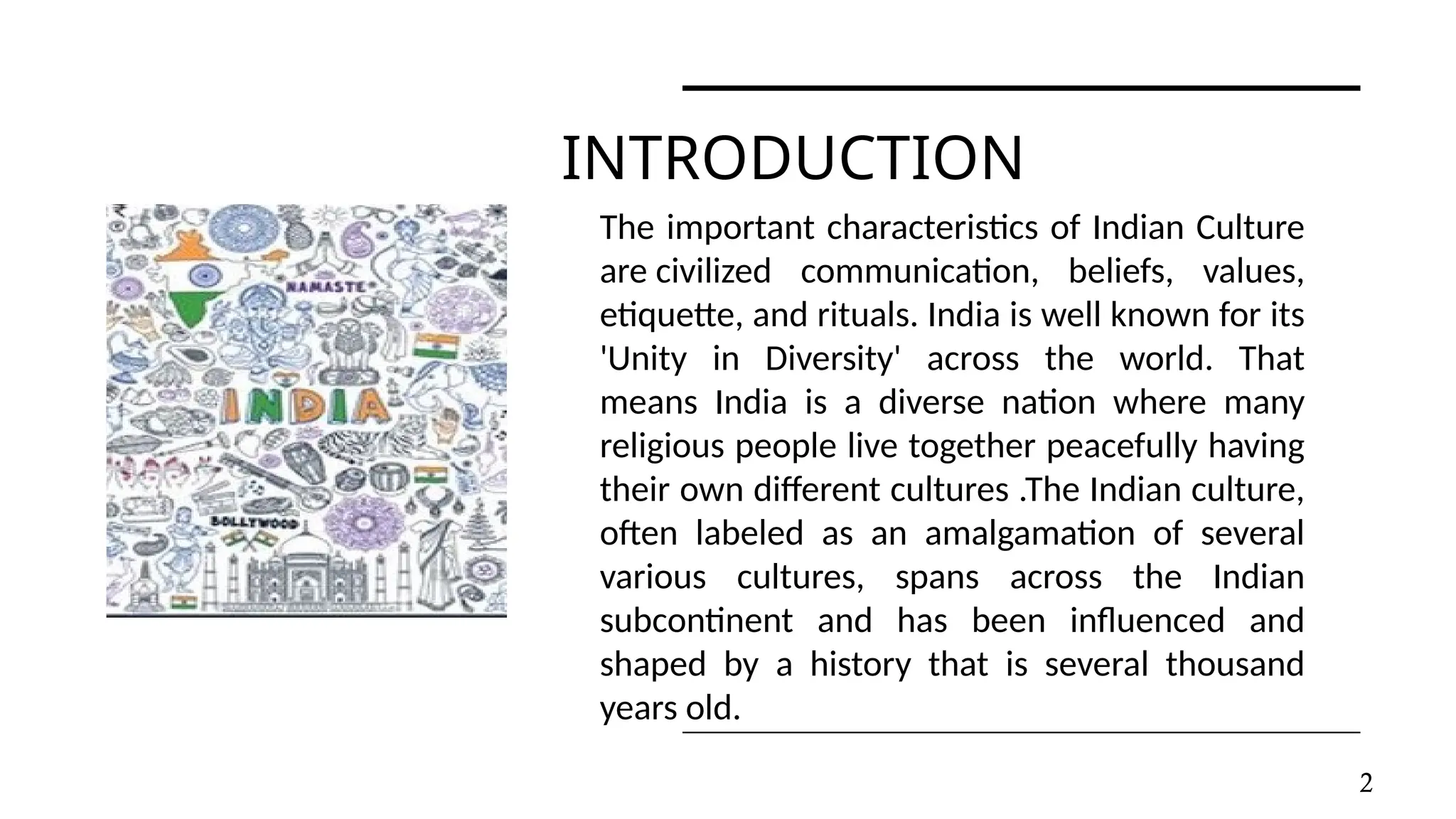
The important characteristics of Indian Culture
are civilized communication, beliefs, values,
etiquette, and rituals. India is well known for its
'Unity in Diversity' across the world. That
means India is a diverse nation where many
religious people live together peacefully having
their own different cultures .The Indian culture,
often labeled as an amalgamation of several
various cultures, spans across the Indian
subcontinent and has been influenced and
shaped by a history that is several thousand
years old.
PRESENTATION TITLE 3
1.ART AND LITERATURE
Art is an expression of creativity and imagination. It
is also a relationship between the artist and the
audience. Literature is art that shares a story and
develops a theme for the audience. While it can
stand alone as a form of art, it also is closely related
to other art forms.Culture includes the elements
that characterize a particular peoples' way of life.
2.Historical Heritage:
History and heritage are two words that always
go together. History is the study of the past and
heritage refers to valued objects and qualities
such as historic buildings and traditions that
have been passed down from previous
generations.Not all heritages of past generations
are "heritage"; rather, heritage is a product of
selection by society.
3.MUSIC AND DANCE:
•Dance in India comprises numerous styles of
dances. Generally classified as classical or folk. As with
other aspects of Indian Culture, different forms of dances
originated in different parts of India, developed according
to the local traditions and also imbibed elements from other
parts of the country. Folk dances are numerous in number
and style and vary according to the local tradition of the
respective state, ethnic, or geographic region. Dance and
music are few of the oldest part of the traditions of the
ancient India.
5
6
4.Traditional Clothing:
Clothing in India varies with the different
ethnicities, geography, climate, and cultural
traditions of the people of each region of India.
Historically, clothing has evolved from simple
garments to rituals and urban areas, western
clothing is common and uniformly worn by
people of all social levels. India also has a great
diversity in terms of weaves, fibers, colors, and
the material of clothing. Sometimes, color
codes are followed in clothing based on the
religion and ritual concerned
5.Language Diversity:
Language diversity, or linguistic diversity, is a broad
term used to describe the differences between
different languages and the ways that people
communicate with each other. Language is one of
the features of humanity that sets the species apart
from others on Earth, as far as scientists are aware.
Language offers new insights into our history,
cultural differences, migration, and the way in
which our brain processes information.
THANK YOU
8

india culture.ppt.pptx.presentation.pptx

  • 1.
    "INDIAN CULTURE" Presented By K.CHANDANNA 23P61A6252[CSC-A] Presented To Mrs. Joy Naomi
  • 2.
    INTRODUCTION PRESENTATION TITLE 2 Theimportant characteristics of Indian Culture are civilized communication, beliefs, values, etiquette, and rituals. India is well known for its 'Unity in Diversity' across the world. That means India is a diverse nation where many religious people live together peacefully having their own different cultures .The Indian culture, often labeled as an amalgamation of several various cultures, spans across the Indian subcontinent and has been influenced and shaped by a history that is several thousand years old.
  • 3.
    PRESENTATION TITLE 3 1.ARTAND LITERATURE Art is an expression of creativity and imagination. It is also a relationship between the artist and the audience. Literature is art that shares a story and develops a theme for the audience. While it can stand alone as a form of art, it also is closely related to other art forms.Culture includes the elements that characterize a particular peoples' way of life.
  • 4.
    2.Historical Heritage: History andheritage are two words that always go together. History is the study of the past and heritage refers to valued objects and qualities such as historic buildings and traditions that have been passed down from previous generations.Not all heritages of past generations are "heritage"; rather, heritage is a product of selection by society.
  • 5.
    3.MUSIC AND DANCE: •Dancein India comprises numerous styles of dances. Generally classified as classical or folk. As with other aspects of Indian Culture, different forms of dances originated in different parts of India, developed according to the local traditions and also imbibed elements from other parts of the country. Folk dances are numerous in number and style and vary according to the local tradition of the respective state, ethnic, or geographic region. Dance and music are few of the oldest part of the traditions of the ancient India. 5
  • 6.
    6 4.Traditional Clothing: Clothing inIndia varies with the different ethnicities, geography, climate, and cultural traditions of the people of each region of India. Historically, clothing has evolved from simple garments to rituals and urban areas, western clothing is common and uniformly worn by people of all social levels. India also has a great diversity in terms of weaves, fibers, colors, and the material of clothing. Sometimes, color codes are followed in clothing based on the religion and ritual concerned
  • 7.
    5.Language Diversity: Language diversity,or linguistic diversity, is a broad term used to describe the differences between different languages and the ways that people communicate with each other. Language is one of the features of humanity that sets the species apart from others on Earth, as far as scientists are aware. Language offers new insights into our history, cultural differences, migration, and the way in which our brain processes information.
  • 8.